

Bovine lactotransferrin plays a crucial role in modulating the immune response. It regulates the immune system through multiple pathways, including the promotion of immune cell proliferation and differentiation, as well as the enhancement of phagocytic activities of macrophages and neutrophils. Recent investigations have demonstrated that lactotransferrin influences the expression of immune-related genes in bovine mammary epithelial cells, thereby augmenting the mammary gland’s resistance to pathogenic challenges. Additionally, lactotransferrin inhibits bacterial growth by sequestering iron ions, thus restricting bacterial access to this essential nutrient (Arnold et al., Reference Arnold, Russell, Champion, Gauthier and Landgraf2011). Emerging research indicates that lactotransferrin can also directly interact with bacterial cell membranes, compromising membrane integrity and inducing bacterial cell death. In the context of mastitis prevention and treatment, the exogenous administration of lactotransferrin has been shown to significantly reduce bacterial load within the bovine mammary gland, mitigate inflammatory responses, and facilitate the repair of mammary tissue. Although lactotransferrin is regarded as a potential health promoter for calves due to its immunomodulatory properties, research indicates that, as a short-term adjunct therapy for diarrhoea, it does not significantly improve long-term survival or health outcomes in calves (Pempek et al., Reference Pempek, Watkins, Bruner and Habing2019). This suggests existing treatment strategies may compromise their efficacy on the farm or be contingent upon specific management environments. During the production process, cows encounter numerous oxidative stress challenges, and lactotransferrin has been identified as having a beneficial role in mitigating oxidative stress. It effectively neutralises excessive free radicals within the body, thereby reducing oxidative damage (Brock, Reference Brock2002). Under conditions of heat stress, lactotransferrin supplementation has been shown to decrease oxidative stress biomarkers in bovine blood, consequently enhancing both production performance and overall health status.
In recent years, substantial advancements have been achieved in the investigation of the effects of bovine lactotransferrin on human physiology. Research indicates that bovine lactotransferrin possesses several critical physiological functions. It exhibits antibacterial properties, has the capability to bind iron ions, and restricts bacterial access to iron, thereby inhibiting the growth of various bacteria (Arnold et al., Reference Arnold, Russell, Champion, Gauthier and Landgraf2011). Notably, it demonstrates exceptional antiviral efficacy by preventing viral attachment to host cells and subsequent replication within cells (Wakabayashi et al., Reference Wakabayashi, Oda, Yamauchi and Abe2014). In murine models infected with the influenza virus, oral administration of lactotransferrin resulted in a reduction of lung consolidation scores and a decrease in the number of infiltrating white blood cells in bronchoalveolar lavage fluid (Yamauchi et al., Reference Yamauchi, Wakabayashi, Shin and Takase2006). Furthermore, lactotransferrin plays a role in modulating the immune system by enhancing immune cell activity, promoting the proliferation and differentiation of immune cells, and ultimately improving overall immunity (Iyer and Lönnerdal, Reference Iyer and Lönnerdal1993). Bovine lactotransferrin has been shown to modulate both the intestinal and systemic immune systems by activating the transcription of key immune-related genes (Yamauchi et al., Reference Yamauchi, Wakabayashi, Shin and Takase2006). Furthermore, it facilitates intestinal development, preserves the integrity of the intestinal mucosa, and maintains the balance of intestinal microbiota by suppressing the proliferation of pathogenic bacteria while promoting the growth of beneficial bacteria (Superti, Reference Superti2020). Additionally, bovine lactotransferrin significantly enhances iron absorption by binding with iron to form compounds that are readily absorbed, thereby improving the rate of iron uptake and aiding in the prevention of iron deficiency anaemia (Iyer and Lönnerdal, Reference Iyer and Lönnerdal1993).
Research has demonstrated a significant association between single nucleotide polymorphisms (SNPs) in the lactotransferrin gene and the susceptibility to mastitis in dairy cows. Specifically, multiple SNP loci have been identified in the exon and adjacent intron regions of the bovine lactotransferrin gene, with variations at these loci potentially serving as genetic markers influencing bovine mastitis (Li et al., Reference Li, Zhang, Sun and Li2004; Shan and Yizhen, Reference Shan and Yizhen2016). Furthermore, SNPs located in the promoter region may act as molecular markers for resistance to latent mastitis (Moncada-Laínez et al., Reference Moncada-Laínez, Valladares-Medina, Castillo, De la Rosa-reyna, Sifuentes-Rincón, Moreno-Medina, Lara-Rivera and Parra-Bracamonte2023). Additional studies suggest that SNPs in the promoter region of lactotransferrin genes can modify the binding sites or affinities of transcription factors, thus regulating the transcriptional activity of these genes (Bahar et al., Reference Bahar, O'Halloran, Callanan, McParland, Giblin and Sweeney2011). This regulatory mechanism may aid in the identification of genetically superior dairy cows with enhanced lactotransferrin content in milk. Investigating the association between SNPs within the promoter region of the lactotransferrin gene and its expression can elucidate the molecular mechanisms governing lactotransferrin expression. This research provides a theoretical foundation for the genetic enhancement of dairy cattle. By examining these SNPs, it is possible to identify genotypes associated with elevated lactotransferrin expression, which can be utilized in dairy cattle breeding programs. This approach aims to increase lactotransferrin content in milk, thereby augmenting its nutritional value and health benefits.
Materials and methods
Animal samples and the ethics statement
Blood and milk samples were collected from 301 Chinese Holstein cows selected from Shandong Shijie Livestock Co., Ltd.’s standardized dairy farm. The cows were uniformly aged 3.0–3.5 years and were in the same lactation period. Information on individual milk yield and total bacterial count was not available; however, the farm’s standardized management system ensured consistent production and health status across all cows. All experimental procedures involving the animals received ethical approval from the Institutional Animal Care and Use Committee of the Institute of Animal Science and Veterinary Medicine, Shandong Academy of Agricultural Sciences (Approval No. IACC20060101).
Identification of SNPs in the LTF gene
Primers (forward primer, 5’-GAGGATAACTGTGCTTT-3’; reverse primer, 5’-CGAGCCCGGATATATCCT-3’, product size = 2867 bp) were designed for the 5-terminal flanking region sequence of the bovine LTF gene (ENSBTAT00000104391.1). Direct blood PCR kit (TransDirect® Blood PCR Kit, AD401) was used for PCR amplification of cow blood. The sequencing results were analysed using SeqMan and SnapGene software to identify SNPs within the LTF promoter region.
Detection of lactotransferrin content
This enzyme-linked immunosorbent assay (ELISA) (Cat. No. E11-126, Bethyl Laboratories, Inc.) was used to detect milk lactotransferrin according to the manufacturer’s instructions. Briefly, this sandwich ELISA quantifies bovine lactotransferrin by capturing the antigen with an anti-bovine lactotransferrin antibody coated on microtiter wells. After washing to remove unbound components, a biotinylated detection antibody was added, followed by streptavidin-conjugated horseradish peroxidase (SA-HRP). Colour development was achieved using tetramethylbenzidine (TMB) substrate and stopped with sulfuric acid, producing a yellow end product. Absorbance was measured at 450 nm. For each animal, samples were analysed in triplicate, and the mean absorbance value was used for quantification. Lactotransferrin concentrations were calculated using a four-parameter logistic standard curve and adjusted for sample dilution factors.
Plasmid constructs of different genotypes
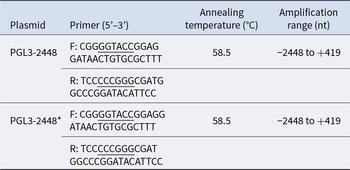
Specific primers (Table 1) were designed to amplify five flanking regions of the LTF gene, encompassing various genotypes, with sequence positions ranging from g. −2448 to g. +419. The PCR was conducted in a 20 μL reaction volume, comprising 0.4 μL each of forward and reverse primers, 10 μL of Trans Direct PCR Super Mix, 1 μL of template DNA, and 8.2 μL of double-distilled water (ddH2O). The thermal cycling conditions were as follows: initial denaturation at 94°C for 5 minutes, followed by 35 cycles of denaturation at 94°C for 30 seconds, annealing at 58.5°C for 30 seconds, and extension at 72°C for 3 minutes, with a final extension step at 72°C for 10 minutes. The amplified PCR products were subsequently digested with KpnI and SmaI restriction enzymes and ligated into PGL3 basic vectors (Promega), resulting in constructs designated as PGL3-2448 and PGL3-2448*.
Plasmid constructs with different LTF genotypes

Note: The positions indicated by the underlines are restriction enzyme cutting sites.
KpnI: CGGGGTACC, SmaI: TCCCCCGGG.
Cell transfection
Human epithelial kidney 293 T (HEK293T) cells were cultured in Dulbecco’s Modified Eagle Medium (DMEM) supplemented with 10% foetal bovine serum (FBS), 100 units/L penicillin, and 100 mg/L streptomycin, maintained at 37°C in an atmosphere of 5% carbon dioxide. Twenty-four hours prior to transfection, the cells were transferred to a 24-well culture plate to achieve a confluency of 70–80% at the time of transfection. To assess the promoter activity of variously sized fragments in the LTF flank region, OPTI-MEM® I medium (Invitrogen) and Lipofectamine 2000 (Invitrogen) were employed to co-transfect 0.5 micrograms of each luciferase reporter plasmid along with 50 nanograms of the internal control pRL-TK plasmid (Promega) into the cells, following the manufacturer's instructions. Five hours post-transfection, the original culture medium was replaced with DMEM containing foetal bovine serum. Forty-eight hours after transfection, the cells were lysed and collected using lysis buffer (Promega). According to the manufacturer’s protocol, the dual luciferase reporter assay system (Promega) was employed to evaluate the expression of reporter genes. The transfection efficiency of firefly luciferase activity was normalized against the activity of Renilla luciferase. The pGL3-basic vector served as a negative control. Each vector transfection was conducted in triplicate.
Statistical analysis
The experimental data are expressed as mean ± standard deviation (mean ± SD) and were analysed utilizing SPSS statistical software. Comparisons among multiple groups were performed using one-way analysis of variance (ANOVA), whereas comparisons between two groups were conducted using an independent samples t-test. A P-value of less than 0.01 was considered indicative of a statistically significant difference.
Results
Identification of functional SNPs in the 5’ flanking region of the LTF gene
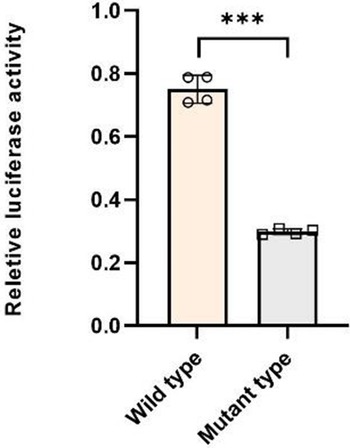
The 5’ flanking region fragment, approximately 2.5 kbp in length, of the LTF gene was amplified, and the resulting PCR product was directly sequenced. This analysis led to the identification of two novel SNP sites, designated as g.-1872C > T and g.-2132C > T (Figure 1). To investigate the impact of these SNPs on the transcriptional activity of the LTF gene, sequences containing the SNPs both pre- and post-mutation were cloned into the PGL3-Basic vector, yielding constructs named PGL3-2448 (wild type) and PGL3-2448* (mutant type), respectively. These recombinant vectors were subsequently transfected into 293 T cells, and their activities were assessed using the dual luciferase reporter assay. The results indicated that the transcriptional activity of the mutant construct PGL3-2448* was significantly reduced compared to that of the wild-type PGL3-2448 (P < 0.01) (Figure 2). Jaspar (https://jaspar.elixir.no/) was used to analyse whether SNPs change the putative transcription factor binding sites. The results showed that the g.-2132C > T mutation created an NR2F1 transcription factor binding site, and the other g.-1872C > T mutation created an NFIC binding site. Fig. S1 shows this result in more detail.
LTF gene structure and SNP locus diagram.

The mutation resulted in a decrease of LTF promoter activity.

Association analysis between SNPs and LTF content
To examine the potential association between two SNPs and LTF content, genotyping of the LTF gene was conducted in a cohort of 301 cows, followed by a genetic association analysis correlating these genotypes with the respective LTF content in milk, as detailed in Table 2. The analysis revealed that milk from cows with the wild-type genotype exhibited significantly higher LTF content compared to milk from cows with the muted genotype (P < 0.05).
Association analysis of different genotypes and LTF content in Chinese Holstein cows

Note: Different letters above the same column indicate significant differences (P < 0.05); the same letter above the column or no letter indicates no significant difference (P > 0.05).
Discussion
Lactotransferrin is integral to immune regulation, antibacterial activity and iron absorption in dairy cows. Elevated lactotransferrin expression levels may enhance the immunity of dairy cows, reduce disease incidence, and positively influence milk quality and nutritional value by augmenting its antibacterial properties and increasing iron content. Consequently, alterations in lactotransferrin expression due to SNPs in the promoter region may impact the production performance and health of dairy cows.
The two SNPs identified within the promoter region in this study, which are associated with the expression levels of lactotransferrin, may influence the binding of transcription factors to the promoter region through various mechanisms, thereby modulating gene expression. Mutations at these SNP sites may directly alter the binding affinity of transcription factors, either facilitating or hindering their ability to bind to the promoters, thus potentially enhancing or diminishing the efficiency of transcription initiation. Two completely linked SNPs (g.-2132C > T, g.-1872C > T) were found by amplifying the 5'flanking region of the bovine LTF gene, and the transcriptional activity was degraded by about 57.1% after mutation. In these two completely linked SNPs, the g.-2132C > T mutation created a putative NR2F1 transcription factor binding site. Studies have shown that NR2F1 can bind to specific elements in the gene promoter, resulting in a decrease in the transcriptional activity of the promoter, thereby affecting gene expression (Dai et al., Reference Dai, Khatun and Hussain2010); Moreover, the g.-1872C > T mutation formed a putative NFIC transcription factor binding site, which, interestingly, binds to the promoter region to negatively regulate gene expression (Shi et al., Reference Shi, Chen, Liu, Fu, Guo, Gao, Wang, Dou, Wang, Wu, Yu and Yu2024). Nevertheless, while predictions were made regarding the influence of certain SNP loci on transcription factor binding, additional experimental validation, such as Electrophoretic Mobility Shift Assay (EMSA) or Chromatin Immunoprecipitation (ChIP), is required to confirm the actual binding of transcription factors to the promoter region. This further investigation is essential to elucidate the molecular mechanisms by which SNPs regulate lactotransferrin.
Conclusions
While this study provides preliminary insights into the role of SNPs in the LTF promoter region, several limitations must be acknowledged. Firstly, other regulatory regions of the gene, such as enhancers and introns, as well as epigenetic modifications, may also influence lactotransferrin expression in conjunction with SNPs in the promoter region. Secondly, the study was conducted on a limited number of cattle populations, potentially affecting the generalizability of the findings. Future research should aim to expand the sample size and include a broader range of breeds and cattle from diverse geographical regions to enhance the reliability and universality of the results. Furthermore, future investigations should comprehensively explore the regulatory elements and functional variations of the lactotransferrin gene to provide a more robust theoretical foundation for molecular breeding in cattle.
Supplementary material
The supplementary material for this article can be found at https://doi.org/10.1017/S0022029925101933.
Acknowledgements
This study was supported by the Biological Breeding-Major Projects in National Science and Technology (2023ZD04049), National Key Research and Development Program of China (2021YFF1000700), Shandong Agricultural Elite Variety Project (2022LZGC012, 2021LZG011), National Natural Science Foundation of China (32272854, 32202677) and Agricultural Scientific and Technological Innovation Project of Shandong Academy of Agricultural Sciences (CXGC2025F09).
Competing interests
The authors declare no competing financial and non-financial interests.
Author contributions
J.M.H., X.J.Z. and X.G.W. conceived and designed the experiments. X.G.W. and M.L.Z. conducted the computational analyses. Y.R.Z., W.J.Z., Q.K.L., J.B.L., Z.H.J., Q.J. and Y.X. performed experiments. Y.P.G., C.H.Y. and J.P.W. collected samples and prepared materials. The manuscript was written by X.G.W. and M.L.Z. All the authors read and approved the manuscript.
Ethical statement
No ethical approval was required because this study did not involve animal subjects. Only data processing was done during the work.




 Open access

