

Was the Ottoman Empire's demise caused externally or internally? Was it owed to war or homegrown nationalism? Three concepts can help us navigate this puzzle: reluctant nationalists, imperial nation-state, and neo-Ottomanism. Together they provide a conceptual framework for understanding the end of the empire as a liminal space of contradictions. They also bring into sharper focus the forces that impinged on the empire to bring it down.
The framework presented here tells us that neither war nor nationalism operated in isolation as exogenous and endogenous factors. It was their interaction that proved explosive and it is that nexus which should be the object of our attention. The Young Turks turned to nationalism to deal with their fears of impending wars and prospects of disintegration. Their recourse to nationalism resulted in unpopular policies whose implementation caused unprecedented conflict with Albanians and galvanized nationalistic activities among them. Disorders and Albanian nationalism both influenced the outbreak of the Balkan Wars, and without the Balkan Wars in the background it was unlikely that the Ottomans would have joined the Great War. In short, nationalism was shaped by fears of disintegration in war, and the policies it compelled hastened the outbreak of Balkan Wars that in turn further intensified nationalism. These developments influenced the Ottoman decision to enter the Great War and to do so as a German ally (Aksakal Reference Aksakal2010). The outcome proved disastrous.
This conflict may have broader implications. After a century of debate on the causes of World War I, attention has turned to the Balkan Wars as a probable cause. For long the enormity of the Great War overwhelmed the memory of the Balkan Wars but lately the idea of the Great War as the Third Balkan War has gained traction (Clark Reference Clark2012; Hall Reference Hall2000; Remak Reference Remak1971). Taking into account the connection between the wars, their centrality for the creation of the modern-day Balkans and the Middle East, and their continuing relevance for ethnic conflicts in the former Ottoman lands, a closer investigation of the causes of the Balkan Wars within the Ottoman context is called for.
July 1908 witnessed the Young Turks revolution and inauguration of the second constitutional era in the Ottoman history. The Young Turk revolutionaries, or more accurately the Committee of Union and Progress (CUP), led an uprising in Macedonia that forced the reopening of the Chamber of Deputies after 30 years and ultimately brought to power the ultramodernist officers and civil bureaucrats. The CUP introduced broad and radical changes, and promised unity among the diverse Ottoman elements, or ethnoreligious groups. Contrary to the revolution's lofty goal of unifying the Ottoman elements, Albanian revolts soon started in March 1909 and continued unabated until the fall of 1912. In October 8, 1912, Montenegro crossed into imperial borderlands and the rest of the Balkan League followed suit. In less than eight weeks Albania declared its status as a new sovereign nation on November 28, 1912, to be internationally recognized on July 29, 1913.
The claim that the 1908 revolution, emergence of nationalism, anti-CUP revolts, and Balkan Wars were interconnected has broad theoretical and historiographic implications, among which is their possible influence on the outbreak of the Great War. The emergence of Turkish and other ethnic nationalisms at the end of the empire has been a tangled issue of late Ottoman history: Some blame all that went wrong on the extreme Turkish chauvinism of the CUP while others dismiss the charge and maintain that it remained Ottomanist until the very end. Here I contend that we need to transcend both views through a better understanding of nationalism in the late Ottoman period by considering the emergence of neo-Ottomanism, an ideal that was Turkish nationalist and Ottomanist at the same time. Furthermore, the context of the end of the empire produced leaders, at least among the Muslim publics, who may be characterized as reluctant nationalists, a depiction that better captures the Turkish, Albanian, and Arab attitudes before the breakup.
Emergence of nationalism at the center is only one component of the larger transition toward the nation-state. As has been said repeatedly, the CUP leaders in power were centralizers, but one should add, not mere centralizers. The CUP ranks were modernist centralizers. They detested the heterogeneity of the traditional empire and drew clear distinctions between the empire and the modern nation-state they set out to construct. That made nationalism only part of the larger transition away from a traditional empire toward their hoped-for imperial nation-state. Thus, the Young Turks were Ottomanist but also Turkist. They were revolutionary nationalists, but reluctant ones. And here was their last dilemma: They wanted to preserve the empire, but one that resembled a nation-state—more integrated, more homogeneous, and inline. This vision concerned not only the identity of the empire's publics, but more broadly, all its institutions.
What follows will make little sense unless we come to terms with the reason why the CUP staged a revolution. The CUP cadres styled themselves as the saviors of an empire on the brink of collapse. The revolution wrested away the reins of the state from an old guard that was depicted as incapable of showing the way out of the impasse of the traditional empire, and placed it into the hands of the revolutionary officers, bureaucrats, intelligentsia, or in short, the newly emerging Westernized middle class, with the avowed mission to regenerate a failing empire through a radical turnaround.
The picture here clashes sharply with the recent antidecline attitude of Ottoman studies, and particularly with its uncritical extension to the nineteenth century. Partly by dismissing as derogatory the notion of “sick man of Europe” originating from Russia and partly by pointing to dynamic changes and signs of prosperity in many corners, the defenders of this thinking have convincingly argued against a near strawman: absolute decline. This is not the place to critically engage with a thinking that manages to rescue the empire by casting aside its enormous geopolitical and internal challenges, or to highlight its inattention to the comparative context and failure to consider decline not in absolute but relative terms. Suffice it to say that the CUP also despised the appellation the “sick man of Europe” for its beloved empire, yet not for being wildly inaccurate, but for sounding as if death was immanent and the empire beyond rescue. Nor did the CUP think the empire lacked dynamism or failed to progress. To the contrary, the prevailing dynamism and prosperity—the emerging middle class of the Young Turks was an important indication (Sohrabi Reference Sohrabi2011)—were understood as signs of the empire's potential. Yet, claims of the empire's internal health and chances of eternal longevity voiced by some today would have appeared astonishing to the CUP.
The Albanian revolts and their solidifying nationalism between the years 1909 to 1912 were reactions to the CUP endeavors to save the empire. Looking at their dynamics uncovers the CUP's attempt to implement its neo-Ottomanist outlook as part of the much broader transition to the imperial nation-state by the nationalists who unwittingly pushed the Albanians in the opposite direction. But the Albanian turn to nationalism remains equally incomprehensible without appreciating the Albanians’ geopolitical insecurities, and misgivings about the chances of the empire's long-term survival. Caught between the prospects of the empire's disintegration and the possibility of becoming victims of Balkan irredentism, they were hesitant to break away as a small budding nation, but also saw a need to assert their “nationhood” in the event. Their story has relevance for understanding this and other similar reactions like the Arab revolts, Arab nationalism, and demands for autonomy and independence.
Neo-Ottomanism of the CUP
Traditional historians and contemporary politicians of the former Ottoman territories celebrated their “national liberation” from the “Turkish yoke” in the closing years of the empire. They blamed the Young Turks’ ethnic chauvinism for the reactive Albanian and Arab “awakenings” that caused the empire's breakdown (e.g., Antonius Reference Antonius1939; Kemal Reference Kemal and Story1920; Skendi Reference Skendi1967; Zeine Reference Zeine1966). Yet, the supposed extreme romantic nationalism of the new rulers of the empire is never adequately explained on rational-historical or sociological grounds.
Against this view are the revisionists (or the increasingly orthodox view of recent years) who argue that it would have been irrational and self-defeating for the ruler of an empire to advocate nationalist policies in the context of a multiethnic empire. Nationalism at the center could only serve to strengthen the hands of peripheral nationalists and exacerbate centrifugal tendencies. Their logic leads them to conclude that the Young Turks avoided ethnonational policies altogether, or if they dallied in it briefly, it was weak, and out of political naiveté that soon corrected itself. As proof the revisionists point to the privileged position that Ottomanism and Islam occupied in the Young Turk political discourse. For these scholars (e.g., Ahmad Reference Ahmad2014; Anscombe Reference Anscombe2014; Dawn Reference Dawn1973, Reference Clark, Khalidi, Anderson, Muslih and Simon1991; Kayalı Reference Kayalı1997), the empire's breakdown had hardly anything to do with nationalism, but was owed to consecutive wars, events that abruptly partitioned to create new states. In this view Turkish, Arab, and Albanian nationalism are accidental by-products of the new territorial and population realties after the collapse of the multiethnic empire and not its cause. Conceding the strong-handed centralizing reach of the Young Turk regime, the revisionists argue that reactions to them were not strong enough to bring down the empire, nor should the nonideological, pragmatic content of the Young Turk centralization be confused with nationalism.
The implication is that without the contingency of wars—matters over which the Ottomans had no control—the empire would have continued to survive in embrace of its various religions and ethnicities, particularly the unswervingly loyal Muslim Ottomans. As such, searching and finding any semblance of nationalism in an earlier era is considered an anachronistic mistake of postimperial situations; the misguided or nationalist historians of the nation-state era, according to revisionists, because of their inability to break free from the nation's spell engage in retroactive projections into settings that were unaware and uncaring for the “modern” sensibilities of nationalism.
Here I take issue with both the traditionalists and the revisionists. Contrary to the revisionists, I argue that nationalism was indeed the cornerstone of Young Turk policies and integral to their centralization program. The empire confronted enormous security challenges in its closing years and faced external and internal legitimacy deficit (Deringil Reference Deringil1998). In the age of nation-state, the empires looked outdated, and no empire appeared as outdated in the European imagination or in the eyes of many of its subjects as the Ottoman Empire.
Acutely aware of the centrifugal forces that pulled away at the seams of the empire internally and security challenges internationally, the Young Turks employed nationalism instrumentally: It was aimed at their publics to create an integrative bond toward a cohesive citizenry, on the one hand, and, on the other hand, it was waved before the international system of states to garner greater legitimacy. Here they walked a fine line. Unwilling to give up on the empire and its variegated publics, they nonetheless felt the need to move toward the more unitary nation-state. The Young Turk policies were not irrational and whimsical ultranationalist undertakings as the traditionalists would have it. Theirs was a set of calculated and risky interventions that were at once centralizing and nationalistic aimed at preserving the empire.
Their brand of nationalism is better characterized as neo-Ottomanism and to fully understand its intellectual origins it is fitting to briefly revisit the father of Pan-Turkism, the brilliant Yusuf Akçura and his tripartite discussion of Ottmanism, Islamism, and Turkism. In 1904, Akçura famously advocated (1) abandoning Ottomanism as a failed state ideology of the Tanzimat era, (2) strengthening Turkish nationalism and Pan-Turkism, and (3) making Islam subservient to Turkism. Islam was thus not to be abandoned but used as an additional bond to strengthen Turkism and broaden its appeal by emphasizing a common religion.Footnote 1 Many have dismissed Akçura as a fringe intellectual whose Pan-Turkism never took hold. Despite marginality of Pan-Turkism, in my view Akçura's influence went far beyond. The impact was felt through his new vision and language of nationalism that depicted three identity layers as Weberian ideal types, identity layers that empirically did not exist in isolation, but whose articulation as three distinct orientations opened the way for the emergence of neo-Ottomanism. The implication was that the decision to accentuate any of the three identity alternatives called for a different policy path.
Akçura's contribution invited immediate responses, with one of the most interesting but also neglected replies coming from Ahmed Ferid.Footnote 2 The state should create an “Ottoman nation” first and foremost through assimilation, argued Ferid in 1904: “In the language of politics, assimilation (temsil) means making the inhabitants who are not part of the sovereign nationality (or dominant ethnicity, millet-i hakime) resemble it in religion, language, manners, and conscience. If it succeeds in this, the government finds under its rule a ‘single nation’ that is comprised of individuals who feel completely equal to one another with the same national and patriotic sentiments.”Footnote 3 This was a goal to be achieved on a case-by-case basis, stated Ferid. Religious assimilation, for example, was not to be directed toward “advanced” groups (e.g., Greeks); linguistic assimilation was sufficient to pave the way for increased interaction, commerce, a sense of unity, and natural assimilation in the future.
The state was to press severely against the dominated nations’ languages and literature, and prevent their spread, and through every means possible, especially schools, turn the state language into the common one, argued Ferid. Contrary to Akçura's claim, held Ferid, Tanzimat had not failed. It was assimilationist and tried to break the “government within the government,” a dismissive reference to the millets and their self-governing institutions. Tanzimat for Ferid had a clear goal and had made Turkish, through the Young Ottoman constitution (for him part of the Tanzimat), the official language of the state. Ferid ended his critique with a surprise. Once assimilation was complete with the help of Islam, they could stop calling it Ottomanism and speak of it as it really was: Turkism. Ferid's was a highly idiosyncratic interpretation of Tanzimat, to say the least, depicting Turkification as its primary goal. Nonetheless, his interpretation had elements of truth about Tanzimat's aim to break the barriers of the millet communities by introducing the modern state ideologies of Ottomanism, equality, and citizenship. These ultimately did lead to the transformation of traditional millet structures during Tanzimat but not in the direction intended. Instead, they ended by inadvertently strengthening particularistic national/ethnic bonds by handing more power to the secular members of the community at the expense of the millets’ traditional religious leadership and religion (Karpat Reference Karpat, Braude and Lewis1982). Clearly for Ferid the not-so-“advanced” groups that shared Islam as a common bond with the sovereign nationality, namely the Albanians, Arabs, and Kurds, had the highest potential for assimilation to Turkism.
The CUP opted for a milder version of Ferid's assimilationist stance and continued to be Ottomanist but turned Turkist at the same time. Was this a contradiction? Not for them because Turkism had a historic mission with the most to contribute to the full realization of Ottoman citizenship. This was to be achieved not through imposing the Turk's national mythology, historic memory, or religion on others, but through making its language, and to a lesser extent its culture, the common currency of the empire. Was Ottomanism of the CUP, Turkification under another name, as it was for Ferid? The answer is both yes and no. Yes, because Turkism now became the “ethnic core” (Smith Reference Smith1986, Reference Smith2000) of the Ottoman nation, and the CUP called for partial Turkification of all elements through language policy. No, because the CUP was far more willing—more willing than Ferid allowed or the CUP opponents claimed—to leave room for cultural, religious, and linguistic autonomy of others, given knowledge of Turkish.
Would neo-Ottomanism appear outrageous to citizens of a modern liberal nation-state? Considering the nation-states’ citizenship rules around the world, the demand was not unusual. The trouble with infusing Ottomanism with a solid Turkish core was its abruptness given the CUP's assumption that the empire was in its last throes. Even more problematic were the lengths to which it was willing to go in the face of overwhelming resistance, especially considering how little the empire had to offer in this identity bargain by way of immediate security and material gains.
The CUP thinking on nationalism was best expressed by Hüseyin Cahid, the chief editor of its semiofficial newspaper Tanin that commanded the widest readership at the time. After he and others raised the issue of Turks as the dominant ethnicity for several times in Tanin, only to backtrack disingenuously,Footnote 4 he finally came clean in mid-1909. Akçura and Ferid clearly resonated in Cahid's writings. Three forms of unity, one embedded within another, could save the country, claimed Cahid. At the center was Turkism, then came Islam, and finally Ottomanism, as the identity expanded to encompass a wider group to reach perfection. This was the unity of elements to which the CUP was dedicated, according to Cahid, and for further validation he turned to science and crystallization around a solid core: The fire of revolution had melted the Ottoman elements that could now reshape around the Turks.Footnote 5
“Let them accuse us of extreme nationalism or aspiration to Turkify other elements. In this country, we are still the most zealot and pure proponents of unity within the bounds of justice and equity” were his opening lines in defense of neo-Ottomanism. Rhetorically he asked if it were possible to Turkify other elements by forcing them to disremember their language, nationality, and religion? To this he answered that Turks like all of humanity were extremely attached to their nationality and left to them they would have Turkified all ethnicities within the Ottoman Empire without wasting a second. His belief that all other ethnicities would have done the same was justification enough for not concealing an all too natural a wish. Yet Cahid assured his audience that the Young Turks would never pursue such a path, though not because they were angels but because of the certainty about its impossibility. Instead he pondered out loud about other alternatives for making the government strong and securing its future with absolute certainty. His answer was that so long as it was necessary to have different languages, religions, and ethnicities in Turkey, they were to search for a common transcendent bond that tied them together and created a strong society, a unity that did not preclude variety.
Incessant ethnic conflict was an obstacle to progress and strength, related Cahid, and it was the fatherland's interest that had pushed the Young Turks in the direction of unity with others, elements whose languages, religions, and nationalities were respected. Certainly the largest share of the sacrifice belonged to the Young Turks, he added, as they pursued Ottomanism alone and were content with recognizing everyone simply as an Ottoman. But the sacrifice preserved for them two advantages: (1) Turkish as the official language and (2) Islam as the official religion of the state. Nothing else set the Young Turks apart from other elements. Was it beneficial for others to accept Ottomanism, he asked? Not if they desired their own state, wanted to join other states, or asked for autonomy on the way to independence.
Putting himself in the shoes of non-Turks, again he asked rhetorically, what should we do now? Continue to act as before and strive for the disintegration of this country, or give up our old ways and strengthen it? What if we did not change our ways? Maybe we will be colonized or turn into a small independent state in constant fear of others. At most, we'll become Greece, when in fact we could be part of a large dignified state.Footnote 6
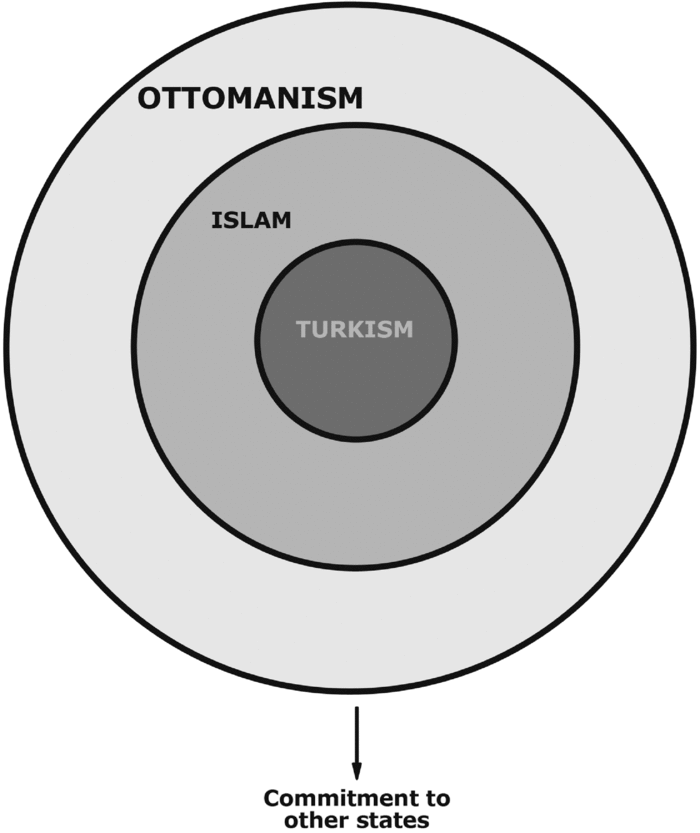
The CUP was certainly introducing its new vision of Ottomanism, one with Turkism at its ethnic core (figure 1). The multivocality of Ottomanism was on display here. When the CUP Ottomanist ideal made ethnicity the prime marker of distinction between citizens, what I have called neo-Ottomanism, it departed from the Ottomanism of Tanzimat that considered religious communities to be its building blocks (figure 2a). More glaringly, it set itself apart from the Islamist Ottomanism of the old regime that by placing Islam at its ideological core had tried to make it the ultimate integrative bond for its avowedly most loyal elements and suppress all talk of ethnicity (figure 2b).Footnote 7 The CUP, so far as can be gleaned from its own and other ideological organs, made distinctions among Ottoman elements, more trustful of some, more hopeful of the assimilation potential of others, or both (figure 2c).Footnote 8 The integrative potential of neo-Ottomanism, thought the CUP, solved the incessant ethnic conflict and strengthened the empire, ensuring its survival. More importantly, the neo-Ottomanism of the CUP was different from the liberal, cosmopolitan vision of Ottoman Liberals espoused after the revolution, around which rallied almost all non-Turkish elements and the Turkish Liberals. Absent in the liberal vision was an ethnic core, but in keeping with the time's spirit, the liberals gave priority to ethnicity over religion, also in distinction from the Tanzimat (figure 2d). The atmosphere of freedom for the duration of one year or so after the revolution witnessed the proliferation of ethnic-oriented clubs, societies, publications, plays, demonstrations, and all things imaginable to accelerate the ethnic identification trend begun in the mid-nineteenth century (Dermatossian Reference Der Matossian2014).
Neo-Ottomanism
Flowchart of multivocal Ottomanism: (a) Tanzimat Ottomanism, (b) Hamidian/Pan-Islam Ottomanism, (c) Young Turk/CUP neo-Ottomanism, and (d) federalist Ottomanism
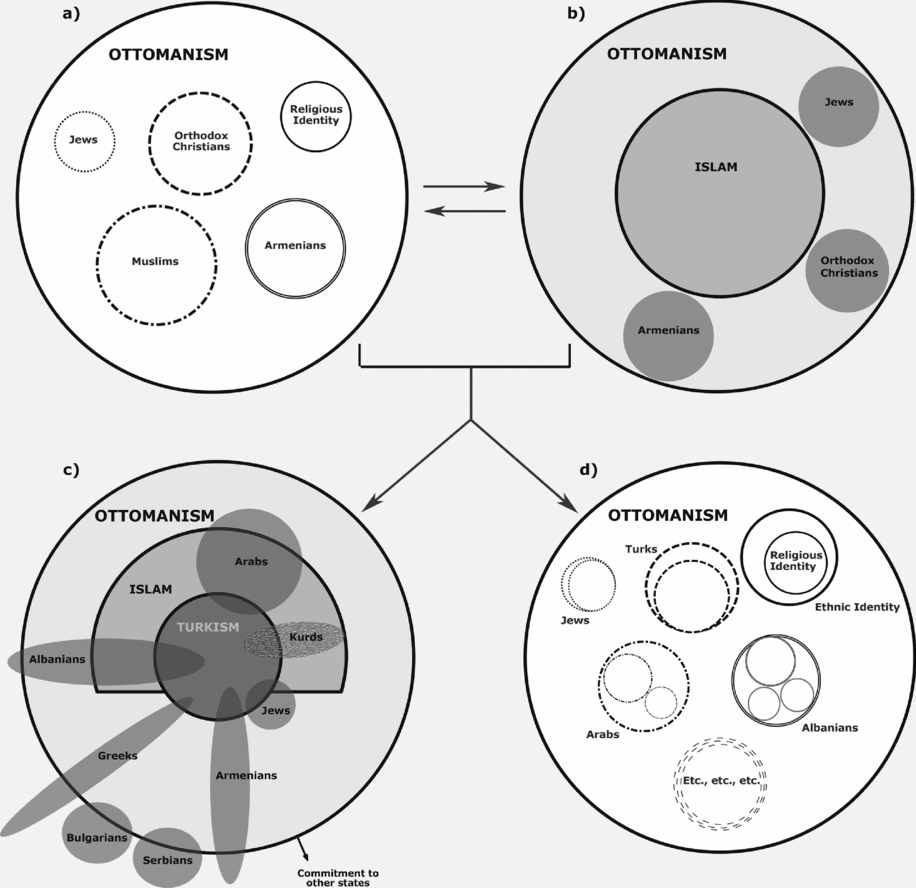
Neo-Ottomanism and Balkan identities

The identity politics of the CUP was part of a much broader transition away from a traditional empire toward a nation-state, or more accurately, toward an imperial nation-state. Traditional empires stood for institutional inequality and hierarchy. Making deals that were contextual, contingent, and varied was their modus operandi (Barkey Reference Barkey2008; Osterhammel Reference Osterhammel2014; Rodrigue Reference Rodrigue1995), deals that were maintained, reinforced, and institutionalized by the center. By contrast nation-states are keen on equality and uniformity. The CUP distinguished itself from the old regime by denouncing its policy of “pragmatic fixing” (idare-i maslahat) and the special pacts it had entered based on the circumstance. Instead, the CUP stood firmly behind administrative uniformity, equality of citizens, and centralization. In the CUP's eyes, the pacts accumulated and institutionalized over time were a heap of irrational, irregular arrangements that contradicted the ideal of equality espoused by the constitutional revolution.
The constitution supported by all in the days of the revolution was now used against many to eradicate traditional privileges in the name of equality before the law, and to threaten the very fabric of millet communities that, although transformed through time, had never been threatened with dissolution as they now were. The rationale was the disparities among the communities and the difference in privileges granted to one against another in violation of constitutional equality. The CUP now denigrated the millet institutions as “government within the government,” chiding their leaders for managing the communities’ political, legal, social, and day-to-day affairs beyond the spiritual realm to which it argued they ought to have been confined.Footnote 9 Equality thus required eradication of difference, and as millets were thought to be working against assimilation and realization of equality, they were to be radically reorganized.Footnote 10
As the brief consideration of the Albanians in the following text will show, the planned transition to the imperial nation-state shook the foundation of the empire as the changes demanded by the CUP brought strong reactions. The project of imperial nation-state and neo-Ottomanism put forward by the (reluctant) Turkish nationalists inadvertently transformed the Albanians from predominantly religious communities into a nascent ethnic one. The CUP tried to implement its centralizing policies with strong-handed tactics when in possession of a weak central state that could not guarantee geopolitical security or material improvements. As a result, it asked for too much when it could only deliver too little. Its policies unsettled Albania, fanned the flames of nationalism, and forced the center into a mild autonomy concession that hastened the outbreak of Balkan Wars. For revolutionary France it took more than a century to implement its nationalist vision of peasants into Frenchmen through state macropolicies and microincentives on the ground at a time when rapid economic growth made French identity attractive and enabled the state to mold the variegated identities in the countryside (Weber Reference Weber1976). The Young Turks centralizing policies by contrast were implemented in a much shorter time span in the midst of internal strife with irredentist neighbors looking on. If intrusive and abrupt macropolicies were at hand, the absence of microincentives such as immediate security or material gains made neo-Ottomanism unattractive. The CUP had set before itself a risky if not impossible task.
Albanian Reaction
The Albanian conflict was vital for bringing about the first Balkan War. The reason behind the conflict was the Ottomans state's attempt to implement its neo-Ottomanist vision on its way to create an imperial nation-state. The following provides concrete glimpses of implemented policies on the ground and the reactions they sparked, and highlights the reluctance in Turkish and Albanian nationalisms.
Albanians were a variegated group with tremendous regional differences. Settled, urban, educated, increasingly prosperous populations of the south (Tosks) contrasted sharply with the impoverished tribal mountaineers in the north (Gegs). Religious difference was a glaring aspect of the Albanian movement. Albanians were about 70 percent Muslim with significant Sunni-Bektashi divisions, against a Christian population with twice as many adherent to Orthodoxy concentrated in the south (20 percent) against Catholics in the north (10 percent). The figures do not do justice to the intermingling and hybridity of religion that existed between Muslims and Catholics. There were also linguistic differences between the Gegalık dialect of the north and the Toskalık dialect of the south, but more significantly, Albanian was written in three different scripts of Arabic, Latin, and Greek. As a population inhabiting a Zomia-like space, to invoke Scott (Reference Scott2009), the previously mentioned differences were only the major distinctions. This composition made for a weak “national” identity late in the nineteenth century.
Geopolitical insecurity was crucial in the development of the Albanian national movement. The disastrous Russo-Turkish war of 1877–78 first led to the signing of the Ayastefanos treaty that created autonomous Bulgaria and independent Serbia, Montenegro, and Romania. Territorially, the gains were modest for Serbia, massive for Bulgaria in absolute terms, and impressive for Montenegro in relative terms that grew three times its previous size. Britain and Austria, concerned about Russian expansionism, quickly organized the Berlin Congress in June 1878 that managed to soften the blow. It pushed back the borders of Bulgaria, now divided into a “privileged” principality and a province that formally remained tied to the Ottoman state, and substantially reduced the gains of Serbia and Montenegro but allowed their independence. Bosnia-Hercegovinia was occupied by Austria (including Yenipazar/Novi Pazar, returned in 1908) and became another “privileged” Ottoman province. Significantly, Macedonia was returned to Ottoman direct rule (Hall Reference Hall2000: 2–3, 7; Zürcher Reference Zürcher1993: 78–79). The initial gains and subsequent tempering, most profound for Bulgaria, kindled Balkan irredentism on all fronts. Bulgaria, Serbia, Greece, and Montenegro perceived the treaty “a barrier to their national aspirations . . . [and] strove to overcome the Berlin settlement and realize national unity” (Hall Reference Hall2000: 3).
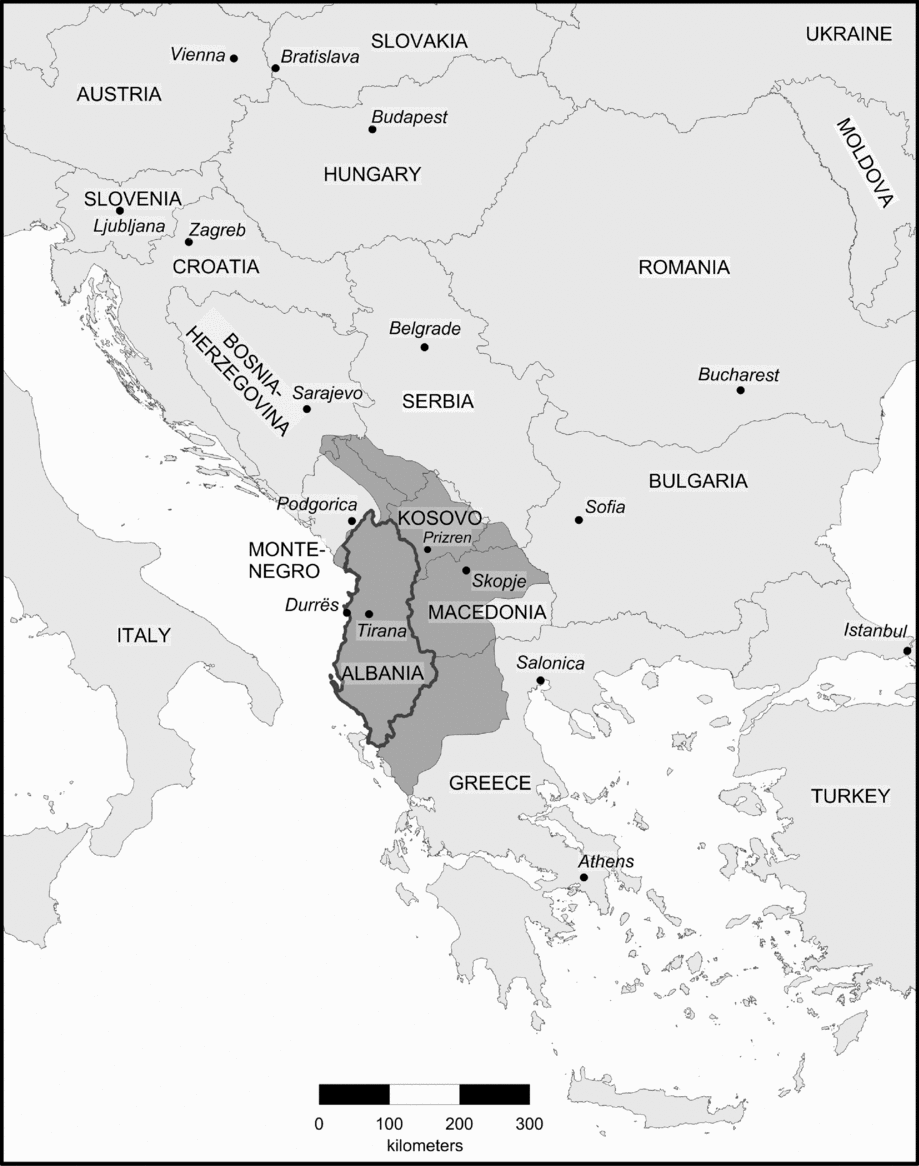
The Berlin Congress failed to recognize the Albanians as an “ethnographic entity” analogous to other Balkan populations. By simply acknowledging them as speakers of a language that inhabited a roughly defined Albania, it gave away parts of the Albanian-speaking regions and alerted the intelligentsia to the insecurities of their situation (Guy Reference Guy2012: 17–18, 22). The Prizren League was established by the intelligentsia in 1878 in response to the Berlin Congress, and as the first national movement among the Albanians it sought to bring ethnographic recognition to Albanians. The initial impetus for the development of Albanian national movement, therefore, was not a reaction against the Ottoman government, which in fact initially supported the Prizren League, but against the irredentism of the Balkan neighbors. We can get a sense of Albanian insecurities in 1908 graphically. When the territorial ambitions for Greater Bulgaria, Greece, Serbia, and Montenegro (demarcated in different shades of gray) are overlaid a small territory emerges whose size and absence of a major port (Duraç/Durres, occupied by Serbia in 1912) would have prevented the establishment of a viable Albanian state altogether (figures 4 and 5).Footnote 11
Balkan irredentism and Albania
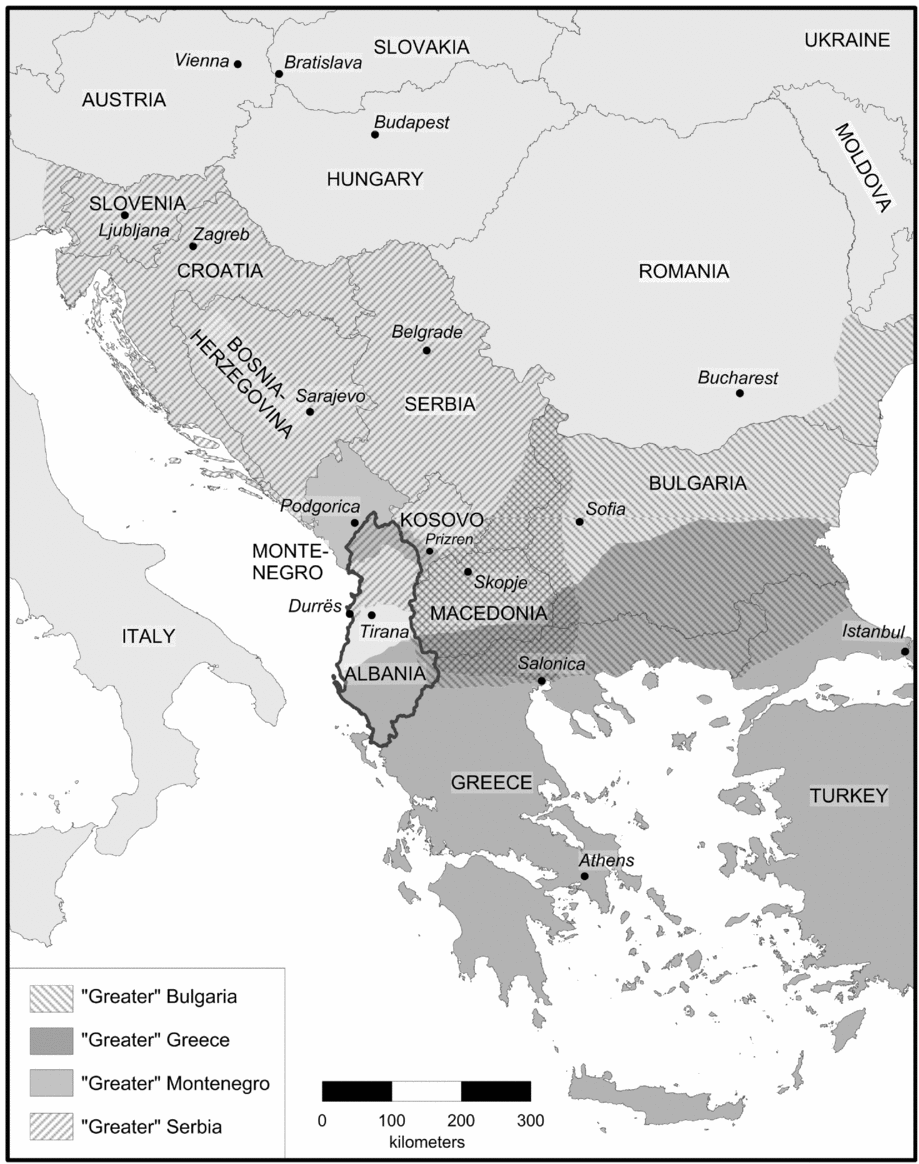
Projected Albania in view of irredentism of the Balkan neighbors

A top CUP leader such as Enver (Reference Paşa and Erdoğan Cengiz1991) sensed the Albanian dilemma caught between loyalty to the Ottomans and fear of neighbors. He differentiated Albanian nationalism (though in this case Muslim Albanians only) from the nationalism of Balkan Christians with the recognition that it did not originate in opposition to the Ottomans. Yet, he believed that Albanians like everyone else had a strong inkling that Macedonia was on the brink of collapse and planned to avert the prospect of becoming absorbed into this or that nation without a territory of their own.
Albania after the 1908 Revolution
The Albanians played a significant part in bringing about the 1908 revolution in Macedonia. Their Firzovik (Urosevic) gathering in July 1908 to protest the dangers directed from the Balkan neighbors, coincided with the mutiny of the Ottoman officers in the Macedonian countryside. The co-optation of the Albanian revolt by the CUP officers in return for future promises proved to be a turning point for the July revolution (Hanioğlu Reference Hanioğlu2001; Sohrabi Reference Sohrabi2011).
After the revolution,Footnote 12 the main Albanian constitutional society, the Bashkim (union) club, bore a name inspired by the CUP and an agenda almost identical to it, symbolized by shared physical space in some localities. But their ways soon parted with the recognition of different priorities. The makeup of the very young Bashkim club in Istanbul, for example, intently drew its mixed Muslim and Christian members from the four provinces of Kosovo, Manastir (Bitola), Yanya (Janina), and İşkodra (Scutari) to reflect its aspiration for the greater Albania (figure 6).Footnote 13
Greater Albania
As early as October 1908, the Albanians were anxious about a possible attack by the neighboring states with news of military preparations in Montenegro and Serbia (and to a lesser extent Greece). The news prompted the Bashkim club to call for a meeting of the Kosovars that drew together about 60 Albanian notables and representatives. These met in Seniçe on November 1, 1908, to express unease at recent developments and make defensive recommendations against military preparations by Montenegro and Serbia. After voicing unconditional loyalty to the Ottoman government and the constitution, the representatives requested government permission and assistance for the creation of a voluntary force of thirty thousand. Supplied with sufficient arms and ammunitions stored in special armories, the force was to be armed and mobilized alongside the army in time of need. Its promise to inform the local government and the CUP if and when the informal force was to be mobilized, expressed the alarming wish that it was to remain primarily under local Albanian control and not the Ottoman army. Until the force was established, the meeting asked for the formation of mixed battalions composed of volunteers and inactive reservists in the military centers to enable the Muslims and Christians to defend their beloved fatherland under military command against transgression of hostile governments, small or large.Footnote 14 The patriotic initiative, and the Christian-Muslim solidarity it exuded, was welcomed by the Kosovo military governor whose supportive report to superiors aimed at allaying Istanbul's suspicions of the initiative.Footnote 15
Beyond the Hamidian Pan-Islam, the old regime had made itself appealing to boisterous northern Albanian leaders (in İşkodra and Kosovo) by showering the region with many privileges. These included the right to bear arms, exemption from most taxes and military service, and informal arbitration of disputes through mountain laws and local customs. Even though officially unacknowledged, near autonomy was the rule in northern Albania. The local Muslim elite in the north felt particular affinity for the sultan and their loyalty was symbolically acknowledged through appointment of the palace special guards, or personal bodyguards of the sultan, in a special unit drawn exclusively from inhabitants of this region. These privileges were granted in return for loyalty, borderlands security that the Albanians helped a good deal in maintaining, while acting as a check on the Slavic speakers in the north and the activities of the Balkan neighbors.
When the government left northern Albania almost entirely on its own, the drawback, given the state's perennial financial crisis, was that it also did little by way of infrastructural work, schools, trade, agriculture, or industry. The few existing Muslim schools that were, were banned from teaching the Albanian language lest they nurtured national feelings. Native language instruction was allowed only in the Orthodox or Catholic schools in their respective alphabets. These restrictions turned into major grievances down the line.
After the revolution, the CUP disparaged the imperial conduct of the old regime as “pragmatic fixing” and denounced it for its heterogeneity, nonuniformity, unpredictability, and idiosyncrasy. In an abrupt shift of strategy the new Young Turk regime set out to abolish all previous privileges, special deals, and the delicate alliances with the local elite. Its mantra was its message of equality and uniformity. In more concrete terms over the course of 1908 to 1912, the government made classic state-building demands from the Albanians combined with assimilationist intent: conscription; sheep tax; land tax and surveys; population surveys; property tax and registration; city toll (oktruva); disarming all of Albania, which beyond involuntary collection of arms meant destruction or modifications of towers and houses to prevent their use as fortifications; abolition of mountain and local laws and the introduction of government courts; and, finally, Turkish as the official language of schools, administration, and courts.
Albanians resisted the disruptive changes to their daily lives. The intelligentsia's reaction went beyond resistance by emphasizing the Albanian language and using it to push back against the CUP's assimilationist posture, and making it a rallying symbol for uniting Albanians. After July 1908, the congresses became a major venue for pursuing that cause. These favorite sites for ethnic entrepreneurs were ahead of rebels on the ground in national aspiration. A choice topic was the alphabet question, as settling on a single alphabet—Latin—signified overcoming religious differences on the way to transcending all other distinctions. To cite one example, the Manastir Congress of April 1910 demanded autonomy, recognition of Albanian nationality, mandatory teaching of the Latin alphabet, Albanian as the official language of Albania, and the use of Albanian in all official transactions. It also asked that soldiers serve exclusively in Albanian units, and requested a greater role for local governing councils, the creation of a separate budget for Albania, and the assignment of a special governor for all four provinces.
Yet, divisions between north and south persisted. The Kosovar Muslims insisted on the Arabic script in deference to religion. The CUP acutely aware of the symbolic significance of the script and the north's religiosity exploited these divisions the best it could. It arranged Albanian congresses of its own, organized demonstrations, created Islamic propaganda commissions, and went so far as to secure a religious ruling (fetva) from the highest religious authority (Şeyhülislam) against the use of Latin script by the Muslim Albanians. This strategy was consistent with the CUP's broader aim of defining the Albanians exclusively as a Muslim public to reverse the tide of national/ethnic identification encouraged by the Albanian intelligentsia that percolated in the Ottoman Balkans. In this respect, the CUP's opportunism embarrassingly resembled Abdulhamid's Pan-Islam, a policy it had explicitly denounced for its noninclusiveness. Yet, even then the rhetorical privileging of Islam was pursued alongside assimilationist Turkism.
The CUP was quite concerned about the prospect of Albanian autonomy. It viewed federalism as a first step toward full-fledged independence and worried about its bandwagon effect on the Ottoman Balkan publics and the precedent it set for the Arabs and Armenians. Its answer was to unleash a repressive campaign throughout Albania from May 1909 that widened and grew harsher with time. The CUP knew that its strong-handed centralizing measures (including linguistic) were risky, but accepted them as the only way forward for the empire. The revolts that followed weakened the state, advertised it to the world, and intensified the calls for autonomy in Greater Albania. The neighbors saw an opportunity in Ottoman weakness, and alarm at the prospect of Albania's autonomy. Both factors strongly influenced the formation of the Balkan League (Report 1914: 47).
Between 1909 and1912, the government faced major revolts in the four Albanian-inhabited provinces. Like congresses the demands during revolts became more nationalist by which I mean autonomy seeking but not separatist. Gradually various factions converged, like the nationalist south and religious north, Southern Muslims and Christians, and eventually a broad coalition resulted that encompassed all. As any group in the making—an ethnic one in this case—the coalitions were not stable and factions wavered over time; sometimes solidly nationalist, at other times concerned with local issues alone, sometimes transcending the religious divide, and at other times exclusive to coreligionists.
The large-scale trends were as follows: Throughout the four years (1909–12) most rebellions took place in the north. Unlike congresses that had a nationalist flavor from the start, the 1909 small-scale rebellions in Kosovo had something of a conservative character and spoke in the language of religion aiming to restore lost or threatened privileges. Only gradually did the revolts become a collaborative effort between the rebellious north and the nationalist south. By 1911, Albania witnessed the emergence of a nationalist language in the north under the south's influence, putting forward demands for recognition of Albanian as the mother tongue and official language of the region, together with full-fledged demands for autonomy of the four provinces with an independent Albanian governor.
The year 1911 witnessed particularly intensive activity by the Christian Malisor. Arms smuggling from Montenegro and Italy, rebel refuge in Montenegro, and attacks on the Ottoman border posts were common. These helped to intensify the international dimension of the movement (Çelik Reference Çelik2004: 403–11). In June 1911, the highly prominent Ottoman statesman and parliamentarian, south Albanian Ismail Kemal, traveled with other Muslim Albanian leaders to Montenegro to meet the Malisor Albanian rebel leaders who had taken refuge there and refused to return. A thoroughgoing nationalist agreement was the outcome. On June 23, he and Luigj Gurakuqi, the principal Christian leader of the movement, issued the autonomy declaration known as the Red Book (or Gerche memorandum) with copies sent to Montenegro, the Great Powers, and the Ottoman government (ibid.: 419–27) in which they declared loyalty to the sultan and support for the constitution but referred to the CUP as a despotic regime. The Red Book's central demands were as follows: recognition of Albanian nationality with the same rights as other Ottoman elements; complete freedom for the selection of deputies, and proportional representation based on population statistics; education of Albanians in their own language in expanded private and public schools that received the same privileges and support as official schools; establishment of decentralized administration in the Albanian provinces; preference for the governor and other high officials fluent in the language and local culture; strict selection of other civil, financial, and judicial officials from among the Albanians and the selection of gendarmes and police from the locals; communication in the courts and between local officials and armed leaders in the Turkish official language, and in Albanian; acceptance of a military draft for all, but service in the Albanian territory during peace time; expenditure of all state revenue in the locality (with minor exceptions); complete right over the use of forests by the locality; and the right to audit the provincial budget and expenditures by the provincial councils (ibid.: 419–20).
After much back and forth, the government finally acceded to almost all the demands, but limited it to the Malisor of İşkodra alone and not the four provinces. This was consistent with the government strategy of dividing the movement and compartmentalizing its demands. At the end, some Malisor returned but the rebels did not quiet down on either side of the border.
A major international crisis in the autumn of 1911 further signaled the Ottoman weakness. Italy made an unprovoked attack on Libya that went without international outcry. This meant the empire was no longer protected by the terms of the Berlin treaty and Europe was not interested in preserving the status quo. Ottoman territories were open game. Added to the atmosphere of discontent was the “big stick election” that prevented the principal Albanian deputies and leaders of the movement from retaking their seats in the Ottoman parliament, prompting them to plan a general uprising.
The Final Agreement
The year 1912 witnessed the widest and most intense uprisings starting in March and April in Kosovo. The revolt of 1912 had several important theoretical and historical implications that deserve greater scrutiny. This year witnessed initially the greatest expansion of the coalition and radicalization through unmistakably autonomy-seeking calls by the Albanian movement as a whole. Ten weeks later, however, the ethnic coalition showed a sudden contraction, of both demands and composition, with the north placing a renewed emphasis on Islam. The pull back to Islam by the northerners indicated at first glance a break with the south and the non-Muslims. This change in demands in the last accord that came before the outbreak of war has led some to conclude that the Albanian movement was conservative, religious, and unconditionally loyal to the Ottomans; in short, not nationalist. My brief intervention here offers a more complex reading.
In that year, various pacts between Muslims and Christians, north and south, showed surprising convergence of demands, and thus the development of a fully enthnicized movement. On May 20, 1912, moderate and conservative northern Muslim leaders Hasan Priştine, Necip Draga, Yakovalı Rıza, Bayram Cur, and Isa Boletin issued a 12-point proclamation in the village of Junik. Based on the nationalist autonomy-seeking Red Book of 1911, the proclamation was not as detailed fiscally, but was even more forceful in emphasizing Albanian language, customs, traditions, and ethnicity. When the government rejected it once again, the uprising intensified in June and July. Reminiscent of the days of July revolution, Albanian officers in the Ottoman army particularly in the south, where participation had been more limited, began to defect to the mountains with soldiers under their command. In this, they were aided by a new opposition society of Savior Officers (Halaskaran) among the predominantly Turkish military officers who shared with Albanians anti-CUP sentiments, but not their autonomy-seeking goals. In July, several northern cities also fell to the rebels (Çelik Reference Çelik2004: 449–55).
The collaboration brought decisive victories. The Savior Officers managed first to force the government to resign and then the chamber to dissolve. On July 21, the government of Said Pasha was replaced with Gazi Muhtar Pasha's, marking victories for the Albanians, Savior Officers, and the newly established party, the Liberal Alliance. In a reconciliatory gesture, the new government sent out for the very first time a fact-finding reform commission headed by the Albanian General Ibrahim Pasha to investigate the Albanian grievances.
General Ibrahim Pasha traveled to the city of Priştine to meet with the northern Albanian Muslim rebel leaders. Following intense negotiations, on August 9, 1912 the rebels issued a surprisingly moderated demand known as the Priştine document signed by 50 leaders. The principal rebel negotiators had included Hasan Priştine, Isa Boletin, Yakovalı Rıza, the very same signatories to the far-reaching Junik agreement a mere 10 weeks earlier.
The 14-point program in short asked for the use of mountain laws (cebal kanunu) in locations where the state courts had failed in practice; military service in Rumelia with the exception of wartime mobilization and unusual circumstances; distribution of the most modern arms; appointment of experienced officials knowledgeable of local language and customs; establishment of lycees (sultani) and agricultural schools at Kosovo, Manastir, Yanya, and İşkodra provincial centers and the more populous subprovinces with Albanian language included in the curriculum; commercial, agricultural, infrastructural, and public works expansion; establishment of elementary, middle, and higher schools that taught the Albanian language; complete freedom in establishing private schools throughout Albania; establishment of subdistricts (nahiye)Footnote 16; establishment of religious schools; greater attention to the preservation of Islamic morals and traditions deemed as the foundation of the constitution; general amnesty for the rebellion participants including civil and military officials, gendarmes, soldiers, and freed prisoners regardless of ethnicity; and the trial of Hakkı and Said Pasha cabinets.Footnote 17
After four years, this was the first and last formal agreement between the government and the rebels that encompassed all four provinces. What the agreement contained and what it left out; what the government conceded to and rejected; and the circumstances before, during, and after the negotiations went a long way in shedding light on the peculiarities of the Albanian movement. As such it deserves our close attention. Even if all issues raised in the following text may not be answered within the confines of the present article, they shed light on the fluidity of the context.
The first question is why this greater conservatism when the Albanians were negotiating from a position of strength and when they had recently issued a thoroughgoing autonomy seeking document? What can the newly found conservatism tell us about the Albanian movement?
What made the Red Book and the Junik documents more ethnic and nationalist were the greater prominence accorded to Albanian language and schools; their explicit call for a decentralized administration and Albanian officials, backed by administrative and fiscal autonomy; and strong hints at military independence in the future. The Priştine document, however, read as something of a compromise between an ethnicist and autonomy-seeking movement and a traditionalist autonomy arrangement under Abdulhamid that privileged Muslims. The first tendency came through, albeit more modestly, with Priştine document's emphasis on Albanian language, schools, administrators, military service, and an explicit nationalist call for fixing of boundaries of the greater Albania, a first of its kind. It veered toward the traditional autonomy model with its emphasis on the mountain laws at the expense of state courts and guns for the public.Footnote 18 Furthermore, the Priştine document's emphasis on Islam also signaled a move away from inclusiveness toward Christian Albanians, and challenged the south and center's emphasis on ethnicity, but significantly avoided the divisive Arabic alphabet issue.
The apparent change in the Albanians’ stance; the internal record of communication between the government and its chief negotiator General Ibrahim Pasha; and the memoir of Hassan Priştine, the principal architect of the agreement, all show that the northern Albanian coalition was unstable. Some northerners had clearly backed away from the more ethnicist demands while others continued to echo the thoroughly nationalist south.
As an example of northern radicalism, Hasan Priştine, a chief architect of the 1912 uprising, presented in his memoirs the nationalist demands he had drawn up prior to meetings with the general,Footnote 19 but which he had been forced to moderate subsequently given the general's success in playing the Islamic card to divide the coalition. In this the general had succeeded to attract Yakovalı Rıza (whom Priştine called a religious fanatic), Isa Boletin, and some additional Kosovar leaders (Prishtina Reference Prishtina1921: 22–23). Yet, Rıza and Boletin went even further by threatening the general with an advance to Salonica in case their principal demand was not met (see following text). Their intent had been to free Sultan Abdulhamid (ibid.: 25), the symbol of Pan-Islam and the benefactor of Albanian favors who was held under house arrest in Salonica after dethronement. This suggestion revealed a restorationist zeal that harked back to the “pragmatic fixing” days of the old regime when the region was left to its own under the mastery of Muslim tribal leaders. It was such sentiments that had found their way into the Priştine agreement. That Isa Boletin had been the head of the sultan's personal bodyguards for decades until the 1908 revolution obviously had something to do with it. The threat was taken quite seriously by the general and by the Albanian coalition members like Priştine, who all tried to avert the possibility at all costs in their own way.
The government was obviously enthusiastic with the moderated autonomy given its immediate acceptance of 12 of the 14 demands after minor modification and communication back to the general by the next day (August 10).Footnote 20 Of the two remaining clauses, it was able to easily maneuver around the call for trial of the prior prime ministers and cabinets as matters that were better left to the legislature.Footnote 21 Modern arms remained the single unresolved issue and as the seemingly essential conditions had been met, to an outside observer it appeared that would be settled easily as well.
Such was not the case. From the beginning and before the government had the chance to respond to any of the demands, the general had insisted that the Albanians' quest for modern arms was the essence of the protest, it overshadowed all other concerns and formed the basis of negotiations with them. The Albanians had professed not to budge a “hair's length” over it. The Albanians protested their forced disarming at a time when the neighboring Montenegrin folk were thoroughly armed. The general reasoned with his superiors that arms distribution was the only way to resolve the issue, have the protestors disperse, and put an end to the habitual disarming of Ottoman soldiers, raiding of armories, or “other” legal infractions committed by Albanians to obtain arms. After weighing all options, the general's final recommendation was distribution of sixty to seventy thousand new weapons. Yet, in anticipation of European objection to the open arming of Albanians he suggested creating special armories for weapons release to the licensees at the time of need (and hence regulated by the military), but still recommended free arms distribution among the border populations.
Istanbul found the demand for the latest weapons extremely alarming and utterly unacceptable. When ruling against the general's recommendation on new guns, the cabinet reminded the general to appeal to the leaders’ Islamic morals to make them stop insisting on this dangerous matter.Footnote 22 Despite agreement over limited autonomy, the failure to attain new guns prompted the rebels to occupy the capital of Kosovo, Üsküp (Skopje), with a force of thirty thousand (Çelik Reference Çelik2004: 459). On August 19, the general anxiously reported about his meeting with the apprehensive foreign consuls and the rebellion's broadening reverberations internationally. He also was concerned with the assistance the rebels were receiving from the city inhabitants in settling them, and the intermingling that took place between the elements. This was his way of warning about the collaboration between Muslim and non-Muslim Albanians and, by implication, ethnicization. Strongly advising the government against the use of force, the general threw cautionary measures such as regulated gun use into the wind and insisted on arms distribution without preconditions. This he thought could be accomplished by tapping into the military armories. He believed the dangers of not doing so far outweighed the risks, including the possibility of a march to Köprülü and the already mentioned Salonica. The government still disagreed vehemently, using the pretext of future protestations from the Serbian and Bulgarian governments against arming of Muslims, and for leaving the military dangerously underequipped. It reiterated its old offer (see previous footnote) but now topped it with up to 120,000 liras for distribution among leaders in compensation for the confiscated old weapons. The cabinet made the Albanians know that military confrontation remained the only option in case its offer was rejected, and ordered the minister of war to reach Üsküp with a special train.Footnote 23 The government's final offer that came at the end of August relented somewhat and agreed to need-based regulated use of new and old military-style weapons stored in dedicated armories.Footnote 24 Whether this agreement, which was widely interpreted as limited autonomy, satisfied the Albanian leaders or not, they let their supporters know the demands had been met and withdrew.
Another indication of instability in the ethnic coalition was Montenegro's promise to the Catholic Malisor for an independent state in the north and success in attracting many Albanians from both sides of the border. To make the matters worse, after the end of negotiations in Üsküp, Ibrahim Pasha was ordered to march to Işkodra and enter discussions with the Catholic Albanian Malisor and Merdita chiefs. The latter were in the midst of a general uprising and about to attack Tuza and İşkodra. Ibrahim Pasha was under instruction to persuade/pressure (istimale) the leaders against the attack and to use force otherwise. As part of military preparations Ibrahim Pasha had succeeded to recruit Yakovalı Rıza and his Albanian irregulars (başıbozuk). These were given military uniforms to conceal their identity and preempt a protest by Europe.Footnote 25 The development was significant as some Muslim Albanians were now preparing for military confrontation against their Catholic brethren under government guidance. With the war's outbreak, a leading Albanian newspaper, Arnavud (editor Derviş Hima), expressed regret at the loss of the Catholic Malisor and lamented that they were now forced to confront their Albanian compatriots duped by Montenegro, thanks to the CUP abuses.Footnote 26 According to Hall, however, “[T]hese irregulars were of dubious military value and doubtless of questionable loyalty to the Montenegrin cause” (Hall Reference Hall2000: 55).
Coming back to our original question as to why the Albanians retracted their original wide-ranging autonomy demands of Red Book or Junik declaration and instead accepted a more limited autonomy demanded by the Priştine document, several explanations are now possible. One is that the north was divided between the ethnicist nationalists and the more religious Ottoman loyalists inclined toward traditional autonomy. Another is that the machinations of Montenegro had attracted the Catholic Malisor and the Merdita, and thus created a rift between Muslims and Christians in the north.
But there was greater complexity. Many northerners and Catholics had stayed behind the ethnic movement. For one, Priştine claimed that the northern Albanians after occupying Üsküp were ready to declare independence with the arrival of the radical central Albanian and Merdita Catholic leaders, but had decided to postpone it for three or four months after witnessing the religiosity of Boletin, Rıza, and companions (Prishtina Reference Prishtina1921: 26). As indicated previously, General Ibrahim Pasha was quite warry of the prospect of Albanian cooperation across religious lines in Üsküp, and his urgent pleas to the center to grant the Alabanian's major wish (guns) was partly motivated by this fear. Priştine expressed regret that the delay in declaring independence had ultimately cost them the Greater Albania, including Kosovo. What made credible Priştine's claim about the serious pursuit of independence in the north at this time was his revelation that a little before the planned uprising of 1912, Priştine had approached the Macedo-Bulgarians, staunch adversaries of Albanians and Ottomans, about joint establishment of an “autonomous Albanian-Macedonian state.” He was surprised to be rejected (ibid.: 10, 12–13). The willingness of the supposedly loyal Muslim northerners to enter independence-seeking alliances with the Orthodox Slavic speakers was certainly surprising and must have appeared as extremely alarming to the Ottomans.
Another layer of complexity enters the picture with recognition that the most Islamic faction of northern Albanians received arms and financial assistance directly from Serbia, the “other” category of legal infractions the general had warned about. A month before the agreement, in a raid at the house of the Muslim Kosovar leader Isa Boletin, the government had found a large number of receipts, ammunitions, and additional evidence that incontrovertibly linked him to large-scale arms smuggling from Serbia. As early as July, the governor of Kosovo believed that 30 percent of the assault weapons in the subprovince of Priştine had originated from Serbia that sold Mausers and ammunition to Albanians at a low price, and the governor predicted that without the needed border security Serbia would soon arm all of Albania.Footnote 27 Even in the midst of meetings with General Ibrahim, recalled Hasan Priştine, the negotiations had taken a complicated turn when the Serbian consul had meddled by making an arms offer to Isa Boletin, Yakovalı Rıza, and other Muslim northern Albanian leaders. After the seeming agreement with the Ottomans the northern Albanians still continued to seek and receive large number of arms and sums of money from Serbia (Çelik Reference Çelik2004: 461; Gawrych Reference Gawrych2006: 197; Prishtina Reference Prishtina1921: 23).
Beyond ideological divisions, what the preceding shows is grave insecurity of Albanians and their relentless pursuit of arms. They were alarmed at the shaping Balkan League and fearful of the impending war. The Albanian general never felt at ease with any of the negotiating parties and remained distrustful of their loyalty and intentions throughout. The government was even more suspicious, adamant that Albanians should not be armed. This raises the following questions: Had the Albanians tamed their demands genuinely, or disingenuously? Were they in search of guns for self-protection at any cost and told the government what it wanted to hear? Where there too many divisions and some had changed their mind? Or did they find the Ottoman government their best bet,Footnote 28 especially given its new gestures like appointment of a new cabinet, dismissal of the chamber, and a reform commission?
The answer is not to be found in a single response, but in all. That is, the Albanians’ insecurity about the Balkan League and quest for guns at any price, the government's conciliatory gestures, and factional divisions within Albanians had all worked together to result in a moderated autonomy agreement. What can be known for certain is that after three years of relentless confrontation the damage had been done: The Ottoman-Albanian relations were at an all-time low, and the national aspirations of Albanians had been intensified and spread beyond intellectual circles. As Skendi, the prominent historian of the Albanian movement, put it: “[T]he last three years of Young Turk rule did more for the development of Albanian national consciousness than decades of slow cultural endeavors would have achieved” (Reference Skendi1967: 471–72). Along the way, the Balkan nations sensed opportunity and danger: opportunity in the Ottoman government's obvious weakness in managing the Albanians and danger in Ottoman-Albanian reconciliation and the latter's ability to extract a limited autonomy that could deepen with time. As the Carnegie report concluded, the developments in 1912 and the compromises the government made with the Albanians alerted the neighbors to the prospects of autonomy of “Greater Albania” that threatened their own irredentist ambitions and hastened the formation of the Balkan League (Hall Reference Hall2000: 9; Report 1914: 47).
At the brink of the Balkan War it was hard to predict how the Albanians would react at this very late date. It was very likely the Albanian guns were to be used against the Balkan enemies alongside the Ottomans as their fates were tied up. Less clear was whether the guns were to be used in defense of the Ottoman fatherland or the Albanian motherland. As reluctant nationalists focused on survival, the Albanians perhaps did not know it either; a great deal rode on how the Ottomans were to perform in the coming war.
The first Balkan War broke out on October 8, 1912. To everyone's surprise the Ottoman armies experienced sudden and near complete collapse. This was owed only partly to drastic improvements in the Balkan armies, first in Bulgaria and Serbia, and secondarily in Greece, in the few years before the war (Höpken Reference Höpken, Boeckh and Rutar2018: 20–24). The “defeat in detail,” expounded by Erickson (Reference Erickson2003), came also as the result of both tactical military blunders and unfinished military reorganization of the entire Ottoman army begun in 1910. The decision to spread the army too thin to enable the defense of everything—and hence nothing—and adoption of unfamiliar and unpracticed new military formations led to one crushing defeat after another.
One month into the war, the Secretive Albanian Independence Committee issued a declaration to powers that the Albanians had taken up arms not to prolong Turkish sovereignty, but for the independence of their own country. Ismail Kemal was authorized by a gathering of Albanians—not entirely representative and haphazardly organized due to war—to travel abroad and secure the independence of Albania by negotiating with Austria and Italy at a time when large parts of greater Albania were occupied and the rest threatened. In a last ditch effort, the Ottoman government, after learning about the impending meeting of Albanian leaders in Avlonya (Vlore), offered them a “privileged administration” (idare-i mümtaze), which in its bureaucratic parlance meant the highest level of autonomy amounting to de facto independence. The government even tried its best to prohibit the meeting by invoking a military curfew.Footnote 29 The next day, on November 28, the Albanian independence was announced in Avlonya in the presence of Albanian representatives who had managed to travel there. With majority approval, the Albanian leaders let the Ottoman center know that the Albanians, in the name of inhabitants of all four provinces, were severing relations with it “to protect their ethnicity (kavmiyet) in search for salvation.” The government reminded them of its offer for autonomy, the grave dangers ahead, and the impossibility of their chance for survival going it alone.Footnote 30 The offer had come too late.
It may be argued that Albania would not have existed without Austrian apprehensions about Serbian, and by implication Russian, access to the Adriatic coast. Clearly, independence was owed to the war and to the Austrian and Italian intervention on Albanians’ behalf in their own self-interest. Nor could we imagine that the Albanians would have broken away without the war, Priştine's claims notwithstanding. But the larger issue to consider are two factors in the Albanian movement that contributed to the outbreak of war. One was the level of disorder it created and the government weakness it demonstrated. The other was in fact the Albanian's success in achieving some level of limited autonomy that only promised to grow deeper with time. Both conditions provided impetus for war, the latter because it was deemed as a hurdle against the national aspiration of the four Balkan belligerents.
At independence, the “Albanians” had not become devout nationalists or one nation, but like all social movements—constitutionalism, socialism, Islamism, fill in the blanks—there was a convergence between the local more immediate concerns on the ground, and the larger, global frames put forth by the intelligentsia, such as nationalism, autonomy, and independence. It is only in that sense that we can speak of a national movement, despite the varying concerns of the subalterns and the leaders, or differences among the leaders. Even long after independence there continued to be movement in and out of the category “Albanian” (Guy Reference Guy2012).
The changing strategies of various parts of the coalition, the search for alliances that did not rule out even the traditional enemies, and the pursuit of guns at any cost in a frightful and constantly changing circumstance, spoke of the insecurity of Albanians in dangerous times. That the national coalitions were fragile was not to be doubted. As an ethnicity in the making, fluctuations in coalitions were not surprising. But if in 1908 northerners identified more with Islam than Albanianism, by 1912 many within their ranks were putting forward the national goals professed by the south, as proven by the Junik declaration, and even by the moderated Priştine document.
Coalescing around ethnicity was a survival strategy geared toward increasing security and raising claims over territory. Clashes over the state- and nation-building initiatives of the CUP was the catalyst for the ethnicized identity that made possible wide recognition of Albania as an ethnographic entity but also inadvertently helped to bring about a war that led to its independence.
The Albanians’ case for autonomy was their claim to be the best line of defense against Balkan aggression with a united, armed Albania giving the Ottomans a survival chance in the Balkans. Their insecurity about irredentism of neighbors, small population, and territory, combined with a long record of loyalty to the Ottomans, made this a credible argument. Yet, the CUP consistently viewed autonomy as a first step toward independence and cited Ottoman history as proof (Djemal Reference Pasha1922: 249–51). The Carnegie Commission was in agreement; autonomy in the Balkans could only stall but not prevent eventual independence (Report 1914: 49). The CUP was also fully aware of the implications of its dealings with Albanians for the future of Arabs, Armenians, and possibly the Kurds, not to mention its Bulgarian, Serbian, and Greek publics and therefore resisted the demands so far as it could. As Beissinger (Reference Beissinger2002) has noted for another context, empires in crisis cannot avoid bandwagon ethnicization and the framing of demands that travel easily from one context to another.
To extinguish autonomy movements, the CUP approached the variegated publics of the empire by thinking as a nation-state: assimilated, equal, uniform, and loyal. The Turkish language was to serve as the bond, while ethnic and religious differences were to be tolerated. Equality and uniformity meant eradication of institutionalized differences maintained by the traditional empire: special rights, concessions, and privileges, or handicaps that had accumulated over centuries and marked the subjects from another, were considered as irregularities to be eliminated. Loyalty was expected to follow as a consequences of equal and integrated citizenship that spoke in one tongue with the same rights and obligations. The CUP policies were the result of this thinking, and they backfired.
The raw words issued in 1912 from the pen of Hüseyin Kazım (Kadri) the governor of Salonica, provide a sense of how the defeat in the First Balkan War and Albanian declaration of independence was experienced from the Ottoman side:
This little text is a curse uttered from the wounded heart of a Turk. A Muslim of any ethnicity who betrays his religion and nation is worthy of a curse and the Albanians did betray this religion and nation. . . . Dear Rumelia was lost, and Muslims were left at the feet of their enemies. A 600 year-old government was shaken to its foundation. The world of Islam was rattled, and blood flew. The Albanians are to blame for it all. . . . The Albanians cheer a foreign ruler and turn their backs to the seat of Caliphate that had opened to them its arms of embrace. (Kazım Reference Kazım (Kadri)1914 [1330]: 2–3)
As a Turk and a Muslim, he added, he could not blame the foreigners but the Albanians who were the main reason for the four-way Balkan unity and the cause of major disorders within the Ottoman Army. In his view, the Albanian disorders had weakened the army, caused it to spread out, and created discord among the officers. He claimed a group of officers who were now in Avlonya had for years wished for Albanian independence, and in collaboration with the Albanian administrators there—appointed due to the hesitations and mistakes of constitutional administration—created chaos by pursuing their own “national aspirations.” When sinister thoughts penetrated the army, he added, some joined the rebels, and when the war broke out, the Albanians were back in their villages rather than serving in the army. When the Ottoman army was victorious in the lowlands of Kumanova/o, in reference to the Serbian army's biggest victory in the war (Hall Reference Hall2000: 47–49), he accused the Albanians of transforming it into defeat by treasonously turning their guns on the Turkish soldiers and murdering them. Simply ask a Turkish private returning from Albania, related Kazım, and you will learn who betrayed the fatherland. In the view of the governor, the reason for Salonica's fall to the Greeks was the Albanians’ desertion in the battle and the administrators’ refuge in Avlonya.
The fall of the CUP, even when it had come at the cost of the fatherland, was applauded by them, lamented Kazım. They had claimed not to have rushed to the fatherland's defense because of the Young Turk oppression, which provoked him to ask if anger at the Young Turks was reason enough to sell the country out to foreigners. They had lived together for five to six hundred years but Turkism was now belittled by no one more than the former Ottoman Albanian deputies, officials, ambassadors, soldiers, and scribes. He took the Albanian experience as a wakeup call for all Muslims and for the Turks (Kazım Reference Kazım (Kadri)1914 [1330])!
Kazım's protestations were a furious mixture of half-truths. Many Albanians fought on the Ottoman side, even if some did not. Blaming Albanians for the Ottoman military collapse was groundless, but the role the Albanian rebellions played in bringing about the Balkan unity and giving impetus to war could not be denied. Keep in mind that Albanians were reacting to assimilationist and nation-state-building pressures placed upon them by the center, and even Kazım's later writings acknowledged this (Kazım Kadri Reference Kazım Kadri1920 [1336]). His account served as an example of intensifying Turkish nationalism in the aftermath of the Balkan Wars. It should be clear by now that Turkish nationalism did not begin with the Balkan Wars, contrary to many discussions around the topic, but intensified with it. And even with the Great War it managed to remain neo-Ottomanist until the very end. In other words, the depiction in figure 2c remained intact even as the circle at the core widened and the identity profiles in the margin kept fading away. Hanioğlu's vision of CUP nationalism comes closest. As he puts it succinctly “Turkism rose to prominence much earlier than is usually assumed, while Ottomanism persisted much later than is commonly held” (Hanioğlu Reference Hanioğlu and Kieser2006: 19). With the loss of the Balkans and the outbreak of the Great War, the intensified cycle of war and nationalism led to harsher assimilationist policies. But such policies were pursued more systematically toward the Arab and other Muslim publics and not the Armenians whose treatment was extraordinary. Exposed to massive population movements and settlement according to the 10 percent rule, widespread forced religious conversion, and outright elimination, their treatment could hardly be characterized as Ottomanist assimilation. Yet, the preceding exploration of Turkish nationalism should not lead to the conclusion that it was the reason behind the Armenian catastrophe; instead war, security concerns, and securitization of the Armenian population played far greater roles in the center's immoral choices, while keeping in mind that forced assimilation lurked in the background and guided the specifics of policy choices.
Discussion: Comparative Perspective on the Arab Lands and the Balkans
Internal comparison within the Ottoman Empire yields more interesting insights than isolated consideration of the Ottoman elements, be it Albanian, Arab, Turk, or others. The interaction of any single element with the center had demonstration effect for the others. Demands that emerged, deals that were struck, compromises made or not in one context framed the center's dialog in negotiation with others.
In reading the narrative of the rise of Albanian nationalism, one is struck by the parallels between this and other nationalist ethnic movements within the empire, Arabs in particular, who similarly constituted a minority Christian and a large loyal Muslim group. Other similarities included the development of an active public sphere after years of suppression under the old regime; sudden surge by the center to establish direct rule; decentralization and centralization controversies; opposition to the staff and language policies of the CUP; charges of Turkification and resistance to it; the loss of Libya; and the significance of Balkan Wars. The narratives of the rise of nationalism among Albanians and Arabs (Khalidi Reference Khalidi1980, Reference Khalidi, Khalidi, Anderson, Muslih and Simon1991) indeed share central themes and significant turning points.
This is not to argue for exact equivalence. For example, if the Italian attack on Libya was a momentous event for both—the Albanians saw in it a definitive end to the status quo sustained by the Berlin Congress, and the empire's inability to maintain security—for the Arab compatriots it was doubly significant. Not only did it signal security concerns, but it proved the government's lopsided priorities when it shifted resources away from Libya for the defense of the Balkans.Footnote 31
As in Albania, the CUP set out to establish direct rule and enforce assimilationist language policies. The Arab notables, who by acting as brokers with the local population managed affairs mutually with the Ottomans (Hourani Reference Hourani, Polk and Chambers1968; Kayalı Reference Kayalı1997; Khoury Reference Khoury1983), were similarly antagonized when direct rule undermined their status and control over resources. The educated Arab middle class was affected even more severely than the latter, or the comparatively smaller Albanian middle class. When the CUP carried out administrative purges to eliminate appointees of the old regime, it did so with the promise of replacing them with the modern school graduates and holders of higher degrees. But as it turned out the new appointments had an additional twist. They privileged the Turkish officials in place of drawing from an equally available and qualified Arab middle class. Combined with the government's language policies in the region, they brought the charge of Turkification against the CUP (Haddad Reference Haddad1994; Khoury Reference Khoury1983).
The revisionists have tended to fend off charges of Turkification by arguing the CUP centralization was misconstrued as Turkification at best, or the charge was used disingenuously by the community elite to counter the CUP. By approaching the matter in this way, they manage to disentangle centralization from Turkification, rendering them as two distinct projects (Dawn Reference Dawn1973, Reference Clark, Khalidi, Anderson, Muslih and Simon1991; Kayalı Reference Kayalı1997). They can now argue that, despite avid centralization policies by the CUP and strong reactions to them by Albanians, Arabs, and others, neither centralization nor its reaction may be understood as nationalist. Yet, this view fails to appreciate the CUP's neo-Ottomanism project, its pivotal status within its centralization policies, the role assigned to the Turkish language, and the antagonism it displayed toward the language of others.
Hechter (Reference Hechter2000), on the opposite side of the spectrum from Kayalı (Reference Kayalı1997) and Dawn (Reference Dawn1973, Reference Clark, Khalidi, Anderson, Muslih and Simon1991), views centralization as the essence of modern nationalism even without any particular consideration of the language issue. Pointing to the mere two-centuries-old infrastructural ability of modern states to impose direct rule on their peripheries, Hechter concludes that modern nationalism is a direct outcome of the newfound power of central states whose centralization drive is sufficient by itself to spark not only revolts everywhere but also nationalist reactions. Expanding on Gellner (Reference Gellner1983), Hechter defines nationalism as a reactive social movement in the periphery that aims to create congruity between the boundaries of a nation and its governing unit. For Hechter, intrusion of central states into culturally distinct areas to end self-governance always sparks nationalist reactions when the locals push back to demand autonomous administrations run by their own culturally distinct local officials. Where revisionists see conservative reaction, Hechter sees nationalist mobilization even in the absence of politicization of language.
The scrutiny of Albania and Arab lands showcases the insights and limitation of both perspectives. Despite their vast differences, both Kayalı and Hechter disregard the influence of nationalist intelligentsia who act as a bridge between the locality and the dominant global intellectual trends. If we agree with Kayalı, we may conclude that intrusion of the central state into the previously unregulated or jointly managed periphery need not spark nationalist reactions but reactive pushbacks, or conservative backlashes aimed at restoring the old order. The initial response of the northern Albanians and the continued insistence of some northerners was in fact of such kind; it was restorationist and religious and not nationalist, aimed at preserving the status quo based on previous arrangements under the old regime. Against Kayalı’s expectation, however, the movement made rapid strides toward ethnic nationalism soon afterward. Yet, contrary to Hechter's comfortable assumption about spontaneous emergence of nationalism, such an outcome was not inevitable. In the absence of the southern nationalist intelligentsia, the Albanian movement could very well have remained conservative and restorationist, and without the south's insistence on linguistic links, the movement disunited. The coalition building and collaboration with the southern intelligentsia proved crucial in breaking out of the mold of the old order with the language of the nationalist south infiltrating the demands of the conservative north in the process. In short, if Hechter lays out the conditions of possibility for the emergence of nationalism, he cannot tell us why or how barely literate tribes end up rallying behind modern nationalism and its central marker, the native language and schools, or demand independent armies and budgets. Kayalı and Dawn, by contrast, close the possibility that reaction to centralization drive can become nationalist under any circumstance, and end up dismissing the locals’ repeated complaints against the nationalism of the center as pretexts, and the nationalist calls in the periphery over language and other matters as superficial.
Several additional contextual factors facilitated the Albanian nationalist response. The centralization drive under the Young Turks was explicitly culturally assimilationist and thus quite distinct from centralization in earlier times. When it put forward language and schooling policies that privileged Turkish, it politicized them among the targeted group and elicited a counterreaction in the periphery centered on language, alphabet, and schooling. Furthermore, in the Balkan milieu local schools acted as a major marker of the national aspirations of a population, and this too impacted the linguistic turn among the Albanians of every stripe.
Let's also look more critically at reaction in culturally distinct areas that underpins Hechter's theoretical outlook. To speak of nationalism as the reaction of culturally distinct groups assumes already the presence of solidly formed identity blocs on the ground before the onset of centralization. Critics may correctly object that the publics of the empire, and especially in the Balkans, were not culturally, linguistically, and ethnically cohesive groups as such and held hybrid-fluid identities.
Indeed, as some of the best historical studies of Ottoman Balkans at the turn of the century have shown, paying heed to fluid identities takes us much further in understanding the complex of identities and the logic of public action at the time (Gounaris Reference Gounaris1996; Mazower Reference Mazower2002, Reference Mazower2005; Yosmaoğlu Reference Yosmaoğlu2014). Starting from this angle, it becomes possible to recognize that as late as the early 1900s and even up to the eve of the Balkan Wars the Orthodox, Slavic-speaking Macedonian peasants had a variety of identity alternatives before them. Given shared religion, it was possible for many Slavic speakers to become Greek, Serbian, Bulgarian, or Macedon-Bulgarian. Even becoming Albanian was in the cards among the multilingual (Durham Reference Durham1985 [1909]; Gounaris Reference Gounaris1996; Mazower Reference Mazower2002).
In fact, it was the openness of group identities, their instability of membership, and hence the possibilities given their plasticity that had sent the ethnic entrepreneurs of various stripes on a feverish scramble for the villagers’ identities and allegiance, a competition that resulted in endemic band warfare in the hope of finding adherents and expanding territorial claims. The nationalist schoolteachers and the clerics of national churches, representing two vital institutions in the countryside especially in the absence of Christian ruling elites (Gounaris Reference Gounaris1996), were the backbone of the seemingly unresolvable church and school issue that haunted the Ottoman officials in the Macedonian countryside. The problem magnified after the revolution with the ethnic entrepreneurs tightening the screws on the previously accommodating practice of church and school rotation; nationalists now made more exclusive claims to the local institutions, disallowing others even a partial share. These ethnic entrepreneurs found villagers confused about their “true identity” (Gounaris Reference Gounaris1996; Mazower Reference Mazower2002). The government reports are rife with descriptions of local conflagrations as the result of switched identities of villages, wholesale or partial, when the new converts, Serbians who were Bulgarian a few months earlier, for example, were pressured in various ways by the local nationalists to reclaim their “true” identities.Footnote 32
Albanians were part of this ethnic mix. They could remain Muslim Ottoman Albanians as they were defined in that order under the old regime in distinction from the Orthodox and Catholic Albanian speakers. The CUP preferred them as Ottoman Muslims on their way to becoming Ottoman Turks, or short of that increasingly unrealistic option, as Ottoman Muslim Albanians, again in distinction from Christians given the CUP's fear of nationalist coalitions. Southern Orthodox Albanians could opt to become Greek, as the Greek church and state wanted them. Notwithstanding that the Albanian and Greek Orthodox churches were locked in a nationalist conflict at the time, after the Balkan Wars the ones who remained in what became northern Greece did assimilate as Greeks in a short span without a seeming trace to their Albanian past (Karakasidou Reference Karakasidou1997). Some could and did become Serbian and Bulgarian by choice or destiny, similarly to those who were pushed out or migrated to the Ottoman domains after the Balkan Wars to become Turks. Northern Catholics had the choice to throw in their lot with Montenegro and their Malisor brethren across the border. Muslims and Christians as a group also had the possibility to transform into Ottoman Albanians (an alternative acceptable by the CUP), to become Albanian Ottomans (autonomy), or simply Albanians (independence).Footnote 33 In this light, figure 3 becomes a more accurate depiction of Ottoman reality at the end of the empire where identities were overlapping, hybrid, with movement allowed more easily from one identity category into another.Footnote 34 The CUP, like other identity entrepreneurs in the Balkans, was aware of the plasticity of identities.
With modernity coming in the form of nationalist low-scale band feuds culminating into international warfare, territorial claims that imagined definitive borders and other pressures to bear fixed identities, the possibility of remaining ungoverned (Scott Reference Scott2009) or permanently “hybrid” was rapidly being ruled out. These considerations sent the Albanian intelligentsia predominantly from the south into a scramble for fixing the Albanian identity. Their task was made easier with the northerners’ creeping realization that declaring allegiance to one or the other nationality and state for the sake of survival had become unavoidable. The Balkan nationalisms in general and Albanian nationalism in particular were interesting portrayals of what Brubaker has called ethnicity without groups (Brubaker Reference Brubaker2002) or, better yet, ethnicities preceding groups. If the ethnic entrepreneurs had a clearly defined idea of ethnicity, the variegated groups the nationalists targeted moved in and out of national categories/coalitions as they saw fit and according to the circumstance. The instability of the Albanian coalitions was a case in point. A major impetus for allegiance to one or the other identity was survival instinct. In an atmosphere of increasing violence, threat of war, and the possibility of diminishing territorial claims, nothing fixed identities more firmly than the need for protection and allies that could secure resources needed for survival or preserving a way of life. In 1908–1909, northerners identified more with Islam than Albanianism. By 1912, they were putting forward clearly nationalist goals that emphasized ethnic affiliation.
Going back to the original criticism about the present-day historians’ misguided projection of essentialized identities onto the late Ottoman Empire, it should be noted that rapidly solidifying identities was the work of modernity that had already made its way into the Ottoman domains, be it through the nationalist movements; constitutional revolutionary waves; pressures to conform to a rationalized, uniform, centralized nation(alist) state; or modern warfare. Given these, identities had already started to take an essentializing turn before the empire's breakdown and are not a figment of present-day researchers’ imagination. This was a trend with a direction, not a finished project. For the population in the successor states of Greece, Serbia, Bulgaria, Arab lands, and especially Albania, the work of national identity formation was to continue for decades under the new states (Guy Reference Guy2012). After the Balkan Wars, Turkish identity solidified more deeply, and nationalism took on a hitherto more prominent role among the remaining Ottoman elements, placing the empire's future at greater peril.
The cycle of interaction and intensification between nationalism and war, in a feedback loop, contributed to the devastation, and perhaps even started an unstoppable chain of events. Hall (Reference Hall2000) and Clark (Reference Clark2012) have both attributed the outbreak of World War I to the intensified hostility between Austro-Hungary and Serbia in the aftermath of the Balkan Wars. Hall has specifically pointed to the Albanian question as central in exacerbating that tension (2000: 142). Whatever the connections to the Great War, the conflict in Albania certainly contributed to the outbreak of the Balkan Wars, and here nationalist conflict, fueled by Turkish and a developing Albanian nationalism, played a prominent role. Beyond war, when the empire broke down, many of the publics it left behind were already politicized along ethnic lines, including its Turkish publics. And that made them different than accidental nationalists sprung into existence purely out of the contingency of externally imposed wars.



