


Invited to the 1991 American Anthropological Association, Eric Hobsbawm started his address by stressing that ‘nations without a past are contradictions in terms’ (see Hobsbawm and Kertzer Reference Hobsbawm and Kertzer1992, 3). History is intrinsically attached to nation-building. The way in which history is told, however, is not a neutral account of the past; it is carefully crafted to serve contemporary needs. As Renan (Reference Renan and Bhabha1990) argued, this often involves turning uncomfortable truths into ‘open secrets’. What happens when these historical skeletons are forced into the open?
Exposing uncomfortable truths threatens the moral status of the nation. Since the status of victim enjoys a moral premium over that of perpetrator (Bar-Tal and Halperin Reference Bar-Tal, Halperin and Huddy2013; Vandermaas-Peeler et al. Reference Vandermaas-Peeler, Subotic and Barnett2024), forging a strong national identity lends itself to histories that, all else equal, prioritize victimhood while neglecting perpetratorhood. A vast literature has explored the effects that histories of collective victimhood have on attitudes related to conflict (Noor et al. Reference Noor, Vollhardt, Mari and Nadler2017; Shelef and vanderWilden Reference Shelef and vanderWilden2024), in-group attachments (Ariely Reference Ariely2017), out-group animosity (Dinas et al. Reference Dinas, Fouka and Schläpfer2021; Wayne and Zhukov Reference Wayne and Zhukov2022), and political identities (Balcells Reference Balcells2012; De Juan et al. Reference De Juan, Haass, Koos, Riaz and Tichelbaecker2024; Villamil Reference Villamil2021). Victimhood is uncomfortable, but not in the same way as collective perpetratorhood, which threatens a nation’s moral premium.
Among the (limited) work focused on collective perpetratorhood, the empirical record points in opposing directions. Some suggest that confronting past perpetratorhood can promote reparatory or conciliatory attitudes towards the victimized group (see, for example, Charnysh Reference Charnysh, Kopstein, Subotic and Welch2023; Lickel et al. Reference Lickel, Schmader, Barquissau, Doosje and Branscombe2004; Ruipérez-Núñez and Sauter Reference Ruipérez-Núñez and Sauter2025; Turkoglu et al. Reference Turkoglu, Ditlmann and Firestone2023; Wohl et al. Reference Wohl, Branscombe and Klar2006), while others argue that making these historical episodes salient leads to derogation of the victimized group and other forms of backlash (see, for example, Bar-Tal Reference Bar-Tal1990; Branscombe and Miron Reference Branscombe, Miron, Tiedens and Leach2004; De Juan et al. Reference De Juan, Peez, Riaz and Voß2025; Rotella and Richeson Reference Rotella and Richeson2013b).
This project considers how making episodes of in-group perpetratorhood salient affects prejudice towards the victimized group, reconciling this literature by focusing on an under-examined moderator. We argue that the effects of self-critical approaches to national history depend on one’s prior attachment to the perpetrating group. In the same way that collective victimhood can be a source of status (Vandermaas-Peeler et al. Reference Vandermaas-Peeler, Subotic and Barnett2024), collective perpetratorhood can threaten status (Kendall Reference Kendall2026). From the micro-perspective, Social Identity Theory (Tajfel Reference Tajfel1982) suggests that individuals can derive self-concept and self-esteem from their group memberships, leading them to protect the group’s status when faced with threatening information (Akerlof and Kranton Reference Akerlof and Kranton2010). For those more attached to their nation (and for whom national identity is more salient), historical wrongdoings by the nation are a direct challenge to their self-concept, triggering defensive responses aimed at preserving a positive group image. By contrast, individuals who feel less attached to the nation – yet are still part of that group by virtue of citizenship – are less likely to translate collective guilt into personal guilt. Accordingly, they can maintain psychological distance from the wrongdoing without threatening their own self-concept (Kunda and Oleson Reference Kunda and Oleson1995). Responding in a morally restorative, rather than defensive, manner allows them to signal to themselves (and to others) that they are not defined by the nation’s immoral past.
We test this idea by exploring antisemitism in Spain using an original survey (N = 4,408) that contained a pre-registered experiment randomly varying whether respondents were primed to consider Spain’s expulsion of Jews in the fifteenth century. This allows us to assess how making a distant episode of historical perpetratorhood salient affects present attitudes towards the victimized group.Footnote 1 The temporal distance from the history in question (see, for example, Peetz et al. Reference Peetz, Gunn and Wilson2010) and the light-touch nature of the intervention position the experiment as a hard case to move attitudes. Nonetheless, we show evidence that individual pre-treatment attachment to the Spanish nation conditions treatment effects.
Our results qualify work suggesting that truth-telling or truth-seeking mechanisms create resentment and backlash (Mendeloff Reference Mendeloff2004). Our theory and findings contribute to the literature on the role of national identity in shaping conflict-related and intergroup attitudes (Mylonas and Tudor Reference Mylonas and Tudor2023; Sambanis and Shayo Reference Sambanis and Shayo2013) by drawing attention to national attachments as a crucial moderator for how one reacts to uncomfortable national histories.
In-Group Perpetratorhood and Out-Group Attitudes
Social Identity Theory posits that people categorize themselves into groups, deriving part of their self-concept from group membership (Noor et al. Reference Noor, Vollhardt, Mari and Nadler2017; Tajfel Reference Tajfel1982). This underscores a motive to perceive the in-group positively (Tajfel and Turner Reference Tajfel, Turner and Worchel1986). When a morally charged aspect of the in-group’s history becomes salient, individuals may engage in various cognitive processes to integrate this information into their worldview, which can subsequently lead to updating perceptions of other groups.
On the one hand, reminders of the in-group as a historical perpetrator could reduce prejudice towards the victimized group. Past crimes can challenge a group’s moral status and create the need to restore the moral status quo (Shnabel and Nadler Reference Shnabel and Nadler2008). When one thinks of their in-group as a historical perpetrator, collective guilt can drive those individuals to seek reparatory and conciliatory gestures (Brown and Cehajic Reference Brown and Cehajic2008; Lickel et al. Reference Lickel, Schmader, Barquissau, Doosje and Branscombe2004; Wohl et al. Reference Wohl, Branscombe and Klar2006). Empirically, for example, Charnysh (Reference Charnysh, Kopstein, Subotic and Welch2023) shows that priming Polish responsibility for the Jedwabne pogrom reduces ethnocentrism among Poles; Mashuri et al. (Reference Mashuri, van Leeuwen and van Vugt2018) show that appeals to in-group wrongdoing promote reconciliatory attitudes among the Indonesian majority group; and Turkoglu et al. (Reference Turkoglu, Ditlmann and Firestone2023) and Ruipérez-Núñez and Sauter (Reference Ruipérez-Núñez and Sauter2025) show that exposure to memorialization stones to the victims of the Holocaust in Germany reduces far-right voting and increases out-group tolerance. Relatedly, Charnysh and Riaz (Reference Charnysh and Riaz2025) find that exposure and proximity to victims can increase support for retributive justice.
On the other hand, reminders of the in-group as a historical perpetrator could increase prejudice towards the victimized group. This perspective builds from the idea of cognitive dissonance, defined as the tension that arises from information that contradicts existing beliefs (Festinger Reference Festinger1957). Information that undermines an understanding of the in-group as morally good may create a backlash against sources credited for challenging the self-serving narrative (De Juan et al. Reference De Juan, Peez, Riaz and Voß2025). More generally, reminders of past perpetratorhood can increase defensiveness and reduce empathy towards out-groups (Rotella and Richeson Reference Rotella and Richeson2013a, Reference Rotella and Richeson2013b), or even lead to derogation of the victimized group as a strategy to retrospectively justify past in-group actions (Bar-Tal Reference Bar-Tal1990; Branscombe and Miron Reference Branscombe, Miron, Tiedens and Leach2004). Together, reminders of in-group perpetratorhood could plausibly move out-group animosity in either direction.
HYPOTHESIS 1a Making episodes of historical in-group perpetratorhood salient reduces out-group animosity.
HYPOTHESIS 1b Making episodes of historical in-group perpetratorhood salient increases out-group animosity.
We contend that the effects of priming historical in-group perpetratorhood depend on pre-existing levels of national attachment. Citizenship defines the bounds of the national in-group and is therefore an ascribed identity, but individuals can still vary in how strongly this identity is internalized. All citizens, in this sense, must respond to information about the nation’s past (as it is ‘their’ history); yet identity-management strategies are likely to differ between low and high identifiers.
For low identifiers, the national group is only weakly tied to their self-concept, while remaining an ascribed category and a lens through which others view them. When confronted with information implicating the nation in historical wrongdoing, they can employ subtyping: recasting themselves as members of a moral subgroup that stands apart from the implicated national collective (Blanz et al. Reference Blanz, Mummendey, Mielke and Klink1998; Richards and Hewstone Reference Richards and Hewstone2001).Footnote 2 Because of this ability to distance themselves from the implicated national group and therefore not face an immediate threat to their self-esteem, low identifiers face little incentive to deny the historical narrative or derogate the victimized group. Alternatively, acknowledging the injustice and expressing sympathy with the victim can be a way to affirm the moral distinction from the implicated national in-group.Footnote 3
For high identifiers, by contrast, national identity is central to how they see themselves. Subtyping is a costly option, as symbolically distancing from the national group would conflict with their broader identity commitments. When historical perpetratorhood is made salient, these individuals confront a direct threat to a personally relevant identity. Because denying or reframing the narrative is less costly than redefining their in-group boundaries, they have incentives to double down on the in-group’s moral standing, minimizing the wrongdoing, invoking justifications, or derogating the victimized group. For them, defensive reactions are a likely path to manage identity threat. This line of argument leads us to the following conditional expectation.
HYPOTHESIS 2 Making past in-group perpetratorhood salient is more likely to increase out-group animosity among high in-group identifiers than low in-group identifiers.Footnote 4
Research Design
We test the impact of priming perpetratorhood on attitudes towards the victimized group by referencing a major instance of antisemitism in Spain. In 1492, the religious persecution that began with the Spanish Inquisition culminated in the expulsion of Jews from Spain. The Alhambra Decree of 31 March ordered all Jews who refused to convert to Christianity – between 100,000 and 300,000 people (Gerber Reference Gerber1994) – to leave Spain.
This incident is a well-documented historical episode that remains uncontested in Spanish public memory. For example, in 2015, the Spanish parliament passed (with overwhelming support) a law granting nationality to the descendants of Jews of Spanish origin (Fundación Areces 2023). This is important to bear in mind when interpreting our treatment, which primes the salience of widely known and uncontested history. Thus, we do not contend to study the effects of particular arguments, framings, or justifications of this history (which may be intended for persuasion or political projects), but rather only its invocation.
We draw on this history using an original survey administered to an online panel of 4,408 adult Spanish respondents that mirrors national population benchmarks for gender, age, and geographic region (see Section A1). The survey was fielded with the Madrid-based company 40db, and data were collected between 3 July and 12 July 2024. The survey first collected demographic and socio-political information, including the question: ‘Could you indicate how “Spanish” you feel on a scale of 0–10, were 0 means you feel “not at all Spanish” and 10 means “very Spanish”’, which is used to assess our heterogeneous prediction in Hypothesis 2.Footnote 5 The distribution of responses is shown when presenting results for H2 (see Figure 5) and by partisanship in Figure A1.Footnote 6
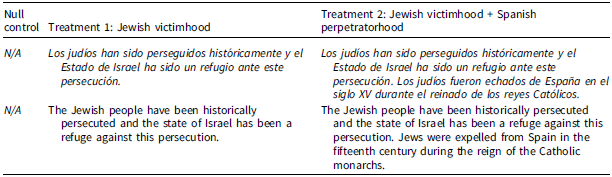
The survey then moved to a treatment phase where we randomly assigned respondents into one of three groups: a pure control, a prime of Jewish victimhood, and a prime of Jewish victimhood paired with attention to the expulsion of Jews from Spain in the fifteenth century.Footnote 7 We reference Israel in the latter two treatments. Given the timing of the survey (July 2024), the design is more internally valid if we ‘hold Israel constant’. Without mention of Israel, it is possible that the invocation of Jews may prime attitudes towards Israel for some, but not others,Footnote 8 leading to greater challenges in isolating how moderators affect the treatment and a weaker claim to information equivalence across treatments. Texts were kept short, approximating a news headline, and positioning results as a theoretical lower bound and a ‘proof of concept’. With a minor treatment intervention, and the content of the perpetratorhood with significant temporal distance from the present, the design of our experiment can be understood as a hard case to find effects. The treatments, in Spanish (as they appeared) and in English, are included in Table 1.
Treatment texts (Spanish and English)

We understand the ‘Spanish Perpetratorhood’ condition as drawing attention to a historical episode that positions respondents’ national group as perpetrators. It is logical to consider the Catholic monarchs and think of Spain, similar to Henry VIII and England or Louis XIV and France. In other words, the relevant identity connected to this history is national, rather than religious. Furthermore, we argue that this can be considered an instance of past perpetratorhood, given the language of the treatment. By first presenting the persecution of a group (the victim statement), and then adding a sentence on Spain’s role in such persecution, we view the treatment as a clear instance of attention drawn to national perpetratorhood.
Following treatment exposure, respondents answered questions on antisemitism and other outcomes. Our survey flow is summarized in Figure 1.
Consort diagram.

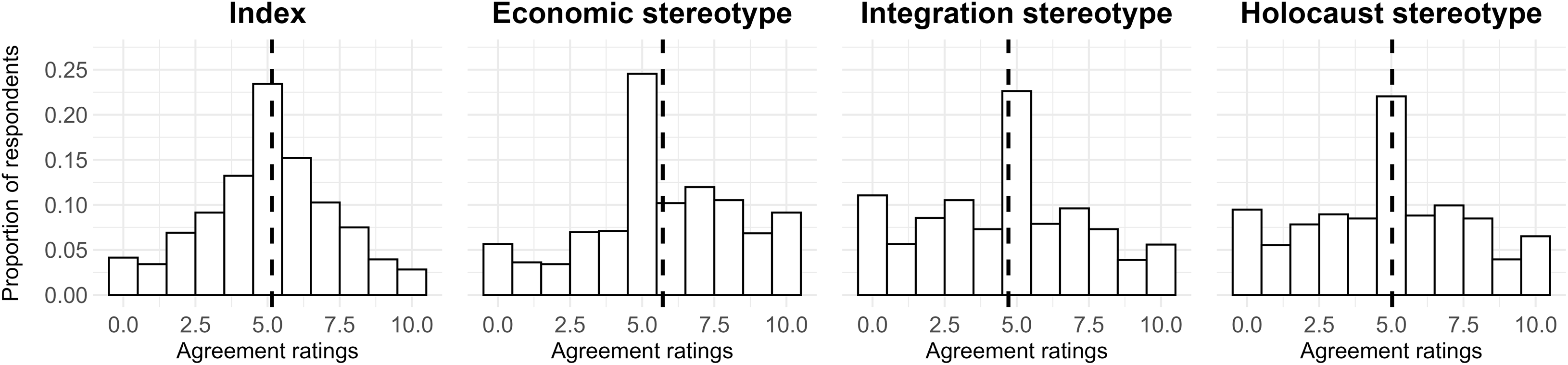
To measure antisemitism, respondents rated their agreement on 0–10 scales for three statements capturing well-known facets of antisemitism (see, for example, Antoniou et al. Reference Antoniou, Dinas and Kosmidis2020): stereotypes about the Jews being powerful as a collective (‘Jews have too much economic power’, mean agreement = 5.65),Footnote 9 about Jews prioritizing their religious identity over other group identities (‘Jews do not integrate into societies in which they live’, mean agreement = 4.61), and about perceived instrumental use of the Holocaust (‘Jews talk too much about the Holocaust’, mean agreement = 4.83). We then combined these into a single index that averaged respondent scores. The internal consistency of these items was relatively stable, with a Cronbach’s α of 0.77.Footnote 10 Figure 2 plots the distribution of agreement with the index and each item.
Distribution of agreement with antisemitic items (pure control group).

Given the deep and politically relevant territorial divisions and cleavages in Spain, our main results exclude respondents in Catalonia and the Basque Country, where the meaning of Spanish identity is far less straightforward than in other regions (Bartolomé Reference Bartolomé2013; Beramendi Reference Beramendi1999), though results are consistent with their inclusion (Section A2.2).
To test Hypothesis 1, we use a difference in means.Footnote 11 Our pre-registered comparison compares the group primed with Jewish victimhood and the group primed with Jewish victimhood and Spanish perpetratorhood. In this way, we isolate the effect of the perpetrator statement without worrying that treatment effects are driven by priming the out-group (Jews), Israel, or general victimization. All three elements are identical in both texts, essentially controlling for them.Footnote 12 Our estimand of interest is an intent to treat (ITT) effect of making an episode of past in-group perpetratorhood salient on antisemitism. We do not claim to identify specific cognitive or affective mechanisms that result from making history salient, given our design. Importantly, the core claim motivating Hypothesis 2 is that making this history salient should spur varied cognitive processes among different individuals. To test Hypothesis 2, we interact treatment assignment with national attachment. Section A2.5 discusses assumptions in our general approach and shows that results are robust with alternative and more flexible modeling strategies.
Results: Perpetratorhood and Antisemitism
Figure 3 plots means for our antisemitism index and related 95 per cent confidence intervals across the three groups, as well as the treatment effect for our main comparison (Hypothesis 1) between the perpetrator and victim groups on the index and disaggregated items.
Minimal differences in attitudes between treatment groups.
Note: Panel A plots the mean indexed score of antisemitism by treatment group (95 per cent confidence interval – henceforth, CI). Panel B shows 90 and 95 per cent CIs for the difference in means between the perpetrator group and victim-only group. Effect sizes are scaled by the standard deviation of the dependent variable – henceforth, DV). Results presented in tabular form, without any scaling of outcomes, in Section A2.7.

Comparing the group primed with perpetratorhood and the group primed only with Jewish victimhood (Hypothesis 1), movement in antisemitism is negligible (+0.045 on an 11 point scale, or a 0.87 per cent increase from the control group mean). Figure 3(A) does show one statistically significant effect: the perpetrator prime increased antisemitism compared to the null control group.Footnote 13
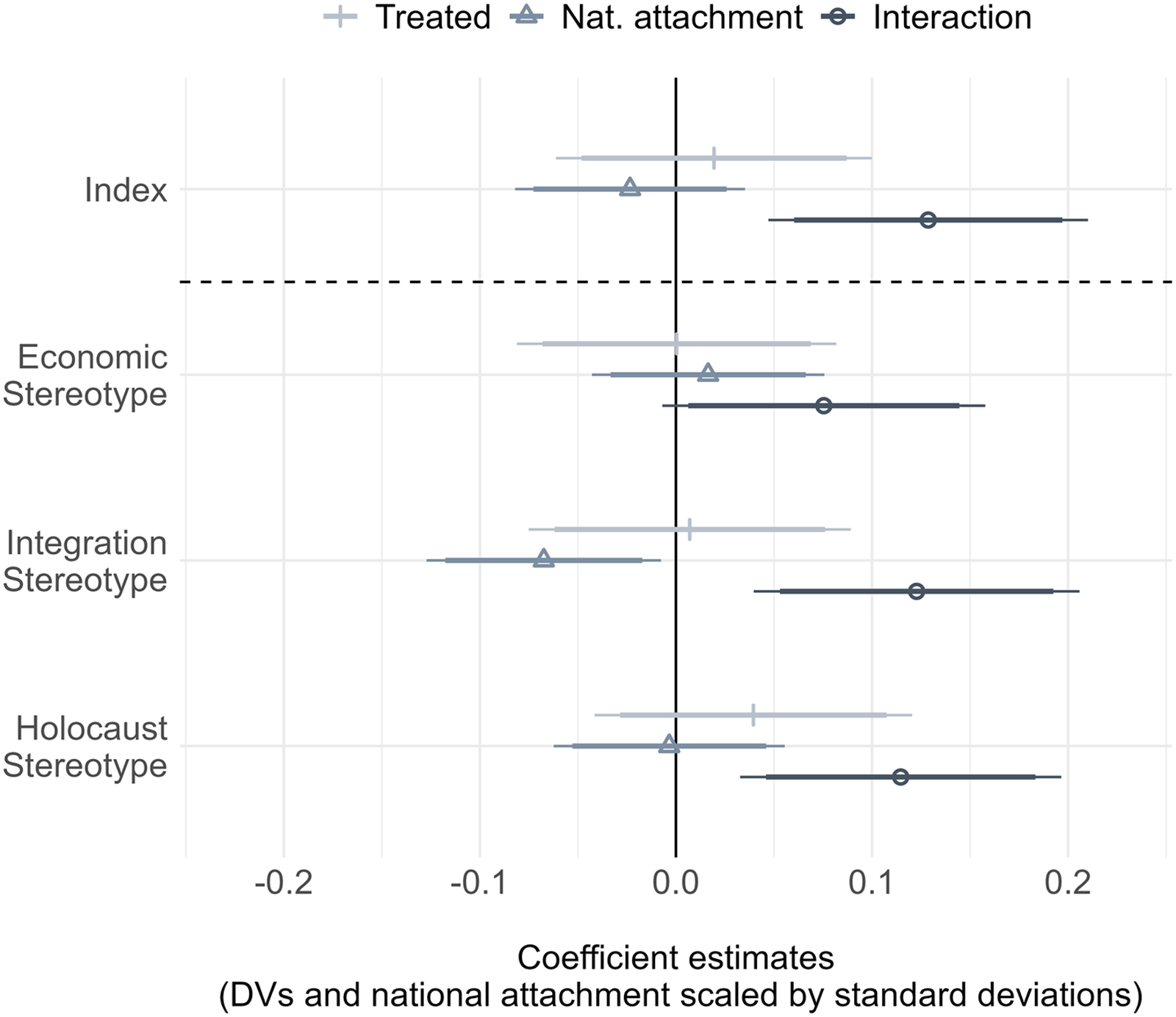
As our theoretical discussion for Hypothesis 2 suggests, though, history that threatens a positive self-image of one’s in-group may have differing effects based on how attached one is to the group. Figure 4 plots the coefficients from our interaction model. Our outcome (antisemitism) and national attachment are scaled by their standard deviations.
Effect of treatment and national attachment on antisemitism.
Note: The figure shows coefficients (with 90 and 95 per cent CIs) from models interacting treatment with national attachment. Results presented in tabular form, without any scaling of outcomes, in Section A2.7.

We find that the interaction term is positive and statistically significant, supporting Hypothesis 2 and suggesting that the effect of making past perpetratorhood salient on antisemitism is moderated by national attachment. This pattern is largely consistent across each indicator.Footnote 14 Figure 5 visualizes marginal effects. Panel A plots the predicted antisemitism scores across national attachment ratings in both the ‘Jewish victimhood’ and ‘Jewish victimhood and Spanish perpetratorhood’ conditions. Panel B transforms these results into conditional ITTs across the moderator, also plotting the density of national attachments.
Visualized conditional treatment effects by national attachment.
Note: Results show how ITTs are moderated by national attachment. Panel A shows predicted outcomes across levels of national attachment, while Panel B shows predicted ITTs from the model across our moderator.

Despite respondents clustering at high levels of attachment, the findings on the lower end of the spectrum are arguably most notable. When estimating treatment effects among the 14 per cent of the sample who identify at or below a 5 on this scale, the treatment effect is negative (ITT = − 0.539, se = 0.274, p = 0.05). At the upper end of the spectrum, we identify a positive, if not more muted, effect among the 57 per cent of the sample identifying at a 9 or 10 on the scale (ITT = 0.198, se = 0.124, p = 0.11).Footnote 15 Together, these suggest that the significant interaction effect identified may be driven to a greater degree by respondents who are less attached to the nation. This makes our corollary hypothesis from Footnote 4 – that making past in-group perpetratorhood salient is more likely to decrease out-group animosity among low in-group identifiers than high in-group identifiers – a more apt description of these results than our original framing of the treatment as more likely to increase animosity among high in-group identifiers. Still, we argue that the clear interaction effect, and flipped signs of point estimates among low and high identifiers, highlights the importance of national attachment as a moderating force important to understanding how making historical perpetratorhood salient affects animosity towards the victimized out-group.
Alternative Explanations
We also consider three possible alternative explanations for our results. First, national attachment may not be the relevant moderator. Our reference to the Catholic monarchs in the perpetratorhood treatment could be thought of as threatening religious, rather than national, identity. Though we lack a measure for religiosity, we provide an indirect test that speaks against this interpretation in Section A2.4. We show that ideology does not moderate treatment effects, though it is much more strongly correlated to religiosity than national attachment in the data from the 2023 European Social Survey (ESS ERIC 2025).
Secondly, rather than activating an identity threat, the perpetrator treatment may have activated alternative mechanisms, such as national glory or a reminder of laws granting Spanish citizenship to Sephardic Jews. We consider both alternative mechanisms unlikely. On the former, the structure of the treatment text – highlighting a victimized group and then assigning the national in-group as one of the perpetrators – makes little room for interpretation outside of an assignment of perpetratorhood to the Spanish nation. Even if one believed that some ‘good’ came of this historical episode, we are still capturing the intent to treat effect of ‘making an episode of historical in-group perpetratorhood salient’. On the latter, as noted above, the citizenship-granting law passed without partisan conflict, did not generate lasting political divides, and the number of repatriations was small – around 73,000 to date (Ministerio de la Presidencia, Justicia y Relaciones con las Cortes 2025). Thus, it is unlikely to have been something at the top of mind for most respondents. Additionally, respondents spent very little time reading the treatment (on average thirteen seconds), making it improbable that they processed history’s contemporary policy implications rather than the historical wrongdoing itself.
Thirdly, we could be mischaracterizing the treatment as ‘making past perpetratorhood salient’, as effects may result from learning. We find this unlikely, not least because the expulsion is widely known but also because, as we detail in Section A2.6, we engage in a bounding exercise to rule out the possibility that ‘learners’ drive results. Still, we do not intend to deny that the treatment could also lead to some small degree of learning or an activation of social norms, though these interpretations of how the treatment operated are still consistent with our interpretation of the estimand as an ITT of making history salient.
Conclusion
A large body of literature examines how history can affect attitudes towards other groups, with the majority of attention on histories of victimhood (see, for example, Kljajić et al. Reference Kljajić, Shelef and vanderWilden2025). In this paper, we focus instead on the role of past perpetratorhood in promoting or reducing animosity towards the victimized out-group. Building on existing literature rooted in Social Identity Theory, we present opposing theoretical possibilities, but ultimately suggest that these reactions should be moderated by attachment to the group-based identity in question.
Drawing on an original survey experiment that references the expulsion of Jews from Spain in the fifteenth century, we show evidence of moderated effects of exposure to historical perpetratorhood on attitudes towards the victimized out-group. Individuals only weakly attached to the nation tend to respond to the treatment with reduced levels of antisemitism. The opposite appears true, albeit to a lesser degree of magnitude, among those most strongly attached to the nation. We interpret these heterogeneous reactions as driven by the varied affective and cognitive processes that one could undertake following attention drawn to information that threatens the morality of their nation. We encourage future work to unpack and measure these processes, which we are not able to speak to directly with our data.
The experimental intervention was light-touch, with minimal text that referenced a distant event, making the threat to in-group morality relatively low (Peetz et al. Reference Peetz, Gunn and Wilson2010). Thus, our design may understate the potential for backlash or more pronounced heterogeneous effects. Longer-form engagement, or the use of more recent histories, may produce larger effects. Additionally, given that we study antisemitism at a time of heightened attention to the issue (for example, in the context of the war in Gaza), it is also possible that the prejudice that we study is harder to move than other forms of prejudice, as people may be more firm in their dispositions. We encourage future researchers to continue probing the scope of histories and of types of out-group prejudice that would be relevant for our framework.
When histories of in-group perpetratorhood are made salient, they have the potential to polarize the public’s attitudes towards the victimized group. Those weakly attached to the national in-group, whose self-concept is less threatened by a degradation of the moral status of the group, report less prejudice towards the victimized group – likely as a product of moral order restoration. Those highly attached to the national in-group, however, tend towards a defensive backlash that can deepen prejudice towards the victimized group. As countries face pressures to address moments of national perpetratorhood, these findings offer insight into the complicated ways that drawing attention to historical wrongdoings can affect out-group animosity.
Supplementary material
The supplementary material for this article can be found at https://doi.org/10.1017/S0007123426101501.
Data availability statement
All data and code to replicate the findings are available in the Harvard Dataverse: https://doi.org/10.7910/DVN/CUT5RQ.
Acknowledgments
We are grateful for feedback from Anil Menon, Leonardo Arriola, Harris Mylonas, María Ignacia Curiel, Nicholas Sambanis, Avital Livny, Chagai Weiss, Gerard Padró-i-Miquel, Vicky Fouka, and the attendees of the Understanding Politics seminar at UC Merced, the 2025 MPSA panel ‘Sources and Determinants of Intergroup Conflict’, and the Yale workshop on inclusive nationalism (April 2025). We thank RA work by Madeleine Schneider, Da Sul Kim, and Kaitlyn Hladik.
The authors made use of OpenAI’s GPT-5 and Perplexity Pro for some copyediting assistance and to transfer a limited number of bibliographic citations into bibtex format. All outputs were checked and edited by the authors, who remain responsible for the content. OpenAI was accessed from https://openai.com/ and used without modification on 10 and 26 November 2025, and Perplexity Pro was accessed from www.perplexity.ai/ and used without modification on 10 and 26 November and 8 and 9 December 2025.
Author Contributions
Authors contributed equally and are listed in alphabetical order. All authors approved the final submitted draft.
Financial support
This study is part of the Georgetown University project ‘Inequality and Governance in Unstable Democracies – The mediating Role of Trust’, implemented by a consortium led by the Institute of Development Studies (IDS). The support of the UK Economic and Social Research Council (ESRC grant ES/S009965/1) is gratefully acknowledged.
Competing interests
None.
Ethical standards
The research meets all ethical guidelines, including adherence to the legal requirements of the study country. Human-subjects research approval was granted by Georgetown University [Id: STUDY00008101] and University of Wisconsin–Madison [Id: 2024-0875-CP001].




 Open access

