


1. Introduction
The traditional product development process, for example based on VDI 2221, comprises several phases ranging from task clarification to design elaboration. Within these phases, essential activities occur such as idea generation (Reference BhuiyanBhuiyan, 2011), design conception, and the review of this design within the development team using computer-aided design (CAD) software (Reference Hasby, Irianto and DiawatiHasby et al., 2024). Subsequently, a physical prototype is developed, after which it undergoes validation experiments and modifications to ensure compliance with the targeted design requirements (Reference Maropoulos and CeglarekMaropoulos & Ceglarek, 2010). In this context, virtual reality (VR) has emerged as a promising technology that enhances the product development process, particularly among distributed teams (Reference Balzerkiewitz and StechertBalzerkiewitz & Stechert, 2022), and improves employee performance (Reference Winkler, Murari, Ferreira and FreitasWinkler et al., 2022).
Before integrating VR into product development, it is necessary to evaluate existing processes and determine the specific needs of employees. This includes identifying areas where VR can deliver the most value and ensuring an efficient implementation within the development process. A workforce‑oriented analysis can therefore provide a foundation for the effective adoption of VR technologies.
Accordingly, this paper presents a structured approach to analysing selected product development activities from the perspective of employees, while also examining how different forms of waste influence their performance. These influences can be reduced or eliminated through the use of VR. This contribution is explicitly intended for practitioners, particularly those involved in applied consultancy and implementation‑oriented decision‑making.
2. Methodology
The methodology (Figure 1) begins with the selection of criteria to assess the current state of the process. The selected criteria are supported by the literature, which demonstrates a clear relationship with VR and indicates that these criteria can be optimized through its application. The activities considered correspond to the product development activities defined in the VDI 2221 standard. The types of waste are derived from Taiichi Ohno’s concept of the seven forms of waste (Reference Hänggi, Fimpel and SiegenthalerHänggi et al., 2022). The activities examined include idea generation, design review, ergonomics testing, and prototyping. The types of waste addressed comprise teamwork inefficiencies, disruptions in information flow, workload imbalances, and time losses. In addition, further aspects such as departmental distribution and lead time are incorporated into the analysis to ensure broad insight into the product development process. Although additional categories and factors could be investigated, this study focuses specifically on those supported by prior research demonstrating their relevance to the use of VR technologies.
Methodological workflow used for the paper analysis

In the analysis of criteria, the selected elements are examined in detail. Their current definitions and practical implementation are investigated, as well as the potential contribution of VR to each criterion.
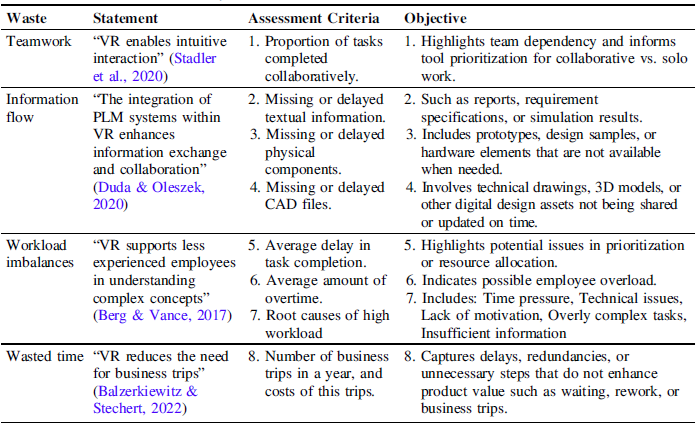
This analysis phase is followed by a visualization phase. In this phase, the benefits of VR identified in the literature are evaluated using derived assessment indicators, which provide a recommendation and a comprehensive perspective on the usefulness of VR in supporting employees during specific activities within the product development process. To understand this contribution, the reader should follow the sequence presented in the tables in Chapter 4. When VR providers or consultants claim that VR solutions add value to specific product development activities or contribute to waste reduction (Column 1), these claims are formulated as literature-based statements (Column 2: Statement). The framework enables these statements to be systematically examined using the proposed assessment criteria (Column 3: Criteria). Each criterion specifies what is to be evaluated and clarifies the expected value for decision-makers, as described in (Column 4 : Objective). In this way, the framework translates externally proposed VR benefits into an internally grounded, employee-centred assessment, allowing management to determine whether the use of VR is meaningful for specific activities within the product development process.
3. State of the art
In this chapter, all relevant items (activities, types of waste, and additional aspects) are reviewed. Each factor is defined and analysed to clarify its meaning and the expected contribution of VR to the respective process element.
3.1. Activities
This section summarizes four activities in (Table 1), supported by evidence and references that demonstrate their relevance to VR.
Product development activities influenced by VR

The idea generation phase is essential for identifying new product concepts or developing improvements to existing products (Reference MandalMandal, 2022). This phase often takes place during brainstorming sessions, which are conducted either in person or digitally among the development team. During this stage, initial concepts are typically sketched in 2D or 3D with hand sketching on paper or digital pens with tablets. It is crucial that these visual representations are clearly understood by all team members.
(Reference Sim and JungSim & Jung, 2025) suggest that VR promotes active engagement and deeper exploration of design ideas through spatial interaction. Additionally, (Reference Fleury, Blanchard and RichirFleury et al., 2021) report that VR enhances creativity by increasing the number of developed ideas compared with hand sketching. (Reference Cavas Martínez, Peris-Fajarnes, Morer Camo, Lengua Lengua and Defez GarcíaCavas Martínez et al., 2022) further demonstrate that advances in VR enable users to modify design concepts more quickly and efficiently during brainstorming activities.
Following idea generation, design review becomes one of the most critical phases in the product development process (Reference Cheng, Wang, Chen, Hu and CaoCheng et al., 2025). It takes place among team or with clients to gain approval and implement any necessary modifications and repeated almost for every phase of conception process to evaluate the progress and identify inefficiencies or areas for improvement. These reviews serve as key checkpoints to ensure that the product aligns with technical requirements, project goals, and stakeholder expectations. Conducting the design reviews with VR help to detect more issues in design than in CAD tools (Reference Horvat, Martinec, Perišić and ŠkecHorvat et al., 2022). (Reference WolfartsbergerWolfartsberger, 2019) illustrate that VR providing a more interactive experience that improves communication, and speeds up the review process.
After the design has been reviewed, the next phase involves building a physical prototype. This stage is typically iterative (Reference Elverum, Welo and TronvollElverum et al., 2016), aiming to develop a validated and approved design that meets customer requirements (Reference Tahera, Wynn, Earl and EckertTahera et al., 2019). Throughout this process, further modifications are often necessary. In some cases, errors identified during physical prototyping lead to late-stage changes in the requirements list, which can disrupt the development timeline (Reference Tan, Otto and WoodTan et al., 2017). These late-stage changes activities introduce inefficiencies that lead to extended project timelines and increased costs. The VR is implemented in this context as a replacement for physical prototypes at least in the early stages, which can be associated with high costs in terms of both time and resources, while simultaneously enhancing the visualization of the prototype (Reference Stadler, Cornet, Mazeas, Chardonnet and FrenklerStadler et al., 2020). The time and cost expenditures are primarily influenced by the number of physical prototypes required and their level of complexity.
In product development, engineers are responsible for ensuring that the final product is both safe and comfortable to use (Reference Zhu, Zedtwitz and AssimakopoulosZhu et al., 2018). As a result, human factors become a central focus during the design phase. This is because users have physical limitations, such as specific body dimensions, strength capabilities, and ranges of motion, which must be taken into account. User-product interaction should be carefully considered throughout the development process, as it directly impacts safety, comfort, and overall user satisfaction (Reference Blaga, Cășeriu, Bucur and VeresBlaga et al., 2025). This evaluation typically takes place during ergonomic testing, where the design is assessed for its usability and its alignment with human physical and cognitive capabilities (Reference Harte, Glynn, Rodríguez-Molinero, Baker, Scharf, Quinlan and ÓLaighinHarte et al., 2017). The use of VR in ergonomic evaluations is more effective for assessing visibility and accessibility (Reference Aromaa and VäänänenAromaa & Väänänen, 2016). Moreover, VR enhances worker safety by enabling the evaluation of risky environments or machinery without exposing users to potential hazards (Reference Ottogalli, Rosquete, Rojo, Amundarain, María Rodríguez and BorroOttogalli et al., 2021).
3.2. Wastes
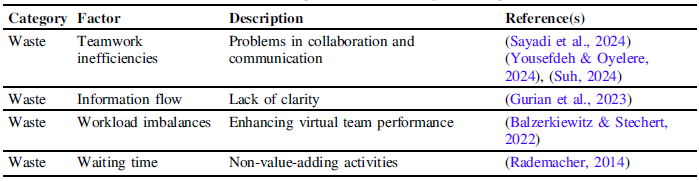
This section outlines the categories of waste that can be minimized or eliminated by implementation of VR, as detailed in (Table 2).
Waste Categories Influenced by VR Integration

Ensuring effective collaboration and teamwork among all members and relevant departments is a critical determinant of process efficiency. A lack of effective collaboration often results in poor communication and a lack of clarity, which in turn lead to misunderstandings regarding tasks, objectives, and expectations (Reference Musheke and PhiriMukelabai M. Musheke, Jackson Phiri, 2021).
Ineffective communication among team members often results in misunderstandings, which in turn hinder collaboration and reduce overall team performance (Reference Marlow, Lacerenza, Paoletti, Burke and SalasMarlow et al., 2018). Furthermore, the tools employed for communication play a crucial role in reducing misunderstandings and ensuring that essential details are effectively conveyed (Reference Bedwell, Wildman, DiazGranados, Salazar, Kramer and SalasBedwell et al., 2012). In this case, the VR enhances visualization and evaluation while enabling intuitive interaction (Reference Stadler, Cornet, Mazeas, Chardonnet and FrenklerStadler et al., 2020).
Closely related to collaboration, an important factor -particularly for new employees or stakeholders not directly involved in design- is their understanding of the information they receive and share (Reference ZhangZhang, 2022). The product development process typically involves multiple departments within a company, such as mechanical, electrical, control, finance, and production, depending on the characteristics of the product being developed. (Reference Bender and GerickeBender & Gericke, 2021). The flow and quality of information across these teams and departments are essential (Reference Bester and KrähmerBester, 2008). Furthermore, according to (Reference Bender and GerickeBender & Gericke, 2021), many products are highly complex, comprising numerous interconnected components that function collectively as an integrated system. The functionality and efficiency of this system are governed by predefined requirements. The systematic process of defining, analysing, structuring, and specifying these requirements is referred to as requirements engineering. This process relies on the elicitation and management of extensive information to ensure that the product can be developed in a consistent and goal-oriented manner. The accuracy, completeness, speed, availability, and level of detail of this information are critical to achieve the task.
Additionally, effective information flow and transfer within product development depend on the use of product lifecycle management (PLM) systems, which provide all teams with continuous access to updated and accurate information (Reference Bender and GerickeBender & Gericke, 2021). Building on this principle, the integration of PLM systems within VR system can further enhance information exchange and collaboration among stakeholders (Reference Duda, Oleszek, Lalic, Majstorovic, Marjanovic, von Cieminski and RomeroDuda & Oleszek, 2020), provided that the system is accessible to all relevant departments and partners. It is important to note that VR does not manage information flow in the structured manner of PLM systems; rather, it enhances the visualization, communication, and understanding of complex product information, such as CAD models, among all stakeholders.
Workload is another factor that significantly influences the employees. And it is results from various factors such as task complexity (Sandra G. Hart Lowell E. Staveland). The presence of personnel who are not yet sufficiently skilled, such as newly employed or inexperienced staff, together with the use of inadequate tools, often leads to uneven task distribution and the overburdening of key contributors (Reference Abughalia and StechertAbughalia & Stechert, 2025b). VR enables the presentation of complex products in a simplified and intuitive manner, thereby improving design clarity for participating teams across different departments and experience levels, such as those involved in mechanical design (Reference Berg and VanceBerg & Vance, 2017). This enhanced clarity reduces the likelihood of design errors and makes VR particularly valuable for supporting less experienced employees in understanding complex design concepts compared with other tools (Reference Wang, Miller, Han, DeVeaux and BailensonWang et al., 2024).
Another important factor is waiting time. Delays may arise from various sources, including ineffective or untimely information transfer between teams which can lead to prolonged approval processes (Reference Williams, Eden, Ackermann and TaitWilliams et al., 1995) such as attending an excessive number of unnecessary meetings (Reference Romney, Allen and HeydarifardRomney et al., 2025), including redundant design reviews. These factors may ultimately result in slow decision-making processes. In addition, time losses can occur due to process-related issues, such as waiting for the outcomes of previous development phases, or as a consequence of using unsuitable tools. As illustrated in the first group, VR can serve as an effective tool for presenting design information, thereby reducing the duration of design reviews and ergonomic evaluations and accelerating the overall decision-making process. An additional factor closely related to waiting time is unnecessary motion, including non-essential business trips, which could potentially be replaced through the use of VR-based collaboration.
3.3. Additional aspects
This section summarizes additional key aspects that should be considered when analysing the implementation of VR in product development. Although these aspects cannot be replaced by VR, it is recommended that they be examined to support process visualization.
An important factor is the dependency between employees and their departments, which helps to represent all departments and the relationships between them in order to better understand their interdependencies.
Finally, lead time and actual process time are fundamental factors when analysing the value stream within a process. It is essential to examine how much time each team member spends on value-adding activities compared to non-value-adding activities, such as waiting or idle periods. In this context, the analysis should focus on the employee’s role in the process, specifically the time each employee is actively engaged in the workflow. Understanding the impact of time reduction helps to identify inefficiencies and opportunities to enhance overall team productivity (Reference Alora and AmayaAlora & Amaya, 2025).
4. Process analysis
In this chapter, all factors identified in the previous section are analysed in detail. The analysis is based on assessment criteria for each factor, highlighting both strengths and weaknesses.
The assessment criteria are developed based on advantages of VR reported in the literature presented in the chapter 3 for the respective activities. For example (Reference Fleury, Blanchard and RichirFleury et al., 2021) report that VR enhances creativity by increasing the number of generated ideas compared with hand sketching. This finding is adopted as a basis for assessment criteria development, from which several indicators are derived, including the proportion of idea-generation activities within the overall process, the number of generated ideas, the type of tools used, and the duration of the session. Together, these indicators provide a comprehensive basis for assessing whether VR adds value to this activity. The same approach is applied consistently across all analysed activities.
4.1. Activities
This section summarizes the assessment criteria developed to evaluate the activities discussed in Chapter 3. (Table 3) identifies four specific activities, along with their corresponding assessment criteria and the objective of each criterion.
Developed assessment criteria for the first group activities

In the design review phase, the literature suggests that the use of VR can support the identification of a greater number of design issues by enhancing interactive experiences and improving communication among team members. Accordingly, relevant factors for analysis include the proportion of this phase within the participants’ overall tasks, the frequency of design reviews conducted per month, the duration of each session, the types of tools utilized, and the specific purpose of the review, whether it is aimed at resolving a design issue or serves as a general collaborative activity.
In the ergonomic testing phase, VR is described in the literature as a promising tool for improving worker safety and reducing costs by enabling the evaluation of ergonomic factors without the need for physical prototypes. Therefore, key factors to be analysed include the number of prototypes required per product for ergonomic testing, the duration of each evaluation session, and the number of participants involved.
In the prototyping phase, VR is assumed to function as a substitute for physical prototypes, which may lead to reductions in both time and cost. Consequently, it is essential to assess factors related to prototype production, including the associated effort, costs, and the rate of rework required.
4.2. Wastes
This section outlines the categories of waste analysed using assessment criteria. (Table 4) presents a summary of these categories together with the suggested assessment criteria.
Developed assessment criteria for the waste-related activities

Although the concept of teamwork is broad and cannot be fully analysed within the scope of this study, a key indicator in the context of VR implementation is the proportion of tasks completed collaboratively versus individually. This distinction is relevant, as VR tends to add greater value in collaborative activities, such as ideation or design reviews, compared to tasks performed individually. however, these aspects are examined across multiple activities within the first group of factors.
To ensure effective information flow, the literature proposes the integration of VR with Product Lifecycle Management (PLM) systems. In this context, indicators related to the core objectives of PLM systems are examined, including missing or delayed textual information, delayed physical components, and missing or delayed CAD files, as these factors are essential for understanding information-related inefficiencies.
With regard to workload, VR is considered a supportive tool that presents designs in a more intuitive and comprehensible manner, thereby facilitating discussion and reducing cognitive workload. This factor primarily concerns employees with limited practical experience or newly employed staff, who may experience increased effort or stress when interpreting designs during ergonomic evaluations, design reviews, or early-stage ideation activities. Accordingly, indicators such as delays in task completion, increased overtime, and the underlying causes of elevated workload are assessed.
To analyse VR’s contribution to reducing time losses, the underlying causes of such inefficiencies are examined. These inefficiencies may arise from process- or method-related factors, such as complex design reviews or ergonomic tests, as well as from tool-related factors, including the use of conventional tools for design reviews (e.g., CAD software) or ideation (e.g., hand sketching). In addition, cost- and time-related factors resulting from business travel are investigated, as these may potentially be reduced through the use of VR-based collaboration (Reference Balzerkiewitz and StechertBalzerkiewitz & Stechert, 2022).
4.3. Additional aspects
This section summarizes the additional aspects that require consideration, as presented in (Table 5).
Developed assessment criteria for the additional aspects

The departmental structure is represented by mapping all relevant departments in relation to one another. This is achieved by collecting data from all participating users across the involved departments. The relationships between departments are visualized using a node–link diagram, which provides a clear and immediate overview of interdepartmental connections and interactions.
Lead time provides an initial indicator of the efficiency of the current process and helps identify whether process reengineering or modification is necessary. While it does not capture all influencing factors, it offers a useful first insight into overall process performance.
5. Case study
The case study was conducted in an academic-industrial hybrid setting to evaluate the applicability of the proposed methodology under conditions that approximate professional practice. A total of 39 Master’s students in Systems Engineering participated, all of whom were employed part-time in engineering roles within industrial organizations. This dual background ensured familiarity with real-world product development processes while allowing controlled experimentation.
Participants were enrolled in a course on engineering leadership and were assigned to seven groups, each representing a core product development function. This structure enabled the analysis of interdepartmental dependencies and information flows, reflecting typical organizational settings.
The proposed methodology was implemented through a web-based application that guided participants through the assessment criteria. Data were collected via a structured survey and processed using a rule-based backend. The system generated visualized results in the form of quantitative indicators and qualitative evaluations, followed by tailored recommendations regarding VR applicability and required training measures.
Beyond validating the feasibility of the methodology, the case study provided insights into user perception and learning effects. Participants reported increased awareness of process inefficiencies and a clearer understanding of where immersive technologies could add value. Differences in VR readiness between roles and experience levels became apparent, underlining the relevance of an employee-centred perspective. While the academic setting limits generalizability, the structured feedback indicates that the approach is suitable as a diagnostic and sensitization tool prior to industrial deployment.
6. Conclusion
This study proposes an employee-centered framework for analyzing product development processes with the objective of identifying suitable entry points for VR integration. By combining classical process analysis with human-centered and waste-oriented criteria, the approach provides a structured basis for evaluating not only technological feasibility but also organizational readiness.
The results demonstrate that VR offers particular benefits in collaborative, communication-intensive activities, while its impact on individual tasks remains limited. The case study highlights that successful adoption depends less on technological availability than on employee capabilities, training, and clarity of objectives. Consequently, VR should be regarded as an enabling instrument within a broader process improvement strategy rather than as a standalone solution.
Several limitations must be acknowledged. The empirical evaluation was conducted in an academic environment and relied on self-reported data, which may influence objectivity. Future research should therefore apply the methodology in industrial case studies, integrate longitudinal performance measurements, and quantitatively assess productivity and quality impacts.
The purpose of the proposed framework is to support management in making informed decisions regarding the implementation of VR within their departments, taking explicit account of employee-related needs and process characteristics.
Overall, the contribution supports practitioners in making informed, employee-oriented decisions regarding VR adoption.
Acknowledgement
The authors express their gratitude to the German Federal Ministry for Economic Affairs and Climate Action and to the project management agency AiF Projekt GmbH for funding the ZIM-project “KI-gestütztes VR-System für ergonomieorientiertes Training und Arbeitsplatzbewertung aus PoV-Perspektive” (KK6118501RU5).





 Open access

