The Rise of Mental Health Nursing

-
The digital format of this book is no longer available to purchase from Cambridge Core. Other formats may be available.
-
Select format
-
- Publisher:
- Amsterdam University Press
- Publication date:
- 28 January 2021
- 27 March 2003
- ISBN:
- 9789048505074
- 9789053565018
- Dimensions:
- Weight & Pages:
- Dimensions:
- Weight & Pages:
- Subjects:
- Medicine: General Interest, Medicine
You may already have access via personal or institutional login- Subjects:
- Medicine: General Interest, Medicine
Show more authors 
You may already have access via personal or institutional login
Book description
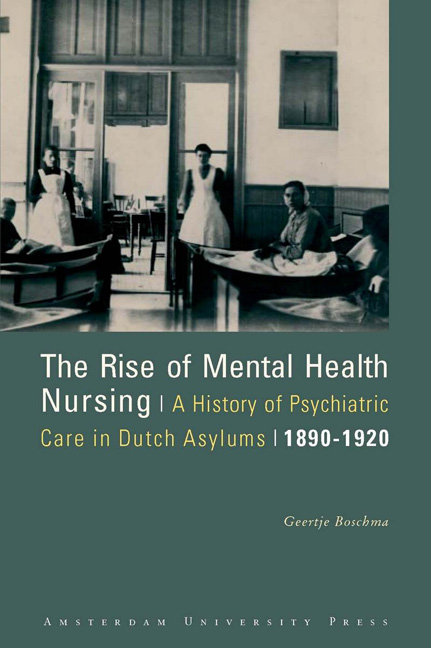
Geertje Boschma's complex study examines issues from the rise of scientific psychiatry and the emergence of mental health nursing to the social relationships of class, gender, and religion that structured asylum care in the Netherlands around 1900. Drawing on the archival collections of four Dutch asylums, Boschma highlights the gendered nature of mental health nursing politics, and captures the contradictory realities of hospital-oriented asylum care, both illustrating the social complexity of the care of the mentally ill and offering an important addition to the history of European psychiatry.
Contents
Contents
Metrics
Full text views
Full text views helpTotal number of HTML views: 0
Total number of PDF views: 0 *
 Loading metrics...
* Views captured on Cambridge Core between #date#. This data will be updated every 24 hours.
Usage data cannot currently be displayed.
Accessibility standard: Unknown
Why this information is here
This section outlines the accessibility features of this content - including support for screen readers, full keyboard navigation and high-contrast display options. This may not be relevant for you.
Accessibility Information
Accessibility compliance for the PDF of this book is currently unknown and may be updated in the future.