


Introduction
On January 6, 2021, a large mob attacked the United States Capitol, attempting to prevent a joint session of Congress from certifying the recent presidential election that Donald Trump lost. This political crime resulted in the death of multiple Americans, injuries to over 100 law enforcement personnel, $2.7 billion in damages, and immeasurable harm to the national morale (U.S. House Select Committee 2022; U.S. Government Accountability Office 2023).
What followed was a massive prosecutorial undertaking. Almost 200 defendants were charged with obstructing an official proceeding, and another 1,350 cases ranged from nonviolent misdemeanors to violent felonies (Hsu Reference Hsu2024; NPR 2025). The prosecutions were remarkably successful by conventional metrics: over 1,100 defendants were criminally sentenced for their actions at the Capitol on January 6th, with about 1,000 of those defendants pleading guilty to one or more charges (NPR 2025). Most defendants received some jail/prison time (~64%), resulting in a median sentence time of 240 days (NPR 2025). The most severe sentence given was 22 years to the former chairman of the Proud Boys, a group accused of helping to plan and coordinate the attack (U.S. House Select Committee 2022; Yousef Reference Yousef2023). The prosecutions were also efficient: nearly a thousand people had been charged by the second anniversary of the attack.
In the simplest terms, this was a victory for the rule of law: people tried to stop a democratic transfer of power, and they were held accountable. Given the success of the prosecutions, it may be surprising that just four years later, Donald Trump was re-elected on a platform that promoted false narratives about the 2020 election and the January 6th insurrection,Footnote 2 giving clemency to the insurrectionists and effectively undoing the work of the prosecutors. But public understandings of the event—and the work to hold the participants accountable—began turning well earlier. We focus on the mid-point between the insurrection and the clemency granted to insurrectionists: the midterm elections of 2022. And we ask a basic question: why would so many Americans disapprove of these successful prosecutorial efforts?
Political prosecutions can be motivated by partisanship—though far from consistently so (Gordon Reference Gordon2009) and vary in part based on the independence of prosecutors from state influence (Voigt Reference Voigt2021). So, partisanship is likely part of the answer, but, as indicated by the initial condemnation by some prominent Republicans (Blake Reference Blake2021), far from a sufficient answer. Broadly, people’s perceptions of prosecutorial efforts—and punishment more generally—reflect the justice system’s historic role in maintaining or challenging systems of privilege (Davis Reference Davis1998; Bobo and Johnson Reference Bobo and Johnson2004). This is especially the case for the prosecution of political activities including protests. Many Americans—particularly those concerned with maintaining existing privileges—have supported the aggressive criminalization of protests that advocate for electoral inclusion and the extension of civil rights (Metcalfe and Pickett Reference Metcalfe and Pickett2022; Thompson et al. Reference Thompson, Metcalfe and Pickett2023). For example, Americans who perceived status threats across the intersection of white and male privilege were fiercely supportive of “law and order” policing of Black Lives Matter protests (Drakulich and Law Reference Drakulich and Law2025).
But what about a protest whose goal seems more aligned with the maintenance of status quo group privileges? The political rhetoric of the MAGA movement has frequently sought to stoke resentments of perceived threats to group position (Jordan and Dykes Reference Jordan and Dykes2022; Johnston Reference Johnston2024; Feagin and Ducey Reference Feagin and Ducey2025), and public support for Trump has generally reflected this (Drakulich et al. Reference Drakulich, Hagan, Johnson and Wozniak2017, Reference Drakulich, Wozniak, Hagan and Johnson2020; Hooghe and Dassonneville Reference Hooghe and Dassonneville2018; Mutz Reference Mutz2018; Schaffner et al. Reference Schaffner, Macwilliams and Nteta2018; Valentino et al. Reference Valentino, Wayne and Oceno2018; Ratliff et al. Reference Ratliff, Redford, Conway and Smith2019; Geiger and Reny Reference Geiger and Reny2024). We suspect perceived threats to group privileges will play a very different role in perceptions of the prosecution and punishment of these protesters relative to what research has uncovered about support for, for example, the criminalization of Black Lives Matter civil rights protestors (Drakulich and Law Reference Drakulich and Law2025). Our question, then, focuses on public support for the prosecution of the January 6th insurrectionists; in particular, people’s perceptions of whether the resulting punishments were too severe. This has clear implications for understanding political prosecutions more generally, encouraging researchers to examine how the prosecutions may be perceived as challenging or reinforcing existing inequalities.
Looking at past examples of attempts to subvert democratic processes in the U.S., and drawing on recent work attempting to understand this social and political moment, we pose an answer rooted in the idea of intersectional threat—the idea that simultaneous challenges to multiple privileged identities provoke a particularly virulent threat reaction (Drakulich and Craig Reference Drakulich and Craig2022; Drakulich and Law Reference Drakulich and Law2025). As systems of privilege—and challenges to them—are often mutually reinforcing, we see opposition to January 6th legal punishments as operating at the intersections of (at minimum) racial and gendered status threats. The racial and gendered nature of January 6th—namely, who participated, how they participated, and what group privileges the Capitol insurrection and MAGA movement were trying to uphold—leads us to suspect these two aspects of threat are particularly important.
We begin by situating the January 6th insurrection, and the prosecution of its participants, in historical context. We then describe the idea of intersectional threat and our conceptual model for how we believe it helps explain public opinion of the prosecutions of January 6th insurrectionists.
Historical precedents
January 6th was not the first instance in American history where people rioted to stop a U.S. Presidential election from being certified. Just as in 2021, in 1861 a mob attempted to storm the Capitol to stop the certification of Abraham Lincoln’s victory—though in that attempt they were stopped by the U.S. military (Widmer Reference Widmer2020). Of course, after the election was certified, seven Southern states seceded from the Union before Lincoln was inaugurated. Other attempts at subverting local democratic elections were more immediately successful. In 1894 in Wilmington, North Carolina, a White mob, under the false cover of a race riot, violently overthrew legitimately elected politicians and replaced them with White supremacists (Cecelski and Tyson Reference Cecelski and Tyson1998). A notable commonality between these two is that in neither case were insurrectionists charged with crimes.
The social context is important to understanding each of these moments. Perhaps most obvious is the state of race relations and racial group positions. Lincoln’s election inspired concerns about a potential end to slavery, which would upset racial social stratification and imperil those who profited from the unpaid labor of others (Kendi Reference Kendi2017). By the 1890s, states in the South were reacting to the end of Reconstruction and attempting to reestablish white political dominance at the advent of Jim Crow (Du Bois Reference Du Bois1935; Gates Jr. Reference Gates2019). In other words, both were motivated quite directly by concerns about black threats to white political, social, and economic privileges.
But beyond the obvious threats to racial privileges, these insurrections also reflected growing tensions in gendered group positions and concerns about threats to male―particularly White male—privilege. Challenges to different dimensions of status quo group positions often overlap in time and social space. Some abolitionists were interested in the intertwined systems of gender and racial prejudice and how they both reinforced the disenfranchised status of women and enslaved people, both of whom lacked suffrage at the time (Grimké Reference Grimké1838). Brown (Reference Brown2000) also notes that changes in the social presence of women during the Civil War, as men were off fighting, challenged traditional norms about the structure of the family. The immediate response to these status concerns was a gendered backlash—the use of violence.
Conceptual model: Intersectional threat
So how did Americans feel about the prosecutions of the January 6th insurrectionists? The most common framework for how people think about the outcomes of prosecutorial work is punitiveness: that people vary in how punitive they desire prosecutors to be. Past research has often identified specific portions of the American public as more punitive: White people, racist people, conservatives, men, etc. (Cohn et al. Reference Cohn, Barkan and Halteman1991; Kinder and Sanders Reference Kinder and Sanders1996; Bobo and Johnson Reference Bobo and Johnson2004; Green et al. Reference Green, Staerklé and Sears2006; Unnever and Cullen Reference Unnever and Cullen2007, Reference Unnever and Cullen2010; King and Wheelock Reference King and Wheelock2007; Matsueda and Drakulich Reference Matsueda and Drakulich2009; Wilson and Nielsen Reference Wilson and Nielsen2011; Hutchings Reference Hutchings2015; Carter et al. Reference Carter, Corra and Jenks2016; Carter and Corra Reference Carter, Corra and Jenks2016; Brown and Socia Reference Brown and Socia2017; Kam and Burge Reference Kam and Burge2019; Morris and LeCount Reference Morris and LeCount2020). However, this is because people usually imagine that the goal of punitiveness is the maintenance of status quo group positions—for instance, the repression of Black people and the maintenance of white supremacy (Chiricos et al. Reference Chiricos, Welch and Gertz2004; King and Wheelock Reference King and Wheelock2007; Pickett and Chiricos Reference Pickett and Chiricos2012). This is particularly visible in support for the punitive repression of civil rights protests—those actively trying to dismantle white supremacy (Metcalfe and Pickett Reference Metcalfe and Pickett2022; Drakulich and Law Reference Drakulich and Law2025). January 6th insurrectionists provide an interesting opportunity to examine how punitive people desire prosecutors to be when the political goals of the targets are focused on maintaining rather than challenging inequality.
Support for punitive prosecutions is driven by threat. Within the scope of group position, threat emerges as a perceived challenge to the desired relationships between social groups. Our study utilizes a conception of threat that centralizes prejudice as the driving force that both legitimizes perceived threats as real and shapes subsequent threat responses (Blumer Reference Blumer1958). While dominant groups are more likely to perceive threats—in part due to them being direct beneficiaries of status quo privileges—perceptions of threat are not limited to them solely. Instead, members of marginalized groups sometimes hold ideologies that maintain group privileges for dominant groups—such as Black Americans who opposed the direct-action protests of the Civil Rights Movement, and women who opposed women’s suffrage. Marginalized individuals may adopt negative in-group attitudes because they lack a sense of shared fate (Kam and Burge Reference Kam and Burge2019) or to subvert social boundaries by boundary-making against others (Lamont and Molnár Reference Lamont and Molnár2002), among other reasons. Prior work on threat has shown the necessity to explore perceptions of threat among marginalized groups. Drakulich and Craig (Reference Drakulich and Craig2022) and Drakulich and Law (Reference Drakulich and Law2025) find that while White people are more likely to perceive racial threats, and men are more likely to perceive gender threat, the effect those threats have on shaping gun views and protest policing responses is remarkably similar among people of color and women as well. Additionally, Drakulich et al. (Reference Drakulich, Robles, Rodriguez-Whitney and Pereira2023) find that racial resentment had similar effects on downplaying the prevalence of excessive police force across Black, Latine, and White respondents.
While research has often focused on single sources of threat, such as threats to white privilege, in reality, threats often overlap—particularly in the midst of overlapping social movements seeking to address the inequalities wrought by those privileges. Intersectionality is useful for understanding how multiple identities are simultaneously relevant (e.g. Combahee River Collective 1977; Crenshaw Reference Crenshaw1989; hooks Reference hooks1981), such as concerns about voting population acting at the intersections of settler colonialism, Christian nationalism, racism, and sexism (Keyssar Reference Keyssar2009; Jordan and Dykes Reference Jordan and Dykes2022). Thus, in combining key tenets of intersectionality and threats to people’s sense of group position, we propose the presence of an intersectional threat as patterning punitiveness toward January 6th insurrectionists. The key is that these threats may not matter in simple additive ways but instead are paired to become something uniquely impactful. Previous work has shown that perceived threats to male privilege play a unique role in shaping people’s views when paired with perceived threats to white privilege—for instance, Americans’ gun policy views (Drakulich and Craig Reference Drakulich and Craig2022), and desires for aggressive policing of Black Lives Matter protests (Drakulich and Law Reference Drakulich and Law2025).
For the January 6th insurrection, we also suspect a role for intersectional threat at the crossroads of concerns about white privilege and male privilege. As in the historical examples—and drawing on a long history of concerns about perceived threats to white political hegemony posed by Black Americans—we expect racial threat to directly impact how people view the punishments secured for the insurrectionists. As we discuss below, racial threat was intentionally and directly activated through implications that cities with large populations of Black Americans were stealing the election. However, as also reflected in the historical examples, we expect that gendered threat will play a compounding role. In particular, we expect racial threats to act as a trigger and gendered threats to act as a conditional amplifier. We expect that concerns about threats to male privilege will increase opposition to punitive punishments for the insurrectionists mostly among those who also perceive threats to white privilege.
Thus, we expect the same threats identified as predicting support for punitive prosecutions of those seen as threats to existing privileges to play the opposite role in the case of prosecutions targeting those attempting to protect and preserve existing inequalities.
In other words, the same threats that drive support for punitive action against those that challenge group privileges will instead stifle support for punitive action—prosecutions in this case—against those protecting group privileges. Responses to threats generally act to secure the privileges being threatened. Opposing punishment for those acting on behalf of those privileges is both a symbolic and practical mechanism to do just that. Below, we begin by reviewing why we believe the insurrectionists would be seen as symbolically working for existing racial and gendered privileges before turning to a review of the existing literature.
The January 6th insurrection as a defense of white and male privilege
As suggested above, we argue that insurrectionists were seen as on the side of maintaining or defending white and male privilege. We see this as both readily apparent and also worth documenting, given the political fragmentation in the framing of the event and its outcomes. We have three related reasons for this. First and most fundamental: there appeared to be explicit attempts to draw on status anxieties to motivate popular opposition to the reported election results. In other words, the public political rhetoric calling for protests, and, arguably, for insurrection, appeared rooted in status anxieties about white and male privilege. Second, these calls shaped who was motivated to protest (i.e. White people, men, those concerned with race and gender). Third these calls shaped how they protested—namely through a symbolic and seemingly default use of violence. We think each of these sent clearly visible signals about the goals of the protesters. We briefly elaborate on each of these three factors below.
Donald Trump, and the MAGA movement more broadly, have tried to delegitimize the electoral process generally, and in particular, the results of the 2020 election. They have done this through a frame that the election was stolen (leading to “stop the steal” protests and the January 6th insurrection).
Social movement scholars argue that frames successfully resonate when they are salient: when they tap into some deeper undercurrent of concern (Benford and Snow Reference Benford and Snow2000). Beginning in the aftermath of Barack Obama’s 2008 election and the rise of the Tea Party, scholars have identified the rise of a sense of aggrievement among a particular subset of Americans: disproportionately, but not exclusively, White men (e.g. Hochschild Reference Hochschild2016; Parker Reference Parker2016). Hochschild (Reference Hochschild2016) describes a “deep story” in which some groups are seen as “cutting the line” for the American dream, displacing the rightful place of entitled groups. This specific aggrievement against purportedly unjust processes and outcomes—particularly those related to elections—appears rooted in status threats (Morris and Shapiro Reference Morris and Shapiro2025; Parker and Lavine Reference Parker and Lavine2025).
In other words, “stop the steal” tapped into a growing belief that electoral processes and outcomes, and perceived status losses, are linked. This is most visible in the case of status losses for White Americans. As examples of this linking in action, prior to polls opening Trump falsely claimed there was mass voter fraud in cities with notably large Black and Latinx populations (e.g. Philadelphia, Atlanta, Detroit, and Milwaukee) (Rutenberg and Corasaniti Reference Rutenberg and Corasaniti2020). After ballots were counted, he brought lawsuits against electors in an attempt some have likened to Jim Crow-era voter subversion (Rutenberg and Corasaniti Reference Rutenberg and Corasaniti2020). These false claims of election interference resulted in a swath of political violence and intimidations against state officials, including racist death threats against a Michigan state representative (Corasaniti et al. Reference Corasaniti, Rutenberg and Gray2020). More broadly, the MAGA movement has often included rhetoric that appealed to White people’s concerns about race, and men’s concern about gender (Johnston Reference Johnston2024; Feagin and Ducey Reference Feagin and Ducey2025; Wolf et al. Reference Wolf, Kim, Brisbane and Junn2025). Perception of status threats has been shown to drive support for and participation in the MAGA movement (Mutz Reference Mutz2018; Schaffner et al. Reference Schaffner, Macwilliams and Nteta2018; Parker Reference Parker2021; Vescio and Schermerhorn Reference Vescio and Nathaniel2021; Parker and Blum Reference Parker, Blum, Livingston and Miller2025; Strawbridge et al. Reference Strawbridge, Mohamed and Lucas2025).
While the framing links to racial threat were most visible, links to threats to the privileged status of men were also apparent. Trump’s rhetoric in the lead-up to January 6th heavily relied on masculine framing of social issues, delineating between the weak and the strong, emphasizing the necessity for courage and protection, and telling his supporters to “fight like hell” (Woodward Reference Woodward2021; Jordan and Dykes Reference Jordan and Dykes2022). This gendered boundary-making and prognostic application of “fighting” appear to be framing attempts linking electoral processes and outcomes to latent concerns some Americans have about the status of hegemonic masculinity. We know that men’s perception that masculinity is less valued by society evokes threat and increases opposition to feminist ideals and women’s movements (Rivera-Rodriguez et al. Reference Rivera-Rodriguez, Larsen and Dasgupta2022).
Second, people’s likelihood of seeing the insurrectionists as defenders of the status quo is also rooted in who participated. The participation of far-right groups—who are largely White conservative men who have a history of prejudicial views against women and people of color (Blee and Creasap Reference Blee and Creasap2010; Huft et al. Reference Huft, Grindal and Haltinner2025)—is, in essence, a physical manifestation of status threat responses. Donned in body armor and horned helmets, armed with pepper spray and baseball bats, and using radios and coordinated plans of action, these far-right groups, and the insurrectionists more broadly, exude the belief that there are things changing in the world and that that’s threatening (The New York Times 2021; U.S. House Select Committee 2022). While these far-right groups may outwardly claim not to be racist or sexist, they do so to justify both the presence of “anti-white” racism and their motivation for collective action being about the value, or purported lack thereof, contemporary society places on masculinity (Anti-Defamation League 2018; Travis Reference Travis2023).
Thirdly, the public also likely drew meaning from how the insurrectionists acted. One way people act on their prejudicial views is through the reinforcement of symbolic and social boundaries (Lamont and Molnár Reference Lamont and Molnár2002). Reinforcing these boundaries serves to delineate privileged status across groups. The insurrection portrayed a specific gendered response to social issues: a hyper-masculine propensity to, and an almost default affinity toward, interpersonal violence (Messerschmidt Reference Messerschmidt1993). In the lead-up to January 6th, Trump supporters attempted to kidnap Governor Whitmer of Michigan and made death threats against several state officials (Corasaniti et al. Reference Corasaniti, Rutenberg and Gray2020; Hirschmann Reference Hirschmann2021). During the tail-end of Trump’s speech on January 6th, militant groups like the Proud Boys, Oath Keepers, and III (Three) Percenters at the Capitol were already instigating violence against law enforcement, as well as catalyzing the forced entry into the Capitol building (U.S. House Select Committee 2022). Over the course of the next three hours, insurrectionists forcibly entered the building, broke into the Senate chamber and congressional offices, attempted entry into the Speaker’s lobby, and prepared a public execution of then Vice President Mike Pence (U.S. House Select Committee 2022; Woodruff Swan and Cheney Reference Woodruff Swan and Cheney2022). Simultaneously, demonstrations would turn violent at several State Capitols (e.g. Arizona, Oregon, etc.) and would continue in earnest at several others (e.g. Michigan, Louisiana, Florida, etc.) (Lonsdorf et al. Reference Lonsdorf, Dorning, Isackson, Kelly and Chang2024).
For all these reasons, we suspect that the most common relationship between threat and desires for punitive punishments will be reversed here, driving opposition to the prosecutorial efforts and punishments against January 6th insurrectionists as a form of boundary making.
Literature review
Perceptions of prosecutions and punishment
A broad literature on Americans’ attitudes toward punishment generally suggests that people, on average, tend to prefer more punitive punishments, but these views are often malleable and are far from universal (Beckett Reference Beckett2000; Cullen et al. Reference Cullen, Fisher and Applegate2000; Garland Reference Garland2001; Weaver Reference Weaver2007; Enns Reference Enns2016).
Accordingly, popular narratives around prosecutors often assume that voters want “tough” prosecutors, and candidates often run accordingly, though this punitive desire is again more malleable and less universal than it may appear on the surface (Nelson and Samarth Reference Nelson and Samarth2022). In fact, a series of so-called “progressive prosecutors” have arisen in recent years to help bridge the disconnect between a desire for more leniency, particularly in urban areas, and the persistence of state-level punitive policies (Mitchell and Petersen Reference Mitchell and Petersen2025). However, reflecting a persistent public capacity for punitiveness, progressive prosecutors have also faced pushback and removal (Hessick Reference Hessick2023).
Fewer studies have looked specifically at political prosecutions. Here, partisanship is identified as a major predictor, one that even withstands framing attempts by political elites (Markovits and O’Donohue Reference Markovits and O’Donohue2025). This partisan divide is also reflected in public opinion on recent political prosecutions, including Donald Trump’s “hush money” trial and Hunter Biden’s gun charges (Fedor and Politi Reference Fedor and Politi2024). Perhaps not surprisingly, then, there is evidence of partisan bias in political prosecutions, particularly under Republican presidents (Heidenheimer Reference Heidenheimer1989; Meier and Holbrook Reference Meier and Holbrook1992; Gordon Reference Gordon2009).
How threat shapes views of prosecutions and punishment
Our most basic question is what explains Americans’ support for more or less punitive prosecutions of the January 6th insurrectionists. Although work on public opinion about political prosecutions and punishment has often focused on partisanship, work on perceptions of punishment more broadly has focused more on threat—and racial threat in particular. Prior work has found that punitiveness is patterned by Americans’ racial, gendered, and political ideologies (Barkan and Cohn Reference Barkan and Cohn1994, Reference Barkan and Cohn1998, Reference Barkan and Cohn2005; Borg Reference Borg1997; Hurwitz and Peffley Reference Hurwitz and Peffley1997; Soss et al. Reference Soss, Langbein and Metelko2003; Bobo and Johnson Reference Bobo and Johnson2004; Hurwitz and Peffley Reference Hurwitz and Peffley2005; Unnever and Cullen Reference Unnever and Cullen2010; Carter et al. Reference Carter, Corra and Jenks2016; Peffley et al. Reference Peffley, Hurwitz and Mondak2017; Drakulich and Law Reference Drakulich and Law2025). However, approaches to crime have largely been targeted toward minority groups and justice-oriented movements.
Criminal justice policies and institutions have been structured to disadvantage minority groups (Wacquant Reference Wacquant2009; Alexander Reference Alexander2010; Van Cleve Reference Van Cleve2016; Davis Reference Davis2018). As racial prejudice is rooted in a sense of group position, desires for enacting the punitive arm of the state, such as through making prosecutions and sentencing more severe (Green et al. Reference Green, Staerklé and Sears2006; Johnson Reference Johnson2008; Brown and Socia Reference Brown and Socia2017), could be based on an awareness that those who are more likely to be affected are minorities.
Additionally, the criminal justice system has disproportionately repressed movements calling for the expansion of civil rights (Earl et al. Reference Earl, Soule and McCarthy2003; Said Reference Said2025). Supporting the repression of these movements reinforces the boundaries between groups by criminalizing efforts to expand equality and dismantle group privileges. Research has shown that Americans with status concerns are more supportive of repressing justice-oriented movements (Metcalfe and Pickett Reference Metcalfe and Pickett2022). For example, in the case of protest policing, there is an inherent awareness that the Black Lives Matter protests work toward the goal of racial justice, thus making them prime targets for racialized desires of punitive policing (Drakulich and Law Reference Drakulich and Law2025).
So what happens when the target of people’s punitiveness are White men who fight to uphold the status quo inequalities? It could be that prejudiced Americans actually don’t desire punitiveness, but only in this instance. Literature on the Capitol insurrection thus far is helpful in understanding generally how the public viewed the events at the Capitol, but also specifically how desires for accountability and punishment were shaped by race and racial ideologies.
Public opinion of January 6th
Numerous polls were collected immediately following the Capitol insurrection that showed general disapproval of the actions on January 6th. While partisanship (Pew Research Center 2021a, 2021c; Anderson and Coduto Reference Anderson and Coduto2022), race (Bucci et al. Reference Bucci, Kirk and Sampson2022; Updegrove et al. Reference Updegrove, Dmello, Cooper and Cho2023), and timing—or how long after the insurrection people were asked about it—seem to be important (Pew Research Center 2021b, 2022), as we describe above, we expect that views about this event that sought to maintain group privileges can be understood through group status concerns. Existing literature on January 6th suggests that people’s perception of the events at the Capitol and desired prosecutorial steps for accountability are largely rooted in racial and gendered status concerns.
Research has illuminated notable interactions between race and racial ideologies in shaping views about the Capitol insurrection. White Americans who placed a strong sense of their identity in whiteness were more likely to be supportive of January 6th protests and White supremacist groups—particularly through their belief in reverse racism (Grindal and Haltinner Reference Grindal and Haltinner2023). White Americans who subscribe to the “great replacement” myth—that White people are under threat of political and social upheaval by immigrant groups—are also more likely to view January 6th positively (Barreto et al. Reference Barreto and Claudia Alegre2023). White men, particularly those who did not think Whites were adequately represented in government and thought the government didn’t help White people well, were much more likely to view the Capitol insurrection as a protest as opposed to an insurrection, and deny the role of racism and white supremacy on January 6th (Robertson et al. Reference Robertson, Davis, Nguy, Alegre, Comandur and Frasure2025). More generally, Americans’ racist and xenophobic attitudes partially mediated the effect of supporting Trump on positive descriptions of January 6th and those involved (Piazza and Van Doren Reference Piazza and Van Doren2023).
Racial ideologies are also influential in shaping respondents’ demands for accountability. Americans who thought there was more anti-black discrimination in the U.S. were more likely to support federal prosecution, whereas those who thought there was more anti-white discrimination were less likely to support federal prosecution (Updegrove et al. Reference Updegrove, Dmello, Cooper and Cho2023). Racially resentful Americans were also more opposed to creating a House Subcommittee to investigate the Capitol insurrection, particularly among Republicans (Davis and Wilson Reference Davis and Wilson2023). Lastly, those with negative racial attitudes—operationalized through perceived white disadvantage, the minimization of racism, and affective feelings about racism—consistently opposed continued federal prosecution of January 6th rioters and any prosecution of President Trump (Rhodes and Nteta Reference Rhodes and Nteta2024).
In sum, we have clear reason to expect that people’s racial ideologies will be related to their views of the punishments secured for the insurrectionists, but we also suspect that gender threat will play a compounding role. Unlike racial ideologies, less research has directly connected gendered ideologies to views of the insurrection, though research has noted that gendered anxieties lead people to support political violence more broadly (Kalmoe and Mason Reference Kalmoe and Mason2022; Piazza and Van Doren Reference Piazza and Van Doren2023; Piazza Reference Piazza2025). Among the few studies we found is the suggestion that the actions at the Capitol can be understood through the lens of toxic masculinity where American notions of self-reliance are prioritized particularly among White men, yet thought to be unattainable because of people of color (Kedrowski Reference Kedrowski2022). In other words, people of color are hindering men from being men by stifling economic opportunities. Additionally, in the context of far-right groups, rhetoric around a sense of male status loss left many turning to represent their masculinity through political violence (Travis Reference Travis2023).
Current study
The data collection period was a particularly interesting time to understand public opinion about the insurrection. Data collection for this study took place in November of 2022, halfway between the attempted insurrection and the pardoning of January 6th defendants. During this time, prosecutorial efforts were developing alongside growing antagonism against those efforts—namely by Trump and other MAGA politicians. In the preceding summer, the January 6th U.S. House Select Committee undertook extensive evidence collection efforts and publicized them through televised hearings (Broadwater Reference Broadwater2022; U.S. House Select Committee 2022). By June of 2022, over 800 suspects were arrested, over 300 pleaded guilty, and nearly 200 were sentenced, a sizable contingent of whom were members of far-right groups (González Reference González2022; Jensen Reference Jensen2022). Leading up to data collection, President Trump continually called for the release of January 6th defendants and promised to pardon them if re-elected (Alfaro Reference Alfaro2022; Papenfuss Reference Papenfuss2022). Amidst data collection, Attorney General Merrick Garland appointed Jack Smith as a special counsel to investigate the Capitol insurrection (Gerstein and Cheney Reference Gerstein and Cheney2022). While much had been uncovered, the cases against those involved would continue to develop.
Academic research on the January 6th insurrection in general is limited. Literature around public support for the prosecution and punishment that January 6th insurrectionists received is even more so. Our study builds on this gap in several ways. First, we explore how Americans perceived the prosecutorial efforts and subsequent punishments that insurrectionists received. Second, we examine support for securing punitive punishments in an understudied context: punishments for those who worked to maintain group privileges. Third, we approach the question of punishments for political crimes from beyond just the scope of partisanship to interrogate the role of racial and gendered threats—status concerns about white privilege and male privilege, respectively. Lastly, we expand upon previous research (Drakulich and Craig Reference Drakulich and Craig2022; Drakulich and Law Reference Drakulich and Law2025) by broadening the applicability of intersectional threat to punitiveness in political prosecutions. This develops how attitudes about political prosecution and punishments are determined whether the behavior being prosecuted seeks to challenge or reinforce status quo inequalities.
Four years after the Capitol insurrection, in the first year of the second Trump presidency, the punishment of January 6th insurrectionists is still a contentious issue in American politics. According to one Quinnipiac Poll, 59% of voters opposed Trump pardoning the insurrectionists (Quinnipiac University 2024). President Trump has faced pushback because of this from local, state, and congressional leaders, national security and law enforcement officials, and the public because of it. With more than 1,000 guilty pleas and sentences ranging from 22 years to a month of probation and legal fines, Americans seem antagonistic to presidential efforts that undermine the role and work of prosecutors.
This paper analyzes the perceived severity of legal punishments against January 6th defendants. On one end, criminal punishments are seen as being too lenient, and on the other end, punishments are seen as being far too severe. Differences in responses may reflect broader feelings of group position—namely, the deservingness of punishment on the part of insurrectionists. To explore this we have theorized that intersectional threat—simultaneous and mutually reinforcing threats to the privileged statuses of men and White Americans—pattern punishment views.
Data
To explore beliefs about the January 6th events, we used secondary data from the American National Election Studies (ANES) 2022 Pilot Study (American National Election Studies 2022). A codebook of model variables is included in the supplemental material and is taken from the ANES 2022 Pilot Study codebook and questionnaire (American National Election Studies 2022). ANES data collection utilized internet-based non-probability sampling of a YouGov panel from November 14 through November 22, 2022. A final sample of 1,500 respondents from this panel was selected through sample matching at the survey invitation phase. Those respondents were then matched to adult U.S. citizens through the 2019 American Community Survey to negate COVID-19-related data disruptions (U.S. Census Bureau 2021). Matched cases were weighted across several key demographic and political characteristics from the American Community Survey frame to better resemble the U.S. population.
Dependent and explanatory variables
To capture attitudes toward the punishments secured for the January 6th insurrectionists, the ANES asks respondents to rate what they think about the severity of punishments brought against those who forcibly entered the Capitol on January 6th: “Do you think the legal punishments for people who forced their way into the United States Capitol (on January 6, 2021) have been[…]?”. Respondents rated their responses on a 5-item Likert scale from “Far too mild” to “Far too harsh” where higher values represent a belief that legal punishments were much too severe for rioters. The average respondent in this dataset thought legal punishments were between an appropriate amount and somewhat too lenient. Table 1 presents descriptive statistics for all model variables.
Descriptive Statistics

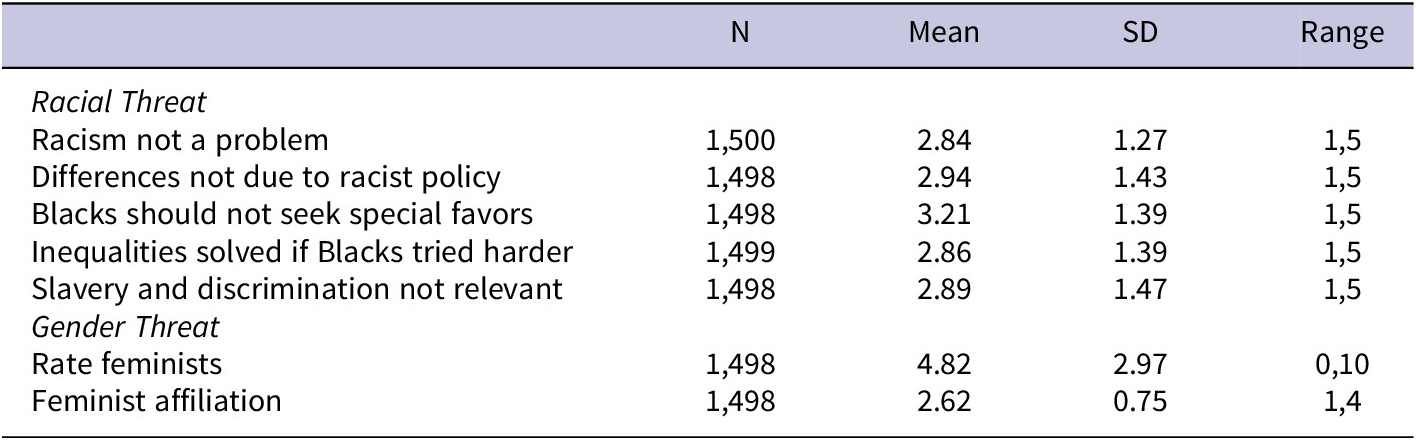
To capture racial threat, we use variables that comprise key mechanisms of laissez-faire, symbolic, and colorblind racism (views of racial discrimination, racial resentment). An exploratory factor analysis produced a well-fitting 3-factor model. From this we created a confirmatory factor analysis. All measures were captured on a 5-item Likert scale and were theoretically relevant and substantively correlated to one another. The first factor theoretically captured a denial of modern racism: differences caused by racial policies and practices, seriousness of racism, and Black people shouldn’t receive special favors. The seriousness of racism and the special favors questions were reverse-coded so higher values represent a stronger denial of modern racism. The second factor theoretically captured abstract liberalism and adherence to the protestant work ethic: Black people should try harder and Black people shouldn’t receive special favors. Both measures are reverse-coded so higher values represent more agreement with the statements. The last factor included the previous two factors as well as the belief that generations of slavery and discrimination have disenfranchised Black Americans from upward economic mobility. The belief of past discrimination was also reverse coded so factor scores extracted from this final factor would represent greater racial threat. This factor analysis produced a model that was a good fit to the data (chi-square: 0.93, p-value: 0.63, RMSEA: 0, SRMR: 0, TLI: 1, CFI: 1). Racial status threats were the least among Black Americans and highest among White Americans. Further descriptive statistics for all indicator variables for racial and gender threat are provided in Table 2.
Descriptive Statistics for Racial and Gender Threat Indicators

We created a measure of gender threat from two questions on feminism. Feminist ideology is synonymous with broad notions of equality across sexes so opposition to feminism would thus reflect a greater desire to maintain the status quo of gender relations (Rivera-Rodriguez et al. Reference Rivera-Rodriguez, Larsen and Dasgupta2022). The first asks respondents to rate feminists from 0 to 100. This variable is rescaled by a factor of 10 and then reverse-coded so higher values represent a lower rating of feminists. The next question asks respondents about their affiliation with feminism. This 4-item Likert measure ranges from “Strong feminist” to “Anti-feminist” where higher values represent greater anti-feminism. Both variables were then standardized, added together into an index, and averaged. The resultant variable is utilized as our measure of gender threat. Additionally, another measure of gender threat weighted each standardized feminism variable by their factor loadings from an exploratory factor analysis, respectively. These weighted variables were then compiled into an additive index. This additional measure of gender threat was not substantially different from the previous measure, so we only report findings from the averaged gender threat measure. Gender status threats were the highest among men and the lowest among women.
Demographics
We control for a number of sociodemographic characteristics: sex, race and ethnicity, age (in tens of years), education level, familial income thresholds, political party affiliation, and political ideology, marital status (separated, divorced, and never married are treated as the reference group), and population density. The racial categories used in multivariate analyses treat being White and being male as the reference category for race and sex. While the January 6th insurrection did see some participation from people of color it was dominated almost exclusively by White Americans and featured White supremacist groups, slogans, and other imagery (Seton Hall School of Law 2023; Washington Post Staff 2024). Additionally, women were present and among those prosecuted, but the insurrection was largely a male-dominated event (Seton Hall School of Law 2023). Thus, White Americans and men may hold distinct views toward the punishment of January 6th insurrectionists.
Analytic strategy
Nearly all of the measures were missing very few cases. In fact, only three measures are missing more than a third of one percent of their cases. These are employment status with about 7%, family income with about 11%, and political ideology with about 14% missingness. We utilize multiple imputation with twenty imputed data sets of model and auxiliary variables to increase efficiency. Auxiliary variables are utilized in multiple imputation to improve the accuracy of multiply imputed estimates (Schafer Reference Schafer2000; Hardt et al. Reference Hardt, Herke and Leonhart2012). They do so by adding additional information—beyond the observed variables in our models—into the imputation algorithm. We include home ownership and feeling thermometers of Democrats and Republicans as auxiliaries. These variables are substantively correlated to family income and political ideology, and help ensure more accurate and reliable estimates of missing values. Below we present our results from linear models where White Americans and those who identify as male are the reference category.Footnote 3
Results
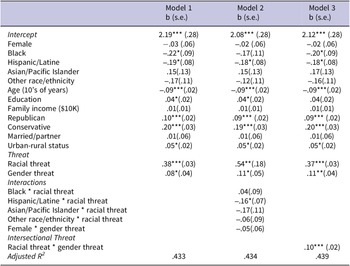
We start with an analysis of views about the punishments that January 6th insurrectionists received. Coefficients predicting the perception that criminal legal punishments against the insurrectionists were too severe are presented in Table 3. Several demographic variables are noteworthy. Black, Hispanic/Latine, and older respondents were more likely to think punishments were not severe enough, whereas Republican and conservative respondents thought punishments were overly severe. Here we start to see the divergence of political ideologies from the norm of punitiveness, a finding further established when considering racial and gender threats. We also find modest effects for education and urbanicity, both associated with opposing punishments.
Coefficients from Models Predicting Perception of Overly Harsh Punishment toward January 6th Rioters

*p <.05, **p <.01, ***p <.001 (2-tailed). N = 1500. Multiply imputed. b = unstandardized coefficients; (s.e.) = standard errors
While accounting for the effect of these controls, we find that concerns about threats to white privilege and male privilege independently are important. Those who perceived racial threats against the status of White Americans, and those who perceived threats against the privileged status of men, were more likely to think that punishments were too severe. As both measures have means around zero and standard deviations around one, the coefficients reflect a larger positive effect for racial relative to gender threat. This novel finding contradicts a vast body of research suggesting threat is associated with more punitiveness, at least punitiveness toward non-political crimes or civil rights protesters. These effects remain consistent across models regardless of the inclusion of interaction terms.
Model 2 explores whether the effects of racial and gendered threats are exclusive to White people and men, respectively. To do so, we ran interactions between all racial groups and racial threat, and gender and gender threat. We find that racial threat has a slightly weaker effect among Hispanic/Latine respondents than it does among White respondents,Footnote 4 but there is no significant difference between Black or Asian respondents and White respondents. In other words, Black people who are high in racial threat don’t have statistically different views about January 6th punishments than White people who are high in racial threat. Similarly, in the gender and gender threat interaction, women who are high in gender threat do not have statistically different views than men who are high in gender threat. Although the effects of threat are similar regardless of what race—except for Hispanic/Latine respondents—or gender perceives that threat, racial threat is far more prevalent among White Americans, and gender threat is far more prevalent among men.
Finally, central to this paper is the presence of an intersectional threat—where respondents feel status threats to multiple privileged identities (being a man and being White) simultaneously. To explore this, we ran an interaction between racial threat and gender threat. In Model 3 of Table 3, we find people who perceived this intersectional threat are significantly more likely to believe the punishments insurrectionists received were too severe. Dual concerns about the privileged status of White Americans and the privileged status of men have a unique effect, distinct from individual threats, that leads people to view January 6th criminal legal punishments as too severe.
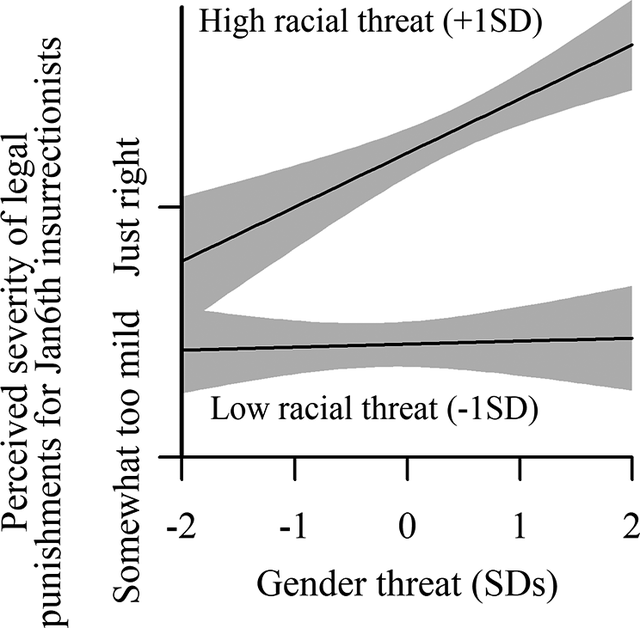
To visually represent these results, Figure 1 presents predicted values for punishment severity views. This figure highlights how gender threat amplifies punishment views among those who also perceive racial threats. For those who don’t perceive racial threats, whether or not they perceive gender threats doesn’t seem to significantly impact their punishment views. Respondents with low perceptions of racial threat tended to consistently lean toward believing that the punishments secured for the insurrectionists were too mild. But for those who do perceive racial threats, also perceiving gender threats makes you more likely to think the legal punishments against insurrectionists were too severe. In other words, concerns about male privilege serve a unique instigating role in punishment views.
Predicted opposition to January 6th punishment severity for racial threat and gender threat interaction, holding other measures at their means.

Discussion and conclusion
On January 6th, 2021, a large crowd violently attacked the U.S. Capitol building, attempting to halt a democratic transfer of power. In response, a massive prosecutorial effort worked efficiently and effectively to hold the participants accountable. Yet over the next four-plus years, those efforts were contested in public dialogues and ultimately undone by Presidential pardons. Our question is one with basic implications for democracy itself: what drove public support or opposition to the outcomes of this prosecutorial work—the punishments themselves—as the prosecutions were ongoing?
Partisanship matters in these judgments, but we suggest something more nuanced lies beneath: concerns about the maintenance of group privilege. Throughout U.S. history, these forces have often acted to garner opposition to protests and support for their criminalization—but only for protests that challenge status quo social inequalities.
The January 6th insurrectionists, however, appeared more interested in the preservation of a specific political order and the racialized and gendered privileges bound up with it. In the past, for other anti-democratic protests aimed at maintaining status quo inequalities—such as the 1894 Wilmington coup and massacre—there was little public outcry (from the White community, at least), and no prosecutions of participants.
Our findings reflect this contrast from views of other protest activity. First, we found Americans who perceive greater threats to white privilege and male privilege respectively were more likely to say that the punishments secured by prosecutors were too severe. While racial threats and gender threats are much more common among White Americans and men respectively, there were no drastic differences in the effect of these threats on punishment views across race or gender.
Second, and central to our intersectional threat framework, among those who perceived threats to white privilege, simultaneously perceiving threats to male privilege amplified their view that punishments were overly severe. This suggests that, while racial threat and gender threat are singularly important factors, criticizing the severity of punishments that January 6th insurrectionists received offers people the ability to simultaneously voice their racial and gendered concerns, legitimizing the gendered violence of a predominantly white supremacy event. In essence, these people are doing the work of reproducing structural inequality across race and gender. The same citizens who may favor harsh punishment in the abstract—or for movements they see as threatening—proved lenient when the defendants were understood as protecting the status quo.
Implications for research
Conflict theorists argue that all crime is political, as clearly are laws, which are produced through political processes, and for that matter, prosecutors, who act as elected or politically appointed representatives of the state. In this sense, all prosecutions are political. But it is worth considering the special case of the prosecution of explicitly and intentionally political public behavior: protests. Our results carry several implications for research.
First, we find that public views of political prosecutions aren’t driven simply by partisan interests. Instead, they reflect deeper concerns about group position and social structural advantages and disadvantages.
Second, while views of prosecutions and punishment more generally are often driven by perceived threats—in particular racial threats—these findings present an interesting counterpoint, suggesting that people’s desires for punitiveness are highly contingent on the assumed targets of threat punitiveness. This contrasts with research revealing racist ideologies as a predictor of punitive attitudes generally (Barkan and Cohn Reference Barkan and Cohn1994, Reference Barkan and Cohn1998, Reference Barkan and Cohn2005; Borg Reference Borg1997; Hurwitz and Peffley Reference Hurwitz and Peffley1997; Soss et al. Reference Soss, Langbein and Metelko2003; Bobo and Johnson Reference Bobo and Johnson2004; Hurwitz and Peffley Reference Hurwitz and Peffley2005; Unnever and Cullen Reference Unnever and Cullen2010; Carter and Corra Reference Carter, Corra and Jenks2016; Peffley et al. Reference Peffley, Hurwitz and Mondak2017), as well as research suggesting that a combination of racism and sexism increased the desired criminalization of Black Lives Matter Protestors (Drakulich and Law Reference Drakulich and Law2025).
Third, research on views of prosecutions and punishment more broadly has tended to emphasize racial threat more than gender threat. Our work suggests that, particularly in the midst of overlapping social movements, we should be conceptualizing threat intersectionally.
Broader implications
Although this paper is most directly an exploration of people’s views of the severity of the punishments secured for January 6th insurrectionists, it can also be read as a test of public opinion about the backlash a future president might face in pardoning participants engaged in political behavior. Presidential pardons, in undoing the work of prosecutors and thereby circumventing the rule of law, have been controversial since the nation’s founding. As George Mason wrote in Objections to the Proposed Constitution, “the President of the United States has the unrestrained power of granting pardons for treason, which may be sometimes exercised to screen from punishment those whom he had secretly instigated to commit the crime, and thereby prevent a discovery of his own guilt” (National Archives 1787). We find that where the public perceives prosecutions as targeting defenders of the status quo, there may be greater tolerance for clemency and skepticism toward punishment. In other words, many Americans may be open to pardons that seem obviously self-interested for crimes committed seemingly on behalf of the president, as long as they see the president’s goals as ensuring the persistence of existing privileges.
Additionally, because judgments about prosecutors hinge on who is imagined as threatened and who is imagined as protected, enforcement against explicitly political acts will tend to be asymmetrical: movements read as challenging racial and gender hierarchies face demands for harshness, while movements read as preserving them elicit demands for restraint. This fits with past experience: protests that try to advance social justice and electoral inclusion are routinely repressed at disproportionate rates. Echoing sentiment from both Dr. King Jr’s 1968 “The Other America” speech and a well-known quote from the 1986 Kerner Commission, there seems to be two separate societies: one where peaceful civil rights protests are repressed, and another where violent protests in defense of the status quo are legitimized. This has particular modern relevance: in the years following the January 6th insurrection, anti-genocide protests on college campuses and peaceful resistance to aggressive immigration enforcement faced violent repression (Epstein et al. Reference Epstein, Debusmann and Hayes2025; Yoon Reference Yoon2025), while opposition movements were formally labeled terrorist organizations to facilitate their criminalization (Patel Reference Patel2025).
These developments are striking, but not historically unique. During the civil rights era, sheriffs, prosecutors, and allied political actors routinely criminalized civil rights activism while ignoring or under-prosecuting the political violence—including lynchings—used to suppress Black Americans (Barkan and Cohn Reference Barkan and Cohn1994, Reference Barkan and Cohn1998, Reference Barkan and Cohn2005; Borg Reference Borg1997; Hurwitz and Peffley Reference Hurwitz and Peffley1997; Beckett and Sasson Reference Beckett and Sasson2004; Soss et al. Reference Soss, Langbein and Metelko2003; Bobo and Johnson Reference Bobo and Johnson2004; Hurwitz and Peffley Reference Hurwitz and Peffley2005; Unnever and Cullen Reference Unnever and Cullen2010; Tonry Reference Tonry2011; Carter and Corra Reference Carter and Corra2016; Peffley et al. Reference Peffley, Hurwitz and Mondak2017; Wacquant Reference Wacquant2024). In short, our contribution is not just that partisanship colors views of January 6th. It is that perceptions of threat to white—and, contingently, male—privilege systematically reweight the scales of justice. That contingency helps explain today’s uneven appetite for accountability and clarifies why the same citizens who champion “law and order” can balk at punishing an attack on democracy.
Supplementary material
The supplementary material for this article can be found at http://doi.org/10.1017/jlc.2026.10024.
Financial support
No funding was received to support the research, authorship, or preparation of this manuscript.
Competing interests
The authors have no conflicts of interest to disclose.



 Open access

