Element contents
Series: Elements of Paleontology
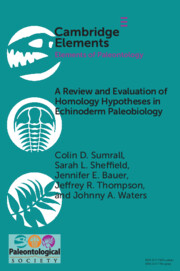
A Review and Evaluation of Homology Hypotheses in Echinoderm Paleobiology
Published online by Cambridge University Press: 24 March 2023

Summary
The extraxial-axial theory (EAT) and universal elemental homology (UEH) are often portrayed as mutually exclusive hypotheses of homology within pentaradiate Echinodermata. EAT describes homology upon the echinoderm bauplan, interpreted through early post-metamorphic growth and growth zones, dividing it into axial regions generally associated with elements of the ambulacral system and extraxial regions that are not. UEH describes the detailed construction of the axial skeleton, dividing it into homologous plates and plate series based on symmetry, early growth, and function. These hypotheses are not in conflict; the latter is rooted in refinement of the former. Some interpretive differences arise because many of the morphologies described from eleutherozoan development are difficult to reconcile with Paleozoic forms. Conversely, many elements described for Paleozoic taxa by UEH, such as the peristomial border plates, are absent in eleutherozoans. This Element recommends these two hypotheses be used together to generate a better understanding of homology across Echinodermata.
Information
- Type
- Element
- Information
- Series: Elements of PaleontologyOnline ISBN: 9781009397155Publisher: Cambridge University PressPrint publication: 13 April 2023
References
Arenas-Mena, C., Cameron, A. R., and Davidson, E. H. (2000). Spatial expression of Hox cluster genes in the ontogeny of a sea urchin. Development, 127, 4631–4643.Google Scholar
Ausich, W. I., and Kammer, T. (2013). Mississippian crinoid biodiversity, biogeography and macroevolution. Paleontology, 56, 727–740.Google Scholar
Ausich, W. I., Wright, D. F., Cole, S. R., and Sevastopulo, G. D. (2020). Homology of posterior interray plates in crinoids: A review and new perspectives from phylogenetics, the fossil record and development. Palaeontology, 63, 525–545.CrossRefGoogle Scholar
Bauer, J. E. (2020). Paleobiogeography, paleoecology, diversity, and speciation patterns in the Eublastoidea (Blastozoa: Echinodermata). Paleobiology, 47, 221–235.Google Scholar
Bauer, J. E., Sheffield, S. L., Sumrall, C. D., and Waters, J. A. (2022). Echinoderm model systems, homology, and phylogenetic inference: Comment and reply to Paul (2021). Acta Palaeontologica Polonica, 67, 455–468. DOI: https://doi.org/10.4202/app.00956.2021.Google Scholar
Bell, B. M. (1976a). A study of North American Edrioasteroidea. New York State Museum and Science Survey, 21, 1–447.Google Scholar
Bell, B. M. (1976b). Phylogenetic implications of ontogenetic development in the class Edrioasteroidea (Echinodermata). Journal of Paleontology, 50, 1001–1019.Google Scholar
Bell, B. M., and Petersen, M. S. (1976). An edrioasteroid from the Guilmette Formation at Wendover, Utah-Nevada. Journal of Paleontology, 50, 577–589.Google Scholar
Bockelie, J.F. (1979). Taxonomy, functional morphology and palaeoecology of the Ordovician cystoid family Hemicosmitidae. Palaeontology 22, 363–406.Google Scholar
Box, G. E. P. (1976). Science and statistics. Journal of the American Statistical Association, 71, 791–799. DOI: https://doi.org/10.1080/01621459.1976.10480949.Google Scholar
Brett, C. E., Moffat, H. A., and Taylor, W. L. (1997). Echinoderm taphonomy, taphofacies, and Lagerstätten. Paleontological Society Papers, 3, 147–190.Google Scholar
Broadhead, T. W., and Strimple, H. L. (1975). Respiration in a vagrant Ordovician cystoid, Amecystis. Paleobiology, 1, 312–319.CrossRefGoogle Scholar
Brochu, C. A., and Sumrall, C. D. (2001). Phylogenetic nomenclature and paleontology. Journal of Paleontology, 75, 754–757.Google Scholar
Brower, J. C. (1999). A new pleurocystitid rhombiferan echinoderm from the Middle Ordovician Galena Group of northern Iowa and southern Minnesota. Journal of Paleontology, 73, 129–153.Google Scholar
Byrne, M., Martinez, P., and Morris, V. (2016). Evolution of a pentameral body plan was not linked to translocation of anterior Hox genes: The echinoderm HOX cluster revisited. Evolution & Development, 18, 137–143.CrossRefGoogle Scholar
Chauvel, J. (1941). Recherches sur les Cystoïdes et les Carpoïdes armoricaines. Mémoires de la Société Géologique et Minéralogique de Bretagne, 5, 1–286.Google Scholar
Cisternas, P., and Byrne, M. (2009). Expression of Hox4 during development of the pentamerous juvenile sea star, Parvulastra exigua. Development Genes and Evolution, 219, 613–618.CrossRefGoogle ScholarPubMed
Czarkwiani, A., Dylus, D. V., Carballo, L., and Oliveri, P. (2021). FGF signaling plays similar roles in development and regeneration of the skeleton in the brittle star Amphiura filiformis. Development, 148, dev180760.Google Scholar
Czarkwiani, A., Ferrario, C., Dylus, D. V., Sugni, M., and Oliveri, P. (2016). Skeletal regeneration in the brittle star Amphiura filiformis. Frontiers in Zoology, 13, 1–17.Google Scholar
David, B., Lefebvre, B., Mooi, R., and Parsley, R. (2000). Are homalozoans echinoderms? An answer from the extraxial-axial theory. Paleobiology, 26, 529–555.Google Scholar
David, B., and Mooi, R. (1998). Major events in the evolution of echinoderms viewed by the light of embryology. In Mooi, R. and Telford, M., eds., Echinoderms: San Francisco. Rotterdam: Balkema, pp. 21–28.Google Scholar
Deline, B. (2021). Echinoderm Morphological Disparity: Methods, Patterns, and Possibilities. Elements of Paleontology. Cambridge, UK: Cambridge University Press.Google Scholar
Deline, B., Thompson, J. R., Smith, N. S. et al. (2020). Evolution and development at the origin of a phylum. Current Biology, 30, 1–8. DOI: https://doi.org/10.1016/j.cub.2020.02.054.Google Scholar
Dexter, T. A., Sumrall, C. D., and McKinney, M. L. (2009). Allometric strategies for increasing respiratory surface area in the Mississippian blastoid Pentremites. Lethaia, 42, 127–137.Google Scholar
Duloquin, L., Lhomond, G., and Gache, C. (2007). Localized VEGF signaling from ectoderm to mesenchyme cells controls morphogenesis of the sea urchin embryo skeleton. Development, 134, 2293–2302. DOI: https://doi.org/10.1242/dev.005108.Google Scholar
Erkenbrack, E. M., and Thompson, J. R. (2019). Cell type phylogenetics informs the evolutionary origin of echinoderm larval skeletogenic cell identity. Communications Biology, 2, 160.CrossRefGoogle ScholarPubMed
Frest, T. J., Strimple, H. L., and Paul, C. R. C. (2011). The North American Holocystites fauna (Echinodermata: Blastozoa: Diploporita): Paleobiology and systematics. Bulletins of American Paleontology, 380, 1–141.Google Scholar
Formery, L., Orange, F., Formery, A. et al. (2021). Neural anatomy of echinoid early juveniles and comparison of nervous system organization in echinoderms. Journal of Comparative Neurology, 529, 1135–1156.CrossRefGoogle ScholarPubMed
Gaillard, C., Neraudeau, D., and Thierry, J. (2011). Tithonia oxfordiana, a new irregular echinoid associated with Jurassic seep deposits in south‐east France. Palaeontology, 54, 735–752.Google Scholar
Gao, F., Thompson, J. R., Petsios, E. et al. (2015). Juvenile skeletogenesis in anciently diverged sea urchin clades. Developmental Biology, 400, 148–158.CrossRefGoogle ScholarPubMed
Gondolf, A. L. (2002). The aboral surface of Asterias rubens L.(Echinodermata: Asteroidea) during metamorphosis with particular reference to the hydropore and madreporite. Invertebrate reproduction & development, 42, 51–59.CrossRefGoogle Scholar
Gorzelak, P. (2021). Functional Micromorphology of the Echinoderm Skeleton. Elements of Paleontology. Cambridge, UK: Cambridge University Press.Google Scholar
Gosselin, P., and Jangoux, M. (1998). From competent larva to exotrophic juvenile: A morphofunctional study of the perimetamorphic period of Paracentrotus lividus (Echinodermata, Echinoida). Zoomorphology, 118, 31–43.Google Scholar
Guensburg, T. E., Blake, D. B., Sprinkle, J., and Mooi, R. (2015). Crinoid ancestry without blastozoans. Acta Palaeontologica Polonica, 61, 253–266.Google Scholar
Guensburg, T. E., Mooi, R., Sprinkle, J., David, B., and Lefebvre, B. (2010). Pelmatozoan arms from the mid‐Cambrian of Australia: Bridging the gap between brachioles and brachials? Comment: There is no bridge. Lethaia, 43, 432–440.CrossRefGoogle Scholar
Guensburg, T. E., and Sprinkle, J. (2001). Earliest crinoids: New evidence for the origin of the dominant Paleozoic echinoderms. Geology, 29, 131–134.Google Scholar
Guensburg, T. E., and Sprinkle, J. (2007). Phylogenetic implications of the Protocrinoida: Blastozoans are not ancestral to crinoids. Annales de Paléontologie, 93, 277–290.Google Scholar
Guensburg, T. E., and Sprinkle, J. (2010). Emended restoration of Titanocrinus sumralli Guensburg and Sprinkle, 2003 (Echinodermata, Crinoidea). Journal of Paleontology, 84, 566–568.Google Scholar
Guensburg, T. E., Sprinkle, J., Mooi, R. et al. (2020). Athenacrinus n. gen. and other early echinoderm taxa inform crinoid origin and arm evolution. Journal of Paleontology, 94, 311–333.CrossRefGoogle Scholar
Hara, Y., Yamaguchi, M., Akasaka, K. et al. (2006). Expression patterns of Hox genes in larvae of the sea lily Metacrinus rotundus. Development Genes and Evolution, 216, 797–809.Google Scholar
Hotchkiss, F. H. (2012). Growth zones and extraxial-axial skeletal homologies in Asteroidea (Echinodermata). Proceedings of the Biological Society of Washington, 125, 106–121.Google Scholar
Janssen, R., and Budd, G. E. (2020). Expression of the zinc finger transcription factor Sp6–9 in the velvet worm Euperipatoides kanangrensis suggests a conserved role in appendage development in Panarthropoda. Development Genes and Evolution, 230, 239–245.Google Scholar
Kammer, T. W., and Ausich, W. I. (2007). Soft‐tissue preservation of the hind gut in a new genus of cladid crinoid from the Mississippian (Visean, Asbian) at St. Andrews, Scotland. Palaeontology, 50, 951–959.Google Scholar
Kammer, T. W., Sumrall, C. D., Zamora, S., Ausich, W. I., and Deline, B. (2013). Oral region homologies in Paleozoic crinoids and other plesiomorphic pentaradial echinoderms. PLoS One, 8, e77989. DOI: https://doi.org/10.1371/journal.pone.0077989.Google Scholar
Kerr, A. M., and Kim, J. (2001). Phylogeny of Holothuroidea (Echinodermata) inferred from morphology. Zoological Journal of the Linnean Society, 133, 63–81.Google Scholar
Kesling, R. V. (1960). Hydropores in edrioasteroids. Contributions from the Museum of Paleontology, University of Michigan, 15, 139–192.Google Scholar
Kesling, R. V. (1968). Cystoids. In Moore, R. C. (ed.), Treatise on Invertebrate Paleontology, part S Echinodermata 1 (1): Lawrence, Kansas, and Boulder, Colorado, University of Kansas Press and Geological Society of America, pp. S85–S267.Google Scholar
Kesling, R. V., and Mintz, L. W. (1960). Internal structures in two edrioasteroid species, Isorophus cincinnatiensis (Roemer) and Carneyella pilea (Hall). Contributions from the Museum of Paleontology, University of Michigan, 15, 315–348.Google Scholar
Kier, P. M. (1968). Echinoids from the Middle Eocene Lake City Formation of Georgia. Smithsonian Miscellaneous Collections, 153, 1–45.Google Scholar
Kikuchi, M., Omori, A., Kurokawa, D., and Akasaka, K. (2015). Patterning of anteroposterior body axis displayed in the expression of Hox genes in sea cucumber Apostichopus japonicus. Development Genes and Evolution, 225, 275–286.Google Scholar
Kroh, A., Lukeneder, A., and Gallemí, J. (2014). Absurdaster, a new genus of basal atelostomate from the Early Cretaceous of Europe and its phylogenetic position. Cretaceous Research, 48, 235–249.Google Scholar
Lam, A. R., Sheffield, S. L., and Matzke, N. J., (2021). Estimating dispersal and evolutionary dynamics in diploporan blastozoans (Echinodermata) across the great Ordovician biodiversification event. Paleobiology, 47, 198–220.Google Scholar
Lev, O., Edgecombe, G. D., and Chipman, A. D. (2022). Serial homology and segment identity in the arthropod head. Integrative Organismal Biology, 4, obac015.Google Scholar
Lowe, C. J., and Wray, G. A. (1997). Radical alterations in the roles of homeobox genes during echinoderm evolution. Nature, 389, 718–721.Google Scholar
McKinney, M. L., and Sumrall, C. D. (2011). Ambulacral growth allometry in edrioasteroids: Functional surface‐volume change in ontogeny and phylogeny. Lethaia, 44, 102–108.Google Scholar
Mooi, R., David, B., and Marchand, D. (1994). Echinoderm skeletal homologies: Classical morphology meets modern phylogenetics. In David, B., Guille, A., Féral, J. P., and Roux, M., eds., Echinoderms through Time. Balkema: Rotterdam, pp. 87–95.Google Scholar
Mooi, R. and David, B. (1997). Skeletal homologies of echinoderms. In Waters, J. A. and Maples, G. G., eds. Geobiology of echinoderms. Paleontological Society Papers, 3, 305–335.Google Scholar
Mooi, R., and David, B. (1998). Evolution within a bizarre phylum: Homologies of the first echinoderms. American Zoologist, 38, 965–974.Google Scholar
Mooi, R., and David, B., 2000. What a new model of skeletal homologies tells us about asteroid evolution. American Zoologist, 40, 326–339.Google Scholar
Mooi, R., David, B., and Wray, G. A. (2005). Arrays in rays: Terminal addition in echinoderms and its correlation with gene expression. Evolution & Development, 7, 542–555.Google Scholar
Mooi, R., and David, B. (2008). Radial symmetry, the anterior/posterior axis, and echinoderm Hox genes. Annual Review of Ecology, Evolution, & Systematics, 39, 43–62.Google Scholar
Morris, V. B. (2007). Origins of radial symmetry identified in an echinoderm during adult development and the inferred axes of ancestral bilateral symmetry. Proceedings of the Royal Society B: Biological Sciences, 274, 1511–1516.Google Scholar
Morris, V. B. (2012). Early development of coelomic structures in an echinoderm larva and a similarity with coelomic structures in a chordate embryo. Development genes and evolution, 222, 313–323.Google Scholar
Morris, V. B., and Byrne, M. (2005). Involvement of two Hox genes and Otx in echinoderm body‐plan morphogenesis in the sea urchin Holopneustes purpurescens. Journal of Experimental Zoology Part B: Molecular and Developmental Evolution, 304, 456–467.Google Scholar
Morris, V. B., and Byrne, M. (2014). Oral–aboral identity displayed in the expression of HpHox3 and HpHox11/13 in the adult rudiment of the sea urchin Holopneustes purpurescens. Development Genes and Evolution, 224, 1–11.Google Scholar
Nohejlová, M., and Fatka, O. (2016). Ontogeny and morphology of Cambrian eocrinoid Akadocrinus (Barrandian area, Czech Republic). Bulletin of Geosciences, 91, 141–153.Google Scholar
Okada, M. (1979). The central role of the genital duct in the development and regeneration of the genital organs in the sea urchin. Development, Growth & Differentiation, 21, 567–576.Google Scholar
Oliveri, P., Tu, Q., and Davidson, E. H. (2008). Global regulatory logic for specification of an embryonic cell lineage. Proceedings of the National Academy of Sciences, 105, 5955–5962.Google Scholar
O’Malley, C. E., Ausich, W. I., and Chin, Y. (2016). Deep echinoderm phylogeny preserved in organic molecules from Paleozoic fossils. Geology, 44, 379–382.Google Scholar
Ortega-Hernández, J., Janssen, R., and Budd, G. E. (2017). Origin and evolution of the panarthropod head: A palaeobiological and developmental perspective. Arthropod Structure & Development, 46, 354–379.Google Scholar
Nohejlová, M., Nardin, E., Fatka, O., Kašička, L., and Szabad, M. (2019). Morphology, palaeoecology and phylogenetic interpretation of the Cambrian echinoderm Vyscystis (Barrandian area. Czech Republic). Journal of Systematic Palaeontology 17, 1619–1634.Google Scholar
Patterson, C. (1982). Morphological characters and homology. In Joysey, K. A. and Friday, A. E., eds., Problems of Phylogenetic Reconstruction. London and New York: Academic Press, pp. 21–74.Google Scholar
Parsley, R. L. (1970). Revision of the North American Pleurocystitidae (Rhombifera – Cystoidea). Bulletins of American Paleontology, 58, 132–213.Google Scholar
Parsley, R. L. (1980). Homalozoa. In Broadhead, T. W. and Waters, J. A., eds., Echinoderms, Notes for a Short Course: Studies in Geology, 3, 106–117.Google Scholar
Parsley, R. L. (2013). Development and functional morphology of sutural pores in Early and Mid-Cambrian gogiid eocrinoids from Guizhou Province, China. In Johnson, C., ed., Echinoderms in a Changing World: Proceedings of the 13th International Echinoderm Conference. Hobart: University of Tasmania, pp. 79–86.Google Scholar
Parsley, R.L., and Mintz, L.W. (1975). North American Paracrinoidea: (Ordovician: Paracrinozoa, new, Echinodermata): Bulletins of American Paleontology, 68, 1–113.Google Scholar
Parsley, R. L., and Zhao, Y. (2006). Long stalked eocrinoids in the basal Middle Cambrian Kaili Biota, Taijiang County, Guizhou Province, China. Journal of Paleontology, 80, 1058–1071.Google Scholar
Paul, C. R. C. (1967). The functional morphology and mode of life of the cystoid Pleurocystites, E. Billings, 1854. In Millott, N., ed., Echinoderm Biology: Symposia of the Zoological Society of London, 20, 105–123.Google Scholar
Paul, C. R. C. (1968a). Macrocystella Callaway, the earliest glyptocystitid cystoid. Palaeontology, 11, 580–600.Google Scholar
Paul, C. R. C. (1968b). Morphology and function of the dichoporite pore-structures in cystoids. Palaeontology, 11, 697–730.Google Scholar
Paul, C. R. C. (1984). British Ordovician Cystoids Part 2. Palaeontographical Society Monographs, 563, 65–152.Google Scholar
Paul, C. R. C. (2021). New insights into the origin and relationships of blastoid echinoderms. Acta Palaeontologica Polonica, 66, 41–62. DOI: https://doi.org/10.4202/app.00825.2020.Google Scholar
Paul, C. R., and Hotchkiss, F. H. (2020). Origin and significance of Lovén’s Law in echinoderms. Journal of Paleontology, 94, 1089–1102.Google Scholar
Paul, C. R. C., and Toom, U. (2021). The diploporite blastozoan Glyptosphaerites (Echinodermata: Blastozoa) and the origin of diplopores. Estonian Journal of Earth Sciences, 70, 224–239.Google Scholar
Peters, J., and Lane, N. G. (1990). Ontogenetic adaptations in some Pennsylvanian crinoids. Journal of Paleontology, 64, 427–435.Google Scholar
Peterson, K. J., Arenas-Mena, C., and Davidson, E. H. (2000). The A/P axis in echinoderm ontogeny and evolution: evidence from fossils and molecules. Evolution & development, 2, 93–101.Google Scholar
Piovani, L., Czarkwiani, A., Ferrario, C., Sugni, M., and Oliveri, P. (2021). Ultrastructural and molecular analysis of the origin and differentiation of cells mediating brittle star skeletal regeneration. BMC Biology, 19, 1–19.Google Scholar
Rowe, T. (1988). Definition, diagnosis, and origin of Mammalia. Journal of Vertebrate Paleontology, 8, 241–264.Google Scholar
Saucède, T., David, B., and Mooi, R. (2001). The strange apical system of the genus Pourtalesia (Holasteroida, Echinoidea). Echinoderm Research, 131–136.Google Scholar
Savriama, Y., Stige, L. C., Gerber, S. et al. (2015). Impact of sewage pollution on two species of sea urchins in the Mediterranean Sea (Cortiou, France): Radial asymmetry as a bioindicator of stress. Ecological Indicators, 54, 39–47.Google Scholar
Shashikant, T., Khor, J. M., and Ettensohn, C. A. (2018). From genome to anatomy: The architecture and evolution of the skeletogenic gene regulatory network of sea urchins and other echinoderms. Genesis, 56, e23253.Google Scholar
Sheffield, S. (2013). The Pennsylvanian cladid crinoid Erisocrinus: Ontogeny and systematics. Unpublished M.S. thesis, Auburn University.Google Scholar
Sheffield, S. L., and Sumrall, C. D. (2017). Generic revision of the Holocystitidae of North America (Diploporita: Echinodermata) based on universal elemental homology. Journal of Paleontology, 91, 755–766. DOI: https://doi.org/10.1017/jpa.2016.159.Google Scholar
Sheffield, S. L., and Sumrall, C. D. (2019). The phylogeny of the Diploporita: A polyphyletic assemblage of blastozoan echinoderms. Journal of Paleontology, 93, 740–752.Google Scholar
Sheffield, S. L., Sumrall, C. D., and Ausich, W. I. (2018). Late Ordovician (Hirnantian) diploporitan fauna of Anticosti Island, Quebec, Canada: Implications for evolutionary and biogeographic patterns. Canadian Journal of Earth Sciences, 55, 1–7. DOI: https://doi.org/10.1139/cjes-2017-0160.Google Scholar
Sheffield, S. L., Limbeck, M. R., Bauer, J. E., Hill, S. A., and Nohejlová, M. (2022). A review of blastozoan echinoderm respiratory structures. Elements of Paleontology. Cambridge, UK: Cambridge University Press. doi:10.1017/9781108881821Google Scholar
Shubin, N. H., Tabin, C., and Carroll, S. (2009). Deep homology and the origins of evolutionary novelty. Nature, 457, 818–823.Google Scholar
Shubin, N. H., and Marshall, C. R. (2000). Fossils, genes, and the origin of novelty. Paleobiology, 26, 324–340.Google Scholar
Smith, A. B. (1984b). Classification of the Echinodermata. Palaeontology, 27, 431–459.Google Scholar
Smith, A. B. (1985). Cambrian eleutherozoan echinoderms and the early diversification of edrioasteroids. Palaeontology, 28, 715–756.Google Scholar
Smith, A. B. (2004). Phylogeny and systematics of holasteroid echinoids and their migration into the deep‐sea. Palaeontology, 47, 123–150.Google Scholar
Smith, A. B. (2005). The pre‐radial history of echinoderms. Geological Journal, 40, 255–280.Google Scholar
Smith, A. B., and Jell, P. A. (1990). Cambrian edrioasteroids from Australia and the origin of starfishes. Memoirs of the Queensland Museum, 28, 715–778.Google Scholar
Smith, A. B., and Zamora, S. (2013). Cambrian spiral-plated echinoderms from Gondwana reveal the earliest pentaradial body plan. Proceedings of the Royal Society B: Biological Sciences, 280, 20131197.Google Scholar
Spirlet, C., Grosjean, P., and Jangoux, M. (1994). Differentiation of the genital apparatus in a juvenile echinoid (Paracentrotus lividus). In David, B., Guille, A., Féral, J. P., and Roux, M., eds., Echinoderms through Time. Balkema: Rotterdam, pp. 881–886.Google Scholar
Sprinkle, J. (1973). Morphology and Evolution of Blastozoan Echinoderms. Cambridge, MA: Harvard University Museum of Comparative Zoology Special Publication.Google Scholar
Sprinkle, J. (1975). The “arms” of Caryocrinites, a rhombiferan cystoid convergent on crinoids. Journal of Paleontology, 49, 1062–1073.Google Scholar
Sprinkle, J., and Wahlman, G. P. (1994). New echinoderms from the Early Ordovician of west Texas. Journal of Paleontology, 68, 324–338.Google Scholar
Sumrall, C. D. (1996). Late Paleozoic edrioasteroids (Echinodermata) from the North American midcontinent. Journal of Paleontology, 70, 969–985.Google Scholar
Sumrall, C. D. (1997). The role of fossils in the phylogenetic reconstruction of Echinodermata. The Paleontological Society Papers, 3, 267–288.Google Scholar
Sumrall, C. D. (2001). Paleoecology and taphonomy of two new edrioasteroids from a Mississippian hardground in Kentucky. Journal of Paleontology, 75, 136–146.Google Scholar
Sumrall, C. D. (2010). A model for elemental homology for the peristome and ambulacra in blastozoan echinoderms. In Harris, L. G., Böttger, S. A., Walker, C. W., and Lesser, M. P., eds., Echinoderms. CRC Durham, London: CRC Press, pp. 269–276.Google Scholar
Sumrall, C. D. (2015). Understanding the oral area of derived stemmed echinoderms. In Zamora, S. & Rábano, I., eds., Progress in Echinoderm Palaeobiology: Cuademos del Museo Geominero. Madrid: Instituto Geológico y Minero de España, 19, pp.169–173.Google Scholar
Sumrall, C. D. (2017). New insights concerning homology of the oral region and ambulacral system plating of pentaradial echinoderms. Journal of Paleontology, 91, 604–617.Google Scholar
Sumrall, C. D. (2020.) Echinodermata. In de Queiroz, K., Gauthier, J., and Cantino, P., eds., Phylonyms: A Companion Volume to the PhyloCode. London: Taylor & Francis Group, pp. 645–648.Google Scholar
Sumrall, C. D., Brett, C. E., Dexter, T. A., and Bartholomew, A. (2009). An enigmatic blastozoan echinoderm fauna from central Kentucky. Journal of Paleontology, 83, 739–749.Google Scholar
Sumrall, C. D., and Gahn, F. J. (2006). Morphological and systematic reinterpretation of two enigmatic edrioasteroids (Echinodermata) from Canada. Canadian Journal of Earth Sciences, 43, 497–507.Google Scholar
Sumrall, C. D., and Schumacher, G. A. (2002). Cheirocystis fultonensis, a new glyptocystitoid rhombiferan from the Upper Ordovician of the Cincinnati Arch – comments on cheirocrinid ontogeny. Journal of Paleontology, 76, 843–851.Google Scholar
Sumrall, C. D., Deline, B., Colmenar, J., Sheffield, S. L., and Zamora, S.. (2015). New data on late Ordovician (Katian) echinoderms from Sardinia, Italy. In Zamora, S. and Rábano, I., eds., Progress in Echinoderm Palaeobiology: Cuademos del Museo Geominero. Madrid: Instituto Geológico y Minero de España, 19, pp. 159–162.Google Scholar
Sumrall, C. D., and Phelps, D. (2021). Spiracarneyella, a new carneyellid edrioasteroid from the Upper Ordovician (Katian) of Kentucky and Ohio and comments on carneyellid heterochrony. Journal of Paleontology, 95, 624–629.Google Scholar
Sumrall, C. D., and Sprinkle, J. (1995). Plating and pectinirhombs of the Ordovician rhombiferan Plethoschisma. Journal of Paleontology, 69, 772–778.Google Scholar
Sumrall, C. D., and Sprinkle, J. (1999). Early ontogeny of the glyptocystitid rhombiferan Lepadocystis moorei. In Carnevali, M. D. C. and Bonasoro, F., eds., Echinoderm Research 1998. Rotterdam: Balkema, pp. 409–414.Google Scholar
Sumrall, C. D., Sprinkle, J., and Guensburg, T. E. (2001). Comparison of flattened blastozoan echinoderms: Insights from the new Early Ordovician eocrinoid Haimacystis rozhnovi. Journal of Paleontology, 75, 985–992.Google Scholar
Sumrall, C. D., and Waters, J. A. (2012). Universal elemental homology in glyptocystitoids, hemicosmitoids, coronoids and blastoids: Steps toward echinoderm phylogenetic reconstruction in derived Blastozoa. Journal of Paleontology, 86, 956–972.Google Scholar
Sumrall, C. D., and Wray, G. A. (2007). Ontogeny in the fossil record: Diversification of body plans and the evolution of “aberrant” symmetry in Paleozoic echinoderms. Paleobiology, 33, 149–163.Google Scholar
Sumrall, C. D., and Zamora, S. (2011). Ordovician edrioasteroids from Morocco: Faunal exchanges across the Rheic Ocean. Journal of Systematic Palaeontology, 9, 425–454.Google Scholar
Sumrall, C. D., and Zamora, S. (2018). New Upper Ordovician edrioasteroids from Morocco. Geological Society, London, Special Publications, 485, 565–577.Google Scholar
Thompson, J. (2022). Molecular Paleobiology of the Echinoderm Skeleton Elements of Paleontology. Cambridge, UK: Cambridge University Press. doi:10.1017/9781009179768Google Scholar
Thompson, J. R., Cotton, L. J., Candela, Y. et al. (2022). The Ordovician diversification of sea urchins: Systematics of the Bothriocidaroida (Echinodermata: Echinoidea). Journal of Systematic Palaeontology, 19, 1395–1448.Google Scholar
Thompson, J. R., Paganos, P., Benvenuto, G., Arnone, M. I., and Oliveri, P. (2021). Post-metamorphic skeletal growth in the sea urchin Paracentrotus lividus and implications for body plan evolution. EvoDevo, 12, 1–14.Google Scholar
Tsuchimoto, J., and Yamaguchi, M. (2014). Hox expression in the direct‐type developing sand dollar Peronella japonica. Developmental Dynamics, 243, 1020–1029.Google Scholar
Tweedt, S. M. (2017). Gene regulatory networks, homology, and the early panarthropod fossil record. Integrative and Comparative Biology, 57, 477–487.Google Scholar
Ubaghs, G. (1971). Diversité et spécialisation des plus anciens Échinodermes que l’on connaisse. Biological Reviews, 46, 157–200.Google Scholar
Wagner, G. P. (2007) The developmental genetics of homology. Nature Reviews Genetics, 8, 473–479.Google Scholar
Wright, D. F. (2015). Fossils, homology, and “Phylogenetic Paleo-ontogeny”: A reassessment of primary posterior plate homologies among fossil and living crinoids with insights from developmental biology. Paleobiology, 41, 570–591.Google Scholar
Zamora, S., Linán, E., Alonso, P. D., Gozalo, R., and Vintaned, J. A. G. (2007). A Middle Cambrian edrioasteroid from the Murero biota (NE Spain) with Australian affinities. Annales de Paléontologie, 93, 249–260).Google Scholar
Zamora, S., and Rahman, I. A. (2014). Deciphering the early evolution of echinoderms with Cambrian fossils. Palaeontology, 57, 1105–1119.Google Scholar
Zamora, S., Rahman, I. A., and Smith, A. B. (2012). Plated Cambrian bilaterians reveal the earliest stages of echinoderm evolution. PLoS One, 7, e38296.Google Scholar
Zamora, S., and Sumrall, C.D. In press. Morphology and relationships of early pentaradial echinoderms. Elements of Paleontology. Cambridge, UK: Cambridge University Press.Google Scholar
Zamora, S., Rahman, I. A., Sumrall, C. D., Gibson, A. P., and Thompson, J. R. (2022). Cambrian edrioasteroid reveals new mechanism for secondary reduction of the skeleton in echinoderms. Proceedings of the Royal Society B, 289, 20212733.Google Scholar
Zamora, S., Sumrall, C. D., and Vizcaïno, D. (2012). Morphology and ontogeny of the Cambrian edrioasteroid echinoderm Cambraster cannati from western Gondwana. Acta Palaeontologica Polonica, 58, 545–559.Google Scholar
Zamora, S., Sumrall, C. D., Zhu, X. -J., and Lefebvre, B. (2017). A new stemmed echinoderm from the Furongian of China and the origin of Glyptocystitida (Blastozoa, Echinodermata). Geological Magazine, 154, 465–475.Google Scholar
Zhao, Y., Sumrall, C. D., Parsley, R. L., and Peng, J. (2010). Kailidiscus, a new plesiomorphic edrioasteroid from the basal Middle Cambrian Kaili biota of Guizhou Province, China. Journal of Paleontology, 84, 668–680.Google Scholar
Accessibility standard: Unknown
Why this information is here
This section outlines the accessibility features of this content - including support for screen readers, full keyboard navigation and high-contrast display options. This may not be relevant for you.Accessibility Information
Accessibility compliance for the HTML of this element is currently unknown
and may be updated in the future.
- 5
- Cited by