

Introduction
The Bahama Nuthatch Sitta insularis, a bark- and twig-gleaning insectivore endemic to the Bahama Islands east of Florida, USA, was long treated as a subspecies of Brown-headed Nuthatch S. pusilla until its recent elevation to species rank (Boesman and Collar Reference Boesman and Collar2020; del Hoyo and Collar Reference del Hoyo and Collar2016), following which it was assessed as first (2016) “Endangered” and then “Critically Endangered” on the International Union for Conservation of Nature (IUCN) Red List of Threatened Species (BirdLife International 2018). During the last century the only known population was that on the island of Grand Bahama (Bond Reference Bond1931), but Pleistocene fossil remains from Abaco (Steadman and Franklin Reference Steadman and Franklin2015; Steadman et al. Reference Steadman, Aldbury, Kakuk, Mead, Soto-Centeno and Singleton2015) and Long Island (Steadman and Franklin Reference Steadman and Franklin2020) show that it existed in other parts of the archipelago.
The fossil record poses some intriguing questions about the evolutionary history of the Bahama Nuthatch. Bahamian Caribbean pine forest Pinus caribaea var. bahamensis, long established as the habitat of the species (Bond Reference Bond1931; Emlen Reference Emlen1977, Reference Emlen1981; Lloyd and Slater Reference Lloyd and Slater2011; Smith and Smith Reference Smith and Smith1994), is the dominant vegetation on the main four north-western islands of the archipelago, Grand Bahama, Andros, New Providence, and Abaco (Bounds Reference Bounds1968; March Reference March1949; Sanchez et al. Reference Sanchez, Hamilton and Farjon2013). However, pines do not feature in the vegetation of Long Island (Buden Reference Buden1992) or its neighbours, which are located over 200 km from the north-western group (March Reference March1949), yet fossil remains of Hispaniolan Crossbill Loxia megaplaga, one of a genus of obligate pine-dwelling finches, have also been found there (Steadman and Franklin Reference Steadman and Franklin2020), indicating that pines must have been present before human settlement. Indeed, areas of pine forest also exist at the south-eastern end of the archipelago on Middle Caicos, North Caicos, and, as its name indicates, Pine Cay (Sanchez et al. Reference Sanchez, Hamilton and Farjon2013). It is therefore reasonable to speculate that the nuthatch might once have been much more widespread in the Bahamas than the record to date suggests.
When first described, the Bahama Nuthatch was “found not uncommonly about the borders of the pine forest” on Grand Bahama but considered “rare in, if not absent from, the interior of the island” (Bond Reference Bond1931). However, studies in the late 1960s and 1970s revealed that the nuthatch was, contra Bond, widespread in “submature” pine forest, then judged “the dominant and most complex of the habitat types on Grand Bahama” (Emlen Reference Emlen1977, Reference Emlen1981). Indeed, in the winter of 1967–1968 D. W. Buden collected 17 specimens and called the species “abundant” at a location east of the Lucayan estates in the centre of the island (Smith and Smith Reference Smith and Smith1994). Nevertheless, in strong contrast, in May 1993 a short survey specifically seeking to determine the species’s conservation status encountered only two birds (Smith and Smith Reference Smith and Smith1994). “Scattered individuals” were reported in the following five years (Withgott and Smith Reference Withgott, Smith, Poole and Gill1998), and extensive surveys in July–August 2004 found few birds until tape-playback was used, resulting in an adjusted estimate of perhaps 6 individuals/km2 and a population of “hundreds” (a projected 1,800 being judged “optimistic”), all in the Lucayan estates (Hayes et al. Reference Hayes, Barry, McKenzie and Barry2004). Line transects throughout the pinelands of Grand Bahama in April 2007 confirmed the “absolute scarcity” of the nuthatch, which again required tape-playback to find 21 out of the 23 birds seen in total, and again these were only encountered in or adjacent to the Lucayan estates (Lloyd and Slater Reference Lloyd and Slater2011; Lloyd et al. Reference Lloyd, Slater and Metcalfundated). Sporadic surveys were conducted in subsequent years; one in early 2018, focusing on known sites for the species, was the first multi-day search since 2016 and also the first to fail to find a single individual (Reid Reference Reid2018). Longer and more intensive fieldwork a few months later, reported in this paper, resulted in so few records that the prognosis was exceptionally poor (Sessa-Hawkins and Hermes Reference Sessa-Hawkins and Hermes2018), and 18 months afterwards Hurricane Dorian devastated Grand Bahama (see Discussion).
The causes of the rapid decline of the nuthatch have been identified as historical logging, real estate development, invasive species, and hurricane damage (Hayes et al. Reference Hayes, Barry, McKenzie and Barry2004), but the relative importance of these factors (and of the various effects each of them brings with it) is not understood. Consequently Lloyd et al. (Reference Lloyd, Slater and Metcalfundated) called for more rigorous population estimates, an investigation into why birds appeared limited to the Lucayan estates, and demographic studies to explain the population decline. Our 2018 fieldwork was a first attempt to answer this call, by gathering new evidence on the bird’s status and habitat requirements, with a view to clarifying its management needs.
Methods
Study area and fieldwork considerations
Grand Bahama is a low-lying limestone island at the north-western end of the Lucayan Archipelago, only 100 km east of Palm Beach, Florida. It has an area of 1,400 km2 but is relatively long (150 km) and narrow (24 km at its widest) (see Figure 1), with a tropical monsoon climate (hot and wet May–October, warm and dry November–April). Caribbean pine forest extends across the island and its cays, fringed by areas of whiteland coppice (shrubby coastal forest) and mangroves. The pine forest, growing largely hydroponically owing to the island’s lack of soil, was heavily logged, mainly for pit-props, in the years 1945–1955, and was clear-felled in places for pulp until 1959 (Bounds Reference Bounds1968; March Reference March1949; Sealey Reference Sealey2015). Its subsequent recovery and management are apparently undocumented, but in 1969, as noted above, Emlen (Reference Emlen1977) found the nuthatch in “submature pines”, which at that time he considered Grand Bahama’s dominant habitat type.
Grand Bahama split into seven sections, showing forest cover in 2018 (source: Hansen/UMD/Google/USGS/NASA) with survey points and transects (black circles) from the 2018 Bahama Nuthatch Sitta insularis study reported here.

Whether further maturation of the pines occurred is not clear. In 2018 the forest on the island varied greatly in condition, with large areas of dead and recovering stands in the northern and central regions. Fire may have caused this, as small-scale anthropogenic burns were reported to us as common in preceding years, but no larger-scale catastrophic fires are known to have occurred (although see Discussion). Weather, however, may provide a more compelling explanation: over the past 30 years Hurricanes Erin in 1995 (Rappaport Reference Rappaport1995), Frances and Jeanne in 2004 (Beven Reference Beven2005; Lawrence and Cobb Reference Lawrence and Cobb2005), Wilma in 2005 (Pasch et al. Reference Pasch, Blake, Cobb and Roberts2006), and Matthew in 2016 (Stewart Reference Stewart2017) caused large-scale forest loss, blowing trees over or inflicting terminal damage by flexing and twisting their trunks (Duryea and Kampf Reference Duryea and Kampf2007). Worse, the accompanying storm surges forced saltwater into the island’s limestone substrate, killing trees by osmotic dehydration (Ross et al. Reference Ross, Ogurcak, Stoffella, Sah, Hernandez and Willoughby2020). The 2004–2005 hurricanes cleared forest wholesale in the outer portions of the northern Lucayan estates (Lloyd and Slater Reference Lloyd and Slater2011; Lloyd et al. Reference Lloyd, Slater and Metcalfundated), and no sightings of the nuthatch have occurred there since. All later sightings have been in the core of the Lucayan estates.
MAG and DJP surveyed forest areas across the island on 42 days over 11 weeks from April to June 2018. This period coincided with the breeding season for local birds and was therefore optimal for assessing the island’s endemic bird populations (Hayes et al. Reference Hayes, Barry, McKenzie and Barry2004). Survey locations were selected using a stratified random method, with the island split into seven sections: West End, Freeport, Lucayan North, Lucayan South, Lucayan East, Eastern Grand Bahama, and East End (Figure 1). To maximise the chances of locating the nuthatch, survey effort was highest in the three Lucayan estates sections (71% of all transects and point counts), which then encompassed the entire estimated range of the species (BirdLife International 2018), with Lucayan North, where birds had been recorded most recently (at least one individual in June 2016; Reid Reference Reid2018), allocated the most survey effort relative to its forest area (45% of all transects and point counts). The surviving forest in the Freeport and West End areas, where most of the island’s human population of 50,000 resides, was highly fragmented, and in some cases very different in structure and understorey composition from that on the rest of the island, so much lower survey effort was allocated to it. Emlen (Reference Emlen1977) surveyed 25 stands, primarily in the Freeport area, and deemed the nuthatch widespread and the stands in good condition, but he only mapped 23 of them (his Figure 5); of these 23, as far as we could judge their position from this map, 10 were in reasonable condition, 11 in poor condition, and two gone, and in any case none had been the source of a nuthatch sighting in the previous 15 years.
Pine forest across Grand Bahama has a dangerously pitted limestone karst substrate and dense understorey, necessitating point counts rather than walked transects, but it is gridded with old roads and abandoned logging tracks which provided sufficient access. Individual survey locations on logging tracks within areas of living pine forest were randomly selected using GIS.
Transects, habitat measurements, and statistical analysis
At each survey location (a point on a logging track), two separate transects were conducted simultaneously by two observers, operating bilaterally (on each side of the track) and parallel with it, 100 m within the forest (see Pereira et al. Reference Pereira, Gardner, Geary, Bell and Collar2023). By surveying within forest, rather than along tracks as in all previous surveys on Grand Bahama, we sought to minimise any edge effects on forest characteristics or avian community structure. By conducting transects bilaterally we sought to account for contrasting forest conditions produced where tracks had acted as fire-brakes. Each transect itself consisted of four count points from which bird observations and habitat measurements were made. These points were all 200 m apart, to minimise the chance of double-counting birds. Each observer conducted two point counts per transect, and altogether (figures for the Lucayan estates in brackets) 116 (82) separate transects comprising 464 (328) point counts were completed at 61 (41) locations. Two transects were conducted at most locations, but at six (three of them in Freeport and West End) the size of the forest patch (four locations) or difficulty of access (two locations) allowed for only one transect.
Point counts were conducted between 06h45 and 12h00 (occasionally continuing to 14h00 if bird activity persisted under overcast skies) in line with previous bird surveys on the island (Hayes et al. Reference Hayes, Barry, McKenzie and Barry2004), encompassing the hours of peak bird activity (Wunderle Reference Wunderle1994). All birds seen or heard during a 10-minute observation period were recorded. Playback was used to maximise detection, broadcasting the “rubber-ducky” call (see Boesman and Collar Reference Boesman and Collar2020) as in previous surveys (Hayes et al. Reference Hayes, Barry, McKenzie and Barry2004; Lloyd et al. Reference Lloyd, Slater and Metcalfundated). The two observers were also surveying the Bahama Warbler Setophaga flavescens, so the point count protocol involved a period of two minutes to settle followed by a 10-minute observation period involving two minutes of silence, two one-minute blocks of warbler calls, two one-minute blocks of nuthatch calls, and a minute of silence after each block to listen for responses (further information in Pereira et al. Reference Pereira, Gardner, Geary, Bell and Collar2023). At each count point a standard-sized quadrant plot was sampled for 12 habitat variables (more details in Pereira et al. Reference Pereira, Gardner, Geary, Bell and Collar2023). For the nuthatch, we were particularly interested in the size of mature trees (height in metres, girth in centimetres) and the number of snags (upright trunks without crown, needles or branches), both of which may be an indication of food availability (Conner et al. Reference Conner, Dickson, Locke and Segelquist1983; Johnston and Odum Reference Johnston and Odum1956; Norris Reference Norris1958; O’Halloran and Conner Reference O’Halloran and Conner1987; Stanton et al. Reference Stanton, Kesler and Thompson2014). Three healthy mature trees in the plot were randomly selected and measured to determine their height and girth (diameter at breast height: DBH), and the number of snags was counted in each plot.
Nuthatch records for the years 2000–2017 were obtained from J. Cox, J. Lloyd, Z. McKenzie, and G. Slater. From these past records, each of our 2018 survey points was categorised using GIS as: nuthatch present in 2018 (after Hurricane Matthew); last recorded before 2018; not known to be recorded. Although eBird records (www.ebird.org) were used to prioritise areas within our surveys, we did not use presence records from eBird in our habitat comparisons owing to uncertainty over the spatial accuracy of the records in relation to the points mapped.
Results
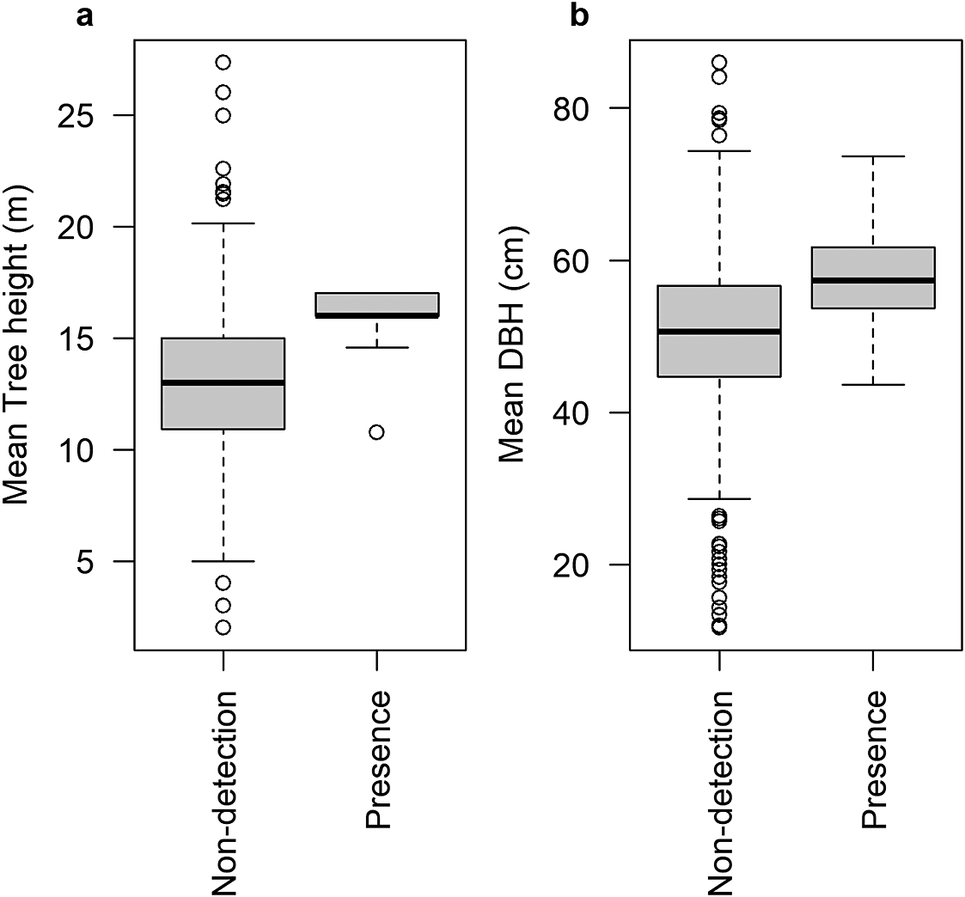
The Bahama Nuthatch was detected on six occasions during our fieldwork. All six sightings involved a single (and very possibly the same) individual, occurred over three separate days (29 May, 23 and 26 June 2018), and were confined to an area of less than 30 ha in Lucayan North. All six locations where we encountered the nuthatch appeared to indicate the importance of mature, tall pines to the species. Fourteen count points in total lay within 500 m of the locations of these sightings and were assumed to be within the home range of the sighted individual (Table 1), given that a population of Brown-headed Nuthatches possessed home ranges of 0.3–47.6 (mean 7.1) ha (Stanton Reference Stanton2013), the diameter of a circle with the higher value being >750 m. Tree size at these 14 points around nuthatch sightings was greater both in terms of height (Figure 2a; presence mean = 15.80, SE = 0.43; non-detection mean = 12.80, SE = 0.16) and DBH (Figure 2b; presence mean = 57.49, SE = 2.01; non-detection mean = 50.08, SE = 0.54).
Bahama Nuthatch Sitta insularis records from 2000 to 2004, 2005 to 2017 (after Hurricanes Frances and Jeanne; data from Hayes et al. Reference Hayes, Barry, McKenzie and Barry2004; Lloyd et al. Reference Lloyd, Slater and Metcalfundated; Lloyd and Slater Reference Lloyd and Slater2011), and 2018 (after Hurricane Matthew; data from this study and American Bird Conservancy 2018). Data from the eBird basic data set (2023) are included for all periods, including one record in 2018.

Boxplots showing (a) mean height (m) and (b) mean DBH (cm) of trees in locations where Bahama Nuthatch Sitta insularis presence was recorded within 500 m (n = 14) and areas where no detections were made (n = 450).
Comparison of the habitat characteristics within the island in 2018 found that the Lucayan estates had taller trees, more snags, a higher proportion of needleless mature trees, a less developed and lower understorey, and a higher amount of visible damage from burning and wind than the forests in Eastern Grand Bahama. Lucayan North, in particular, had the highest mean tree height (14.20, SE 0.25) of all the sections surveyed (Figure 3). Moreover, those count points within 500 m of our nuthatch sightings had a higher mean tree height (15.8, SE = 0.43) than other count points within the same section (14.09, SE = 0.26).
Boxplots showing mean tree height across the regions of Grand Bahama surveyed for Bahama Nuthatch Sitta insularis.

Count points (n = 70) which were within 500 m of any of the 52 records of Bahama Nuthatch in the period 2004–2018 had higher mean tree height (presence mean = 15.37, SE = 0.47; non-detection mean = 12.46, SE = 0.15), larger DBH (presence mean = 53.28, SE = 1.54; non-detection mean = 49.77, SE = 0.56), and more snags (presence mean = 1.83, SE = 0.29; non-detection mean = 1.03, SE = 0.07) than count points over 500 m away from previous detections. Count points within 500 m of our 2018 nuthatch records tallied a greater number of snags (mean = 2.29, SE = 0.65) than those within 500 m of the 2004–2007 nuthatch records (mean = 1.82, SE = 0.36).
Unknown to us at the time of our work, the American Bird Conservancy had also supported a survey led by Zeko McKenzie (University of the Bahamas–North), which in May 2018 found five birds, including a juvenile, in at least two sites, one of them (Z. McKenzie in litt. 2018) in the area where our records were made (American Bird Conservancy 2018). However, no further information on this survey appears to have been reported.
Discussion
Decline in habitat quality
Our 2018 records of the Bahama Nuthatch were derived from what might be (or have been) the only stands of tall, dense pine trees on Grand Bahama. Despite the small numbers of sightings, this is the most significant outcome of our fieldwork. It strongly suggests a real habitat preference in the species, presumably because such trees, with their broader boles and flakier, invertebrate-harbouring bark, offer a greater quantity and quality of foraging substrate per unit area, as hypothesised also for the Bahama Warbler (Pereira et al. Reference Pereira, Gardner, Geary, Bell and Collar2023). The Brown-headed Nuthatch, sister species to the Bahama Nuthatch, shows a clear preference for old-growth pines (Conner et al. Reference Conner, Dickson, Locke and Segelquist1983; Johnston and Odum Reference Johnston and Odum1956; Norris Reference Norris1958; O’Halloran and Conner Reference O’Halloran and Conner1987), and the total absence of such habitat away from Lucayan North could explain why the Bahama Nuthatch was geographically so constrained in recent decades.
However, a preference is not a requirement, and the absence of the nuthatch from the eastern forests does not necessarily reflect the species’s inability to survive in the conditions we encountered in 2018. It may rather be that past clear-felling and storm effects rendered the eastern forests temporarily unsuitable, and/or that the species’s absence from the regenerated stands in 2018 simply reflected its poor powers of dispersal and recolonisation. Satellite imagery from 1984 indicated an apparently healthy forest across the whole island east of Freeport. Browning and thinning in the now dead central forest areas between the Lucayan estates and the eastern forests only appears in these images after the three major hurricanes of 2004 and 2005, testifying to a major impact from storm surges and saltwater intrusion, with further deterioration over the subsequent 10 years. Thus, although the absence of natural barriers before 2004 might be expected to have allowed the nuthatch to move eastwards if the habitat there was favourable, at this stage the evidence does not exist to take this speculation further.
It is impossible to know whether habitat conditions at nuthatch sites in 2018 matched those when birds were recorded during previous surveys between 2000 and 2017, although it could be assumed that taller trees with wider trunk diameters would have been present for most of this period. However, sites will also have experienced differing levels of hurricane and fire damage in intervening years, their status in 2018 probably more reflecting the frequency and recency of disturbance in the years immediately prior to 2018.
Decline in habitat extent
There are no solid data on the extent of pine forest on Grand Bahama in recent decades other than what we can extrapolate from satellite images. According to Figure 5 in Emlen (Reference Emlen1977), in 1968 pines covered at least 75% of the island, hence >1,000 km2. However, one estimate suggested a coverage of only 591 km2 in 2004 (Hayes et al. Reference Hayes, Barry, McKenzie and Barry2004). Although there have been no indications of logging since the 1960s, it is possible that there was an unreported attrition of forest cover over the subsequent decades, resulting from the development of roads, real estate, resorts, and industrial facilities and from the direct and indirect effects of hurricanes. Contraction of habitat inevitably reduces the numbers of individuals it can support, and this could have made a significant contribution to the nuthatch’s rarity.
Decline in nesting substrate
Areas in which the nuthatch was recorded after 2004 tended to have more snags, and those areas where we recorded the nuthatch in 2018 had a higher mean number of snags than areas where the species was recorded previously. Well-rotted snags may be vital to the survival of the nuthatch by providing the optimum substrate in which the species can excavate nest-sites. This is the case with Brown-headed Nuthatches (Dornak et al. Reference Dornak, Burt, Coble and Conner2004; McNair Reference McNair1984), which select breeding sites with higher densities of snags (Wilson and Watts Reference Wilson and Watts1999) and achieve higher productivity with increasing number of snags around the nest-site (Lloyd and Slater Reference Lloyd and Slater2007). It may be that the presence of multiple snags increases predator search time, and/or permits rapid selection of a new site after nest failure, and/or reduces interspecific nest-site competition (Sullivan Reference Sullivan2011). Thus, the lower densities of snags elsewhere in 2018 may not have met the needs of the Bahama Nuthatch, rendering such areas population sinks, where mortality exceeds productivity (Pulliam Reference Pulliam1988). Moreover, although hurricanes may create snags, they may also blow down well-rotted ones as well as living trees with cavities, thereby depriving birds of nest-sites for perhaps many years.
Decline and bottlenecks in food availability
Snags may also be a food source, as hypothesised for the Brown-headed Nuthatch (Stanton et al. Reference Stanton, Kesler and Thompson2014). If it is assumed that older, more rotted snags contain more invertebrates but are more vulnerable to breakage, hurricanes may again be responsible for removing a valuable foraging substrate for the Bahama Nuthatch. A similar consideration extends to pine cones. Brown-headed Nuthatches are known to consume pine-seeds in winter (Morse Reference Morse1967; Norris Reference Norris1958; Yaukey Reference Yaukey1997), so the Bahama Nuthatch may also do or have done so, despite its scant use of them when breeding (Emlen Reference Emlen1977) and the mildness of Bahama winters. As Lloyd et al. (Reference Lloyd, Slater and Snow2009) intimated, hurricanes that strip cones off trees in the fall could create bottlenecks in winter food supply that compromise breeding condition or even starve birds.
Increase in invasive predators and competitors
Alien species potentially threatening the nuthatch (fide Hayes et al. Reference Hayes, Barry, McKenzie and Barry2004) are raccoons Procyon lotor and feral cats (predators), corn snakes Elaphe guttata (nest predators), and Common Starlings Sturnus vulgaris and House Sparrows Passer domesticus (nest competitors), although in 2018 these latter two species were never seen outside Freeport. Guam’s forest birds started declining in the 1960s, but it took until 1983 to identify the brown tree snake Boiga irregularis as the culprit (Rodda et al. Reference Rodda, Fritts and Chiszar1997). The corn snake, which can shelter in sinkholes and survive months without food (see McCue Reference McCue2007), may therefore well be a threat to the nuthatch, having years ago moved “well into the pine forest habitat” (Hayes et al. Reference Hayes, Barry, McKenzie and Barry2004). However, black rats Rattus rattus, not mentioned in any material documenting birds on Grand Bahama, are also present on the island (Shiels and Veitch Reference Shiels and Veitch2013; MAG and DJP personal observation) and must also be a threat; forest logging, degradation, and fragmentation increase their numbers, and storms increase their aggression, leaving native wildlife highly vulnerable (references in Collar Reference Collar2015). Research on the current and potential status of these species is urgently needed.
Increase in major mortality events
Direct weather-driven mortality of birds is commonly difficult to observe but obvious to infer. Small resident birds with limited dispersive capacity, especially on islands, cannot escape extreme weather. The hurricanes that struck Grand Bahama in the past two decades were probably catastrophic for the nuthatch. Birds sheltering in cavities would die from injury as trees fell or from exposure afterwards (the loss of cavities in storms increases woodpecker mortality; Engstrom and Evans Reference Engstrom and Evans1990). A hole-nesting/hole-roosting species with limited numbers and range will take a threefold hit from a storm – to its total population, its food supply, and its breeding/roosting substrate. Storms in rapid succession (i.e. within decades) will only amplify these effects, driving down numbers and, by damaging habitat, leaving them ever less able to recover. Given the findings of our survey in 2018 it is fair to assume that Hurricane Matthew had taken a significant toll on whatever population of nuthatches remained earlier in 2016; given the force and duration of Hurricane Dorian when it struck Grand Bahama in 2019 (see below) it is equally fair to assume that the few surviving members of that population were killed outright.
Possible unrecorded events
The history of the forest on Grand Bahama is very patchy, with no documentation covering the 1980s, when the nuthatch seemingly became rare, or indeed any subsequent decade. The possibility that the nuthatch was negatively affected by some unrecorded event such as a programme of timber extraction or a significant fire must be remote but cannot on available evidence be excluded.
Conclusions
Several or indeed all of the foregoing factors may have contributed to the decline of the Bahama Nuthatch, and to them we should add the insidious influence of global warming, which may be increasing both the intensity of tropical cyclones (IPPC 2023) and, in coastal areas of southern USA, their frequency (Balaguru et al. Reference Balaguru, Xu, Chang, Leung, Judi and Hagos2023). These considerations do not, however, explain the marked discrepancy in the status of the species in the short space of time between the studies by Emlen (Reference Emlen1977, Reference Emlen1981) and the surveys by Smith and Smith (Reference Smith and Smith1994): the former suggested a density of 8.48 birds/km2 in 1969 and 13 birds/km2 in May 1976 and May 1978, while the latter could not find the species in brief intensive searches in the years 1986–1990, and in May 1993 encountered only two birds during a slow-driven 96 km transect over 20 hours involving 54 stops to search on foot (Smith and Smith Reference Smith and Smith1994). Strikingly the surveys, which indicated a decline in the nuthatch since 1969 of >90% but produced no clear evidence for declines in other pineland species, included the five study plots where Emlen encountered the species as well as the area where Buden found it abundant (see above).
Combining the Brown-headed Nuthatch’s failure to recolonise pine stands 60 years after “region-wide logging” with Emlen’s failure to find the Bahama Nuthatch in 20 of his 25 pine forest plots, Smith and Smith (Reference Smith and Smith1994) concluded that a decline in the latter species caused by the logging and clear-felling of the 1950s may already have been underway during Emlen’s 1960s fieldwork. However, despite Emlen being acknowledged for reading a draft of their paper, these authors somehow missed the fact that Emlen (Reference Emlen1981) made higher density estimates in his 1976 and 1978 fieldwork (see previous paragraph). Even so, their discovery that the birds found by Emlen and Buden “apparently were in some of the few small stands of old growth where clear-cutting did not occur” (Smith and Smith Reference Smith and Smith1994) is surely a key insight, consistent with our own evidence and that for the Brown-headed Nuthatch cited above. Given the massive growth of Freeport only tens of kilometres away, it seems wholly plausible that these plots would have experienced persistent small-scale removal during the 1980s of the largest trees on which the nuthatch depended for successful breeding and sufficient foraging. The impacts of the five major hurricanes in the years 1995–2016 doubtlessly depleted remaining populations in stands of pine elsewhere in the island.
Eleven weeks of fieldwork on Grand Bahama in 2018 produced six records of single nuthatches, quite possibly the same individual, within a very small area of forest. There are records of birds in at least three other sites in 2018 (at least two in the American Bird Conservancy [2018] survey) and one from July on eBird– this being the last sighting ever) but no records since. On 1–3 September 2019 the Bahamas were struck by the exceptionally powerful (category 5) Hurricane Dorian (Avila et al. Reference Avila, Stewart, Berg and Hagen2020; Bell Reference Bell2019; Zegarra et al. Reference Zegarra, Schmid, Palomino and Seminario2020), which stalled for 40 hours over Grand Bahama with winds up to 295 kph in “one of the most prolonged known [human] population exposures to extreme hurricane hazards” (Shultz et al. Reference Shultz, Sands, Kossin and Galea2020). Such were the strength and length of the assault that it cannot realistically be imagined that the manifestly tiny population of nuthatches present in 2018 endured it. In 2020, 11 days of surveys by the Bahamas National Trust (2021) on Grand Bahama, including the area where we found it, yielded no sightings of the species. A further detailed survey is now needed to confirm its extinction or to pursue last-ditch measures if any individuals are found to survive, and perhaps more urgently and realistically to review the status and conservation needs of other endemic species of bird, notably the Bahama Warbler.
Acknowledgements
We are most grateful to the Bahamas Environment, Science and Technology (BEST) Commission for permission to conduct scientific research in the Bahamas, Thrigby Hall Wildlife Gardens and the Sir Philip Reckitt Educational Trust for financially supporting the work, the Bahamas National Trust (BNT) for their assistance and encouragement, Ellsworth Weir, David Clare, Jinnel Sturridge, Lisa Wildgoose and the other staff and volunteers of the Rand Nature Centre for their invaluable help, knowledge, and friendship, David Wege and BirdLife International for various forms of assistance, Zeko McKenzie, Jim Cox, John Lloyd, and Gary Slater for sharing their nuthatch survey data (via David Wege), Sandra Buckner for answering inquiries regarding corn snakes, and the people of Grand Bahama for their assistance, advice, and warm hospitality. Thanks go also to a referee for comments that improved the submission.


 Open access

