




1. Introduction
Quebec’s sociopolitical context is currently characterized by two distinct political undertakings which, while compatible in theory, come into conflict in practice. On the one hand, the Coalition Avenir Québec government recently undertook to modernize the Charter of the French Language with the adoption, in 2022, of the Act respecting French, the official and common language of Québec (hereafter LLOCQ). The last few years have also been marked by a series of measures explicitly aimed at strengthening the protections granted to the French language in Quebec. These include the questioning of the bilingualism requirement in the selection process for judges at the Court of Quebec, and the increase in tuition fees for non-university students who are not Quebec residents. The various ministers responsible make no secret of it: These different decisions aim, in their own way, to “curb the decline of the French language” (Labbé, Reference Labbé2023, our translation). On the other hand, Quebec also shows a desire to establish a “nation-to-nation” relationship with the Indigenous peoples whose traditional territory lies within Quebec.Footnote 1 This desire is enshrined, in particular, in Quebec’s currentFootnote 2 policy of national affirmation, which positions reconciliationFootnote 3 with Indigenous peoples as one of the pillars of its national “affirmation statement” (Quebec, 2017, pp. 129–140). In this respect, however, there is much less clarity about the true determination of the François Legault government. Admittedly, recent actions suggest a certain rapprochement between Quebec and Indigenous peoples — including the negotiation of agreements for the development of wind energy projects in certain traditional territories.Footnote 4 However, the last few years remain deeply tainted by the significant wrongs committed by Quebec against Indigenous individuals and communities.Footnote 5 In addition to this, there are dynamics of re-colonization of Indigenous peoples that are emerging from the most recent jurisdictional disputes between the provincial and federal governments, particularly in the case of the challenge to Bill C-92.Footnote 6
There is every reason to believe that the current modernization of the Charter of the French Language is part of this trend towards re-colonization. The LLOCQ completely overlooks from the outset the issue of the protection of Indigenous languages in Quebec. Some have not failed to point out this significant blind spot, highlighting the contradiction inherent in a national approach to the protection of French that is blind to the needs of Indigenous languages (Cardinal et al., Reference Cardinal, Beauchemin, Robichaud and Bouchard2023; Gosselin-Tapp, Reference Gosselin-Tapp2023). The Assembly of First Nations Quebec-Labrador (hereafter AFNQL) has also publicly taken a stand against the LLOCQ. According to the AFNQL, this law places an additional linguistic burden on Indigenous people in Quebec, a burden that is not neutralized by the few exemptions and relief measures granted to Indigenous people (Lévesque, Reference Lévesque2024). Later in this article, we will revisit in more detail the linguistic injustices caused by Quebec policies with regard to Indigenous peoples whose territory lies within Quebec. In any case, the neglect of Indigenous languages in the current reform of the Charter of the French Language is not surprising. It is true that the preamble to the Charter of the French Language already included a symbolic recognition of the linguistic rights of Indigenous nations, as well as a recognition of linguistic rights in education in Articles 87 and 88. In practice, however, the defence of linguistic rights has been (and continues to be) an important area of tension between the Quebec nation and Indigenous nations.
This article therefore sets out to reflect on this apparent contradiction between two pillars of Quebec’s national affirmation project: the protection of French and reconciliation with Indigenous peoples. In the hope of helping to resolve this tension, we propose a critical analysis of the conceptual and political implications of the notion of a “common language” (hereafter CL), which lies at the heart of both Quebec’s language policies and scholarly writings on the subject. The general hypothesis of this article is that the notion of CL is based on a conception of linguistic justice that is unsuited to a plurinational society such as Quebec. This article ultimately aspires to reframe the discourse surrounding the protection of French in a way that fully recognizes both the linguistic sovereignty of Quebecers and that of Indigenous peoples.
2. Methodological Considerations
This article is an exercise in applied political philosophy, taking the form of a mainly conceptual analysis of the notion of CL from the perspective of linguistic and ethnocultural justice. This exploration draws on both academic works related to the protection of minority languages and cultures, as well as writings (academic and non-academic) on Quebec’s language policies. We adopt a methodological stance that combines abstract normative reflection with consideration of empirical parameters specific to the Quebec institutional and linguistic context. Our mode of analysis is directly inspired by “public philosophy” as practised by James Tully (Reference Tully2008a; Reference Tully2008b), as well as his critical conception of political theorization (Tully, Reference Tully2002). Our analysis thus gives a certain primacy to practice: the goal being to propose solutions to the political and conceptual impasses in which Quebec society finds itself. By re-examining the fundamental categories of the Quebec conceptual field of French language protection, and in particular the idea of (French as) CL, we hope to have a therapeutic effect, aimed at alleviating existing social tensions and cleansing the public debate.
Furthermore, we position our research with the aim of an alliance with Indigenous peoples regarding language protection.Footnote 7 We are aware that we, as white researchers, possess numerous epistemic, political, and social privileges. Therefore, we wish to acknowledge our privileged situated experience and we are aware that our interpretations cannot be detached from our lived experience. However, with the aim of building an alliance and the intention of uncovering various structures of domination at play in our research context, we believe that it is our responsibility to speak out in order to denounce the injustices suffered by Indigenous peoples with regard to the protection and revitalization of their languages. Consequently, we agree with Linda Alcoff’s (Reference Alcoff1991) conclusions regarding the problem of speaking for others. For Alcoff, speaking for others can certainly involve epistemic and moral dangers. However, by considering the angle of “speaking to others,” it is possible to address certain complex subjects and issues while avoiding the dangerous trap of speaking in place of others. Alcoff mentions that “[w]e should strive to create wherever possible the conditions for dialogue and the practice of speaking with and to rather than speaking for others” (Alcoff, Reference Alcoff1991, p. 23, our emphasis). However, the methodology for doing so must be guided by four guiding principles to mitigate the aforementioned dangers, namely: (1) prioritizing epistemic humility that takes into account the context and the people involved; (2) remaining open to questioning our position and conclusions, since our situated experience will always have certain blind spots — while avoiding the instrumentalization of our privileges to absolve ourselves; (3) proposing conclusions marked by responsibility and accountability; (4) analyzing the possible effects and implications of the discourse on others.
Although we could be criticized for taking a stand on such a subject, we believe, like Alcoff, that nuanced speech is the middle ground between the two extremes of the problem. The first extreme consists of speaking from a position of epistemic arrogance. This can manifest itself in the failure to acknowledge one’s position of privilege and situated experience in the world, and in disregarding interventions by and for the individuals directly concerned by the issue at hand. This violent and ignorant gesture is an example of contributory epistemic injustice (Dotson, Reference Dotson2011); it not only causes epistemic and moral harm to the individuals concerned, but their voices are also silenced from the outset. The corollary of this first extreme is to speak only in one’s own name. This action implies, as Alcoff (Reference Alcoff1991, p. 20) points out, an individualistic conceptual framework and an assumed “sovereign autonomy” of the individual. However, such a conception of the individual is part of the colonial act of seeking to detach oneself from all embodied experience and context, with the aim of possessing a capacity for absolute self-determination (Burkhart, Reference Burkhart2019). On the contrary, the individual cannot be completely isolated from others, given that they are always already in relation to others: One can therefore never really “speak only in one’s own behalf” since one cannot escape interdependence and interconnection with others (Allard-Tremblay, Reference Allard-Tremblay2022). Finally, the second extreme consists of the act of simply remaining silent. However, this “non-act” is just as insidious as the first; it reinforces the status quo, namely the oppressive structures and dynamics in place in society (from which we, as white people, benefit).
In sum, it is in such a posture of practical philosophy, imbued with epistemic humility and openness, inspired by Tully and Alcoff, that we have engaged in this critical re-examination of the conceptual field of the “common language” in Quebec’s discourse of national affirmation.
3. Equally Valid Linguistic Claims
Language policies raise two distinct categories of normative problems, to which an approach to the protection of French must be able to respond. The issue of the protection of minority languages relates, on the one hand, to ethnocultural justice, insofar as it involves a normative reflection aimed at achieving a form of equity between ethnocultural communities and national groups. On the other hand, these protective measures also raise important questions regarding the protection of the linguistic autonomy and socioeconomic mobility of individuals. This conjunction of two types of normative considerations explains why linguistic issues are often portrayed as involving a tension between collective rights — justifying the protection of national minority languages — and individual rights — of which linguistic autonomy is limited by these protective measures.Footnote 8
Here, the idea of “national group,” “nation,” and “people” refers to groups of distinct cultures and with an institutional structure.Footnote 9 When they are minorities — we then speak of national minorities — it is commonly accepted, in approaches to ethnocultural justice, that national groups can avail themselves of policies aimed at the protection of their culture. In the case at hand, the francophone community in Quebec and the Indigenous nations are precisely national minorities in Canada. If they can benefit from such policies, it is because the protection of the culture of national minorities has an existential dimension: The loss of their culture on Canadian soil means the definitive disappearance of their culture, as opposed to ethnocultural groups from recent immigration whose cultures exist outside of Canadian territory.
Unsurprisingly, the protection of cultural diversity is closely linked to that of linguistic diversity. Cree writer Tomson Highway is right to say that “without knowing other languages, one can never know […] that such a vision of life, so different from [ours], has ever existed” (Highway, Reference Highway2019, pp. 40–41, our translation). Policies for the preservation of national minority languages are therefore essential to ensure the sustainability of their culture. That said, when policies aimed at protecting a minority language interfere with “individual linguistic autonomy,” they also tend to create tensions — both on a social and a conceptual level (Patten, Reference Patten2001, p. 692). As such, the normative issue is therefore always to determine to what extent ethnocultural justice can justify a limitation on the freedom of individual speakers.
From a conceptual perspective, the justification for the protective measures granted to the language of a national minority roughly takes the following form. Since language is at the heart of the identity of national minority groups, they should be granted special linguistic rights. Linguistic rights are generally seen as collective rights or as “group-differentiated” rights (as Will Kymlicka, Reference Kymlicka1989, suggests), because they are derived from the collective interests of linguistic communities (and not from the needs of individual speakers as such) rather than from the interests of individuals (from which individual rights arise). The strength of these arguments is therefore not dependent on the number of speakers of a minority language, but rather on the disadvantaged status of the linguistic community. Let’s be clear: The number of speakers will certainly play a role, in one way or another, in the implementation of linguistic rights. But it is conceptually impossible to set a minimum threshold of speakers at which the claim for linguistic rights by a national minority would become legitimate (at least not from the perspective of ethnocultural justice).
Following this logic, we have to admit that 12 national groups could make equally valid claims regarding linguistic rights in Quebec. Its linguistic heritage includes 11 Indigenous languages, classified according to three language families: the Iroquoian languages (Kanyen’kéha and Wendat); the Algonquian languages (Atikamekw, Anishnaabemowin, Abenaki, Cree, Innu-Aimun, Mi’kmaq, Naskapi and Wolastoqey Latuwewakon); and the Eskaleut languages (Inuktitut). As in all societies resulting from European colonization, these Indigenous ancestral languages are strongly affected by a natural tendency towards linguistic assimilation by majority languages (Drapeau, Reference Drapeau2011). And, unlike speakers of minority languages from recent immigration, the consequences of losing an Indigenous linguistic heritage affect not only speakers themselves and their families, but also constitute “a cultural tragedy that threatens the very existence of the group” (Taylor et al., Reference Taylor, Caouette, Usborne and Wright2008, p. 70). In other words, the normative argument that justifies the recognition of special linguistic rights for French in Quebec is equally valid for Indigenous languages.
The language policies in effect in QuebecFootnote 10 reflect, to some extent, this particularityFootnote 11 of Indigenous languages — in comparison with other minority languages (other than English). What measures are then in place to protect Indigenous languages in Quebec? Although overlooked in the LLOCQ, ancestral languages are protected by other laws, notably federal laws, which recognize the importance of these languages in preserving the culture and identity of Indigenous peoples. First, the most important law in this regard, which also marks a turning point in the protection of the rights of Indigenous peoples, is the Indigenous Languages Act (2019), a federal law adopted in 2019, which incorporates Indigenous languages rights into ancestral rights protected by the Constitution Act, 1982. It was adopted following the Canadian government’s endorsement in 2016 of the United Nations Declaration on the Rights of Indigenous Peoples and in response to the imminent extinction of Indigenous languages in Canada.Footnote 12 This law not only promotes the use of Indigenous languages, but also ensures greater language security for Indigenous people in several areas, particularly in relation to education and access to justice. Before that, there also was another federal law known as the Cree-Naskapi (of Quebec) Act (1984), which protected the language rights of the Cree and Naskapi peoples, recognizing the official status of the Cree and Naskapi languages in each of the communities. Furthermore, the Act recognized, among other things, the right of these peoples to use their language in government interactions and legal proceedings. This law concerns various provisions found in the James Bay and Northern Quebec Agreement (JBNQA), signed in 1975 by the governments of Quebec and Canada, Hydro-Québec, the Grand Council of the Crees of Quebec and the Northern Quebec Inuit Association, which explicitly recognizes Indigenous languages as official languages and essential elements of the cultural identity of the Indigenous peoples of Northern Quebec. The JBNQA also guarantees access to education in the mother tongue, access to services in Indigenous languages, and encourages the promotion and preservation of Indigenous languages. It should also be noted that the LLOCQ includes certain exemptions — particularly regarding the French language requirements at the college level — specifically intended for Indigenous students (Lévesque, Reference Lévesque2024).
Nevertheless, the recognition of a special status for Indigenous languages in Quebec’s legal corpus still faces the symbolic barrier posed by the status of “official and common language,” which only French can claim. However, as jurists Geneviève Motard and Mathieu-Joffre Lainé rightly point out, it is curious — not to say completely contradictory — that “Indigenous languages have never benefited from the same legal protections as the dominant languages, English and French,” despite the fact that “Indigenous peoples and their citizens largely share this sensitivity of Quebecers towards their vernacular languages” (Motard & Lainé, Reference Motard and Lainé2017, p. 255, our translation).
This contradiction can be explained by the presence, in Quebec, of a propensity for what anthropologist Ann Laura Stoler calls “colonial aphasia” (Stoler, Reference Stoler2011).Footnote 13 The notion of “aphasia” here refers to the difficulty of describing and conceiving of the linguistic injustices suffered by Indigenous peoples when subjected to measures aimed at protecting and reinforcing the colonial language, French. Furthermore, in social contexts marked by a dual majority/minority dynamic — as is the case in Quebec — we are even dealing with a heightened version of “colonial aphasia.” Because the discourse around the “fragility of francophone Quebec in America” somehow both justifies and sustains the invisibilization of the claims and needs of Indigenous nations (Bouchard, Reference Bouchard2011, p. 447). The semantic field of “insecurity” is indeed omnipresent in writings on Quebec’s linguistic and cultural policies. Whether it is a “feeling of national fragility” (Guénette & Mathieu, Reference Guénette and Mathieu2018, our translation) or the “identity malaise” (Seymour, Reference Seymour2010, our translation) of Quebec society, Quebec minority nationalism is inevitably thought of as a response to a “fear of disappearing” (Seymour & Gosselin-Tapp, Reference Seymour and Gosselin-Tapp2018, p. 192, our translation). This “collective feeling of cultural fragility” is most often explained by “the sense of a duty to fight for the future of the francophone culture” (Bouchard, Reference Bouchard, Meer, Modood and Zapata-Barrero2016, p. 79, our emphasis). In this sense, one can even speak of “linguistic insecurity” — as sociolinguist Anne-Marie Beaudoin-Bégin (Reference Beaudoin-Bégin2015, our translation) does — to describe the underlying emotional background of the need for national affirmation in Quebec.
However, while this cultural insecurity has primarily manifested through the demand for “external protections,”Footnote 14 particularly measures aimed at limiting the penetration of English into Quebec society (Le Moing, Reference Le Moing2023, p. 144), the Indigenous peoples of Quebec have also paid a heavy price for this “fear of being [absorbed]” among Quebecers (Hudon, Reference Hudon1994, p. 38, our translation). In the form, particularly, of a “fear of territorial fragmentation,” Quebec’s cultural insecurity has contributed to justifying, especially since the Quiet Revolution, an effort to recolonize the Indigenous nations by the Quebec government (Giroux, Reference Giroux2020, p. 76). This is particularly evident in the rhetoric based on the “myth of two founding peoples of the Canadian state,” which completely excludes Indigenous nations from the understanding that the people of Quebec have of Canadian national diversity (Goulet, Reference Goulet2006, p. 199, our translation). Therefore, even though Quebec’s political forces have actively worked to assert the plurinational nature of Canada (Gagnon, Reference Gagnon2021), they have nonetheless largely ignored national diversity within the province (see Gosselin-Tapp, Reference Gosselin-Tapp2023). As we shall see, the recent reform of the Charter of the French Language unfortunately does not escape this trend of re-colonization.
4. Common Language and National Affirmation
Language and national affirmation go hand in hand in Quebec. The Quebec national affirmation policy statement, Quebecers: Our Way of Being Canadian, places the linguistic question — and in particular the trajectory of the “francophone majority” — at the heart of its presentation of the cultural pluralism management model. The idea of a “common language” is also presented as the cornerstone of interculturalism, a model of integration that aims to “strike a balance between openness to diversity and the continuity and vitality of Québec’s distinct and French speaking identity” (Quebec, 2017, p. 69). It describes French “as the common language of public discourse which unites Quebecers of all origins” (Quebec, 2017, p. 71). From the perspective of Quebec political thought, it is indeed in the writings and political discourses on interculturalismFootnote 15 that we find the most developed conceptualizations of the CL paradigm. This approach is associated — in its common usage (particularly among parliamentarians) — with “the primacy of the French fact” and the idea that “the French language is the common language shared by everyone” (comments reported in Carpentier & Mathieu, Reference Carpentier and Mathieu2022, p. 433). The same trend can be observed in scholarly writings on the subject.
Despite the polysemy surrounding Quebec’s interculturalism,Footnote 16 there seems to be a consensus among its theorists on the importance given to measures protecting French as the CL (Iavarone-Turcotte, Reference Iavarone-Turcotte2023). In fact, even among those who directly question the theoretical specificity of interculturalism (as a normative framework distinct from multiculturalism), the protection of French as the CL — or sometimes as the “public language” — is presented as the distinctive featureFootnote 17 of the Quebec variant.
What exactly do theorists of interculturalism mean by the idea of CL? The most developed conceptualization of the CL can undoubtedly be found in Michel Seymour’s A Liberal Theory of Collective Rights (Reference Seymour2017, p. 18). For him, the CL — also called the “common public language” — must be seen as one of two possible forms of “public languages,” along with “minority public languages” (Seymour, Reference Seymour2017, p. 32). The notion of CL is consequently defined as the language spoken primarily “in common public institutions” (Seymour, Reference Seymour2017, p. 18). For Seymour, for each societal context, there will necessarily be a single CL, although it may, in theory at least, coexist with the protection and promotion of several “minority public languages” (Seymour, Reference Seymour2017, p. 32). We will see, later in the article, that such cohabitation has certain particularities in a linguistic and national context, such as that of Quebec. Seymour also sees the CL as one of the central elements of the “structure of culture”Footnote 18 of a national group, as it is compatible with a pluralism of values and conceptions of the good life. It is on this basis that he normatively justifies the inclusion of measures to protect the French language in the Quebec model of diversity management (Seymour & Gosselin-Tapp, Reference Seymour and Gosselin-Tapp2018).
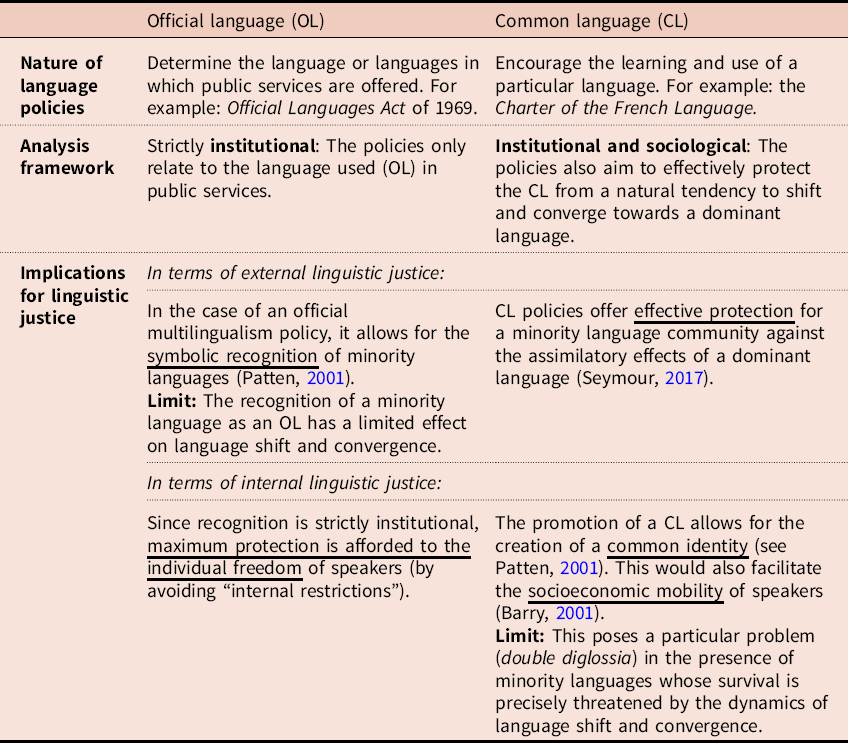
It should be noted that the use of the conceptual field of the “common public language” in works on interculturalism is not insignificant. It reflects an opposition to conceptions of linguistic justice focused solely on the notion of “official language” (OL). The notion of OL refers to the language in which public services are provided. The approach centred on OL is justified normatively by the liberal principle of equal treatment of individual speakers of different languages — rather than equal treatment of linguistic communities as groups. The idea of symbolic recognition fits within this framework of a liberal, individualist conception of state neutrality, in that it aims to address linguistic injustices while allowing individuals maximum freedom in linguistic matters (Patten, Reference Patten2003, p. 370). It is certainly possible to recognize more than one OL in a given jurisdiction. That being said, by only promoting policies of “official multilingualism,” one still subscribes to a conception of linguistic justice focused on the symbolic recognition of minority languages (Patten, Reference Patten2001, pp. 695–697). As we shall see, it is on this point that CL policies differ.
Following the Laurendeau-Dunton Commission, the Canadian strategy for linguistic justice initially corresponded to such a strictly institutional approach, focusing solely on the recognition of French as an “official language.” By prioritizing individual freedom in the development of language policies, the 1969 Official Languages Act Footnote 19 thus perpetuated a form of “free competition” between languages, ultimately relying on the autonomy of the speakers. And this is precisely what Quebec society sought to address by adopting the Charter of the French Language in the 1970s (Corbeil, Reference Corbeil2007).
This distancing from the strictly institutional approach to linguistic justice is evident in the juxtaposition of the concepts of “official” language and “common” language in Quebec’s language policy statements. In the literature on linguistic justice, the CL approach differs substantially from the OL approach in that it conceives of language policies as instruments for (1) imposing a language commonly shared by all citizens, and (2) serving as the basis for a common identity (Patten, Reference Patten2003, p. 365). The use of the concept of CL rather than simply OL is part of a questioning of the effectiveness of official multilingualism approaches, with regard to the neutralization of the natural tendency towards a “shift away from some languages” and “convergence on some dominant language” (Patten, Reference Patten2001, p. 700). In the rest of the article, we explore the normative implications of this shift — induced by CL policies — from a strictly institutional response to a sociological response to linguistic injustices.
5. Internal and External Linguistic Justice
At this point in the argument, it is important to distinguish between two dimensions of linguistic justice that national minorities, such as Quebec, must navigate. First, there is the external dimension of linguistic justice, which refers to the prerogatives available to a linguistic community to protect itself from the pressure it faces from other linguistic communities. However, in the political tradition of Quebec, the protection of the French language has tended to be seen as legitimately leading to constraints imposed on individuals. This opens up a second area of reflection surrounding the internal dimension of linguistic justice. This area of reflection focuses on the linguistic dynamics that arise in a given jurisdiction when a minority language community promotes a specific CL. The field of internal linguistic justice therefore consists of distinguishing what constitutes a legitimate constraint from what represents internal linguistic injustice.
By definition, models based on a strictly institutional response to the linguistic injustices suffered by national minorities — such as Kymlicka’s (Reference Kymlicka2002, pp. 396–398) — aim to considerably limit internal linguistic injustices. However, as we explained earlier, the CL paradigm emerged from a critique of the powerlessness of official multilingualism policies in the face of the pressures experienced by speakers, which skew their linguistic choice in favour of the dominant language.
We can thus clearly see how the conceptual field of the CL shifts from a strictly institutional approach to an institutional and sociological response to linguistic fragility. As such, the logic behind CL policies is reminiscent of the economically inspired models of linguistic justice. In Philippe Van Parijs’s variant (Van Parijs, Reference Van Parijs2011), for example, the natural tendency towards the emergence of a lingua franca is placed at the centre of the determination of linguistic injustices and the appropriate means to address them. He starts from the principle that two sociological mechanisms necessarily tend to favour the convergence of speakers towards a dominant language. On the one hand, learning a second language depends on opportunities and incentives (“probability-driven learning”). On the other hand, there is a trend towards choosing a language in a multilingual context based on the maxi-min principle: The language chosen is the one that, at the minimum level of proficiency for the “worst linguist,” is the best (this is referred to as the “language of maximal minimal competence”). These two principles generate a positive feedback loop that precipitates the emergence of a lingua franca (Van Parijs, Reference Van Parijs2011, pp. 11–15). For Van Parijs, although inevitable (and desirable), the emergence of such a dominant language nevertheless gives rise to inequities between the different profiles of speakers (see Table 1).
Comparison between the OL and CL paradigms

In the remainder of this article, we focus solely on the case of linguistic injustices induced by CL policies and experienced by Indigenous people. The main linguistic injustice committed, in our view, against Indigenous speakers is placing them in a doubly diglossic situation, induced by the juxtaposition of three linguistic pressures: the pressure exerted by English as the dominant language at the Canadian and international level, the policies for the protection of French at the provincial level, and the measures for the protection and revitalization of ancestral languages at the level of Indigenous nations. Disglossia — as initially defined by sociolinguist Charles A. Ferguson — refers to “language situations” characterized by the superposition of a primary language and the language acquired through “formal education” (Ferguson, Reference Ferguson2020, pp. 38–39). The reason diglossia presents a normative problem is that it can lead to inequalities between linguistic communities in terms of the efforts and time required to master the language used in formal situations. This is particularly the case in societies structured by relationships of political and social domination between linguistic communities. In the case of the Indigenous nations whose traditional territory lies within Quebec, the situation is therefore doubly diglossic. The dominant status of French in the Quebec context places Indigenous speakers in a first-order diglossic situation (French — ancestral language), without eliminating the pressure that speakers of a language other than English face in learning it (English — ancestral language).
It should be noted that, according to some approaches to linguistic justice, the costs associated with the diglossia imposed on speakers of minority languages would be offset by the gains in terms of social mobility. We are thinking here of Brian Barry’s socioeconomic argument, which sees CL policies as a way of guaranteeing equal opportunities for all. In his view, promoting the acquisition of a CL encourages socioeconomic mobility, which would politically justify its assimilatory effects. According to Barry, “the provision of genuine equality of opportunity without linguistic assimilation […] would be, if not absolutely impossible, almost unimaginably burdensome” (Barry, Reference Barry2001, p. 107).
That being said, while the time spent learning French increases the socioeconomic mobility of speakers of a minority language (i.e., other than English and French) in Quebec, it still limits the time these speakers can invest in learning English — and consequently their overall social mobility. While this opportunity cost associated with learning the CL can sometimes pose an issue of internal linguistic justice with respect to allophones from recent immigration, this is even truer in the case of Indigenous people. Their linguistic burden is disproportionate compared to that of other citizens: In addition to the obligation to learn the CL and the practical necessity of mastering the global lingua franca that is English, they also bear the responsibility of working to maintain and/or revitalize a traditional language (in the face of the real risk of its extinction).
The use of the CL paradigm thus has important implications in a sociolinguistic context such as Quebec. From the outset, this raises the question of internal linguistic justice, particularly considering the opportunity costs associated with learning French for non-English and non-French speakers. These considerations are not, in themselves, sufficient to reject the CL model, but they do require taking into account the different forms of linguistic injustices that this generates. Theorists of the CL paradigm are fully aware of this, as evidenced by the emphasis placed in the writings on the subject on finding a fair balance between measures aimed at external linguistic justice and the prevention of internal linguistic injustices (see Seymour & Gosselin-Tapp, Reference Seymour and Gosselin-Tapp2018).
The situation of Indigenous persons, however, has a particular character in this regard, in that CL policies keep them in a doubly diglossic situation, despite the fact that Indigenous languages are national minority languages just as French is in Quebec. In what follows, we propose a line of thought aimed at overcoming this contradiction through a reconfiguration of the conceptual field of the protection of French in Quebec.
6. From Common Language to National Language
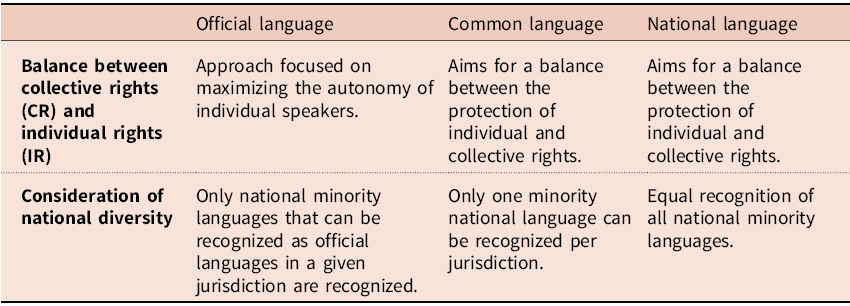
From a normative point of view, there are three main findings so far in this article. First, our reflection started from the premise — commonly accepted in ethnocultural justice models — that national minorities (as opposed to minorities stemming from immigration) should be able to enjoy a special status, which translates into measures for the protection of national minority languages. From this perspective, the linguistic rights that national minorities can claim do not depend on the number of speakers. These rights are derived from the principle that every unique culture deserves to be preserved. In this way, the linguistic claims of Indigenous nations in Quebec are just as valid as the linguistic claims of Quebecers for the protection of French. Following this logic, the number of speakers would only come into play in the operationalization of linguistic rights, but it does not allow for the prior ranking of the linguistic needs of national minorities. Second, we have shown that use of the conceptual field of the CL was justified in Quebec by the insufficiency of OL policies alone to curb the natural tendency towards language convergence on English. Third, we showed that the conceptual field of the CL tends to relegate — and to perpetuate — the linguistic injustices that affect the Indigenous nations whose traditional territory lies within Quebec. In our view, if the conceptual field of the CL produces such linguistic injustices, it is because it fails to fully consider the fact of Quebec’s national diversity. In other words, our analysis suggests that the concept of CL favours the linguistic rights of a national minority to the detriment of the similar rights that other national minorities should be able to claim (see Table 2).
Comparison between official language policies, common language policies, and national language policies

However, there is an alternative way of conceptualizing the linguistic needs of national linguistic minorities. The external language protections of a national minority can indeed be justified and conceived of based on the principle of “linguistic sovereignty.” In contrast to the concept of CL, the idea of linguistic sovereignty has the advantage of clearly highlighting the subject of legitimate linguistic claims, i.e., national groups (and not individual speakers of minority languages) (see, for example, Peled, Reference Peled2023). Seen in this light, the principle of linguistic sovereignty must be understood as the right of national groups to “determine all linguistic matters on their territory” (Sanguin, Reference Sanguin1978, p. 79, our translation). Obviously, as with any other collective right, the exercise of linguistic sovereignty does not exempt a group from its obligation to limit internal linguistic injustices (Seymour & Gosselin-Tapp, Reference Seymour and Gosselin-Tapp2018).
By using the conceptual field of linguistic sovereignty rather than that of the CL, the discourse surrounding the protection of French in Quebec would be better positioned to avoid the pitfalls that we have previously highlighted. It is worth recalling here that the Charter of the French Language inherently carries a certain conception of linguistic sovereignty. As we have seen, the evolution of Quebec’s language policies is directly linked to Quebec’s national affirmation project. However, the protection of French as CL somehow starts from the principle that the subject of linguistic sovereignty is the jurisdictional entity represented by Quebec as a federal unit, rather than the Quebec nation as such. In other words, this implies that, in order to enjoy full linguistic sovereignty, the Quebec people must have the final say on linguistic matters throughout the entire territory of the province of Quebec. In this sense, there is an assumed correspondence between Quebec, as a jurisdictional unit (that is, as a province), and the Quebec people. If Quebec were a mono-national society, this correspondence between jurisdictional unit and national group would not be problematic at all. But in a plurinational context such as ours, this association is fundamentally contradictory. In Quebec, several national groups can legitimately aspire to linguistic sovereignty. However, the full weight of the various Indigenous languages claims is completely obscured when it comes to French as the CL.
The conceptual field of linguistic sovereignty furthermore suggests replacing the notion of a common language with that of a national language.Footnote 20 This characterization has the advantage of recalling that the subject of language rights is a national group, rather than a jurisdictional unit. Consequently, it makes it possible to point out that French is one of the national languages of Quebec. This paves the way, in theory at least, for the exercise of multiple linguistic sovereignties in Quebec. It also suggests that the Charter of the French Language should be negotiated in a “nation-to-nation” dialogue in Quebec, fully acknowledging its plurinational character.
To be clear, the idea of a “national language” in no way implies renouncing the sociological shift initiated by the CL paradigm. The shortcomings that CL policies seek to address, compared to those of OL, are very real, and apply as much to ancestral languages as to the French language. In order to be effective, measures to protect national minority languages must be able to curb, in one way or another, the natural tendencies towards language shift and convergence. That being said, where the idea of a “national language” differs from that of CL is in its attempt to avoid the situation of Indigenous speakers being considered in the same way as that of speakers of other minority languages. The claims of the speakers of an ancestral language have a resolutely collective scope, in that they are linked to the preservation of a national culture and are therefore not based solely on issues of individual social mobility. It is also entirely possible to envision linguistic policies that combine the notions of official language, common language, and national language. But the fact remains that the integration of the concepts of national language and linguistic sovereignty into Quebec’s political discourse is necessary to consider and protect our linguistic diversity in all its complexity.
7. Conclusion
This article calls for a rethinking of the paradigm regarding the protection of the French language, moving away from the notion of CL in favour of a conceptual field centred on the linguistic sovereignty of the 12 nations that share the territory of Quebec. This article also suggests that linguistic policies must be negotiated in a way that fully respects and recognizes the right to linguistic sovereignty of each nation. The right to linguistic sovereignty should be seen as a corollary of the right to national self-determination that all peoples sharing the territory of Quebec should be able to exercise.
However, for these lines of thought to be put into practice, they require a more thorough examination, particularly in light of the needs and claims of each national minority in Quebec. Among other things, and as mentioned previously, the protection of a national minority language will necessarily have to be modulated according to the number of speakers of that language and their level of knowledge of the language. The recognition of the national character of 12 languages in Quebec does not have to translate into uniform measures of protection and/or revitalization.
Therefore, it is clear that much remains to be done to clarify the implications and possible modalities of recognizing multiple linguistic sovereignties within the same jurisdiction. However, these questions go beyond the scope of this article. Our objective in this article was simply to show that it is not only possible, but also necessary, from the perspective of linguistic justice, to conceive of the place of French in a plurinational society such as Quebec in a different way.
Acknowledgements
The authors are grateful to Maxime Mariage for the translation of the text from French to English. This research was funded by the Research Support Program of the François-et-Rachel-Routhier Fund. The reflection that led to the writing of this article was also greatly informed by the comments and reflections of the participants in the 2024 conference of the Centre interuniversitaire d’études et de recherches autochtones (CIÉRA) and the 2nd Forum on First Nations Language Rights in Quebec. The authors also received logistical support from the Institute of Applied Ethics at Laval University (IDÉA).
Competing interests
The authors declare that they have no conflict of interest.

 Open access

