

Introduction
Philology and archaeology have had a difficult relationship, as this article illustrates. Texts, including inscriptions, and names are the philologists’ primary evidence, and when these can be localized and dated they can profitably be studied alongside archaeological evidence for the same localities at the same periods. Such interdisciplinarity is harder in prehistoric periods from which no written records survive. While philologists can infer a great deal about lost proto-languages by working backwards from their descendants, their tools for localizing them in space and time are inadequate. This explains the endless debates about the ‘homelands’ and dates of Balto-Slavic, Indo-Iranian, Indo-European and other postulated proto-languages (Mallory et al. Reference Mallory, Dybo and Balanovsky2019)—debates further complicated when simplistic assumptions are made about prehistoric populations’ archaeological, linguistic, ethnic and biological homogeneity (cf. Sims-Williams Reference Sims-Williams1998b; Reference Sims-Williams2012b). All too often, philologists have leant on outdated archaeological models, which in turn depended on outdated philological speculations—and vice versa. Such circularity is particularly evident in the study of Celtic ethnogenesis, a topic which can hardly be approached without understanding the chequered development of ‘Celtic philology’, ‘Celtic archaeology’ and their respective terminologies.
The term ‘Celtic’ has been used in many conflicting senses (Chapman Reference Chapman1992; Collis Reference Collis2003; Renfrew Reference Renfrew1987, 214). In this paper, ‘Celtic’ refers both to the peoples whom Greek and Latin writers called variously Celts, Galatians, Gauls and Celtiberians and to their related languages, as known from inscriptions or inferred from place- and personal names. Applying a single term both to a population and to a language should never be done lightly, but in the case of the Celts they do seem, at least from the middle of the first millennium bc onwards, to constitute a valid ‘ethno-linguistic group’ (for this term, see Mallory et al. Reference Mallory, Dybo and Balanovsky2019).Footnote 1 No single material ‘culture’ can be associated with them, and there is no prima facie reason why we should expect one to do so. The relevant material ‘cultures’ are so varied as to cast doubt on the coherence of ‘Celtic archaeology’ and ‘Celtic art’. Old attempts at archaeological definition such as ‘The term “Celt” designates with certainty the La Tène cultural complex from 400 bc on’ (Brun Reference Brun, Arnold and Gibson1995, 13) now appear arbitrary; ‘Celtic’ is rightly regarded as a misleading label for the central European Hallstatt and La Tène material ‘cultures’ of the Late Bronze Age and Iron Age (Renfrew Reference Renfrew1987, 240; Sims-Williams Reference Sims-Williams1998a). The peoples of the first millennium bc who spoke the attested languages which meet the philological criteria for Celticity—certain unique divergences from reconstructed Proto-Indo-European—corresponded encouragingly well in their distribution to the historically attested Celts, Galatians, Celtiberians, and so on, while corresponding poorly to the ‘archaeological Celts’ deduced from Hallstatt and La Tène archaeology.
This difficulty started to become apparent in the middle of the twentieth century, as archaeologists began to accept that the oldest Celtic-language inscriptions—of the sixth and second centuries bc respectively—were to be found in the context of the ‘Golasecca culture’ around the north Italian lakes (the site of the ‘Lepontic’ inscriptions) and in Celtiberia in northeastern Spain (Lejeune Reference Lejeune1955; Reference Lejeune1971). These were not ‘Hallstatt’ or ‘La Tène’ areas. Celtiberia, for instance, ‘shared hardly any material features with the La Tène culture’ (Beltrán & Jordán Reference Beltrán, Jordán, Sinner and Velaza2019, 244), even though its population spoke and wrote a Celtic language and identified themselves as Celts—the Latin poet Martial being an example (Collis Reference Collis2003, 11, 23, 103, 195–6).
Language became prominent in definitions of Celticity, following the discovery of Lepontic and Celtiberian, coupled with the revival of archaeological interest in language and ethnogenesis inaugurated by Renfrew (Reference Renfrew1987, 212). To quote Beltrán and Jordán (Reference Beltrán, Jordán, Sinner and Velaza2019, 244),
The undoubted status of the Celtiberians of Hispania as Celtic, demonstrated by inscriptions such as the Botorrita bronzes [near Zaragoza] as well as their clear differences from the La Tène Gauls, has helped to define the conception of Celt by emphasizing its essentially linguistic character.
They continue (Beltrán & Jordán Reference Beltrán, Jordán, Sinner and Velaza2019, 244–5):
At the same time, new perspectives question even the supposed central European origin of the Celtic language, suggesting a possible genesis along Europe's Atlantic facade, whence it would have spread towards central Europe.
Here they allude to the twenty-first-century hypothesis that situates what are called ‘Celtic origins’ (Cunliffe & Koch Reference Cunliffe and Koch2019) in the extreme west of Europe, a view now espoused by some who had previously favoured Celtic ethnogenesis in central Europe (e.g. Cunliffe Reference Cunliffe1992). According to this new ‘Celtic from the West’ hypothesis, the Celtic language was already current by 3000 bc throughout an ‘Atlantic zone’ that embraced the British Isles, northwestern France, western Spain and Portugal, and then ‘spread eastwards into middle Europe during the Beaker period by 2000 bc’ (Cunliffe Reference Cunliffe2018, 395). A variation on ‘Celtic from the West’ is ‘Celtic out of Iberia’ (Koch & Cunliffe 2016, 3): by 5000 bc an Italo-Celtic dialect of Neolithic Proto-Indo-European reached southwestern Iberia, where Celtic split off from Italic and spread as far as Scotland by 3000 bc (Cunliffe Reference Cunliffe2013, 247–8).
Thus there have been three main stages of scholarship: (1) the Celts are identified with the Hallstatt and La Tène ‘cultures’ of the first millennium bc; (2) then the discovery of contemporary Celtic-language inscriptions (Lepontic and Celtiberian) in the ‘wrong’ areas casts doubt on whether the ‘ethno-linguistic’ Celts can be identified archaeologically; (3) most recently, however, they are associated with the archaeological cultures of the Atlantic zone of c. 3000 bc or even earlier. In this paper, I argue that both the new ‘Atlantic’ model and the older ‘central European’ one, though alluringly exotic, are unsupported by any solid evidence and are inherently implausible. I shall conclude by suggesting a realistic, if less romantic, scenario: ‘Celtic from the centre’.
Celtic from the East
For most of the twentieth century, archaeologists associated the emergence of the Celts and the Celtic languages with the central European ‘Hallstatt culture’. The Late Bronze and Early Iron Age type-site in the Salzkammergut that gave this ‘culture’ its name lies within what in the Roman period constituted the Celtic kingdom of Noricum in central and eastern Austria and northern Slovenia. The supposition that Hallstatt itself was a Celtic site, perhaps connected with the Celtic Taurisci tribe, was already current in the mid nineteenth century, although some preferred to regard it as ‘Illyrian’ in origin (Müller-Scheeßel Reference Müller-Scheeßel2000, 71; Sims-Williams Reference Sims-Williams2016, 9 n. 14).
In the English-speaking world, Terence Powell's The Celts ( Reference Powell1958) was a classic presentation of the ‘Hallstatt Celts’. Behind Powell lay Joseph Déchelette's Premier âge du fer ou époque de Hallstatt (Reference Déchelette1913), the textbook used by Powell's Cambridge teacher H.M. Chadwick, and behind Déchelette lay the speculations of Bertrand and Reinach's Les Celtes dans les vallées du Pô et du Danube (Reference Bertrand and Reinach1894) and Henri d'Arbois de Jubainville's Principaux auteurs de l'Antiquité à consulter sur l'histoire des Celtes (Reference de Jubainville1902). On the basis of tendentious interpretations of passages in Hecataeus and Herodotus, all these scholars associated the original Celts not with Gaul, as might have been expected of Frenchmen, but with Noricum and the headwaters of the Danube in southern Germany, whence the Celts were supposed to have spread west to France and Italy (cf. Collis Reference Collis1997; Reference Collis2003; Sims-Williams Reference Sims-Williams2016; Reference Sims-Williams2017a). To some extent Déchelette's synthesis of archaeological and written sources survived intact into the present century, both among archaeologists (e.g. Spindler Reference Spindler and Birkhan2007) and among linguists, who continued to refer to ‘the original Celtic homelands in the south of Germany and Austria’ (Meid Reference Meid2010, 14).
Nineteenth-century scholarship had prepared the way for an eastern location. The philologists known as ‘Celtisten’ or ‘Celtomanen’ had claimed, falsely, that the Germanic languages could be explained on the basis of Irish and Welsh, and hence that German civilization was fundamentally Celtic (Poppe Reference Poppe, Maier and Zimmer2001, 208–20). More respectably, most philologists since the 1830s had come to accept that the Celtic languages descended from Proto-Indo-European and must therefore be in some sense ‘eastern’ (Poppe Reference Poppe, Maier and Zimmer2001, 208–9), especially given prevalent assumptions about what Sir John Rhys (Reference Rhys1877, 272) termed ‘the supposed westward course of civilisation’.
But how far west had Proto-Indo-European travelled before it evolved into Celtic? This was—and remains—a problem, for the picture is complicated by awkward evidence for eastward Celtic movements in the historical period. Thus the obviously Celtic ethnic, place- and personal names of Galatia in Turkey (Freeman Reference Freeman2001; Sims-Williams Reference Sims-Williams2006) are clearly due to the Celts’ documented eastward migrations of the third century bc, as reported by Greek writers (Tomaschitz Reference Tomaschitz2002, 142–79). Other eastward migrations raise similar problems. The Volcae Tectosages were settled north of the Danube in ‘the most fertile areas of Germany, around the Hercynian forest’, according to Julius Caesar (Gallic War 6.24). Their tribal name is linguistically Celtic (‘property seekers’), as is the name of the Hercynian forest (‘oak forest’), one of the earliest attested Celtic place-names, already mentioned by Aristotle; but Caesar is adamant that the Volcae Tectosages had migrated eastwards across the Rhine from Gaul (Falileyev Reference Falileyev2010, 132, 214–15, 242; Reference Falileyev2014, 46–7; Tomaschitz Reference Tomaschitz2002, 180–84), and unfortunately we do not know which Celtic-speakers first named the great Hercynian forest—as the forest was so vast, those who named it may have lived a long way from it (Sims-Williams Reference Sims-Williams2016, 9 n. 16).
Another linguistically Celtic (Falileyev Reference Falileyev2010, 10, 77–8) but problematic eastern ethnonym is that of the Boii of Bohemia. No ancient author claims that the Boii were indigenous to Bohemia. Instead, Caesar and Tacitus relate that they crossed the Rhine eastwards into Noricum (Caesar, Gallic War 1.5) or Bohemia (Tacitus, Germania 28), while Strabo (Geography 5.1.6) states that they migrated from northeast Italy to ‘the regions around the Danube, where they dwelt with the Taurisci’, a people he identifies as Celts (Geography 7.2.2, citing Posidonius) and as neighbours of the Norici—although according to Pliny (Natural History 3.20.133) the Taurisci and Norici were identical (cf. Collis Reference Collis2003, 115–17, 120, 121, 185; Tomaschitz Reference Tomaschitz2002, 85–7, 189). Here again, the classical ethnography, confused though it is, fails to support ‘Celts from the East’.
The origin of the north Italian Celts presents similar problems, and any arrows on modern maps are speculative, as rightly noted by Cunliffe (Reference Cunliffe1992, 133) and Collis (Reference Collis2003, 93–7; contrast Cunliffe Reference Cunliffe1997, 71–2, figs 55–6). No contemporary written evidence survives. Nevertheless, the tradition reported by Livy c. 26 bc, that the various contingents came from east central France, is quite credible, despite his confused chronology (Collis Reference Collis2003, 97–8; Pare Reference Pare1991) (see Fig. 1). Yet Bertrand and Reinach (Reference Bertrand and Reinach1894, 26) rejected Livy's account entirely, with the exception of one sentence (5.34.8) which describes how a contingent of Gauls, following an expedition to Marseilles, travelled through the territory of the Taurini (around Turin) on their way to found Milan, after crossing the Julian(!) Alps. Bertrand and Reinach, like d'Arbois de Jubainville (Reference de Jubainville1902, 240–41), insisted that the circuitous eastern route via the Julian Alps—in Slovenia, far from Turin!—was no mistake, and emended Taurini to Taurisci to fit, so that the Gauls would start out from their supposed archaeological eastern homeland in Tauriscan Noricum. Most editors of Livy regard the Julian (Iuliae) Alps as a mistake to be emended, but some commentators still favour the northeastern route because ‘archaeological evidence’ (ultimately just the opinion of Bertrand and Reinach!) makes it more ‘historically accurate’ (Bonfante Reference Bonfante1939; Ogilvie Reference Ogilvie1965, 712; Ross Reference Ross1996, 112–13; Tomaschitz Reference Tomaschitz2002, 50; cf. Bayet & Baillet Reference Bayet and Baillet1964, 57–8, 161–2). This is implausible. The argument is circular.
‘The Celtic tribes which invaded Italy, mentioned by Livy and Polybius (italic script), and by Julius Caesar (normal script). The arrows show the routes taken by Celts over the Great St Bernard and Mont Cenis passes’ (Pare Reference Pare1991, 199). [‘Mont Cenis’ depends on the standard emendation of ‘Iuliae’ in Livy to ‘Duriae’.] (Map reproduced by permission of the Proceedings of the Prehistoric Society.)

Perhaps because assumptions about the ‘westward course of civilization’ were so ingrained, nineteenth- and twentieth-century scholars underplayed the problem posed by the Celts’ eastward migrations. The insistence of Bertrand and Reinach, d'Arbois de Jubainville and Déchelette that the Celts of Noricum and the upper Danube were indigenous, and that a Celtic ‘Hallstatt culture’ spread thence westwards to France, is a good example. Their alleged written evidence for a Celtic homeland in Austria and southern Germany does not stand up. It came from only two writers, both from Asia Minor: Hecataeus (c. 500 bc) and Herodotus (c. 450 bc).
According to Stephanus of Byzantium (Billerbeck Reference Billerbeck2006–, III, 396), Hecataeus, in a work now lost, referred to a ‘Celtic city’ called Nyrax. The nineteenth-century speculation that Nyrax can be connected with the names of Noricum and/or its city Noreia was based only on a vague similarity, as already conceded by d'Arbois de Jubainville (Reference de Jubainville1902, 14) and Déchelette (Reference Déchelette1913, 567) themselves. Philologically, it was inferior to Müllenhoff's perplexing speculation about a connection between Nyrax and the Sardinian word nurághe [fort], since attested as NURAC on a Roman inscription near Molaria in Sardinia (Müllenhoff Reference Müllenhoff1870, 96–7; Sims-Williams Reference Sims-Williams2016, 8–9; Reference Sims-Williams2017a, 431). Stephanus’ only other relevant citation again takes us well away from Austria: he cites Hecataeus as mentioning Massilia (Marseilles) as ‘a city in Liguria near Keltikê’ (Billerbeck Reference Billerbeck2006–, III, 274). Unfortunately, ‘near Keltikê’ (meaning Gaul) may be a clarification added in transmission and need not go back to Hecataeus’ time. Fortunately, however, better support for an early Celtic presence in the Marseilles hinterland is provided by Celtic personal names on fifth- and fourth-century pottery from Lattes and Ensérune, and by Apollonius of Rhodes’ allusion in the third century bc to Celts and Ligurians along the river Rhône (Mullen & Ruiz Darasse Reference Mullen, Ruiz Darasse, Sinner and Velaza2019, 200–202; Sims-Williams Reference Sims-Williams2016, 9–10; Reference Sims-Williams2017a, 43).
Herodotus alone provided the French scholars with their evidence for fifth-century bc Celts around the source of the Danube in Germany, evidence which supposedly proved the Celticity of the ‘eastern Hallstatt culture’ and, by extension, the so-called ‘western Hallstatt culture’ which derived from it (Déchelette Reference Déchelette1913, 570–71)—or so they believed, on inadequate archaeological grounds (cf. Müller-Scheeßel Reference Müller-Scheeßel2000). For Bertrand and Reinach (Reference Bertrand and Reinach1894, 34, 133), the Celts of the upper Danube were at the southern end of an imaginary empire celtique (d'Arbois de Jubainville's phrase) which stretched north to Bohemia and Jutland; by contrast, their Celtiberians occupied an insignificant strip of land between the Rhône and the Pyrenees!
Unfortunately, all these scholars assumed that Herodotus knew where the source of the Danube lay—something the Romans did not discover until 15 bc (Strabo, Geography 7.1.5). The focus of both passages in Herodotus (Histories 2.33 and 4.4) is the immeasurable length of the Nile and its alleged symmetry with the Danube, which supposedly flowed through the whole of Europe to the Black Sea, starting from the land of the Celts, ‘the westernmost people of Europe except for the Cynetes’, and the ‘city’ (polis) of Pyrene. In the first passage Herodotus added that the Celts lived ‘beyond the Pillars of Hercules’ (the Strait of Gibraltar)—something that was certainly true of the Cynetes, who dwelt in the Portuguese Algarve.
Herodotus’ ‘city’ of Pyrene, though followed by Avienus, must be a mistake for ‘mountain’ (i.e. the Pyrenees), as is shown by Aristotle's statement (Meteorology 1.13 [350b]) that Pyrene is a mountain in the west in Keltikê from which the Tartessos (Guadalquivir) flows westwards to the Atlantic beyond the Pillars of Hercules and the Danube flows eastwards across Europe to the Black Sea. Aristotle obviously overestimated either the length of the Guadalquivir or the width of the Pyrenees (or both). The best explanation of their lengthy Danube is that Herodotus and Aristotle imagined it to be connected with a Pyrenean river like the Ariège or—as supposed by Timagetus in the fourth century and perhaps by Apollonius in the third—with the Rhône, which in turn, according to Aeschylus and other ancient writers, reached Iberia (Strabo, Geography 3.4.19; Pliny, Natural History 37.11.32). We deduce, then, that Herodotus had heard about Celts in and around the Pyrenees c. 450 bc. The Celts in question may have been specifically the historically attested Celtiberians of northeastern Spain, south of the river Ebro. In placing the Hispanic Celts ‘beyond the Pillars of Hercules’, Herodotus may have been influenced by the position of the Cynetes; or he may have exaggerated the extent of the Hispanic Celts, as later Greek writers did, as when Herodorus of Heraclea c. 400 bc assigned all the territory east of the Mastinoi (around Almuñécar) ‘as far as the Rhône’ to the Kelkianoi (Moravcsik & Jenkins Reference Moravcsik and Jenkins1967, 98–9)—probably a scribal slip for Keltianoi (see Sims-Williams Reference Sims-Williams2016; Reference Sims-Williams2017a).
Déchelette's much repeated suggestion (Reference Déchelette1913, 568) that Herodotus knew about Celts at the true source of the Danube as well as ones in the far west was an unconvincing attempt to shore up the eastern homeland theory.
Deprived of support from Hecataeus and Herodotus, the ‘Celtic’ label for the ‘eastern Hallstatt culture’ has to depend on Celtic place- and personal names. But these are attested too late to be useful. For example, Arto-briga, 50 miles northwest of Hallstatt, is a transparently Celtic place-name, ‘bear-fort’, and so is Gabro-mago ‘goat-field’, 30 miles east of Hallstatt, yet they are only attested in late sources (Ptolemy c. 150 ad; the Antonine Itinerary; and the Tabula Peutingeriana) which long post-date the Celtic eastward migrations of the fourth and third centuries (Falileyev Reference Falileyev2010, 58–9, 126; Talbert Reference Talbert2000, maps 19–20). We cannot assume (with Meid Reference Meid2010, 14) that such names are ancient. Both in Austria and eastwards into Hungary (Pannonia), the Celtic place-names seem to form a superstrate above an older layer of toponymy which Peter Anreiter called ‘Eastern Alpine Indo-European’ (Anreiter et al. Reference Anreiter, Haslinger, Roider, Parsons and Sims-Williams2000, 115; Anreiter Reference Anreiter2001; cf. Falileyev Reference Falileyev2002). If a linguistic label really had to be attached to the ‘eastern Hallstatt culture’, Anreiter's ‘Eastern Alpine Indo-European’ would be preferable both to ‘Celtic’ and even more so to ‘Germanic’, recently suggested by Renfrew (Reference Renfrew, Koch and Cunliffe2013, 216) when rightly questioning whether ‘the Hallstatt chiefs of the Heuneburg in the 6th century bc … spoke a Celtic language at all’. It has to be remembered that archaeological ‘cultures’ and languages do not have to coincide (cf. Lorrio & Sanmartí Reference Lorrio, Sanmartí, Sinner and Velaza2019; Sims-Williams Reference Sims-Williams2012b, 441–2). It has also to be remembered that there were probably many more languages around than the familiar ones like Celtic, Germanic and Italic. According to Prósper (Reference Prósper2018, 119), for example, ‘Pannonia forms a part of a vast linguistic continuum in which an indeterminate number of Indo-European dialects was once spoken’.
The density of Celtic-looking place-names in the East Alpine region is lower than in Britain or France (Raybould & Sims-Williams Reference Raybould and Sims-Williams2009, 40, 57; Sims-Williams Reference Sims-Williams2006, 162–6, 175, 222), and the same is true further east (Falileyev Reference Falileyev2014; Repanšek Reference Repanšek2016; Sims-Williams Reference Sims-Williams2006). The sparse but often militaristic nature of these eastern place-names suggests relatively late settlement by a Celtic-speaking elite (cf. Anreiter Reference Anreiter2001, 203 nn. 702–3; Meid Reference Meid2008, 189).
In contrast to its shortage of Celtic place-names, Noricum has far more than its share of Celtic personal names—see Fig. 2—more for its size than any other part of the Roman Empire. This presumably reflects the relatively privileged status granted to the Noricans who identified as Celtic when the inscriptions were erected in the first three centuries ad, rather than the situation five or six centuries earlier (Meid Reference Meid2008; Raybould & Sims-Williams Reference Raybould and Sims-Williams2007, ix; Reference Raybould and Sims-Williams2009, 37–43, 54–6). Subliminally, these impressive inscriptions may have reinforced modern impressions that Noricum and its region were near the Celtic homeland. For that eastern homeland there is no early evidence, as we have seen. ‘Celtic from the East’ resulted from a circular argument by which the classical sources such as Herodotus were misread so as to apply the Celtic label to the ‘Hallstatt culture’.
Lapidary inscriptions of the Roman provinces that contain Celtic compound personal names (linguistically the most distinctive type). (Map by Keith Briggs, from Raybould & Sims-Williams Reference Raybould and Sims-Williams2009, 43.)

Celtic from the West
The early Celts and their language were still associated with the ‘Hallstatt culture’ when the present writer started to take an interest in the topic c. 1992. Thus, according to Barry Cunliffe's The Celtic World (Reference Cunliffe1992), the emergence of the Celts and their Indo-European dialect took place within the ‘Hallstatt culture’ in about the eighth century bc (Cunliffe Reference Cunliffe1992, 15–19). By 1992, however, the paradigm was already shifting. In 1987 Colin Renfrew had published his controversial hypothesis that by 4000 bc Proto-Indo-European had already spread, with the Neolithic farmers, from Anatolia to France, Britain, Ireland, and probably ‘much of Iberia also’, and that the Celtic languages emerged in situ, ‘essentially in those areas where their speech is later attested’ (Renfrew Reference Renfrew1987, 245)—a phrase intended to include Cisalpine and Transalpine Gaul, not just the Atlantic fringe (Renfrew Reference Renfrew, Koch and Cunliffe2013, 215–16). It was therefore inadmissible, Renfrew argued, ‘to restrict Celtic origins in any artificial narrow way to a specific area localized north of the Alps’, namely the region ‘where aristocratic chieftains of the iron age are first seen, and where La Tène art developed’ (Reference Renfrew1987, 249).
In 1993 I accepted Renfrew's negative conclusion that that region ‘has no specially privileged claim to be the unique and original homeland of the Celts’ (Renfrew Reference Renfrew1987, 249), while doubting his positive hypothesis that the attested Celtic languages could have developed in situ over so vast an area as the one in which they were later attested (Sims-Williams Reference Sims-Williams, Ramat and Ramat1993, 376–7; Reference Sims-Williams1998b, 511). Simon James (Reference James1999, 83), however, thought that Renfrew's model could ‘form the basis for comprehensive explanations encompassing both archaeological and philological evidence’. But can the two disciplines be combined? From a philological point of view, it was difficult to be so optimistic (cf. Sims-Williams Reference Sims-Williams1998b; Reference Sims-Williams2012b). Philological evidence depends on local literacy or literate observers, and neither reached most parts of Europe until frustratingly late, in the first millennium bc and later. Where we do have early inscriptions, as in the Italian and Iberian peninsulas, we see a confusing patchwork of minor Indo-European and non-Indo-European languages, many of them with no surviving descendants (see the maps in Salomon Reference Salomon2017 and Sinner & Velaza Reference Sinner and Velaza2019). There is no reason to hope that the linguistic geography anywhere in Europe was conveniently simpler before the first millennium bc—probably the reverse, for it is generally agreed that the number of languages world-wide has been diminishing for many millennia (Sims-Williams Reference Sims-Williams1998b, 511, 517; Reference Sims-Williams2012b, 436–7). Moreover, even if the first farmers brought a language to Europe, that language need not have been Proto-Indo-European; a language related to Hattic and Minoan is a rival candidate (Schrijver Reference Schrijver, Kroonen, Mallory and Comrie2018). Nor can we assume that they only spoke a single language.
In 1997, in the first edition of The Ancient Celts, Cunliffe rejected Renfrew's view ‘that the Celtic languages of the west simply evolved in situ from an indigenous Indo-European base’ (Cunliffe Reference Cunliffe1997, 146–7). Instead, he hypothesized that a ‘network of cultural interrelationships … c. 1300–600’ provided
a suitable context for the Celtic language in its [supposedly] more archaic form [Q-Celtic] to spread from its west central European homeland to the Atlantic zone … If Celtic was the lingua franca of the Atlantic sea-ways, it may have been from the western coasts of Iberia that the inland Celtiberians developed their language and the Lusitanians theirs. (Cunliffe Reference Cunliffe1997, 155 [my parentheses] & map, p. 147)
So in 1997 Cunliffe still regarded ‘west central’ Europe as the homeland from which Celtic speech spread to the ‘Atlantic zone’, perhaps bypassing inland Celtiberia in northeast Spain. (Koch (Reference Koch1996, 19) had recently speculated that ‘Old Celtic’ was the lingua franca in which the ‘élites of the British Isles and Armorica spoke to their dominant [Urnfield/Hallstatt] partners nearer the Alps’, c. 1300–c. 600 bc.) The view that the Lusitanian inscriptions (in Portugal and adjacent parts of Spain) are Celtic is now generally rejected (Luján Reference Luján, Sinner and Velaza2019; Wodtko Reference Wodtko2017). Rather, Lusitanian is the most westerly Indo-European language attested in the Iberian peninsula, with no known descendants. It is an alternative candidate for the Atlantic lingua franca, if there ever was one. The lingua franca hypothesis is undermined, however, by the conclusion reached by Heggarty (Reference Heggarty2017, 163), in another context:
trade and lingue franche, like religions and sacred languages, in fact tend to be rather poor drivers of first language expansions, replacing other languages. Trade languages often remain principally as second languages, and fail to replace native tongues. They do not even represent expansions at all, then, on the level of native languages and families. Like Swahili still today …, many trade languages count far more second- than first-language users. This leaves them highly susceptible to their apparent (but only second-language) ‘expansion’ collapsing back in on itself once circumstances change. Witness the declines of several once widespread trading languages of the Mediterranean (Phoenician, Greek, Sabir) or the eastern coast of Africa (Arabic, Portuguese, Swahili), none of which established itself as a first language across the whole region.
By 2001, in Facing the Ocean, Cunliffe was more certain than in 1997 about the Celtic lingua franca. It was ‘inevitable that a lingua franca would have developed’ among the Bronze Age communities of Atlantic Europe [my emphasis]. This lingua franca, spoken ‘from Portugal to Britain by the middle of the first millennium bc’, was Celtic, and could be argued to have ‘developed gradually over the four millennia that maritime contacts had been maintained, perhaps reaching its distinctive form in the Late Bronze Age’ (Cunliffe Reference Cunliffe2001, 293, 296). He termed it ‘Atlantic Celtic’ to ‘distinguish it, conceptually, from the language which is generally assumed to have been spoken by the historical Celts whose migrations were recorded by the classical writers’, adding that this suggestion
takes with it no implication that the two languages were different. Such were the complexities of the exchange networks … that it would not be surprising if a common language had not developed over the entire region from the Atlantic to west central Europe where the rivers Loire, Saône, Seine, Rhine, and Danube come together. (Cunliffe Reference Cunliffe2001, 296–7)
He was now agnostic about where this ‘common [Celtic] language’ emerged, rejecting ideas about ‘Hallstatt’ and ‘La Tène’ westward migrations and declining to endorse theories about Celtic being carried much earlier by Renfrew's ‘Neolithic cultivators’ or by ‘Beaker folk’ (Cunliffe Reference Cunliffe2001, 295–6).
In time Cunliffe came to envisage a deeper chronology: that Celtic developed in the Atlantic zone as early as the fourth millennium bc, when contact along the seaways began to get under way (Cunliffe Reference Cunliffe2009; Reference Cunliffe2013, 235-49; Reference Cunliffe2017, 254). In the new edition of The Ancient Celts (2018), he favours the hypothesis that a Proto-Indo-European language from Anatolia had reached the Atlantic along with Neolithic farming by 5500 bc (Cunliffe Reference Cunliffe2018, 55–6 and map, p. 57). He prefers this to the more popular theory that Proto-Indo-European first arrived three millennia later from the Pontic-Caspian steppe (e.g. Anthony & Ringe Reference Anthony and Ringe2015; Olsen et al. Reference Olsen, Olander and Kristiansen2019; Silva et al. Reference Silva, Dulias, Oteo-Garcia, Cunliffe and Koch2019, 183; cf. Klejn et al. Reference Klejn, Haak and Lazaridis2018) and now hypothesizes that ‘Atlantic Celtic’, having evolved in situ from Renfrew's hypothetical Neolithic Proto-Indo-European, was the primary form of Celtic, which then spread eastwards with the Maritime Bell Beaker culture in the third millennium:
An early Atlantic lingua franca could have been the base from which Celtic developed. If this is so, then the Celtic language originated in the same maritime region in which it is known to have been widely spoken in the first millennium bc. (Cunliffe Reference Cunliffe2018, 59–60)
Therefore,
If the beginnings of Celtic as a lingua franca lay in the earlier period [that of the Atlantic ‘networks of connectivity’, 5500–2800 bc], then the eastward spread of Bell Beaker culture [2700–2200 bc] could be the vector by which the Celtic language spread across much of western Europe. (Cunliffe Reference Cunliffe2018, 63 and maps, pp. 61, 395)
Furthermore, the lingua franca, as it spread east, was perhaps ‘refreshed and extended’ as a lingua franca by contact with a new wave of Indo-European reaching west central Europe from the Pontic-Caspian steppe in the third millennium (Cunliffe Reference Cunliffe2018, 65).
From a linguistic point of view, it is tricky to see how the Anatolian and steppe theories for Indo-European can be combined in this way (and for archaeogenetic objections, see Silva et al. Reference Silva, Dulias, Oteo-Garcia, Cunliffe and Koch2019, 183). Would we not expect Celtic to be very different from the language of the steppe after a separation of many millennia?
It can hardly be overemphasized that the existence of any Atlantic lingua franca, while incapable of disproof, is entirely hypothetical (Isaac Reference Isaac2004; Sims-Williams Reference Sims-Williams2012b, 432; Reference Sims-Williams2016, 25 and n. 99). As Cunliffe himself has admitted, while people obviously communicated from Iberia to the Orkneys, this was ‘not necessarily, of course, in the same language throughout’ (Reference Cunliffe2013, 237). Moreover, ‘the hard archaeological evidence cannot, of course, directly answer these questions’ (Cunliffe Reference Cunliffe2009, 59). He offers only three pieces of evidence that Celtic ‘was already a vibrant language, at least in the Atlantic zone, in the Late Bronze Age’ (Reference Cunliffe2018, 54), and all three are philological rather than archaeological.
1. ‘Computerized analysis of word lists’ (Cunliffe Reference Cunliffe2018, 409)
Recent work, using computer-modelling procedures to analyse standard vocabularies, has offered a different picture [from Celtic separating from Italic during the period 1300–800 bc] suggesting that the Celtic language group first became distinguishable from the rest of the Indo-European languages of the European peninsula around 4000 bc and that the distinction between the Goidelic and Brythonic groups of Celtic languages took place about 900 bc. (Cunliffe Reference Cunliffe2018, 30, cf. 55)
Here Cunliffe is relying on glottochronological work by the New Zealand team led by Gray and Atkinson (Atkinson et al. Reference Atkinson, Nicholls, Welch and Gray2005; Bouckaert et al. Reference Bouckaert, Lemey and Dunn2012; Gray & Atkinson Reference Gray and Atkinson2003; cf. Gray et al. Reference Gray, Atkinson and Greenhill2011). Glottochronology typically uses ‘the percentage of shared “cognates” between languages to calculate divergence times by assuming a constant rate of lexical replacement or “glottoclock”’ (Gray & Atkinson Reference Gray and Atkinson2003, 436). Most linguists reject all forms of glottochronology as ‘long discredited’ (Dixon Reference Dixon1997, 37; cf. Holman et al. Reference Holman, Brown and Wichmann2011, 862–70; Olander Reference Olander, Olsen, Olander and Kristiansen2019, 15; Pereltsvaig & Lewis Reference Pereltsvaig and Lewis2015). In California, Chang and colleagues, though sympathetic to the New Zealanders’ methods, have arrived at less deep chronologies using the same data (Chang et al. Reference Chang, Cathcart, Hall and Garrett2015; Garrett Reference Garrett2018). After pointing out many anomalies in the New Zealanders’ results—such as Irish and Scottish Gaelic not descending directly from Old Irish—the Californians date Proto-Indo-European to c. 4500 bc (which suits the steppe hypothesis) as opposed to the New Zealanders’ c. 6000 bc date (which suited the Anatolian hypothesis). Where the New Zealanders calculated the separation of Goidelic (Irish) and Brythonic to c. 900 bc, Chang and colleagues date it to c. 400 bc. Even this date is unnecessarily early and casts doubt on the whole cognate-counting exercise, for, judging by the more reliable evidence of phonology, the two dialects were identical at the start of the first millennium ad, apart from the trivial Q/P distinction (Jackson Reference Jackson1953, 694). As conceded by Heggarty (Reference Heggarty2014, 571), ‘language phylogenies are more reliably established from … phonology and morphology’ (cf. Olander Reference Olander, Olsen, Olander and Kristiansen2019, 15).
Another attempt at glottochronology, by Forster and Toth (Reference Forster and Toth2003), cited by Cunliffe (Reference Cunliffe2009, 58), dated the separation of Gaulish, Goidelic and Brythonic to ‘3200 bc ± 1,500 years’, supposedly the ‘oldest feasible estimate for the arrival of Celtic in the British Isles’, while Novotná & Blažek (Reference Novotná and Blažek2006) calculated 1100 bc, and Holman et al. (Reference Holman, Brown and Wichmann2011, 854, 862) dated the separation of Goidelic and Brythonic to c. 1865 bc.
Such quasi-scientific studies simply illustrate, yet again, ‘the fatal shortcomings of glottochronology’, to quote Eska & Ringe (Reference Eska and Ringe2004, 569). The ‘computerized analysis of word lists’ has not dated the emergence of Celtic, and probably never will, however often glottochronology is repackaged and recalibrated ad hoc (cf. Maurits et al. Reference Maurits, de Heer, Honkola, Dunn and Vesakoski2019).
Only the New Zealand group attempted to map how far Proto-Indo-European had travelled when its dialects emerged. Their proposed area of origin for Celtic—northern France, Britain, and Ireland—was the result of excluding Continental Celtic linguistic data (Bouckaert et al. Reference Bouckaert, Lemey and Dunn2012, 960), by far the earliest data available, and is therefore worthless, as rightly pointed out by Renfrew (Reference Renfrew, Koch and Cunliffe2013, 214) and Heggarty (Reference Heggarty2014, 573).
It is worth recalling that there is no proof that Celtic was spoken in Britain before the late first millennium bc and that Ptolemy's Geography of c. ad 150 is the terminus ad quem for Celtic having reached Ireland. Even if the island's earlier attested name (whence Hibernia and Éire) is Celtic (Cunliffe Reference Cunliffe2013, 245), which is disputed, it could have been bestowed by overseas Celtic-speakers rather than by people dwelling in Ireland itself (cf. Coates Reference Coates2012, 55, 73, 85–6; Sims-Williams Reference Sims-Williams1998a, 20–21; Reference Sims-Williams, Luján and García Alonso2011, 280–81; Reference Sims-Williams2012b, 435 n. 86). Dates such as ‘3200 bc ± 1,500 years’ for the arrival of Celtic in the British Isles are pure fantasy.
2. Ancient Celtic-looking place-names
The most thorough attempt to explore the extent of spoken Celtic is Patrick Sims-Williams's detailed research on ancient Celtic place names in Europe and Asia, published in 2006. It presents a set of data which, later replotted in a trend-surface map by Stephen Oppenheimer, shows that surviving Celtic place names are concentrated in Ireland, Britain, France, and Iberia, with less dense occurrences extending eastwards through the centre of Europe and around the Black Sea and cropping up again in Asia Minor. The eastern distribution neatly demonstrates the southern and eastern migration of Celts recorded by classical writers at their height between 400 and 200 bc …, but it is the very strong western concentration that stands out. Taken at its face value the map seems to imply that the heart of Celtic-speaking Europe lay in the west, in the Atlantic zone. It should, however, be remembered that the data is achronic, reflecting the situation across many centuries, and includes only those names which have survived the vicissitudes of later history. That said, there is no reason to suppose that it is not representative of the region in which Celtic was most frequently spoken (Cunliffe Reference Cunliffe2018, 54, cf. 31 (map) and Oppenheimer Reference Oppenheimer2006, 53).
I do not agree with these deductions. My 2006 study was based on the database underlying the Barrington Atlas of the Greek and Roman World and its Map-by-Map Directory (Talbert Reference Talbert2000). This includes over 20,000 places, rivers, peoples, etc. (some with more than one name), about a third of them labelled ‘unlocated’, since they could not be pinpointed on the maps. Some names are attested as late as the seventh century ad and a few are even later, especially in France (Sims-Williams Reference Sims-Williams2006, 16–18). Very few putatively Celtic ones are attested as early as the ‘unlocated’ Hercynia Silva (Talbert Reference Talbert2000, map 11), first mentioned by Aristotle (see above). Chronologically, then, we are at some distance from the Bronze Age. We cannot be sure that the names are ancient, and obviously place-names with Latin Augusto-, Caesaro-, Flavio-, or Iulio- + a Celtic element cannot be (Sims-Williams Reference Sims-Williams2006, 307). Just as the Celtic names in the east can be attributed to migrants in the first millennium bc and later (see above), so can those in the west—although it would be speculative to suppose that they all do.
The ‘strong western concentration’ of names needs some explanation. I began the research by assembling and mapping by 1-degree square all ‘Celtic-looking’ names, i.e. names which might contain Celtic elements such as DUN, BRIG (Fig. 4, below), or MAG. The raw totals for ‘Celtic-looking’ names were given square-by-square and then presented as percentages of the total number of names in the square (‘Celtic-looking’ + ‘non-Celtic-looking’) (Sims-Williams Reference Sims-Williams2006, 163–5). Since isolated ‘Celtic-looking’ elements were bound to turn up by chance in otherwise non-Celtic areas, most of the rest of my book was devoted to detailed sifting and mapping, with the aim of establishing the geographical range of Celtic names (Sims-Williams Reference Sims-Williams2006, 301, 304, maps 11.1–2) rather than their density (Sims-Williams Reference Sims-Williams2006, 173–305). In the map mentioned and reproduced by Cunliffe (Reference Cunliffe2013, 242; Reference Cunliffe2018, 31), Oppenheimer (Reference Oppenheimer2006, 53, 279) returned to my raw ‘Celtic-looking’ data and attempted to reduce the risk of including pseudo-Celtic names in a mechanical way: by leaving out areas with less than 10 per cent of ‘Celtic-looking’ names. This was an understandable short-cut, given the time available to him (his book went to press soon after mine), but it unfortunately removed the valid Celtic names in north Italy such as Medio-lanum (Milan) which were swamped by Latin names. Oppenheimer (Reference Oppenheimer, Cunliffe and Koch2010, 124) later reworked his map, without the 10 per cent cut-off, and similar ‘100 per cent’ maps were published by Cunliffe (Reference Cunliffe, Cunliffe and Koch2010, 17; Reference Cunliffe and Koch2019, 11) and Raybould & Sims-Williams (Reference Raybould and Sims-Williams2009, 57, cf. 40 n. 165; see Figure 3). While these maps of ‘Celtic-looking’ names gave more weight to areas like north Italy, they also allowed in ‘false friends’ such as Thracian names in -bria which only resemble Celtic names in –briga by coincidence (cf. Sims-Williams Reference Sims-Williams2006, 14, 50, 262, 269, 328; Reference Sims-Williams, Luján and García Alonso2011, 279–80; see Figure 4).
‘Celtic-looking’ place-names in the Barrington Atlas data. (Map by Martin Crampin, from Raybould & Sims-Williams Reference Raybould and Sims-Williams2009, 57.)
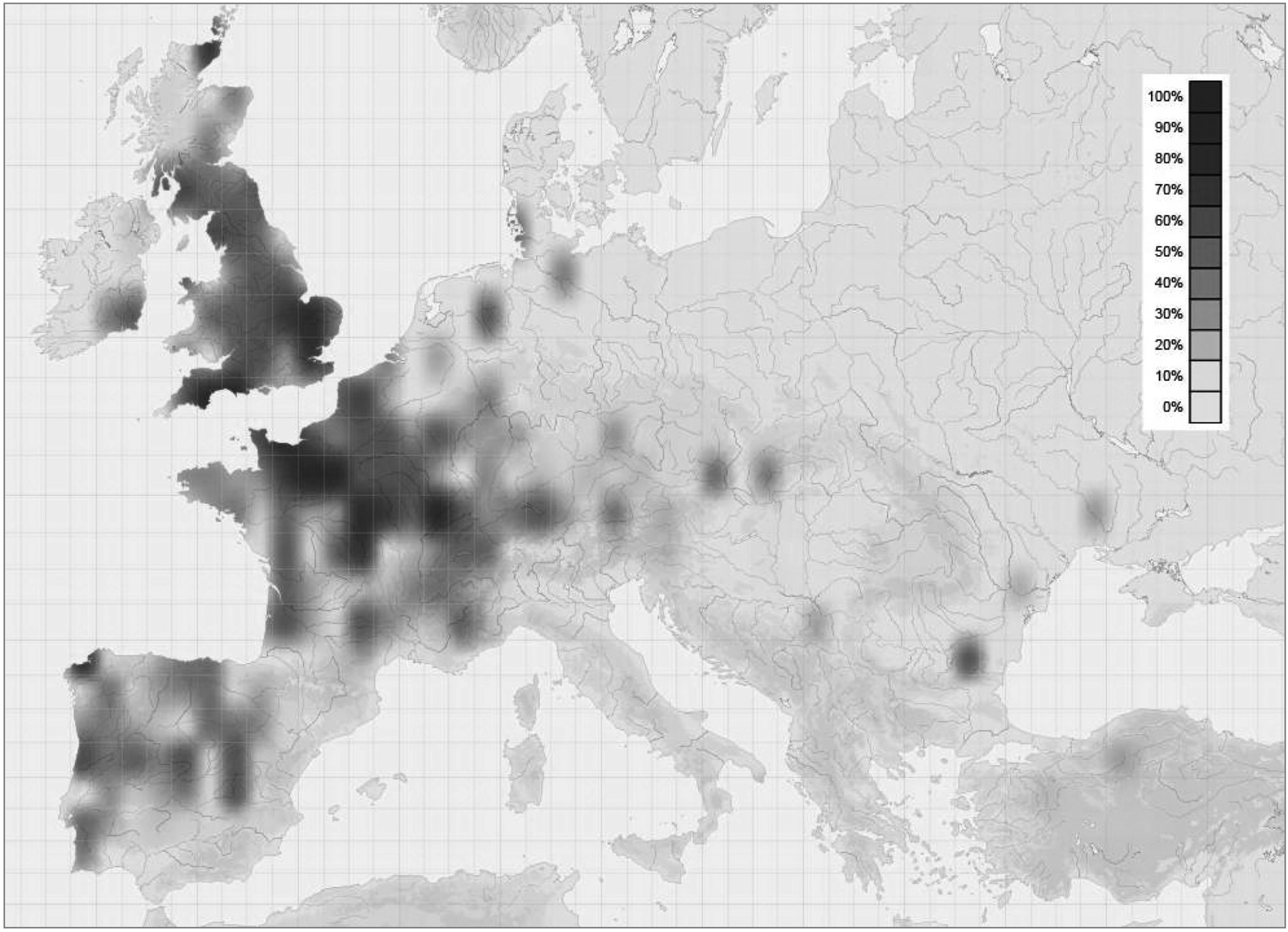
‘Celtic-looking’ BRIG place-names (cf. Sims-Williams Reference Sims-Williams2006, 49–53, 308, 328). Figures indicate squares where there are 1+ examples. Solid squares have names in -BRIA which are unlikely to be Celtic.

Even ‘taken at its face value’, Oppenheimer's ’90 per cent’ map (like the ‘100 per cent’ maps just mentioned) shows that the ‘Celtic-looking’ toponymy of France is at least as dense as that of the Iberian peninsula, and that the peninsula has great tracts which do not look Celtic at all, both in the south and in the east. The distribution of Celtic personal names in Latin inscriptions gives the same impression (Raybould & Sims-Williams Reference Raybould and Sims-Williams2009, 48; Sims-Williams Reference Sims-Williams2012b, 439; see Figure 2, above). These blanks are not what one might expect if Celtic really spread from the Atlantic.
Moreover, the Celticity of the Iberian peninsula is exaggerated on all these maps. Nearly half of the relevant peninsular names contain Celtic versions of the Proto-Indo-European root *bhr˚gh- ‘high’ which in Celtic developed the distinctive form *brig-, whence the Celtic words *brig-s and *briga, which gave Old Irish brí and Welsh bre respectively. These Insular Celtic words mean simply ‘hill’, but on the Continent the meaning seems to be ‘hillfort’ or ‘oppidum’ and in northwest Hispania briga is often translated as castellum in Latin sources (Luján Reference Luján, Luján and García Alonso2011; Sims-Williams Reference Sims-Williams2006, 49–53, 307, 328; Untermann Reference Untermann2018, 136). For occurrences in the Barrington data (Talbert Reference Talbert2000), see Figure 4. Out of my 153 locations in Hispania with ‘Celtic-looking’ names (Sims-Williams Reference Sims-Williams2006, 142–51), 62 (41 per cent) included BRIG (or its variants BRIC, BIRIK, BRIS, BRIA), the next most popular string being SEG (or SEK) ‘power, victory’, in 17 locations (12 per cent). Thus the Celtic-looking toponymy of Hispania is heavily weighted towards BRIG and is much less varied than that of areas such as France and Britain. This monotonous lack of variety suggests that it lacks chronological depth. Moreover, alongside true Celtic compounds like Sego-briga ‘power-hillfort’ (in Celtiberia) we find many hybrids with non-Celtic or even Latin first elements, e.g. Conim-briga (now Coimbra, Portugal) and Flavio-briga (Castro Urdiales, Spain), the name of the latter colonia having replaced Amanum portus according to Pliny (Natural History 4.20.110). Such hybrids may sometimes indicate no more than an awareness of the prestige of Celtic culture in the way that modern English-medium creations like Bourn-ville and Minnea-polis reflect the prestige of French and Greek. It is well known that foreign place-name elements can be borrowed in bilingual communities and then spread into non-bilingual areas, a case in point in Welsh toponymy being cnwc ‘hill’, from Irish cnoc (Wmffre Reference Wmffre, Jankulak and Wooding2007, 54-6). Another example is *burg- from the Proto-Indo-European root *bhr˚gh-. This was borrowed by the Romans from Germanic (or from a language such as ‘East Alpine Indo-European’) as burgus ‘watchtower, citadel’, a word that then turned up in Latin place-names as far afield as north Africa (Sims-Williams Reference Sims-Williams2006, 4, 317–18). In the same way, Celtic briga may have been current as a term for various types of hillforts and oppida in Iberia well outside the Celtic-speaking regions (cf. Gorrochategui & Vallejo Reference Gorrochategui, Vallejo, Sinner and Velaza2019, 340 n. 11; Luján Reference Luján, Sinner and Velaza2019, 327–81; Sims-Williams Reference Sims-Williams2012b, 44). And in areas where Celtic names are otherwise rare, briga/castellum may indicate relatively recent Celtic intrusions (Luján Reference Luján, Luján and García Alonso2011). Given the chronology of hillforts in the peninsula (Arenas-Esteban Reference Arenas-Esteban, Anreiter, Bánffy, Bartosiewicz, Meid and Metzner-Nebelsick2012, 36; Fernández-Götz Reference Fernández-Götz2018, 146-7; Lorrio & Ruiz Zapatero Reference Lorrio and Ruiz Zapatero2005, 222), it is hard to imagine that many of the peninsular -briga names are much older than the first millennium bc.
There is a second, more technical reason why the Celticity of the Iberian peninsula may be exaggerated on the above maps of ‘Celtic-looking’ names. In the peninsula, and to a lesser extent in Britain and Ireland, there are a large number of ‘unlocated’ ‘Celtic-looking’ names in the Barrington Atlas data (Talbert Reference Talbert2000) which can in fact be located at least as closely as a 1-degree square, thanks especially to the work of Albertos (Reference Albertos Firmat1990) in the case of about 20 of the Atlas's ‘unlocated’ -briga names in Hispania (see Sims-Williams Reference Sims-Williams2006, 50–52). Since it proved impossible to estimate how many ‘unlocated non-Celtic-looking’ names might belong in the same 1-degree squares, the inclusion of such ‘unlocated Celtic-looking names’ was bound to have exaggerated the percentages in the relevant squares (as cautioned in Sims-Williams Reference Sims-Williams2006, 162). If this statistical problem could be solved, or if the maps were redrawn after eliminating the approximately locatable ‘unlocated’ names, the effect would be greatly to reduce the relative Celticity of the Iberian peninsula and the British Isles—precisely the Atlantic fringe that is so important for the ‘Celtic from the West’ hypothesis.
Thus Oppenheimer's map cannot be ‘taken at its face value’ (Cunliffe Reference Cunliffe2018, 54) in favour of ‘Celtic from the West’. Cunliffe's most recent comment on the place-names is properly more cautious: ‘While this evidence cannot be claimed as positive support for the Celtic from the West hypothesis it is at least consistent with it’ (Cunliffe Reference Cunliffe, Cunliffe and Koch2019, 12).
3. The ‘recent demonstration that the inscriptions on the stelae of south-western Iberia were Celtic’ (Cunliffe Reference Cunliffe2018, 409)
Since the original mapping was done [by Sims-Williams and Oppenheimer], the detailed work of John Koch on the inscriptions found in the extreme south-western corner of Iberia has shown that Celtic was the indigenous language spoken in this region and has added further data to the map. More to the point, it has shown that Celtic was being spoken in the region in the seventh century bc and quite possibly at least as early as the eighth century. Inscriptions from the Lepontic region of northern Italy take the use of Celtic in that part of Europe to at least as early as the sixth century. (Cunliffe Reference Cunliffe2018, 54)
While some date these southwestern Hispanic inscriptions (sometimes called ‘Tartessian’) to as early as the eighth century (Lorrio & Sanmartí Reference Lorrio, Sanmartí, Sinner and Velaza2019, 37), others prefer the sixth and fifth centuries (Correa & Guerra Reference Correa, Guerra, Sinner and Velaza2019, 126; for maps see 110–11 and de Hoz Reference de Hoz, Sinner and Velaza2019a, 3). Whichever date is correct, if the southwestern inscriptions really were Celtic they would be the earliest Celtic inscriptions in the peninsula, for the northeastern Celtiberian inscriptions begin no earlier than the end of the third century bc. For decades, philologists have been searching for Celtic words or names in the southwestern ones and have retired defeated, and Koch (Reference Koch2019) seems to be the only Celtic linguist who still argues that ‘Tartessian’ is Celtic, on the basis of what some call ‘circular reasoning’ (Valério Reference Valério2014, 446 & 458). It is therefore strange that in 2018 Cunliffe followed Koch and ignored the negative conclusions expressed between 2007 and 2017 by James Clackson, Javier de Hoz, Jürgen Zeidler, Oliver Simkin, Alberto Nocentini, Joaquín Gorrochategui, Eugenio Luján, Joseph Eska, Blanca Prósper, Peter Schrijver, Tatyana Mikhailova, Jesús Rodríguez Ramos, Joan Ferrer, Noemí Moncunill, Javier Velaza, Sebastián Celestino and Carolina López-Ruíz (see Sims-Williams Reference Sims-Williams2016, 14 n. 47; Reference Sims-Williams2017a, 421 n. 3; and now Correa & Guerra Reference Correa, Guerra, Sinner and Velaza2019, 122, 134–6; Eska Reference Eska2017; Reference Eska2018, 326–7; Hewitt Reference Hewitt2018; Stifter Reference Stifter, Amann, Corsten, Mitthof and Taeuber2019, 120). The state of the question is summed up by de Hoz (Reference de Hoz, Sinner and Velaza2019a, 11):
J. Koch's recent proposal that the south-western inscriptions should be deciphered as Celtic has had considerable impact, above all in archaeological circles. However, the almost unanimous opinion of scholars in the field of Palaeohispanic studies is that, despite the author's indisputable academic standing, this is a case of a false decipherment based on texts that have not been sufficiently refined, his acceptance of a wide range of unjustified variations, and on purely chance similarities that cannot be reduced to a system; these deficiencies give rise to translations lacking in parallels in the recorded epigraphic usage.
The final remark relates to ‘translations’ such as ‘the highest throne has delivered [the deceased] to the greatest tumulus. Raha the Bronze Minister now lies down’ (Koch Reference Koch, Koch and Cunliffe2016, 465) and ‘when/until for/to the bright ones I do not drink sub-true things’ (Kaufman Reference Kaufman2015, quoted by Eska Reference Eska2017, 204).
The inscriptions in question are centred on the Algarve, the territory of the Cynetes. As the Cynetes are specifically distinguished from the Celts by Herodotus (see above), no one would expect them a priori to have a Celtic language. Even if there were one or two Celtic personal names in the inscriptions, which remains very doubtful (cf. Correa & Guerra Reference Correa, Guerra, Sinner and Velaza2019, 131–3; Gorrochategui & Vallejo Reference Gorrochategui, Vallejo, Sinner and Velaza2019, 358; Koch Reference Koch, Koch and Cunliffe2016, 458–9; Sims-Williams Reference Sims-Williams2016, 14; Villar Reference Villar, Lambert and Pinault2007, 436-40), the simplest explanation would be that the people in question could be incomers from inland Celtiberia in the northeast.
Once these ‘Tartessian’ inscriptions are set aside, there remains little evidence for Celticity in the southwest of the Peninsula and none of it is early (on the mythical Arganthonios of Tartessos, see Sims-Williams Reference Sims-Williams2016, 22–3; Valério Reference Valério2014, 442). Celtic personal names are relatively rare in the Latin inscriptions (see maps in Raybould & Sims-Williams Reference Raybould and Sims-Williams2009, 43, 48 & 54–6), and south of latitude 40 and west of longitude -05, there are only about 26 plausible Celtic toponyms (fewer according to Untermann Reference Untermann2018), half of which are -briga names, in connection with which it is worth quoting de Hoz's opinion (Reference de Hoz, Sinner and Velaza2019b, 153) that the -briga names of Andalusia, ‘as reflected by both the written sources and archaeology’, refer to ‘settlements whose origins were no earlier than the fourth century bce’. Some of the few Celtic-looking place-names are probably to be connected with incoming Celtic-speaking settlers, possibly those known as Celtici (Sims-Williams Reference Sims-Williams2006, 226–7; Reference Sims-Williams2016, 22; Reference Sims-Williamsforthcoming). There were various groups of these Celtici in Roman Hispania, and there is no reason to doubt Pliny's statement in the first century ad (Natural History 3.1.13) that their rituals, language and oppidum-names showed that the Celtici of Baeturia in the southwest had immigrated from Celtiberia via Lusitania (de Hoz Reference de Hoz, Sinner and Velaza2019b, 142–3; Lorrio & Sanmartí Reference Lorrio, Sanmartí, Sinner and Velaza2019, 40, 50; Untermann Reference Untermann2018, 338–41; Villar Reference Villar, Lambert and Pinault2007, 418–21).
So Celtic may have spread westwards in the Peninsula towards the Atlantic in the latter part of the first millennium bc (cf. Lorrio & Sanmartí Reference Lorrio, Sanmartí, Sinner and Velaza2019, 48–53), not from the Atlantic eastwards in the third millennium, along with the Bell Beaker culture, as hypothesized by Cunliffe (Reference Cunliffe2018, 63). Westwards could also be the direction of travel that brought Celtic to Brittany, Britain, and Ireland.
In principle, it is always worth investigating whether the spread of material ‘cultures’ can be correlated with the spread of peoples and languages. A particular weakness with the ‘Celtic from the West’ hypothesis, however, is its attempt to match up Celtic, or supposedly Celtic, linguistic data from the first millennium bc and later with archaeological data from the third millennium bc such as Bell Beakers (cf. Falileyev Reference Falileyev, Prieto Martínez and Salanova2015). The chronological disparity is so vast that the hypothesis is impossible to confirm. ‘Celtic from the East’ was more realistic in focusing on philological and archaeological data from the same period (the first millennium bc). This led to its downfall, once the discovery of the Lepontic and Celtiberian inscriptions failed to correlate with the distribution of what was supposed to be ‘Celtic archaeology’. By contrast, third-millennium linguistic data from the Atlantic seaboard is unlikely to be discovered, and to that extent ‘Celtic from the West’ is safe from refutation. Nevertheless, it remains a baseless speculation.
A simpler hypothesis: Celtic from the centre
A more economical view of the origin of the Celtic languages, consonant with the historical and linguistic evidence, might run as follows (cf. Sims-Williams Reference Sims-Williams2017a, 432–5).
Celtic presumably emerged as a distinct Indo-European dialect around the second millennium bc, probably somewhere in Gaul (Gallia/Keltikê), whence it spread in various directions and at various speeds in the first millennium bc, gradually supplanting other languages, including Indo-European ones—Lusitanian and ‘Eastern Alpine Indo-European’ are candidates—and non-Indo-European ones—candidates are Raetic, Aquitanian/Proto-Basque, ‘Iberian’, ‘Tartessian’ and Pictish (Rodway Reference Rodway2020; Sims-Williams Reference Sims-Williams2012b, 431); and presumably there were dozens more languages about which we know nothing, especially in northern Europe.
The reasons for suggesting Gaul (perhaps including part of Cisalpine Gaul) are: (i) it is central, obviating the need to suppose that Celtic was spoken over a vast area for a very long time yet somehow avoided major dialectal splits (cf. Sims-Williams Reference Sims-Williams2017a, 434); (ii) it keeps Celtic fairly close to Italy, which suits the view that Italic and Celtic were in some way linked in the second millennium (Schrijver Reference Schrijver, Koch and Cunliffe2016). During the first millennium bc, Celtic spread into eastern Iberia (probably well before the time of Herodotus and Herodorus), into northern Italy (as first evidenced by the Lepontic inscriptions in the sixth century: Stifter Reference Stifter, Amann, Corsten, Mitthof and Taeuber2019), into Britain, and perhaps already into Ireland (though Ireland is undocumented), and also towards the east, eventually reaching Galatia in Turkey in the third century bc (as documented in Greek sources).
The Celts who took their language with them may often have adopted the material culture of the territories where they settled, thereby becoming archaeologically indistinguishable. At least latterly, some large-scale folk movements were involved, judging by the classical sources, but Celtic may also have spread incrementally and unspectacularly, following the model proposed by Robb (Reference Robb1991, as discussed by Sims-Williams Reference Sims-Williams2012b, 436; cf. Mallory Reference Mallory, Koch and Cunliffe2016; Wodtko Reference Wodtko, Koch and Cunliffe2013, 193–204). Since Celtic may well have been moving into areas with patchworks of minor languages—5000 speakers being the median for languages worldwide (Nettle Reference Nettle1999, 113)—quite a low number of Celtic speakers could be enough to effect a language shift. For example, if only 10 per cent of people in Britain spoke Celtic but the rest of the population spoke a dozen other languages, Celtic might have the advantage, especially when reinforced by the language of the adjacent part of the Continent.
Finally, in the latter part of the first millennium bc, Celtic may still have been expanding and consolidating in many areas, both east and west, before it was overtaken by the expansion of the Roman Empire.
‘Celtic from the Centre’ may lack the time-depth and exotic locations that appeal to romantics, but the economical hypothesis sketched above is realistic and fits the known facts. According to Caesar, central France was occupied by the Galli (Gauls), who called themselves Celtae in their own language (Gallic War 1.1), and according to Livy it was the homeland of the Gauls who migrated to Italy (see Figure 1). It is an obvious place for Celtic ethnogenesis. That said, it must be admitted that while the most economical hypothesis is often the best available option, it is never necessarily correct. Even the above hypothesis entails a gap of perhaps a millennium between the hypothetical emergence of the Celtic language and its first attestation in the Lepontic inscriptions of the sixth century bc. Currently we have no direct linguistic evidence about what occurred during that gap.
Conclusion
Some general lessons can be learnt from the above study. Except when lucky enough to find inscriptions, archaeologists can rarely shed direct light on ancient linguistic geography. Philologists may contribute more, provided that early and locatable place- and personal names survive, or informative texts. Their main efforts, however, have always been devoted to the reconstruction of proto-languages, working back from the attested data to starred proto-forms, using well-tried comparative methods. Valid though they may be in context of the discipline, such reconstructed languages tend to belong in ‘asterisk reality’, fixed neither in time or space. This is frustrating from an archaeological standpoint, since ‘“when?” and “where?” are precisely the questions which archaeologists … like to ask’ (Renfrew Reference Renfrew1987, 286). When philologists do offer them answers, their answers should not be accepted uncritically. ‘Celtic from the East’ is a case in point. Misunderstood classical texts and place-names led nineteenth-century philologists to locate the origin of the Celtic languages in southern Germany and Austria c. 500 bc, and their opinion led archaeologists to label the ‘Hallstatt culture’ as Celtic, a label which in turn led philologists to use ‘Hallstatt’ archaeology as a basis for linguistic geography—and so on by a circular argument. ‘Celtic from the West’ is similarly flawed. It was conjectured that the Celtic languages originated along the Atlantic seaboard before 3000 bc, on the basis of (1) ‘glottochronology’ (regarded as a pseudo-science by most philologists), (2) Celtic-language place-names attested three or more millennia too late, and (3) first-millennium bc inscriptions on stelae in southwest Iberia which hardly any philologists now regard as Celtic or even Indo-European in language. On the basis of this dubious philology, it is suggested that ‘the eastern spread of Bell Beaker culture could be the vector by which the Celtic language spread across much of western Europe’ (Cunliffe Reference Cunliffe2018, 63). The ‘Bell Beaker culture’ seems set to replace the ‘Hallstatt culture’ as a surrogate for solid information about prehistoric linguistic geography. It is a baseless speculation.
From a methodological point of view, ‘Celtic from the East’ was preferable to ‘Celtic from the West’: it at least compared (dubious) philological data with archaeological data from within the same millennium. This eventually enabled it to be falsified. By contrast, ‘Celtic from the West’ compares (dubious) philological data from the first millennium bc and later with archaeological data from a period several millennia earlier from which no philological data survive.
I have argued above, and elsewhere (Sims-Williams Reference Sims-Williams2012b, 440), that instead of such unbridled speculation it would be better to work carefully backwards from the earliest known philological data in the mid first millennium bc. When we do so, we come up with the plausible hypothesis that Celtic need not have begun to spread from a central homeland (roughly France) much before c. 1000 bc. This economical hypothesis represents a reasonable starting point for future work and is open to falsification by the discovery of new inscriptions or other data.
Mutatis mutandis, the above case study may be useful to those considering the prehistoric linguistic geographies of other areas. To mention just one example, some archaeologists have a ‘presumption’, on the basis of the ‘Corded Ware culture’, that ‘some form of Germanic was spoken in south Scandinavia from c 3000 bc onwards’, whereas ‘linguists have rarely imagined that the Germanic language itself came into existence much before 500 bc’ (see Mallory et al. Reference Mallory, Dybo and Balanovsky2019, 1483). In such situations, archaeologists and philologists need to reconsider the nature and validity of the evidence they use.
Acknowledgements
I am grateful to the Editor, Dr Robb, and his referees for their helpful comments, and also to Professors Raimund Karl, James Mallory and Marged Haycock.


 Open access

