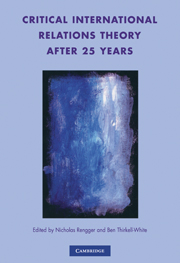
Book contents
- Frontmatter
- Contents
- Preface
- Notes on contributors
- Editors' Introduction
- Looking back from somewhere: reflections on what remains ‘critical’ in critical theory
- Transnational theories of order and change: heterodoxy in International Relations scholarship
- Happy Anniversary! Time and critique in International Relations theory
- Is critical theory always for the White West and for Western imperialism? Beyond Westphilian towards a post-racist critical IR
- The promise of critical IR, partially kept
- Towards a sociology of global morals with an ‘emancipatory intent’
- Between Kant and Pufendorf: humanitarian intervention, statist anti-cosmopolitanism and critical international theory
- Index
Editors' Introduction
Published online by Cambridge University Press: 06 July 2010

Book contents
- Frontmatter
- Contents
- Preface
- Notes on contributors
- Editors' Introduction
- Looking back from somewhere: reflections on what remains ‘critical’ in critical theory
- Transnational theories of order and change: heterodoxy in International Relations scholarship
- Happy Anniversary! Time and critique in International Relations theory
- Is critical theory always for the White West and for Western imperialism? Beyond Westphilian towards a post-racist critical IR
- The promise of critical IR, partially kept
- Towards a sociology of global morals with an ‘emancipatory intent’
- Between Kant and Pufendorf: humanitarian intervention, statist anti-cosmopolitanism and critical international theory
- Index
Summary
Twenty-five years ago, theoretical reflection on International Relations (IR) was dominated by three broad discourses. In the United States the behavioural revolution of the 1950s and 1960s had helped to create a field that was heavily influenced by various assumptions allegedly derived from the natural sciences. Of course, variety existed within the behaviourist camp. Some preferred the heavily quantitative approach that had become especially influential in the 1960s, while others were exploring the burgeoning literature of rational and public choice, derived from the game theoretic approaches pioneered at the RAND corporation. Perhaps the most influential theoretical voice of the late 1970s, Kenneth Waltz, chose neither; instead he developed his Theory of International Politics around an austere conception of parsimony and systems derived from his reading in contemporary philosophy of science.
These positivist methods were adopted not just in the United States but also in Europe, Asia and the UK. But in Britain a second, older approach, more influenced by history, law and by philosophy was still widely admired. The ‘classical approach’ to international theory had yet to formally emerge into the ‘English School’ but many of its texts had been written and it was certainly a force to be reckoned with. Relatedly, there were voices within the realist tradition, elsewhere, drawing on older traditions of thinking about international relations. Most notably of these was Hans Morgenthau, whose first (and most powerful) English language book was a concerted reaction against the ‘scientific’ approaches dominant in his adopted homeland.
Information
- Type
- Chapter
- Information
- Publisher: Cambridge University PressPrint publication year: 2007
Accessibility standard: Unknown
Why this information is here
This section outlines the accessibility features of this content - including support for screen readers, full keyboard navigation and high-contrast display options. This may not be relevant for you.Accessibility Information
Accessibility compliance for the PDF of this chapter is currently unknown
and may be updated in the future.
- 1
- Cited by