

1 Introduction
In this Element, we introduce a family of approaches that regard constructions – that is, form–meaning pairs at various levels of abstraction and complexity – as the main units of linguistic knowledge. Traditional approaches to grammar often assume that our knowledge of language consists of two components: the lexicon as a repository of morphemes, words, and a very limited set of idioms, on the one hand, and the grammar as a set of rules for combining the items in the lexicon on the other (see e.g. Reference PinkerPinker 1994; Reference TaylorTaylor 2012). In such approaches, the lexicon is usually kept at a minimum – as Reference Di Sciullo and WilliamsDi Sciullo and Williams (1987: 3) famously put it, “[t]he lexicon is like a prison – it contains only the lawless, and the only thing that its inmates have in common is lawlessness.” Constructionist approaches take a radically different stance. Their starting point is the observation that there is much more idiomaticity in language than is usually assumed. Broadly speaking, idiomatic units are complex constructions whose meaning cannot be fully derived from their constituent parts (but see Reference WulffWulff 2008, Reference Wulff, Hoffmann and Trousdale2013 for a more nuanced treatment of idiomaticity and its relation to compositionality). Consider, for example, the much discussed way-construction, exemplified in (1) (all from the News on the Web corpus, Reference DaviesDavies 2016–).
a. Mr. Musk bluffed his way through the crisis. (October 5, 2018, US, MarketWatch, NOW corpus)
b. Last month Tesla CEO Elon Musk bullied his way to reopening his electric car factory in California ahead of local health officials’ recommendations. (June 11, 2020, KE, nairobiwire.com, NOW corpus)
c. Tesla founder and CEO Elon Musk teased his way through the car’s introduction, showing pictures of the company’s past (April 1, 2016, PK, BusinessRecorder, NOW corpus)
d. Elon Musk tweets his way through his pending Twitter acquisition. (May 21, 2022, US, wral.com, NOW corpus)
As Reference Israel and GoldbergIsrael (1996) points out, one important feature of this construction is that it always entails the subject’s movement (in a literal or metaphorical sense), even if the lexical semantics of the verb do not imply any kind of movement. Thus, the meanings of the sentences in (1) cannot necessarily be derived from the meanings of their constituent parts. In these examples, the whole is more than the sum of its parts – in other words, we are dealing with structures that are not fully compositional. As we will show in Section 2, the insight that noncompositionality is more ubiquitous in language than one might think was one of the main starting points of constructionist approaches. Language, on this view, is highly idiomatic. Constructionist approaches therefore depart from the classic position that words and morphemes are the main “building blocks” of language that are combined via a set of rules, and instead propose a joint format for the representation of meaning-bearing units of varying sizes and at different levels of abstraction: constructions.
Speaking of “constructionist approaches” underlines that Construction Grammar (CxG), which has grown into a large research field over the last decades with a variety of journals, textbooks, and book series dedicated to it, is not a uniform paradigm but has rather developed into a heterogeneous set of “Construction Grammars,” plural (see e.g. Reference Hoffmann and DancygierHoffmann 2017a, Reference Hoffmann and Dancygierb). While different approaches differ substantially in some of the assumptions they make as well as in their goals, Reference Goldberg, Hoffmann and TrousdaleGoldberg (2013) and Reference HoffmannHoffmann (2022: 10–16) summarize four basic assumptions that are common to all “flavors” of Construction Grammar, in addition to the basic concept of linguistic constructions:
They do not assume a strict division between lexicon and grammar but instead postulate a lexicon-syntax continuum.
They assume that constructions do not exist in isolation and that our knowledge of constructions should not be conceived of as an unstructured list (as is sometimes the case in conceptualizations of the mental lexicon). Instead, they are organized in a taxonomic network, a construct-i-con. We will deal with the inner workings of this “grammar network” (Reference DiesselDiessel 2019) in Section 4.
They are surface oriented, that is, they do not posit some sort of “deep structure” with abstract syntactic representations and operations. Instead, it is assumed that constructions emerge (historically) and are learned (ontogenetically) via generalizations over concrete instances that language users encounter.
Given this surface orientation, they do not assume a “Universal Grammar” that underlies all human languages but instead expect a considerable amount of cross-linguistic variability. To the extent that there are universals of language (see Reference Evans and LevinsonEvans & Levinson 2009 for a skeptical stance), they are explained as generalizations deriving from domain-general cognitive processes and functional pressures (Reference HoffmannHoffmann 2022: 16).
In the remainder of this text, we will give an overview of the historical development, the current state of the art, and potential future outlooks of constructionist approaches. Of course, many excellent introductions to the framework already exist: for book-length introductions, see Reference HilpertHilpert (2019) and Reference HoffmannHoffmann (2022); for chapter-length summaries, see Reference Fried, Östman, Fried and ÖstmanFried and Östman (2004), Reference Croft and CruseCroft and Cruse (2004: 257–290), Reference Croft, Geeraerts and CuyckensCroft (2007), Reference Diessel, Dąbrowska and DivjakDiessel (2015), Reference Hoffmann and DancygierHoffmann (2017a) and Reference Boas, Wen and TaylorBoas (2021); see also Reference Hoffmann and TrousdaleHoffmann and Trousdale’s (2013) handbook. Compared with these earlier overviews, our focus here will be especially on recent developments in the field, including current research topics as well as ongoing debates that yet need to be resolved.
In Section 2, we provide an overview of the genesis of CxG, before addressing varying definitions of the concept of “construction” and discussing the question of whether morphemes and words should also count as constructions. In Section 3, we compare different constructionist approaches with regard to three parameters: their degree of formalization, their research foci, and the methods they prefer to use. Section 4 focuses on the structure of the construct-i-con, addressing its psychological underpinnings and the different types of links it may contain as well as some open research problems (see also Diessel’s [Reference Diessel2023] contribution to the Elements in Construction Grammar series for an in-depth treatment of constructional networks). Finally, Section 5 discusses some further current developments in CxG, zeroing in on three research topics that have increasingly gained attention in recent years: linguistic creativity, multimodality, and individual differences between language users. Section 6 offers a brief conclusion.
2 Discovering Idiomaticity: The Case for Constructions
2.1 The Early Days of CxG
Historically, the emergence of CxG is closely connected to the endeavor of establishing a counterpart to Chomskyan generative linguistics, which was the dominant paradigm especially in North American linguistics for much of the second half of the twentieth century (see e.g. Reference HarrisHarris 2021).Footnote 1 While the concept of “constructions” in the constructionist sense as well as the term “Construction Grammar” emerged in the 1980s, especially in the works of Reference FillmoreFillmore (1988; Reference Fillmore, Kay and O’ConnorFillmore, Kay, & O’Connor, 1988) and Reference LakoffLakoff (1987), Reference Boas, Wen and TaylorBoas (2021: 43) points out that the intellectual roots of CxG – and of its “sister theory,” frame semantics – lie in Reference Fillmore, Bach, Harms and FillmoreFillmore’s (1968) seminal paper “The Case for Case.” Specifically, he argues that the idea of “deep cases” foreshadows what later came to be known as semantic roles, which in turn play a key role in the interaction of verbs and constructions in CxG. But while the notion of “construction” already appears in earlier works, Reference Fillmore, Kay and O’ConnorFillmore et al.’s (1988) paper on the let alone construction is nowadays usually seen as the key starting point of CxG (see e.g. Reference Boas, Wen and TaylorBoas 2021: 49).
Reference Fillmore, Kay and O’ConnorFillmore et al. (1988) argue that idiomaticity is not just an “appendix” to the grammar of the language – instead, idiomatic patterns are themselves productive, highly structured, and worthy of grammatical investigation. In the case of let alone, they argue that neither can its properties be exhaustively derived from its lexical makeup and grammatical structure, nor can it be treated as a fixed expression. At the syntactic level, Fillmore et al. analyze let alone as a coordinating conjunction; at the semantic and pragmatic level, they see it as a paired-focus construction that evokes a certain scale. For example, in (2a), “taking the first step” and “taking the second step” can be interpreted as the contrastively focused elements, and as points on a scale. In (2a), this scale is fairly obvious, as it is in (2b), where approach and equal can be considered classic examples of lexical items that form a so-called Horn scale, that is, a scale where the stronger term entails the weaker one while the weaker term implicates the falsity of the stronger one (e.g. <warm, hot>, <some, many, most, all>; see Reference CumminsCummins 2019: 49).
a. I barely knew what step to take first, let alone what step to take second, let us not talk about the third. (A08, BNC)
b. The old Herring and Addis tools were made with a finesse and temper that modern tools do not approach, let alone equal. (A0X, BNC)
c. [R]eference to its existence, let alone study of its function, has been sedulously avoided. (A69, BNC)
d. I don’t have time to feed the children, let alone prepare my lecture. (Reference Fillmore, Kay and O’ConnorFillmore et al. 1988: 531)
In some cases, however, the scales evoked by let alone are more complex, as (2c) and especially Fillmore et al.’s example (2d) illustrate: Here, the conjuncts – reference to its existence and study of its function in (2c), feed the children and prepare my lecture in (2d) – do not belong to the same semantic domain. Thus, the scales evoked by let alone can be strongly context-dependent.
Apart from let alone, Reference Fillmore, Kay and O’ConnorFillmore et al. (1988: 510–511) mention a number of other constructions in passing, some of which have been investigated in more detail in later constructionist work; for example, the what with construction (what with the kids and all; see e.g. Reference TrousdaleTrousdale 2012) and the incredulity response construction (Him a doctor?!?; see e.g. Reference Szcześniak and PachołSzcześniak & Pachoł 2015). Fillmore et al.’s article thus spawned a series of further constructionist analyses, starting in the early 1990s – for example Reference KayKay’s (1990) paper on even and Reference MichaelisMichaelis’ (1993) study of the English perfect construction – and growing in number ever since.
In the following, we cannot provide a summary of all the phenomena that have been studied from a constructionist perspective over the last thirty-five years, as there are too many. Instead, we will focus on the key notion of “construction,” exploring how the concept has developed over time in the context of the changes that CxG as a paradigm has undergone. In particular, we will focus on Reference GoldbergGoldberg’s (1995, Reference Goldberg2006, Reference Goldberg2019) definitions of constructions, as the evolution of the concept in her writing arguably reflects important developments in CxG, which is why the different definitions she has provided over the years are often cited and compared to each other in introductory texts (e.g. Reference HilpertHilpert 2019; Reference Ziem and LaschZiem & Lasch 2013). We will also discuss what kinds of units can be seen as constructions, which naturally depends on the definition of construction that one adopts.
2.2 “Construction”: An Evolving Concept
A major contribution to defining the notion of construction was made by Reference GoldbergGoldberg (1995) in a monograph that also constitutes the first book-length summary of the constructional approach and can therefore be seen as a further milestone in CxG history.Footnote 2 In this book, Goldberg outlines many of the key issues that have been at the heart of constructionist approaches ever since: the important role that aspects of meaning (semantic and pragmatic) play in the analysis of grammar; the interaction between constructional meaning and verb meaning; the notion that constructions motivate each other within a network of stored knowledge (see Section 4); and a usage-based account of the partial productivity of constructions based on learning mechanisms such as indirect negative evidence (see Reference GoldbergGoldberg 2019 for a more recent account of this mechanism in terms of “statistical preemption”).
Crucially, Reference GoldbergGoldberg (1995) also proposes what may be the best-known definition of “construction”:
C is a construction iffdef C is a form-meaning pair <Fi, Si> such that some aspect of Fi or some aspect of Si is not strictly predictable from C’s component parts or from other previously established constructions.
The definition captures two central elements. First, drawing on the traditional concept of a Saussurean sign (Reference GoldbergGoldberg 1995: 6), constructions are regarded as units of form that inherently carry meaning, contrary to their generativist conception in terms of meaningless structural rules. In Goldberg’s approach as well as subsequent work, “meaning” has come to be understood in a broad sense, comprising lexical, semantic, pragmatic, discourse-functional, and social aspects, while “form” is usually taken to include phonological, syntactic, and morphological information (but see e.g. Reference Herbst and UhrigHerbst & Uhrig 2020 for discussion).Footnote 3 Second, Goldberg uses nonpredictability as a criterion for what counts as a construction and what does not: Any pattern that has “unique” properties that go beyond the properties of its subparts and those of other, partially similar, constructions is recognized as a construction in its own right. Nonpredictability is closely linked to the notions of idiomaticity and noncompositionality, which are also often used to argue for the construction status of a pattern (see Reference Pleyer, Lepic and HartmannPleyer et al. 2022 for the multifaceted meanings of “compositionality”). Crucially, however, the nonpredictability criterion applies not only to idiomatic constructions which, in previous generative work, had been relegated to the “periphery” of language (Reference ChomskyChomsky 1981); it also allows for highly frequent and seemingly “regular” or “core” patterns, such as the caused-motion pattern illustrated in (3), to be treated as constructions. The fact that (3b) implies a motion event, even though it contains an intransitive nonmotion verb, suggests that the “caused motion” meaning is associated with the construction itself and is not predictable from the lexical items it contains. As a result, Goldberg’s definition allows for a wide view of “constructions” that covers both broad grammatical generalizations and the many less-frequent idiomatic patterns whose role was emphasized by early CxG work.
a. Pat pushed the piano into the room. (Reference GoldbergGoldberg 1995: 76)
b. Sally sneezed the napkin off the table. (Reference GoldbergGoldberg 1995: 6)
Reference GoldbergGoldberg’s (1995) definition has, however, not remained unchanged over time; rather, it has continued to evolve as subsequent research has brought to light some of its limitations. First, scholars have come to agree that, apart from their nonpredictability, the frequency of linguistic patterns is another major determinant of their status as constructions. Early evidence that speakers track and record frequencies in the linguistic input came from studies showing that more frequent units tend to be phonologically more reduced than less frequent ones (Reference Bybee, Barlow and KemmerBybee 2000; Reference LosiewiczLosiewicz 1992). Moreover, the long-standing research on formulaic patterns in language (Reference BolingerBolinger 1976; Reference Kuiper and HaggoKuiper & Haggo 1984; Reference PawleyPawley 1985) has highlighted that speakers rely heavily on lexically fixed chunks in natural speech. As illustrated in (3) and (4), speakers routinely prefer certain frequent expressions over less frequent alternatives, even when the words they contain have similar meanings and they are both sanctioned by the same abstract construction, such as the noun-phrase construction in (4) and the transitive construction in (5). This suggests that speakers store highly frequent chunks as constructions in their own right, even when they can be predicted from their component parts or based on an abstract template they instantiate.
a. innocent bystanders (preferred)
b. uninvolved people (dispreferred)
a. it boggles my mind (preferred)
b. it giggles my brain (dispreferred)
(all adapted from Reference GoldbergGoldberg 2019: 53)
Apart from these fully lexicalized instances, there is also ample evidence that speakers encode frequency information about partially lexicalized subtypes of more abstract constructions. For example, Reference Gries and StefanowitschGries and Stefanowitsch’s (2004) corpus results indicate that speakers’ use of the ditransitive and the to-dative construction varies depending on the verb: While verbs such as give, tell, and show are more often used with the ditransitive, as illustrated in (6), verbs such as allocate, wish, and accord are preferably used with the to-dative, as in (7). Even though the sentences in (6) and (7) are all instances of more abstract generalizations, the fact that speakers prefer one variant over the other suggests that they associate distinct frequency-based information with each verb-specific pattern.
a. She told the children the story. (preferred)
b. She told the story to the children. (dispreferred)
a. She allocated the seats to the guests. (preferred)
b. She allocated the guests the seats. (dispreferred)
As a result, many researchers have argued for the existence of lexically specific constructions even when their form and meaning seem predictable from the more abstract schemas they instantiate (Reference Booij, Nooteboom, Weerman and WijnenBooij 2002; Reference Bybee and HopperBybee & Hopper 2001; Reference Langacker, Peña Cervel and de Ruiz Mendoza IbáñezLangacker 2005). An often-cited example is I love you (Reference Langacker, Peña Cervel and de Ruiz Mendoza IbáñezLangacker 2005: 140), which, due to its high frequency, is likely to be stored as a separate construction, even though it is fully compositional. Given this evidence, Reference GoldbergGoldberg (2006) proposed a modified definition of constructions, which explicitly incorporates the frequency criterion and which has again been widely used since:
Any linguistic pattern is recognized as a construction as long as some aspect of its form or function is not strictly predictable from its component parts or from other constructions recognized to exist. In addition, patterns are stored as constructions even if they are fully predictable as long as they occur with sufficient frequency.
But the story does not end there, and aspects of the 2006 definition have also come under scrutiny. Reference Zeschel, Evans and PourcelZeschel (2009), for instance, raises doubts about the use of the nonpredictability criterion for delineating constructions. In particular, he takes issue with the categorical nature of the criterion: By regarding patterns as either predictable or nonpredictable, analysts are forced to draw sharp distinctions between the features that set apart one construction from another and the ones that fail to do so. As Reference Zeschel, Evans and PourcelZeschel (2009: 187–188) argues, however, these decisions are often difficult to make because tests for the presence of a certain feature are not always available; because features might vary in their salience depending on the context; and because interindividual variation among speakers means that constructions are not really characterized by strictly necessary properties but rather by statistical tendencies. Similarly, with respect to compositionality, it has been argued that patterns are not either compositional or noncompositional but that compositionality is a matter of degree (Reference LangackerLangacker 2008: 169).
As an alternative to the nonpredictability criterion, Reference Zeschel, Evans and PourcelZeschel (2009) advocates the use of Reference LangackerLangacker’s (1987, Reference Langacker, Peña Cervel and de Ruiz Mendoza Ibáñez2005) entrenchment criterion, according to which a pattern is recognized as a construction if it is sufficiently entrenched, that is, cognitively routinized (on the concept of entrenchment, see e.g. Reference Blumenthal-DraméBlumenthal-Dramé 2012 and Reference SchmidSchmid 2017b). Since entrenchment is naturally a gradient concept, this view entails that the distinction between what is a construction and what is not may be continuous rather than categorical, with higher degrees of entrenchment providing increasingly stronger evidence that a pattern has construction status. Crucially, the entrenchment of a unit is commonly assumed to depend on several factors, among them the frequency and the similarity of its instances: The more instances a pattern comprises, and the more similar these instances are to each other (while being simultaneously dissimilar to instances of other patterns), the more likely speakers are to group them together under a construction (Reference Bybee, Hoffmann and TrousdaleBybee 2013; Reference SchmidSchmid 2020; see also Section 4.3 for discussion). Crucially, the notion of similarity is closely related to the nonpredictability criterion used in Goldberg’s earlier definitions: The more dissimilar a pattern is to already existing units, the less predictable it is. If, instead, a group of instances are highly similar to an extant construction, they can be subsumed under that generalization, thereby further strengthening it, rather than forming a construction in their own right. The entrenchment criterion, grounded in similarity, can therefore be used to identify constructions in a similar way as the nonpredictability criterion, while simultaneously recasting the distinction in gradient rather than in categorical terms (see later in this section for a discussion of this gradient view).
These comments help explain the differences between Goldberg’s earlier accounts and her third and most recent definition of constructions, as stated in her 2019 monograph:
[C]onstructions are understood to be emergent clusters of lossy memory traces that are aligned within our high- (hyper!) dimensional conceptual space on the basis of shared form, function, and contextual dimensions.
As is evident from this quote, Goldberg’s latest definition completely does away with the notion of nonpredictability. Instead, the similarity among instances is used to group them together in “clusters” that correspond to constructions. Moreover, Goldberg couches her view of constructions in more psychological terms than in earlier definitions, relying on the concepts of “memory traces,” “emergent clusters,” “conceptual space,” and “lossiness.” The latter concept is borrowed from computer science and characterizes speakers’ memories as partially abstracted (“stripped-down”) versions of the original input. The strong psychological component of the definition can be related to theoretical and methodological trends in CxG, where more and more emphasis has been placed on the cognitive reality of constructions, rather than on their description alone, and in which psycho- and neurolinguistic paradigms have become ever more important sources of evidence (see e.g. Reference HoffmannHoffmann 2020).
While Reference GoldbergGoldberg’s (2019) definition is the outcome of several decades of constructionist theorizing, it surely will not mark the last attempt to come to terms with the concept of “constructions.” One obvious question raised by the definition, for example, is how much formal, functional or contextual information has to be shared by a group of instances (or memory traces) for them to be classified as a construction. Clearly, determining an adequate threshold for similarity is an important task for future empirical research (see also Section 4.3). Another striking feature of the 2019 definition is that it no longer makes reference to frequency as a necessary or sufficient criterion for construction status, in contrast to Reference GoldbergGoldberg’s 2006 account (see the earlier definition in this section). This omission is, in fact, intentional, as Reference GoldbergGoldberg (2019) identifies a problem with the earlier frequency criterion. According to the 2006 definition, a pattern is only recognized as a construction if speakers have witnessed it with sufficient frequency. The paradox that Reference GoldbergGoldberg (2019: 54) identifies is this: How can speakers accrue experience with a pattern if they only store it once they have already encountered it with sufficient frequency? In other words, if speakers do not retain individual instances of a new pattern, then each newly witnessed instance would seem to be the first of its kind, and speakers would never reach the frequency threshold required for forming a constructional representation. There is, in fact, ample evidence that speakers do store single instances of use, also called “exemplars” (Reference Abbot-Smith and BehrensAbbot-Smith & Behrens 2006; Reference AmbridgeAmbridge 2020; Reference BybeeBybee 2010). The latter are an important feature of the view of grammar as an emergent system (Reference HopperHopper 1987) that many cognitive linguists and Construction Grammarians subscribe to (e.g. Reference Ellis and Larsen-FreemanEllis & Larsen-Freeman 2006; Reference GoldbergGoldberg 2006; Reference MacWhinney, Dąbrowska and DivjakMacWhinney 2019).
Given these arguments, researchers are faced with a potential dilemma: On the one hand, if scholars maintain Reference GoldbergGoldberg’s (2006: 18) well-known claim that “it’s constructions all the way down,” that is, that speakers’ grammatical knowledge in toto consists of constructions, then they need to count a single stored exemplar of a new pattern as a construction. This would undermine the frequency criterion of the 2006 definition discussed earlier in this section and allow a potentially exploding number of constructions into the theory. If, on the other hand, scholars reserve the label “construction” for groups of stored exemplars that have grown sufficiently large, then they seem to give up the claim that grammatical knowledge consists of constructions only, and instead treat constructions as generalizations over more atomic units.
There are several ways to (potentially) resolve this problem. One rather radical approach would be to abandon the notion of constructions entirely and to reconceptualize linguistic knowledge in terms of a network of associations. Reference SchmidSchmid’s (2020) entrenchment-and-conventionalization model goes in this direction, although he retains the notion of construction (however, he abandons the idea of constructions as “nodes” in a network; see Reference Schmid and SchmidSchmid 2017a). A second approach would also be quite radical as it would abandon one of the major tenets of CxG: retaining the concept of construction as a heuristic device but dropping the idea that constructions are cognitively plausible entities. This would, however, entail the question of why the concept of constructions is needed in the first place. A third, and potentially the most promising, approach is to adopt a gradualist notion of constructionhood (see Reference UngererUngerer 2023) – an idea that is also implicit in Goldberg’s latest definition and Langacker’s entrenchment criterion, as discussed earlier in this section. On this view, construction status is not conceived of as a binary concept according to which a linguistic unit either counts as a construction or does not. Instead, this approach assumes a gradient scale of constructionhood, understood as the degree to which a pattern is mentally encoded. This view, of course, entails challenges of its own: For example, the question remains of how degrees of constructionhood can be measured and whether such quantification could be used to define a threshold that patterns have to cross to be included in the constructional inventory of a given analysis (see also Section 4.3). However, there are good arguments in favor of a reconceptualization of constructions in gradualist terms – for instance, diachronic studies show very clearly that the emergence of constructions is usually a gradual process (Reference HartmannHartmann 2021; Reference Traugott and TrousdaleTraugott & Trousdale 2013).
As this discussion has illustrated, the concept of “construction” has undergone a considerable evolution over the last thirty years, and yet researchers are still grappling with its definition and operationalization. The different definitions of the concept have important consequences for the question of which linguistic units can be regarded as constructions – including the question of whether words and morphemes should count as constructions, which is the issue to which we now turn.
2.3 The Lower Boundary: Words and Morphemes as Constructions?
As the preceding sections have shown, Construction Grammarians initially focused on the analysis of idiomatic phrasal constructions such as let alone, before extending their purview to more general clause-level patterns like the ditransitive construction. Subsequent research, however, has also applied CxG principles to the “lower” end of the grammatical system, that is, to the lexical and morphological level. One important question in this context is how far “down” the notion of construction extends: Does it include words or even morphemes? We will address this question in two steps, starting with (bound) morphemes and then discussing the status of lexical items. As we shall see, this topic is another example of a seemingly simple question that has given rise to a complex and still ongoing debate.
Starting with the morphological level, some authors have relatively straightforwardly assumed that morphemes are constructions (e.g. Reference Boas, Hoffmann and TrousdaleBoas 2013; Reference GoldbergGoldberg 2006). This seems to make intuitive sense for free morphemes that form monomorphemic words such as car or about. These units match the definitions of “construction” laid out in the previous section: They combine a linguistic form with a meaning, and they are not predictable from other similar items or from their component parts. The same argument has also been made for bound morphemes like pre- or -ing (Reference GoldbergGoldberg 2006: 5), which are traditionally regarded as carrying lexical or grammatical meaning. This is, however, where Reference BooijBooij (2010) disagrees: He argues that morphemes should not be regarded as constructions “because morphemes are not linguistic signs, i.e. independent pairings of form and meaning” (Reference BooijBooij 2010: 15). In his view, bound morphemes are not meaningful on their own but only when combined with other items, which is why they are best accounted for by frame-and-slot patterns such as [[X]A-ness]N (as in greatness). According to Booij, the latter templates are constructions, but the morphemes that occur in them are not.
Booij’s view is appealing, even though one might wonder whether there is really a fundamental difference between regarding bound morphemes as constructions while stipulating that they cannot occur without a base, and positing a morphological construction that combines the morpheme with its (underspecified) base. Perhaps some scholars intend the former option as a shorthand version of the latter: Reference CroftCroft (2001), for example, states that morphemes can be constructions (p. 25), but he simultaneously illustrates them with constructional frames like [NOUN-s] (p. 17). Another complication is that the “independence” of a unit (whether it is free or bound) is sometimes difficult to assert, and that the distinction between morphemes and free words may rather be a continuum (Reference HaspelmathHaspelmath 2011). This becomes particularly clear if we look at processes of grammaticalization in which affixes arise from lexical items, as in the development of English -dom (e.g. in kingdom) from Old English dom ‘judgment, doom’ (Reference Traugott and TrousdaleTraugott & Trousdale 2013: 170).
Moving on to the lexical level, there is also disagreement about whether words should count as constructions, even though the reasons for this debate are different. On one side of the discussion, some scholars defend a fairly radical version of the lexicon–syntax continuum (see Section 1), according to which words like apple are, in terms of their status as constructions, fundamentally the same as clause-level constructions like the ditransitive and differ from the latter only in their degree of abstraction (Reference HoffmannHoffmann 2022: 10). In contrast, other researchers (e.g. Reference Dąbrowska, Evans and PourcelDąbrowska 2009; Reference Diessel, Dąbrowska and DivjakDiessel 2015) have argued that simple words should not be regarded as constructions, while complex words such as armchair and forgetful should. This is not, however, because these authors do not perceive monomorphemic words as meaningful; rather, they advocate a narrower understanding of the term “construction,” restricting it to “grammatical patterns that involve at least two meaningful elements, e.g., two morphemes, words or phrases” (Reference DiesselDiessel 2019: 11). Meanwhile, on this view, both simple words and constructions (in the narrow sense) are subsumed under the concept of signs in their traditional Saussurean sense as pairings of form and meaning.Footnote 4 This understanding of “sign” therefore corresponds to other scholars’ use of “construction” in its wide sense – as a result, researchers who adopt the latter view (e.g. Reference BooijBooij 2010; Reference Traugott and TrousdaleTraugott & Trousdale 2013) often use both terms interchangeably.
The question of whether “sign” or “construction” should serve as the coverall term for the basic units of language may be partly a terminological issue. As Reference DiesselDiessel (2019: 11) notes, restricting the term “construction” to complex units echoes its use in traditional grammar (see also Reference LangackerLangacker 1987: 83–87). On the other hand, it could be argued that the label “Construction Grammar” implies a wide understanding of the concept, according to which it encompasses the entirety of speakers’ grammatical knowledge (in line with Reference GoldbergGoldberg’s [2006: 18] claim that “it’s constructions all the way down”; see Section 2.2). Terminology aside, however, the deeper underlying question is whether or not there is a fundamental distinction between simple and complex constructions (or, using the alternative terms, between lexical and constructional signs). Reference DiesselDiessel (2019: 11) argues that such a distinction is indeed crucial because “lexemes and constructions are learned and processed in very different ways.” According to his view (Reference DiesselDiessel 2019: 107–111), lexemes are characterized by the fact that they tap directly into speakers’ world knowledge and are embedded in rich semantic networks.Footnote 5 (Complex) constructions, on the other hand, do not tap directly into encyclopedic knowledge; rather, they provide speakers with “processing instructions” for how lexemes should be combined and interpreted together. Diessel’s view also draws support from neurolinguistic evidence suggesting that there are considerable differences in the processing of lexical items compared with units above the word level (Pulvermüller, Cappelle, & Shtyrov 2013).
Nevertheless, the distinction between lexemes and constructions is complicated by several factors. First, the central notion of complexity deserves closer attention. At first glance, a complex construction can be relatively easily defined as a pattern that is composed of multiple discernible units or constituents (comparable to the distinction between simplex and complex words; see e.g. Reference BooijBooij 2012: 7). One question, however, is which features of constructions are at issue: Does complexity concern their form or also their meaning? Reference Dąbrowska, Evans and PourcelDąbrowska (2009: 217), for example, taking a Langackerian Cognitive Grammar perspective, argues that relational words such as verbs qualify as constructions because they are complex at both the semantic and the phonological levels. This view rests on the assumption that the semantics of a verb include representations for the participants involved in the event or action encoded by the verb. For example, Dąbrowska suggests that the lexical representation of trudge contains representations for the walker and the setting, similar to the more abstract intransitive motion construction, which includes representations for the mover and the path.Footnote 6
Another challenge for the distinction between simple and complex linguistic units is that words differ in their degree of analyzability, as has been convincingly demonstrated in the psycholinguistic literature (Reference HayHay 2003; Reference Hay, Baayen, Booij and van MarleHay & Baayen 2002). This has ramifications not only for their production and processing but also for their phonetic realization (Reference Bell, Ben Hedia and PlagBell, Ben Hadia, & Plag 2021) and even for the occurrence of spelling variants (Reference Gahl and PlagGahl & Plag 2019). For instance, a word like discernment can be segmented more readily than a word like government (Reference HayHay 2003: 136). This can be explained by assuming that complex words lead a “double existence” as instances of a (morphological) construction on the one hand and as lexical items in their own right on the other. The same has been argued for phrasal idioms such as pull strings, which seem to be simultaneously analyzed into their component parts and processed holistically (Reference BybeeBybee 1998: 424–425). The fact that expressions can thus be perceived as simple and complex at the same time, and that they may vary in how strongly they lean toward one pole or the other, suggests that the distinction between lexemes and complex constructions may be more gradient than is sometimes assumed.
Summing up, there seem to be arguments both in favor of and against drawing a distinction between simple and complex signs, and consequently between a wide and a narrow use of the term “construction.” While this casts doubt on radical conceptions that do not assume any qualitative differences between lexical and grammatical (or syntactic) constructions, it does not invalidate the idea that lexicon and grammar form opposite ends of a continuum. Regarding the question of what counts as a construction, these findings also support the idea of reconceptualizing constructionhood as a gradient and dynamic notion that can accommodate a range of construction types that behave in potentially dissimilar ways.
2.4 Summary
In this section, we have given a brief historical overview of the evolution of constructionist approaches, focusing on the key concept of construction itself. We have reviewed several definitions of constructions, arguing for a gradient and dynamic notion of constructionhood that is also compatible with the most recent definition of constructions proposed by Reference GoldbergGoldberg (2019). We have also sketched out some ongoing controversies about what types of linguistic units should be seen as constructions. In particular, the jury is still out regarding the question of whether words and morphemes can be considered constructions.
An aspect that we have not yet addressed is to what extent the theoretical disagreements about the definition of constructions affect scholars’ daily research practice. In some cases, the practical ramifications for linguistic analyses may be arguably quite limited: For example, researchers can use similar constructionist principles to account for lexical and morphological processes without agreeing on the exact definitions of terms like “construction” and “sign.” This may also explain why constructionist scholars can have very compatible views of language and still continue to debate the exact nature of these key concepts.
3 From Sign-Based to Radical: “Flavors” of Construction Grammar
The present Element could have been called Construction Grammar. But as CxG has developed into a highly diverse field, it has become quite common to follow, for instance, Reference Goldberg, Hoffmann and TrousdaleGoldberg (2013) in speaking of “constructionist approaches.” It is, of course, not always possible to tell different approaches clearly apart, nor to allocate individual researchers to a specific constructionist framework. After all, CxG is a very dynamic field of research that takes a bottom-up rather than a top-down approach to language, which entails that many details concerning its theoretical foundations are continually in flux. Nevertheless, we can distinguish different types of CxG along some key parameters. Reference Ziem and LaschZiem and Lasch (2013), for example, propose a coarse-grained distinction between formal constructionist approaches, on the one hand, and cognitive, usage-based, and typologically oriented approaches, on the other. Among the formal approaches are Berkeley CxG (Reference Fillmore, Kay and O’ConnorFillmore et al. 1988), Sign-Based CxG (Reference Sag, Boas and SagSag 2012), Fluid CxG (Reference Steels and SteelsSteels 2011) and Embodied CxG (Reference Bergen, Chang, Östman and FriedBergen & Chang 2005).Footnote 7 Meanwhile, the main frameworks that fall into the other (less formal) group are Cognitive CxG (e.g. Reference GoldbergGoldberg 1995) and Radical CxG (Reference CroftCroft 2001).Footnote 8 We cannot give an extensive overview of each of those different approaches here – for more in-depth introductions to the individual frameworks, we refer the reader to the excellent summaries that already exist (see e.g. the contributions in Reference Hoffmann and TrousdaleHoffmann & Trousdale 2013 and the further references in Table 1 in Section 3.4). Instead, we will discuss some important commonalities and differences between the six above-mentioned approaches, focusing on three key areas: formalization, research foci and methods. We will address these aspects in turn, considering in particular the more recent developments that have taken place in each framework.
| Berkeley CxG | Sign-Based CxG | Fluid CxG | Embodied CxG | Cognitive CxG | Radical CxG | |
|---|---|---|---|---|---|---|
| Formalization | High degree of formalization, characterized by attribute value matrices (AVMs) and unification | Limited formalization with varying notations (e.g. boxes, brackets) | ||||
| Research foci | Grammatical description, both of idiomatic and “regular” constructions; focus on constructional form | Computational modeling of language comprehension and/or production; language learning and evolution; technological applications | Cognitive and typological dimensions of language use; usage-based orientation; focus on constructional meaning; language change and acquisition | |||
| Methods | Introspective analysis; some empirical (corpus-based) work; constructicography | Introspective analysis; computational modeling (using customized software); psycholinguistic and neurolinguistic evidence | Introspective analysis; extensive corpus-based work; experimental methods | Introspective analysis; (largely qualitative) cross-linguistic comparisons | ||
| Core references | Reference Fillmore, Hoffmann and TrousdaleFillmore (2013); Reference Fillmore, Kay and O’ConnorFillmore et al. (1988); Reference Fried, Östman, Fried and ÖstmanFried and Östman (2004) | Reference Boas and SagBoas and Sag (2012); Reference Michaelis, Hoffmann and TrousdaleMichaelis (2013, Reference Michaelis, Heine and Narrog2015) | Reference Steels and SteelsSteels (2011, Reference Steels, Hoffmann and Trousdale2013, Reference Steels2017); Reference Van Trijp, Beuls and Van EeckeVan Trijp et al. (2022) | Reference Bergen, Chang, Östman and FriedBergen and Chang (2005, Reference Bergen, Chang, Hoffmann and Trousdale2013); Reference Feldman, Dodge, Bryant, Heine and NarrogFeldman, Dodge, and Bryant (2015); Reference FeldmanFeldman (2020) | Reference Boas, Hoffmann and TrousdaleBoas (2013); Reference GoldbergGoldberg (1995, Reference Goldberg2006, Reference Goldberg2019); Reference HilpertHilpert (2019) | Reference CroftCroft (2001, Reference Croft, Hoffmann and Trousdale2013, Reference Croft2020) |
3.1 Formalization
Even though all constructionist approaches employ some degree of formalization, a rough distinction can be drawn between approaches that use more elaborate and strictly defined formal conventions and those that do not. As mentioned at the beginning of Section 3, Berkeley, Sign-Based, Fluid, and Embodied CxG can be counted among the more formal frameworks, while Cognitive and Radical CxG constitute less formal variants.
The formal Construction Grammars share two important characteristics. First, they represent constructions in the form of feature structures, and more specifically as attribute-value matrices (AVMs). Each construction is characterized by a number of syntactic attributes, for example syntactic category and valence, and semantic attributes, such as reference and thematic roles; each of these attributes is assigned a unique value. This is illustrated in Figure 1 with a Sign-Based CxG analysis of the subject–predicate construction, which licenses basic declarative clauses (Reference Michaelis, Hoffmann and TrousdaleMichaelis 2013). As the diagram shows, the construction specifies two daughters that combine into a mother node. The head daughter H, in this case the verb, is defined by several syntactic features: its category (finite verb), its valents (the other daughter X, here the subject), and its marking (i.e. the absence of a grammatical marker such as the complementizer that). The mother node is similarly unmarked, and has an empty valence list because it selects no further arguments. Naturally, specific frameworks vary somewhat in terms of the attributes they use and how flexibly they handle them. Especially the computationally oriented approaches, Fluid CxG and Embodied CxG, tend to be relatively agnostic regarding what specific features should be included in the representations, as long as they improve the performance of the models (Reference SteelsSteels 2017: 188).
Sign-Based CxG formalism: a feature-based analysis of the subject–predicate construction
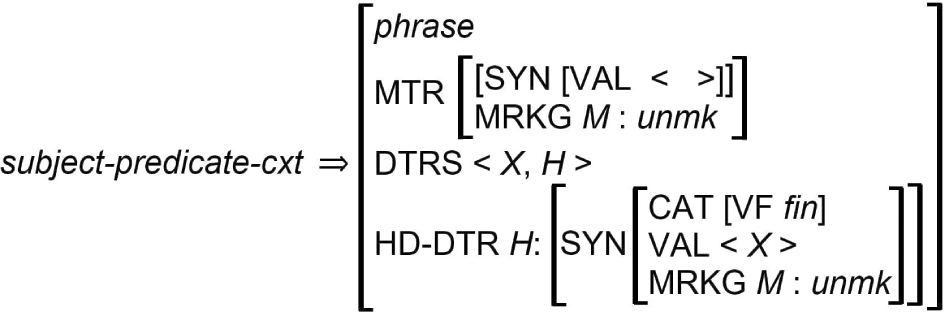
The second hallmark of formal Construction Grammars concerns the specific mechanism they use to combine feature structures: unification. This operation has played a long-standing role in constraint-based theories such as Reference Gazdar, Klein, Pullum and SagGazdar et al.’s (1985) Generalized Phrase Structure Grammar (GPSG) and Reference Pollard and SagPollard and Sag’s (1987) Head-Driven Phrase Structure Grammar (HPSG), both of which heavily inspired Sign-Based CxG (see Reference Michaelis, Heine and NarrogMichaelis 2015: 151). Unification is defined as an operation by which two structures that have matching feature values combine into a new structure that “contains no more and no less than what is contained in its component AVMs” (Reference Fried, Östman, Fried and ÖstmanFried & Östman 2004: 33; see also Reference ShieberShieber 1986). For example, returning to the example in Figure 1, the verb unifies with an argument that matches its valence specification in order to form a subject–predicate phrase.
In contrast to the aforementioned approaches, the less formal Construction Grammars – Cognitive CxG and Radical CxG – use neither AVM-style feature structures nor unification. The lack of formalism in these approaches is intentional, as Reference Goldberg, Hoffmann and TrousdaleGoldberg (2013: 29) highlights: “I have avoided using all but the most minimal formalization in my own work because I believe the necessary use of features that formalism requires misleads researchers into believing that there might be a finite list of features or that many or most of the features are valid in cross-linguistic work. The facts belie this implication.”
Reference GoldbergGoldberg (2006: 216–217) provides several further arguments against the use of AVMs for representing constructions. For example, she remarks that formalist approaches often do not account for the rich frame semantics of constructions and instead describe their semantic features in terms of simple “constants.” Moreover, she argues that formal analyses tend to overemphasize syntactic features over semantic ones, and that the formalisms are usually too unwieldy to capture the amount and complexity of speakers’ constructional knowledge. Finally, the aforementioned quote from Reference Goldberg, Hoffmann and TrousdaleGoldberg (2013) also questions the typological validity of the features used in formal approaches, a theme that is particularly prominent in Croft’s Radical CxG. Reference CroftCroft (2001, Reference Croft2020) argues against the universality of grammatical categories such as word classes (e.g. noun, adjective) and syntactic relations (e.g. subject, object). Based on evidence from typologically distant languages, he shows that both the syntactic environments that define word classes and the linking mechanisms between verbs and their arguments vary considerably across languages. As a result, he suggests that word classes are characterized by language-specific constructions and that syntactic relations can be derived from underlying semantic relations (again, in construction-specific ways).
It is debatable whether Goldberg’s and Croft’s criticisms – also considering that some of them were stated a while ago – still paint an accurate picture of formal Construction Grammars, and if so, how the problems they identify could be resolved. For one, some of the authors’ remarks have been accommodated by the formal approaches: Features, for example, can have complex values, so the semantic attributes of AVMs can be filled by rich semantic frames, a practice that has been adopted in recent formal work (Reference Sag, Boas and SagSag 2012; Reference SteelsSteels 2017). It also seems feasible that the features posited by these frameworks could be defined in language-specific ways rather than via universal primitives, thus accounting for typological variability in their realization (see e.g. Reference Fried, Östman, Fried and ÖstmanFried & Östman 2004: 77).
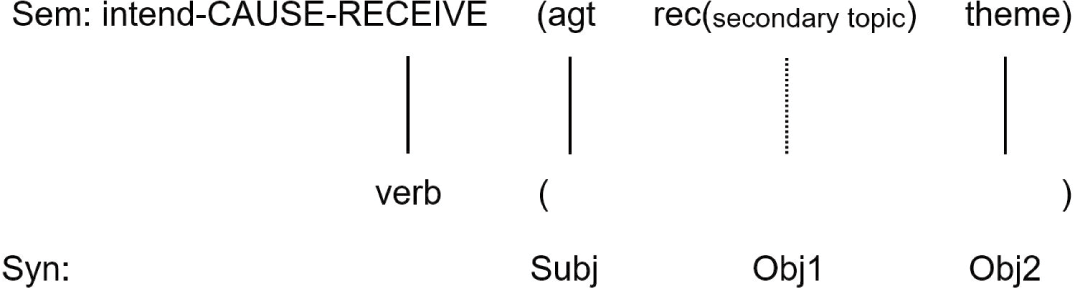
Another question is whether the less formal varieties of CxG deal more successfully with the challenges identified by Goldberg and Croft. While nonformal Construction Grammars typically do not rely on elaborate feature structures, they nevertheless characterize constructions in terms of their salient properties. Compare Figure 2, which reproduces a Cognitive CxG analysis of the ditransitive construction (Reference GoldbergGoldberg 2006; see Section 2.2 for examples). The upper half of the diagram outlines the semantic properties of the construction (its overall meaning and the thematic roles it comprises), while the lower half specifies its syntactic functions. Other researchers working in nonformal Construction Grammars have used even more abbreviated representations, such as the bracketed notation in (8). Nevertheless, both these representations comprise the same features that could also be listed as part of an AVM (e.g. as a valence list or within a semantic frame). It is also worth noting that Figure 2 makes use of the same grammatical categories (e.g. syntactic functions) that Croft (2000, 2021) criticizes for their lack of crosslinguistic validity. While these categories may not be crosslinguistically stable, it appears that, for the purposes of a language-specific analysis, they provide a useful and ultimately indispensable way of capturing generalizations.
(8) [[SUBJ V OBJ1 OBJ2] ↔ [X CAUSE Y to RECEIVE Z]] (Reference Traugott and TrousdaleTraugott & Trousdale 2013: 59)
Cognitive CxG analysis of the ditransitive construction
All things considered, there may be no principled reasons why Construction Grammars should or should not rely on a certain degree of formalization. Rather, it seems that the differences between frameworks are largely a result of their specific research goals (which will be discussed in more detail in the next section). For example, a primary goal of Sign-Based CxG and related formal approaches is to account for “the licensing of word strings by rules of syntactic and semantic composition” (Reference Michaelis, Heine and NarrogMichaelis 2015: 151) – an enterprise that these frameworks share with traditional generative grammar. For this purpose, it seems feasible to employ a rigorous unification-based formalism that captures how well-formed structures arise from feature matching among their component parts. Moreover, unification lends itself to computational implementation (Reference KnightKnight 1989); and the algorithms are not affected by how detailed and potentially “unwieldy” the AVMs are. For the less formal Construction Grammars, on the other hand, the readability of the representations is an important consideration, and researchers tend to highlight only those features of constructions that are relevant for their respective analyses. For the purposes of the latter – which focus on the mental representation of constructions and their use in naturalistic speech – the use of precise formalisms may thus be less important.
3.2 Research Foci
As hinted at in Section 3.1, the different “flavors” of CxG are not only distinguished by their degree of formalization, but they also differ in terms of the research questions they tend to emphasize. Broadly, three subgroups can be distinguished in this context, characterized by their respective focus on (i) grammatical description; (ii) computational modeling; or (iii) the cognitive and typological dimensions of language use.
Starting with the first group, Berkeley CxG and its successor framework, Sign-Based CxG, have primarily been concerned with providing detailed descriptions of grammatical phenomena, using the formal tools discussed in the previous section. As outlined in Section 2.1, the early work by the Berkeley group focused particularly on analyses of partially filled idioms, such as let alone (Reference Fillmore, Kay and O’ConnorFillmore et al. 1988) and the What’s X doing Y? construction (Reference Kay and FillmoreKay & Fillmore 1999). This interest was soon extended to constructions in other languages that carry specific syntactic, semantic, or pragmatic properties, such as right-detached comme in French, as in C’est cher, comme appareil, ça ‘That’s an expensive camera’ (Reference Lambrecht, Fried and ÖstmanLambrecht 2004). Moreover, proponents of the framework have also investigated more general, nonidiomatic phenomena, such as extraposition (Reference Michaelis and LambrechtMichaelis & Lambrecht 1996) and different verb-complementation patterns (Reference Fillmore, Hoffmann and TrousdaleFillmore 2013).
This line of research has been carried on by Sign-Based CxG, which was partially developed by proponents of the earlier Berkeley approach. In his detailed overview of the paradigm, Reference Sag, Boas and SagSag (2012) provides Sign-Based analyses of a broad range of construction types, including lexical classes (e.g. the main verb construction), inflectional morphology (e.g. the preterite construction), phrasal structure (e.g. the head-complement construction), and argument structure (e.g. the ditransitive). It has been suggested that Sign-Based CxG tends to focus more on the formal-syntactic rather than the semantic aspects of constructions (e.g. Reference FeldmanFeldman 2020: 151). For example, to account for filler-gap phenomena such as wh-interrogatives and topicalization, Reference SagSag (2010) posits an overarching construction that only has formal specifications but no meaning. This contrasts with other views, primarily by proponents of Cognitive CxG, who have called the existence of meaningless schemas into question, arguing instead that every construction must have a meaning, even if only a highly abstract one (Reference GoldbergGoldberg 2006: 166–182; Reference HilpertHilpert 2019: 50–74; Reference DiesselSommerer and Baumann 2021: 125–126).
Moving on to the second group of theories that share an overall research goal, Fluid CxG and Embodied CxG aim primarily at constructing computational models of language processing. As a result, the two frameworks focus particularly on the practical challenges involved in creating functional CxG implementations. Still, the two approaches differ somewhat in terms of their backgrounds and research foci. Fluid CxG has been under development at computer science labs in Paris and Brussels since the late 1990s. Its main goal is to create a construction-based architecture for language production and comprehension (Reference SteelsSteels 2017). In doing so, the proponents of the framework “do not make any claims about biological realism or cognitive relevance” (Reference SteelsSteels 2017: 181), focusing instead on maximizing the descriptive coverage of their models. Recent analyses have addressed a range of constructions, including English auxiliaries (Reference Van TrijpVan Trijp 2017) and long-distance dependencies (Reference Van TrijpVan Trijp 2014), Dutch word order (Reference Van EeckeVan Eecke 2017), and Spanish verb conjugation (Reference BeulsBeuls 2017). Moreover, the approach has been used to model aspects of language evolution (Reference SteelsSteels 2012; Reference Steels and SzathmárySteels & Szathmáry 2016). In parallel to these research contributions, Fluid CxG has generated a number of real-world applications, among them a model for visual question answering (i.e. answering text questions about images; Reference Nevens, Eecke and BeulsNevens, Eecke, & Beuls 2019) and a platform for analyzing opinions on social media (Reference Willaert, Van Eecke, Beuls and SteelsWillaert et al. 2020).
Embodied CxG, on the other hand, developed out of the Neural Theory of Language project (Reference FeldmanFeldman 2006) at the University of California, Berkeley. As a result, its proponents aim to model speakers’ grammatical processing specifically in relation to its neural underpinnings. In contrast to the other formally oriented Construction Grammars, Embodied CxG emphasizes the analysis of meaning, and of embodied meaning in particular (Reference FeldmanFeldman 2020: 151). As Reference Bergen, Chang, Hoffmann and TrousdaleBergen and Chang (2013) outline, the framework aims to account for the role of embodied simulation in language processing, that is, speakers’ tendency to activate perceptual and motor systems in the brain that recreate experiences similar to the ones that arise during actual perception or movement (Reference BarsalouBarsalou 1999). Previous studies have used Embodied CxG to analyze phenomena such as the English caused-motion construction (Reference Dodge, Petruck, Artzi, Kwiatkowski and BerantDodge & Petruck 2014) and Hebrew verbal morphology (Reference Ungerer and HartmannSchneider 2010), and to model aspects of grammatical parsing (Reference BryantBryant 2008) and acquisition (Reference MokMok 2009). Recent work, meanwhile, has somewhat moved away from linguistic analysis and instead focused on technological applications in natural language understanding, including verbal control of robots (Reference Eppe, Trott, Raghuram, Feldman, Janin, Benzmüller, Sutcliffe and RojasEppe et al. 2016) and a system for providing health advice (Reference FeldmanFeldman 2020).
Finally, as a third group that is characterized by similar research goals, Cognitive CxG and Radical CxG focus on the cognitive, typological, and contextual factors that underlie and shape speakers’ grammatical knowledge. In contrast to the above-mentioned frameworks, these approaches identify themselves as “usage-based” (see e.g. Reference Barlow and KemmerBarlow & Kemmer 2000; Reference Langacker and Rudzka-OstynLangacker 1988; Reference TomaselloTomasello 2003), devoting their attention to how “experience with language creates and impacts the cognitive representations for language” (Reference Bybee, Hoffmann and TrousdaleBybee 2013: 49). As a result, the frameworks are sometimes grouped under the broader label of “Usage-Based CxG” (e.g. Reference Diessel, Dąbrowska and DivjakDiessel 2015).Footnote 9 Compared with the other approaches discussed above, proponents of usage-based Construction Grammars tend to focus less on the form side of constructions and more on characterizing their rich meanings in psychologically plausible ways, using concepts such as construal (Reference Langacker, Dąbrowska and DivjakLangacker 2019), conceptual blending (Reference Turner, Dąbrowska and DivjakTurner 2019), and semantic maps for cross-linguistic comparisons (Reference CroftCroft 2022).
Despite their similarities, Cognitive and Radical CxG also differ in terms of their research questions. Proponents of Cognitive CxG are particularly concerned with how constructions motivate each other in virtue of their mutual similarities and associative relations (Reference Booij, Gisborne and HippisleyBooij 2017; Reference GoldbergGoldberg 1995; Reference LakoffLakoff 1987), a notion that is captured by positing networks of constructions (see Section 4 for a detailed discussion). In addition, they often study how speakers’ linguistic behavior is shaped by domain-general cognitive processes such as attention, categorization, analogy, and social cognition (e.g. Reference Bybee, Hoffmann and TrousdaleBybee 2013; Reference DiesselDiessel 2019; Reference GoldbergGoldberg 2019). As what is probably the largest strand of CxG to date, Cognitive CxG has spawned an extensive body of work. While the paradigm became initially known particularly for its analyses of argument-structure constructions (e.g. Reference BoasBoas 2003; Reference GoldbergGoldberg 1995; Reference PerekPerek 2015), its proponents have since tackled a wide range of other phenomena, including (but not limited to) complex clauses (Reference HoffmannHoffmann 2011), information structure (Reference Goldberg, Östman and FriedGoldberg 2005), discourse organization (Reference TraugottTraugott 2022), tense and modality (Reference BergsBergs 2010; Reference Cappelle and DepraetereCappelle & Depraetere 2016), and phrase-internal structure (Reference SommererSommerer 2018), as well as inflectional and derivational morphology (Reference BooijBooij 2010). The framework is also often extended to diachrony, with many proponents of “Diachronic Construction Grammar” (Reference Coussé, Andersson and OlofssonCoussé, Andersson, & Olofsson 2018; Reference Ungerer and HartmannSommerer & Smirnova 2020; Reference Traugott and TrousdaleTraugott & Trousdale 2013) situating their work broadly within Goldbergian usage-based CxG (see Section 4.1 for an explanation of key diachronic concepts such as “constructionalization”). Moreover, there has been considerable research on language acquisition, focusing in particular on children’s early item-based constructions (e.g. ___ gone, as in Cherry gone; Reference TomaselloTomasello 1992), the emergence of abstract constructions, and the acquisition of complex sentences (for overviews, see Reference BehrensBehrens 2021; Reference Diessel, Hoffmann and TrousdaleDiessel 2013; Reference TomaselloTomasello 2003).
Radical CxG, on the other hand, relies on a smaller body of work, most of it created by William Croft (e.g. Reference Croft2001; Reference Croft2020). The framework has a strong typological focus, centering on the question of which aspects of speakers’ grammatical knowledge are language- and construction-specific, and which ones may be universal. In his work, Croft discusses many grammatical core phenomena, including word classes, argument structure, syntactic roles, and grammatical categories like voice, aspect, and tense. Further applications have extended the framework to aspects of grammar acquisition (Reference Deuchar and VihmanDeuchar and Vihman 2005) and template-based phonology (Reference Vihman and CroftVihman & Croft 2007) as well as modal and discourse particles (Reference Fischer, Alm, Degand, Cornillie and PietrandreaFischer & Alm 2013).
3.3 Methods
Across the different constructionist approaches, there is a broad consensus that in order to understand the nature and use of constructions, we need evidence from a wide variety of sources – more technically, we have to triangulate evidence from different methodological approaches (Reference Baker and EgbertBaker & Egbert 2016). Still, we can draw some broad generalizations in terms of which methods the different approaches are most closely connected to.
First, it should be acknowledged that all types of CxG rely to some extent on the “introspective” method, that is, researchers’ use of their own intuitive judgments to analyze selected examples and develop theoretical accounts (but see Reference WillemsWillems 2012 for potential differences between introspection and intuition). Introspection plays a crucial role in all theoretical and descriptive approaches to grammar: As Reference Janda and JandaJanda (2013: 6) points out, “[i]ntrospection is irreplaceable in the descriptive documentation of language” (see also Reference Talmy, Gonzales-Marquez, Mittelberg, Coulson and SpiveyTalmy 2007). While many Construction Grammarians, especially proponents of the more usage-based varieties, are skeptical of introspection, perceiving it perhaps as a hallmark of more traditional (generative) analyses (Reference WillemsWillems 2012: 665), the method nevertheless serves an important role in hypothesis generation, theory building, and the interpretation of results.
Beyond that, most Construction Grammarians agree that introspection needs to be combined with other sources of evidence, but specific approaches differ in terms of what methods they use and the extent to which they apply them. Naturally, the choice of methods is closely related to the research goals of the different frameworks. As such, Berkeley and Sign-Based CxG tend to rely relatively strongly on fine-grained theoretical analyses, in line with their goal of providing a formally rigorous account of the grammatical system. Nevertheless, work in these areas has also been partially assisted by corpus methods – see, for example, Reference Brenier and MichaelisBrenier and Michaelis (2005) for a corpus-based study of copula doubling in the context of formal CxG.
Especially Cognitive CxG has developed a broad inventory of empirical methods to study the synchronic and diachronic use of constructions and draw inferences about their representation in speakers’ minds. In particular, proponents of the framework draw on an ever-expanding set of corpus-based methods. These approaches are guided by the usage-based assumption that linguistic knowledge is experience-based: Children learn language by detecting patterns in the input they receive, thus building up a dynamic network of constructions that is subject to lifelong reorganization (Reference Ambridge and LievenAmbridge & Lieven 2011; Reference TaylorTaylor 2012; Reference TomaselloTomasello 2003). In line with this, constructionist corpus analyses aim at gauging language users’ linguistic knowledge on the basis of frequency and distribution data from authentic usage. They draw primarily on measures of frequency, dispersion, and association (Reference DivjakDivjak 2019; Reference GriesGries 2008), distributional semantic methods (Reference PerekHilpert & Perek 2015; Reference DiesselPerek 2016), and (most recently) artificial neural networks (Reference BudtsBudts 2022; Reference Budts, Petré, Sommerer and SmirnovaBudts & Petré 2020).
One particularly widespread corpus-based method in constructionist work is collostructional analysis (Reference Gries and StefanowitschGries & Stefanowitsch 2004; Reference Ungerer and HartmannStefanowitsch & Gries 2003, Reference Stefanowitsch and Gries2005). Following a long tradition of corpus-linguistic approaches that investigate collocations, that is, words that occur together, collostructional analysis focuses on the interaction between words and constructions. Consider, for instance, the into-causative construction, as in They talked us into writing this Element: Using the simplest version of collostructional analysis, simple collexeme analysis, Reference Ungerer and HartmannStefanowitsch and Gries (2003: 225) show that words like trick, fool, and coerce occur at above-chance level in the first verb slot of this construction, when compared to their total corpus frequency. Using covarying collexeme analysis, which focuses on the co-occurrence of items in a construction with two open slots, Reference Stefanowitsch and GriesStefanowitsch and Gries (2005: 13) furthermore show that fool and thinking are most likely to occur together in the construction, while other verb pairs like force into thinking or provoke into accepting are much less likely to co-occur. Importantly, collostructional techniques are also subject to constant refinement, as their methodological rationale and cognitive underpinnings have been controversially, and sometimes heatedly, debated (Reference GriesGries 2015; Reference Küchenhoff and SchmidKüchenhoff & Schmid 2015; Reference DiesselSchmid & Küchenhoff 2013).
These corpus approaches have come to be increasingly complemented by experimental paradigms, which are used especially by proponents of Cognitive CxG but also inform research in other frameworks such as Fluid and Embodied CxG (e.g. Reference Bergen, Gonzalez-Marquez, Mittelberg, Coulson and SpiveyBergen 2007; Reference FeldmanFeldman 2006). Commonly used methods include acceptability judgments (Reference DąbrowskaDąbrowska 2008; Reference Gries and WulffGries & Wulff 2009), sorting tasks (Reference Bencini and GoldbergBencini & Goldberg 2000; Reference PerekPerek 2012), artificial language learning (Reference Casenhiser and GoldbergCasenhiser & Goldberg 2005; Reference Ungerer and HartmannPerek & Goldberg 2015), priming (Reference Busso, Perek and LenciBusso, Perek, & Lenci, 2021; Reference UngererUngerer 2021, Reference Ungerer2022), and a number of other techniques, such as sentence repetition (Reference Diessel and TomaselloDiessel & Tomasello 2005) and sentence completion (Reference PerekPerek 2015). Experimental approaches are needed because many aspects related to the processing, storage, and acquisition of constructions cannot be satisfactorily answered on the basis of corpus data alone. Among other things, experimental studies have lent support to the cognitive reality of “constructions” as meaningful elements of speakers’ linguistic knowledge. Reference Bencini and GoldbergBencini and Goldberg (2000), for example, presented speakers with a list of sentences that differed either in terms of the verb they contained or the construction they instantiated, and asked participants to sort the sentences into categories. Interestingly, the authors found that participants were more likely to group instances of the same construction into a category than sentences with the same verb. This suggests that constructions are psychologically real units that play an important role for the way speakers categorize the linguistic input.
Meanwhile, artificial language-learning experiments can shed light on how the input shapes speakers’ acquisition of new constructions. In Reference Ungerer and HartmannPerek and Goldberg’s (2015) study, for example, participants were exposed to made-up verbs (e.g. moop) that occurred in novel constructions (featuring non-English word orders). Depending on whether the verbs combined with different constructions or always with the same construction during the training phase, participants used them either more “liberally” or more “conservatively” in a subsequent productive task, suggesting that the input determined what constructional generalizations speakers formed. Finally, priming studies are particularly informative about relations between constructions in speakers’ mental networks. This follows from the assumption that the degree to which one construction primes, that is, affects the processing of, another construction functions as an indicator of how similar speakers’ representations of the two patterns are (Reference UngererUngerer 2022; see Section 4.1 for details).
While constructionist research has thus drawn on a variety of experimental methods, the paradigm could further benefit from other techniques used in the wider context of cognitive linguistics, especially in experimental semantics (Reference Matlock, Winter, Heine and NarrogMatlock & Winter 2015) and experimental semiotics (Reference Nölle, Galantucci, García and IbáñezNölle & Galantucci 2023). Research in the former field, which investigates the meaning not only of individual words but also of constructions, has obvious implications for constructionist work. For example, using a mouse-tracking paradigm, Reference Anderson, Matlock and SpiveyAnderson, Matlock, and Spivery (2013) found interesting differences between sentences with varying aspectual construal (progressive vs. nonprogressive), thus supporting the cognitive-linguistic hypothesis that distinct grammatical constructions yield differences in semantic construal. Experimental semiotics, meanwhile, addresses the question of how symbolic systems come about by conducting laboratory studies that involve novel communication systems. For instance, Reference Goldin-Meadow, So, Ozyurek and MylanderGoldin-Meadow et al. (2008) and Reference Christensen, Fusaroli and TylénChristensen, Fusaroli and Tylén (2016) used silent-gesture paradigms to account for the emergence and cognitive underpinnings of cross-linguistically well-attested word-order preferences. Especially for usage-based CxG, which sees language as a highly dynamic system, the results of these studies are particularly relevant because they can help explain common pathways of language change and grammaticalization (or “constructionalization”; see Section 4.1).
Returning to other methods used in CxG, constructionist work in the Berkeley tradition has given rise to a research strand that we have not addressed so far and which uses lexicographic methods to build large-scale repositories of constructions. Researchers working in this area, which has become known as “constructicography” (Reference Lyngfelt, Borin, Ohara and TorrentLyngfelt et al. 2018), create construction entries that are then linked up with semantic frames from FrameNet (Reference Fillmore, Lee-Goldman, Rhomieux, Boas and SagFillmore et al. 2012). A semantic frame is here defined as “any system of concepts related in such a way that to understand any one concept it is necessary to understand the entire system” (Reference Petruck, Verschueren and ÖstmanPetruck 2022: 592). Constructional inventories, or “construct-i-cons” (see Section 4), are currently being built for several languages, including English (Reference Perek and PattenPerek & Patten 2019), German (Reference Ziem, Flick and SandkühlerZiem, Flick, & Sandkühler 2019), Russian (Reference Janda, Lyashevskaya, Nesset, Rakhilina, Typers, Lyngfelt, Borin, Ohara and TorrentJanda et al. 2018), and Brazilian Portuguese (Reference Torrent, da Silva Matos, Lage, Lyngfelt, Borin, Ohara and TorrentTorrent et al. 2018). While such constructional inventories can form the basis for cross-linguistic comparisons, the strand of CxG that has most strongly focused on comparative methods is arguably Radical CxG. Notably, proponents of this paradigm often rely on qualitative analyses rather than quantitative tools (but see e.g. Reference Deuchar and VihmanDeuchar & Vihman 2005 for quantitative case studies of language acquisition from a Radical CxG perspective).
Finally, the methods discussed so far are complemented by computational approaches, which are used in particular by Fluid and Embodied CxG to model aspects of language comprehension and/or production. Fluid CxG provides what is arguably the most advanced computational implementation of CxG to date. The use of this formalism has been recently facilitated by the release of the FCG Editor (Reference Van Trijp, Beuls and Van EeckeVan Trijp, Beuls, & Van Eecke 2022), an open-source development tool with which researchers can customize their own grammars for sentence parsing and production. Proponents of Fluid CxG have also created models of language learning and evolution using autonomous robots that play language games (Reference Steels and HildSteels & Hild 2012). Embodied CxG, meanwhile, has developed its own development platform, the ECG workbench (Reference Eppe, Trott, Raghuram, Feldman, Janin, Benzmüller, Sutcliffe and RojasEppe et al. 2016), even though the latter seems to have more limited functionality than its Fluid CxG counterpart (Reference Van Trijp, Beuls and Van EeckeVan Trijp et al. 2022: 6–7).
3.4 Summary
In this section, we have provided a brief sketch of the six major variants of CxG, focusing on their similarities and differences in terms of formalization, research goals, and methods. The results of our comparisons are summarized in Table 1. Of course, the broad generalizations we have outlined are limited in several ways: They cannot do justice to the whole body of work in the respective areas, nor is it always possible to decide which specific framework a certain contribution should be attributed to. For example, the constructicography projects described in Section 3.3 (i.e. the creation of language-specific constructional inventories) stand in the tradition of Berkeley-style frame semantics, but they also share elements with other constructionist approaches, for example with respect to their usage-based orientation and the use of data-driven methods. Such overlap across frameworks is to be expected: After all, CxG is an eclectic and constantly developing field, whose proponents share many of their core assumptions and thus often enter into fruitful collaborations.
4 Connecting the Dots: The Construct-i-con
Despite the differences that exist between specific constructionist frameworks, as discussed in the previous section, all Construction Grammarians agree on certain fundamental assumptions. One of these ideas – that language comes in the format of form–meaning pairings, or constructions – was introduced in Section 2. Here we discuss a second core tenet: namely that constructions do not exist in isolation from each other, but that rather their forms and meanings are intricately interconnected. To account for these relationships, Construction Grammarians model language as a network of constructions stored within speakers’ minds (e.g. Reference BooijBooij 2010; Reference BybeeBybee 2010; Reference DiesselDiessel 2019, Reference Diessel2023; Reference Fried, Östman, Fried and ÖstmanFried & Östman 2004; Reference GoldbergGoldberg 1995, Reference Goldberg2019; Reference Ungerer and HartmannSommerer & Smirnova 2020; Reference Traugott and TrousdaleTraugott & Trousdale 2013). Positing such a constructional network, also known as a construct-i-con (or “constructicon”), marks another radical departure from mainstream generative grammar: Rather than assuming that speakers derive grammatical patterns “on the fly” based on abstract principles and procedural rules, the constructionist view is that speakers store a vast inventory of linguistic units, including morphemes and words as well as phrase- and clause-level structures, as part of their long-term declarative knowledge.Footnote 10
In the following sections, we will first discuss some key characteristics of the network model, before taking a closer look at the different types of network relations that have been proposed. We will then outline some further questions and open research problems that concern the architecture of constructional networks and the way in which they can be investigated.
4.1 The Network Model: Characteristics and Applications
Modeling language as a network captures the basic insight that words and complex constructions do not exist in isolation but share varying types of relations with each other. Consider the example of the ditransitive construction in (9a). By combining the words of the example into phrases (e.g. the and student into the subject), and those phrases (the subject, verb, and two objects) into a sentence, speakers naturally establish relationships between the smaller units. Construction Grammarians typically refer to these links between linearly co-occurring units as syntagmatic relations (alternatively known as sequential relations; Reference DiesselDiessel 2019). These relations can be captured in a network in which words (or phrases) are linked to their frequently co-occurring neighbors.
a. The student gave his friend the lecture notes.
b. The student gave the lecture notes to his friend.
Meanwhile, the example in (9a) also has other types of “relatives”: For example, it shares a relation of similarity with the to-dative example in (9b). The to-dative is usually interpreted as the alternating, that is, near-synonymous, counterpart of the ditransitive construction (Reference PerekPerek 2015; but see Reference PijpopsPijpops 2020 for the varying meanings of “alternation”). Based on their similarity, the two patterns can be substituted along the paradigmatic axis, that is, they can fill the same position in a piece of discourse. As a result, they can be modeled as units in a network that are linked via a paradigmatic relation.
Networks are a powerful tool for capturing diverse kinds of relations between elements. As such, they have been increasingly used to analyze complex phenomena across the natural and social sciences (Reference BuchananBuchanan 2002). Network science – the interdisciplinary study of networks – has been heralded by some as the “science of the 21st century” (Reference BarabásiBarabási 2016: 25). Figure 3 illustrates the key features of network representations with the help of a schematic diagram. Networks consist of nodes (or vertices) and links (or edges), both of which can represent a variety of things. In the case of constructional networks, nodes can correspond to different linguistic units, such as morphemes, words, or complex constructions. Similarly, the links can instantiate varying relations, such as the syntagmatic and paradigmatic relations introduced above (see Section 4.2 for further linking types), even though researchers often restrict their analyses to one linking type only. Moreover, scholars sometimes use alternative graphic means to draw their diagrams, for example by using annotated boxes for the nodes and arrows for the links (if the network relations are directed).
Schematic network diagram
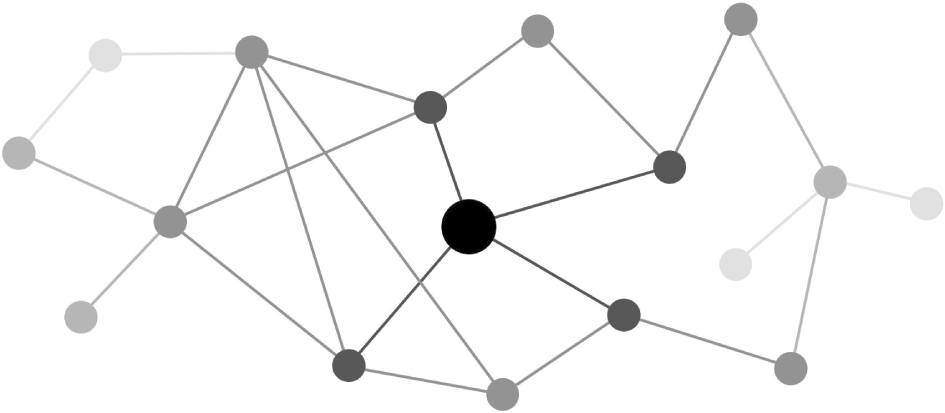
Grammatical networks, as they are envisaged by Construction Grammarians, are situated in the minds of speakers. As such, they are directly involved in the storage and retrieval of information during the processing of linguistic utterances. Figure 3 provides some additional clues as to how such processing may operate within the network (see also Reference DiesselDiessel 2019; Reference Langacker and SchmidLangacker 2017; Reference SchmidSchmid 2020 for discussion). The large circle in the center of the diagram represents the construction that is activated during a particular usage event; this construction serves as an “entry point” (Reference SchmidSchmid 2020: 44) to the network. Following the principle of spreading activation (Reference AndersonAnderson 1983; Reference Collins and LoftusCollins & Loftus 1975), the currently active unit is then assumed to trigger the activation of neighboring network units, leading to a chain of activation. These units can, for instance, be frequently co-occurring lexical items or constructions, or items that are related in virtue of their similarity (see the discussion of syntagmatic and paradigmatic links above). Reference SchmidSchmid (2020: 46), for example, assumes that different mental states representing the same communicative goal are connected via associations – a form like the boy, then, would trigger (near-)synonyms like the young man, the teenager, and so on. The strength of activation a unit receives from another depends on how closely the two are related; with increasing distance in the network, the amount of activation spread decays. This is illustrated by the grayscale of the nodes and links in Figure 3, where fainter shades represent increasingly lower activation levels.
This brief outline of the network model hints at several reasons for why networks have acquired such a central role in CxG research. First, the network model is naturally compatible with a number of frequently observed psychological effects, both providing a framework for interpreting these effects and drawing additional empirical support from them. Among the phenomena discussed by Reference DiesselDiessel (2019: 201–202) and Reference SchmidSchmid (2020: 53–55) are: (i) frequency effects, that is, the tendency for more frequent units to be recognized faster and more accurately, which can be explained via their increased resting activation in the network; (ii) recency effects, that is, the tendency for recently activated units to be recognized faster, which can be attributed to their residual activation in the network; and (iii) neighborhood effects, that is, slower recognition of units in dense network neighborhoods, which is likely to arise from competition among co-activated patterns. Related to recency effects, another pervasive phenomenon is priming, defined as a change in speakers’ response to a stimulus after previous exposure to the same or a similar item (Reference Branigan and PickeringBranigan & Pickering 2017: 6). Priming occurs both at the lexical level – between words that are semantically, phonetically, or orthographically related (Reference Goldinger, Luce and PisoniGoldinger, Luce, & Pisoni 1989; Reference Meyer and SchvaneveldtMeyer & Schvaneveldt 1971; Reference Meyer, Schvaneveldt and RuddyMeyer, Schvaneveldt, & Ruddy 1974) – and at the level of complex constructions, where the phenomenon is known as “structural priming” (Reference Branigan and PickeringBranigan & Pickering 2017). Regarding the latter, structural priming effects have been observed not only between instances of the same construction (e.g. between two ditransitive sentences; Reference BockBock 1986) but also between distinct but related constructions (e.g. between benefactive and dative sentences; Reference Ziegler and SnedekerZiegler & Snedeker 2018). As a result, priming effects are regarded as one of the strongest sources of evidence for the network model (Reference DiesselDiessel 2019: 204; Reference UngererUngerer 2021, Reference Ungerer2022).
Second, networks provide a dynamic tool for modeling processes of language change. Reference Smirnova, Sommerer, Sommerer and SmirnovaSmirnova and Sommerer (2020: 3) argue that all types of linguistic change can be reconceptualized as network changes, given that the constructional network that makes up a language can change via node creation or loss, via node-internal changes, or via reconfigurations of the network. The creation of a new node roughly corresponds to what Reference Traugott and TrousdaleTraugott and Trousdale (2013) call constructionalization, while the loss of a node can be characterized in terms of constructional attrition (Reference Colleman and NoëlColleman & Noël 2012), that is, the phenomenon whereby a construction gradually falls out of use. Node-internal changes are roughly equivalent to Traugott and Trousdale’s constructional changes (but see Reference Smirnova, Sommerer, Sommerer and SmirnovaSmirnova & Sommerer [2020: 9–18], who argue that constructionalization and constructional changes often cannot be clearly told apart). For example, the grammaticalization of a new future marker such as the English going to future construction could be described as the emergence of a new node in the constructional network, while the ongoing change of because, which used to take only verbal complements and is currently extending its usage domain to nominal complements (because reasons), could be considered a node-internal change. Node-internal changes can, in turn, entail the emergence of new nodes and as such lead to a reconfiguration of the constructional network. Reference Lorenz, Sommerer and SmirnovaLorenz (2020), for instance, demonstrates that the contracted forms gonna, wanna, and gotta have over time developed their own usage profiles, which are distinct from those of the full forms going to, want to, and got to.
Another example of a linguistic change that can be conceived of as a reconfiguration in the constructional network is constructional contamination as described by Reference Pijpops and Van de VeldePijpops and Van de Velde (2016). Constructional contamination occurs when two superficially similar (but unrelated) constructions influence each other. Their example concerns two etymologically and structurally unrelated constructions in Dutch: the partitive genitive, as in iets verkeerd(s) gegeten ‘eaten something wrong’, where a variant with -s alternates with an s-less variant; and a construction in which the quantifier iets ‘something’ forms an independent noun phrase while verkeerd “wrongly” functions as an adverb, as in … dat iets verkeerd geïnterpreteerd wordt ‘… that something gets wrongly interpreted’ (Reference Pijpops and Van de VeldePijpops & Van de Velde 2016: 544–545). The authors show that the frequent co-occurrence of iets and verkeerd leads to “a measureable preference for the variant without -s in partitive genitives” (Reference Pijpops and Van de VeldePijpops & Van de Velde 2016: 545). De Smet et al. (2018), meanwhile, discuss how functional relatedness between similar forms can both increase and decrease over time, using the concepts of attraction and differentiation. Attraction means that two forms become more similar to each other over time, which the authors show to be the case for [begin + ing-clause] and [begin + to-infinitive]. Differentiation means that two constructions become less similar, which seems to have been the case for [start + ing-clause] and [start + to-infinitive]. However, as the authors argue, what looks like differentiation might actually be an epiphenomenon of underlying attraction processes: As [start + to-infinitive] became increasingly attracted to [begin + to-infinitive], it became less similar to [start + ing-clause]. This shows that network changes cannot be studied independently from each other and that the “bigger picture” of the constructional network needs to be taken into account.
4.2 Types of Network Links
A crucial aspect of the network structure that scholars continue to debate concerns the types of links that should be part of the network model. Most Construction Grammarians agree on at least three types of such relations. Two of them were already introduced in Section 4.1: paradigmatic relations between similar units and syntagmatic relations between linearly co-occurring units. A third type consists of symbolic relations, which connect the form and the meaning pole of constructions (e.g. Reference CroftCroft 2001; Reference LangackerLangacker 1987). By positing these symbolic relations, researchers can use the network model to capture the fundamental CxG view of grammatical units as form–meaning pairings (see Section 2).
While symbolic links seem to be a natural element of the network model, they also pose a potential challenge. If constructional networks are assumed to be “networks of constructions,” that is, networks in which constructions function as the nodes then symbolic relations are, strictly speaking, not links between network nodes but part of the nodes themselves. In other words, the nodes in such a model would be internally complex units that consist of a pair of interlinked form and meaning. This view is embraced by Reference DiesselDiessel (2019: 11–22), who treats constructions (or “signs,” in his terminology) as the basic nodes of the network (which is thus a “network of signs”) but also assumes that these nodes themselves consist of networks (i.e. “signs as networks”). The result of this is a “nested” network (see also Diessel 2023) that comprises several layers, with symbolic links only featuring at the construction-internal layer and not at the layer at which different constructions are related to each other (see also Reference Smirnova, Sommerer, Sommerer and SmirnovaSmirnova & Sommerer 2020, who distinguish between a “node-external” and a “node-internal” level). While this offers a possible solution, in practice it means that symbolic links are often not explicitly represented in network diagrams, which tend to focus on the relations between constructions rather than on their internal connectivity.
Returning to the paradigmatic and syntagmatic relations discussed above, these links, too, come with their own complexities. Even though the two linking types encode fundamentally different relations, a crucial feature they share is that they both give rise to hierarchical organization. Specifically, paradigmatically related units form taxonomies, that is, series of increasingly more abstract (or schematic) categories that generalize over the similarities of their subtypes. This is illustrated with a simple lexical example in Figure 4a, which shows the relationship between cat and dog and their taxonomic superordinate animal. Analogously, syntagmatically related units give rise to meronomies, i.e. part-whole hierarchies in which smaller units are combined into increasingly more complex units. This is depicted in Figure 4b using the example of the and dog, which compose into the dog. The important role of meronomies becomes evident if one considers that phrase-structure diagrams, which are part and parcel of most grammatical analyses, are part-whole hierarchies of increasingly more complex units (Reference CroftCroft 2001). Taxonomic and meronomic hierarchies, and their underlying dimensions of schematicity and complexity, can therefore be regarded as fundamental structuring mechanisms of speakers’ grammatical knowledge, which is modeled via “taxonomic and meronymic networks of constructional families” (Reference Barðdal, Gildea, Barðdal, Smirnova, Sommerer and GildeaBarðdal & Gildea 2015: 23).
Parallels between taxonomic and meronomic hierarchies, including vertical links (solid lines) and horizontal links (dashed lines)
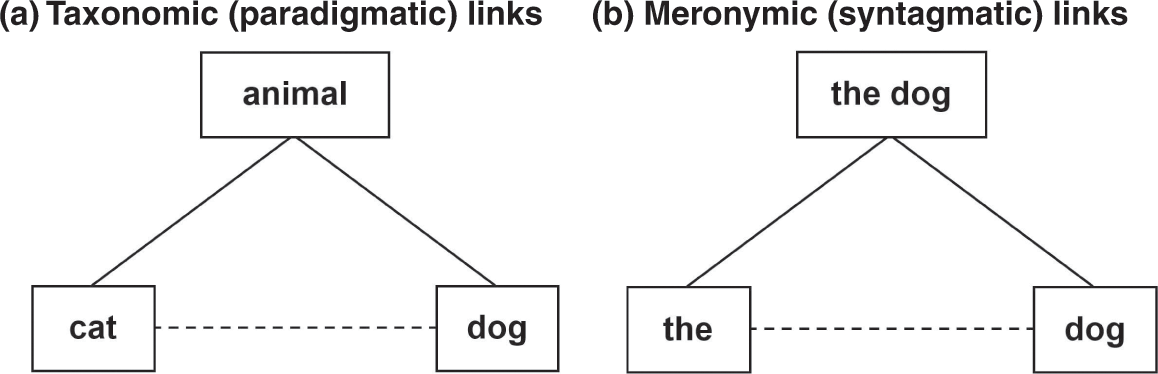
One question in this context, however, is what types of links constructional networks should incorporate: vertical links between units at different hierarchical levels (illustrated by the solid lines in Figure 4), horizontal links between units at the same hierarchical level (illustrated by the dashed lines), or both types of links? Specifically, the question is what functions vertical and horizontal links serve in the network, and whether they constitute distinct or potentially overlapping mechanisms. This has been primarily discussed in the context of paradigmatic relations, but the vertical/horizontal distinction can in principle also be applied to syntagmatic relations (see Reference Budts, Petré, Sommerer and SmirnovaBudts & Petré 2020: 320–321; Reference LangackerLangacker 1987: 94–96). In discussions of paradigmatic relations, vertical and horizontal links are often assumed to play fundamentally distinct roles. Vertical links, which were introduced to constructionist theorizing by Reference LakoffLakoff (1987) and Reference GoldbergGoldberg (1995), are typically couched in terms of inheritance, based on the notion that subtypes “inherit,” that is, adopt, the features of their supertype (also known as a “schema”; see Reference Daelemans, De Smedt and GazdarDaelemans, De Smedt, & Gazdar 1992 for the origins of the concept of “inheritance” in the computational literature). Horizontal relations (also called lateral relations), on the other hand, have been a more recent addition to the CxG literature (Reference AudringAudring 2019; Reference Diessel, Dąbrowska and DivjakDiessel 2015, Reference Diessel2023; Reference Van de Velde, Boogaart, Colleman and RuttenVan de Velde 2014; Reference PerekPerek 2015; Reference Smirnova, Hilpert, Cappelle and DepraetereSmirnova 2021); they are assumed to relate “similar or contrastive constructions, even when these constructions are not (immediately) subsumed under a schema” (Reference DiesselDiessel 2019: 200). Horizontal links have been posited, for example, between alternating variants such as the two English verb-particle constructions (e.g. turn off the TV vs. turn the TV off; Reference CappelleCappelle 2006; see also Reference Colleman, Fedriani and NapoliColleman 2020; Reference ZehentnerZehentner 2019) and between members of constructional paradigms, such as different clause types in Dutch (verb-initial, verb-second, and verb-final; Reference Van de Velde, Boogaart, Colleman and RuttenVan de Velde 2014; see also Reference Sommerer, Sommerer and SmirnovaSommerer 2020; Reference Diewald, Sommerer and SmirnovaDiewald 2020).
It has been pointed out (Reference HoffmannHoffmann 2020; Reference DiesselUngerer in press), however, that some of the scenarios that have been analyzed with horizontal links could be equally captured in terms of vertical relations. For example, alternating constructions can be either connected via a horizontal similarity link, or they can be vertically subsumed under a common schema, in analogy to Figure 4 (compare also Reference CappelleCappelle’s [2006: 18] analysis, which includes both vertical and horizontal links). Based on this argument, Reference HoffmannHoffmann (2020: 150) argues that the two analyses are empirically indistinguishable in these cases. Reference DiesselUngerer (in press) goes a step further and suggests that a horizontal link between constructions is, by definition, conceptually equivalent to a pair of vertical relations to a schema. The difference, he argues, is only notational, in that vertical analyses make the shared content of the subconstructions explicit while it is merely implicit in a horizontal link. From this perspective, constructional networks could contain either vertical or horizontal relations, but the two would be treated as notational variants rather than as distinct cognitive mechanisms.
Other researchers do not share this view and have continued to highlight the differences between vertical and horizontal links. Reference ZehentnerZehentner (2019: 324), for instance, suggests that horizontal links may represent similarities of varying strengths, while schemas only emerge if the connections are “very strong, systematic and pervasive.” In addition, Reference DiesselDiessel (2023: 57–75) argues that only horizontal links can capture relations of similarity and contrast both within constructional families and with other neighboring constructions that do not belong to the family. For example, the verb-particle constructions in (10a)–(10b) form a constructional family, but they also resemble sentences in which an adjective can either follow or precede the object, as in (10c)–(10d); moreover, (10a) is similar to an intransitive construction with a prepositional phrase, as in (10e). Diessel argues that the existence of horizontal relations such as these is supported by psycholinguistic effects such as priming and by the time course of language acquisition, but that there is no evidence that speakers store a separate schema for each group of similar constructions. In contrast to this position, Reference UngererUngerer (2022, Reference Diesselin press) suggests that priming effects can be equally interpreted as evidence for horizontal links and vertically related schemas, especially if it is assumed that both links and schemas can vary in “strength,” that is, in their degree of entrenchment (Reference HilpertHilpert 2015; Reference Langacker and SchmidLangacker 2017; Reference SchmidSchmid 2020).
a. He took off the label.
b. He took the label off.
c. He held the door open.
d. He held open the door.
e. He jumped off the wall.
(all from Reference DiesselDiessel 2023: 68)
Moving beyond vertical and horizontal relations, researchers have also suggested a number of other linking mechanisms that could be included in constructional networks, besides the “standard” triad of symbolic, paradigmatic, and syntagmatic relations. Reference GoldbergGoldberg (1995: 74–81), for example, proposed an influential four-way classification of network relations into instance links, subpart links, polysemy links, and metaphorical extension links.Footnote 11 The former two largely correspond to paradigmatic and syntagmatic links, with instance links describing relations between subtypes and their paradigmatic supertypes, and subpart links capturing relations between wholes and their parts. Polysemy and metaphorical links, meanwhile, capture specific types of similarities between linguistic units. Polysemy links have been posited between the multiple subsenses of constructions such as the ditransitive, which can not only denote “successful transfer of possession” but also “intended transfer,” “enabled transfer,” and other related meanings (Reference GoldbergGoldberg 1995: 75–77; see also Reference Croft, Cuyckens, Berg, Dirven and PantherCroft 2003). Metaphorical links have been used, for instance, to relate the literal “change of location” meaning of the caused motion construction to its metaphorical extension as “change of state” in the resultative construction (Reference GoldbergGoldberg 1995: 81–89). Given that both of these links rely on similarity, they could be regarded as special types of paradigmatic relations. Reference Smirnova, Sommerer, Sommerer and SmirnovaSmirnova and Sommerer (2020: 25), for example, reinterpret Goldberg’s metaphorical links as a kind of (paradigmatic) horizontal link.Footnote 12
Reference DiesselDiessel (2019, Reference Diessel2023) proposes another type of network link, so-called filler–slot relations that connect the open slots of constructional schemas to their lexical or phrasal fillers. Filler–slot relations not only capture general facts about the distribution of lexical categories, such as the occurrence of adjectives in attributive position (DET ___ N) or predicative position (NP be ___; Reference DiesselDiessel 2019: 21), but they also govern the way in which specific lexical items preferentially combine with certain constructions (e.g. the fact that give occurs more frequently in the ditransitive than in the to-dative; Reference Gries and StefanowitschGries & Stefanowitsch 2004). While filler-slot relations are a useful descriptive tool in these contexts, the question remains of whether they can be ultimately broken down into a combination of paradigmatic and syntagmatic relations. Specifically, the filler seems to stand in a paradigmatic relation with the open slot that it occupies, and this slot is in turn syntagmatically linked to the rest of the abstract construction.
Finally, Reference Schmid and SchmidSchmid (2017a; Reference Schmid2020), working within a related usage-based framework, proposes pragmatic relations (or “associations,” in his terminology) as a fourth type of network link besides symbolic, paradigmatic, and syntagmatic relations. These pragmatic relations are assumed to connect linguistic items with their context-dependent meanings, including reference, deixis, implicature, and speech acts. Reference SchmidSchmid (2020: 48) acknowledges that pragmatic relations are thus similar to symbolic relations but distinguishes the context-dependent mappings of the former from the more system-internal function of the latter. While this view has the advantage of highlighting contextual factors that are otherwise often backgrounded in constructionist network analyses, it faces the well-known difficulty of delimiting the boundary between semantics and pragmatics, or context-independent and context-dependent meaning (Reference LangackerLangacker 1987: 154; but see Reference Cappelle, Depraetere and SalkieCappelle 2017 and Reference LeclercqLeclercq 2020 for discussions of how the distinction can be maintained in CxG).
4.3 Areas for Further Research
As the preceding comments have shown, the architecture of constructional networks, and in particular the types of links included in the model, continue to be a topic of lively discussion among Construction Grammarians. Beyond that, recent work has given rise to a number of other theoretical and empirical questions that are likely to remain on the research agenda for the coming years. We will outline four such research problems in the following, which concern: (i) the relationship between the network nodes and links; (ii) the empirical basis for the representations; (iii) the use of formal and computational tools for network construction and analysis; and (iv) potential limitations of the network model as well as possible alternatives.
Starting with the first point, scholars continue to debate central aspects of the network architecture, among them the question of what the ontological status of the nodes and links is, and what respective roles they play in encoding speakers’ linguistic knowledge. Recent work (Reference Hilpert, Coussé, Andersson and OlofssonHilpert 2018; Reference Hilpert, Diessel and SchmidHilpert & Diessel 2017; Reference Smirnova, Sommerer, Sommerer and SmirnovaSmirnova & Sommerer 2020) has distinguished between “node-centered” views, which assume that the bulk of the information contained in the network is stored within its nodes, and “connection-centered” views, which assume that speakers’ grammatical knowledge resides mainly in the linking patterns between nodes rather than within the nodes themselves. As Reference Hilpert, Coussé, Andersson and OlofssonHilpert (2018) argues, the connection-centered view lends itself particularly to investigating gradual diachronic developments: For example, the extension of may from its deontic to an epistemic meaning can be modeled as a shift in linking patterns between the modal auxiliary and the verbs that it typically combines with (Reference HilpertHilpert 2016; see also Reference Ungerer and HartmannTorrent 2015 and Reference Hoffmann and TrousdaleHoffmann & Trousdale 2022 for related approaches). Reference Hilpert, Coussé, Andersson and OlofssonHilpert (2018: 32–34) argues that the connection-centered view not only captures better the dynamicity of constructional networks over time, but that it is also more compatible with neurophysiological models and computational implementations such as artificial neural networks (see e.g. Reference DiesselPulvermüller 2010 for an approach that combines the latter two).
A radical version of the connection-centered view is presented by Reference Schmid and SchmidSchmid (2017a: 25), who altogether “rejects the distinction between constructions serving as nodes in the network and relations between nodes and instead assumes that linguistic knowledge is available in one format only, namely, associations.” One challenge for this perspective, however, is that a network model, by its nature, needs to contain both nodes and links – in other words, there cannot be a “network without nodes.” As a result, researchers need to make explicit what kind of information the nodes in their respective models represent. A second relevant issue is Reference Hilpert, Coussé, Andersson and OlofssonHilpert’s (2018: 33) observation that node-centered and connection-centered views are often compatible, and that one can potentially be reformulated in terms of the other (see also the discussion of schemas and horizontal links in Section 4.2). For example, if an abstract construction comes to combine with a new class of lexical fillers, this could either be modeled as a modification of the constructional node itself (e.g. an extension of its meaning pole) or as a change in the links between network units. This is especially true if construction nodes are allowed to be internally complex or “nested,” consisting themselves of patterns of interlinked nodes, as we suggested in Section 4.1.
In light of these comments, the relationship between nodes and links in the network may be yet more complex than can be captured with the distinction between node-centered and connection-centered approaches. One possibility is that researchers’ choice of what they encode in the nodes and links, respectively, is not primarily determined by some objective reality of what speakers’ constructional networks “are like,” but rather by pragmatic considerations of which representation best fulfills the purposes of a specific analysis. While an analysis of macro-changes within a constructional family may benefit from a model in which each family member is represented as a single constructional node, an alternative account that zooms into more fine-grained semantic changes may represent the same constructions as clusters of multiple lower-level units. Nevertheless, theoretical arguments and neuropsychological evidence may also place constraints on the plausibility and empirical robustness of certain types of network representations. A major task for future research is therefore to identify criteria and, if possible, quantifiable measures that can be used to determine and compare the descriptive and explanatory adequacy of different network models.
The latter point leads naturally to the second area of ongoing research mentioned at the beginning of this section: the use of empirical data for constructing and testing models of constructional networks. As has frequently been noted (e.g. Reference CroftCroft 2001: 57; Reference DiesselDiessel 2019: 16; Reference TomaselloTomasello 2003: 98), the question of which network structures speakers plausibly entertain is an empirical one. In particular, this applies to the level of abstraction at which speakers form constructional generalizations, which crucially determines the types of network nodes that researchers posit and the level of granularity at which they conduct their analyses. Traditionally, scholars have largely relied on theoretical argumentation to motivate the existence of constructions at a certain degree of abstraction. In particular, researchers have increasingly posited lower-level schemas at intermediate levels of abstraction rather than highly abstract constructions (e.g. Reference BoasBoas 2003; Reference DąbrowskaDąbrowska 2008; Reference HartmannHartmann 2019; Reference HilpertHilpert 2015). Recently, attempts have also been made to base such modeling decisions on quantifiable factors: Reference SchmidSchmid (2020: 234), for example, suggests that the likelihood of speakers forming a schematic construction depends on the frequency and similarity of its instances, as well as the (syntagmatic) size of the pattern and its paradigmatic range.
Frequency can be relatively easily quantified using a variety of well-established corpus measures (Reference DivjakDivjak 2019; Reference GriesGries 2008). Similarity, meanwhile, is more difficult to measure, but relevant evidence could come from a number of corpus-based and experimental methods. On the corpus side, collostructional analysis (see Section 3.3) has been used to compare the typical lexemes that combine with two constructions and thus obtain at least a rough impression of their similarity (Reference Gries, Brdar, Gries and FuchsGries 2011; Reference HartmannHartmann 2019). In addition, distributional semantic methods such as semantic vector space analysis (see Reference LenciLenci 2018 for an overview) yield quantitative measures of the semantic similarity between lexemes – or, if averaging over those lexemes, of the abstract constructions in which they occur – based on their collocational profiles (Reference Hilpert and PerekHilpert & Perek 2022; Reference Percillier, Sommerer and SmirnovaPercillier 2020). On the experimental side, priming effects, in particular, are regarded as an important indicator of constructional similarity (Reference PerekPerek 2015; Reference UngererUngerer 2021, Reference Ungerer2022), given that priming tends to be stronger the more similar prime and target are (Reference Branigan and PickeringBranigan & Pickering 2017; see also Section 4.1).
Even with these methods at their disposal, researchers are still several steps away from constructing network representations in a fully bottom-up data-driven way. One challenge is to account for how the different factors, such as frequency and similarity, interact in order to determine the level of abstraction at which constructions are represented. Reference HilpertHilpert (2015, Reference Hilpert2021) has begun to sketch out a tentative model of such interactive processes. Using the example of English noun-participle constructions, such as [N-based] (e.g. in computer-based), the author examines whether an abstract schema that subsumes different noun-participle patterns (e.g. [N-based] and [N-oriented]) has become more entrenched over the last two centuries (or in Hilpert’s words, how much “upward strengthening” the schema has received). The results suggest that some individual noun-participle constructions have become a lot more frequent, but that there has not been the emergence of many new infrequent and semantically dissimilar subtypes that one would expect if the overall schema became more productive. Nevertheless, even though Hilpert’s model illustrates important principles of schema formation and potential tools for investigating them, it still lacks a precise formalization and an explicit algorithm for determining degrees of entrenchment among a variety of construction. Further research will thus need to explore whether a clustering algorithm can be constructed that generates constructional categories in a (largely) automatized bottom-up way, based on the frequency and pairwise similarity of their instances.
The latter point again raises another question, addressed here as a third research problem, namely how formal and computational methods can be used to assist the construction and analysis of constructional networks. In particular, the question is to what extent constructionist research can benefit from advances in two areas: first, the use of artificial neural networks (ANNs) to model the emergence of networks and their changes over time; and second, the use of “network science” tools for the analysis of large-scale connectivity patterns.
Starting with ANNs, these methods have had considerable success in modeling, for example, the acquisition of English past-tense morphology (Reference Rumelhart, McClelland, Rumelhart and McClellandRumelhart & McClelland 1986) and the lexical categories of nouns and verbs (Reference ElmanElman 1990); more recent applications have targeted the emergence of recursive syntactic structures (Reference Christiansen and MacDonaldChristiansen & MacDonald 2009) and syntactic dependencies (Reference Manning, Clark, Hewitt, Khandelwal and LevyManning et al. 2020). Importantly, the connectionist architecture of these networks does not map directly onto the symbolic structures that are, at least tacitly, assumed in many constructionist network models (but see e.g. Reference GoldbergGoldberg [2019: 21], who provides both a symbolic and a distributed example of linguistic representations). Nevertheless, ANNs may still constrain the way in which symbolic networks are constructed, for example by providing estimates of the connection strength between patterns that can then be represented with a symbolic architecture. This is illustrated by Reference Budts, Petré, Sommerer and SmirnovaBudts and Petré’s (2020) study, which provides one example of the still rare application of ANNs in (Diachronic) CxG. Training their model on corpus data between 1580 and 1700, the authors simulate how the distributional profile of periphrastic do became increasingly similar to those of modal auxiliaries like will, can, and may. Based on these results, Budts and Petré characterize the development of do into an auxiliary during the Early Modern English period as a reconfiguration of its paradigmatic links with similar constructions (see Section 4.2). In line with this example, the role of connectionist networks as a fruitful method for CxG has been recognized (see e.g. Reference Hilpert, Diessel and SchmidHilpert & Diessel 2017: 71), but their wider application to different areas of constructionist research is still outstanding.
Concerning the second strand of formal methods, “network science” has developed as an interdisciplinary field that uses the mathematical tools of graph theory to describe networks across biology, economics, and the social sciences, among other areas (Reference BarabásiBarabási 2016; Reference BuchananBuchanan 2002). In linguistics, these methods have been used to study different types of networks, including lexical networks (Reference Steyvers and TenenbaumSteyvers & Tenenbaum 2005), phonological networks (Reference VitevitchVitevitch 2008), orthographic networks (Reference SiewSiew 2018), networks of linear word co-occurrences (Reference Ferrer i Cancho and SoléFerrer i Cancho & Solé 2001), and networks of syntactic dependencies (Reference Ferrer i Cancho, Solé and KöhlerFerrer i Cancho, Solé, & Köhler, 2004). While this is not their only application, network science tools are often used to characterize the macrostructure of larger networks and uncover underlying properties that are not apparent to the naked eye. The above-mentioned studies have, for example, illustrated the “small-world” and “scale-free” properties that linguistic networks share with many other phenomena in the natural world: that is, the fact that nodes are on average connected by relatively few steps and that the networks contain “hub” nodes that connect distant network regions with each other.
As with connectionist methods, network science tools have so far been only sparsely applied in constructionist analyses. One notable exception is the work of Reference Ellis, Römer and O’DonnellEllis, Römer, and O’Donnell (2016), who analyze semantic networks of verbs that occur in prepositional verb constructions such as [V about N]. The researchers use the WordNet database (Reference FellbaumFellbaum 1998) to construct networks of similarity links among these verbs. They then employ formal network measures such as betweenness centrality, which indicates how often a given node is passed on the shortest path from any place in the network to any other place, to identify well-connected “hub” nodes. This provides a data-driven strategy for identifying semantically more prototypical verbs – which, as Ellis et al. show, are also more likely to be associated with the constructional frame by participants in a free-association experiment. Following their example, future work could explore in more detail how network science methods can be used to analyze constructional networks, especially if larger networks are constructed that are no longer amenable to visual inspection.
As a fourth and final topic, while the last decades of constructionist research have illustrated the descriptive power and cognitive plausibility of constructional networks, it is also worth considering what the limitations of the network model are, and what alternative representations may be available. Some potential limitations of the network model have already been mentioned: For example, it requires researchers to distinguish between nodes and links, thus “imposing” a discrete structure on what might ultimately only be continuous patterns of neural activation (see Reference Schmid and SchmidSchmid 2017a). Moreover, current analyses tend to focus on a small number of linking mechanisms in constructional networks, for example the vertical and horizontal relations discussed in Section 4.2 – but the question is whether this two-dimensional structure can do justice to the multidimensional (or, in Goldberg’s [Reference Goldberg2019: 7] terms, “hyperdimensional”) connections that exist within speakers’ linguistic knowledge (see also Reference Smirnova, Sommerer, Sommerer and SmirnovaSmirnova & Sommerer 2020: 31–34; Reference Van TrijpVan Trijp 2020). A related point concerns visualization: Bound by the spatial constraints of traditional print media, the network diagrams used in CxG work usually provide small, simplified illustrations of the theoretical network architecture rather than detailed descriptions of their empirical reality. As such, the diagrams have been criticized for providing “static, highly schematized (viz. hierarchical abstraction) and only partial visualizations of the complete grammatical system” (Reference Ibbotson, Salnikov and WalkerIbbotson, Salnikov, & Walker 2019: 671). One option for future research may be to combine print publications with external interactive tools, for example as part of electronic supplements, which allow readers to explore more complex constructional networks (and their changes over time) in a suitable virtual interface.
These limitations have also led some researchers to suggest alternative tools for the representation of constructional relations. Reference FriedFried (2021: 47), for example, proposes a “constructional map” in which constructions – in her study, different types of Czech interactive datives – are not represented as discrete nodes but rather as overlapping shapes within “a contiguous cognitive space.” The author suggests that this representation can more adequately capture the partial similarity of constructions that share some of their features but are still difficult to subsume under a taxonomic supertype, as well as the nondiscrete boundaries of the domains (e.g. semantic and interactional) within which the constructions are situated. In contrast to a network in which the number of intervening links, or their weight, expresses the strength of a relation, Fried’s constructional map uses the amount of overlap among shapes, as well as their distance in the diagram, to indicate the degree of relatedness between constructions. Naturally, while this kind of representation might exceed the cognitive plausibility of a network diagram, it has its own drawbacks, such as a lesser degree of readability and visual parsimony. It thus remains to be seen how feasible it is to replace (or complement) networks with such other forms of representation.
4.4 Summary
In this section, we have discussed how relations between constructions can be captured in terms of constructional networks. This is a key topic for current constructionist approaches for several reasons. First, a cognitively plausible characterization of linguistic knowledge requires an adequate, and empirically supported, account of how the units that make up a language are organized in the mind. Second, networks provide researchers with a flexible tool to link up the description of synchronic and diachronic phenomena with their underlying psychological mechanisms (e.g. categorization and spreading activation). Third, lexicographic approaches such as the various ongoing “construct-i-con” projects (Reference Lyngfelt, Borin, Ohara and TorrentLyngfelt et al. 2018; see Section 3.3), which in turn can prove relevant for applied-linguistic contexts such as L2 learning and teaching, often rely on network approaches to characterize the relations between the units they describe.
However, our overview has also highlighted a number of open questions about how exactly constructional networks can or should be modeled. These aspects concern the different types of links that form part of the network structure, but also questions about the empirical foundations of the representations and the methods used to investigate them. Nevertheless, we would argue that the recent attempts to question the theoretical assumptions and practical implementations of the network model should be seen as an encouraging trend. As such, they illustrate the lively role that constructional networks are likely to play within constructionist research in the coming years.
5 Creativity, Multimodality, Individual Differences: Recent Developments in Construction Grammar
Like all scientific paradigms, constructionist approaches have undergone continuous development and tend to follow certain trends and “fashions” over time. In some cases, such trends are closely connected to the overall evolution of a paradigm, as they may emerge from the realization that some important aspects have previously been neglected. This is arguably the case when it comes to the three examples of current developments in CxG that we would like to discuss in this section. Specifically, we will first address constructionist research on linguistic creativity, then turn to multimodality, and finally take a closer look at individual differences among speakers. All these developments are, in a way, a reaction to the emphasis of “mainstream” CxG on more or less “regular” constructional patterns in spoken and written language as well as the tendency to abstract away from the individual language user.
5.1 Linguistic Creativity
Concerning the first aspect, linguistic creativity, Reference BergsBergs (2018, Reference Bergs2019) points out that the term can refer to two rather different things. On the one hand, in contexts such as child language acquisition, researchers discuss the phenomenon of children starting to use a specific construction creatively (e.g. Reference TomaselloTomasello 2003: 107). In this sense, creative is more or less synonymous to productive. Children – and also adults – extend an existing rule to new cases, without, however, “bending” the rules. On the other hand, the term creativity also refers to cases in which language users go beyond the rules. Reference BauerBauer (2001: 64), for example, defines creativity as “the extension of non-productive patterns” (see Reference BarðdalBarðdal [2008: 3] for discussion). To distinguish between these two meanings, Reference Sampson and HintonSampson (2016: 19) suggests the term F-creativity (for “fixed creativity”), referring to “activities which characteristically produce examples drawn from a fixed and known (…) range,” and E-creativity (for “enlarging” or “extending creativity”), which refers to “activities which characteristically produce examples that enlarge our understanding of the range of possible products of the activity.”
Reference BergsBergs (2018) identifies three different sources for E-creativity in language: (i) performance errors, such as slips of the tongue; (ii) language contact, for instance through borrowing; and (iii) the intentional manipulation of linguistic material. The latter type of E-creativity, in particular, can be connected to the notion of linguistic extravagance, which refers to speakers’ desire to talk in such a way that they are noticed (Reference HaspelmathHaspelmath 1999; Reference KellerKeller 1994; Reference Ungerer and HartmannUngerer & Hartmann 2020). One example of this is “snowcloning,” that is, the use of formulaic patterns that usually draw on a more-or-less-fixed template (Reference Hartmann and UngererHartmann & Ungerer 2023; Reference Traugott and TrousdaleTraugott & Trousdale 2013: 183–186). Frequently mentioned examples of snowclones include [the mother of all X], as in Reference HoffmannHoffmann (2022) is the mother of all Construction Grammar textbooks, or [X BE the new Y], as in Ungerer and Hartmann are the new Ungerer and Schmid. Snowclones are interesting from a constructionist perspective for at least two reasons. First, they are prime examples of partially fixed constructions, as they consist of a lexically fixed part and one or more open slots. Second, they fulfill specific pragmatic and interpersonal functions: On the one hand, they typically display extravagant characteristics, such as the hyperbolic meaning of the mother of all X or the quasi-paradoxical comparisons inherent in many instances of X is the new Y (e.g. small is the new big). On the other hand, snowclones also adhere to what Reference HaspelmathHaspelmath (1999) calls the maxim of conformity, that is, the desire to talk like others talk (Reference KellerKeller 1994). As such, snowclones illustrate the interplay between the two opposing maxims of extravagance and conformity, functioning both as creative patterns while also being instantly recognizable by members of the (frequently online) communities in which they are propagated.
As with many concepts that are part and parcel of constructionist approaches, we cannot draw a clear line between E-creativity and F-creativity, as they blend into one another. A construction that emerges as an E-creative pattern can become an inconspicuous, run-of-the-mill construction if it is used often enough. A classic example are the developments described by Jespersen’s cycle (Reference JespersenJespersen 1917; Reference DiesselMosegaard Hansen 2011): An item that is originally used to emphasize negation, such as French pas (originally ‘step’), becomes a part of the negation pattern (French ne … pas). This is also true for the creative use of words: The German word Kopf ‘head,’ for example, is cognate to English cup, which is also what it originally denoted. The human head was metaphorically, and probably jokingly, referred to as a vessel. The original semantics of the term is not transparent anymore to present-day language users, however, and Kopf has become the unmarked default term for “head.”
These examples illustrate a number of challenges that constructionist approaches face when dealing with creativity. First, social-pragmatic dimensions of constructional knowledge have to be taken into account. Most constructionist approaches are aware of the importance of this dimension, but only few operationalize it in a systematic way. Reference SchmidSchmid (2020), for instance, while not explicitly working in a constructionist framework, posits pragmatic associations to account for such phenomena within his entrenchment-and-conventionalization model (see also Section 4.2). Second, these socio-pragmatic features are a moving target, illustrating once again the dynamics of linguistic signs and constructions. Like other aspects of meaning, socio-pragmatic aspects of constructions can bleach, and as an initially infrequent construction is used more regularly, it can lose its salience. One concept that aims at capturing this continuum is Reference BarðdalBarðdal’s (2008) productivity cline, which ranges from analogical extension to full productivity. For instance, early uses of the suffixFootnote 13 -gate ‘scandal,’ as in Koreagate (a 1976 bribery scandal),Footnote 14 can be seen as analogical coinages based on Watergate. As the suffix became more and more productive, it is possible that it has gradually lost the connection to its source and that more recent formations like Partygate (referring to the prime minister of a peculiar island country celebrating parties during Covid lockdowns) are not coined in analogy to Watergate anymore but rather make use of a schema [X-gate] that is now independent from its source.
Third, Reference HoffmannHoffmann (2018: 271–272) mentions the importance of taking individual differences in the use of creative language into account, citing psychological research that shows a strong correlation between creativity and personality traits like openness and extroversion. A crucial question that follows from this perspective is why and by whom creative constructions are coined, and how they spread in the language community. This is also connected to some of the key questions in historical linguistics: Who are the agents of language change, and how do linguistic innovations emerge and spread? Research on linguistic creativity and individual differences (see Section 5.3) can arguably help provide answers to such questions.
5.2 Multimodality and Signed Languages
Importantly, mechanisms of creativity and dynamic change are of course not limited to the spoken modality. Recent research has also focused on signed languages on the one hand, and on co-speech gesture on the other. While both make use of the manual-visual modality, it is important to note that sign languages are fully-fledged languages in their own right, while co-speech gesture accompanies spoken language. Following Kendon (e.g. Reference Kendon2004: 99–106) and Reference DiesselMcNeill (2016: 5), we can posit a continuum from gesticulation via pantomime to sign language, with gesture accompanying speech, while signs in signed languages are “not accompanied by speech […], and the languages themselves have the essential properties of all languages” (Reference McNeill and HoganMcNeill 2011: 344, emphasis original).
Reference Lepic, Occhino. and BooijLepic and Occhino (2018: 143–146) observe that the field of sign language linguistics has left a few potentially fallacious assumptions of structuralist theory unquestioned, including the division of linguistic knowledge into two types, “lexicon” and “grammar,” and propose that a constructionist analysis could help overcome a number of problems that arise from these assumptions. For example, a strict lexicon/grammar division requires linguistic units to be assigned to one of those categories, even though there is good evidence that even fully transparent structures may be cognitively entrenched (see Section 2.2) – Reference LangackerLangacker (1987: 42) calls this the rule/list fallacy. In the area of sign language linguistics, this is relevant for the question of which signs are considered to be part of the mental lexicon. Reference Lepic, Occhino. and BooijLepic and Occhino (2018: 148) show that traditionally, “unanalyzed” signs have been treated as listed in the lexicon – however, this is problematic, as “signers readily ‘reanalyze’ the structure of ‘unanalyzed’ signs in the course of normal signing.” A constructionist approach allows researchers not only to characterize the internal structure of signs as continuous rather than discrete but also to arrange them along a gradient cline from gesture to language in the spirit of Kendon’s and McNeill’s gesture continuum (Reference Lepic, Occhino. and BooijLepic & Occhino 2018: 162–167). This also makes it possible to use similar analytical tools for the investigation of signed languages on the one hand, and co-speech gesture on the other.
As for the latter, another key discussion within CxG revolves around the assumption of multimodal constructions: It is a matter of debate to what extent co-speech gestures can be conceived of as an integral part of constructions. For example, Reference ZimaZima (2014) argues that constructions like [Vmotion in circles] (e.g. we ended up going in circles for twenty minutes) and [all the way from X PREP Y] (e.g. all the way from the Seattle area down through Oregon) are accompanied by specific gestures so frequently and systematically that it makes sense to speak of multimodal constructions. As usage-based constructionist approaches assume that linguistic knowledge is rooted in embodied experience (Reference LakoffLakoff 1987), it stands to reason to assume that this experience is not limited to strictly linguistic features but encompasses paralinguistic features like prosody, pitch, and intonation as well as features traditionally seen as nonlinguistic, such as gesture (see e.g. Reference Cienki, Müller, Cienki and FrickeCienki 2013, Reference Cienki2017; Reference LanwerLanwer 2017).
Reference Feyaerts, Brône, Oben and DancygierFeyaerts, Brône, and Oben (2017) and Reference SchoonjansSchoonjans (2017), however, point to an important issue in this context: Most authors arguing for multimodal constructions “stress the systematicity of the multimodal co-occurrences in corpus data as an argument for their construction status” (Reference Feyaerts, Brône, Oben and DancygierFeyaerts et al. 2017: 147). Yet as we have seen above, the frequency criterion is a complex issue for CxG in general, and given that there is usually more room for individual variation in the domain of multimodal constructions than in the case of linguistic signs, it is even harder to determine when the co-occurrence of verbal and gestural patterns can count as a construction. In principle, arguments similar to the ones that have been brought forward against the frequency criterion in the definition of constructions (see Section 2.2) can be used to argue against the assumption of multimodal constructions. One key aspect that has to be taken into account is that the nonverbal elements that form part of putative multimodal constructions are rarely, if ever, obligatory. Reference ZiemZiem (2017), for example, argues that there is no clear evidence for the existence of inherently multimodal constructions, that is, constructions in which the nonverbal elements form an integral part of the construction’s form side. Then again, if we take the idea seriously that language is a highly dynamic system and that our knowledge of constructions is vast and redundant, rather than limited and highly economic, it does make sense to assume that knowledge about typically co-occurring co-speech gestures or other nonverbal elements can form part of a language user’s knowledge of a construction. As such, many of the open questions regarding Multimodal CxG hark back to overarching questions of constructionist approaches (see Reference SchoonjansSchoonjans 2017), including the crucial question of how the key notion of construction is defined and operationalized.
Another example of multimodality concerns the interaction of text and images, for example in Internet memes (Reference Bülow, Merten and JohannBülow, Merten, & Johann, 2018; Reference Dancygier and VandelanotteDancygier & Vandelanotte 2017). A subtype of these, so-called image-macro memes, consist of a more-or-less fixed image and a text that can display different degrees of variability. For example, in the case of the Merkel–Obama meme studied by Reference Bülow, Merten and JohannBülow et al. (2018), the image shows Angela Merkel spreading her arms in front of Barack Obama, who is sitting on a bench. This gesture can be interpreted quite differently, as suggested by the captions, which vary from Give Mommy a big hug, referencing an embracing gesture, to Wir sagen 2-Grad-Ziel und tun nichts. Who cares? ‘We say 2-degree goal and do nothing. Who cares?,’ which indexes an exaggerated shrug gesture signaling indifference. Reference Bülow, Merten and JohannBülow et al. (2018) also find that many of the captions contain the pattern soooo combined with an adjective, for example Echt jetzt? Das Internet gibt es schon soooo lange? ‘Really? The Internet has already existed for soooo long?,’ which alludes to Merkel’s much-ridiculed statement (during a press conference with Obama in 2013) that the Internet was still Neuland ‘new territory’ for everyone. This example also shows that Internet memes tap into rich encyclopedic background knowledge. The same is true for the One does not simply meme investigated by Reference Dancygier and VandelanotteDancygier and Vandelanotte (2017), which contains a screenshot from the film The Lord of the Rings: The Fellowship of the Ring, accompanied by a variation of the film quote One does not simply walk into Mordor. One of the examples the authors discuss is One does not simply save Africa by donating $1, which evokes cultural knowledge about donation campaigns in addition to the background knowledge about the film that is required to process the meme. Moreover, by reproducing a lexically fixed part of the original (One does not simply …), this type of meme shows resemblance to the “snowclones” discussed in Section 5.1 and could thus be seen as a multimodal extension of the latter (see Reference Hartmann and UngererHartmann & Ungerer 2023).
The reason for treating Internet memes as constructions is that they can be considered partially schematic pairings of form and function. The image in particular contributes aspects of conventionalized meaning that cannot be compositionally derived from the caption text. For instance, the Scumbag Steve meme also discussed by Reference Dancygier and VandelanotteDancygier and Vandelanotte (2017) imposes a specific viewpoint, characterizing the action or stance expressed in the caption text as socially inappropriate (e.g. Breaks something expensive of yours – “Why would you spend that much on it anyway?”). While Reference Dancygier and VandelanotteDancygier and Vandelanotte (2017: 591–592) concede that an analysis as constructions may not be appropriate for all meme types, such as spoof videos (parody videos), they do argue that image-macro memes can be regarded as multimodal constructions. Moreover, they suggest that “Just as construction grammar has long recognized clines of constructionality in dimensions of size […] and abstractness […], we might begin to conceive of gradations in terms of modalities involved (from monomodal to multimodal)” (Reference Dancygier and VandelanotteDancygier & Vandelanotte 2017: 591).
Finally, another modality that has not yet been explored in detail from a constructionist perspective but that would merit further investigation is written language. Within the emerging field of grapholinguistics (Reference Ungerer and HartmannMeletis 2020; Reference Meletis and DürscheidMeletis & Dürscheid 2022; Reference Ungerer and HartmannNeef 2015), written language is regarded as more than just a representation of spoken language, but rather a modality to be studied in its own right. For one thing, writing affords a number of resources that are unique to this modality, such as capitalization and punctuation. For another, there is psycho- and neurolinguistic evidence that the processes of reading and writing may not function with recourse to speech (see e.g. Reference DehaeneDehaene 2009; Reference Meletis and DürscheidMeletis & Dürscheid 2022: 28–29). From a constructionist point of view, this means that, at the very least, graphemic properties should be taken into consideration when describing the form side of constructions (Reference Geyer, Bick, Kleene and KnoblockGeyer, Bick, & Kleene 2022: 247). But going a step further, the question is whether the standard inventory of constructions should be complemented by graphemic constructions, especially if we adopt a broad notion of constructionhood like the one we have applied to image-macro memes. Consider, for instance, the expressive use of multiple exclamation marks <!!!> (see e.g. Reference BuschBusch 2021: 326), or the use of sentence-internal capital letters in German, whose main role in present-day language can be considered metalinguistic (viz., marking heads of noun phrases). These graphic devices fulfill functions that do not have a direct counterpart in other modalities. If we adopt a broad concept of constructions in the sense of mentally internalized generalizations that also allows for the possibility of, for instance, gestural constructions, then it does not seem too far-fetched to allow for graphemic constructions as well. At the same time, however, as we have seen, it is an open question whether such an extension of the construction concept is desirable, or whether a narrower notion of constructions will prove more useful for linguistic analysis.
In sum, these examples show that language users make use of a wide range of semiotic resources, both linguistic and paralinguistic as well as nonlinguistic. Constructionist approaches are arguably well equipped to explore all these facets of communication, as most of their key concepts are neither tied to a specific modality nor strictly limited to linguistic signs. In many respects, however, multimodal CxG is still in its infancy, and a constructionist approach to grapholinguistics has yet to be developed.
5.3 Individual Differences
The overarching questions regarding the definition and operationalization of constructions are closely connected to the last of the three aspects to be discussed in this section: If we conceive of CxG as a theory of linguistic knowledge, the question arises of whose linguistic knowledge it is that we are actually describing. The fact that Construction Grammarians for a long time tended to abstract away from individual differences might be a bit surprising at first glance, as the declared goal of the paradigm is “to find out what speakers know when they know a language and to describe this knowledge as accurately as possible” (Reference HilpertHilpert 2013: 1–2). From this perspective, it is crucial to take the level of the individual into account, especially given the mounting evidence that speakers differ significantly in their linguistic knowledge (e.g. Reference 60DąbrowskaDąbrowska 2012). In recent years, this perspective has become ever more important in constructionist approaches, and in usage-based linguistics in general (see e.g. Reference Petré and AnthonissenPetré & Anthonissen 2020). Nevertheless, much work in constructionist frameworks can be criticized for paying lip service to this commitment while at the same time retaining, at least implicitly, the concept of an “ideal speaker-hearer” (Reference ChomskyChomsky 1965). The latter assumption is also intertwined with potentially problematic notions such as that of a standard language, which in turn is often tied to language ideologies (see e.g. Reference DiesselWalsh 2021).
A perspective that emphasizes individual differences follows straightforwardly from a usage-based account: If language is learned through experience, as argued by the usage-based approach to language acquisition (e.g. Reference TomaselloTomasello 2003; Reference DiesselTomasello & Lieven 2008), each person will build up their own “construct-i-con” as every individual encounters at least somewhat different linguistic input. What makes matters even more complex is that a person’s construct-i-con can change over the course of a lifetime (see e.g. Reference NeelsNeels 2020). Charting intra- and interindividual differences is a challenge for research on language acquisition, language variation, and language change. But constructionist approaches are arguably well suited to meet this challenge as they, at least in principle, offer the possibility of modeling individual-specific constructional networks. While there are still some open questions about how exactly this could be done, the recent surge in research on individual differences promises significant progress regarding the development of analytical tools for addressing these issues (see e.g. Reference Anthonissen and PetréAnthonissen & Petré 2019; Reference Beaman and BuchstallerBeaman & Buchstaller 2021; Reference Schmid and MantlikSchmid & Mantlik 2015; Reference Standing, Petré, Beaman and BuchstallerStanding & Petré 2021). The turn toward individual differences is also a consequence of the commitment of usage-based approaches to putting actual language use center stage.
As one example of a study investigating individual differences, consider Reference NeelsNeels’ (2020) analysis of the let alone construction in the works of William Faulkner. Comparing Faulkner’s novels with the Fiction part of the Corpus of Historical American English (COHA), Neels shows that Faulkner was way ahead of his contemporaries in the use of this construction, using it more and more over his lifespan, and increasingly varying the constituent types in the X and Y slot of [X, let alone Y] as well as the syntactic positioning of let alone. To some extent, then, the development of the construction in Faulkner’s idiolect can be regarded as anticipating the community-wide grammaticalization of the construction. In a similar vein, Reference Schmid and MantlikSchmid and Mantlik (2015) investigate the construction [N BE that], such as all the talk is that …, in the language use of eighteenth- and nineteenth-century authors, showing that their usage profiles differed in terms of the frequency with which they used the construction as well as the construction’s collocational range. These differences turn out to be much larger than expected even for authors whose works can be considered very similar in terms of parameters like genre and style (Reference Schmid and MantlikSchmid & Mantlik 2015: 616). Especially from a diachronic point of view, then, processes at the micro-level of individuals can prove highly informative, as they allow us to bridge the gap between entrenchment, as a process that primarily takes place at the level of the individual, and conventionalization, as a process that unfolds at the level of the community (see e.g. Reference SchmidSchmid 2020).
5.4 Summary
Summing up, constructionist approaches are currently extending their scope, taking numerous aspects into account that may have been implicit in the assumptions of the paradigm but which arguably remained understudied until fairly recently. We have discussed three examples of topics that are currently gaining traction in constructionist research: the role of creativity, especially in the sense of “rule-breaking” creativity that entails extravagant effects; multimodal perspectives on language; and individual differences among speakers. More topics could easily be added to this list, including the recent endeavors in “constructicography,” that is, attempts to document the constructional inventories of different languages (Reference HerbstHerbst 2019; Reference Lyngfelt, Borin, Ohara and TorrentLyngfelt et al. 2018; see Section 3.3), the related question of how exactly formal and semantic aspects of constructions can be cross-linguistically mapped onto each other in an empirically valid way (see e.g. Reference WillichWillich 2022), the question of how multilingualism can be modeled in a CxG framework (Reference Höder, Braunmüller and GabrielHöder 2012, Reference Höder2014; Reference Ungerer and HartmannWasserscheidt 2015, Reference Wasserscheidt2021), and proposals for how constructionist principles can be applied to language pedagogy (Reference BoasBoas 2022; Reference De Knop and GilquinDe Knop & Gilquin 2016). These examples show that constructionist approaches continue to evolve in multiple productive directions, both in terms of theory and those of methodology.
6 Conclusion and Outlook
Surveying the recent CxG literature, one might gain the impression that constructionist approaches are notoriously self-reflexive – compare paper titles like “Three open questions in Diachronic Construction Grammar” (Reference Hilpert, Coussé, Andersson and OlofssonHilpert 2018) or “What would it take for us to abandon Construction Grammar?” (Reference HoffmannHoffmann 2020). The present Element is no exception, as giving an overview of current developments in CxG necessarily requires a discussion of the many different ways in which basic concepts such as that of “construction” have been, and are being, implemented in different streams of constructionist research. But we hope to have shown that the heterogeneity of constructionist approaches can actually be seen as a strength of the paradigm, as it allows for approaching research questions in different, yet often complementary, ways.
One reason why much of the recent work in CxG has taken a metatheoretical perspective is that there are a number of unresolved key questions, some of which we have addressed in this Element. The most important one is probably that of how exactly the notion of construction is defined, and which types of linguistic units it encompasses. In Section 2, we showed that there is a broad consensus that constructions can be conceived of as form–meaning pairs at various levels of abstraction and complexity. However, it is a matter of debate whether morphemes and/or words can be considered as constructions. In line with the recent tendency in usage-based linguistics to conceive of language as a complex adaptive system (Reference Beckner, Blythe and BybeeBeckner et al. 2009), we have argued for a dynamic and gradient notion of constructionhood. Another question is whether the number of different constructionist approaches, and their theoretical and methodological divergences, strengthen the paradigm or whether they lead to a fragmentation of the field. In Section 3, we reviewed six major constructionist frameworks, arguing that they pursue somewhat different but mutually complementary research goals, and that their analyses often require different methods and degrees of formalization. A third issue, which we addressed in Section 4, concerns the dynamic nature of language and how it can be modeled via different types of network relations between constructions. We discussed the potential and challenges of current network models in CxG, addressing aspects such as the ontological status of the network units, the empirical basis for network representations, and the use of formal tools like those of network science for the analysis of connectivity patterns.
Finally, in Section 5, we introduced three topics that have recently become more important in constructionist research: linguistic creativity, multimodality, and individual differences. While these examples show that CxG is extending its scope, taking phenomena into account that had previously been neglected, there are still a number of desiderata. One is extending constructionist approaches to a broader inventory of different languages. While there has been much progress regarding the adaptation of constructionist analyses to a more diverse set of languages, including ones that are understudied (see e.g. Reference Hölzl, Coussé, Andersson and OlofssonHölzl 2018 for a constructionist account of negation constructions in Manchu), most constructionist theorizing still focuses on a small set of WEIRD languages (in the sense of Reference Henrich, Heine and NorenzayanHenrich, Heine, & Norenzayan 2010, i.e. languages spoken in Western, Educated, Industrialized, Rich, and Democratic societies). This problem is not limited to constructionist approaches, but it is particularly relevant for CxG as it is still to some extent an open question how well constructionist concepts can account for typologically very different languages, including signed languages, as discussed in Section 5.2. Another challenge concerns the cognitive plausibility of constructions and relations between constructions. While there have been many attempts to bring together empirical evidence using multiple different methods (see e.g. Reference Schönefeld and SchönefeldSchönefeld 2011), these are often limited to individual case studies that can lead to very different conclusions when individual researchers try to derive bigger-picture conclusions from them. Such differences can either give rise to a fragmentation of the field, or to fruitful and productive discussions. We hope that our approach in the present Element will contribute to the latter, by highlighting specific points of divergence and suggesting a number of possible avenues for future research.
Despite the remaining questions and challenges, constructionist approaches have become a major paradigm in the study of language. The concept of constructions offers a unified framework for investigating phenomena at different levels of linguistic analysis and for modeling grammatical knowledge in a way that is gradually becoming more and more cognitively plausible. But even after more than thirty years, the constructionist enterprise has only just begun, and, to close with the obligatory pun, CxG as a field and as a family of theories is still very much under construction.
Thomas Hoffmann
Catholic University of Eichstätt-Ingolstadt
Thomas Hoffmann is Full Professor and Chair of English Language and Linguistics at the Catholic University of Eichstätt-Ingolstadt as well as Furong Scholar Distinguished Chair Professor of Hunan Normal University. His main research interests are usage-based Construction Grammar, language variation and change and linguistic creativity. He has published widely in international journals such as Cognitive Linguistics, English Language and Linguistics, and English World-Wide. His monographs Preposition Placement in English (2011) and English Comparative Correlatives: Diachronic and Synchronic Variation at the Lexicon-Syntax Interface (2019) were both published by Cambridge University Press. His textbook on Construction Grammar: The Structure of English (2022) as well as an Element on The Cognitive Foundation of Post-colonial Englishes: Construction Grammar as the Cognitive Theory for the Dynamic Model (2021) have also both been published with Cambridge University Press. He is also co-editor (with Graeme Trousdale) of The Oxford Handbook of Construction Grammar (2013, Oxford University Press).
Alexander Bergs
Osnabrück University
Alexander Bergs joined the Institute for English and American Studies at Osnabrück University, Germany, in 2006 when he became Full Professor and Chair of English Language and Linguistics. His research interests include, among others, language variation and change, constructional approaches to language, the role of context in language, the syntax/pragmatics interface, and cognitive poetics. His works include several authored and edited books (Social Networks and Historical Sociolinguistics, Modern Scots, Contexts and Constructions, Constructions and Language Change), a short textbook on Synchronic English Linguistics, one on Understanding Language Change (with Kate Burridge) and the two-volume Handbook of English Historical Linguistics (ed. with Laurel Brinton; now available as five-volume paperback) as well as more than fifty papers in high-profile international journals and edited volumes. Alexander Bergs has taught at the Universities of Düsseldorf, Bonn, Santiago de Compostela, Wisconsin-Milwaukee, Catania, Vigo, Thessaloniki, Athens, and Dalian and has organized numerous international workshops and conferences.
About the series
Construction Grammar is the leading cognitive theory of syntax. The present Elements series will survey its theoretical building blocks, show how Construction Grammar can capture various linguistic phenomena across a wide range of typologically different languages, and identify emerging frontier topics from a theoretical, empirical and applied perspective.


 Open access