

The leaky pipeline is both a metaphor and an empirically testable concept. As a testable concept, several studies discussed in this article demonstrate that, in STEM fields, the proportion of women who join the ranks of university professors is small compared to the number of girls and women who take science classes in school. Thus, men outnumber women in STEM fields. As Kurnick and Fladd emphasize in their introduction to this themed issue, this type of disparity results in the neglect of diverse perspectives, entailing “a loss in potential human development” (see also Heath-Stout Reference Heath-Stout2024; Hofstra et al. Reference Bas, Kulkarni, Muñoz-Najar Galvez, Bryan, Jurafsky and McFarland2020). Switching from empirical phenomenon to metaphor, the “leaky pipeline” carries a series of flaws. For example, as Kurnick and Fladd note, a “leak” from the pipeline implies a passive process, even though some of the processes that prevent women from advancing, such as bias and harassment, can be active. We address the leaky pipeline as an empirical phenomenon but also attend to its metaphorical deficiencies: we recognize active processes involved in gendered imbalance and suggest ways to counter them.
Although archaeology combines both humanistic and scientific approaches, several studies (Kramer and Stark Reference Kramer and Stark1988; Nelson and Crooks Reference Nelson, Crooks, Margaret C. Nelson and Wylie1994; Speakman et al. Reference Speakman, Hadden, Colvin, Cramb, Jones, Jones and Kling2018) suggest that, when it comes to leaky pipelines for women in academia, archaeology clearly aligns with STEM fields. Yet, when using the most robust databases available and controlling for chronology, we show in this article that, in fact, there is no leak in archaeology from the completion of the PhD to the attainment of tenure-track positions. We then show that there is no leak from assistant professor to associate professor. A clear imbalance can be found, however, in the kind of tenure-track jobs that women and men acquire. Specifically, men are hired to teach at PhD programs more often than women. This is important because PhD programs are more research-intensive and train future leaders. We also find that women PhD students select women as advisers more often than men and that there are multiple advantages to having women as advisers. Yet, the lower number of women teaching in PhD programs means that women pursuing PhDs have a disproportionately smaller supply of women as mentors and role models, leading to adverse outcomes. Thus, the pipeline does not leak, but in academic archaeology, women find themselves in destinations where their ability to contribute value to the field, whether in setting the research agenda, training future scholars, or mentoring other women, is reduced.
We begin by placing the question of leaky pipelines and different destinations in a broader context by exploring what researchers have learned from other fields of academia. This contextualization helps because researchers have found very specific areas where gender bias emerges. Locating these areas enables us to propose solutions that directly target implicit bias and those practices that perpetuate a lack of balance in the hiring of women as faculty in archaeology PhD programs.
Broader Trends in Academia
There is no question that women are underrepresented in the professoriate of several academic fields (Monroe and Chiu Reference Monroe and Chiu2010). For example, far fewer women than men hold tenure or tenure-track positions in math, chemistry, biology, physics, engineering, and other STEM fields (National Center for Science and Engineering Statistics [NCSES] 2023). Yet at the beginning of the academic “pipeline,” starting in grade school, there is balance: in the contemporary United States, girls and boys begin with relatively similar STEM curricula. Therefore, the fact that fewer women pursue science careers in academia means that there are leaks on the long pathway to the professoriate.
Leaks can occur in multiple places. For example, fewer women hold associate professorships than hold assistant professorships, and fewer women hold full professorships than associate professorships. Importantly, these gaps cannot be explained by “demographic inertia” (Hargens and Long Reference Hargens and Long2002): the lag required for women to progress through the ranks of previously male-dominated fields (see also Ceci Reference Ceci2018:24; Charlesworth and Banaji Reference Charlesworth and Banaji2019:7231).
There are also leaks between obtaining a PhD and being hired as an assistant professor in psychology, chemistry, geosciences, and the life sciences (Ceci et al. Reference Ceci, Ginther, Kahn and Williams2014:8; Dutt et al. Reference Dutt, Pfaff, Bernstein, Dillard and Block2016; Monroe and Chiu Reference Monroe and Chiu2010; Sheltzer and Smith Reference Sheltzer and Smith2014). In these fields, colleges and universities do not hire women as assistant professors commensurate with the proportion of women earning PhDs. Yet, there is no such leak in engineering (Ceci Reference Ceci2018; Handelsman et al. Reference Handelsman, Cantor, Carnes, Denton, Fine, Grosz, Hinshaw, Marrett, Rosser, Shalala and Sheridan2015). In math and physics, Ceci’s (Reference Ceci2018:Figure 2) data show no leak, whereas Handelsman and colleagues’ (Reference Handelsman, Cantor, Carnes, Denton, Fine, Grosz, Hinshaw, Marrett, Rosser, Shalala and Sheridan2015) data do. In our own category—the social sciences—the 2023 survey of doctorate recipients (NCSES 2024) shows no leak: women who earned a social science PhD in 2023 had better chances than men of finding jobs in academia (23.6% versus 19.4%). Anthropology also shows no leak at this point in the pipeline (17.5% versus 17.9%).
Finally, there are leaks from the undergraduate level to graduate school, not to mention disparities in high school and earlier (Blickenstaff Reference Blickenstaff2006; Weisgram et al. Reference Weisgram, Dinella and Fulcher2011). Indeed, in the sciences, “the problem of women’s underrepresentation is located much earlier in the pipeline, at the start of elementary school when ability-related beliefs and stereotypes emerge and begin to be associated with gendered career aspirations” (Ceci Reference Ceci2018:23).
Researchers have proposed several explanations for such leaks. In some instances, women find that personal goals, such as starting a family, must be sacrificed to achieve success in academia (van Anders Reference Van and Sari2004). Yet it is important to note that choices to opt out of academic careers are often affected by a variety of forces, structural and otherwise (Leuschner and Fernández Pinto Reference Leuschner and Fernández Pinto2021). Universities have been slow to adopt family-friendly policies (Correll et al. Reference Correll, Benard and Paik2007). Societal norms continue to constrain professional women (Lynn et al. Reference Lynn, Howells and Stein2018:2). In two-parent working households, women spend more time on housework and childcare, which may contribute to the exodus from academic positions of a larger number of women with children (Wolfinger et al. Reference Wolfinger, Mason and Goulden2008). Finally, women often find a chilly climate in academia (Handelsman et al. Reference Handelsman, Cantor, Carnes, Denton, Fine, Grosz, Hinshaw, Marrett, Rosser, Shalala and Sheridan2015; Overholtzer and Jalbert Reference Overholtzer and Jalbert2021; Wylie Reference Wylie, Nelson, Nelson and Wylie1994), if not outright sexual harassment, assault, or both (Meyers et al. Reference Meyers, Horton, Boudreau, Carmody, Wright and Dekle2018; Voss Reference Voss2021a).
This chilly climate can be partly attributed to various forms of bias. Summarizing dozens of studies, a National Academy of Sciences (2007:7) report momentously concluded, “People are less likely to hire a woman than a man with identical qualifications, are less likely to ascribe credit to a woman than to a man for identical accomplishments, and, when information is scarce, will far more often give the benefit of the doubt to a man than to a woman.” Since 2007, several studies have focused on gender inequity in academia. Of these, we first present five well-known experiments. Moss-Racusin and colleagues (Reference Moss-Racusin, Dovidio, Brescoll, Graham and Handelsman2012) conducted an experiment showing that, when STEM faculty evaluated applicants for a lab manager job, they perceived men as more hirable and deserving higher salaries than women, even though the resumes with men’s names were identical to those with women’s names. Similarly, Reuben and colleagues (Reference Reuben, Sapienza and Zingales2014) conducted an experiment that showed that, among men and women with similar math scores, the men were more likely to be employed. Eaton and colleagues (Reference Eaton, Saunders, Jacobson and West2020) found that a sample of physics professors evaluated CVs that were identical except for the gender of the names and judged the male applicants for a postdoc as more competent and hirable than the female applicants.
When it comes to bias in hiring at the assistant professor level, experimental data are mixed. On the one hand, Steinpreis and colleagues (Reference Steinpreis, Anders and Ritzke1999) conducted an experiment in which the actual CVs of women applying for assistant professorships and for tenure were given to academic psychologists, though with some of the women’s names changed to men’s names. The CVs carrying men’s names were perceived as more competitive than those with women’s names. On the other hand, Williams and Ceci (Reference Williams and Ceci2015) conducted an experiment in which faculty considered narrative summaries of hypothetical male and female applicants for an assistant professorship, controlling for quality of the applicant. In biology, engineering, and psychology, both male and female faculty perceived women to be twice as hirable as men, though in economics, male faculty ranked the male applicants as more hirable.
Moving from experiments to actual hiring data, Sheltzer and Smith (Reference Sheltzer and Smith2014) show that men running the highest-impact biology labs tend not to hire women as postdocs (women running high-impact labs hire both men and women as postdocs). Kim and coauthors (Reference Kim, Smith, Hofstra and McFarland2022) find that, due to implicit bias, scholars conducting research traditionally associated with women face disadvantages in the job market. Charlesworth and Banaji (Reference Charlesworth and Banaji2019:7232) document the Matilda effect—the tendency to downplay accomplishments of women in science: although women comprised 27% of senior faculty and 38% of junior faculty in STEM fields (as of 2015), they received only 17% of the prestigious awards (see also Lincoln et al. Reference Lincoln, Pincus, Koster and Leboy2012). Ceci and Williams (Reference Ceci and Williams2024) compile information from several audits of tenure-track job searches (see, for example, Carlsson et al. Reference Carlsson, Finseraas, Midtbøen and Rafnsdóttir2021; Henningsen et al. Reference Henningsen, Horvath and Jonas2021; Solga et al. Reference Solga, Rusconi and Netz2023) and find that in biology, chemistry, math, physics, and engineering, the percentage of women who were offered the job is equal to or higher than the percentage of women who applied for the position.
In sum, many studies document leaks and bias, but some do not. Alas, the rhetorical reception for findings that dissent from previous claims of gender inequity can be strained. For example, Leuschner and Fernández Pinto (Reference Leuschner and Fernández Pinto2021) refer to Ceci and Williams’s data as “manufactured.” They argue that studies that do not find bias are akin to those that challenge global warming and can be equated with “the tobacco industry, whose dissenting campaign led to the deaths of millions of people worldwide” (Leuschner and Fernández Pinto Reference Leuschner and Fernández Pinto2021:526). In this fraught milieu of tobacco deaths and climate-change deniers, we present our findings for archaeology with great trepidation.
Leaks from PhD to Professoriate in Archaeology? Twentieth-Century Studies
The idea of a leaky pipeline from graduate school to the professoriate in archaeology has a long history, although often it has not been satisfactorily demonstrated. We begin by discussing attempts to document the leaky pipeline in the 1980s and 1990s and then move to the twenty-first century. Kramer and Stark (Reference Kramer and Stark1988) showed that women held 20% of the full-time archaeology jobs listed in the 1986–1987 American Anthropological Association’s Guide to Departments (hereafter referred to as Anthroguide) but had received approximately 36% of all PhDs awarded from 1976 to 1986 (see also Gifford-Gonzalez Reference Gifford-Gonzalez, Nelson, Nelson and Wylie1994:165); our own data, also taken from the Anthroguides, show that women earned 32% of PhDs from 1976 to 1986. Even though Kramer and Stark (Reference Kramer and Stark1988:11) wonder “where all the recent female PhDs have gone,” the discrepancy between 32% and 20% represents not a leak but rather an issue with the chronology of the datasets being compared. The discrepancy would only represent a leak if all archaeologists listed in the 1986–1987 Anthroguide had earned their PhDs between 1976 and 1986. Yet most employed archaeologists listed in the 1986–1987 Anthroguide earned their doctorates before 1976: many of these PhDs date to the 1950s and 1960s (some to the 1930s), when women accounted for far fewer doctorates than in the 1980s.
Thus, we have a relatively clear case of demographic inertia. Most archaeologists listed in the 1986–1987 Anthroguide got their positions when relatively few women were in the applicant pool. A shift toward more women earning PhDs will not eliminate gender imbalance in the professoriate until most senior men retire from their faculty positions. Stated another way, comparing the figure of 20% to the figure of 32% is like comparing apples and oranges because the 32% (an apple) represents only graduates between 1976 and 1986, whereas the women comprising the 20% (an orange) with academic jobs received their PhDs between the 1930s and 1986. Chronology also matters because the academic job market tightened after 1975, such that both men and women with degrees after 1975 had less success finding jobs (Nelson and Crooks Reference Nelson, Crooks, Margaret C. Nelson and Wylie1994:60).
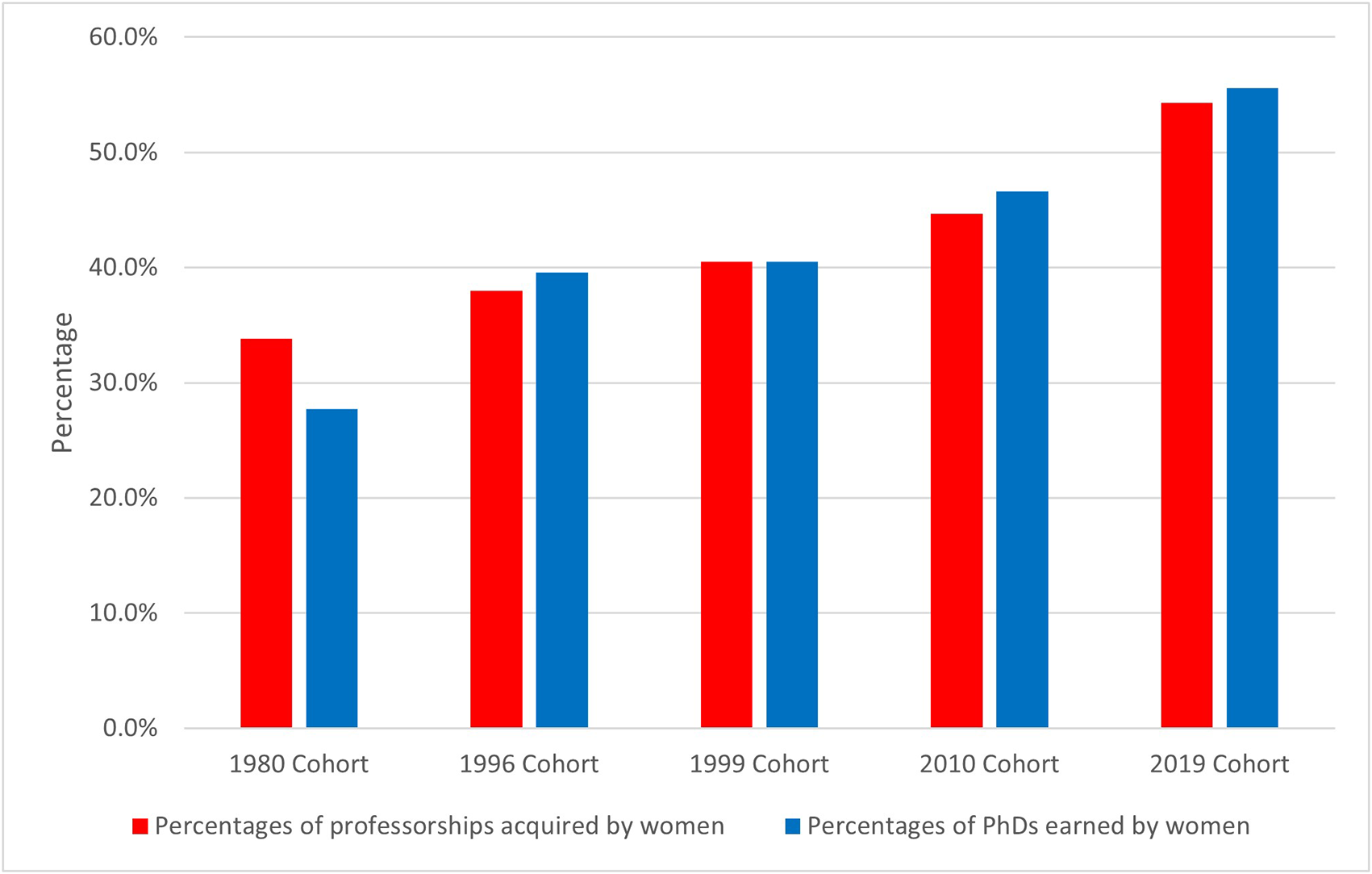
Testing the hypothesis of a leaky pipeline from graduate school to the professoriate requires comparing the percentage of PhDs earned by women in a particular range of years to the percentage of academic jobs held by women who earned their PhDs from that same range of years. Keeping chronology constant—focusing on the same range of years for earning the PhD—ensures we are comparing apples to apples. Hutson (Reference Hutson1998) performed such comparisons for two periods: 1976–1980 and 1991–1996. From 1976 to 1980, women earned 27.7% of dissertations. In the 1980–1981 Anthroguide, women acquired 33.8% of the assistant professor jobs held by people with PhDs from 1976 to 1980 (Figure 1). From 1991 to 1996, women earned 39.6% of the dissertations. In the 1996–1997 Anthroguide, women acquired 38% of the assistant professor jobs held by people with PhDs from 1991 to 1996. Thus, there was no leak from PhD degree to professoriate for those two spans of years.
Comparison of percentage of PhDs earned and tenure-track jobs acquired by women.

This finding aligns with Hammel and coworkers’ (Reference Hammel, Mason, Prater and Lundy1995) report on faculty positions for all subfields of anthropology. They found bias against women in hiring for entry-level positions before the mid-1970s but no bias after the mid-1970s. Beyond anthropology, women in the mid-1980s were hired into assistant professor positions at a rate that “slightly exceeded their presence in the relevant PhD pools” (Chamberlain Reference Chamberlain1988:214; Wylie Reference Wylie, Nelson, Nelson and Wylie1994). Ford and Hundt (Reference Ford, Hundt, Nelson, Nelson and Wylie1994) found that women received 40% of the PhDs in Mesoamerican archaeology during the 1980s (as listed in Anthroguides): 48% of these women were listed in the 1989–1990 Anthroguide. Of these 48%, 25% were in ladder faculty positions. In contrast, 59% of the men receiving dissertations in Mesoamerican archaeology in the 1980s were listed in the 1989–1990 Anthroguide, and 74% of them had ladder faculty positions. These data suggest that, although there may not have been a leak in archaeology as a whole, some regional specialties did experience leaks.
Stark and colleagues (Reference Stark, Spielmann, Shears and Ohnersorgen1997) found that between the 1986–1987 Anthroguide and the 1992–1993 Anthroguide, the number of full-time archaeology faculty positions grew from 486 to 631, yet the percentage of women in these positions only grew from 20% to 21%. Assuming that the 145 additional positions represent new hires at the assistant professor level from the pool of people receiving PhDs from 1987 to 1992, a pipeline without leaks would deliver 38% of these new jobs (55 in total) to women because women earned 38% of the PhDs from 1987 to 1992. These 55 hires would mean that 24.4% of the archaeology professoriate should be women. Yet the assumption that the 145 additional positions represent new hires made between 1987 and 1992, presumably at the assistant professor level, remains untested. It may instead be the case that more departments advertised in the later Anthroguide. Indeed, we found that the 1992 Anthroguide contains 41 colleges and universities that did not appear in the 1987 Anthroguide. We also found that many of the archaeology faculty at these 41 colleges and universities were tenured faculty hired before 1987 and with PhDs predating 1987. Thus, we cannot expect the gender breakdown of these 145 additional positions to reflect the 38% pool of women PhDs from 1987 to 1992. In other words, this is not strong evidence of a leak.
No Leaks from PhD to Assistant Professor: Recent Studies and New Data
More recently, a team from the University of Georgia (Speakman et al. Reference Speakman, Hadden, Colvin, Cramb, Jones, Jones and Kling2018:8) stated that “hiring practices in archaeology are strongly biased toward males.” Their data appear to confirm the existence of a leaky pipeline: their Figure 3 shows that in every year from 1992 to 2014 men received fewer doctorates than women, but more men than women acquired jobs at universities. The shortcoming of this study is the use of a PhD database—the annual NSF Survey of Earned Doctorates (SED)—that had relatively small sample sizes for earlier years. Graduate schools distribute the surveys, often about eight pages long, to graduates, who then return them to their graduate schools, which forward them to a third party (The National Opinion Research Center in the 2000s; The Research Triangle Institute more recently) that attempts to contact nonrespondents by phone, mail, or email. Before 2011, the SEDs dramatically underreported completed PhDs in archaeology. Between 1981 and 2010, the SEDs list 1,028 completed doctorates in archaeology. Yet the Anthroguides list 2,626 completed doctorates in archaeology for that same span of years. From 2011 onward, the SEDs report more archaeology PhDs than the Anthroguide listings. The cause for the underreporting of archaeology PhDs in the SEDs before 2011 is not clear, given that SED response rates for all academic fields combined have always been above 90%. Oddly, although the number of archaeology PhDs reported in the SEDs has increased over time, the response rates to the SEDs for all fields combined have declined from a yearly average of 96.8% in the 1970s to 91.9% in the 2010s (p < 0.001; NCSES 2024:Table A.2). Before 2011, the sample size for completed dissertations reported in the Anthroguides was not just larger but also more representative because nearly all US PhD programs reported completed dissertations. The Anthroguide sample diminished more recently because several prominent anthropology departments did not report completed PhDs to the American Anthropological Association in the 2010s.
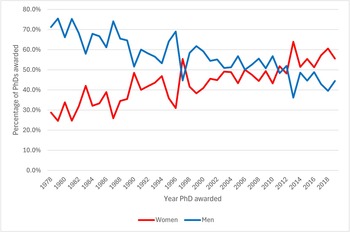
Whereas data exclusively from the NSF SEDs led the University of Georgia group to state that women earned 60% of the doctorates between 1994 and 2014, the more robust data that come from using the Anthroguides from 1994 to 2010 and the SEDs from 2011 to 2014 (recall that in 2011 the SED sample size eclipses that of the Anthroguides) show that women actually earned 46% of the doctorates from that range of years. Table 1 and Figure 2 present the data from both sources for a much broader range of years: 1978–2019.
Proportions of archaeology PhDs awarded to men and women over time.
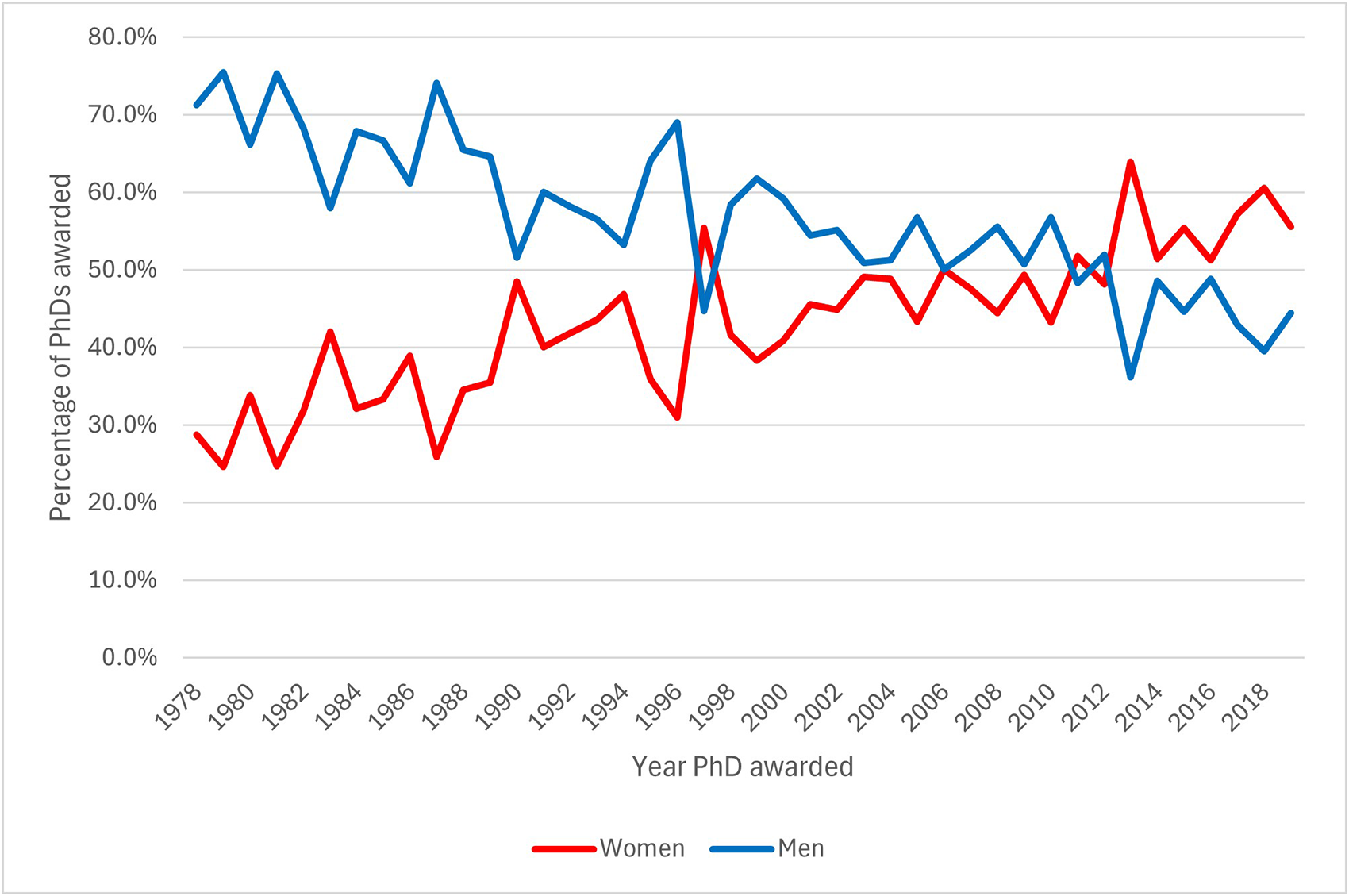
Archaeology PhDs Awarded over Time as Reported by Anthroguide and NSF.

Table 1 Long description
The table is intended to report the number of archaeology doctoral degrees awarded over multiple years, using figures attributed to Anthroguide and the NSF. However, no rows, columns, years, or counts are included in the provided table data. Because the numeric entries are missing, it is not possible to identify key values, compare the two sources, or describe increases or decreases over time. If you share the year-by-year counts for each source, the can summarize peaks, lows, overall direction, and any differences between Anthroguide and NSF reporting.
Using the Anthroguides up to 2011 (the years when it is more robust than the SED) and the SED from 2011 forward (the years when it is more robust than the Anthroguides), we attempted to identify a leaky pipeline at three moments, each about 10 years apart: 1999, 2010, and 2019. (We did not use exact 10-year intervals because the 2009–2010 Anthroguide was not available to us when we began our study). We sifted through Anthroguides for 1999–2000, 2010–2011, and 2019–2020 and identified all full-time, nontemporary, nontenured faculty (visiting professors and adjunct faculty excluded) who received their PhD in the previous five years and whose keywords (bioarchaeology, zooarchaeology, historical archaeology, etc.) suggested that they are archaeologists. Thus, we have three “cohorts” that, based on the publication year of the Anthroguide, we call the 1999, 2010, and 2019 cohorts. The three cohorts consist of 74, 47, and 46 faculty members, respectively. (The drop in faculty members in the latter two cohorts may signify a tougher job market in the last two decades, but it is also the case that fewer departments are reported in the later Anthroguides.) We assigned gender based on the faculty member’s first name, and where gender was not clear, we consulted web profiles and other sources of information. We recognize that this method of gender assignment has disadvantages (Bardolph Reference Bardolph2014:526; Fulkerson and Tushingham Reference Fulkerson and Tushingham2019; Heath-Stout Reference Heath-Stout2020:410). For example, it follows a binary system and therefore miscategorizes nonbinary archaeologists.
We then compared the proportion of men and women who acquired jobs to the proportion of men and women who earned PhDs in the preceding five years. In the 1999 cohort, which contains 74 faculty members (as listed in the 1999–2000 Anthroguide) who received their degrees between 1995 and 1999, 40.5% are women (Figure 1). Of the 476 archaeology PhDs earned between 1995 and 1999, 40.5% went to women. In other words, there is full gender parity between those who were hired and those who received PhDs. In the 2010 cohort, 44.7% of faculty with degrees from 2005 to 2010 were women, whereas 46.6% of the PhDs awarded during these years went to women (χ2 = 0.093, p = 0.798). In the 2019 cohort, 54.3% of faculty with degrees from 2015 to 2019 were women, and 55.6% of the PhDs awarded during these years went to women (χ2 = 0.0284; p = 0.866). We therefore failed to find evidence for a leaky pipeline.
In Canada, Overholtzer and Jalbert (Reference Overholtzer and Jalbert2021) examined possible leaks from graduate programs to faculty positions in three categories: archaeologists, bioarchaeologists, and classical archaeologists. Although women are amply represented in the professoriate in the latter two categories (with women in bioarchaeology comprising a remarkable 69% of faculty of all ranks), in the archaeology category women received 64% of PhDs awarded by Canadian graduate programs from 2007 to 2016 but comprise only 46% of assistant professors. The leak is even larger considering that most women assistant professors at the time of Overholtzer and Jalbert’s study did not actually earn their degrees in Canada. They found that many women with Canadian degrees did not leak but rather found academic jobs in the United States, therefore merging into a bigger pipeline. Nevertheless, they report that “men who earned their degrees in Canada between 2003 and 2017 are three times more likely to occupy faculty positions in Canada today” (Overholtzer and Jalbert Reference Overholtzer and Jalbert2021:269–270).
No Leaks from Assistant Professor to Associate Professor
Although there was no leaky pipeline for women from the PhD to the tenure track, are there leaks on the step between assistant professor and associate professor? For the 1999 and 2010 cohorts discussed in the previous section, we used the 2010–2011 and 2019–2020 Anthroguides, respectively, to gather data on promotion outcomes. In the 1999 cohort, 71 of the 74 faculty had advanced to associate professor by 2010. Of the three who leaked, one was a woman and two were men. In other words, 29 of 30 women were promoted compared to 42 of 44 men. This result shows that in the first decade of the new millennium, there were no gender-based leaks in the pipeline from assistant professor to associate professor. Of the 71 who were promoted, 15 changed universities between 2000 and 2010. At least one of these changes occurred before promotion at the original university, although in many cases the change to a new employer occurred after promotion. Eleven men and four women changed institutions; thus, 26.2% (11 of 42) of the men changed institutions, and 13.8% (4 of 29) of the women changed universities (χ2 = 1.58, p = 0.208).
Moving ahead a decade to the 2010 cohort, 43 of the 47 faculty had advanced to associate professor by 2019. Of the four who did not, two were women and two were men. In other words, 19 of 21 women and 24 of 26 men were promoted. Thus, once again there was no gender-based leak in the pipeline from assistant to associate. Of the 43 promoted professors, four changed universities between 2010 and 2019. This is a lower rate of change than in the 1999 cohort (21.1% vs. 9.3%, χ2 = 2.696, p = 0.101), but we would expect a lower rate of mobility in the 2010 cohort, given that they have had less time to move around. Of the four who changed universities, two are men and two are women.
Different Destinations? Women Are Hired into Less Research-Intensive Academic Positions
To summarize the previous sections, we failed to find a gendered leak from grad school to assistant professor and from assistant professor to associate professor. But this is not the whole story: we need to look not just at who is hired but also where they are hired. Ginther’s (Reference Ginther2022) analysis of the 2019 NSF Survey of Earned Doctorates shows that, in the social sciences, 41% of faculty at all types of universities and colleges (all ranks) are women compared to only 37% of faculty at research-intensive universities (see also Monroe and Chiu Reference Monroe and Chiu2010:304). In the context of the current study, some archaeologists are part of anthropology departments that offer PhDs; others are not. Furthermore, some PhD programs rank more highly than others. We begin with the possibility that women are hired into PhD programs less often than men.
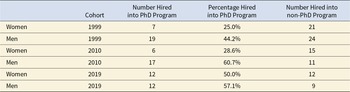
For the 1999 cohort, 44.2% of men who joined the professoriate found jobs in a program offering a PhD compared to 25.0% of women (χ2 = 2.69, p = 0.101; Table 2). For the 2010 cohort, the difference is more striking: 60.7% of men versus 28.6% of women (χ2 = 4. 89, p = 0.026) found jobs in PhD programs. For the 2019 cohort, the difference is less pronounced: 57.1% of men, 50.0% of women (χ2 = 0.89, df = 1, p = 0.632). If we combine all three cohorts, thereby increasing the sample size, we find an appreciable difference (χ2 = 5.30, p = 0.021). Thus, women remain poorly represented in research-focused academic positions (see also Surface-Evans and Jackson Reference Surface-Evans and Jackson2012:21).
Trends in Hiring Men and Women into PhD-Granting Programs.
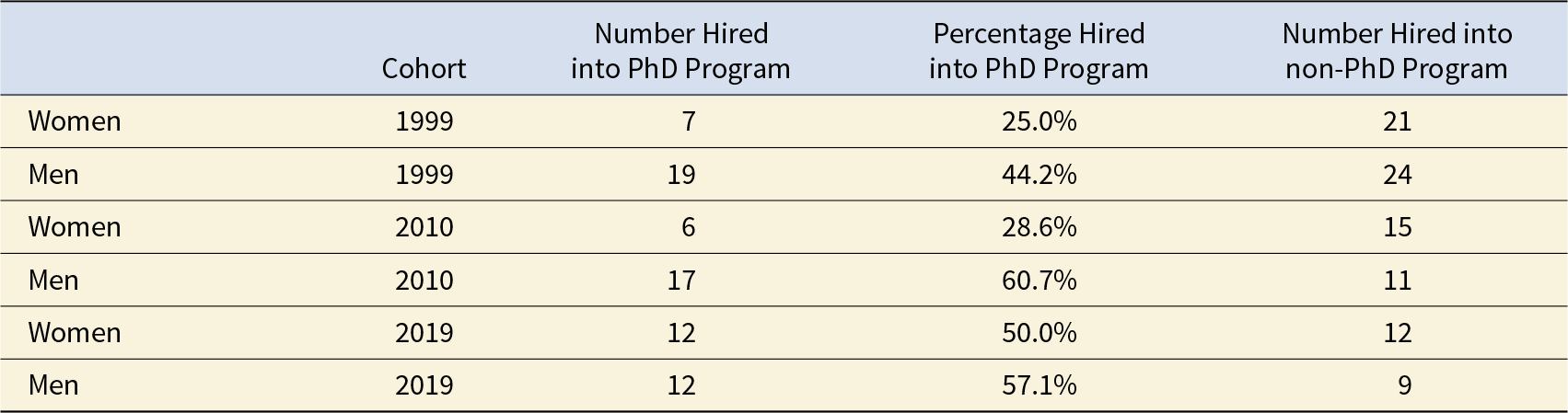
Table 2 Long description
The table is intended to measure hiring patterns for men and women into PhD-granting programs over time. However, no rows, columns, labels, or numeric values are included in the provided table data. Because the underlying figures are missing, it is not possible to identify key data points, compare men and women, or describe increases, decreases, or stability across years or categories. Any interpretation about gender differences or hiring trends would be speculative without the actual entries. Provide the table values and headings to enable an accurate, WCAG-compliant summary.
The fact that women are not hired as often into PhD programs has a variety of consequences. First, their research productivity may decline because they likely face heavier teaching assignments. Second, they do not directly train PhD students, which means they have fewer opportunities to shape future generations of archaeologists. Third, a PhD student is a resource that often stimulates research. So, when women lack PhD students, their research networks and productivity might decrease. Fourth, PhD-granting departments can be considered more prestigious than those who do not offer doctorates. As Burris (Reference Burris2004) and Kawa and coauthors (Reference Kawa, Michelangeli, Clark, Ginsberg and McCarty2018) have argued, departmental prestige derives largely from its position within the network of PhD exchange; that is, which departments’ PhDs get hired as faculty. Departments that offer no PhDs are left out of this network, and members of these departments miss out on prestige. In contrast, faculty in PhD programs may benefit from being in research-oriented departments (Weakliem et al. Reference Weakliem, Gauchat and Wright2012:325).
Thus, by being hired less frequently into PhD-granting programs, women’s scholarship is at risk of being undervalued because of the lower standing of the departments that hire them. If women are not hired as often into PhD programs because of the undervaluation of their research, we have a negative feedback loop: their work gets undervalued once again because they are not in PhD-granting programs. In sum, placement in non–PhD-granting institutions limits women’s productivity, potentially devalues what they do produce, and may reduce their professional networks and mentoring impact, all resulting in constraints on women’s voices and an impoverishment of discourse. Alternatively, the lower number of women in PhD-granting institutions may reflect preferences for academic jobs with a greater focus on undergraduate teaching.
The lower number of women in PhD programs also has a profound effect on structures of mentoring. Studies both in archaeology (Brown Reference Brown2018; Safi Reference Safi2014:37) and beyond (Smeby Reference Smeby2000) show that women receive better mentoring from other women. With fewer women teaching in PhD programs, students have fewer female role models. We explored the gendered nature of mentorship for the three cohorts of faculty. Information on PhD committee members was available (from the front matter of dissertations available in Proquest) for 66 of the 74 members of the 1999 cohort, 39 of the 47 members of the 2010 cohort, and 37 of the 46 members of the 2019 cohort. Information on PhD advisers was available for 68, 44, and 37 members of the 1999, 2010, and 2019 cohorts, respectively. Our data show that women are more likely to have women as their main advisers (Figure 3a) and that women in all three cohorts had more women on their advisory committees than did men (Figure 3b). Combining all three cohorts, we find major differences for the gender of committee members (χ2 = 20.03, p < 0.0001) and the gender of advisers (χ2 = 4.14, p = 0.033). This shows that women students, more often than men students, have women as faculty mentors. But because of the underrepresentation of women faculty in PhD programs, women students have smaller numbers of women faculty available to serve as mentors. Insofar as women get better mentoring from women, the shortage of women mentors hurts the mentees. It also disadvantages women mentors: since there are more women than men seeking a PhD these days, women mentors have a potentially larger advising load, which can reduce their productivity (Brown Reference Brown2018:203).
(A) Percentage of PhD advisers (to men and women with tenure-track jobs) who are women; (B) percentage of PhD committee members (for men and women with tenure-track jobs) who are women.

Figure 3 Long description
The image A showing a grouped bar graph. The horizontal axis shows 1999 cohort, 2010 cohort, 2019 cohort. The vertical axis label is Percentage of PhD advisers that are women, with percent values from 0.0 percent to 70.0 percent. Legend entries: Women in tenure track jobs; Men in tenure track jobs. Bar values: 1999 cohort, Women in tenure track jobs 21.0 percent, Men in tenure track jobs 10.0 percent. 2010 cohort, Women in tenure track jobs 24.0 percent, Men in tenure track jobs 20.0 percent. 2019 cohort, Women in tenure track jobs 60.0 percent, Men in tenure track jobs 35.0 percent. The image B showing a grouped bar graph. The horizontal axis shows 1999 cohort, 2010 cohort, 2019 cohort. The vertical axis label is Percentage of PhD committee members that are women, with percent values from 0.0 percent to 60.0 percent. Legend entries: Women in tenure track jobs; Men in tenure track jobs. Bar values: 1999 cohort, Women in tenure track jobs 19.0 percent, Men in tenure track jobs 13.0 percent. 2010 cohort, Women in tenure track jobs 32.0 percent, Men in tenure track jobs 27.0 percent. 2019 cohort, Women in tenure track jobs 48.0 percent, Men in tenure track jobs 29.0 percent.
Within PhD programs, some departments rank more highly than others. Do women work in highly ranked programs as often as men? The University of Georgia group ranked PhD programs into tiers based on how often a program’s grads find jobs in academia (Speakman et al. Reference Speakman, Hadden, Colvin, Cramb, Jones, Jones and Kling2018; see also Kawa et al. Reference Kawa, Michelangeli, Clark, Ginsberg and McCarty2018). They found that for the pool of archaeologists who earned PhDs between 1994 and 2003, women were hired more often at prestigious departments: those with the most success in placing their students into academic jobs. But for the 2004–2014 PhD pool, men were hired more often into these positions. We found that for the 1999 cohort, the average rank of the PhD programs that women were hired into was higher than the average rank of the programs that hired men, but the difference is slight (Mann-Whitney U, p = 0.59). For the 2010 cohort, men and women were hired into PhD programs with essentially the same ranks (Mann-Whitney U, p = 0.80). For the 2019 cohort, the average rank of the PhD programs that hired women was lower than the average rank of the programs that hired men, but the difference is minor (Mann-Whitney U, p = 0.30)
Why Does Inequality Persist?
Although we did not find a leak in the pipeline from graduate school to the professoriate nor from assistant to associate ranks, we did find that women are disproportionately employed in anthropology departments that do not offer a PhD. This is an important inequality. Given that PhD programs are more research-intensive and train future generations of archaeologists, women have fewer opportunities to shape the agenda and substance of the field. This imbalance comes at a cost to the discipline as a whole. Various studies have provided empirical evidence that gender diversity and broader participation of under\represented groups lead to better science (Hofstra et al. Reference Bas, Kulkarni, Muñoz-Najar Galvez, Bryan, Jurafsky and McFarland2020; Nielsen et al. Reference Nielsen, Alegria, Börjeson, Etzkowitz, Falk-Krzesinski, Josh, Leahey, Smith-Doerr, Woolley and Schiebinger2017; see also Handelsman et al. Reference Handelsman, Cantor, Carnes, Denton, Fine, Grosz, Hinshaw, Marrett, Rosser, Shalala and Sheridan2015). In archaeology, Heath-Stout (Reference Heath-Stout2024) shows that a lack of diversity results in weaker knowledge. Explanations for why inequalities in academia persist, however, can vary from one field of study to another.
As discussed earlier, bias turns up in many corners of academia. Experiments show that both men and women can be biased against women in the natural sciences and psychology (Dutt et al. Reference Dutt, Pfaff, Bernstein, Dillard and Block2016; Madera et al. Reference Madera, Hebl, Dial, Martin and Valian2019; Moss-Racusin et al. Reference Moss-Racusin, Dovidio, Brescoll, Graham and Handelsman2012; Reuben et al. Reference Reuben, Sapienza and Zingales2014). To quote Moss-Racusin and colleagues (Reference Moss-Racusin, Dovidio, Brescoll, Graham and Handelsman2012:16477), bias is often subtle:
The fact that faculty members’ bias was independent of their gender, scientific discipline, age, and tenure status suggests that it is likely unintentional, generated from widespread cultural stereotypes rather than a conscious intention to harm women. Additionally, the fact that faculty participants reported liking the female more than the male student further underscores the point that our results likely do not reflect faculty members’ overt hostility toward women.
In archaeology, there is indeed overt hostility in the form of sexual harassment, assault, or both (Meyers et al. Reference Meyers, Horton, Boudreau, Carmody, Wright and Dekle2018; VanDerwarker et al. Reference VanDerwarker, Brown, Gonzalez and Radde2018; Voss Reference Voss2021a), but it is unclear whether such hostility could explain why women get hired more often into non-PhD programs.
Returning to the question of bias, several studies illuminate the issue. Goldstein and colleagues (Reference Goldstein, Herr, Mills, Burkholder, Aiello and Thornton2018) show that men and women in archaeology successfully procure grants at the same rate, which aligns with findings in other fields (Boyle et al. Reference Boyle, Smith, Cooper, Williams and O’Connor2015; Ceci Reference Ceci2018; Ginther Reference Ginther2022). Likewise, the rates of acceptance of journal articles are similar between men and women (Rautman Reference Rautman2012). Yet women do not feature as often as men in archaeology textbooks (Surface-Evans and Jackson Reference Surface-Evans and Jackson2012:21). Women in archaeology publish at rates that are not always proportionate with their representation in academia (Hutson et al. Reference Hutson, Johnson, Price, Record, Rodriguez, Snow and Stocking2023; see also Bardolph Reference Bardolph2014), and they submit fewer grant proposals than one would expect (Goldstein et al. Reference Goldstein, Herr, Mills, Burkholder, Aiello and Thornton2018). Although this disparity could result from there being fewer women in research-intensive departments (e.g., those with PhD programs), it may also result from issues of mentorship: better mentorship seems to lead to more resubmission of grants and articles (VanDerwarker et al. Reference VanDerwarker, Brown, Gonzalez and Radde2018). Yet women with men as mentors, which is to say most women, report receiving less encouragement to publish and participate in conferences (Brown Reference Brown2018:194–195). Men cite women’s work in the same proportions that women cite women’s work, but there still may be a Matilda effect of undervaluing women’s scholarship: both genders cite women’s work at a proportion that is lower than what we would expect, given the proportion of publications by women that are available to cite (Hutson Reference Hutson2002). We suspect that bias plays a role: implicit gender bias has been linked to disparities in career outcomes across academia (Kim et al. Reference Kim, Smith, Hofstra and McFarland2022), but we lack precise experimental data to connect bias with hiring in archaeology PhD programs.
The valorization of fieldwork in archaeology may also help explain why women are disproportionately employed in anthropology departments that do not offer PhDs. Sexual harassment and assault against women are prevalent in field contexts (Clancy et al. Reference Clancy, Nelson, Rutherford and Hinde2014; Voss Reference Voss2021a). In their article “Family and the Field,” Lynn and coauthors (Reference Lynn, Howells and Stein2018:2) write,
The disciplinary importance of fieldwork relies on individuals who are socially unencumbered and financially solvent, either through their own means or external funding. However, it systematically overlooks the significant social and financial responsibilities experienced by many professionals and trainees, including dependent family members (children, elderly parents, etc.), and household expenses (rent, car payments, student loan bills, tuition, credit card bills), and may act to systematically privilege those without these pressures.
Their survey of 1,193 anthropologists shows that parenthood negatively affects women’s fieldwork opportunities more than men’s. Thus, Lynn and coauthors conclude that field-based disciplines like archaeology are subject to factors that undermine the integrity of knowledge construction. Although the notion that fieldwork is masculinized has been overstated (Heath-Stout and Jalbert Reference Heath-Stout and Jalbert2023), the reduction in fieldwork opportunities due to family commitments may constrain women from maintaining the high research productivity required to secure a faculty position in a PhD program. The contributors to the “Life in Ruins: Work-Life Balance in Archaeology” special forum in the SAA Archaeological Record (Barber Reference Barber2012) clarify the challenges in balancing family commitments and a career in archaeology. These challenges also appear in economics and political science, where parenthood affects women’s ability to gain tenure (Ginther and Kahn Reference Ginther and Kahn2021:141; Windsor and Crawford Reference Windsor and Crawford2020:276).
Possible Solutions
What can be done to improve the chances that women are hired into PhD programs at the same rate as men? Simply increasing the number of women in the pipeline will not solve the problem. Having more women with PhDs does “not necessarily mean increased visibility or influence on the discipline” (Surface-Evans and Jackson Reference Surface-Evans and Jackson2012:21). The issue, to repeat, is not a leaky pipeline, but rather that the pipeline more commonly brings women to non-research-intensive jobs in academia. We suggest three solutions: confronting bias, improving mentoring, and bolstering research.
Confronting Bias
Despite debate over the degree of bias in academic hiring, studies cited earlier clearly document the existence of at least some bias. Improving the chances that women will be hired at PhD programs requires pinpointing the specific contexts where biases occur in the hiring process and providing suggestions for reducing them. In this section we provide suggestions in three specific contexts: letters of recommendation, the assessment of coauthoring credit, and the degree to which applicants’ profiles match job descriptions. Beyond these three contexts, hiring committees should undergo implicit bias training to gain awareness of “how the research topics of women, under-represented minorities, or non-dominant genders are systematically undervalued” (Kim et al. Reference Kim, Smith, Hofstra and McFarland2022:13).
Letters of Recommendation. Madera and colleagues (Reference Madera, Hebl, Dial, Martin and Valian2019) examined 624 authentic letters of recommendation written for assistant professor positions in psychology. Controlling for the quality of the candidate (as measured by teaching experience and the amount and quality of publications), they found that letters written for women contained a significantly larger amount of negativity, hedging, and faint praise than those written for men. They also showed that when letter writers raise such doubts, it harms the candidate, whether male or female. Dutt and colleagues (Reference Dutt, Pfaff, Bernstein, Dillard and Block2016) examined 1,224 authentic letters of recommendation written for postdoctoral positions in geosciences and found that women were only 50% as likely as men to receive excellent letters of recommendation. This robust documentation of bias confirms earlier suggestions that women are more often praised for diligence and nurturing behavior as opposed to brilliance and confidence (Schmader et al. Reference Schmader, Whitehead and Wysocki2007; Trix and Psenka Reference Trix and Psenka2003).
Because letters of recommendation can contain bias that candidates do not control, we suggest that search committees should not solicit recommendations until late in the hiring process, when the applicant pool has already been narrowed to a list of eight or fewer candidates, based on materials (cover letter, CV, sample publications) written by the applicant (Carlson and Zorn Reference Carlson and Zorn2021). Furthermore, following Madera and colleagues (Reference Madera, Hebl, Dial, Martin and Valian2019), search committees should prompt recommenders to structure their letters into specific sections: unstructured letters have been shown to be less valid (Kuncel et al. Reference Kuncel, Kochevar and Ones2014). Committee members should also provide explanations and justifications for how they respond to a letter of recommendation. Such explanations reduce gender bias (Koch et al. Reference Koch, D’Mello and Sackett2015; Morgan et al. Reference Morgan, Elder and King2013).
Coauthorship Credit. Coauthorship is also a common context for gender bias. Sarsons and coauthors (Reference Sarsons, Gȅrxhani, Reuben and Schram2021) found that, within economics departments, men and women who publish as the sole author of most of their work achieve tenure at the same rate, controlling for journal ranking and the number of citations. Yet, when men and women publish as coauthors, men are more likely to achieve tenure than women. However, a woman whose coauthors are women is more likely to achieve tenure than a woman whose coauthors are men (the Matilda effect once again). In sum, Sarsons and coauthors argue that publishing alone is a clear signal of ability, whereas work published by mixed-gender coauthors is a noisy signal, allowing bias to occur. This bias can be mitigated if evaluators of job applications pay attention to the specific roles played by each author. Furthermore, in cases where contributions from coauthors are approximately equal, criteria should stipulate that coauthorship counts equally, regardless of the gender of the coauthors.
Screen Applicants for Match with Job Description. To improve the chances of equity in hiring, job search committees should prioritize the degree to which applicants match the criteria stipulated in the published job description. Carlson and Zorn (Reference Carlson and Zorn2021) note that women more commonly limit their applications to jobs where the criteria match well with their own qualifications. Men, in contrast, are more likely to apply for jobs for which they are not well matched. If some of these poorly matched men have very impressive CVs, the applicant pool lacks balance in terms of gender because women with equally impressive CVs but not as good a match for the job may not have applied. Recovering equity in the applicant pool requires filtering out those (usually male) applicants whose qualifications do not meet the criteria of the job description, even if those applicants are strong in other ways.
Improving Mentoring
Mentoring is both a locus of implicit bias and a means to correct it. Moss-Racusin and colleagues (Reference Moss-Racusin, Dovidio, Brescoll, Graham and Handelsman2012) show that both senior men and women tend to judge male students as more competent and hirable than female students. If men are seen as more competent, this could mean that women are getting less encouragement, less consideration for awards, and less investment from professors. Indeed, women archaeologists in California have reported less encouragement from male mentors (Brown Reference Brown2018). To the extent that this type of feedback affects a student’s sense of self-worth, a shortage of positive recognition might lessen students’ likelihood of persevering in the face of challenge, leading them to lower their goals and expectations for success: “Good mentorship . . . can save individuals from otherwise dropping out at difficult points in their careers, protect them from individual ‘gatekeepers’ that determine who gets particular resources and opportunities, and aid in building network alliances and discussing ideas among colleagues” (Brown Reference Brown2018:202). Mentoring that consists of continuous and enthusiastic encouragement can reduce bias (Handelsman et al. Reference Handelsman, Cantor, Carnes, Denton, Fine, Grosz, Hinshaw, Marrett, Rosser, Shalala and Sheridan2015). According to Surface-Evans and Jackson (Reference Surface-Evans and Jackson2012:21), “Mentoring has a powerful influence on how students perceive female scholars and how they view the discipline.”
Women as mentors are more encouraging and inclusive, but with fewer women teaching in PhD programs and more women enrolled in these programs, women mentors will face higher mentoring loads (VanDerwarker et al. Reference VanDerwarker, Brown, Gonzalez and Radde2018). This extra effort must be appropriately valorized and perhaps recognized with awards (Brown Reference Brown2018). Furthermore, because no single mentor has expertise on all possible career paths, mentoring should be spread among many people (Baxter et al. Reference Baxter, Mayfield, O’Gorman, Peterson and Stone2008; Burchell and Cook Reference Burchell and Cook2014). Of course, interventions in the quality of mentoring can address many other issues. For example, women in academia often carry higher service loads (Park Reference Park1996; Wylie et al. Reference Wylie, Jakobsen and Fosado2007:6). All faculty should be mentored to participate equitably in service activities, and those in a position to assign service roles should be mentored about maintaining gender equity when making service assignments (Handelsman et al. Reference Handelsman, Cantor, Carnes, Denton, Fine, Grosz, Hinshaw, Marrett, Rosser, Shalala and Sheridan2005:1191). Furthermore, because women perform more “invisible labor,” which Reid (Reference Reid2021:504) defines as student-initiated mentorship in which faculty serve as emotional counselors and even surrogate caregivers, often around DEI (see also June Reference June2015), such labor should be codified inclusively and formally credited.
Bolstering Research
Academic structures can be transformed to bolster women’s ability to do the kind of research that makes them more competitive in landing jobs at PhD programs. Building on Lynn and coauthors’ (Reference Lynn, Howells and Stein2018) survey result—that extensive fieldwork entails barriers of various sorts for women and people of lower socioeconomic status—a direct solution would be more research fieldwork support, financial and otherwise, for women and other disadvantaged archaeologists. Charlesworth and Banaji (Reference Charlesworth and Banaji2019:7239) state that “reducing or supporting women’s household and childcare duties may be crucial to ensuring equal advancement in STEM.” Given the high incidence of sexual harassment and assault in fieldwork, all field projects should create and follow policies emphasizing safety, inclusivity, and collegiality, with clear communication of procedures for reporting harassment and assault (Clancy et al. Reference Clancy, Nelson, Rutherford and Hinde2014; Davis et al. Reference Davis, Meehan, Klehm, Kurnick and Cameron2021; Voss Reference Voss2021b). We also encourage colleagues to attribute more prestige to archaeological research that does not require fieldwork, such as working with legacy collections. Even collection-based work, however, can involve extensive travel costs and long stretches of time away from home and family without a way to pay one’s rent/mortgage. This, then, becomes a call for more digitization of raw data (including 3D models of artifacts, etc.) so that analysis can take place anywhere.
Conclusion
We found that some attempts to document a leaky pipeline in academic archaeology in the 1980s and 1990s were hampered by not controlling for chronology. A more recent attempt was hampered by not using robust data on the pool of PhDs. Controlling for chronology and using better data on PhDs reveal no gender-based leak in the late 1970s, early 1990s, late 1990s, late 2000s, and late 2010s. Furthermore, there has been no gender-based leak from assistant professor to tenured associate professor in the late 1990s, late 2000s, and late 2010s.
Nevertheless, men get hired into PhD programs more often than women. We also find that female PhD students have women as advisers more than often men. This means that women in graduate school have a disproportionately smaller supply of women who could serve as mentors and role models. Fortunately, within PhD programs, men and women can be found in approximately equal proportions in both highly ranked and lower-ranked departments.
Thus, the pipeline does not leak, but, in academia, women sometimes find themselves in destinations where their ability to contribute value to the field is reduced. Their research productivity (as seen in grants and publications) and therefore their professional voice are muted, as is their ability to expand collaborations and train graduate students who will become the next generation of archaeology professors.
Several phenomena may contribute to this problem. Gender imbalance may result from subtle, unintentional biases, originating within widespread cultural stereotypes, that cast men as more competent in the sciences and tend to undervalue women’s contributions. The importance of fieldwork in archaeology combined with sexual harassment in the field and unequal gendered burdens around childcare, eldercare, and other concerns may make women less competitive for research-intensive jobs.
Although some solutions to this problem can be expensive, many are cheap and within our grasp, such as targeting areas where bias can intervene. Specifically, we advise job search committees to wait until late in the hiring process to solicit letters of recommendation, to standardize the valorization of coauthorship for both men and women, and to prioritize how well applicants’ qualifications match job descriptions. Mentoring from multiple mentors can be a means of confronting bias while also boosting both men and women with continuous and enthusiastic encouragement. Rewards for mentoring should be increased. Finally, adopting explicit anti-harassment policies and restructuring forms of funding can reduce barriers to fieldwork and lab work that affect women more than men.
Acknowledgments
We thank the three anonymous reviewers, as well as Sarah Kurnick and Samantha Fladd, for helpful comments.
Funding Statement
We received no funding for the analyses reported in this article.
Data Availability Statement
Data on PhDs in archaeology are available at https://anthropology.as.uky.edu/sites/default/files/Supp1.pdf. Data on hiring cohorts are available at https://anthropology.as.uky.edu/sites/default/files/Supp2.pdf.
Competing Interests
The authors declare none.



 Open access

