


Impact statement
Our ability to assess cumulative effects underpins our capacity to manage cumulative effects. If we want to know how multiple human activities are interacting with and impacting our ecosystems and societies, we need good cumulative effects assessments (CEAs). These tools enable decision-makers and stakeholders to understand what impact existing activities and proposed development are likely to have on a changing environment. Good CEAs, therefore, are a prerequisite for sustainable development. This paper reviews advances in CEA in marine and coastal environments, assesses whether these advances are linked to decision-making and identifies where implementation challenges exist. Our review shows that research into how effects accumulate continues, but that there is much less evidence of research investigating how to bring that science into decision-making. The review intends to support efforts to accelerate the inclusion of CEA into marine and coastal planning and management. To that end, we propose research directions to bridge the gap between science, policy and delivery. While our paper focuses on marine and coastal systems, it is straightforward to find evidence of the continuing need for good CEAs in terrestrial and freshwater systems also. To that end, we hope that our review of recent research and proposed research directions will be of international interest and relevance.
Introduction
There is tension between the drive to develop coastal and marine environments and the need to protect our coastal and marine ecosystems. Demands to develop blue economies and to use these environments to support net zero targets mean that further development of coastal areas, seas and the ocean is inevitable. The outcome of that development is not inevitable, however. If ocean governance can move beyond the historically siloed approach to marine management and monitoring, there is the potential for development to be sustainable. Sustainable development depends on our ability to manage coastal and marine spaces holistically, which requires that decision-makers and stakeholders are supported by assessments of how multiple activities and processes cumulatively shape the environment, that account for how diverse actors use and value these spaces, and that permit identification of effective strategies for managing these cumulative effects to benefit ecosystems, societies and economies.
If we are concerned about sustainable development, we are concerned about the cumulative effects of human activities (Duinker, Reference Duinker2020). Cumulative effects impact the sustainability of elements of the environment that human societies care about, called valued components (VCs; Beanlands and Duinker, Reference Beanlands and Duinker1984). VCs could include, for example, populations, species, habitats or ecosystem services. VCs never experience causal agents (entities, actions or occurrences) in isolation. Instead, VCs’ condition and resilience reflect a range of causal agents acting on VCs at multiple scales (Segner et al., Reference Segner, Schmitt-Jansen and Sabater2014). For future development to be sustainable, policymakers and planners must be aware of the current status of VCs, how vulnerable VCs are to change and have robust predictions of how VCs respond to causal agents (Sinclair et al., Reference Sinclair, Doelle and Duinker2017). Decision-makers need an understanding of which spatial and temporal scales are relevant to VCs, as well as insight into how VCs connect into a wider socio-ecological system.
Decision-makers also need to consider the pace at which environmental parameters are changing due to human activities such as climate change. Cumulative effects assessments (CEAs) should support decision-making by systematically identifying and evaluating the significance of effects from multiple sources/activities and providing estimates of the overall expected impact to inform management measures (Judd et al., Reference Judd, Backhaus and Goodsir2015). Truly effective sustainable management of our coastal and marine environments requires CEAs that are a trusted source of information facilitating sustainable development and shaping policy, planning and management.
This review enquires into the state of knowledge about how we assess and address cumulative effects in coastal and marine environments. These environments are undergoing significant cumulative change as human activities are altering land- and seascapes, and as climate change alters ecological systems. Some coastal and marine areas are recovering or are protected where strong management is in place, but, broadly speaking, the resilience of coastal and marine ecosystems is in decline (IPCC, Reference Pörtner, Roberts, Tignor, Poloczanska, Mintenbeck, Alegría, Craig, Langsdorf, Löschke, Möller, Okem and Rama2022). Uncertainties about the impacts of human activities on VCs are exacerbated by the challenges of monitoring and quantifying interactions and change in tidal and subtidal environments. There is, however, an active community of researchers investigating the space where net zero, the blue economy and ecosystem functioning collide, providing a pool of literature to support inquiry into the current state of knowledge regarding the application and use of CEA in marine and coastal spaces.
The legal requirement to assess and manage cumulative effects in coastal and marine environments
We first touch on examples of national and regional legislation that explicitly or implicitly call for CEA to highlight that there is a legal, as well as scientific, imperative to implement ecologically sound and politically functional CEA. In these regions (Table 1), the assessment and management of cumulative effects has been intentionally incorporated into multiple legislative acts. This legislation requires planning and management of coastal and marine environments to be informed by CEAs. Given the ethos and rationale behind environmental impact assessment (EIA), nations with legislation requiring EIA (more than 140 in 2013; Glasson et al., Reference Glasson, Therivel and Chadwick2012) could be argued to legally require CEA. However, multiple authors have flagged difficulties in integrating CEA into policy, planning and delivery (e.g., Judd et al., Reference Judd, Backhaus and Goodsir2015; Van Roon et al., Reference Van Roon, Rigold and Dixon2016; Davies et al., Reference Davies, Fisher, Couzens, Allison, van Putten, Dambacher, Foley and Lundquist2020), including inconsistent CEA approaches and quality, fragmented legislation, mismatches between political and ecological scales and the need for long-term data and funding.
Examples of nations and regions with legislative frameworks requiring CEA

Reviewing recent coastal and marine CEA research
Methodology
We assessed the current state of CEA research in marine and coastal environments by examining new evidence, building upon previous reviews (Judd et al., Reference Judd, Backhaus and Goodsir2015; Willsteed et al., Reference Willsteed, Gill, Birchenough and Jude2017) to update and reflect on past and emerging observations and challenges in their implementation. We applied a variation of the systematic mapping method described by James et al. (Reference James, Randall and Haddaway2016), which is detailed in the extended methodology in the Supplementary Material.
Systematic mapping collates, describes and catalogues available evidence relating to a topic or question of interest, and is useful for identifying evidence for policy-relevant questions, knowledge gaps and knowledge clusters (James et al., Reference James, Randall and Haddaway2016). We limited the literature search to the Scopus publications database, which while not exhaustive, provides a comprehensive spread of source journals from which to investigate and reflect on progress in the use and effectiveness of CEA.
We asked: what is the current state of knowledge regarding CEA in marine and coastal environments?
And defined search parameters as:
-
i. The title, abstract or keywords (where ‘keywords’ is a combined field that searches the author-selected keywords, index terms and trade names) of the paper must contain one of the phrases ‘cumulative effect(s) assessment’ or ‘cumulative impact(s) assessment’.
-
ii. The title, abstract or keywords of the paper must contain one of the words ‘marine’, ‘coast’ or ‘sea’.
-
iii. The publication year is after 2014.
-
iv. The document type must be either an article (ar), review (re) or conference paper (cp).
Full details of the search process, the treatment of the initial list of literature returned by the search, the coding fields and the review process can be found in the Supplementary Material.
Literature mapping results and observations
The initial Scopus search returned 296 results that were reduced to 91 following the rapid review of titles and abstracts. This number increased to 118 once supplemented with papers added by the review team. Following the more detailed review of included papers, 78 papers and articles were included in the mapping exercise. The mapping database can be found in the Supplementary Material. The coding exercise flagged instances where coding required interpretation, introducing potential subjectivity. Capacity constraints limited our ability to test for and reduce subjectivity to relying on second reviews and discussions across the team, so we limited reported observations to those results where clear trends were identified.
The count and distribution of CEA research
Research into cumulative effects and impact assessments continues apace (Figure 1). All the papers scoping into the review flagged the importance of assessing cumulative effects relative to environmental protection and conservation goals. Each published CEA concluded that cumulative effects pose a risk to VCs and ecosystems, adding further weight to the argument that we urgently need to bridge the gap between identifying, quantifying and managing cumulative effects. CEAs that provided estimates of the significance of impacts were few in number (discussed in a later section).
Number of CEA publications per year between 2015 and 2022 included within the Scopus database of peer-reviewed literature using the search term defined, and those scoped into the literature review. Note 2022 is a partial year.

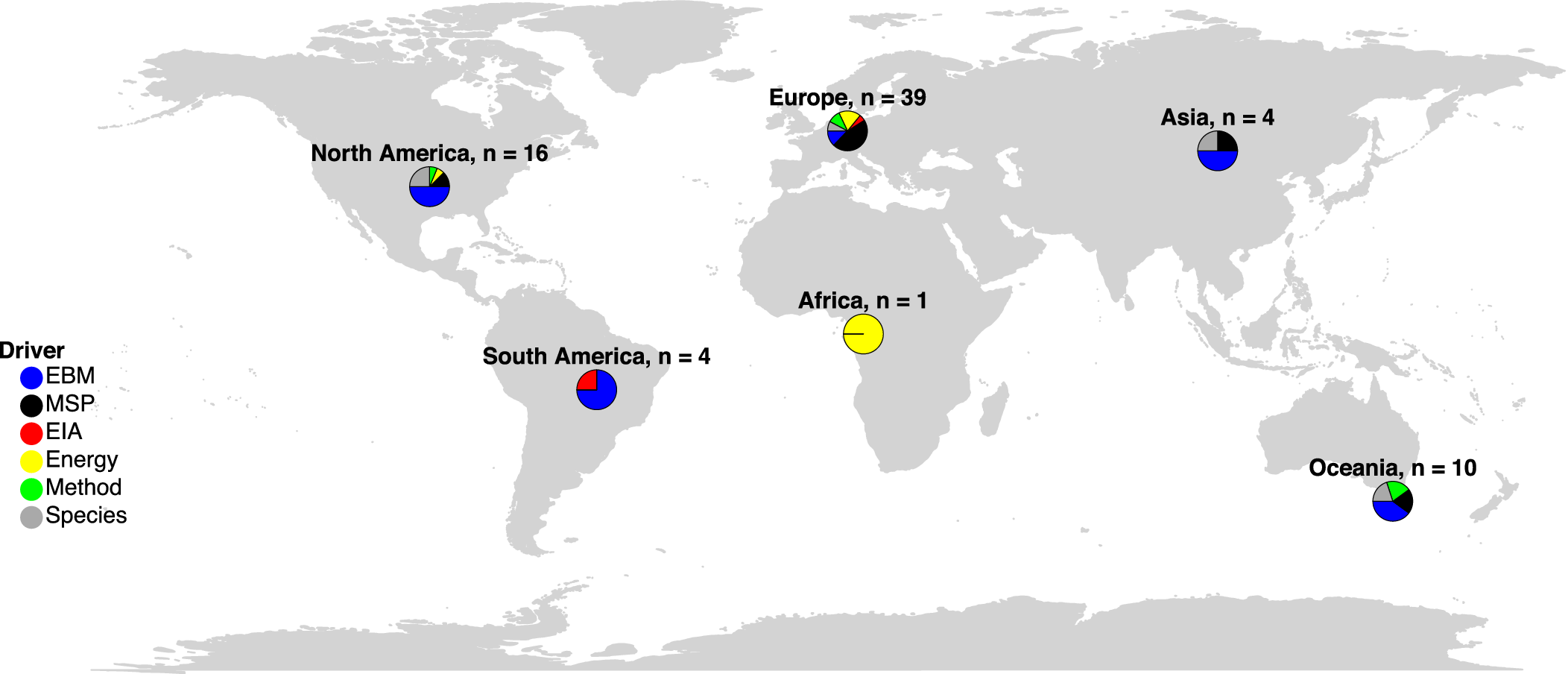
Of the papers mapped, the majority originated in Europe (50%), followed by North America (20%) and Oceania (12%), with research also originating from South America (Brazil) and Asia (China, including Hong Kong, and South Korea) (Figure 2). Just one example of CEA research relating to Africa was identified, stemming from research considering the effects of energy infrastructure on bird species migrating between Africa and Europe (Gauld et al., Reference Gauld, Silva, Atkinson, Record, Acácio, Arkumarev, Blas, Bouten, Burton, Catry, Champagnon, Clewley, Dagys, Duriez, Exo, Fiedler, Flack, Friedemann, Fritz and Franco2022). Two studies included proof of concept examples or considered case studies that were distributed in multiple regions of the globe (Tamis et al., Reference Tamis, de Vries, Jongbloed, Lagerveld, Jak, Karman, van der Wal, Slijkerman and Klok2015 and Stelzenmüller et al., Reference Stelzenmüller, Coll, Cormier, Mazaris, Pascual, Loiseau, Claudet, Katsanevakis, Gissi, Evagelopoulos, Rumes, Degraer, Ojaveer, Moller, Giménez, Piroddi, Markantonatou and Dimitriadis2020, respectively).
Map of geographic regions to which papers covered by the review relate with pie charts indicating the policy drivers linked to CEAs scoped into the review.
Drivers behind CEA research
Coding the drivers behind each CEAs revealed clear links between drivers. For example, Marine Spatial Planning (MSP) was frequently discussed in conjunction with Ecosystem-Based Management (EBM), and Energy was often discussed in combination with MSP. A handful of papers included two drivers (e.g., Gauld et al., Reference Gauld, Silva, Atkinson, Record, Acácio, Arkumarev, Blas, Bouten, Burton, Catry, Champagnon, Clewley, Dagys, Duriez, Exo, Fiedler, Flack, Friedemann, Fritz and Franco2022) where energy and species conservation were given equal importance. Acknowledging this blurring of drivers, it is nonetheless apparent that over the period reviewed, MSP has motivated the majority of CEAs in Europe, whereas EBM has been the leading driver elsewhere (Figure 2). Interestingly, given the scale of current concerns about the cumulative environmental effects of offshore wind expansion in Europe, North America and beyond, CEAs assessing the cumulative impacts of offshore energy generation were less well represented in recent literature.
The prevalence of MSP as a driver in Europe may reflect the influence of the Marine Strategy Framework Directive (2008/56/EC) and the Marine Spatial Planning Directive (2014/89/EU), which are closely linked with the former introducing the concept of ecosystem-based MSP (Douvere, Reference Douvere2008). During the review, it was difficult to determine whether CEAs were responding to specific policy or legislative drivers because few papers (about 10%, n = 78) could be unambiguously categorised as responding to a specific legislative need. Signposting CEAs to specific policy and/or legislative needs would be useful from an implementation perspective, providing a clear link between assessment and intended goals.
Definitions, methods and focus
Linking CEAs to legislative needs may also be helpful in effectively using CEA in decision-making. A range of authors noted the importance of framing CEAs, of being explicit about a CEA’s intentions and objectives, and of clearly defining what the term ‘cumulative effects’ refers to in each CEA (Judd et al., Reference Judd, Backhaus and Goodsir2015; Foley et al., Reference Foley, Mease, Martone, Prahler, Morrison, Murray and Wojcik2017; Stelzenmüller et al., Reference Stelzenmüller, Coll, Cormier, Mazaris, Pascual, Loiseau, Claudet, Katsanevakis, Gissi, Evagelopoulos, Rumes, Degraer, Ojaveer, Moller, Giménez, Piroddi, Markantonatou and Dimitriadis2020). Within the literature mapped, we found that half of the papers reviewed (39 of 78) did not clearly define ‘cumulative effects/impacts’ (Figure 3a). In some cases, authors’ interpretation of cumulative effects could be deduced from the methodology sections, but clear, unambiguous definitions and statements of purpose would aid transparency.
Selection of literature mapping results. 3a) number of CEAs with a clear definition of cumulative effects/impacts or no definition; 3b) number of CEAs applying qualitative (Qual.), quantitative (Quant.) or mixed approaches (Mix); 3c) number of CEAs assessing cumulative effects on ecosystems (Ecosys.), multiple VCs (Multi VCs), or individual VCs; 3d) number of CEAs investigating effects over local, regional, transboundary (Trans-bound.), regional and trans-boundary (Reg. & T-b.) or local, regional and trans-boundary (L, Reg & T-b.); 3e) number of CEAs presenting a snap-shot of cumulative effects (static) or where temporal trends are incorporated; 3f) number of CEAs with outputs coded as pressure maps (Press. Map), where the cumulative contribution of stressors were estimated (Cum. Cont.), where demographic change was estimated (Demog. Change), or where the risk of cumulative impacts were assessed (Risk. Assess).

About 75% of CEAs (excluding papers relating to methods or reviews, n = 68) applied quantitative methods that emphasised the use of and reliance on data to support models of cumulative impacts and mapping of overlapping pressures and VCs (Figure 3b). Expert opinion continues to play an important role in many quantitative CEAs to overcome the lack of empirical data about pressures, VCs and the effects of pressures on VCs. Broadly speaking, all CEAs reviewed flagged that better data would increase confidence in CEA findings by decreasing uncertainty. Calls for better data were also found in relatively data-rich CEAs (e.g., Stockbridge et al., Reference Stockbridge, Jones and Gillanders2020). Murray et al. (Reference Murray, Hannah, Doniol-Valcroze, Wright, Stredulinsky, Locke and Lacy2019) provide one example of the scale of data requirements required to deliver a scientifically robust CEA designed to inform marine managers about measures designed to aid species recovery.
The need to quantify and reduce uncertainty remains a common thread between CEAs. CEAs applying qualitative and quantitative–qualitative approaches indicate a range of methods to advance this aim. These include: (1) applying evidence-based review methods and combining multiple lines of evidence (Diefenderfer et al., Reference Diefenderfer, Johnson, Thom, Buenau, Weitkamp, Woodley, Borde and Kropp2016); (2) explicitly accounting for expert uncertainty and combining uncertainty scenarios to identify more robust outputs (Jones et al., Reference Jones, Doubleday, Prowse, Wiltshire, Deveney, Ward, Scrivens, Cassey, O’Connell and Gillanders2018) and (3) the use of risk-based approaches to reduce complexity and bridge the gap between theory and practice (Stelzenmüller et al., Reference Stelzenmüller, Coll, Cormier, Mazaris, Pascual, Loiseau, Claudet, Katsanevakis, Gissi, Evagelopoulos, Rumes, Degraer, Ojaveer, Moller, Giménez, Piroddi, Markantonatou and Dimitriadis2020) and to overcome ‘paralysis by analysis’ (Brignon et al., Reference Brignon, Lejart, Nexer, Michel, Quentric and Thiebaud2022, p. 273).
In terms of focus, the majority of CEAs investigated cumulative effects acting on ecosystems, followed by multiple VCs, followed by individual VCs (Figure 3c). Several CEAs investigated effects on ecosystems through assessing multiple VCs as proxies for ecosystem change.
Scale, treatment of time and outputs
Scale is critical to CEA, from the geographical and temporal scales required to understand the range of pressures impacting VCs over distributions and life cycles, to the political scales that manage regional and often transboundary impacts. Of the papers detailing specific applications of CEA, the majority considered impacts at the regional scale (Figure 3d). This is a positive trend given the need for CEAs to inform regional policy and delivery processes, including MSP and EBM. Sutherland et al. (Reference Sutherland, Waterhouse, Smith, Saunders, Paige and Malt2016) note the emerging consensus that regional approaches are essential for CEA to become a useful strategic tool. One challenge in this regard is that data collection at regional scales is often too coarse to provide the detail required to inform management measures and that significant local impacts may be missed or obscured at regional scales (Gkadolou et al., Reference Gkadolou, Stithou and Vassilopoulou2018). This highlights the need for CEA to consider a multi-scale approach, capable of identifying and evaluating both local and regional impacts. The importance of evaluating cumulative effects at local scales was highlighted by CEAs applying empirical data. Field observations identified significant variation in local-scale responses to different combinations of anthropogenic pressures (Guarnieri et al., Reference Guarnieri, Bevilacqua, de Leo, Farella, Maffia, Terlizzi and Fraschetti2016), and significant differences between modelled predictions of cumulative impacts and observed ecosystem condition (Stockbridge et al., Reference Stockbridge, Jones, Gaylard, Nelson and Gillanders2021). Validating modelled and expert-opinion-derived CEAs is key if these assessments are to be used in decision-making.
The inclusion of time in CEA continues to lag behind analysis of spatial characteristics of cumulative effects (Figure 3e). The most common CEA application was to a specific moment in time (about 75%), as opposed to CEAs that explicitly considered how pressures, VCs or ecosystem status are changing over time. The value of static CEAs can be increased through regular updates (Halpern and Fujita, Reference Halpern and Fujita2013; Murray et al., Reference Murray, Agbayani, Alidina and Ban2015), but this is dependent on the underlying datasets being maintained consistently (Murray et al., Reference Murray, Agbayani, Alidina and Ban2015) or CEAs being linked to ongoing monitoring programmes, ideally for indicators across regional scales (Sutherland et al., Reference Sutherland, Waterhouse, Smith, Saunders, Paige and Malt2016). Unsurprisingly, CEAs that identify demographic change in VCs incorporate temporal analysis (e.g., Brabant et al., Reference Brabant, Vanermen, Stienen and Degraer2015; Marcotte et al., Reference Marcotte, Hung and Caquard2015; Otto et al., Reference Otto, Niiranen, Blenckner, Tomczak, Müller-Karulis, Rubene and Möllmann2020; Bozec et al., Reference Bozec, Hock, Mason, Baird, Castro-Sanguino, Condie, Puotinen, Thompson and Mumby2022).
Previous research has identified variability in CEA approaches (Hodgson and Halpern, Reference Hodgson and Halpern2018; Stelzenmüller et al., Reference Stelzenmüller, Coll, Mazaris, Giakoumi, Katsanevakis, Portman, Degen, Mackelworth, Gimpel, Albano, Almpanidou, Claudet, Essl, Evagelopoulos, Heymans, Genov, Kark, Micheli, Grazia and Rumes2018). This was also observed in our review. An investigation of CEAs within EIAs identified high variability between approaches even when focussed on the same VC in the same region (Hague et al., Reference Hague, Sparling, Morris, Vaughan, Walker, Culloch, Lyndon, Fernandes and McWhinnie2022). Within the papers reviewed here, some approaches were more common, such as the use of GIS to derive spatial analyses of overlapping pressures and VC distributions (about 55%), and the driver–pressure–state–impact–response model framework used to support the identification of cause–effect pathways between pressures and VCs. Expert opinion was often used to score the importance of pressure–VC pathways.
The frequent use of Geographic Information System (GIS) meant that outputs were commonly maps (Figure 3f), primarily of the cumulative pressures acting on a system, but also of risk, connectivity and recovery, and the identification of areas for potential management interventions. Such outputs are relevant to regional MSP but struggle to provide quantitative estimates for specific pressures and local impacts. More advanced outputs were derived in some CEAs where estimates of the contribution of specific pressures or stressors to the state of VCs were derived (e.g., to estuaries, Van Roon et al., Reference Van Roon, Rigold and Dixon2016; to coral reefs, Loiseau et al., Reference Loiseau, Thiault, Devillers and Claudet2021), enabling the identification of key leverage points or focal points for management measures (Loiseau et al., Reference Loiseau, Thiault, Devillers and Claudet2021). Only rarely were CEAs found to deliver estimates or measures of demographic change to VCs, which are valuable when estimating the significance of cumulative impacts, either ex post (e.g., on coral reefs; Bozec et al., Reference Bozec, Hock, Mason, Baird, Castro-Sanguino, Condie, Puotinen, Thompson and Mumby2022) or ex ante (e.g., on coastal and riparian habitats; Sutherland et al., Reference Sutherland, Waterhouse, Smith, Saunders, Paige and Malt2016). Such quantification of cumulative impacts on demographic rates allows for a more dynamic understanding of current and future impacts of pressures, enabling the use of modelling projections to derive impact forecasts on key populations. As noted previously, CEAs indicating demographic change inevitably include temporal data as well as spatial data. Appropriate spatial delineation of populations is key to this approach. Another relevant research area when determining how significant effects are to VCs is the identification of thresholds (Brabant et al., Reference Brabant, Vanermen, Stienen and Degraer2015). Studies that advance knowledge about integrating quantitative management targets into coastal and marine planning (e.g., noise budgets; Merchant et al., Reference Merchant, Faulkner and Martinez2018) are important.
Cumulative effects assessments in decision-making today
Our review reveals limited evidence that research applying CEA methods (as opposed to research contributing to methodological advances) is allied to decision-making. Studies concluding that cumulative effects pose a risk to ecological resilience frequently recommend that CEAs are incorporated into decision-making but rarely identify how to do so.
Notable examples of research that support CEA implementation do exist. For instance, CEA research originating in Canada offers lessons, with CEAs stimulated by the need for species at risk recovery plans (Murray et al., Reference Murray, Hannah, Doniol-Valcroze, Wright, Stredulinsky, Locke and Lacy2019) and being explicitly linked to the need to support Federal regulators tasked with responding to new legislative demands (Lieske et al., Reference Lieske, Tranquilla, Ronconi and Abbott2020). In both examples, VCs are placed at the centre of the CEA, discussion of results is placed in the context of planning and management decision-making and the value of robust underlying data is evident. Diggon et al. (Reference Diggon, Bones, Short, Smith, Dickinson, Wozniak, Topelko and Pawluk2022) provide important insight into the broader decision-making, conflict resolution and technical architecture required to develop collaborative marine plans informed by CEA. These approaches provide guidance to ensure CEA research contributes to the design and delivery of policy, which should be emphasised in future assessments.
Judd et al. (Reference Judd, Backhaus and Goodsir2015) observed that CEA consistency and robustness are critical if CEA is to become a trusted tool for informing decision-making. Calls for consistency are repeated in recent studies (e.g., Stelzenmüller et al., Reference Stelzenmüller, Coll, Cormier, Mazaris, Pascual, Loiseau, Claudet, Katsanevakis, Gissi, Evagelopoulos, Rumes, Degraer, Ojaveer, Moller, Giménez, Piroddi, Markantonatou and Dimitriadis2020; Tamis et al., Reference Tamis, Jongbloed, Piet and Jak2021), and the wide variety of approaches to CEA observed in this review lead us to echo this call. Examples of research that potentially progress consistency include Tamis et al. (Reference Tamis, de Vries, Jongbloed, Lagerveld, Jak, Karman, van der Wal, Slijkerman and Klok2015), Stelzenmüller et al. (Reference Stelzenmüller, Coll, Cormier, Mazaris, Pascual, Loiseau, Claudet, Katsanevakis, Gissi, Evagelopoulos, Rumes, Degraer, Ojaveer, Moller, Giménez, Piroddi, Markantonatou and Dimitriadis2020) and Piet et al. (Reference Piet, Tamis, Volwater, de Vries, van der Wal and Jongbloed2021), who propose and test frameworks that can be replicated at different scales and for different VCs and pressures. Notably these frameworks apply risk-based approaches that simplify complexity, promote transparency regarding the treatment of uncertainty and can be iterated to make use of improved evidence. Notable also was research by Griffiths et al. (Reference Griffiths, Kesner-Reyes, Garilao, Duffy and Román2019), which adapted a tried and tested species vulnerability assessment approach to investigate the cumulative impacts of fisheries to investigate the suitability of biological reference points to support ecosystem-based fisheries management.
Also relevant to implementation is research that supports CEA at strategic scales. Tamis et al. (Reference Tamis, Jongbloed, Piet and Jak2021) provide a consistent approach to project-level assessments that can be integrated into strategic planning and that specifically estimate cumulative impacts, offering support to efforts to address project-level CEA shortcomings (see Willsteed et al., Reference Willsteed, Birchenough, Gill and Jude2018a; Hague et al., Reference Hague, Sparling, Morris, Vaughan, Walker, Culloch, Lyndon, Fernandes and McWhinnie2022). Sutherland et al. (Reference Sutherland, Waterhouse, Smith, Saunders, Paige and Malt2016) systematically selected indicators for strategic CEA, which offers a transferable approach to forecasting present and future indicator condition. CEAs that identify the significance of individual pressures also support implementation by informing management measure design; for example, Tulloch et al. (Reference Tulloch, Adams, Martin, Tulloch, Martone, Avery-Gomm and Murray2022) identified that addressing priority threats to keystone VCs reduces risks across an ecosystem.
Finally, we highlight examples of research that offer insights into how to bridge the gap between CEA science and its application in policy and delivery. Common obstacles observed include fragmented legislation, poor alignment between ecological scales relevant to CEA and political scales relevant to management of cumulative effects and the need for reliable, long-term datasets and the problem of shifting baselines (Van Roon et al., Reference Van Roon, Rigold and Dixon2016; Davies et al., Reference Davies, Fisher, Couzens, Allison, van Putten, Dambacher, Foley and Lundquist2020; Hollarsmith et al., Reference Hollarsmith, Therriault and Côté2022). Enabling integrated coastal and marine planning and management involves long timescales, highlighting the need for long-term engagement and funding (Van Roon et al., Reference Van Roon, Rigold and Dixon2016; Diggon et al., Reference Diggon, Bones, Short, Smith, Dickinson, Wozniak, Topelko and Pawluk2022). The need to include diverse values, including those of indigenous peoples, into decision-making is discussed by Davies et al. (Reference Davies, Fisher, Couzens, Allison, van Putten, Dambacher, Foley and Lundquist2020) and Diggon et al. (Reference Diggon, Bones, Short, Smith, Dickinson, Wozniak, Topelko and Pawluk2022). Collaboration and inclusion of diverse sources of knowledge enable progress and support stakeholder buy-in (Diefenderfer et al., Reference Diefenderfer, Johnson, Thom, Buenau, Weitkamp, Woodley, Borde and Kropp2016; Diggon et al., Reference Diggon, Bones, Short, Smith, Dickinson, Wozniak, Topelko and Pawluk2022; Hollarsmith et al., Reference Hollarsmith, Therriault and Côté2022).
Research directions to integrate CEA in decision-making
Reflecting on the findings of the review and the review teams experiences with CEA, we briefly touch on research directions to progress the integration of CEA into coastal and marine planning and management. We echo previous studies that stressed the need for consistency, explicit contextualisation of CEAs, careful use of terminology, explicit identification and treatment of uncertainty and the potential for adaptive, risk-based frameworks to enable coherence and progress. Beyond this, we pose a series of research questions that respond to other common barriers to implementation.
Enabling strategic CEA: CEA applied at strategic levels and scales is likely to be most beneficial in delivering to policy needs (Jones, Reference Jones2016; Sutherland et al., Reference Sutherland, Waterhouse, Smith, Saunders, Paige and Malt2016; Sinclair et al., Reference Sinclair, Doelle and Duinker2017; Willsteed et al., Reference Willsteed, Jude, Gill and Birchenough2018b), but there is also compelling evidence for the need for fine-scale assessments capable of identifying and quantifying localised impacts, for instance, on key-protected populations (e.g., Guarnieri et al., Reference Guarnieri, Bevilacqua, de Leo, Farella, Maffia, Terlizzi and Fraschetti2016; Gkadolou et al., Reference Gkadolou, Stithou and Vassilopoulou2018; Stockbridge et al., Reference Stockbridge, Jones, Gaylard, Nelson and Gillanders2021). Key research questions include:
-
• Can alternative CEA approaches bridge different spatial and temporal scales, and how can resulting increased data requirements be adequately met?
-
• How transferable are indicators across different activities, and can VC indicators be correlated to aid in their quantification and prediction in less well-studied systems (e.g., Sutherland et al., Reference Sutherland, Waterhouse, Smith, Saunders, Paige and Malt2016)?
-
• Which modelling frameworks best support testing and evaluating different management measures?
-
• What testing and validation of CEA frameworks are necessary to meet planning and regulatory thresholds for evidence and proportionality?
Investigating data needs: Broadly speaking, while there are always some data available to support CEA, a common theme running through environmental literature more widely is that there are never enough data. Therefore, key research questions are:
-
• What are the minimum data requirements to adequately quantify shifting baselines, and to gain sufficient knowledge to quantify and predict cause–effect pathways?
-
• In situations where data and analytical complexity are high, how can CEAs avoid ‘paralysis by analysis’ and deliver assessments that enable decisions?
-
• Which statistical frameworks can be used to ensure that uncertainty arising from data limitations is captured and expressed coherently in CEA outputs?
-
• Recognising the importance of nested scales, what information storage systems would be required to enable open access to coherent long-term data, and who is responsible for inputting to and maintaining these structures?
Evaluating effect significance, thresholds, integrating diverse values and trade-offs: For CEA to best support sustainable development, progress is needed in answering the ‘so what?’ questions.
-
• What are the implications of coinciding pressures and VCs from the perspectives of VCs, of stakeholders, and of regulators?
-
• At what point are impacts significant, and what are the thresholds beyond which additional impacts will be unacceptable?
-
• How can diverse values and trade-off analyses be integrated into CEA? By way of example, this research theme is a priority in the North Sea in Europe, where offshore wind expansion, depleted VCs, competing interests and a complex policy and delivery environment collide. There is growing recognition that project-by-project mitigation and compensation will not address the risks of cumulative impacts to ecological and social VCs caused by widespread construction of offshore wind farms. Progress relative to the questions posed here and advances in CEAs are urgently required to inform if compensatory measures are likely to be adequate.
Understanding the delivery landscape: Noting the observation that CEA should remain independent of decision-making (Stelzenmüller et al., Reference Stelzenmüller, Coll, Cormier, Mazaris, Pascual, Loiseau, Claudet, Katsanevakis, Gissi, Evagelopoulos, Rumes, Degraer, Ojaveer, Moller, Giménez, Piroddi, Markantonatou and Dimitriadis2020), there is a clear need for CEA research to have greater interaction with decision-makers, to align with policy and delivery information needs (Jones, Reference Jones2016; Van Roon et al., Reference Van Roon, Rigold and Dixon2016). Therefore, key research questions are:
-
• Relative to CEA, how coherent are existing governance systems?
-
• What research would be appropriate to test CEA approaches on people involved in policy, planning and delivery to identify implications from regulatory and legal perspectives?
-
• Recognising the iterative nature of CEAs and the need for adaptive management approaches, how would adoption of CEA frameworks impact the need for regulatory stability and to maintain investor confidence?
-
• What are the capacity building needs within decision-making institutions and participating stakeholder groups to support integration of CEA into decision-making and enhance understanding of the implications of uncertainty (or of inaction)?
-
• What is the appetite for regulatory change to deliver standardised data collection as part of the approvals and post-consent processes, and for data to be provided open access in government databases?
Fast-tracking CEA in developing nations: Perhaps the most pressing question is: what is ‘good enough CEA’? While this is a relevant question in all jurisdictions, it is especially pertinent in regions where rapid coastal and marine development is forecast, but legislative frameworks are less developed and governance systems are seriously constrained by capacity shortfalls. Key research questions to address this shortfall are:
-
• How transferable is global CEA research, covering the technical, policy and legal and participatory lens (Sinclair et al., Reference Sinclair, Doelle and Duinker2017), and can this be simplified and packaged to support developing nations to leapfrog the decades of incremental progress in more advanced jurisdictions?
-
• Can CEA research be applied to support strengthening of environmental and social accountability of developers and investors? For example, by providing technical advice to clarify CEA commitments contained in standards for private investment in developing countries, such as the International Finance Corporation Performance Standards.
Conclusion
The leading role that cumulative effects have in shaping environmental change coupled with the need for sustainable development has led to high expectations of CEA. However, assessing cumulative effects in complex adaptive systems is challenging and the intricacies of governance challenge application. Our review suggests that aspirations remain high, that scientific challenges are well discussed, but implementation challenges much less so, and that despite decades of CEA research, there is little evidence that ‘good’ CEA informs decision-making. The pace of development in coastal and marine systems suggests that aspirations need to be balanced by pragmatism.
Our review suggests that while CEA research continues, there is a parallel and urgent need to bridge the gap between science and policy, planning and delivery. We recommend stepping back to identify the technical, political and participative lenses (see Sinclair et al., Reference Sinclair, Doelle and Duinker2017) that could coordinate CEA efforts within regions, overcoming mismatches between ecological, social and political scales. Defining common ground across policies, delivery bodies and industries would aid coordination, collaboration and communication and accelerate progress towards ‘good enough CEA’.
Recognising that change in governance systems takes time but that we need change now, we suggest that existing coastal and marine policy provides a sufficiently robust policy and legislative lens to focus CEA. For example, ecosystem-based MSP sensu (Ansong et al., Reference Ansong, Gissi and Calado2017) is mandated in parts of Africa, Asia, the Americas, Europe and Oceania. We need more CEAs that specifically focus on delivering existing marine and coastal policy. We urgently need trusted and robust CEAs that support reconciliation of net zero and blue economy aspirations with responsibilities to protect socio-ecological systems.
Open peer review
To view the open peer review materials for this article, please visit http://doi.org/10.1017/cft.2023.6.
Supplementary materials
To view supplementary material for this article, please visit http://doi.org/10.1017/cft.2023.6.
Acknowledgements
We thank the three peer reviewers for their constructive and positive comments, which led to an improved and more rounded paper.
Financial support
This research received no specific grant from any funding agency, commercial or not-for-profit sectors.
Competing interest
The authors comprise people with ongoing technical and policy research and consultancy work relating to coastal and marine management. The authors declare that they have no known competing financial interests or personal relationships that would influence the work reported in this paper.


 Open access


Comments
Dear Professor Spencer,
I am writing to introduce our paper that we are submitting to Coastal Futures for consideration and which we hope will be of interest to the journal and its readers.Our paper seeks to advance the science and discourse relating to the need to account for cumulative effects in policy and management.
Quantifying and managing the cumulative effects of human activities on coastal and marine environments is among the foremost challenges in enabling sustainable development in the 21st Century. Demands to develop blue economies and to use coastal and marine environments to support net zero targets mean that further development of coasts, seas, and the ocean is inevitable. For this to happen sustainably requires policy makers, planners, and regulators to be supported by Cumulative Effects Assessments (CEAs) that should systematically identify and evaluate the significance of cumulative effects caused by human activities. The information from CEAs is needed to design and refine management measures to ensure development is sustainable. However, the widespread degradation of coastal and marine spaces provides ample evidence that cumulative effects are not being adequately managed and authors have flagged that bringing CEA into the decision-making space is challenging. This review inquires into recent advances and summarises the state of knowledge about how we assess and address cumulative effects in coastal and marine environments. Our review reveals limited evidence that research applying CEA methods (as opposed to research specifically contributing to methodological advances) is allied to decision making. This review intends to support efforts to bridge the gap between CEA science and the policy, planning, and delivery environments. Priority research questions are formulated to accelerate the inclusion of effective cumulative effects assessment in marine and coastal planning and management.
I confirm this is a novel contribution and that all authors have read and approved the manuscript.
Yours sincerely
Edward Willsteed (lead author)