


Introduction
In studies on workplace bullying, those in managerial positions are typically considered potential perpetrators, for example, through abusive supervision (Tepper, Simon & Park, Reference Tepper, Simon and Park2017) or other forms of active destructive leadership styles (Einarsen, Aasland & Skogstad, Reference Einarsen, Aasland and Skogstad2007). They have also been examined as providers of social support, which may buffer the occurrence or consequences of bullying (Blomberg, Rosander & Einarsen, Reference Blomberg, Rosander and Einarsen2024), or as laissez-faire leaders, who can contribute to creating an unclear work environment that may serve as a breeding ground for bullying and subsequently fail to act to stop it (Skogstad, Einarsen, Torsheim, Aasland & Hetland, Reference Skogstad, Einarsen, Torsheim, Aasland and Hetland2007). However, the extent to which managers themselves experience workplace bullying remains largely underexplored. Studies on ‘upwards bullying’, where subordinates mistreat a superior, offer some insight (e.g., Branch, Reference Branch2007; Branch, Ramsay, Shallcross, Hedges & Barker, Reference Branch, Ramsay, Shallcross, Hedges, Barker, D’Cruz, Noronha, Baillien, Catley, Harlos, Hogh and Mikkelsen2021; Tuckey, Oppert, Neall, Li & Selby, Reference Tuckey, Oppert, Neall, Li and Selby2024), but research rarely accounts for how managerial status within an organization shapes vulnerability to bullying. Instead, most studies dichotomize employees into workers and managerial staff (e.g., Nielsen, Evensen, Parveen & Finne, Reference Nielsen, Evensen, Parveen and Finne2024; Ortega, Hogh, Pejtersen, Feveile & Olsen, Reference Ortega, Hogh, Pejtersen, Feveile and Olsen2009), overlooking differences in exposure between first-line supervisors and higher-level managers.
The present study addresses this critical gap by systematically examining bullying experiences among managerial staff across hierarchical levels. More specifically, it compares those in the first line of operation with both workers and higher-level managers, acknowledging that supervisors may hold a particularly vulnerable position due to their dual role between employees and senior management. Adding to our knowledge of bullying of those in managerial positions, the present study focuses on bullying from subordinates, colleagues at the same hierarchical level, as well as superiors. Furthermore, it investigates how perceived social support and laissez-faire leadership influence the level of exposure to bullying across these different organizational levels.
Understanding bullying risk among managers is not only a matter of individual well-being but also a crucial organizational issue as leadership plays a key role in shaping workplace environments, team dynamics, and organizational culture (Cao, Li, van der Wal & Taris, Reference Cao, Li, C. van der Wal and Taris2023; Tepper et al., Reference Tepper, Simon and Park2017). When managers experience bullying, it may undermine leadership effectiveness, leading to weakened decision-making, lower team cohesion, and deteriorating workplace climate (Hoel, Cooper & Einarsen, Reference Hoel, Cooper, Einarsen, Einarsen, Hoel, Zapf and Cooper2020). Thus, the present study contributes to organizational sciences by broadening our understanding of how hierarchical positioning and leadership behaviours contribute to workplace mistreatment, with implications for both theory and practice.
Workplace bullying
Workplace bullying is defined as the systematic and prolonged mistreatment of a person at work by subordinates, colleagues, and/or superiors, in situations where the victim gradually finds it increasingly difficult to ward off or stop the mistreatment (Einarsen, Hoel, Zapf & Cooper, Reference Einarsen, Hoel, Zapf, Cooper, Einarsen, Hoel, Zapf and Cooper2020). Bullying differs from one-off instances of harassment, which may include various forms of negative and unwanted interpersonal behaviour, such as incivility, and sexual or gender-based harassment (Rosander, Blomberg & Einarsen, Reference Rosander, Blomberg and Einarsen2024). Repeated exposure to bullying behaviours can wear down the victim, often leading to a state of learned helplessness, where the situation is perceived as uncontrollable, and no action seems to improve it (Rosander & Nielsen, Reference Rosander and Nielsen2023; Samnani, Reference Samnani2013). This perceived lack of control has been suggested as a key factor contributing to the severe consequences of workplace bullying, including mental health problems, long-term sickness absence, expulsion from working life, and suicidal ideation, as demonstrated in multiple primary and meta-analytic studies (see, e.g., Boudrias, Trépanier & Salin, Reference Boudrias, Trépanier and Salin2021; Verkuil, Atasayi & Molendijk, Reference Verkuil, Atasayi and Molendijk2015). Bullying behaviours can be direct or indirect. Direct bullying includes humiliation and other openly aggressive acts, while indirect bullying involves social exclusion and covert forms of mistreatment (Rosander & Nielsen, Reference Rosander and Nielsen2023). Einarsen and Raknes (Reference Einarsen and Raknes1997) categorized workplace bullying into two main types: work-related bullying and person-related bullying. Person-related bullying involves attacks on the victim’s personal integrity, whereas work-related bullying consists of actions that negatively impact the victim’s ability to perform their job. The work environment hypothesis (Einarsen, Raknes & Matthiesen, Reference Einarsen, Raknes and Matthiesen1994) suggests that workplace bullying primarily stems from deficiencies in the work environment, such as poor job design, role stressors, and inadequate leadership, including laissez-faire leadership. Workplace bullying is viewed as an escalating process, where exposure to bullying behaviours turns into victimization (Rosander & Blomberg, Reference Rosander and Blomberg2019). An important aspect of this process is the perceived power imbalance, where the target experiences a sense of inferiority and lack of agency (Nielsen et al., Reference Nielsen, Evensen, Parveen and Finne2024). This is particularly relevant when focusing on managerial staff, as formal power imbalances are inherent in their roles and organizational status, which may shape their exposure to and experience of bullying.
Organizational status
Organizational status refers to the formal position within the organization (Hoel, Cooper & Faragher, Reference Hoel, Cooper and Faragher2001); supervisors, first-line managers, middle managers, and senior managers represent different hierarchical positions that are unrelated to the personal standing of the individual holding such a position. Typically, supervisors are responsible for monitoring and coordinating employees’ performance, often focusing on specific tasks or areas within a department. First-line managers directly oversee the immediate operational aspects and ensure the implementation of company policies at the ground level. Middle managers bridge the gap between senior management and first-line managers, translating strategic goals into specific objectives for lower management levels. Senior management sets strategic goals, makes high-level decisions, and guides the overall direction of the organization. In the present study, I focus on two levels of organizational status – a lower level involving managerial positions in the first line (hereinafter supervisors), directly involved in day-to-day operations and interacting closely with non-managerial staff. The other level comprises those higher up in the hierarchy (hereinafter managers), for example, middle and senior management, who have aspects in common, such as guiding the organization through policy-making and long-term planning, and primarily interacting with each other and first-line managers.
Studies on bullying of managerial staff
A number of studies have focused on the bullying of those in managerial positions (Forssell, Reference Forssell2016; Hoel et al., Reference Hoel, Cooper and Faragher2001; Nielsen et al., Reference Nielsen, Evensen, Parveen and Finne2024; Ortega et al., Reference Ortega, Hogh, Pejtersen, Feveile and Olsen2009; Salin, Reference Salin2001). When it comes to comparing the level or risk of exposure with workers, the results are mixed, with some studies finding no difference (Forssell, Reference Forssell2016; Hoel et al., Reference Hoel, Cooper and Faragher2001; Nielsen et al., Reference Nielsen, Evensen, Parveen and Finne2024) and others finding that those in managerial positions are less exposed to bullying (Ortega et al., Reference Ortega, Hogh, Pejtersen, Feveile and Olsen2009; Salin, Reference Salin2001). All studies that compared workers to managerial staff used a self-labelling measure of bullying, based on a definition and a single item asking for the frequency of exposure – some with a 1-year time frame, others with 6 months as the frame of reference. Some studies also measured bullying using a behavioural experience method, but not as a basis for comparison (e.g., Branch, Reference Branch2007; Nielsen et al., Reference Nielsen, Evensen, Parveen and Finne2024). Most studies focused on managerial staff as a single category, for example, ‘a supervisory position’ (Forssell, Reference Forssell2016, p. 456), ‘some sort of formal leadership responsibility’ (Nielsen et al., Reference Nielsen, Evensen, Parveen and Finne2024, p. 3), or ‘managers/supervisors’ as one combined category (Ortega et al., Reference Ortega, Hogh, Pejtersen, Feveile and Olsen2009, p. 421). Some studies have applied a finer mesh, including divisions into ‘managers’ and ‘middle managers’ (Salin, Reference Salin2001, p. 432) or ‘supervisors, middle managers, and senior managers’ (Hoel et al., Reference Hoel, Cooper and Faragher2001, p. 446). Branch (Reference Branch2007) focused on three levels of organizational status: ‘supervisor, manager, senior manager’ (p. 182) but only focused on upward bullying and made no comparison to non-managers. In the present study, I use a behavioural experience method to compare three levels of organizational status, with two representing managerial staff – supervisors and managers higher up in the hierarchy.
There are also a few qualitative studies on the bullying of managerial staff, specifically focusing on upward bullying (e.g., Branch, Reference Branch2007; Patterson, Branch, Barker & Ramsay, Reference Patterson, Branch, Barker and Ramsay2018; Tuckey et al., Reference Tuckey, Oppert, Neall, Li and Selby2024). Upward bullying is, of course, an important aspect of the working situation for those in managerial positions, but it does not tell the whole story if exposure from others than one’s subordinates is not also considered. When it comes to upward bullying, it highlights the paradox of being in a position of formal power while simultaneously feeling powerless in relation to subordinates engaging in bullying behaviours. However, as pointed out by Branch (Reference Branch2007), being in a formal position of power does not automatically mean that others will show respect for that power. What matters most when it comes to bullying is informal power. As shown by Nielsen et al. (Reference Nielsen, Evensen, Parveen and Finne2024), the perception of inferiority to the bully was just as strong for managerial staff as it was for workers when exposed to bullying.
In many studies on workplace bullying, where those in managerial positions are not in focus, the managerial staff is still part of the data, as reported in the sample/participants section of articles – sometimes used as control, but often only as a way to describe the material. Their inclusion in the data may contribute to an underestimation of prevalence rates (if the studies showing the managerial staff to be less exposed to bullying are correct). However, in most cases the inclusion of managerial staff when investigating workplace bullying is not discussed.
Theoretical background
Theoretically, bullying of managerial staff may be understood using the job demands–resources model (JD–R, Demerouti, Bakker, Nachreiner & Schaufeli, Reference Demerouti, Bakker, Nachreiner and Schaufeli2001), a social identity perspective, and in particular the self-categorization theory (Turner, Hogg, Oakes, Reicher & Wetherell, Reference Turner, Hogg, Oakes, Reicher and Wetherell1987), as well as a social interactionist perspective (SIP, Felson, Reference Felson and Mummendey1984; Tedeschi & Felson, Reference Tedeschi and Felson1994). First, I will provide a brief overview of the theories. Then, in the following section, I will connect these theories to the specific case of workplace bullying targeting those in managerial positions, with a particular focus on supervisors as the first line of operation in relation to the workers.
The job demands–resources model (Bakker & Demerouti, Reference Bakker and Demerouti2007; Demerouti et al., Reference Demerouti, Bakker, Nachreiner and Schaufeli2001) explains how job characteristics impact work engagement, exhaustion, and job performance. Central to the theory is the categorization of risk factors into two general categories: job demands and job resources. Job demands refer to aspects that require sustained effort and are associated with physical or psychological costs, such as high work pressure or emotional demands. Job resources, on the other hand, are aspects that help achieve goals, reduce job demands, and foster personal development. These resources relate to, for example, interpersonal relations, such as support from colleagues or superiors, or the organization of work, for example, role clarity. Job performance is influenced by both a health impairment process, where high job demands may deplete energy, potentially leading to health issues, and a motivational process, where job resources may enhance work engagement. Furthermore, job resources can buffer the negative effects of job demands, with both pathways affecting job performance (Bakker & Demerouti, Reference Bakker and Demerouti2007).
The self-categorization theory (Turner et al., Reference Turner, Hogg, Oakes, Reicher and Wetherell1987) focuses on intragroup processes and how individuals categorize themselves and others into social groups – defining themselves based on group membership rather than individual traits. Central to this process is the concept of depersonalization, where individuals see themselves as interchangeable members of a group, adhering to group norms and prototypes. Group prototypes are ideal representations that maximize similarities within the group and differences between groups, thus fostering a distinct group identity (Hogg & Terry, Reference Hogg and Terry2000). This categorization into ingroup and outgroup accentuates conformity to group norms. The uncertainty reduction hypothesis (Hogg, Reference Hogg2000) posits that individuals strive for a stable and predictable social identity, especially under conditions of uncertainty. This drive can intensify the pursuit of prototypical homogeneity within the group, often marginalizing those seen as deviant or non-prototypical (Hutchison, Jetten & Gutierrez, Reference Hutchison, Jetten and Gutierrez2011). When group cohesion is threatened, non-prototypical members may be re-categorized as ‘not us’, a phenomenon known as the black sheep effect (Marques, Yzerbyt & Leyens, Reference Marques, Yzerbyt and Leyens1988). This re-categorization can increase the likelihood of negative treatment towards perceived deviant members (Marques & Paez, Reference Marques and Paez1994).
The social interactionist perspective (Tedeschi & Felson, Reference Tedeschi and Felson1994) focuses on understanding aggressive behaviours as goal-oriented social interactions and the motivations behind these interactions. The theory views aggression as coercive and intentional actions with the main aim to achieve some valued outcome. The primary motives are (a) retributive justice, (b) promotion of one’s social image, and/or (c) benefits resulting from an adversary’s compliance. An important aspect is perceived norm violations and the formation of grievances. Norm violations may relate to distributive, procedural, or interactional justice. Many factors may contribute to norm violations, with perceived stress being one that could make people more likely to violate interaction norms, that is, norms about respect and politeness towards others. Such violations could set off a spiral of coercive interactions. The expression of grievances may also lead to countergrievances, resulting in a retaliatory cycle (Tedeschi & Felson, Reference Tedeschi and Felson1994).
The vulnerable position of supervisors
In the present study, there is a special focus on those in the first line of management. One reason is that a person in such a position may be in an especially vulnerable position as there may be demands both from superiors and subordinates that are not entirely compatible creating role conflicts. It is also not uncommon for someone to come into such a position from previously having been one of the workers, which could create expectations of loyalties and informal obligations that can be hard to fulfil or reconcile with the added responsibilities connected to a managerial position.
Tuckey et al. (Reference Tuckey, Oppert, Neall, Li and Selby2024) identified several factors that may contribute to the bullying of managerial staff, such as joining a team as a new manager or being promoted in competition with colleagues from the same team one is now appointed to lead. Organizational restructuring may also act as a trigger. When the processes and practices of a team are perceived to be threatened, from the perspective of the workers, an immediate supervisor may be viewed as the cause of these changes and perceived deficiencies in the working environment (Tuckey et al., Reference Tuckey, Oppert, Neall, Li and Selby2024). This dissatisfaction may manifest as direct or indirect acts of aggression towards the leader. As the formal power of a superior may be hard to overcome, bullying solely by subordinates is likely a rather uncommon phenomenon (Zapf et al., Reference Zapf, Escartín, Scheppa-Lahyani, Einarsen, Hoel, Vartia, Einarsen, Hoel, Zapf and Cooper2020). Zapf et al. argued that upward bullying may only occur if a superior has lost the support of their colleagues or senior management. In such situations, bullying behaviours may come from several sources – superiors, colleagues, and subordinates. However, passive and indirect negative behaviours, such as social isolation or the spreading of rumours, may still be possible, albeit dysfunctional, ways for subordinates to demonstrate dissatisfaction or deal with frustration.
In terms of the JD–R model (Bakker, Demerouti & Sanz-Vergel, Reference Bakker, Demerouti and Sanz-Vergel2023; Demerouti et al., Reference Demerouti, Bakker, Nachreiner and Schaufeli2001), the job demands in a managerial position may involve high work pressure, responsibilities not only for oneself but also for an entire team, and accountability regarding the team’s work tasks and performance. Each of these aspects can turn into job stressors. This risk may be particularly evident in situations where adequate job resources are lacking, such as support from one’s superior, or when there is high role stress resulting from both unclear and conflicting roles (e.g., unclear communication about what is expected and/or incompatible expectations from different people or positions). Furthermore, deficiencies in job resources may themselves be a source of job stress. This may hamper both the motivational and health impairment processes, affecting social relations and the opportunities to do one’s job and fulfil expectations, putting the supervisor in a more vulnerable position. From an SIP (Tedeschi & Felson, Reference Tedeschi and Felson1994), this could be interpreted as norm violations leading to aggression from others.
Self-categorization theory explains how leaders can be perceived in two contrasting ways within a group. According to Hogg (Reference Hogg2001), leaders who embody the group’s prototype are seen as more legitimate and are more likely to be followed, serving as a source of sensemaking in ambiguous situations (van Knippenberg & Hogg, Reference van Knippenberg and Hogg2003). This occurs when the leader’s actions and behaviours align with the group’s norms and values, acting as ‘one of us’, that is, being prototypical, and ‘doing it for us’, that is, displaying group-oriented behaviour (Haslam & Platow, Reference Haslam, Platow, Hogg and Terry2001), demonstrating fairness within the group. The social identity theory of leadership (Hogg, Reference Hogg2001) posits that a successful leader typically embodies the group prototype. However, prototype-based leadership can also distance the leader from the group, creating an intergroup relationship that can provide a framework for both the abuse of power and retaliation from subordinates (Hogg, Reference Hogg2001). When leaders are seen as the source of negative work conditions, such as creating a high workload or fostering a poor working environment, they can be re-categorized as ‘them’ rather than ‘us’. This re-categorization can lead to the leader being viewed as an outgroup member, potentially resulting in resistance and antagonistic behaviours from subordinates. The risk of being viewed as ‘not one of us’ is also apparent for managers higher up in the hierarchy, however, as they do not interact with workers in the same way as supervisors they are less likely to find themselves in a position where this might increase the risk of negative treatment. The supervisors may find themselves in a difficult situation, interacting closely with workers in day-to-day operations while simultaneously representing a different organizational status. The perception of leadership fairness may play an important role in how a leader is perceived. van Knippenberg and Hogg (Reference van Knippenberg and Hogg2003) argued that as group members increasingly view their identity in collective terms, the emphasis on leader procedural fairness surpasses that of leader distributive fairness in determining leadership effectiveness. In other words, lacking fairness, especially procedural fairness, a leader will be less supported and less effective (Hogg & van Knippenberg, Reference Hogg and van Knippenberg2003). In light of this, from an SIP (Tedeschi & Felson, Reference Tedeschi and Felson1994), the notion of retributive justice as a motive behind aggressive behaviour may help explain the negative treatment of supervisors.
In a meta-analysis, Hershcovis et al. (Reference Hershcovis, Turner, Barling, Arnold, Dupre, Inness and Sivanathan2007) found that perceptions of interpersonal injustice and abusive supervision are strong predictors of aggression directed at supervisors. This involves experiencing unfair treatment and perceiving that one’s immediate superior displays sustained hostile verbal and nonverbal behaviours (Tepper, Reference Tepper2000). This dynamic may be connected to a trickle-down effect, where abusive behaviour from higher-level management affects the behaviour of first-line managers and supervisors, which in turn influences the level of negative behaviours in workers (Mawritz, Mayer, Hoobler, Wayne & Marinova, Reference Mawritz, Mayer, Hoobler, Wayne and Marinova2012). A combination of lacking resources and ability to attain goals set by senior management could increase this risk (Mawritz, Folger & Latham, Reference Mawritz, Folger and Latham2014). Drawing on recent research on the interplay of bullying behaviours, mistreatment does not always initially involve a clear victim and perpetrator (see, e.g., Baillien et al., Reference Baillien, Camps, Van den Broeck, Stouten, Godderis, Sercu and De Witte2016; Vranjes, Elst, Griep, De Witte & Baillien, Reference Vranjes, Elst, Griep, De Witte and Baillien2022). In the early stages of the bullying process, both parties may engage in negative behaviours. When subordinates expose a superior to negative treatment, this could, in terms of a social interactionist approach (Tedeschi & Felson, Reference Tedeschi and Felson1994), be an attempt to achieve retributive justice or to promote one’s social image as attacks at work likely occurs in the presence of others. However, due to factors such as lack of support, one party may eventually become the victim. Supervisors perceiving themselves as treated unfairly or abusively by higher-level managers, as part of the trickle-down effect, likely indicate a lack of support. This lack of support could contribute to them ending up in this vulnerable position, experiencing negative behaviours both from subordinates and superiors.
Hypothesis development: risk of bullying for managerial staff
Supervisors, positioned at the intersection between workers and higher management, face unique job demands that may increase their vulnerability to negative treatment. From a JD–R perspective (Demerouti et al., Reference Demerouti, Bakker, Nachreiner and Schaufeli2001), supervisors experience high work pressure, competing role expectations, and accountability for their team’s performance, which may turn into stressors, particularly when job resources such as support from superiors are lacking. These stressors may lead to interpersonal strain and increased conflict.
From a social identity perspective, supervisors may struggle with group belongingness, as they are part of both the managerial hierarchy and the operational workforce. According to the social identity theory of leadership (Hogg, Reference Hogg2001), leaders who are seen as non-prototypical or fail to uphold group norms risk re-categorization as outgroup members, increasing their likelihood of being targeted with negative treatment. Supervisors, due to their day-to-day interactions with workers, may be particularly vulnerable to this dynamic.
From an SIP (Tedeschi & Felson, Reference Tedeschi and Felson1994), conflicts stemming from unmet expectations, procedural injustice, or perceived norm violations can escalate into aggression, with subordinates viewing negative treatment as a form of retaliation or retributive justice. In line with research on upward bullying, supervisors who lack support from senior management may be more likely to experience negative behaviours from both subordinates and superiors (Zapf et al., Reference Zapf, Escartín, Scheppa-Lahyani, Einarsen, Hoel, Vartia, Einarsen, Hoel, Zapf and Cooper2020).
Thus, drawing on the JD–R model, social identity theory of leadership, and the SIP, as well as previous research on upward bullying, I hypothesize the following:
Hypothesis 1: Supervisors are exposed to bullying behaviours to a higher degree compared to higher-level management.
Research Question 1: To what degree are those in managerial positions bullied by another person in a managerial position, and to what degree are they bullied by a subordinate compared to the exposure of workers?
The research question contributes to the understanding of how workplace bullying manifests in hierarchical relationships, particularly by examining managers’ exposure to bullying from both superiors and subordinates – an area that remains underexplored in previous research.
Laissez-faire leadership and social support
In the present study, I investigate job resources that could potentially affect the situation for those in managerial positions, particularly supervisors – support from and the activity of one’s superior. Social support from superiors is crucial for those in managerial positions to cope with bullying (Björklund, Hellman, Jensen, Åkerblom & Brämberg, Reference Björklund, Hellman, Jensen, Åkerblom and Brämberg2019; Tuckey et al., Reference Tuckey, Oppert, Neall, Li and Selby2024). Conversely, having a non-active, laissez-faire leader has been associated with an increased risk of bullying (Einarsen et al., Reference Einarsen, Aasland and Skogstad2007; Skogstad et al., Reference Skogstad, Einarsen, Torsheim, Aasland and Hetland2007).
Laissez-faire leadership is defined as an inactive and destructive leadership style (Einarsen et al., Reference Einarsen, Aasland and Skogstad2007). Such leaders avoid making decisions, shirk responsibilities, stay neutral during disputes, refrain from intervening, and sidestep difficult choices (Bass & Riggio, Reference Bass and Riggio2005). While active forms of leadership may have a reducing effect on bullying (Nielsen, Reference Nielsen2013), inactive leadership may have a wider impact on the risks associated with bullying. Laissez-faire leadership has a negative impact on role stress (Skogstad et al., Reference Skogstad, Einarsen, Torsheim, Aasland and Hetland2007), can contribute to conflict escalation (Ågotnes, Einarsen, Hetland & Skogstad, Reference Ågotnes, Einarsen, Hetland and Skogstad2018), and fosters a perception that there is a low cost for engaging in negative behaviours, as laissez-faire leaders are not expected to intervene, thus increasing the risk of perpetration (Nielsen, Reference Nielsen2013; Sischka, Schmidt & Steffgen, Reference Sischka, Schmidt and Steffgen2020).
Social support is an important job resource, strengthening motivational processes and buffering health impairment processes (Bakker et al., Reference Bakker, Demerouti and Sanz-Vergel2023). It plays a crucial role in expanding individual resources beyond personal capabilities (Hobfoll, Freedy, Lane & Geller, Reference Hobfoll, Freedy, Lane and Geller1990). In the present study, I focus on support from one’s superior, which may involve emotional, instrumental, and informational support (House, Reference House1981). The primary focus is on building trust and confidence through acts of care, attentive listening, and demonstrating respect and understanding. This approach encompasses a range of behaviours that demonstrate consideration, acceptance, and concern for the needs and feelings of others, helping to foster and sustain effective interpersonal relationships (Yukl, Reference Yukl2013). A lack of support from higher-level management may undermine supervisors’ legitimacy in relation to their subordinates (Björklund et al., Reference Björklund, Hellman, Jensen, Åkerblom and Brämberg2019), making them more at risk of negative treatment.
Hypothesis development: the role of laissez-faire leadership
Supervisors, as frontline managers, hold a dual position – they interact closely with employees while also being subordinate to higher-level management. This position makes them particularly dependent on the leadership style and support they receive from their own superiors.
From a JD–R perspective, a lack of active leadership (i.e., laissez-faire leadership) can deprive supervisors of necessary job resources, leaving them more exposed to interpersonal strain and increasing their vulnerability to negative treatment (Ågotnes et al., Reference Ågotnes, Einarsen, Hetland and Skogstad2018; Skogstad et al., Reference Skogstad, Einarsen, Torsheim, Aasland and Hetland2007). Research suggests that laissez-faire leaders contribute to role stress, workplace conflict, and a perception that negative behaviours will not be sanctioned (Einarsen et al., Reference Einarsen, Aasland and Skogstad2007; Nielsen, Reference Nielsen2013; Sischka et al., Reference Sischka, Schmidt and Steffgen2020), thereby creating conditions that facilitate bullying. Given their intermediary role in the hierarchy, supervisors may be particularly sensitive to such leadership in comparison to higher-level managers, who have greater autonomy and less direct dependence on their immediate superior.
Conversely, support from one’s superior serves as a key job resource that can buffer against stress and conflict (Bakker et al., Reference Bakker, Demerouti and Sanz-Vergel2023; Hobfoll et al., Reference Hobfoll, Freedy, Lane and Geller1990). Supportive leadership can enhance a supervisor’s ability to navigate their role effectively and maintain legitimacy in relation to subordinates (Björklund et al., Reference Björklund, Hellman, Jensen, Åkerblom and Brämberg2019). Without sufficient support, supervisors may lack the authority and confidence needed to manage difficult situations, increasing their risk of becoming targets of negative behaviours from both subordinates and higher management.
Building on these theoretical perspectives, I hypothesize the following:
Hypothesis 2: Exposure to bullying is dependent on the level of perceived laissez-faire leadership from one’s superior, with a higher degree of dependency for supervisors compared to others.
Hypothesis 3: Exposure to bullying is dependent on the level of perceived supportive leadership from one’s superior, with a higher degree of dependency for supervisors compared to others.
A final question concerns whether the negative effects of laissez-faire leadership outweigh the positive effects of social support from one’s superior. Is bad stronger than good, as suggested by Baumeister, Bratslavsky, Finkenauer and Vohs (Reference Baumeister, Bratslavsky, Finkenauer and Vohs2001)? They reviewed research from a wide range of psychological phenomena and found overwhelming support for the notion that negative experiences outweigh positive ones across various outcomes. For example, in terms of social support, negative interactions had a more pervasive and long-lasting effect. Baumeister et al. argued that positive aspects require consistency over time, whereas a single negative event can have a profound adverse impact. Research has consistently shown the negative effects that laissez-faire leadership may have in relation to workplace bullying (Nielsen, Reference Nielsen2013; Skogstad et al., Reference Skogstad, Einarsen, Torsheim, Aasland and Hetland2007). At the same time, much research points to strong positive effects supportive leadership from a superior may have (Blomberg et al., Reference Blomberg, Rosander and Einarsen2024; Nielsen, Christensen, Finne & Knardahl, Reference Nielsen, Christensen, Finne and Knardahl2020). Thus, I pose the following research question:
Research Question 2: For supervisors, which has a greater impact on exposure to bullying – the negative effects of laissez-faire leadership or the positive effects of supportive leadership?
This question extends existing research by investigating whether the detrimental effects of laissez-faire leadership outweigh the protective effects of supportive leadership, providing new insights into how leadership styles influence bullying exposure of those in managerial positions.
Methods
The data used in the study come from a probability sample of the full Swedish workforce, excluding workplaces with fewer than 10 employees, and only including ages 18–65. The sampling and distribution of questionnaires were handled by Statistics Sweden (a governmental agency). Postal letters were sent out with all necessary information for informed consent. Data were collected in the autumn of 2017 (n = 1,853). I had no access to any direct personal information about the participants. When the data collection was complete, Statistics Sweden added demographic information from the Swedish population register, such as sex, age, and education, before delivering the data to us. The project was approved by the Regional Ethical Review Board at [REMOVED FOR BLIND REVIEW].
Participants
There were 57% women and 43% men (biological sex, as the data were taken from the national population register). The mean age of the participants was 48.19 years (SD = 10.88). They had worked at their current workplace for an average of 12.97 years (SD = 11.51), with 14% holding a managerial position. Altogether, 95% had a fixed contract. Half of the participants (50%) had obtained a degree from a university or college, 43% had finished upper secondary school as their highest education, and 7% had only completed primary and lower secondary school.
Measures
Workplace Bullying was measured using the Swedish version of the Negative Acts Questionnaire–Revised (NAQ–R, Einarsen, Hoel & Notelaers, Reference Einarsen, Hoel and Notelaers2009; Rosander et al., Reference Rosander, Blomberg and Einarsen2024). It comprises 22 negative and unwanted behaviours that one can be exposed to at work. If exposed to such behaviours in a systematic way over time it may constitute bullying. For each item, respondents indicate the frequency of exposure on a 5-point scale from never to daily. Internal consistency (Cronbach’s α) was 0.91, composite reliability (CR) was 0.92, and average variance extracted (AVE) was 0.38.
Laissez-faire leadership (LZF) was measured using four items from the Multifactor Leadership Questionnaire (Bass & Avolio, Reference Bass and Avolio1990) covering if one’s immediate superior addresses important topics in a timely manner, is available when needed, makes good decisions, and responds quickly when important questions need to be answered. Cronbach’s α was 0.94 (CR = 0.94 and AVE = 0.80).
Supportive leadership (SLS) was measured using five items from the Psychosocial Work Environment Questionnaire (PSYWEQ, Rosander & Blomberg, Reference Rosander and Blomberg2018). The items all focus on one’s immediate superior, covering feeling trusted and appreciated, being listened to, feeling comfortable around them, and perceiving that one’s immediate superior clearly cares about one’s well-being. Cronbach’s α was 0.94 (CR = 0.94 and AVE = 0.77).
Everyone who responded to the LZF and the SLS had a superior. Each item in these two scales included an option stating ‘does not apply to me’. For someone at the very top of an organization, that would be the natural choice, and their responses were treated as missing values.
Control variables
I used three organizational control variables to adjust for aspects that could affect differences between different categories of organizational status, for example, to control for the possibility that supervisors perceived their work environment as more hostile and less organized than managers higher up in the hierarchy. Previous research has connected unclear and ambiguous roles, a hostile work climate, and a lack of psychosocial safety to the occurrence of bullying (see, e.g., Rosander & Salin, Reference Rosander and Salin2023; Salin & Hoel, Reference Salin, Hoel, Einarsen, Hoel, Zapf and Cooper2020). All three measures were taken from the PSYWEQ (Rosander & Blomberg, Reference Rosander and Blomberg2018), and all three control variables, as well as the LZF and the SLS, use a 7-point Likert scale.
Order & Organization was measured using three items focusing on well-functioning routines, clear roles, and a perception of an orderly organization. Cronbach’s α was 0.90 (CR = 0.90 and AVE = 0.75). Hostile Work Climate (HWC; Rosander & Salin, Reference Rosander and Salin2023) was measured using five items covering the perception that: (a) the workplace is characterized by suspicion, conflicts, misunderstandings, and rudeness; (b) there are ongoing conflicts; (c) co-workers are treated badly; (d) one does not feel safe and secure; and (e) the atmosphere is not good. Cronbach’s α was 0.81 (CR = 0.82 and AVE = 0.49). Psychosocial Safety – Close Colleagues was measured using three items comprising the perception that there is trust, that one can speak one’s mind, and that there are opportunities to be oneself among one’s closest colleagues. Cronbach’s α was 0.88 (CR = 0.89 and AVE = 0.72).
In all regression analyses, I adjusted for sex, whether one was born in Sweden or not, and whether one had been previously bullied. Studies show that men and women may be treated differently in the workplace regarding bullying (see Salin, Reference Salin, D’Cruz, Noronha, Caponecchia, Escartín, Salin and Tuckey2021 for an overview). Place of birth is also an important factor that may significantly affect the risk of bullying (Rosander & Blomberg, Reference Rosander and Blomberg2022, Reference Rosander and Blomberg2025). Finally, controlling for previous exposure to bullying is crucial as it may profoundly affect how one perceives one’s working environment and the current risk of exposure (Hoprekstad, Hetland & Einarsen, Reference Hoprekstad, Hetland and Einarsen2021).
An additional control variable was whether a respondent worked in the governmental sector, municipality, healthcare sector, or a private company. Studies have shown different risks of bullying, especially connected to men and women, in different work sectors (e.g., Rosander, Hetland & Einarsen, Reference Rosander, Hetland and Einarsen2023). The variable was dummy coded, and results are presented as either of the three latter sectors compared to the governmental sector.
Other possible demographic variables that I could have, but did not control for, were age, education, and seniority at the workplace. The reason for this was that they are associated with organizational status, so using them as control in relation to the outcome would create what Spector and Brannick (Reference Spector and Brannick2011) referred to as contamination.
Validity and reliability
To assess the validity and reliability of the measures, I examined CR, AVE, and discriminant validity (Fornell & Larcker, Reference Fornell and Larcker1981) in addition to Cronbach’s α. CR values for all constructs exceeded the recommended threshold of 0.70, indicating good internal consistency. AVE values were above the 0.50 threshold for most constructs, supporting convergent validity. Cronbach’s α was above 0.80 for all measures. Two constructs, NAQ-R and HWC, had AVE values below 0.50 (0.38 and 0.49, respectively). However, as both scales capture broad and multifaceted workplace experiences, it is expected that some items exhibit lower factor loadings, leading to slightly reduced AVE values. Importantly, both NAQ-R (CR = 0.92) and HWC (CR = 0.82) demonstrated strong CR, indicating that the measures are internally consistent. Prior research suggests that when CR is well above 0.70, AVE values below 0.50 may still be acceptable, particularly for complex constructs that measure diverse behaviours (Fornell & Larcker, Reference Fornell and Larcker1981; Malhotra, Reference Malhotra2011), such as a range of possible bullying behaviours or different aspects that constitute a climate variable. Discriminant validity was assessed using the Fornell–Larcker criterion. For all constructs, the square root of AVE exceeded the correlations with other constructs, supporting discriminant validity. The results showed that the measures used in the present study demonstrate adequate reliability and construct validity.
To assess potential common method bias, we conducted Harman’s single-factor test (Podsakoff, MacKenzie, Lee & Podsakoff, Reference Podsakoff, MacKenzie, Lee and Podsakoff2003). The results showed that the first unrotated factor accounted for only 35.9% of the variance, which is well below the 50% threshold. This suggests that common method bias is unlikely to be a major concern in the present study.
Three categories of organizational status
The data were part of a wider data collection, not specifically with the present study in focus. There was no question about organizational status other than one about being in a managerial position or not. A way to distinguish supervisors from managers higher up in the hierarchy was needed. One factor that carries information about organizational status is income. I had access to each participant’s income from the Swedish population records. While income is not a perfect indicator of one’s organizational status, using the median income for those in managerial positions as a cut-off is likely a good starting point. However, income alone may not be sufficient as the level of income for those in managerial positions can depend on several factors, such as the sector they work in, their gender, and whether they work in a large city or a smaller town.
To improve the basis for categorization, I calculated the median income for men and women working in different sectors and locations (smaller towns vs. one of Sweden’s five largest cities), with each combination generating its own median, guiding the division into two managerial levels. In total, I calculated 16 median incomes as the basis for a median split for each combination of factors. For example, the median income for women working in municipalities in small towns (486k Swedish kronor, SEK annually) was one of the 16, while the median income for men working in private companies in large cities (729k SEK annually) was another.
The categories were Low-Income Supervisors as an estimation of supervisors (n = 120) and High-Income Managers as an estimation of managers higher up in the hierarchy (n = 123). A third category was Workers, encompassing all those not in a managerial position (n = 1,579). In Table 1, descriptive statistics for background data are presented and compared across the three categories of organizational status.
Descriptive statistics for the three levels of organizational status

Notes: Income = annual income in k SEK. Education: Level 1 = primary and lower secondary school, Level 2 = upper secondary school, Level 3 = university or college degree. a–d = different letters represent significantly different percentages.
There was a significant difference between all three categories of organizational status with regard to income. Since income was used to categorize the two managerial levels, these differences were expected. The income of the high-income managers was highly skewed, with a few individuals having very high incomes, which is why I also presented the median incomes. The income level in the high-income manager category in the study was higher than the national data for this category of managers in the same year (699k SEK annually, SCB, 2017), while the level in the low-income supervisor category was lower than the national income level for this group (551k SEK annually, SCB, 2017), creating a clear distinction between the two managerial groups (an even clearer division compared to the national data). This strengthens the operationalization of those in managerial positions into the two separate levels of organizational status based on income.
Regarding age, a post hoc test showed that high-income managers were older than the other two categories, which did not differ significantly from each other. There were no significant differences in length of employment. Finally, the differences in education were due to a higher frequency of workers in education level 2 and a lower frequency in level 3. There were no significant differences between the two managerial categories.
To test this categorization further, I examined whether a difference in income as such would have an effect by conducting additional analyses, also categorizing workers using the median income of workers as a cut-off (see the end of the results section).
The bully
One question in the survey covered who the bully was perceived to be: a worker, someone in a managerial position, or someone else within the organization (not at the same workplace as the target). It was a multi-choice question, so each participant could report being bullied by, for example, both a worker and someone in a managerial position. For those in a managerial position, I do not have data on whether the bully was someone at an equal hierarchical level or a superior. So, for example, for a supervisor, it could be another supervisor or someone higher up in the hierarchy. Thus, for workers, I can report if they were bullied by co-worker or by a superior; for those in a managerial position, I can report if they were bullied by a subordinate, or by someone at an equal hierarchical position or a superior. There was internal attrition for this question; 33% of those in a managerial position and 24% of the workers did not answer the question. Therefore, I will only report results for those in a managerial position regardless of organizational status.
Statistical analyses
All analyses were conducted using IBM SPSS version 29. Testing Hypothesis 1, I compared the level of exposure to bullying behaviours for the three categories of organizational status using a one-way ANOVA. Research Question 1 was addressed using χ2, comparing cases where the bully was perceived to be a worker or someone in a managerial position for workers and supervisors/managers. Hypotheses 2 and 3 were tested with moderation analysis using Hayes (Reference Hayes2022) model 1 in PROCESS macro (version 4.3.1) with a multicategorical independent variable (Hayes & Preacher, Reference Hayes and Preacher2014). For Research Question 2, I used the same analysis as for Hypotheses 2 and 3, but with two moderators (i.e., model 2 in the PROCESS macro). In all moderation analyses, the moderators were mean-centred.
Results
In total, 12.1% of all participants were bullied (NAQ–R ≥ 35, Rosander et al., Reference Rosander, Blomberg and Einarsen2024). For the three categories of organizational status, 12.5% of the workers, 12.5% of the low-income supervisors, and 7.4% of the high-income managers were bullied (the differences were not significant, χ2(2) = 2.76, p = .252). Comparing the level of exposure to bullying behaviours showed no significant difference, F(2, 1813) = 1.90, p = .150 (high-income managers: M = 26.44, SD = 4.84; low-income supervisors: M = 28.24, SD = 8.86; workers: M = 27.85, SD = 8.29). Thus, Hypothesis 1 did not get support.
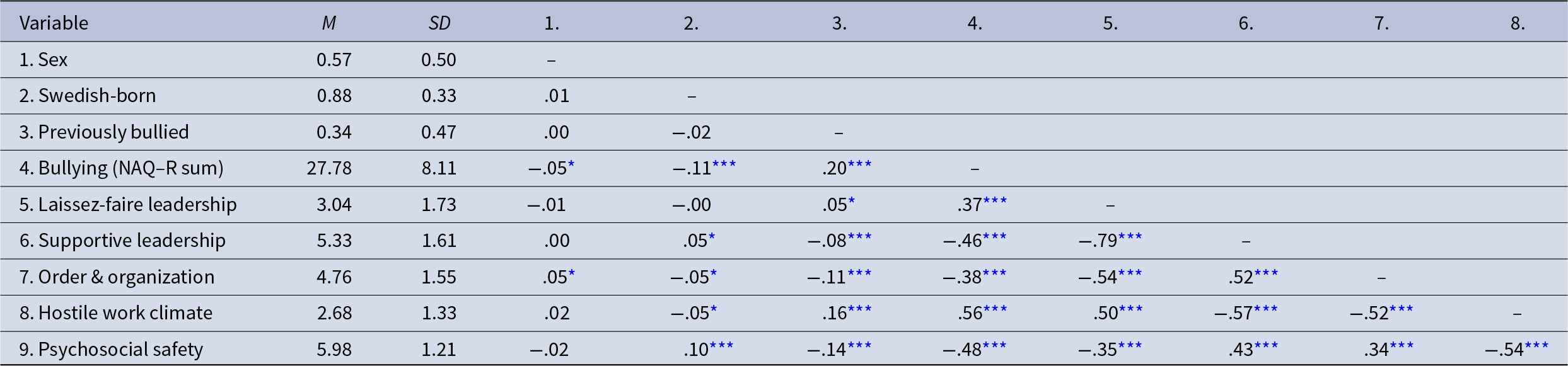
Table 2 presents the means, standard deviations, and intercorrelations of the study variables. The results indicated that sex, being foreign-born, and previous experiences of bullying were significantly associated with current exposure to bullying behaviours, supporting their inclusion as control variables in the study. Furthermore, being foreign-born and having a history of bullying victimization were also correlated with perceptions of the current work environment, suggesting that past experiences shape how individuals evaluate their workplace conditions. Notably, individuals currently experiencing workplace bullying reported significantly worse perceptions of leadership quality, workplace climate, and psychosocial safety, which aligns with previous research suggesting that exposure to bullying behaviours negatively influences employees’ overall work experiences (Rosander & Nielsen, Reference Rosander and Nielsen2024).
Means, standard deviations, and intercorrelations of the study variables
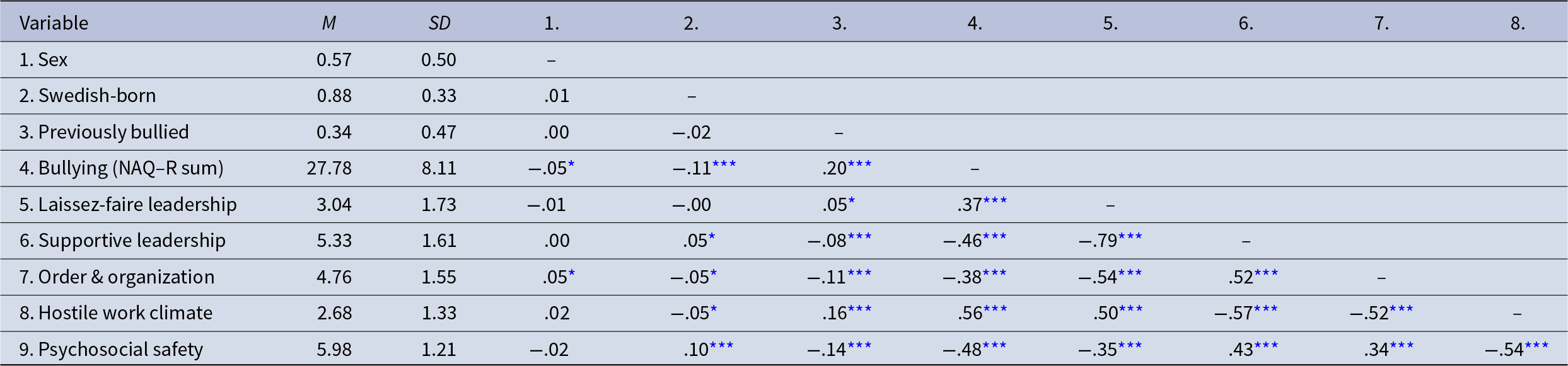
* Notes: Sex (female = 1, male = 0). Swedish-born (= 1, foreign-born = 0). Previously bullied (= 1, not previously bullied = 0). NAQ–R = Negative Acts Questionnaire–Revised. *p < .05. ***p < .001.
To address Research Question 1, I compared bullied (NAQ–R ≥ 35) workers and those in managerial positions regarding the frequency of exposure to bullying by someone in a managerial position and by a worker. In total, 54% reported being bullied by someone in a managerial position. There was no significant difference between workers (53%) and supervisors/managers (56%), χ2(1) = 0.05, p = .824. In total, 61% reported being bullied by a worker, and there was no significant difference here either between workers (63%) and supervisors/managers (44%), χ2(1) = 2.34, p = .126. Additionally, 31% of the workers and 44% of supervisors/managers reported being bullied by someone else within the organization but not from the same workplace. Although there was some variation in numbers, the share of workers and supervisors/managers being bullied by someone in a managerial position was almost identical.
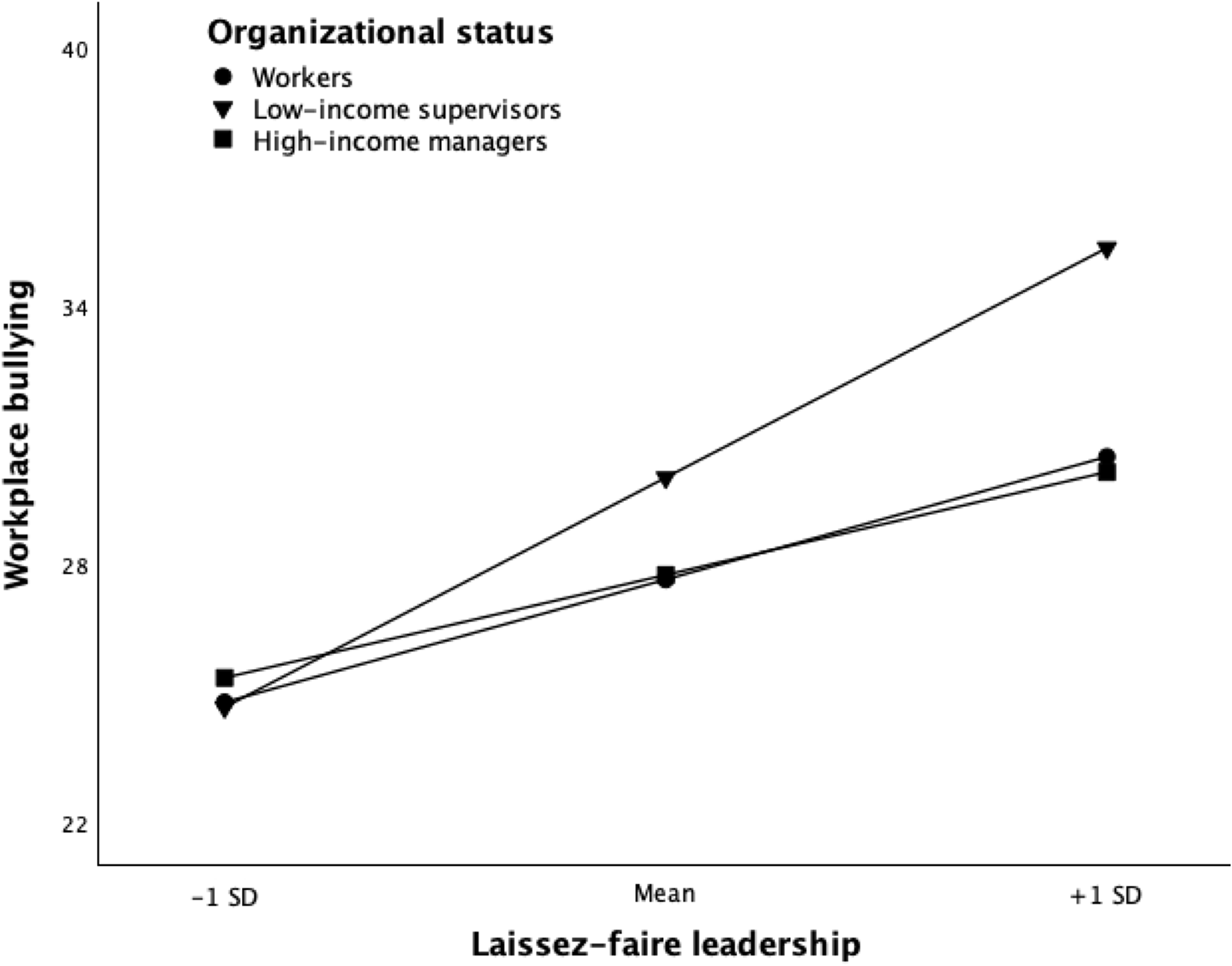
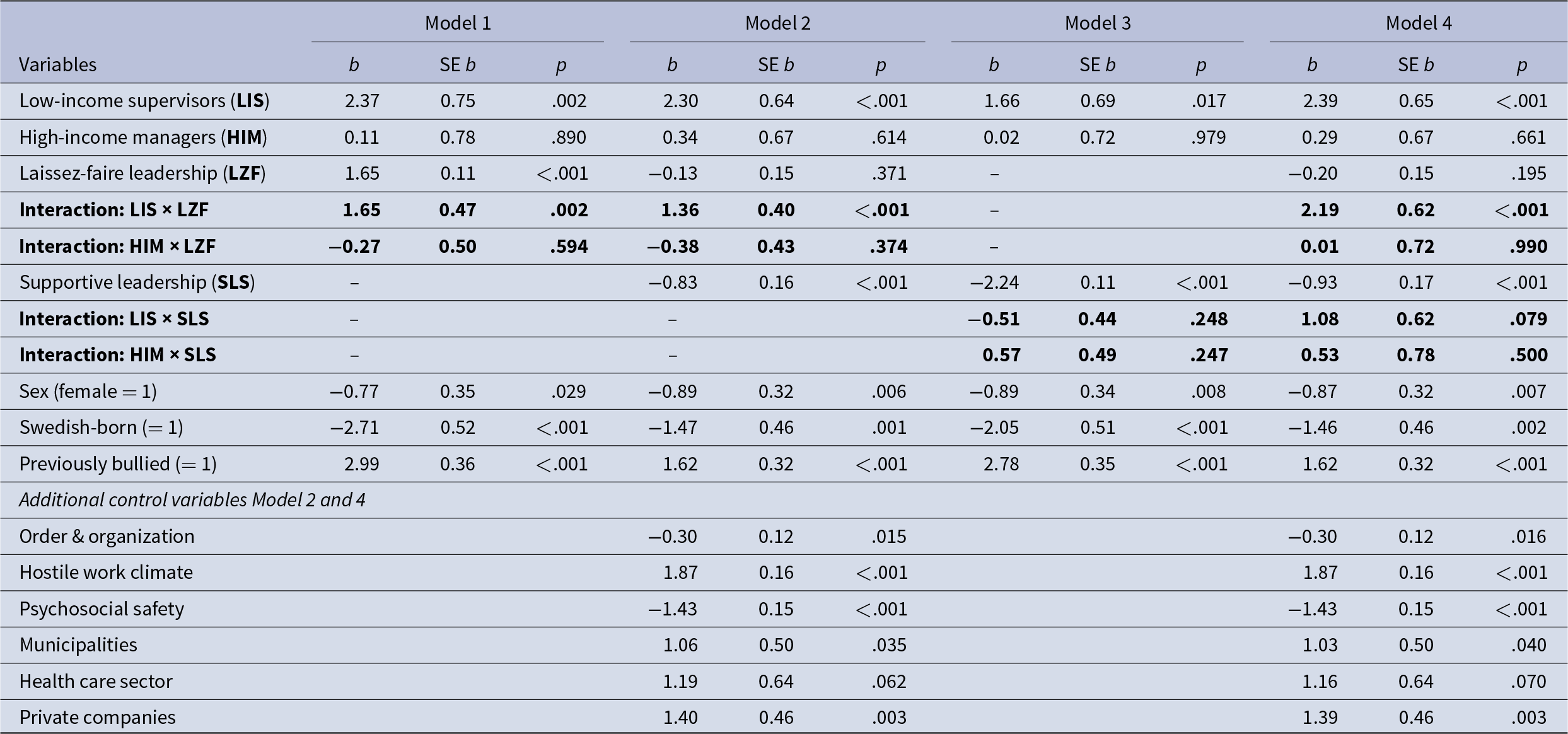
Hypotheses 2 and 3 as well as Research Question 2 were investigated using moderation analyses predicting exposure to bullying behaviours. In all analyses, I added sex, whether one was born in Sweden or not, and whether one had been previously bullied as control variables. Furthermore, all analyses used a multicategorical independent variable (workers, low-income supervisors, and high-income managers). I tested four models (a) a simple moderation with LZF as a moderator (Model 1), (b) Model 1 with the addition of organizational control variables, including SLS (Model 2), (c) a simple moderation with SLS as a moderator (Model 3), and (d) a full model including both LZF and SLS as moderators as well as all organizational control variables (Model 4). The results for all four models are presented in Table 3. The results for Model 1 showed that there was a significant interaction, but only for low-income supervisors and LZF with regard to exposure to bullying behaviours, b = 1.65, p < .001, not for high-income managers and LZF, b = −0.27, p = .594. See Figure 1 for an illustration of the interaction. At low levels of LZF, there were no differences between the three categories of organizational status, but with higher levels of LZF, the increase in exposure to bullying behaviours was stronger for low-income supervisors compared to both other categories (see Table 4). Hypothesis 2 was supported.
Interaction between perceived laissez-faire leadership of one’s immediate superior and exposure to bullying behaviours for three levels of organizational status (Model 1).

Predicting workplace bullying
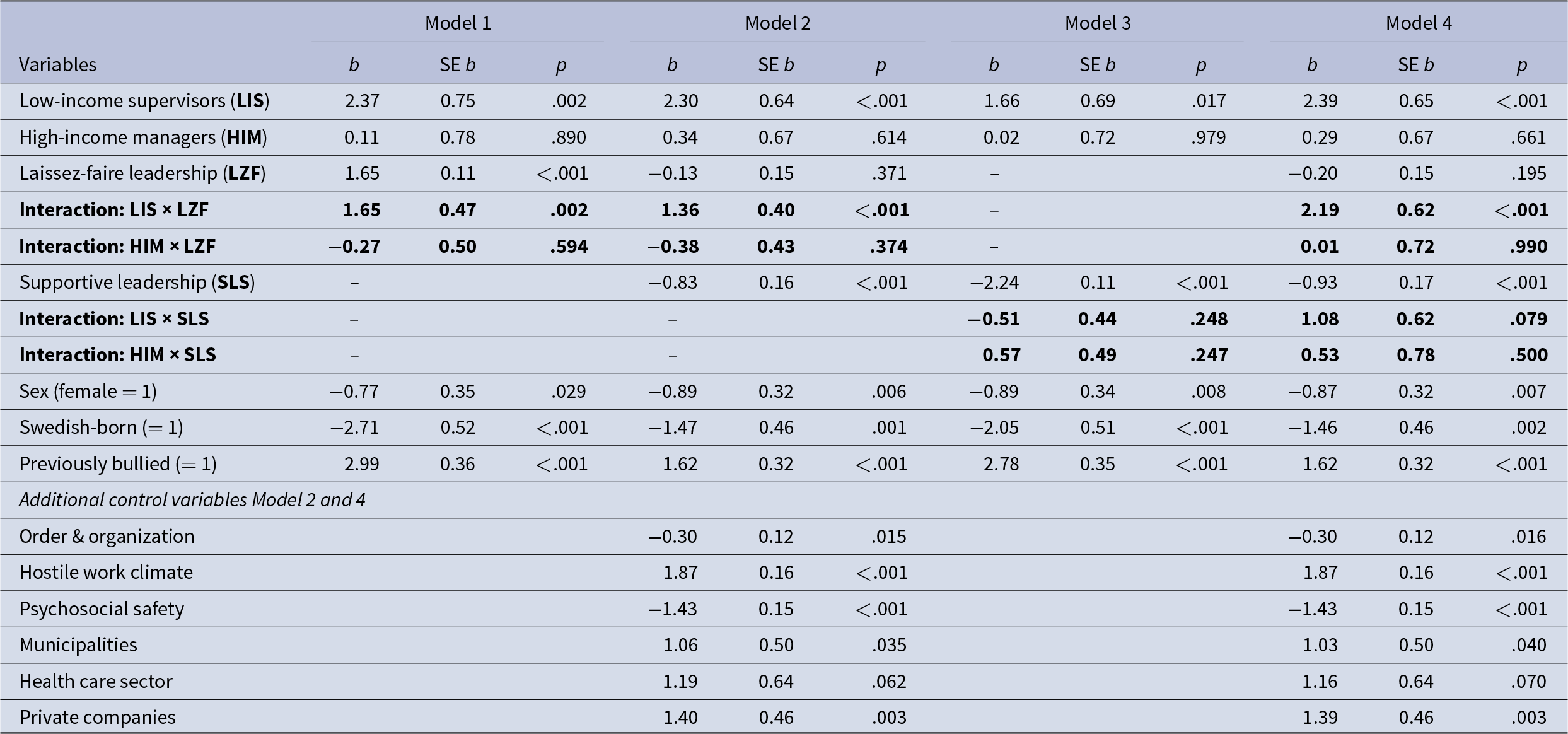
Notes: Bold text highlights the interactions for clarity. Municipalities, healthcare sector, and private companies are dummy coded = 1 with governmental sector = 0.
Conditional effects of laissez-faire leadership and estimated conditional means of exposure to bullying

Notes: X1 = low-income supervisors versus workers. X2 = high-income managers versus workers.
This result remained significant after controlling for a number of organizational variables: order & organization, hostile work climate, psychosocial safety – close colleagues, and SLS (Model 2, Table 3). That is, the interaction for low-income supervisors and LZF was still significant, b = 1.36, p < .001, while the interaction for high-income managers and LZF was not, b = −0.38, p = .374. This strengthens the support for Hypothesis 2.
Testing Hypothesis 3, I replaced LZF as a moderator with SLS. The results showed that there were no interactions for either low-income supervisors or high-income managers (see Model 3, Table 3). Thus, Hypothesis 3 did not get support. However, there was a significant simple effect of SLS on exposure to bullying, b = −2.24, p < .001.
I investigated Research Question 2 using the same basic analysis as in Model 2, but with both LZF and SLS as moderators. The results showed that the interaction between low-income supervisors and LZF was significant, b = 2.19, p < .001, while the corresponding interaction for SLS was not, b = 1.08, p = .079 (see Model 4, Table 3). Thus, I can conclude that the negative effects of perceived LZF seem to outweigh the positive effects of perceived SLS from one’s immediate superior for low-income supervisors.
As I used income as a way to categorize those in managerial positions, I wanted to ensure that it was not an issue of low income per se. I tested this by running the same analyses but also categorizing workers based on median income. These analyses showed no interaction for the worker categories (low- vs. high-income workers). Both worker categories and the high-income managers were all at a similar level and parallel to each other, with only low-income supervisors, as before, showing a different trajectory with high levels of LZF. It is worth noting that the level of exposure to bullying behaviours was significantly higher for the low-income worker category (M = 28.59, SD = 9.24) compared to the high-income managers (M = 26.44, SD = 4.84) as well as the high-income workers (M = 27.11, SD = 7.14), F(3, 1812) = 5.66, p < .001. There was no significant difference when comparing the low-income supervisors to any of the other categories.
Discussion
The aim of the present study was to explore the prevalence of bullying of those in managerial positions by comparing the experiences of supervisors with those of managers higher up in the hierarchy, as well as workers. Additionally, the study sought to examine how perceived social support and laissez-faire leadership influenced the level of exposure to bullying within these groups. The results showed that supervisors were, in general, not more exposed to bullying behaviours compared to managers higher up in the hierarchy (Hypothesis 1 did not receive support). The level of exposure for supervisors was also the same as for workers. However, the level of exposure was dependent on perceiving one’s superior as a laissez-faire leader, and this dependence was stronger for supervisors, providing support for Hypothesis 2. Supportive leadership did not have the same differential effect for supervisors (Hypothesis 3 did not receive support); however, the results showed that leader support was beneficial for managers/supervisors and workers alike. Having a superior who cares and provides social support is important for everyone, whether they are workers or in managerial positions. However, for supervisors, the benefit of social support was overshadowed if one’s superior fails to act when expected (Research Question 2). Perceiving one’s immediate superior as a laissez-faire leader is particularly detrimental for supervisors, making them more vulnerable to bullying. Additionally, regarding Research Question 1, there was no difference between supervisors/managers and workers in terms of reporting someone in a managerial position as the bully, nor was there a difference in reporting a worker as the bully.
Caught in the crossfire
Research on the bullying of individuals in managerial positions is lacking. Existing research has mainly focused on upward bullying (e.g., Branch, Ramsay & Barker, Reference Branch, Ramsay and Barker2007; Branch et al., Reference Branch, Ramsay, Shallcross, Hedges, Barker, D’Cruz, Noronha, Baillien, Catley, Harlos, Hogh and Mikkelsen2021; Tuckey et al., Reference Tuckey, Oppert, Neall, Li and Selby2024), that is, bullying from subordinates, rather than the full picture, where superiors may also be bullied by colleagues with the same organizational status or by their own superiors. Furthermore, research rarely considers different levels of organizational status of those in managerial positions. The present study provides new insights in these regards by examining bullying from multiple sources and analysing how organizational status interacts with leadership behaviours to shape the risk of bullying.
Supervisors are in a vulnerable position, as there may be expectations and demands from both workers and superiors. They are responsible for daily operations but do not always control how to prioritize tasks, creating tension with subordinates if decisions do not meet expectations. Workers may attribute personal responsibility to supervisors for cutbacks and negative working conditions, even though their role is that of a messenger. The JD–R model (Bakker et al., Reference Bakker, Demerouti and Sanz-Vergel2023; Demerouti et al., Reference Demerouti, Bakker, Nachreiner and Schaufeli2001) provides a useful framework for understanding this vulnerability. A lack of critical job resources – such as support, guidance, and involvement from higher-level managers – can increase job strain, affecting both motivational and health impairment processes. The findings suggest that laissez-faire leadership from higher-level managers, characterized by passivity and lack of involvement, exacerbates this strain by depriving supervisors of necessary resources. This could, in turn, affect their ability to meet their superiors’ expectations, potentially leading to negative treatment. The results showed that most crucial resources for supervisors are not social support or compassion but concrete action from their immediate superior: being present, responding to urgent questions, making decisions, and getting involved in important issues. Without such actions, supervisors are left to their own devices, and if they do not perform up to par, they risk becoming targets of negative actions from both subordinates and superiors (Felson, Reference Felson and Mummendey1984; Tedeschi & Felson, Reference Tedeschi and Felson1994).
Negative treatment from one’s superiors may trickle down to one’s subordinates (Mawritz et al., Reference Mawritz, Mayer, Hoobler, Wayne and Marinova2012). Such behaviours may be interpreted by subordinates as highly unjust and abusive (Tepper, Reference Tepper2000), which has been shown to be connected to aggression towards those in lower managerial positions (Hershcovis et al., Reference Hershcovis, Turner, Barling, Arnold, Dupre, Inness and Sivanathan2007). A leader perceived as lacking fairness receives less support from subordinates (Hogg & van Knippenberg, Reference Hogg and van Knippenberg2003), creating grievances that may fuel retaliatory aggression to achieve retributive justice (Tedeschi & Felson, Reference Tedeschi and Felson1994). This also opens up for the possibility of re-categorization of the supervisor as an outsider, no longer seen as part of the group. Research on the social identity theory of leadership (Hogg, Reference Hogg2001) suggests that leaders gain influence by embodying the group prototype, perceived as ‘one of us’ and ‘doing it for us’ (Haslam & Platow, Reference Haslam, Platow, Hogg and Terry2001). A supervisor perceived as neither sufficiently supportive by subordinates nor acting in their best interest, nor sufficiently competent by higher-level managers may be vulnerable to mistreatment from both directions. This dynamic may help explain why supervisors are bullied at comparable levels to workers, despite their formal authority.
Bullying is not an ‘either-or’ process (Rosander & Blomberg, Reference Rosander and Blomberg2019) but typically escalates gradually from isolated actions, possibly with both parties engaging in negative behaviours (see, e.g., Baillien et al., Reference Baillien, Camps, Van den Broeck, Stouten, Godderis, Sercu and De Witte2016; Vranjes et al., Reference Vranjes, Elst, Griep, De Witte and Baillien2022). A supervisory position involves a formal power imbalance, but informal power can shift the balance (Branch, Reference Branch2007) in which collective resistance from subordinates may gain strength over time, particularly if higher-level management fails to intervene. Without sufficient resources, supervisors may find themselves isolated, lacking both the authority and the resources to manage escalating conflicts. The findings suggest that passive leadership at higher organizational levels may play a key role in such escalations, reinforcing the need for clear leadership structures and proactive managerial involvement.
Consequences may be severe, as someone in a managerial position may leave the bullying unaddressed due to shame, believing they should not find themselves in such a situation. This may be particularly problematic for supervisors, as their reputation and career prospects depend on their perceived ability to manage workplace dynamics (Tuckey et al., Reference Tuckey, Oppert, Neall, Li and Selby2024). The findings showed that in over half of the cases, a supervisor was bullied by someone in a managerial position, suggesting that power struggles and leadership conflicts may be central to workplace mistreatment.
The level of bullying, when considering all sources, was the same for supervisors, managers higher up in the hierarchy, and workers. The ambiguity in previous results (e.g., Forssell, Reference Forssell2016; Ortega et al., Reference Ortega, Hogh, Pejtersen, Feveile and Olsen2009) about whether those in managerial positions are more or less exposed to bullying than workers may be explained by the sources of bullying included – whether the focus is solely on upward bullying or a broader range of perpetrators – as well as the availability of job resources. These findings highlight the importance of considering workplace bullying in a broader organizational context, where power, leadership, and structural factors intersect to shape vulnerability to mistreatment.
Practical implications
The practical implications are fairly straightforward. The present study demonstrated that supervisors experience bullying at the same level as workers, indicating the need for vigilance regarding their working conditions. Simply having formal power does not protect one from negative treatment (Branch, Reference Branch2007). Furthermore, the results highlighted that social support is important for everyone – both workers and those in managerial positions. This has been shown in numerous studies (e.g., Blomberg et al., Reference Blomberg, Rosander and Einarsen2024; Nielsen et al., Reference Nielsen, Christensen, Finne and Knardahl2020). However, for supervisors, having an active immediate superior is even more crucial. An inactive superior who fails to address urgent questions and does not engage in issues important to the supervisor clearly increases the risk of bullying for those in lower managerial positions.
Several actions can be taken to reduce this risk. To prevent tension between supervisors and their subordinates, organizations could implement clearer communication channels. This would ensure that decisions are explained transparently, reducing the likelihood that lower-level managers are blamed for decisions beyond their control. Furthermore, regular workplace climate assessments could identify areas where supervisors are at risk of bullying. Such audits would allow organizations to take proactive steps in addressing risks before they escalate into full-blown bullying situations. It is crucial not to automatically interpret negative feedback about the immediate supervisor or poor results from a work group as evidence of faulty leadership. Organizations must consider the possibility that the supervisor may be the target of bullying by their subordinates. Organizations should also ensure that bullying prevention policies explicitly cover individuals at all levels, including managerial staff, as the present study shows that those in managerial positions are just as vulnerable to bullying as workers. This would ensure an inclusive and comprehensive approach to workplace bullying. The findings have direct implications for organizational policies, leadership training, and interventions, emphasizing the need for structural and cultural measures to reduce bullying risks across different management levels.
Strengths and limitations
A strength of the present study is that it is based on a probability sample of the Swedish workforce and includes accurate income data obtained directly from the Swedish population register. Income was used to categorize those in managerial positions into low-income supervisors, as an operationalization of supervisors in the first line of management, and high-income managers, representing those higher up in the hierarchy. This categorization was informed by gender, work sector, and city size, all of which can potentially affect income levels. This approach was likely sufficient for the study’s purposes. Comparing the income for these two managerial levels with the national data revealed an even clearer distinction in the study data, further strengthening the categorization. Although the exact labels for their roles, such as supervisor or first-line manager, may not be entirely clear, all tests and comparisons indicate a distinct and clear difference between the lower and higher levels of organizational status. Testing an income cut-off for workers showed that income per se was not a deciding factor, further supporting the premise that the categorization was appropriate for those in managerial positions.
The study used cross-sectional data; however, the main focus was on comparing workers with those in different managerial positions, so the use of longitudinal data would not have provided additional insights. Future studies should explore the consequences of exposure to bullying for those in managerial positions, and for this purpose, longitudinal data will be necessary.
The data in the present study were self-reported, making them susceptible to social desirability bias and common method variance. Responses influenced by social desirability would likely seek to conceal vulnerability, suggesting that results may reflect underestimations rather than exaggerations. Additionally, I assessed the potential risk of common method variance using Harman’s single-factor test, which indicated that it was not a concern in the present study (Podsakoff et al., Reference Podsakoff, MacKenzie, Lee and Podsakoff2003). Finally, power distance is lower in Sweden relative to many other countries, which could have affected the results or at least the possibilities for generalizing the findings to other regions of the world, highlighting the importance of investigating bullying of managerial staff in other cultural contexts.
Conclusions
The present study showed that supervisors are generally as exposed to bullying as workers, and that they are about equally exposed by subordinates and superiors. However, the risk of bullying depends on whether important resources are available. If their immediate superior is unavailable when needed or fails to address issues that supervisors deem important in a timely manner, the risk of bullying increases. Notably, the study showed no difference in exposure to bullying behaviours comparing workers to the two managerial levels.
Supervisors are in a vulnerable position, often caught between the demands of workers and those of their superiors. An imbalance between demands and available resources can negatively impact their health and motivation, further increasing their susceptibility to bullying. The findings indicated that the most critical resource for these managers is not social support but concrete actions from their immediate superiors.
A trickle-down effect of mistreatment from higher-level management, or the misinterpretation of lower-level managers’ actions – over which they have little control – as unfair behaviour, can lead to distancing them from their work group. This may result in a loss of group support, opening the door to further negative treatment and social isolation. Both hierarchical power imbalances and perceived unfairness can contribute to negative actions directed towards supervisors, intensifying their vulnerability to bullying.
Supervisors risk being caught in the crossfire, and organizational measures to reduce this risk should ensure that preventive actions against bullying include all levels of the organization. Long-term strategies to address the systemic causes of this dynamic, alongside regular evaluations and clear communication, are key practical methods for prevention.
Data availability statement
The data that support the findings of this study are available from the corresponding author upon reasonable request.
Acknowledgements
Many thanks to professor Morten Birkeland Nielsen for being a critical friend!
Financial support
This work was supported by the Swedish Research Council for Health, Working life and Welfare under Grant number 2023-00262.
Conflicts of interest
I have no potential conflict of interest to report.
Ethical standards
The research project was approved by the Regional Ethical Review Board at Linköping University (protocol number: 2017/336-32).
Michael Rosander is a professor of psychology at Linköping University, Sweden. His main research interest lies within work and organizational psychology, with a special focus on workplace bullying and harassment. Specifically, he has published nearly 25 articles and book chapters on this subject over the last 5 years, the majority as first author. He has contributed to high-impact journals such as Work & Stress, The International Journal of Human Resource Management, and Applied Psychology, collaborating with, for example, Professor Ståle Valvatne Einarsen, Professor Morten Birkeland Nielsen, and Professor Denise Salin.



 Open access

