

In an economic system, manufacturers procure raw materials from suppliers and transform them into finished goods. Next, the finished goods are traded in markets to fulfill various consumer needs. Supply chain management is at the center of both production and fulfillment activities. Therefore, it is often considered the backbone of global economy and economic growth (Bhatia et al., Reference Bhatia, Lane and Wain2013). Companies that excel in supply chain management can enhance revenues while reducing costs. Thus, they achieve a competitive edge and sustainable profits even during turbulent times.
For example, electronics giant Samsung has a well-connected, resilient supply chain network including strategic production locations close to their suppliers (Wong, Reference Wong2023). Unlike its competitors, Samsung increased profits in 2020 owing to its excellent supply chain practice despite the COVID pandemic (Byford, Reference Byford2021). Shipping company FedEx also has a long-standing reputation for supply chain excellence such that the delivery giant manages a complex supply chain network to deliver both personal and business parcels (e.g., online orders for many ecommerce retailers). FedEx’s supply chain performance helped improve its financials in 2024 despite the deteriorating market for parcel deliveries (Fung, Reference Fung2023; Fung, Reference Fung2024). Excellence in supply chain management helps companies like Samsung and FedEx fulfill market demand efficiently, which in turn helps cut both production and logistics costs.
Supply chain excellence is important not only for manufacturers, retailers or logistics companies but also for most service companies (e.g., airlines, hotels, and restaurants). Service companies transform select resources into a service. Acquisition and conversion of resources into a service may enlist several supply chain activities. Thus, excellence in supply chain management helps increase profits while reducing the waste of resources. Fast-food chain Wendy’s, for instance, partnered with big-data platform provider Palantir Technologies to connect a large network of suppliers, distributors, and restaurants, which helped improve Wendy’s profits while eliminating food waste (Stroh, Reference Stroh2024).
At the macro level, a nation with robust infrastructure and strong supply chain networks can facilitate supply chain flows, improving its overall productivity. Nations also benefit from supply chain excellence by reducing waste of Earth’s limited resources. When most companies wield supply chain excellence in an economic system, limited resources are utilized efficiently, creating more wealth for individuals while lowering the carbon footprint of operational activities. For example, Switzerland’s many corporations that excel in supply chain management also enjoy the support of healthy economic policies and robust infrastructure. As a result, this country preserves natural resources at the highest quality and offers a wealthy life to its citizens (the Switzerland case is discussed later in this chapter). This poses an important question: How can organizations achieve supply chain excellence?
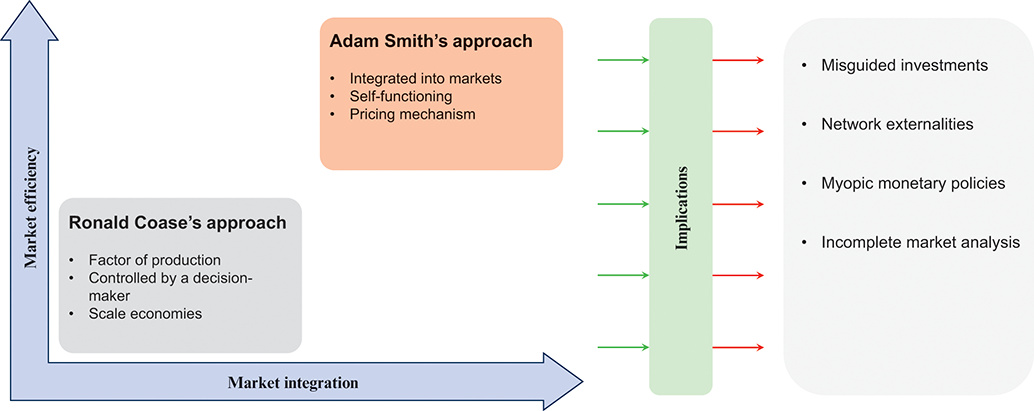
Excellence in supply chain management is highly challenging, with no one simple formula or method. One prerequisite is having a strong understanding of the economics of supply chain management. In this chapter, we will survey economic perspectives and relate them to supply chains as shown in Figure 1.1. We will focus on two economic views for understanding the dynamics of supply chains – namely, Ronald Coase and Adam Smith. Supply chain management has been heavily influenced by Coase’s approach, leading to the perception of being a factor of production. Because supply chain management straddles production and markets in practice, this singular view causes some serious problems: (1) misguided investments, (2) network externalities, (3) myopic monetary policies, and (4) incomplete market analysis. This chapter examines all these problems in detail.
Economic perspectives of supply chain management and their implications
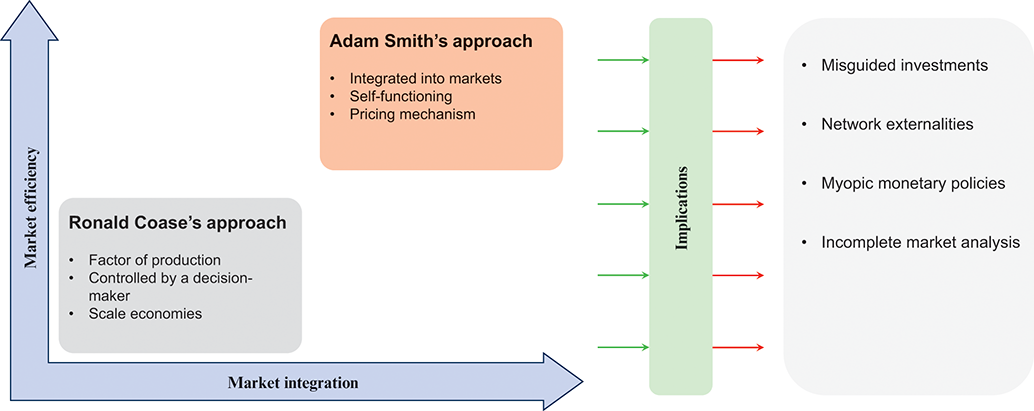
Figure 1.1 Long description
At the bottom left near the origin, it shows Ronald Coase’s approach, which includes factor of production, controlled by a decision-maker and scale economies. At the top right, it shows Adam Smith’s approach, which includes integrated into markets, self-functioning and pricing mechanism. The graph leads to implications that further lead to misguided investments, network externalities, myopic monetary policies and incomplete market analysis.
Economists study market dynamics to secure price stability, income equality, and sustainable growth of societies. Several branches of economics now scrutinize how our society is shaped by the dynamics of economic systems. For example, central banks peg the interest rate and transact securities in efforts to manage inflation and price stability. Microeconomics looks at how firms use resources to create value for society via their constructed networks that shape the structure of supply chains. Surely, economists working as experts in central banks, government organizations (e.g., Department of Commerce), international agencies (e.g., the World Trade Organization), for-profit companies, and nonprofit organizations exert strong influence, either positively or negatively, in our lives.
The development of liberal economic models dates back to the eighteenth century. Adam Smith then positioned economics as the “science of wealth” (Aspromourgos, Reference Aspromourgos2008). Smith asserted that wealth is created by division of labor and free markets. Division of labor prods individuals to specialize in specific tasks. This type of specialization helps people improve productivity by focusing on certain skills. Individuals then exchange goods and services in free markets. An economic system thrives when markets function efficiently with talented people being employed to do certain tasks that are aligned with their expertise.
Creating sustainable economic wealth is in some way analogous to winning the UEFA Champions League trophy. A football team is composed of eleven players, each specializing in distinct aspects of the game. Expectations from a goalkeeper and a striker are very much different, promoting division of labor in a team. Having all top players for each area is not enough to win a game. The players must also control the ball and move it efficiently between different zones of the pitch, resembling free markets in an economic system. Despite all efforts, the best team in the tournament may still lose a game due to external factors, such as rivals, weather, and spectators. Eventually, they can still win the trophy after losing a game.
In economic systems, there are also such factors as supply and demand having an impact on the welfare of individuals. When product supply falls short of demand, for example, price bids upward. In free markets, such a price increase only causes short-term inconvenience, like the football team losing a game but winning the trophy in the end. Rising prices encourage other suppliers to make the product, hence increasing the supply. The rise in supply lowers the price, pushing it to equilibrium value. The supply and demand levels at equilibrium pricing determine the long-term economic activities in the system. The flow of goods and services is always improved by an efficient pricing mechanism in free markets, promoting economic welfare.
1.1 Emergence of Supply Chain Economics
When markets are efficient as envisioned by Adam Smith, the price of a product reflects its true value, and people trade goods without any friction. Here, supply chain management is considered a part of markets because flows of goods are controlled by the pricing mechanism of markets. In other words, there is no need for decision-makers to manage the supply chain, since its management would simply comprise smoothly performing, self-functioning tasks.
For example, Uber Eats owes its success to integrating supply chain management into markets. In the past, restaurants had been offering home delivery services by using their own resources. When they received orders, their employees were tasked to deliver them to customers’ homes. Restaurant managers had to manage those logistics activities. Now, restaurants opt out of managing home delivery (except pizzerias) and employing any fleet for that. Instead, the platform coordinates those activities by collecting orders from platform users and inducing platform drivers to do deliveries through an effective pricing mechanism.Footnote 1
Unfortunately, platforms at Uber’s scale and efficiency are scarce, and markets are often inefficient in practice. This causes (1) search and (2) contracting costs (Coase, Reference Coase1937). First, people incur search costs to discover fair prices of products in markets. Second, contracting costs accrue for transactions because trade must be organized according to a contract. In a trading relationship without any contract, each party may behave opportunistically and harm the other. To avoid such mischief, parties enact a contract listing responsibilities and rights. Therefore, individuals incur search and contracting costs to trade a good or service, which is referred to as “the cost of market inefficiencies.”
The cost of market inefficiencies can be eliminated when certain supply chain activities are controlled by a central decision-maker. When the cost of controlling the activity matrix is less than the cost of market inefficiencies, a firm arises to manage activities in-house. For example, an individual may need to buy a specific service from another person repeatedly to produce a good. Contracts written per service will create inefficiency for the individual. When a firm is established and the person providing the service is hired as an employee, high contracting costs can be eliminated. Here, a decision-maker in the firm becomes responsible for controlling the activities of the employee. However, managing activities in-house may become costlier than dealing with market inefficiencies depending on the complexity of activities, firm size, and alternative solutions offered in the market. Therefore, any advantage of carrying out activities in-house may vanish in future depending on these factors.
The cost of market inefficiencies affects the scope of supply chain activities, which in turn determines a firm’s size. Ronald Coase asserted in his seminal work that firms grow under three circumstances (Coase, Reference Coase1937). First, the cost of controlling new activities in-house should not exceed the cost of market inefficiencies. Here, decision-makers may face more challenges in managing complex activities in-house as their firms grow. It is rational to stop growing a firm when the cost of controlling new activities exceeds the cost of market inefficiencies.
For example, pizzerias (e.g., Domino’s and Pizza Hut) often have their own fleet for home delivery because they can keep the cost of home delivery lower than the charges paid to the platforms such as Uber Eats.Footnote 2 Nevertheless, the platforms offer immense potential for reaching new customers. Therefore, it would be more appealing for pizza chains to use the platforms for increasing sales while managing delivery service in-house. Domino’s Canada started to follow this strategy in 2024 by forming a partnership with Uber Eats such that customers can place their orders via the app, but deliveries are done by Domino’s employees as usual (Harrison, Reference Harrison2024).
Second, decision-making quality must be preserved when controlling more activities. Decision-makers carry out multiple duties as their companies grow. Therefore, the quality of their decisions would erode because human attention is limited, and decision quality is affected by the level of workload. The growth of firms must be limited to where the quality of the decision-making process is preserved. Finally, the growth of firms must offer the benefits of scale economies. Producing goods in large volume allows companies to better utilize resources, thereby reducing production costs. This phenomenon is referred to as “economies of scale,” which helps manufacturers reduce costs while expanding their businesses.
The economic tenets of Coase are still at work in structuring supply chain networks toward two important outcomes, the first being economies of scale tending to spawn centralized supply chain networks. The second is viewing supply chain management as a factor of production, thus placing cost efficiency at the center of supply chain strategies.
1.1.1 Economies of Scale
Manufacturers must make fixed investments to secure the resources necessary to carry out production activities. They must build plants, buy machines and trucks, construct offices, and so on. Regardless of firm size, such investments must be made to start production. Next, manufacturers operate those resources to produce some goods for sale in markets. They must pay salaries, utility bills, and other operating expenses. Unlike investment costs, operating expenses increase linearly with firm size and the production level. When mass production is enacted in mega plants, the proportion of fixed investment costs to operating expenses shrinks, which helps boost return on investment. Such a strategy also makes it possible to repeat specific activities over time. This helps workers learn how to use resources (e.g., machines and trucks) in ways that maximize efficiency. Therefore, carrying out production in mega factories also helps manufacturers increase efficiency.
In short, economies of scale may benefit organizations in two ways: (1) increased return on investment, and (2) increased efficiency. Hence, it helps lower per-unit product costs. The cost advantage from economies of scale, for instance, shaped the automotive industry in the prior century. In 1913, Ford started the mass production of automobiles in the Highland Park assembly plant to reduce market price via economies of scale. Henry Ford designed and built his assembly lines to improve efficiency (Ford Motor Company, n.d.). At that time, other automakers enlisted skilled craftsmen who did all the assembling and molding of cars at one station. Ford’s assembly line used conveyor belts to move automobiles to workers where each handled a single task. Instead of one craftsman building the entire car, Ford assigned only one task to each worker who acted in repetition. Although a single-task assignment had a negative impact on the motivation of employees, assembly lines did help Ford boost output. Thus, the price for a Ford Model T fell to $260 in 1925 from $825 in 1908. This price drop led to a surge in demand for Ford cars. Next, Henry Ford attempted to control sourcing activities and shrink the cost of raw materials by acquiring his vendors (Gelderman, Reference Geldermann.d.). Highland Park facilities later moved to a newly built River Rouge site. Ford further acquired railways, coal mines, timberland, and so on. Such control of various activities along different segments of the supply chain proved to be a viable strategy given the surge in demand for Ford cars and well-known benefits of economies of scale. Henry Ford successfully implemented this strategy and built his conglomerate.
More than a century after Ford pioneered mass production, manufacturers still explore the opportunities from economies of scale in their supply chains. However, supply chains are now much more complex than in 1920. Therefore, the projected costs and benefits calculated before production-related investments may not materialize, often forcing producers to reverse investment decisions or change plant locations over time. For instance, production activities in many industries had been outsourced to China between 1980 and 2010 to exploit economies of scale coupled with low production costs. When both the labor and real-estate costs in China reached the level of Western economies, many firms relocated production from China to the United States, India, and Mexico. As a result, field investments in manufacturing have increased in the United States from $41 billion in 2010 up to $108 billion in 2022 (Keilman, Reference Keilman2023). Even Apple, which heavily relies on Chinese production, opted to move some of its production of iPhones from China to India in 2023 (Roy et al., Reference Roy, Kubota and Wen2023).
Economies of scale tend to favor centralized supply chain networks. Here, production activities of a manufacturer are carried out in a single or a limited number of mega facilities to serve markets dispersed worldwide. Despite the decrease in production costs, centralized networks incur high logistics costs, elevated inventory in transit, extended shipping times, and massive vessel traffic in main ports. Such negative consequences of scale economies may exceed any benefits, potentially rendering this strategy counterproductive in the design of supply chains. Thus, this strategy can no longer be affordable because rapidly changing market dynamics are making centralized production infeasible in the long term.
1.1.2 Mere Factor of Production?
The term “factor of production” is used in economics to describe inputs needed to make products available in the market. There are four main factors of production: (1) capital, (2) land, (3) labor, and (4) organization. Entrepreneurs make capital investments to build factories that transform select natural resources extracted from land to products with the effort of workers. Then, decision-makers organize supply chain activities to make products available in the market for consumption. Here, supply chain management is cast as organizational effort, thus deemed a factor of production.
Factors of production describe four important input types isolated from markets and not included in influential economic models. Although supply chain management involves complex activities in practice, it finds simplistic treatment in economics. Indeed, economists see supply chain management as a set of activities confined within the boundaries of firms where central decision-makers organize those activities in-house. Inter-firm supply chain transactions are ignored by economists. This view conflicts with real-world supply chain practices. For example, supply chain management involves coordinating flows of goods, information, and capital among supply chain (both internal and external) parties. There are many actors in supply chains who do specific tasks, and companies put much effort synchronizing all actors. Cisco, a US-based electronics company, has been investing heavily to integrate supply chain activities that take place in other companies (Cisco Systems, 2014), suppliers and contact manufacturers that merit discussion later in this book.
There are more examples of firms that invest in the integration of inter-firm supply chains. Economists, however, ignore such integration efforts, since they believe that the inter-firm transactions occur naturally in markets by virtue of the pricing mechanism. As Coase said in his seminal work (Coase, Reference Coase1937): “The integrating force … already exists in the form of price mechanism. It is perhaps the main achievement of economic science that it has shown there is no reason to suppose that specialization must lead to chaos.”
This economic ideology says that supply chain management must focus on micro activities executed within organizational boundaries because the flow of goods to outside entities is assumed to occur efficiently without any control by decision-makers. Such a view contradicts current supply chain practices. Both practitioners and scholars of supply chain management work on the development of systems and methods for integrating supply chains among different firms.
Another important aspect related to this economic ideology is that decision-makers are encouraged to fixate on the cost efficiency of supply chains. After all, supply chain costs must be kept below the cost of market inefficiencies to grow the firm. While salient for supply chains, cost efficiency is not always the top priority. Supply chain professionals often prioritize the resilience and responsiveness of supply chains over cost efficiency.
1.2 Implications of Economic Perspectives for Supply Chain Management
Supply chain executives ought to revise their economic perspectives to better design and operate supply chains effectively in our current economic systems. Such a revision of economic ideology is not easy, yet possible. For example, information technology attained revised thinking that embraced Internet technologies during the last three decades. Google’s launch in 1998 by Larry Page and Sergei Brin awed investors with its technological innovation. Google’s search engine successfully listed the most relevant web pages, impossible by other search engines such as Yahoo or Excite. Yet it was not then clear to investors how this would generate revenues (Carlson, Reference Carlson2009).
As the founders mused different revenue models (e.g., charging user fee for site services), a famous economist from the University of California-Berkeley, Hal Varian, coauthored a book with Carl Shapiro on information economics. The book perfectly conceptualized information as a product wielding trade value in the market (Shapiro & Varian, Reference Shapiro and Varian1999). Varian later became the chief economist at Google. With this revised economic thinking, tech firms developed effective business models. Now, we use a variety of Google’s products without cost! In other words, Google pays us (not cash, but free access to its services) to collect data useful in its Ads program. Without Varian’s economic thinking, it might not have been possible for untold millions of people to benefit from such services.
This case shows how important economists are to society, where even re-imagination of economic systems could change our lives significantly. Unfortunately, the extensive understanding of supply chain economics suffers from two shortcomings. First, the negative aspects of economies of scale are not well known, with implications for investment analysis and network externalities. Second, supply chain management is not merely a factor of production as it exerts powerful influence in shaping markets. This second shortcoming impacts both monetary policy efforts in stabilizing prices and market analysis.
1.2.1 Investment Analysis
Some companies invest heavily to forge their supply chains. For example, Henry Ford bought railroads and mines to build his network igniting the mass production of Ford autos. Tesla spent $5.5 billion to build its Berlin giga factory in 2022 (Sozzi, Reference Sozzi2022). While companies like Tesla and Ford invest in building production and supply chain networks, others hesitate to make supply chain investments. For example, Apple does not own facilities that produce iPhones. Instead, it partners with the Taiwanese contract manufacturer Foxconn. In 2022, Apple sold 232 million iPhones mostly assembled in Foxconn facilities (Perrigo, Reference Perrigo2023). Apple’s decision of not investing in production facilities would be unrelated to high fixed investment costs given its status as one of the most valuable companies in the world. Indeed, the company does not need to make such an investment in supply chains.
Strategic decisions as to a company owning its production sites versus outsourcing it to a contract manufacturer require a detailed investment analysis. Two cost elements play a vital role in these investment decisions. The first is total product cost covering raw material, production, warehousing, and shipping costs that accrue until the product reaches the customer. Economies of scale help reduce this first cost element. The second is the hidden cost of mismatches between supply and demand – that is, cost of product shortages when demand exceeds supply, or cost of excess inventory when demand falls short of demand. To reduce this hidden cost, firms often improve the responsiveness of their supply chains. They integrate supply chain operations (from procurement of raw materials to fulfillment of customer orders), which in turn helps them react quickly to sudden fluctuations in customer demand. When demand plummets unexpectedly, integrated supply chains reduce the supply and avoid excess inventory. When demand escalates, integrated supply chains ramp up the supply to meet demand. In the end, integrated supply chains ought to successfully reduce the mismatch costs. However, supply chain integration often leads to decentralized supply chains, conflicting with economies of scale. Thus, operational expenses run high for integrated supply chains, leading to higher total product costs.
Suppose a manufacturer procures goods from an offshore production facility where operations and labor would be cheaper than at home. However, long lead times linked to offshore facilities expose supply chains to serious mismatches. Offshore production would offer a cost edge over domestic production – for example, 5 percent, 10 percent, or 15 percent cheaper than the domestic alternative. Key question: Is the reduction in total product costs high enough to offset the increase in supply–demand mismatches? The answer to this question shapes not only a firm’s investment strategies but also its supply chain networks.
Having collaborated with different companies and US Department of Commerce, we quantified the impact of long lead times on the mismatch cost and developed a cost-differential frontier as a function of lead time (De Treville et al., Reference De Treville, Bicer and Chavez-Demoulin2014). For firms facing volatile market demand, an offshore production decision that looks only at total product cost may cause a huge loss due to supply–demand mismatches. Despite high total product cost, reshoring production near markets would help businesses increase profits by reducing mismatches. K’NEX Brands, a family-owned toys company, reduced costs by 20 percent after reshoring its production to the United States, even though total product cost was cheaper in China.Footnote 3
Hewlett Packard (HP) followed a similar strategy to improve the bottom line of its notebook division. In 1997, HP was a top player in the notebook computer market. Yet HP’s notebook division was losing money. Its supply chain network was misaligned with the market (Slagmulder & Van Wassenhove, Reference Slagmulder and Van Wassenhove2004). HP had traditionally focused on total product cost and attempted to reduce it. Mismatch costs had not been explicitly observed in its accounting. To fathom the level of mismatch costs, HP first formed a team of experts from different departments and academia. In electronics, obsolescence cost is high because consumers shun products using old technology. Thus, products have short lifecycles with average prices declining over time. After weighing these aspects, the team’s analysis revealed that the mismatch costs account for around 50 percent of total inventory value. Following this analysis, HP restructured its supply chain and improved responsiveness. As a result, they reduced inventory by 50 percent and reversed the notebook division from money-losing to profit-making in just two years.
Unfortunately, not all manufacturers are as successful as HP in turning around operations. We would often see such problems in firms strongly influenced by the CFO because finance professionals are mostly influenced by Coase’s view of supply chain management by their education. To understand the influence of executive members in an organization, the best approach is to look at compensation. Kimberly-Clark, a US-based consumer goods and personal care company, paid its second highest compensation, after the CEO, to its CFO in 2022.Footnote 4 On August 25, 2023, the company announced its decision to stop selling Kleenex facial tissues in Canada due to high operating costs and the supply constraints (Evans, Reference Evans2023). This scuttled 15 percent of the market share. Executives and investors often cite the importance and challenges of growth. Kimberly-Clark must have invested much time and capital growing the business to reach its 15 percent market share in Canada. Then the sudden decision to exit the market! What seemed impossible for Kimberly-Clark proved profitable for other companies (e.g., Kruger) remaining in the Canadian market. Cost calculations that justify economies of scale often fail to incorporate the hidden costs of supply–demand mismatches. The cheapest supply chain structure can prove so fragile that the operating system unravels when demand and the input prices fluctuate.
1.2.2 Network Externalities
The utility of a product for consumers grows with the crowd of people using it. This phenomenon is referred to as “network externalities” in economics. Products and services here become more convenient in a market with more users (Katz & Shapiro, Reference Katz and Shapiro1985). There are two factors influencing network externalities. First, people share their experiences about products with others. If a product is useful for a group of people, it is recommended to other people quickly where they can use it to their increased utility. Second, the cost of a product falls as more people consume it. When the number of customers using Uber rises, for example, the platform attracts more ride-hail drivers. The increased availability of drivers trims ride-hailing charges, which in turn lures more customers. In the end, the platform becomes highly convenient for both drivers and customers.
Unfortunately, network externalities do not often benefit supply chains. As supply chain networks expand, serious problems can emerge due to capacity limits. When companies stop investing in supply chains, they land in a vicious cycle. Those with a high operational capacity can fulfill customer demand rapidly. Fast service then brings new customers and more demand for the products. As demand increases under limited capacity, customers start facing delays where operational success stories are replaced by customer complaints or other issues. Here, one widespread problem is losing customers to rivals. Another is the outsourcing of some activities to contract manufacturers to overcome capacity shortages where the outsiders could learn the technology and become competitors in the long term.
In the aerospace industry, big players like Boeing and Airbus had been manufacturing most aircraft components in-house pre-1950 (Rossetti & Choi, Reference Rossetti and Choi2005). With demand burgeoning after World War II, both decided to outsource the production of most components to select suppliers. Outsourcing does not cause any problem if the strategic objectives of suppliers and manufacturers are well aligned. However, aircraft manufacturers made a big mistake at one point when they forced suppliers to expand capacities and cut prices in the 1990s. This made suppliers with excess capacity incur large losses. They reacted to the excess capacity problem in an unforeseen way. They disintermediated the supply chain and started selling spare parts directly to airline companies. Aerospace manufacturers generate substantial profits from service contracts with airline companies, and much here was lost to the suppliers. Failure to manage network externalities had shackled these manufacturers with hefty losses.
Like aircraft manufacturers, network externalities brought challenges to Apple that led to Samsung becoming a key player in the smartphone industry. Samsung entered the smartphone industry as one of the largest suppliers to Apple, supplying displays and chips for iPhones and iPads (Jackson, Reference Jackson2011). After Samsung’s operational capability to produce the displays and chips yielded a close collaboration with Apple, the former evolved into one of the biggest smartphone manufacturers in the world. Given Samsung’s ability to produce advanced technology products, Apple could not replace Samsung after becoming principal foes in the smartphone market.
As exemplified in these cases, network externalities pose supply chain issues to firms. Nevertheless, some companies take the challenges seriously and react by building an effective supply chain network instead of ignoring or sugarcoating them. For example, Amazon developed from scratch a fulfillment network as the company grew its sales volume. Amazon had initially outsourced its express delivery services to FedEx. Until 2019, these two worked together delivering orders to Amazon’s customers promptly. When Amazon ably built its own network of logistics fleet, this deal ended (Kim, Reference Kim2019). In sum, Amazon vertically integrated the logistics services when network externalities made such a move feasible. Though several hardships from network externalities persist for supply chains, executives can make strategic investments that turn challenges into opportunities à la Amazon.
1.2.3 Monetary Policy
Supply chain professionals often face challenging uncertainties when making critical decisions. For example, we have cited the role of total product and the mismatch costs in choosing where to produce goods. The mismatch costs may lie hidden to decision-makers, as in the HP case, with important decisions being made in the dark. Despite these challenges, executives tend to carefully enlist detailed risk analyses before drafting final decisions that appear optimal given current pricing and cost parameters. Facing high inflation, though, optimal decisions might soon prove suboptimal in the wake of price volatility, leaving huge sunk investment costs.
Economic policies tend to establish price stability in markets, offering a positive impact on supply chains. In some cases, however, policies are too lax in keeping prices highly stable. Supply chains are far more vulnerable to price instability than markets. Therefore, failure to achieve price stability may wield a devastating impact on supply chains while market prices proceed unscathed. Given that economic models consider supply chain management a factor of production, economic policies ignore the impact of price stability on supply chains while fixated on market dynamics.
Central banks are duty-bound to ensure price stability of economic systems. Bank of Canada’s website, for example, states, “We are Canada’s central bank. We work to preserve the value of money by keeping inflation low and stable.” When inflation is high, they increase the interest rates to induce savings and curb demand, which tames inflation. However, central banks often hesitate to raise interest rates in deference to corporate financial stability, while incurring a hefty cost: destabilized supply chains. On September 6, 2023, Bank of Canada announced its decision to hold the interest rate steady at 5 percent (Evans, Reference Evans2023b). The bank had increased the interest rate from 0.25 percent to 5 percent gradually to reduce inflation in 2022 and 2023. Inflation abated from a reported 8 percent in 2022 to 2.8 percent in June 2023, next rebounding to 4.0 percent in August 2023. Though violating the targeted 2 percent, Bank of Canada stopped increasing the interest rate. This decision can be attributed to the Bank’s tendency to favor leveraged individuals and firms. We see here a trade-off between inflation and interest rates. On the one hand, leveraged companies (having high debt) suffer under high interest rates as the cost of borrowing escalates. For a company with $10 million in debt, the interest rate hike from 0.25 percent to 5 percent amplifies its annual interest expense twentyfold from $25K to $500K! On the other hand, inflation escalates both wages and the cost of materials in classic fashion. Still, what about the hidden costs that accumulate along supply chains?
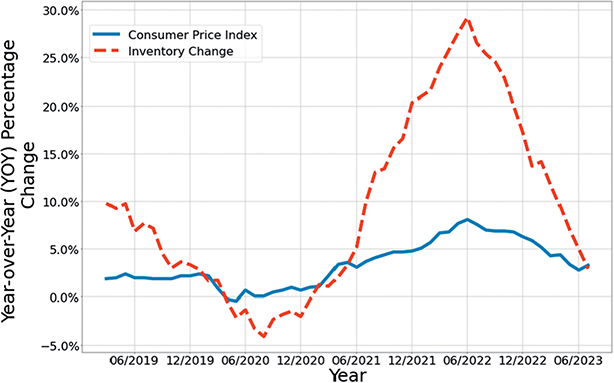
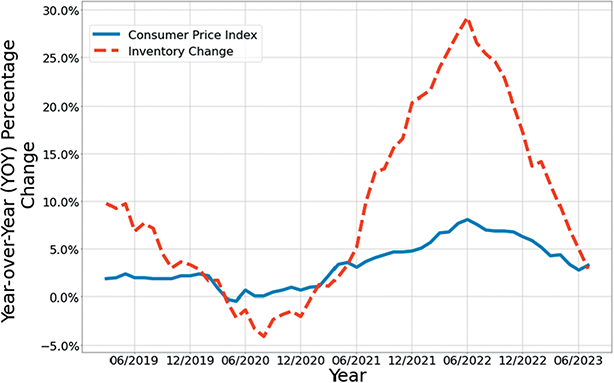
Figure 1.2 plots the inflation rate and manufacturers’ total inventory change in Canada from March 2019 to July 2023.Footnote 5 The solid line shows the inflation rate measured as consumer price index, whereas the dashed curve represents the inventory change, adjusted for seasonal fluctuations (e.g., firms often keep seasonal inventory for salient reasons such as Christmas shopping). When the inflation rate is under control (i.e., less than the targeted 2 percent level), manufacturers can better anticipate future prices and consumers’ purchasing preferences. This helps them make inventories leaner as observed by the declining trend in the inventory change before 2021. High inflation after 2021 causes a tight correlation between inflation and inventory changes. However, the magnitude of change in the inventory is much higher than that of inflation. Inflation rates neared 8 percent in July 2022, but inventory change reached 30 percent! Under high inflation, it becomes tougher to match supply with demand due to price fluctuations coupled with ever-present supply chain uncertainties. Thus, high inflation spawns inventory risk. Supply chain executives need stable pricing to manage inventories and make their systems as lean as possible. Otherwise, keeping interest rates low while the inflation being high would cause cheap debt-financing to promote supply chain inefficiencies. Yet economists often overlook the impact of their decisions on supply chain management while ably addressing other economic and market issues.
Canada’s inflation rate and inventory change (year-over-year) in the manufacturing industry from 2019 to 2023
1.2.4 Market Analysis
Despite economic thinking that casts supply chain management as a factor of production, many real-world examples have shown supply chain management to influence market dynamics. For example, evolution of ecommerce can be attributed to supply chain innovations. Amazon has long invested in supply chain management to raise its market share. To convince traditional shoppers to buy online, Amazon has regularly reduced delivery times (Goode & Calore, Reference Goode and Calore2023). Without same-day or next-day delivery, it would not have been possible to lure impatient customers to shop online. Amazon’s success in shrinking lead times has obviously helped the retailer increase its customer count and revenues. Copying its success, many other retailers have invested in building operational capabilities that offer a seamless ecommerce experience to their customers. E-tailers have injected supply chain management into the markets (contrary to the view of supply chain management being just a factor of production), thus altering the economic system. Ecommerce is now an integral component of our economic system shaping global markets. It accounted for 17 percent of total 2020 retail sales, with more than 1.5 million workers employed by Amazon alone (Ikenson, Reference Ikenson2022; Novet, Reference Novet2023). This could have been impossible without supply chain management innovations targeting markets.
Integrating supply chain management with markets also helps companies identify wide-ranging business opportunities. Amazon also invested in technology to control and monitor supply chain activities. Instead of relying on software services offered by other companies, it developed its own Amazon Web Services (AWS). Having arisen as a supply chain management byproduct, AWS later turned into a software business serving other firms. AWS’ 2020 annual sales exceeded $80 billion contesting software giants Microsoft and Google in cloud systems. Therefore, Amazon’s supply chain success fertilized new opportunities in the market meriting a business valuation in the hundreds of billions of dollars.
Amazon is not the only company that has reshaped its market and elevated profits, flexing its muscle in supply chain management. Nestlé too operates a robust supply chain network with different parties: coffee bean farmers, production sites, and retailers. As part of a research project in collaboration with Nestlé Switzerland, I was awed by the robustness and responsiveness of this company’s supply chain (De Treville et al., Reference De Treville, Bicer and Chavez-Demoulin2014). Owing to its strong supply chain management practice, Nestlé successfully allied with Starbucks to bring Starbucks’ coffee to regional markets (Weissman, Reference Weissman2018). This helped Nestlé strengthen market power in the coffee industry.
Typecasting supply chain management as a factor of production reinforces an economic system that operates in the sequence “manufacture-sell-consume.” For example, Adidas has long been making and selling shoes. Before the widespread adoption of the Internet, customers were aware of new models after being displayed in retail stores. In other words, customers were not involved in the production decision as markets were isolated from the job floor. Today’s firms are trying to change this model for select products, especially those with high margins. Adidas now offers customized shoes such that customers can design shoes on the company website per their preferences and submit purchase orders (Seifert, Reference Seifert2002). After receiving the purchase orders, Adidas initiates production. Therefore, the “manufacture-sell-consume” practice has radically remapped into “sell-manufacture-consume.” Many brands from watchmaker Rolex to bag-maker Timbuk2 now offer customized products to customers. Because companies make products in response to customer orders in this setting, supply chain management can no longer be dismissed as just a factor of production. It is now a vital hand in trade shaping market forces.
1.3 The Switzerland Example
Switzerland is a great case of what a nation can achieve when economic policies center on supply chain management. Swiss corporations and government have a keen sense as to the economics of supply chain management, which has strongly contributed to the Swiss economy. Switzerland is a small European country located between Germany, France, and Italy with a population of 8.7 million as of 2021. It is the most innovative, one of the wealthiest lands in the world.Footnote 6 Some argue that the wealth of the Swiss economy can be attributed to the banking system in which the Swiss government offers protection to foreign accounts. However, the truth is that the wealth of the Swiss economy is due to its strong economic system emphasizing supply chain management that makes manufacturing in Switzerland viable despite its high wages. One firm, Rotho Group, makes basic plastic items such as file boxes and bins in the country.Footnote 7 How can a company stay competitive in the production of such basic office supplies, while other developed nations have been importing such items from offshore countries? Switzerland has a strong supply chain network, one very well integrated into markets. Although the labor cost is remarkably high, Swiss manufacturers can minimize other cost elements, such as inventory and overhead – allowing to the country’s robust and integrated supply chains. This makes Swiss manufacturing competitive in the European markets.
Two key factors have helped Switzerland excel in supply chain management: (1) price stability and (2) robust infrastructure. Swiss governments have always managed to keep inflation exceptionally low. The inflation rate has ducked 3.5 percent, even during the COVID pandemic when other developed nations suffered near 10 percent rates. Such price stability helps Swiss companies make supply chain decisions weighing only inherent supply chain uncertainties without much exposure to price volatility. Switzerland also enjoys one of the most robust infrastructures in the world. From a supply chain perspective, the most important part of the infrastructure is the rail system operated by the Swiss Federal Railways (SBB), which also offers frequent cargo services to businesses at fair prices. This equips Swiss producers to stay competitive, although this strategy forfeits some of SBB’s profits (Briginshaw, Reference Briginshaw2022). However, any loss at SBB is not a problem for the Swiss government-owned SBB Cargo as long as Swiss companies can still generate high revenues (Raimondi, Reference Raimondi2023).
Coupling its success in supply chain management with its innovation culture, there are strong production bases in Switzerland. The watch industry is in the Geneva area, which includes its most famous brands (e.g., Rolex, Patek Philippe, the Swatch Group) and the local suppliers. The food industry is based in the Lausanne-Fribourg area, with Swiss giant Nestlé headquartered in Lausanne. There are also many dairy farms, plus chocolate and cheese factories in the Fribourg footprint. This same Fribourg exports tons of Gruyère cheese all around the world (Moses, Reference Moses2023). Zurich’s tech industry is home to giant ABB’s headquarters. Owing to its popularity as Europe’s techno-hub, Zurich attracts plenty of global tech companies such as Google, IBM, and Microsoft. Finally, the pharmaceutical industry based in the Basel area is home to drug giant Roche.
The separation of industries into distinct geographical areas forces firms to keep suppliers close as part of integrated supply chains. Supply chain integration helps address any negative aspects of network externalities as companies can ramp up production quickly to meet increasing demand from network externalities. For example, Rolex launched temporary production sites to meet increasing watch demand in 2023 (Hoffman, Reference Hoffman2023). While some companies in other nations take on excess inventory risk to handle rising demand, Rolex tackles the production issues of network externalities without taking such a risk, benefiting from a strong watchmaking network in the Geneva area of Switzerland. The Swiss example shows that manufacturing in high-cost economies is feasible, but a systematic approach must begin with updated economic thinking.
1.4 Conclusion
Supply chain management is arguably the most crucial factor shaping the development of corporations and economies. Companies must excel in supply chain management to generate sustainable profits in the long term. Many real-world examples have shown that even highly innovative companies can suffer financial hardships under a fragile supply chain presence. For example, Dutch electronics company Philips had been Europe’s most innovative company in the 2000s. Yet its inability to manage its complex supply chain incurred serious financial problems. The firm scored an operational turnaround by selling off business units to gain better control over its supply chains (Mocker & Ross, Reference Mocker and Ross2017).
To thrive in global markets, companies must innovate to deliver more value for customers at a lower cost. Innovation often takes place in two forms: (1) product and (2) process innovation. Product innovation targets development of niche products or salient upgrades to existing products so that market demand is fulfilled. Process innovation mostly relates to supply chain activities. It aims to enhance technological systems toward excellence in supply chain management. For Apple, product innovation is more important than process innovation as it sells hundreds of millions of iPhones and iPads to customers worldwide. Product innovation obviously dominates any process innovation in sparking peak demand. For many other businesses (probably 95 percent of all established firms in the maturity stage), however, process innovation holds much more salience. Despite its success in product innovation, for example, Philips faced financial plagues that were solved by prioritizing supply chain management (Mocker & Ross, Reference Mocker and Ross2017).
The four stages of the corporate business cycle well clarify the innovation trajectory (Seifert et al., Reference Seifert, Tancrez and Biçer2016). The first one is the birth stage, where entrepreneurs develop a product and launch the start-up business. Here, product innovation is critical because start-up founders often work solely on improving the product to attract more customers. Profitability is not a main concern at this stage. Start-ups often consume cash and demand capital from investors to innovate products and sustain the business. The second is the growth stage, which begins after start-ups achieve a successful product-market fit. At the growth stage, supply chain management becomes important to make products available in different markets. After marketing, supply chain management here truly becomes the second-top priority. The third stage is maturity, where companies reach peak potential markets and generate high revenues. Here, supply chain management occupies priority one to transform high revenues into worthwhile profits. Any failure to excel in supply chain management puts companies in risky situations reminiscent of Philips. Excluding Apple-esque design and sales of products that feature continuous upgrades, most decision-makers must emphasize innovation as to supply chain management in the maturity stage. The final stage is decline, where companies downsize operations and divest assets to trim the cost of ongoing businesses.
Considering the entire business lifecycle, companies generate most profits during the maturity stage. Effective supply chain practices help firms increase profits. Start-ups able to delineate the long-term supply chain plan and convince investors of its viability would merit dedicated support with greater seed capital. Therefore, start-up founders must develop a supply chain plan early even while focusing on product innovation during the birth stage.
Finally, excellence in supply chain management makes companies highly competitive. Product innovation can be easily copied by rivals. For example, Amazon launched cloud services with AWS in 2006. Google and Microsoft followed Amazon by launching cloud services in 2008 and 2009, respectively.Footnote 8 Cloud service providers have proliferated in the market, offering customized services to many corporations. Though service providers may secure various patents and intellectual property, such efforts may not defend market share because technology can be developed in alternative ways to serve market demand. Supply chain management differs from product development in its level of duplication difficulty. Design and development of highly effective supply chain systems can sometimes be copied, but the implementation is much tougher. Therefore, a firm that excels in supply chain management cannot be easily imitated by rivals execution-wise. This bestows a competitive advantage to those with superior supply chain practices. To attain such excellence, decision-makers must start by revising the traditional economic template we have just outlined.