




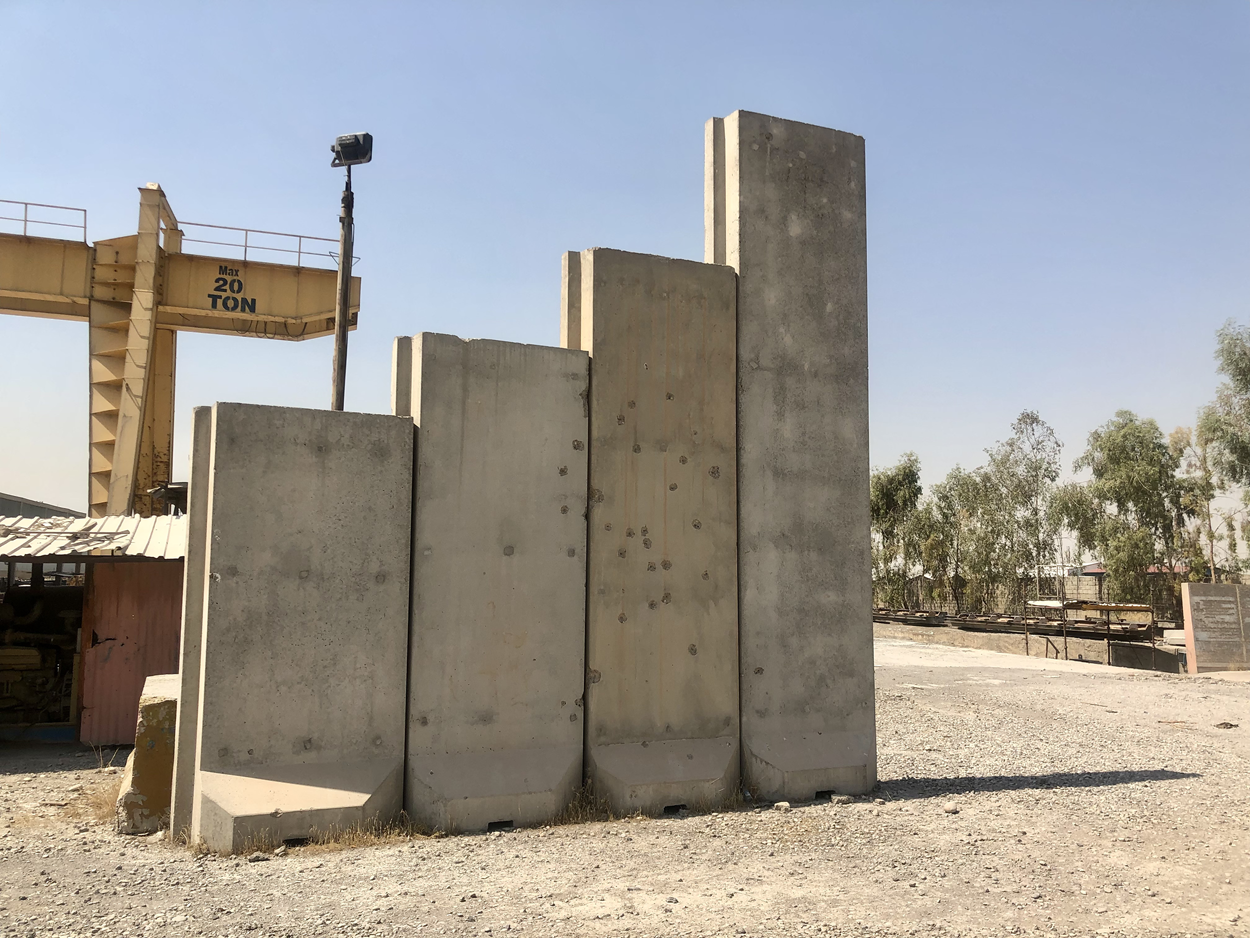
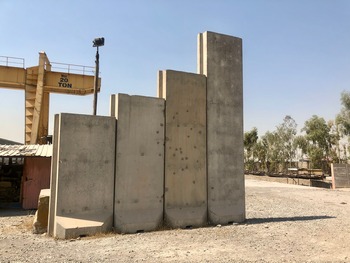
Standing inside a t-wall factory in Erbil in the summer of 2021, I was struck by the fact that, nearly twenty years after the US invasion of Iraq, these military walls were still in production. T-walls are six-ton steel-reinforced, blast-proof concrete wall segments named for their upside-down t-shape (Fig. 1). They were introduced to Afghanistan and Iraq in the early 2000s. Derivative of the Berlin wall's design, they are recognizable to those who have witnessed the Israeli separation wall, which is composed of thousands of t-walls lined up.
T-wall factory, northern Iraq, 2021. Photograph by the author.
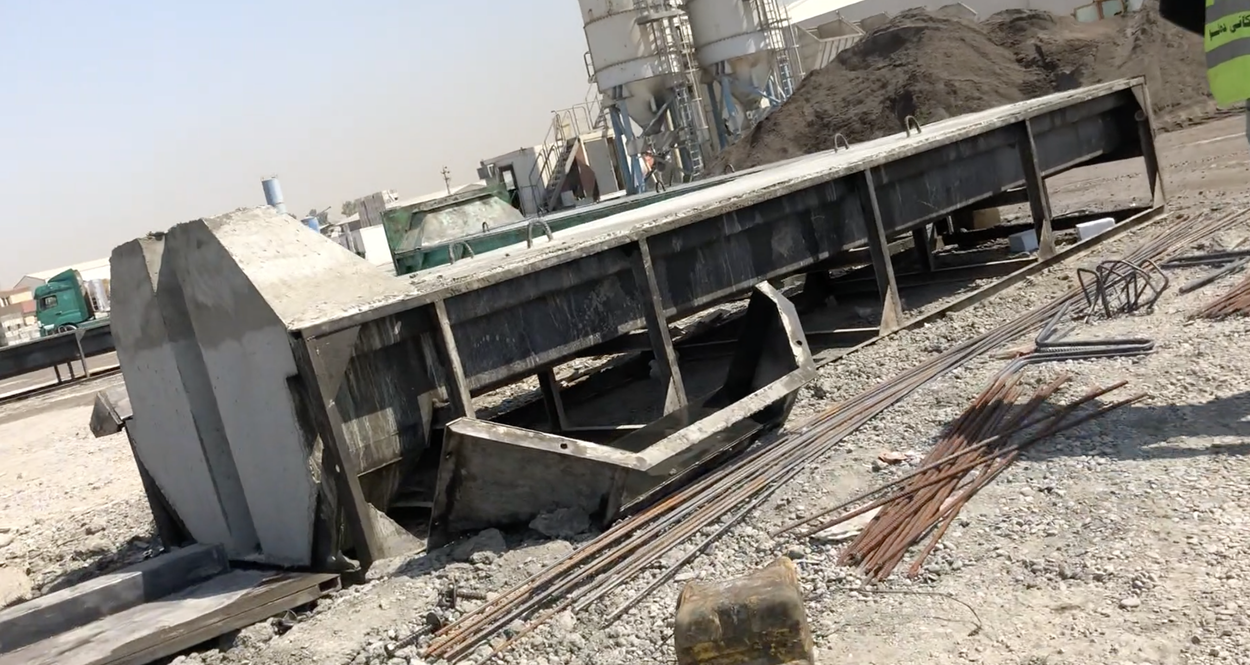
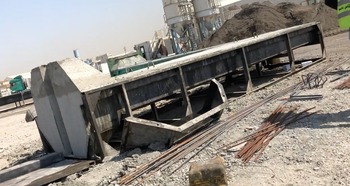
Aside from the thrill of photographing a slab of concrete that I was not supposed to photograph and seeing the mundane simplicity of its production, I also was pleased by other thrills: I felt rebellious being an Arab in a place with a “no Arab employees” policy centered around a logic of racial danger. I also was thrilled to find a missing link between the extractive cement industry in Bazian valley that is killing crops and lungs, and the implementation of t-walls at checkpoints and in neighborhoods in Baghdad and Fallujah where their violence becomes visibly actionable. Here, I was witnessing these hideous grey moths in their cocoons, fully formed but still wet, before they spread out across the landscape of Iraq (Fig. 2). This was a place where the “War on Terror” materialized.
A t-wall in its mold, northern Iraq, 2021. Photograph by the author.
I had finally found this relatively hidden source of t-walls after researching the military-cement industrial complex in Iraq starting in the early 2000s. Currently, three companies produce t-walls in Iraq, with aggressive secrecy. This secrecy has to do with corporate competition and special formulas but also with a security logic so layered that the security for protecting security walls requires its own set of security walls. Why such a redundancy? Partly because the “War on Terror” produces excessive ways of chasing its own tail, generating threats in order to stop them.Footnote 1
But also, because t-walls are special. T-walls are not really walls so much as they are concrete soldiers, nonhuman beings whose functions extend well beyond the basics of a wall. They operationalize logics of remote-imperialism, speed, and social division.
Over the past few years, the demand for t-walls has expanded from exclusively military consumption to include embassies and municipal compounds, a shift reflective of how the “War on Terror” weaves itself into increasingly ordinary architectures. At this stage in its development, the “War on Terror” is not just a set of doctrines and methods but also a landscaping project shaping material encounters far beyond the immediacy of war and counterinsurgency. In fact, the “War on Terror” has become a paradigm by which not only contestation but also “peace” is conceived and constructed.
The “War on Terror” is Material
I learned from a local factory manager that the batch of t-walls I was standing in front of was ordered by “the US” four months in advance. Although t-walls can be deployed on a landscape rapidly—overnight, in fact—their actual production cannot be. They take time to build, and so they offer indexes of premeditation. A batch of t-walls ordered today for deployment four months from now indicates directionality, maybe even intentionality. What might attention to such material things bring to the politics and ethics of researching and writing on the “War on Terror”?
Rather than using a paradigm, I propose defining the “War on Terror” as an object of material attention. From critiques of Orientalist, Islamophobic narratives to identifying systematic effects of international and national lawmaking, much of the scholarship on the “War on Terror” operates in the realm of the discursive, addressing its rhetoric and laws and its social implications.Footnote 2 Other scholarship on the genealogy of the “War on Terror” defines it in terms of its historical precedents or its ways of blurring the boundaries between militarism and policing, both new and borrowed.Footnote 3
Forensic approaches to the “War on Terror” require analyzing it materially, rather than discursively. Those who follow bodies show how the “War on Terror” produces mass displacement and might be imagined as a displacement machine, part of a militarized global apartheid in which certain laboring groups are both needed and prevented from moving, physically included but legally excluded. In this way, Muslim mobility is policed.Footnote 4 For other scholars, myself included, the primary interlocutors are not always people, but instead material objects that help define the “War on Terror.” Focusing on forensic implications, these scholars seek to aggregate the global diffusions of violence of the “War on Terror” in ways that point back to geopolitical actors like the state or global systems like supply chains.Footnote 5 The circulation of scrap metal, munitions, or cash demonstrates the particularities and material effects of a global, even universalist project like the “War on Terror” as it intersects with capitalism.Footnote 6 Joseph Masco offers a materialist model to define the “War on Terror.”Footnote 7 Attending to the number of nuclear warheads in the world, Masco makes a case that the Cold War never ended and that the “War on Terror” is in fact Cold War 2.0. Approaching the “War on Terror” materially not only activates nuanced understandings of what it means and to whom; it also can alter the timeline of when a “war” begins and ends.
The “War on Terror” is a Landscaping Project
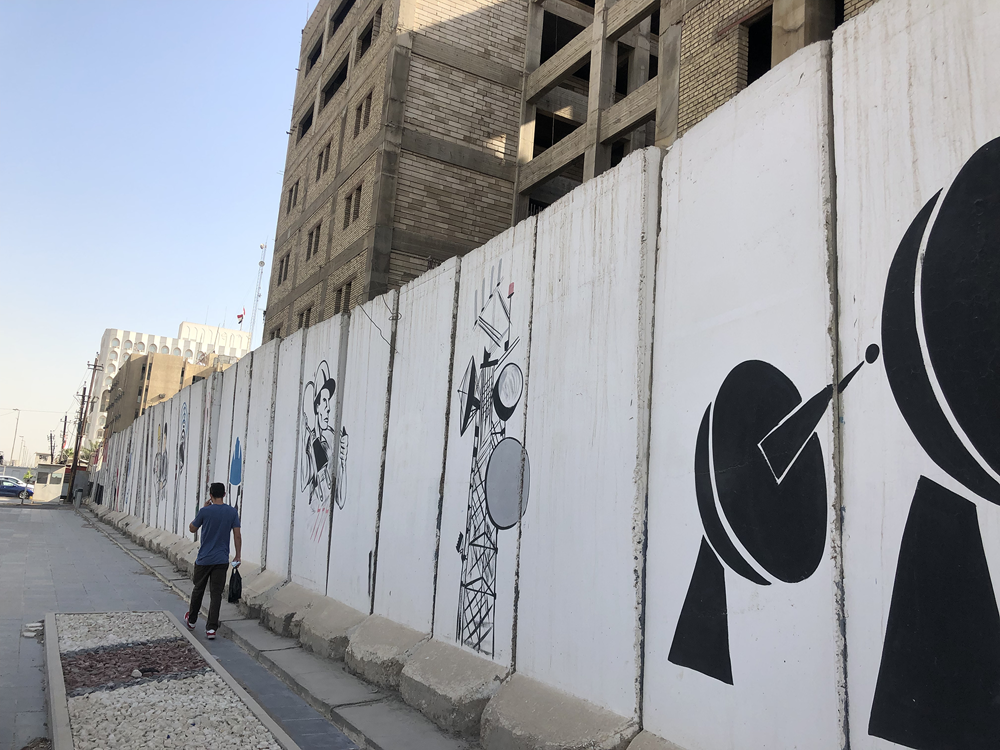
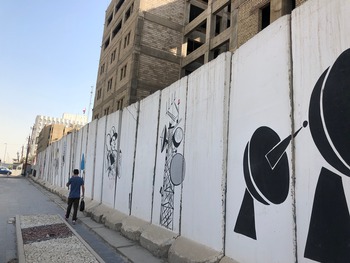
If the Cold War landscape is one in which strontium lines all bones and nuclear warheads remain in arsenals, then the landscape of the “War on Terror” includes these, but also objects like drones, militarized police gear, and base proliferation.Footnote 8 The landscape of this war is shaped not by the bunkers and trenches of World War I and World War II, but by domesticized architectures inclusive of military detritus in waste spaces and in public spaces that absorb t-walls, barbed wire barriers, and surveillance technologies (Fig. 3).Footnote 9
T-walls in Baghdad, 2021. Photograph by the author.
Approaching it as a landscaping project allows us to locate the “War on Terror” in places otherwise unrecognized as such. T-walls were introduced to Iraq after 2003, when the US military securitized the landscape for its own bases, but also walled off neighborhoods in urban areas in response to sectarian violence. In fact, this process materialized a sectarian landscape dividing Iraqis into deeper segregation.Footnote 10 Over a short time, Iraq became an archipelago of t-walled enclaves, which now often appear more and more as if they offer protection from the world they have produced. Over time, peace appears to be predicated on separation, on the diminishment of mutual exposure.
This reflects a broader truth about how, when approached materially, the “War on Terror” extends itself into peace via constructive violence: the model of peace offered by the “War on Terror” is a landscape built for potential war at all times in all places.Footnote 11 T-walls and their ongoing production reveal the myriad ways postwar construction manifests a militarized vision of peace.Footnote 12 That which is constructed appears as a source of security, rather than as a central mechanism for social disruption. My interest in cement and concrete has to do with its mundane-ness, its seeming neutrality as a technology of this constructive violence. What t-walls really do is constitute the material framework for structural violence, branded as peaceful, defensive, and the norm. This is not unlike what Jason DeLeon shows in demonstrating how Prevention Through Deterrence (also a landscaping project) naturalizes violence by letting the landscape do the killing of migrants crossing the US–Mexico border.Footnote 13 As a landscaping project, the “War on Terror” builds warscapes, landscapes transformed and affixed to the project of militarization.
Military leaders like generals David Petraeus and James Mattis were aware of how landscapes are multipliers of force, and how human relations are situated in material landscapes.Footnote 14 The Human Terrain System, which was oriented to both geographic and social cartographies, was engaged in winning Iraqi and Afghani hearts and minds, but also mapping the relationship between social groups and Iraq's diverse ecologies (see Shah Mahmoud Hanifi's contribution to this roundtable). In other words, the practitioners and theorists of the “War on Terror” both imagined and made Iraq's landscape in the image of a warscape.
But, as Jennifer Fluri argues, the warscape is a spatial arrangement of things like bombs, bodies, and barricades, which produce lived social conditions unique from how they may be imagined discursively from above.Footnote 15 From below, this infusion of geopolitical war and peace into the landscape makes the “War on Terror” more granular, and more lasting, not as an aftermath to battles, but rather as a core component of the project. In Iraq, the “War on Terror” infuses militarism into daily life, not necessarily in new ways. As some of my interlocutors in Iraq mentioned, t-walls not only disrupt their navigation, they also signal disinvitation. In Baghdad, one cannot get anywhere without t-walls carving off elite spaces from the public. The fact that t-walls are now being ordered by municipalities, embassies, and other spaces that were formerly accessible public institutions, speaks to the stratified and limited condition of democratic potential. Since the 2018 protests in Iraq—which called for an end to imperialism and corruption in a country where government institutions do not feel accountable to the people—more t-walls are on order to maintain the prevailing spatial modality of “peaceful” public life in which all landscapes can be activated into warscapes. In this way the “War on Terror” echoes in forums of public life, integrated into coercive landscapes via construction.
The “War on Terror” Elides Construction and Peace
The “War on Terror” echoes many imperial landscaping projects that militarize order and peace by infusing structural violence into construction.Footnote 16 Approached materially, forensically, and without narrative attachment, t-walls are but one example of how the “War on Terror” constructs peace by stabilizing warfare as a basic condition of order, an order whose disruption is framed as violence.
Construction for the sake of structural violence upholds the imperial logic that dismantlement and destruction are problematic whereas creation and construction are always good. This logic normalizes structural violence, fetishizing construction and its objects. It also criminalizes destruction and dismantlement: what statues and monuments are protected and why? What are the costs of tearing them down?
T-walls, military objects with few to no other possible functions, make quite visible how violent construction can be. As a consequence, built into the architecture and landscape of the so-called postwar is perpetual potential for the next war. Construction reveals the priorities set on a landscape. In Fallujah today, a new shopping mall just opened, but many homes remain bullet-pocked or dilapidated. Checkpoints are everywhere, surrounded by t-walls and operated by al-Hashed militias and the Iraqi army. From a material perspective, what gets rebuilt and what remains neglected during times of stability reflects the militarization of priorities in Iraq.
If one looks at the violence of the “War on Terror” as a material project of building, then the permanent infrastructure of warfare, writ large, requires different points of intervention, different kinds of disruption. To center construction is to attend to the overlooked, to pay attention to the disruptive violence of both the “War on Terror” and its targets in material form. As I look at t-walls, at these concrete columns and the resources that go into their being made “blast proof” and “defensive” and also “soldier-like,” I think of Yousef Baker's discussion, in this roundtable, of reversing the arrow on conditional sovereignty. Flipping that script, and taking it to a logical extreme, may mean seriously analyzing something like 9/11 as an attack on material structures representing centers of World Trade and global militarism.
What would happen to our analysis if we treated the twin towers falling not as a destruction-taboo, but as a scene of crumbling concrete without fetish, without unconditional and unidirectional safety and sovereignty? What happens to our conception of peace when we think materially about the violent relationship between peace and construction?
As the “War on Terror” disappears into forms of constructive continuity, embedded into the very fabric and architecture of spatial and social order, it becomes increasingly urgent to highlight and make visible what it does. One thing it does is to landscape: to shape the contours of material and social life as a core and enduring component of how it structures relations of power. A materialist approach focuses on the “War on Terror”'s physical mechanisms and physical consequences, broadening the scope of where and when it is considered to exist and persist.

 Open access

