





1 Introduction
Cantor proved that all countable dense unbounded linear orders are isomorphic. The countability hypothesis in Cantor’s result cannot be avoided in general. However, in the early 1970s, Baumgartner proved that consistently all $\aleph _1$
-dense separable linear orders are isomorphic [Reference Baumgartner4]. This statement is known as Baumgartner’s axiom. In their work [Reference Abraham and Shelah2], Abraham and Shelah introduced entangled linear orders as combinatorial objects witnessing the failure of Baumgartner’s axiom.
$\aleph _1$
-dense separable linear orders are isomorphic [Reference Baumgartner4]. This statement is known as Baumgartner’s axiom. In their work [Reference Abraham and Shelah2], Abraham and Shelah introduced entangled linear orders as combinatorial objects witnessing the failure of Baumgartner’s axiom.
An uncountable linear order L is said to be n-entangled, for some positive integer $n> 0$
, if for every uncountable collection F of increasing, pairwise disjoint n-tuples of elements of L and for every
$n> 0$
, if for every uncountable collection F of increasing, pairwise disjoint n-tuples of elements of L and for every $t \in {}^n 2$
, there are
$t \in {}^n 2$
, there are $x, y \in F$
such that, for every
$x, y \in F$
such that, for every $i < n$
,
$i < n$
, $x_i < y_i$
if and only if
$x_i < y_i$
if and only if $t_i = 0$
. A linear order is called entangled if it is n-entangled for every
$t_i = 0$
. A linear order is called entangled if it is n-entangled for every $n> 0$
(see Definition 2.1 for a more general definition).
$n> 0$
(see Definition 2.1 for a more general definition).
Entangled linear orders satisfy a strong form of rigidityFootnote
1
: they have no nontrivial self-embeddingsFootnote
2
(a linear order with this property was first constructed in [Reference Dushnik and Miller10]); actually, they do not even have nontrivial monotone self-maps; furthermore, every two disjoint uncountable subsets of an entangled linear order have different order types (a linear order with this property was first constructed, under $\mathsf {CH}$
, in [Reference Dushnik and Miller11]).
$\mathsf {CH}$
, in [Reference Dushnik and Miller11]).
Todorčević [Reference Todorčević29] showed that these linear orders provide a powerful method to construct counterexamples relative to various problems, such as the productivity of chain conditions and the square bracket partition relation. He also observed that every $2$
-entangled linear order is ccc and that every
$2$
-entangled linear order is ccc and that every $3$
-entangled linear order is separable (see Section 2). In particular, every entangled linear order is isomorphic to a suborder of the real line
$3$
-entangled linear order is separable (see Section 2). In particular, every entangled linear order is isomorphic to a suborder of the real line $\mathbb {R}$
. Therefore, when studying entangled linear orders, it is not restrictive to only consider sets of reals that are entangled with respect to their natural linear ordering. For recent applications of entangled linear orders, see, e.g., [Reference Bagaria3, Reference Chodounský and Zapletal7, Reference Guzmán and Todorčević17, Reference Miyamoto and Yorioka24].
$\mathbb {R}$
. Therefore, when studying entangled linear orders, it is not restrictive to only consider sets of reals that are entangled with respect to their natural linear ordering. For recent applications of entangled linear orders, see, e.g., [Reference Bagaria3, Reference Chodounský and Zapletal7, Reference Guzmán and Todorčević17, Reference Miyamoto and Yorioka24].
The existence of an entangled linear order is independent of $\mathsf {ZFC}$
: on the one hand, these linear orders exist under
$\mathsf {ZFC}$
: on the one hand, these linear orders exist under $\mathsf {CH}$
(actually, under
$\mathsf {CH}$
(actually, under $\mathrm {cf}(2^{\aleph _0}) = \omega _1$
) [Reference Bonnet and Shelah5, Reference Todorčević29]; on the other hand, they do not exist under Baumgartner’s axiom [Reference Abraham and Shelah2].
$\mathrm {cf}(2^{\aleph _0}) = \omega _1$
) [Reference Bonnet and Shelah5, Reference Todorčević29]; on the other hand, they do not exist under Baumgartner’s axiom [Reference Abraham and Shelah2].
In this article, we address the following natural questions:
-
(1) Does an n-entangled linear order need to be $(n+1)$
-entangled?
$(n+1)$
-entangled? -
(2) Is entangledness a topological property? That is to say, if we have two homeomorphic sets of reals
$A, B \subseteq \mathbb {R}$
with A entangled, does it follow that B is also entangled? -
(3) How definable can an entangled set of reals be?
-
(4) Under which conditions is there a
$2$
-entangled linear order which is not separable?


Our main results are as follows. The first two are instances of more general statements proved later, formulated with reference to cardinal characteristics of the continuum (see Theorems 3.1 and 4.1).
Theorem A. Assume $\mathsf {CH}$
. Then, for every
$\mathsf {CH}$
. Then, for every $n> 1$
, there exists an n-entangled set of reals which is not
$n> 1$
, there exists an n-entangled set of reals which is not $(n+1)$
-entangled.
$(n+1)$
-entangled.
Theorem B. Assume $\mathsf {CH}$
. Then, there are two homeomorphic sets of reals
$\mathsf {CH}$
. Then, there are two homeomorphic sets of reals $A,B\subseteq \mathbb {R}$
such that A is entangled but B is not
$A,B\subseteq \mathbb {R}$
such that A is entangled but B is not $2$
-entangled.
$2$
-entangled.
Recall that $\Pi ^0_1$
sets are complements of semirecursive sets, also called effectively open sets. Projections of
$\Pi ^0_1$
sets are complements of semirecursive sets, also called effectively open sets. Projections of $\Pi ^0_1$
sets are denoted
$\Pi ^0_1$
sets are denoted $\Sigma ^1_1$
, and their complements are the
$\Sigma ^1_1$
, and their complements are the $\Pi ^1_1$
sets. As we argue in Section 5, every analytic set of reals is not entangled. In this sense, our next result is optimal.
$\Pi ^1_1$
sets. As we argue in Section 5, every analytic set of reals is not entangled. In this sense, our next result is optimal.
Theorem C. Suppose that $ \mathbb {R}\subseteq \mathsf {L}$
. Then there exists a
$ \mathbb {R}\subseteq \mathsf {L}$
. Then there exists a $\Pi _1^1$
set of reals which is entangled.
$\Pi _1^1$
set of reals which is entangled.
Since, as we already noted, every $2$
-entangled linear order is ccc, a
$2$
-entangled linear order is ccc, a $2$
-entangled non-separable linear order is, in particular, a Suslin line. In particular, we conclude that
$2$
-entangled non-separable linear order is, in particular, a Suslin line. In particular, we conclude that $\mathsf {CH}$
—from which the existence of an entangled linear order follows—does not suffice to prove the existence of a
$\mathsf {CH}$
—from which the existence of an entangled linear order follows—does not suffice to prove the existence of a $2$
-entangled non-separable linear order. Indeed, it is well-known that Suslin’s Hypothesis is consistent with
$2$
-entangled non-separable linear order. Indeed, it is well-known that Suslin’s Hypothesis is consistent with $\mathsf {CH}$
[Reference Devlin and Johnsbråten9]. However, we prove that the existence of a
$\mathsf {CH}$
[Reference Devlin and Johnsbråten9]. However, we prove that the existence of a $2$
-entangled non-separable linear order follows from
$2$
-entangled non-separable linear order follows from $\diamondsuit $
. Note that the existence of such a linear order is already known to be consistent by a forcing argument due to Krueger [Reference Krueger21].
$\diamondsuit $
. Note that the existence of such a linear order is already known to be consistent by a forcing argument due to Krueger [Reference Krueger21].
Theorem D. Suppose that $\diamondsuit $
holds. Then, there exists a
$\diamondsuit $
holds. Then, there exists a $2$
-entangled non-separable linear order.
$2$
-entangled non-separable linear order.
The underlying general technique used to prove all four results is the diagonalization method. More precisely, the proofs of the first two theorems use a diagonalization argument à la Sierpiński (e.g., [Reference Sierpiński27, Reference Sierpiński and Zygmund28]). The proof of our third result uses a diagonalization argument similar to the construction (originally due to Gödel [Reference Kanamori19, p. 170]) of a $\Pi _1^1$
set without the perfect set property. Finally, the diagonalization construction of our fourth result is similar to the construction due to Jensen of a Suslin line under
$\Pi _1^1$
set without the perfect set property. Finally, the diagonalization construction of our fourth result is similar to the construction due to Jensen of a Suslin line under $\diamondsuit $
[Reference Devlin8, Reference Kunen22].
$\diamondsuit $
[Reference Devlin8, Reference Kunen22].
In Section 2 we provide a more general definition of entangled linear order and we give a brief account of what is known on this topic. Sections 3–6 are then devoted to the proofs of Theorems A–D. We provide some open questions along the way.
Notation. For most of our article the notation is standard (see, e.g., [Reference Jech18, Reference Kechris20]). Given two tuples s and t, we denote the concatenation of s with t by $s^\smallfrown t$
. In Section 5, following set-theoretic practice, we refer to elements of the Baire space
$s^\smallfrown t$
. In Section 5, following set-theoretic practice, we refer to elements of the Baire space ${}^\omega \omega $
as “reals,” and we employ some notation from [Reference Kanamori19].
${}^\omega \omega $
as “reals,” and we employ some notation from [Reference Kanamori19].
2 Preliminaries
There exists a more general notion of entangled linear order than the one we gave in the introduction, one that extends to cardinalities larger than the continuum. This more general definition (Definition 2.1) will be useful in our discussion.
We say that two tuples $x,y$
are disjoint if they have no element in common—that is, if
$x,y$
are disjoint if they have no element in common—that is, if $\mathrm {ran}(x) \cap \mathrm {ran}(y) = \emptyset $
.
$\mathrm {ran}(x) \cap \mathrm {ran}(y) = \emptyset $
.
Given a linear order $(L, \le )$
and two n-tuples e and
$(L, \le )$
and two n-tuples e and $e'$
of elements of L, we let
$e'$
of elements of L, we let $t(e,e') \in {}^n 2$
be the binary n-tuple defined as follows: for every
$t(e,e') \in {}^n 2$
be the binary n-tuple defined as follows: for every $i < n$
, the i-th element of
$i < n$
, the i-th element of $t(e,e')$
is
$t(e,e')$
is $1$
if and only if
$1$
if and only if $e^{\prime }_i < e_i$
.
$e^{\prime }_i < e_i$
.
For each $t \in {}^{<\omega } 2$
, we denote by
$t \in {}^{<\omega } 2$
, we denote by $\neg t$
the tuple
$\neg t$
the tuple $\langle 1-t_i \mid i < \text {length}(t)\rangle $
. Clearly, if the n-tuples e and
$\langle 1-t_i \mid i < \text {length}(t)\rangle $
. Clearly, if the n-tuples e and $e'$
are disjoint, then
$e'$
are disjoint, then $t(e,e') = \neg t(e', e)$
. We say that e and
$t(e,e') = \neg t(e', e)$
. We say that e and $e'$
realize s if either
$e'$
realize s if either $t(e,e') = s$
or
$t(e,e') = s$
or $t(e,e') = \neg s$
.
$t(e,e') = \neg s$
.
Given a set S of mutually disjoint n-tuples of elements of some linear order, and given a binary n-tuple t, we say that S avoids t if no couple of distinct elements of S realizes t. For each $n> 0$
, we call the n-tuple
$n> 0$
, we call the n-tuple $\langle 0\rangle ^n = \langle 0, 0, \dots , 0\rangle \in {}^n 2$
the increasing type.
$\langle 0\rangle ^n = \langle 0, 0, \dots , 0\rangle \in {}^n 2$
the increasing type.
We point out a trivial yet useful observation. The usual order $\leq $
on real numbers is closed but not open as a subset of
$\leq $
on real numbers is closed but not open as a subset of $\mathbb {R}^2$
and it becomes clopenFootnote
3
on
$\mathbb {R}^2$
and it becomes clopenFootnote
3
on $\mathbb {R}^2$
minus the diagonal. Therefore, for every
$\mathbb {R}^2$
minus the diagonal. Therefore, for every $t \in {}^n 2$
, the following (symmetric) binary relation
$t \in {}^n 2$
, the following (symmetric) binary relation $R_t$
on
$R_t$
on $\mathbb {R}^{2n}$
is open:
$\mathbb {R}^{2n}$
is open: $e \mathrel {R_t} e'$
if e and
$e \mathrel {R_t} e'$
if e and $e'$
are disjoint and realize t.
$e'$
are disjoint and realize t.
Definition 2.1 [Reference Abraham and Shelah2, Reference Todorčević29].
Given a linear order $(L, \le )$
, an infinite cardinal
$(L, \le )$
, an infinite cardinal $\kappa ,$
and a positive integer
$\kappa ,$
and a positive integer $n> 0$
, we say that L is
$n> 0$
, we say that L is $(\kappa , n)$
-entangled if
$(\kappa , n)$
-entangled if $|L| \ge \kappa $
and for every collection F of size
$|L| \ge \kappa $
and for every collection F of size $\kappa $
of 1–1 mutually disjoint n-tuples of L and for every binary n-tuple t, there are two distinct elements of F that realize t. A linear order which is
$\kappa $
of 1–1 mutually disjoint n-tuples of L and for every binary n-tuple t, there are two distinct elements of F that realize t. A linear order which is $(\kappa , n)$
-entangled for every
$(\kappa , n)$
-entangled for every $n> 0$
is said to be
$n> 0$
is said to be $\kappa $
-entangled. If
$\kappa $
-entangled. If $\kappa $
is not mentioned, it is assumed that
$\kappa $
is not mentioned, it is assumed that $\kappa = \aleph _1$
.
$\kappa = \aleph _1$
.
We now state some known theorems regarding entangled linear orders. The first one is about some topological consequences of entangledness. In particular, it implies that every $3$
-entangled linear order is isomorphic to a set of reals. This theorem is stated without proof in [Reference Todorčević29]. For a proof, we refer the reader to [Reference Krueger21].
$3$
-entangled linear order is isomorphic to a set of reals. This theorem is stated without proof in [Reference Todorčević29]. For a proof, we refer the reader to [Reference Krueger21].
Theorem 2.2 [Reference Todorčević29].
Every $2$
-entangled linear order is ccc, and every
$2$
-entangled linear order is ccc, and every $3$
-entangled linear order is separable.
$3$
-entangled linear order is separable.
Corollary 2.3. Every $3$
-entangled linear order is isomorphic to a suborder of
$3$
-entangled linear order is isomorphic to a suborder of $\mathbb {R}$
.
$\mathbb {R}$
.
Proof. Every $2$
-entangled linear order has countably many gapsFootnote
4
: otherwise, letting
$2$
-entangled linear order has countably many gapsFootnote
4
: otherwise, letting $\{ (a_\xi , b_\xi ) \mid \xi < \omega _1\}$
be an uncountable family of gaps, the map
$\{ (a_\xi , b_\xi ) \mid \xi < \omega _1\}$
be an uncountable family of gaps, the map $a_\xi \mapsto b_\xi $
would be uncountable, 1–1 and increasing, against
$a_\xi \mapsto b_\xi $
would be uncountable, 1–1 and increasing, against $2$
-entangledness of the underlying linear order.
$2$
-entangledness of the underlying linear order.
Therefore, it follows from the classical Dedekind completion argument that every $3$
-entangled linear order, being separable and having countably many gaps, is isomorphic to a suborder of
$3$
-entangled linear order, being separable and having countably many gaps, is isomorphic to a suborder of $\mathbb {R}$
.
$\mathbb {R}$
.
The next theorem is an example of the numerous applications of entangled linear orders as studied by Shelah, Todorčević, and others (see, e.g., [Reference Bonnet and Shelah5, Reference Chapital6, Reference Shafir and Shelah25, Reference Shelah26, Reference Todorčević29]).
Theorem 2.4 [Reference Todorčević29].
If there is an entangled linear order, then there are two ccc partial orders whose product is not ccc.
The next results are mainly concerned with the existence or nonexistence of entangled linear orders:
-
• There exists a
$\mathrm {cf}(2^{\aleph _0})$
-entangled linear order [Reference Bonnet and Shelah5, Reference Todorčević29]. -
• Adding a single Cohen real or random real adds an entangled linear order [Reference Todorčević30, p. 55].
-
• It follows from the Open Graph Axiom that there are no
$2$
-entangled sets of reals [Reference Todorčević30, Proposition 8.4]. -
• It follows from
$\mathsf {MA}(\aleph _1)$
that there are no entangled linear orders [Reference Abraham and Shelah2]. -
• It is consistent, relative to
$\mathsf {ZF}$
, that
$\mathsf {MA}(\aleph _1)$
holds and that, for every
$n> 0$
, there is an n-entangled set of reals [Reference Abraham, Rubin and Shelah1].


Next, we note that it directly follows from the Erdős–Dushnik–Miller theorem [Reference Dushnik and Miller11] (see also [Reference Jech18, Theorem 9.7] for a proof) that the definition of $(\kappa , n)$
-entangled linear order is equivalent to the seemingly stronger version in which we do not only require the existence of just two distinct elements of F to realize the given type t, but we ask for the existence of an infinite subset of F whose elements, mutually, realize t.
$(\kappa , n)$
-entangled linear order is equivalent to the seemingly stronger version in which we do not only require the existence of just two distinct elements of F to realize the given type t, but we ask for the existence of an infinite subset of F whose elements, mutually, realize t.
Theorem 2.5 (Erdős–Dushnik–Miller).
Any infinite graph $G = (V, E)$
not containing an independent set of size
$G = (V, E)$
not containing an independent set of size $|V|$
contains an infinite complete subgraph.
$|V|$
contains an infinite complete subgraph.
Proposition 2.6. Let L be a $(\kappa , n)$
-entangled linear order. Then, for every collection F of size
$(\kappa , n)$
-entangled linear order. Then, for every collection F of size $\kappa $
of 1–1 mutually disjoint n-tuples of L and for every binary n-tuple t, there exists an infinite
$\kappa $
of 1–1 mutually disjoint n-tuples of L and for every binary n-tuple t, there exists an infinite $H\subseteq F$
such that for all distinct
$H\subseteq F$
such that for all distinct $e,e' \in H$
, e and
$e,e' \in H$
, e and $e'$
realize t.
$e'$
realize t.
Proof. Let us fix a $(\kappa , n)$
-entangled linear order L, a collection F of size
$(\kappa , n)$
-entangled linear order L, a collection F of size $\kappa $
of 1–1 mutually disjoint n-tuples of
$\kappa $
of 1–1 mutually disjoint n-tuples of $L,$
and a binary n-tuple t.
$L,$
and a binary n-tuple t.
Consider the binary relation $R_t$
on F defined by:
$R_t$
on F defined by: $e \mathrel {R_t} e'$
if e and
$e \mathrel {R_t} e'$
if e and $e'$
realize t. By entangledness, the graph
$e'$
realize t. By entangledness, the graph $(F, R_t)$
does not contain an independent set of size
$(F, R_t)$
does not contain an independent set of size $|F| = \kappa $
. Therefore, by the Erdős–Dushnik–Miller Theorem, the graph
$|F| = \kappa $
. Therefore, by the Erdős–Dushnik–Miller Theorem, the graph $(F, R_t)$
contains an infinite complete subgraph. In other words, there exists an infinite
$(F, R_t)$
contains an infinite complete subgraph. In other words, there exists an infinite $H\subseteq F$
such that for all distinct
$H\subseteq F$
such that for all distinct $e,e' \in H$
, e and
$e,e' \in H$
, e and $e'$
realize t.
$e'$
realize t.
Finally, let us provide a proof of the following proposition from [Reference Todorčević29, Section 1] that provides a criterion to show that a set $E\subseteq \mathbb {R}$
is
$E\subseteq \mathbb {R}$
is $(2^{\aleph _0}, n)$
-entangled.
$(2^{\aleph _0}, n)$
-entangled.
Proposition 2.7. Let $E\subseteq \mathbb {R}$
be a set of cardinality
$E\subseteq \mathbb {R}$
be a set of cardinality $2^{\aleph _0}$
. Assume that there exists an enumeration
$2^{\aleph _0}$
. Assume that there exists an enumeration $\langle r_\alpha \mid \alpha < 2^{\aleph _0}\rangle $
of E such that, for every continuous function f from a
$\langle r_\alpha \mid \alpha < 2^{\aleph _0}\rangle $
of E such that, for every continuous function f from a $G_\delta $
subset of
$G_\delta $
subset of $\mathbb {R}^{n-1}$
to
$\mathbb {R}^{n-1}$
to $\mathbb {R}$
, there exists an
$\mathbb {R}$
, there exists an $\alpha < 2^{\aleph _0}$
with
$\alpha < 2^{\aleph _0}$
with
 $$ \begin{align} f\big[\{r_\gamma \mid \gamma < \beta\}^{n-1}\big] \cap E \subseteq \{r_\gamma \mid \gamma < \beta\}, \end{align} $$
for all $\beta \ge \alpha $
. Then E is
$\beta \ge \alpha $
. Then E is $(2^{\aleph _0},n)$
-entangled.
$(2^{\aleph _0},n)$
-entangled.
Lemma 2.8. Let E be a $(2^{\aleph _0}, n)$
-entangled set of reals, for some
$(2^{\aleph _0}, n)$
-entangled set of reals, for some $n> 0$
, and let
$n> 0$
, and let $g:F \rightarrow E$
be a function with F being a subset of
$g:F \rightarrow E$
be a function with F being a subset of $E^n$
of cardinality
$E^n$
of cardinality $2^{\aleph _0}$
whose elements are 1–1 and pairwise disjoint. If g has
$2^{\aleph _0}$
whose elements are 1–1 and pairwise disjoint. If g has $2^{\aleph _0}$
-many discontinuity points, then any
$2^{\aleph _0}$
-many discontinuity points, then any $t \in {}^{n+1}2$
is realized by two distinct
$t \in {}^{n+1}2$
is realized by two distinct $x,y \in \mathrm {graph}(g)$
.
$x,y \in \mathrm {graph}(g)$
.
Proof. Let us assume without loss of generality that $E\subseteq [0,1]$
, and let
$E\subseteq [0,1]$
, and let ${G \subseteq [0,1]^{n+1}}$
be the closure of the graph of the map g.
${G \subseteq [0,1]^{n+1}}$
be the closure of the graph of the map g.
It follows from the compactness of the unit interval that for every $u \in F$
, u is a continuity point of g if and only if
$u \in F$
, u is a continuity point of g if and only if $|G_u| = 1$
or, equivalently,
$|G_u| = 1$
or, equivalently, $G_u = \{g(u)\}$
, where
$G_u = \{g(u)\}$
, where $G_u {:=}q \{y \in [0,1] \mid u^\smallfrown y \in G\}$
. We conclude from our hypothesis that there are
$G_u {:=}q \{y \in [0,1] \mid u^\smallfrown y \in G\}$
. We conclude from our hypothesis that there are $2^{\aleph _0}$
-many
$2^{\aleph _0}$
-many $u \in F$
with
$u \in F$
with $|G_u|> 1$
. Therefore, there must be a rational
$|G_u|> 1$
. Therefore, there must be a rational $q \in \mathbb {Q}$
and a subset
$q \in \mathbb {Q}$
and a subset $D\subseteq F$
of cardinality
$D\subseteq F$
of cardinality $2^{\aleph _0}$
such that, for every
$2^{\aleph _0}$
such that, for every $u \in D$
, there are
$u \in D$
, there are $a,b \in G_u$
with
$a,b \in G_u$
with $a < q < b$
.
$a < q < b$
.
Fix some $t \in {}^{n+1} 2$
and assume without loss of generality that
$t \in {}^{n+1} 2$
and assume without loss of generality that $t(n) = 0$
. By entangledness, there are
$t(n) = 0$
. By entangledness, there are $u,v \in D$
such that
$u,v \in D$
such that $t(u, v) = t \upharpoonright n$
. Then, by definition of D, we can pick
$t(u, v) = t \upharpoonright n$
. Then, by definition of D, we can pick $x,y \in F$
sufficiently close to u and v, respectively, such that
$x,y \in F$
sufficiently close to u and v, respectively, such that $g(x) < q < g(y)$
and
$g(x) < q < g(y)$
and $t(x, y) = t(u, v) = t \upharpoonright n$
. Therefore,
$t(x, y) = t(u, v) = t \upharpoonright n$
. Therefore, $x^\smallfrown g(x)$
and
$x^\smallfrown g(x)$
and $y^\smallfrown g(y)$
realize t.
$y^\smallfrown g(y)$
realize t.
Proof of Proposition 2.7.
We prove the proposition by induction on $n> 0$
. The base case
$n> 0$
. The base case $n = 1$
follows from the fact that E has cardinality
$n = 1$
follows from the fact that E has cardinality $2^{\aleph _0}$
. Suppose that
$2^{\aleph _0}$
. Suppose that $n> 1$
and fix an enumeration
$n> 1$
and fix an enumeration $\langle r_\alpha \mid \alpha < 2^{\aleph _0}\rangle $
of E that satisfies the hypothesis of the proposition. By the induction hypothesis, E is
$\langle r_\alpha \mid \alpha < 2^{\aleph _0}\rangle $
of E that satisfies the hypothesis of the proposition. By the induction hypothesis, E is $(2^{\aleph _0}, n-1)$
-entangled.
$(2^{\aleph _0}, n-1)$
-entangled.
Fix a collection F of $2^{\aleph _0}$
-many 1–1 pairwise disjoint n-tuples of elements of E. By passing to a subset of F, we can assume without loss of generality that all the tuples of F are increasing with respect to the fixed enumeration of E.
$2^{\aleph _0}$
-many 1–1 pairwise disjoint n-tuples of elements of E. By passing to a subset of F, we can assume without loss of generality that all the tuples of F are increasing with respect to the fixed enumeration of E.
Suppose, towards a contradiction, that F, seen as a function from a subset of $E^{n-1}$
to E, has less than
$E^{n-1}$
to E, has less than $2^{\aleph _0}$
-many discontinuity points. Then, passing to a subset if necessary, we can suppose that F is continuous. By Kuratowski’s extension theorem [Reference Kechris20, Theorem 3.8], there exists a continuous map
$2^{\aleph _0}$
-many discontinuity points. Then, passing to a subset if necessary, we can suppose that F is continuous. By Kuratowski’s extension theorem [Reference Kechris20, Theorem 3.8], there exists a continuous map $\tilde {f}$
from a
$\tilde {f}$
from a $G_\delta $
subset of
$G_\delta $
subset of $\mathbb {R}^{n-1}$
to
$\mathbb {R}^{n-1}$
to $\mathbb {R}$
that extends F. Since F has cardinality
$\mathbb {R}$
that extends F. Since F has cardinality $2^{\aleph _0}$
, and its elements are increasing with respect to the fixed enumeration of E, we conclude that for cofinally many
$2^{\aleph _0}$
, and its elements are increasing with respect to the fixed enumeration of E, we conclude that for cofinally many $\beta < 2^{\aleph _0}$
, the set
$\beta < 2^{\aleph _0}$
, the set $\tilde {f}[\{r_\gamma \mid \gamma < \beta \}^{n-1}] \cap E $
is not included in
$\tilde {f}[\{r_\gamma \mid \gamma < \beta \}^{n-1}] \cap E $
is not included in $\{r_\gamma \mid \gamma < \beta \}$
, against (1). Hence the contradiction.
$\{r_\gamma \mid \gamma < \beta \}$
, against (1). Hence the contradiction.
Therefore, F has $2^{\aleph _0}$
-discontinuity points. But then, by the
$2^{\aleph _0}$
-discontinuity points. But then, by the $(2^{\aleph _0}, n-1)$
-entangledness of E and Lemma 2.8, we conclude that every
$(2^{\aleph _0}, n-1)$
-entangledness of E and Lemma 2.8, we conclude that every $t \in {}^{n} 2$
is realized by a pair of elements of F. Thus, E is
$t \in {}^{n} 2$
is realized by a pair of elements of F. Thus, E is $(2^{\aleph _0}, n)$
-entangled.
$(2^{\aleph _0}, n)$
-entangled.
3 Separating n-entangledness
Theorem A is a direct consequence of the following theorem. Recall that $\mathrm {cov}(\mathcal {B})$
is the least cardinal
$\mathrm {cov}(\mathcal {B})$
is the least cardinal $\kappa $
such that a perfect Polish space (it does not matter which) can be expressed as the union of
$\kappa $
such that a perfect Polish space (it does not matter which) can be expressed as the union of $\kappa $
-many meager sets.
$\kappa $
-many meager sets.
Theorem 3.1. Assume $\mathrm {cov}(\mathcal {B}) = 2^{\aleph _0}$
. Then, for every
$\mathrm {cov}(\mathcal {B}) = 2^{\aleph _0}$
. Then, for every $n> 1$
, there exists a
$n> 1$
, there exists a $(2^{\aleph _0}, n)$
-entangled set of reals which is not
$(2^{\aleph _0}, n)$
-entangled set of reals which is not $(2^{\aleph _0}, n+1)$
-entangled.
$(2^{\aleph _0}, n+1)$
-entangled.
Lemma 3.2. For every $n> 1$
, there exists a countable set
$n> 1$
, there exists a countable set $D \subseteq \mathbb {R}^{n+1}$
of 1–1 mutually disjoint
$D \subseteq \mathbb {R}^{n+1}$
of 1–1 mutually disjoint $(n+1)$
-tuples of reals such that:
$(n+1)$
-tuples of reals such that:
-
(1) D avoids the increasing type.
-
(2) For every nonempty open
$U \subseteq \mathbb {R}^n$
, for every
$i< n$
, there are two disjoint
${e,e' \in D}$
such that:-
(2a)
$t(e,e') = \langle 0 \rangle ^i{}^\smallfrown \langle 1 \rangle {}^\smallfrown \langle 0 \rangle ^{n-i}$
. -
(2b)
$e \upharpoonright n$
and
$e' \upharpoonright n$
belong to U. -
(2c) There are two disjoint
$w,w' \in U$
that realize the increasing type and such that
$w_j = e_j$
and
$w^{\prime }_j = e^{\prime }_j$
for all
$j < n$
with
$j \neq i$
.
-


Proof. We define by induction a sequence $\langle (r_k^0, r_k^1) \mid k \in \omega \rangle $
of couples of
$\langle (r_k^0, r_k^1) \mid k \in \omega \rangle $
of couples of $(n+1)$
-tuples of reals such that the set
$(n+1)$
-tuples of reals such that the set $D = \{r_k^i \mid k\in \omega \text { and } i \in 2\}$
satisfies the desired properties.
$D = \{r_k^i \mid k\in \omega \text { and } i \in 2\}$
satisfies the desired properties.
Fix an enumeration $\langle U_k \mid k\in \omega \rangle $
of a countable basis of
$\langle U_k \mid k\in \omega \rangle $
of a countable basis of $\mathbb {R}^n$
. Fix also a surjective map
$\mathbb {R}^n$
. Fix also a surjective map $k \mapsto \langle (k)_0, (k)_1\rangle $
from
$k \mapsto \langle (k)_0, (k)_1\rangle $
from $\omega $
to
$\omega $
to $\omega \times n$
.
$\omega \times n$
.
Now we deal with the inductive construction of the sequence. Suppose we have defined $(r_m^0, r_m^1)$
for every
$(r_m^0, r_m^1)$
for every $m < k$
, towards defining
$m < k$
, towards defining $(r_k^0, r_k^1)$
, with the induction hypothesis being that
$(r_k^0, r_k^1)$
, with the induction hypothesis being that $D_k {:=}q \{r_m^i \mid m < k \text { and } i \in 2\}$
is a set of 1–1 mutually disjoint
$D_k {:=}q \{r_m^i \mid m < k \text { and } i \in 2\}$
is a set of 1–1 mutually disjoint $(n+1)$
-tuples that avoids the increasing type.
$(n+1)$
-tuples that avoids the increasing type.
For each n-tuple s of reals, let
 $$ \begin{align*} u_k(s) &{:=}q \min \{x \in \mathbb{R} \mid \exists w \in D_k \ (t(s, w \upharpoonright n) = \langle 1 \rangle^n \text{ and } w_n = x)\}\\ l_k(s) &{:=}q \max \{x \in \mathbb{R} \mid \exists w \in D_k \ (t(s, w \upharpoonright n) = \langle 0 \rangle^n \text{ and } w_n = x)\}, \end{align*} $$
where we use the convention that $\min \emptyset = +\infty $
and
$\min \emptyset = +\infty $
and $\max \emptyset = -\infty $
.
$\max \emptyset = -\infty $
.
Claim 3.2.1. $l_k(s) < u_k(s)$
for every s.
$l_k(s) < u_k(s)$
for every s.
Proof. If there is no $w \in D_k$
such that
$w \in D_k$
such that $t(s, w \upharpoonright n) = \langle 1\rangle ^n$
the claim trivially follows, and similarly if there is no
$t(s, w \upharpoonright n) = \langle 1\rangle ^n$
the claim trivially follows, and similarly if there is no $w' \in D_k$
such that
$w' \in D_k$
such that $t(s, w' \upharpoonright n) = \langle 0\rangle ^n$
. So we can assume that such w and
$t(s, w' \upharpoonright n) = \langle 0\rangle ^n$
. So we can assume that such w and $w'$
exist and fix them. Clearly,
$w'$
exist and fix them. Clearly, $w \neq w'$
and
$w \neq w'$
and $t(w \upharpoonright n, w' \upharpoonright n) = \langle 0\rangle ^n$
. By the induction hypothesis, w and
$t(w \upharpoonright n, w' \upharpoonright n) = \langle 0\rangle ^n$
. By the induction hypothesis, w and $w'$
do not realize the increasing type. Thus, we must have
$w'$
do not realize the increasing type. Thus, we must have $w^{\prime }_n < w_n$
. It directly follows from the definition of u and l that
$w^{\prime }_n < w_n$
. It directly follows from the definition of u and l that $l_k(s) < u_k(s)$
.
$l_k(s) < u_k(s)$
.
Since $D_k$
is finite, we can pick two 1–1 disjoint tuples
$D_k$
is finite, we can pick two 1–1 disjoint tuples $p, q \in U_{(k)_0}$
such that:
$p, q \in U_{(k)_0}$
such that:
-
(a)
$(\mathrm {ran}(p) \cup \mathrm {ran}(q)) \cap \bigcup _{w \in D_k} \mathrm {ran}(w) = \emptyset $
. -
(b)
$t(p,q) = \langle 0 \rangle ^{(k)_1}{}^\smallfrown \langle 1 \rangle {}^\smallfrown \langle 0 \rangle ^{n-1-(k)_1}$
. -
(c)
$l_k(p) = l_k(q)$
and
$u_k(p) = u_k(q)$
. -
(d) Letting
$\tilde {p},\tilde {q} \in \mathbb {R}^n$
be such that
$\tilde {p}_j = p_j$
and
$\tilde {q}_j = q_j$
for all
$j \neq (k)_1$
and
$\tilde {p}_{(k)_1} = q_{(k)_1}$
and
$\tilde {q}_{(k)_1} = p_{(k)_1}$
, we have
$\tilde {p},\tilde {q} \in U_{(k)_0}$
.


Indeed, by the finitude of $D_k$
, we can always find a nonempty open set
$D_k$
, we can always find a nonempty open set $V\subseteq U_{(k)_0}$
such that
$V\subseteq U_{(k)_0}$
such that $\mathrm {ran}(s) \cap \bigcup _{w \in D_k} \mathrm {ran}(w) = \emptyset $
for all
$\mathrm {ran}(s) \cap \bigcup _{w \in D_k} \mathrm {ran}(w) = \emptyset $
for all $s \in V$
; furthermore, to satisfy (c) and (d) we just need to choose, in
$s \in V$
; furthermore, to satisfy (c) and (d) we just need to choose, in $U_{(k)_0}$
, p and q so that they are close enough (e.g., with respect to the Euclidean metric on
$U_{(k)_0}$
, p and q so that they are close enough (e.g., with respect to the Euclidean metric on $\mathbb {R}^n$
); thus, any two 1–1, disjoint, close enough p and q realizing
$\mathbb {R}^n$
); thus, any two 1–1, disjoint, close enough p and q realizing $\langle 0 \rangle ^{(k)_1}{}^\smallfrown \langle 1 \rangle {}^\smallfrown \langle 0 \rangle ^{n-1-(k)_1}$
taken inside V will satisfy (a)–(d).
$\langle 0 \rangle ^{(k)_1}{}^\smallfrown \langle 1 \rangle {}^\smallfrown \langle 0 \rangle ^{n-1-(k)_1}$
taken inside V will satisfy (a)–(d).
Again by the finitude of $D_k$
, we can pick
$D_k$
, we can pick $x,y \in (l_k(p), u_k(p))$
with
$x,y \in (l_k(p), u_k(p))$
with $x < y$
such that
$x < y$
such that $x,y \not \in \bigcup _{w \in D_k} \mathrm {ran}(w)\cup \mathrm {ran}(p) \cup \mathrm {ran}(q)$
. Set
$x,y \not \in \bigcup _{w \in D_k} \mathrm {ran}(w)\cup \mathrm {ran}(p) \cup \mathrm {ran}(q)$
. Set $r_k^0 = p^\smallfrown \langle x\rangle $
and
$r_k^0 = p^\smallfrown \langle x\rangle $
and $r_k^1 = q^\smallfrown \langle y\rangle $
. Clearly,
$r_k^1 = q^\smallfrown \langle y\rangle $
. Clearly, $r_k^0$
and
$r_k^0$
and $r_k^1$
realize
$r_k^1$
realize $\langle 0 \rangle ^{(k)_1}{}^\smallfrown \langle 1 \rangle {}^\smallfrown \langle 0 \rangle ^{n-(k)_1}$
.
$\langle 0 \rangle ^{(k)_1}{}^\smallfrown \langle 1 \rangle {}^\smallfrown \langle 0 \rangle ^{n-(k)_1}$
.
It follows from the choices of $p,q,x,y$
that
$p,q,x,y$
that $D_{k+1} = D_k \cup \{r_k^0, r_k^1\}$
is still a set of 1–1 mutually disjoint
$D_{k+1} = D_k \cup \{r_k^0, r_k^1\}$
is still a set of 1–1 mutually disjoint $(n+1)$
-tuples that avoids the increasing type, and (d) guarantees that
$(n+1)$
-tuples that avoids the increasing type, and (d) guarantees that $\tilde {p}$
and
$\tilde {p}$
and $\tilde {q}$
are in
$\tilde {q}$
are in $U_{(k)_0}$
and realize the increasing type, thus ensuring
$U_{(k)_0}$
and realize the increasing type, thus ensuring $(2c)$
. This finishes the inductive construction. It is straightforward to check that the set D as defined satisfies the desired properties.
$(2c)$
. This finishes the inductive construction. It is straightforward to check that the set D as defined satisfies the desired properties.
Proof of Theorem 3.1.
Fix a set D of $(n+1)$
-tuples that satisfies the statement of Lemma 3.2. Fix also an enumeration
$(n+1)$
-tuples that satisfies the statement of Lemma 3.2. Fix also an enumeration $\langle f_\alpha \mid \alpha < 2^{\aleph _0}\rangle $
of the continuous functions from
$\langle f_\alpha \mid \alpha < 2^{\aleph _0}\rangle $
of the continuous functions from $G_\delta $
subsets of
$G_\delta $
subsets of $\mathbb {R}^{n-1}$
to
$\mathbb {R}^{n-1}$
to $\mathbb {R}$
. We can assume that
$\mathbb {R}$
. We can assume that $f_0(s) = s_0$
for every
$f_0(s) = s_0$
for every $s \in \mathbb {R}^{n-1}$
.
$s \in \mathbb {R}^{n-1}$
.
We define inductively a sequence $\langle r_\alpha \mid \alpha < 2^{\aleph _0} \rangle $
of 1–1 mutually disjoint
$\langle r_\alpha \mid \alpha < 2^{\aleph _0} \rangle $
of 1–1 mutually disjoint $(n+1)$
-tuples of reals that avoids the increasing type, but such that the set
$(n+1)$
-tuples of reals that avoids the increasing type, but such that the set $ E {:=}q \bigcup _{\alpha < 2^{\aleph _0}} \mathrm {ran}(r_\alpha )$
is
$ E {:=}q \bigcup _{\alpha < 2^{\aleph _0}} \mathrm {ran}(r_\alpha )$
is $(2^{\aleph _0}, n)$
-entangled. In particular, E is a
$(2^{\aleph _0}, n)$
-entangled. In particular, E is a $(2^{\aleph _0}, n)$
-entangled set of reals which is not
$(2^{\aleph _0}, n)$
-entangled set of reals which is not $(2^{\aleph _0}, n+1)$
-entangled.
$(2^{\aleph _0}, n+1)$
-entangled.
Suppose we have defined $r_\beta $
for every
$r_\beta $
for every $\beta < \alpha $
towards defining
$\beta < \alpha $
towards defining $r_\alpha $
, with the induction hypothesis being that the set
$r_\alpha $
, with the induction hypothesis being that the set
 $$\begin{align*}P_\alpha {:=}q D \cup \{r_\beta \mid \beta < \alpha\} \end{align*}$$
is a set of 1–1 mutually disjoint $(n+1)$
-tuples that avoids the increasing type (for the base case
$(n+1)$
-tuples that avoids the increasing type (for the base case $\alpha = 0$
, this is guaranteed by Lemma 3.2). Let
$\alpha = 0$
, this is guaranteed by Lemma 3.2). Let
 $$\begin{align*}Q_\alpha {:=}q \bigcup_{w \in P_{\alpha}} \mathrm{ran}(w), \end{align*}$$
and
 $$ \begin{align*} A_\alpha {:=}q\ &\big\{s \in \mathbb{R}^n \mid \exists i < n \ \exists \beta \le \alpha \ \exists u \in (Q_\alpha \cup \mathrm{ran}(s \upharpoonright i))^{n-1} \\ &\text{ such that }s_i = f_\beta(u)\big\}. \end{align*} $$
Furthermore, for each $s \in \mathbb {R}^n$
let
$s \in \mathbb {R}^n$
let
 $$ \begin{align*} u_\alpha(s) &{:=}q \inf \{x \in \mathbb{R} \mid \exists w \in P_\alpha \ (t(s, w \upharpoonright n) = \langle 1 \rangle^n \text{ and } w_n = x)\},\\[0.4em] l_\alpha(s) &{:=}q \sup \{x \in \mathbb{R} \mid \exists w \in P_\alpha \ (t(s, w \upharpoonright n) = \langle 0 \rangle^n \text{ and } w_n = x)\}. \end{align*} $$
By an argument analogous to the one used in Claim 3.2.1, we can show that ${l_\alpha (s) \le u_\alpha (s)}$
for every
${l_\alpha (s) \le u_\alpha (s)}$
for every $s \in \mathbb {R}^n$
. Next, we prove the following two claims, the second of which is key.
$s \in \mathbb {R}^n$
. Next, we prove the following two claims, the second of which is key.
Claim 3.2.2. $A_\alpha $
is the union of
$A_\alpha $
is the union of ${<}2^{\aleph _0}$
-many nowhere dense sets.
${<}2^{\aleph _0}$
-many nowhere dense sets.
Proof. Consider the following map:
 $$ \begin{align*} g:\mathbb{R}^{n} \times (Q_\alpha \cup n)^{n-1} &\longrightarrow \mathbb{R}^{n-1}\\ (s, c) &\longmapsto w\text{, where } w_i {:=}q \begin{cases} c_i &\text{ if } c_i \in Q_\alpha,\\ s_j &\text{ if } c_i=j < n. \end{cases} \end{align*} $$
Clearly, for any fixed $c \in (Q_\alpha \cup n)^{n-1}$
, the map
$c \in (Q_\alpha \cup n)^{n-1}$
, the map $g({\cdot }, c) : \mathbb {R}^n \rightarrow \mathbb {R}^{n-1}$
is continuous. It suffices to show that given any fixed
$g({\cdot }, c) : \mathbb {R}^n \rightarrow \mathbb {R}^{n-1}$
is continuous. It suffices to show that given any fixed $i <n, \beta < \alpha ,$
and
$i <n, \beta < \alpha ,$
and $c \in (Q_\alpha \cup i)^{n-1}$
, the set of all those
$c \in (Q_\alpha \cup i)^{n-1}$
, the set of all those $s \in \mathbb {R}^n$
such that
$s \in \mathbb {R}^n$
such that $s_i = f_\beta \circ g(s, c)$
is nowhere dense. But this is a direct consequence of the continuity of
$s_i = f_\beta \circ g(s, c)$
is nowhere dense. But this is a direct consequence of the continuity of $f_\beta $
and of
$f_\beta $
and of $g({\cdot }, c)$
.
$g({\cdot }, c)$
.
Claim 3.2.3. There exists an $s \in \mathbb {R}^n \setminus A_\alpha $
and an
$s \in \mathbb {R}^n \setminus A_\alpha $
and an $x \in \mathbb {R}$
such that
$x \in \mathbb {R}$
such that
-
(1)
$l_\alpha (s) \le x \le u_\alpha (s)$
. -
(2) For all
$u \in (Q_\alpha \cup \mathrm {ran}(s))^{n-1}$
, for all
$\beta \le \alpha $
,
$f_\beta (u) \neq x$
.


Proof. If there were an $s \in \mathbb {R}^n \setminus A_\alpha $
such that
$s \in \mathbb {R}^n \setminus A_\alpha $
such that $l_\alpha (s) < u_\alpha (s)$
we would be done. Indeed, since there are only
$l_\alpha (s) < u_\alpha (s)$
we would be done. Indeed, since there are only ${<}2^{\aleph _0}$
-many possible
${<}2^{\aleph _0}$
-many possible $u \in (Q_\alpha \cup \mathrm {ran}(s))^{n-1}$
and
$u \in (Q_\alpha \cup \mathrm {ran}(s))^{n-1}$
and $\beta \le \alpha $
, there would certainly be an
$\beta \le \alpha $
, there would certainly be an $x \in (l_\alpha (s), u_\alpha (s))$
satisfying (2). Thus, we need to deal with the case in which
$x \in (l_\alpha (s), u_\alpha (s))$
satisfying (2). Thus, we need to deal with the case in which $l_\alpha (s) = u_\alpha (s)$
for every
$l_\alpha (s) = u_\alpha (s)$
for every $s \in \mathbb {R}^n \setminus A_\alpha $
.
$s \in \mathbb {R}^n \setminus A_\alpha $
.
Towards a contradiction, suppose that for every $s \in \mathbb {R}^n\setminus A_\alpha $
there exists a
$s \in \mathbb {R}^n\setminus A_\alpha $
there exists a ${u \in (Q_\alpha \cup \mathrm {ran}(s))^{n-1}}$
and a
${u \in (Q_\alpha \cup \mathrm {ran}(s))^{n-1}}$
and a $\beta \le \alpha $
such that
$\beta \le \alpha $
such that $l_\alpha (s) = u_\alpha (s) = f_\beta (u)$
. Consider the map g defined in Claim 3.2.2. Then, another way of stating our (absurd) assumption is that for every
$l_\alpha (s) = u_\alpha (s) = f_\beta (u)$
. Consider the map g defined in Claim 3.2.2. Then, another way of stating our (absurd) assumption is that for every $s \in \mathbb {R}^n \setminus A_\alpha $
there exists a
$s \in \mathbb {R}^n \setminus A_\alpha $
there exists a $c_s \in (Q_\alpha \cup n)^{n-1}$
and a
$c_s \in (Q_\alpha \cup n)^{n-1}$
and a $\beta _s \le \alpha $
such that
$\beta _s \le \alpha $
such that $l_\alpha (s) = u_\alpha (s) = f_{\beta _s} \circ g (s, c_s)$
.
$l_\alpha (s) = u_\alpha (s) = f_{\beta _s} \circ g (s, c_s)$
.
Since we are assuming $\mathrm {cov}(\mathcal {B}) = 2^{\aleph _0}$
, and since, by Claim 3.2.2,
$\mathrm {cov}(\mathcal {B}) = 2^{\aleph _0}$
, and since, by Claim 3.2.2, $A_\alpha $
is the union of
$A_\alpha $
is the union of ${<}2^{\aleph _0}$
-many nowhere dense sets, it follows that there must exist a nonempty open set U, a
${<}2^{\aleph _0}$
-many nowhere dense sets, it follows that there must exist a nonempty open set U, a $\beta \le \alpha ,$
and a
$\beta \le \alpha ,$
and a $c \in (Q_\alpha \cup n)^{n-1}$
such that U is included in the closure of the set
$c \in (Q_\alpha \cup n)^{n-1}$
such that U is included in the closure of the set
 $$\begin{align*}R {:=}q \{s \in \mathbb{R}^n \setminus A_\alpha \mid (\beta_s, c_s) = (\beta, c)\}. \end{align*}$$
Now, since c has length $n-1$
, there is an
$n-1$
, there is an $i < n$
such that
$i < n$
such that $i\not \in \mathrm {ran}(c)$
. Fix one such i and fix
$i\not \in \mathrm {ran}(c)$
. Fix one such i and fix $e,e'$
in D that satisfy (2a)–(2c) of Lemma 3.2 for U and i. Let
$e,e'$
in D that satisfy (2a)–(2c) of Lemma 3.2 for U and i. Let $w,w'$
witness (2c) for
$w,w'$
witness (2c) for $e, e'$
.
$e, e'$
.
For every $s, s' \in R$
such that
$s, s' \in R$
such that $t(s, e \upharpoonright n) = \langle 1\rangle ^n$
and
$t(s, e \upharpoonright n) = \langle 1\rangle ^n$
and $t(s',e' \upharpoonright n) = \langle 0\rangle ^n$
, we have
$t(s',e' \upharpoonright n) = \langle 0\rangle ^n$
, we have $u_\alpha (s) \le e_n$
and
$u_\alpha (s) \le e_n$
and $l_\alpha (s') \ge e^{\prime }_n$
. Thus,
$l_\alpha (s') \ge e^{\prime }_n$
. Thus,
 $$\begin{align*}f_{\beta} \circ g(s, c) = u_\alpha(s) \le e_n < e^{\prime}_n \le l_\alpha(s') = f_{\beta} \circ g(s', c). \end{align*}$$
Note that the value of $f_{\beta } \circ g(s, c)$
does not depend on the i-th element of s, since
$f_{\beta } \circ g(s, c)$
does not depend on the i-th element of s, since $i \not \in \mathrm {ran}(c)$
. Therefore, by continuity of
$i \not \in \mathrm {ran}(c)$
. Therefore, by continuity of $f_\beta $
and by the density of R in U, we can find
$f_\beta $
and by the density of R in U, we can find $z,z' \in R \cap U$
close enough to w and
$z,z' \in R \cap U$
close enough to w and $w'$
, respectively, such that
$w'$
, respectively, such that
-
(a)
$t(z,z') = \langle 0 \rangle ^n$
; -
(b)
$f_{\beta } \circ g(z, c) \le e_n$
; -
(c)
$f_{\beta } \circ g(z', c) \ge e_n'$
.


By density of $\{a \upharpoonright n \mid a \in D\}$
in
$\{a \upharpoonright n \mid a \in D\}$
in $\mathbb {R}^n$
, there must be
$\mathbb {R}^n$
, there must be $a,a' \in D$
(with
$a,a' \in D$
(with $a \upharpoonright n$
and
$a \upharpoonright n$
and $a' \upharpoonright n$
close enough to z and
$a' \upharpoonright n$
close enough to z and $z'$
, respectively) with
$z'$
, respectively) with $a\upharpoonright n$
and
$a\upharpoonright n$
and $a' \upharpoonright n$
in U such that
$a' \upharpoonright n$
in U such that
-
(i)
$t(a \upharpoonright n,a' \upharpoonright n) = \langle 0 \rangle ^n$
; -
(ii)
$t(z, a \upharpoonright n) = \langle 0\rangle ^n$
; -
(iii)
$t(z',a' \upharpoonright n) = \langle 1\rangle ^n$
.


In particular, $a_n \le l_\alpha (z) = f_{\beta } \circ g(z, c)$
and
$a_n \le l_\alpha (z) = f_{\beta } \circ g(z, c)$
and $a^{\prime }_n \ge u_\alpha (z') = f_{\beta } \circ g(z', c)$
. Since
$a^{\prime }_n \ge u_\alpha (z') = f_{\beta } \circ g(z', c)$
. Since $f_{\beta } \circ g(z, c) < f_{\beta } \circ g(z', c)$
, we conclude
$f_{\beta } \circ g(z, c) < f_{\beta } \circ g(z', c)$
, we conclude $a_n < a^{\prime }_n$
. But then a and
$a_n < a^{\prime }_n$
. But then a and $a'$
realize the increasing type. In particular, we have found two distinct elements of D that realize the increasing type, contradiction.
$a'$
realize the increasing type. In particular, we have found two distinct elements of D that realize the increasing type, contradiction.
Fix an $s \in \mathbb {R}^n \setminus A_\alpha $
and an x satisfying the statement of our claim, and set
$s \in \mathbb {R}^n \setminus A_\alpha $
and an x satisfying the statement of our claim, and set ${r_\alpha = s^\smallfrown \langle x\rangle }$
.
${r_\alpha = s^\smallfrown \langle x\rangle }$
.
It remains to prove that the inductive hypothesis is still satisfied, i.e., that ${D \cup \{r_\beta \mid \beta \le \alpha \}}$
is a set of 1–1 mutually disjoint
${D \cup \{r_\beta \mid \beta \le \alpha \}}$
is a set of 1–1 mutually disjoint $(n+1)$
-tuples that avoids the increasing type.
$(n+1)$
-tuples that avoids the increasing type.
Claim 3.2.4. $r_\alpha $
is 1–1.
$r_\alpha $
is 1–1.
Proof. By construction, $r_\alpha \upharpoonright n \not \in A_\alpha $
. In particular, we have that
$r_\alpha \upharpoonright n \not \in A_\alpha $
. In particular, we have that ${r_{\alpha , i} \neq f_0(\langle r_{\alpha , j}\rangle ^{n-1}) = r_{\alpha , j}}$
for all
${r_{\alpha , i} \neq f_0(\langle r_{\alpha , j}\rangle ^{n-1}) = r_{\alpha , j}}$
for all $j < i < n$
. Moreover, by (2) of Claim 3.2.3, we know that
$j < i < n$
. Moreover, by (2) of Claim 3.2.3, we know that $r_{\alpha , n} \neq f_0(\langle r_{\alpha , i}\rangle ^{n-1}) = r_{\alpha , i}$
for all
$r_{\alpha , n} \neq f_0(\langle r_{\alpha , i}\rangle ^{n-1}) = r_{\alpha , i}$
for all $i < n$
. Thus,
$i < n$
. Thus, $r_\alpha $
is 1–1.
$r_\alpha $
is 1–1.
Claim 3.2.5. For all $r \in P_\alpha $
, r and
$r \in P_\alpha $
, r and $r_\alpha $
are disjoint.
$r_\alpha $
are disjoint.
Proof. Fix some $r \in P_\alpha $
. The argument is analogous to the one of the previous claim. Since
$r \in P_\alpha $
. The argument is analogous to the one of the previous claim. Since $r_\alpha \upharpoonright n \not \in A_\alpha $
, we know that
$r_\alpha \upharpoonright n \not \in A_\alpha $
, we know that $f_0(\langle r_i\rangle ^{n-1}) = r_i \not \in \mathrm {ran}(r_\alpha \upharpoonright n)$
for every
$f_0(\langle r_i\rangle ^{n-1}) = r_i \not \in \mathrm {ran}(r_\alpha \upharpoonright n)$
for every ${i \le n}$
. In other words, we know that
${i \le n}$
. In other words, we know that $\mathrm {ran}(r_\alpha \upharpoonright n) \cap \mathrm {ran}(r) = \emptyset $
. Moreover, by (2) of Claim 3.2.3, we can also conclude that
$\mathrm {ran}(r_\alpha \upharpoonright n) \cap \mathrm {ran}(r) = \emptyset $
. Moreover, by (2) of Claim 3.2.3, we can also conclude that $r_{\alpha , n} \not \in \mathrm {ran}(r)$
. Thus, r and
$r_{\alpha , n} \not \in \mathrm {ran}(r)$
. Thus, r and $r_\alpha $
are disjoint.
$r_\alpha $
are disjoint.
Claim 3.2.6. For all $r \in P_\alpha $
, r and
$r \in P_\alpha $
, r and $r_\alpha $
do not realize the increasing type.
$r_\alpha $
do not realize the increasing type.
Proof. Fix $r \in P_\alpha $
. If
$r \in P_\alpha $
. If $r \upharpoonright n$
and
$r \upharpoonright n$
and $r_\alpha \upharpoonright n$
do not realize the increasing type, then a fortiori r and
$r_\alpha \upharpoonright n$
do not realize the increasing type, then a fortiori r and $r_\alpha $
do not. So we can assume that
$r_\alpha $
do not. So we can assume that $r \upharpoonright n$
and
$r \upharpoonright n$
and $r_\alpha \upharpoonright n$
realize the increasing type. For the sake of simplicity, let us assume
$r_\alpha \upharpoonright n$
realize the increasing type. For the sake of simplicity, let us assume $t(r \upharpoonright n, r_\alpha \upharpoonright n) = \langle 0 \rangle ^{n}$
(the other case is analogous).
$t(r \upharpoonright n, r_\alpha \upharpoonright n) = \langle 0 \rangle ^{n}$
(the other case is analogous).
It follows that $u_\alpha (r_\alpha \upharpoonright n) \le r_n$
. By (1) of Claim 3.2.3, we know that
$u_\alpha (r_\alpha \upharpoonright n) \le r_n$
. By (1) of Claim 3.2.3, we know that ${r_{\alpha , n} \le u_\alpha (r_\alpha \upharpoonright n)}$
. Thus, given that
${r_{\alpha , n} \le u_\alpha (r_\alpha \upharpoonright n)}$
. Thus, given that $r_{\alpha , n} \neq r_n$
by Claim 3.2.5, we conclude that
$r_{\alpha , n} \neq r_n$
by Claim 3.2.5, we conclude that $r_{\alpha , n} < r_n$
. In particular,
$r_{\alpha , n} < r_n$
. In particular, $t(r, r_\alpha ) = \langle 0\rangle ^n{}^\smallfrown \langle 1\rangle $
, which is clearly different from the increasing type.
$t(r, r_\alpha ) = \langle 0\rangle ^n{}^\smallfrown \langle 1\rangle $
, which is clearly different from the increasing type.
This ends the inductive definition. The set E is not $(2^{\aleph _0}, n+1)$
-entangled, since
$(2^{\aleph _0}, n+1)$
-entangled, since $\{r_\alpha \mid \alpha < 2^{\aleph _0}\}$
is a collection of size
$\{r_\alpha \mid \alpha < 2^{\aleph _0}\}$
is a collection of size $2^{\aleph _0}$
of 1–1 mutually disjoint
$2^{\aleph _0}$
of 1–1 mutually disjoint $(n+1)$
-tuples of E that avoids the increasing type. Now note that if we order
$(n+1)$
-tuples of E that avoids the increasing type. Now note that if we order $2^{\aleph _0} \times (n+1)$
with the lexicographic ordering, then the enumeration
$2^{\aleph _0} \times (n+1)$
with the lexicographic ordering, then the enumeration $\langle r_{\alpha , i} \mid \alpha < 2^{\aleph _0}, i \le n\rangle $
of E satisfies the hypothesis of Proposition 2.7 by construction, and hence E is
$\langle r_{\alpha , i} \mid \alpha < 2^{\aleph _0}, i \le n\rangle $
of E satisfies the hypothesis of Proposition 2.7 by construction, and hence E is $(2^{\aleph _0}, n)$
-entangled.
$(2^{\aleph _0}, n)$
-entangled.
Remark 3.3. Actually, a slight modification of the argument of Theorem 3.1 yields the following: if $\mathrm {cov}(\mathcal {B}) = 2^{\aleph _0}$
, then, for every
$\mathrm {cov}(\mathcal {B}) = 2^{\aleph _0}$
, then, for every $n> 1$
and for every cardinal
$n> 1$
and for every cardinal $\kappa \le 2^{\aleph _0}$
with
$\kappa \le 2^{\aleph _0}$
with $\mathrm {cf}(\kappa ) = \mathrm {cf}(2^{\aleph _0})$
, there exists a
$\mathrm {cf}(\kappa ) = \mathrm {cf}(2^{\aleph _0})$
, there exists a $(\kappa , n)$
-entangled set of reals which is not
$(\kappa , n)$
-entangled set of reals which is not $(\kappa , n+1)$
-entangled.
$(\kappa , n+1)$
-entangled.
Question 3.4. Is the hypothesis $\mathrm {cov}(\mathcal {B}) = 2^{\aleph _0}$
necessary in Theorem 3.1?
$\mathrm {cov}(\mathcal {B}) = 2^{\aleph _0}$
necessary in Theorem 3.1?
Question 3.5. Let $n\geq 2$
. Can there be an n-entangled set but no
$n\geq 2$
. Can there be an n-entangled set but no $(n+1)$
-entangled sets?Footnote
5
$(n+1)$
-entangled sets?Footnote
5
4 Entangledness is not a topological property
This section is devoted to the proof of Theorem 4.1 and Lemma 4.3, from which Theorem B directly follows.
Given two distinct $x, y \in {}^\omega 2$
, we let
$x, y \in {}^\omega 2$
, we let $\Delta (x,y)$
be the least
$\Delta (x,y)$
be the least $n\in \omega $
such that
$n\in \omega $
such that ${x(n) \neq y(n)}$
. A subset
${x(n) \neq y(n)}$
. A subset $S\subseteq {}^\omega 2$
is monochromatic if the parity of
$S\subseteq {}^\omega 2$
is monochromatic if the parity of $\Delta (x,y)$
is the same for all distinct
$\Delta (x,y)$
is the same for all distinct $x,y \in S$
.
$x,y \in S$
.
The cardinal invariant $\mathfrak {hm}$
, introduced in [Reference Geschke, Kojman, Kubiś and Schipperus13], is defined as the least cardinality of a family of monochromatic sets that cover
$\mathfrak {hm}$
, introduced in [Reference Geschke, Kojman, Kubiś and Schipperus13], is defined as the least cardinality of a family of monochromatic sets that cover ${}^\omega 2$
. A peculiar property of
${}^\omega 2$
. A peculiar property of $\mathfrak {hm}$
is that it cannot fall far behind the continuum, as
$\mathfrak {hm}$
is that it cannot fall far behind the continuum, as $\mathfrak {hm}^+ \ge 2^{\aleph _0}$
—we refer the reader to [Reference Geschke, Goldstern and Kojman12, Reference Guzmán16] for more on this cardinal invariant.
$\mathfrak {hm}^+ \ge 2^{\aleph _0}$
—we refer the reader to [Reference Geschke, Goldstern and Kojman12, Reference Guzmán16] for more on this cardinal invariant.
Regarding the statement of the next theorem, note that proving the existence of an entangled set of reals with a nontrivial autohomeomorphism is somewhat trivial: you can simply take an entangled set of reals and add two isolated points to it; it is still entangled and has a nontrivial autohomeomorphism, the one that simply swaps the two isolated points. It becomes less trivial if we ask our entangled set to be sufficiently crowded. Recall that a set $A \subseteq \mathbb {R}$
is said to be
$A \subseteq \mathbb {R}$
is said to be $\kappa $
-crowded, for some infinite cardinal
$\kappa $
-crowded, for some infinite cardinal $\kappa $
, if
$\kappa $
, if $|U \cap A| \ge \kappa $
for every open subset
$|U \cap A| \ge \kappa $
for every open subset $U \subseteq \mathbb {R}$
with
$U \subseteq \mathbb {R}$
with $U \cap A \neq \emptyset $
.
$U \cap A \neq \emptyset $
.
Theorem 4.1. Assume $\mathfrak {hm} = 2^{\aleph _0}$
. Then, there exists a
$\mathfrak {hm} = 2^{\aleph _0}$
. Then, there exists a $2^{\aleph _0}$
-crowded,
$2^{\aleph _0}$
-crowded, $2^{\aleph _0}$
-entangled set of reals with a nontrivial autohomeomorphism.
$2^{\aleph _0}$
-entangled set of reals with a nontrivial autohomeomorphism.
Given a set $A\subseteq X\times Y$
, we denote by
$A\subseteq X\times Y$
, we denote by $\mathrm {Proj}_X[A]$
the canonical projection of A onto X. Moreover, given some
$\mathrm {Proj}_X[A]$
the canonical projection of A onto X. Moreover, given some $x \in X$
, we denote by
$x \in X$
, we denote by $A_x$
the set
$A_x$
the set $\{y \in Y \mid (x,y) \in A\}$
. If
$\{y \in Y \mid (x,y) \in A\}$
. If $A \subseteq X^n$
, then we simply write
$A \subseteq X^n$
, then we simply write $\mathrm {Proj}_k(A)$
, with
$\mathrm {Proj}_k(A)$
, with $k \le n$
, instead of
$k \le n$
, instead of $\mathrm {Proj}_{X^k}(A)$
.
$\mathrm {Proj}_{X^k}(A)$
.
The following lemma plays a role similar to that of Kuratowski’s extension theorem in the proof of Proposition 2.7.
Lemma 4.2. Given a Polish space X and a set $A\subseteq X \times {}^\omega 2$
such that A is closed in
$A\subseteq X \times {}^\omega 2$
such that A is closed in $\mathrm {Proj}_X[A]\times {}^\omega 2$
and, for all
$\mathrm {Proj}_X[A]\times {}^\omega 2$
and, for all $x \in X$
,
$x \in X$
, $A_x$
is monochromatic, then there exists a
$A_x$
is monochromatic, then there exists a $G_\delta $
set
$G_\delta $
set $\tilde {A}$
such that
$\tilde {A}$
such that $A \subseteq \tilde {A} \subseteq \mathrm {cl}(A)$
and, for all
$A \subseteq \tilde {A} \subseteq \mathrm {cl}(A)$
and, for all $x \in X$
,
$x \in X$
, $\tilde {A}_x$
is monochromatic.
$\tilde {A}_x$
is monochromatic.
Proof. Consider the set $D = \{x \in X \mid \mathrm {cl}(A)_x \text { is monochromatic}\}$
. We claim that D is
$D = \{x \in X \mid \mathrm {cl}(A)_x \text { is monochromatic}\}$
. We claim that D is $G_\delta $
. Indeed, if we let
$G_\delta $
. Indeed, if we let $S_0$
and
$S_0$
and $S_1$
be the sets of all
$S_1$
be the sets of all $s \in {}^{<\omega }2$
of even length and odd length, respectively, then, for all
$s \in {}^{<\omega }2$
of even length and odd length, respectively, then, for all $x \in X$
, the following holds:
$x \in X$
, the following holds:
 $$ \begin{align*} x \in D \iff& \forall s \in S_0 \ (\mathrm{cl}(A)_x \cap N_{s^\smallfrown 0} = \emptyset \text{ or } \mathrm{cl}(A)_x \cap N_{s^\smallfrown 1} = \emptyset) \text{ or }\\& \forall s \in S_1 \ (\mathrm{cl}(A)_x \cap N_{s^\smallfrown 0} = \emptyset \text{ or } \mathrm{cl}(A)_x \cap N_{s^\smallfrown 1} = \emptyset). \end{align*} $$
Here, $N_s$
is the standard open set of the Cantor space induced by s—i.e., the set of all the infinite binary sequences extending s. Using the sequential compactness of the Cantor space, an easy argument shows that the set of x’s such that
$N_s$
is the standard open set of the Cantor space induced by s—i.e., the set of all the infinite binary sequences extending s. Using the sequential compactness of the Cantor space, an easy argument shows that the set of x’s such that $\mathrm {cl}(A)_x \cap N_{s} = \emptyset $
is open for every s. Therefore we conclude that D is
$\mathrm {cl}(A)_x \cap N_{s} = \emptyset $
is open for every s. Therefore we conclude that D is $G_\delta $
.
$G_\delta $
.
Now simply let $\tilde {A} = \mathrm {cl}(A) \cap (D \times {}^\omega 2)$
. It is clearly
$\tilde {A} = \mathrm {cl}(A) \cap (D \times {}^\omega 2)$
. It is clearly $G_\delta $
. Since we assumed A to be closed in
$G_\delta $
. Since we assumed A to be closed in $\mathrm {Proj}_X[A]\times {}^\omega 2$
, we clearly have
$\mathrm {Proj}_X[A]\times {}^\omega 2$
, we clearly have $A_x = \mathrm {cl}(A)_x$
for all
$A_x = \mathrm {cl}(A)_x$
for all $x \in \mathrm {Proj}_X[A]$
. Furthermore, since
$x \in \mathrm {Proj}_X[A]$
. Furthermore, since $A_x$
is assumed to be monochromatic for all x, we conclude that
$A_x$
is assumed to be monochromatic for all x, we conclude that $\mathrm {Proj}_X[A] \subseteq D$
. In particular,
$\mathrm {Proj}_X[A] \subseteq D$
. In particular, $A \subseteq \tilde {A}$
.
$A \subseteq \tilde {A}$
.
Proof of Theorem 4.1.
We work with the Cantor space ${}^\omega 2$
, which we consider endowed with the lexicographic ordering. Note that the order-topology of the lexicographic ordering coincides with the standard topology of the Cantor space.
${}^\omega 2$
, which we consider endowed with the lexicographic ordering. Note that the order-topology of the lexicographic ordering coincides with the standard topology of the Cantor space.
Consider the map $s_2:{}^\omega 2 \rightarrow {}^\omega 2$
defined by: for every
$s_2:{}^\omega 2 \rightarrow {}^\omega 2$
defined by: for every $x \in {}^\omega 2$
and
$x \in {}^\omega 2$
and $n\in \omega $
,
$n\in \omega $
,
 $$\begin{align*}s_2(x)(n) = \begin{cases} x(n)+1 \bmod 2 &\text{ if } n \bmod 2 = 0,\\ x(n)&\text{ otherwise}. \end{cases} \end{align*}$$
Note that a set $A \subseteq {}^\omega 2$
is monochromatic if and only if
$A \subseteq {}^\omega 2$
is monochromatic if and only if $s_2 \upharpoonright A$
is monotone.
$s_2 \upharpoonright A$
is monotone.
We want to define a $2^{\aleph _0}$
-crowded and
$2^{\aleph _0}$
-crowded and $2^{\aleph _0}$
-entangled set
$2^{\aleph _0}$
-entangled set $E\subseteq {}^\omega 2$
which is closed under the map
$E\subseteq {}^\omega 2$
which is closed under the map $s_2$
. If we manage to do such a construction we are done, as the map
$s_2$
. If we manage to do such a construction we are done, as the map $s_2 \upharpoonright E$
would be a nontrivial autohomeomorphism of E.
$s_2 \upharpoonright E$
would be a nontrivial autohomeomorphism of E.
To ensure crowdedness, fix a surjective map $\psi : 2^{\aleph _0} \rightarrow \omega $
with
$\psi : 2^{\aleph _0} \rightarrow \omega $
with $|\psi ^{-1}(n)| = 2^{\aleph _0}$
for every
$|\psi ^{-1}(n)| = 2^{\aleph _0}$
for every $n\in \omega $
and fix also an enumeration
$n\in \omega $
and fix also an enumeration $\langle I_n \mid n \in \omega \rangle $
of the basic open sets of
$\langle I_n \mid n \in \omega \rangle $
of the basic open sets of ${}^\omega 2$
. Finally, fix an enumeration
${}^\omega 2$
. Finally, fix an enumeration $\langle H_\alpha ^n \mid n> 0 \text { and } \alpha < 2^{\aleph _0} \rangle $
of the
$\langle H_\alpha ^n \mid n> 0 \text { and } \alpha < 2^{\aleph _0} \rangle $
of the $G_\delta $
sets
$G_\delta $
sets $H\subseteq ({}^\omega 2)^{n+1}$
such that
$H\subseteq ({}^\omega 2)^{n+1}$
such that $H_x$
is monochromatic for all
$H_x$
is monochromatic for all $x \in ({}^\omega 2)^{n}$
. We can suppose for simplicity that
$x \in ({}^\omega 2)^{n}$
. We can suppose for simplicity that $H_0^1 = \{(x,x) \mid x \in {}^\omega 2\} \cup \{(x, s_2(x)) \mid x \in {}^\omega 2\}$
.
$H_0^1 = \{(x,x) \mid x \in {}^\omega 2\} \cup \{(x, s_2(x)) \mid x \in {}^\omega 2\}$
.
Now we define inductively a sequence $\langle x_\alpha \mid \alpha < 2^{\aleph _0}\rangle $
of elements of
$\langle x_\alpha \mid \alpha < 2^{\aleph _0}\rangle $
of elements of ${}^\omega 2$
as follows: suppose we have defined the
${}^\omega 2$
as follows: suppose we have defined the $x_\beta $
’s for all
$x_\beta $
’s for all $\beta < \alpha $
, then we pick
$\beta < \alpha $
, then we pick $x_\alpha $
inside
$x_\alpha $
inside $I_{\psi (\alpha )}$
and outside the set
$I_{\psi (\alpha )}$
and outside the set
 $$ \begin{align} \bigcup\big\{(H_\gamma^n)_x \mid n> 0 \text{ and } \gamma < \alpha \text{ and } x \in \{x_\beta \mid \beta < \alpha\}^{n}\big\}. \end{align} $$
Note that the set in (1), being the union of less than $2^{\aleph _0}$
-many monochromatic sets, does not cover
$2^{\aleph _0}$
-many monochromatic sets, does not cover $I_{\psi (\alpha )}$
, since we are assuming
$I_{\psi (\alpha )}$
, since we are assuming $\mathfrak {hm} = 2^{\aleph _0}$
.
$\mathfrak {hm} = 2^{\aleph _0}$
.
Let $E = \{x_\alpha \mid \alpha < 2^{\aleph _0}\} \cup \{s_2(x_\alpha ) \mid \alpha < 2^{\aleph _0}\}$
. Clearly, E is
$E = \{x_\alpha \mid \alpha < 2^{\aleph _0}\} \cup \{s_2(x_\alpha ) \mid \alpha < 2^{\aleph _0}\}$
. Clearly, E is $2^{\aleph _0}$
-crowded. We are left to prove that E is
$2^{\aleph _0}$
-crowded. We are left to prove that E is $2^{\aleph _0}$
-entangled.
$2^{\aleph _0}$
-entangled.
To each pair $(\alpha , i)$
in
$(\alpha , i)$
in $2^{\aleph _0} \times 2$
, we associate the real
$2^{\aleph _0} \times 2$
, we associate the real $r_{\alpha , i}$
which is
$r_{\alpha , i}$
which is $x_\alpha $
if
$x_\alpha $
if $i = 0$
and
$i = 0$
and $s_2(x_\alpha )$
if
$s_2(x_\alpha )$
if $i = 1$
. Note that the map
$i = 1$
. Note that the map $(\alpha , i) \mapsto r_{\alpha , i}$
is a bijection between
$(\alpha , i) \mapsto r_{\alpha , i}$
is a bijection between $2^{\aleph _0} \times 2$
and E.
$2^{\aleph _0} \times 2$
and E.
Claim 4.2.1.
E is $2^{\aleph _0}$
-entangled.
$2^{\aleph _0}$
-entangled.
Proof. We prove that E is $(2^{\aleph _0}, n)$
-entangled for every
$(2^{\aleph _0}, n)$
-entangled for every $n> 0$
by induction on n. The base case
$n> 0$
by induction on n. The base case $n=1$
is trivial, hence we assume that E is
$n=1$
is trivial, hence we assume that E is $(2^{\aleph _0}, n)$
-entangled and fix a set F of 1–1, mutually disjoint
$(2^{\aleph _0}, n)$
-entangled and fix a set F of 1–1, mutually disjoint $(n+1)$
-tuples of elements of E with
$(n+1)$
-tuples of elements of E with $|F| = 2^{\aleph _0}$
and a
$|F| = 2^{\aleph _0}$
and a $t \in {}^{n+1} 2$
towards showing that t is realized by two elements of F.
$t \in {}^{n+1} 2$
towards showing that t is realized by two elements of F.
Seeing F as a set of $(n+1)$
-tuples of elements of
$(n+1)$
-tuples of elements of $2^{\aleph _0} \times 2$
, we can also assume without loss of generality that the
$2^{\aleph _0} \times 2$
, we can also assume without loss of generality that the $(n+1)$
-tuples of F are increasing with respect to the lexicographic ordering on
$(n+1)$
-tuples of F are increasing with respect to the lexicographic ordering on $2^{\aleph _0} \times 2$
. We want to find two elements of F realizing t.
$2^{\aleph _0} \times 2$
. We want to find two elements of F realizing t.
Suppose first that there exists a subset $F' \subseteq F$
of size
$F' \subseteq F$
of size $2^{\aleph _0}$
such that for all
$2^{\aleph _0}$
such that for all $r \in F'$
there is a
$r \in F'$
there is a $\beta $
and an
$\beta $
and an $(n-1)$
-tuple s such that
$(n-1)$
-tuple s such that $r = s^\smallfrown (x_\beta , s_2(x_\beta ))$
. Fix one such
$r = s^\smallfrown (x_\beta , s_2(x_\beta ))$
. Fix one such $F'$
. We divide the argument in two cases, depending on whether
$F'$
. We divide the argument in two cases, depending on whether $n = 1$
:
$n = 1$
:
-
n = 1: We claim that
$\mathrm {Proj}_1[F']$
is not monochromatic. Indeed, suppose towards a contradiction that it is. Then, there exists an
$\alpha $
such that
$H_\alpha ^1 = {}^\omega 2\times \mathrm {cl}(\mathrm {Proj}_1[F'])$
. By construction,
$x_\beta \not \in \mathrm {Proj}_1[F']$
for all
$\beta> \alpha $
, which contradicts
$F'$
having cardinality
$2^{\aleph _0}$
. Hence,
$\mathrm {Proj}_1[F']$
is not monochromatic, or, equivalently,
$s_2 \upharpoonright \mathrm {Proj}_1[F'] = F'$
is not monotone. Hence, every
$t \in {}^2 2$
is realized by two elements of
$F'$
, as we wanted to show. -
n > 1: Denote by J the closure of
$\mathrm {Proj}_{n}[F']$
. Let D be the set of all those
${x \in \mathrm {Proj}_{n-1}[F']}$
such that
$J_x$
is monochromatic. Suppose towards a contradiction that
$|D| = 2^{\aleph _0}$
. By Lemma 4.2, there exists an
$\alpha $
such that
$H_\alpha ^{n-1} \supseteq J \cap (D\times {}^\omega 2)$
. Now pick some n-tuple
$s^\smallfrown x_\beta \in \mathrm {Proj}_n[F']$
with
$\beta> \alpha $
and
$s \in D$
—it exists because we are assuming
$|D| = 2^{\aleph _0}$
. In particular,
$x_\beta \in (H_\alpha ^{n-1})_s$
, since
$H_\alpha ^{n-1} \supseteq J \cap (D\times {}^\omega 2) \supseteq \mathrm {Proj}_n[F'] \cap (D\times {}^\omega 2)$
. But as
$\alpha < \beta $
, it follows directly from our construction that
$x_\beta \not \in (H_\alpha ^{n-1})_s$
, hence the contradiction.Thus,
$|D| < 2^{\aleph _0}$
. In particular, there exists a set
$B\subseteq \mathrm {Proj}_{n-1}[F']$
of size
$2^{\aleph _0}$
such that
$J_x$
is not monochromatic for all
$x \in B$
. We can assume without loss of generality that t is either equal to
$u^\smallfrown \langle 0,0\rangle $
or to
$u^\smallfrown \langle 1,0\rangle $
for some binary
$(n-1)$
-tuple u. If
$t = u^\smallfrown \langle 0,0\rangle $
(resp.
$u^\smallfrown \langle 1,0\rangle $
), then let
$C \subseteq B$
be such that
$|C| = 2^{\aleph _0}$
and, for some finite binary sequence v of odd (resp. even) length,
$J_x$
has nonempty intersection with both
$N_{v^\smallfrown 0}$
and
$N_{v^\smallfrown 1}$
for all
$x \in C$
. By the induction hypothesis, E is
$(2^{\aleph _0}, n-1)$
-entangled. Hence, there are two distinct elements
$w,z \in C$
such that
$t(w,z) = u$
. Since
$J_w$
and
$J_z$
have nonempty intersection with both
$N_{v^\smallfrown 0}$
and
$N_{v^\smallfrown 1}$
, we can find
$x,y \in F'$
, with
$x \upharpoonright (n-1)$
and
$y \upharpoonright (n-1)$
sufficiently close to w and z respectively, such that:-
(1)
$t(x \upharpoonright (n-1), y \upharpoonright (n-1)) = u$
; -
(2) if
$t = u^\smallfrown \langle 0, 0\rangle $
, then
$x(n-1) \in N_{v^\smallfrown 0}$
and
$y(n-1) \in N_{v^\smallfrown 1}$
; otherwise (i.e., if
$t = u^\smallfrown \langle 1, 0\rangle $
),
$x(n-1) \in N_{v^\smallfrown 1}$
and
$y(n-1) \in N_{v^\smallfrown 0}$
.
By the way we chose
$F'$
, we conclude that
$t(x, y) = t$
. -


Now suppose that there is no such $F'$
. This case is dealt with as in the standard construction of an entangled set. It follows from our hypothesis that there are
$F'$
. This case is dealt with as in the standard construction of an entangled set. It follows from our hypothesis that there are $2^{\aleph _0}$
-many
$2^{\aleph _0}$
-many $r \in F$
for which there is a
$r \in F$
for which there is a $\gamma $
and some n-tuple
$\gamma $
and some n-tuple $s \in \{x_\beta , s_2(x_\beta ) \mid \beta < \gamma \}^n$
such that r is either
$s \in \{x_\beta , s_2(x_\beta ) \mid \beta < \gamma \}^n$
such that r is either $s^\smallfrown x_\gamma $
or
$s^\smallfrown x_\gamma $
or $s^\smallfrown s_2(x_\gamma )$
. We just consider the case in which there exists a subset
$s^\smallfrown s_2(x_\gamma )$
. We just consider the case in which there exists a subset $F" \subseteq F$
of size
$F" \subseteq F$
of size $2^{\aleph _0}$
such that, for all
$2^{\aleph _0}$
such that, for all $r \in F"$
,
$r \in F"$
, $r = s^\smallfrown s_2(x_\gamma )$
for some
$r = s^\smallfrown s_2(x_\gamma )$
for some $\gamma $
and
$\gamma $
and $s \in \{x_\beta \mid \beta < \gamma \}^n$
, as the other cases are analogous. Let us consider
$s \in \{x_\beta \mid \beta < \gamma \}^n$
, as the other cases are analogous. Let us consider $F"$
as a map from
$F"$
as a map from $({}^\omega 2)^n$
to
$({}^\omega 2)^n$
to ${}^\omega 2$
, and assume towards a contradiction that it has less than
${}^\omega 2$
, and assume towards a contradiction that it has less than $2^{\aleph _0}$
-many discontinuity points. Then, by restricting it if necessary, we can suppose that
$2^{\aleph _0}$
-many discontinuity points. Then, by restricting it if necessary, we can suppose that $F"$
is continuous. By Lemma 4.2 (or directly by Kuratowski’s extension theorem) there is an
$F"$
is continuous. By Lemma 4.2 (or directly by Kuratowski’s extension theorem) there is an $\alpha $
such that
$\alpha $
such that $s_2^{-1} \circ F" \subseteq H_\alpha ^n$
. Since
$s_2^{-1} \circ F" \subseteq H_\alpha ^n$
. Since $F"$
has cardinality
$F"$
has cardinality $2^{\aleph _0}$
, there is a
$2^{\aleph _0}$
, there is a $\gamma $
with
$\gamma $
with $\alpha < \gamma $
and an
$\alpha < \gamma $
and an $s \in \{x_\beta \mid \beta < \gamma \}^n$
such that
$s \in \{x_\beta \mid \beta < \gamma \}^n$
such that $s^\smallfrown s_2(x_\gamma ) \in F"$
and, a fortiori,
$s^\smallfrown s_2(x_\gamma ) \in F"$
and, a fortiori, $s^\smallfrown x_\gamma \in H^n_\alpha $
. But by construction
$s^\smallfrown x_\gamma \in H^n_\alpha $
. But by construction $x_\gamma \not \in (H^n_\alpha )_s$
, hence the contradiction. Thus,
$x_\gamma \not \in (H^n_\alpha )_s$
, hence the contradiction. Thus, $F"$
has
$F"$
has $2^{\aleph _0}$
-many discontinuity points. Since, by induction hypothesis, E is
$2^{\aleph _0}$
-many discontinuity points. Since, by induction hypothesis, E is $(2^{\aleph _0}, n)$
-entangled, we conclude by Lemma 2.8 that t is realized by two elements of
$(2^{\aleph _0}, n)$
-entangled, we conclude by Lemma 2.8 that t is realized by two elements of $F"\subseteq F$
.
$F"\subseteq F$
.
This finishes the proof.
Theorem B follows directly from Theorem 4.1 together with the following fact.
Lemma 4.3. Suppose that there exists a $\kappa $
-crowded,
$\kappa $
-crowded, $\kappa $
-entangled set of reals with a nontrivial autohomeomorphism. Then, there are two homeomorphic sets of reals
$\kappa $
-entangled set of reals with a nontrivial autohomeomorphism. Then, there are two homeomorphic sets of reals $A, B$
such that A is
$A, B$
such that A is $\kappa $
-entangled but B is not
$\kappa $
-entangled but B is not $(\kappa , 2)$
-entangled.
$(\kappa , 2)$
-entangled.
Proof. Fix a $\kappa $
-crowded,
$\kappa $
-crowded, $\kappa $
-entangled
$\kappa $
-entangled $E\subseteq \mathbb {R}$
and a nontrivial autohomeomorphism
$E\subseteq \mathbb {R}$
and a nontrivial autohomeomorphism $h: E\rightarrow E$
. In particular there exist two nonempty disjoint open intervals
$h: E\rightarrow E$
. In particular there exist two nonempty disjoint open intervals $I, J$
such that
$I, J$
such that $|E \cap I| = |E \cap J| = \kappa $
and
$|E \cap I| = |E \cap J| = \kappa $
and $h[E \cap I] = E \cap J$
. Fix a nonempty open interval W disjoint from both I and J, and fix an increasing homeomorphism
$h[E \cap I] = E \cap J$
. Fix a nonempty open interval W disjoint from both I and J, and fix an increasing homeomorphism $f: J \rightarrow W$
.
$f: J \rightarrow W$
.
Let $A = E \cap (I \cup J) $
and
$A = E \cap (I \cup J) $
and $B = (E \cap J) \cup f[E \cap J]$
. The set A, being a subset of E of cardinality
$B = (E \cap J) \cup f[E \cap J]$
. The set A, being a subset of E of cardinality $\kappa $
, is
$\kappa $
, is $\kappa $
-entangled. The set B, on the other hand, is not
$\kappa $
-entangled. The set B, on the other hand, is not $(\kappa , 2)$
-entangled, as witnessed by the increasing map f. Consider the following map:
$(\kappa , 2)$
-entangled, as witnessed by the increasing map f. Consider the following map:
 $$ \begin{align*} \varphi: A &\longrightarrow B\\ x &\longmapsto \begin{cases} h(x) &\text{ if } x \in I,\\ f(x) &\text{ otherwise.} \end{cases} \end{align*} $$
The map $\varphi $
is a homeomorphism by disjointness of I and J, and so we are done.
$\varphi $
is a homeomorphism by disjointness of I and J, and so we are done.
Remark 4.4. As for Theorem 3.1, a slight modification of the argument of Theorem 4.1 yields the following: if $\mathfrak {hm}= 2^{\aleph _0}$
, then, for every
$\mathfrak {hm}= 2^{\aleph _0}$
, then, for every $n> 1$
and for every cardinal
$n> 1$
and for every cardinal $\kappa \le 2^{\aleph _0}$
with
$\kappa \le 2^{\aleph _0}$
with $\mathrm {cf}(\kappa ) = \mathrm {cf}(2^{\aleph _0})$
, there exists a
$\mathrm {cf}(\kappa ) = \mathrm {cf}(2^{\aleph _0})$
, there exists a $\kappa $
-crowded,
$\kappa $
-crowded, $\kappa $
-entangled set of reals with a nontrivial autohomeomorphism.
$\kappa $
-entangled set of reals with a nontrivial autohomeomorphism.
Question 4.5. Is $\mathfrak {hm} = 2^{\aleph _0}$
necessary in Theorem 4.1?
$\mathfrak {hm} = 2^{\aleph _0}$
necessary in Theorem 4.1?
Question 4.6. Does it follow from $\mathsf {CH}$
that there exists an entangled set that is homogeneous as a topological space?
$\mathsf {CH}$
that there exists an entangled set that is homogeneous as a topological space?
5 Definable entangled sets
In this section we prove Theorem C. Let us first observe that Theorem C is, arguably, optimal, since no analytic set can be $2$
-entangled. Indeed,
$2$
-entangled. Indeed, $2$
-entangled sets do not satisfy the perfect set property.
$2$
-entangled sets do not satisfy the perfect set property.
Proposition 5.1. No $2$
-entangled set of reals contains an uncountable closed set.
$2$
-entangled set of reals contains an uncountable closed set.
Proof. It suffices to show that no closed set of reals is $2$
-entangled. Fix a closed uncountable
$2$
-entangled. Fix a closed uncountable $C \subseteq \mathbb {R}$
, and fix a countable
$C \subseteq \mathbb {R}$
, and fix a countable $D\subset C$
which is (topologically) dense in C and such that D is unbounded and dense as a linear order. By Cantor’s isomorphism theorem, there exists a decreasing map
$D\subset C$
which is (topologically) dense in C and such that D is unbounded and dense as a linear order. By Cantor’s isomorphism theorem, there exists a decreasing map $f: D \rightarrow D$
, and, by the closure of C, f can be extended to a decreasing map from C to C. Therefore, C is not
$f: D \rightarrow D$
, and, by the closure of C, f can be extended to a decreasing map from C to C. Therefore, C is not $2$
-entangled.
$2$
-entangled.
Corollary 5.2. No analytic set of reals is $2$
-entangled.
$2$
-entangled.
Proof. Analytic sets satisfy the perfect set property—i.e., every uncountable analytic set contains an uncountable closed set.
In what follows we employ the notation of [Reference Kanamori19, Section 13]. Any real $x \in {}^\omega \omega $
encodes the binary relation
$x \in {}^\omega \omega $
encodes the binary relation $R_x = \{\langle m,k \rangle \mid x(\langle\!\langle m,k\rangle\!\rangle ) = 0\}$
on
$R_x = \{\langle m,k \rangle \mid x(\langle\!\langle m,k\rangle\!\rangle ) = 0\}$
on $\omega $
, where
$\omega $
, where $\langle\!\langle \cdot , \cdot \rangle\!\rangle : \omega \times \omega \rightarrow \omega $
is a recursive bijection, and consequently it also encodes the structure
$\langle\!\langle \cdot , \cdot \rangle\!\rangle : \omega \times \omega \rightarrow \omega $
is a recursive bijection, and consequently it also encodes the structure
 $$\begin{align*}M_x = \langle \omega, R_x\rangle \end{align*}$$
for the language of set theory. Also, each real $x \in {}^\omega \omega $
encodes the sequence of reals
$x \in {}^\omega \omega $
encodes the sequence of reals $\langle (x)_i \mid i\in \omega \rangle $
defined by
$\langle (x)_i \mid i\in \omega \rangle $
defined by $(x)_i(j) = x(\langle\!\langle i,j\rangle\!\rangle )$
for each
$(x)_i(j) = x(\langle\!\langle i,j\rangle\!\rangle )$
for each $i,j\in \omega $
.
$i,j\in \omega $
.
Theorem 5.3. Suppose that $ \mathbb {R}\subseteq \mathsf {L}$
. Then there exists a
$ \mathbb {R}\subseteq \mathsf {L}$
. Then there exists a $\Pi _1^1$
set of reals which is entangled.
$\Pi _1^1$
set of reals which is entangled.
Proof. Assume that $\mathbb {R}\subseteq \mathsf {L}$
and denote by
$\mathbb {R}\subseteq \mathsf {L}$
and denote by $<_{\mathsf {L}}$
the canonical well-ordering of
$<_{\mathsf {L}}$
the canonical well-ordering of $\mathsf {L}$
. Consider the set
$\mathsf {L}$
. Consider the set $\mathcal {A}$
of all the countable admissibleFootnote
6
ordinals
$\mathcal {A}$
of all the countable admissibleFootnote
6
ordinals $\alpha $
such that
$\alpha $
such that $\mathsf {L}_\alpha \vDash $
“Every set is countable.” Note that
$\mathsf {L}_\alpha \vDash $
“Every set is countable.” Note that $\mathcal {A}$
is unbounded in
$\mathcal {A}$
is unbounded in $\omega _1^{\mathsf {L}} = \omega _1$
. The idea is to get a
$\omega _1^{\mathsf {L}} = \omega _1$
. The idea is to get a $\Pi _1^1$
set of unique codes for the structures
$\Pi _1^1$
set of unique codes for the structures $\langle \mathsf {L}_\alpha , \in \rangle $
with
$\langle \mathsf {L}_\alpha , \in \rangle $
with $\alpha \in \mathcal {A}$
(c.f. [Reference Kanamori19, Theorem 13.12]).
$\alpha \in \mathcal {A}$
(c.f. [Reference Kanamori19, Theorem 13.12]).
Consider the set $E\subseteq {}^\omega \omega $
of all reals x that satisfy the conjunction of the following formulae:
$E\subseteq {}^\omega \omega $
of all reals x that satisfy the conjunction of the following formulae:
-
(1)
$M_{(x)_0}$
is well-founded and extensional and
$M_{(x)_0} \cong \langle \mathsf {L}_{\alpha }, \in \rangle $
for some
$\alpha \in \mathcal {A}$
. -
(2) For every
$i\in \omega $
,
$M_{(x)_{i+1}}$
is well-founded and extensional and
$M_{(x)_{i+1}} \cong \langle \mathsf {L}_{\delta _{i+1}}, \in \rangle $
, with
$\delta _{i+1}$
being the least limit
$\delta < \omega _1$
such that
$(x)_i \in \mathsf {L}_\delta $
. -
(3) For every
$i\in \omega $
, for every
$z \in {}^\omega \omega \cap \mathsf {L}_{\delta _{i+1}}$
, if
$\mathsf {L}_{\delta _{i+1}} \vDash "z <_{\mathsf {L}} (x)_i$
,” then
${M_z \not \cong M_{(x)_i}}$
.


By rewriting (1)–(3) in the language of second-order arithmetic, we find that the set E is $\Pi _1^1$
—again, see [Reference Kanamori19, Theorem 13.12]. For each
$\Pi _1^1$
—again, see [Reference Kanamori19, Theorem 13.12]. For each $x \in E$
, let
$x \in E$
, let $\alpha _x$
be such that
$\alpha _x$
be such that $M_{(x)_0} \cong \langle \mathsf {L}_{\alpha _x}, \in \rangle $
.
$M_{(x)_0} \cong \langle \mathsf {L}_{\alpha _x}, \in \rangle $
.
Claim 5.3.1. For each $x \in E$
,
$x \in E$
, $x \not \in \mathsf {L}_{\alpha _x}$
.
$x \not \in \mathsf {L}_{\alpha _x}$
.
Proof. Suppose towards a contradiction that $x \in \mathsf {L}_{\alpha _x}$
. Since
$x \in \mathsf {L}_{\alpha _x}$
. Since $M_{(x)_0}$
is well-founded and extensional, a fortiori
$M_{(x)_0}$
is well-founded and extensional, a fortiori $\mathsf {L}_{\alpha _x} \vDash "M_{(x)_0}$
is well-founded and extensional.” But then, since
$\mathsf {L}_{\alpha _x} \vDash "M_{(x)_0}$
is well-founded and extensional.” But then, since $\alpha _x$
is admissible, the transitive collapse of
$\alpha _x$
is admissible, the transitive collapse of $M_{(x)_0}$
also belongs to
$M_{(x)_0}$
also belongs to $\mathsf {L}_{\alpha _x}$
. Since the transitive collapse of
$\mathsf {L}_{\alpha _x}$
. Since the transitive collapse of $M_{(x)_0}$
is
$M_{(x)_0}$
is $\mathsf {L}_{\alpha _x}$
, we have reached a contradiction.
$\mathsf {L}_{\alpha _x}$
, we have reached a contradiction.
Note that for each $\alpha \in \mathcal {A}$
, there exists exactly one
$\alpha \in \mathcal {A}$
, there exists exactly one $x \in E$
with
$x \in E$
with $\alpha _x = \alpha $
. Moreover, note that, for each
$\alpha _x = \alpha $
. Moreover, note that, for each $\beta> \alpha $
with
$\beta> \alpha $
with $\beta \in \mathcal {A}$
, the (unique) real
$\beta \in \mathcal {A}$
, the (unique) real $x \in E$
with
$x \in E$
with $\alpha _x = \alpha $
can already be found in
$\alpha _x = \alpha $
can already be found in $\mathsf {L}_\beta $
—this is where we use that
$\mathsf {L}_\beta $
—this is where we use that $\mathsf {L}_\beta \vDash $
“Every set is countable,” to ensure that
$\mathsf {L}_\beta \vDash $
“Every set is countable,” to ensure that $\mathsf {L}_\alpha $
is countable in
$\mathsf {L}_\alpha $
is countable in $\mathsf {L}_\beta $
.
$\mathsf {L}_\beta $
.
Claim 5.3.2. E is entangled.
Proof. Since for every $\alpha \in \mathcal {A}$
there exists a unique
$\alpha \in \mathcal {A}$
there exists a unique $x \in E$
with
$x \in E$
with $\alpha _x = \alpha $
, the well-order on
$\alpha _x = \alpha $
, the well-order on $\mathcal {A}$
naturally induces a well-order on E. More precisely, let
$\mathcal {A}$
naturally induces a well-order on E. More precisely, let $\langle \alpha _\nu \mid \nu < \omega _1 \rangle $
be the increasing enumeration of
$\langle \alpha _\nu \mid \nu < \omega _1 \rangle $
be the increasing enumeration of $\mathcal {A}$
, and let
$\mathcal {A}$
, and let $\langle x_\nu \mid \nu < \omega _1\rangle $
be the enumeration of E such that
$\langle x_\nu \mid \nu < \omega _1\rangle $
be the enumeration of E such that $\alpha _{x_\nu } = \alpha _\nu $
for every
$\alpha _{x_\nu } = \alpha _\nu $
for every $\nu < \omega _1$
.
$\nu < \omega _1$
.
It suffices to show that for every continuous map f from a $G_\delta $
subset of
$G_\delta $
subset of $\mathbb {R}^k$
into
$\mathbb {R}^k$
into $\mathbb {R}$
(for some
$\mathbb {R}$
(for some $k \in \omega $
), there exists a
$k \in \omega $
), there exists a $\nu < \omega _1$
such that, for all
$\nu < \omega _1$
such that, for all $\mu \ge \nu $
,
$\mu \ge \nu $
,
 $$ \begin{align} f\big[\{x_\eta \mid \eta < \mu\}^k\big] \cap E \subseteq \{x_\eta \mid \eta < \mu\}, \end{align} $$
as then it follows from Proposition 2.7 that E is entangled.
Pick a continuous map f from a $G_\delta $
subset of
$G_\delta $
subset of $\mathbb {R}^k$
into
$\mathbb {R}^k$
into $\mathbb {R}$
(for some
$\mathbb {R}$
(for some $k \in \omega $
). The map f is coded by some real
$k \in \omega $
). The map f is coded by some real $\bar {f} \in \mathbb {R}$
. Let
$\bar {f} \in \mathbb {R}$
. Let $\nu < \omega _1$
be large enough so that
$\nu < \omega _1$
be large enough so that $\bar {f} \in \mathsf {L}_{\alpha _\nu }$
—here we are using the hypothesis
$\bar {f} \in \mathsf {L}_{\alpha _\nu }$
—here we are using the hypothesis $\mathbb {R} \subseteq \mathsf {\mathsf {L}}$
. Now pick some
$\mathbb {R} \subseteq \mathsf {\mathsf {L}}$
. Now pick some $\rho> \mu \ge \nu $
and some
$\rho> \mu \ge \nu $
and some $s \in \{x_\eta \mid \eta < \mu \}^k$
. Since both
$s \in \{x_\eta \mid \eta < \mu \}^k$
. Since both $\bar {f}$
and s belong to
$\bar {f}$
and s belong to $\mathsf {L}_{\alpha _\rho }$
, it follows that
$\mathsf {L}_{\alpha _\rho }$
, it follows that $f(s)$
also belong to
$f(s)$
also belong to $\mathsf {L}_{\alpha _\rho }$
. But then, since by Claim 5.3.1
$\mathsf {L}_{\alpha _\rho }$
. But then, since by Claim 5.3.1 $x_\rho \not \in \mathsf {L}_{\alpha _\rho }$
, it follows
$x_\rho \not \in \mathsf {L}_{\alpha _\rho }$
, it follows $f(s) \neq x_\rho $
. Thus, (1) holds.
$f(s) \neq x_\rho $
. Thus, (1) holds.
This finishes the proof.
6 A
$2$
-entangled non-separable linear order

In this section we prove Theorem D. As we already noted in the introduction, every $2$
-entangled non-separable linear order is, in particular, a Suslin line. It is well-known that the existence of a Suslin line follows from
$2$
-entangled non-separable linear order is, in particular, a Suslin line. It is well-known that the existence of a Suslin line follows from $\diamondsuit $
(e.g., [Reference Devlin8, Reference Kunen22]). We show that from the same hypothesis we can construct a
$\diamondsuit $
(e.g., [Reference Devlin8, Reference Kunen22]). We show that from the same hypothesis we can construct a $2$
-entangled Suslin line. Recall that the existence of a
$2$
-entangled Suslin line. Recall that the existence of a $2$
-entangled Suslin line is already known to be consistent by a forcing argument due to Krueger [Reference Krueger21].
$2$
-entangled Suslin line is already known to be consistent by a forcing argument due to Krueger [Reference Krueger21].
Recall that a partial order $(T, \le )$
is a tree (in the order-theoretic sense) if for every
$(T, \le )$
is a tree (in the order-theoretic sense) if for every $x \in T$
, the set of the predecessors of x—i.e., the set
$x \in T$
, the set of the predecessors of x—i.e., the set $\{y \in T \mid y \le x\}$
—is well-ordered with respect to
$\{y \in T \mid y \le x\}$
—is well-ordered with respect to $\le $
. Given a node
$\le $
. Given a node $x \in T$
, the height of x is the order type of
$x \in T$
, the height of x is the order type of $\{y \in T \mid y < x\} $
. For every tree
$\{y \in T \mid y < x\} $
. For every tree $(T, \le )$
and ordinal
$(T, \le )$
and ordinal $\alpha $
, we let
$\alpha $
, we let $\mathrm {Lev}_\alpha (T, \le )$
be the set of all the nodes
$\mathrm {Lev}_\alpha (T, \le )$
be the set of all the nodes $x \in T$
of height
$x \in T$
of height $\alpha $
.
$\alpha $
.
Theorem 6.1. Suppose that $\diamondsuit $
holds. Then, there exists a
$\diamondsuit $
holds. Then, there exists a $2$
-entangled non-separable linear order.
$2$
-entangled non-separable linear order.
Proof. The construction is similar to the classical construction of a Suslin line under $\diamondsuit $
. We define a tree ordering
$\diamondsuit $
. We define a tree ordering $\unlhd $
on
$\unlhd $
on $\omega _1\times \omega $
with
$\omega _1\times \omega $
with $\mathrm {Lev}_\alpha (\omega _1 \times \omega , \unlhd ) = \{\alpha \}\times \omega $
for every
$\mathrm {Lev}_\alpha (\omega _1 \times \omega , \unlhd ) = \{\alpha \}\times \omega $
for every $\alpha $
. For every
$\alpha $
. For every $x = (\alpha , k) \in \omega _1\times \omega $
, we denote
$x = (\alpha , k) \in \omega _1\times \omega $
, we denote $\alpha $
(resp. k) by
$\alpha $
(resp. k) by $\mathrm {ht}(x)$
(resp.
$\mathrm {ht}(x)$
(resp. $n(x)$
). Moreover, given
$n(x)$
). Moreover, given $x,y \in \omega _1\times \omega $
, we write
$x,y \in \omega _1\times \omega $
, we write $x \top y$
(resp.
$x \top y$
(resp. $x \perp y$
) when x and y are comparable (resp. incomparable) with respect to
$x \perp y$
) when x and y are comparable (resp. incomparable) with respect to $\unlhd $
.
$\unlhd $
.
We want to define the tree $(\omega _1\times \omega , \unlhd )$
such that the following lexicographic-like linearization of
$(\omega _1\times \omega , \unlhd )$
such that the following lexicographic-like linearization of $\unlhd $
is
$\unlhd $
is $2$
-entangled and non-separable: for all
$2$
-entangled and non-separable: for all $x,y \in \omega _1\times \omega $
,
$x,y \in \omega _1\times \omega $
,
 $$ \begin{align*} x \preceq y \text{ if either } x \unlhd & y \text{ or } \big( x \perp y \text{ and } \\ & n(\min\{z \unlhd x \mid z \not\trianglelefteq y\})> n(\min \{z \unlhd y \mid z \not\trianglelefteq x\})\big), \end{align*} $$
where the minimum is taken with respect to $\unlhd $
. From now on, the minima and maxima between nodes of our tree are taken with respect to
$\unlhd $
. From now on, the minima and maxima between nodes of our tree are taken with respect to $\preceq $
.
$\preceq $
.
We now introduce a useful binary relation induced by $\preceq $
: given
$\preceq $
: given $x,y \in \omega _1 \times \omega $
, we let
$x,y \in \omega _1 \times \omega $
, we let $x \prec ^+ y$
if
$x \prec ^+ y$
if $x \preceq y$
and
$x \preceq y$
and $x \perp y$
. The following straightforward observations are often implicitly used afterward: if
$x \perp y$
. The following straightforward observations are often implicitly used afterward: if $x \prec ^+ y$
, then
$x \prec ^+ y$
, then $z \prec ^+ y$
for all
$z \prec ^+ y$
for all $z \unrhd x$
; moreover, if
$z \unrhd x$
; moreover, if $y \preceq x$
, then
$y \preceq x$
, then $y \preceq z$
for all
$y \preceq z$
for all $z \unrhd x$
.
$z \unrhd x$
.
For the sake of clarity, we denote by $L_\alpha $
the set
$L_\alpha $
the set $\{\alpha \}\times \omega $
for each
$\{\alpha \}\times \omega $
for each $\alpha $
. Fix a
$\alpha $
. Fix a $\diamondsuit $
-sequence
$\diamondsuit $
-sequence $\langle A_\alpha \mid \alpha < \omega _1\rangle $
. Fix also a bijection
$\langle A_\alpha \mid \alpha < \omega _1\rangle $
. Fix also a bijection $\psi : \omega _1 \rightarrow (\omega _1 \times \omega )^2$
. We define
$\psi : \omega _1 \rightarrow (\omega _1 \times \omega )^2$
. We define $\unlhd $
inductively such that:
$\unlhd $
inductively such that:
-
(1)
$\unlhd $
is a tree ordering on
$\omega _1 \times \omega $
and
$\mathrm {Lev}_\alpha (\omega _1 \times \omega , \unlhd ) = L_\alpha $
for every
$\alpha < \omega _1$
; -
(2) for every n and
$\alpha < \omega _1$
, there are infinitely many m’s such that
$(\alpha , n) \unlhd (\alpha +1, m)$
; -
(3) if
$\beta < \alpha < \omega _1$
and
$x \in L_\beta $
, then there is a
$y \in L_\alpha $
with
$x \lhd y$
; -
(4) Suppose that
$\alpha $
is limit and
$\psi : A_\alpha \subseteq (\alpha \times \omega )^2$
is a map, denoted for clarity by
$f_\alpha $
, which is maximal among the 1–1 and monotone maps f from a subset of
$\alpha \times \omega $
to
$\alpha \times \omega $
such that
$f(x) \neq x$
for all
$x \in \mathrm {dom}(f)$
. Then, for all
$x,y \in (\alpha +1) \times \omega $
, if either-
(4a)
$\mathrm {ht}(x) = \mathrm {ht}(y) = \alpha $
, or -
(4b)
$\mathrm {ht}(x) < \alpha $
and
$\mathrm {ht}(y) = \alpha $
and
$x \not \in \mathrm {dom}(f_\alpha )$
, or -
(4c)
$\mathrm {ht}(x) = \alpha $
and
$\mathrm {ht}(y) < \alpha $
and
$y \not \in \mathrm {ran}(f_\alpha )$
,
then the map
$f_\alpha \cup \{(x,y)\}$
is not monotone. -


In (4) and onward, monotonicity is always with respect to $\preceq $
. Suppose for the moment that we have already defined
$\preceq $
. Suppose for the moment that we have already defined $\unlhd $
satisfying (1)–(4). We claim that the linear order
$\unlhd $
satisfying (1)–(4). We claim that the linear order $(\omega _1 \times \omega , \preceq )$
is
$(\omega _1 \times \omega , \preceq )$
is $2$
-entangled and non-separable.
$2$
-entangled and non-separable.
Claim 6.1.1. $(\omega _1 \times \omega , \preceq )$
is non-separable.
$(\omega _1 \times \omega , \preceq )$
is non-separable.
Proof. Fix a countable $D\subseteq \omega _1 \times \omega $
. Then, there is an
$D\subseteq \omega _1 \times \omega $
. Then, there is an $\alpha < \omega _1$
such that
$\alpha < \omega _1$
such that ${D\subseteq \alpha \times \omega }$
. By (2), we can pick
${D\subseteq \alpha \times \omega }$
. By (2), we can pick $x \in L_\alpha $
and
$x \in L_\alpha $
and $y \in L_{\alpha +1}$
with
$y \in L_{\alpha +1}$
with $x \lhd y$
. Then, the open interval
$x \lhd y$
. Then, the open interval $]x, y[$
in
$]x, y[$
in $(\omega _1 \times \omega , \preceq )$
is nonempty as, by (2) again, it contains infinitely many elements of
$(\omega _1 \times \omega , \preceq )$
is nonempty as, by (2) again, it contains infinitely many elements of $L_{\alpha +1}$
. Moreover, it is straightforward that
$L_{\alpha +1}$
. Moreover, it is straightforward that ${]x,y[} \subseteq (\omega _1\setminus \alpha ) \times \omega $
. Thus, no element of D belongs to
${]x,y[} \subseteq (\omega _1\setminus \alpha ) \times \omega $
. Thus, no element of D belongs to $]x,y[$
. We conclude that
$]x,y[$
. We conclude that $(\omega _1 \times \omega , \preceq )$
is non-separable.
$(\omega _1 \times \omega , \preceq )$
is non-separable.
Claim 6.1.2. $(\omega _1 \times \omega , \preceq )$
is
$(\omega _1 \times \omega , \preceq )$
is $2$
-entangled.
$2$
-entangled.
Proof. Fix a 1–1 monotone map $f: A \rightarrow \omega _1 \times \omega $
, with
$f: A \rightarrow \omega _1 \times \omega $
, with $A \subseteq \omega _1 \times \omega $
, such that
$A \subseteq \omega _1 \times \omega $
, such that $f(x) \neq x$
for all
$f(x) \neq x$
for all $x \in A$
towards showing that A is countable.
$x \in A$
towards showing that A is countable.
Let $\tilde {f}$
be a maximal 1–1 and monotone extension of f such that
$\tilde {f}$
be a maximal 1–1 and monotone extension of f such that $\tilde {f}(x) \neq x$
for all
$\tilde {f}(x) \neq x$
for all $x \in \mathrm {dom}(\tilde {f})$
.
$x \in \mathrm {dom}(\tilde {f})$
.
There is a club $C\subseteq \omega _1$
such that, for all
$C\subseteq \omega _1$
such that, for all $\alpha \in C$
,
$\alpha \in C$
, $\alpha \times \omega $
is closed under both
$\alpha \times \omega $
is closed under both $\tilde {f}$
and
$\tilde {f}$
and $\tilde {f}^{-1}$
and
$\tilde {f}^{-1}$
and $\tilde {f} \upharpoonright \alpha \times \omega $
is maximal among the maps from a subset of
$\tilde {f} \upharpoonright \alpha \times \omega $
is maximal among the maps from a subset of $\alpha \times \omega $
to
$\alpha \times \omega $
to $\alpha \times \omega $
that satisfy the same relevant properties of
$\alpha \times \omega $
that satisfy the same relevant properties of $\tilde {f}$
—that is, being 1–1, monotone, and pointwise different from the identity. By the properties of the
$\tilde {f}$
—that is, being 1–1, monotone, and pointwise different from the identity. By the properties of the $\diamondsuit $
-sequence there is an
$\diamondsuit $
-sequence there is an $\alpha \in C$
with
$\alpha \in C$
with $f_\alpha = \tilde {f} \upharpoonright \alpha \times \omega $
. We claim that
$f_\alpha = \tilde {f} \upharpoonright \alpha \times \omega $
. We claim that $\mathrm {dom}(\tilde {f}) \subseteq \alpha \times \omega $
, from which the countability of A directly follows.
$\mathrm {dom}(\tilde {f}) \subseteq \alpha \times \omega $
, from which the countability of A directly follows.
Suppose towards a contradiction that there exists some $x \in \mathrm {dom}(\tilde {f}) \setminus (\alpha \times \omega )$
. Fix one such x. Note that, since
$x \in \mathrm {dom}(\tilde {f}) \setminus (\alpha \times \omega )$
. Fix one such x. Note that, since $\alpha \times \omega $
is closed under
$\alpha \times \omega $
is closed under $\tilde {f}^{-1}$
, we also have
$\tilde {f}^{-1}$
, we also have ${\tilde {f}(x) \not \in \alpha \times \omega }$
. Let
${\tilde {f}(x) \not \in \alpha \times \omega }$
. Let $x \upharpoonright \alpha $
be the
$x \upharpoonright \alpha $
be the $\unlhd $
-predecessor of x of height
$\unlhd $
-predecessor of x of height $\alpha $
, and define
$\alpha $
, and define $\tilde {f}(x) \upharpoonright \alpha $
analogously for
$\tilde {f}(x) \upharpoonright \alpha $
analogously for $\tilde {f}(x)$
. By (4), the map
$\tilde {f}(x)$
. By (4), the map $(\tilde {f} \upharpoonright \alpha \times \omega ) \cup \{(x \upharpoonright \alpha , \tilde {f}(x) \upharpoonright \alpha )\}$
is not monotone.
$(\tilde {f} \upharpoonright \alpha \times \omega ) \cup \{(x \upharpoonright \alpha , \tilde {f}(x) \upharpoonright \alpha )\}$
is not monotone.
It is straightforward that for every $z,w \in \omega _1\times \omega $
with
$z,w \in \omega _1\times \omega $
with $\mathrm {ht}(z)> \mathrm {ht}(w)$
,
$\mathrm {ht}(z)> \mathrm {ht}(w)$
, $z \prec w$
if and only if
$z \prec w$
if and only if $z \prec ^+ w$
. Therefore, it follows directly from the useful observation made after the definition of
$z \prec ^+ w$
. Therefore, it follows directly from the useful observation made after the definition of $\prec ^+$
and from
$\prec ^+$
and from $(\tilde {f} \upharpoonright \alpha \times \omega ) \cup \{(x \upharpoonright \alpha , \tilde {f}(x) \upharpoonright \alpha )\}$
not being monotone that also
$(\tilde {f} \upharpoonright \alpha \times \omega ) \cup \{(x \upharpoonright \alpha , \tilde {f}(x) \upharpoonright \alpha )\}$
not being monotone that also $(\tilde {f} \upharpoonright \alpha \times \omega ) \cup \{(x, \tilde {f}(x))\}$
is not monotone, which is a contradiction.
$(\tilde {f} \upharpoonright \alpha \times \omega ) \cup \{(x, \tilde {f}(x))\}$
is not monotone, which is a contradiction.
We define $\unlhd $
by induction on its levels. Suppose that we have defined
$\unlhd $
by induction on its levels. Suppose that we have defined $\unlhd $
on
$\unlhd $
on $\alpha \times \omega $
so that (1)–(4) holds below
$\alpha \times \omega $
so that (1)–(4) holds below $\alpha $
, towards extending
$\alpha $
, towards extending $\unlhd $
to
$\unlhd $
to $(\alpha +1) \times \omega $
.
$(\alpha +1) \times \omega $
.
We deal with the only nontrivial case: $\alpha $
is limit, and the hypotheses of (4) are satisfied. Fix an increasing sequence
$\alpha $
is limit, and the hypotheses of (4) are satisfied. Fix an increasing sequence $(\xi _m)_{m\in \omega }$
of countable ordinals such that
$(\xi _m)_{m\in \omega }$
of countable ordinals such that $\sup _m \xi _m = \alpha $
and fix also an enumeration
$\sup _m \xi _m = \alpha $
and fix also an enumeration $(b_n)_{n\in \omega }$
of
$(b_n)_{n\in \omega }$
of $\alpha \times \omega $
.
$\alpha \times \omega $
.
We define a family $\langle z^n_m \mid n,m\in \omega \rangle $
of elements of
$\langle z^n_m \mid n,m\in \omega \rangle $
of elements of $\alpha \times \omega $
such that
$\alpha \times \omega $
such that $\mathrm {ht}(z^n_m) \ge \xi _m$
and
$\mathrm {ht}(z^n_m) \ge \xi _m$
and $z^n_{m} \unlhd z^n_{m+1}$
for every
$z^n_{m} \unlhd z^n_{m+1}$
for every $n,m\in \omega $
. Once we have defined this family, we extend
$n,m\in \omega $
. Once we have defined this family, we extend $\unlhd $
as follows: for every
$\unlhd $
as follows: for every $x \in \alpha \times \omega $
and
$x \in \alpha \times \omega $
and $n\in \omega $
, we let
$n\in \omega $
, we let $x \lhd (\alpha , n)$
if
$x \lhd (\alpha , n)$
if $x \unlhd z^n_m$
for some m.
$x \unlhd z^n_m$
for some m.
We describe how to define the $z^{n}_m$
s and only then we show that this definition works—that is, the resulting extension of
$z^{n}_m$
s and only then we show that this definition works—that is, the resulting extension of $\unlhd $
on
$\unlhd $
on $(\alpha +1) \times \omega $
still satisfies (1)–(4) below
$(\alpha +1) \times \omega $
still satisfies (1)–(4) below $\alpha +1$
.
$\alpha +1$
.
Fix an $n\in \omega $
and suppose that we have defined
$n\in \omega $
and suppose that we have defined $z^k_m$
for all
$z^k_m$
for all $k < n$
and all m, towards defining
$k < n$
and all m, towards defining $z^{n}_m$
for all m. Fix an enumeration
$z^{n}_m$
for all m. Fix an enumeration $(w_m, i_m)_{m\in \omega }$
of the set
$(w_m, i_m)_{m\in \omega }$
of the set $((\alpha \times \omega ) \cup (\{\alpha \} \times n))\times 2$
.
$((\alpha \times \omega ) \cup (\{\alpha \} \times n))\times 2$
.
First let us define $z_0^n$
. Suppose first that there is no
$z_0^n$
. Suppose first that there is no $z \in \mathrm {dom}(f_\alpha ) \cup \mathrm {ran}(f_\alpha )$
such that
$z \in \mathrm {dom}(f_\alpha ) \cup \mathrm {ran}(f_\alpha )$
such that $b_n \lhd z$
: in this case let
$b_n \lhd z$
: in this case let $z_0^n$
be such that
$z_0^n$
be such that $b_n \lhd z_0^n$
and
$b_n \lhd z_0^n$
and $\mathrm {ht}(z_0^n) = \max (\mathrm {ht}(b_n), \xi _0)+2$
—we can find such
$\mathrm {ht}(z_0^n) = \max (\mathrm {ht}(b_n), \xi _0)+2$
—we can find such $z_0^n$
by (3).
$z_0^n$
by (3).
Now suppose that there is a $z \in \mathrm {dom}(f_\alpha ) \cup \mathrm {ran}(f_\alpha )$
such that
$z \in \mathrm {dom}(f_\alpha ) \cup \mathrm {ran}(f_\alpha )$
such that $b_n \lhd z$
. Fix one such z. Let
$b_n \lhd z$
. Fix one such z. Let $z^\star = f_\alpha (z)$
if
$z^\star = f_\alpha (z)$
if $z \in \mathrm {dom}(f_\alpha )$
and
$z \in \mathrm {dom}(f_\alpha )$
and $z^\star = f_{\alpha }^{-1}(z)$
otherwise. We need to consider the following cases:
$z^\star = f_{\alpha }^{-1}(z)$
otherwise. We need to consider the following cases:
-
(i)
$z \top z^\star $
and
$f_\alpha $
is increasing:By the way we chose z and by case assumption,
$z,z^\star $
, and
$b_n$
are all
$\unlhd $
-compatible and, moreover,
$\max (\min (z,z^\star ), b_n) \lhd \max (z,z^\star )$
. Let
$\delta = \mathrm {ht}(\max (\min (z, z^\star ), b_n))+1$
, and let
$i \in \omega $
be such that
$(\delta , i) \unlhd \max (z, z^\star )$
. By (2), we can pick
$j> i$
such that
$\max (\min (z, z^\star ), b_n) \lhd (\delta , j)$
. By (3) we can pick
$z_0^n$
such that
$(\delta , j) \unlhd z_0^n$
and
$\mathrm {ht}(z_0^n) \ge \xi _0$
. In particular, we have
$\min (z,z^\star ) \prec z_0^n \prec ^+ \max (z, z^\star )$
. -
(ii)
$z \top z^\star $
and
$f_\alpha $
is decreasing:By (3) we can pick
$z_0^n$
such that
$\max (z,z^\star ) \unlhd z_0^n$
and
$\mathrm {ht}(z_0^n) \ge \xi _0$
. In particular, we have
$z,z^\star \preceq z_0^n$
. -
(iii)
$z \prec ^+ z^\star $
and
$b_n \not \trianglelefteq z^\star $
and
$f_\alpha $
is increasing:By (3) we can pick
$z_0^n$
such that
$z \unlhd z_0^n$
and
$\mathrm {ht}(z_0^n) \ge \xi _0$
. In particular, we have
$z \preceq z_0^n \prec ^+ z^\star $
. -
(iv)
$z^\star \prec ^+ z$
and
$b_n \not \trianglelefteq z^\star $
and
$f_\alpha $
is increasing:Let
$i \in \omega $
be such that
$(\mathrm {ht}(b_n)+1, i) \unlhd z$
. By (2), we can fix some
$j> i$
such that
$b_n \lhd (\mathrm {ht}(b_n)+1, j)$
. By (3), we can pick
$z_0^n$
such that
$(\mathrm {ht}(b_n)+1, j) \unlhd z_0^n$
and
$\mathrm {ht}(z_0^n) \ge \xi _0$
. In particular, we have
$z^\star \prec z_0^n \prec ^+ z$
. -
(v)
$z \perp z^\star $
and
$b_n \unlhd z, z^\star $
and
$f_\alpha $
is increasing:By (3), we can pick
$z_0^n$
such that
$\min (z,z^\star ) \unlhd z_0^n$
and
$\mathrm {ht}(z_0^n) \ge \xi _0$
. In particular, we have
$\min (z,z^\star ) \preceq z_0^n \prec ^+ \max (z,z^\star )$
. -
(vi)
$z \prec ^+ z^\star $
and
$b_n \not \trianglelefteq z^\star $
and
$f_\alpha $
is decreasing:Pick
$z_0^n$
as in (iv). In particular, we have
$z_0^n \prec ^+ z,z^\star $
. -
(vii)
$z^\star \prec ^+ z$
and
$b_n \not \trianglelefteq z^\star $
and
$f_\alpha $
is decreasing:Pick
$z_0^n$
as in (iii). In particular, we have
$z,z^\star \preceq z_0^n$
. -
(viii)
$z \perp z^\star $
and
$b_n \unlhd z, z^\star $
and
$f_\alpha $
is decreasing:By (3), we can pick
$z_0^n$
such that
$\max (z,z^\star ) \unlhd z_0^n$
and
$\mathrm {ht}(z_0^n) \ge \xi _0$
. In particular, we have
$z,z^\star \preceq z_0^n$
.


Suppose that we have defined $z_m^n$
towards defining
$z_m^n$
towards defining $z_{m+1}^n$
. If either
$z_{m+1}^n$
. If either $i_m = 0$
and
$i_m = 0$
and $w_m \in \mathrm {dom}(f_\alpha )$
, or
$w_m \in \mathrm {dom}(f_\alpha )$
, or $i_m = 1$
and
$i_m = 1$
and $w_m \in \mathrm {ran}(f_\alpha )$
, then simply let
$w_m \in \mathrm {ran}(f_\alpha )$
, then simply let $z_{m+1}^n$
be such that
$z_{m+1}^n$
be such that $z_{m}^n \unlhd z_{m+1}^n$
and
$z_{m}^n \unlhd z_{m+1}^n$
and $\mathrm {ht}(z_{m+1}^n) \ge \xi _{m+1}$
—we can find such a
$\mathrm {ht}(z_{m+1}^n) \ge \xi _{m+1}$
—we can find such a $z_{m+1}^n$
by (3).
$z_{m+1}^n$
by (3).
Now assume that either $i_m = 0$
and
$i_m = 0$
and $w_m \not \in \mathrm {dom}(f_\alpha )$
, or
$w_m \not \in \mathrm {dom}(f_\alpha )$
, or $i_m = 1$
and
$i_m = 1$
and $w_m \not \in \mathrm {ran}(f_\alpha )$
. If there is no z with
$w_m \not \in \mathrm {ran}(f_\alpha )$
. If there is no z with $z_m^n \lhd z$
such that
$z_m^n \lhd z$
such that $z \in \mathrm {ran}(f_\alpha )$
if
$z \in \mathrm {ran}(f_\alpha )$
if $i_m = 0$
and
$i_m = 0$
and $z \in \mathrm {dom}(f_\alpha )$
if
$z \in \mathrm {dom}(f_\alpha )$
if $i_m = 1$
, then let
$i_m = 1$
, then let $z_{m+1}^n$
be such that
$z_{m+1}^n$
be such that $z_m^n \lhd z_{m+1}^n$
and
$z_m^n \lhd z_{m+1}^n$
and $\mathrm {ht}(z_{m+1}^n) \ge \xi _{m+1}$
and
$\mathrm {ht}(z_{m+1}^n) \ge \xi _{m+1}$
and $z_{m+1}^n \neq w_m$
. Otherwise, fix one such z and let
$z_{m+1}^n \neq w_m$
. Otherwise, fix one such z and let $z^\star $
denote
$z^\star $
denote $f^{-1}_\alpha (z)$
if
$f^{-1}_\alpha (z)$
if $i_m = 0$
, and
$i_m = 0$
, and $f_\alpha (z)$
if
$f_\alpha (z)$
if $i_m = 1$
. Now we need to consider the following cases:
$i_m = 1$
. Now we need to consider the following cases:
-
(a)
$f_\alpha $
is increasing and
$z^\star \prec w_m$
:Let
$i \in \omega $
be such that
$(\mathrm {ht}(z_m^n)+1, i) \unlhd z$
. By (2), there we can fix some
$j> i$
such that
$z_m^n \lhd (\mathrm {ht}(z_m^n)+1, j)$
. By (3), we can pick
$z_{m+1}^n$
such that
$(\mathrm {ht}(z_m^n)+1, j) \unlhd z_{m+1}^n$
and
$\mathrm {ht}(z_{m+1}^n) \ge \xi _{m+1}$
. In particular, we have
$z_{m+1}^n \prec ^+~z$
-
(b)
$f_\alpha $
is decreasing and
$w_m \prec z^\star $
:As in (a).
-
(c)
$f_\alpha $
is increasing and
$w_m \prec z^\star $
:By (3), we can pick
$z_{m+1}^n$
such that
$z \unlhd z_{m+1}^n$
and
$\mathrm {ht}(z_{m+1}^n) \ge \xi _{m+1}$
. -
(d)
$f_\alpha $
is decreasing and
$z^\star \prec w_m$
:As in (c).


This ends the inductive definition of the $z_m^n$
s. We are left to prove that (1)–(4) are still satisfied below
$z_m^n$
s. We are left to prove that (1)–(4) are still satisfied below $\alpha +1$
.
$\alpha +1$
.
Since we chose the $z_m^n$
s such that
$z_m^n$
s such that $\sup _m \mathrm {ht}(z_m^n) = \sup _m \xi _m = \alpha $
for every n, we conclude that
$\sup _m \mathrm {ht}(z_m^n) = \sup _m \xi _m = \alpha $
for every n, we conclude that $\mathrm {Lev}_\alpha ((\alpha +1)\times \omega , \unlhd ) = L_\alpha $
—that is, (1) is satisfied.
$\mathrm {Lev}_\alpha ((\alpha +1)\times \omega , \unlhd ) = L_\alpha $
—that is, (1) is satisfied.
Condition (2) trivially holds since it holds below $\alpha $
by the induction hypothesis, and
$\alpha $
by the induction hypothesis, and $\alpha $
is limit.
$\alpha $
is limit.
Moreover, since $b_n \unlhd z_0^n \lhd (\alpha , n)$
for every n by choice of
$b_n \unlhd z_0^n \lhd (\alpha , n)$
for every n by choice of $z_0^n$
, (3) also holds—that is, every element of
$z_0^n$
, (3) also holds—that is, every element of $\alpha \times \omega $
has an
$\alpha \times \omega $
has an $\unlhd $
-successor in
$\unlhd $
-successor in $L_\alpha $
.
$L_\alpha $
.
Finally, we need to check that (4) is satisfied. We prove it by induction in the following sense: we suppose that for all $x,y \in (\alpha \times \omega ) \cup (\{\alpha \} \times n)$
satisfying one among (4a)–(4c), the map
$x,y \in (\alpha \times \omega ) \cup (\{\alpha \} \times n)$
satisfying one among (4a)–(4c), the map $f_\alpha \cup \{(x,y)\}$
is not monotone, towards showing that the same can be said for all
$f_\alpha \cup \{(x,y)\}$
is not monotone, towards showing that the same can be said for all $x,y$
taken in
$x,y$
taken in $(\alpha \times \omega ) \cup (\{\alpha \} \times (n+1))$
.
$(\alpha \times \omega ) \cup (\{\alpha \} \times (n+1))$
.
We will check only some representative cases, as the other are analogous. From now on we assume that $f_\alpha $
is increasing.
$f_\alpha $
is increasing.
Let us show that $f_\alpha \cup \{((\alpha , n), (\alpha , n))\}$
is not increasing. Suppose that there is a
$f_\alpha \cup \{((\alpha , n), (\alpha , n))\}$
is not increasing. Suppose that there is a $z \in \mathrm {dom}(f_\alpha ) \cup \mathrm {ran}(f_\alpha )$
such that
$z \in \mathrm {dom}(f_\alpha ) \cup \mathrm {ran}(f_\alpha )$
such that $b_n \lhd z$
. Fix the z satisfying this property we chose when defining
$b_n \lhd z$
. Fix the z satisfying this property we chose when defining $z_0^n$
—we assume for simplicity
$z_0^n$
—we assume for simplicity $z \in \mathrm {dom}(f_\alpha )$
, as the case
$z \in \mathrm {dom}(f_\alpha )$
, as the case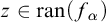 $z \in \mathrm {ran}(f_\alpha )$
is analogous. Then, looking at the possible cases (i.e., (i) and (iii)–(v)), either
$z \in \mathrm {ran}(f_\alpha )$
is analogous. Then, looking at the possible cases (i.e., (i) and (iii)–(v)), either $z_0^n \prec ^+ z$
and
$z_0^n \prec ^+ z$
and $f_\alpha (z) \preceq z_0^n$
, or
$f_\alpha (z) \preceq z_0^n$
, or $z_0^n \prec ^+ f_\alpha (z)$
and
$z_0^n \prec ^+ f_\alpha (z)$
and $z \preceq z_0^n$
. In particular, since
$z \preceq z_0^n$
. In particular, since $z_0^n \lhd (\alpha , n)$
, either
$z_0^n \lhd (\alpha , n)$
, either $(\alpha , n) \prec z$
and
$(\alpha , n) \prec z$
and $f_\alpha (z) \prec (\alpha , n)$
, or
$f_\alpha (z) \prec (\alpha , n)$
, or $z \prec (\alpha , n)$
and
$z \prec (\alpha , n)$
and $(\alpha , n) \prec f_\alpha (z)$
. In other words, the pairs
$(\alpha , n) \prec f_\alpha (z)$
. In other words, the pairs $((\alpha , n), (\alpha , n))$
and
$((\alpha , n), (\alpha , n))$
and $(z, f_\alpha (z))$
realize the type
$(z, f_\alpha (z))$
realize the type $\langle 1,0\rangle $
.
$\langle 1,0\rangle $
.
Now suppose instead that there is no $z \in \mathrm {dom}(f_\alpha ) \cup \mathrm {ran}(f_\alpha )$
such that
$z \in \mathrm {dom}(f_\alpha ) \cup \mathrm {ran}(f_\alpha )$
such that $b_n \lhd z$
. By definition of
$b_n \lhd z$
. By definition of $z_0^n$
and case assumption, we have
$z_0^n$
and case assumption, we have $\mathrm {ht}(z_0^n) \ge \mathrm {ht}(b_n)+2$
. Therefore, we can fix some t such that
$\mathrm {ht}(z_0^n) \ge \mathrm {ht}(b_n)+2$
. Therefore, we can fix some t such that $b_n \lhd t \lhd z_0^n$
. By case assumption, both t and
$b_n \lhd t \lhd z_0^n$
. By case assumption, both t and $z_0^n$
do not belong to
$z_0^n$
do not belong to $\mathrm {dom}(f_\alpha ) \cup \mathrm {ran}(f_\alpha )$
. By maximality of
$\mathrm {dom}(f_\alpha ) \cup \mathrm {ran}(f_\alpha )$
. By maximality of $f_\alpha $
, we conclude that there is an
$f_\alpha $
, we conclude that there is an $x \in \mathrm {dom}(f_\alpha )$
such that
$x \in \mathrm {dom}(f_\alpha )$
such that $(x, f_\alpha (x))$
and
$(x, f_\alpha (x))$
and $(t, z_0^n)$
realize
$(t, z_0^n)$
realize $\langle 1,0\rangle $
. From the latter observation and our case assumption, it follows that either
$\langle 1,0\rangle $
. From the latter observation and our case assumption, it follows that either $t \prec ^+ x$
and
$t \prec ^+ x$
and $f_\alpha (x) \preceq z_0^n$
, or
$f_\alpha (x) \preceq z_0^n$
, or $x \preceq t$
and
$x \preceq t$
and $z_0^n \prec ^+ f_\alpha (x)$
. Since
$z_0^n \prec ^+ f_\alpha (x)$
. Since $t \lhd z_0^n \lhd (\alpha , n)$
, we conclude that the pairs
$t \lhd z_0^n \lhd (\alpha , n)$
, we conclude that the pairs $((\alpha , n), (\alpha , n))$
and
$((\alpha , n), (\alpha , n))$
and $(x, f_\alpha (x))$
realize the type
$(x, f_\alpha (x))$
realize the type $\langle 1,0\rangle $
.
$\langle 1,0\rangle $
.
We have shown that $f_\alpha \cup \{((\alpha , n), (\alpha , n))\}$
is not increasing. Now fix some k with
$f_\alpha \cup \{((\alpha , n), (\alpha , n))\}$
is not increasing. Now fix some k with $k < n$
and let us show that
$k < n$
and let us show that $f_\alpha \cup \{(\alpha , k), (\alpha , n)\}$
is not increasing. Fix an m such that
$f_\alpha \cup \{(\alpha , k), (\alpha , n)\}$
is not increasing. Fix an m such that $w_m = (\alpha , k)$
and
$w_m = (\alpha , k)$
and $i_m = 0$
. Clearly
$i_m = 0$
. Clearly $w_m = (\alpha , k) \not \in \mathrm {dom}(f_\alpha )$
.
$w_m = (\alpha , k) \not \in \mathrm {dom}(f_\alpha )$
.
Suppose first that there is a z with $z_m^n \lhd z$
such that
$z_m^n \lhd z$
such that $z \in \mathrm {ran}(f_\alpha )$
. Fix the z satisfying this property we chose when defining
$z \in \mathrm {ran}(f_\alpha )$
. Fix the z satisfying this property we chose when defining $z_{m+1}^n$
. Looking at the cases (a) and (c) in the definition of
$z_{m+1}^n$
. Looking at the cases (a) and (c) in the definition of $z_{m+1}^n$
, it is easy to see that either
$z_{m+1}^n$
, it is easy to see that either $f_\alpha ^{-1}(z) \prec (\alpha , k)$
and
$f_\alpha ^{-1}(z) \prec (\alpha , k)$
and $z_{m+1}^n \prec ^+ z$
, or
$z_{m+1}^n \prec ^+ z$
, or $(\alpha , k) \prec f_\alpha ^{-1}(z)$
and
$(\alpha , k) \prec f_\alpha ^{-1}(z)$
and $z \preceq z_{m+1}^n$
. Hence, the pairs
$z \preceq z_{m+1}^n$
. Hence, the pairs $((\alpha , k), (\alpha , n))$
and
$((\alpha , k), (\alpha , n))$
and $(f_\alpha ^{-1}(z), z)$
realize
$(f_\alpha ^{-1}(z), z)$
realize $\langle 1,0\rangle $
.
$\langle 1,0\rangle $
.
Now suppose instead that there is no z with $z_m^n \lhd z$
such that
$z_m^n \lhd z$
such that $z \in \mathrm {ran}(f_\alpha )$
. Clearly, this means that
$z \in \mathrm {ran}(f_\alpha )$
. Clearly, this means that $z_{m+1}^n \not \in \mathrm {ran}(f_\alpha )$
. By the induction hypothesis, there is some
$z_{m+1}^n \not \in \mathrm {ran}(f_\alpha )$
. By the induction hypothesis, there is some $x \in \mathrm {dom}(f_\alpha )$
such that the pairs
$x \in \mathrm {dom}(f_\alpha )$
such that the pairs $(x, f_\alpha (x))$
and
$(x, f_\alpha (x))$
and $((\alpha , k), z_{m+1}^n)$
realize
$((\alpha , k), z_{m+1}^n)$
realize $\langle 1,0\rangle $
. But now note that, again by case assumption, we must have either
$\langle 1,0\rangle $
. But now note that, again by case assumption, we must have either $z_{m+1}^n \prec ^+ f_\alpha (x)$
or
$z_{m+1}^n \prec ^+ f_\alpha (x)$
or $f_\alpha (x) \prec z_{m+1}^n$
. Therefore, the pairs
$f_\alpha (x) \prec z_{m+1}^n$
. Therefore, the pairs $(x, f_\alpha (x))$
and
$(x, f_\alpha (x))$
and $((\alpha , k), (\alpha , n))$
also realize
$((\alpha , k), (\alpha , n))$
also realize $\langle 1,0\rangle $
.
$\langle 1,0\rangle $
.
We have shown that $f_\alpha \cup \{((\alpha , k), (\alpha , n))\}$
is not increasing. Now fix some
$f_\alpha \cup \{((\alpha , k), (\alpha , n))\}$
is not increasing. Now fix some ${y \in \alpha \times \omega }$
with
${y \in \alpha \times \omega }$
with $y \not \in \mathrm {ran}(f_\alpha )$
towards showing that
$y \not \in \mathrm {ran}(f_\alpha )$
towards showing that $f_\alpha \cup \{((\alpha , n), y)\}$
is not increasing. Fix an m such that
$f_\alpha \cup \{((\alpha , n), y)\}$
is not increasing. Fix an m such that $w_m = y$
and
$w_m = y$
and $i_m = 1$
.
$i_m = 1$
.
If there is a z with $z_m^n \lhd z$
such that
$z_m^n \lhd z$
such that $z \in \mathrm {dom}(f_\alpha )$
, the argument used to show that there is some
$z \in \mathrm {dom}(f_\alpha )$
, the argument used to show that there is some $x \in \mathrm {dom}(f_\alpha )$
such that
$x \in \mathrm {dom}(f_\alpha )$
such that $(x, f_\alpha (x))$
and
$(x, f_\alpha (x))$
and $((\alpha , n), y)$
realize
$((\alpha , n), y)$
realize $\langle 1,0\rangle $
is the same as in the previous case. So, let us assume that there is no such z. In particular, we must have
$\langle 1,0\rangle $
is the same as in the previous case. So, let us assume that there is no such z. In particular, we must have $z_{m+1}^n \not \in \mathrm {dom}(f_\alpha )$
. Moreover, by the way we chose
$z_{m+1}^n \not \in \mathrm {dom}(f_\alpha )$
. Moreover, by the way we chose $z_{m+1}^n$
, we also have
$z_{m+1}^n$
, we also have $z_{m+1}^n \neq w_m = y$
. By maximality of
$z_{m+1}^n \neq w_m = y$
. By maximality of $f_\alpha $
, there is some
$f_\alpha $
, there is some $x \in \mathrm {dom}(f_\alpha )$
such that the pairs
$x \in \mathrm {dom}(f_\alpha )$
such that the pairs $(x, f_\alpha (x))$
and
$(x, f_\alpha (x))$
and $(z_{m+1}^n, y)$
realize
$(z_{m+1}^n, y)$
realize $\langle 1,0\rangle $
. But now note that, again by case assumption, we must have either
$\langle 1,0\rangle $
. But now note that, again by case assumption, we must have either $z_{m+1}^n \prec ^+ x$
or
$z_{m+1}^n \prec ^+ x$
or $x \prec z_{m+1}^n$
. Therefore, the pairs
$x \prec z_{m+1}^n$
. Therefore, the pairs $(x, f_\alpha (x))$
and
$(x, f_\alpha (x))$
and $((\alpha , n), y)$
also realize
$((\alpha , n), y)$
also realize $\langle 1,0\rangle $
.
$\langle 1,0\rangle $
.
The other cases are analogous.
Question 6.2. Can there be a 2-entangled linear order but no separable 2-entangled linear order?Footnote 7
Acknowledgments
The authors are grateful to the anonymous referee for their useful suggestions and remarks.
Funding
The first and third authors were partially supported by the Italian PRIN 2022 “Models, sets and classifications” prot. 2022TECZJA and “Logical Methods in Combinatorics” prot. 2022BXH4R5. The research of the third author was funded in whole or in part by the Austrian Science Fund (FWF) 10.55776/ESP1829225.


 Open access

