

Acid–base balance in the rumen plays a vital role in lactating cows because a decrease in rumen pH can impair digestibility and yield. A low-roughage (30–35% forage) TMR fed to lactating cows may lead to acidification of the rumen fluid due to rapid fermentation of TMR concentrates, thereby increasing the risk of SARA (DeVries et al., Reference DeVries, Beauchemin, Dohme and Schwartzkopf-Genswein2009). Therefore, when feeding low-roughage TMR, it is common to include dietary sodium bicarbonate (NaHCO3 henceforward SB) as a buffer to reduce the risk of SARA and maintain optimal rumen pH (Hu and Murphy, Reference Hu and Murphy2005). In addition, adding SB to feed containing less than 26% ADF may increase milk fat content, enhancing the benefits of adding this buffer to low-roughage TMR (Erdman, Reference Erdman1988). Erdman (Reference Erdman1988) and, later, Hu and Murphy (Reference Hu and Murphy2005) stated that the positive effect of adding SB appears when the TMR roughage is composed mainly of corn silage; adding SB to a non-corn diet will have a more negligible effect. In their study, Hu and Murphy (Reference Hu and Murphy2005) used a mixed model based on 27 previous trials to assess the effect of adding SB to corn- and non-corn-based TMR. A closer look at the 5 studies in which a non-corn-forage TMR with ADF lower than 20% was used revealed that the conclusion (that SB does not need to be added to non-corn-silage diets) does not necessarily hold when low-roughage TMR is fed to high-yielding lactating cows. Canale and Stokes (Reference Canale and Stokes1988) reported a DMI of 17.4–19.4 kg/d and, although adding 12.5 g/kg SB increased milk fat concentration only when cows were fed corn silage, adding SB did improve ADF digestibility of corn silage and hay diets alike. Cow DMI was up to 20.4 kg/d in Stokes et al. (Reference Stokes, Vandemark and Bull1986), who reported higher rumen pH when 0.7% SB was added to the TMR. dePeters et al. (Reference DePeters, Fredeen, Bath and Smith1984) added up to 0.75% SB to TMR containing alfalfa hay and barley grains, and up to 1.2% SB to TMR containing alfalfa and corn grains, and reported no effect on intake or yield. The DMI in their study was up to 19.6 kg/d with a milk yield of 32 kg/d. Tucker et al. (Reference Tucker, Aslam, Lema, Shin, Ruyet, Hogue, Buchanan, Miller and Adams1992) reported no effect of adding 1.5% SB to a sorghum-silage-based TMR on intake or yield, with an intake of 19.5 kg DM/d and milk yield of 26 kg/d. On today's intensive dairy farms, a mature cow in mid lactation consumes around 29 kg DM/d (National Academies of Science, Engineering, and Medicine, 2021) and produces around 42 kg ECM/d. These are larger values than in the aforementioned studies. Doepel and Hayirli (Reference Doepel and Hayirli2011) removed SB from a TMR with non-corn-silage-based forage (34.7% barley silage, 15.3% alfalfa hay, ADF = 21.8% of TMR DM) and concluded that its removal was safe, and even recommended. Matamoros et al. (Reference Matamoros, Cai, Patterson and Harvatine2021) reported an increase in milk fat yield upon addition of SB (3.4% of DM) to a corn-silage-based (39.5%) TMR. On the other hand, Cruywagen et al. (Reference Cruywagen, Taylor, Beya and Calitz2015) reported that adding 0.8% SB to a non-corn-forage TMR (alfalfa and oat hay, each at 17.6% of DM) increases ECM yield, leaving the question of SB supplementation partially open. In Israel, due to scarcity of land and rain, it is common to feed lactating cows with low-roughage TMR (30–35% forage, 30–34% NDF, and 15–17% ADF of TMR DM) to ensure energy supply, with mainly corn silage or wheat silage and wheat hay as the forage source to ensure appropriate rumen activity. Although the NDF level of low-roughage TMR is adjusted to the recommended level, that of the physically effective NDF (peNDF), which plays a major role in rumen physiology, is lower than that reported by Cruywagen et al. (Reference Cruywagen, Taylor, Beya and Calitz2015) (205 g/kg vs. an average 112 g/kg in our study). Therefore, conclusions drawn in the aforementioned studies regarding the role of dietary SB are less relevant to the case of feeding a low-roughage non-corn-forage TMR to high-yielding lactating cows, and more research is needed. The addition of SB has some disadvantages, such as higher sodium in the TMR which leads to higher water intake and urine secretion (Khelil-Arfa et al., Reference Khelil-Arfa, Faverdin and Boudon2014), and increased dietary sodium, which results in higher sodium excretion from dairy farms (Ben Meir et al., Reference Ben Meir, Shaani, Bikel, Portnik, Jacoby, Moallem, Miron and Frank2023). Therefore, the removal of dietary SB is desired. In addition to acting as a buffer, by contributing Na SB directly affects dietary cation and anion differences (DCAD). Lower DCAD is associated with lower DMI and milk yield (Hu and Murphy, Reference Hu and Murphy2004; Iwaniuk and Erdman, Reference Iwaniuk and Erdman2015) and whether this is due to changes in acid base homeostasis as suggested by Iwaniuk and Erdman (Reference Iwaniuk and Erdman2015) or due to other unknown mechanism, it raises another concern to address before removing dietary SB.
We measured the effect of the concentration of dietary SB added to wheat-based TMR. In addition, we measured the effect of dietary SB levels on rumination patterns, information that is lacking in previous studies. Accordingly, the objective of this study was to examine the effect of 3 levels of dietary SB: 0, 0.74, and 1.47% of TMR DM on intake, milk and milk-component yields, feed efficiency, whole-tract apparent digestibility, rumen pH and daily rumination time. We hypothesized that removing dietary SB from the TMR will not result in a significant reduced milk yield when feeding a low-roughage wheat- based TMR, thereby encouraging dairy farmers to reconsider its inclusion.
Materials and methods
Animals and experimental design
All procedures and animal use during this study were approved by the institutional ethical committee, permit no. 870-1613, according to regulations regarding the protection of animals used for scientific purposes, Directive 2010/63/EU and Israeli law.
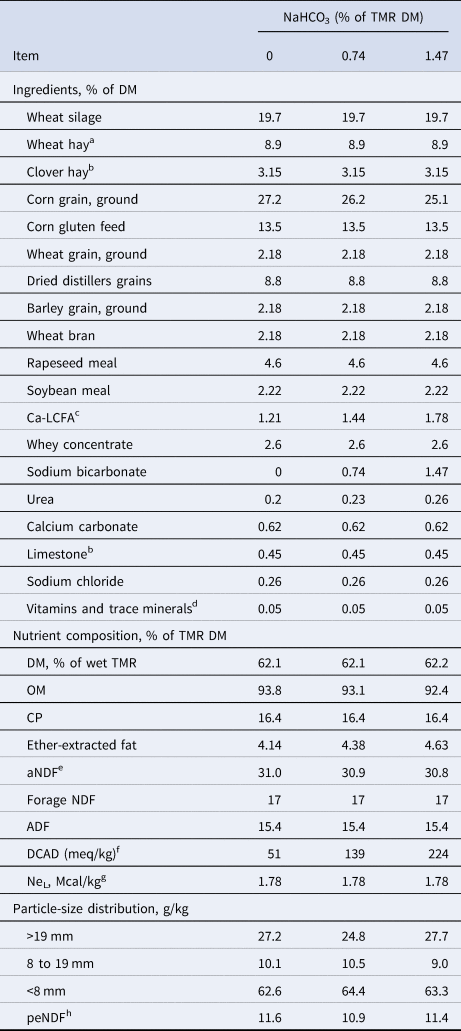
Forty-two multiparous healthy Israeli Holstein cows (a single animal is the experimental unit) in mid lactation (average ± se, DIM of 184 ± 8.4, parity of 3.1 ± 0.2, milk yield of 44.2 ± 1.2 kg/d, BW of 640 ± 6.9 kg) were selected for the study. After 2 wk of adaptation to the individual barn while being fed the study's intermediate level of SB (0.74% TMR DM), cows were divided into 3 groups blocked for parity, DIM and milk yield. Each group was fed TMR containing 0, 0.74, or 1.47% SB. The 3 TMR were balanced to be isocaloric and isonitrogenous by adjusting corn grain content, supplementing different amounts of calcium salts of long-chain fatty acids, and adjustments of urea content (a detailed description of the diets is given in Table 1) for an additional 47 d while recording DMI, BW, milk and milk-component yields and rumination time. At weeks 1, 3, 5 and 7 subgroups of 7 cows per treatment with similar milk yield (44.1 ± 1.0 kg/d), DIM (189 ± 11.7) and parity (3.0 ± 0.3) were selected for rumen pH measurement. The same subgroups were used to measure whole-tract apparent digestibility at week 7. The selection of 7 cows per treatment were based on our previous study showing significant differences for DM digestibility (Shaani et al., Reference Shaani, Nikbachat, Yosef, Ben-Meir, Mizrahi and Miron2017). Cows were housed, freely recumbent, in the open-shade Agricultural Research Organization (ARO) experimental dairy barn (Rishon Lezion, Israel), which is equipped with a cow-recognition system for feed-intake measurements (Halachmi et al., Reference Halachmi, Edan, Maltz, Peiper, Moallem and Brukental1998). In this barn, cows can move freely and each cow has access to its individual feeder (assigned prior to splitting to treatment groups). Since each cow was assigned to a single feeder, hierarchy interruption among cows was minimized, and the system detected each visit to the feeder. All cows were housed in 1 barn as a single group and had free access to water and their specific feeder. Feed was delivered to the individual feeders once a day between 0900 and 1000 h, and the amount delivered to each cow was calculated based on the last 5 d of DMI to provide ad libitum intake (~5% orts). When a cow consumed its ration before the next delivery, extra feed was added to the feeder during the evening or morning milking.
Ingredients and chemical composition of TMR containing different levels of sodium bicarbonate
a Chopped while mixing TMR (2.5–4.0 cm).
b Trifolium alexandrinum. Sidanit (Zmitut 81 Ltd., Haifa, Israel), containing (% of product): CaO, 54.2; Al2O3, 1.2; MgO, 1; Na2O, 0.3; K2O, 0.2; SiO2, 0.1; TiO2, 0.1; Fe2O3, 0.04.
c Calcium salts of long-chain fatty acids.
d Mix containing (% of mix DM): Zn, 24; Fe, 24; Cu, 12.8; Mn, 24; I, 1.44; Co, 0.32; Se, 0.32; and 16 000 000 IU of vitamin A; 3 200 000 IU of vitamin D3; and 48 000 IU of vitamin E.
e Alpha amylase-treated NDF.
f DCAD, dietary cation and anion difference = Na + K–Cl–S.
g NRC (2001).
h Physically effective aNDF remaining above the 8-mm sieve.
Management, BW measurement and daily rumination times
Cows were milked 3 times daily, at around 0530, 1330 and 2030 h. Milk yield (kg) and milk fat, protein and lactose contents were recorded at each milking by an automatic meter equipped with an online near-infrared spectrometer (Afilab, Afimilk Ltd., Kibbutz Afikim, Israel) as described by Weller and Ezra (Reference Weller and Ezra2016). Milk samples were collected from 3 consecutive milkings every 21 d and analyzed for milk fat, protein, and lactose by infrared analysis (standard IDF 141C:2000; IDF, 2000) at the laboratories of the Israeli Cattle Breeders Association (Caesarea, Israel) to validate the results obtained from the automatic meter. Daily BW was recorded by an automatic walk-on scale (Afilab, Afimilk Ltd.) 3 times daily when cows exited the milking parlor. The ADG (kg/d) for each cow was calculated as the regression slope of daily weight data against days in the trial. This method is used to overcome the variation in BW for each cow between milkings and days caused by eating, drinking, urine and fecal size effects. All cows were equipped with collar-mounted HR tags (SCR Engineers Ltd., Netanya, Israel) that monitored and transmitted rumination time (Schirmann et al., Reference Schirmann, von Keyserlingk, Weary, Veira and Heuwieser2009). Rumination data were recorded daily during the 7 wk of the experiment by a special sensor that detects the rhythmic movement of this activity. Data were stored in 2-h blocks and wirelessly uploaded to the computer at the milking parlor in real time.
Sample collection and analyses
The TMR of each treatment was sampled weekly from the individual feeders immediately after feeding (samples were considered to calculate intake), and orts were collected from each feeder before the following day's feeding, pooled weekly and sampled. The TMR was mixed and pooled for each treatment, and orts samples were mixed and pooled for each cow during the trial to determine the TMR DM content and nutrient composition. Particle-size distribution of forage, TMR and orts was determined by a Penn State Particle Separator (PSPS) equipped with a 19-mm screen (large), an 8-mm screen (medium), and a pan (fine) (Lammers et al., Reference Lammers, Buckmaster and Heinrichs1996). The content (on a DM basis) of peNDF remaining above the 8-mm and 19-mm sieves of the separator was designated peNDF in this study as recommended by Yang et al. (Reference Yang, Ouellet and Beauchemin2006) and calculated according to Kononoff et al. (Reference Kononoff, Heinrichs and Lehman2003): peNDF (g/kg DM) = g wet fraction from the 8 + 19 mm sieves × % DM in separated fraction × % NDF in original DM sample/g DM sample inserted.
Fecal grab samples were collected at wk 7 of the trial from the subgroups of 7 cows for each treatment 12 times over 3 consecutive days (at 0600, 1200, 1800 and 2400 h) and pooled for each cow. Fecal samples were dried at 60°C for 48 h in a forced-air oven and ground to pass through a 1-mm sieve. We determined DM contents of the 3 TMR, orts and fecal samples by drying them in a forced-air oven for 48 h at 60°C. NDF treated with alpha amylase (aNDF, Mertens, Reference Mertens2002) was analyzed with heat-stable amylase and Na-sulfite using an A200 ANKOM fiber analyzer and F57 fiber filter bags (ANKOM220 Technology, Macedon, NY). ADF was determined in sequence after the aNDF analysis using the same device (based on AOAC official method 973.18; AOAC, 2019).
The two-stage in vitro digestibility technique of Tilley and Terry (Reference Tilley and Terry1963) was used to analyze the content of residual indigestible NDF (iNDF) in the TMR orts and the pooled fecal samples of each cow. This technique consists of incubation with rumen fluid for 72 h followed by incubation for 48 h with HCl-pepsin (Adin et al., Reference Adin, Solomon, Nikbachat, Zenou, Yosef, Brosh, Shabtay, Mabjeesh, Halachmi and Miron2009). The ratio of iNDF in the TMR to iNDF in the feces is identical to the ratio of fecal DM to DMI of each cow, which is the reciprocal of in vivo DM digestibility according to the following equation (Adin et al., Reference Adin, Solomon, Nikbachat, Zenou, Yosef, Brosh, Shabtay, Mabjeesh, Halachmi and Miron2009): DM digestibility = 1 – [TMR iNDF (% of DM)/fecal iNDF (% of DM)]. The digestibility values of DM and NDF were calculated for each cow using its proportion between intake orts and fecal output according to the equation presented by Adin et al. (Reference Adin, Solomon, Nikbachat, Zenou, Yosef, Brosh, Shabtay, Mabjeesh, Halachmi and Miron2009).
The subgroups were sampled for rumen pH at wk 1, 3, 5 and 7, twice a day: before feeding at 0600 h (after withholding access to feed by closing gates for individual feeders for 6 h) and 6 h post-feeding (after allowing access to feed) at 1500 h. This sampling routine was based on preliminary observations demonstrating maximal and minimal rumen pH 1 h prefeeding and 6 h postfeeding, respectively (Shaani et al., Reference Shaani, Eliyahu, Mizrahi, Yosef, Ben-Meir, Nikbachat, Solomon, Mabjeesh and Miron2016). Rumen fluid (~400 ml) was collected from each cow with a rumen vacuum connected to a self-made metal-coated esophageal rubber pipe (2 m length, 15 mm internal diameter). For each sample, to avoid saliva contamination, the vacuum pump was turned on only after the sampler pipe was inserted through the esophagus and localized in the ventral portion of the rumen. Rumen pH values were determined onsite with a portable pH meter (PL 600, MRC Israel).
Feed sorting behavior was measured by weighing orts of the same 3 subgroups used for pH and digestibility measurements. Orts and feed (0.5 kg DM orts or TMR from weekly pooled samples of each cow) were sampled for each cow in the subgroups 4 times during the trial after recording intake. Wet particle distribution was determined on the 3 sieves of the PSPS 24 h postfeeding and compared to the offered TMR. Sorting index was calculated as the quantitative ratio between actual DM intake of each particle-size fraction of the PSPS separator and the predicted DM intake of each fraction (assuming no sorting). A sorting index of 100 indicated lack of any sorting (similar DM intake of the entire TMR and each particle-size fraction measured). A sorting index above 100 indicated a preference for consuming small particles (Leonardi and Armentano, Reference Leonardi and Armentano2003).
Calculations and statistical analysis
All data have a normal distribution and were analyzed with formal statistical tests, no transformations were made. ECM yield (kg/d, of standard milk containing 3.5% fat, 3.5% protein and 5% lactose, with energy value of 0.714 Mcal/kg milk: NRC, 2001) was calculated, based on data from each milking, as follows: milk yield (kg/d) × {[3.887 × milk fat (%)] + [2.356 × milk protein (%)] + [1.653 × milk lactose (%)]}/3.1338 (Moallem, Reference Moallem2016).
To compare the groups receiving 0, 0.74, and 1.47% SB, the following parameters were summarized daily for each cow: DMI, milk, milk-component and ECM yields, BW, ECM-to-DMI ratio and rumination time. Data were analyzed using the mixed model procedure in JMP pro 16.0 software (SAS Institute, 2016). Treatment, day and treatment × day were used as fixed effects, cow nested within treatment was a random effect and day served as a repeated measures factor. The structure of the covariance which gave the lowest AIC values was autoregressive (AR(1)). Rumen pH was analyzed with a similar model, with each measurement as a repeated measures factor. The parameters ADG and in vivo digestibility were summarized by cow. Since those variables were measured once per cow, we did not include the repeated measures factor nor random effect. Dose response was tested by linear and quadratic contrast with specification of −1, 0, +1 (linear) and + 0.5, −1, + 0.5 (quadratic) for 0, 0.74 and 1.47% SB, respectively. The standard error of the mean (sem) was calculated for each trait for all treatment variables. Significant differences were declared at P < 0.05.
Results
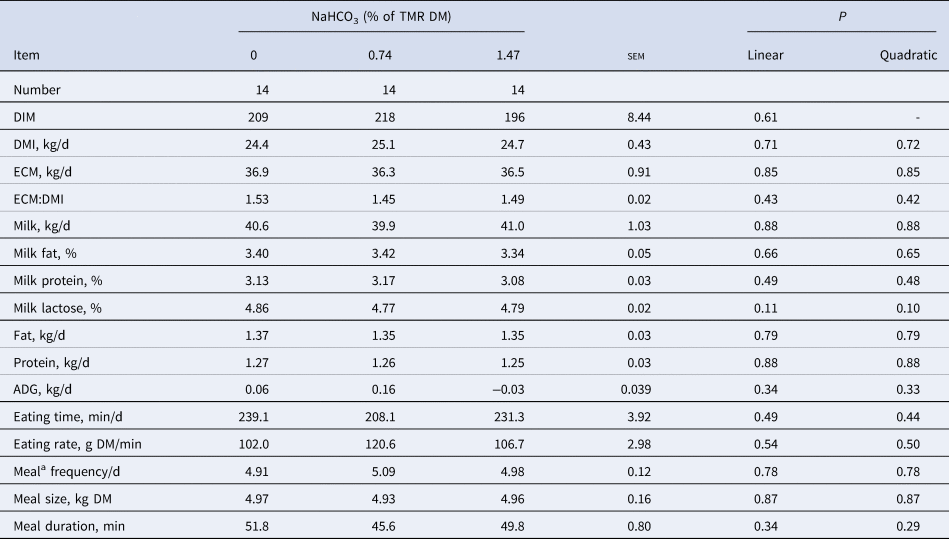
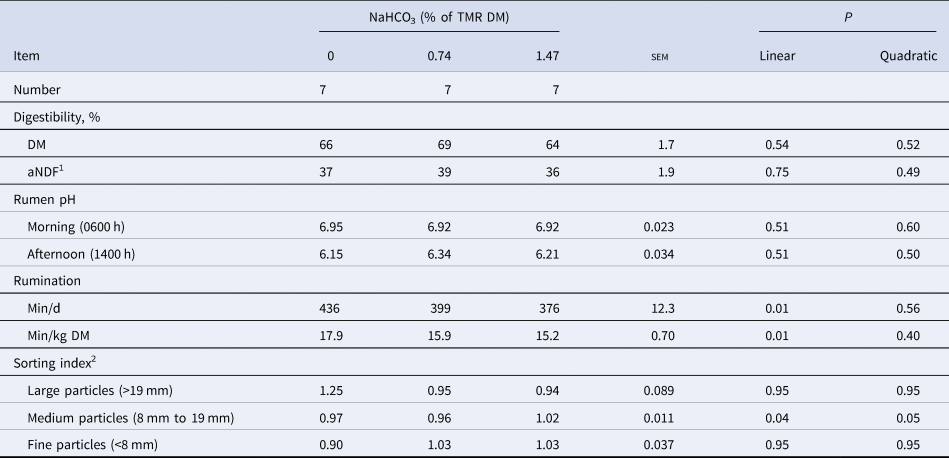
Results of intake, milk and milk-component yields and ADG for cows fed dietary SB of 0, 0.74, and 1.47% of TMR DM are given in Table 2. There was no effect of dietary SB level on any of these parameters. The rumen physiology traits (total-tract apparent digestibility, rumen pH and daily rumination time) are given in Table 3. Dietary SB concentration did not affect digestibility of DM or NDF, or rumen pH sampled before or after feeding. However, dietary SB concentration correlated negatively with daily rumination time (436, 399, and 376 min/d for dietary SB at 0, 0.74, and 1.47%, respectively).
Comparison of intake, milk and milk-component yields, daily gain, feed efficiency, and eating behavior for cows receiving different levels of sodium bicarbonate
a A meal is defined as the sum of close visits initiated less than 33 min after the end of the previous visit. Meal duration is calculated as sum of visits + intervals between visits during an average meal.
Comparison of whole-tract apparent digestibility of DM and NDF, rumen pH, rumination time, and feed sorting of cows receiving different levels of sodium bicarbonate
a,bMean values in the same row with different superscripts differ for the interaction between rumination parameters and sodium bicarbonate supplementation.
1 Alpha amylase-treated NDF.
2 Sorting index was calculated as the quantitative ratio between actual intake (after 24 h) and predicted DM intake (without any sorting) of each fraction retained on sieves of the Penn State Particle Separator. A sorting index of 100 indicates lack of any sorting (similar intake of the TMR DM and the fraction). Sorting index below 100 indicates sorting by cows against non-consumed large particles (>19 mm) (Leonardi and Armentano, Reference Leonardi and Armentano2003).
Discussion
The hypothesis of this study was that removing dietary SB from low-roughage TMR with mainly wheat silage and wheat hay as the forage source would not result in decreased DMI or yield, thus encouraging dairy farmers to exclude SB from the lactating cow diet. The results backed up our hypothesis: removing dietary SB did not affect intake, milk or milk-component yields or ADG. Our TMR was low-roughage (68.3% concentrates) with mainly wheat silage and wheat hay (20.6 and 8.9% of TMR DM, respectively) as the forage source. Adding SB to the TMR in our study did not lead to higher rumen pH at the sampling times and did not increase digestibility, thus indicating no positive effect on rumen activity. Our results are supported by Doepel and Hayirli (Reference Doepel and Hayirli2011), who compared 2 non-corn-forage TMR (roughages of alfalfa hay and barley silage, 15.3 and 34.7%, respectively, and concentrates of steam-rolled barley, wheat, and corn grains at 9.8, 20.0, and 5.1%, respectively), with or without 0.75% SB, and reported no effect of dietary SB on intake, ECM yield, or milk yield. Dietary SB in their study did not affect rumen pH recorded at the sampling times used in our study (before and after feeding) and they did not observe signs of SARA (Doepel and Hayirli, Reference Doepel and Hayirli2011). On the other hand, Cruywagen et al. (Reference Cruywagen, Taylor, Beya and Calitz2015) measured the effect of removing SB from a non-corn-forage TMR (oat and alfalfa hay, both 17.6 and 40% corn grains) on intake, yield and rumen pH measured continually. In their study, removing SB decreased milk fat yield (1.22 to 1.06 kg/d) and ECM (32.0 to 29.2 kg/d). They also reported lower average rumen pH (5.3 vs. 6.0) when SB was excluded from the TMR, with cows experiencing prolonged periods of rumen pH below 5.5 (13.8 h/d) and showing signs of SARA (panting and drooling). This discrepancy may be explained by the large content of corn grains in Cruywagen et al.'s (Reference Cruywagen, Taylor, Beya and Calitz2015) study (40% compare to 26.1% in our study), different roughage (oat and alfalfa hay compared to mainly wheat silage and wheat hay), or lower NDF (26.3% compared to 31.0% of DM in our study). Hu and Murphy (Reference Hu and Murphy2005) concluded that the positive effect of adding SB appears when the TMR roughage is composed mainly of corn silage. However, their conclusion may also be valid for other types of forage depending on various characterizations, or when there is a large amount of corn grains in the concentrate, explaining the results of Cruywagen et al. (Reference Cruywagen, Taylor, Beya and Calitz2015). Another explanation might be differences in peNDF between their study (20.4–20.5%) and ours (10.9–11.6%). Our TMR that included 26.1% corn grain and did not cause a decrease in rumen pH or milk fat yield when SB was excluded. Support for our result can also be found in the work of Bach et al. (Reference Bach, Guasch, Elcoso, Duclos and Khelil-Arfa2018), where SB did not affect rumen pH after subjecting the cows to a concentrate challenge by increasing barley grains from 20.4 to 32.1% of TMR DM. Their TMR included 19.9% corn grains and 50% corn silage. However, their data were insufficient to draw any conclusion on the effect of grain source (corn or others) on the role of SB in rumen pH.
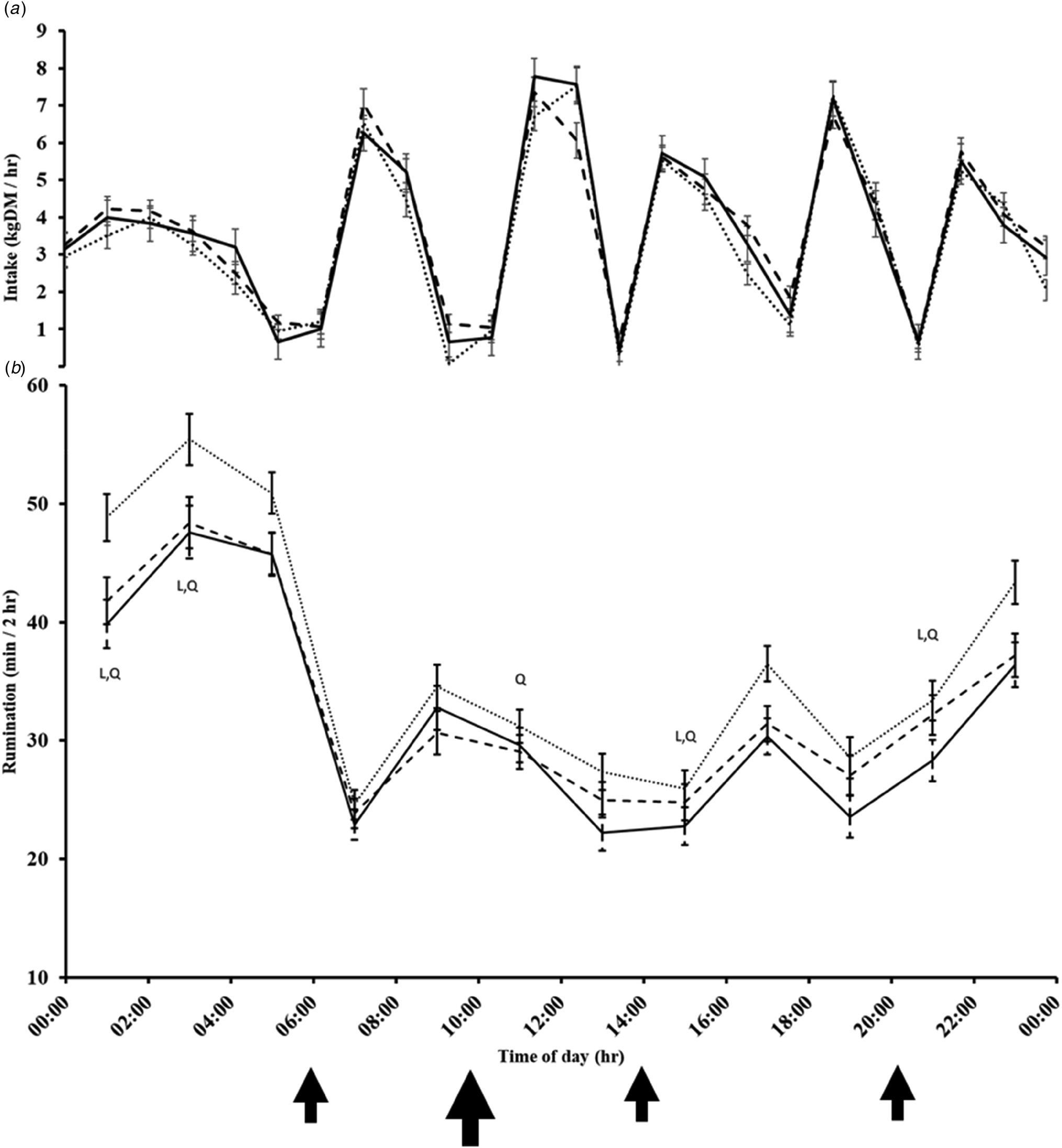
In our study, omitting SB encouraged rumination, as reflected by the negative linear relationship between dietary SB content and daily rumination time (Table 3). Most of the differences in rumination time occurred at night (Fig. 1b) in accordance with Beauchemin (Reference Beauchemin2018), who stated that most rumination occurs at night when the cows are at rest. DeVries et al. (Reference DeVries, Beauchemin, Dohme and Schwartzkopf-Genswein2009) artificially created a high risk for SARA in lactating cows by replacing some of the barley silage with barley and corn grains (52.7, 10.6 and 2.4% of TMR DM to 39.6, 19.6 and 8.0%, respectively). They found that cows subjected to the high-risk TMR ruminated less than those fed the control TMR, which was expected because the high-SARA-risk TMR contained less NDF (Beauchemin, Reference Beauchemin2018). However, they also found that rumination time increased with increasing time of rumen pH under 5.8 (for 1 h of rumen pH < 5.8, cows ruminated an additional 12.3 min/d, R 2 = 0.91). They explained that these results are not entirely surprising given that pH < 5.8 is harmful to ruminal cellulolytic bacteria (Russell and Wilson, Reference Russell and Wilson1996) and, therefore, detrimental to fiber digestibility. The negative linear relationship between dietary SB content and daily rumination time in our study (Table 3) may have compensated for the lack of buffer, because we only observed a tendency toward lower pH and there was no difference in aNDF digestibility. One should note that since most differences in rumination time occurred at night, and we measured pH during the daytime, we may have missed a night-time decrease in rumen pH. With respect to overall rumen activity, removing dietary SB did not impair the digestibility of DM or aNDF, suggesting that longer rumination time does indeed compensate for the lack of buffer. There was no effect of dietary SB on sorting index (Table 3) of large or fine feed particles, and cows sorted in favor of the medium-size particles (8 to 19 mm) in relation to dietary SB. Therefore, we can link the increase in daily rumination time to the lack of dietary SB. However, it should be noted that we did not use an observer to record rumination but rather a collar tag, and some other jaw movements might have resulted in recording ‘pseudo rumination’ as rumination. Further research is thus warranted to study the relationship between TMR grain source and the need for a buffer. Another limitation for the conclusion regarding the effect of adding buffer on rumination time relates to the differences in urea concentration that were 0.2, 0.23. 0.26% of TMR DM for the treatments of 0, 0.74, and 1.47% SB, respectively. However, in their meta-analysis, Souza et al. (Reference Souza, Ribeiro and Harvatine2022) dismiss the relation between dietary CP for TMR ranged from 12.2 to 22.1% CP of TMR DM, which would suggest low to non-effect of dietary N on rumination time in our study as well. On the other end, Souza et al. (Reference Souza, Ribeiro and Harvatine2022) in principal component analysis, show some negative relationship between feed FA and rumination time. In order to balance TMRs NeL we added Ca-LCFA from 1.21% of TMR DM for 0% SB up to 1.78% for 1.47% SB. Accordingly, EE concentrations were 4.14, 4.38 and 4.63% of TMR DM for 0, 0.72, and 1.47% SB, respectively. As a lower rumination time was recorded for the highest SB concentration, without an additional study assessing the effect of feed FA concentration on rumination time this factor cannot be dismissed. Future studies should concentrate on this type of diet (wheat, wheat silage, hay and corn grains) with and without buffer (sodium bicarbonate, etc.).
Daily feed intake (a) and rumination time (b) of cows fed diets supplemented with sodium bicarbonate at a concentration of 0 (dotted line), 0.74 (dashed line) and 1.47% (solid line) of TMR DM. For feed intake (a), bars represent ± se at each hour of the day for each group and there was no effect of treatment (P > 0.05) apart from a treatment × time interaction (P < 0.01). For rumination time (b), bars represent ± se for each 2-h rumination period for each group and L, Q indicate significant difference (P < 0.05) for linear or/and quadratic contrasts at the respective time. There is a treatment × time interaction (P > 0.01). Large arrow is feeding, small arrows are milking.
In conclusion, based on this study of a TMR containing wheat silage (20.6%), hay (8.9%) and corn grains (24.1–26.1%), removing SB does not affect intake, digestibility or milk or milk-component yields. However, due to the longer rumination time, we cannot dismiss the possible risk of SARA when dietary SB is completely removed. Further research with more detailed rumen pH monitoring is needed with this diet type to assess if removal of dietary buffers like SB increases the risk for SARA.
Acknowledgments
The authors express their appreciation to Yavne Feeding Center for producing the TMR, and to the team at the ARO research dairy farm for their efforts. This study was supported by grant no. 870-1613 from the Israeli Dairy Board Foundation.


 Open access

