


Introduction
Growing populations in the arid western U.S. increase water demand, yet available supplies are diminishing due to increased environmental constraints and changes in the timing of water flows. Climate models predict increased variability in water supplies in the future (Milly et al. Reference Milly, Betancourt, Falkenmark, Hirsch, Kundzewicz, Lettenmaier and Stouffe2008; IPCC Reference Stocker, Qin, Plattner, Tignor, Allen, Boschung, Nauels, Xia, Bex and Midgley2013). Water policymakers (e.g., the Western Governors’ Association) increasingly recognize that properly structured water transfers can help communities cope with water shortages (Doherty and Smith Reference Doherty and Smith2012). Municipalities, agricultural producers, environmental managers, and other water users are also becoming increasingly aware of the value of water in its current use and the options available to them for adjusting their water supplies upward or downward through markets. There is, however, significant variability across the western U.S. in water market activity, prices, and contract type, whether water rights transfer (buyer receives a flow of water each year in perpetuity) or lease (buyer receives a flow of water each year for the duration of the contract, but the right itself does not change hands).
Several studies have characterized water trading activity and prices in western water markets (Loomis et al. Reference Loomis, Quattlebaum, Brown and Alexander2003; Howitt and Hansen Reference Howitt and Hansen2005; Brown Reference Brown2006; Brewer et al. Reference Brewer, Glennon, Ker and Libecap2008; Hrozencik et al. Reference Hrozencik, Manning, Suter, Goemans and Bailey2017). They identify patterns in relative prices paid, contract types, and quantities sold or purchased by different water user groups (e.g., agricultural, environmental, and municipal). Other studies seek to identify the primary determinants of water price, in the tradition of hedonic price analysis, by estimating price as a function of quantity transferred and various other factors anticipated to affect supply, demand, or both (Colby et al. Reference Colby, Crandall and Bush1993; Goodman and Howe Reference Goodman and Howe1997; Brown Reference Brown2006; Olmstead et al. Reference Olmstead, Hanemann and Stavins2007; Young and Loomis Reference Young and Loomis2014; Toll et al. Reference Toll, Broadbent and Beeson2019). Brookshire et al. (Reference Brookshire, Colby, Ewers and Ganderton2004) seek to estimate a system of supply and demand equations for three water markets in Arizona, Colorado, and New Mexico. However, data limitations hamper the identification of the supply equations. Using case studies from New Mexico and Colorado, respectively, De Mouche et al. (Reference De Mouche, Landfair and Ward2011) and Payne et al. (Reference Payne, Smith and Landry2014) find that the endogeneity bias resulting from the simultaneous determination of water price and quantity is inessential. Additionally, Payne et al. (Reference Payne, Smith and Landry2014) caution against generalizing these results to other settings, given that price endogeneity is an inherent characteristic of market economies, with the possibility that its effects may vary in magnitude across different markets.
A significant portion of the water transferred in the western U.S. is leased. Buyers in need of water and sellers willing to sell often resort to rights transfers and leases. However, the practice of buying and selling in lease markets is largely overlooked in the literature as a potential alternative to rights transfers. Hansen et al. (Reference Hansen, Howitt and Williams2014) constitute a pioneering effort in this direction. It examines the relative effects of economic, hydrologic, and state-level institutional variables on a water agency’s decision whether to lease or purchase water rights. It still has several limitations, particularly in its ability to thoroughly investigate the cross-demand relationship between transfers and leases, given that an important consideration, such as price, is omitted from the analysis. Additionally, it fails to consider the supply-side dynamics that play a crucial role in determining prices. Therefore, a more comprehensive analysis is necessary to examine how these factors interact and influence market behavior, thereby providing a deeper understanding of pricing mechanisms.
In our research, we aim to make a meaningful contribution to the existing body of literature by presenting a more comprehensive approach to analyzing the impacts of water transfer and leasing prices on water utilization. These factors are crucial in shaping water usage policies, and understanding their effects is essential for developing sustainable management strategies. By examining these key elements in greater detail, we aim to illuminate their significance and offer valuable insights for policymakers and stakeholders alike. Our approach uniquely integrates cross-demand effects between transfers and leases, while considering the supply-side dynamics that influence the price determination process. By leveraging an extensive database encompassing numerous water transfers and leases, we believe our study can yield more accurate estimates of price impacts than earlier works. These refined estimates of price impact offer a more nuanced understanding of the effectiveness of different water regulation policies in practice. Policies promoting water conservation may encompass various strategies, such as implementing tiered water rate structures, establishing guidelines for outdoor water use, issuing water allocation permits, encouraging water-saving practices, regulating industrial water withdrawals, and promoting the use of water-efficient appliances, among others. Together, these multifaceted approaches work harmoniously to achieve sustainable water management and protect this essential resource for future generations. Failing to integrate the extensive features outlined in our study may have unintended consequences, hindering our ability to achieve the specific policy objectives designed to tackle water shortages effectively. The distinctive elements of our study, which contribute to its uniqueness and effectiveness, are elaborated upon below. First, unlike previous studies that limit their scope of analysis to water rights transfers only, we model the markets for water rights transfers and leases jointly, recognizing the possibility that water rights transfers and lease prices influence one another in both markets. More specifically, we estimate a simultaneous system of demand equations for water transfer and lease, which not only captures the implicit tradeoff between rights transfers and leases faced by water agencies but also accounts for any unsuspected contemporaneous correlation between the unobserved determinants of demand for the two contract types that might exist. In addition, we control for unobserved state heterogeneity by incorporating state-fixed effects. These may reflect state legislation and other factors that remain relatively stable over time, and which may present measurement difficulties. Second, we account for the supply side of water rights transfer and lease determination by supplementing our demand system with reduced-form price equations for both transfers and leases, which relate prices for both contract types to exogenous supply determinants (e.g., weather shocks and water sources, such as groundwater versus surface water). Specifically, we apply a full information maximum likelihood (FIML) procedure to estimate the system of demand and reduced-form price equations in the spirit of Dhar, Chavas, and Gould (Reference Dhar, Chavas and Gould2003). This method accounts for the simultaneous effects of supply and demand factors on prices. It generates more efficient parameter estimates as compared to similar econometric procedures such as the three-stage least squares (3SLS) on the one hand and the 2SLS and other limited maximum likelihood estimators on the other (Hayashi Reference Hayashi2000). Third, we utilize data that cover a broader geographical area and enable us to generate location-specific estimates of water market value, given our use of geographically explicit explanatory variables and a rigorous econometric model sufficiently robust to account for price endogeneity.
The major findings emerging from this study indicate that water users are considerably responsive to water rights transfer and lease price changes. More specifically, lessees are found to be relatively more sensitive to rights transfer price changes than buyers are to those of water leases. Further, water rights transfers and leases are estimated to be close substitutes, with buyers being more responsive to rights transfer price changes vis-à-vis changes in the lease when deciding on the amount of water needed. Similarly, lessees appear more sensitive to water leases than rights transfer prices. We also find that ignoring price endogeneity brought by the omission of the supply side of water markets generates significant biases in parameter estimates and economic effects. Finally, a simple simulation analysis reveals considerable biases in the projected water demand over 2020–25 resulting from restrictive analytical frameworks.
The paper is organized as follows: Section 2 outlines our empirical strategy for estimating demand equations for water rights and leases, addresses price endogeneity, and describes our sample and key variables. Section 3 presents the results from the empirical and simulation analyses, while Section 4 summarizes the main findings.
An empirical framework
In this section, we present our empirical framework comprising a simultaneous system of demand equations for water rights and leases, which is supplemented by the respective reduced-form price equations that are used to address price endogeneity. Further, we offer a brief description of the data containing information on both price and quantity of water rights transfers and leases, as well as a number of important supply and demand determinants that have been utilized in our empirical analysis. Finally, we provide a brief explanation of water price endogeneity followed by a short discussion of the methodology used to account for it.
An empirical model of demand for water rights transfers and leases
Our approach to modeling water demand considers potential interrelationships between water rights transfers and leases. In theory, a water agency interested in acquiring long-term access to water has the choice of purchasing a water right or leasing water. The lease may be a long-term contract whose price, terms, and conditions approximate those of a rights transfer; or it may be a series of short-term leases acquired sequentially through time. This choice between rights transfer and lease resembles the make-or-buy literature of transaction cost economics (Shelanski and Klein Reference Shelanski and Klein1995; Klein Reference Klein, Ménard and Shirley2005; Hansen et al. Reference Hansen, Howitt and Williams2014). Differences in state law make jurisdictions more or less conducive to one type of transaction or another. We do, however, observe that all else equal, water agencies are risk averse and prefer to own – and are often willing to pay more for – water rights to meet new demand rather than risk repeated exposure to lease markets (Howitt Reference Howitt, Easter, Rosegrant and Dinar1998; Hansen et al. Reference Hansen, Howitt and Williams2014). This premium for rights transfers over leases is also reflected in the low lease-to-sale capitalization ratio prevalent in states whose water market activity during the study period is driven by municipal water agencies seeking to meet urban growth (see, e.g., Colorado and Nevada, Table 1).Footnote 1
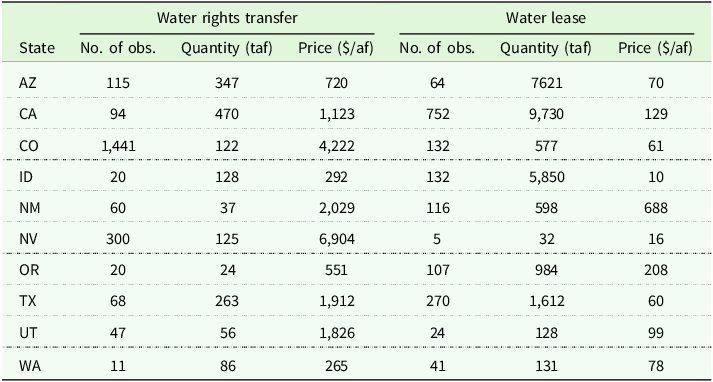
State-level volume and price data for transactions with identifiable climate division location information
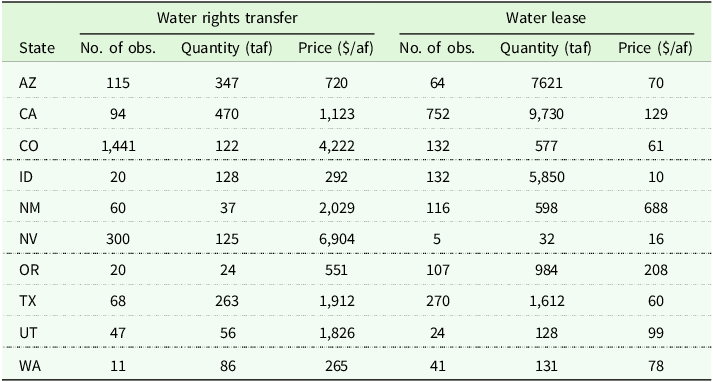
Notes: The Total number of transactions involving water rights transfer and lease is 2,176 and 1,643, respectively. Prices for leases longer than one year are annualized to ensure parity with annual leases and comparison with rights transfers.
Source: Water Strategist; Hansen et al. (Reference Hansen, Howitt and Williams2014).
Our analysis consequently controls for the implicit tradeoff between rights transfers and leases faced by water agencies and further accounts for any unsuspected contemporaneous correlation between the unobserved determinants of demand for rights transfers and leases that might exist. It further has the promise of generating more accurate elasticity estimates for the markets, where water rights transfers and leases are perceived as alternative water sources.
Let $Q_{it}^R$
,
$Q_{it}^R$
, $Q_{it}^L$
denote the amount of water transacted in water rights and lease markets in climate zone i in year t, and
$Q_{it}^L$
denote the amount of water transacted in water rights and lease markets in climate zone i in year t, and $P_{it}^R$
,
$P_{it}^R$
, $P_{it}^L$
represent the respective prices. Demand equations for water rights transfers and leases can then be presented as shown below:
$P_{it}^L$
represent the respective prices. Demand equations for water rights transfers and leases can then be presented as shown below:
 $$\begin{gathered}\ln \left( {Q_{it}^R} \right) = {\beta _{10}} + {\beta _{11}}\ln \left( {In{c_{it}}} \right) + {\beta _{12}}\ln \left( {Po{p_{it}}} \right) + {\beta _{13}}MIne{w_{it}} + {\beta _{14}}\ln \left( {TB{P_{it}}} \right) + {\beta _{15}}\ln \left( {P_{it}^R} \right) \\
\!\!\!\!\!\!\!\!\!\!\!\!\!\!\!\!\!\!\!\!\!\!\!\!\!\!\!\!\!\!\!\!\!\!\!\!\!\!\!\!\!\!\!\!\!\!\!\!\!\!\!\!\!\!\!\!\!\!\!\!\!\!\!\!\!\!\!\!\!\!\!\!\!\!\!\!\!\!\!\!\!\!\!\!\!\!\!\!\!\!\!\!\!\!\!\!\!\!\!\!\!\!\!\!\!\!\!\!\!\!\!\!\!\!\!\!\!\!\!\!\!\!\!\!\!\!\!\!\!\!\!\!\!\!\!+ {\beta _{16}}\ln \left( {P_{it}^L} \right) + {\upsilon _{it}},\end{gathered}$$
$$\begin{gathered}\ln \left( {Q_{it}^R} \right) = {\beta _{10}} + {\beta _{11}}\ln \left( {In{c_{it}}} \right) + {\beta _{12}}\ln \left( {Po{p_{it}}} \right) + {\beta _{13}}MIne{w_{it}} + {\beta _{14}}\ln \left( {TB{P_{it}}} \right) + {\beta _{15}}\ln \left( {P_{it}^R} \right) \\
\!\!\!\!\!\!\!\!\!\!\!\!\!\!\!\!\!\!\!\!\!\!\!\!\!\!\!\!\!\!\!\!\!\!\!\!\!\!\!\!\!\!\!\!\!\!\!\!\!\!\!\!\!\!\!\!\!\!\!\!\!\!\!\!\!\!\!\!\!\!\!\!\!\!\!\!\!\!\!\!\!\!\!\!\!\!\!\!\!\!\!\!\!\!\!\!\!\!\!\!\!\!\!\!\!\!\!\!\!\!\!\!\!\!\!\!\!\!\!\!\!\!\!\!\!\!\!\!\!\!\!\!\!\!\!+ {\beta _{16}}\ln \left( {P_{it}^L} \right) + {\upsilon _{it}},\end{gathered}$$
 $$\begin{gathered}\ln \left( {Q_{it}^L} \right) = {\beta _{20}} + {\beta _{21}}\ln \left( {In{c_{it}}} \right) + {\beta _{22}}\ln \left( {Po{p_{it}}} \right) + {\beta _{23}}MIne{w_{it}} + {\beta _{24}}\ln \left( {B{P_{it}}} \right) + {\beta _{25}}\ln \left( {P_{it}^L} \right) \\ \!\!\!\!\!\!\!\!\!\!\!\!\!\!\!\!\!\!\!\!\!\!\!\!\!\!\!\!\!\!\!\!\!\!\!\!\!\!\!\!\!\!\!\!\!\!\!\!\!\!\!\!\!\!\!\!\!\!\!\!\!\!\!\!\!\!\!\!\!\!\!\!\!\!\!\!\!\!\!\!\!\!\!\!\!\!\!\!\!\!\!\!\!\!\!\!\!\!\!\!\!\!\!\!\!\!\!\!\!\!\!\!\!\!\!\!\!\!\!\!\!\!\!\!\!\!\!\!\!+ {\beta _{26}}\ln \left( {P_{it}^R} \right) +{\omega _{it}},\end{gathered}$$
where $In{c_{it}}$
and
$In{c_{it}}$
and $Po{p_{it}}$
represent average annual per capita income (measured in $1,000s) and population (in 1,000s) in climate zone i and year t, respectively;
$Po{p_{it}}$
represent average annual per capita income (measured in $1,000s) and population (in 1,000s) in climate zone i and year t, respectively; $MIne{w_{it}}$
is the share of transactions where the buyer’s new use is municipal/industrial;
$MIne{w_{it}}$
is the share of transactions where the buyer’s new use is municipal/industrial; $TB{P_{it}}$
is the cumulative number of building permits issued since 1990 in climate zone i through year t;
$TB{P_{it}}$
is the cumulative number of building permits issued since 1990 in climate zone i through year t; $B{P_{it}}$
reflects the number of building permits issued in the year of the transaction; and
$B{P_{it}}$
reflects the number of building permits issued in the year of the transaction; and ${\upsilon _{it}}$
,
${\upsilon _{it}}$
, ${\omega _{it}}$
are unobserved water demand determinants. We include the cumulative number of building permits in the rights equation because cumulative building permit activity would indicate a strong need for acquiring water in perpetuity. We include annual building permits in the lease equation because a prospective buyer and seller may lease water in the short term while they wait for a rights transfer to be approved. To summarize, all of the included variables are anticipated to affect demand for water acquired through both rights transfers and leases, as most water acquisition in the western U.S. is by municipal water agencies seeking to firm up their existing supply portfolios and, often, to serve new customers (Hansen et al. Reference Hansen, Howitt and Williams2014).
${\omega _{it}}$
are unobserved water demand determinants. We include the cumulative number of building permits in the rights equation because cumulative building permit activity would indicate a strong need for acquiring water in perpetuity. We include annual building permits in the lease equation because a prospective buyer and seller may lease water in the short term while they wait for a rights transfer to be approved. To summarize, all of the included variables are anticipated to affect demand for water acquired through both rights transfers and leases, as most water acquisition in the western U.S. is by municipal water agencies seeking to firm up their existing supply portfolios and, often, to serve new customers (Hansen et al. Reference Hansen, Howitt and Williams2014).
In our empirical demand specifications, we further incorporate state-fixed effects in an attempt to account for unobserved state heterogeneity that may reflect state legislation and other factors that remain relatively stable over time and which may present measurement difficulties. Despite these benefits, the system of equations in (1)–(2) remains restrictive, given its reliance on the implicit assumption of demand factors constituting the main drivers behind water prices (e.g., Hovhannisyan and Bozic Reference Hovhannisyan and Bozic2017). However, omitting the supply side of the water price formation mechanism will likely result in the unobserved water determinants also reflecting supply-driven (e.g., changes in temperature, precipitation, and supply of surface and ground water) price variation. Unless accounted for, this leads to price endogeneity, which may generate biased (due to simultaneity) and inconsistent parameter estimates and economic effects, ultimately leading to erroneous policy implications and recommendations.
To account for this source of water price endogeneity, we adopt a procedure proposed by Dhar, Chavas, and Gould (Reference Dhar, Chavas and Gould2003). More specifically, we supplement our empirical framework in (1) – (2) with the following reduced-form price equations that allow us to account for the effects of various supply shifters on water rights transfer and lease prices:
 $$\begin{gathered}\ln \left( {P_{it}^R} \right) = {\alpha _{10}} + {\alpha _{11}}\ln \left( {Tem{p_{it}}} \right) + {\alpha _{12}}\ln \left( {\Pr e{c_{it}}} \right) + {\alpha _1}Aol{d_{it}} + {\alpha _{14}}\ln \left( {SFarm{L_{it - 1}}} \right)\cr \!\!\!\!\!\!\!\!\!\!\!\!\!\!\!\!\!\!\!\!\!\!\!\!\!\!\!\!\!\!\!\!\!\!\!\!\!\!\!\!\!\!\!\!\!\!\!\!\!\!\!\!\!\!\!\!\!\!\!\!\!\!\!\!\!\!\!\!\!\!\!\!\!\!\!\!\!\!\!\!\!\!\!\!\!\!\!\!\!\!\!\!\!\!\!\!\!\!\!\!\!\!\!\!\!\!\!\!\!\!\!\!\!\!\!\!\!+ {\alpha _{15}}G{W_{it}} + {\xi _{it}},\end{gathered}$$
 $$\begin{gathered}\ln \left( {P_{it}^L} \right) = {\alpha _{20}} + {\alpha _{21}}\ln \left( {Tem{p_{it}}} \right) + {\alpha _{22}}\ln \left( {\Pr e{c_{it}}} \right) + {\alpha _{23}}Aol{d_{it}} + {\alpha _{24}}\ln \left( {SAg{r_{it}}} \right)+ {\alpha _{25}}G{W_{it}} \\ \!\!\!\!\!\!\!\!\!\!\!\!\!\!\!\!\!\!\!\!\!\!\!\!\!\!\!\!\!\!\!\!\!\!\!\!\!\!\!\!\!\!\!\!\!\!\!\!\!\!\!\!\!\!\!\!\!\!\!\!\!\!\!\!\!\!\!\!\!\!\!\!\!\!\!\!\!\!\!\!\!\!\!\!\!\!\!\!\!\!\!\!\!\!\!\!\!\!\!\!\!\!\!\!\!\!\!\!\!\!\!\!\!\!\!\!\!\!\!\!\!\!\!\!\!\!\!\!\!\!\!\!\!\!\!\!\!\!\!\!\!\!\!\!\!\!\!\!\!\!\!\!\!\!\!\!\!\!\!\!\!\!\!+ {\zeta _{it}},\end{gathered}$$
where $Tem{p_{it}}$
and
$Tem{p_{it}}$
and $\Pr e{c_{it}}$
represent temperature and precipitation in climate zone i in year t, respectively;
$\Pr e{c_{it}}$
represent temperature and precipitation in climate zone i in year t, respectively; $Aol{d_{it}}$
denotes the share of transactions where seller’s use was agriculture;
$Aol{d_{it}}$
denotes the share of transactions where seller’s use was agriculture; $SFarm{L_{it - 1}}$
denotes the value of farmland lagged by one period and is a proxy for the agricultural production value that producers can expect to realize in the long-term;
$SFarm{L_{it - 1}}$
denotes the value of farmland lagged by one period and is a proxy for the agricultural production value that producers can expect to realize in the long-term; $SAg{r_{it}}$
indicates the annual agricultural production value;Footnote
2
$SAg{r_{it}}$
indicates the annual agricultural production value;Footnote
2 $G{W_{it}}$
represents the share of transactions in climate zone i in year t that rely on a groundwater aquifer for water supply rather than a river or reservoir; and
$G{W_{it}}$
represents the share of transactions in climate zone i in year t that rely on a groundwater aquifer for water supply rather than a river or reservoir; and ${\xi _{it}}$
,
${\xi _{it}}$
, ${\zeta _{it}}$
denote unobserved supply-side determinants of water rights and lease prices, respectively.
${\zeta _{it}}$
denote unobserved supply-side determinants of water rights and lease prices, respectively.
The variables included in the price equations (3) and (4) must satisfy the (i) relevance and (ii) exogeneity requirements to be considered valid price instruments. With the inclusion of temperature and precipitation, our goal is to control for the effects of weather-related factors on prices, which occur only indirectly through their effects on water supply. This mechanism also excludes the possibility of a feedback effect (i.e., prices affecting supply shifters); therefore, temperature and precipitation are proper price instruments (Hovhannisyan and Bozic Reference Hovhannisyan and Bozic2017). We further incorporate the value of farmland and agricultural production to account for changes in opportunity costs associated with water sales and leases, respectively. Specifically, as many sellers are agricultural water users, especially in the 1990s, their willingness to sell water is likely to be influenced by factors reflecting the value of water as an input into agricultural production. In the 1990s, many sellers were agricultural water users, and their decision to sell water was likely influenced by various factors that emphasized the vital role of water as an essential input in agricultural production. Therefore, the value of farmland and agricultural production is expected to satisfy the relevance criterion. While we recognize the potential for feedback effects between prices and these variables, a considerable amount of time may pass before these effects are fully realized. (This is especially true of land values slow to respond to changing economic circumstances. See, e.g., Burns et al. Reference Burns, Key, Tulman, Borchers and Weber2018). Finally, we believe our price instruments are appropriately excluded from the water demand equations (uncorrelated with unobserved determinants ${\upsilon _{it}}$
,
${\upsilon _{it}}$
, ${\omega _{it}}$
) and affect water demand indirectly, that is, through their effects on prices (i.e., exogeneity requirement).
${\omega _{it}}$
) and affect water demand indirectly, that is, through their effects on prices (i.e., exogeneity requirement).
Our identification strategy is firmly rooted in the recognition that many environmental factors significantly influence water availability for agricultural use. These factors include varying precipitation levels, reservoirs’ ability to store water effectively, the rates at which groundwater replenishes, and the overarching weather patterns that dominate a region. Each of these elements plays a vital role in determining the fluctuations of water supply for farming activities (e.g., Chang and Bonnette Reference Chang and Bonnette2016; and Konapala et al. Reference Konapala, Mishra, Wada and Mann2020), while the actual demand for water from crops remains relatively constant, largely dictated by their intrinsic biological requirements. Once farmers have made their crop selections, it is essential to understand that the water needs of these crops stay consistent in the face of seasonal climate changes and rainfall variability that occur throughout the year. This consistency contrasts sharply with the unpredictable water supply resulting from environmental factors. Although weather and climate information have become significantly more accurate in recent years, many agricultural producers still do not fully use these tools to optimize their water management. This raises important questions about whether crop selection decisions are aligned with local weather patterns. The evidence suggests they may be less closely linked than one might expect (Mase and Prokopy Reference Mase and Prokopy2014).
Lastly, we perform our empirical analysis of water markets using the following water demand (5–6) and reduced-form price (7–8) equations:
 $$\begin{gathered}\,\,Q_{it}^R = {\beta _{10}} + {\beta _{11}}In{c_{it}} + {\beta _{12}}Po{p_{it}} + {\beta _{13}}MIne{w_{it}} + {\beta _{14}}TB{P_{it}} + {\beta _{15}}P_{it}^R + {\beta _{16}}P_{it}^L \\ \!\!\!\!\!\!\!\!\!\!\!\!\!\!\!\!\!\!\!\!\!\!\!\!\!\!\!\!\!\!\!\!\!\!\!\!\!\!\!\!\!\!\!\!\!\!\!\!\!\!\!\!\!\!\!\!\!\!\!\!\!\!\!\!\!\!\!\!\!\!\!\!\!\!\!+ \sum\nolimits_j {t_j^{DR}{Y_j}} \, + \sum\nolimits_{ik} {\gamma _k^R{D_k}} +{\iota_{it}},\end{gathered}$$
 $$\begin{gathered}Q_{it}^L = {\beta _{20}} + {\beta _{21}}Tren{d_{it}} + {\beta _{22}}In{c_{it}} + {\beta _{23}}Po{p_{it}} + {\beta _{24}}MIne{w_{it}} + {\beta _{25}}B{P_{it}} + {\beta _{26}}P_{it}^L + {\beta _{27}}P_{it}^R \\ \!\!\!\!\!\!\!\!\!\!\!\!\!\!\!\!\!\!\!\!\!\!\!\!\!\!\!\!\!\!\!\!\!\!\!\!\!\!\!\!\!\!\!\!\!\!\!\!\!\!\!\!\!\!\!\!\!\!\!\!\!\!\!\!\!\!\!\!\!\!\!\!\!\!\!\!\!\!\!\!\!\!\!\!\!\!\!\!\!\!\!\!\!\!\!\!\!\!\!\!\!\!\!\!\!\!\!\!\!\!\!\!\!\!\!+ \sum\nolimits_j {t_j^{DL}{Y_j}} \,+ \sum\nolimits_{ik}{\gamma _k^L{D_k}} + {\tau _{it}},\end{gathered}$$
 $$\begin{gathered}P_{it}^R = {\alpha _{10}} + {\alpha _{11}}Tren{d_{it}} + {\alpha _{12}}Tem{p_{it}} + {\alpha _{13}}\Pr e{c_{it}} + {\alpha _{14}}Aol{d_{it}} + {\alpha _{15}}SFarm{L_{it - 1}} \\\!\!\!\!\!\!\!\!\!\!\!\!\!\!\!\!\!\!\!\!\!\!\!\!\!\!\!\!\!\!\!\!\!\!\!\!\!\!\!\!\!\!\!\!\!\!\!\!\!\!\!\!\!\!\!\!\!\!\!+ {\alpha _{16}}G{W_{it}}+ \sum\nolimits_j {t_j^{SR}{Y_j}} \, + \sum\nolimits_{ik} {\lambda _k^R{D_k}} + {\vartheta _{it}},\end{gathered}$$
 $$\begin{gathered}P_{it}^L = {\alpha _{20}} + {\alpha _{21}}Tren{d_{it}} + {\alpha _{22}}Tem{p_{it}} + {\alpha _{23}}\Pr e{c_{it}} + {\alpha _{24}}Aol{d_{it}} + {\alpha _{25}}SAg{r_{it}} + {\alpha _{26}}G{W_{it}} \\\!\!\!\!\!\!\!\!\!\!\!\!\!\!\!\!\!\!\!\!\!\!\!\!\!\!\!\!\!\!\!\!\!\!\!\!\!\!\!\!\!\!\!\!\!\!\!\!\!\!\!\!\!\!\!\!\!\!\!\!\!\!\!\!\!\!\!\!\!\!\!\!\!\!\!\!\!\!\!\!\!\!\!\!\!\!\!\!\!\!\!\!\!\!\!\!\!\!\!\!\!\!\!\!\!+ \sum\nolimits_j {t_j^{SL}{Y_j}}+ \sum\nolimits_{ik} {\lambda_k^L{D_k}} + {\varsigma _{it}},\end{gathered}$$
where ${D_k}$
denotes state-fixed effects with
${D_k}$
denotes state-fixed effects with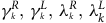 $\gamma _{^k}^R,\,\gamma _{^k}^L,\,\lambda _{^k}^R,\,\lambda _k^L$
being parameters reflecting unobserved state heterogeneity;Footnote
3
$\gamma _{^k}^R,\,\gamma _{^k}^L,\,\lambda _{^k}^R,\,\lambda _k^L$
being parameters reflecting unobserved state heterogeneity;Footnote
3 ${Y_j}$
reflects time-fixed effects (i.e., annual dummies) with the respective parameters of
${Y_j}$
reflects time-fixed effects (i.e., annual dummies) with the respective parameters of $t_j^{DR}$
,
$t_j^{DR}$
, $t_j^{DL}$
,
$t_j^{DL}$
, $t_j^{SR}$
, and
$t_j^{SR}$
, and $t_j^{SL}$
; and
$t_j^{SL}$
; and ${\iota _{it}}$
,
${\iota _{it}}$
, ${\tau _{it}}$
,
${\tau _{it}}$
, ${\vartheta _{it}}$
, and
${\vartheta _{it}}$
, and ${\varsigma _{it}}$
are unobserved demand and price determinants, respectively.
${\varsigma _{it}}$
are unobserved demand and price determinants, respectively.
Data description
We base our empirical analysis on data compiled from the Water Strategist, a trade journal (discontinued in 2010) that provided transaction details concerning water transfers across the western U.S. from 1990 to 2010. The most complete Water Strategist transaction descriptions include buyer and seller identity, price, quantity transferred, water source (e.g., aquifer or reservoir name), a binary variable indicating whether the transaction is a lease or a rights transfer, and the use to which the water will be put (e.g., municipal, industrial, and agricultural). Several observations may also contain specific additional terms important to understanding the nature of the transaction, for example, whether the transfer is coupled with a land sale or litigation, whether the deal is an exchange in which the seller is returned water at a different time or location, or whether the contract specifies any flexibility in delivery quantity or timing of delivery. The complete database on which we rely includes 5,777 observations.Footnote 4
We supplement the Water Strategist data by attaching county identifier information to each transaction. This allows us to assign socio-demographic and climatic variables to each transaction at a finer spatial resolution as opposed to the state level (all that is readily available in the Water Strategist).Footnote 5 However, it is important to note that we lack data on exchange and retail transactions, storage contracts, bundled land, and water transactions in which water is not priced separately, option contracts that are not known to have been exercised, and other transactions that do not fit easily into the categories of rights transfer and lease. We further exclude transactions from states with minimal trading volume and those with missing information regarding water price or volume transferred, as well as the observations for which the buyer’s county location cannot be identified from the information provided in the Water Strategist (e.g., anonymous buyers, buyers listed as “developers,” and so on).
Table 1 displays descriptive statistics for the prices and quantities of water rights that have been transferred and leased. Both prices and quantities exhibit significant spatial variability. Specifically, the volume-weighted rights transfer price per acre-foot (af) ranges from $265 in Washington to $6,904 in Nevada. In terms of lease prices per af, the range extends from $10 in Idaho to $688 in New Mexico. Furthermore, the quantities of rights transferred vary from 24,000 acre-feet (af) in Oregon to just 470 af in California. For leased water, the quantities range from 32 af in Nevada to 9,730 af in California.
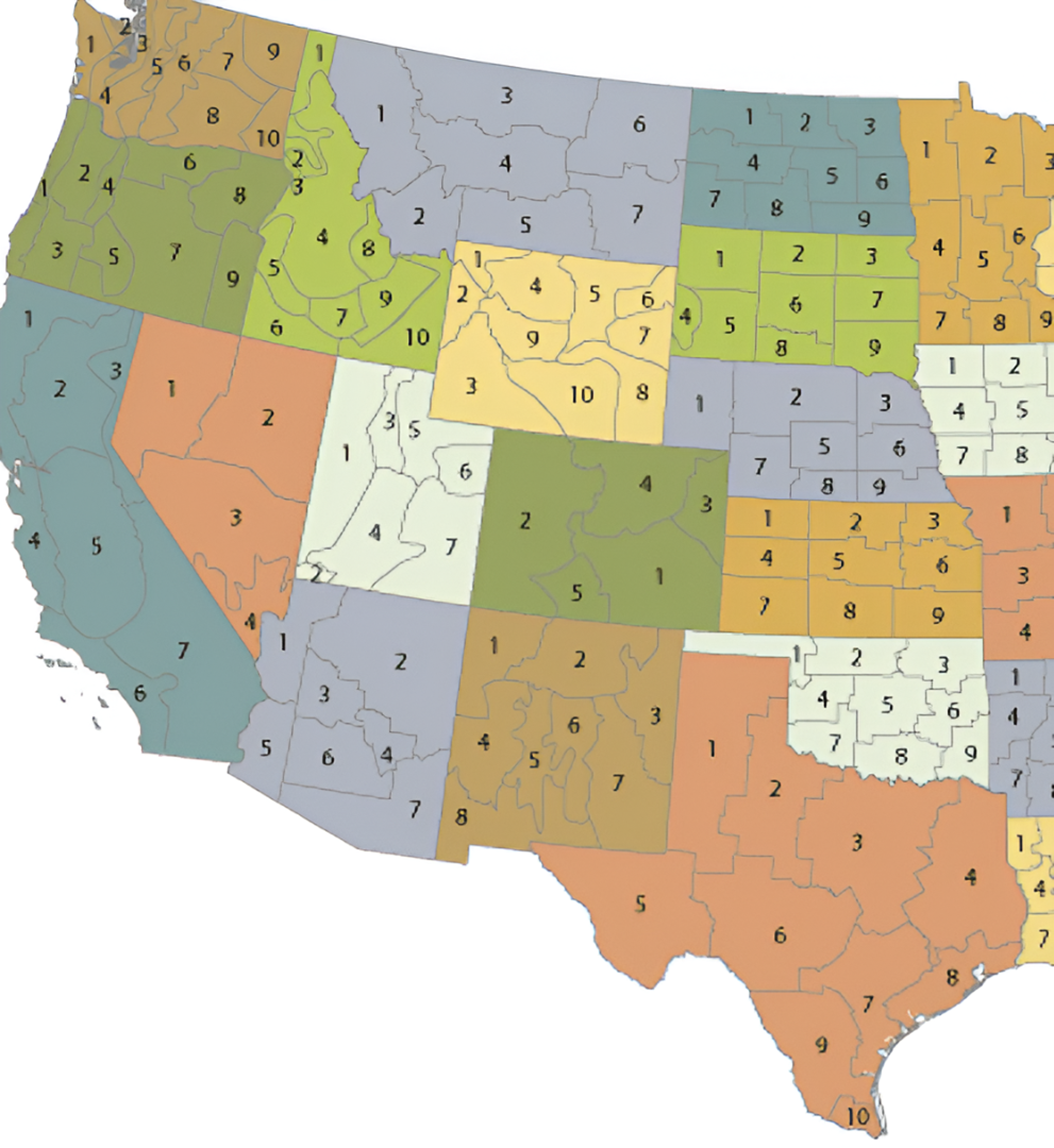
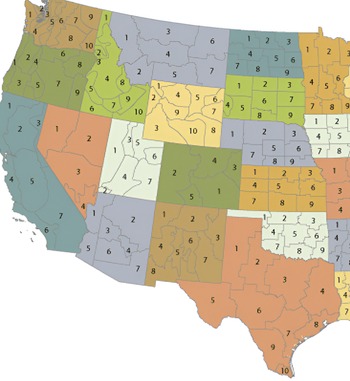
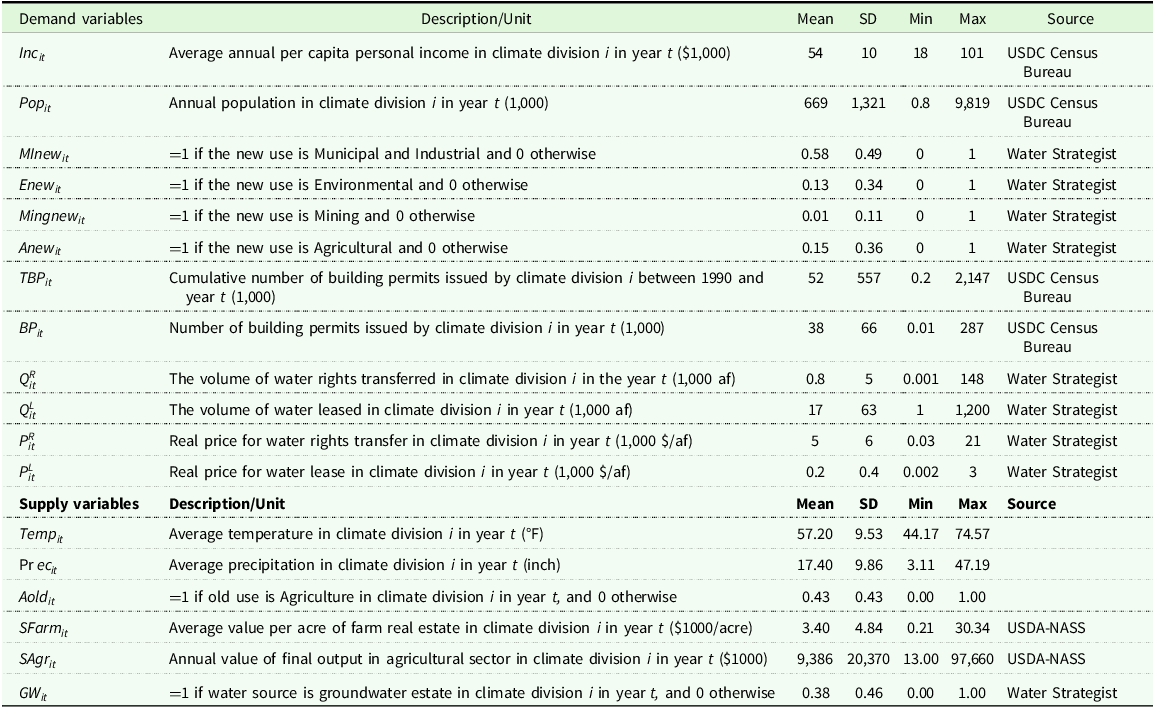
For the final empirical analysis, we aggregate our observations to the NOAA climate division level (see Figure 1) to ensure that each geographical unit sampled contains multiple rights transfer and lease observations for each year over the sample period. We calculate the sum of transaction-level rights and lease transfer quantities while also averaging the corresponding prices and leases, along with additional variables such as temperature and precipitation. This process yields 69 observations (i.e., 276 observations for our system of empirical demand and reduced-form price equations). Although data aggregation may mask some transaction-level heterogeneity, it is necessary for estimating a simultaneous system of demand equations and quantifying the extent of substitutability between water rights transfers and leases. Notably, the number of climate divisions per state varies from four to nine in our dataset, allowing us to account for climate variability separately from state-fixed effects. Finally, Table 2 presents descriptive statistics for the transaction-specific and county-level demographic and hydrologic variables included in the analysis, which have been aggregated to the climate division level. On average, new water use is distributed as follows: approximately 58% is dedicated to municipal or industrial purposes, indicating a significant focus on urban development and industry, while agricultural use accounts for around 15%, highlighting its significant role in food production. In the 1990s, many sellers were agricultural water users, and their decision to sell water was likely influenced by various factors that emphasized the vital role of water as an essential input in agricultural production. Environmental use accounts for about 13%, demonstrating a commitment to sustaining natural ecosystems. Lastly, mining constitutes a modest 1%, suggesting room for growth in sustainable practices in that sector. These figures reflect a diverse array of water use priorities that can guide future resource management strategies.
NOAA climatic divisions in the western US. Source: National Climatic Data Center – NOAA.
Descriptive statistics for variables affecting water market prices
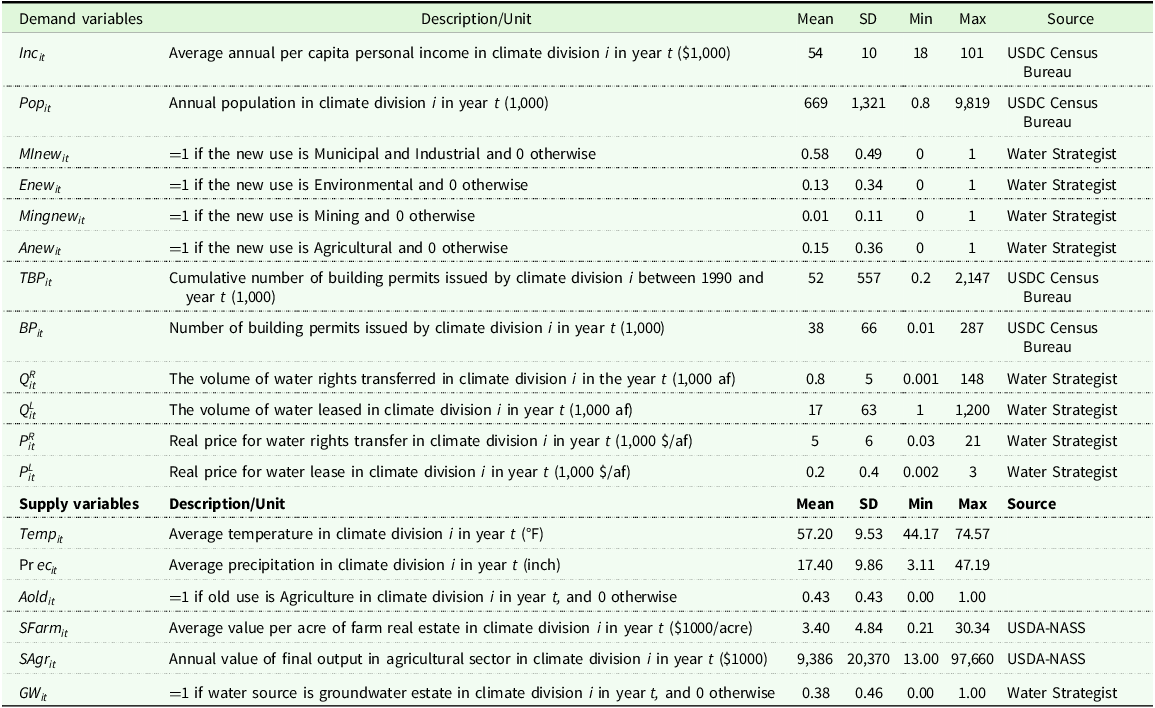
Note: Descriptive statistics are based on variables measured at a climate division level.
Empirical results
Model diagnostic and endogeneity test results
We use the GAUSSX programming module of the GAUSS software system to estimate a number of empirical specifications extending from single demand equations for water rights transfers and leases to full-blown systems of demand and reduced-form price equations that incorporate leases, embrace unobserved state heterogeneity, and are estimated via the FIML procedure. This enables us to evaluate the incremental improvement in model performance by incorporating additional covariates and integrating the lease demand and reduced-form price equations. Our choice of the FIML estimation procedure reflects its superiority over the instrumental variable (IV) technique in that the asymptotic efficiency does not depend on the choice of instruments, and the IV technique applies only to linear models (Hayashi, p. 482; Dhar, Chavas, and Gould Reference Dhar, Chavas and Gould2003).
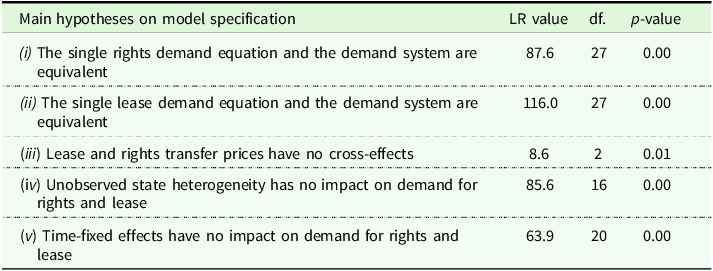
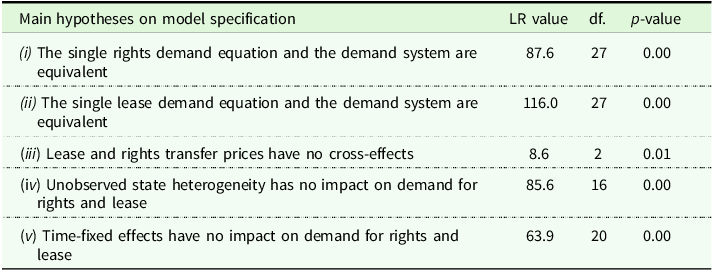
Results from model diagnostic tests are presented in Table 3. As one would expect, generalizing a single demand equation to a demand system that comprises both water rights transfer and lease equations statistically significantly enhances model explanatory power according to a Likelihood Ratio (LR) test (Table 3). To evaluate the importance of modeling the supply side of the price determination mechanism, we further generalize the demand system by incorporating the reduced-form price equations provided in (7) and (8). The LR test results indicate a significant role for supply factors in determining water rights transfer and lease prices, the omission of which may introduce biases into the demand system parameter estimates and economic effects. Next, incorporating rights transfer and lease prices in the demand equations further improves our model performance. By modeling the markets for water rights transfers and leases jointly, we capture the implicit tradeoff between sales and leases faced by water agencies and account for unsuspected contemporaneous correlation between the unobserved determinants of demand for rights transfers and leases. Our findings further reveal the important role that the unobserved state heterogeneity and time-fixed effects play in determining water demand. Finally, it is worth noting that we evaluate the importance of modeling the simultaneous shifts in demand and supply determinants (and hence the importance of rights transfer and lease prices’ endogeneity), which we perform in the spirit of Dhar, Chavas, and Gould (Reference Dhar, Chavas and Gould2003), and Bakhtavoryan and Hovhannisyan (Reference Bakhtavoryan and Hovhannisyan2022). A significant advantage of this test is that it enables the testing of the endogeneity of multiple variables. The test is conducted in several related steps, starting with the identification of potentially endogenous variables, then controlling for endogeneity through the incorporation of additional equations that relate endogenous variables to the respective instruments, and finally evaluating the difference between parameter estimates from the restrictive model that ignores endogeneity and the one that addresses it.
As a final exercise, we evaluate the validity of the set of instruments used in the current analysis, which requires that the instruments are relevant (i.e., sufficiently correlated with the endogenous variables in question) and exogenous (i.e., not correlated with the unobserved determinants in the respective demand equations). Since both the water rights and lease demand equations contain two endogenous variables (i.e., water rights and lease prices), the ${R^2}$
and F statistics are of limited use as they can overstate the relevance of the excluded instruments (i.e., regressors in the reduced-form price equations) as shown by Shea (Reference Shea1997). Therefore, we rely on Shea’s partial
${R^2}$
and F statistics are of limited use as they can overstate the relevance of the excluded instruments (i.e., regressors in the reduced-form price equations) as shown by Shea (Reference Shea1997). Therefore, we rely on Shea’s partial ${R^2}$
that takes into account the intercorrelations among the instruments, and thus, constitutes a more accurate and robust measure of the instrument relevance.Footnote
6
Specifically, Shea’s partial
${R^2}$
that takes into account the intercorrelations among the instruments, and thus, constitutes a more accurate and robust measure of the instrument relevance.Footnote
6
Specifically, Shea’s partial ${R^2}$
is estimated to be 0.69 and 0.50 for water rights and lease prices in the demand equation for water rights and 0.74 and 0.52 for water lease, which, despite the unavailability of thresholds to compare with, may be considered a sufficiently strong correlation between endogenous variables and instruments (Shea Reference Shea1997).
${R^2}$
is estimated to be 0.69 and 0.50 for water rights and lease prices in the demand equation for water rights and 0.74 and 0.52 for water lease, which, despite the unavailability of thresholds to compare with, may be considered a sufficiently strong correlation between endogenous variables and instruments (Shea Reference Shea1997).
To validate the exclusion restrictions (i.e., exogeneity assumption) for over-identified models (i.e., number of instruments exceeds the number of endogenous variables), past studies relied on Hansen’s J statistic. Our Hansen’s J statistic values and the associated p-values were estimated to be 0.61 and 0.10 for the water rights and lease demand equations, respectively. Thus, we may not reject the null hypothesis of instrument exogeneity at 5% level of significance. However, it is important to bear in mind that, as shown by Parente and Silva (Reference Parente and Silva2012), overidentifying restrictions provide little information on the exogeneity of instruments, and exogeneity should be inferred from the underlying economic model and the causal mechanism, such as the one presented in sub-section 2.1.
Estimation results from the simultaneous system of equations
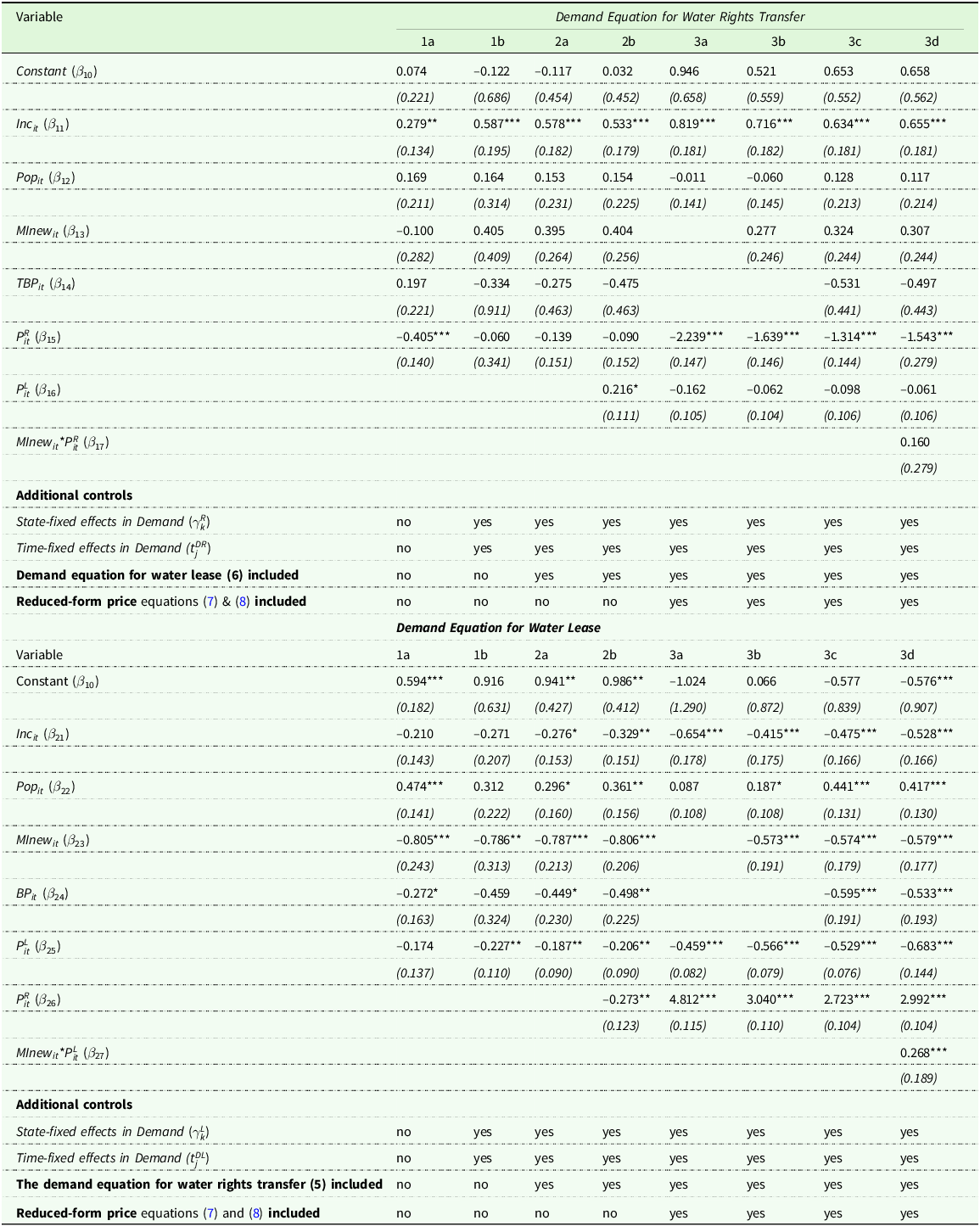
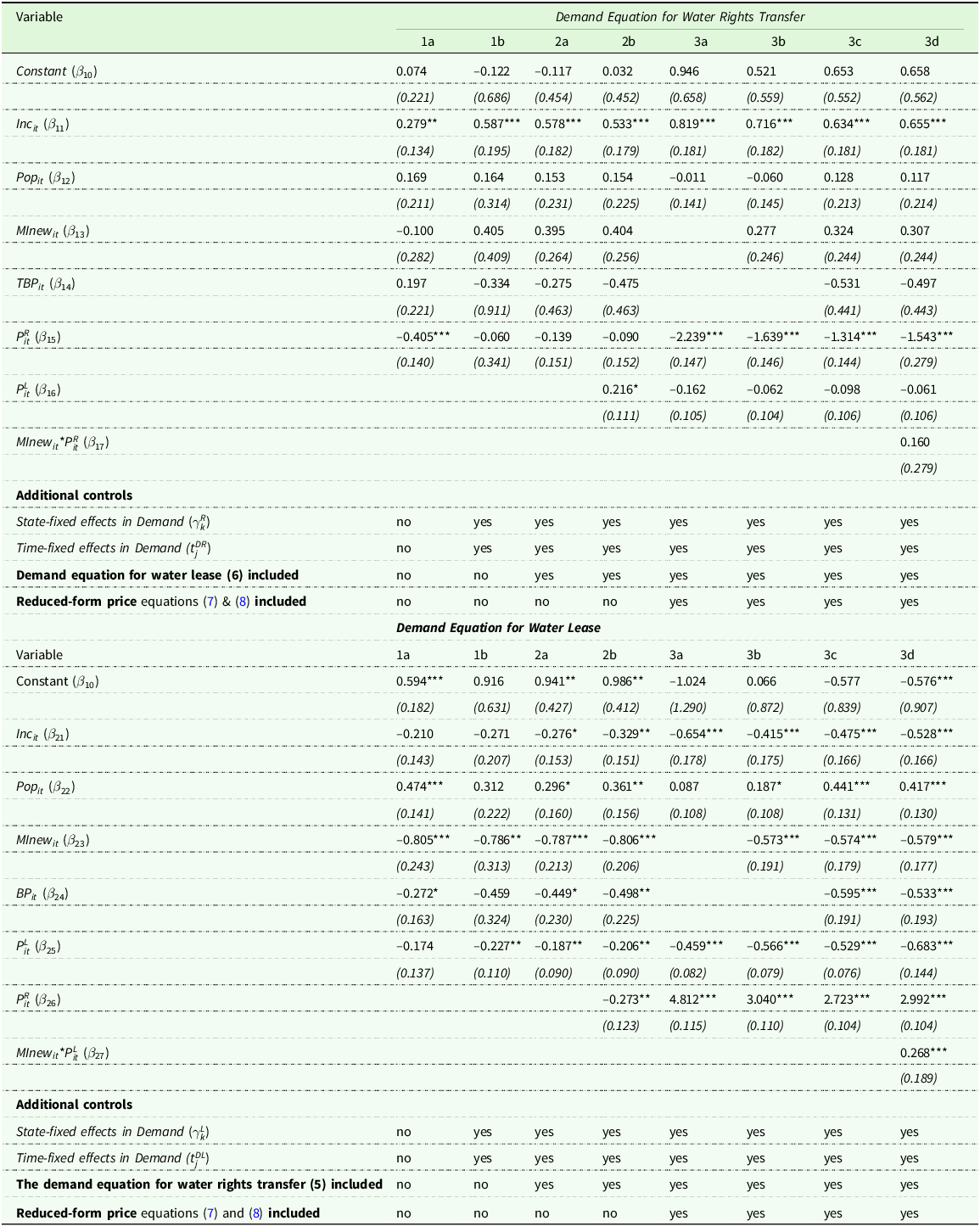
As can be observed from the single demand equations comprising only own prices, the own-price elasticity of demand ( ${\beta _{15}}$
) is negative in both the water rights transfer equation (–0.405) and in the lease demand equation (
${\beta _{15}}$
) is negative in both the water rights transfer equation (–0.405) and in the lease demand equation ( ${\beta _{25}}$
) (–0.174). However, only the coefficient for water rights is statistically significant (Table 4, specification 1a). Comparison of the respective parameter estimates across different demand specifications reveals that the upward bias in the estimated own-price effect diminishes as less restrictive models are adopted in the empirical analysis. For instance, we observed a significant increase in the magnitude of the own-price elasticity estimate within the water rights equation, which rose dramatically in magnitude from –0.405 to an impressive –1.543. Similarly, the elasticity concerning lease prices experienced a considerable ascent, shifting from –0.174 to –0.683. Notably, this latter figure attained statistical significance only after accounting for unobserved state heterogeneity, incorporating time-fixed effects, and addressing price endogeneity (see specification 3d). Our choice to employ the FIML estimation method was instrumental in capturing the intricate interplay between both demand and supply factors influencing the prices of rights transfers and leases (specifications 3a–3d). This approach not only rectifies the bias in own-price elasticity resulting from simultaneity but also integrates state and time-fixed effects, effectively mitigating the risk of omitted variable bias (as outlined in specifications 2a–2b). It is crucial to highlight that our findings suggest an upward bias in the own-price elasticity estimate, a result that aligns closely with the price endogeneity effects typically observed in linear demand models, as demonstrated in prior research (see, e.g., Hayashi Reference Hayashi2000).
${\beta _{25}}$
) (–0.174). However, only the coefficient for water rights is statistically significant (Table 4, specification 1a). Comparison of the respective parameter estimates across different demand specifications reveals that the upward bias in the estimated own-price effect diminishes as less restrictive models are adopted in the empirical analysis. For instance, we observed a significant increase in the magnitude of the own-price elasticity estimate within the water rights equation, which rose dramatically in magnitude from –0.405 to an impressive –1.543. Similarly, the elasticity concerning lease prices experienced a considerable ascent, shifting from –0.174 to –0.683. Notably, this latter figure attained statistical significance only after accounting for unobserved state heterogeneity, incorporating time-fixed effects, and addressing price endogeneity (see specification 3d). Our choice to employ the FIML estimation method was instrumental in capturing the intricate interplay between both demand and supply factors influencing the prices of rights transfers and leases (specifications 3a–3d). This approach not only rectifies the bias in own-price elasticity resulting from simultaneity but also integrates state and time-fixed effects, effectively mitigating the risk of omitted variable bias (as outlined in specifications 2a–2b). It is crucial to highlight that our findings suggest an upward bias in the own-price elasticity estimate, a result that aligns closely with the price endogeneity effects typically observed in linear demand models, as demonstrated in prior research (see, e.g., Hayashi Reference Hayashi2000).
Parameter estimates from the simultaneous system of demand equations for water rights and lease
Note: Specifications 1a, b are single rights and leases equations; 2a, b are simultaneous demand equations. Equations 3a, b, c, and d include demand and reduced-form price equations for water rights and leases estimated using FIML. Significance levels are indicated by ***, **, * at 0.00, 0.05, and 0.10, with standard errors in parentheses.
Our empirical results indicate the need for more credible estimation and identification techniques that utilize data on exogenous supply shifters. Therefore, we base further analysis of water demand and substitutability on the full-blown system of demand and reduced-form pricing equations in (5)–(8) that account for unobserved state heterogeneity affecting both demand and supply (e.g., soil type, state laws, policies, and other variables that are relatively stable over time and vary across the states) and are estimated via the FIML procedure (e.g., Kadiyali, Vilcassim, and Chintagunta Reference Kadiyali, Vilcassim and Chintagunta1996; Hovhannisyan and Gould Reference Hovhannisyan and Gould2012; Hovhannisyan and Bozic Reference Hovhannisyan and Bozic2013). The FIML is equivalent to 3SLS, both being asymptotically consistent without the normality assumption (Amemiya Reference Amemiya1985). While they are asymptotically equivalent in linear systems, nonlinear FIML is more efficient than nonlinear 3SLS (Hayashi Reference Hayashi2000, pp. 534–535). Additionally, FIML is superior when invariance to reparameterization is important, unlike 3SLS and GMM (Hayashi Reference Hayashi2000, pp. 452–453).
Own-price elasticities of demand for rights transfers and leases are relatively stable across the specifications that account for price endogeneity (Table 4, specifications 3a – 3d). In 3c, particularly, the own-price elasticity of demand is estimated to be negative and significant for both rights transfers (–1.314) and leases (–0.529). The cross-price elasticities concerning leases within the rights transfer equation are insignificant. In contrast, the rights transfers in the lease equation, with a value of 2.723, demonstrate a positive and significant relationship. This indicates a one-way substitution dynamic, suggesting that changes in the price of rights have a noteworthy impact on leasing decisions, while the reverse – leases affecting rights prices – do not seem to hold. The magnitude of these estimates indicates considerable price responsiveness for both buyers and lessees. The increased sensitivity to water rights prices likely indicates the significant long-term effects accompanying decisions to purchase water rights. In contrast, leasing water rights may not entail the same level of long-term consequences, suggesting that the choices made in water rights acquisition carry profound and lasting implications, while leasing may operate more within a transient framework.
These estimates are higher than those found in past studies. Recent meta-analyses of residential water demand generally find that residential own-price demand elasticities range from –0.70 to –0.31 (Espey et al. Reference Espey, Espey and Shaw1997; Dalhuisen et al. Reference Dalhuisen, Florax, De Groot and Nijkamp2003; Sebri Reference Sebri2014). The most recent and comprehensive study identifies an average water price elasticity estimate of –0.40, with a standard deviation of 0.72 and a median of –0.34 (Marzano et al. Reference Marzano, Rougé, Garrone, Grilli, Harou and Pulido-Velazquez2018). Flyr et al. (Reference Flyr, Burkhardt, Goemans, Hans, Neel and Maas2019) estimate the own-price elasticity for commercial demand at –0.30, with sub-category-specific elasticity estimates clustered around –0.45. Schoengold et al. (Reference Schoengold, Sunding and Moreno2006) find an own-price elasticity of water demand in the agricultural sector of –0.79, which they report as being high relative to earlier econometric studies of agricultural water demand.
One could reasonably anticipate that the demand elasticity estimates presented in this study would be more elastic compared to those found in earlier research. This expectation stems from the unique context of the decision-makers involved: water agency employees. Unlike the retail customers – whether they are residential homeowners, commercial enterprises, or agricultural operators – analyzed in previous studies, water agency professionals are generally more attuned to price signals and exhibit a higher level of responsiveness to changing economic conditions. Furthermore, water agencies often have access to alternative sources of supply, such as rights transfers and lease markets, which were modeled in this research (e.g., Hovhannisyan and Bozic Reference Hovhannisyan and Bozic2014). This flexibility enables them to adjust their strategies in response to pricing dynamics. In contrast, retail customers typically find themselves in a captive situation with their water agency, lacking viable options for alternative supply sources beyond conservation efforts. As a result, the comparative autonomy of water agencies is likely to yield a different approach to price elasticity, emphasizing the nuanced differences in demand responsiveness between these two groups.
In specification 3d, we include an interaction variable,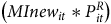 $\left( {MIne{w_{it}}*P_{it}^R} \right)$
, in the rights transfer demand equation, and
$\left( {MIne{w_{it}}*P_{it}^R} \right)$
, in the rights transfer demand equation, and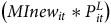 $\left( {MIne{w_{it}}*P_{it}^L} \right)$
to the lease demand equation. These variables test the hypothesis that demand elasticities for rights and leases differ across sectors. The coefficient estimates for the interaction variables in the water rights demand equation are not statistically significantly different from zero. This supports the conclusion by Brookshire et al. (Reference Brookshire, Colby, Ewers and Ganderton2004) that, as markets mature, price differences based on buyer type are likely to vanish. However, this interaction term is significant in the lease demand equation, suggesting that price differentials by buyer type still exist for leases.
$\left( {MIne{w_{it}}*P_{it}^L} \right)$
to the lease demand equation. These variables test the hypothesis that demand elasticities for rights and leases differ across sectors. The coefficient estimates for the interaction variables in the water rights demand equation are not statistically significantly different from zero. This supports the conclusion by Brookshire et al. (Reference Brookshire, Colby, Ewers and Ganderton2004) that, as markets mature, price differences based on buyer type are likely to vanish. However, this interaction term is significant in the lease demand equation, suggesting that price differentials by buyer type still exist for leases.
Regarding the remaining demand determinants, unsurprisingly, income is estimated to have a positive and significant effect on demand for water rights (0.634), while income considerations appear to be negatively related to water lease decisions (–0.475). In contrast, population growth is found to increase the demand for lease agreements (Table 4, specification 3c), with no significant effects on the transfer of water rights. A significant consequence of this discovery is that the combination of rising incomes and ongoing population growth will inevitably escalate the demand for water leases to a much greater degree. This heightened demand will place an even greater strain on already limited water resources in the western U.S., intensifying the competition for this vital resource. Another interesting finding is that demand for water leases is lower for municipal and industrial users vis-à-vis agricultural and other users, while demand for water rights was not found to vary across different industries and types of consumers. Most of the remaining demand shifters analyzed in our study are statistically insignificant, likely due to a high degree of correlation among the included covariates.
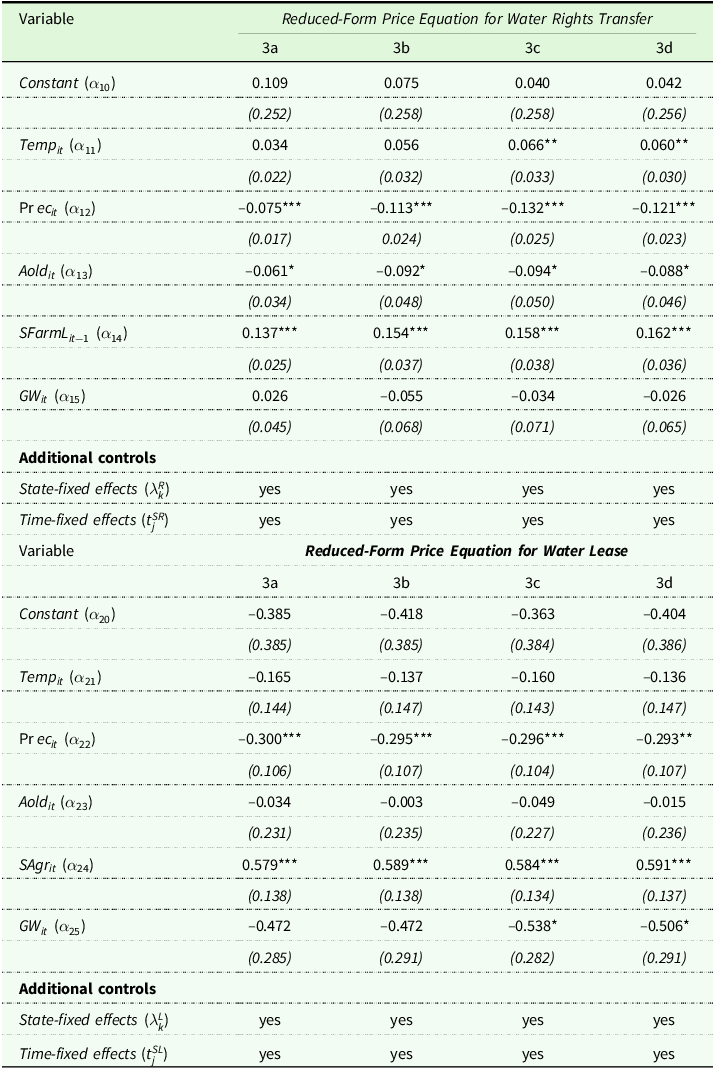
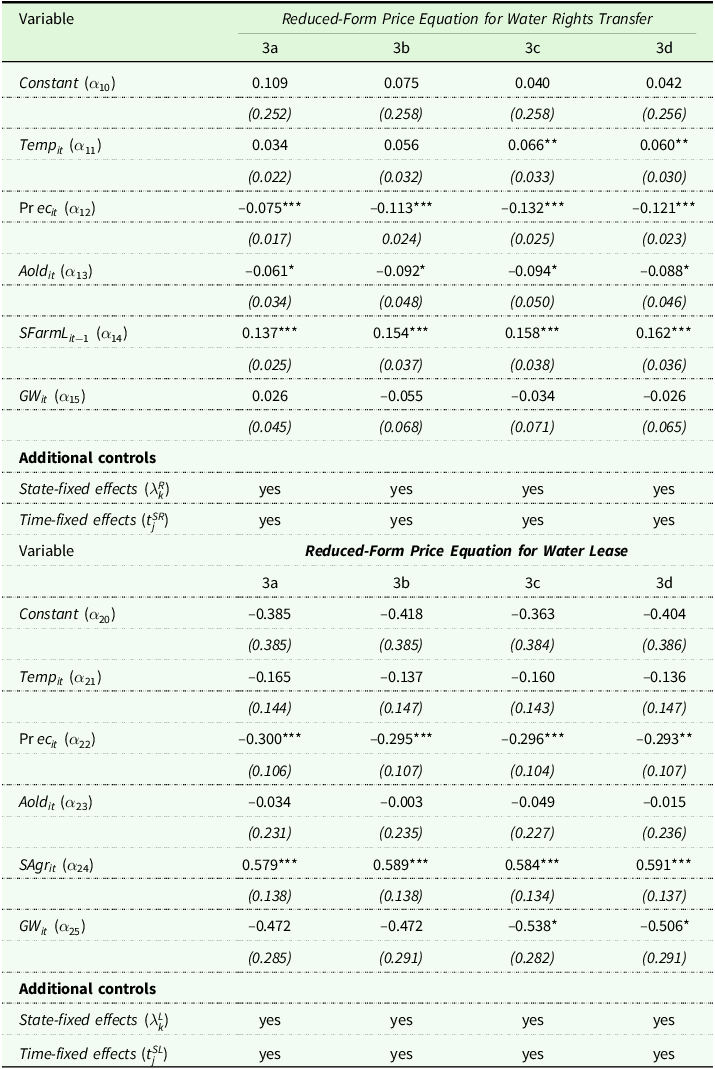
As can be observed from Table 5, the temperature variable is significant for only water rights transfer prices in specifications 3c and 3d. The positive coefficient (0.066) may reflect the positive impact on the rights transfer prices of reduced water supply brought by warmer temperatures. The precipitation coefficient is negative and significant in the water rights and lease price equations (–0.132 and –0.296, respectively). Logically, the lease price would be inversely related to the precipitation level. However, one might expect the rights transfer price to be informed by average expectations of precipitation rather than its realization at the time of the transaction.Footnote 7 Drought conditions might create fertile ground for water agencies to gather the political backing needed to secure coveted water rights. Regardless of the reasons, our findings reveal a noteworthy insight: the influence of precipitation on the transfer of water rights appears to be significantly less pronounced than its impact on water leases. This highlights a complex relationship between environmental factors and the dynamics of water resource management.
Parameter estimates from the reduced-form water rights and lease price equations
Note: Specifications 1a, b are single rights and leases equations; 2a, b are simultaneous demand equations. Equations 3a, b, c, and d include demand and reduced-form price equations for water rights and leases estimated using FIML. Significance levels are indicated by ***, **, * at 0.00, 0.05, and 0.10, with standard errors in parentheses.
We included $Aol{d_{it}}$
in the price equations to account for the possibility of rights transfer and lease prices differing by seller type. The
$Aol{d_{it}}$
in the price equations to account for the possibility of rights transfer and lease prices differing by seller type. The $Aol{d_{it}}$
coefficient is only marginally significant and negative (–0.094) across all specifications of the rights equations. This observation suggests that holders of agricultural water rights may indeed possess less bargaining power than other sellers in the marketplace when it comes to transferring their water rights. This notion aligns with assertions made in various market analyses, highlighting the challenges these rights holders face in negotiating favorable terms. The
$Aol{d_{it}}$
coefficient is only marginally significant and negative (–0.094) across all specifications of the rights equations. This observation suggests that holders of agricultural water rights may indeed possess less bargaining power than other sellers in the marketplace when it comes to transferring their water rights. This notion aligns with assertions made in various market analyses, highlighting the challenges these rights holders face in negotiating favorable terms. The $SAg{r_{it}}$
coefficient is logically positively significant (0.584) in the lease price equation; lease prices are higher when the agricultural value of production is higher, reflecting the short-term opportunity cost to sellers of foregoing water use in agriculture. We anticipate that the variable representing the long-term value of agricultural land will play a crucial role in informing the pricing of rights transfers. This expectation is underscored by the significance of the coefficient on the one-period lagged value of farmland, which ranges from 0.137 to 0.162 across all specifications examined. This finding highlights the importance of historical land values in shaping current market dynamics and influencing prices in agricultural transactions. Finally, groundwater (
$SAg{r_{it}}$
coefficient is logically positively significant (0.584) in the lease price equation; lease prices are higher when the agricultural value of production is higher, reflecting the short-term opportunity cost to sellers of foregoing water use in agriculture. We anticipate that the variable representing the long-term value of agricultural land will play a crucial role in informing the pricing of rights transfers. This expectation is underscored by the significance of the coefficient on the one-period lagged value of farmland, which ranges from 0.137 to 0.162 across all specifications examined. This finding highlights the importance of historical land values in shaping current market dynamics and influencing prices in agricultural transactions. Finally, groundwater ( $G{W_{it}}$
) is found to be an important short-run price determinant in the reduced-form price equations for only leases (–0.538).Footnote
8
We believe the negative coefficient reflects the fact that seller opportunity costs are lower for water from groundwater sources as compared to surface water. Thus, the seller’s willingness to accept is lower for groundwater.
$G{W_{it}}$
) is found to be an important short-run price determinant in the reduced-form price equations for only leases (–0.538).Footnote
8
We believe the negative coefficient reflects the fact that seller opportunity costs are lower for water from groundwater sources as compared to surface water. Thus, the seller’s willingness to accept is lower for groundwater.
Effects of restrictive modeling assumptions on estimated parameters and future water demand projections
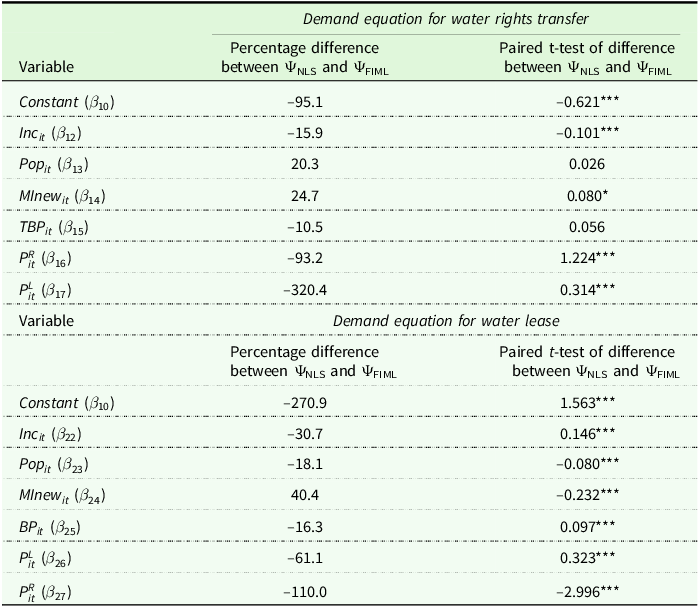
We examine the impact of several restrictive assumptions on the estimated model coefficients, as detailed in Table 6. The findings presented in this table provide compelling evidence that these assumptions significantly alter the parameter estimates, with notable variations observed in both percentage terms and the results from paired t-tests of difference. This evaluation underscores the importance of critically evaluating and understanding the implications of these assumptions within empirical applications, as they can significantly impact our interpretations and conclusions.
Bias in price elasticities and demand coefficients resulting from the omission of price endogeneity
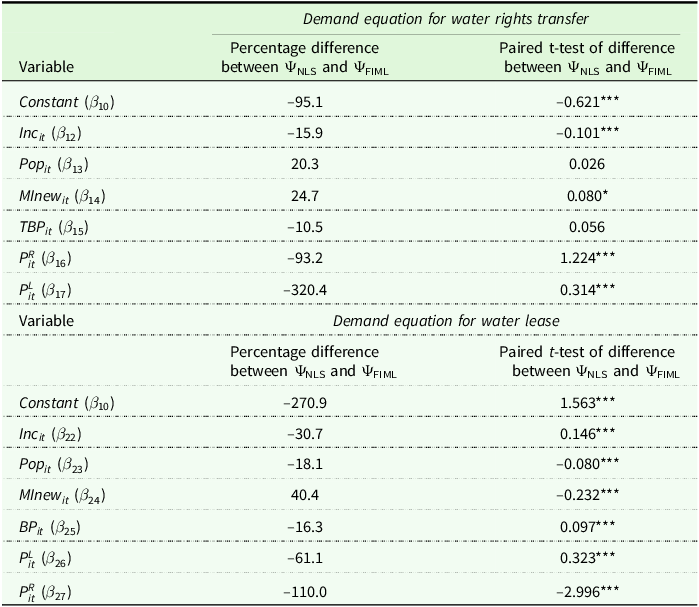
Note: The standard errors are in parenthesis and are computed based on $\sqrt {\sigma _{NLS}^2/N + \sigma _{FIML}^2/N} $
, where
$\sqrt {\sigma _{NLS}^2/N + \sigma _{FIML}^2/N} $
, where $\sigma _{NLS}^{}$
,
$\sigma _{NLS}^{}$
, $\sigma _{FIML}^{}$
denote the respective parameter standard errors from the NLS and FIML estimations, and N is the sample size. **, **, *identify parameter estimates that are statistically different from 0 at the 0.01, 0.05, and 0.10 significance levels, respectively. NLS, nonlinear least squares.
$\sigma _{FIML}^{}$
denote the respective parameter standard errors from the NLS and FIML estimations, and N is the sample size. **, **, *identify parameter estimates that are statistically different from 0 at the 0.01, 0.05, and 0.10 significance levels, respectively. NLS, nonlinear least squares.
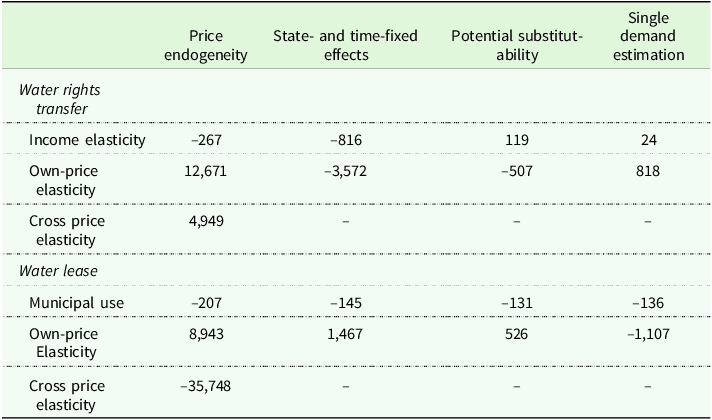
In our final exercise, we conduct a simple simulation analysis to assess the significance of these modeling assumptions in informing policy decisions. Specifically, we compute water demand projections for 2025 under different empirical specifications, using the respective elasticity estimates, current levels of water consumption through rights transfers and leases, and our sample average annual growth rates for the respective causal factors (e.g., income, own, and cross prices). Results from our simulation analysis indicate that endogeneity-induced bias in projected demand for water rights transfer can reach up to 12,671 taf, which constitutes a significant underestimation of demand for water rights in 2025 (Table 7, top panel). Similarly, omitting price endogeneity overestimates demand for water leases in 2025 by 8,943 taf (Table 7, bottom panel). Unobserved time and state effects, as well as potential substitutability between water rights transfers and leases, are also found to bias future water projections. However, the magnitude of the bias appears relatively minor. Finally, ignoring price endogeneity introduces significant biases in cross-price elasticities, resulting in considerable biases in projected demand for rights transfers and leases, with the bias ranging from 4,949 to 35,748 taf.
Bias in projected water demand in 2025 resulting from the estimation of restrictive models (thousand acre-feet)
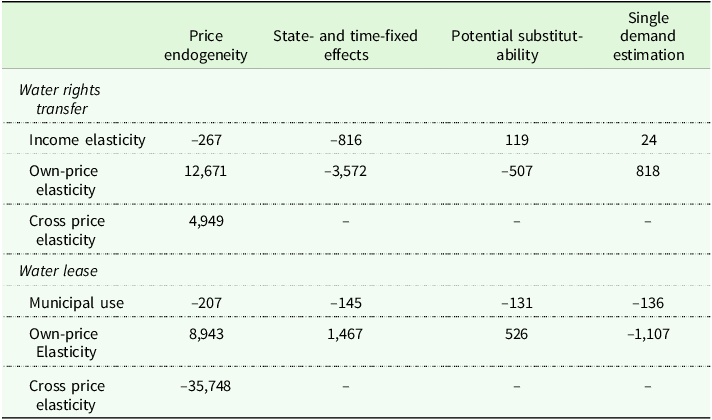
Note: The bias in projected water demand is calculated as the difference between the respective demand projections in 2030 under different empirical specifications using the respective elasticity estimates, the current levels of water consumption through rights transfers and leases, and our sample average annual growth rates for the respective causal factors.
Summary and conclusions
This paper models the markets for water rights transfers and leases jointly by estimating a simultaneous system of demand equations for rights transfers and leases, recognizing the possibility that prices for both rights transfers and leases influence transfer volumes in both markets. It allows us to account for supply drivers affecting rights transfer and lease prices by supplementing this demand system with reduced-form price equations for transfers and leases. The resulting system accounts for the simultaneous effects of supply and demand factors on prices. We can employ an econometric model sufficiently robust to account for price endogeneity in water markets due to our unique, transaction-specific dataset with geographically explicit explanatory variables that covers a broader geographical area across the western U.S..
Own-price demand elasticities are –1.314 and –0.529 for rights transfers and leases, respectively. These estimates are somewhat higher than demand elasticities generally reported in the literature. Our explicit modeling of substitutes explains this difference, as does the fact that the agents in the present study are water agencies rather than residential, commercial, or agricultural water users, who generally have less access to substitute supply sources than water agencies. This study is, by the methods used, limited to locations where both sales and leases occur, so substitutes exist by design. The absolute value of demand elasticity could be lower in locations where only one or the other contract form has been reported. However, given that additional substitutes (new supply sources, conservation, and transaction activity not reported in the dataset) may also exist in these other locations, the elasticities found in this study may still be reasonable elsewhere in the western U.S..
The specifications outlined in this analysis highlight the critical importance of addressing price endogeneity, particularly in the context of supply-side factors. Omitting these drivers can lead to substantial biases in parameter estimates and distort the understanding of economic implications. The neglect of price endogeneity related to rights transfers can result in significant inaccuracies within a relatively brief timeframe, evident through to 2026. Furthermore, the oversight of unobserved state heterogeneity and available substitutes also contributes to the skewing of estimated economic effects and other related outcomes, underscoring the necessity for a more comprehensive approach to analysis.
Previous water market studies, such as those by Brookshire et al. (Reference Brookshire, Colby, Ewers and Ganderton2004), De Mouche et al. (Reference De Mouche, Landfair and Ward2011), and Payne et al. (Reference Payne, Smith and Landry2014), which failed to find price endogeneity, focused on smaller geographic areas with smaller numbers of transactions. This may account for the differences in our findings. Further, water quantity transferred – and indeed, transfer quantities for other natural resources – likely become more responsive to price over time, as the institutions through which they are transferred take on more characteristics of conventional commodity markets.
We were unable to estimate a comprehensive structural system of demand and supply equations due to a lack of sufficient climate division-year cells with both sales and lease observations. This paper nonetheless represents an advance over previous Western U.S. water market studies, which attempted to estimate market forces of supply and demand. It is notable for its ability to account for supply shifters in the demand equations and to incorporate lease substitutes and transaction-specific location information into the analysis. In the future, more recent and comprehensive data could enable us to estimate a comprehensive model of demand and supply equations, which would also yield the supply elasticity. Understanding the relationships and linkages between different types of water transfers will become increasingly important in the western U.S., as policymakers in the region gain experience with water markets and become more reliant on them to match variable water supplies to growing water demands. Additionally, the incorporation of precipitation and weather-related variables into our pricing instruments presents a notable limitation in our study. This stems from the fact that both buyers and sellers operate within the same climate divisions. Consequently, our chosen instruments may inadvertently correlate with water demand, complicating the assessment of pricing effects on consumption. To improve the reliability and precision of future research studies, it would be advantageous to conduct an in-depth analysis of buyers and sellers situated within different climate divisions, particularly as sufficient data becomes available. Finally, data aggregation at the climate division level is a major limitation of this study, which may have affected the results. Therefore, we recommend that future research address this issue.
Competing interests
None of the coauthors have any potential conflicts of interest.



 Open access

