

Introduction
Lake dwellings, most of them dating from the late Neolithic to the Bronze Age, are exceptionally well-preserved settlement sites, found in the littoral zone of the lakes of Switzerland, southern Germany and northern Italy (e.g. Reference KellerKeller 1866; Reference MenottiMenotti 2004). Vast quantities of organic objects have been turned up by excavation, including textiles, wooden structures, wooden and bone artefacts, leather and food and plant remains as well as large numbers of stone, metal and ceramic objects. These discoveries have had a strong public appeal, resulting in many visual and life-size reconstructions of the sites, and museums across Europe endeavoured to have a representative set of objects from the sites.
The collection
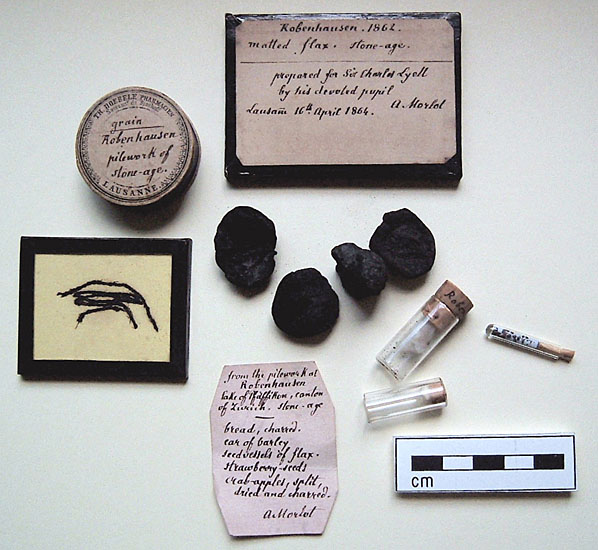
One example of an early investigation at a Swiss lake dwelling is Robenhausen near Lake Pfäffikon, one of the richest sites in the Kanton of Zurich, which was owned and excavated by Jakob Messikommer. A small assemblage of organic material from this site is now located in the Museum of Archaeology and Anthropology in Cambridge (Figure 1). It includes pieces of charred bread, an ear of barley, seeds of flax, strawberry seeds, crab-apples (split, dried and charred) and charred grain. These are all in glass test-tubes. There are also two pieces of woven flax and matted flax in glass-plated wooden frames, and a hand-written note identifying the samples.
The collection of lake dwelling artefacts from von Morlot to Charles Lyell. (Reproduced with the permission of the Cambridge Museum of Archaeology and Anthropology, Acc. no. 2003.18.).

Research shows that these objects were given to the eminent British geologist Sir Charles Lyell (1797-1875) in 1864 by the Swiss scientist and antiquarian Adolf von Morlot (1820-1867) and became part of Lyell's already considerable collection of geological and archaeological specimens. The gift resulted from the correspondence and academic friendship between the two men regarding their geological and archaeological researches. Lyell was interested to know more about 'the curious antiquities' that were coming out of Swiss lake sites (Reference LyellLyell 1860a) as he was simultaneously writing his Antiquity of Man published in 1863. He also asked Morlot send him a copy of a paper by the Swiss animal bone specialist Rütemeyer because 'it has direct bearing on the work I [Lyell] am now writing on "the antiquity of Man" and his relation to former states of the organic world...' (Reference LyellLyell 1860b).
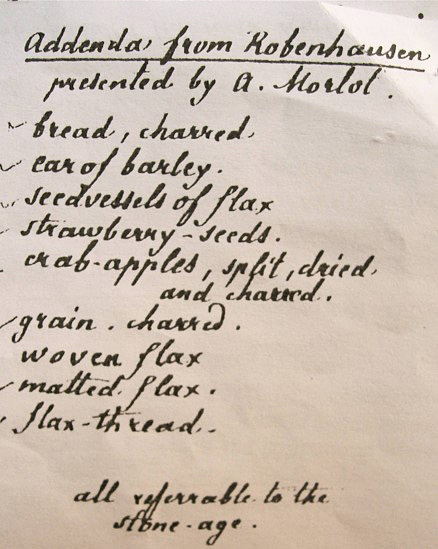
Detail of the catalogue containing the list of objects sent from Uhlmann and Morlot to Charles Lyell. This detail shows Morlot's addendum (MAA collections, Acc no: 1951. 556.).

Following further correspondence during the 1860s, particularly on prehistoric Scandinavia, Morlot and his Lausanne-based colleague Dr Uhlman proposed to send Lyell a selection of Swiss 'lake antiquities', which Lyell acknowledged would 'prove of great use to myself and others.' (Reference LyellLyell 1860c). A collection of bone and some organic material from the lake site of Moosseedorf was chosen as representative of the various animal remains preserved in the lake sites and specifically tailored to Lyell's interests in the prehistoric environment and 'Man's relation' with its flora and fauna. This is seen in the accompanying letter to Lyell in 1864, which Morlot authored, enclosing an English translation he had completed of the bone catalogue stating, 'I [Morlot] thought, that a series, showing the different marks upon the bones from the [lake dwellings] would be welcome [sic] to you.' (Morlot 1864).
Uhlmann and Morlot jointly sent the collection to Lyell, though Morlot wrote the accompanying artefact list and letter. It seems that Dr Uhlmann was responsible for gathering much of the material but also eager to include Morlot in the prestigious transaction. Morlot writes that '[Uhlmann] wishes the [bone] series to be presented in my name, as well as in his, although the merit is all his own' (Morlot 1864).
It was at this point that Morlot added the small group of objects discovered at Robenhausen in 1862, considered and illustrated here, listing them under an addendum (Figure 2) and thus separating them from the main hand-written catalogue of bone. Morlot set these specimens apart as a gift from himself, seen not only by his addendum but also in his careful presentation of the specimens; the grains and seeds in hand-labelled glass tubes and a little box and the two textile fragments mounted in glass frames with Morlot's label and greeting on the back of both frames which reads:
'Robenhausen 1862 matted flax. Stone-age. prepared for Sir Charles Lyell by his devoted pupil A. Morlot Lausanne, 16th April 1864.' (MAA, collections, Acc.no. 2003.18.)
Collections, social networks and archaeological practice
By referring to himself as a 'devoted pupil', Morlot seems eager to thank and endear himself to his well-known mentor by marking out a group of objects distinctly bearing his name. This emphasises the social nature of the transaction. Specimens like this played two roles simultaneously, conveying scientific evidence of the prehistoric past and bonding through the exchange of gifts.
The interactions behind this exchange are revealed not just by their social context but are embodied in the objects themselves. Collections and their archives are therefore key sources for analysis of the social and material environment within which archaeological knowledge was formulated. Through this small vignette we can piece together the complicated threads that make up past archaeological practices and the social networks within which collections were entwined.
It was quite common for archaeological and scientific specimens to be bought or exchanged as gifts by private collectors and such transactions are the foundation of many museum collections. The biography of a collection like this is of interest as a type of primary source through which to explore social and intellectual networks in the second half of the nineteenth century.
Acknowledgements
I want to thank Anne Taylor at MAA, Cambridge and Pamela Jane Smith, MacDonald Institute, Cambridge.