

Introduction
Heritage is an actively constructed understanding of the past that is shaped by political, economic and social concerns of the present (e.g. Harrison Reference Harrison2010; Silverman et al. Reference Silverman, Waterton and Watson2017; Waterton & Watson Reference Waterton and Watson2015). As such, it is also a political tool that can be used for the construction of identity, of social memory and social amnesia (Assmann Reference Assmann and Schacter1995), through processes of forgetting and exclusion and of narratives that perpetuate specific versions of history. Archaeological heritage, in particular, can play a very powerful role in shaping and re-shaping collective identities and histories, because of the tangibility and historical depth of the archaeological remains. It is precisely these properties that create links between place, time, people and things, materially substantiating the past and offering, at the same time, an ideal framework for its continuous construction in the present. This is why archaeology matters so much for political agendas, for the media and the public and for social imagination (cf. Pollock Reference Pollock, Pollock and Bernbeck2005). Control of the past and its representation is tantamount to control of history. Thus, it is a source of power in the present.
I am specifically interested here in the relationship between heritage, space and history. Space or place can be a powerful social imaginary, while debates about the value and meaning of archaeological sites are fundamentally debates about the meaning of place and histories of spatiality or locality. Additionally, the concept of heritage is associated with notions of inheritance, legacy and ownership, and as such it can be mobilized to assert claims to land and legitimacy. History represented by heritage can also be directed towards particular ends and can arise from selective processes by hegemonic political ideologies which decide which pasts, events, perspectives, sites and objects become part of ‘official’ history (Lowenthal Reference Lowenthal1998; Moody Reference Moody, Waterton and Watson2015). Consequently, studying how heritage is involved in the shaping of historical discourse entails an understanding of the historical and contemporary cultural context through which antiquity is imagined. This paper analyses the official treatment of the Neolithic archaeological heritage in Greece and Turkey and the politics of historiography at the level of the state, but also oppositional views mobilized by public discourse or incorporated into the narratives of present communities, using representative sites as case-studies and placing them all into a larger historical and discursive context.
A final note concerns heritage and nationalism. Archaeologists have endeavoured to deconstruct this relationship since the mid 1990s and by now several studies assert the demise of nation-states in an age of globalization and the rise of post-national forms of identity. However, nationalist conceptions of history and identity continue to influence research questions and public conversation today. Modern ideas of nationalism and colonialism continue to underlie contemporary heritage management, as seen, for example, in UNESCO World Heritage List's nation-centred orientation, despite new policies encouraging inclusivity and ‘lay historicities’ (Brumann Reference Brumann2014, 181; Meskell Reference Meskell2015). In the wider political context, the current re-rise of Far Right ideologies in Europe, of interest in national identities in eastern Europe and of religious nationalism in the Middle East, and generally the global resurgence of ethnic tensions suggest that the politics of nationalism ‘remain as vibrant and as troubling as ever’ (Winter Reference Winter, Waterton and Watson2015, 331). Central in all of these rhetorics is the identification of a national heritage. Furthermore, there is a distinction between the Western nationalism, developed as a crucial ideological legitimation for already established states, and the Eastern nationalism, developed out of concepts of nation and national identity preceding, and motivating, the construction of nation-states, many of which, moreover, emerged only after the collapse of dynastic empires, the interference of European powers and the disruption of political territories (Rampley Reference Rampley and Rampley2012a, 10–11). Hence the exceptional emphasis placed by nationalist archaeology in these states on historical roots and continuities on the one hand and the utilization of Western colonialist concepts for the new national agendas, on the other. In this sense, the hegemonic form of collective identity is already a trans-national or hybrid product.
Greece and Turkey as historical and political contexts
In the part of the world broadly defined by southeast Europe, eastern Mediterranean and the Middle East, the engagement with the past has a political history of its own that has shifted in line with continuous changes in these countries’ relationship to the West (Boytner et al. Reference Boytner, Swartz Dodd and Parker2010; Meskell Reference Meskell1998; Pollock & Bernbeck Reference Pollock and Bernbeck2005; Rampley Reference Rampley2012b; Solomon Reference Solomon2021). As stated above, the new-born states looked to the West for identification until they eventually reasserted ancient lines of descent and reclaimed cultural property. National identity therefore had to be formed and propagated against the ‘crucial dilemma between modernization and westernization’ (Plantzos Reference Plantzos, Damaskos and Plantzos2008, 22).
Greece and Turkey are no exception, and particularly interesting parallels may be drawn between them. Both countries have been at a junction of different historical forces and political powers, and their cultural heritage has been used to address questions about origins and identity of a European and even global significance. Archaeological research and heritage management are seen as inherently linked to national history and identity: they are operated through strict centralized administration systems run by the respective Ministries of Culture and have been far from uncontested. Finally, both countries are most popular destinations for cultural tourism and the quest for ‘authenticity’, with tourism generating a significant income for their respective economies.
Although Greece and Turkey were never formally colonized, nation-state building involved colonization in intellectual and economic terms (Herzfeld's Reference Herzfeld2002 ‘crypto-colonialism’), including notions of Western modernity, the quest for establishing archaeologically documented roots and ancestry and the involvement of foreign archaeological schools and expeditions (officially since the nineteenth century) in the ways in which archaeological knowledge, research agendas and notions about cultural heritage have been produced.
Moreover, the two countries have a long history of enmity and conflicts, involving territorial disputes, warfare, displacement, mutually negative perceptions and sharply opposing nationalist ideologies of selfhood and otherhood, although since the 1980s initiatives for reconciliation have been undertaken by both sides (Karakatsanis Reference Karakatsanis2014). Two major historical conflicts are especially crucial. First, the Greek War of Independence (1821–29), which caused the loss of Ottoman territories of the lands of ‘Rum’ (Rome/Romans in Greek), a term originally denoting the self-definition of the inhabitants of the eastern Roman Empire (commonly known as Byzantium) (for later meanings, see Kafadar Reference Kafadar2007). Second, the Greco-Turkish War, part of both the Turkish War for Independence 1919–22 and Greece's irredentist attempt to encompass the ‘non-liberated homelands’ in Asia Minor (known as the ‘Great Idea’), which resulted in one of the largest forced population exchanges in contemporary European history (Karakatsanis Reference Karakatsanis2016). This painful recent past has deeply affected attitudes to the archaeological past, including competing juxtapositions of Greek and Turkish heritages and attempts to erase the Greek imprints in Anatolia and the Ottoman imprints in Greece.
The anxiety for cultural distinction in the West is evident in the pre-occupation with ‘firsts’ and ‘oldests’ and the rivalry between Greece and Turkey (Anatolia) as the Cradle of Western civilization. A distinct example regards the Neolithic or rather what I would call ‘the politics of Neolithization’. That is, a large amount of Neolithic research in both countries—whether conducted by indigenous archaeologists or others—has recurrently revolved around the origins of the Neolithic as indigenous versus exogenous, with a view to determining the transmission of farming to Europe and against the background of Western grand narratives of social evolution.
Finally, in both Greece and Turkey the study of prehistory was marked by the excavations in Troy by Heinrich Schliemann in the late nineteenth century. Although Troy is located in present-day Turkey, it has been associated with Greek antiquity and mythology, as described in the Iliad, for centuries. It was therefore the Greek rather than the Turkish Bronze Age that became the focus through the Troy excavations, further reinforced by Schliemann's discoveries at Mycenae a little later. In Turkey, the legacy of Troy and the relationship between the site and the modern Turkish nation still constitute matters of debate (see Gür Reference Gür, Boytner, Swartz Dodd and Parker2010, 68–72; Tanaka Reference Tanaka and Shankland2013, 57–9).
Greece
In Greece the construction of national identity and official history was based on the ideas of spatial and historical continuity with Hellas and the superiority of the Classical past, given also the identification of (Classical) Greece as the source of Western civilization by the political and intellectual elites of the West already in the eighteenth century. The story of the production of modern Greece and the complicated ways in which antiquities (mainly Classical) are understood, appropriated or contested have been of central interest in the international literature (see Solomon Reference Solomon2021, for latest discussions and references; also Greenberg & Hamilakis Reference Greenberg and Hamilakis2022). Attitudes to the deeper past, on the other hand, and especially the Neolithic (and the Palaeolithic), have rarely received any sustained critical attention (see below for exceptions).
The identification of Greece with its Hellenic past, including the consequent Atheno-centric view of the Greek state (Karatzas Reference Karatzas and Rampley2012), has led to a monumentalization of Greece's cultural space and time (Hamilakis Reference Hamilakis2007, 105, 122), further underlined by the tripartite periodization of Greek history into ancient, medieval and modern and the fusion of Classical antiquity with Byzantine Christianity (Helleno-Christianism), constructed by Greek intellectuals in the late nineteenth century. And when prehistory was investigated, it was the Minoan and Mycenaean civilizations of the Bronze Age which attract(ed) attention, not least because they were taken to extend the wider belief in Greece as the Cradle of European civilization back to later prehistory. They were indeed incorporated into the historical development of Hellenism as the forerunners to the Classical and, by implication, the modern European civilization (e.g. Hamilakis Reference Hamilakis, Hamilakis and Momigliano2006; Momigliano Reference Momigliano, Borgna, Caloi, Carinci and Laffineur2019).
This selective historiography not only excludes the Neolithic period; it also converts it into a number of decontextualized and unimportant spaces. Thus, while Neolithic archaeology in Greece began more than a century ago, has made significant contributions to world prehistory and has burgeoned in the last two decades (see Chapman & Souvatzi Reference Chapman and Souvatzi2020), the construction of heritage has marginalized the Neolithic in the national official discourse on antiquity and in public consciousness. At the same time, the wider focus on Classical Greece, the world described in the Homeric epics and the achievements of the Minoan and Mycenaean cultures have often resulted in the adoption of inappropriate models of interpretation of Neolithic societies derived from later and structurally different historical contexts. The Neolithic sites discussed below illustrate these points.
Dimini
Dimini in Thessaly (fifth millennium bc), one of the most famous Neolithic settlements of Greece and among the first discovered in Europe, offers an ideal case for contextualizing the history of interpretations of the Greek Neolithic past. The settlement is composed of habitation terraces constructed at different levels, defined by multiple stone-built concentric enclosures and surrounding a central courtyard (4–5 m higher than ground level) (Souvatzi Reference Souvatzi2014, fig. 5.1).
It was first excavated by Christos Tsountas, a pioneer of Greek archaeology, in 1903. Influenced by his contemporary discoveries in Troy and Mycenae, Tsountas (Reference Tsountas1908) interpreted Dimini as a well-defended ‘acropolis’, ruled by a king residing in the tripartite building of the innermost enclosure which he called ‘megaron’. As is known, the term ‘megaron’ was employed in the Homeric epics to describe the residence of Mycenaean leaders. In fact, before Dimini, Tsountas had taken over the excavations at Mycenae from Schliemann himself and it was he who discovered the Mycenaean palace (or megaron) there (Voutsaki Reference Voutsaki, Voutsaki and Cartledge2017).
Excavations at the site were resumed in the 1970s under Giorgos Hourmouziadis, another greatly influential Greek prehistorian and a proponent of systems theory and Marxist archaeology. Based on the new data, Hourmouziadis (Reference Hourmouziadis1979) refuted the defensive function of the enclosures, the idea of social stratification and the existence of a ‘megaron’ during the Neolithic and attributed a communal character to the central courtyard. He viewed the settlement as being functionally divided into large spatial segments corresponding to self-sufficient units of production, in accordance with the static perspectives of processual archaeology.
Since the two excavations, Dimini has been widely used in the international literature to construct generalizing socio-economic models about the Neolithic in Greece as a whole. Astonishingly, common in several is a re-appearance of the notion of a megaron hierarchy, accompanied, in addition, by the claim that the origins of the Late Bronze Age palatial economies are to be found in the Neolithic and in settlements like Dimini (e.g. Halstead Reference Halstead, Laffineur and Niemeier1995). Dimini has also been considered an ideological forerunner of the monumental citadel and five megaron buildings inside a central walled courtyard of Troy II (Jablonka Reference Jablonka, Steadman and McMahon2013, 726). Troy II is dated to 2600–2300 bc. This is at least 2000 years after the establishment of Dimini. Other readings also reflect a return to the traditional explanations of Neolithic enclosures in terms of defence and fortification (e.g. Alušik Reference Alušik, Sarris, Kalogiropoulou, Kalayci and Karimali2017).
While Tsountas's interpretation may be understandable in the context of his era and the very limited knowledge of the Neolithic period at that time, this return to outdated paradigms implies biased research priorities. Privileging the quest for centralized hierarchy in Neolithic societies presumed to be the ancestors of future kingdoms and states, thus seeking to establish evolutionary links over thousands of years and considerable geographical distances, only serves to highlight the continuing bias of the perceived ‘value’ of later prehistory. What is more, these top-down models are not substantiated by contextual and bottom-up analysis of the site's data, which reveal instead social inter-dependence, heterarchy and cross-cutting networks of power (Souvatzi Reference Souvatzi, Kohring and Wynne-Jones2007; Reference Souvatzi2014, ch. 5).
Dispilio
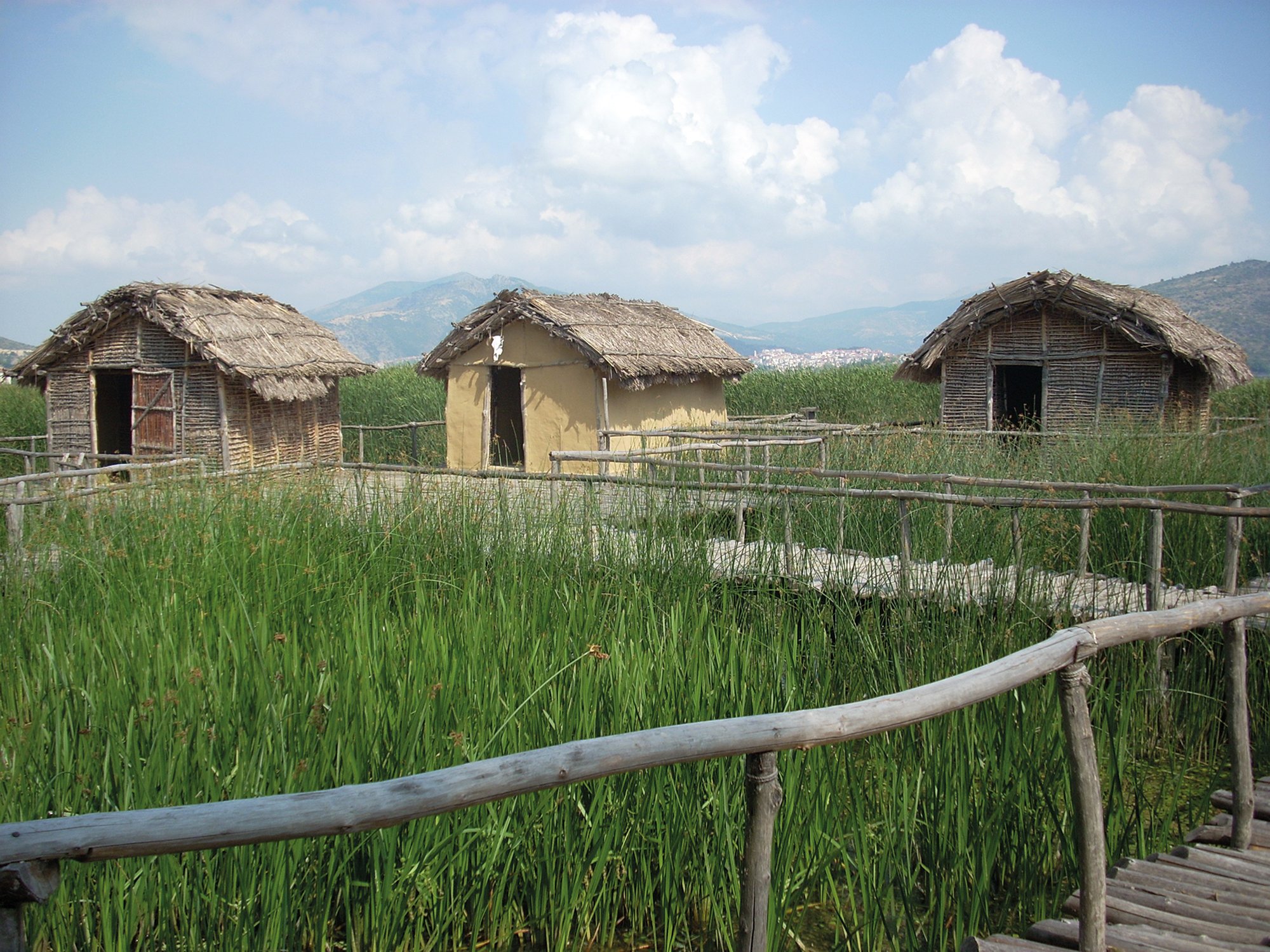
Dispilio (c. 6000–1200 bc) in western Macedonia is the first lake settlement discovered in Greece. Systematic excavations between 1992 and 2013 unearthed a number of Neolithic wooden post-framed dwellings on raised platforms (Hourmouziadis Reference Hourmouziadis2002). Eight dwellings have been reconstructed since 1999 as part of an Open-Air Eco-museum (Fig. 1), which also includes a permanent exhibit containing original artefacts. Rare findings include three bone flutes, wooden tools and a wooden tablet inscribed with linear symbols, radiocarbon-dated to 5250 bc. Renewed research at the site has initiated an international collaborative project for the development of dendrochronological frameworks (Kotsakis Reference Kotsakis2019).
Dispilio: reconstruction of Neolithic pile dwellings; modern city of Kastoria visible in background. (Photograph: © the author.)
Visitors—national and other—and the press usually perceived Dispilio within a Hellenocentric context (Hourmouziadi & Touloumis Reference Hourmouziadi, Touloumis, Stroulia and Buck Sutton2010). Many took it as proof of the deep historical roots and spatiality of the Greeks and their dominant role in world history, while some read the traces of the aforementioned ‘protoscript’ as the first example of Greek writing. The inhabitants of the modern village of Dispilio, on the other hand, were not at all keen to claim continuity or any cultural association with the distant Neolithic ancestors, whose fragmented remains were neither impressive nor related to familiar symbols of the Hellenic civilization. The nearby city of Kastoria, known for its wealth from the fur trade since the eighteenth century, its traditional upper-class mansions and its host of Byzantine churches, offered a much more attractive option for association with heritage. In addition, given the conservatism of the region, there were even instances of hostility by a number of locals led by the local priest, who considered archaeologists as a group of atheists who sought pre-Christian antiquities (see Hourmouziadi & Touloumis Reference Hourmouziadi, Touloumis, Stroulia and Buck Sutton2010, 311–12, 315).
None of these sites, or any other Neolithic site in Greece for that matter, has generated any lasting excitement in the public and the media. The glorious Classical past continues to monopolize attention in global academic and popular discourse, while the Neolithic, however important it is to archaeologists, does not offer material suitable for the Helleno-centric construction of heritage and history. It is not considered worthy to be included in marketing strategies. Dispilio is not even mentioned in the website of the Ministry of Culture. The Neolithic period is still ignored in school textbooks and is still under-represented in most of the Greek archaeological museums. It was also strikingly absent from the otherwise much-analysed parade of Greek Antiquity in the Opening Ceremony of the Athens 2004 Olympic Games. Greece's selection of sites for World Heritage nomination definitely speaks to what constitutes national pride and what does not. Of the 18 inscribed sites in total, only one is prehistoric, and that is the archaeological sites of Mycenae and Tiryns combined, while the Minoan Palatial Centres (five of them together) is the only prehistoric site among 14 sites in the Tentative List.
Turkey
Turkey's history is a palimpsest of different cultures and there is a large number of archaeological and historical remains which are not immediately identified as Turkish. Many of these, moreover, constitute a ‘difficult’ heritage created by ethnic ‘others’ such as Greeks and Armenians. Consequently, a primary aim of the modernization project of the Turkish Republic, founded in 1923, was to produce an ethno-spatially homogeneous national territory across the millennia based on the concept of ‘Turkishness’. The ‘Turkish History Thesis’, published in 1930, attempted to rewrite the history of Turkey, to erase the history of other cultural and ethnic groups, as well as to insert modern Turkey into world history. It argued that the Turks belonged to an ancient culture that brought civilization to many parts of the world through waves of migration from an original homeland in Central Asia, where the origins of all human civilizations are to be found (Atakuman Reference Atakuman2008). Emphasis shifted to ‘Anatolia’ (sunrise or East in Greek) as the second homeland of the Turks (Atakuman Reference Atakuman and de Francesco2017; Bilsel Reference Bilsel2007). Ankara became the new iconic capital of the secular nation-state, while the presence of the Roman Temple of Augustus at its centre further legitimized the idea of a long past on native soil and of strong ties with Europe (Güven Reference Güven, Redford and Ergin2010).
In this context, prehistoric archaeology gained outstanding prominence as an instrument for national politics, contrasted with ambivalence towards the Greek, Roman and Byzantine heritages (Ergin Reference Ergin, Redford and Ergin2010). It was expected to yield proof of a Turkish ethnic and cultural continuity in Anatolia since the Neolithic (Bilsel Reference Bilsel2007, 223, 225) in order to claim ownership rights over the land and cultural heritage. The discovery of the Hittites as a rival to and more ancient civilization than the Greeks (Atakuman Reference Atakuman2008, 225–8) and their initial identification as proto-Turks served to create a native past as well as to counteract Greek and Armenian territorial claims at the time.
Later Anatolianist intellectual movements since the 1950s embraced the plan of homogenization and homeland-based culturalism. The Anatolian Civilisation Discourse purports that all the civilizations that flourished in Anatolia from prehistory to the present constitute a cultural continuum, evolving from one another in a kind of ‘territorial kinship’ (Gür Reference Gür, Boytner, Swartz Dodd and Parker2010, 73) and sharing a common identity of ‘Anatolian-ness’, rooted in the Anatolian landscape. This discourse was materialized in the Ankara Museum of Anatolian Civilizations (see Gür Reference Gür and Özyürek2007). Blue Anatolianists in particular, so named to identify with the blue of the Aegean Sea, re-introduced the Greek heritage into public discourse with the aim of asserting Anatolia as the direct forerunner of the Hellenic civilization. By tracing the roots of every aspect of Greek antiquity back to Anatolia (see Bilsel Reference Bilsel2007, 234–5, 237; Gür Reference Gür, Boytner, Swartz Dodd and Parker2010, 81–8), they attempted to present Turkey rather than Greece as the real origin of Western civilization.
Since the military coup in 1980, Islam became part of the official ideology of the state and by now the discourse of national heritage is dominated by Ottoman-Islamic perspectives (Apaydin Reference Apaydin2018, 493–4). Nevertheless, the ‘transcendental identity’ (Bilsel Reference Bilsel2007, 237) of Anatolianness and the image of Anatolia as ‘the cradle of civilizations’ remain most powerful in the public and archaeological community (Atakuman Reference Atakuman and de Francesco2017, 176), as seen, for example, in the commodification of ‘Anatolia's uniqueness’ by Turkey's tourist industry and the interpretation of the transmission of the Neolithic to Europe in terms of waves of migration via the Balkans and the Aegean Sea (e.g. Özdoğan Reference Özdoğan2011).
Çatalhöyük
The world renowned Çatalhöyük, a World Heritage Site since 2012, is located about 45 km from the city of Konya in central Turkey. It comprises two large habitation mounds, together showing continuous occupation from 7100 to 5500 bc. The older and larger East Mound (7100–6000 bc) alone (Fig. 2) has revealed long sequences of densely packed houses containing wall paintings, reliefs carved on walls, sculptures and embedded animal heads, as well as the skeletal remains of over 400 individuals buried under the floors (Hodder Reference Hodder2021; Hodder & Marciniak Reference Hodder and Marciniak2015).
Çatalhöyük: view of the East Mound. (Photograph: © the author.)

Çatalhöyük has also been famous for its public and community archaeology projects (e.g. Atalay Reference Atalay2012) and for in-depth exploration of how archaeological sites can be used by diverse groups—from local and national politicians to Mother Goddess groups and to artists (Bartu Reference Bartu and Hodder2000; Bartu-Candan Reference Bartu-Candan and Özyürek2007; Hodder Reference Hodder2002; Reference Hodder2006, 32–42; Reference Hodder and Meskell2009). But I would like to focus here on the interpretation of the lesser-known local understandings of the site that are rarely recognized in knowledge production about the past, as recorded by the social anthropologist David Shankland in the local village of Küçükköy in the 1990s, before Çatalhöyük acquired its present status as a World Heritage site, as well as to integrate some newer and lesser-known examples of the continuing role of the site and the region in the national scene.
Origins and oral history
I was most surprised to learn that many locals considered Çatalhöyük to be of Greek origin and that, in addition, they had a clear memory of the Greek (Rum) population who departed in 1923 as part of the exchange of populations between Turkey and Greece (Shankland Reference Shankland and Hodder1996, 355; Reference Shankland and Hodder2000, 170). Specifically, the villagers indicated that it was not their ancestors but the ancestors of the Greeks (Rum) who lived at Çatalhöyük, and that their own village, Küçükköy, originated instead from the ancient settlement remains in the area (see below), known as Eskiköy [‘old village’] (Shankland Reference Shankland and Hodder1996, 355). The same beliefs were retained at least 10 years later, in 2007, when radiocarbon dating of the post-Neolithic human burials at Çatalhöyük (see below) indicated that some of these were early Islamic rather than Roman or Byzantine, as was initially thought (Haddow et al. Reference Haddow, Sadvari, Knüsel, Moore, Nugent, Larsen, Betsinger, Scott and Tsaliki2020, 329). The locals immediately referred to Eskiköy and stated that the skeletons belonged to that old community, who had used the East Mound at Çatalhöyük as a graveyard (Hodder Reference Hodder and Meskell2009, 197–9).
In order to contextualize and understand local perceptions of space and heritage fully, it is important to examine the wider archaeological and historical landscape of the Konya province. Konya preserves the name of the city of the Graeco-Roman antiquity (Iconion in Greek and Iconium in Latin) that belonged to the Lycaonian league (Sayar Reference Sayar and Maner2019). The region has been inhabited since the Palaeolithic and has been a crossroad of various cultures and civilizations throughout history, including the Hittites, ancient Greeks, Romans, Byzantines and Seljuk Turks, all of which have left their material traces (e.g. Harmanşah Reference Harmanşah2014; Maner Reference Maner2019). Several parts of this landscape have in fact been accepted into the World Heritage Tentative List, including the city of Konya, Eflatun Pınar (see below) and Ivriz (from the Greek word Vrissi [Βρύση]).
Çatalhöyük is therefore part of a landscape steeped in history, complex multi-culturalism and many religious affiliations. The site itself is multi-period. After the Neolithic, the summit of the East Mound was briefly occupied by a Hellenistic settlement (334–133 bc) (Haddow et al. Reference Haddow, Sadvari, Knüsel, Moore, Nugent, Larsen, Betsinger, Scott and Tsaliki2020, 323–4). Between the 1st and the 17th century AD both the East and West mounds were used, discontinuously, as burial grounds for circa 2,000 individuals of pagan Roman, Byzantine Christian, Seljuk and Ottoman communities (Haddow et al. Reference Haddow, Sadvari, Knüsel, Moore, Nugent, Larsen, Betsinger, Scott and Tsaliki2020). Field surveys have identified a potential Roman settlement just east of the East Mound (Jackson & Moore Reference Jackson and Moore2018, 193, 201–2) and an abundance of late antique, Byzantine and Greek sites in the Konya city and plain (see e.g. Harmanşah Reference Harmanşah2014, 73–4; Maner Reference Maner2019), while a substantial quantity of spolia from monumental historical buildings is reported within the buildings of Küçükköy.
In this light, it is not at all surprising that the locals were aware of the presence of past cultures in their land or that they had made a connection between Çatalhöyük and the Christian population who were the last remaining ethnic minority in the area. The local story of origin also shows that certain spaces and landscapes can become signs of political remembrance. The fact that the locals referred to the Greeks 70 years after the latter's departure suggests that memories of displacement, unlikely to be based on real experiences, were transmitted from generation to generation (cf. Karakatsanis Reference Karakatsanis2016, 12).
Interestingly, a parallel story is related to Eflatun Pınar [lit. ‘Spring of Plato’], a massive stone-built Hittite spring sanctuary (fourteenth or thirteenth century bc) with carved reliefs of deities (Harmanşah Reference Harmanşah2014, 67–72). The local views, as recorded in the early twentieth century by the antiquarian and archaeologist W.F. Hasluck (cited in Harmanşah Reference Harmanşah2014, 72–3 and Nixon Reference Nixon and Shankland2004, 433–4), indicate a most interesting connection with the ancient Greek philosopher Plato. In the twelfth and thirteenth centuries ad, when Konya was the capital of the Seljuk Sultanate in the Lands of the Rum and Neo-platonism was entering higher education, Plato was conceptualized as an Islamicized magician-philosopher-engineer. By the seventeenth century, Plato had become the local patron saint of miracles and waterworks in Konya, as reported by the Ottoman traveller Katip Çelebi (Harmanşah Reference Harmanşah2014, 73). The monument was linked to the Sufi saintly cult of Plato/Eflatun, who prevented floods in the area and then set talismans (i.e. the Hittite reliefs) to guard the mouth of the river. Both the Çatalhöyük and the Eflatun Pınar local narratives incorporate multiple spaces, historical periods and religious and ethnic groups—most notably a prehistoric monument, a Greek past and a Seljuk past, along with paganism, Christianity, Sufism and orthodox Islamism.
Archaeological mounds and tolerance
Equally interesting is that for the Küçükköy people, Çatalhöyük's real significance lay in the fact that it was a mound. Mounds had a special spiritual significance as containers of human bones and therefore as habitats of human souls (Shankland Reference Shankland and Shankland2004, 476). In his published memoir as a site guard at Çatalhöyük in the 1990s, the local Sadrettin Dural (Dural & Hodder Reference Dural and Hodder2007, 12, 146) also refers to the souls of the dead which inhabit and guard the mounds and which do not like to be disturbed. Such was the story of Güllü, a controversial female dancer who had been buried on the East Mound around a century ago (see Haddow et al. Reference Haddow, Sadvari, Knüsel, Moore, Nugent, Larsen, Betsinger, Scott and Tsaliki2020, 336) and who screamed when her grave was disturbed by two local looters (Dural & Hodder Reference Dural and Hodder2007, 95, 154; cf. Shankland Reference Shankland and Hodder2000, 171). Güllü was excluded from the local village cemetery and was buried alone in Çatalhöyük either because she was considered an outcast or because she was thought to have been of Rum ancestry (Shankland Reference Shankland and Hodder2000, 174).
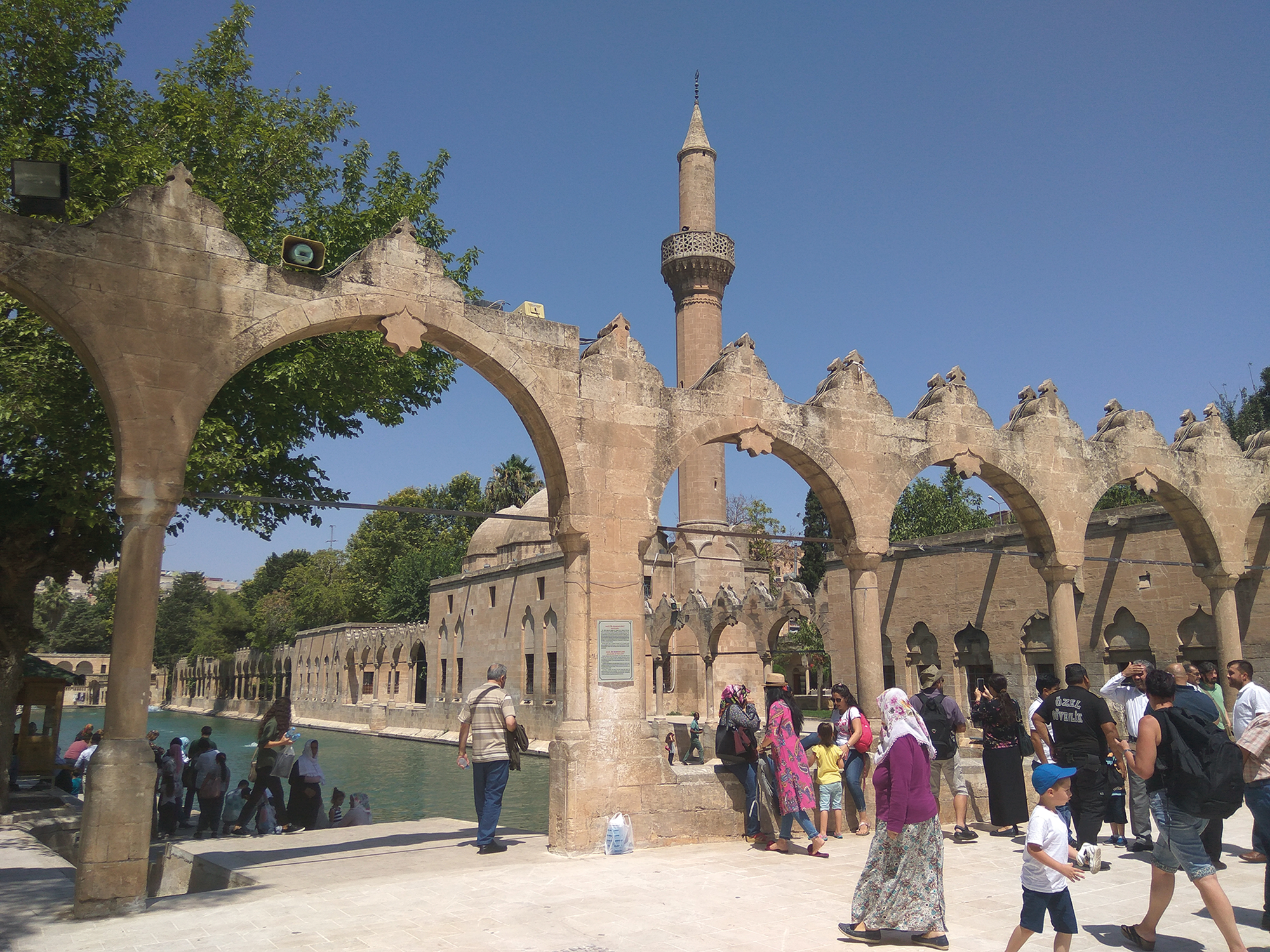
These beliefs extended beyond Çatalhöyük and spread to all of the anthropogenic and archaeological mounds of the Konya plain, including the famous Mausoleum of the Mevlana/Rumi (Shankland Reference Shankland and Shankland2004, 276) (Fig. 3). Mevlana Celaleddin-i Rumi was a thirteenth-century Persian Sufi mystic, Islamic philosopher, polymath and prominent poet. His full name, probably assigned to him after his death, means ‘our master [who is] of [the lands of eastern] Rome’, relating to the original self-designation of the Byzantine Christians (‘Romans’), while at the same time showing the later appropriation of ‘Roman-ness’ by other cultural and religious groups in that geography (Kafadar Reference Kafadar2007, 11). Mevlana/Rumi visited Konya in 1228 at the invitation of the Seljuk sultan, where the Mevlevi (Sufi) Order, also known as the Order of the Whirling Dervishes, was later founded (Küçük Reference Küçük2007). When he died in 1273, a mausoleum was erected over his remains. This was turned into a museum in 1926 by Atatürk. Sufi orders, on the other hand, were banned in 1925. Nevertheless, Sufism is still active in Konya (Küçük Reference Küçük2007, 251) and the Mausoleum is among the country's most major sites of pilgrimage and most-visited museums.
The Mevlana/Rumi Mausoleum in Konya. (Photograph: © the author.)

Significantly, the Küçükköy people did not make a sharp distinction between Muslim and non-Muslim mounds, graves or skeletons. All the people who rest in archaeological remains or who lived in these lands may protect their mounds and their bones, regardless of their cultural origins or religious affiliations (Shankland Reference Shankland and Hodder2000; Reference Shankland and Shankland2004). Sadrettin Dural, the local site guard, was even against any discrimination between living foreigners and locals or Turkish people. When asked by Hodder about the use of these terms, Dural (Dural & Hodder Reference Dural and Hodder2007, 140–41) replied that nobody was a foreigner in this world, that in the past there were no countries and that all the ancestors lived in a social community. These subtle and tolerant local views are in sharp contrast with nationalist political agendas, which around that same time sought for genetic links between Çatalhöyük and present-day populations in the region in order to support arguments about Turkish cultural and racial superiority (see Hodder Reference Hodder2002, 175–6).
Today, Konya is known for its conservatism, nationalist politics and fundamentalist Islamic perspectives. The area of Çumra, the local town near Çatalhöyük, once culturally mixed, has since the 1920s been Islamic and made up of migrants from the Balkans and nomads from other parts of Asia (Shankland Reference Shankland and Hodder2005; Yalman Reference Yalman and Hodder2005, 331–3). Çatalhöyük is now part of an official Turkish narrative which emphasizes the earliest phase of the site as testimony to the indigenous and unique cultural developments of Anatolia (Atakuman Reference Atakuman2010, 122–3) and de-emphasizes any other cultural, ethnic or religious pasts. A prime and little-known example of the role that the Neolithic settlement continues to play in the national scene concerns its use in the discussions of the Constitutional Renewal in Turkey, starting in 2011, and with particular reference to the definition of Turkishness (Bilgin Reference Bilgin2013). The representative of the Republican People's Party (CHP) started his speech referring to Çatalhöyük as evidence of the history and ancestry of the Turks in Anatolia. The chairperson of the Justice and Development Party (AKP) then pointed out that it is not Çatalhöyük but Göbekli Tepe (see next section) which is the oldest site in Anatolia. Such references, however superficial, are indicative of the national territorialization of ancient civilizations. Eflatun Pınar is now translated as the ‘lilac coloured spring’ and not as the spring of Plato in the official description for UNESCO's World Heritage Tentative List. Through this translation the entire afterlife of the monument is lost, collective memory is controlled and oral history is muddled.
Göbekli Tepe
The large mound of Göbekli Tepe (tenth and ninth millennium bc) (Fig. 4) is located 15 km from Şanlıurfa in southeastern Turkey on the Germuş mountain range, overlooking the Harran plain. It is best known for its series of monumental enclosures (between 10 and 30 m in diameter) made of locally quarried T-shaped monoliths carved with images of wild animals and often interconnected by stone walls or stone benches. In the middle of each building stood pairs of even larger monoliths (as tall as 5.50 m and as heavy as 20 tonnes), often with low-relief depictions of anthropomorphic features such as arms, hands, garments and pendants (Schmidt Reference Schmidt, Özdoğan, Bașgelen and Kuniholm2011; Reference Schmidt2012). Göbekli Tepe entered the World Heritage List in 2018.
Göbekli Tepe: view of the site in 2018. (Photograph: © the author.)

The site has attracted world-wide attention, fuelled public imagination, aroused academic debate and given rise to very diverse lines of speculation (e.g. Notroff Reference Notroff2017a,Reference Notroffb) The excavator, the late Klaus Schmidt (Reference Schmidt2012), suggested a religious interpretation, seeing the buildings as temples, the monoliths as representations of gods and the site as a mountain sanctuary for hunter-gatherer communities. Despite important criticisms (e.g. Banning Reference Banning2011; Bernbeck Reference Bernbeck, Kaniuth, Lohnert, Miller, Otto, Roaf and Sallaberger2013; Watkins Reference Watkins, Becker, Beuger and Müller-Neuhof2019), the temple narrative has very widely disseminated in academic discourse and in public imagination. Renewed research at the site, headed by Necmi Karul, has provided evidence for the existence of domestic buildings and year-round settlement (Clare Reference Clare2020) and recent publications interpret the site in new light, for instance as a place used for the promotion of inter-community solidarity and the material documentation of shared history or mythology and identity (e.g. Clare et al. Reference Clare, Dietrich, Notroff, Sönmez and Hodder2018; Reference Clare, Dietrich, Gresky, Notroff, Peters, Pöllath and Hodder2019).
The official discourse
National and global politics and agencies make major efforts to promote the site, including: the construction of Turkey's largest archaeological museum in Şanlıurfa, opened in 2015; the proclamation by the Turkish Ministry of Culture of 2019 as ‘Göbekli Tepe Year’; the financial support of the Global Heritage Fund; and the sponsorship for 20 years of the Doğuş Group (‘Şahenk Initiative’), a Turkish conglomerate that includes tourism and media companies, announced at the World Economic Forum in Davos in 2016.
Since the Doğuş Group is now the official commercial sponsor for Göbekli Tepe, with the stated vision of transforming the site into a global icon, the narrative conveyed and presented to the public through the Group's Göbekli website and their visitor centre at the site deserves special attention. Together with the new Şanlıurfa Museum and the websites of the Turkish Ministry of Culture and the Official Travel Guide of Turkey, they provide an official paradigm that will most likely remain dominant for several years to come.
With the motto ‘Göbeklitepe: the Zero Point in Time’ the Doğuş Group (n.d.) informs us that:
[Göbeklitepe] predates the famous Stonehenge […], the Egyptian Pyramids […] and the temples on Malta […]. Göbeklitepe is a source of pride for the people of this unique region. [Şanlıurfa is] a city of tolerance […] where religions, languages, races, cultures and civilisations meet. […] conveying important values to share with humanity today as it has in the past. An ancient city […] in Turkey's southeastern Anatolia region, in the lands of Mesopotamia where the history of humanity began
This discourse finds its institutional validation on the website of the Turkish Ministry of Culture (2021), according to which Göbeklitepe is ‘the starting point in history’ and ‘the temple that changed the timeline of civilization’. In addition, the site ‘which is not used as a settlement and serves only as a temple […] proved the effect of religious belief on the transition to a settled life’. Furthermore:
Şanlıurfa is ‘the city of the first, the oldest and the most important events’ […] that spread from here across the world. Imagine the dozens of religions, cultures and civilisations […] ancient streets and mansions decorated with rich stonework take you on a historical journey […].
Şanlıurfa is the ‘city of faith’ […] also known as the city of prophets […] According to the legends, the story of Şanlıurfa begins with the arrival of Adam and Eve to the earth [who] planted the wheat grain they brought with them from Paradise on the Harran plain, and thus started agriculture and therefore civilization for the first time here. (Official Travel Guide of Turkey 2020)
While presenting itself as inclusive, this heritage discourse represents a selective historiography that carries messages of the official national ideology and attempts to rewrite the history of the region and to propagate the state's current ethno-religious postulates. The notion of Göbekli Tepe as the originator of world civilization coupled with emphasis on the region's uniqueness and many ‘firsts’ (true or imagined) reveal the perspective of Anatolianism, thus reaffirming the larger nationalist discourse. The narrative refers to a vague multi-cultural heritage failing to recognize the cultural and ethnic groups that have materially shaped this heritage. Instead, these are effectively subsumed into an eternal and homogenized present embedded in a pristine landscape that brought all humans together. Similarly, the Şanlıurfa Museum tells the story of peoples from the Palaeolithic to the Islamic period as an indivisible and authentic entity of Anatolian civilizations. Furthermore, the attempt to affix civilization to one moment in time—the ‘starting’ or ‘zero point’—flattens out the meaning of history and effectively results in the creation of a de-historicized space cut- off from public memory and problems of contestation in southeast Turkey (see below). Finally, religion is presented as the driving factor of Neolithization. Şanlıurfa is also depicted as a timeless city that came into being in mythical or biblical ways, the archaeological remains of the entire landscape are adjusted to a ‘biblical’ past, connnected especially with the Harran plain, and the idea promoted is that ‘important’ material culture reflects religious rather than secular ideology.
In the Muslim tradition, Şanlıurfa is the birthplace of Abraham (Ibrahim), an association probably traced back to the eighth century ad (Segal Reference Segal1963, 21–2), and it is also linked to many other prophets, including Lot, Jacob, Job and Moses. Thousands of Muslims visit the city every year to see the cave where Abraham may have been born and the fishpond marking the site of the pyre where, according to the legend, he was almost burned up by the Babylonian heathen king Nimrod, except that God transformed the fire into water and the coals into fish (Segal Reference Segal1963, 22–3) (Figs 5 & 6). The Şanlıurfa Museum attributes a specific significance to these particular cultural aspects by displaying a huge glass installation of fish in its entrance hall (Fig. 7) and by devoting a gallery entitled ‘Hall of Prophets’ to the life of Abraham. Consequently, it defines them as the representative symbols of the city.
Şanlıurfa: the pool of sacred fish marking the site of the pyre where Abraham is believed to have been almost burned up by Nimrod. (Photograph: © the author.)
Şanlıurfa: entrance to the cave where Abraham is said to have been born. (Photograph: © the author.)

The glass feature of sacred fish in the entrance hall of the Şanlıurfa Archaeological Museum. (Photograph: © the author.)

In order to understand more fully the ideological weight embedded in the official narrative, we have to examine the complex history and multi-ethnic geography of the region and Urfa in particular.
The multi-cultural historical background
Since antiquity, and up until the 1920s, Şanlıurfa was a thriving polyglot town with a complex co-existence of different ethnic groups and religious traditions contributing to a ‘poly-interpretable culture’ (Drijvers Reference Drijvers1980, 17; Segal Reference Segal1970). Its present official name, Şanlıurfa [Urfa the Glorious], was assigned in 1984 with reference to the city's role in the Turkish War of Independence (Öktem Reference Öktem2004, 571). In public and academic discourse it is simply known as Urfa. The city is still remembered with its Greek name, Edessa, as it was transformed into a Greek polis by Seleucos I Nicator around 304 bc, who named it after the capital of ancient Macedonia. In later Syriac native sources the city was called Urhay, from which the Arabic form al-Ruha and the modern name Urfa derive (Harrak Reference Harrak, Bradshaw and Fossey2014, 166).
Edessa/Urfa also is one of the most prominent cradles of Christianity. It was the first Christian kingdom in the world, already in the second century ad, the ‘blessed city’ (Segal Reference Segal1970), a very important centre of early Christianity up to the Arab conquest in the twelfth century, a place of pilgrimage from both the East and the West and an important gateway for the Christianization of Mesopotamia (Harrak Reference Harrak, Bradshaw and Fossey2014). It is also linked with the famous story of the Image of Edessa, the face of Christ, depicted according to the legend on a handkerchief (mandelion) by Christ himself (Segal Reference Segal1963, 11–12). In the first centuries ad, paganism, Judaism and Christianity co-existed in mixed patterns, as did autochthonous Aramaeans, Macedoneans, Jews, Arabs and Parthians-Iranians. Around today's fish pool stood shrines of Jupiter, Mercury and other gods, the Seleucids’ altar, summer baths and Christian churches. In later times Judaism, Christianity and Islam co-existed, as did Armenian and Syriac Christians, Jews, Arabs, Turks and Kurds.
Contestation
Contrary to the official rhetoric, the region's history is not only about social harmony. It is also about contestation and conflict. Historical times saw a continuous conflict between Edessa and Harran for at least twelve centuries (Segal Reference Segal1963), a series of wars (e.g. between the Muslims and the Crusaders) and subsequent destructions of the city and incessant sectarian strife within the Christian community. In the recent past, southeast Turkey has been contested recurrently by Armenians, Arabs, Kurds, Turks and European powers. The Urfa region was a major site of the Armenian pogroms of 1895 and the large-scale deportations and massacres of 1915 (see Öktem Reference Öktem2004). By the time of the foundation of the Republic in 1923, the entire Christian population had been killed, had fled or was in hiding, and Urfa had become a Muslim city resettled with Kurds and Muslim refugees from the Balkans. Urfa's history as ‘a city of tolerance’ ended more than a century ago. The vague ‘ancient streets and mansions decorated with rich stonework’ of the official narrative have been built almost in their entirety by Syriac Christian architects (Öktem Reference Öktem2004, 570). They constitute a locus of public memory but apparently also a target for public amnesia.
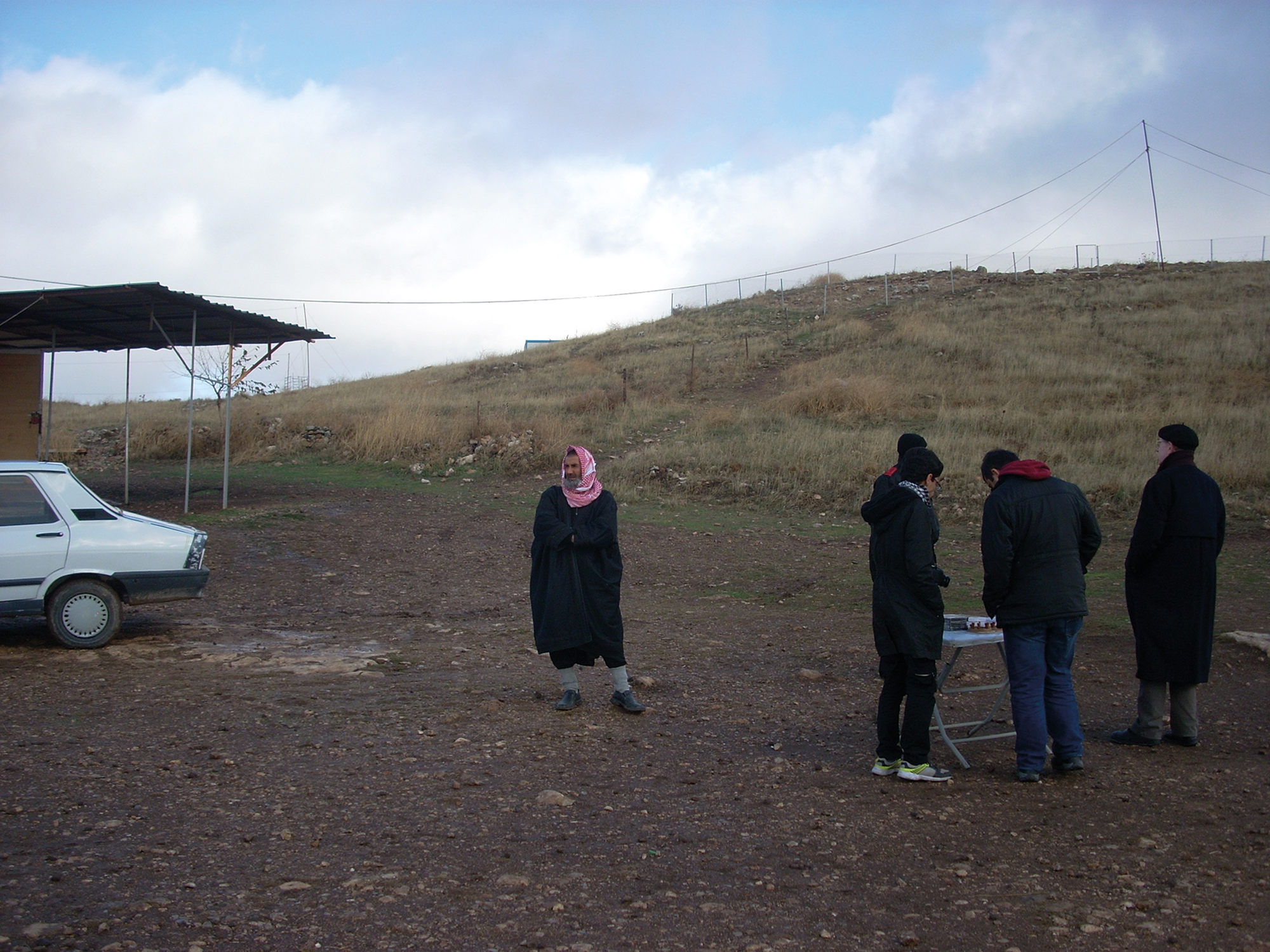
The narrative also keeps silent about today's strong presence and legacy of the Kurds in the region. Urfa's present population is largely composed of the Kurdish ‘Other’ (although substantial building projects may soon result in another demographic transformation), and so is that of Örencik, the local village 2.5 km distant from Göbekli Tepe (Fig. 8). The Turkish state's ethnic conflict with the Kurds has often culminated in armed and community-wide clashes in southeast Turkey since the 1980s (e.g. Ergin Reference Ergin2014), further fuelled by Turkey's involvement in the Syrian civil war and the Siege of Kobani in 2014–15. Göbekli Tepe is only 50 km from the Turco-Syrian border. By early 2015, some 400,000 Kurdish refugees from Syria had crossed to the Urfa province.
Göbekli Tepe: view of the site in 2013. (Photograph: © the author.)
Strangely, during that same period a documentary prepared by TRT, the national public broadcaster of Turkey, associated Göbekli Tepe with the biblical story of the destruction of idols by Abraham (Erbil Reference Erbil2017): it speculated that the pillars were constructed by Abraham's idolater father, Terah, and that Abraham smashed a T-shaped monolith with a fox motif. As the late Turkish archaeologist Nezih Başgelen promptly stated at the time, targeting Göbekli Tepe as an idol centre was particularly dangerous, given the destruction of so much archaeological heritage by the ISIS already.
Another public controversy relates to cranes, a recurrent motif in the site's rich animal iconography, possibly documenting rituals imitating the cranes’ dancing or involving humans disguised as cranes (Notroff & Dietrich Reference Notroff and Dietrich2017). Incidentally, cranes have a special place in the Alevi-Bektashi belief, the second largest Islamic sect in Turkey, as symbols of holy people (Temizkan Reference Temizkan2014). In February 2020 I attended a talk on Göbekli Tepe delivered by Necmi Karul and hosted by the Turkish Embassy in Berlin. Karul referred to the holy dances of the Alevis in order to illustrate the archaeological interpretation for the (mostly Turkish) audience. The reactions were mixed. One attendant found the comparison with Alevis unreasonable and stated that ‘our ancestors were not shamans’, while another found it fascinating and convincing. Yet another asked whether faith in Göbekli could not be associated with the Semites and monotheism instead.
In conclusion, Göbekli Tepe and its landscape emerge as a site of antagonistic conceptualizations and as a clear illustration of the constructed nature and ideological importance of heritage, involving the construction of an imagined collective memory as well as of social amnesia. In the official discourse, Göbekli Tepe and Urfa are deliberately removed from any historical relation with the multi-ethnic and contested heritage in the region associated with the Greek, Syriac, Armenian, Jewish and Kurdish ‘Others’ and are placed into an idealized present devoid of ‘dark histories’ (Öktem Reference Öktem2004, 573) and traumatic collective memories. However, as Atakuman (Reference Atakuman and de Francesco2017, 167) points out, the strategy of neglect of the ‘other’'s cultural heritage continuously creates new sites of conflict by way of perpetuating ‘otherness’. At the same time, the religious focus on the monument and its landscape by the state institutions entails a further mystification of history. It seems already to have effected a shift towards religious tourism in recent years, mostly domestic and Middle Eastern (Jens Notroff and Birgut Ögüt pers. comm., February 2020).
Conclusions
Political appropriations of the past in the present, diverging historical perspectives and contestation of archaeological sites are central and common to Greece and Turkey. Both states have had a strong political interest in promoting a selective historiography based on archaeological heritage in order to form and sustain national consciousness and public memory, whose understanding, moreover, is akin to the Eastern nationalism discussed earlier. In both cases, the official discourse propagates the nationalist version of history and the state's particular understanding of identity (and religion), emphasizing roots and ancestry, while it keeps silent about certain aspects of the past and the present. But selection differs considerably when it comes to temporal and spatial referents. In Greece, the Neolithic does not support the hegemonic Hellenocentric narrative and the wider emphasis on the glorious Classical past and is therefore not suitable for political manipulation and not included in the official version of history. In contrast, in Turkey, where there is no single master narrative of the same kind and where, in fact, much of the post-prehistoric multi-ethnic past constitutes a ‘difficult’ heritage that cannot be associated straightforwardly with Turkishness, Neolithic sites can get much more politically entangled and have been fully used in different and complex ways to install a certain image of history and to control collective memory.
At the same time, the controversial interpretations and diverse reactions surrounding the sites discussed here demonstrate that different people or groups or audiences can produce ‘stories of heterogeneity’ (Gür Reference Gür and Özyürek2007, 62, 67) that do not overlap with, or are even opposed to, political agendas, hegemonic ideologies and the officially sanctioned image of history (or the archaeological interpretations, for that matter). Local stories of origin and public perceptions of cultural heritage, identity and history, especially in symbolically charged or World Heritage sites such as Çatalhöyük and Göbekli Tepe, demonstrate how archaeological spaces serve as loci of the material construction of collective memory through daily experience, as well as how this memory may act as historical consciousness as well as political remembrance, used to emphasize similarity and continuity, but also difference and discontinuity.
Returning to the initial question about the relationship between archaeological heritage space and history, the entanglement of archaeology in contradictory political agendas, narratives about the past and public discourses is nothing new. The negotiation of meaning, value and treatment of past spaces in which archaeologists are involved always entails conflicts. The crucial question is what archaeology can do for heritage studies and, more importantly, how archaeological discourses will not provide support to culturally essentialist versions of history that rest on particular conceptualizations or representations of past spaces. One of the greatest contributions archaeology can make is towards a greater exploration of the politics of historiography through heritage. After all, the remains of the past gain value in the present through their roles and meanings within archaeological narratives. Consequently, archaeology is involved in the shaping of historical discourse.
Archaeologists can expose false ideologies involved in official versions of history and heritage that shape public conversation and can subvert assumptions based on contemporary politics and on essentialized national, religious and state-based categories. In our rethinking of history through archaeological heritage, we can benefit from a deeper contextualization of the debates, controversy and contestation politically, socially and culturally. This contextualization can add to a fuller and more nuanced understanding of the process of heritage today and of how social imaginaries have been established. More crucially, it can advance archaeology's critical engagement with contemporary social and political issues of wider, global impact.
Acknowledgements
My sincere thanks to the many colleagues in Turkey and Germany, where much of this research was conducted, for offering valuable information and advice, especially Ciǧdem Atakuman, Sümer Atasoy, François Bertemes, Christoph Brumann, Antonios Chatzopoulos, Lee Clare, Elif Denel, Güneş Duru, Fokke Gerritsen, Ian Hodder, Necmi Karul, Jens Notroff, Birgut Ögüt, Mehmet Özdoğan, Susan Pollock, Gül Pulhan, Burkhard Schnepel, Lutgarde Vandeput, Trevor Watkins and Lale Yalçin-Heckmann. Financial support for this research was obtained from several agencies: British Institute at Ankara and Koç University Research Centre for Anatolian Civilizations (ANAMED); TÜBITAK; American School of Classical Studies at Athens; Deutsche Akademischer Austauschdienst (DAAD); German Archaeological Institute—Athens & Berlin.


 Open access

