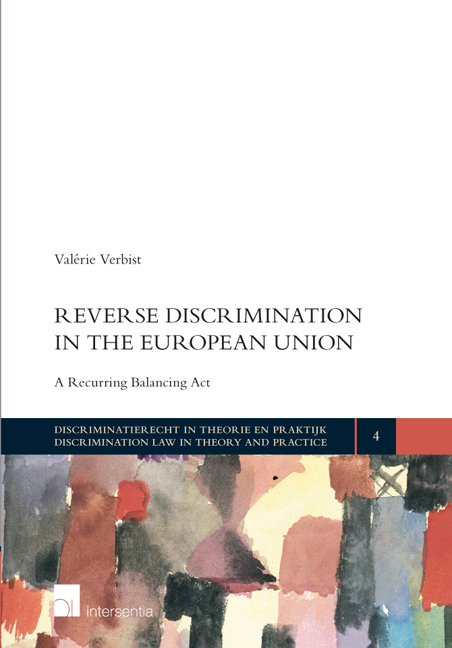

The issue of 'reverse discrimination' is a topical subject, particularly in the field of family reunification. Reverse discrimination occurs when a European Union (EU) citizen in a 'purely internal situation' is treated less favourably than an EU citizen of another nationality whose situation is largely governed by EU law. Reverse Discrimination in the European Union offers an up-to-date standard reference work on reverse discrimination.Part I of this book analyses the issue of reverse discrimination from an EU perspective. In particular, it questions whether reverse discrimination falls within the scope of application of Member State law or whether it falls within the ambit of EU law. Subsequently, it discusses the interpretation of the 'purely internal situation' doctrine on the basis of the case law of the European Court of Justice, giving special attention to recent developments since the controversial Ruiz Zambrano judgment.Although reverse discrimination is of interest from the perspective of the Member States, it is still mostly studied from the viewpoint of the EU. To address this, Part II looks at reverse discrimination in five Member States, namely Belgium, France, Italy, Germany and Austria. The focus lies on the ground(s) on which the national authorities decide whether or not to allow stricter treatment of purely internal situations. Finally, Part III analyses specific instances of reverse discrimination in federally structured Member States, from the perspective of both EU law and Belgian and German law.
Loading metrics...
* Views captured on Cambridge Core between #date#. This data will be updated every 24 hours.
Usage data cannot currently be displayed.
This section outlines the accessibility features of this content - including support for screen readers, full keyboard navigation and high-contrast display options. This may not be relevant for you.
Accessibility compliance for the PDF of this book is currently unknown and may be updated in the future.
