


Impact statement
Descriptions of technological solutions for the end-of-life utilisation of plastics often include inherent value judgements. Terms such as upcycling, downcycling and recycling all ascribe directionality that often lacks an explicit foundation. In this perspective, we explore and question that directionality through case studies and reflect on the choices underpinning the terminologies applied. Through this exploration, we hope to engage with researchers, stakeholders, technologists and beyond regarding how we describe potential solutions to the broader public. Sustainability is a term that can be viewed from many perspectives: economic, environmental, societal and more. The necessity of improved end-of-life plastics management requires clear identification of how a process fits within solution-oriented systems.
Introduction
Imagine two Earths. On Earth A, we have limited the damage of the linear economy by prioritising an economically, environmentally and socially sustainable future. As inhabitants of Earth A, we treat objects and materials individually and optimise processes to ensure each plastic bottle is turned back into a plastic bottle, each t-shirt back into a t-shirt and each office chair back into an office chair. On Earth B, we still avoid a linear economy but instead have created a spiralling system where a plastic bottle becomes a take-away container, which becomes a t-shirt, which becomes an office chair, which is ultimately chemically deconstructed to monomers and repolymerised to generate a new bottle. On both Earths, we imagine plastic sortation is perfect, and each waste management system is fully optimised.
Within the framing of this thought experiment, we can conceptualise the outcomes of these choices by posing some leading questions. What are the short-, medium- and long-term impacts of the choices being made? Which Earth can provide a habitat for humanity for the longest time? Which is, in the subjective opinion of the reader, better? To prolong the existence of a habitat fit for humanity on our One Earth, and to hypothesise answers to the existential questions being posed in the above conceptual exercise, the intersections of climate change, the energy transition and the circular economy must be examined in a more holistic and conciliatory manner.
This perspective will focus on material transitions as one of the points of intersectionality between these challenges. Specifically, we consider polymeric – or plastics once formulated – transitions, acknowledging that the overarching goal must be to limit both the amount of material we are extracting from the biosphere and the amount and nature of what we are returning to it. For plastics, this debate is complex from the perspective of both the source and fate of the materials. It has been proposed that for plastics to achieve net-zero emissions, a combination of biomass and carbon dioxide (CO2) utilisation, along with a recycling rate of 70%, is necessary (Meys et al., Reference Meys, Kätelhön, Bachmann, Winter, Zibunas, Suh and Bardow2021). Indeed, an emphasis on large-scale recycling is championed, and its incentivisation is endorsed (Meys et al., Reference Meys, Kätelhön, Bachmann, Winter, Zibunas, Suh and Bardow2021) in many domains, but in a world awash with terminologies and claims such as ‘upcycling’ and ‘downcycling’, what does ‘recycling’ mean? Here we will look at how we assign value to plastic waste and explore the perception of these value-judgement-laden labels.
Recycling techniques
The end of life (EoL) of a plastic for our purposes is considered the point at which it has reached R7 (Recycle) or higher (Recover and Re-mine), within the framework outlined by Reike et al., where our ability to reutilise the material at a lower R-level (Reduce, Repair, Remanufacture, etc.) is not feasible with existing technology (Reike et al., Reference Reike, Vermeulen and Witjes2018). Within this context, plastics at EoL can meet any number of fates, including landfilling, incineration for disposal, incineration for energy recovery, mechanical recycling and chemical recycling (Geyer et al., Reference Geyer, Jambeck and Law2017; Lange, Reference Lange2021). Of these, landfilling and incineration routes can be considered terminal routes from a material perspective. They are purposefully linear within the paradigm of existing technologies. Currently, the mining and utilisation of waste plastic from landfill is not a developed technology space (Krook et al., Reference Krook, Svensson and Eklund2012; Jain et al., Reference Jain, Kumar and Kumar2023), while promising carbon capture and utilisation from incineration is nascent in its development (Dziejarski et al., Reference Dziejarski, Krzyżyńska and Andersson2023). For a discussion on the directionality of terminology, we will focus on the non-terminal routes for EoL plastics: mechanical and chemical recycling approaches.
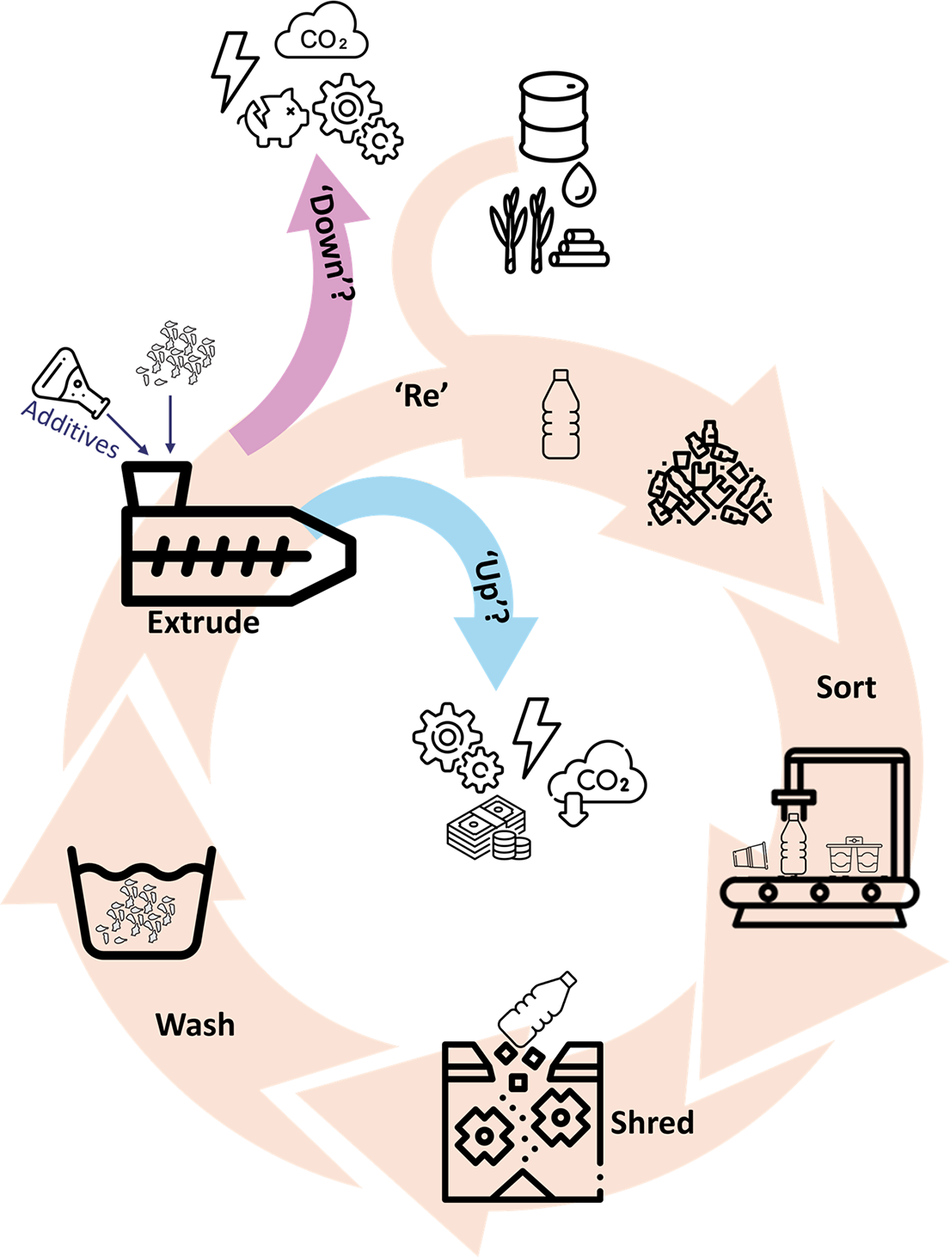
For mechanical recycling, a definition provided by Ragaert et al. is useful as it describes mechanical recycling as methodologies that ‘do not (intentionally) change the chemical structure’ of the polymer, which stands in contrast to chemical recycling methodologies, which do (Ragaert et al., Reference Ragaert, Ragot, Van Geem, Kersten, Shiran and De Meester2023). Classical mechanical recycling has seen widespread commercial application, forming the backbone of existing plastic waste management systems. The standard route taken by the plastic waste involves segregated collection, sorting, washing, drying, melt extruding and remanufacturing into a new product (Figure 1) (British Plastics Federation, 2025).
Steps involved in classical mechanical recycling from the comingled recycling bin through sorting, shredding, washing, extruding and repurposing. After extrusion, possible fates include recycling into the same material, upcycling (generating economic, environmental or functional value) or downcycling (decreasing economic, environmental or functional value).

Depending on the jurisdiction, varying levels of segregation generally occur at the point of disposal before collection. Upon collection and delivery to a Materials Recovery Facility (MRF) for initial sorting, a secondary Plastic Recovery Facility, often co-located with MRFs, narrows the polymer diversity in the various individual streams. A wide variety of methodologies for sorting are operated at scale in these facilities, varying from object-level sorting to material-level sorting. The former includes techniques like manual picking and artificial intelligence-based image analysis to facilitate the separation of material of the same type based on visible characteristics, such as shape (Duan and Li, Reference Duan and Li2021; British Plastics Federation, 2025; Grey Parrot, 2025; Health and Safety Executive, 2025). In the latter case, colour, sink-float separation and near-infrared-based separation are examples of techniques that sort by physical characteristics, like density or absorbance of specific frequencies of infrared light (Duan and Li, Reference Duan and Li2021; British Plastics Federation, 2025). Sequences of these, and more, separation steps are used to improve the purity of the material streams. The material is then washed, dried and shredded to reduce its size. At this stage, the material is fed into an extruder to melt and reprocess plastics alongside additives such as anti-oxidants and compatibilisers to form pellets of a standardised size for use in product manufacturing (British Plastics Federation, 2025). Emergent forms of mechanical recycling, such as solvent-based recycling strategies, involving polymer dissolution and reprecipitation before the extrusion step, exist and are envisioned to improve the quality, safety and purity of mechanical recyclate (Ragaert et al., Reference Ragaert, Ragot, Van Geem, Kersten, Shiran and De Meester2023; Uekert et al., Reference Uekert, Singh, DesVeaux, Ghosh, Bhatt, Yadav, Afzal, Walzberg, Knauer, Nicholson, Beckham and Carpenter2023).
Chemical recycling techniques can be broadly classified into two areas: non-selective and selective chemical recycling. Examples of non-selective chemical recycling include pyrolysis and gasification techniques that degrade polymer structures to broad mixtures of base molecules, which are then frequently used as feedstocks in traditionally oil-fraction-fed chemical processes, such as steam or catalytic cracking (Vollmer et al., Reference Vollmer, Jenks, Roelands, White, Harmelen, Wild, Laan, Meirer, Keurentjes and Weckhuysen2020; Clark and Shaver, Reference Clark and Shaver2024; Ryou et al., Reference Ryou, Byun, Bae, Kim and Han2025). This process is distinct from the selective deconstruction of polymeric materials via the disconnection of particular bonds within a polymer to access a narrower mixture of targeted, synthetically complex molecules. Selective deconstruction is, by its nature, made up of a larger number of techniques, due to the ability to tailor each to the plastic or plastic mixture being deconstructed. These techniques range from chemocatalytic (chemicals break bonds) to enzymatic (enzymes break bonds) depolymerisations (Vollmer et al., Reference Vollmer, Jenks, Roelands, White, Harmelen, Wild, Laan, Meirer, Keurentjes and Weckhuysen2020). Regeneration of the same plastics that were used as input feedstocks in each recycling method is possible via both selective and non-selective chemical recycling technologies; however, more steps are generally needed to rebuild the plastic from the products of non-selective deconstruction (Clark and Shaver, Reference Clark and Shaver2024).
Regardless of the technology used, the terminologies of ‘upcycling’ and ‘downcycling’ are often used to describe mechanical, selective or non-selective chemical recycling. When it comes to specific examples of processes that have been assigned each terminology, processes labelled ‘upcycling’ include conversion of poly(ethylene terephthalate) (PET) polymer to monomer or derivative molecules of perceived economic value or polyethylene (PE) to detergents and waxes (Britt et al., Reference Britt, Coates, Winey, Byers, Chen, Coughlin, Ellison, Garcia, Goldman, Guzman, Hartwig, Helms, Huber, Jenks, Martin, McCann, Miller, O’Neill, Sadow, Scott, Sita, Vlachos and Waymouth2019; Korley et al., Reference Korley, Epps, Helms and Ryan2021; Sun et al., Reference Sun, Dong, Gao, Zhao, Moon and Scott2024). Predictably, very few original research studies self-identify as ‘downcycling’, with review articles tending to hand out those labels to processes converting high value textiles to rags and recycled plastics into park benches (Eriksen et al., Reference Eriksen, Pivnenko, Faraca, Boldrin and Astrup2020; Vogt et al., Reference Vogt, Stokes and Kumar2021; Hahladakis, Reference Hahladakis2025; Ogwu and Kosoe, Reference Ogwu and Kosoe2025). However, these terms are laden with connotations and built-in value judgements that are subsequently applied by promoters and detractors of a technology in a way that can obfuscate the discussion around why the directionality has been ascribed.
Downcycling connotes a process and resulting materials that are less favourable and somehow ‘bad’, while upcycling implies a ‘good’ resulting material (Ragaert et al., Reference Ragaert, Ragot, Van Geem, Kersten, Shiran and De Meester2023) Helbig et al. undertook a comprehensive study of ‘downcycling’ by grouping the different methods by which downcycling occurs, resulting in the following encompassing definition: ‘downcycling is the phenomenon of the quality reduction occurring during or because of recycling, expressing itself in a thermodynamic, functional or economic way’(Helbig et al., Reference Helbig, Huether, Joachimsthaler, Lehmann, Raatz, Thorenz, Faulstich and Tuma2022). To this definition, an environmental perspective must surely be added to highlight the need for environmentally sustainable solutions to plastic waste. Upcycling, therefore, should simply be the opposite definition, where a quality increase occurs because of recycling, in a thermodynamic, functional, economic and/or environmental manner. However, a myriad of uses for ‘upcycling’ exist. The term is used broadly to refer to a form of ‘creative reuse’ (‘Upcycling’, 2025), as well as ‘any process that transforms byproducts, undesired, unwanted or waste products into new materials of higher value’ (Pauli and Hartkemeyer, Reference Pauli and Hartkemeyer1999; Jehanno et al., Reference Jehanno, Alty, Roosen, De Meester, Dove, Chen, Leibfarth and Sardon2022). Meanwhile, in industry contexts, ‘upcycling’ is defined as a process of ‘converting polymer to monomer, polymer to other small molecules or polymer to polymer using post-polymerisation modification reactions’ (Kim et al., Reference Kim, Park, Kim, Hwang, Rizzo and Peterson2025). While some papers discuss the thermodynamic or economic impacts of their processes (Mishra et al., Reference Mishra, Zope and Goje2002; Sangroniz et al., Reference Sangroniz, Zhu, Tang, Etxeberria, Chen and Sardon2019; Peng et al., Reference Peng, Yang, Deng, Deng, Shen and Fu2023; Vozniak et al., Reference Vozniak, Hosseinnezhad, Rozanski, Zaïri, Vozniak and Kulagin2025; Yang et al., Reference Yang, Dong, Zhang, Zhang, Miscall, Brozena, Chen, Liu, Li, Liu, Nascimento, Dantas, Zhang, Mumtaz, Liu, Liu, Du, Wang, Pang, Liu, Huang, Lima, Pan, Ju, Fu, Hu, Beckham and Hu2025), many simply assume that because a change was observed, up- or down-cycling has occurred (Chaudhary et al., Reference Chaudhary, Kumari, Chauhan and Ram Chaudhary2021; Hoang et al., Reference Hoang, Nguyen, Ta, Nguyen and Hoang2022; Lee and Jung, Reference Lee and Jung2022b; Nguyen et al., Reference Nguyen, Chang, Phillips, DeWitt and Sievers2023).
So, what is up or down? All methods of plastic recycling have inherent challenges, and none are a panacea to the plastic waste problem. Sorting capabilities, efficiencies and capacities, along with contamination (both ingrained in materials and introduced because of sorting deficiencies), disrupt existing scaled recycling techniques. Pure (single-polymer) waste streams can return the cleanest, highest-performing product (Vollmer et al., Reference Vollmer, Jenks, Roelands, White, Harmelen, Wild, Laan, Meirer, Keurentjes and Weckhuysen2020; Schyns and Shaver, Reference Schyns and Shaver2021); however, due to the myriad of additives used industrially and the realities of use cases, ‘pure’ waste streams are impractical to access (Law et al., Reference Law, Sobkowicz, Shaver and Hahn2024). Through centuries of innovation, we have developed formulations for materials such as paints and plastics to incorporate precise mixtures of otherwise incompatible components. Placing value on these materials will require an effort to see each component of a waste mixture in the same way we do resources such as crude oil. The driving force to make better sorting happen is usually the value placed on the end product and the avoidance of end-stage waste disposal burdens. Perceived value is malleable and subjective, and dependent on changeable policy and messaging. We need sortation that makes good decisions, balancing volume and throughput with chemical quality and economic value.
All recycling processes have failed to live up to the messaging around them. Descriptions of new and scaled methods to deal with plastic waste are touted as the solution to the plastic waste problem (Gao et al., Reference Gao, Ma, Chen, Tian and Zhao2022; Slobodian et al., Reference Slobodian, Riha and Hausnerova2025). The continued growth of plastic waste and our perceptions of the problem are emblematic of the limitations of either the current technologies or the manner in which they are being implemented. In this perspective, we present three case studies exploring recycling approaches and how they intersect with the rhetoric around value judgements in recycling to prompt discussion and careful consideration of those judgements.
Case studies
Food-grade polypropylene
Consider a yoghurt pot. The polypropylene (PP) has been specifically made and shaped by a company to catch your attention as a consumer to buy their yoghurt. The pot may be transparent, letting you see the aesthetic of the contents, or have been doped with a white pigment like TiO2 to stand out in the grocery aisle. However, once the yoghurt has been eaten, the perceived value of the pot drops significantly. We did not buy the pot; we bought its contents. What, then, can be done with it? And what fate holds the most value?
A yoghurt pot is made from food-grade PP, with a defined composition that ensures additives are food-safe and free of contaminants. PP can be mechanically recycled and retains much of its original quality. If perfectly sorted, cleaned and reprocessed, it could become a yoghurt pot again. In terms of up-, down- or re-cycling, this would fall under the ‘re’ category. However, perfect sorting, cleaning and reprocessing are challenging if not impossible in this imperfect world.
If a yoghurt pot becomes a yoghurt pot (as it would on Earth A), its use cycle is very short, meaning that the same polymer chains will soon go through another loop of sorting, cleaning and reprocessing, with more thermo-mechanical and thermo-oxidative damage occurring with each reprocessing step (Schyns and Shaver, Reference Schyns and Shaver2021). If we are unable to segregate yoghurt pots on their own, or clean them effectively, contamination will become a challenge, both because maintaining food-safe accreditation would be difficult as additives and contaminants are commingled (Law et al., Reference Law, Sobkowicz, Shaver and Hahn2024), and because polymeric contaminants can accelerate degradation during reprocessing, particularly in polyolefins (Patel et al., Reference Patel, Schyns, Franklin and Shaver2024). We could overcome these barriers by laborious means: creating a return system just for yoghurt pots or legislation that all yoghurt pots from all companies be made identically, or mandating exceptional sorting efficiency. Recent technologies have been devising methods to ensure PP quality. For example, CleanStream (formerly Berry Global Circular Polymers and now Amcor) is a sortation process with an operational factory in the United Kingdom for producing food-grade packaging from recycled content (Berry Global, 2023). Meanwhile, commercial-scale trials have been run by companies such as PureCycle, where contaminants are removed by selectively dissolving and filtering them out of the plastic mixture, leaving behind only PP (‘PureCycle’, 2025). Alternatively, NextLooPP uses fluorescence tags on food-grade PP package labels to more efficiently sort them from other PP sources, in order to ensure a pure feedstock (‘NextLooPP’, n.d.). These methods can return the US Food and Drug Administration-accredited food-grade PP; however, they incur increased environmental impacts and economic burden from these additional processes.
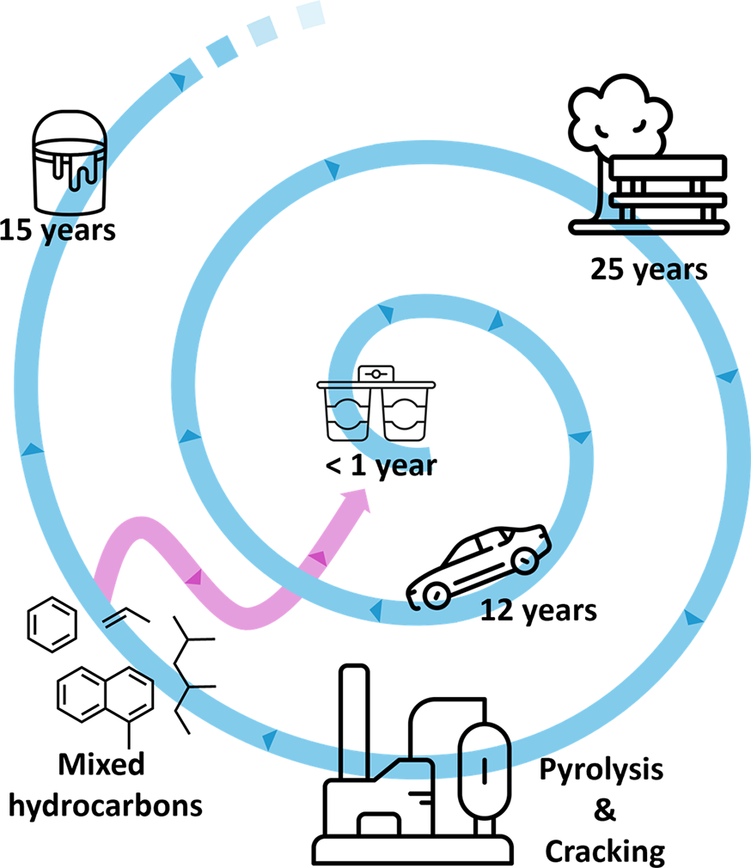
Many products are made from PP, including cars, hard shell suitcases, garden furniture, plastic parts for electrical wiring, appliances and plumbing. The specifications for each will differ and may require modification with additives or blends (Hindle, Reference Hindle2025). If a yoghurt pot is recycled into a car (as it would be on Earth B), its use cycle becomes longer (12 years as opposed to a matter of weeks). However, automotive-grade PP has different technical specifications, and so careful innovation is needed to enable this material transition. Ideally, years will go by before the car part needs to be replaced or the vehicle is damaged beyond repair. We can imagine repurposing each material into a longer-lasting application as a ‘spiral economy’, with chemical deconstruction stages giving the opportunity to return to the original use at the centre of the spiral (Figure 2). However, with single-use items piling up, we also have to consider the match in markets for the gaps our yoghurt pots could fill (Korley et al., Reference Korley, Epps, Helms and Ryan2021). Short loops may not always be a worse choice.
An imagined spiral economy with use timeframes for a yoghurt pot (weeks), becoming a car (12 years), becoming a park bench (25 years), to chemical deconstruction by pyrolysis, leading to a hydrocarbon feedstock that could be reused for making yoghurt pots (pink arrow) or continue along to diverse applications such as paint or fuels.

Which fate for PP is best? Why do we call object-to-object transformations recycling, and transformations into building or transport products downcycling? Are we evaluating property performance when stating these directions? From a polymer chain perspective, we could refer to both the pot-to-car and pot-to-pot fates as ‘downcycling’, as mechanical strain is applied to the yoghurt pot and chain scission leads to a degradation of properties (Helbig et al., Reference Helbig, Huether, Joachimsthaler, Lehmann, Raatz, Thorenz, Faulstich and Tuma2022). Economically, a car is worth much more than a yoghurt pot, so public perception may think of this as ‘upcycling’. By using directional terms to describe processes, we ascribe a perception of value to the process, regardless of the more tangible meanings of those terms.
PET beverage bottles
Bottle-to-bottle recycling of PET is a genuine success story (Welle, Reference Welle2011), but also a lens through which we can again look at these directional terms. In a report from 2022 studying PET in the European market, it was found that of the 5 m tonnes of PET used in packaging that year, 3 m tonnes were collected, with bottles accounting for 2.8 m tonnes (Unesda et al., 2022). Deposit return schemes (DRS) can help drive high returns of PET bottles, with such schemes accounting for 30% of bottle collection volumes in Europe in 2022 (Unesda et al., 2022), representing 43% of Europe’s GS1 Member Organisations, with a further 21% promising an upcoming system (Larsen et al., Reference Larsen, Schimmel and Behrend2024). Many of these schemes are well-established, with Sweden (1984), Norway (1999), Denmark (2002) and Germany (2003) averaging over 77% bottle waste collection rates (Unesda et al., 2022; Larsen et al., Reference Larsen, Schimmel and Behrend2024). Even in countries that do not have DRS, PET bottle collection and recycling are remarkably high.
Beverage companies’ collaboration in choosing consistent formulations for PET in bottles, coupled with collection frameworks, helps ensure a consistent PET feedstock for recycling (Smith et al., Reference Smith, Takkellapati and Riegerix2022; Law et al., Reference Law, Sobkowicz, Shaver and Hahn2024). The quality of this waste stream and the development of technologies to help rebuild molecular weight during recycling produce a recycled PET (rPET) feedstock ready to sell into new bottles, as well as to make other products (Bobek-Nagy et al., Reference Bobek-Nagy, Kurdi, Kovács, Simon-Stőger, Szigeti and Varga2023). Economically, virgin PET is $1.33 per kg and rPET $1.95 per kg in Europe (‘PET (Polyethylene Terephthalate) price index’, 2024; Taylor, Reference Taylor2025). Even with the price premium, rPET is increasingly incorporated into products, a move driven by legislation from governments to mandate recycled content levels and companies striving for greener product portfolios (Soomro et al., Reference Soomro, Hong and Shaver2025).
In both industry and beyond, PET is also an exceptionally popular substrate for recycling research, in part because of the variety of fates accessible due to the ester linkages forming the PET chains. PET can, and industrially does, undergo the mechanical recycling strategy described in the introduction section, with additives such as chain extenders, antioxidants and antihydrolysis agents used to improve the properties of the resulting material (Wang et al., Reference Wang, Shaver and De Hoe2024), or process improvements like solid state (re)polymerisation, rebuilding molecular weights and restoring lost properties (Chang et al., Reference Chang, Sheu and Chen1983).
This recyclate does not simply end up in bottles – many sectors want to seem greener by incorporating recycled content in their products. Currently, nearly every material that claims to be made of rPET uses PET drink bottles as the material source. The quality and consistency of food-grade beverage bottles make them perfect feedstocks for bottle-to-bottle processes. However, this high quality attracts buyers from other markets, potentially cannibalising circular economies and diverting feedstocks away from circularity (Majumdar et al., Reference Majumdar, Shukla, Singh and Arora2020). Not all applications, however, require the high purity that a plastic drink bottle provides. Spinning bottle fibres into a T-shirt or a seat cover in a car is currently a common practice (Patagonia, 2025). Bottle-grade PET generally requires a higher molar mass (length of polymer chain) and intrinsic viscosity (measure of material flow) than fibre-grade PET (Jang et al., Reference Jang, Sadeghi and Seo2022). Yet bottles are chosen because of the accessibility of the feedstock, even though any PET material with a higher molar mass and intrinsic viscosity than fibre-grade could theoretically be recycled into a fibre-grade material.
The chemical make-up of the polymer backbone in PET, essential for rebuilding molecular weights through repolymerisation, has also inspired more creative chemical transformations. Strategies to create new molecules from ethylene glycol and terephthalic acid after depolymerisation are often tagged as upcycling (Carniel et al., Reference Carniel, Ferreira dos Santos, Buarque, Mendes Resende, Ribeiro, Marrucho, Coelho and Castro2024). Secondary chemical or biological transformations can create, from this waste stream, a host of useful compounds, such as pigments (lycopene) (Diao et al., Reference Diao, Hu, Tian, Carr and Moon2023), reagents (adipic acid) (Valenzuela-Ortega et al., Reference Valenzuela-Ortega, Suitor, White, Hinchcliffe and Wallace2023) and pharmaceuticals (paracetamol) (Johnson et al., Reference Johnson, Valenzuela-Ortega, Thorpe, Era, Kjeldsen, Mulholland and Wallace2025). Economic and environmental impacts are rarely quantified for these kinds of processes, as it is often assumed that using a waste stream as a feedstock is inherently ‘green’. How these impacts compare with both the production of replacement PET and the incumbent production process for the useful molecules is of great significance when assigning directionality to these processes. Beyond this, the quantities of waste PET and the market opportunity for the proposed products are often misaligned and might quickly overwhelm the current demand for these molecules, which often have niche markets. If we divert waste PET bottles to these products, are we assessing the macroeconomic, microeconomic and environmental pressures of these processes when we define them as ‘up’? Or are we (intentionally or unintentionally) greenwashing by simply applying a label?
Textiles, carpet, automotive parts and many other everyday items are made from PET and are rarely recycled. For example, thermoformed PET, commonly found in food tubs and trays, has much lower recycling rates than PET bottles. While some progress has been made towards commercial-level recycling, such as with the proposed Veolia plant in the United Kingdom (Veolia, 2025), collection challenges, the frequent multi-material nature of thermoforms (e.g., laminates with polyethene), colours and additives used, make recovery more complicated and less economically viable. These do, however, represent PET streams with limited EoL options. Could they be used without circular cannibalism? Are they reformable into fibres, drugs or fragrances? Does the feedstock change the perception of fate? These are challenging questions that require consideration from multiple angles. Economic, environmental and functional analyses need to be considered to define directions and ensure the best possible outcomes.
Valuing mixtures of materials
The mixed materials that make up our world may seem like a root cause for lost value in recycling. Contamination from poorly separated or inseparable plastic streams can both accelerate degradation in mechanical recycling processes, decreasing product quality and consistency and hinder chemical and enzymatically catalysed processes (Klotz et al., Reference Klotz, Haupt and Hellweg2023; Association of Plastic Recyclers, 2025). In addition, many plastic materials are specifically made as complex mixtures, such as polycarbonate/acrylonitrile butadiene styrene and layered PET/PP films. However, the material world is filled with astoundingly complex mixtures that have realised values sufficient to shape economies given the appropriate leverage.
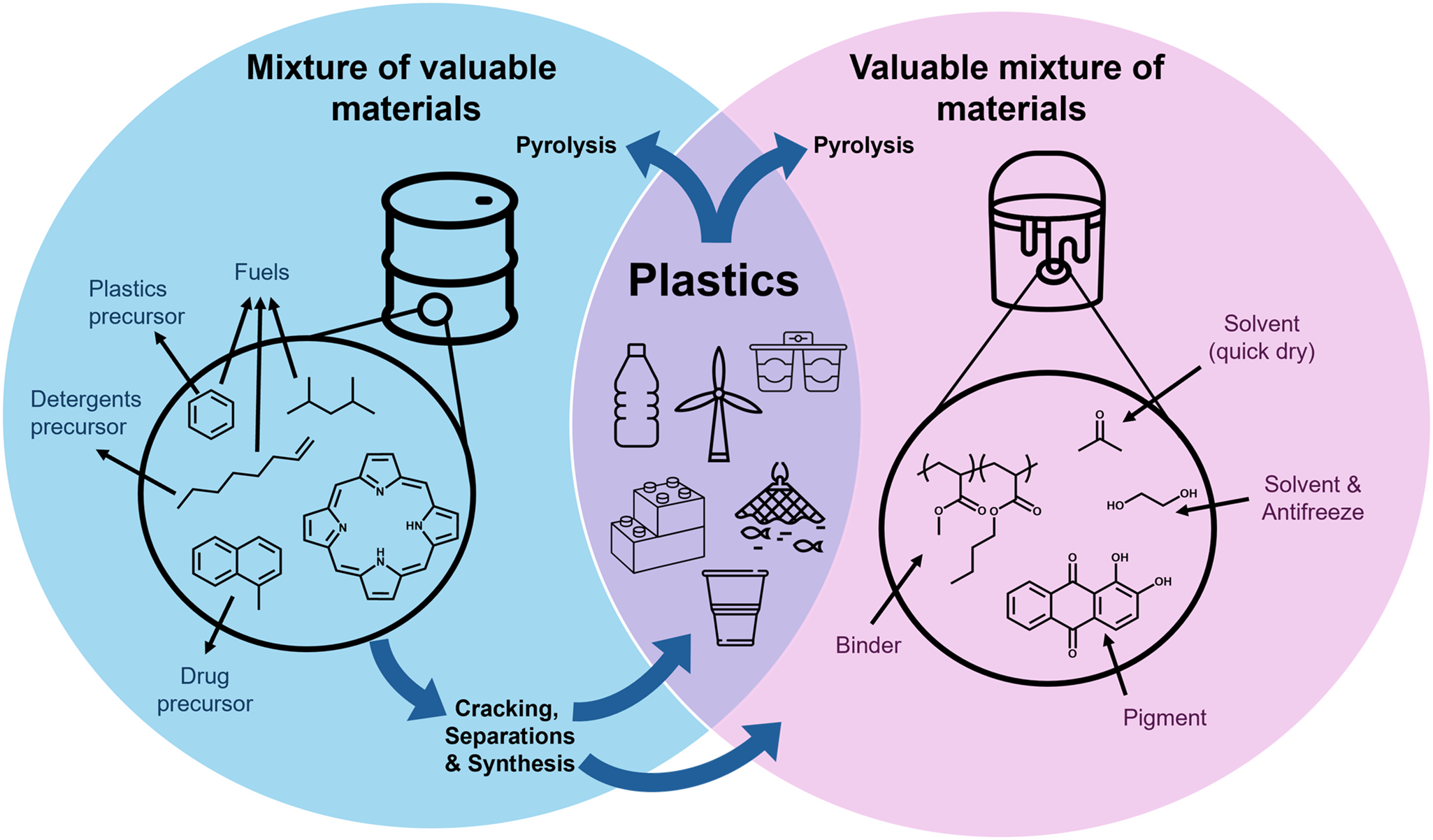
A barrel of crude oil is among the most complex mixtures in the world, with the geographical source of any barrel varying in relative elemental composition (carbon, hydrogen, nitrogen and sulphur), molecular diversity and physicochemical properties. The value inherent in the oil was recognised centuries ago, with early exploitation of some of its properties finding niche applications as fire-lighters from oil-soaked peat and heavy tars in caulk for boats (Craig et al., Reference Craig, Gerali, MacAulay and Sorkhabi2018). However, it was not until the 1860s that production technologies and, in particular, the development of the oil-refining industry, that oil began to become a foundation of modern society (Craig et al., Reference Craig, Gerali, MacAulay and Sorkhabi2018). Through decades of research and ingenuity, the complexity of crude oil’s composition was revealed – and then exploited – as valuable applications were found for all its components, from energy and transportation to pills, plastics and paints (Figure 3) (Craig et al., Reference Craig, Gerali, MacAulay and Sorkhabi2018). The modern value ascribed to crude oil is, in part, the result of linking its composition to the development of valuable applications that both scale and minimise waste not easily consigned to the tragedy of the commons (Hardin, Reference Hardin1968). In this way, crude oil represents a mixture of valuable materials, which we define as conceptually distinct from a valuable mixture of materials.
To make almost anything in our material world, we rely on crude oil, a valuable mixture of materials. The components of crude oil go on, after cracking, separation and synthesis, to be medicines, fuels, detergents, pigments and polymers. These are then combined into valuable mixtures of materials such as paints. Plastics sit at the intersection of these – they are valuable mixtures of materials, precisely formulated to do their functions. However, at the end of a plastic’s life, it has the potential to transform into a mixture of valuable materials or into a new valuable mixture of materials.

Paint is an example of a valuable mixture of materials. It is a combination of polymers, pigments, solvents and organic/inorganic additives, each holding some value individually (Jhamb et al., Reference Jhamb, Enekvist, Liang, Zhang, Dam-Johansen and Kontogeorgis2020; Rodrigues Peruchi et al., Reference Rodrigues Peruchi, Zuchinali and Bernardin2021). However, it is through their precise formulation that a mixture of a higher overall value for an application is realised. The required properties span a wide remit, from specific viscosities, phase separations, solubilities and evaporation rates, to more aesthetic properties such as a particular finish or colour, or protective properties like hardness and weather resistance (Figure 3). This broad range of requirements highlights how complex mixtures can trace value to their mixed nature (Ramachandran et al., Reference Ramachandran, Paroli, Beaudoin and Delgado2002; Jhamb et al., Reference Jhamb, Enekvist, Liang, Zhang, Dam-Johansen and Kontogeorgis2020). Yet as soon as we use this valuable mixture, it is linearly consumed – we cannot recover value from the paint already on our walls, and if a change or repair is needed, we simply consume more of this polymeric mixture.
This reality complicates the assignment of value judgements when terms such as ‘upcycling’ and ‘downcycling’ are deployed in the realm of chemical recycling. Pyrolysis, the application of intense heat to plastic waste in an oxygen-free environment with or without a catalyst, produces a mixture of solid carbon black, a liquid crude oil and gases (Figure 3) (Biakhmetov et al., Reference Biakhmetov, Dostiyarov, Ok and You2023; Radhakrishnan et al., Reference Radhakrishnan, Senthil Kumar, Rangasamy, Praveen Perumal, Sanaulla, Nilavendhan, Manivasagan and Saranya2023). The liquid and gas fractions require separation and upgrading to complete the extraction of value (Ryou et al., Reference Ryou, Byun, Bae, Kim and Han2025). These processes are, in part, compatible with the existing infrastructure we use to create value from a barrel of oil. Said compatibility, along with the process’s feedstock agnosticism and contamination resistance, can provide compelling arguments for its implementation as a complementary recycling strategy. Arguing to the contrary, the process is energy-intensive and only a fraction of the input material is used to produce products of similar value to the input materials, as other fractions are applied more broadly, from fuels (including to power the pyrolysis process itself) to fillers, with widely differing economic, material or environmental values.
Pyrolysis can also be tuned to convert polyolefin waste streams (PE, PP and mixtures thereof) to waxes for application as either lubricants or, when oxidised to fatty acids, as surfactants (Figure 3) (Jia et al., Reference Jia, Qin, Friedberger, Guan and Huang2016; Ramachandrarao et al., Reference Ramachandrarao, Naresh, Panday and Venkateswarlu Choudary2019; Xu et al., Reference Xu, Munyaneza, Zhang, Sun, Posada, Venturo, Rorrer, Miscall, Sumpter and Liu2023; Patil et al., Reference Patil, Goswami and Pinjari2024; Shaker et al., Reference Shaker, Hamdani, Muzata and Rabnawaz2024). This emergent direction aims to generate a stream of materials with intended high economic value applications as mixtures that minimise costly separations, thus using a potential limitation as a strength by targeting applications that require mixtures. In this context, the direct application of the materials in high economic value applications may lead to economic, if not environmental, justifications for directional terminology. Much more needs to be done to ensure material properties of the products match expectations and are less environmentally impactful in their production than incumbent materials.
For polymers like PET, selective deconstruction-to-application pathways (hydrolysis, alcoholysis, acidolysis, etc.) can be catalysed in a plethora of manners to generate a variety of products, including monomers related to the structure of the starting polymer (Müller et al., Reference Müller, Schrader, Profe, Dresler and Deckwer2005; George and Kurian, Reference George and Kurian2014; Yoshida et al., Reference Yoshida, Hiraga, Takehana, Taniguchi, Yamaji, Maeda, Toyohara, Miyamoto, Kimura and Oda2016; Austin et al., Reference Austin, Allen, Donohoe, Rorrer, Kearns, Silveira, Pollard, Dominick, Duman, El Omari, Mykhaylyk, Wagner, Michener, Amore, Skaf, Crowley, Thorne, Johnson, Woodcock, McGeehan and Beckham2018; Hoang et al., Reference Hoang, Nguyen, Ta, Nguyen and Hoang2022; Peng et al., Reference Peng, Yang, Deng, Deng, Shen and Fu2023; Clark and Shaver, Reference Clark and Shaver2024). These monomers can be rather straightforwardly repolymerised, as they often integrate well into the existing technologies, assuming sufficiently pure monomer feedstocks (Toot et al., Reference Toot, Simpson, Debruin, Naujokas and Gamble1996; Paben, Reference Paben2023). The resulting polymers may be identical to those depolymerised, or to the monomers reassembled to have different chain lengths or architectures for a new application.
This ‘recycling’ route is differentiated by transformations into small molecule precursors to medicines (Johnson et al., Reference Johnson, Valenzuela-Ortega, Thorpe, Era, Kjeldsen, Mulholland and Wallace2025) and commodity chemicals (Zhou et al., Reference Zhou, Ren, Li, Xu, Wang, Ge, Kong, Zheng and Duan2021; Gao et al., Reference Gao, Ma, Chen, Tian and Zhao2022) for their higher perceived value. Subsequent chemical transformations or purifications add economic and environmental burdens. However, routes that exploit, rather than avoid, the complex mixture of molecules can also add value. Lee et al. have formed flame-retardant polyisocyanurate foams by reacting the product mixtures of PET glycolysis with an isocyanate (Lee et al., Reference Lee, Kim, Tikue and Jung2022; Lee and Jung, Reference Lee and Jung2022a; Lee and Jung, Reference Lee and Jung2022b). While the authors refer to their process as ‘economic’ and ‘upcycling’, this is yet to be quantified beyond highlighting the use of a low-cost solvent system (Lee et al., Reference Lee, Kim, Tikue and Jung2022; Lee and Jung, Reference Lee and Jung2022b).
Value from both selective and non-selective deconstruction product streams can either treat the output stream as a starting point for further processing or seek to leverage the mixed nature of the product stream to enable the next life for these molecules. Both approaches often self-describe, based on fragile economic arguments, as ‘upcycling’, while less often accede to the ‘downcycling’ terminology. These attributions rarely engage with the environmental impacts of proposed processes, instead relying on waste valorisation as a sufficient benefit. The use of directionality in describing these approaches to plastic waste management depends on the value being placed on the waste stream, the recovered products and the energy needed for the transformation. The application of ‘up’ and ‘down’ terminologies to processes imbued with subjectivity renders the terms so vague as to be meaningless.
Discussion
Solutions to the plastic waste problem are frequently presented in a manner that will lead some to think the problem has been overcome. However, the continued existence of the problem is symptomatic of the gulf between potential solutions and implementation. The manner in which these solutions are presented is partially responsible for this confusion, and terminology like ‘upcycling’ and ‘downcycling’ and the value judgements that they imply are intimately related to this persistence. The decision-making surrounding the deployment of these terms is of great importance, and to aid in this process, standardised tools have been developed and are gaining in popularity (Box 1) (Nicholson et al., Reference Nicholson, Rorrer, Singh, Konev, Rorrer, Carpenter, Jacobsen, Román-Leshkov and Beckham2022).
Choosing pathways for recyclate considering source, technologies, and value judgements.
Life Cycle Assessment (LCA) is a tool that can be used to analyse the environmental impacts of a product or process between specified boundaries, such as from raw material extraction through use to disposal of a product at EoL (Curran, Reference Curran2013). LCAs have been conducted, for example, to compare the environmental impacts of recycling PET by enzymatic processes versus producing new terephthalic acid molecules (PET monomer) (Uekert et al., Reference Uekert, DesVeaux, Singh, Nicholson, Lamers, Ghosh, JE, Carpenter and Beckham2022) and by companies to compare the products of two processes, such as Mura’s HydroPRS™ to naphtha from pyrolysis (Ozoemena and Coles, Reference Ozoemena and Coles2023). These studies are, by definition, limited to the boundaries of their specifically defined system, which can make cross-study comparison difficult. The base case used as a comparator in an LCA can also skew the findings. Sensitivity analyses are critical for understanding how changes to the process, location or presumptions impact the system overall. While LCA itself can be used to understand environmental impacts across many impact categories, there is often a focus on the greenhouse gas emissions – the carbon footprint of a process – which can lead to the other deleterious impacts being overlooked.
To obtain a better understanding of the economic aspects of a technology, techno-economic analysis (TEA) can assess how costs and revenue opportunities are distributed across an entire process. This analysis can allow for cost drivers and value propositions to be identified and acts as a useful tool to guide investment and research, as well as resource allocation decisions (Kobos et al., Reference Kobos, Drennen, Outkin, Webb, Paap and Wiryadinata2020). TEAs have been used to examine the impacts of closed-loop recycling technologies for commodity plastics (Uekert et al., Reference Uekert, Singh, DesVeaux, Ghosh, Bhatt, Yadav, Afzal, Walzberg, Knauer, Nicholson, Beckham and Carpenter2023), as well as to assess the effects of mechanical recycling of post-consumer plastic packaging waste (Larrain et al., Reference Larrain, Van Passel, Thomassen, Van Gorp, Nhu, Huysveld, Van Geem, De Meester and Billen2021). Ideally, LCA and TEA are used in conjunction to provide a clear overall picture of the impact of a process or product (DesVeaux et al., Reference DesVeaux, Uekert, Curley, Choi, Liang, Singh, Mante, Beckham, Jacobsen and Knauer2024).
Performance and consistency are also critical considerations when the value of a material is being assessed. If the ultimate material does not function the way it was intended, be it a surfactant or a plastic bottle, diverting a waste feedstock stream towards it may not impart the intended economic or environmental gain. Consistency of performance across batches over a protracted timeframe, and across locations, is also important. Batch-to-batch variability can damage trust in the products by both the end user and the product engineers and designers, making material choices. This consideration is of particular importance in applications where the consequences of material failure may be severe, emphasising the importance of caution in this space. Incorporating recycled plastic materials in products can present significant barriers to entry. In the automotive sector, a car contains large quantities and a variety of plastics. In reference to our case studies above, significant quantities of PP and PET parts highlight some of these barriers. Specific physical properties, safety, smell, appearance, perceived quality, hand feel, colour and more, can limit the willingness of engineers to incorporate materials or customers to buy into products.
The motivations for choosing different materials or products are as diverse as the products themselves. For an airbag to deploy through an instrument panel effectively, the plastic encasing it must deform and move out of the way with specificity and reproducibility. Are the materials in a yoghurt pot of sufficiently high quality, and the recycling processing capable of producing materials of sufficient consistency to facilitate this? Could recycled polypropylene (rPP) from cracked pyrolysis oil, a virgin-quality material, be used in this application? Or should rPP be reserved for less safety-critical components? For the upholstery of a vehicle, choices are often based on our tactile, aesthetic and olfactory perception. Leather and poly(vinyl chloride) are used to impart these perceptions of quality in high-end vehicles. Would it be possible for rPET to find acceptance as a more sustainable replacement in these spaces? Should we cannibalise bottles to do this? What PET grades and sources could be considered to impart that perception of sufficient quality? Can a luxury vehicle’s level of value be reproduced?
Outlook
Throughout the above discussion, we have offered a variety of cases and potential approaches for manufacturers, researchers, and consumers to consider when valuing recycled plastic material. Polymer transitions are not isolated but instead are a system of systems. Viewing technocentric interventions in isolation, rather than in concert, can mask sustainable change. Open data sharing across studies can improve reproducibility and trust in life cycle and techno-economic assessments. Encouraging the use of such tools to authenticate ‘up-’ and ‘down-’ cycling terms and carefully examining the sources of waste that best match technologies are essential. To enable this broader view, both government action and industry diversification are key.
While policy on its own should not be considered a silver bullet to induce circular practices in a variety of sectors, it is essential. For example, policies, like the EU EoL vehicle directive, frame specific goals, such as ‘25% of plastic used to build a vehicle must come from recycling’ with 25% of that recycled material coming from automotive sources (‘Directive 2000/53/EC of the European Parliament and of the Council of 18 September 2000 on end-of life vehicles - Commission Statements’, 2000; European Commission, 2023). Promoting recycling within a sector provides an impetus to that sector to investigate the recycling potential therein, while nuance is needed to ensure the flexibility for exploring intersectoral recycling opportunities. The UN Plastics Treaty negotiations highlight why nuanced policy is so challenging, especially when global cooperation is required (Laville, Reference Laville2025). While reducing production is essential to create an economic impetus to treat recyclate as a resource, policy must embrace subtlety to avoid unintended consequences. Cooperation between sectors needs to be possible, such that recycled material is distributed logically among supply and demand opportunities. If we revisit Earth B, the recycled material from a plastic food tray after a single use moves to a long life in a car and an automotive plastic used in a t-shirt, and finally a well-worn t-shirt chemically recycled back to monomer for repolymerisation and re-entry into the spiral. The relative market sizes suggest that material from the packaging industry at the end of its circular life (44% of 391 Mt globally in 2022) could cover other sectors such as automotive (8%), textiles (14%) and building and construction (18%), assuming the material has been adapted to the appropriate quality. Even with good policy, consumer response is essential. Will consumers make choices that align with a spiral system? How can we set up a system that encourages sustainable behaviours?
Innovation is also essential, but is equally a challenge. Many of the most disruptive ideas originate in start-up companies. These can fill niche markets and open the broader industry’s eyes to new opportunities. However, risk is not always accompanied by reward, with early-stage companies often struggling to achieve stability. For example, seven recycling companies in the Netherlands (Blue Cycle, Ioniqa, Fuenix Ecogy, Stiphout Plastics, Vinylrecycling and Umincorp) all declared bankruptcy in 2024 (Faulkner, Reference Faulkner2025). For many of these companies, bankruptcy was filed during scale-up, with operations sometimes shutting down months before a planned opening. Additionally, companies fold due to mismatches between the availability of the starting materials and the market viability of the end products. If we want such transitions to work, how can we best support companies through the early vulnerable periods and market fluctuations, and choose the appropriate feedstocks and markets?
Throughout this perspective, considerations of environmental justice with respect to the production and use of recyclate have been neglected. If recycled yoghurt pots suddenly became a high-value material, what impacts would this have on the communities that produced them? If reclamation and sorting are executed in an inequitable manner, and the value of recyclate increases, are we at risk of perpetuating exploitation? The current linear economy already exploits communities and the environment – neither Earths A nor B should be allowed to make that worse.
This perspective has purposefully raised more questions than answers. Let us leave off with a systems-level thought: The next time you eat a yoghurt, where do you want the pot to end up? Should it become another yoghurt pot? A park bench? A car? What would you do to enable that? What should the producers and recyclers of the pot do? What should your government do? And before calling one of those fates ‘up-’ or ‘down-’ cycling, do we know the economic, environmental and functional aspects to assure that designation?
Open peer review
To view the open peer review materials for this article, please visit http://doi.org/10.1017/plc.2026.10041.
Acknowledgements
The authors would like to thank Laura E. Bergin for editing and discussions.
Author contribution
Claire L. Seitzinger: Conceptualisation and writing – original draft. Ciaran W. Lahive: Conceptualisation and writing – original draft. Michael P. Shaver: Conceptualisation, writing – review and edition, supervision and funding acquisition.
Financial support
This work was supported by funding from the Royal Academy of Engineering (RCSRF2324-17-43), BBSRC (BB/Y007972/1), EPSRC (EP/S025200/1), European Regional Development Fund (OC15R19P) and the University of Manchester.
Competing interests
The authors declare none.

 Open access


Comments
19th September 2025
Dear Prof. Steven Fletcher & the Cambridge Prisms: Plastics Editorial Board,
We are excited to submit this Perspective entitled Up, Down & Back Again: Value Judgements in Polymer Recycling, by Claire L. Seitzinger, Ciaran W. Lahive, and Michael P. Shaver for consideration in Cambridge Prisms: Plastics.
Our research endeavour in plastic recycling ranges from improving mechanical and chemical recycling outcomes, lowering the impacts of additives in plastics formulations, and exploring systemic changes to plastics in packaging, automotive, healthcare, and construction sectors. These efforts have highlighted the need for an article calling for careful consideration of the consequences of value-laden terminology. Often when discussing recycling methods, especially novel technologies, the terms ‘up-’ and ‘down-’ cycling are applied with little to no data-driven consideration of the value judgements inherent in that terminology. This has both confused general and expert audiences, as technologies labelled as ‘upcycling’ are considered to be better than those labelled ‘downcycling’, regardless of the useful placement of these technologies in a broader economic system. The potential for these terms to mask underlying sustainability challenges that can impact needed systemic change. In this perspective, we explore the use of these terminologies (including their varied definitions), their application in three case studies (polypropylene, poly(ethylene terephthalate), and mixtures of materials), and methods for validating their use from environmental, economic, and structural considerations. We aim to encourage the reader to think critically when using value judgment-laden terms, and to consider the complex systems inherent in any recycling technology.
To ensure broad impact and interest from a wide audience, we have written this perspective to consider factors beyond chemical challenges. Societal behaviour, historical context, and tools such as life cycle assessment (LCA) and techno-economic analysis (TEA) are coupled to chemical and engineering content to provoke critical thinking. The perspective disrupts the reader’s framing of challenges to leaving the reader with the confidence to question and consider whether processes are upcycled/downcycled/recycled. It is thus purposefully written in an interdisciplinary style, merging elements of social science and philosophy with core scientific discourse.
This manuscript features original work that is not under consideration by any other journals. All authors approve of the submission of this manuscript to Cambridge Prisms: Plastics. We are hopeful it will be a meaningful contribution to your journal and look forward to your feedback.
With sincerity,
Prof. Michael P. Shaver, FRSC, FIMMM
Director of Sustainable Materials Innovation Hub