


1. Introduction
Rapid prototyping is crucial in mechanical engineering, allowing for iterative design refinement and validation of concepts. However, traditional electronic development methods often introduce delays and hinder the progress of prototyping cycles (Reference Murphy, Floresca, Fu and LinseyMurphy et al., 2022). This disparity between mechanical and electronic maturity can result in prototypes needing more essential functionality and compromising effectiveness (Reference Ferretti, Magnani and RoccoFerretti et al., 2004). Hackathons in the public sector or at Small and Mid-sized Enterprises (SMEs) usually provide further constraints in prototyping. Next to the time constraint, there is usually also the aim to low-cost prototype (Reference Terrazas, Hawkridge, McFarlane and McNallyTerrazas et al., 2021).
To address this challenge, modular electronic systems have emerged as a powerful tool for accelerating prototyping workflows. With readily available evaluation boards and interconnected modules with standardized interfaces (e.g., 2.54 mm pin raster), engineers can quickly assemble functional electronic subsystems without requiring extensive custom circuit design and fabrication. This approach enables rapid exploration of different hardware configurations, sensor integrations (e.g., acceleration, magnetometers, temperature), and actuator control strategies.
Microcontrollers and real-time capable computing systems are the core processing units within these modular setups, enabling data acquisition, processing, logging, and actuator control. The open-source Arduino movement has significantly propelled the adoption of this methodology, providing a vast ecosystem of modules, libraries, and online resources for rapid prototyping and experimentation (Reference Kondaveeti, Kumaravelu, Vanambathina, Mathe and VappangiKondaveeti et al., 2021).
However, using hardware modules still needs a more profound knowledge of embedded systems and how to interconnect them. Especially when choosing the appropriate communication module for a specific application, non-experts often can only choose the correct available protocol based on trial and error or gut feeling.
While integrating electronics into mechanical systems is becoming increasingly ubiquitous, the complexities of electronics design can present a significant barrier to entry for mechanical engineers unfamiliar with electrical engineering principles. This paper aims to bridge this gap by providing a clear and concise overview of modular electronics systems and their applications in mechatronic prototyping. In industry, electronics engineers typically handle design, but early prototyping or interdisciplinary projects often require mechanical engineers to engage with electronics. In education, this approach aids learning, akin to material selection tools in mechanical engineering.
It documents the benefits and applications of modular electronic systems in mechanical prototyping. We will explore specific examples of how these systems have been successfully employed in two contexts, from industrial product development to hackathons. Furthermore, we will discuss this rapidly evolving field’s limitations and potential future directions.
2. Supporting Literature on Modular Electronics and Optimization
Reference Li, Liu, Ren, Li and LiLi et al., 2022 describe a method to better map user preferences of product configurations of unmanned aerial vehicles leveraging big data analytics and fuzzy c-means clustering to classify user needs into specific and uncertain categories based on performance ratings of unmanned aerial vehicle (UAV) modules. Reference Wang, Zhou, Chang and ZhangWang et al., 2020 focus on optimizing configuration schemes for computerized numerical control (CNC) honing machines through modular design. The authors propose a three-step process for generating feasible configuration schemes and utilize performance, cost, and delivery time indicators to evaluate different options. They introduce a mathematical model incorporating invariant costs, variant costs, installation costs, interface distances, and bit encoding weights. The work highlights the importance of modularization in product design and aims to develop an efficient framework for customizing CNC honing machines based on customer requirements. Over the last few years, customizing electronic hardware modules to ease access has been applied several times. Reference Sarik and KymissisSarik and Kymissis, 2010 implemented the Arduino Board Architecture in a more compatible way, enabling students to do lab exercises at home. Reference Jamieson and HerdtnerJamieson and Herdtner, 2015 showed the challenges of introducing modular electronics to students in lectures, and Reference Ishikawa and MarutaIshikawa and Maruta, 2010 showed the use of modular electronics to teach control theory. Reference Krause and GebhardtKrause and Gebhardt, 2018 describe the development of variant-rich products using modular product structures, addressing complexity reduction from the perspective of product development. These modular product structures enable a broader variety of customer demands to be met while maintaining a low internal diversity of components and processes within the company.
Model-based approaches to modular hardware design have gained traction, allowing for more structured cost optimization and product configuration. Product families contribute to reducing complexity and play a significant role in cost reduction (Reference Rötzer, Thoma and ZimmermannRötzer et al., 2020, Reference Rötzer, Berger and Zimmermann2022). Reference Schäppi, Andreasen, Kirchgeorg and RadermacherSchäppi et al., 2005 as well as Reference Mortensen, Hvam, Haug, Boelskifte, Lindschou and FrobeniusMortensen et al., 2010 describes the design of product families using a so-called product family master plan. This plan aims to avoid replicating undesirable product characteristics while adopting well-functioning features during the design of the product family.
Graph-based design for product families is not limited to electronics and can also be found in robotics. Rules that specify when compatible components can be assembled are called “grammar” in this context. One example is the work by Reference Zhao, Xu, Konaković-Luković, Hughes, Spielberg, Rus and MatusikZhao et al., 2020, who used a graph-based algorithm to determine an optimal set of robot links and joints to fulfill specific tasks. Another example is the research by Reference Sathuluri, Sureshbabu, Frank, Amm and ZimmermannSathuluri et al., 2023. This study aimed to combine modular configurations of robot parts to minimize costs while meeting all robot requirements.
Typical algorithms for graph-based search include greedy and A* algorithms (Reference Russell and NorvigRussell & Norvig, 2021, pp. 82). The A* is widely used in computer science to compute the shortest path between two nodes in a graph with positive edge weights. It was first described in 1968 by Peter Hart, Nils J. Nilsson, and Bertram Raphael (Reference Hart, Nilsson and RaphaelHart et al., 1968). The algorithm can be considered a generalization and extension of Dijkstra’s algorithm (Reference DijkstraDijkstra, 1959). Notably, the search algorithm exhibits relatively robust behavior. While various solution algorithms exist for different problems in plant and robot engineering, there is currently no solution for electronic design in mechatronic applications within the prototyping development domain.
3. Methodology
Selecting compatible components for modular electronics is challenging, often relying on intuition or trial-and-error, making automation essential. The proposed process stores extracted data of so-called off-the-shelf electronic module datasheets, extracts information, and saves it to a database, structuring it in a graph-based format to enable automated selection and optimization, where system models serve to structure and visualize extracted data. To generate an optimized module set, requirements are fed into the algorithms. The result is an optimized product. The whole process can be seen in Figure 1.
Process of filling the database of the algorithm and optimizing the hardware module set

3.1. Database
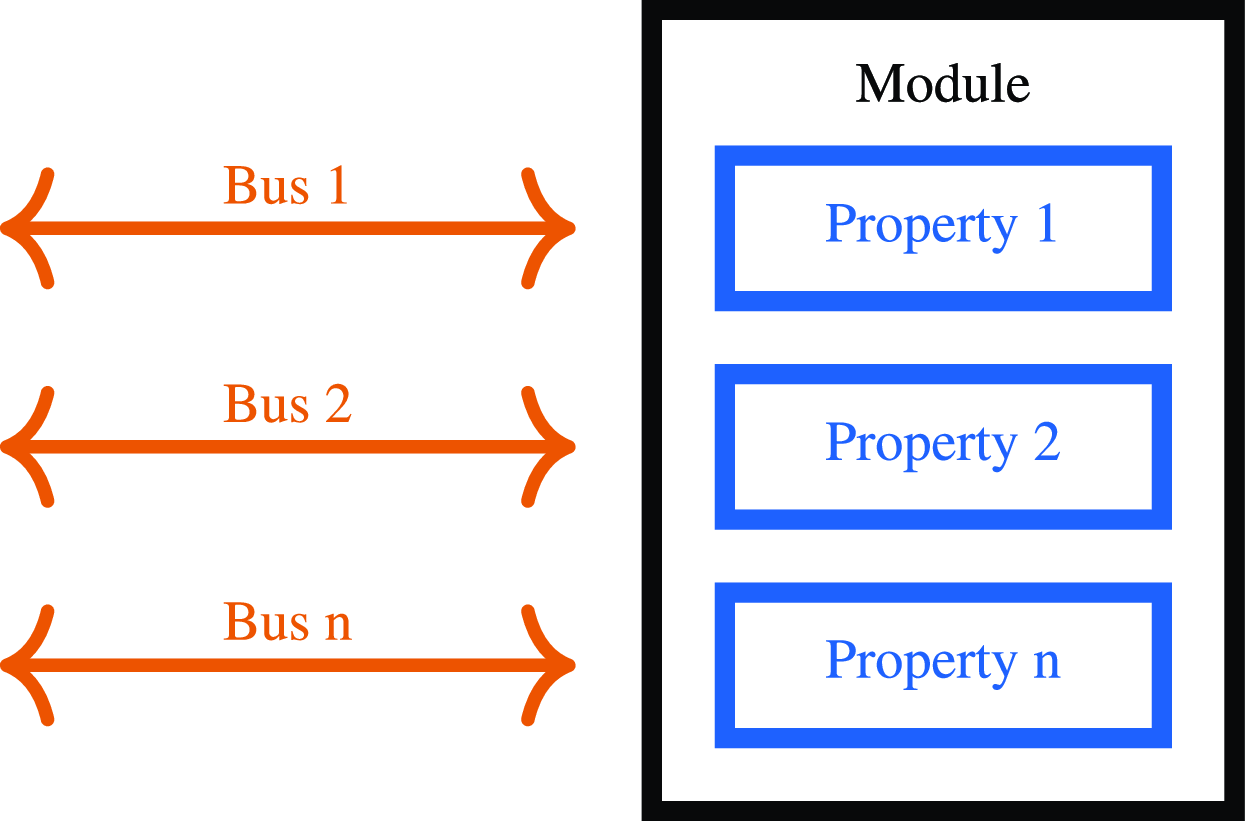
As with prototyping, modules are often used for testing purposes, and they incorporate one or more chips that fulfill a function or drive a motor, for example. These are readily available, shorten the development time for prototyping, and are controlled via standardized bus systems. The module itself can, therefore, be seen as a black box as in Figure 2.
An abstracted generic hardware module with properties and buses for communication

Examples of modules are a temperature sensor board based on an ADS1256 by Texas Instruments (ADS1256 Very Low Noise, 24-Bit Analog-to-Digital Converter, 2013), a servo drive motor like the T-Motor AK60-6 (AK60-6 V3.0, 2023), or a microcontroller board like an ESP32-Wroom-32 by Espressif (ESP32-WROOM-32 Datasheet, 2023) to process the data.
Depending on the manufacturer, these modules are described using different methods and terms. The first step is, therefore, to extract the information from the data sheets, standardize it to common pattern (e.g. SI units) and put it in a common framework (i.e. transfer it to a database) from which the algorithm can then select the optimal configuration. Requirements are formulated to match the properties of the modules.
The following organizational structure can be assumed for the database of available modules. A module can provide various properties. The property entity defines the capabilities provided by a module. Each property has a name, a minimum and maximum performance range, and a unit representing the property’s capability, as shown in Figure 3. Like other entities, it also has a unique identifier. These attributes enable the precise characterization of each property and facilitate its linkage to modules. The modules can communicate with each other for data processing on different buses. The bus entity represents the communication buses used for data exchange between various modules. Each bus is characterized by its name, the minimum and maximum baud rates it supports, the voltage range it operates within, and a unique identifier. The Unified Modeling Language (UML) diagram in Figure 3 illustrates two critical many-to-many relationships (Reference Kemper and EicklerKemper & Eickler, 2018; Reference Rumbaugh, Jacobson and BoochRumbaugh et al., 2004). The first is between buses and modules, and the second is between modules and properties. These relationships are modeled using two intermediary tables, M2M-Module-Bus and M2M-Module-Property.
The many-to-many relation (M2M) is defined in M2M-Module-Bus table bridges the relationship between buses and modules. It includes attributes for a unique identifier, a foreign key referencing the bus table, and another foreign key referencing the module class. This structure ensures that each row represents a valid association between a specific bus and module.
Similarly, the M2M-Module-Property table bridges the relationship between modules and functions. It also includes attributes for a unique identifier, a foreign key referencing the property table, and a foreign key referencing the module table. This structure enables the flexible linkage of modules to various functions, ensuring scalability and reusability. This means that 1‥n functions and 1‥n buses can be assigned to the modules or, in other words, M2M-Module-Bus ⫅ Bus × Module and M2M-Module-Property ⫅ Property × Module. These functions and buses do not all have to be used simultaneously. Figure 3 illustrates the UML representation of the module database structure, showcasing the relationships between modules, properties, and buses. The connections between entities enable efficient data retrieval for the optimization algorithm.
Class Definition of the Module Database the algorithm can choose from as well as Instances created by the algorithm

This database scheme adheres to foundational design principles to ensure efficiency and reliability. The design follows normalization principles, specifically up to the third normal form (3NF), to eliminate redundancy and maintain data consistency (Reference Codd and RustinCodd, 1972). For example, attributes such as names, costs, and specifications are stored in their respective tables without unnecessary repetition. Scalability is a core feature of the scheme, achieved through intermediary tables for many-to-many relationships. This allows new buses, modules, or properties to be added or linked without modifying the scheme. The system is thus adaptable to growing requirements. Data integrity is maintained through the use of primary and foreign key constraints. Primary keys ensure that records in each table are unique, while foreign keys enforce valid relationships between tables. These constraints guarantee the accuracy and reliability of the data stored in the database.
Examples of modules can be found in the Figures 4 and 5. A common microcontroller is instantiated and a servo motor as an actuator.
Instance of an ESP32 Microcontroller

Instance of a T-Motor Actuator

3.2. Problem Definition
The A* algorithm is employed as the search algorithm in this study. The optimization problem for the minimization algorithm can be formulated as follows:
 $$\mathop {\min}\limits_{\bf{A}} \mathop \sum \nolimits{C_{module}}$$
 $${\text{subject \ to}}\quad \min R\ge R_{crit}$$
 $$g({\bf{A}}, \cdot) \le 0$$
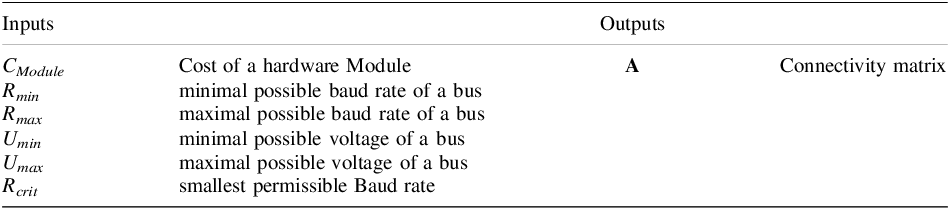
As expressed in Equation 1, the objective is to minimize the total costs, precisely the sum of the costs of all modules CModule . The algorithm outputs a connectivity matrix that satisfies the constraints. The constraints ensure that all requirements are met, as detailed in equation 3. Here, g(x) = 1 if a requirement is unmet, and g(x) = –1 if it is fulfilled. This binary evaluation framework allows the algorithm to systematically assess the feasibility of solutions within the defined cost and requirement bounds. Future work could extend this to allow graded satisfaction levels, capturing trade-offs in requirement fulfillment. An explanation of the other variables can be found in Table 1.
Definitions of the input and output variables

3.3. Algorithm
The algorithm dynamically instantiates both buses and modules as needed. This flexibility enables the system to adaptively meet requirements, such as satisfying a demand using two modules of type B instead of a single type A module. The iterative nature of the process generates a graph, and the algorithm leverages the A* graph-based search due to its high robustness and ability to efficiently explore large solution spaces. The A* algorithm is chosen due to its ability to efficiently explore large solution spaces while ensuring optimal path selection based on cost and feasibility. It evaluates potential configurations dynamically, selecting the lowest-cost modules while ensuring all functional requirements are met. The heuristic function estimates the remaining cost to an optimal solution, ensuring efficient decision-making. The use of A* is particularly advantageous in our context, where multiple modules can fulfill the same function, and the algorithm must evaluate trade-offs in cost and performance. The connectivity matrix produced by the algorithm evolves dynamically, as the number of instances can vary with each iteration. Consequently, the dimensionality of the scheme changes, reflecting the algorithm’s capacity to adapt its configuration to the requirements at each step. This adaptive framework introduces three levels of abstraction within the process, as illustrated in Figure 6, that represents the hierarchical abstraction levels in our approach. The highest level defines generic component types, while the middle level instantiates components with defined attributes. The lowest level details realized components with their specific interconnections, crucial for deriving the final connectivity matrix. At the highest level, the abstraction defines the types of components available. This includes specifications for buses, modules, and their associated functions. The second level, the component variant, instantiates the defined component types, allowing for multiple instances of similar types within the system. This layer represents the database contents from which the algorithm selects components. At the lowest level are the instantiated component variants, called realized components. The connectivity matrix details the connections between these realized modules via the realized buses. The scheme specifies each realized module’s functional allocation and interconnections, providing a clear overview of how the system meets the given requirements. This multi-layered approach ensures both flexibility and precision in the assignment process.
Abstraction levels of the problem considered

The result of the methodology is an connectivity matrix that maps instances of the hardware module component variants on the bus component variants.
4. Case Study: Temperature Measurement
The methodology described in section 3 will now be transferred to the following problem: To demonstrate the capabilities of the procedure, a device that evaluates 13 temperature sensors will be generated.
4.1. Requirements and Data-set
The requirements of the measurement device can be seen in Table 2. Various modules with associated properties and buses were instantiated in the example. 52 Analog-to-Digital Converter (ADC) hardware modules were employed to convert temperature into machine-processable values. At the end of each module, PT100 sensors were connected to perform the temperature measurement. These modules exhibit a range of discretization levels, varying from 6-bit to 24-bit resolution, and support different numbers of channels, specifically 1, 2, 4, or 8 channels per module.
Requirements on the temperature measurement device

The modules were connected using various bus systems, including buses like Inter-Integrated Circuit (I2C), Serial Peripheral Interface (SPI), universal asynchronous receiver-transmitter (UART), and Controller Area Network (CAN), to facilitate communication. This diversity in communication protocols allows for flexible integration of the ADC modules into the system. Two microcontroller options were provided for data processing: the ATmega328 and the ESP-Wroom-32. These microcontrollers offer different computational power and connectivity capabilities, ensuring adaptability to various system requirements and use cases. This configuration demonstrates the versatility and scalability of the approach in addressing specific application needs.
To generate an optimized configuration, the algorithm first analyzes the available modules based on their specifications (e.g., resolution, number of channels, supported bus types). It then assigns modules to fulfill each requirement while minimizing costs. The heuristic function iteratively evaluates configurations, rejecting those that do not meet constraints and selecting the optimal combination.
4.2. Results
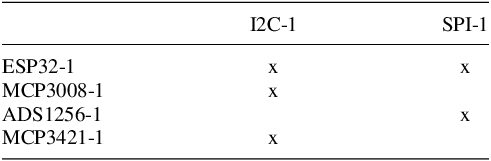
Applying the algorithm results in an connectivity matrix for the realized components of AT in Table 3. The design no. 02 is illustrated in Figure 7 (a). This architecture is represented in UML, illustrating a system composed of instantiated buses I2C-1 and SPI-1, along with the Modules ESP32-1, MCP3008-1, ADS1256-1, MCP3421-1. These modules collectively provide the system with the required functional capabilities. The integration of these components demonstrates the practical viability of the algorithm in configuring a modular system that meets specified functional requirements.
Compatibility matrix of the temperature measurement device of design no. 2

The calculated total cost for the selected modules amounts to 33.92 C, based on publicly available supplier data, acknowledging that pricing can vary due to order volume and sourcing. The outcome highlights the algorithm’s ability to derive a solution that satisfies the necessary architectural constraints while remaining cost-conscious. Alternatively, other configurations are possible that, while semantically correct, are more cost-intensive. Examples can be seen in figures 7 (a)-(c). These configurations maintain the required bus compatibility to ensure seamless communication between modules but do not prioritize cost optimization. Such alternatives provide a broader perspective on the flexibility of the method, showcasing its capacity to generate solutions under varying constraints and preferences. This adaptability underscores the algorithm’s utility in scenarios where cost may not be the primary concern, but functional and architectural alignment remains critical.
Examples of feasible designs

5. Discussion and Limitations
The presented methodology automates the selection of appropriate electronic modules during the prototyping phase. By employing an A* search algorithm and leveraging a database of available modules, the method efficiently identifies the most cost-effective combination to fulfill a specific function. Subsequently, an connectivity matrix derived from product family design principles generates viable product architectures. This approach empowers non-experts in mechatronics to conceptualize and design mechanical assemblies with minimal prior knowledge. The automation of module selection and architecture generation significantly reduces the barriers to entry for individuals lacking specialized expertise in electronics and circuit design. However, certain limitations inherent to the method warrant discussion. One prominent constraint arises from the inefficiencies in the underlying graph search algorithm. The performance of the method is heavily influenced by the algorithm’s ability to efficiently navigate and explore potential configurations. When the graph search algorithm fails to operate optimally, it can lead to suboptimal solutions or increased computational overhead. This underscores the necessity for future research to focus on improving the robustness and efficiency of graph search mechanisms within this context. Additionally, the breadth and depth of the module library directly influence the effectiveness of the proposed method. A limited number of modules within the library can restrict the algorithm’s capacity to generate diverse configurations, potentially reducing the method’s applicability across varying use cases. This limitation emphasizes the importance of developing and maintaining an extensive and well-curated library of modules, which can support a broader range of product families and enhance the versatility of the approach. The same applies to an increase of number of requirements. These limitations highlight the dual necessity of algorithmic refinement and systematic library expansion to fully realize the potential of the presented methodology. Future efforts could focus on integrating more sophisticated graph search techniques and employing strategies for enriching the module library. By addressing these challenges, the proposed method can be further optimized to accommodate a wider array of applications and improve the overall efficiency of product family design.
6. Conclusion
The methodology presented in this work demonstrates a novel approach to addressing the evolving challenges in product architecture generation. A key aspect of this advancement is the dynamic dimension of the connectivity matrix’s dimensions. Unlike static models, where such dimensions remain fixed, the proposed approach allows these dimensions to vary based on the algorithm’s instantiation of modules and buses. This flexibility introduces significant potential for scalability and adaptability in complex systems. The functionality of this approach has been successfully demonstrated through the application of a targeted algorithm, highlighting its capability to handle the variability inherent in modular system design. Integrating automated data extraction, component-level optimization, and circuit design tools within this framework facilitates a more efficient modular electronics development process. This approach can potentially lower barriers to entry in sophisticated electronics by providing accessible tools and a continuously expanding library of components. The outcome is an acceleration in the development cycle for advanced mechatronic solutions.
7. Outlook
While modular electronics significantly accelerate prototyping, further optimization at the component level can unlock even greater efficiency and flexibility. This paper proposes a novel approach that leverages automated data extraction and circuit design tools to streamline the process from the initial concept to fully realized electronic modules. Further optimization at the component level can enhance flexibility and efficiency. Instead of relying solely on pre-existing modules, a system that allows engineers to refine designs at an individual component level could offer greater adaptability. Another crucial improvement lies in automating data extraction and database integration. By developing a system that parses datasheet specifications and integrates them into a structured database, the component selection process can be significantly accelerated. Additionally, a web crawler could be implemented to continuously scan online catalogs of electronic distributors, ensuring that the database remains up to date with the latest component information. The extracted datasheet data can be directly integrated into circuit design software. This eliminates tedious manual work and minimizes design errors, leading to faster prototyping cycles.







 Open access

