

Introduction
The green transition (i.e., the transition to a climate-neutral economy to limit global warming) and digitalization, often referred to as the twin transition, combine two of the most important challenges for advanced capitalist economies, which affect labor markets, economic and social policies, as well as societies more generally (European Commission 2022; Muench et al. Reference Muench, Stoermer, Jensen, Asikainen, Salvi and Scapolo2022). Addressing and governing both transformations simultaneously at the national and international levels requires substantial governmental investments over the coming decades, which ultimately depend on citizens’ political support (Golka et al. Reference Golka, Murau and Thie2024; Guter-Sandu et al. Reference Guter-Sandu, Haas and Murau2024). Public investments in the green transition entail, for instance, the promotion of renewable energy production, the electrification of public transport, public funds for housing insulation, or flood and heat protection measures (Hainsch et al. Reference Hainsch, Löffler, Burandt, Auer, del Granado, Pisciella and Zwickl-Bernhard2022). But also for the digital transition to succeed, public investment is crucial, requiring spending on digital infrastructure, the digitalization of public services, funding for key technologies such as artificial intelligence, cybersecurity, and digital education (European Commission 2024). Moreover, both transitions require public investment in up-and reskilling the workforce through education and training measures (Petmesidou and Guillén Reference Petmesidou and Guillén2022). These investments draw on finite public budgets and therefore involve trade-offs. Prominent examples include the EU Recovery and Resilience Facility (European Commission 2021) as well as major U.S. initiatives such as the Inflation Reduction Act (U.S. Congress 2022b) and the CHIPS and Science Act (U.S. Congress 2022a), all of which require governments to allocate public funds between green and digital priorities. While some policies – such as smart grids – may advance both transitions simultaneously, most measures target either digitalization or the green transition, so greater spending on one set of objectives necessarily constrains resources for the other.
More generally, states can respond to large-scale economic transformations either by promoting structural change through public investment or by seeking to protect existing economic structures from disruption. In the field of social policy, existing research has often conceptualized this choice as one between compensatory or social investment policies on the one hand, and protectionist policies aimed at preventing or slowing structural change on the other (Colantone and Stanig Reference Colantone and Stanig2018; Kuo et al. Reference Kuo, Manzano and Gallego2024). Building on this literature, we focus on public investment as a key policy instrument through which governments can actively promote the green and digital transitions. In this context, lower levels of public investment can be interpreted as reflecting a more protectionist orientation toward limiting the pace or scope of a transformation, also to safeguard employment.Footnote 1
When deciding on public investment, governments face budgetary constraints insofar as they cannot spend unlimited resources across all potential policy areas but rather have to prioritize and reduce spending in some areas in favor of others. A recent and salient example of these budgetary constraints is the German budget crisis of November 2023 (Golka et al. Reference Golka, Murau and Thie2024), during which a sudden unavailability of public spending on climate adaptation and mitigation projects ultimately resulted in far-reaching budget cuts in this policy area (German Federal Government 2023). Other countries face similar austerity constraints (Bremer and Bürgisser Reference Bremer and Bürgisser2023a).
The twin transition will also (continue to) considerably impact labor markets. While a growing literature focuses on how either of the two transforms labor markets (Bowen et al. Reference Bowen, Kuralbayeva and Tipoe2018; Consoli et al. Reference Consoli, Marin, Marzucchi and Vona2016; Curtis and Marinescu Reference Curtis and Marinescu2023; Curtis et al. Reference Curtis, O’Kane and Jisung Park2024; Rutzer et al. Reference Rutzer, Niggli and Weder2020; Vona et al. Reference Vona, Marin, Consoli and Popp2018), little work has explored how both in tandem create different labor market risks, which affect policy preferences. Depending on their job type, people might fear neither, feel single-pressured by either, or cross-pressured by both transitions. The risk of a transition can be either objectively linked to jobs in certain sectors, such as the impact of the green transition on coal mining or fossil fuel industries, or subjectively interpreted as such, which has been shown to matter for certain policy preferences (Busemeyer et al. Reference Busemeyer, Stutzmann and Tober2025; Iversen and Soskice Reference Iversen and Soskice2001; Rehm Reference Rehm2009). How different labor market risk perceptions affect relative investment preferences in either transition remains so far understudied.
In light of the crucial role of public opinion for the success of policy change (Burstein Reference Burstein2003; Wlezien and Soroka Reference Wlezien and Soroka2016), it is essential to understand the importance citizens attach to both transitions and whether they perceive a trade-off in dealing with both. Based on this, we seek to understand citizens’ preferences for how governments should allocate a fixed amount of money across the two transformations (what we will henceforth call relative spending preferences) and the determinants of these individual-level preferences. Our understanding of a public spending trade-off implies that individuals are forced to choose between more relative spending on one transition, which necessarily implies cutting back on the spending of the other transition (or allocating an equal split with 50% of the total amount to both transitions) (Armingeon and Bürgisser Reference Armingeon and Bürgisser2021; Busemeyer and Tober Reference Busemeyer and Tober2023). Thus, in contrast to other contributions studying budgetary trade-offs (Bremer and Bürgisser Reference Bremer and Bürgisser2023b), we do not focus on a trade-off between the absolute size of spending on both areas on the one hand and reducing spending on other areas or increasing public debt or taxation on the other hand in order to finance this spending.
Moreover, while the bulk of research on preferences over budgetary trade-offs has so far mainly centered on social policies (Armingeon and Bürgisser Reference Armingeon and Bürgisser2021; Busemeyer Reference Busemeyer and Hemerijck2017; Busemeyer and Garritzmann Reference Busemeyer and Garritzmann2017; Busemeyer and Tober Reference Busemeyer and Tober2023; Neimanns et al. Reference Neimanns, Busemeyer and Garritzmann2018), we focus on public spending on digitalization and the green transition for the following reasons: both of these transitions are future-oriented policy areas and the importance of both has increased relatively recently compared to other spending areas such as education or health which have been important for a very long time. Therefore, governments had to find additional room for public spending on both the green and the digital transitions in recent decades compared to other, more entrenched, spending areas. Relatedly, both transitions entail uncertainty about the required technologies, which have been identified as contributing to slower investment in the two transitions (Andersson et al. Reference Andersson, Nerlich, Pasqua and Rusinova2024). These factors underline the relevance of studying trade-off perceptions of investments into the twin transition.Footnote 2 Apart from these commonalities, both transitions also have important differences (see Busemeyer et al. (Reference Busemeyer, Stutzmann and Tober2025) for a more extensive discussion of this). While the bulk of the green transition (in the labor market) will unfold over the next decades (Causa et al. Reference Causa, Nguyen and Soldani2024; OECD 2023), the digital transformation is already more tangible and visible. Moreover, the green transition is a more policy-driven transformation than digitalization, which tends to be more market-driven (OECD 2023).
In our paper, we explore the following main research question: What are the relative public spending preferences on the green transition versus digitalization, and how can they be explained across advanced democracies? Given the importance assigned to these transitions for changing labor market risks, we are interested in investigating the role of individual labor market risk regarding the two transitions as well as the effect of labor market cross-pressuredness, i.e., perceiving both transitions as threatening to one’s job, on relative public spending preferences regarding the twin transition.
Based on arguments rooted in material self-interest, we expect that individuals who feel their jobs are threatened by a societal transformation will be more likely to prefer slowing down that particular transformation or at least maintaining the status quo. Consequently, they may favor the government allocating relatively less funding to this transition. We explore trade-off perceptions and test our theoretical expectations using novel comparative survey data from six countries (Germany, the US, Spain, Sweden, Poland, and Japan). The survey (n = 19,800) focused on labor market experiences and policy preferences of working-age individuals (between 18 and 65 years) and was fielded in the summer of 2022. Our findings show that many people perceive a trade-off between addressing both transitions simultaneously and generally prefer slightly more investment into the green transition than into digitalization. Moreover, urgency perceptions are slightly higher for digitalization in the labor market than for the green transition. At the same time, respondents also perceive their countries’ labor markets as slightly better prepared for digitalization than for the green transition. The empirical analysis supports our main expectation that relative spending preferences are shaped by individual labor market risk perceptions, such that perceiving one of the two transitions as a labor market risk is associated with a preference for less relative investment into that area. We also show that preferences for public spending are distinct from preferences for compensatory spending, as subjective labor market risk is associated with higher support for compensatory policies in response to each transition. Several additional analyses underscore the robustness of our findings. In the concluding section, we discuss the implications of our results.
Literature review: digitalization, the green transition, and policy trade-offs
Our paper builds on and connects different research streams on digitalization, the green transition, and policy trade-offs, which have so far remained largely isolated.
In recent years, there has been a burgeoning literature on the labor market consequences of technological change (see Busemeyer (Reference Busemeyer2022) and Gallego and Kurer (Reference Gallego and Kurer2022) for recent overviews). The bulk of this literature has focused on automation as the key labor market risk. In contrast, more recent contributions to this literature have centered on different phenomena encompassed by technological change, such as artificial intelligence (AI) (Acemoğlu et al. Reference Acemoğlu, Autor, Hazell and Restrepo2022) or the spread of industrial robots (Acemoğlu and Restrepo Reference Acemoğlu and Restrepo2020; Dauth et al. Reference Dauth, Findeisen, Suedekum and Woessner2021). For the purpose of our paper, we refer to these developments as digitalization, while recognizing that they might all have distinct effects on labor markets. Taking the seminal work by Autor et al. (Reference Autor, Levy and Murnane2003) as a starting point, this literature argues that through a simultaneous increase in high-skilled and low-skilled occupations and the routinization of middle-skilled occupations, routine-biased technological change has led to a hollowing of the middle class and thus to higher income inequality (Autor and Dorn Reference Autor and Dorn2013; Autor et al. Reference Autor, Dorn and Hanson2015; Frey and Osborne Reference Frey and Osborne2017; Goos and Manning Reference Goos and Manning2007; Goos et al. Reference Goos, Manning and Salomons2014; Michaels et al. Reference Michaels, Natraj and Van Reenen2014). These developments have sparked scholarly interest in the consequences of labor market change through technological change, with existing papers focusing primarily on preferences for redistribution and social policy (Busemeyer and Tober Reference Busemeyer and Tober2023; Gallego et al. Reference Gallego, Kuo, Manzano and Fernández-Albertos2022; Im Reference Im2021; Kurer and Häusermann Reference Kurer and Häusermann2022; Thewissen and Rueda Reference Thewissen and Rueda2019; Zhang Reference Zhang2022). Moreover, there have been several recent contributions that examine how automation risk is correlated with support for “protectionist policies” that aim to stop technological change or maintain the status quo (Bicchi et al. Reference Bicchi, Kuo and Gallego2024; Gallego et al. Reference Gallego, Kuo, Manzano and Fernández-Albertos2022; Kuo et al. Reference Kuo, Manzano and Gallego2024), which we discuss in more detail in the theoretical section. However, investigating how labor market risks arising from technological change affect support for budgetary policies that enable and enhance technological change has hardly been studied.
Regarding the question of how the green transition affects labor markets and its consequences for public policy, research is still very much in its infancy. A number of contributions in economics agree that the green transition is predicted to lead to a net gain of jobs concentrated in green sectors (Bowen et al. Reference Bowen, Kuralbayeva and Tipoe2018; Consoli et al. Reference Consoli, Marin, Marzucchi and Vona2016; Curtis and Marinescu Reference Curtis and Marinescu2023; Curtis et al., Reference Curtis, O’Kane and Jisung Park2024; Rutzer et al. Reference Rutzer, Niggli and Weder2020; Vona et al. Reference Vona, Marin, Consoli and Popp2018), paralleled by a loss in jobs in carbon-intensive industries (van Doorn and van Vliet Reference van Doorn and van Vliet2024; International Labor Organization 2018; Vona et al. Reference Vona, Marin, Consoli and Popp2018). However, apart from several contributions that analyze policies that link environmental and social goals – so-called “eco-social” policies – (Armingeon and Bürgisser Reference Armingeon and Bürgisser2021; Fritz and Koch Reference Fritz and Koch2019; Fritz et al. Reference Fritz, Koch, Johansson, Emilsson, Hildingsson and Khan2021; Gugushvili and Otto Reference Gugushvili and Otto2023; Jakobsson et al., Reference Jakobsson, Muttarak and Ah Schoyen2018; Johansson and Koch Reference Johansson and Koch2020; Koch and Fritz Reference Koch and Fritz2014; Kono Reference Kono2020; Otto and Gugushvili Reference Otto and Gugushvili2020; Sivonen and Kukkonen Reference Sivonen and Kukkonen2021; Spies-Butcher and Stebbing Reference Spies-Butcher and Stebbing2016), the consequences of labor market change due to the green transition for support for public policies remain vastly understudied. One exception is the contribution by Busemeyer et al. (Reference Busemeyer, Stutzmann and Tober2025), which analyses preferences for social policy responses arising from the green transition and technological change as labor market risks. Their findings suggest that, similar to automation risk, workers at risk of losing their jobs due to the green transition also prefer compensatory policies over social investment policies.
In addition to the literature on labor market change and its impact on public policies, our paper also speaks to a growing body of literature that studies policy trade-offs and their measurement in surveys. Compared to approaches that allow respondents to express high support for all kinds of policy options, constrained choice settings force respondents to choose the policies that they prioritize compared to other options (Armingeon and Bürgisser Reference Armingeon and Bürgisser2021; Bremer and Bürgisser Reference Bremer and Bürgisser2023a, Reference Bremer and Bürgisser2023b; Busemeyer Reference Busemeyer and Hemerijck2017; Busemeyer and Tober Reference Busemeyer and Tober2023; Cavaillé et al. Reference Cavaillé, Chen and Van der Straeten2025; Gallego and Marx Reference Gallego and Marx2017; Häusermann et al. Reference Häusermann, Kurer and Traber2019; Neimanns et al. Reference Neimanns, Busemeyer and Garritzmann2018). Given governments’ budgetary constraints, this approach is deemed more realistic than unconstrained choice settings (Busemeyer and Tober Reference Busemeyer and Tober2023). A large part of the existing trade-off literature has analyzed how individual preferences shift when moving from an unconstrained to a trade-off setting, mostly in the context of social policy trade-offs (Armingeon and Bürgisser Reference Armingeon and Bürgisser2021; Busemeyer Reference Busemeyer and Hemerijck2017; Busemeyer and Garritzmann Reference Busemeyer and Garritzmann2017; Busemeyer and Tober Reference Busemeyer and Tober2023; Neimanns et al. Reference Neimanns, Busemeyer and Garritzmann2018). Thereby, this line of research studies policy positions, i.e., policy preferences in an unconstrained setting, in comparison to policy priorities, i.e., policies as well as the importance that individuals attach to them when forced to prioritize (Bremer and Bürgisser Reference Bremer and Bürgisser2023a, Reference Bremer and Bürgisser2023b). In contrast to most of this literature, we only focus on preferences in a constrained setting.
Theoretical background: the role of labor market concern
Our theoretical vantage point for explaining relative spending preferences is based on the assumption that material self-interest guides policy preferences. Rooted in the seminal contribution by Meltzer and Richard (Reference Meltzer and Richard1981), we follow the reasoning of Häusermann et al. (Reference Häusermann, Kurer and Schwander2015) that “people will be in favour of state intervention if they expect to gain from it” (p. 236). Existing work in this line of thinking has examined how material self-interest, in the form of income, affects individual-level preferences for redistribution (Rueda and Stegmueller Reference Rueda and Stegmueller2019).
Our expectations about how subjective labor market concern affects relative spending preferences tap into the same logic of self-interest. We start from the assumption that those who feel their job is threatened by either transition believe that investing in this transition would worsen their situation by advancing the transformation they are concerned about. Thus, we expect people who perceive a threat to their own labor market situation due to the green transition or digitalization to prefer less relative spending on the transformation they feel threatened by (single-pressuredness hypothesis). We argue that diverting investment away from the transformation perceived as a threat represents another form of prevention of a material shock from job loss. Therefore, we expect individuals concerned about losing their jobs due to the green transition to prefer less relative investment in the green transition and rather more investment in digitalization, and vice versa for digitalization as a labor market threat. This diversion of investment away from the transition that individuals feel threatened by is argued to be appealing to individuals at risk of job loss, as they should prefer to maintain the status quo rather than have governments accelerate the transformation they perceive as threatening.
Two studies have made a related argument for workers at risk of automation by studying how automation risk relates to preferences for protectionist policies aimed at preventing or slowing down technological change: Both Bicchi et al. (Reference Bicchi, Kuo and Gallego2024) and Gallego et al. (Reference Gallego, Kuo, Manzano and Fernández-Albertos2022) find that subjective risk of automation is positively correlated with support for policies aimed at slowing down technological change (while not correlated with support for redistribution), Moreover, regarding communities that are threatened by the green transition such as communities in fossil fuel producing regions, Gaikwad et al. (Reference Gaikwad, Genovese and Tingley2022) have shown that affected communities tend to prefer the status quo compared to accepting or accelerating societal change that they perceive as threatening as this would induce more uncertainty for them. Based on this literature, we expect a similar response from individuals who perceive a specific labor market threat by preferring to channel public investment away from the transformation they perceive as threatening.
Going beyond treating both labor market risks as separate, we expect some individuals to perceive both the green transition and digitalization as threatening their jobs simultaneously or to be objectively affected by both risks simultaneously, which we refer to as labor market cross-pressuredness. On the one hand, this group might be composed of individuals whose jobs are objectively at risk due to both transformations, for instance, an office clerk working for a fossil fuel company who faces the risk of losing their job due to automation and the green transition. In case the affected individual is aware of both risks, this objective risk would then translate into a perceived subjective risk. For technological change as a labor market risk, however, this correlation between objective risk and subjective risk perception has been contested (Gallego et al. Reference Gallego, Kuo, Manzano and Fernández-Albertos2022). Apart from this first reason, subjective labor market cross-pressuredness might also occur when respondents perceive a general sense of labor market anxiety, making them more likely to report concern about both transformations simultaneously.
Regarding its impact on relative public spending preferences, we expect labor market cross-pressuredness to be associated with a preference for a more equal allocation of public investment across the two spending areas (cross-pressuredness hypothesis). We do not formulate any theoretical expectation as to which risk should dominate, but simply contend that being, or perceiving to be, threatened by both labor market risks at the same time should move the preferences of affected individuals towards allocating an equal amount of public investment to both transitions.
Data, operationalization, and method
In order to explore trade-off perceptions and test our hypotheses, we use data from an original survey we fielded in June and July 2022 in Sweden, Poland, Japan, Germany, Spain, and the US.Footnote 3 One part of the survey aimed to understand how individuals think about the green transition and digitalization’s impact on society and labor markets. Within the larger project context, countries were selected to represent systematic differences in welfare regimes while all are advanced capitalist economies. In addition, countries vary systematically in their levels of digitalization and in the implementation of the green transition. For instance, with respect to the countries in our sample, Sweden is ranked first in terms of digital competitiveness and environmental performance, while Poland scores last (International Institute for Management Development 2022; Wolf et al. Reference Wolf, Emerson, Esty, de Sherbinin and Wendling2022).
The survey sample comprises 3,300 respondents in each of the six countries and included quotas for age, gender, and education. We only surveyed working-age individuals (between 18 and 65 years old) because this part of the population is more affected by transformations in the labor market than those who have not yet entered or already left the labor market. After excluding respondents who exhibited either item non-response (a non-response rate of more than 45% across the survey questions) or straightlining (always ticking the same answer), the final sample for our analyses consists of 16,060 individuals.
At the beginning of the survey, individuals were shown a brief introductory text to explain the key concepts of the survey, namely, the green transition, digitalization, and automation.Footnote 4 Then, after a few introductory questions, the survey’s first substantive question was about perceived subjective labor market risks due to the green transition and digitalization. While the majority of the survey questions focused on attitudes and politics of technological change, the questions on preferences regarding public spending trade-offs between digitalization and the green transition were placed toward the end of the survey.
Measures of policy preferences
The main dependent variable that we are interested in measures the relative spending preferences for digitalization and the green transition, for which the question is as follows: The government of [country] is faced with both challenges, digitalization and the green transition to a climate-neutral economy. Apart from investments that address both challenges at the same time, how do you think the government’s financial budget to address both challenges should be allocated? As the wording of this question is very broad, we are aware that respondents might have different conceptions of the specific policies governments would adopt to invest in the two transformations. Moreover, by design of the survey item, respondents state their relative preferences for investing in one area over the other (or allocating an equal split) rather than their absolute preferences for how much public investment in the green transition or digitalization they want.
Respondents answered this question on an 11-point scale from 0 (100% digitalization and 0% green transition) to 10 (0% digitalization and 100% green transition). For our analyses, we re-centered the variable to a scale ranging from −5 to 5, with negative values indicating more relative spending on digitalization than on the green transition, zero indicating an equal split, and positive values indicating more relative spending on the green transition than on digitalization.
To show that public spending preferences are distinct from preferences for compensatory spending policies, we include two additional variables in our analyses that capture support for compensatory spending in response to the respective transition, which were also part of our survey (Busemeyer et al. Reference Busemeyer, Stutzmann and Tober2025). The two measures are “increasing unemployment benefits” and “paying out subsidies to firms that suffer most from labor market transitions,” for which respondents were asked, “How strongly do you agree or disagree with the following policy responses to the labor market transition due to [digitalization and automation/the green transition to a climate-neutral economy]?”. Responses were given on a 5-point scale from “strongly disagree” to “strongly agree” and, as this survey item was part of a split-sample design, half of the sample received the question regarding digitalization and automation, and the other half regarding the green transition.
Measures of subjective labor market concern
Our two main independent variables are individual subjective labor market concerns arising from two sources of labor market risk: the green transition as well as digitalization and automation. To capture how concerned individuals are about losing their jobs due to the two transformations, we rely on the following survey two items: Now please think about how these developments might affect you personally. How concerned are you that you might become unemployed in the next five years as a result of [digitalization and automation/the green transition to a climate-neutral economy]? Respondents were asked to rate their level of concern by choosing between “not at all concerned,” “slightly concerned,” “moderately concerned,” “very concerned” or “extremely concerned.” For our empirical analyses, we dichotomized the two variables with being moderately to extremely concerned coded as “concern,” while not at all concerned and slightly concerned is coded as “no concern.”Footnote 5
In line with existing work arguing that individuals can only react to labor market risks that they actually perceive (Ahrens Reference Ahrens2024; Marx and Picot Reference Marx and Picot2020), which is why subjective risk perception should drive policy preferences more than objective labor market risk, we decided to primarily analyze subjective labor market concern rather than objective risk exposure. Additionally, as mentioned earlier, subjective concern and objective labor market risk have been shown to being hardly correlated in the context of technological change (Gallego et al. Reference Gallego, Kuo, Manzano and Fernández-Albertos2022), which we corroborate with our data for both the green transition and digitalization.Footnote 6 Nevertheless, we replicate our main results with objective risk measures and estimate interaction effects of subjective risk perception and objective risk, which we both show in the results section.
Control variables
To account for the potential influence of other individual-level factors that shape relative spending preferences, we include several individual-level control variables in our main model. For our robustness checks, we also include additional control variables, which we introduce in the results section. In our main model, we control for the respondents’ gender (as a binary variable: 1 = female, 0 = male), age (as a categorical variable: 1 = 18–34 years, 2 = 35–49 years, 3 = 50–64 years), education (as a categorical variable: 1 = Low (ISCED 0–2), 2 = Medium (ISCED 3–4), 3 = High (ISCED 5–8)), and how they assess their household’s current income situation (very difficult, difficult, coping or living comfortably). Additionally, to account for the impact of an individual’s political ideology, we also include a measure of left-right self-placement (on an 11-point scale with low values indicating left and high values indicating right). Lastly, we include country-fixed effects to control for between-country heterogeneity.
For the empirical analysis, we estimate Ordinary Least Squares (OLS) regressions to facilitate the interpretation of the regression coefficients.
Results
We begin by presenting some descriptive findings on people’s perceptions of urgency and preparedness regarding the two transitions, and whether they perceive a trade-off between them, before proceeding to a multivariate analysis of relative spending preferences, both in terms of single-pressuredness and cross-pressuredness. We also include a multitude of additional models to probe the robustness of our findings.
Descriptive results
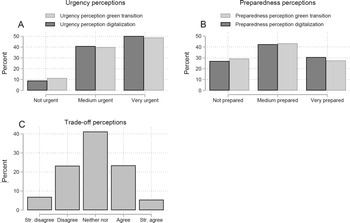
We start by assessing respondents’ perceptions of both the urgency of these labor market transformations and their countries’ preparedness to respond to them.Footnote 7 This gives us an indication of the importance that individuals attach to either transformation in a setting where they are not forced to choose between them. Panel A in Figure 1 depicts the distribution of answers for the variable recoded into three categories: not urgent, medium urgent (which comprises the three middle levels), and very urgent. The Figure shows that, on average, individuals have similar urgency perceptions regarding the green transition and digitalization, with the mean being marginally higher for digitalization. This reinforces the analytical value of examining preferences in a trade-off setting, where individuals must choose between both options, thereby revealing more realistic policy priorities. Appendix A in the Supplementary Materials contains heterogeneity analyses of these urgency perceptions. Panel B shows the distribution of answers for respondents’ preparedness perceptions. It can be seen that respondents perceive their country as slightly better prepared for the digital transition in the labor market than for the green transition. This means that while respondents perceive policy reforms due to digitalization as slightly more urgent than those for the green transition, they also think their country is already better prepared for digitalization than for the green transition.
Urgency, preparedness, and trade-off perceptions.
Note: Survey items: Panel A: How urgent do you think it is that the government passes policy reforms that respond to [digitalization and automation/the green transition]? Panel B: Some people expect that labor markets will undergo significant transformations in the coming 10 years due to [digitalization and automation/the green transition]. How well is your country prepared to deal with this challenge? Panel C: As a society, we cannot deal with digitalization and the green transition at the same time.

Figure 1. Long description
The bar graph compares urgency, preparedness, and trade-off perceptions regarding green transition and digitalization. It consists of three sub-graphs labeled A, B, and C. Sub-graph A shows urgency perceptions with two data series: urgency perception green transition and urgency perception digitalization. The x-axis categories are Not urgent, Medium urgent, and Very urgent, while the y-axis represents percentage values. The green transition bars show approximately 10 percentage for Not urgent, 35 percentage for Medium urgent, and 55 percentage for Very urgent. The digitalization bars show approximately 5 percentage for Not urgent, 40 percentage for Medium urgent, and 55 percentage for Very urgent. Sub-graph B shows preparedness perceptions with two data series: preparedness perception green transition and preparedness perception digitalization. The x-axis categories are Not prepared, Medium prepared, and Very prepared, while the y-axis represents percentage values. The green transition bars show approximately 25 percentage for Not prepared, 45 percentage for Medium prepared, and 30 percentage for Very prepared. The digitalization bars show approximately 20 percentage for Not prepared, 45 percentage for Medium prepared, and 35 percentage for Very prepared. Sub-graph C shows trade-off perceptions with a single data series. The x-axis categories are Str. disagree, Disagree, Neither nor, Agree, and Str. agree, while the y-axis represents percentage values. The bars show approximately 10 percentage for Str. disagree, 20 percentage for Disagree, 40 percentage for Neither nor, 25 percentage for Agree, and 5 percentage for Str. agree. All values are approximated.
We are now interested in whether individuals perceive a trade-off at all between the two transitions. Panel C in Figure 1 plots the distribution of responses to whether individuals agree with the statement that “as a society, we cannot deal with digitalization and the green transition at the same time,” i.e., that there is a trade-off between the two transformations. When pooling results across all countries, the answers are very evenly distributed, with a very slight preference for disagreement. This is consistent with prior evidence from Germany and France. A 2021 German study finds that most respondents recognize the environmental downsides of digitalization, and only about half see it as facilitating the energy transition (Bitkom e.V 2021), while a 2019 French study shows that digitalization is more often perceived as environmentally harmful than beneficial (BVA Xsight 2019). This aligns with our results, which show a substantial perception of a trade-off between digitalization and the green transition.
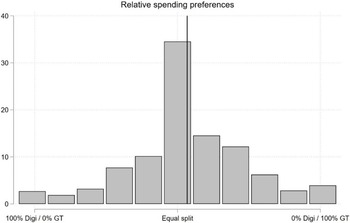
Turning to the distribution of responses for our main dependent variable, relative spending preferences (Figure 2), a slight majority prefers greater spending on the green transition over digitalization, with an average score of 0.325. This pattern is consistent with respondents perceiving their country as slightly less prepared for the green transition than for digitalization, which may translate into slightly higher baseline support for more spending on the green transition.
Relative spending preferences for digitalization and the green transition with sample mean (black vertical line).

Figure 2. Long description
The bar graph compares relative spending preferences for digitalization and the green transition. It features vertical bars representing different spending preferences, with the x-axis labeled from ‘100 percentage Digi slash 0 percentage G T’ to ‘0 percentage Digi slash 100 percentage G T’ and the y-axis labeled with numerical values ranging from 0 to 40. The highest bar, labeled ‘Equal split,’ reaches approximately 35 on the y-axis. Other bars vary in height, indicating different preferences for spending splits between digitalization and the green transition. The black vertical line represents the sample mean. All values are approximated.
Regarding perceptions of subjective labor market risk, our main independent variables, Figures A10 and A11 in Appendix B in the Supplementary Materials depict the frequency distributions of the two labor market concern variables for the pooled analysis. At the same time, Figure A12 shows the distribution of high subjective labor market risks across countries. In all countries except the US, individuals are more concerned about losing their jobs due to the green transition than due to digitalization. Appendix A in the Supplementary Materials contains heterogeneity analyses of these subjective labor market risk perceptions.
Multivariate regression analyses
Single-pressuredness
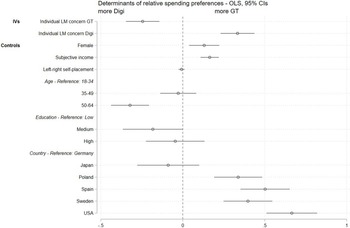
Our main dependent variable measures relative spending preferences, with positive values indicating a preference for more public spending on the green transition relative to digitalization and negative values indicating the reverse. Accordingly, positive regression coefficients indicate a preference for a move towards more relative spending on the green transition. In contrast, negative regression coefficients indicate a preference for a move towards more relative spending on digitalization. Figure 3 (and Table A1 in Appendix C in the Supplementary Materials) presents the coefficients from our main model explaining relative spending preferences.
Determinants of relative spending preferences on digitalization and green transition.

Figure 3. Long description
A horizontal dot plot displays the determinants of relative spending preferences on digitalization and green transition. The x-axis ranges from -5 to 1, indicating preferences for more digitalization on the left and more green transition on the right. The y-axis lists various determinants, including individual concerns for green transition and digitalization, gender, subjective income, left-right self-placement, age groups, education levels, and countries. Each dot represents a data point with 95% confidence intervals. Notable patterns include a strong preference for digitalization among those concerned with digitalization and a preference for green transition among those concerned with the green transition. Age groups, education levels, and countries show varying preferences, with some countries like Japan and Poland showing a stronger preference for the green transition, while others like the USA show a preference for digitalization. All values are approximated.
Concerning our main independent variables, individuals who perceive either transformation as threatening to their labor market situation shift their preferences towards less relative investment in the policy area they perceive as a threat. Being concerned about losing one’s job due to digitalization increases relative spending preferences for the green transition (thereby reducing relative spending preferences for digitalization) by 0.334 points. Regarding the individual labor market concern due to the green transition, being concerned rather than not concerned is associated with a 0.245-point reduction in relative spending preferences for the green transition. This suggests that individual labor market concerns due to digitalization have a slightly larger effect on relative spending preferences than those due to the green transition. This asymmetry mirrors the earlier finding that individuals attach slightly more urgency to policy reforms responding to digitalization. One plausible explanation is that digitalization has already progressed further and is therefore more tangible and visible to respondents, which may make it appear more urgent and thus produce a slightly larger effect. These findings lend support to our expectation that individuals prefer to divert public spending away from the transformation they feel threatened by. Appendix A in the Supplementary Materials contains heterogeneity analyses of the impact of subjective labor market concern on relative spending preferences.
Turning to the control variables, Figure 3 shows that identifying as female and reporting higher subjective income are associated with a greater preference for more relative spending on the green transition over digitalization. In contrast, political orientation, as measured by left-right self-placement, and level of education are not significantly related to relative spending preferences. Moreover, being between 50 and 64 years old, compared to being 18 to 34 years old, is significantly associated with a preference for less relative spending on the green transition and, thereby, more relative spending on digitalization. Lastly, the coefficients for country fixed effects suggest that respondents in Poland, Spain, Sweden, and the US, compared to German respondents, prefer significantly more relative spending on the green transition over digitalization.
We also examine how subjective labor market concern relates to compensatory social spending, allowing us to assess whether respondents interpret spending on the two transitions as public investment or compensation. In line with our argument, subjective labor market risk should be positively associated with preferences for compensatory spending, while being negatively associated with support for increased public spending on the respective transition itself. Figures A14 and A15 in Appendix C of the Supplementary Materials confirm this expectation: perceived labor market risk is significantly and positively associated with higher compensation demands in response to both labor market transitions. This supports our argument that preferences for relative public spending on both transitions are distinct from preferences for compensatory social policies.
Cross-pressuredness
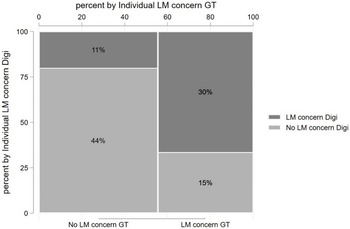
In addition to analyzing the two labor market risks separately, we examine how labor market cross-pressuredness relates to relative spending preferences. First, the spine plot in Figure 4 depicts the joint distribution of the two subjective labor market concern variables, indicating that the share of individuals who perceive the same level of labor market risk due to both transformations is substantial.
Joint distribution of subjective labor market concerns due to the green transition and digitalization.

Figure 4. Long description
The bar graph illustrates the joint distribution of subjective labor market concerns due to the green transition and digitalization. The x-axis represents the concern levels for the green transition, divided into ‘No LM concern GT’ and ‘LM concern GT’. The y-axis represents the percentage by individual LM concern Digi, ranging from 0 to 100 percentage. The graph is divided into two main sections: one for ‘No LM concern GT’ and one for ‘LM concern GT’. In the ‘No LM concern GT’ section, 44 percentage of individuals show no concern for digitalization, while 11 percentage show concern. In the ‘LM concern GT’ section, 30 percentage of individuals show concern for digitalization, while 15 percentage show no concern. The color scheme uses two shades of gray: darker gray for ‘LM concern Digi’ and lighter gray for ‘No LM concern Digi’. All values are approximated.
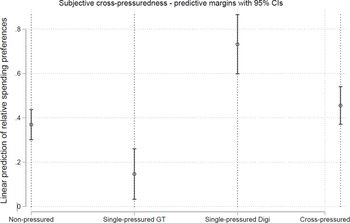
In the next step, we investigate how labor market cross-pressuredness shapes relative spending preferences. To do that, we construct a categorical variable that captures whether individuals are non-pressured (0), single-pressured (1 for single-pressuredness due to the green transition and 2 for single-pressuredness due to digitalization), or cross-pressured (3) and estimate its impact on relative spending preferences. While Figure A13 and Table A2 in Appendix C of the Supplementary Materials present the coefficients, Figure 5 shows the predicted values for the relative spending preferences across the four groups of single-and cross-pressuredness. In general, all groups show a slight preference for more relative spending on the green transition compared to digitalization – even those that are only pressured by the green transition in the labor market. Nonetheless, this Figure confirms our previous findings that being single-pressured by either the green transition or digitalization significantly shifts preferences towards less spending on the transition that is perceived as threatening. Moreover, due to the high baseline support for the green transition, the perception of labor market cross-pressuredness is not associated with a preference for an exact equal split. Yet, this group’s relative spending preferences lie between those of the two single-pressured groups, supporting the expectation that the effects of the two labor market risks offset one another.
Subjective labor market cross-pressuredness.

Figure 5. Long description
The line graph illustrates the linear prediction of relative spending preferences across four categories: Non-pressured, Single-pressured GT, Single-pressured Digi, and Cross-pressured. The x-axis represents these categories, while the y-axis indicates the linear prediction values ranging from 0 to 0.8. Each category is marked with a data point and an error bar representing the 95% confidence intervals. The Non-pressured category shows a prediction around 0.4, Single-pressured GT around 0.2, Single-pressured Digi around 0.7, and Cross-pressured around 0.5. All values are approximated.
Robustness checks
Additional controls
To probe the robustness of our findings, we run a multitude of additional models. In a first step, we include several further control variables to test the robustness of our results regarding single-pressuredness. The first three additional models are depicted in Figure A16 in Appendix D in the Supplementary Materials (see Table A1 in Appendix D for coefficients).Footnote 8 First, we include measures for objective labor market risk due to the green transition, digitalization, and automation. For automation risk, we rely on Routine Task Intensity (RTI) scores calculated by Mihaylov and Tijdens (Reference Mihaylov and Tijdens2019). With RTI scores generally being the most widely used measure to assess objective risk to automation, this particular measure uses a precise approach to assess the routine content of an occupation. It ranges from-1 (occupations that contain only non-routine tasks) to 1 (occupations that contain only routine tasks). To assess labor market vulnerability to the green transition, we use the frequency-weighted Brownness indicator by Scholl et al. (Reference Scholl, Turban and Gal2023), which provides a measure of occupations with a high prevalence in high-polluting industries and ranges from 0 to 1. Both objective risk measures are at the occupation level, based on the International Standard Classification of Occupations 2008 (ISCO-08), which can be linked to our survey data, which also contains an ISCO-08 identifier. Including these objective risk measures does not change our main results. Moreover, as shown in Figure A16 in Appendix D of the Supplementary Materials, a higher Brownness score is associated with a preference for less spending on the green transition. However, the RTI score is not significantly related to relative spending preferences.
Second, we control for respondents’ perceptions of the preparedness of their country for the two upcoming labor market transformations as well as for urgency perceptions, which also does not change our substantial findings.Footnote 9 Third, as shown in Figure A17 in Appendix D, we also control for respondents’ distrust in the government, whether respondents agree with the statement that private enterprise is the best way to solve their country’s economic problems and for climate skepticism. In addition, we control for major occupational groups as defined by the ISCO-08 classification (Appendix A in the Supplementary Materials contains analyses of how occupational groups correlate with other social characteristics). Our results remain consistent when controlling for these additional variables. Fourth, we estimated the main model for each country separately (Figure A18 in Appendix D), which shows that the patterns are broadly the same across countries, even though estimates are less statistically significant due to smaller sample sizes.
Alternative operationalizations
Moreover, to test the robustness of our main findings regarding labor market single-pressuredness, we also re-estimate our models using multinomial logistic regressions where relative spending preferences are recoded as a categorical variable with three levels: more relative investment into digitalization over the green transition (=1), an equal split between public spending on digitalization and on the green transition (=2), or more relative investment into the green transition over digitalization (=3). This operationalization is meaningful because it allows us to separate the middle category, i.e., the equal split option, which may capture those who do not perceive a trade-off or feel cross-pressured. Figures A19 to A24 in Appendix D show the average marginal effects of the determinants of relative spending preferences. These results largely replicate our main results using OLS regressions. In addition, it allows a better understanding of who chooses the equal split option (see Figure A19 in Appendix D). Respondents who opt for this answer are more likely to be female, older (50–64 years), and not concerned about the labor market impact of either transition.
Additionally, we re-estimate our main model using the original scales of the labor market concern variables rather than dichotomizing them. Figure A25 in Appendix D shows that the negative association between perceived labor market risk and preferences for relative spending in the area perceived as threatening intensifies with increasing perceived labor market risk for both transformations.
Finally, to probe the robustness of our cross-pressuredness analysis, we also constructed a categorical variable capturing whether individuals are objectively non-, single-, or cross-pressured, analogous to the subjective cross-pressuredness variable. Figure A26 in Appendix D shows that the preferences of those who are objectively cross-pressured lie between those who are objectively single-pressured for either transition. However, the difference is not statistically significant, which may be due to the very small share of individuals working in occupations objectively at risk, as defined by the Brownness score.
Discussion and conclusion
How to address the twin transition is a key challenge for governments in advanced democracies. To remain competitive and provide sustainable jobs, governments need to invest in both digitalization and the green transition. Yet, budgetary constraints limit governments’ room to maneuver and potentially require a trade-off between the investments in either of the two. Since public spending requires public support, understanding citizens’ preferences for relative investment in digitalization or the green transition is important.
Starting from the assumption that individuals are motivated by material self-interest, we have argued that the specific perceived job risks associated with either digitalization or the green transition will shape relative public spending preferences. Support for this assumption can be found in studies of automation and digitalization risks (Bicchi et al. Reference Bicchi, Kuo and Gallego2024; Gallego et al. Reference Gallego, Kuo, Manzano and Fernández-Albertos2022), as well as in studies on the green transition (Gaikwad et al. Reference Gaikwad, Genovese and Tingley2022). We argued that feeling single-pressured, i.e., perceiving one of the transitions as a labor market threat, would reduce support for public investment in this transition. If people feel cross-pressured, i.e., both transitions are perceived equally as a threat to one’s job, this should result in a preference to invest equally in both transitions.
To analyze relative spending preferences on the twin transition, we used novel survey data collected in 2022 across six advanced democracies (Germany, the US, Spain, Sweden, Poland, and Japan). Our descriptive analysis indicates that respondents are evenly divided on whether they perceive a trade-off between digitalization and the green transition. Overall, respondents rate labor market policy reforms related to digitalization as slightly more urgent than those related to the green transition. At the same time, our analyses reveal that respondents perceive their countries’ labor markets as better prepared for digitalization than for the green transition, which could also explain the higher general preference for investment in the green transition.
Using a constrained choice scenario, respondents were then asked to allocate a given budget to either digitalization or the green transition, allowing them to split the budget arbitrarily between the two or spend it all on either. Our descriptive results show that people slightly prefer investment in the green transition relative to digitalization across most countries in our study. Yet, public sentiment seems rather split, with a substantial share opting for equal spending on both transitions. Based on multivariate regressions, we found that relative spending preferences are shaped by perceptions of individual labor market risks associated with either of the two transitions, with labor market concern associated with a preference for a move towards less relative spending in the area that is perceived as threatening. The effect of labor market risks is robust, and its effect size is larger than that of any other individual-level trait, such as education or political orientation.
Moreover, we found that the effect of perceived labor market risk on preferences for relative spending on the specific transition is slightly larger for digitalization than for the green transition. This might be explained by the descriptive finding that individuals attach slightly more urgency to policy reforms responding to digitalization. Arguably, digitalization has already progressed further than the green transition, making it more tangible and visible, which can ultimately be linked to these higher urgency perceptions, which, in turn, might translate into a slightly stronger effect of subjective labor market concern due to digitalization on relative spending preferences.
We also analyzed the relative spending preferences of respondents who feel jointly threatened by both transitions. People who perceive themselves as cross-pressured are reverting to a preference for an equal split in investment for the twin transition, while still slightly leaning towards more investment in the green transition. Interestingly, non-pressured and cross-pressured groups are rather similar in their spending preferences, preferring an equal split in this constrained choice scenario. Since both groups make up the largest share of respondents in our sample, politically, it will be key to find a compromise that balances spending on both transitions. It should be noted, however, that the group of cross-pressured individuals would probably prefer less investment in both transitions in an unconstrained setting, a scenario that our variables cannot capture.
Our study has several additional limitations that future research should address. First, we use a constrained choice scenario to analyze spending preferences. While it would have been interesting to also know more about unconstrained spending preferences, we follow the existing literature which argues that constrained choice settings provide a more realistic portrayal of public spending preferences (Busemeyer and Tober Reference Busemeyer and Tober2023; Neimanns et al. Reference Neimanns, Busemeyer and Garritzmann2018). Second, we limit ourselves to two policy fields and do not consider other areas, such as social policies, even though governments obviously have to allocate their budgets across far more policy areas. Third, we do not address the potential labor market opportunities arising from both transitions. While much research focuses on labor market challenges, future research should also examine who benefits from the twin transition and how this affects policy preferences. In addition, our survey item capturing relative spending preferences hides potentially differing understandings of public investment. Future research should explore how individuals conceptualize public spending across the two transitions, for instance, by viewing it through a gain-or-loss lens. Such perceptions of gain or loss related to the two transformations could be explored through open-ended survey questions. Moreover, our study is limited to advanced democracies, even though the twin transition is arguably an important challenge for all countries around the globe. Future studies should take this into account and expand the selection of countries and competing policies. Finally, future research should explore other potential drivers of the higher baseline support for investment into the green transition, such as elite signaling or intrinsic environmental concern.
This study is among the first to examine public spending preferences in the context of the twin digital and green transitions and to identify their key determinants. Interestingly, our results are highly consistent across the advanced democracies we study, suggesting that orientations towards the twin transition and its underlying determinants are rather pervasive. All in all, when deciding on funding the future, governments need to strike an intricate balance between promoting both transitions. Since relative spending preferences are shaped by individual labor market risk perceptions, governments, as well as parties competing for votes, need to consider and address these concerns, for instance, by spending on social investment and compensatory policies, as well as by highlighting new labor market opportunities resulting from both transitions.
Supplementary material
The supplementary material for this article can be found at https://doi.org/10.1017/S0143814X26101172.
Data availability statement
Replication materials are available in the Journal of Public Policy Dataverse at https://doi.org/10.7910/DVN/GYMHW6.
Acknowledgements
The authors thank Ben Ansell, Marius Busemeyer, Federica Genovese, Olivier Jacques, Alexander Kuo, Thomas Kurer, Gabriele Spilker, David Weisstanner, members of the Working Group on Comparative Political Economy at the University of Konstanz, and the participants at the “Fall Academy Challenging Inequalities II” at the University of Konstanz 2023, the “Research in Progress” Seminar at the Department of Politics at the University of Oxford 2024, the “Comparative Political Economy Seminar” at Nuffield College 2024, the “Climate Vulnerability Reading Group” at the University of Oxford 2024, the “In_equality Conference” at the University of Konstanz 2024, the CES Annual Conference 2024, the DVPW Kongress 2024, the Social Investment Working Group at the EUI 2024, the “Green Backlash” Workshop at Sciences Po Paris 2025 and the SASE Conference 2025 for very helpful comments on earlier drafts.
Funding statement
This research is supported with funding from the Deutsche Forschungsgemeinschaft (DFG – German Research Foundation) under Germany’s Excellence Strategy – EXC-2035/1 – 390681379.
Competing interests
The authors declare none.


 Open access

