


Introduction
The Journal of Management and Organization (JMO) is a catalyst for engaging with the scholarly, practitioner and policy maker community as well as the general public. It is a venue to discover new ideas and engage with older theories and practice still very much relevant today. To drive the field forward new thinking is needed to spark fresh insights that lead to exciting discoveries. As the journal of the Australian and New Zealand Academy of Management (ANZAM) it is also related to the philosophy that management researchers are eager to develop new knowledge frontiers. By being enthusiastic and proactive changes can be made to stir intellectual development. Managers nowadays need to shift to a technology enabled model which they are probably already doing so in order to be more forward thinking. This includes embedding new ideas and societal objectives particularly related to artificial intelligence and sustainability.
The core goal of managers is to monitor performance but a visionary perspective taking into account various stakeholders is required (Anlesinya, Amponsah-Tawiah, Adom & Damoah, Reference Anlesinya, Amponsah-Tawiah, Adom and Damoah2025). To push boundaries a transdisciplinary or interdisciplinary perspective is required that offers a holistic view. Concepts previously studied in other fields can enrich management research by challenging assumptions. The idea is to be a bit naughty with integrating new ideas that previously have not been studied. This can be risk taking in going against established practices but when done in the right way is illuminating.
We live in a global world with digital communication being almost instantaneous. This immediateness reflects in changing notions of one’s culture and heritage in our international landscape. JMO is the recognised journal of the ANZAM and due to its cultural connections to place and society it is important to reflect on the distinctiveness of Australian and New Zealand research from a management perspective.
In this editorial, I will discuss Australian and New Zealand uniqueness in terms of how it does in a direct or indirect way influence research practices. Often personal histories and societal conditions are not mentioned in academic research due to their subjective nature. However, personal stories can and do play a part in how and why research is conducted. The institutional requirements of Australian and New Zealand universities may influence research practices but so does the ingenuity evident in individuals.
Research conditions
Good research conditions tend to be characterised by a positive physical and online work environment with good financial and non-financial support. They exist in different formats based on the geographical and space settings. Usually natural light and clean air enable research to be conducted with quiet workspaces that facilitate deep thought can be helpful. In some research contexts collaboration is required so teamwork settings are needed. Researchers need to have a secure environment where they can work in privacy. This is important for confidential and time sensitive research topics. To reduce stress workplaces should have the necessary equipment including technology. This decreases time wastage and ensures a controlled computing space. Researchers should have a sense of safety when conducting research. This means good occupational health and safety guidelines are followed. Research often needs to show it is reproducible so it is important that ethical requirements are followed. This will ensure research is considered transparent and it follows required procedures.
Cultural elements related to research productivity and quality are numerous and include having appropriate rewards programs. This will enable successes to be rewarded and fair systems put in place. Increasingly research is interdisciplinary, so it is important to try to foster collaboration. Intellectual exchange is a characteristic of academia but secrecy is often needed to ensure copyright protection. This means to help facilitate an open culture, information where possible should be exchanged. This can include building an inclusive environment that promotes different points of view in the hope of fostering new ideas. Innovation in research can occur from many sources but often occurs via debate. This means comparing and contrasting different points of view.
Research cultures differ around the world depending on the competitiveness of a region. There is an emphasis on publishing quickly as publications are important to career progression. The ‘publish or perish’ philosophy means that academics need to publish in order to stay in existence. In addition, there is now more statistical information about research performance made possible by Google Scholar and other providers. This means that researchers need to be good academic citizens in terms of valuing their brand name and reputation so they have an everlasting impact.
Research impact
The impact research has on society is increasingly being emphasised due to the need to capture value. The way impact is measured is continually changing. Often it is represented in quantitative data including analytics and statistics but increasingly qualitative measures such as thought pieces are being included. Management scholarship requires measures of impact in terms of validating research expenses. As a result, metrics have become important in analysing how management research is perceived in society. There are political complexities associated with certain research metrics depending on how research is measured. This is why established metric systems including the Australian Business Deans Council (ABDC) journal ranking list is judged as being amongst the most reliable quality journal review systems. A journal’s reputation can change over time, so it is important to consider longer term evaluation mechanisms. This will enable certain ebbs and lows to be less influential in overall journal outcomes.
To justify impact research can be measured via citation data. This enables a count of how many others are citing certain research sources. Scopus data in which verified quality journals are only included is often used in output evaluations. This ensures the cited sources are from credible sources and can be relied upon. However, some good quality research may not be cited due to its intricate nature and speciality.
To be considered as impactful, research should be visible and used in society. This ensures it has relevance and a practical nature. Good research should be verifiable in terms of explaining how and why it was conducted. This means publishing research protocols and data. Impact can be generally considered as consequential change in terms of substantial alterations. This means some kind of positive association is reflected in the views about research. Impact can be deliberate in terms of conducting research for a certain reason. This means the research has been conducted based on some kind of rationale in why it is useful. Some research impact can be unplanned and surprising. This is due to others viewing it in a different way. Often when research transcends different fields it can have more global impact and result in interesting findings. So, it is important to consider international factors when planning any research study. Impact can be viewed in an observable way in terms of people acknowledging its value.
Management research is a fundamental and critical activity that plays a key role in new knowledge generation. Most universities in Australia and New Zealand require faculty to engage in research practices that show impact. As a consequence, most faculty have time devoted to research activities. To publish in leading journals can require a certain structure and approach in terms of how it is conducted. This means certain topics and methodologies may be preferred by researchers. Management researchers play a role in documenting change in organisations. This means responding to why management practices are important and how they can be improved.
Australian and New Zealand research context
A countries culture shapes how research is perceived by others. The social way of doing things in terms of having an individualistic or collectivist culture may lead to more sole author or team projects. Australia and New Zealand are positioned geographically close to one another and are amongst the first countries to ring in the new year. This earliness in terms of time can be related to also being innovative in terms of introducing new and novel topics into management research. This is evident in Australian made medical breakthroughs often through university-industry collaboration such as the cervical cancer vaccine. Both countries tend to be similar in terms of culture but have unique features that are often highlighted in tourism marketing campaigns. The unique landscapes of Australia and New Zealand are reflected in diverse scenery that is quite different to other countries (Phillips & Smith, Reference Phillips and Smith2000).
The amount of investment by governments in research influences the popularity of certain research pursuits. In Australian culture, there is the tall poppy syndrome which means to take down those who are succeeding (Rickard, Reference Rickard2017). This means Australian culture often does not encourage bragging or self-promotion but more focuses on novel and unique research. Thus, you could say that the Australian and New Zealand environment including its wildlife inspires imagination in research. The environmental diversity includes contrasting conditions such as sun and snow, mountains and sea.
Australians and New Zealanders are known for their informality and can-do attitude (Lattas, Reference Lattas1992). This means there tends to be a lack of formality in conversation especially with research practices. This sense of egalitarianism can make it easier for management researchers to connect with others thereby facilitating easier discussion (Kamil et al., Reference Kamil and Nordin2025). This contrasts to more hierarchical cultures that place greater emphasis on a person’s standing in society that might limit novel research taking shape.
Australian culture
The Australian university system has highly ranked universities known for their high quality research and top teaching results (Hall, Agarwal & Green, Reference Hall, Agarwal and Green2013). There are a high number of international students studying in Australia that fosters internationalisation of research activities. Australia is the only country in the world that is also a continent. This means it has no direct land borders with other countries so people in Australia must go by boat or air to travel overseas. Other countries have direct borders with different countries that make it easier for them to travel and to share ideas. This sense of isolation is still apparent but not quite as evident as it was years ago when air flights were more expensive and lengthy.
Australia is one of the largest countries in the world with diverse terrain. Its capital city Canberra was purposely built due to competition from Sydney and Melbourne. This meant Canberra was designed specifically as Australia’s national capital. The official language of Australia is English although many people in Australia speak more than one language. Australia has its own currency called the Australian dollar that is amongst the most traded currencies in the world. In 1966 the Australian dollar was introduced as a decimal currency to replace the Australian pound. This linkage to the United Kingdom in terms of commerce is still evident with frequent interactions between ANZAM and BAM (the British Academy of Management). Interestingly before Federation in 1901 each of the colonies in Australia had different currencies. Federation involved separate British self-governing colonies including New South Wales, Queensland, South Australia, Tasmania, Victoria, and Western Australia joining to form the Commonwealth of Australia. The reason for federation was to increase unity and to advance efficiency. There are still though many regulatory as well as cultural differences amongst the Australian states and territories that persist to the present day (Frow, Reference Frow2007). The idea for federation was also to identify as Australian rather than British due to the geographic as well as cultural consequences of Australia as a country (Kapferer, Reference Kapferer2020).
Australia is rich in natural resources and its economy is linked to mining. Most people in Australia live on the eastern seaboard in the main capital cities of Brisbane, Melbourne, and Sydney although Perth’s population in Western Australia has been increasing. The majority of people living close to the sea is reflected in a love for the outdoors and the sea which may influence an escapism attitude towards research activities. The mostly moderate but often sunny climate can be linked to an openness and willingness to embrace new things regarding research (Johnston, Reference Johnston2000). For management researchers open thinking and a commitment to expect the unknown can lead to new research topics (Davis, Frolova & Callahan, Reference Davis, Frolova and Callahan2016). This is important in the ever-changing academic landscape that emphasises novelness.
The wildlife in Australia is spectacular and often talked about with famous animals including the koala, kangaroo, wombat, platypus, and echidna. Famous Australian actors include Nicole Kidman, Hugh Jackman, and Rose Byrne. Recently the cartoon Bluey has become popular overseas and enabled the internationalisation of Australian culture including slang language and colloquialisms. Australia geographically is located in the southern hemisphere between the Indian and Pacific oceans. It was amongst the last geographical areas to be explored by European settlers. When the British Royal Navy landed the first fleet in 1788 at Botany Bay in Sydney there was an already existing Indigenous population. The national flower of Australia is the golden wattle with the colours green and yellow often representing Australia. Famous geographic features in Australia include the Great Barrier Reef which is the largest mass of coral in the world. Famous landmarks in Australia include the big banana, pineapple, and prawn that represent agricultural and sea industries.
Australia invented plastic bank notes in 1988 that replaced paper bank notes. This invention helped lower or eliminate counterfeited bank notes. They also lasted longer than paper bank notes thereby helping with sustainability gains. Other notable medical inventions include the bionic ear that utilised Cochlear implants. This invention in 1978 electronically stimulated sound thereby improving hearing. The first artificial pacemaker for hearts was developed by an Australian doctor in the 1920s. Technology inventions made by Australians include the black box flight recorder in the 1950s to improve safety and Google Maps developed in the 2000s. Wi-Fi technology was developed in partnership with CSIRO and John O’Sullivan in 1992 from radio astronomy research. Other notable inventions include in 1961 David Robinson and George Korsof building the first commercially viable ultrasound scanner. In 1854 James Harrison in Geelong made the first commercially viable ice making machine. The hills hoist clothesline was invented in 1945 in Australia and was found in many Australian home’s backyards. More recently there has been an emphasis on technology companies with Canva starting in 2013 to simplify online design creation.
Famous sport events held in Australia include the Australian Open which is one of four Grand slam tennis tournaments, the Bells beach surfing context, Grant Prix car racing, Sydney to Hobart yacht race, and the Melbourne cup horse event. In Melbourne the city is known for sport events as it has two public holidays for sport events (the Australian Football League grand final and the Melbourne cup horse racing). Some of the largest companies in Australia are banking based including Macquarie Group, ANZ Group, and Westpac or mining based such as Fortescue Mining Group, Newcrest Mining, and BHP. Australian technology companies include Atlassian, NextDC, Telstra, and WiseTech. New Zealand’s largest companies include Fonterra a dairy company, Air New Zealand, and Fisher & Paykel. Well-known New Zealand inventions include instant coffee invented by David Strang in 1889 who patented his dry hot-air process.
New Zealand culture
New Zealand shares a similar culture to Australia although it is distinctive due to geographical and historical conditions (Pearce, Reference Pearce2015). The Māori name for New Zealand is Aotearoa and this name is increasingly seen in promotion material (Liu, Wilson, McClure & Higgins, Reference Liu, Wilson, McClure and Higgins1999). New Zealand has its own currency and is based on a parliamentary democracy system. It is located next to Australia and there are many joint collaborative activities between Australia and New Zealand including ANZAM. New Zealand has two main islands called the north and south island. People from New Zealand are affectionately called ‘Kiwis’ and Australians called ‘Aussies’. Similar to Australia most of the population in New Zealand live in capital cities with the most populous city being Auckland. The main industry in New Zealand is tourism although agricultural industries are increasingly important (Glasby, Reference Glasby1991). The British travelled to New Zealand and signed a treaty in 1840 with the Māori. Interestingly New Zealand was the first country in the world in 1893 to allow women to vote.
New Zealand has a long coastline with many fjords and harbours, which means many people live close to the water. The culture in New Zealand blends Indigenous Māori traditions with British as well as other cultural influences (Ryan, Reference Ryan2002). There is a strong emphasis on connection to nature with sustainability initiatives emphasised and this correlates to New Zealand management researchers being known for focusing on sustainable management practices (Brougham & Haar, Reference Brougham and Haar2013). The national identify is focused on humility and shared connections, which can be linked to how New Zealanders conduct management research (McIntosh, Reference McIntosh2004).
Food is central to any culture but is particularly relevant to Australian and New Zealand culture. The ‘barbie’ or barbeque is a popular form of informal social gathering in Australia with many held in public places or in backyards. Famous Australian foods include meat pies and sausage rolls that are relatively inexpensive and informal meals. Chicken parmigiana is a particularly favourite dish in Australia with many varieties available. Iconic Australian desserts include pavlova and lamingtons with biscuits such as Tim Tams popular. Modern Australian foods include fairy bread and avocado on toast. Famous New Zealand food includes Manuka honey that has different quality levels and Hokey Pokey ice cream. Hāngī is a food cooked under the ground and is a traditional method of cooking. Fish and chips is popular as well as Whittaker’s chocolate.
In Australia and New Zealand there has been a tendency for sport athletes to be highly valued whereas in other cultures particularly in countries such as the United States both sport and education are valued. This is evident in the college sport system in the United States in which many athletes go to college before becoming professional athletes. Moreover, most United States universities have a 4-year undergraduate degree rather than the 3-year typical Australian and New Zealand undergraduate degree. In the United States many university students live on campus whereas in Australia and New Zealand most students tend to commute to university.
The culture of a place can be acquired through a socialisation process. This involves learning the customs and knowledge endemic in an area. Increasingly more countries like Australia and New Zealand are a combination of many different social norms that change over time. The expectations of a social group are based on codes of acceptable behaviour (Knapp, Namada & Dougan, Reference Knapp, Namada and Dougan2025). This means valuing certain behaviour and functional responses. The practices of social engagement in society are influenced by oral and written history. This includes the cultural heritage of an area that interweaves social behaviours. In Australia and New Zealand there are different ethnic groups based on heritage or social interests that can be identified in dress and voice symbols. This means Australia and New Zealand have a common culture as well as ethnic differences regarding cultural attitudes.
Culture is represented in the soul of a region and morals of the people. It is a social domain based on habits of people and expressed through discourse. This includes the evolved ability to interact with others via social learning practices. The culture of a region is transmitted via social interactions that enable thought processes to emerge. Due to the expansion of international commerce, there is a tendency for internationalisation although local culture is still important. Global events including art and music influences affect cultural practices.
A countries research culture emerges from shared values and beliefs that develop over time. It can be based on expectations about good research or directed by policy initiatives. Moreover, there are assumptions often made in an implied way about research objectives. A good research culture promotes innovation and ingenuity. This leads to greater recognition of research on the international stage.
Core future themes for Australian and New Zealand management research
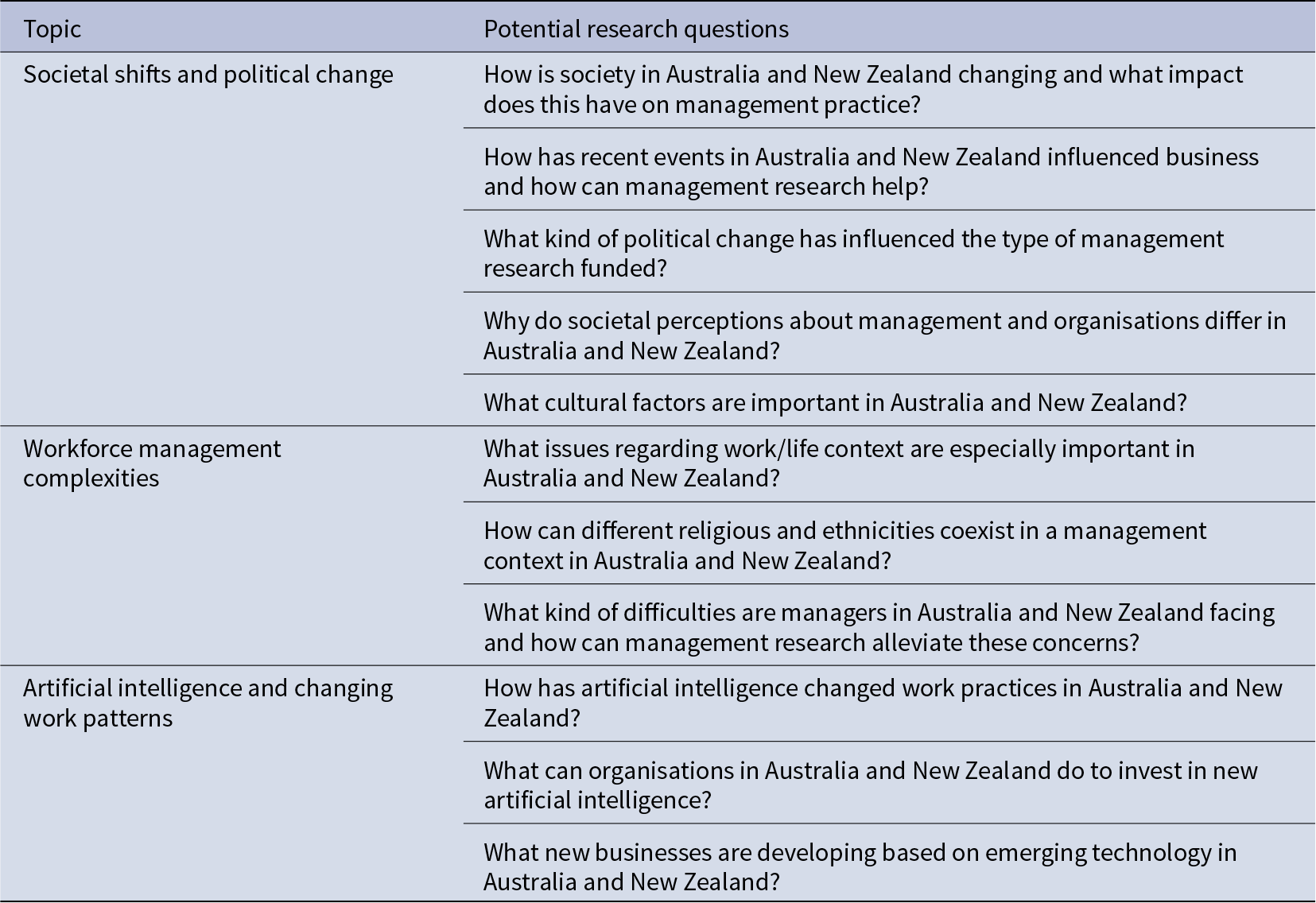
Managers and those involved in organisations face many current, emerging and future challenges. The substantial disruption caused by artificial intelligence has altered how and why management is conducted. Further geopolitical issues have required managers to think in different ways in order to find solutions (Shi, Liu, Fong & Lan, Reference Shi, Liu, Fong and Lan2025). Management research as a consequence plays a key role in ensuring the success of business activities. The key management research areas will now be discussed based on the Australian and New Zealand context. I propose that the management field is facing these main challenges: (1) societal shifts and political change, (2) workforce management complexities, and (3) artificial intelligence and changing work patterns. Each of these challenges will now be discussed. Table 1 states the main research questions from these research challenges.
Future research questions regarding Australian and New Zealand management research

Source: Author developed.
Societal shifts and political change
There has been many societal shifts and political change in Australia and New Zealand. The COVID-19 pandemic altered the way people live and work in society. Increasing amounts of people now work from home for some days each week. In addition, remote working has become more popular with concepts such as being a digital nomad or being able to work anywhere becoming more important. In December 2025, the Bondi terrorism attack at a Hannukah festival at Bondi beach in Sydney changed Australian society. As a consequence, there has been much debate around social cohesion. This is challenging in the Australian as well as international context due to the multi-level factors that come into play. This includes the different religious and political views of people in Australia. Consequently, management researchers need to focus more on how cultural values influence practice as well as looking into how to foster better organisational strategies.
Political change in Australia and New Zealand can take many forms whether motivated by events or changing living conditions. The increase in population in Australia and New Zealand has bought about many opportunities but also costs. This compels organisations to advance education and training programs around new topics. Future research should explore how organisations are managing change and how they are providing better services.
Managers are interested in anticipating future societal change so researchers need to emphasise the benefits of a socially inclusive work force. The sense of belonging is important to managers so more research should go into promoting organisational fairness. This will help to discover more information about employee sentiment and enable researchers to consider different viewpoints. To achieve better performance outcomes, management research should examine issues around political change such as that regarding union membership but also cultural views. This will enable research to yield new information about how managers can respond quickly to keep up with the pace of change.
Workforce management complexities
Managers need to deal with complex workforce issues that are the result of numerous factors. These issues have been recognised in existing research but more is needed in terms of the Australian and New Zealand context. Every country and region has unique cultures that influence how work is conducted. Consequently, organisations need to manage the adaptability of their workplace in conjunction with changing work patterns.
Management research has identified in some ways how to manage people but more is needed regarding geopolitical change. A more responsive and progressive way is required in an uncertain global landscape. Traditionally human resource management has been researched by taking a responsive approach. New research needs to consider overlapping research areas that may offer advice. This will prompt more contexts in specific management practices to emerge. Organisations need to utilise better the capabilities of their workforce. This is due to human capital taking different forms based on knowledge acquisition and experience.
Global crises including the pandemic and wars have caused disruption to organisations. National security and sentiment regarding countries are important. This means research and practice needs to consider future crises to have plans in place. Scenario planning can be conducted that will enable managers and workers to consider how they deal with certain situations. Integrating resilience into organisations is a top concern for managers. Strategic decisions about time and resource allocation is shaped by resilience. Studies need to compare different regions in Australia and New Zealand to understand resilience patterns. This can have policy implications regarding attitudes towards change. Public, private, and hybrid organisations need to be studied in order to understand their attitudes. This will inform social policy but also enable organisations better engagement with stakeholders. Research needs to question whether the differences between geographic areas or income levels do explain resilience attitudes or whether there are other emotional considerations (Moreira, Marques, Braga & Ratten, Reference Moreira, Marques, Braga and Ratten2019). This is a delicate area of research inquiry as different strata of society should be considered. Alongside this is the need to consider industry norms and organisational behaviours. Further research that takes an open approach to research collection and interpretation is required.
Artificial intelligence and changing work patterns
Artificial intelligence usage has surged in recent years with programs such as ChatGPT becoming more popular. As a result, artificial intelligence in business management is a hot topic that is studied from a variety of perspectives. Changing work patterns are likely to result from artificial intelligence with the results still unknown. Management research needs to consider from an Australian and New Zealand perspective the ethical, economic, and social implications of artificial intelligence. This can include case studies about new artificial intelligence start-ups that yield good results. The financial technology sector is particularly interesting given the potential for unicorn companies (Pereira et al., Reference Pereira, Correia, Braga, Alves, Ratten and Braga2025). As a result, further research is required on the complex interplay between individuals and organisations regarding artificial intelligence. The international business environment is continually changing due to new scientific discoveries particularly around artificial intelligence.
A manager’s effectiveness depends on being emotionally intelligent in terms of catching on to new thinking paradigms but also being able to utilise other intelligence sources such as that made possible by artificial means. A move beyond traditional management styles to evidence based and intuitive management practices is required. This can nudge employees to a more confident way to fulfil their job titles. Management scholarship has a visible influence on business practice as well as influencing society in other ways (Ligorio, Venturelli, Rosato & Campo, Reference Ligorio, Venturelli, Rosato and Campo2025). There can be a tendency in academia to be critical about any form of study rather than focusing on the benefits. This is due to the competitiveness of academia and the need for discussion. As a result, management theory building has been perceived as lacking in credibility due to its academic nature so this needs to change in future research endeavours.
To appreciate management research there needs to be more industry connections in terms of knowledge translation. Co-creative research that links theory to practice presents a way to show impact or relevance (Lin & Yi, Reference Lin and Yi2025). By doing so management theory can help to explain how managers and organisations perform. It can be difficult to measure or articulate the advantage of management research as its outcomes can be hard to evaluate. Often ideas found in management research are considered as too complex to understand compared to everyday concepts. The research is then legitimised when managers realise the benefits. To redirect research into new areas then a more systematic understanding is required. This means incorporating viewpoints or methodologies not often utilised in management study.
Conclusions
In conclusion, it is evident that the cultural context of Australian and New Zealand needs to be considered in any form of management research. The global business landscape is constantly changing so we should take both a domestic and international approach to management research. Given the disruptions of artificial intelligence there are new management challenges likely to emerge. Many of these are known and often discussed in the media but others are still emerging. This editorial article has considered the main way Australia and New Zealand management research is unique with the goal of highlighting interesting new research avenues for 2026 and beyond, which is why the title of the editorial is JMO 2026. So we need to consider what is the distinctiveness of Australian and New Zealand management research? How can the field develop? Why is this important?
It is crucial to push the narrative that Australian and New Zealand management research is innovative and entrepreneurial. This means taking a more holistic approach to research by placing importance on context. The role of context and culture is known in management research but still requires further development. Management scholars need to highlight this more in their studies but also utilise it in a branding way. By doing so articles, books, book chapters, and other material written by Australian and New Zealand authors will be continually viewed as novel, path breaking, and high quality. The COVID-19 pandemic emphasised the need for national security and valuing one’s country. The geopolitical issues still emerging are further proposing country advantages. Management research needs to emphasise culture in studies thereby incentivising people to focus on context. It will be great to see further creative and intriguing management research by Australian and New Zealand management researchers in the competitive global academic scene.

 Open access

