


1. Introduction
In recent years, awareness of the need for stronger environmental protection in industry and transportation has increased significantly. In response, the European Commission introduced a regulatory framework aimed at achieving a 55% reduction in greenhouse gas emissions by 2030 compared to 1990 levels (EU Commission, n.d.). The mining industry alone accounts for 4–7% of global CO₂ emissions, while construction machinery is the second-largest source of pollution among non-road mobile machinery, after maritime vessels. According to the Clean Air Support System (CAPSS), construction machinery generates nearly 80% of NRMM-related pollutants (Reference Song, Chang, Seokho, Lee, Seo and ChaSong et al., 2023). Diesel has long been the dominant energy source for construction machinery (Reference Ebrahimi, Wallbaum, Jakobsen and BootoEbrahimi et al., 2020), emitting significant quantities of CO₂, SO₂, NOx, and particulate matter. Recently, leading manufacturers have introduced fully electric models with varying levels of autonomy, aiming to reduce emissions (Reference Bertoni, Machchhar, Larsson and FrankBertoni et al., 2022). A key challenge in deploying electric construction machinery lies in ensuring efficient charging solutions that maintain operational continuity. Two main approaches are currently being explored: fast charging, which minimizes downtime but requires substantial electrical infrastructure, and battery swapping, which enables the rapid replacement of depleted batteries to ensure uninterrupted operations. Both approaches offer viable routes toward lower environmental impact but differ in their trade-offs (Reference Cavus, Dissanayake and BellCavus et al., 2025). Studies (e.g. Reference Zhan, Wang, Zhang, Liu, Cui and DorrellZhan et al., 2022; Reference Jain, Ahmad, Alam and RafatJain et al., 2020) highlight that battery swapping reduces downtime, alleviates grid stress, and improves operational efficiency—especially for heavy-duty vehicles—while enabling optimized energy management (Reference Zhan, Wang, Zhang, Liu, Cui and DorrellZhan, et al., 2022). Fast-charging technology is also advancing rapidly. The Megawatt Charging System (MCS), for instance, promises shorter charging durations (Reference Zhu, Li, Li, Li, Lu, Han and OuyangZhu et al., 2022) but introduces issues such as accelerated battery degradation from thermal and electrochemical stress (Reference Gull, Rauf, Arshad and KhalidGull et al., 2024) and higher energy demand that may strain the grid, especially under large-scale adoption (Reference Zhan, Wang, Zhang, Liu, Cui and DorrellZhan et al., 2022). From a systems engineering perspective, the challenge lies in the early system development stages, when engineers must account for the multifaceted effects of design decisions on both environmental and economic performance. However, there remains a lack of decision-support tools capable of simulating these trade-offs of different technological solutions.
This paper presents a simulation framework and its preliminary implementation for comparing charging solutions for battery-electric construction machinery. Existing simulation frameworks for battery swapping and fast charging address operational efficiency, energy planning, and infrastructure design (Reference Marchesano, Popolo, Rozhok and CavalaglioMarchesano et al., 2024), but most focus on urban mobility and passenger vehicles, whose conditions differ greatly from off-road operations. To address this gap, a flexible simulation framework was developed to represent both fast charging and battery swapping scenarios through a unified modelling structure. This enables assessment of alternative technological pathways and their implications for energy use, battery utilization, productivity, and costs in road construction and mining contexts.
The paper is structured as follows: Section 2 describes the research approach; Section 3 reviews the state of the art; Section 4 introduces the proposed framework, the implementation of which is described in Section 5 in the context of open-pit mining and road construction; Sections 6 and 7 discuss the results and present the conclusions.
2. Research approach
This research was conducted using a Participatory Action Research (PAR) approach (Reference Whyte, Greenwood and LazesWhyte et al., 1989). PAR was selected for its iterative and inclusive nature, enabling the co-creation of knowledge through cycles of problem definition, solution development, and validation. This approach ensures that the proposed simulation framework remains both theoretically robust and practically relevant. A systematic review of academic and industrial publications was conducted to identify state-of-the-art charging strategies for battery-electric vehicles (BEVs) and simulation methodologies applicable to industrial contexts. The review focused on energy management systems, operational planning, and performance evaluation frameworks. The development of the simulation model started with the definition of the simulation architecture, followed by the iterative definition of realistic assumptions to be integrated into the model. Such part was supported by semi-structured interviews and workshops organized with key stakeholders, including representatives from the partner company and academic partners. These sessions provided critical insights into operational constraints, technological limitations, and strategic priorities, which informed the configuration of the simulation model. Contributions from industry partners were instrumental in defining parameters such as battery capacity, state-of-charge thresholds, and fleet size, and in identifying the two case studies in which the simulation framework was implemented, namely open pit mining and road construction. The development of the simulation framework followed cycles of look, think, and act, during which intermediate prototypes were presented at monthly or bi-weekly meetings among the research partners to refine the model and refocus priorities. The simulation model was implemented using a commercial simulation environment named Simio®. The software enabled discrete-event simulation enhanced with agent-based logic to capture the dynamic interactions among vehicles, batteries, and infrastructure. Preliminary validation was conducted through iterative feedback sessions with industrial stakeholders. These sessions evaluated the credibility of model assumptions, the plausibility of the outputs, and the alignment of the simulation logic with real-world operational dynamics.
3. Simulation frameworks for supporting the electromobility transition
Simulation is essential for managing operations and planning in EV infrastructure, particularly for fast charging and battery swapping (Reference Gull, Rauf, Arshad and KhalidGull et al., 2024). It optimizes battery availability, queue management, charging cycles, and resource allocation to reduce waiting times and improve infrastructure utilization (Reference Saha, Thakur and BhattacharyaSaha et al., 2025; Reference Zhan, Wang, Zhang, Liu, Cui and DorrellZhan et al., 2022; Reference Nåbo, Abrahamsson, Bhatti, Björklund, Daniels, Danilovic and SallnäsNåbo et al., 2024). Grid impact during charging—such as power losses, peak loads, and stability—must also be considered (Reference Al-Zaidi and InanAl-Zaidi and Inan, 2023), enabling sustainable planning of operations and infrastructure (Reference Marchesano, Popolo, Rozhok and CavalaglioMarchesano et al., 2024; Reference Shafiei and Ghasemi-MarzbaliShafiei and Ghasemi-Marzbali, 2022). Simulations enable the testing of scenarios such as vehicle demand and renewable energy integration before infrastructure deployment, thereby saving time and cost (Reference Gull, Rauf, Arshad and KhalidGull et al., 2024). Frameworks aim to minimize costs and battery degradation while ensuring service quality (Reference Marchesano, Popolo, Rozhok and CavalaglioMarchesano et al., 2024). Discrete Event Simulation (DES) is widely used to model EV arrivals, battery demand, and queue dynamics (Reference Hooli, Skawina, Halim and SundqvistHooli et al., 2024; Reference Imani, Jin and BaiImani et al., 2016). Hybrid approaches combine DES with Agent-Based Modelling (ABM) and optimization to capture complex interactions and customer behavior (Reference Marchesano, Popolo, Rozhok and CavalaglioMarchesano et al., 2024; Reference Zhan, Wang, Zhang, Liu, Cui and DorrellZhan et al., 2022). System Dynamics (SD) models further support adoption analysis and pricing strategies (Reference Setiawan, Zahari, Anderson and MoeisSetiawan et al., 2023; Reference Benz and PrucknerBenz & Pruckner, 2023). Advanced methods include evolutionary algorithms for scheduling (Reference Saha, Thakur and BhattacharyaSaha et al., 2025), game theory for dynamic pricing, and reinforcement learning for renewable-powered BSSs in uncertain environments (Reference Renga, Spoturno and MeoRenga et al., 2024). These are particularly relevant for remote sites with unstable electricity supply. Integration with the grid is another focus, addressing peak demand and enabling renewable-based battery swap stations (BSSs) as active grid nodes (Reference Shi, Ni, Jin, Wang, Wang, Sun and QiuShi et al., 2025; Reference Al-Zaidi and InanAl-Zaidi & Inan, 2023; Reference Huang, Yan, Tao, Chen and CaoHuang et al., 2024). Infrastructure design studies examine the optimal placement of stations and hybrid models that combine swapping and fast charging (Reference Liu, Zhang, Ming and YuLiu et al., 2024; Reference Imani, Jin and BaiImani et al., 2016), providing insights applicable to temporary, site-specific solutions in construction and mining.
3.1. Benefits and drawbacks of battery swapping vs. fast charging
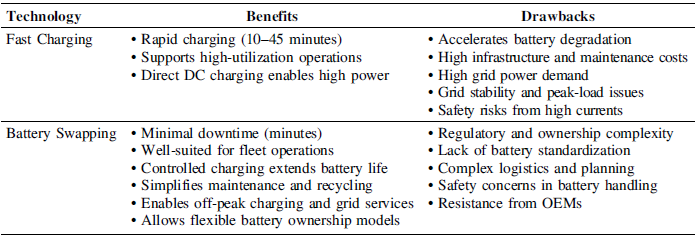
Both fast charging and battery swapping aim to minimize downtime and enhance operational efficiency, but differ substantially in their technical, economic, and infrastructural implications. Fast charging delivers direct current directly to the battery, bypassing onboard converters to enable rapid energy replenishment. It can achieve up to 80% charge within 10–30 minutes for passenger vehicles (Reference Silva, Sousa and RoqueSilva et al., 2017) and around 45 minutes for electric construction equipment operating at 360 A. Integration with smart grids and renewable energy systems further supports cost and energy optimization (Reference Shafiei and Ghasemi-MarzbaliShafiei & Ghasemi-Marzbali, 2022). However, fast charging presents several challenges. High charging currents accelerate battery degradation through thermal and electrochemical stress, shortening battery lifespan (Reference Zhu, Li, Li, Li, Lu, Han and OuyangZhu et al., 2022; Reference Marchesano, Popolo, Rozhok and CavalaglioMarchesano et al., 2024). The infrastructure demands are significant, requiring high-power grid connections and expensive charging stations that increase both capital and maintenance costs. Concurrent fast charging can also cause peak loads that threaten grid stability and power quality (Reference Shafiei and Ghasemi-MarzbaliShafiei & Ghasemi-Marzbali, 2022). Additionally, safety risks such as overheating and short circuits further complicate deployment.
Summary of the benefits and drawbacks of fast charging vs. battery swapping

Battery swapping, by contrast, replaces depleted batteries with fully charged units at dedicated BSS, completing the process in only a few minutes—comparable to conventional refueling (Reference Jain, Ahmad, Alam and RafatJain et al., 2020). This significantly reduces downtime for heavy-duty fleets (Reference Marchesano, Popolo, Rozhok and CavalaglioMarchesano et al., 2024). Centralized charging under controlled conditions improves battery lifespan and facilitates systematic maintenance and recycling (Reference Jain, Ahmad, Alam and RafatJain et al., 2020). From an energy management perspective, BSSs can exploit off-peak charging and support battery-to-grid services, enhancing grid stability (Reference Zhan, Wang, Zhang, Liu, Cui and DorrellZhan, et al., 2022). Economically, swapping allows flexible ownership models—such as rental or subscription schemes—that lower initial vehicle costs (Reference Nåbo, Abrahamsson, Bhatti, Björklund, Daniels, Danilovic and SallnäsNåbo et al., 2024). The integration of renewable energy further strengthens environmental sustainability (Reference Gull, Rauf, Arshad and KhalidGull et al., 2024). Decoupling vehicle and battery ownership introduces regulatory challenges related to registration and insurance (Reference Nåbo, Abrahamsson, Bhatti, Björklund, Daniels, Danilovic and SallnäsNåbo et al., 2024). Technical barriers include the absence of standardized battery formats and the logistical complexity of battery management (Reference Nåbo, Abrahamsson, Bhatti, Björklund, Daniels, Danilovic and SallnäsNåbo et al., 2024). Effective spatial planning is also crucial to ensure accessibility (Reference Al-Zaidi and InanAl-Zaidi & Inan, 2023). Safety concerns about handling heavy, chemically active batteries require strict procedures and operator training. Finally, cultural and industrial barriers—particularly OEM reluctance to adopt disruptive business models—limit large-scale implementation in some regions (Reference Nåbo, Abrahamsson, Bhatti, Björklund, Daniels, Danilovic and SallnäsNåbo, et al., 2024). In summary, the analysis of the benefits and drawbacks of such technologies, summarized in Table 1, is complex and multidimensional, requiring an understanding of ecosystem implications and total cost of ownership. The contribution presented in this paper covers a specific part of the ecosystem analysis, namely the comparison of the operational costs of deploying the technologies.
4. Proposed simulation framework
The simulation framework was designed to ensure both flexibility and traceability in capturing key behaviors associated with the operation of electric haulage vehicles, whether powered by fast-charging or battery-swapping systems. It was developed to replicate realistic operational conditions across two representative domains: mining and road construction. While the core architecture remains consistent for both scenarios, tailored assumptions are incorporated to reflect the unique characteristics and constraints of each environment. This section introduces the overarching simulation framework along with general modeling assumptions applicable to both contexts. The discussion then proceeds to the implementation of the framework through two reference case studies.
4.1. Simulation architecture
The simulation architecture is structured around multiple classes of objects, logically interconnected within a DES environment (as visualized in Figure 1). A similar architecture is described in Reference Bertoni, Bertoni, Larsson and HusbergBertoni et al. (2025). Each operational phase—from blasting and excavation to unloading and battery replacement—is represented through discrete event objects, selected for their capacity to mirror real-world operational components and their process-oriented internal logic. Dynamic elements such as material, haulers, and batteries are modeled as entities within the framework. The framework comprises the following object types:
Entities. Entities are generated by source objects according to user-defined rules and constraints. They are categorized into three subclasses:
-
• Material. Each “rock” entity corresponds to a user-specified quantity of material (e.g., 1 ton per entity). Material entities can only move through the system—from blasting to stockpiling—when combined with both a hauler and a battery entity.
-
• Hauler: Hauler entities are generated by a dedicated source object, governed by user-defined parameters. A hauler can only operate when combined with a battery entity.
-
• Battery: Battery entities are also generated by a specific source object. In fast charging scenarios, the battery population matches that of the haulers, as each vehicle remains continuously connected to a battery. In battery swapping scenarios, the battery population exceeds that of the haulers to accommodate the exchange process.
The use of subclasses facilitates the integration of agent-based modeling logic within the DES framework. This allows each entity class—material, hauler, or battery—to respond uniquely to varying operational conditions, thereby increasing the realism and adaptability of the model.
Sources (e.g., Blasting). Source objects initiate the creation of entities based on predefined rules and schedules.
Servers (e.g., Excavation, Parking, Charger). Server objects simulate operations characterized by fixed processing times and limited capacity, such as digging, loading, or charging. These objects manage resource queuing and regulate throughput, reflecting real-world constraints.
Combiners (e.g., Loading, Mount Battery). Combiner objects merge two or more entities—such as a hauler with a load of material or a hauler with a charged battery—into a single composite entity. This model’s assembly processes require the simultaneous availability of multiple components.
Separators (e.g., Unloading, Remove Battery). Separator objects perform the inverse function of combiners, splitting a composite entity into its constituent parts. Examples include unloading material from a hauler or detaching a depleted battery.
Sinks (e.g., Material Pile). Sink objects define the system’s exit points, where entities such as delivered materials or parked vehicles are removed from the simulation.
The simulation framework with key elements and connections in a non-dimensional spatial arrangement; the “entities” of the simulation are represented on the left of the figure

4.2. General assumptions of the simulation framework
The proposed framework is built upon the following key assumptions:
Vehicle Energy Management: Each vehicle is programmed to proceed to a charging or battery swapping station once its battery level falls below a predefined threshold, set by the modeler. This threshold ensures that the vehicle can complete its current operational cycle without interruption.
Operational Cycle Constraint: The model enforces a rule that vehicles cannot travel directly from the loading point to a charging station. This constraint reflects real-world operational logic, where material must first be unloaded due to weight limitations before the vehicle can proceed to recharge.
Constrained Routes and Speeds: Vehicles are required to follow predefined routes, with specific speed limits assigned to each segment. These routes account for varying road conditions and gradients, ensuring a realistic simulation of travel times and energy consumption.
Overnight Battery Recharging: It is assumed that all batteries are recharged overnight. This reflects a cost-optimization strategy that leverages off-peak electricity rates, enabling vehicles to begin operations early in the morning and minimizing downtime due to charging delays.
Charging Station Priority Logic: At the charging station, priority is given to the battery with the highest remaining state of charge. This strategy is designed to optimize resource utilization and reduce overall queuing time.
Battery Swap Modelling: The battery swapping process is represented using the Combiner and Separator objects. This approach enables a realistic simulation of the decoupling of a depleted battery from the vehicle and the integration of a fully charged replacement, accurately reflecting the physical exchange process. A battery is never swapped back to a hauler if not fully charged.
5. Case studies implementation
5.1. General simulation setup common to both case studies
The case studies shared a common simulation setup. The simulation’s time horizon spanned a four-week period, based on a standard schedule of 20 weekdays with 8-hour shifts. To capture seasonal effects, June and December were selected as representative months, highlighting differences in electricity prices, battery performance, and temperature-dependent charging behavior. For each scenario, the model tracks key performance indicators, namely, energy consumption, battery utilization and degradation, vehicle productivity (e.g., tonnage transported), and operational costs.
The setup maintains consistent operational schedules across both energy systems and seasonal conditions, enabling comparative analysis of fast charging versus battery swapping. To enhance realism, the simulation model incorporates seasonal variations in electricity prices and temperature-dependent battery performance, reflecting the influence of environmental factors on system efficiency. Charging power assumptions varied by system. For battery swapping, three levels were considered: 50 kW, 75 kW, and 150 kW (Reference Nåbo, Abrahamsson, Bhatti, Björklund, Daniels, Danilovic and SallnäsNåbo et al., 2024), with a preference for slower charging to preserve battery health. In contrast, fast charging relies on higher capacities—150 kW and up to 350 kW—to minimize vehicle downtime. Energy consumption calculations considered Sweden’s variable electricity prices, which fluctuate according to time of day, month, and season. Summer prices are typically lower due to a greater reliance on renewable energy sources, while winter prices rise with reduced solar availability. To avoid grid overload and reduce costs, battery charging is scheduled in the model to promote charging when possible, during time slots when energy is low, such as at night. To reflect seasonal efficiency differences, grid draw coefficients of 0.9 (June) and 0.8 (December) are applied. Lower winter efficiency is due to reduced battery performance in cold temperatures, which increases internal resistance and energy loss.
In the context of a comparative analysis between the two energy systems considered in this, the calculation of monthly battery cycles and C-rate (charging rate), was essential for assessing battery performance and sustainability. The number of charge cycles is directly linked to battery degradation: as the number of cycles increases, internal wear increases, thereby accelerating performance loss over time. Similarly, the C-rate also has an impact on battery degradation (Reference Qu, Jiang and ZhangQu et al., 2022), especially at high values. The latter can be advantageous for fast operations and limited downtime, but may cause an increase in internal temperatures and reduce the overall life of the battery. Slower charging would result in a moderate C-rate value, thereby slowing down battery degradation and ensuring greater reliability in the long term. Another important aspect in assessing the performance of the two technologies and the economic and environmental sustainability of electric vehicles concerns battery degradation over time. To estimate this impact, calculations were introduced in this study to represent the degradation relative to the scenarios examined and the resulting costs, enabling an economic assessment of the situation.
Firstly, it was necessary to understand how to calculate the degradation rate for each battery cycle. To this end, a semi-empirical approach based on the Arrhenius equation, widely used in various studies on lithium-ion batteries (Reference Chen, Wang, Wu, Xia and PanChen et al., 2024), was adopted. The semi-empirical formula, which extends the Arrhenius approach, considers two important factors: the C-rate and the Depth of Discharge (DoD), which represents the percentage of battery capacity used in each cycle.
The following sub-sections briefly describe the application of the framework in the two case studies, in detail on an open pit mine located in Ronneby (Sweden) (Figure 2A) and a road construction project in the southwest of Sweden (Figure 2B).
Site layout for the open pit mine case (A) and for the road construction case (B)

5.2. Open-pit mining case
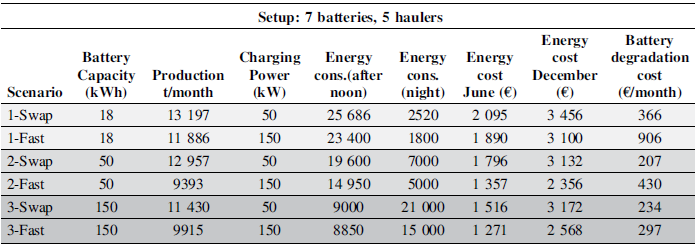
The open-pit mining case study is described here by presenting the data from a fictitious mining site located in Ronneby (Figure 2(a)), Sweden. Although not representative of the mine’s actual geographical location, the simulation framework and architecture utilize the real topography and dimensions, albeit without access to proprietary data from the mine owner. The open-pit mine case represents a closed-loop, high-frequency haulage system, where vehicles transport material from the loading point to the unloading zone, traveling over short and repetitive loops. This setup enables a centralized charging/swap infrastructure, where both the fast-charging station and the battery swap station are situated approximately midway between the loading and unloading areas. The mining simulations examined how various energy management strategies impact productivity and operating costs in an environment characterized by high power demands and the necessity for continuous operation. This model focused on evaluating the effectiveness of the Battery Swap approach, particularly its ability to support uninterrupted operations through the rapid replacement of depleted batteries. Several scenarios were iteratively simulated, varying as input variables the number of haulers, the number of available batteries (equal to the number of haulers in the fast-charging scenario, and the available charging power at the charging station). As a demonstrative example, Table 1 presents a comparison of results for both battery swapping and fast charging in a scenario involving 5 electrical haulers in the mine, with 7 available batteries for battery swapping. The table compares battery capacities of 18, 50, and 150 kWh, along with charging powers of 50 kW for battery swapping and 150 kW for fast charging.
Example of simulation results for battery capacity of 18, 50, and 150 kWh in the open pit mine with 5 haulers and 7 batteries to swap

Overall, for the battery swapping scenarios, the 50 kWh batteries consistently exhibit the most competitive energy costs and the least amount of degradation. Although scenario 2-Swap with 7 batteries and 5 vehicles (as shown in Table 2) has the highest throughput, another scenario with 6 batteries and 4 vehicles appears to provide the best balance between cost and productivity. Although less effective, the scenario with 5 batteries and 3 vehicles remains practical in situations with lower operational intensity. As far as fast charging is concerned, the five vehicles in the fast-charging setup maximize throughput and slightly reduce the stress impact on the batteries. While larger batteries cushion the impact, degradation rates, particularly for smaller packs, remain significant. Across all three configurations, the pattern is relatively clear: faster charging with 350 KW enables more production but comes at a cost both in terms of energy expenditure and battery wear. Smaller batteries (like the 18 kWh ones in scenario 1-Fast in Table 2) are especially sensitive to this, showing high degradation rates that raise monthly costs significantly. In contrast, 50 kWh batteries consistently performed better, absorbing the stress of rapid cycling with less deterioration and offering lower costs per unit of energy delivered. From a cost-efficiency standpoint, keeping charging power moderate (150 kW) while using larger-capacity batteries appears to offer the best balance,
5.3. Road construction case
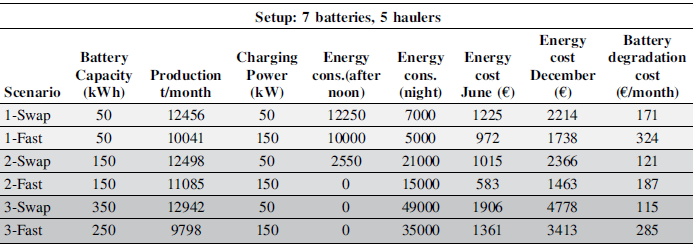
The road construction case study focused on a highway construction project situated in the center-west of Sweden, representing a scenario with longer trips and dispersed infrastructure. This scenario introduces variable-distance transport patterns, with trips potentially spanning 15 to 20 km, thereby excluding the use of small batteries, such as those in the open-pit mine scenario. Additionally, the scenario featured the absence of a centrally located charging station, due to the impracticality of deploying power cables over long distances. In this case, the model encompasses the use of a vehicle to transport the battery from the storage to the swapping station and vice versa. As shown in the previous subsection, an example of the simulation results obtained in a scenario with 5 haulers and 7 is presented in Table 3. The results from the battery swap scenarios showed that increasing the number of vehicles and batteries available clearly leads to an increase in productivity, but energy costs change slightly despite variations in charging power. This suggests that, once the battery fleet has been correctly sized, faster charging offers limited added value; therefore, slower charging could be used to minimize battery degradation in the long term. Of all the configurations, the 50 kWh batteries performed most efficiently, maintaining stable energy costs and showing the lowest degradation. Even in the most demanding scenario (5 vehicles and 7 batteries), wear remained low, confirming the resilience of high-capacity batteries in prolonged operations.
Example of simulation results for road construction with battery capacities of 50, 150, and 350 kWh, with 5 haulers and 7 batteries to swap

The comparison of the scenarios in the fast-charging setting reveals some clear differences. Using three vehicles kept costs low in terms of energy consumption, but not in terms of battery degradation, although production was limited. With four vehicles, the system handled a higher workload without excessively increasing energy costs, primarily due to the larger batteries and moderate charging speeds. The case of five vehicles produced the highest yield but also resulted in greater wear and higher energy consumption, which could offset some of the benefits gained. Overall, configurations using 50 kWh batteries charged at 150 kW (such as scenario 1-Fast in Table 3) performed well in all cases, offering a good balance.
6. Discussion
As noted in Section 3.1, the choice between battery swapping and fast charging goes beyond energy costs or short-term production capacity. Both options carry long-term environmental and economic implications that extend beyond operational performance (e.g., total cost of ownership, emissions). The simulation framework developed in this study provides an effective tool for assessing the economic and environmental impacts of electrification strategies in construction equipment. It is designed to be repeatable across contexts—such as open-pit mining and road construction—enabling controlled comparisons between fast-charging and battery-swap solutions. Although applied here to mining and road construction, the same modelling logic readily transfers to indoor logistics systems, including AGVs and forklifts, where battery-swapping technologies are already more mature. An important aspect of the framework is its flexibility in adapting to variable inputs, especially concerning machine configuration, battery capacity, and charging power. A distinctive feature of the proposed framework is its departure from the conventional use of the “transporter” object to represent vehicles in DES. Instead, vehicles are treated as individual entities that progress through the various stages of the DES model. This approach enables both haulers and batteries to exhibit independent behaviour, thereby enhancing modelling flexibility and supporting the analysis of emergent dynamics during scenario and sensitivity analyses. It also allows the use of the same simulation architecture for both battery swapping and fast charging. The open pit mine and the road construction contexts were selected for their contrasting characteristics, i.e., short, repetitive cycles in mining versus longer, variable routes in road construction, allowing for a comprehensive evaluation of charging strategies under diverse conditions. The simulations enabled the exploration of how different construction machinery charging technologies impact operations under controlled conditions, highlighting points in the work cycle where waiting times and inefficiencies occur. This provides concrete evidence to guide investment decisions between battery swapping and fast charging. The major area of application for the framework is the construction equipment design and mining planning phase, where simulation can help estimate operational performances by determining the optimal number and location of chargers or exchange stations, and efficiently estimate the number of vehicles and spare batteries required. This reduces the risk of oversizing the infrastructure, incurring excessive costs, or, conversely, undersizing, which would compromise production levels. Such knowledge is critical to a broader analysis of the economic and environmental trade-offs when considering the total cost of ownership of the entire ecosystem under analysis.
In terms of further development, the general assumptions of the simulations could be enhanced in future work by introducing batteries non-linear discharge depth management and considering longer time horizons, such as a year, in which to include variables typical of operational site including vacation periods in addition to the weekends that are already taken into consideration in the model and downtime due to unexpected machine breakdowns. Future work also concerns considering the energy source to provide a more realistic estimate of the environmental impact, which is currently overly simplified by treating energy consumption as the sole performance indicator. In this regard, the model could incorporate renewable sources (e.g., photovoltaics) for site-specific solutions (e.g., mining or construction sites without grid connection) and aggregate real-time energy price dynamics to produce scenarios closer to market conditions.
7. Conclusion
The paper presented a simulation framework to investigate the economic and environmental impact of alternative charging strategies for the electrification of construction machinery, in particular, comparing fast charging and battery swapping. The development of the framework focused on the ability to flexibly model both fast charging and battery swapping, starting from a general model and adapting it to the specific working context. The case studies demonstrated the possibility to simulate different scenarios by varying key parameters, namely the number of vehicles, batteries, battery capacity and charging power to evaluate the performance of each scenario, thus providing companies with an adaptable tool to compare and test alternative solutions before committing to real investments. While no economic optimum emerges, the simulations indicate that battery swapping tends to be preferable in high-utilisation, closed-loop operations where downtime is critical, whereas fast charging becomes more attractive in lower-intensity or spatially dispersed scenarios, provided that battery degradation costs are acceptable. The paper makes a methodological contribution by developing a simulation framework that underpins future decision support systems, enabling the analysis of both the economic and sustainability impacts of the electromobility transition across the heavy-duty vehicle ecosystem.
Acknowledgement
This research was funded by the Swedish Innovation Agency (Vinnova) and the Swedish Energy Agency (Energimyndigheten) through the ‘CONVERGE II – En lösning för energidistributionen inom vägbyggnation & bergtäkt’ research project



 Open access

