

Introduction
The commemorations for the 50th anniversary of the Portuguese Revolution happened during the whole year. The significance of the event was that it celebrated the origins of the transition to Portuguese democracy between 1974 and 1976 after 48 years of dictatorship.Footnote 1 Moreover, the political class was engaged in permanent electoral campaigning due to legislative elections, subnational regional elections in the Azores and Madeira, and European Parliament elections. On 2 April, a new minority government under Luis Montenegro took office.
Election report
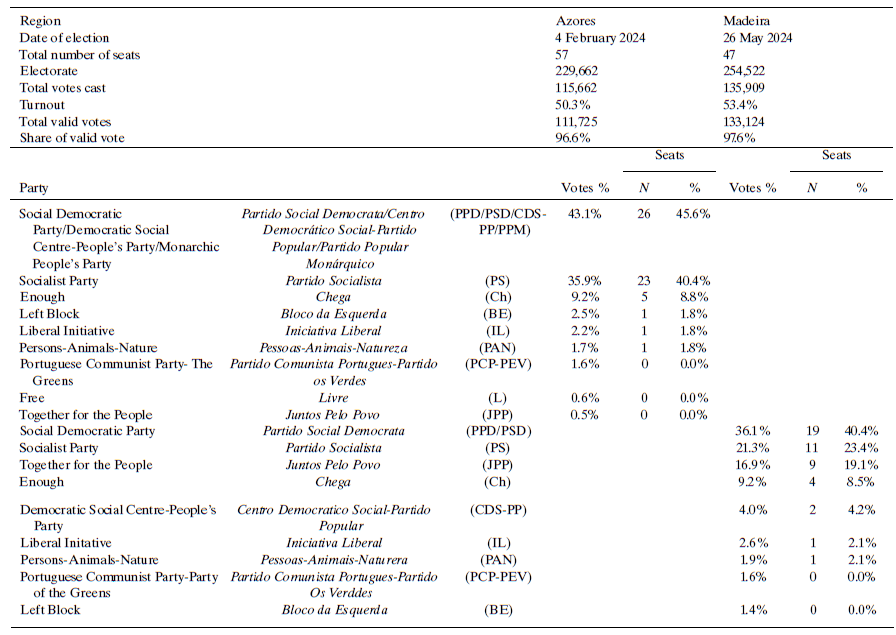
The regional elections to the Legislative Assembly in the Azores on 4 February 2024
The first big electoral test for the national political parties was the regional elections to the Legislative Assembly in the Azores (Table 1). Between 2020 and 2024, the ruling center-right coalition government comprising the Social Democratic Party (Partido Social Democrata, PSD), Democratic Social Centre-People's Party (Centro Democrático Social-Partido Popular, CDS-PP), and Monarchic People's Party (Partido Popular Monárquico, PPM) under regional President José Manuel Bolieiro, was kept in power because of the support of the radical right populist Chega (Enough) and Liberal Initiative (Iniciativa Liberal, IL). Since early 2023, Bolieiro had no majority in the regional assembly. The main reason for the early election was that the budget of Bolieiro's government coalition was not approved in the regional assembly at the end of November (Expresso 2023).

Notes:
1. Regarding the elections in the Azores, additional parties were Democratic National Alternative/Alternativa Democrática Nacional/ADN (0.33%, 0 seats)
2. Regarding the elections in Madeira, additional parties were Portuguese Labour Party/Partido Trabalhista Portugues/PTP (0.9%, 0 seats), Free/Livre/L (0.7%, 0 seats), Democratic National Alternative/Alternativa Democrática Nacional/AND (0.6%, 0 seats), and the Movement Earth Party-Alliance/Movimento Partido da Terra-Alianca (0.4%, 0 seats).
The Azores regional legislative elections were important as a prelude to the subsequent national legislative elections on 10 March. Bolieiro's center-right coalition consisted of the same parties as at the national level under Luis Montenegro. The latter hoped that a good result would strengthen the position of the electoral coalition Democratic Alliance (Aliança Democrática, AD) in the national election.
Eight parties and three coalitions competed in this early election. The campaign focused on the extreme structural poverty of the island's population. The population of the Azores is very dependent on state social benefits, among them the so-called social integration income (rendimento social de inserção) (Expresso 2024g, 2024h; RTPNotícias 2024a).
On election night, against the two opinion poll predictions of a technical impasse between the two main parties, the incumbent President José Bolieiro was the clear winner of the night with 42.1 per cent and 26 seats out of 57. Second-placed Socialists (Partido Socialista, PS) achieved only 35.9 per cent and 23 seats. Chega got 9.2 per cent and five seats, almost doubling its result from 2020. Also, the IL was able to get again its seat with 2.2 per cent but did not improve on the results of 2020. On the left, the Left Block (Bloco da Esquerda, BE) received 2.5 per cent of the vote and one seat. Persons, Animals and Nature (PessoasAnimais–Natureza, PAN) achieved 1.7 per cent of the vote and one seat, completing the list of parties represented in the legislative assembly. The Unitary Democratic Coalition (Coligação Democrática Unitária, CDU) obtained just 1.6 per cent of the vote and failed to enter the legislative body again as in the 2020 election ((Ministério da Administração Interna [MAI] 2024a).
Despite missing the absolute majority by three seats, Bolieiro was able to form a quite stable coalition government. Bolieiro's electoral coalition had a strong relative majority in comparison to 2020 when it was second after the PS, and to get to power was very dependent on the votes of the other right-wing parties, IL and Chega. In the present legislature, Bolieiro lacked just three seats in the Regional Assembly to achieve the absolute majority. It allowed for variable majorities with the parties in the legislature (Diário de Notícias 2024b; Reuters 2024; for a more detailed study, see Castaldo Reference Castaldo2024).
The legislative election to the Assembly of the Republic on 10 March 2024
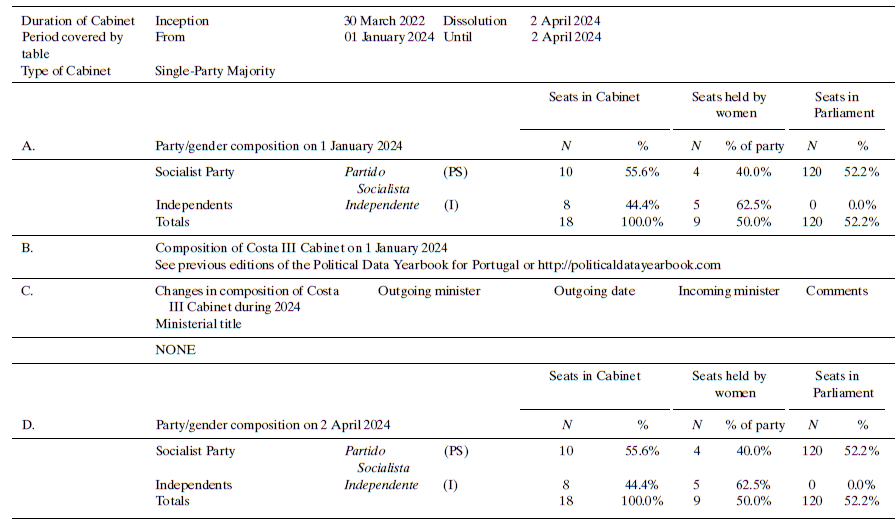
The resignation of António Costa on 7 November 2023 represented the end of an era, in which he presided over three governments over eight years (2015–2019, 2019–2022, 2022–2024). Costa retired from national politics, and a new leader, Pedro Nuno Santos, became the Secretary General of the party at the Socialist party conference on 5–7 January 2024 (Diário de Notícias 2024a; see Magone Reference Magone2024: 407).
Apart from the alleged cases of traffic of influences, named by the public prosecutor as “operation influencer,” the Socialists’ left government with a budget surplus of €4.33 billion, corresponding to 1.8 per cent of the gross domestic product, was able to achieve the goal of a public debt lower than 100 per cent, one year before planned (Expresso 2024f, 2024i). As already mentioned in the 2023 PDY, the absolute majority government was characterized by high levels of instability, also reinforced by operation influencer (Ferrinho Lopes Reference Ferrinho Lopes2024: 229–230; Magone Reference Magone2024: 407).
Main opposition leader, Luis Montenegro, had a difficult time standing up to these facts. As already mentioned in the previous section, he formed the pre-electoral coalition AD. Despite consisting of three parties (PSD, CDS-PP and PPM), the opinion polls predicted an electoral impasse for the AD.
One of the campaign issues was, then, what would happen if the AD won but was then dependent on the support of the third-party, Chega, which was predicted to double its share of the vote to 17 per cent to 21 per cent according to an opinion poll (Expresso 2024g, 2024l). AD, even with the support of IL, was not able to achieve an absolute center-right majority. Therefore, the potential rise of Chega in the upcoming elections would be key to achieving a right-wing majority. However, Luis Montenegro excluded this possibility from the outset, distancing himself from the extreme right party Chega.
In parallel to these more polarizing debates, both Montenegro and Santos, leaders of AD and PS, declared that they would be willing to work together on topics of national interest (Expresso 2024j, 2024k).
In total, there were 32 bilateral and multilateral debates on the different television channels. The final performance of the ecologist/animal rights party PAN was uncertain. Its leader, Inês Sousa Real, tried to keep an equidistant stance between PSD and PS, with all their options open. The left-wing parties CDU, BE, and Livre emphasized their differences with the Socialists; however, some of them (particularly the BE, under new leader Mariana Mortágua, and Livre, under Rui Tavares) advocated for a return of the parliamentary cooperation between all left-wing parties that took place between 2015 and 2019, and which was known as the “Geringonça” (contraption) (QUERY 6: Expresso, 2024e). Santos was also supportive of an all-left-wing party cooperation agreement if the conditions were right. All three left-wing parties emphasized social issues, including an increase in the minimum wage and affordable housing (Jornal de Negócios 2024).
The big unknown factor was the large number of eligible voters, between 16 per cent and 19 per cent, who had still not decided their vote and might do so just on Election Day. Moreover, about 22 per cent of eligible voters admitted that they might still change their vote choice (Expresso 2024n). In terms of voter loyalty, an election poll of the Catholic University, a major provider in this area, in early March 2024 (conducted between 28 February and 5 March) allows us to come to some insights. At first sight, the Communists seemed to be the party with the most loyal voters; however, in reality, they are very old, and they are not able to attract new voters from other parties. According to the poll, 77 per cent of Communist Party voters in 2022 would vote again for them in 2024. However, it would lose more votes to other parties (22 per cent) than it would win (7 per cent). In contrast, Chega, which was a relatively young party and supported by young people, already showed an ability to secure loyal voters (86 per cent), while also attracting voters from other parties (56 per cent) as well as non-voters (23 per cent), compensating quite well the 14 per cent loss (Centro de Estudos e Sondagens de Opinião [CESOP] 2024: 11; QUERY 7: Expresso 2024o).
AD and PS together, usually labeled as the Central Block (Bloco Central), tend to share a proportion of voters who switch loyalty from election to election. Moreover, they also had a big group of loyal voters. Inspired by an expression used by Duverger (Reference Duverger1964: 40–41) to refer to the positions of the first political parties in the Convention during the French Revolution, Jalali (Reference Jalali2007: 87–89) has referred to the Central Block's vote as the electorate marais (a French term meaning the marsh, or the swamp), which works together to prevent any dangers coming from challengers from the radical right or left. On the other hand, the BE and CDU tend to suffer considerably when the PS appeals to tactical voting because its electorate is more fluid in terms of left-wing intra-block volatility. Similarly, the Liberals (IL), despite already having a group of loyal voters (36 per cent), remain exposed to the electoral dynamics of the right-wing block, particularly to the AD (CESOP 2024: 11).
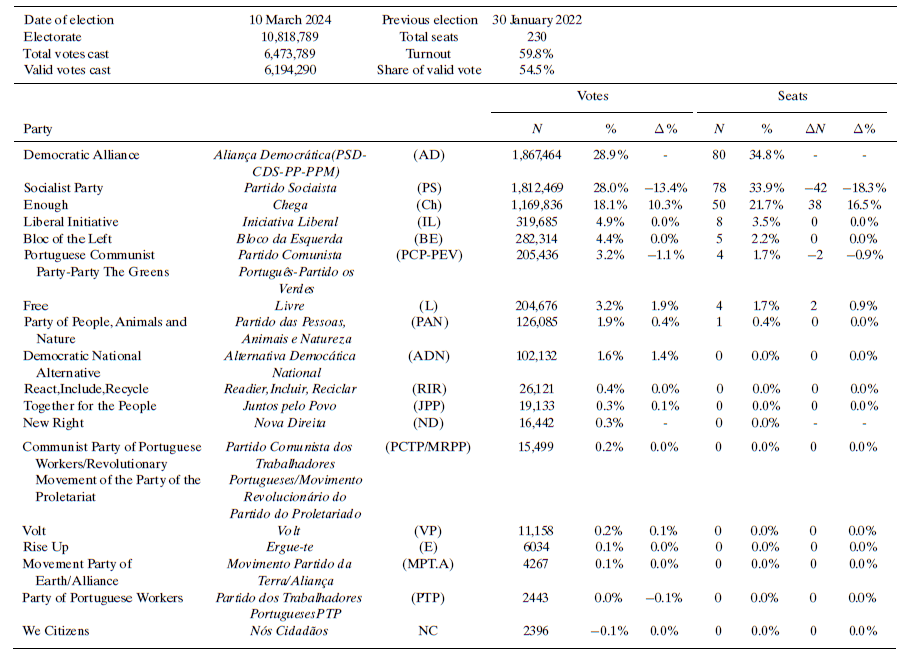
On Election Day (Table 2), the results were not dissimilar of those forecast by the one of the last opinion polls (Expresso 2024n). Montenegro's AD won by a whisker of 0.8 percentage points against the Socialists. AD gained 28.8 per cent of the vote and 80 seats; the Socialists achieved 28 per cent of the vote and 78 seats; Chega doubled its share of the vote to 18.1 per cent and 50 seats; IL attained almost the same as in 2022, with 4.9 per cent of the vote share and eight seats; BE similarly with 4.4 per cent and five seats. The Communists lost two seats, so that now they had 3.2 per cent (−1.2). Last, PAN got about 2 per cent and one seat (MAI 2024b).

Notes:
1. Democratic Alliance did not run as coalition in previous elections; therefore, data are not comparable.
2. New Right was a new party.
Source: MAI (2024b).
The big losers of the election were the Socialists, who lost 13.4 per cent of the vote and 42 seats. The new leader was not able to mobilize its potential electorate (for a more detailed analysis, see Ferrinho Lopes Reference Ferrinho Lopes2024: 236–238; Santana-Pereira & Nina Reference Santana-Pereira and Nina2024: 254–259). Despite a tiny advantage over the Socialists, the big winner was Luis Montenegro and his AD. After the election, President Rebelo de Sousa nominated Luis Montenegro to form the new government.
The Legislative Assembly Election of Madeira on 26 May 2024
A major scandal imploded on the island of Madeira. The Prosecutor General found out that, under regional President Miguel Albuquerque, more than half of the infrastructure projects since 2013 had been awarded to the largest construction firm in Madeira, Avelino Farinha Agrela. Albuquerque's former vice president, Paulo Calado, was in charge of awarding the contracts to the firm, which was chaired by entrepreneur Avelino Farinha. Despite inklings that political corruption or influence was at play, the Prosecutor General did not give a good image of herself by detaining the suspects for 21 days, only to release them. Under the circumstances, Albuquerque, who had to resign from the Presidency, was able to come back as interim president. He was also able to compete in the Madeira early elections (Table 1) as the leader of the PSD (Expresso 2024m).
Despite this scandal, Albuquerque was able to win the election by a substantial margin over the Socialists. The PSD received 36.1 per cent and ally CDS-PP 4 per cent, they had together 21 out of 47 seats (−2 seats).
The Socialists were not able to profit from the scandal and had almost the same share of the vote with 21.3 per cent and 11 seats as in 2023. Chega improved slightly to 9.2 per cent but with just the same amount of seats. IL and PAN got one seat each. The big winner was Together for the People (Juntos para o povo), a regional party, improving from 11 per cent to 16.9 per cent in the share of the vote and increasing their representation in the regional assembly from five to nine seats.
Albuquerque was able to form a minority coalition government with the CDS-PP and with occasional parliamentary support by Chega and IL (MAI 2024c).
The center-right minority coalition government consisting of PSD-CDS-PP had to face a motion of censure in mid-December 2024, leading to its demise, the Parliament's dissolution, and new elections in early 2025.
The election to the European Parliament on 9 June 2024Footnote 2
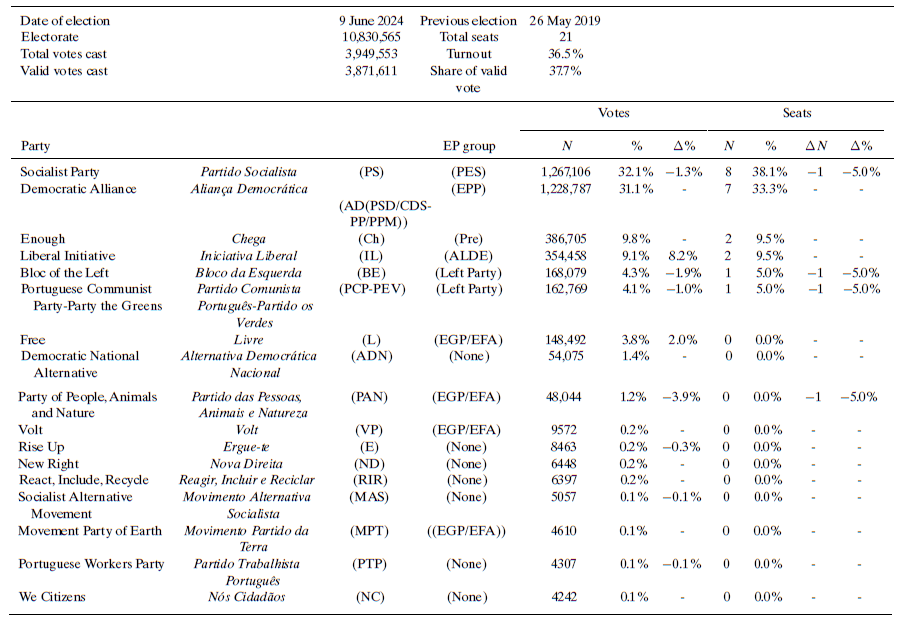
The super electoral year finished with the European Parliament elections (Table 3). Former Prime Minister Antonio Costa was rumored to become the new President of the European Council after the elections. This possibility also played a role during the campaign (CNN Portugal 2024a).

The independent candidate Sebastião Bugalho was the head of the AD list. He was a 28-year-old journalist who had been involved in political campaigns before. The AD's manifesto was not remarkably different from that of the European People's Party (EPP). Most topics were related to defense and security, as well as continuing support for Ukraine (Query 4: AD, 2024). In the last days of the campaign, Bugalho was accompanied by the president of the European Commission and the main candidate of the EPP in a rally in Oporto (Público 2024c).
The main candidate of the Socialist Party was the former very popular health minister during the Covid period, Marta Temido. She was supported by the grandees of the party, including the leader, Pedro Nuno Santos, and former European Commissioner Antonio Vitorino. She had also the support of the main candidate of the Party of European Socialists (PES), the Luxembourgeois Nicolas Schmit (Público 2024c). The party manifesto of the PS was closely aligned with that of the PES. Under the title “The Future of Portugal in Europe,” the manifesto included topics like social solidarity, the European ecological pact, the democratic values of the EU, and the concept of European strategic autonomy (Partido Socialista [PS] 2024).
On the left, the BE and the CDU were defenders of the social dimension, peace and against the war. Former head of the BE, Catarina Martins, was the party's main candidate. The head candidate of the CDU was the former Member of Parliament João Oliveira, who is a lawyer and part of the executive of the party. The Communist Party was the only political actor that was against supporting President Zelenskyy and the Ukrainian war effort (Bloco da Esquerda [BE] 2024; Partido Comunista Português [PCP] 2024; Público 2024a; SIC Noticias 2024). PAN fielded Pedro Fidalgo Marques. He conducted a campaign under the motto “For the planet, for you, for the animals.”
Further national parliamentary parties were very keen to get representation in the European Parliament. The radical right populist Chega, under candidate Tânger Corrêa, looked for campaign places in which there were major problems and used them to criticize the government. On 29 May, Corrêa went with André Ventura to Mourão, close to the Spanish border, to show solidarity with the security forces who were aggressively removing tents from the camps of Roma and Sinti (Público 2024b). They emphasized law and order themes and were against immigration and its consequences. They presented the slogan “Europe needs a clean-up” (A Europa precisa de uma limpeza). On the issue of European integration, Chega supports a “Europe of Nations” (Chega 2024). The Liberals (IL) fielded their popular former leader João Cotrim de Figueiredo and pursued a European campaign with European themes. The party was affiliated with the Alliance of Liberals and Democrats in Europe (Iniciativa Liberal [IL] 2024). Last, Rui “Tavares” Livre also looked for representation in the European Parliament. The main candidate was Francisco Paupério, a biology and biomedicine doctoral student.
The election results were quite similar to those of the national elections. The big difference was the very thin victory of the Socialist Party, with 32.1 per cent and eight seats, followed by the AD with 31.1 per cent and seven seats. New Prime Minister Luis Montenegro could live with it because, apart from being second-order elections, the margin between the two parties was quite small. Chega was not able to repeat its result at the national level and got just 9.8 per cent of the votes and two seats. Despite being of a second-order nature, it did not follow the major populist trend across Europe, as Chega was not able to capitalize among the protest voters. However, one should not underestimate the significance of Chega getting representation in the European Parliament for the first time. The Liberals got 9.1 per cent and two seats. This was a 10-time increase from the previous election in 2019. The BE and the Communists obtained one seat each, with 4.4 per cent and 4.1 per cent of the vote, respectively (MAI 2024d).
Cabinet report
The outgoing Costa III government: Administrative tidying up
Between Prime Minister Antonio Costa's resignation on 7 November 2023 (Table 4) and the formation of a new government in early April, Costa concentrated his efforts on expediting the long-overdue reform of the state, which was estimated to be six months behind schedule, as well as other reforms which were deemed possible under the interim role of Prime Minister.

The central reform of the state included the research and planning services, which should not only be reduced but also made more efficient. In contrast to other attempts before 2021, the reform was now part of the conditionality program negotiated with the European Commission to get funds from the Plan of Recovery and Resilience (Plano de Recuperação e Resiliência-PRR). The conditionality linked to the PRR has become a major new hard instrument of the European Commission to make sure that the long-standing program of reforms, agreed upon during successive European semesters, and linked to economic governance was implemented. The catalogue of reforms included the modernization of the powerful interest groups, known as the professional guilds (ordens professionais), such as physicians, lawyers, and engineers, among others, the reform of the capital markets, and the digitalization of the public administration and schools. If the Portuguese government fails to deliver, they will not receive the next tranche of the total €22.2 billion in funding (€16.3 billion in grants and €5.9 billion in loans). Such a situation happened at the end of December 2023, when the European Commission refused to transfer €714 million, withheld from the third and fourth tranches of payments, after following a negative evaluation in terms of the implementation of the reforms (Expresso 2024d; Observador 2024).
The new government of Luis Montenegro
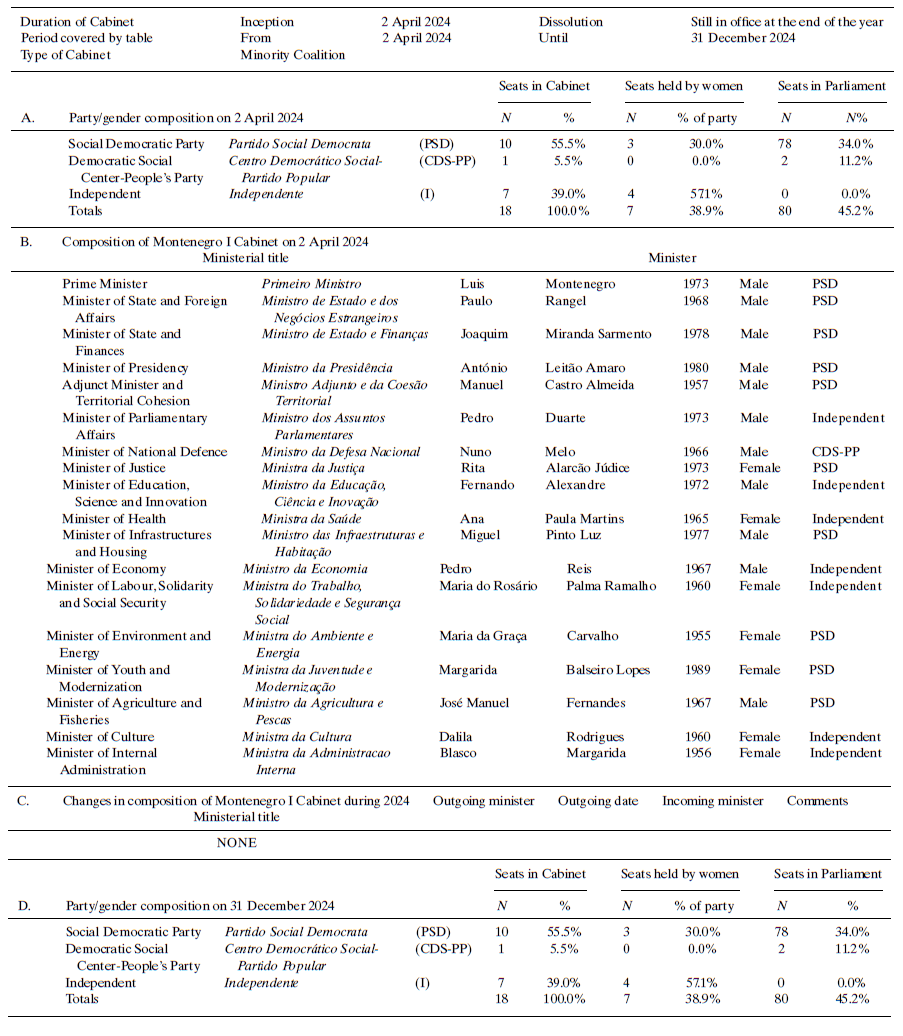
On 2 April, a new minority coalition government under Prime Minister Luis Montenegro took office (Table 5).

Source: Governo de Portugal (2024b).
Montenegro Cabinet was heavily dominated by his closest allies in the PSD. Among the heavy-weight grandees was the very experienced Paulo Rangel, who became Minister of Foreign Affairs. Rangel had carried out his career through being a member of the European Parliament (2009–2024). Remarkably interesting was the appointment of Joaquim Miranda Sarmento as Finance Minister. Miranda is a well-known university professor and is also strongly involved in the PSD. He also worked in institutions of the state such as the parliamentary Technical Support Unit for the Budget (Unidade Técnica de Apoio ao Orçamento). As Minister of the Presidency, Montenegro chose the 43-year-old lawyer António Leitāo Amaro, who was the coordinator of the electoral program of AD and had a long parliamentary career as well as experience in the junior position of State Secretary between 2013 and 2015. Nuno Melo was the only minister from the CDS-PP. He was given the difficult Ministry of Defence, which, due to the Russian war against Ukraine and NATO requirements, needed a considerable upgrade. However, the central task was to calm down the personnel in the armed forces about issues of low pay and esteem, which had developed in the past years. He had quite a lengthy career in the European Parliament and national politics. However, he had also completed the compulsory military service, was commander of a platoon and trained soldiers as a lieutenant, and worked in the military police. His main task was to restore a good atmosphere in the military forces, who felt undervalued and underpaid. In the past years, they had formed informal groups demanding upgrades in pay. Finally, the 66-year-old lawyer Manuel Castro Almeida was appointed Minister of Territorial Cohesion, in charge of dealing with the incoming structural and investment funds from the European Union.
Prime Minister Montenegro had difficulties finding women for his government, which was quite a male-dominated Cabinet, with 11 men and seven women. Just two women, Ana Paula Martins and Maria da Graça Carvalho, were party members; all the others were independent but close to the party. The Minister of Health was Ana Paula Martins, a 58-year-old pharmacist with a long administrative career in the Portuguese National Health Service. She is well acquainted with the deficiencies and problems of the sector. As Labor Minister, Montenegro appointed Maria Rosário Palma Ramalho, a 63-year-old professor of labor law at the University of Lisbon who had worked closely with the PSD in the past. Despite the lack of gender parity, Hugo Ferrinho Lopes in his excellent election report emphasized that 40.6 per cent of junior ministers were women ministers, the highest share of all governments since 1976 (Ferrinho Lopes Reference Ferrinho Lopes2024: 239). Moreover, the geographical origins of the ministers are less dominated by the capital Lisbon (previous Costa III government: 75 per cent; Montenegro: 25 per cent). Furthermore, in the Montenegro government, 50 per cent of ministers were lawyers, and there was an exceptionally higher rate of engineers (three) in comparison to previous governments (Ferrinho Lopes Reference Ferrinho Lopes2024: 241).
The new Prime Minister had to negotiate all the legislative proposals with the opposition parties in Parliament. However, until the end of the summer, there was almost no contact with other parties. Between Prime Minister Montenegro and Pedro Nuno Santos, leader of the second largest party, there were just two face-to-face meetings. One of the meetings took place at the beginning of the legislature, where they agreed on a rotation of the first President of the Assembly of the Republic. A second meeting occurred later to decide on the location of a new airport (Expresso 2024q).
Originally, Montenegro wanted a supplementary correcting budget rather than a regular budget. However, he soon gave up on this idea because of the difficulty of getting it approved. Instead, he concentrated on negotiating the regular budget for 2025 with the Socialists. He categorically refused to negotiate with the radical right-wing populist Chega (Expresso 2024p).
Parliament report
The Assembly of the Republic closed their 15th legislature on 15 January, so many outstanding pieces of legislation were approved at the last moment. This included the new law related to professional guilds. The law regulating lobbying and lobbies in Portugal was not adopted (Expresso 2024b, 2024c).
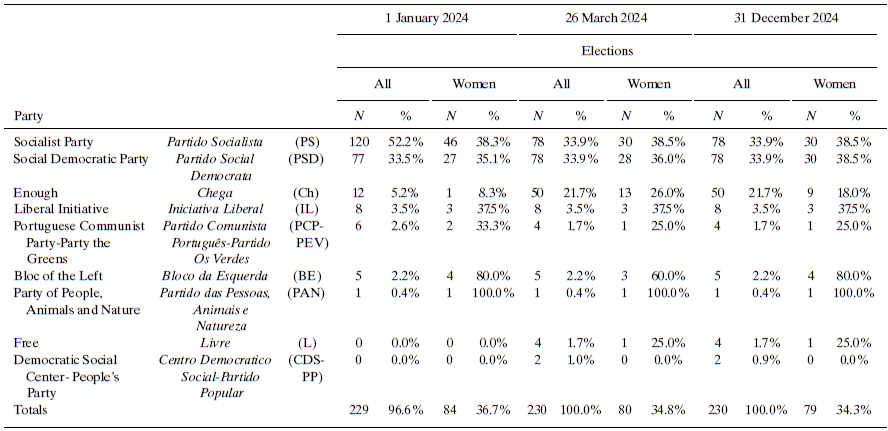
The new 16th legislature started on 26 March 2024 (Table 6). Nine parties achieved representation in Parliament. Prime Minister Montenegro had to look for majorities on a case-by-case basis. However, despite his long parliamentary experience, he had difficulties engaging in dialogue with all the opposition parties.

Source: Assembleia da Republica (2024).
Montenegro's government wanted to slightly reduce the income tax for high earners and submitted a government bill to Parliament. Due to a lack of dialogue with the opposition parties, the bill was rejected. Instead, the presented an alternative bill that proposed an income tax for low earners, which was approved by most parties, but with the abstention of the radical populist Chega, on 5 June 2024. The Socialists profited from their experience in the outgoing government, as they were already aware of how much funding was available for their purposes. In contrast, the new PSD government needed time to get an overview of the nation's finances. Moreover, such a review of the income tax was also part of the Socialist Party manifesto (Diário de Notícias 2024c).
After the summer break, cooperation between Prime Minister Montenegro and the Socialist leader intensified in order to negotiate a budget that would consider the priorities of the Socialist Party. The budget was approved on 2 December 2024 with the votes of the AD (80), the abstention of the Socialist Party (78), and the votes against of Chega (50), IL (8), BE (5), PCP-PEV (4), Livre (4) and PAN (1) (RTP Notícias 2024b).
Political party report
In the party conference of the Socialist Party on 5–7 January, Pedro Nuno Santos was confirmed as the new Secretary General (Expresso 2024a). He won in the primaries with 62 per cent against José Luis Carneiro, with 36 per cent on 16 December 2023 (Magone Reference Magone2024: 410).
In 2024, a new party New Right (Nova Direita) of leader Ossander Liber was rejected official registration twice by the Constitutional Court due to not fulfilling formal requisites. Finally, by the third time, it was accepted that it could take part in the Legislative and European Parliament elections of 2024. Liber was a candidate in the PSD splinter party Alliance (Aliança, A) originally led by Pedro Santana Lopes and gained some prominence in the press and social media. However, in the legislative and parliamentary elections, New Right received just 0.2 per cent of the vote (Table 7).

Issues in National Politics
Throughout the year, there was the commemoration of the 50th anniversary of the Portuguese Revolution of Carnations of 25 April 1974. The peak of the celebrations was the official ceremony in the Assembly of the Republic on that day.
The most important event was the appointment of former Prime Minister Antonio Costa as President of the European Council. Speculation on this possibility started at the beginning of the year and gained traction before and after the European Parliament elections. Prime Minister Luis Montenegro and President of the Republic, Marcelo Rebelo de Sousa, supported him, even though they belonged to the rival party, PSD. Montenegro was very instrumental in convincing the prime ministers and heads of state aligned with the European People's Party (EPP) to choose Costa for the position (Público 2024d).
Before the appointment of former Prime Minister Costa, the Prosecutor General lifted all the restraining measures on the people allegedly involved in the “operation influencer” on the traffic of influences for projects related to the exploitation of lithium and the building of a new data center at the Port of Sines. Former Prime Minister Costa, who was not indicted of any crime, was also cleared of any wrongdoing by a court in Lisbon (CNN Portugal 2024b). However, investigations would continue by the Prosecutor General.
The general impression was that Prosecutor General Lucilia Gago and the prosecutor's office in the “operation influencer” did not do their work thoroughly and relied too much on reports from the press. Moreover, the poor handling of the Madeira affair also played a role in undermining her standing. In the end, the pressure was too big for her, so she resigned from the position. In the second half of the year, the Prime Minister began looking for a new Prosecutor General. On 12 October 2024, President Marcelo Rebelo de Sousa, after a proposal of Prime Minister Montenegro, appointed Amadeu Francisco Ribeiro Guerra as the new Prosecutor General.
Former Finance Minister Maria Luis Albuquerque (PSD, 2013–2015), who worked quite constructively with the Troika during the Portuguese bailout program between July 2011 and June 2014, was appointed European Commissioner for Financial Services and the Savings and Investment Union.
Acknowledgments
Open access funding enabled and organized by Projekt DEAL.


 Open access

