




INTRODUCTION
The end of the 3rd and the beginning of the 2nd millennium BC in the area corresponding to modern-day Belgium are characterized by the emergence of the cremation funerary practice, which joins the well-established inhumation practice (see Capuzzo et al. Reference Capuzzo, Snoeck, Boudin, Dalle, Annaert, Hlad, Kontopoulos, Sabaux, Salesse, Sengeløv, Stamataki, Veselka, Warmenbol, De Mulder, Tys and Vercauteren2020 and references therein). Despite the intensification of excavation activities, especially in Flanders (north of Belgium), resulting from the large diffusion of commercial archaeology since 2005, little is still known about the funerary practices and population dynamics in the first phases of the Bronze Age in Belgium.
Our knowledge about the end of the Final Neolithic and the beginning of the Bronze Age originates almost exclusively from the few settlement contexts and the chronological information from 14C-dated charcoal fragments recovered from the infills of ditches of several flattened barrows (Warmenbol Reference Warmenbol2004, 2019; Bourgeois and Cherretté Reference Bourgeois and Cherretté2005; De Mulder et al. Reference De Mulder, Boudin, Deschepper, Verbrugge, Van Strydonck, Capuzzo and De Clercq2020). Indeed, funerary contexts belonging to the last phases of the Final Neolithic in Belgium are rare, and only visible through the presence of Bell Beaker pottery, associated with either cremated remains such as at the site of Kruishoutem-Wijkhuis or with inhumed individuals such as at Mol-Bergeijkse Heide, Kruishoutem-Kapellekouter, Wéris, and Humain-Entre-Deux-Falleux (Warmenbol Reference Warmenbol2004; De Mulder Reference De Mulder2019a). After this period, at the onset of the 2nd millennium BC, even less information about funerary practices exists. It seems that almost no burials, in Belgium, date to that period. Only few inhumations and cremation deposits have been dated to the the Early Bronze Age (EBA) and the beginning of the Middle Bronze Age (MBA), after which the number of cremation deposits begins to increase (Capuzzo et al. Reference Capuzzo, Snoeck, Boudin, Dalle, Annaert, Hlad, Kontopoulos, Sabaux, Salesse, Sengeløv, Stamataki, Veselka, Warmenbol, De Mulder, Tys and Vercauteren2020). This ascertainment is also done in the Netherlands where EBA funerary information declines during this period (Bourgeois Reference Bourgeois2013). Funerary data are also scarce for the Paris basin and northern France at the beginning of the 2nd millennium BC and start increasing only after 1800 BC when barrow construction is flourishing (Marcigny et al Reference Marcigny, Bourgeois, Talon, Lehoërff and Talon2017). Also, the French “Centre-Ouest” delivers little information concerning funerary practices for this period (Boulud-Gazo et al. Reference Boulud-Gazo, Gomez de Soto, Mélin, Nordez, Prieto and Martínez2022).
The scarcity of graves contrasts with the presence of circular barrows traditionally dated to a large time span from the final phases of the Neolithic onwards, with the large majority in the MBA, as shown by available 14C dates obtained mainly from charcoal fragments recovered in the ditches of these barrows (De Reu Reference De Reu2012, Reference De Reu2014; De Reu and Bourgeois Reference De Reu, Bourgeois, Fontijn, Louwen, van der Vaart and Wentink2013). Intensive ploughing activities in the sandy regions of Flanders flattened most of the burial mounds destroying the graves at the higher levels, resulting in the dispersing of human remains. As such, the identification of inhumation or cremation graves in those funerary monuments is hindered which subsequently impairs obtaining information on funerary practices in that area (Capuzzo et al. Reference Capuzzo, Snoeck, Boudin, Dalle, Annaert, Hlad, Kontopoulos, Sabaux, Salesse, Sengeløv, Stamataki, Veselka, Warmenbol, De Mulder, Tys and Vercauteren2020). From the more than 1000 barrows identified in the flat landscape dominating Flanders, less than 50 revealed Bronze Age (cremated) human remains and even less yielded samples dating to the EBA. Late Neolithic to Middle Bronze Age barrows were large monuments with an average diameter of 31.5 m for double circular ditched monuments and 24.5 m for single ditched monuments as inferred by the negative traces left in the archaeological record (De Reu and Bourgeois Reference De Reu, Bourgeois, Fontijn, Louwen, van der Vaart and Wentink2013). Funerary barrows were also present in Wallonia, in southern Belgium. Overflights from the early 1960s until 2001 carried out by Charles Leva (Bourgeois and Meganck Reference Bourgeois and Meganck2005) and, more recently, LiDAR prospections (Henton et al. Reference Henton, Fourny, Van Assche and Clarys2016) have allowed to identify many burial mounds in the Walloon area north of the Meuse river. However, most of these sites have not been selected for archaeological excavations, leaving a gap in our understanding of EBA and MBA funerary practices in that region.
Another potential explanation for the low number of clearly identified graves for the EBA and MBA could be linked to the grave type adopted in those chronological phases. Only few graves are urn grave contexts, such as the cremation deposits associated with so-called Hilversum-Drakenstein urns which are commonly considered to be a time marker for the central phases of the Bronze Age (Fokkens Reference Fokkens, Bourgeois and Talon2005). In most cases, however, cremated human remains were deposited or scattered directly in simple pits. Due to intense soil leaching over long stretches of time, visibility of these pits is limited. The absence of urns and, in some cases, charcoal from the pyre, could be responsible for the limited traces left in the archaeological records. These are more likely to be affected by bioturbation processes, responsible for the degradation of the osteological material.
Additionally, EBA and MBA graves are frequently isolated burials or organized in small clusters, thus hardly recognisable during fieldwork, in contrast with larger urnfield cremation cemeteries. All these factors could partially explain the extremely high number of radiocarbon dates from urn graves with cremated remains attributed to the Late Bronze Age (LBA) and the Early Iron Age (EIA) (see Capuzzo et al. Reference Capuzzo, Snoeck, Boudin, Dalle, Annaert, Hlad, Kontopoulos, Sabaux, Salesse, Sengeløv, Stamataki, Veselka, Warmenbol, De Mulder, Tys and Vercauteren2020 and references therein). Previous research has shown that the attribution of these urnless graves to a well-defined time span is also problematic due to the lack of any ceramic or metallic funerary items, which can lead to errors in the chronological interpretation (De Mulder et al. Reference De Mulder, Creemers and Van Strydonck2014). The cremation graves without an urn and grave goods are indeed a specific category that needs to be dated by absolute dating methods such as 14C.
The first excavations of Belgian barrows and urnfields date back to the end of the 19th and the beginning of the 20th century, prompted by the visibility of the mounds in the landscape and in connection to sand winning activities for urnfields. Often, the bones recovered in that period are lost or only partially preserved in museum depots, and contextual documentation is lacking or incomplete. Scientific analyses, such as osteological study, radiocarbon dating or isotopic measurements, have generally not been performed on those cremated remains from old excavations. For this reason, within the EOS-funded CRUMBEL project, which studies the collections of cremated bone found in Belgium dating from the Neolithic to the Early Medieval period using state of the art analytical and geochemical analyses (Dalle et al. Reference Dalle, Sabaux, Capuzzo, Tys, Snoeck, Vercauteren, Warmenbol, Boudin, Annaert, Stamataki, Kontopoulos, Veselka, Sengeløv, Hlad, Salesse and De Mulder2019; Snoeck et al. Reference Snoeck, Salesse, Annaert, Boudin, Capuzzo, Dalle, De Mulder, Hlad, Kontopoulos, Sabaux, Sengeløv, Stamataki, Tys, Veselka, Warmenbol and Vercauteren2019), 500 new radiocarbon dates have been obtained on Belgian calcined bone fragments. This massive dating campaign—a unique case in the European panorama—has allowed us to obtain a large amount of new data on undated and poorly dated contexts, such as Herstal (Sabaux et al. Reference Sabaux, Veselka, Capuzzo, Snoeck, Sengeløv, Hlad, Stamataki, Boudin, Annaert, Dalle, Salesse, Debaille, Tys, Vercauteren and De Mulder2021), Hastape and Fosse del Haye (Draily et al. Reference Draily, Annaert, Boudin, Capuzzo, Dalle, De Mulder, Hanut, Hlad, Salesse, Sengeløv, Stamataki, Tys, Vercauteren, Veselka, Vrielynck, Warmebol, Snoeck and Sabaux2021), and Sint-Gillis-Waas (De Mulder et al. Reference De Mulder, Dalle, Snoeck, Tys, Vercauteren, Boudin, Warmenbol, Capuzzo, Salesse, Sabaux, Stamataki, Sengeløv, Hlad, Annaert and Veselka2021), to refine the chronological information on specific sites (e.g., Destelbergen, Dalle et al. submitted), and eventually to bring back to light old excavated contexts, whose materials were stored in local museums and depots.
The aim of this paper is to investigate funerary practices and population dynamics in Belgium between the Final Neolithic and the Bronze Age (3000–800 BC). This has been possible by combining the new dataset of 14C dates produced in CRUMBEL and presented here, with already published radiocarbon dates from cemeteries and settlements in the Belgian area spanning the period under study. This approach has allowed to detect significant palaeodemographic variations and to reveal continuities and discontinuities in the use of different burial practices (inhumation vs. cremation), burial monuments (barrows vs. flat graves) and cremation grave types across space and over time.
Material: Newly 14C-Dated Cremation Cemeteries
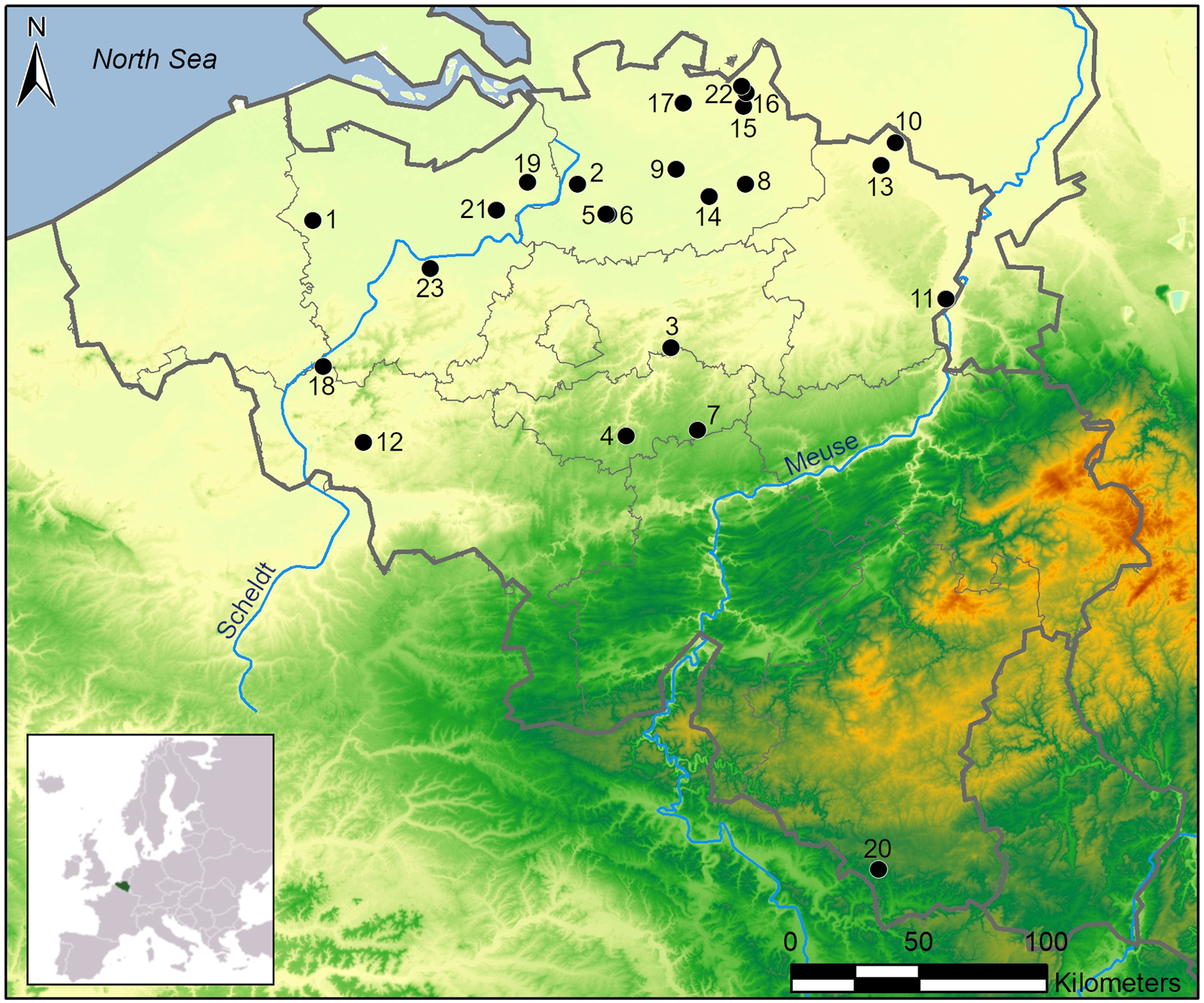
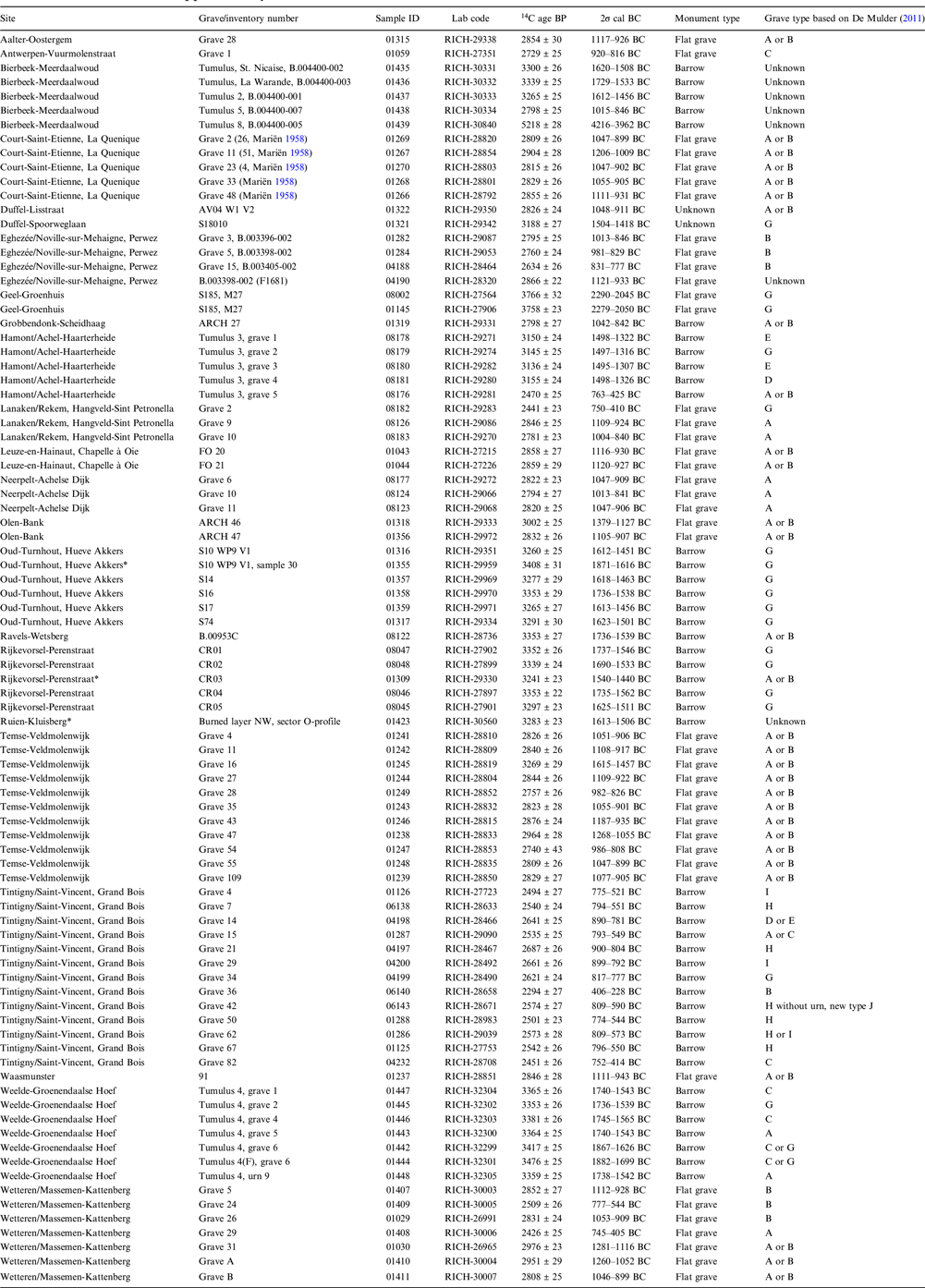
Eighty-eight new radiocarbon dates from 23 archaeological sites spanning from the end of the 5th to the beginning of the 1st millennium BC were obtained from cremation burials located in the Belgian territory (Figure 1; Table 1). Detailed information on the sites, ordered according to the Belgian provinces, and the sampled cremation deposits is available in supplementary material S2. Fragments of fully calcined (totally white) bone were dated, except in one case where only charcoal was available. The site selection aimed to fill the spatial and temporal gaps in 14C-dated Neolithic-Bronze Age cremation burials detected in previous research (Capuzzo et al. Reference Capuzzo, Snoeck, Boudin, Dalle, Annaert, Hlad, Kontopoulos, Sabaux, Salesse, Sengeløv, Stamataki, Veselka, Warmenbol, De Mulder, Tys and Vercauteren2020), covering both the north (Flanders) and the south (Wallonia) of Belgium. The conventional chronological framework adopted in this study for the Neolithic and the Bronze Age is the one in use in Flanders and modeled from the Dutch system (De Laet Reference De Laet1982; Bourgeois and Talon Reference Bourgeois, Talon and Lehoërff2012; Roberts et al. Reference Roberts, Uckelmann, Brandherm, Fokkens and Harding2013), which comprises the following phases: Middle Neolithic (4500–3500 BC), Late Neolithic (3500–3000 BC), Final Neolithic (3000–2100/2000 BC), Early Bronze Age (2100/2000–1800/1750 BC), Middle Bronze Age A (1800/1750–1500 BC), Middle Bronze Age B (1500–1200 BC), and Late Bronze Age (1200–800 BC).
Neolithic and Bronze Age funerary contexts with new radiocarbon-dated cremation deposits presented in the paper. The numbers correspond to (1) Aalter-Oostergem; (2) Antwerpen-Vuurmolenstraat; (3) Bierbeek-Meerdaalwoud; (4) Court-Saint-Etienne, La Quenique; (5) Duffel-Lisstraat; (6) Duffel-Spoorweglaan; (7) Eghezée/Noville-sur-Mehaigne, Perwez; (8) Geel-Groenhuis; (9) Grobbendonk-Scheidhaag; (10) Hamont/Achel-Haarterheide; (11) Lanaken/Rekem, Hangveld-Sint Petronella; (12) Leuze-en-Hainaut, Chapelle à Oie; (13) Neerpelt-Achelse Dijk; (14) Olen-Bank; (15) Oud-Turnhout, Hueve Akkers; (16) Ravels-Wetsberg; (17) Rijkevorsel-Perenstraat; (18) Ruien-Kluisberg; (19) Temse-Veldmolenwijk; (20) Tintigny/Saint-Vincent, Grand Bois; (21) Waasmunster; (22) Weelde-Groenendaalse Hoef; (23) Wetteren/Massemen-Kattenberg.
Overview of the new 14C dates from prehistoric and protohistoric cremation deposits located in Belgium. All measurements were obtained from fully calcined bone fragments of human diaphysis except for the samples (*) from Ruien-Kluisberg obtained from a piece of charcoal, from Rijkevorsel-Perenstraat obtained from a fragment of calcined human mandible and from Oud-Turnhout, Hueve Akkers which was obtained from a fragment of calcined human cranium. Detailed information on the sites, their chronology, and the references is available in supplementary materials S2 and S3.
Methods: 14C Dating and Chronological Modeling
Radiocarbon dating on carefully selected fragments of fully calcined bone and a fragment of charcoal was carried out at the Royal Institute for Cultural Heritage, Brussels (KIK-IRPA). Only fully calcined fragments (i.e., exposed to more than 600ºC) of cremated bone were chosen for 14C dating. Black- and gray-colored bones were avoided because of the high risk of carbon (C) contamination (Zazzo et al. Reference Zazzo, Saliège, Person and Boucher2009, Reference Zazzo, Saliège, Lebon, Lepetz and Moreau2012; Van Strydonck et al. Reference Van Strydonck, Boudin and De Mulder2010; Snoeck et al. Reference Snoeck, Brock and Schulting2014). Calcined diaphysis fragments were selected; since in two cases these were not available a fragment of cranium and mandible were sampled.
The procedure was composed of three different steps: (1) pretreatment, (2) CO2 extraction and graphitization and (3) measurement by accelerated mass spectrometry (AMS) (Van Strydonck et al. Reference Van Strydonck, Boudin, Hoefkens and De Mulder2005, Reference Van Strydonck, Boudin and De Mulder2009; Wojcieszak et al. Reference Wojcieszak, Van den Brande, Ligovich and Boudin2020). (1) The applied pretreatment protocol for cremated bones started with the removal of the bone surface, which is less protected against C substitution, by acid treatment with hydrochloric acid (HCl, 8%) until ca. 50% of the material was leached. The samples were then washed several times with Milli-Q water, dried in the oven, ground, and left in acetic acid (CH3COOH, 1%) for 24 hr to remove secondary carbonates. Afterwards, the bone powder was rinsed with Milli-Q water and dried again in the oven. The charcoal sample was pretreated following the AAA protocol in use at KIK-IRPA (Wojcieszak et al. Reference Wojcieszak, Van den Brande, Ligovich and Boudin2020). (2) Reaction was done under vacuum with phosphoric acid (H3PO4, 85%); the released CO2 was captured in a reactor and combusted with Ag and CuO. The CO2 was then cryogenically trapped and converted to graphite at 680ºC using pretreated Fe (Alfa Aesar, Iron powder, spherical, <10 microns, 99.9%) as catalyst. The charcoal sample was graphitized on the AGE (Němec et al. Reference Němec, Wacker and Gaggeler2010; Wacker et al. Reference Wacker, Němec and Bourquin2010) which is linked to an Elementar Vario Isotope Select (Wojcieszak et al. Reference Wojcieszak, Van den Brande, Ligovich and Boudin2020). Typical sample size for AMS analysis is 0.5–1 mg of graphite. (3) The 14C/12C ratio in the graphite was AMS measured and converted into a radiocarbon age (expressed in years BP), after correction for isotope fractionation, using the δ13C AMS measurement. All the measurements were obtained with the AMS type MICADAS, mini carbon dating system, at the KIK-IRPA (lab code RICH) (Boudin et al. Reference Boudin, Van Strydonck, van den Brande, Synal and Wacker2015). Calibration of the radiocarbon ages (BP) into calendar years (BC) was performed using the software OxCal 4.4 (Bronk Ramsey Reference Bronk Ramsey2009) and the atmospheric calibration curve IntCal20 (Reimer et al. Reference Reimer, Austin, Bard, Bayliss, Blackwell, Bronk Ramsey, Butzin, Cheng, Edwards, Friedrich, Grootes, Guilderson, Hajdas, Heaton, Hogg, Hughen, Kromer, Manning, Muscheler, Palmer, Pearson, Van Der Plicht, Reimer, Richards, Scott, Southon, Turney, Wacker, Adolphi, Büntgen, Capano, Fahrni, Fogtmann-Schulz, Friedrich, Köhler, Kudsk, Miyake, Olsen, Reinig, Sakamoto, Sookdeo and Talamo2020).
Summed calibrated probability distribution (SCPD) and Kernel density estimate (KDE) of radiocarbon dates, obtained with the tools KDE_Plot and KDE_Model in OxCal 4.4, have been used to study population fluctuations and to model changes in funerary practices. This has been possible by modeling 14C dates from inhumations and cremation burials, and settlements, between the 3rd and the beginning of the 1st millennium BC in the area of modern-day Belgium. Peaks in the SCPDs and KDEs correspond to episodes of maximum development of the studied phenomenon, while troughs are interpreted as moments of crisis or contraction. Kernel density analysis of radiocarbon dates has been successfully applied to model the temporal frequency of funerary practices and burials structures at prehistoric times (Brunner et al. Reference Brunner, von Felten, Hinz and Hafner2020; Capuzzo et al. Reference Capuzzo, Snoeck, Boudin, Dalle, Annaert, Hlad, Kontopoulos, Sabaux, Salesse, Sengeløv, Stamataki, Veselka, Warmenbol, De Mulder, Tys and Vercauteren2020; Capuzzo and Barceló Reference Capuzzo and Barceló2022), showing its potential to remove high frequency noise in the form of sharp edges, peaks and troughs caused by the calibration process and retaining the lower frequency signal. For a detailed description of the Kernel density method applied to 14C dates we refer to Bronk Ramsey (Reference Bronk Ramsey2017). The “dates as data” approach was introduced in the late 1980s to beginning of 1990s and was based on the assumption “more people=more sites=more dates” (Rick Reference Rick1987; Ames Reference Ames1991). The main concern of the method relates to the bias in the frequency of dates related to the local research history affecting the sampling strategy and the sampling size (Contreras and Meadows Reference Contreras and Meadows2014), the existence of different ranges of preservation of the archaeological evidence with an expected lower amount of datable material for older periods (Surovell et al. Reference Surovell, Byrd Finley, Smith, Brantingham and Kelly2009), and the artificial results generated by the calibration process (Williams Reference Williams2012; Crema and Bevan Reference Crema and Bevan2021). Other authors have also highlighted the importance of adopting a multi-proxy approach for palaeodemographic reconstructions (Palmisano et al. Reference Palmisano, Bevan and Shennan2017).
To overcome these issues, multiple radiocarbon measurements from the same grave were statistically tested prior the modeling using the R_Combine tool in OxCal 4.4, which provides information on the inner coherence of the radiometric series through the chi-squared (χ2) test (Ward and Wilson Reference Ward and Wilson1978). The dates were considered contemporary—i.e., corresponding to the same chronological event—when the resulting value of the χ2-test indicated as T in OxCal was below the calculated 5% threshold value (p-value < 0.05). In this case, the value obtained from the combination was used in the KDE models. If the dates did not pass the χ2-test, for instance at the site of Herstal (Sabaux et al. Reference Sabaux, Veselka, Capuzzo, Snoeck, Sengeløv, Hlad, Stamataki, Boudin, Annaert, Dalle, Salesse, Debaille, Tys, Vercauteren and De Mulder2021), only the more recent date was arbitrarily retained since it is a more accurate estimate for the depositional event (i.e., the action of burying the human remains). In case of dates on charcoal and cremated bone from the same grave, measurements from long-lived samples were excluded, retaining only dates on calcined bone. In this way, a pre-analytic “binning” procedure was applied to filter the data (Capuzzo et al. Reference Capuzzo, Zanon, Dal Corso, Wiebke and Barceló2018).
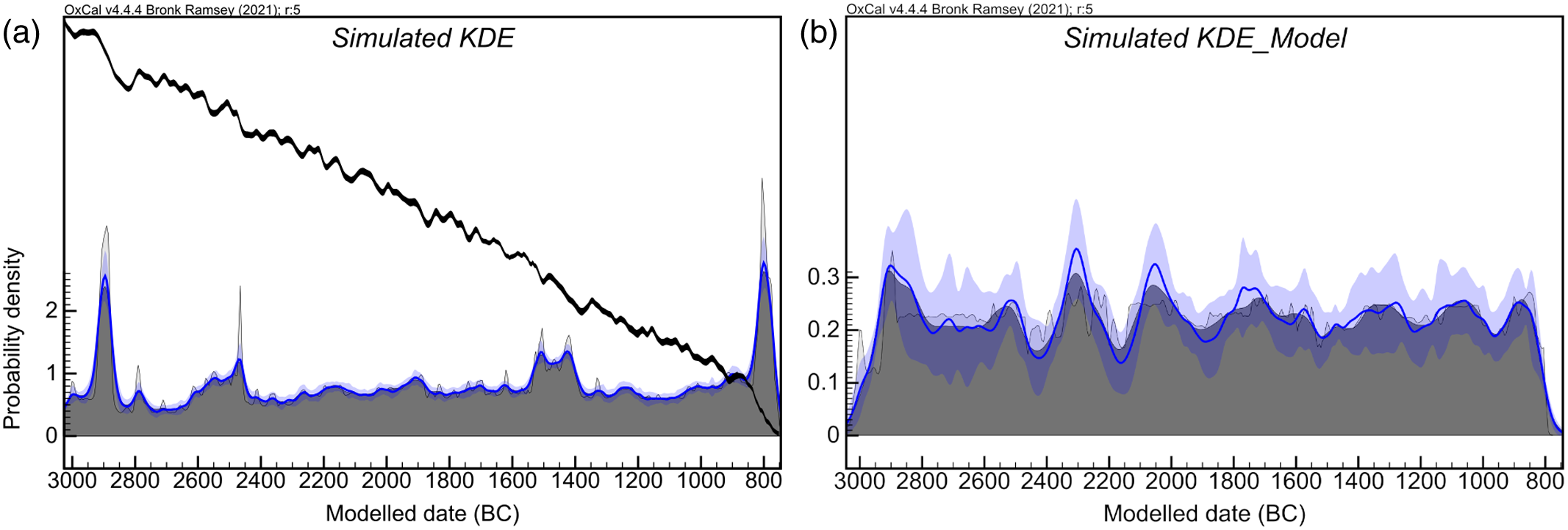
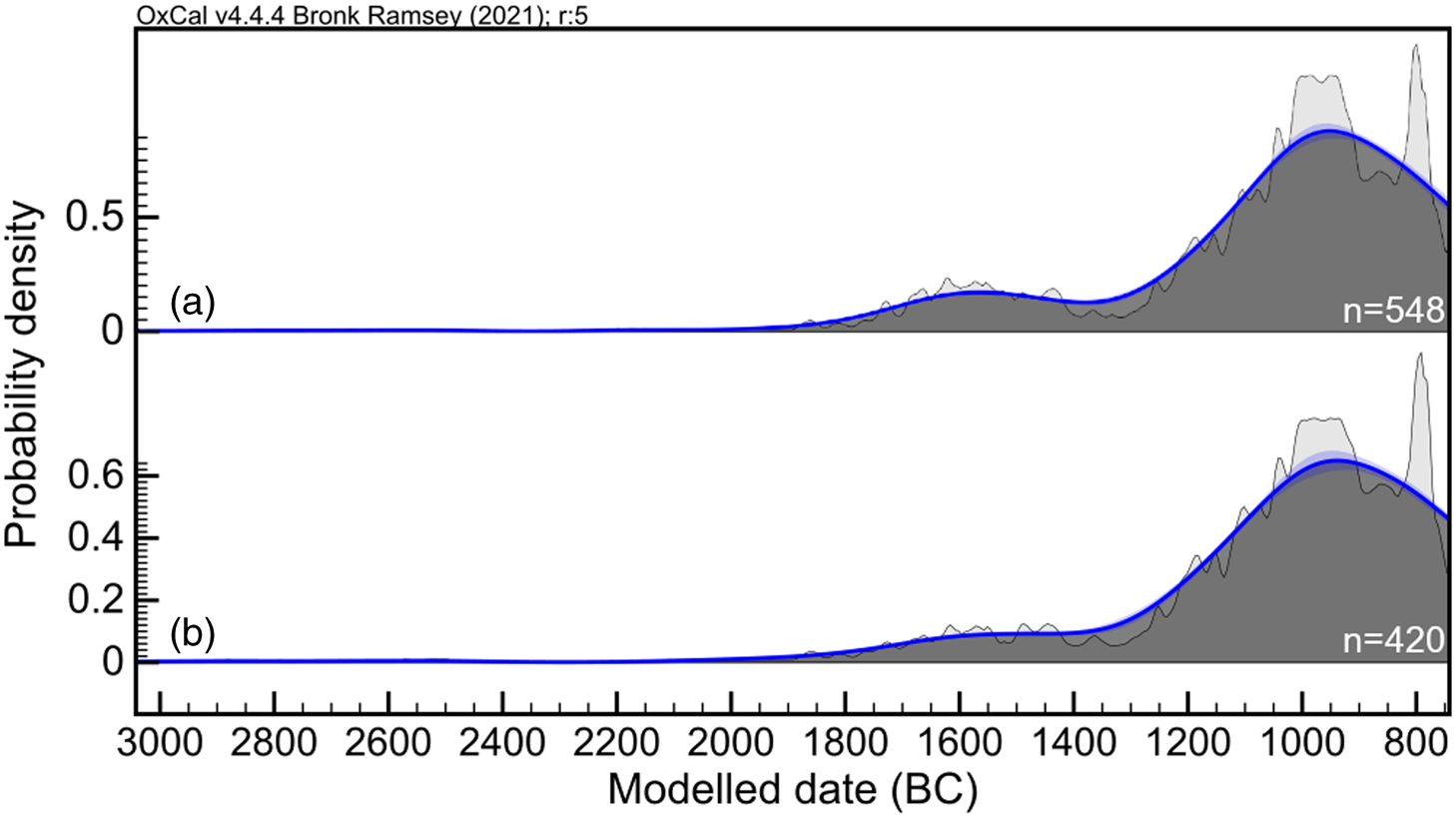
To test the effects of the calibration curve on radiocarbon estimates, which can alter the shape of the SCPDs and to a lesser extent the KDEs, two simulated KDE curves have been produced using OxCal 4.4. The first KDE plot is composed of uniformly distributed radiocarbon dates (one date each year between 4430 BP and 2500 BP with ±10 years as a standard deviation for each date), under the assumption that the amount of dated archaeological contexts was the same for each year (Figure 2a). The second KDE model (Figure 2b) was obtained using the R_Simulate tool, setting 3000 BC as the start date, 800 BC as the end date, and 500 as the number of dates in the simulation, as detailed in the OxCal code in supplementary material S1. This was done to test a null hypothesis of no relationship between the observed KDE plot and the effects of particular sections of the calibration curve, such as plateaus and calendar age steps (Williams Reference Williams2012). In the first KDE plot (Figure 2a) two prominent peaks in the simulated KDE are visible at ca. 2900 and 800 BC, corresponding to two steep calendar-age steps between 2940–2830 BC and 860–700 BC in the IntCal20 calibration curve. Three other peaks of considerably lesser magnitude are visible at ca. 2470, 1520, and 1420 BC, showing a certain impact of the calibration curve shape at those ages. Beside these areas, the simulated KDE curve maintains a reasonably neutral trend, suggesting an overall limited influence of the calibration curve on our study time window. The simulated KDE model (Figure 2b) shows that the SCPD is in fact fairly uniform, with some noise in some parts of the curve than others, such as at 2900 BC; the KDE curve tends to reflect the SCPD but with some smoothing and the uncertainties are larger than those in Figure 2a, especially in the time span 2500–1900 BC.
(a) Simulated KDE plot (in blue) of uniformly distributed 14C dates and the IntCal20 calibration curve (in black); (b) simulated KDE model using the R_Simulate tool and the OxCal 4.4 code in supplementary material S1. (Please see online version for color figures.)
A total of 10 KDE curves were obtained using the empirical data. The first two were produced using the OxCal tool KDE_Plot and aimed at testing if the new dating campaign managed to fill the temporal gaps detected in the previous study (Capuzzo et al. Reference Capuzzo, Snoeck, Boudin, Dalle, Annaert, Hlad, Kontopoulos, Sabaux, Salesse, Sengeløv, Stamataki, Veselka, Warmenbol, De Mulder, Tys and Vercauteren2020) or otherwise strengthened the observed temporal trends. A new KDE including the new 14C dates presented in this paper, the dates gathered in Capuzzo et al. (Reference Capuzzo, Snoeck, Boudin, Dalle, Annaert, Hlad, Kontopoulos, Sabaux, Salesse, Sengeløv, Stamataki, Veselka, Warmenbol, De Mulder, Tys and Vercauteren2020) and the 41 dates from De Mulder et al. (Reference De Mulder, Dalle, Snoeck, Tys, Vercauteren, Boudin, Warmenbol, Capuzzo, Salesse, Sabaux, Stamataki, Sengeløv, Hlad, Annaert and Veselka2021), Sabaux et al. (Reference Sabaux, Veselka, Capuzzo, Snoeck, Sengeløv, Hlad, Stamataki, Boudin, Annaert, Dalle, Salesse, Debaille, Tys, Vercauteren and De Mulder2021), Draily et al. (Reference Draily, Annaert, Boudin, Capuzzo, Dalle, De Mulder, Hanut, Hlad, Salesse, Sengeløv, Stamataki, Tys, Vercauteren, Veselka, Vrielynck, Warmebol, Snoeck and Sabaux2021) and Dalle et al. (submitted) was obtained.
Four KDE curves were modeled using the tool KDE_Model to infer changes in funerary practices and at the same time as a proxy to detect palaeodemographic variations between 3000 and 800 BC. The first one includes radiocarbon dates from Final Neolithic and Bronze Age inhumation burials in Belgium (Capuzzo et al. Reference Capuzzo, Snoeck, Boudin, Dalle, Annaert, Hlad, Kontopoulos, Sabaux, Salesse, Sengeløv, Stamataki, Veselka, Warmenbol, De Mulder, Tys and Vercauteren2020), two others gather 14C dates from cremation deposits in burial mounds (barrows) and flat graves, respectively, and the fourth one is composed of dates from samples collected in the infills of postholes of pre- and protohistoric wooden buildings in Flanders (De Mulder et al. Reference De Mulder, Boudin, Deschepper, Verbrugge, Van Strydonck, Capuzzo and De Clercq2020).
Eventually, four additional KDE models were produced to study the temporal distribution of four cremation grave types, as defined in De Mulder Reference De Mulder2011: (1) graves with urn with or without remains of the pyre (Types A, B and H in the De Mulder typology), (2) block of bones covered or not by remains of the pyre (German: Knochenlager; French: Bloc d’ossements) (Type C and D in the De Mulder typology), (3) burial with cremated remains and remnants of the pyre jointly deposited in the bottom of a pit (German: Brandgrubengrab) (Type E in the De Mulder typology), and (4) bones scattered directly in a pit with or without charcoal fragments (Type G in the De Mulder typology). In all the models the default values to N(0,1) and U(0,1) were used for the Kernel and factor in the OxCal code.
RESULTS
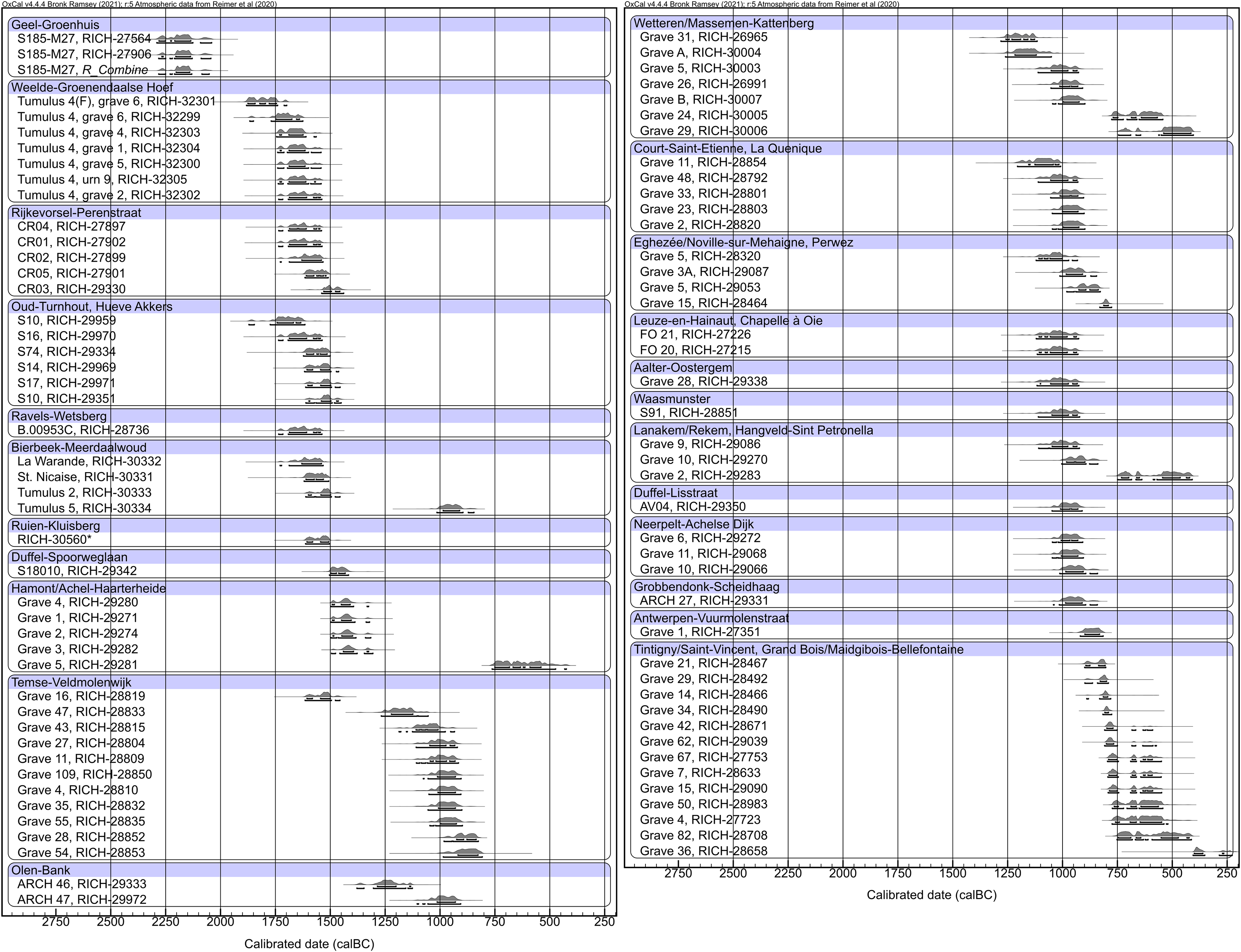
The results of 88 new radiocarbon dates from 23 archaeological sites (Table 1, Figure 3) span from the end of the 5th to the 1st millennium BC. The spatial coverage of radiocarbon-dated cremations in Belgium has improved significantly (Figure 4), however in southern Belgium the number of Bronze Age cremations is still very low, with an absence of dated contexts south of the Meuse river and in the Ardennes Plateau, with the notable exception of the newly dated site of Tintigny/Saint-Vincent, Grand Bois. Early and Middle Bronze Age A cremations appear clustered in northern Belgium, especially in the Campine region (in the northeastern part of Flanders) and in the so-called Flemish Ardennes, a hilly region in the south of the province of East Flanders.
OxCal plot showing the new calibrated radiocarbon dates on calcined fragments of human bones and charcoal (*) from cremation deposits located in Belgium.
Funerary contexts with radiocarbon-dated cremation deposits (left) and inhumation burials (right) between the 3rd and the beginning of the 1st millennium BC (Final Neolithic and Bronze Age) in Belgium. The colors of the dots correspond to the chronology of 14C-dated graves following the conventional chronological framework. The numbers correspond to the IDs in Table S3.

The temporal frequency of cremation burials, based on already available radiocarbon data and the new 14C dates produced in CRUMBEL, including the new estimates presented in this paper and those already published (De Mulder et al. Reference De Mulder, Dalle, Snoeck, Tys, Vercauteren, Boudin, Warmenbol, Capuzzo, Salesse, Sabaux, Stamataki, Sengeløv, Hlad, Annaert and Veselka2021; Draily et al. Reference Draily, Annaert, Boudin, Capuzzo, Dalle, De Mulder, Hanut, Hlad, Salesse, Sengeløv, Stamataki, Tys, Vercauteren, Veselka, Vrielynck, Warmebol, Snoeck and Sabaux2021; Sabaux et al. Reference Sabaux, Veselka, Capuzzo, Snoeck, Sengeløv, Hlad, Stamataki, Boudin, Annaert, Dalle, Salesse, Debaille, Tys, Vercauteren and De Mulder2021; Dalle et al. submitted), shows remarkable consistency with the trend observed in the KDE plot published in Capuzzo et al. (Reference Capuzzo, Snoeck, Boudin, Dalle, Annaert, Hlad, Kontopoulos, Sabaux, Salesse, Sengeløv, Stamataki, Veselka, Warmenbol, De Mulder, Tys and Vercauteren2020; Figure 5). This confirms the high presence of cremation burials from 1300 BC onward, with a peak in the LBA and the EIA transition, in the area corresponding to modern-day Belgium.
KDE plot showing the temporal distribution of Final Neolithic and Bronze Age cremation deposits in Belgium including (a) all the available 14C dates, compared to (b) the previously published KDE plot in Capuzzo et al. (Reference Capuzzo, Snoeck, Boudin, Dalle, Annaert, Hlad, Kontopoulos, Sabaux, Salesse, Sengeløv, Stamataki, Veselka, Warmenbol, De Mulder, Tys and Vercauteren2020).
Chronology of Sites
The oldest recently dated bone deposit originates from tumulus 8 (grande tombelle La Warande) at Bierbeek-Meerdaalwoud, which yielded a Middle Neolithic date (4216–3962 at 2σ). The grave is the oldest reliable Neolithic cremation in Belgium, matching the pottery fragments and lithics typologically datable to the Michelsberg culture recovered in the same tumulus, thus confirming that the area of Meerdaal had a funerary function since the end of the 5th millennium BC. This date, being much older than the others by several millennia, is not included in the KDE models.
At the site of Geel-Groenhuis, the osteological study of the cremation deposits showed that two out of four consisted of solely animal bones. The two deposits containing human remains were very small (< 15 g) and also contained small amounts of animal bones. Two radiocarbon dates unexpectedly placed the grave S185 M27 in the last centuries of the 3rd millennium BC corresponding to the end of the Final Neolithic. The inner coherence of the dates was ensured using the test of contemporaneity, which yielded a more precise estimate for the context R_Combine 3761±19 BP, representing one of the oldest cremations in the area.
Remarkably, only one of the newly dated cremated bone deposits yielded an EBA date (Figure 3). The calcined bones from grave 6 (profile F) from Weelde-Groenendaalse Hoef were dated to the 19th–18th century BC at 2σ, suggesting these remains could be likely associated with the pre-existing horseshoe shaped funerary enclosure discovered under tumulus 4, since the other graves recovered in the barrow, including the central one, are consistent with the MBA A phase. Five other sites were 14C dated to the MBA A phase. The five cremation deposits from Rijkevorsel-Perenstraat were dated to the 17th and 16th century BC at 2σ, thus confirming the preliminary chronological assignment from a date obtained on CR02 Poz-115842, 3290±30 BP (Van Kerkhoven Reference Van Kerkhoven2020). The cremated remains recovered in the barrows of Ravels-Wetsberg and Bierbeek-Meerdaalwoud were also dated to the same time span. The date from Ruien-Kluisberg places the funerary monument in the MBA A, as already suggested by the so-called Hilversum urn recovered in the barrow. At Oud-Turnhout, Hueve Akkers, the dating of two samples from the central grave (S10) yielded two MBA dates that did not correspond to the same chronological event (T=13.86, 5%=3.8). In the same period, the funerary monument was also used to host the other cremation graves placed in the inner ditch of the double ditch barrow (S14, S16, S74), all dated to the 17th and 16th century BC at 2σ.
The MBA B conventionally ranges from 1500 until 1100 BC, with the emergence of the first elements of the urnfield tradition in the Hallstatt A2 phase, 1100–1000 BC (Desittere Reference Desittere1968; De Laet Reference De Laet1982). However, new research based on the large number of 14C dates has proposed to place the end of the MBA B and, consequently, the beginning of the LBA at around 1350 BC (Leclercq Reference Leclercq2014) or in the second half of the 13th century BC (De Mulder et al. Reference De Mulder, Leclercq, Van Strydonck and Warmembol2016). Five newly dated sites can be assigned to this time span. The four cremation deposits with calcined human bones and charcoal dispersed in rectangular pits in tumulus 3 at Hamont/Achel-Haarterheide were dated to the 15th–14th century BC at 2σ. All these graves are statistically contemporary and correspond to the second half of the 15th century BC. The cremated remains in an urn correspond to a secondary deposition in tumulus 3, being 14C dated to the EIA, in agreement with the urn typology. The cremation S18010 from Duffel-Spoorweglaan was 14C dated to the 15th century BC corresponding to the beginning of the MBA B. The new estimate obtained on calcined bone proved that the existing date, Ua-45162; 3385±67 BP, 1870–1512 BC (2σ), performed on a charcoal fragment collected in the same grave (Woltinge et al. Reference Woltinge, Cox, Verbeek and Houchin2013), was affected by old-wood-effect since it yielded a much older date. This stresses the importance of dating preferably fully calcined bone remains over charcoal.
The two urn graves from Olen-Bank were dated to a later period. The cremated remains in the biconical urn, typologically assigned to the LBA, were dated to the 13th–12th century BC, slightly older than expected while the human remains in the undecorated urn are more recent, being assigned to the 11th–10th century BC, in agreement with the urn type. Radiocarbon dates from Wetteren/Massemen-Kattenberg spanned the MBA B-EIA, revealing a long use of the cemetery for more than six centuries. Grave 31 and grave A were dated to the later phases of MBA B; afterwards, the cemetery remained in use during the LBA, as confirmed by the dates from the bone deposits in graves B, 5, and 26, until the EIA as shown by the 14C estimates from graves 24 and 29. The dates match the expected typological chronology based on the urns (supplementary material S4a).
The 11 14C-dated graves from Temse-Veldmolenwijk could suggest an early use of the funerary area during the MBA A, as proven by the measurement from grave 16 corresponding to the 16th and the first half of the 15th century BC at 2σ. This date, however, seems too old for the urn typology (supplementary material S4b) that can be dated to a LBA phase. This could be the consequence of an old-wood effect on the calcined bone or a reburial of the cremated remains in a more recent urn, as recently detected at Herstal (Sabaux et al. Reference Sabaux, Veselka, Capuzzo, Snoeck, Sengeløv, Hlad, Stamataki, Boudin, Annaert, Dalle, Salesse, Debaille, Tys, Vercauteren and De Mulder2021). The main use of the site is placed in a later phase of MBA B and in the LBA, as confirmed by the 10 new dates and those obtained in 2010 (De Mulder Reference De Mulder2011).
Grave 28 from Aalter-Oostergem, partly disturbed, yielded a date at the end of the 11th–10th centuries BC at 2σ, corresponding to the LBA. This result is more recent than the date obtained from a charred twig from grave 18 (KIA-40864; 3060±20 BP, 1406–1261 BC 2σ), placed in an earlier phase corresponding to the 14th–13th centuries BC. The urn fits with other Atlantic types for this period. Grave 1 from Antwerpen-Vuurmolenstraat was dated to the LBA, slightly older than the typologically-dated graves in the Wilrijk sector, attributed to the EIA (Warmenbol and Oost Reference Warmenbol and Oost1984). To the LBA were also dated the urn graves from the small cemeteries of Neerpelt-Achelse Dijk and Leuze-en-Hainaut, Chapelle à Oie, the urn grave from Grobbendonk-Scheidhaag, as well as the fragments of calcined bone from Duffel-Lisstraat, Waasmunster, and the grave from tumulus 5 in Bierbeek-Meerdaalwoud that could be interpreted as a secondary burial. To the 11th–10th centuries BC, are assigned the urn graves from Court-Saint-Etienne, La Quenique and Lanaken/Rekem, Hangveld-Sint Petronella, with an EIA phase for the latter one. Slightly more recent are the urn graves from Eghezée/Noville-sur-Mehaigne, Perwez, which were dated to the LBA until the Iron Age transition, of which the start is commonly placed in Belgium at ca. 800 BC (Warmenbol and Leclercq Reference Warmenbol and Leclercq2009; Warmenbol Reference Warmenbol, Schumann and van der Vaart-Verschoof2017). Eventually, the radiocarbon estimates from the large cemetery of Tintigny/Saint-Vincent, Grand Bois confirmed that the burial area was in use at the end of the LBA and in the EIA.
Funerary Practices and Population Dynamics
To have a general overview on funerary dynamics between 3000 and 800 BC in the Belgian area, the information on burial typology (barrows vs. flat graves) from the newly dated sites was combined with the available data on previously 14C-dated cremation deposits in Belgium between the Final Neolithic and the Bronze-Iron Age transition (Capuzzo et al. Reference Capuzzo, Snoeck, Boudin, Dalle, Annaert, Hlad, Kontopoulos, Sabaux, Salesse, Sengeløv, Stamataki, Veselka, Warmenbol, De Mulder, Tys and Vercauteren2020; De Mulder et al. Reference De Mulder, Dalle, Snoeck, Tys, Vercauteren, Boudin, Warmenbol, Capuzzo, Salesse, Sabaux, Stamataki, Sengeløv, Hlad, Annaert and Veselka2021; Sabaux et al. Reference Sabaux, Veselka, Capuzzo, Snoeck, Sengeløv, Hlad, Stamataki, Boudin, Annaert, Dalle, Salesse, Debaille, Tys, Vercauteren and De Mulder2021; Draily et al. Reference Draily, Annaert, Boudin, Capuzzo, Dalle, De Mulder, Hanut, Hlad, Salesse, Sengeløv, Stamataki, Tys, Vercauteren, Veselka, Vrielynck, Warmebol, Snoeck and Sabaux2021; Dalle et al. submitted). An additional KDE curve was obtained modeling radiocarbon dates from inhumation burials in Belgium (Capuzzo et al. Reference Capuzzo, Snoeck, Boudin, Dalle, Annaert, Hlad, Kontopoulos, Sabaux, Salesse, Sengeløv, Stamataki, Veselka, Warmenbol, De Mulder, Tys and Vercauteren2020). After the peak in the number of inhumations in the first half of the 3rd millennium BC, corresponding to collective burials in caves and rock shelters located in the Walloon region between the karstic areas of the Belgian Meuse basin and the Ardennes, the KDE model (Figure 6a) shows a general decline in the practice of inhumation, which reaches its minimum in the first half of the 2nd millennium BC. Almost no inhumation burials have been radiocarbon dated to the EBA and the MBA.
SCPDs (dark colors) and posterior KDE models (light colors) which describe the temporal diffusion of: (a) inhumation burials (data from Capuzzo et al. Reference Capuzzo, Snoeck, Boudin, Dalle, Annaert, Hlad, Kontopoulos, Sabaux, Salesse, Sengeløv, Stamataki, Veselka, Warmenbol, De Mulder, Tys and Vercauteren2020), (b) cremation deposits, under burial mounds, circular and elongated barrows (red), and in flat graves (gray) in Belgium, and (c) wooden buildings in Flanders (data from De Mulder et al. Reference De Mulder, Boudin, Deschepper, Verbrugge, Van Strydonck, Capuzzo and De Clercq2020) during the Final Neolithic and the Bronze Age.
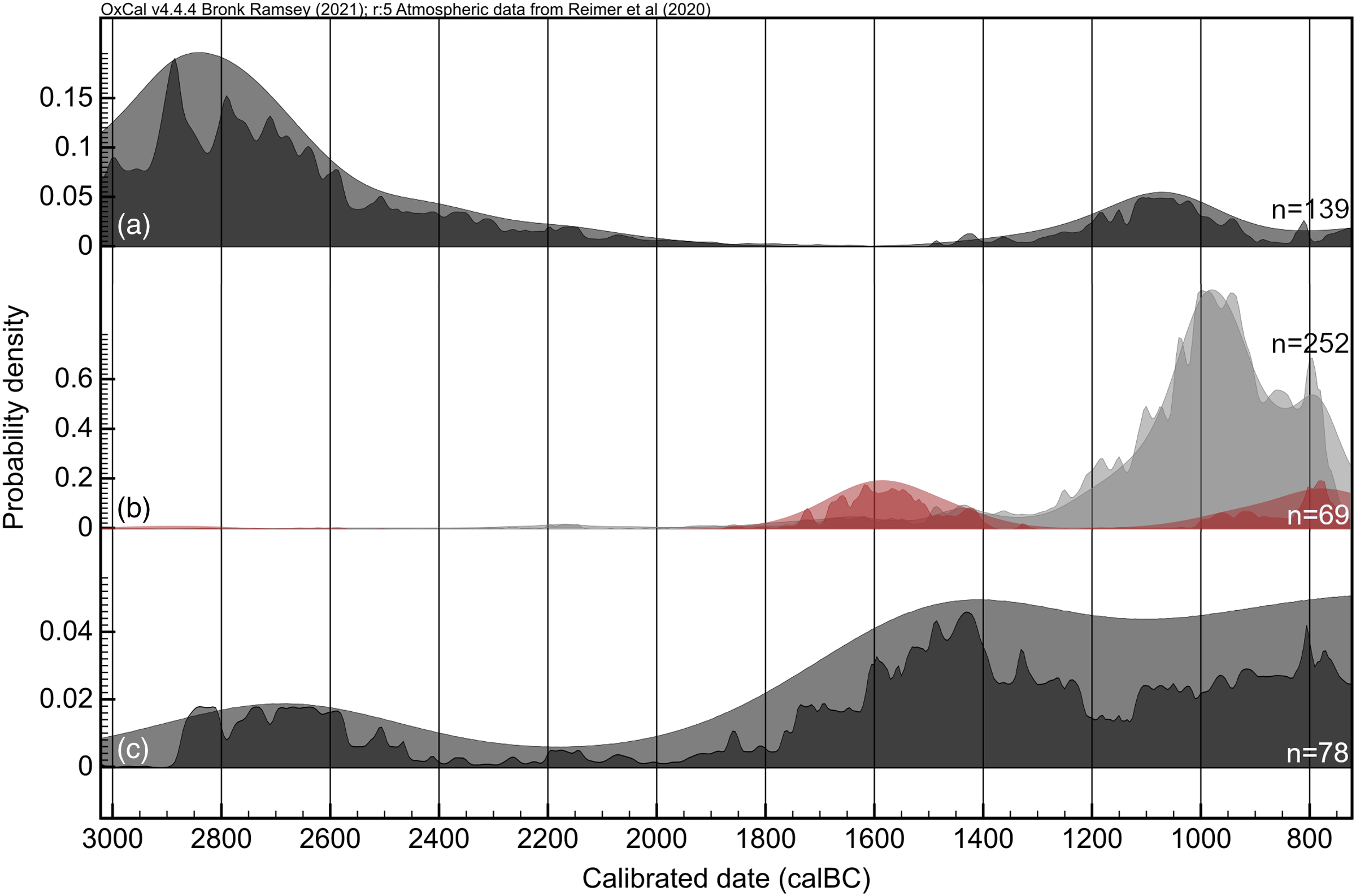
An opposite pattern is detected for cremation deposits. Following the very few archaeological funerary contexts with this practice in the 3rd and in the first two centuries of the 2nd millennium BC, a notable increase in cremation graves is observed during the MBA A and the very beginning of the MBA B with barrows as the dominant burial monument (Figure 6b). In concomitance with cremation deposits in burial mounds, cremated bones were also sporadically deposited in flat graves, mainly isolated burials, in contrast with traditional large cremation cemeteries characterizing the LBA. From the end of the 15th century BC, the practice of cremations under barrows started to decrease in popularity and a strong preference for burying the cremated remains of their dead in flat graves prevail in Bronze Age communities inhabiting protohistoric Belgium. This phenomenon of cultural change, from barrows to flat graves can be dated to the beginning of the 14th century BC. This period and the LBA also correspond to a slight resurgence of inhumation burials, whose archaeological evidence is clustered in few sites, mainly collective burial caves in Wallonia. The end of the LBA and the EIA transition exhibit another remarkably positive trend in cremation deposits under tumuli, this phenomenon includes both the reuse of MBA barrows and the erection of new burial mounds, usually with smaller dimensions.
To better contextualize these data and to obtain information on the palaeodemographic presence in the Belgian area in the 3rd and 2nd millennium BC, 14C dates from wooden buildings in Flanders (De Mulder et al. Reference De Mulder, Boudin, Deschepper, Verbrugge, Van Strydonck, Capuzzo and De Clercq2020) have been used to obtain a KDE model which shows the temporal distribution of settlements (Figure 6c). After a mild peak in the number of settlements matching the maximum development of inhumation burials, a contraction in their number is visible for the second half of the 3rd millennium BC. This decline is remarkably correlated with the strong decrease of inhumation burials and the almost generalized lack of cremation deposits. Only from the end of the EBA and especially in the MBA an increase in wooden buildings is attested, in correspondence to the peak in MBA barrows; after this period the curve reaches a neutral trend suggesting a stable number of settlements. By visually comparing these funerary and settlement proxies a large period of demographic contraction can be inferred for the end of the Final Neolithic and the EBA, suggesting a low anthropic impact and a sparse occupation of the area corresponding to modern-day Belgium at those times.
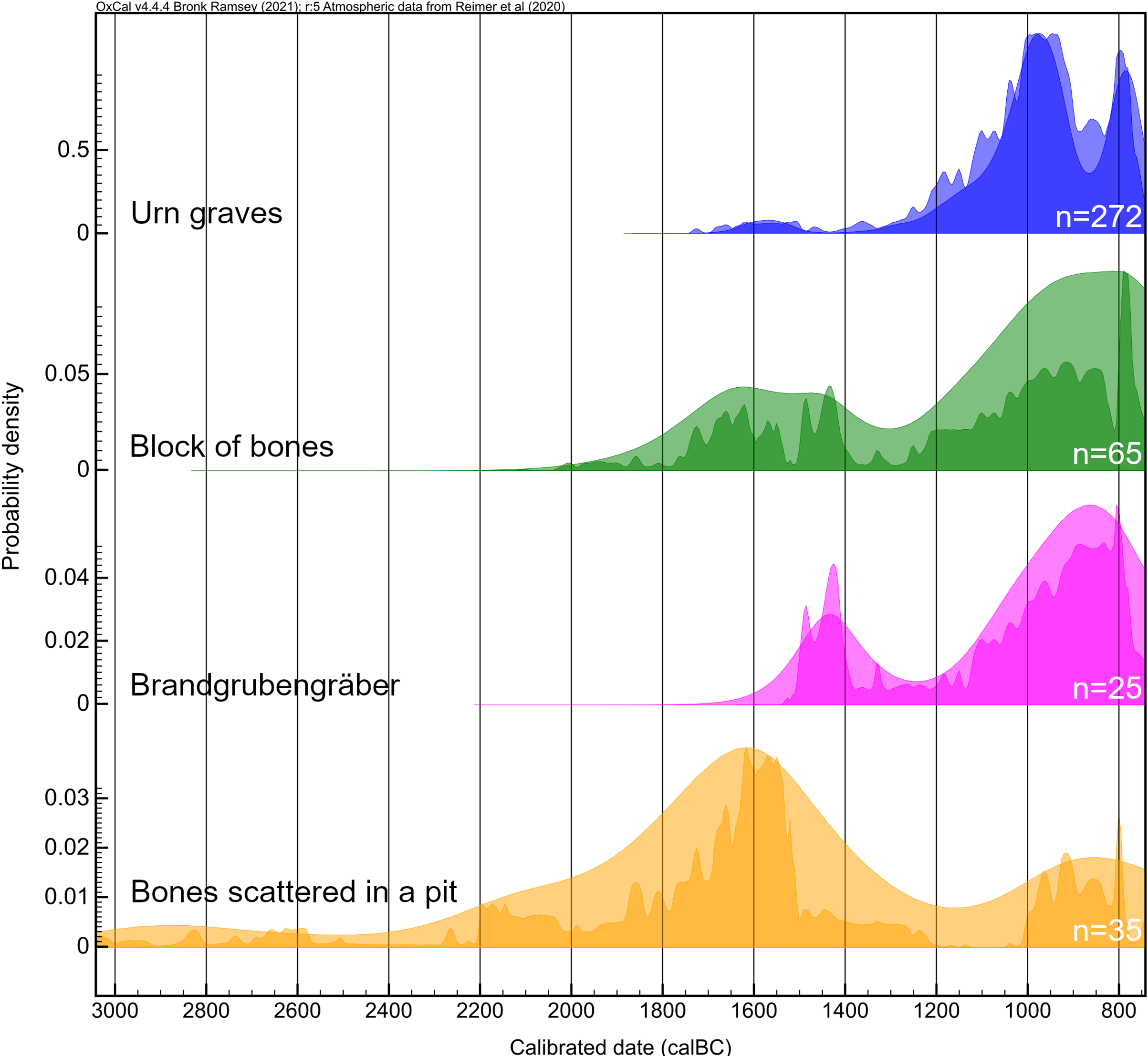
Eventually, to study the temporal distribution of four cremation grave types (urn graves, block of bones, Brandgrubengräber, and bones scattered in a pit; either in barrows or flat graves), four KDE models have been obtained (Figure 7). The results indicate that the simplest type, i.e., graves with bones scattered directly into pits, is the only type attested during the Final Neolithic. This type reached a maximum diffusion in the MBA during the 17th and 16th centuries BC. An absence of this grave type is recorded in the time span 1200–1000 BC. Blocks of bones, in some cases with charcoal, are present from the EBA (ca. 2000 BC) with a fluctuating trend in the analysed time span. The existence of a perishable container like textile that originally wrapped the human remains has been suggested for these grave types, defined by a clustered accumulation of cremated bones in the soil. The first use of ceramic urns can be dated to the 17th century BC in a phase of MBA A, but it is only from the end of the MBA B that they become largely adopted by local communities, becoming in the LBA the most common grave type, as also confirmed by the high number of dated contexts. The peak of urn graves around 1000–900 BC corresponds to the peak observed in flat graves, resulting from the wide use of the typical urnfield grave type in the Belgian area. Finally, Brandgrubengräber are in use since the 15th century BC, in the MBA B, with an increase in the number during the LBA.
SCPDs and posterior KDE models which describe the temporal diffusion of the following cremation grave types: urn graves, block of bones, Brandgrubengräber, and bones scattered in a pit, in Belgium between Final Neolithic and the Iron Age transition.
DISCUSSION
The new CRUMBEL radiocarbon dating campaign provided the oldest reliable 14C-dated Neolithic cremation from Belgium dating back to the end of the 5th millennium BC. Additionally, the KDE models produced combining this new 14C dataset with the already available dates from cremation deposits, inhumation burials and settlements spanning the Final Neolithic and the Bronze Age allowed to gain new knowledge on past funerary practices and population densities in Belgium. These results need to be interpreted taking into account the caveats of the “dates as data” approach, such as the taphonomic bias related to the expected more abundancy of dated samples for the most recent periods compared to the oldest phases and to the poor preservation of unburnt bones (inhumations) in acidic environments as the schist soils of the Ardennes plateau, in southern Belgium, and the sandy soils of northern Flanders; the much higher research intensity in archaeological excavations and sampling for radiocarbon dating in Flanders than in Wallonia (Capuzzo et al. Reference Capuzzo, Snoeck, Boudin, Dalle, Annaert, Hlad, Kontopoulos, Sabaux, Salesse, Sengeløv, Stamataki, Veselka, Warmenbol, De Mulder, Tys and Vercauteren2020), and eventually the biases of the technique addressed in Methods.
Final Neolithic
Neolithic cremation burials are extremely rare in the Belgian area and even fewer are the contexts that were submitted to radiocarbon dating. Only four sites provided 14C dates on Late and Final Neolithic graves: Kruishoutem-Wijkhuis; Oud-Turnhout, Hueve Akkers; Ranst-Zevenbergen; and the newly dated site of Geel-Groenhuis. This makes the new Middle Neolithic date (4216–3962 BC 2σ) from a cremated bone deposit in tumulus 8 at Bierbeek-Meerdaalwoud of exceptional importance, filling a gap in our understanding of funerary practices in the Michelsberg period. Information on other typologically dated Neolithic cremation graves originates mainly from archaeological excavations carried out in the last part of the 19th century and at the beginning of the 20th century. In those years, burnt bones, initially interpreted as cremation burials, associated with fragments of charcoal, Michelsberg pottery, and lithics were recovered at Ottenbourg and Boitsfort in the outskirts of Brussels (De Loë and Rahir Reference De Loë and Rahir1924). Part of these discoveries are currently preserved in the Art & History Museum (RMAH) in Brussels, but the cremated bones are not part of the collection. The posterior study by De Laet and Glasbergen (Reference De Laet and Glasbergen1959) and the following excavations at the sites carried out between 1968 and 1978 rejected the original funerary interpretation, attributing the archaeological evidence of both sites to dwellings and settlement structures (Stewart and Decart Reference Stewart and Decart2005). This reinforces the need of cautiously interpreting the results of the old excavations, especially when no osteological analyses or radiocarbon dates on human remains are available.
The 14C-dated funerary contexts showed that inhumation was largely predominant in the Final Neolithic and cremation was a marginal practice in Belgium and in northwestern Europe in the 3rd millennium BC. This is also confirmed by the very low number of cremation deposits dating to this period in France and the Netherlands (Gatto Reference Gatto2007; Bourgeois Reference Bourgeois2013; Billand et al. Reference Billand, Le Goff, Talon, Lehoërff and Talon2017). All the known Final Neolithic Belgian cremation deposits seem to be isolated graves as was the flat grave of Kruishoutem-Wijkhuis (De Laet and Rogge Reference De Laet and Rogge1972), where a layer of charcoal and few cremated bone fragments were found with an upside-down maritime Bell Beaker and a flint arrowhead. Another example comes from Lanaken-Neerharen (De Puydt Reference De Puydt1892; Bauwens-Lesenne Reference Bauwens-Lesenne1968), where a burial mound with an urn grave containing cremated remains was discovered in 1894 in a pit together with charcoal fragments, two silex blades, a polished axe, and pottery fragments. Regrettably, the bone material is missing, impairing further analyses. Central graves in barrow structures were identified at Ranst-Zevenbergen, dating to the first half of the 3rd millennium BC (Van Liefferinge Reference Van Liefferinge2009). The erosion of barrows and the loss of human remains due to the impact of agricultural activities certainly played an important role in the low amount of bone material recovered from these burial monuments. An example is Edegem-Buizegem (Antwerp) where a Final Neolithic barrow with circular post setting was discovered but no human remains were recovered in the structure (Vandevelde et al. Reference Vandevelde, Annaert, Lentacker, Ervynck and Vandenbruaene2007). The preservation of barrows was certainly better in wooded areas, like in the Campine region, northeastern Flanders, in the so-called Flemish Ardennes, and in the Netherlands (Bourgeois Reference Bourgeois2013).
Early Bronze Age
Early Bronze Age cremation deposits are also extremely rare. Only a few graves were attributed to the 2100/2000–1800/1750 BC time span, and only one of the 88 new radiocarbon measurements dates back to that period. At Weelde-Groenendaalse Hoef (Beex Reference Beex1959), the new 14C date from grave 6 revealed an EBA use of the barrow. At Wielsbeke-De Maurissenstraat, cremated bones of a child were deposited in the middle of a barrow and were 14C dated to the EBA (Beke and van den Dorpel Reference Beke and van den Dorpel2017). At Alveringem/Maldegem-Fluxys lot 3, two graves were dated to the EBA-beginning of the MBA A (Baeyens et al. Reference Baeyens, Dyselinck, Van Remoorter, De Mulder, Janssens, Christine Swaelens and Vanden Borre2018), as were the two cremation deposits from Waasmunster/Sombeke-Aquafintracé, one with the cremated remains associated with fragments of so-called Hilversum handmade pottery (Bradt et al. Reference Bradt, Kellner, Mestdagh, Van Hove and Acke2011). One grave was unearthed at Vleteren/Oostvleteren-Veurnestraat; contrary to the original interpretation, in which the 14C date on charcoal was rejected (Bracke et al. Reference Bracke, Scheltjens and Wyns2016), the bone deposit can be considered EBA. All these early contexts were urnless graves with the bone and charcoal fragments from the pyre deposited directly into pits, as in the two graves from Wijnegem-Blikstraat, which date to the EBA-MBA transition (De Mulder et al. Reference De Mulder, Van Strydonck, Boudin and Bourgeois2017), or in the form of block of bones with probably a perishable container, as at Wielsbeke-De Maurissenstraat (Beke and van den Dorpel Reference Beke and van den Dorpel2017) and Ronse-De Stadstuin (Pede et al. Reference Pede, Clement, De Cleer, Guillaume and Cherretté2015).
By comparing different proxies, such as the number of radiocarbon dates from cremation deposits, inhumation graves, and residential structures, it appears that the end of the 3rd and the beginning of the 2nd millennium BC, in comparison with earlier and later periods, were characterized by a low population count in the Belgian area. This period directly follows the 4.2 ka cal BP climatic event, which has been identified globally as a period of abrupt climate change (Bond et al. Reference Bond, Kromer, Beer, Muscheler, Evans, Showers, Hoffmann, Lotti-Bond, Hajdas and Bonani2001; Drysdale et al. Reference Drysdale, Zanchetta, Hellstrom, Maas, Fallick, Pickett, Cartwright and Piccini2006; Roland et al. Reference Roland, Caseldine, Charman, Turney and Amesbury2014; Cheung et al. Reference Cheung, Zhang, Hepburn, Yang and Richards2019; Rousseau et al. Reference Rousseau, Zanchetta, Weiss, Bini and Bradley2019; Lawrence et al. Reference Lawrence, Palmisano and de Gruchy2021; Di Rita et al. Reference Di Rita, Michelangeli, Celant and Magri2022; Younes and Bakry Reference Younes and Bakry2022). The origin of this rapid climate change has been traditionally linked to changes in the ocean-atmosphere circulation system in the North Atlantic, although recently this hypothesis has been questioned (Bradley and Bakke Reference Bradley and Bakke2019). The 4.2 ka event was responsible for pronounced dry conditions at lower latitudes and cooler and/or wetter conditions at higher latitudes of the Northern Hemisphere. These climatic conditions could have played a role in the population decrease detected in the KDE reconstructions, however the relationship between climatic change and archaeological/cultural changes is complex and more research is needed to increase the temporal resolution of local palaeoclimatic and palaeoenvironmental reconstructions between 3rd and 2nd millennium BC. More research is also needed to identify if this population contraction is a localized phenomenon. Currently, this negative trend for the end of the Final Neolithic and the EBA has not been observed in other areas, such as in northern Germany and southwestern Denmark (Feeser et al. Reference Feeser, Dörfler, Kneisel, Hinz and Dreibrodt2019; Kneisel et al. Reference Kneisel, Dörfler, Dreibrodt, Schaefer-Di Maida and Feeser2019), southern France (Berger et al. Reference Berger, Shennan, Woodbridge, Palmisano, Mazier, Nuninger, Guillon, Doyen, Begeot, Andrieu-Ponel, Azuara, Bevan, Fyfe and Roberts2019), and in eastern Iberia (Fyfe et al. Reference Fyfe, Woodbridge, Palmisano, Bevan, Shennan, Burjachs, Legarra Herrero, García Puchol, Carrión, Revelles and Roberts2019).
Middle Bronze Age
Based on the radiocarbon dates, the MBA seems to correspond to a period of repopulation of Belgium and demographic expansion, which could be the consequence of local population growth or the arrival of new peoples in the area, importing their own funerary traditions as evidenced by a clear preference for cremations. Regrettably, the absence of grave goods, with the exception of the few contexts with the so-called Hilversum pottery, is a constant in MBA cremations in the Belgian area and does not help in shedding light into people provenience on the basis of material culture. However, future analyses of strontium isotope ratios on MBA cremations could contribute to obtaining a clearer picture of these complex population dynamics. This period corresponds to the maximum development of the barrow phenomenon in northwestern Europe, with the construction of groups of mounds that formed characteristic and widely studied burial landscapes, particularly in the north of Belgium (De Reu Reference De Reu2012, Reference De Reu2014; De Reu and Bourgeois Reference De Reu, Bourgeois, Fontijn, Louwen, van der Vaart and Wentink2013; De Mulder et al. Reference De Mulder, Leclercq, Van Strydonck and Warmembol2016). In sandy soils of northwestern Belgium only, more than 1000 structures were identified as Bronze Age barrows (De Reu et al. 2013). Great variability has been observed in barrows regarding their size and the presence of one or two ditches or a palisade around the mound, which has been interpreted as the result of different cultural traditions (De Mulder et al. Reference De Mulder, Leclercq, Van Strydonck and Warmembol2016).
In the time span 1800–1400 BC, cremation deposit types attested in barrows were in the forms of graves with bones scattered directly into the pit, block of bones, more rarely urn graves and, from the MBA B (1500 BC), also as Brandgrubengrab-type graves. Among the earliest barrow cemeteries with preserved cremated remains, the site of Beerse-Krommenhof is one of the largest, revealing 10 barrows of which seven were excavated and contained cremated remains in urns, block of bones, and bone fragments scattered in a pit, all dated to the MBA A and the beginning of the MBA B (De Smaele et al. Reference De Smaele, Delaruelle, Thijs, Verdegem, Scheltjens and Van Doninck2011). MBA barrows commonly contained more than one grave, which could be placed at different locations, such as in the centre of the barrow, within the ditches or even inside the ditches. Remarkable examples are the tumulus 4 from Weelde-Groenendaalse Hoef, the circular double-ditched mounds of Rijkevorsel-Perenstraat, that contained five cremation graves inside the inner circle and within the two ditches, and the monument of Oud-Turnhout, Hueve Akkers, in which beside the central grave, seven other cremation deposits were identified directly inside the inner and the outer ditches, as was also the case detected in Beveren/Haasdonk-Zuurstofleiding/Groendam (Dyselinck and Hertoghs Reference Dyselinck and Hertoghs2017). The new radiocarbon measurements on these sites allow the reconstruction of the burial dynamics of the funerary monuments. At Oud-Turnhout, Hueve Akkers after the deposition of the Neolithic individual (Delaruelle et al. Reference Delaruelle, De Smaele, Thijs, Verdegem, Scheltjens and Van Doninck2012; De Smaele et al. Reference De Smaele, Delaruelle, Thijs, Verdegem, Scheltjens, Hertoghs and Van Doninck2012), the central grave was used as a burying place for at least two additional individuals as demonstrated by 14C measurements. One at the beginning and the other at the end of the MBA A. The other graves in the monument do not follow a specific chronological and spatial order in the depositions.
Cremation deposits under barrows are not the exclusive burial practice during the MBA in Belgium (De Mulder Reference De Mulder2019b, Reference De Mulder2020). The KDE modeling confirmed that early flat graves are attested in this phase as demonstrated by two block of bones graves recovered at Deinze/Bachte-Maria-Leerne (De Logi and Hoorne Reference De Logi and Hoorne2019), two bone deposits (S1220 and S1213) with cremated remains scattered directly in pits at Wijnegem-Blikstraat (De Mulder et al. Reference De Mulder, Van Strydonck, Boudin and Bourgeois2017), the isolated burial with block of bones at Brecht-Ringlaan (S3506-S3507) (Bracke et al. Reference Bracke, Mestdagh, Scheltjens and Wyns2017), and the isolated urn grave at Kruishoutem-Moerasstraat (Deschieter and De Wandel Reference Deschieter and De Wandel2010). Flat graves became more popular during the MBA B, with documented graves at Tessenderlo-Engsbergen, such as grave 14, the oldest Brandgrubengrab in Belgium (De Mulder et al. Reference De Mulder, Van Strydonck and De Clercq2013), Leuze-en-Hainaut/Blicquy-Ville d’Anderlecht (De Mulder et al. Reference De Mulder, Van Strydonck, Boudin, Lerclercq, Paridaens and Warmenbol2007), Kluizenmolen-Reepstraat (Lauwers et al. Reference Lauwers, Veselka, Van Strydonck and Boudin2016), Kuurne-Steenovenstraat (Beke and van den Dorpel Reference Beke and van den Dorpel2020), and Kampenhout-Tritsstraat (Hazen and Drenth Reference Hazen and Drenth2014). Peculiar is the case of Zingem-Ouwegemsesteenweg, where a cremated human bone package was recovered in a structure (S107) interpreted by the excavators as a water well (Vanhoutte and Apers Reference Vanhoutte and Apers2018).
The traditional archaeological interpretation adopted for the Central European Bronze Age was based on the existence of two phases: the Tumulus culture (Hügelgräberkultur) first followed by the urnfield culture (Urnenfelderkultur). The KDE modeling of burial structures (Figure 6b) and grave types (Figure 7) however shows a much larger complexity regarding funerary practices starting from the MBA in Belgium with the contemporaneous presence of barrows and flat graves and different forms of burying the cremated remains. This complexity has also been recently observed in central Europe by Brunner et al. (Reference Brunner, von Felten, Hinz and Hafner2020), who highlighted the existence of an immense variability of attendant phenomena within the burial practices and the funerary monument types. The identification of different funerary practices in the relatively small area of Belgium potentially reflects a high degree of socio-cultural variability regarding beliefs and the approach to death within human groups inhabiting northwestern Europe from MBA onwards. The area was indeed located at the crossroads between the so-called Atlantic (Channel-North Sea) and Continental (eastern France, the Rhine area, and western Switzerland) cultural traditions, while influences from the Nordic Bronze Age culture are also visible to a lesser extent (Mariën Reference Mariën1951; Warmenbol Reference Warmenbol, Brun and Mordant1988; Lehoërff et al. Reference Lehoërff, Bourgeois, Clark and Talon2012; Leclercq Reference Leclercq, Leclercq and Warmenbol2013; De Mulder Reference De Mulder2013, Reference De Mulder and Schuman2017; Stamataki et al. Reference Stamataki, Kontopoulos, Salesse, McMillan, Veselka, Sabaux, Annaert, Boudin, Capuzzo, Claeys, Dalle, Hlad, Sengeløv, Vercauteren, Warmenbol, Tys, De Mulder and Snoeck2021).
Late Bronze Age
The 14th and 13th centuries BC mark an episode of cultural change regarding burial practices. The popularity of barrows starts to decline, while the use of flat graves increases over time. This phenomenon, however, does not correspond to a standardization in cremation grave types. The increase of flat graves matches the increase of urn graves, which began in the 13th century BC and became more frequent during the 12 century BC until this burial practice reached its maximum diffusion in the second half of the 11th and in the 10th century BC (Figure 7). Traditionally, the appearance of the first elements of the urnfield tradition, whose main feature is the deposition of cremated remains in urns, dates to the Hallstatt A2 period (1100–1000 BC) in northwestern Belgium and to the Hallstatt B period (1050–800 BC) in northeastern Belgium (Desittere Reference Desittere1968; De Laet Reference De Laet1982). In contrast with this hypothesis, the obtained results point out that the increase of cremation deposits in urns, certainly related to the space-time diffusion of the urnfield phenomenon, can be dated to an earlier phase which started at ca. 1300 BC, as suggested by radiocarbon measurements on “old” urnfield graves, such as at Temse-Veldmolenwijk, Tessenderlo-Engsbergen, Beerse-Mezenstraat, Velzeke-Paddestraat, Wijnegem-Blikstraat, Boechout-Berthoutstraat, and Wetteren/Massemen-Kattenberg (De Mulder Reference De Mulder, Cahen-Delhaye and De Mulder2014; De Mulder et al. Reference De Mulder, Leclercq, Van Strydonck and Warmembol2016; Hiddink Reference Hiddink2019).
In addition to the urn graves, the LBA also shows a peak in the deposition of cremated remains in two other types of graves: block of bones and Brandgrubengräber (Figure 7), with a greater abundance of the first group over the second type. Brandgrubengräber constitute a quite sporadic burial practice during the Bronze Age with only 25 reliable contexts included in the KDE modeling. Previous studies estimated that during the LBA Brandgrubengrab-type burial represented approximately 15% of the cremation graves in urnfield cemeteries (De Mulder et al. Reference De Mulder, Van Strydonck and De Clercq2013). The spread of urnfield burials corresponds to a phase of abandonment of depositions in circular barrow structures, which are very rare in most of Belgium between 1300 and 1000 BC. However, small barrows seem to persist during the LBA in the Campine region as at Achel-Pastoorsbos (Beex and Roosens Reference Beex and Roosens1967) next to cemeteries with flat graves as Tessenderlo-Engsbergen and Lummen-Meldert (De Mulder et al. Reference De Mulder, Creemers and Van Strydonck2014), but no radiocarbon dates from cremation deposits in these monuments are available. These LBA barrows are part of the northwestern group identified by M. Desittere (Reference Desittere1968) in the southern Netherlands (Louwe Kooijmans et al. Reference Louwe Kooijmans, van den Broeke, Fokkens and Al2005).
The introduction of long barrow structures (Langbedden or Langgraben) is dated to the MBA B-LBA transition as revealed by a 14C date of a cremation deposit in an urn inside an oval-shaped ditch with triple pole circles at Beerse-Mezenstraat (Delaruelle et al. Reference Delaruelle, De Smaele and Van Doninck2008). These funerary monuments, characterized by an elongated shape, are documented in cemeteries 14C-dated to LBA such as Destelbergen-Eenbeekeinde/Panhuisstraat, Hofstade-Kasteelstraat, Herk-de-Stad Donk, Boechout-Berthoutstraat and Tessenderlo-Engsbergen and in the non-14C-dated sites of Achel-Pastoorbos, Neerpelt-De Roosen, Geel-Eikenvelden in Belgium and in the southern Netherlands (Roymans and Kortlang Reference Roymans and Kortlang1999; Louwe Kooijmans et al. Reference Louwe Kooijmans, van den Broeke, Fokkens and Al2005; De Mulder Reference De Mulder, Cahen-Delhaye and De Mulder2014; Hiddink Reference Hiddink2018). In the last phase of the LBA and in the EIA transition, a resumption of cremation deposits under barrows is shown by the modeled 14C data (Figure 6b). This phenomenon includes both the reuse of previous barrows as attested at Leuven/Wijgmaal-Kroonstraat (Pauwels Reference Pauwels2006), Tongerlo (Stamataki et al. Reference Stamataki, Sabaux, Hlad, Tys, Snoeck, Vercauteren, Warmenbol, Boudin, Annaert, Kontopoulos, Veselka, Dalle, Sengeløv, Capuzzo, Salesse, Monsieur and De Mulder2019) and Hamont/Achel-Haarterheide, and the erection of new burial mounds of smaller dimensions compared to the MBA ones as revealed by the newly dated cemetery of Saint-Vincent Grand Bois, Grave 2 of Herstal-Pré Wigier (Sabaux et al. Reference Sabaux, Veselka, Capuzzo, Snoeck, Sengeløv, Hlad, Stamataki, Boudin, Annaert, Dalle, Salesse, Debaille, Tys, Vercauteren and De Mulder2021), Neerpelt-De Roosen (Roosens and Beex Reference Roosens and Beex1961), and by the EIA tombelles of the Ardennes in southern Belgium. At Hamont/Achel-Haarterheide a secondary cremation deposit in a Harpstedt type urn, attributed to the Hallstatt C period (800–600 BC), was recovered in tumulus 1 and a secondary urn grave from tumulus 3 has been dated in this study to the 8th–7th century BC. Harpstedt urns under tumuli were also recovered in the same area at Overpelt-Dorperheide/Kruiskiezel (Engels and Van Impe Reference Engels and Van Impe1985). LBA cremation graves under tumuli were excavated at Grobbendonk-Scheidhaag, Bierbeek-Meerdaalwoud, and Wijgmaal-Kroonstraat (Pauwels Reference Pauwels2006) as confirmed by the radiocarbon measurements on the cremated bone deposits.
The Belgian region south of the Meuse river shows a clear lack of Bronze Age cremations. On the contrary, inhumation burials are present both in open-air sites as at the EBA site of Rebaix, Couture-Saint-Vaast (Cammaert et al. Reference Cammaert, Clarys, Van Assche, Gailly, Bloch and Mathieu1996) and in burial caves located in the Calestienne region, a narrow strip in Wallonia formed by limestone rocks, such as Trou del Leuve (Warmenbol Reference Warmenbol2006), Trou de Han (Jasinski and Warmenbol Reference Jasinski, Warmenbol and Campbell2017), Grotte de On (Polet et al. Reference Polet, Warmenbol, Boudin and Goffette2017), and Grotte de la Roche Albéric (Cattelain and Warmenbol Reference Cattelain and Warmenbol1993). Radiocarbon measurements on human bones from these funerary contexts suggest a continuous occupation of this area in the 2nd millennium BC (Capuzzo et al. Reference Capuzzo, Snoeck, Boudin, Dalle, Annaert, Hlad, Kontopoulos, Sabaux, Salesse, Sengeløv, Stamataki, Veselka, Warmenbol, De Mulder, Tys and Vercauteren2020). Funerary structures called marchets or cairns, formed by a circle of stones covered by a mound were excavated in the Calestienne mostly in the second half of the 19th century and at the beginning of the past century, frequently without a proper method and lacking documentation. These structures were interpreted as Bronze Age funerary monuments. Two of the few more recently excavated structures, the marchets of the Terre de David and Plateau des Cinques at Olloy-sur-Viroin, revealed two inhumations typologically and 14C dated to the end of the MBA (Cattelain and Warmenbol Reference Cattelain and Warmenbol1993; De Mulder and Warmenbol Reference De Mulder, Warmenbol, Marcigny and Mordant2021). These discoveries indicate that in the area south of the Meuse river including the Ardennes, during the Bronze Age local communities preferred the inhumation practice over the cremation practice, thus suggesting a sort of cultural independence and resilience. It is only in the last phase of the LBA, with the newly 14C-dated cemetery of Saint-Vincent, Grand Bois that cremation started to be largely adopted by local communities, becoming widespread in the Hallstatt C period (800–600 BC) as known by the great number of EIA burials in that region, such as at Louette-Saint-Pierre, Fosse aux Morts; Burg-Reuland, Grüffligen; Neufchâteau-Massul, Al Vaux; Saint-Vith, Neundorf; Gouvy-Halconreux, Fosse del Haye and Courtil-Pralles, Hastape (Warmenbol Reference Warmenbol1993; Leterme Reference Leterme2006; Heukemes Reference Heukemes2010; Capuzzo et al. Reference Capuzzo, Snoeck, Boudin, Dalle, Annaert, Hlad, Kontopoulos, Sabaux, Salesse, Sengeløv, Stamataki, Veselka, Warmenbol, De Mulder, Tys and Vercauteren2020; Draily et al. Reference Draily, Annaert, Boudin, Capuzzo, Dalle, De Mulder, Hanut, Hlad, Salesse, Sengeløv, Stamataki, Tys, Vercauteren, Veselka, Vrielynck, Warmebol, Snoeck and Sabaux2021).
To sum up, this research shows that Belgium during the end of the 3rd and the beginning of the 2nd millennium BC was a culturally peripheral area, compared to other European regions in which main archaeological cultures flourished, such as central and southern Britain with the Wessex culture, central and eastern Europe with the Únětice culture, northern Italy with the Polada culture, or southeastern Spain with the Argaric culture (Fokkens and Harding Reference Fokkens and Harding2013). The almost lack of evidence from funerary and settlement contexts could mirror a lack of a structured settlement system and local communities with a complex internal social organization. As observed by Mordant (Reference Mordant, Fokkens and Harding2013), Belgium, Britain, the Netherlands, and northern France do not seem to be a driving force behind the invention of metallurgy. As a consequence of this peripheral condition the area was characterized by a low anthropic presence and a sparse human occupation leading to lower resilience towards possible climatic change. Climatic instabilities could also have played a role in this scenario, although more research is needed to assess the relation between human occupation and palaeoclimatic trends in the area.
This situation radically changed at the beginning of the MBA. Hilversum tradition developed in this period in northern Belgium until the IJssel river in the Netherlands, showing connections with both southern England and northwestern France (Fokkens Reference Fokkens, Bourgeois and Talon2005). A repopulation of Belgium seems attested by the growing number of funerary contexts and settlements; this also marks the beginning of a phenomenon of cultural regionalisation with the southern part of the country following different cultural influences compared to the northern as shown by the lack of Bronze Age cremation south of the Meuse river. Significantly, late Beaker pottery with Barbed Wire decoration (Lanting Reference Lanting1973) dated to the end of the EBA is found in all the Low Countries except in the Ardennes (Fokkens and Fontijn Reference Fokkens, Fontijn, Fokkens and Harding2013).
Modeling of radiocarbon dates shows that the transition from barrows to flat graves in the MBA was not an abrupt event, but rather a gradual phenomenon in which both burial types coexisted over a large period (ca. 500 years). The traditional urnfield graves with cremated remains deposited inside urns appeared earlier than widely accepted, at ca. 1300 BC. This would imply the need of a revision of the beginning of the Late Bronze Age in the Belgian area, that should be assigned to an earlier period as suggested also in other recent studies (Leclercq Reference Leclercq2014; De Mulder et al. Reference De Mulder, Leclercq, Van Strydonck and Warmembol2016).
Regional differences persist during the LBA, as also recently confirmed by variations in cremation conditions between the Scheldt and the Meuse basins in Belgium (Stamataki et al. Reference Stamataki, Kontopoulos, Salesse, McMillan, Veselka, Sabaux, Annaert, Boudin, Capuzzo, Claeys, Dalle, Hlad, Sengeløv, Vercauteren, Warmenbol, Tys, De Mulder and Snoeck2021). The northern area makes part of the so-called Atlantic Bronze Age, while in the southern area cultural influences from southeastern France and the western Swiss regions prevail, as confirmed by the presence of characteristic finely incised and combed decorated pottery which is linked to the Rhin-Suisse-France Oriental tradition (RSFO) (De Mulder et al. Reference De Mulder, Leclercq, Van Strydonck and Berg2008). However, the practice of cremation, which was a main element in the RSFO tradition, was not adopted by local communities south of the Meuse river, which preferred following the inhumation practice over cremation.
CONCLUSION
The large new dataset consisting of 88 radiocarbon dates on fragments of calcined bone and charcoal from 23 archaeological sites spanning from the end of the 5th to the beginning of the 1st millennium BC has allowed to obtain new knowledge on Middle Neolithic, Final Neolithic, and Bronze Age funerary practices in Belgium. As a result, the oldest reliably radiocarbon-dated Neolithic cremation burial in Belgium, datable to the Michelsberg period, has been identified. Thanks to the KDE modeling applied to these new radiocarbon measurements, jointly with previously 14C-dated cremation deposits and inhumation burials, it has been possible to quantify the timing of positive and negative trends in the use of barrows vs. flat graves and different cremation grave types in the Final Neolithic and the Bronze Age in the Belgian area. Moreover, adding the chronological information from 14C-dated settlements, knowledge on local population variations has been inferred. Inhumation burials started to decline in the second half of the Final Neolithic reaching a minimal presence in the Early Bronze Age, two periods in which cremation was still a marginal funerary practice. Archaeological evidence from settlements seems also very rare at the end of the 3rd millennium BC. These results would suggest a major episode of population contraction dated to the end of the 3rd and the beginning of the 2nd millennium BC. This time span corresponds to the 4.2 ka cal BP climatic event, which has been identified globally as a period of abrupt climate change. A certain climatic variability seems to characterize Belgium, although the temporal resolution of local palaeoclimatic and palaeoenvironmental reconstructions need to be improved and more research is needed to assess the causes of the cultural and demographic changes observed in the models.
An increase in complexity in burial practices is observed from the Middle Bronze Age, in correspondence to what could be called a repopulation of Belgium starting from ca. 1800 BC. After a period in which cremation deposits were mainly urnless, with cremated bones scattered directly in pits, the obtained KDE reconstructions show a complex panorama with the contemporary presence of cremations under burial mounds, flat graves in a lower number and the introduction of new grave types. The KDE models indicate an introduction of block of bones from the Early Bronze Age (ca. 2000 BC) and Brandgrubengräber from the Middle Bronze Age B (ca. 1500 BC). The major episode of cultural change must be placed in the 14th–13th centuries BC with the progressive abandonment of burial mounds and the wide adoption of flat graves. Such a change was probably promoted by the arrival of new cultural influences from the south, within the urnfield phenomenon. This dating could imply an earlier beginning of the Late Bronze Age, traditionally associated with the introduction of the first urnfield elements in the Belgian area. Overall, a complexity in cremation funerary practices persists during the Late Bronze Age with the contemporary presence of four grave types: urn graves, block of bones, Brandgrubengräber, and bones scattered in a pit, with the large predominance of the first category over the others. The geographic position of Belgium, influenced by Atlantic (Channel-North Sea) and Continental (eastern France, the Rhine area, and western Switzerland) cultural traditions certainly played a major role in the 2nd millennium cremation practices diversity.
ACKNOWLEDGMENTS
This project was made possible thanks to the financial support of the FWO-F.R.S.-FNRS with the EOS project No. 30999782 CRUMBEL. Cremations, Urns and Mobility - Ancient Population Dynamics in Belgium. We would like to thank the Fonds Wetenschappelijk Onderzoek – Vlaanderen (FWO) for E. Stamataki and M. Hlad’s doctoral fellowships and the Fonds de la Recherche Scientifique (F.R.S.-FNRS) for A. Sengeløv’s doctoral fellowship. We acknowledge all the institutes that provided the cremated bone material from their collections: the Agence Wallonne du Patrimoine (AWAP), the Agentschap Onroerend Erfgoed, the Art & History Museum (RMAH), the Archeologische Dienst Waasland (now Erfpunt), Archief & Musea Turnhout, the depot Stad Antwerpen, Erfgoed Noorderkempen, Fodio BVBA, the Gallo-Roman Museum in Tongeren, the University of Gent, the Provinciaal Archeologisch Depot of Antwerpen, and the Vlaams Erfgoed Centrum (VEC). We also thank Tess Van den Brande and Gaia Ligovich for the sample preparation for radiocarbon analyses. Eventually, we also express our gratitude to C. Bronk Ramsey and an anonymous reviewer for their constructive comments that improved the quality of the article.
Supplementary material
To view supplementary material for this article, please visit https://doi.org/10.1017/RDC.2022.94


 Open access

