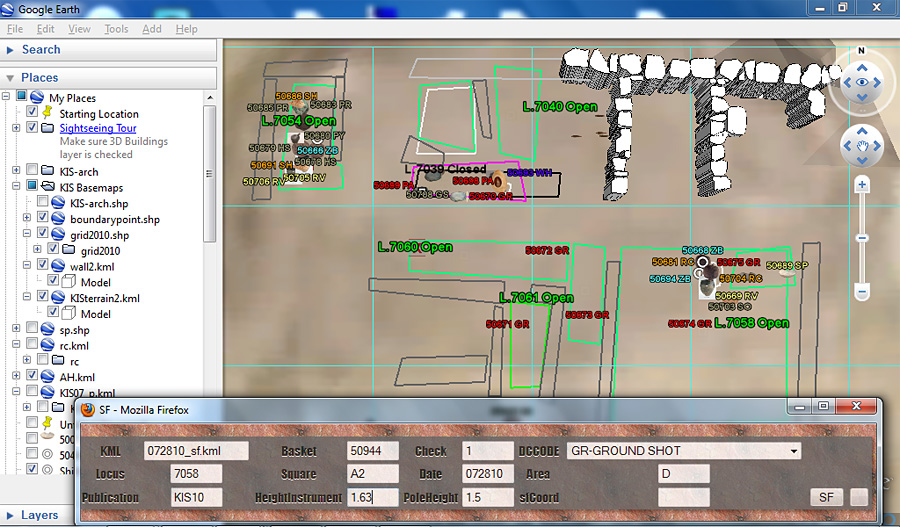


Building upon previous implementations of an on-site digital archaeology system for field recording (Levy & Smith 2007; Levy et al. 2010; Petrovic et al. 2011; Gidding et al. in press), a real-time 3D data recording interface called ArchField has been developed for a total reconstruction of architecture and recovered material culture (Figure 1). Since 1998, the methodological goal of our fieldwork has been to develop a streamlined fully integrated Geographic Information System (GIS) that would enable the production of digital top plans and at the end of the season publication-quality digital maps, charts and tables. By using GIS as the nexus for data storage and analysis, our research has played a major role in the application of digital/cyber-archaeology field methods to help answer historical, anthropological and archaeological questions. These goals have led to the innovation of a new on-site digital archaeology recording system for field recording and digital conservation called ArchField.
ArchField Data Entry graphical user interface with Google Earth real-time display in background (screen shot of Khirbat al-Iraq in Showbak, Jordan).

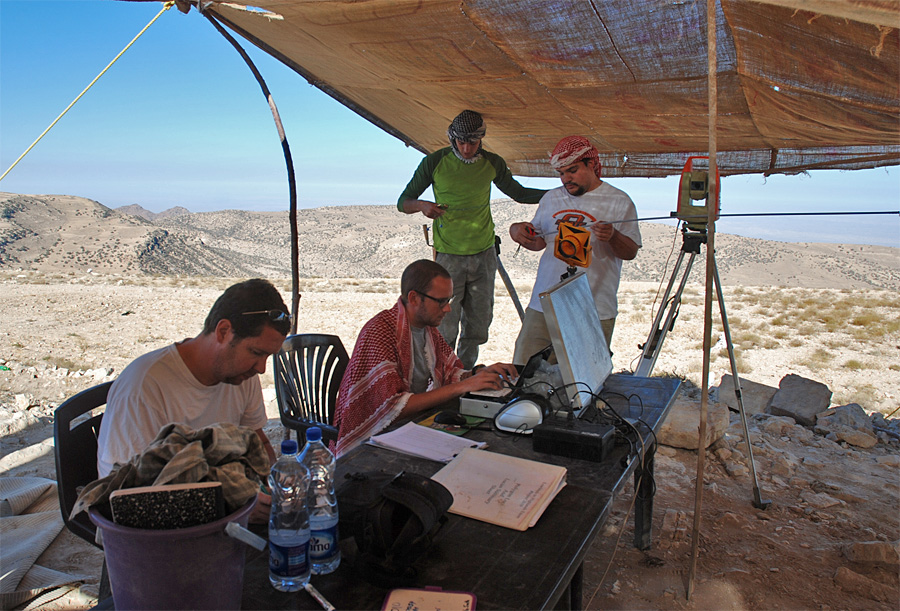
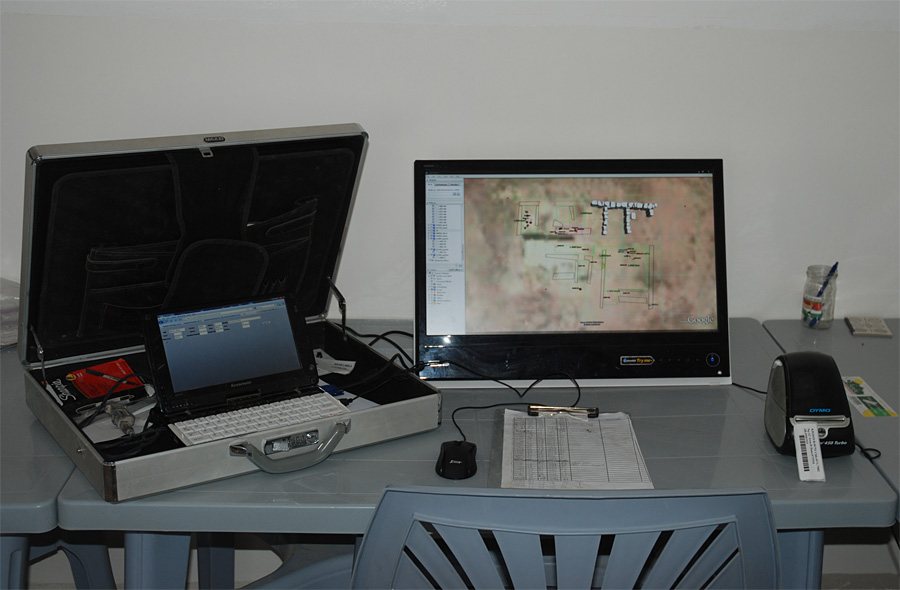
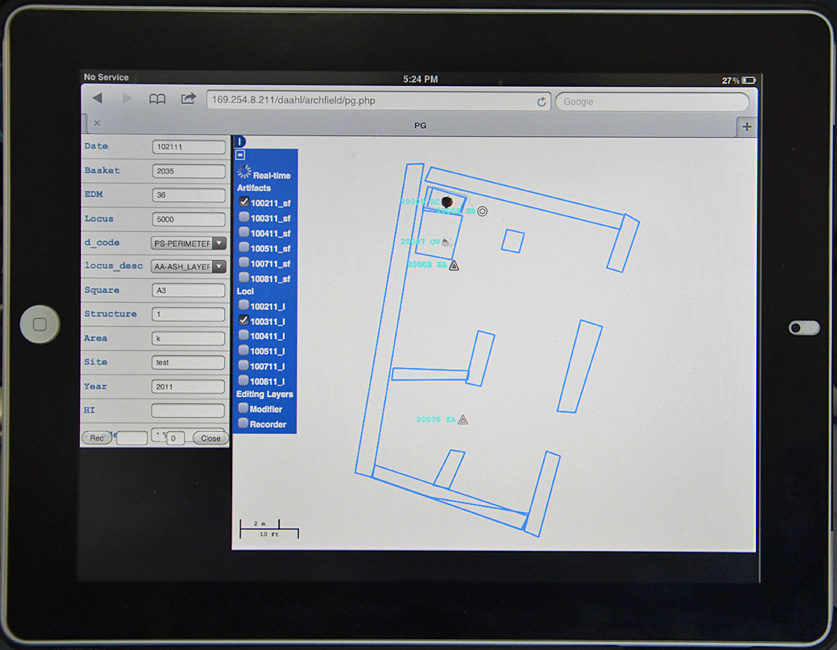
As more archaeological projects move towards the digitisation of their field data there arises a greater need for precision in the recording of artefacts and loci during excavation and affordable tools to accomplish this goal. Until now, the development of software to record data in the field that directly communicates with high precision recording equipment has remained a project of the commercial sector. These programs' limitations to an archaeologist and cost have led to a very limited adoption of digital field entry programs for on-site recording of artefacts, features, and loci. ArchField is such an open-source solution, designed to meet archaeologists' digital recording needs. It is an OS independent, web-based program for all excavation data recording, designed to store data in a server-based online database and automatically render in the field what is being excavated. Using ArchField, a total station or GPS unit can be connected to any data entry device, preferably a field-ready laptop but smartphones (e.g. iPhone or Android Phone), rugged pdas (e.g. TDS Recon) or tablets (e.g. iPad) can also run ArchField (Figures 2–4). When the team returns from the field the data recorded in ArchField is auto-synchronised with the field's lab server. It is a tool that allows any archaeologist with a minimal amount of training to generate maps, conduct analyses, and visualise queried results in full three-dimensions.
Students in the field using ArchField with a Leica Total Station (system in operation at Khirbat al-Iraq)

Full setup of digital field recording equipment using ArchField with Google Earth on a portable 24" lcd, labelwriter, and second touchscreen netbook in CISA3 Showbak Cyber-archaeology Research Laboratory, Jordan, 2010.

iPad version of ArchField with imbedded OpenLayers for real-time visualisation of recorded data (screenshot of Khirbat Nuqayb al-Asaymir 2011 in Faynan, Jordan).

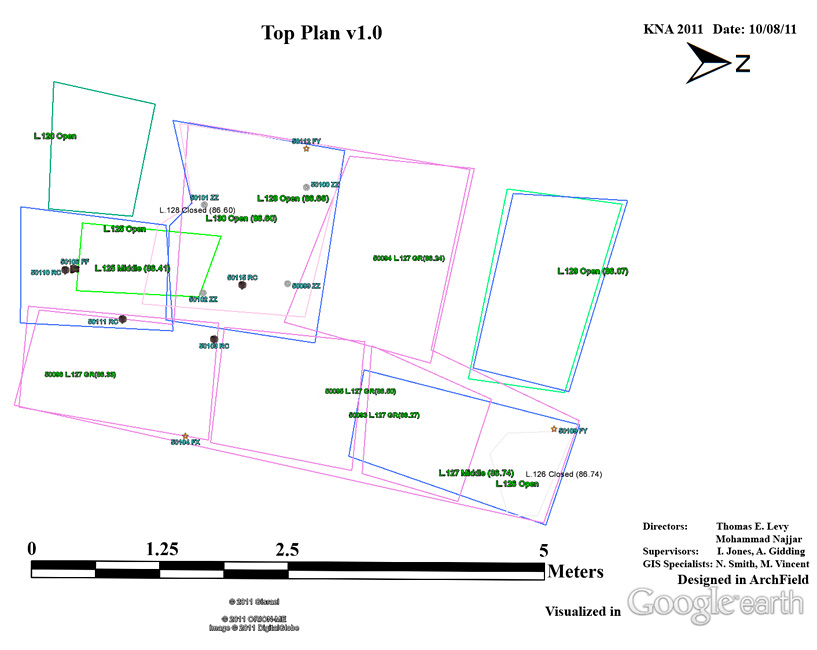
Real-time top plan produced by ArchField that is currently being visualised in Google Earth (Khirbat Nuqayb al-Asaymir , 2011).

The primary functionality of ArchField is to facilitate and streamline the procedures to properly record the provenience of artefacts and loci in 3D space and display them in a format understandable to archaeologists in real-time. Traditional analogue methods in archaeology to describe artefacts in 3D involved the manual recording of artefact positions by the use of measuring tapes and levelling devices. The locations of artefacts or loci were then plotted onto graph paper, colour coded and then labelled (e.g. on a top plan). With ArchField, every artefact and three-dimensional locus polygon is recorded with sub-centimetre accuracy. As the vertices for the locus' polygon are recorded, the user can watch as it is formed. Once an artefact or polygon is recorded, all its data can be accessed and edited within ArchField. The ability for ArchField to process the recorded data in real time allows it to auto-generate a 'digital' top plan at the moment data is recorded in the field (Figure 5).
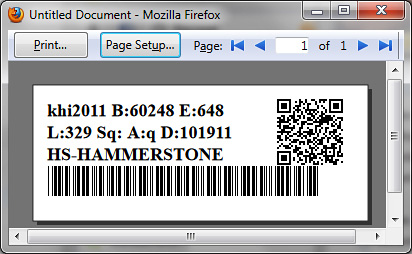
Digitally-generated label with barcode and QRcode (bar code of hammerstone found at Khirbat Hamrat Ifdan in Faynan, Jordan, 2011).

ArchField's method for data storage is open-source based and interoperable with many GIS software systems. PostgreSQL with PostGIS was adopted as the primary server-based database. Data stored in the database can be retrieved by ArchField and formatted to function with any other mapping program. Moreover, other mapping programs or map servers can read PostGIS databases without the intervention of ArchField. The interoperability of the software and accessibility of the PostGIS database means that complex spatial and analytical studies can be off-loaded, using ArchField, to numerical computing environments with dedicated programming languages or a networked Linux cluster.
ArchField also enables the use of auto-generated printed labels with barcodes and QRcodes in the field (Figure 6). These can then be used to rapidly pull up an artefact's information on a computer using a barcode scanner or iPhone. The printed labels save time for the registrar, eliminate the chance that they may write the wrong information, and prevent the label from being misread by others.
Future directions
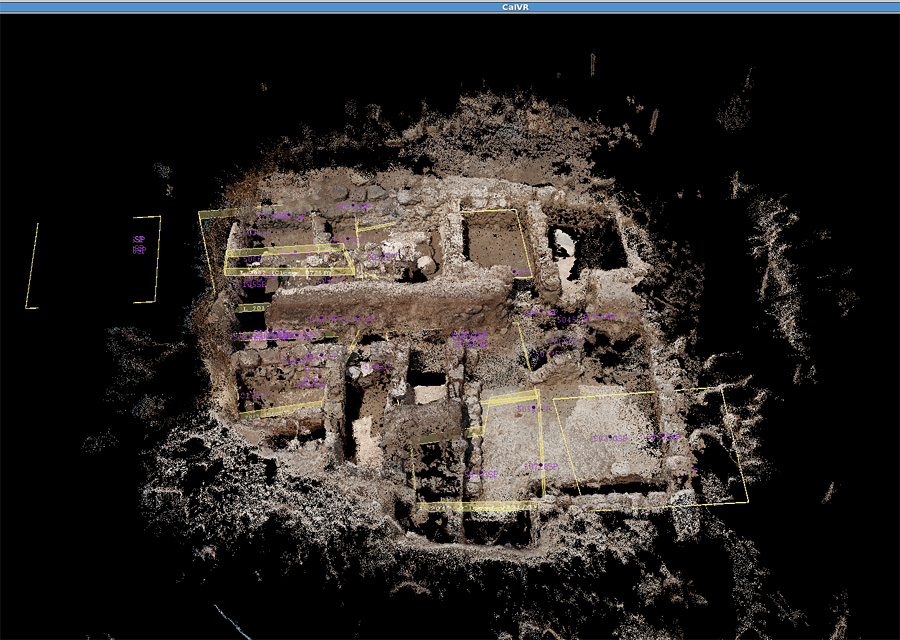
Dense point-cloud 3D reconstruction (SfM) of architecture from Khirbat al-Iraq running in CalVR with ArtifactVis (architecture from Khirbat al-Iraq: 2010, Iron Age II (800-600 BCE))

The use of ArchField opens many possibilities in how data is visualised and analysed in the field. Since summer 2010, we have begun to develop a fully three-dimensional stereoscopic program called ArtifactVis for visualising the 3D data recorded in ArchField (Figure 7). It enables us to integrate ArchField data with 3D point cloud models of a site. The goal is to produce a fully immersive and interactive 3D environment in which complex analyses can be visualised. Our team is in the field in southern Jordan is at present in the middle of fully integrating ArchField and ArtifactVis into our digital field recording.
Now that the initial prototype has been successfully implemented and evolved over two field seasons it is imperative to develop and test the second stage of streamlining the software to make it easily adaptable to very different archaeological projects and old recording systems. Current builds of ArchField will be shared broadly online from ArchField's website (http://adaa.ucsd.edu/ArchField/).
Acknowledgments
This project was funded by a Digital Humanities Start-Up grant from the National Endowment for the Humanities. ArchField is also incorporated into various UCSD graduate student research excavations carried out in Jordan's Faynan district as part of the National Science Foundation (NSF) Integrative Graduate Education and Research Traineeship (IGERT) program sponsored by the Center of Interdisciplinary Science for Art, Architecture and Archaeology (CISA3). We are grateful to the Department of Antiquities of Jordan, and ELRAP/L2HE co-director Dr. Mohammad Najjar. We also would like to thank Connor Defanti and Dr. Jurgen Schulze for their work to integrate CalVR with ArchField.