

An individualised learning profile is a recommended and accepted practice for students on the autism spectrum to maximise learning and facilitate an understanding of unique challenges and strengths (Clark et al., Reference Clark, Adams, Roberts and Westerveld2020; Iovannone et al., Reference Iovannone, Dunlap, Huber and Kincaid2003). Components of an individualised process are required by law in many countries. In the United States (US), the Individuals with Disabilities Education Act (IDEA, 2004) mandates the use of an individualised educational plan (IEP), and in Australia, the Disability Standards for Education 2005 dictates the involvement of parents/caregivers and students as a collaborative planning component when possible (Australian Government, 2005). In a review of educational interventions, Iovannone and colleagues (Reference Iovannone, Dunlap, Huber and Kincaid2003) identified individual planning as a core component for effective educational practices for students on the autism spectrum. Following COVID-19, the need for individualised educational programs has become even more critical because of the disruption of learning that occurred during the pandemic (Hurwitz et al., Reference Hurwitz, Garman-McClaine and Carlock2022).
Individualised planning is a collaborative process involving the student, their parents/caregivers, and their educational team, including teachers and other support services or allied health professionals. Despite the requirements for the process in many countries, stakeholders often report that it is not successful or consistently implemented (Snell-Rood et al., Reference Snell-Rood, Ruble, Kleinert, McGrew, Adams, Rodgers, Odom, Wong and Yu2020). Teachers responsible for leading the process for students on the autism spectrum and their parents/caregivers require a high level of autism expertise (Segall & Campbell, Reference Segall and Campbell2012; Soto-Chodiman et al., Reference Soto-Chodiman, Pooley, Cohen and Taylor2012). Parents and caregivers also need to be prepared to advocate for their children (Smith-Young et al., Reference Smith-Young, Chafe, Audas and Gustafson2022). However, according to a recent systematic review, teachers’ knowledge of autism is poor (Gómez-Marí et al., Reference Gómez-Marí, Sanz-Cervera and Tárraga-Mínguez2021), and parents/caregivers face several barriers to advocacy, including time commitments, financial challenges, system bureaucracies, stigma, and lack of knowledge and support (Smith-Young et al., Reference Smith-Young, Chafe, Audas and Gustafson2022). Therefore, there is a critical need for interventions that can assist students on the autism spectrum, their families, and their educators and support more reliable implementation of individual planning (Snell-Rood et al., Reference Snell-Rood, Ruble, Kleinert, McGrew, Adams, Rodgers, Odom, Wong and Yu2020).
One such intervention is the Collaborative Model for Promoting Competence and Success (COMPASS; Ruble, Dalrymple, & McGrew, Reference Ruble, Dalrymple and McGrew2012). COMPASS is coordinated by an autism-specific consultant who works with the parent/caregiver, teacher, and student to develop individualised goals and teaching plans and measure progress on the goals throughout the school year. The intervention has two parts: (a) an initial consultation with all stakeholders that lasts 3 hours and (b) four follow-up coaching sessions for the teacher and the consultant to review student progress. The primary outcome for COMPASS is progress towards a student’s individualised goals (see the 2012 COMPASS manual for more information; Ruble, Dalrymple, & McGrew, Reference Ruble, Dalrymple and McGrew2012; and the most recent version; Ruble & McGrew, Reference Ruble and McGrew2023), with positive effects demonstrated in a number of trials conducted in the US using both web-based and face-to-face delivery (Ruble & McGrew, Reference Ruble and McGrew2013; Ruble et al., Reference Ruble, McGrew, Dalrymple and Jung2010, Reference Ruble, McGrew, Toland, Dalrymple, Adams and Snell-Rood2018) and an adaptation conducted in Australia (Love et al., Reference Love, Cai, Stephenson, Gallagher, Toland and Gibbs2024). The Australian adaptation was the first to replicate COMPASS using community-based consultants; previously, COMPASS relied on researchers as consultants. Additionally, this adaptation was conducted in an autism-specific classroom within Australia — a deviation from the previously published US samples.
The success of a research-based intervention such as COMPASS relies on the acceptability and satisfaction of the stakeholders involved. Acceptability research is an important step in the research process and is ‘designed to obtain useful information for examining the extent to which an intervention meets the needs of the target population and organizational setting’ (Ayala & Elder, Reference Ayala and Elder2011, p. S75). Although randomised-controlled trials may demonstrate statistical effectiveness, an understanding of the benefits and challenges from the perspective of stakeholders helps to ensure that the intervention is feasible and practical. Additionally, insights gained from qualitative studies can help to strengthen the evidence that supports the replication and adaptation of interventions such as COMPASS in diverse settings, understanding the perspectives of stakeholders who experience and perceive COMPASS. In school-based research, qualitative research can help to enrich acceptability and feasibility data specifically. Currently, qualitative examinations of COMPASS have supported COMPASS adaptations, such as the adaptation for transition-age students (e.g., Ruble, McGrew, Snell-Rood, et al., Reference Ruble, McGrew, Snell-Rood, Adams and Kleinert2019; Ruble et al., Reference Ruble, McGrew, Toland, Dalrymple, Adams and Snell-Rood2018; Snell-Rood et al., Reference Snell-Rood, Ruble, Kleinert, McGrew, Adams, Rodgers, Odom, Wong and Yu2020), but have not yet examined acceptability.
Current Study
According to the latest statistics, approximately 4% of children aged 12 years in Australia have a diagnosis of autism (May et al., Reference May, Brignell and Williams2020). These students are educated in a variety of classroom environments, including mainstream schools, special schools, and schools or classes designed specifically for students on the autism spectrum (Australian Bureau of Statistics, 2017; Mitchelson et al., Reference Mitchelson, Adams and Simpson2022). Despite the range of educational settings available, autistic Footnote 1 students in Australia have poorer educational outcomes than students with other disabilities (Jones et al., Reference Jones, Akram, Murphy, Myers and Vickers2018) and change schools more frequently due to a lack of autism awareness among educators, insufficient social support and resources, and poor home–school collaboration (Mitchelson et al., Reference Mitchelson, Adams and Simpson2022).
The current study is part of a larger study that explored the effectiveness of COMPASS in Australian schools for students on the autism spectrum (Love et al., Reference Love, Cai, Stephenson, Gallagher, Toland and Gibbs2024) and is the first attempt to replicate COMPASS outside of the US. In this study, we found that students whose individualised program planning was supported by the COMPASS process made more progress on their individualised goals than students who received individualised program planning as per usual (Love et al., Reference Love, Cai, Stephenson, Gallagher, Toland and Gibbs2024). In addition, 75% of the students in the COMPASS group achieved their goal, and fidelity, adherence, and satisfaction among participants was demonstrated (Love et al., Reference Love, Cai, Stephenson, Gallagher, Toland and Gibbs2024). The aim of this qualitative component of the research project was to explore the perspectives of parents/caregivers, teachers, and consultants on the potential benefits and barriers of the COMPASS process.
Methods
This study was approved by the University of Sydney (#2020/761). In this study, we utilised a sample of participants including teachers, consultants, and parents/caregivers who participated in a trial of COMPASS in 2021. Participants attended one of three autism-specific schools in Australia, all privately run by Autism Spectrum Australia. Focus groups and interviews were conducted with COMPASS participants at the end of the year to explore the impact of COMPASS on teachers, consultants, and parents/caregivers and any perceived benefits and barriers to the intervention.
Community Involvement Statement
Our study reflected a ‘co-produced’ model where autistic and non-autistic researchers worked together to answer a question of interest that was common to all team members. In addition, during the design phase, two autistic research assistants worked alongside the research team to design the study, review the measures, and offer advice on the methodology. During the full lifecycle of the study, an autistic research assistant worked alongside a non-autistic researcher to support recruitment, data collection, and data analysis. Finally, this research study was co-produced with education staff members, including school principals, teachers, and consultants, who work at autism-specific schools and were invested in the research to improve their educational practices. The schools and staff members involved were committed to a continuous improvement project where one of their goals was to examine their individualised goal-setting procedures and understand how to improve them and ultimately improve student outcomes.
Recruitment
This study was conducted in three schools in NSW, Australia, from January to December 2021. Recruitment was a multi-step process and involved getting administrative (principal) support, and then seeking interest from their team of consultants or school coordinators. From there, teachers and then parents/caregivers were recruited, and participants were given a participant information sheet and provided their consent (see Love et al., Reference Love, Cai, Stephenson, Gallagher, Toland and Gibbs2024, for full recruitment details). Once informed consent was gathered from all participants, training for COMPASS consultants began before the start of the 2021 Australian school year (January–December). As COMPASS is delivered through the consultant, a COMPASS training package was provided by the original authors of COMPASS and adapted for the Australian context (Ruble et al., Reference Ruble, McGrew, Dale and Yee2022).
Participants
Participants in the study included consultants (n = 7), teachers (n = 15), and parents/caregivers of autistic students (n = 20). Consultants (M age = 43.8 years, SD age = 6.2) were experienced teachers employed by the schools to provide supervision to classroom teachers and had been in this consulting role for an average of 6.9 years (SD = 4.4). Teachers (M age = 41.0 years, SD age = 9.9) had been teaching for an average of 15.4 years (SD = 9.9). Both teachers and consultants were predominantly female, with one male participant in each group. Parents/caregivers who participated were 95% female and had a mean age of 39.5 (SD age = 7.6). They were predominantly parents/carers of boys (83%) who ranged in age from 5 to 18 years (M age = 9.3, SD age = 3.2). To attend the schools that participated in this study, a formal diagnosis of autism was required.
Description of Intervention
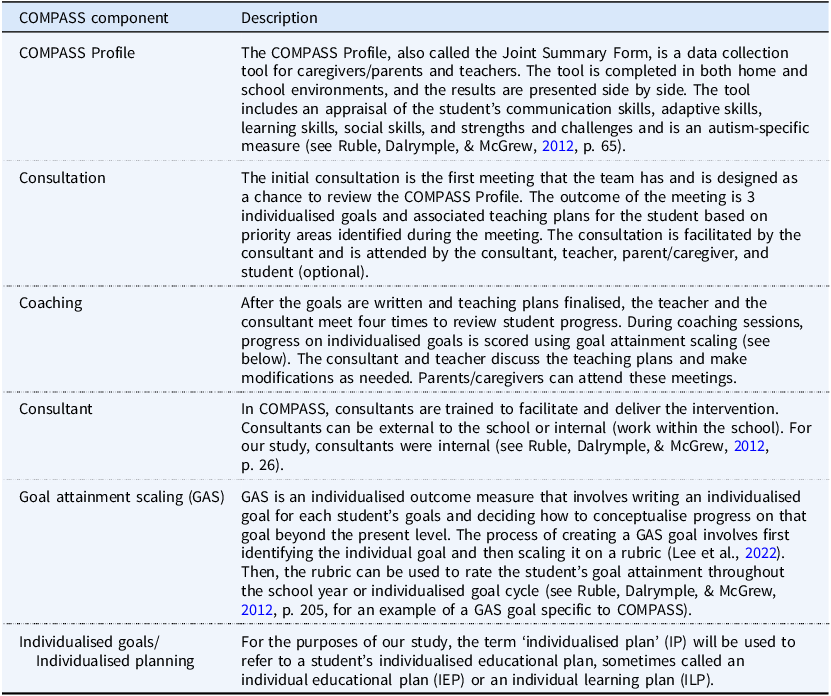
The COMPASS intervention begins with an initial consultation, where the student’s team (i.e., parent/caregiver, student, consultant, and teacher) review data from the school and home environments side by side using a data tool, the COMPASS Profile, which was specifically designed for this purpose (see Ruble & McGrew, Reference Ruble and McGrew2023). The outcome of the consultation is the creation of three goals (a communication, social, and learning goal) that are written together as a team along with associated teaching plans so that all members of the student’s team can carry out the intervention plans. To avoid recognised challenges with goal setting (Lee et al., Reference Lee, Shogren, Segal, Pezzimenti, Aleman-Tovar and Taylor2022), the goals are then measured using goal attainment scaling (GAS) across four coaching sessions, where the consultant supports the teacher in reviewing the student’s progress towards the goal and the associated teaching practices (Ruble et al., Reference Ruble, McGrew, Dale and Yee2022). A GAS is an individualised outcome measure with standardised goal scaling and asks the team to consider not only the student’s goal but also how this goal is linked to the student’s present level and what progress looks like (Love et al., Reference Love, Cai, Stephenson, Gallagher, Toland and Gibbs2024). Critical components of COMPASS are presented in Table 1, and more details can be found in the original (Ruble, Dalrymple, & McGrew, Reference Ruble, Dalrymple and McGrew2012) and updated manual (Ruble & McGrew, Reference Ruble and McGrew2023).
Components of COMPASS
Data Collection
The data from this study came from two sources: interviews with parents/caregivers and teachers and focus groups with consultants. Interviewers were exit interviews that were conducted over the phone or on Zoom by the first and second authors using a semistructured question guide. Interviews lasted 20–30 minutes. The interviews were at the end of the school year after the COMPASS intervention had been carried out for 1 year. The interviews were conversational in style with broad open-ended questions that were used to elicit information about the participants’ experiences and perspectives of the COMPASS program for their student and family. Guiding questions included, ‘Were there any strengths associated with using COMPASS this year for you and your students?’ and ‘Were there any challenges or disadvantages associated with COMPASS this year for you and your students?’ Additionally, a 60-minute focus group was conducted with six of the seven consultants who delivered the COMPASS program to discuss any perceived benefits and challenges of COMPASS, from their perspective, that were encountered throughout the school year.
Data Analysis
Braun and Clarke’s (Reference Braun and Clarke2006, Reference Braun and Clarke2019, Reference Braun and Clarke2023) reflexive thematic analysis framework was used, which involved an inductive or bottom-up process to identify patterns of meaning within the dataset. The qualitative analysis was informed by our experience and training in psychology and education, and by positionality as an autistic self-advocate (fourth author). To start the thematic analysis, the first author, who conducted 50% of the interviews, read the transcripts to re-familiarise themselves with the data, and notes were taken. Once transcripts were read, relevant pieces were coded by the first author (NVivo 12 software). In this analysis, patterns are identified using both semantic and latent coding, which results in the interpretation of both explicit and subtler content. Once the coding of all transcripts was completed, the first author identified patterns of codes to generate an initial set of themes and subthemes as well as a thematic map. Next, the fourth author reviewed the codes to provide additional input, contribute to data trustworthiness, and create themes and subthemes from the codes. The first author reviewed the initial set of themes and subthemes, then resolved any discrepancies and decided on a final set of themes and subthemes. The full research team engaged in regular discussions to refine the themes and subthemes. (Refer to Bryne, Reference Byrne2022, for a worked example of Braun and Clarke’s approach to reflexive thematic analysis.)
Results
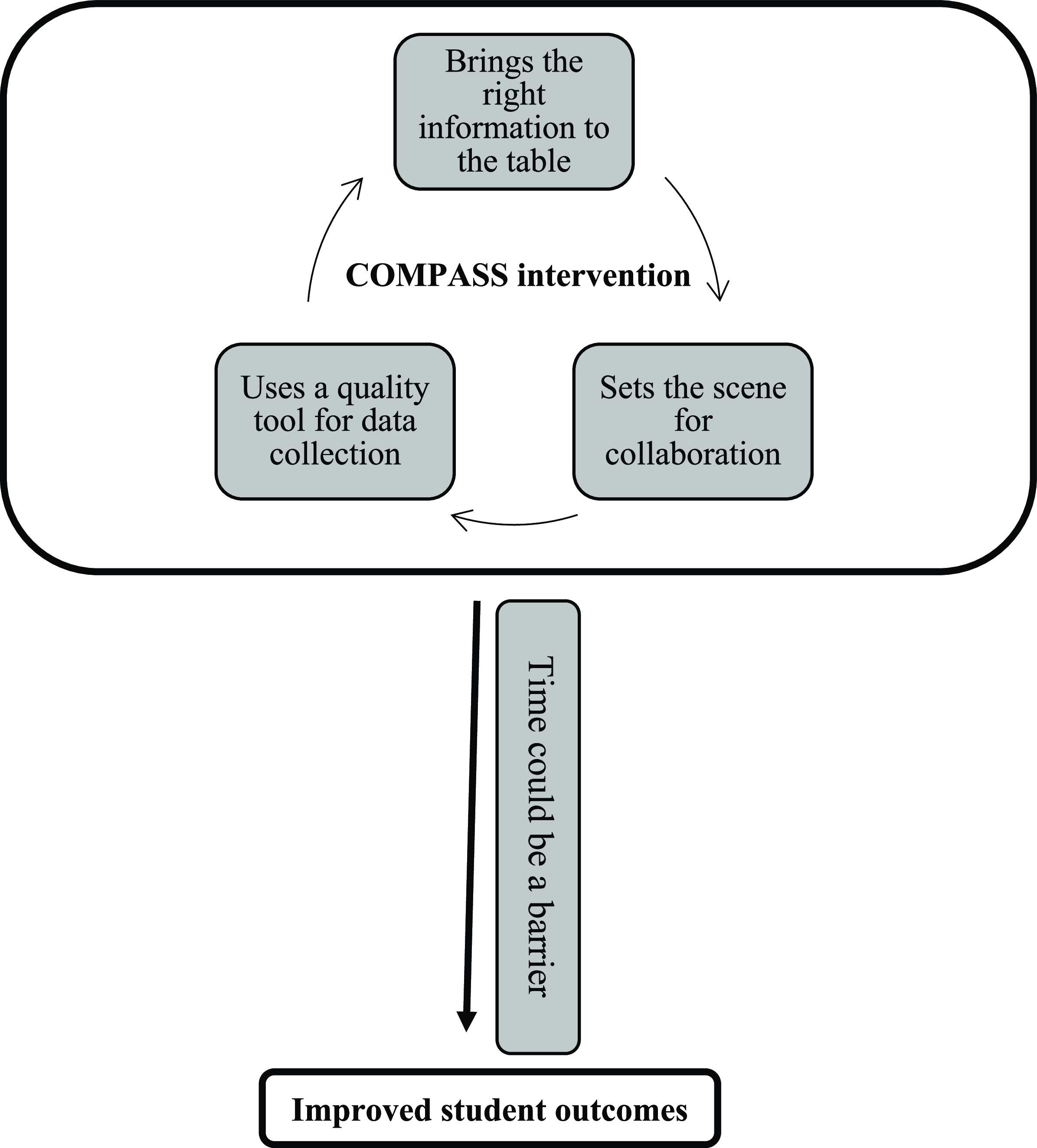
Qualitative analysis provided insight into the perceptions of study participants regarding their participation in COMPASS. Data from all stakeholders were analysed collectively to ensure that the findings accurately represent the collaborative efforts of the entire team supporting students throughout the individualised plan (IP) process. We identified three themes that related to positive aspects of the COMPASS program that were consistent across stakeholders: Theme 1, Brings the right information to the table; Theme 2, Sets the scene for collaboration; and Theme 3, Uses a quality tool for data collection (see Figure 1). However, participants also spoke of the challenges they experienced because of the time that was needed to engage with the COMPASS program (Theme 4, Time could be a barrier). The quotes in this section have been reproduced verbatim, with participant ID (from the larger study) and role (e.g., teacher, consultant, parent/caregiver) indicated.
Final Thematic Map That Represents Benefits and Barriers of COMPASS From the Perspective of Stakeholders.
Theme 1: Brings the Right Information to the Table
The COMPASS process was described by stakeholders as one that brings the right information to the table (Theme 1). One of the most valuable aspects of the COMPASS process described by our participants was the way in which the data pertaining to a student was brought to the initial conversation. One teacher referred to the COMPASS Profile that is used at the initial consultation as ‘probably the best information gathering from families at the beginning’ (T26, teacher). Participants in our study described feeling valued during the process of sharing data from the child’s two primary environments side by side:
Yeah, we looked at them together, and compared. I think it was a nice opportunity for both ways, to get information from families, but then also on the most part, families to go, ‘Oh, cool. You actually see my child as well’. For them to be able to go, ‘Oh, yeah, you see that too’. (T26, teacher)
Parents spoke of prior experiences where they had filled out ‘pages and pages of data’ (S98, parent) in contrast to the COMPASS process, which resulted in ‘meaningful data that dropped goals on our doorstep’ (T28, teacher). One parent reflected on the COMPASS Profile and the initial consultation, stating, ‘This process did allow me to learn more about my son and I am very grateful and appreciative for that’ (S87, parent), and another spoke of how ‘communication is very important and I feel I was able to learn more about his goals from the teacher and schools’ perspective’ (S72, parent). As a consequence of utilising the COMPASS information-gathering tool, teachers expressed how they were able to be ‘really specific with the parents to work out the skill that will be worked on’ (T43, teacher). The comprehensive nature of the tool was also valued by participants:
The fact that it was one document was really great, and the fact that it wasn’t just autism specific, but included developmental expectations for all children, with the autism was layered in, which was really lovely. (C98, consultant)
The process resulted in new learnings for both parents and caregivers — ‘And then I think it brought up things that probably haven’t come up in other [meetings] that I’ve done before’ (T33, teacher) — as well as confirmation and validation that they were on the same page. One teacher was surprised to learn new information through the process, stating, ‘we had a couple of families tell us information that we hadn’t heard before’ (T26, teacher). Parents/caregivers had similar experiences, and one felt the data led to ‘more specific areas of discussion based on unique strategies’ and shared how they had learned about a strategy that had been used regularly at school that their teachers had not yet discussed with them. The parent went on to say, ‘I understand the teachers are really busy and this was unintentionally missed. But it would have been nice to know as we now implement the same system at home and it would have been better to implement it sooner’ (S75, parent).
Theme 2: Sets the Scene for Collaboration
COMPASS was perceived as a ‘more collaborative approach’ (T28, teacher) that sets the scene for collaboration (Theme 2). Participants spoke about the importance of collaboration between parents/caregivers, teachers, and other team members ‘from the beginning’ (T32, teacher). Participants appreciated the collaborative nature of using the COMPASS Profile, where ‘We just easily worked together because the data was school and home and the goals were ours, not theirs’ (S74, parent). One consultant explained, ‘I feel the parent input is a lot more, what’s the word, not comprehensive, but [our original process] doesn’t allow us to give as much information. The parent contributions [in COMPASS] are richer, are real life, are, what’s the word, current’ (C48, consultant). A teacher described how before participating in COMPASS, they would seek initial parent collaboration, but then complete the process on their own, which was perceived as being less beneficial:
I think them being part of the decision-making around the goals, really being part of it, I think in previous circumstances that we can chat what might we be doing about the goals. Have a general thing, but then I would’ve gone away and done it all. (T26, teacher)
Another consultant shared that this was ‘the easiest collaboration I’ve ever done with a parent, despite years of trying other methods because there were steps that kept it clear and simple for how to collaborate’ (C84, consultant).
Theme 3: Uses a Quality Tool for Data Collection
According to participants, COMPASS uses a quality tool for data collection (Theme 3) that resulted in many benefits, from their perspective. The tool used to measure student progress on individualised goals was GAS (see Table 1), and it was overwhelmingly described as a positive aspect of COMPASS, particularly from the perspective of teachers. The GAS process was described as ‘thorough’ (T43, teacher) and ‘more accountable for staff’ (C98, consultant). Teachers commented that it was feasible and ‘it’s not tons of writing, it’s easy to see and we kind of know where we’re going. And also, even next year or whoever takes them on, it’s easy to kind of pick up for someone else’ (T28, teacher). Teachers reflected on how writing a GAS goal enabled them to clearly see and understand the ‘little steps that you could work on’ and ‘when things don’t work out, like a situation like this year [with COVID], we know there’s a step to fall back on’ instead of rewriting a new goal (C18, consultant). One teacher expressed, ‘I’m desperate to see GAS make its way into [our schools]’ (T25, teacher).
Theme 4: Time Could be a Barrier
Despite the beneficial aspects of the COMPASS program, participants also discussed how time could be a barrier (Theme 4) to the successful implementation of COMPASS across the school. Participants reflected on how ‘time-consuming’ the COMPASS process was (T28, teacher). This theme encompassed one of the primary obstacles identified by all participants as something that could impede student outcomes. One teacher explained that although the initial consultation had ‘a lot of value in it’, they felt that ‘the time to do the intense long meeting, if you times that by a full class load, that could be a lot’ (T26, teacher). Another teacher reflected on how they may not ‘have the time to implement [COMPASS] on a consistent basis for all students’ (T36, teacher), and another participant reflected on the consultation, stating that ‘three hours is a really long time for time-poor teachers’ despite the resulting ‘robust conversation’ (C18, consultant).
For participants in our study, the intervention was trialled during COVID-19, when there was a mix of virtual home learning and face-to-face traditional. Interestingly, participants felt the periods of home learning enhanced collaboration between parents/caregivers and teachers and gave parents/caregivers a chance to ‘build capacity from home learning and working on goals on their own’ (S82, parent). A consultant explained:
It almost was like COVID-19 helped those goals being worked on because the teachers they’d had one-on-one time twice a week, three times a week with each student. And then we would also have collective time where we’d had a few peers to test the GAS form. (C98, consultant)
However, had COVID-19 not provided that extra one-on-one time, the process may have been ‘difficult to manage’ across a full class (C48, consultant).
Overall, participants in our study felt that COMPASS began with valuable data that led naturally to individualised goals (Theme 1), supported quality collaboration throughout the process (Theme 2), and provided an easy and effective way to demonstrate progress on individualised goals (Theme 3). Critically, however, the time that went into the COMPASS process was problematic for participants (Theme 4). One consultant summarised the process well:
I like that the process of this, the way the goals were created, it felt like it supported a more cyclic approach to IP writing, because … the staff change and then the sites change and so many factors change. And that means that their capacity to use a skill changes, so they may have that skill at this site, with that teacher, but then not the next. I feel like that [COMPASS Profile] and the GAS form would really support a cyclic approach where that information could be given and the next teacher would know how to move on from that better, because the assessment tool is the same and the reporting and the data collecting is the same. (C48, consultant)
Discussion
In this study, we sought to build on our previous research where evidence demonstrated improved outcomes for students participating in the COMPASS intervention (Love et al., Reference Love, Cai, Stephenson, Gallagher, Toland and Gibbs2024). While our previous study (Love et al., Reference Love, Cai, Stephenson, Gallagher, Toland and Gibbs2024) and past randomised controlled trials (Ruble et al., Reference Ruble, McGrew, Dalrymple and Jung2010, Reference Ruble, McGrew, Toland, Dalrymple, Adams and Snell-Rood2018) have demonstrated that COMPASS is effective in improving student outcomes, little is known about why it is effective or what components of COMPASS participants find most helpful and contribute to their perspectives of acceptability in specific settings and contexts. In this paper, we sought to understand the extent to which stakeholders receiving COMPASS considered it to be appropriate and what elements were meaningful based on their experiences. Acceptability is linked to implementation and student outcomes, so exploring the construct in more depth allows for more understanding than a score on a survey. Here, we gathered the perspectives of parents/caregivers, teachers, and consultants who participated in the intervention and found that the comprehensive, standardised, individualised planning process of COMPASS was seen as acceptable and impactful. The qualitative data showed us that what participants perceived as important was collaboration (Theme 2) and assessment that is collaborative and leads naturally to student goals (Theme 1). Further, participants felt GAS gave them a way to concretely track student IP goals and understand the progress that students made (Theme 3).
The participants of our study valued the collaboration between school and home environments. This type of collaboration is often called parent–teacher alliance and can be defined as mutually supportive relationships and agreement about goals and strategies (Cameto et al., Reference Cameto, Levine and Wagner2004; Ruble, McGrew, Wong, et al., Reference Ruble, McGrew, Wong, Adams and Yu2019). Consistent with our findings, strong parent–teacher alliance has been linked to important factors such as student engagement (Hughes & Kwok, Reference Hughes and Kwok2007) and social-emotional functioning (Izzo et al., Reference Izzo, Weissberg, Kasprow and Fendrich1999) as well as parent factors such as involvement in educational programs and parent satisfaction with the school (Burke & Hodapp, Reference Burke and Hodapp2014). Participants felt that the intervention enhanced their collaboration and made all team members equal partners in the process, a finding that is seldom present in interventions involving parents and teachers within special education settings (Goldman & Burke, Reference Goldman and Burke2017) but has been demonstrated in past iterations of COMPASS (Ruble, McGrew, Wong, et al., Reference Ruble, McGrew, Wong, Adams and Yu2019).
A significant barrier identified by participants was time, and for some participants, this influenced their perspectives of acceptability and feasibility (Theme 4). The COMPASS process includes a 3-hour initial consultation and four coaching sessions for the teacher and consultant across the school year. In theory, all students in the school could use COMPASS for their IP process. For our study, each teacher identified one student to trial COMPASS with while continuing their services-as-usual model for their other students. Teachers felt that if they were to do COMPASS across all students in their class (usually a class size of 6–10), there would not be time to devote to the process, and taking COMPASS to a full school or full classroom level may not be feasible. Parents also felt the burden of the initial consultation because of the time it took. Additionally, due to time and resource constraints, an internal consultant could not closely mediate all consultation and coaching meetings if all students in a school environment participated in COMPASS. To problem-solve this barrier, models of COMPASS where professional learning communities support the COMPASS process instead of consultants could be explored, thus providing an opportunity for teachers to share the time burden. Colleagues could keep each other accountable for their student’s IPs instead of requiring consultant accountability. This could potentially be more sustainable and may demonstrate increased self-efficacy and autonomy. Additionally, COMPASS could be reserved as an intervention for a specific cohort of students, instead of the whole student body. Finally, the COMPASS process could be rolled out at different times in the school year for all students so that teachers did not have the impact of the long consultation at the beginning of the year for all students. Continued research that trials COMPASS in community settings may identify further adaptations that make it sustainable, ensuring the meaningful benefits identified in this study are achievable for participants.
Based on the findings of this research, several practical recommendations for schools can be presented. First, schools should ensure authentic and adequate involvement and collaboration in all decision-makers (e.g., parents/caregivers, teachers, and students). This is consistent with previous research that has shown that there is a gap in successful collaboration that has stressed the importance of parental involvement (Hsiao et al., Reference Hsiao, Higgins and Diamond2018; Kurth et al., Reference Kurth, McQueston, Ruppar, Toews, Johnston and McCabe2019; Ruppar & Gaffney, Reference Ruppar and Gaffney2011; Snell-Rood et al., Reference Snell-Rood, Ruble, Kleinert, McGrew, Adams, Rodgers, Odom, Wong and Yu2020; Tucker & Schwartz, Reference Tucker and Schwartz2013). Additionally, schools can review assessment tools that are used to gather data for determining individualised goals. In our study, the COMPASS Profile allowed for caregiver/parent data and teacher data to be reviewed side by side, leading to authentic data-based decision-making. Finally, consideration of how progress monitoring during the IP process should be prioritised. This is consistent with emerging evidence that demonstrates how GAS is beneficial for individuals on the autism spectrum because it provides a personalised goal on a standardised metric. Lee and colleagues (Reference Lee, Shogren, Segal, Pezzimenti, Aleman-Tovar and Taylor2022) recommend the use of personalised outcome measurement for community intervention work with youth and adults on the autism spectrum, and the GAS tool that was used in COMPASS has demonstrated consistency with other outcome measures (Ruble et al., Reference Ruble, McGrew, Dale and Yee2022).
Several strengths exist in this study. Our research extends what is known from research in the US to Australia and is the first attempt at replicating COMPASS outside of the research team who designed COMPASS. Additionally, the majority of COMPASS research is quantitative or based on the development or adaptation of COMPASS; this is the first study to explore participant accessibility through qualitative analyses. This study, however, was also limited by the small and unique sample of participants who trialled COMPASS. Because the setting was an autism-specific school in Australia, the findings may not generalise to other settings, and therefore we suggest qualitative work continue to accompany quantitative work that expands the evidence base of COMPASS, further supporting the perspectives of COMPASS participants from more diverse samples. Finally, our study did not include the perspectives of students, and the research team believes that future studies should address this gap. Despite these limitations, the experience of those who participated in COMPASS can also help guide future replications of COMPASS and other interventions focusing on individualised planning. For parents, teachers, and consultants in our study, the components of COMPASS that were impactful and memorable were the data tools and the collaboration, the importance of improved student outcomes, and the challenges with time. Therefore, future research replications of COMPASS or experimental designs could consider whether these elements, in isolation, still produce strong student outcomes.
This study presents a multifaceted examination of the COMPASS intervention, offering several noteworthy strengths, including its contribution to the extension of COMPASS research from the US to Australia and its innovative qualitative approach to participant accessibility. In conclusion, the insights gleaned from COMPASS participants offer valuable guidance for future replications and interventions focused on individualised planning in education.
Funding statement
The authors acknowledge the financial support of Autism Spectrum Australia (Aspect).
Competing interests
The authors have no relevant financial or non-financial conflicts of interests to disclose.


 Open access

