

Introduction
In the context of the 2025 Chilean presidential elections—marked by sharp polarization between José Antonio Kast, representative of the far right and heir to Pinochetism, and Jeanette Jara, member of the Communist Party and identified with the legacy of the Unidad Popular—the issue of memory emerges as a central axis of the political debate. Two opposing memories confront each other: on the one hand, the memory of human rights and the disappeared during the dictatorship, institutionalized in the Museum of Memory in Santiago de Chile; and, on the other, the memory of the right, defined by a visceral struggle against communism and embodied, almost paradigmatically, by Chilean business elites.
Within this context, this article explores how the business elites currently leading Chile remember the government of the Unidad Popular (hereafter UP) (1970–1973), led by Salvador Allende, and how these memories contribute to shaping part of their political culture today.Footnote 1 Our analysis begins with the premise that acts of remembrance originate in the present, thereby implying that memories are not necessarily contemporaneous assessments of facts, but rather, represent later reinterpretations, constructions, and adhesions.Footnote 2 As AguilarFootnote 3 points out, memories “are not immovable, but are continuously shaped, influenced and transformed by the memories and stories of others.” In this framework, the research question guiding this article is: how are these memories of the UP articulated with a political culture that business elites continue to promote and reproduce nowadays?
We focus on two main narrative axes of the discourse on elites’ memories: confrontations (real or perceived) with supporters of the UP government and experiences related to food and commodity shortages.Footnote 4 We approached these accounts from a generational perspective, differentiating two cohorts of interviewees: one that was an adult during the Allende government and another that lived through it in childhood or adolescence.Footnote 5 Both generations now occupy positions of power in the Chilean business world, and their memories contribute to consolidating a collective memory shared by this elite. Using a hermeneutic approach to oral testimonies and content analysis, we examine how significant personal experiences and intergenerationally transmitted narratives shape long-lasting political and cultural imaginaries. The objective is not to assess the veracity of the recollections, but rather to analyze their processing, reinterpretation, or suppression, and their role in perpetuating a conservative political culture resistant to systemic reform.
In this context, it is crucial to define the characteristics of the group under study. The Chilean economic elite examined in this article are leaders from the country’s longest-standing and most influential business sectors: the National Agriculture Society (hereafter SNA), the Society for Industrial Development (hereafter SOFOFA), and the Confederation of Production and Commerce (hereafter CPC). This is a socially cohesive sector, predominantly male,Footnote 6 composed mostly of traditional upper-class families. Members of these sectors exhibit comparable educational backgrounds, primarily from elite private schools, and reside predominantly in affluent eastern Santiago neighborhoods.Footnote 7 From a political perspective, this elite exhibits a right-leaning ideology,Footnote 8 grounded in an authoritarian and presidentialist imaginary,Footnote 9 and shaped by conservative values such as authority, hierarchy, and order, which persist despite certain transformative processes.Footnote 10 This ideological orientation has deep historical roots, anchored in the figure of Diego Portales and the notion of the “weight of the night” [el peso de la noche],Footnote 11 whereby the enlightened elite assumes a tutelary role over masses considered politically immature or ignorant.Footnote 12 These conditions, along with the political definitions consolidated during the UP period, have shaped a specific collective memory that contrasts with the historical narratives of popular sectors supportive of Salvador Allende’s government.
Revisionist literature on the Unidad Popular (UP) has highlighted the profound political polarization and the intensity of social conflict that characterized this period.Footnote 13 Nonetheless, substantive debates persist regarding the causes of the crisis, the democratic nature of the reforms promoted by Allende’s government, the shortage of basic goods, and the various forms of political violence. This study focuses particularly on the latter two issues, which are fundamental to understanding the disputes surrounding the historical memory of the era. Addressing these memories requires, on the one hand, consideration of the impact of agrarian reform, understood as a process of profound redistribution of political and economic power that decisively affected rural landowning sectors through a series of expropriations that dismantled the latifundio system.Footnote 14 On the other hand, it is essential to examine the phenomenon of shortages, whose scarcity of basic goods became one of the most enduring milestones in Chile’s historical and collective memory.Footnote 15
These two phenomena contributed to the consolidation of a memory that presents the UP as a traumatic experience, a “historical lesson”Footnote 16 that must not be repeated. To reinforce this, following the 1973 coup d’état, the civil-military dictatorship promoted a narrative of “salvation,” according to which armed intervention was necessary to restore order.Footnote 17 Paradoxically, although the coup entailed significant violence, business elites tended not to remember with the same intensity or persistence either the violence of the event itself or the systematic human rights violations that followed, in comparison with other episodes of the period—such as agrarian reform or shortages—which occupied a more central place in their memory and interpretation of the conflict. The narrative of “inevitability” and of curing the “Marxist cancer” legitimized both the institutional rupture and the neoliberal transformation of the country, while simultaneously obscuring systematic human rights violations. This memory, in certain cases biased and unilateral—since it downplays the trauma caused by the coup and the dictatorship for other social groups—was employed to construct a narrative that promotes and reproduces the political culture of these elites. Since the return to democracy, this narrative has been contested by policies of memory, justice, and reparation.Footnote 18
Studying the recollections of the business elite that currently lead Chile’s economy makes it possible to examine not only how this group interprets the recent past, but also the symbolic foundations underpinning its political vision of the present and the future. This is particularly relevant in the current polarized presidential election, in which the right oscillates between far-right positions and a center-left represented by a Communist candidate, Jeanette Jara—a scenario that continuously reactivates memories of Allende’s government and the negative memories of the UP. The current electoral context reveals not only the importance of studying memory but also the pertinence of addressing this right-wing memory embodied by business elites. This becomes evident in the centrality that anticommunism has acquired in the debates and discourses of the ongoing presidential campaign, where the elite has deployed anticommunist arguments and attacks directed at Jeanette Jara, especially on social media, as will be shown later. In this sense, the analysis is crucial for understanding central aspects of business elites’ political culture, since memory not only reorganizes the past but also contributes to the construction of a collective identity shaped by victimization, which in turn reinforces cohesion and a self-perception as guarantors of political and economic order.Footnote 19 At the same time, the analysis of the emotions tied to memory allows for a deeper understanding of the fears, distrust, and misgivings that these elites systematically express toward the state. At the heart of this tendency is what we call “emotional economy,” which is the tendency of these elite business sectors to invest internationally or directly leave the country because of the nation’s current sociopolitical context. In this sense, rather than a mere residue of the past, the negative memories of the elites consolidate as a political resource whose influence on the present must be further investigated.
To advance in our objective, this article revisits some of the conclusions previously elaborated by Chilean historiographyFootnote 20, but contrasts them empirically through an innovative methodology: in-depth interviews. Following LinzFootnote 21, we begin with the premise that elites privilege their own discourses as primary sources for understanding political processes—even when these diverge from real historical facts.Footnote 22 Therefore, our investigation focuses on the elements of memory and omission within narratives, and how these constructs influence enduring political and cultural perceptions, potentially obstructing structural reform. This conception of memory offers a valuable framework for improving the analysis of corporate political culture, thereby augmenting methodologies focused on the social stratification of these actors.Footnote 23
Over time, memories of the UP period and the 1973 coup have undergone significant transformations, especially in relation to the traces left by the civil-military dictatorship. The traumatic experience of the authoritarian regime deeply shaped these memories, particularly by imposing an official narrative that characterized the prior democratic period as a time of disorder and conflict. In addition, they constructed a “memory of salvation” to justify the institutional rupture in the name of national unity.Footnote 24 This symbolic operation aimed not only to legitimize the democratic breakdown but also to support the new economic and institutional model that emerged. In this context, it is crucial to analyze how those in power initially promoted these memories, and how these memories have since been challenged, contested, and re-signified in the democratic context, especially through social and political processes seeking truth, transitional justice, victim reparations, and national reconciliation.Footnote 25 These dynamics highlight the constant tension between imposed memories and emerging memories that strive to dominate the cultural battlefield in the public sphere.Footnote 26
Methods
To explore and interpret memories and components of political culture in relation to the UP government, we adopted a qualitative strategy comprising fifty interviews with presidents and vice-presidents of the three main business associations: the SNA, SOFOFA, and CPC. Three hierarchical levels compose the Chilean business sector: at the first level are the sectoral associations, including the Sociedad Nacional de Agricultura (SNA), which brings together more than fifty specialized associations; at an intermediate level, federations such as the Sociedad de Fomento Fabril (SOFOFA), founded in 1883, which articulates sectoral demands and coordinates diverse associations; and, at the top, the Confederación de la Producción y del Comercio (CPC), created in 1935, which groups the principal federations and associations and acts as the representative of big business before the state and other social actors.
Given the qualitative nature of the study, we did not intend to have a representative sample of the entirety of Chile’s business elite; however, the sample provided access to leaders of the most relevant sectors within the three associations. We conducted fieldwork longitudinally between early 2018 and late 2023, in a context marked by the social uprising of October 2019 and the constitutional plebiscite of 2020—milestones that, sometimes, hindered data collection and delayed the continuity of the study. Part of the interviews then took place during the two failed constituent processes, which gave the empirical material a situated character within a moment of high political and social instability.
The fieldwork combined three strategies: (1) formal invitations through letters sent to business leaders, which proved to be the most effective approach;Footnote 27 (2) the snowball technique, by asking interviewees to facilitate the participation of other potential subjects;Footnote 28 and (3) mediation through close contacts of the elite, who acted as intermediaries in establishing ties with members of big business. All interviews required signing an informed consent form that specified the objectives of the study and guaranteed both confidentiality and participant anonymity.
We should note that, in every interview, the topic of the UP emerged spontaneously, framed as a negative experience that, according to the interviewees, had motivated the intervention of the Armed Forces and Carabineros de Chile in the 1973 coup d’état. Based on first responses throughout the fieldwork, and anticipating the orientation that some responses might take, we then developed an “alternative question grid” that included specific questions on the UP. This alternative grid sought to explore in greater depth the political evaluation of that government, the business leaders’ memories of the period, their processes of political socialization at the time, their families’ experiences, and the political lessons derived from that historical episode.
We analyzed the interviews according to the principles of grounded theory.Footnote 29 From the discourse analysis, we formulated emergent theoretical categories that made it possible to understand the relationships among different narrative elements and to advance toward an empirically grounded conceptual elaboration aimed at capturing business leaders’ memories of the UP experience.
We transcribed the interviews and coded them with ATLAS.ti software (version 8.4.13). The coding process yielded more than 600 coding units; from there, we organized 2 main categories defined under criteria of affinity and differentiation:Footnote 30 (a) experiences of political violence and (b) shortages of basic goods. In both instances, we adopted a “live” categorization, choosing representative expressions from the testimonies to designate the identified phenomena. For instance, expressions such as “a country totally unhinged” or “a very fractured country” emerged in the interviewees’ narratives, aptly illustrating the substance of these categories.
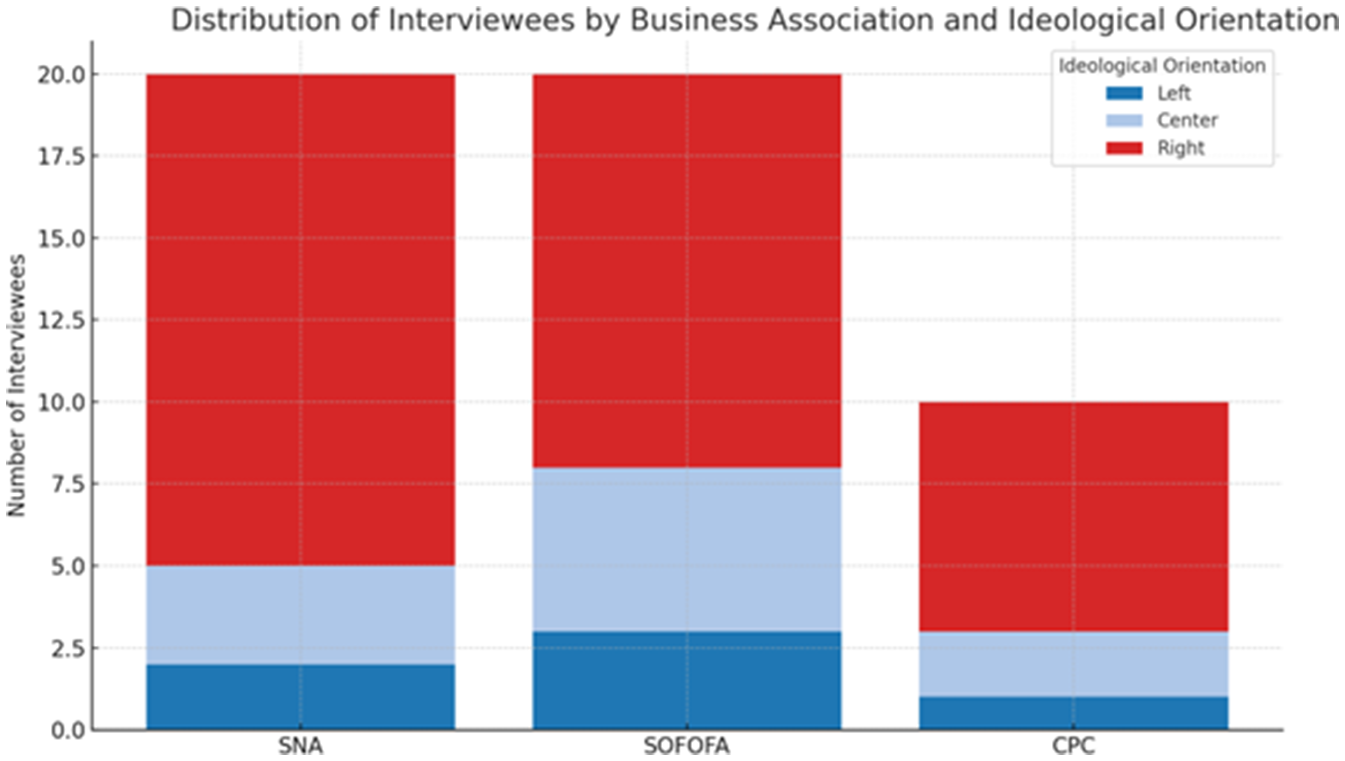
The sampling strategy was purposive and defined by three criteria. First, the organizational component: current and former leaders of three business associations—the SNA, SOFOFA, and CPC—were interviewed, each with distinct trajectories of political engagement. The SNA, linked to the agricultural elite, has historically maintained close ties with the right,Footnote 31 while SOFOFA and CPC, associated with the industrial, service, and construction sectors, have displayed more varied positions, oscillating between the center and the right. Nonetheless, after the 1973 coup, all these organizations aligned with Pinochet’s dictatorship and, during democracy, have defended the economic legacy of that period, maintaining their adherence to the right and participating in governments through representative roles.Footnote 32 Second, the generational component distinguished between two cohorts: those who were adults during the Unidad Popular and directly experienced the events, and those who were children or adolescents at the time of the coup and the dictatorship, whose memories were largely shaped by family narratives and fragmented recollections.Footnote 33 Third, the ideological component involved asking each interviewee to place themselves on the left–right spectrum, a cleavage that remains fundamental for understanding political orientations in Latin AmericaFootnote 34 and that in Chile retains significance despite changes in the party system between the pre-dictatorship period and the post-transition democracy.Footnote 35
As shown in Figure 1, the sample crosses three key business elites: the SNA, SOFOFA, and CPC. We distinguished two generations: one that experienced the Unidad Popular period firsthand (generation 1), and another that lived it indirectly through narratives transmitted in their family environment (generation 2). The SNA includes a greater representation of interviewees from generation 1, while in SOFOFA and the CPC, there is a more balanced distribution between the two generations.
Interviewees Grouped by Business Association and Generation
Source: Authors’ elaboration.

Distribution of Interviewees by Business Association and Ideological Orientation
Source: Authors’ elaboration.

Figure 2. Long description
The x-axis lists business associations S N A, S O F O F A, and C P C from left to right. The y-axis shows number of interviewees from zero to twenty. Each bar is divided into three colored segments representing ideological orientation: blue for Left at the bottom, light blue for Center in the middle, and red for Right at the top. S N A and S O F O F A each have bars reaching twenty interviewees, with Right orientation occupying the majority of each bar, Center in the middle, and Left at the base. C P C has a shorter bar at ten interviewees, also dominated by Right, with smaller Center and Left segments. The legend at the upper right identifies the color coding for Left, Center, and Right.
The Figure 2 shows the distribution of interviewees according to their trade union membership (SNA, SOFOFA, CPC) and their ideological positioning along the left–right axis. As seen, most participants identify with the right, especially among members of the SNA. However, there are also positions ranging from center to center-right and, to a lesser extent, center-left, suggesting some ideological diversity even within traditionally conservative organizations. This heterogeneity allows for an analysis of how different political orientations modulate memories of the UP, even within the same institutional space.
Theoretical Framework: Memory as the Foundation of Elite Political Culture
From this perspective, it’s essential to consider how specific social groups, particularly elites, construct, transmit, and contest memories. In recent decades, the concept of memory has gained a significant place in the study of political culture.Footnote 36 Far from being a mere archive of the past, memory functions as an active force that shapes beliefs, ideological orientations, and forms of political behavior and collective action.Footnote 37 Memories of significant—especially traumatic—events can leave lasting marks on both individual and group political dispositions.Footnote 38
Collective memory, understood as a dynamic and socially constructed process,Footnote 39 contributes to the shaping of political and cultural imaginaries: symbolic frameworks through which groups interpret their place in society and legitimize their relationship to power.Footnote 40 These imaginaries not only structure narratives about the past but also delineate what is politically possible and socially desirable. In this sense, memory becomes an ideologically charged domain, shaped by processes of socialization, discursive disputes, and power relations.Footnote 41
The link between memory and political culture lets us understand how we transmit and solidify certain interpretive frameworks—cognitive, emotional, and evaluative—over time, influencing political attitudes.Footnote 42 These frameworks are shaped by individual structural positions,Footnote 43 past experiences,Footnote 44 and ingrained belief systems.Footnote 45 Nevertheless, these beliefs are not static; they are subject to change through political education and democratic engagement.Footnote 46
When lived experiences are negative or dramatic, their impact on intergenerational transmission can be intense, significantly influencing the imaginaries that shape the understanding of reality.Footnote 47 This phenomenon is even deeper when it occurs in contexts of early political socialization, as it produces long-lasting teachings that are often difficult to reverse.Footnote 48
In polarized contexts like Chile, ideological positioning plays a key mediating role between collective memory and political culture. The actors’ ideological orientations condition interpretations of the past—for instance, regarding the military dictatorship or the democratic crisis before the coup.Footnote 49 Thus, memory operates as a symbolic battlefield where divergent and often opposing narratives coexist.Footnote 50
Despite the growing interest in the study of memory and political culture, Latin American social sciences have paid little attention to a relevant group: the economic elites. This gap is striking given that these elites not only play a central role in shaping economic, political, and cultural powerFootnote 51 but also in producing and reproducing historical imaginaries that sustain the status quo.Footnote 52
In the Chilean case, the large business community makes up an economic elite in the strict sense: a small and relatively homogeneous collective of individuals who share values, lifestyles, and interests, who occupy leadership and decision-making positions at the highest levels of institutional power. This elite carries a unified, coherent, and superior project for the entire country, in which value elements and social interests converge.Footnote 53 This elite concentrates material and symbolic resources of high value, which allows it to exert influence not only in economic and social life,Footnote 54 but also in public affairs, effectively acting as a pressure and interest group.Footnote 55
Since the military dictatorship, the Chilean business elite has maintained a close relationship with right-wing politics, openly defending the economic and institutional legacy of the Pinochet regime, including the inherited constitutional framework.Footnote 56 This alignment is clear in individual actions and official statements from key figures.Footnote 57
At the regional level, studies of economic elites in Latin America have focused mainly on their role in developmentFootnote 58and their perceptions of structural phenomena.Footnote 59 In the Chilean context, empirical research has explored various perceptual dimensions: from how elites understand wealthFootnote 60 or tax systems,Footnote 61 to how middle classes perceive these elites,Footnote 62 and what factors foster more egalitarian views within dominant sectors.Footnote 63 Research has also advanced in analyzing the ideological fragmentation of elites,Footnote 64 their social transformations,Footnote 65 and their power networks and mechanisms of resource mobilization.Footnote 66 However, scholars have scarcely explored how elites remember episodes of democratic crisis, what role they assign themselves in those processes, and how those memories shape their political culture, potentially influencing their decisions and stances regarding the country’s political construction.
Results
(A) Memories of Direct Confrontation
(1) “A country totally unhinged”: Accounts of conflict and loss of status in the older generation
To situate the context of our interviewees, in the beginning, in 1962, criticism of Chile’s agrarian system intensified, alongside growing indignation over the extreme poverty in which the rural population lived.Footnote 67 This climate of rising conflict culminated in 1968, under the government of Eduardo Frei Montalva, in a process of land nationalization that led to the collapse of the traditional hacienda model and triggered a wave of peasant strikes, which definitively challenged the long-standing subordination of tenant farmers.Footnote 68 Agrarian reform entailed a profound redistribution of political and economic power, substantially affecting rural landowning sectors.Footnote 69 Allende’s government continued and radicalized this process by expanding the number of expropriations, virtually putting an end to the latifundio system. This policy accelerated the transformation of land ownership, aiming to create new social and economic relations in the rural system.Footnote 70 In doing so, the Popular Unity government broke with the previous “compromise state” model and deepened the rift between the state and the business sector.Footnote 71 These expropriations were characterized by waves of violence stemming from peasant mobilization, which instilled fear among landed economic elites,Footnote 72 whereas the leaders of the peasant movement perceived the reforms as a fair measure to rectify historical inequalities.Footnote 73 This contrast reveals the coexistence of divergent memories of the same historical process.
Among the older business leaders interviewed—especially those affiliated with the SNA—a memory shaped by conflict predominates, constructed from experiences of expropriation, family tensions, and even physical confrontations with supporters of the government. They interpret these memories as episodes of “political violence,” reinforcing a narrative of victimhood and grievance. As one interviewee stated: “I was 13 years old, we had to use weapons to defend our property… it was a pretty hard blow” (SNA, Generation 1, right-wing).
In contrast, businesspeople from urban organizations such as SOFOFA or CPC do not refer with the same intensity to experiences of violence or dispossession. Physical conflict less characterizes their narratives, possibly because their urban origins and business trajectories remained unaffected by the agrarian reform. Only in exceptional cases—such as that of a leader who recounts a double expropriation of land and family businesses—are similar testimonies recorded. This discrepancy in accounts is partially attributable to the structural role of SNA families within the pre-1970 economic system. Using a conservative ideology based on Portalian and authoritarian imaginaries,Footnote 74 already present before the coup, people articulated the objective experience of land loss, thereby reinforcing, retrospectively, an antagonistic reading of the Allende government.
From this perspective, memory becomes a narrative device that combines material elements (the loss of heritage) with symbolic resources (the defense of order, property, and rural identity), thus configuring a corporate political culture that retrospectively legitimizes the rejection of the UP’s transforming project.
My father was held hostage inside the estate … it was quite a hard episode, we had to defend him and you can’t forget that when you experience it at 17 or 18. (SNA, Generation 1, right-wing)
In my family, we’ve always been clearly identified with a right-wing sector, not even center-right. And that was reinforced, because the estate was expropriated legally and was attempted to be taken illegally. (SNA, Generation 1, right-wing)
These testimonies, far from being simple individual memories, are part of a shared repertoire among segments of the agricultural business elite, in which the defense of property constitutes a core of a unifying narrative that, through the experience of conflict, reshapes and justifies present-day frameworks of legitimacy. In this sense, memories of the UP not only evoke a traumatic past but also help consolidate a cultural business identity forged in opposition to redistributive demands and the political protagonism of popular sectors. Memory thus operates as a cultural mechanism that reproduces social and symbolic distinctions inherited from the past (enlightened elite vs. ignorant people), while simultaneously naturalizing and justifying them.
Nevertheless, the apparent discursive unity within the business elite regarding the memory of the coup and the UP appears to be strained when examining the testimonies of those who place themselves ideologically in the center or center-left. In these cases, while there is acknowledgment of the coup as an action that prevented a possible “civil war,” there is also a clear condemnation of the systematic violence deployed by the dictatorship, considered excessive and undesirable. This ambivalence suggests a dual form of memory: on the one hand, the justification of the coup as “salvation” from the chaos attributed to the UP government; on the other, an explicit critique of the human rights violations committed during the military regime. This second aspect nuances the first, as in certain cases—particularly among interviewees ideologically closer to the center—testimonies emerge expressing the inability to anticipate or know the extent of the violations that would later occur.
These types of accounts reveal how memory is constantly being re-articulated, especially when intersecting with less ideologically homogeneous trajectories within the elite. Greater exposure to democratic discourses and the circulation of counter-hegemonic interpretive frameworks questioning the historical legitimacy of the military regime may explain this narrative flexibility among interviewees from the center and center-left. Therefore, memory is not conceived as a static entity, but rather as a contested and reinterpreted field allowing for significant discursive shifts within the group, especially concerning human rights.
Sometimes I wonder what would have happened without the coup … I felt like we were heading straight into civil war. At first, I supported the coup, I saw it as the only way out. But I never imagined the level of violence it would bring. When I heard Allende had died, I was shocked; I thought they would arrest him, not that this would turn into such a brutal regime. Over time I realized that wasn’t what I wanted. (SOFOFA, Generation 1, center-left)
For me, the important thing about the return to democracy was the end of that smokescreen over human rights. To put an end to that hidden power capable of making someone disappear without explanation. That nightmare so many people were living. (CPC, Generation 1, center)
In summary, the older generation structures their memory around loss, threat, and the defense of order—though not without ideological tensions. This memory, loaded with emotional weight and symbolism, marks the starting point for its transmission to younger generations.
(2) “A very fractured country”: Transmitted memories of conflict in the younger generation
Among younger business leaders, memories of the UP do not come from direct experience but from a process of intergenerational transmission. These memories revolve around vague recollections of the period and inherited narratives that highlight family episodes of confrontation, risk, and loss. In particular, the stories passed down through the family function as foundational narratives that shape a vision of the past ideologically oriented toward the right.
In the case of interviewees linked to the agricultural sector represented by the SNA, this transmission appears more pronounced. The inherited narratives tend to reinforce an image of “survival” in a hostile rural environment, in which armed defense appears as a legitimate response to actors associated with the UP government:
I had to sleep in the bathtub so the bullets wouldn’t reach me … the government supporters would show up with machine guns. It was quite painful for rural life. (SNA, Generation 2, center-right)
Even when interviewees acknowledge they did not experience these events directly, they attribute a powerful influence to their parents’ experience in shaping their ideological orientation:
Indirectly, through my father, because I was three years old at the time … but my father did suffer quite a lot. (SNA, Generation 2, center-right)
In these cases, emotional and political transmission not only persists over time but also acts as a formative principle. The repetition of stories involving threat, dispossession, and resistance shapes the ideological frameworks of the younger elite, reinforcing a memory of grievance that retrospectively legitimizes the institutional breakdown of 1973. This narrative operation converges with what SternFootnote 75 calls “salvation memory”: the representation of the coup as a necessary act to restore order amidst the chaos attributed to the Allende government.
My parents decided to stay in Chile, even though more than once they thought about leaving the country because of the situation under that government. That influences the political decisions one makes later on. (SNA, Generation 2, center)
This transmission logic extends beyond the rural world. In urban trade associations such as SOFOFA and CPC, inherited memories also reproduce an imaginary of threat and destabilization, albeit with less dramatic tone. In these cases, the focus is more on economic insecurity and institutional uncertainty than on direct violence:
My grandfather was a German Jewish immigrant who started from scratch and managed to build his business … so when there’s a threat that everything you’ve achieved might be taken away, it creates a huge sense of insecurity. (CPC, Generation 2, center-right)
The socioeconomic trajectory of these families can partially explain the difference between the two groups. While agricultural businesspeople were more exposed to expropriation processes and direct confrontation, urban families—often linked to services, manufacturing, or commerce—faced the period from a position of lower immediate risk. This distinction results in variations in the intensity and form of memory, though not necessarily in ideological orientation.
From a generational perspective, younger members of the SNA reproduce the inherited grievance narrative with remarkable fidelity, whereas members of SOFOFA and CPC present somewhat more nuanced accounts, though still critical of the UP experience. This difference suggests greater ideological homogeneity in the agricultural business sector compared to an urban elite with more diverse discourses—a trend already noted by PetrasFootnote 76 in his early characterization of the Chilean business class.
Taken together, these findings reinforce the idea that corporate memory about the UP is not just an accumulation of personal or family memories, but a collective discursive repertoire. In this repertoire, the past functions as a warning: an inherited narrative that projects the conflict of the past onto the present, aiming to forestall any repetition of Allende’s popular project as an existential threat to the established social order.
(B) Memories of Shortages
The phenomenon of shortages became one of the most enduring events in Chile’s historical and collective memory.Footnote 77 This scarcity of basic goods was driven, among other factors, by increased domestic demand resulting from wage rises and certain redistributive policies implemented by the government (Larrañaga, Reference Larrañaga2016). Since the local productive apparatus could not adequately respond to this new scenario, imports increased, which in turn generated a severe macroeconomic imbalance.
Inflation reached critical levels—close to 700%—and phenomena such as the “black market” and the state’s direct intervention in the distribution of goods emerged.Footnote 78 The scale of the shortages was further exacerbated by the 1972 truck drivers’ strike, known as the paro de patrones (“bosses’ strike”), which was orchestrated by business sectors to destabilize Allende’s government, in a climate of extreme political radicalization.Footnote 79
(1) “A national clamor for the army to intervene”: Memories of scarcity among the older generation
Unlike the memories centered on direct conflict, narratives about the shortages during the UP period form a shared narrative that brings together a wide range of testimonies from the business community. However, these recollections show substantial heterogeneity in their intensity and expression, influenced by geographical location, trade association affiliations, and the interviewees’ socioeconomic status.
Among popular sectors aligned with the UP, the memory of the shortage often highlights the structural inequality of its impact: “poor people didn’t have anything stored, the powerful and rich did”.Footnote 80 In contrast, the businesspeople interviewed in this study describe the shortages as a dramatic, traumatic, and paralyzing experience. Their narratives revolve around feelings of anxiety, helplessness, and despair, especially related to the inability to obtain basic goods for family survival, such as food, medicine, or hygiene products. The notion of privilege may explain the divergence in how popular and elite sectors perceived and experienced this period: elites experienced the scarcity of basic products as unprecedented, while popular sectors were accustomed to precarious daily living conditions. Therefore, elites were more deeply affected by the “shock” of the shortage.
My son was born, and at three months we took him to the pediatrician, and the child started sucking his thumb from hunger … I went to every pharmacy and couldn’t find [the formula], I sent out an SOS in the office until I finally got it on the black market. (SNA, Generation 1, right-wing)
Individual experiences, however, differed significantly. Among agricultural businesspeople affiliated with the SNA, several discourses downplay the impact of the shortage in rural areas. Food self-sufficiency in the countryside appears as both a symbolic and practical resource that softened the effects of scarcity:
In the countryside, poverty is more dignified: when you’re hungry, you eat a chicken, pull up a carrot … We managed during the UP. I remember standing in line for toilet paper, but there was no real hunger in the countryside. (SNA, Generation 1, center-right)
Urban businesspeople, such as those from the CPC and SOFOFA, describe the shortage more dramatically, highlighting the fragility of access to health care and food.
I’ve had asthma since I was little. During the UP, to buy certain inhalers or medications I used, there were times when I walked around for days, pharmacy after pharmacy … that kind of thing mark you a lot. (SOFOFA, Generation 1, right-wing)
These emotionally charged memories contrast with historiographical accounts that have highlighted community organization and popular resistance during this period.Footnote 81 Alternatively, the scarcity depicted here is presented as evidence of the UP’s failed political project, thereby substantiating the 1973 coup d’état. Interviewees recall the daily experience of scarcity not merely as material deprivation, but also as a breakdown of societal order and state authority.
At that point I said: there’s nothing more to be done”; “I had friends who had nothing to eat”; “those were experiences that really marked you.” (CPC, Generation 1, right-wing)
In this sense, these recollections are not merely testimonial but operate as discursive resources that reinforce a business political culture deeply critical of Allende’s government. By portraying the recent past as a time of disorder, chaos, and insecurity, these memories symbolically reinforce the rejection of any policy that threatens to alter the property and stability arrangements established during the civil-military dictatorship.
The reference to a “national clamor for the army to intervene,” present either explicitly or implicitly in several testimonies, reflects not only a perception of crisis but also an appeal to authority as the restorer of order. In this way, the memory of the shortage is integrated into a conservative repertoire that links experienced (or interpreted) suffering with the necessity of authoritarian solutions.
(2) “Stories my mom used to tell me”: Transmitted memories of the shortage
Among middle-aged business leaders, the shortage during the Unidad Popular period constitutes a key axis in the intergenerational transmission of family memories. Unlike the older generation, these individuals did not experience expropriations or political confrontations directly, but they were socialized in environments where the scarcity of basic goods, long lines, and the sense of chaos occupied a central place in stories told by parents and grandparents.
These memories—more inherited than lived—refer not only to material conditions but function as moral keys to interpret the past. As one interviewee put it: “All of it is based on stories my mom or my grandparents used to tell me.” This form of recollection corresponds to what AssmannFootnote 82 calls communicative memory, meaning memory that circulates within the family sphere and, despite its informal character, exercises a decisive influence on how individuals view the world. In this sense, transmitted memories act as socially effective knowledge that allows individuals to interpret the present as if it were based on their own experience.Footnote 83
In the case of the SNA, this emotional transmission occurs during what is referred to as the “impressionable years”,Footnote 84 generating early ideological orientation. The emotional weight of family narratives—centered on fear, scarcity, and threat—contributed to consolidating a conservative political identity, often internalized as natural:
I think many of the positions I held were more influenced by my family — my parents, my grandparents — than by personal reflection. At the time, it was hard to have a truly personal opinion. (SNA, Generation 2, center-right)
By contrast, among members of SOFOFA and CPC, the transmission of these memories appears less intense. This may be due to more urban family backgrounds that were less directly affected by the UP’s transformative project. Still, recollections of “disorder” and “everyday hardship” serve a similar function: generating a retrospective critical reading of the period and implicitly justifying the interruption of the democratic process.
“You had to wait in long lines to buy a kilo of bread … that’s something you hear about,” says the only female interviewee, acknowledging the indirect nature of her memories. (SOFOFA, Generation 2, center)
In these narratives, the contrast between countryside and city again appears as a structuring element. The narratives portray rural life as more dignified, self-sufficient, and resilient in the face of scarcity, while depicting the city as overwhelmed by chaos:
I remember that time as good, despite the difficulties. We lived in the countryside … we waited in line for basic items like toilet paper, but we didn’t feel hunger the same way. Rural poverty was more bearable. (SNA, Generation 2, center-right)
Thus, even without direct threats of expropriation, the narrative about scarcity gains symbolic value: it acts as a foundational experience that legitimizes a conservative business identity. Exceptions arise where individuals cite fear of losing their family business—reinforcing the idea that traumatic memory depends not exclusively on objective facts, but on perceptions, anticipated fears, and inherited narratives.
My father came from a business family and my mother didn’t. I remember there was a perception in my family of a risk of expropriation: they had a medium-sized company that ultimately wasn’t expropriated, but they definitely felt that threat. (CPC, Generation 2, right-wing)
Taken together, these narratives show how memory of the shortage operates as a cultural mechanism for political socialization. Through intimate, emotionally charged stories, the business elite shapes an ideological framework where scarcity symbolizes state failure, and stability, order, and private property become the guiding values. As in other cases, elites articulate this memory, not monolithically, but around a common emotional matrix structuring their interpretations of the past and their approach to the present political landscape.
(C) “We may fall into the same trap again”: The reconfiguration of memory in the context of the 2025 presidential election
Business elites reconfigure the memory of direct confrontations and shortages within their political imaginary, revealing the complex articulation between past traumatic experiences and their current political positions. This memory, passed down through generations, is now the foundation of business culture and ideology, stemming from a deep-seated opposition to communism. Within this context, communism becomes a symbol representing all the evils the business elites claim to have experienced. Furthermore, this depiction functions as a narrative reduction of a more comprehensive political, economic, and social environment, encapsulated in the slogan “never again communism,” used to justify business opposition to any structural alteration of the political and economic system. Consequently, it is unsurprising that events including the social uprising, constitutional processes, and the presidential candidacy of Jeanette Jara have elicited pronounced negative emotions and anxieties within business sectors. The longitudinal interviews we compiled regarding these events emphasize the profound nature of the resentment they provoked, a sentiment directly associated within elite discourses with recollections and experiences from the Unidad Popular era, as evidenced, for example, by this interviewee’s statement on the constitutional process:
How old are you? You’re a fucking kid, but look, my father was president … My father was president and partner, and they took the company away from us in April 1973, and when the military pronouncement came, they returned it, but there wasn’t a single machine left, dude [sic], they had bankrupted all of it, stolen everything. That was Chile during the UP era, and we’re heading straight back there with this fucking convention. (SNA, Generation 1, right-wing)
The respondent’s statements are relevant for several reasons. Initially, given his “paternalistic” attitude toward the interviewer, it is assumed that the interviewer’s lack of life experience, specifically not having lived through the Unidad Popular, prevented them from possessing the necessary knowledge to fully grasp the process and, therefore, make a valid judgment. Furthermore, and in opposition, his personal experience led him to the belief that the UP era was “a robbery,” which, in his estimation, would be repeated by the 2020–2022 constituent convention. As a result, a link is forged between the past and the present: memory underpins contemporary political evaluations, thus influencing the current business culture and political ideology.
Memory thus resurfaces with a strong negative emotional component—bordering on anger and trauma—that colors current discourses. This is especially evident when the focus turns to the failed 2022 constitutional process, as when a CPC business leader, asked about the legitimacy of the existing constitution, emphasized:
Of course. And the left, when it rewrites history, says: ‘No, dude, it has an original sin.’ Even though the current Constitution is good, it has an original sin. And why? Because the ‘hard left’ wanted a Constitution that would let them seize power and keep it forever, like in Nicaragua, Venezuela, Bolivia, dude, in Korea, in Cuba, like they tried with Allende and the UP. No, no, stop this shit! (CPC, Generation 1, right-wing)
Once again, present judgments about the constitutional process are forged by memories of the UP, which serve as raw material for disqualification and political opposition. It is also significant that the “communist threat,” as presented in this quotation, is equated with occurrences in other regional countries to further justify it. This is done without making any subtle distinctions between contexts or acknowledging that, despite all circumstances, the Communist Party in Chile has consistently engaged in democratic politics and has never assumed power by force.
In short, these discursive expressions do not differ substantially from a trauma openly acknowledged by business leaders in contexts of potential change perceived as threatening to ruling elites, as expressed by a SOFOFA leader during the 2014 constituent process under Bachelet’s mandate—which, moreover, did not have the re-foundational character of the 2022 process:
We cannot allow the UP to return to Chile. Those were traumatic times we cannot forget. (Andrés Montero, El Mostrador, 2016)
This process highlights a collective memory impacted by trauma, which provokes disanchoring dynamics among the nation’s business elites. This strong opposition to communism is particularly evident in business representatives’ social media posts, specifically in the context of the 2025 presidential campaign. Juan Pablo Swett, the current president of the Multigremial de Emprendedores, offers a particularly illustrative perspective in his subsequent post on platform X:
Reaffirm strongly: NEVER AGAIN communism in Chile … a call to the left to vote for moderation and ideas that promote Chile’s development. Chile without communists. (Juan Pablo Swett, June 2025, on “X”)
Ironically, the slogan “never again” constitutes a signifier shared by both the right and the left in Chile, albeit with diametrically opposed meanings: for the left it signifies never again tolerating human rights violations, while for the right it means preventing the return of communism. This right-wing political memory, crystallized in a slogan, functions not only as a framework for interpreting the past but also as a resource for fueling and legitimizing attacks against the 2025 presidential candidate Jeanette Jara:
A person raised under the wing of the Communist Party, responsible for millions of deaths worldwide … Jara has 36 years of militancy; it hardly seems credible that she represents social democracy. (Juan Sutil, Businessman, Matthei’s Campaign Team, August 2025 on “X”)
The exclusive association of Jeanette Jara’s political affiliation with violent and murderous practices reinforces and reactivates pre-existing fears, thus shaping a presidential campaign characterized by the consistent linkage of past and present, and inciting anxieties across the political spectrum. The mnemonic resource adds to the complexity of research on business elites, moving away from purely instrumentalist readings in favor of affective and emotional dimensions. Business resistance to structural reforms does not respond solely to material interests, but also to interpretations inherited through families as collective “trauma.” Understanding this process is crucial for clarifying why these sectors persist in defending the status quo and acting as an impediment to communism in politics, given that historical memory remains a contested domain in contemporary Chilean politics.
Conclusions
This study contributes to a largely unexplored field in Latin American social sciences by centering the mnemonic component in the analysis of elite political culture.Footnote 85 Given the renewed discussions about the validity of economic and political frameworks, grasping how elites perceive history is essential for deciphering their reluctance to embrace transformation, considering their role in shaping the current political landscape. The 2025 political campaign in Chile sees business elites drawing their narratives and political ideology from the past, particularly the memory of the Unidad Popular, which shapes the present.
This article examines how Chilean economic elites recall, and cause others to recall, the Popular Unity period, drawing on interviews with key figures from the SNA, SOFOFA, and CPC. The analysis allowed for the identification of two key narrative cores: conflicts related to land reform and recollections of goods scarcity. While diverging by generation, business conglomerate, and ideological alignment, the business elite constructs a narrative of threat and disorder that reinforces a conservative political identity and an authoritarian imaginary inherited from the country’s sociohistorical construction.
In the older generations, specifically within the SNA, a unified narrative of grievance is prevalent, wherein traumatic experiences are reinterpreted as instances of loss, threat, and disorder. Conversely, younger segments, particularly within urban unions, demonstrate increased ambivalence or ideological disengagement. Nevertheless, the familial and emotional transmission of such memories constitutes a significant catalyst for political socialization, reinforcing conservative viewpoints and right-wing identities, even among individuals without direct experience of the events.
This process corroborates the observations of Neundorf and SmetsFootnote 86 concerning the formative period of long-term political learning: here, scarcity, economic disorder, and patrimonial decline become negative symbols that shape a vision of the past in opposition to popular participation, associating stability with authoritarianism and democratic change with threat. Consistent with AssmannFootnote 87 and Halbwachs,Footnote 88 these memories function not merely as recollections, but also as affectively and ideologically charged interpretive frameworks that delineate the boundaries of political acceptability. The recollection of the shortage and the agrarian reform serves as a unifying narrative for the entire sector, which validates conservative stances among the events’ survivors and their inheritors.
Recollections from the UP further corroborate the traumatic qualities of adverse experiences, as well as their significant effect on intergenerational transfer.Footnote 89 This phenomenon is especially apparent within early socialization environments, where learned behaviors are reinforced and exhibit significant persistence.Footnote 90 The interviews show that leaders, when evaluating institutional or redistributive reforms, directly or indirectly reference the memory of the UP as a continuing presence within their political framework, highlighting the consistent recall of these memories, coupled with discursive strategies that resist change.
However, these memories are not static, and they are consistently reconfigured in the contemporary political context. Specifically, within the framework of the 2025 presidential election, the slogan “never again communism” functions as a crucial symbol, encapsulating past traumas and reawakening dormant anxieties. When used in social networks and public addresses by union leaders, this slogan transcends a mere instrumental function, gaining efficacy through the activation of emotional and affective elements rooted in a collective traumatic memory. Consequently, candidate Jeanette Jara’s political alignment is linked to violence and unrest, thus perpetuating a perception of existential danger and presenting the memory of the UP as a cautionary tale for contemporary times.
To summarize, memory is a key resource in shaping the political culture of the Chilean business elite. It establishes a “discursive repertoire” that expresses emotions, social hierarchies, and ideological frameworks, functioning as a cultural and political matrix. While not uniform, this collection reduces history to simplistic opposing concepts, like “order/chaos” or “democracy/communism,” which supports both the past coup’s justification and current opposition to change. From this perspective, memory evolves into a “field of dispute”Footnote 91 and builds up a right-wing symbolic repertoire that subsequently delegitimizes the UP government, supports the authoritarian liberal order, and condemns any association with extreme left-wing ideologies. Therefore, memory not only reconstructs the past but also anticipates and conditions responses to processes of change, acting as an ideological and emotional anchor during times of uncertainty.


 Open access

