


Introduction
The question of legislative stability is one of the staples of political thought.Footnote 1 Classic theorists such as de Tocqeuville (Reference de Tocqeuville and Warner1917) assigned a central role to understanding the nature of legal stability and its function in modern democracies. Legal stability is also a fundamental precondition of due process and legal certainty. Due process and legal certainty play a pivotal role in Anglo-Saxon jurisprudence (e.g. the Magna Carta, the Constitution of the United States) and Western jurisprudence in general, as in the case of the European Convention for the Protection of Human Rights and Fundamental Freedoms and the International Covenant on Civil and Political Rights (Vogler Reference Vogler, Rosenfeld and Sajó2012, pp. 929–932). In sum, the textual stability of the legislative corpus is one of the important constituent elements of the concept of legislative stability. Correspondingly, it also serves as one of the key indicators of the latter.
In addition to the theoretical discussions, the question of legislative stability also regularly crops up in public discourse, irrespective of partisan affiliation. The following two examples from Hungarian politics illustrate this. In evaluating the legislative activity of the 2010–2014 legislative term, the right-wing speaker of the Hungarian Parliament, László Kövér, said at a townhall meeting in 2013 that the legislation produced up to that point in the term measured "up to standards, be it from a quantitative or a qualitative angle". Kövér discussed these two dimensions as part of a single analytic framework:
Setting a frantic pace, the House [the Hungarian parliament, the National Assembly] has adopted 800 laws and 400 resolutions," [which included] "some that needed to be subsequently amended, but none of them caused any damage (...) at worst, they did not yield as many benefits as their sponsors would have liked them to.Footnote 2
Another critique of legislative stability during the Orbán government was advanced by Tibor Kovács, a left-wing opposition politician during the same legislative period. Kovács highlighted that legislative instability went hand in hand with a low level of legislative quality. In addressing the pace with which legislation was adopted by Parliament—which was still accelerating at that point—in remarks he made in December 2010, the MP criticised the right-wing governing Fidesz party by arguing that
what [Fidesz parliamentary group leader János Lázár] failed to mention is that the quality of these laws is mostly exceptionable. (...) I'm not sure if the [Fidesz parliamentary] caucus leader is aware, for example, that a third of the legislation adopted concerns the correction of mistakes enacted three weeks earlier in a similar package of laws.Footnote 3
The common denominator in the theoretical literature and public affairs debates, such as the ones cited above, is that they regard legislative stability as a key factor for the functional and lawful operation of the state. Yet there is a scarcity of research that investigates amendment procedures in general or its various practices across space and time. In light of the above, the present study formulates a proposal for measuring the stability of legislation and it develops a Legislative Stability Index (LSI) to this end.
The key to our measurement is a methodology designed for analysing changes in individual pieces of legislation. Empirically, this rests on measuring the frequency with which legislation is amended. Relying on a database originally developed for the Hungarian Comparative Agendas Project (Boda and Sebők Reference Boda and Sebők2015), our study also provides an empirical illustration of how the index works and offers a brief assessment and explanation of the changes we observed in the stability of legislation in post-transition Hungary. Our results show that the legislative term in which bills were adopted, and their length, had a significant impact on the LSI of individual laws. Moreover, depending on the model specification we used, the public policy area that individual laws pertained to also had an influence on the results.
In the following, we begin by offering a brief review of the relevant academic literature. Then, we proceed to present the LSI, which serves as the dependent variable in our models. As the next step, we present the hypotheses that seek to explain the observed variation in the values of the index, and we also discuss the database we used and our methodology. Next, we review the descriptive statistics that characterise our database and proceed to present the regression results from the testing of the hypotheses. Finally, the last two sections evaluate potential directions for future improvements of the methodology deployed here, as well as the usefulness of this research for understanding legislative stability in general.
Theory
While the quality of legislation is an important topic in political thought, the various interpretations of the concept of quality have failed to result in a coherent approach to capture this concept in contemporary empirical political science. We can distinguish four distinct (but in some respects interconnected) aspects of legislative quality. The first one focuses on substantive-policy-based criteria. This approach tries to measure the quality of legislation based on certain types of general values (see Gomes et al. 2011; Voermans Reference Voermans2009). It is important to note that the concept of quality can diverge substantially between these various subfields (see Mousmouti Reference Mousmouti2012).
The second approach is based on formal-legal-constitutional criteria. They generally revolve around the concept of due process, elements like the clarity and unambiguity of legal norms (see Vanterpool Reference Vanterpool2007), and the avoidance of omnibus laws which regulate unrelated policy areas. This concept also includes the unity of laws and bills (Norton Reference Norton2001; Krutz and Lebeau Reference Krutz and Lebeau2006), the infrequency of their amendment or the prohibition of retroactive legislation and the proper time to adjust to new legislation (Vogler Reference Vogler, Rosenfeld and Sajó2012, pp. 934–935).
The third approach is based on procedural criteria: it investigates the formal procedural rules of law-making and the actual compliance with these rules as a basic requirement of legislative quality (see Arter Reference Arter2012). Our first hypothesis (H1) states that laws adopted by qualified majorities are amended less frequently. We can also state that in situations when the sponsor of the bill has limited tools to draft his own bill, in general the result will be a less stable law.
This problem increased especially after 2010 with the boom of MP-sponsored laws, which was referred to as “governance by parliamentary group” (see Sebők and Artner Reference Sebők, Artner, Sebők, Gajduschek and Molnár2020). Thus, our second hypothesis (H2) states that legislative stability is lower if the bill was introduced by an MP than in the case of bills introduced by institutionalised bodies. This approach, based on procedural criteria, is also found in research on input legitimacy (Schmidt Reference Schmidt2013) or on deliberation (Steenbergen et al. Reference Steenbergen, Bächtiger, Spörndli and Steiner2003). Based on the role of deliberation, our third hypothesis posits that the longer it takes to adopt a law, the likelier it is to score higher in terms of subsequent legislative stability (H3). At the same time, based on the idea of input legitimacy, our fourth hypothesis (H4) states that laws adopted by a consensus involving all (or the majority of) parties are amended less frequently.
Studies that mainly focus on procedural criteria reveal how the differences between these approaches tend to become blurred: many criteria to capture the quality of legislation mix these three approaches (Aitken Reference Aitken2013; Mousmouti Reference Mousmouti2012). Procedural criteria can be investigated regarding legislative performance, as Marshall (Reference Marshall2002, p. 63) states, based on the law's internal structure. Thus, our fifth hypothesis states that the longer the text of the law, the more frequently it will be amended (H5), as generally the so-called omnibus laws tend to be the longest bills.
The fourth approach, namely legislative stability, is also regarded as a fundamental pillar of legislative quality by many scholars. In the academic literature on the subject, both legislative stability and quality are identified with the due process of law, and thus, they are strongly connected to the formal-legal-constitutional approach. We can assert that the amendment of laws is not fundamentally or necessarily an indication of failure: rigidity of the legal system is often itself the cause of lower legislative quality. Nevertheless, on the whole we can also state that generally speaking, the higher frequency of legal amendments is an indicator of legislative failure (Mousmouti Reference Mousmouti2019) and hence of a lower quality of legislative output.
At first glance, legislative success seems to be the opposite of legislative failure. However, despite the opposite meanings implied in grammatical terms, the concept of legislative success refers to the successfulness of law introduction. It is generally measured by legislative output (Saiegh Reference Saiegh, Martin, Saalfeld and Strøm2014). Karpen (cited by Aitken Reference Aitken2013) proposes a mix of formal and substantive criteria for identifying quality laws. He uses, among others, the notion of stability. Mader's approach (Aitken Reference Aitken2013) differs from that of Karpen’s only in terms of the insistence on stability as a factor.
Several authors point out that quality laws must be characterised by stability (see: Florijn Reference Florijn, Arnscheidt, Otto and Rooij2008; Mousmouti Reference Mousmouti2014, Reference Mousmouti2012, Reference Mousmouti2019; Xanthaki Reference Xanthaki2014; Brenner and Fazekas 2020; Goetz and Zubek Reference Goetz and Zubek2007; Maltzman and Shipan Reference Maltzman and Shipan2006; Manasyan 2020). Unstable amendments are problematic for two reasons. First, laws which are amended shortly after the enactment of the law are unable to realise the policy outcomes that the sponsors sought to achieve (Maltzman and Shipan Reference Maltzman and Shipan2006; Aitken Reference Aitken2013). Secondly, amendments are problematic when they make up a majority of legislative acts (Goetz and Zubek Reference Goetz and Zubek2007) or if they render the legislative system unpredictable (Ortino 2019).
Various authors agree that stability is not the same as immutability (Maltzman and Shipan Reference Maltzman and Shipan2006; Manasyan 2020; Rasch and Congleton Reference Rasch, Congleton, Congleton and Swedenborg2006; Venice Commission 2016). Most authors also argue that stability is worthless if it becomes an obstacle following the way of adapting the legal system to societal changes. According to Manasyan (2020), viability and stability correlate and Ginsburg and Melton (Reference Ginsburg and Melton2015) also emphasise that flexibility is a key factor in stability.
Consequently, it is not possible to determine the ideal number or frequency of amendments, since ultimately it depends on the legislative and political environment (Ginsburg and Melton Reference Ginsburg and Melton2015; Manasyan 2020; Venice Commission 2008). Political circumstances strongly determine not only the nature of laws which are drafted and adopted during a given period but also the stability of the legislation overall (see Maltzman and Shipan Reference Maltzman and Shipan2006). Similarly, Goetz and Zubek (Reference Goetz and Zubek2007) argue that decentralised governments and parliaments result in “responsive legislation”, while Brenner and Fazekas (2020) claim that a powerful government leads to fewer amendments.
Thus, our sixth hypothesis states that there is a significant difference between the legislative stability of different electoral cycles (H6). In the Hungarian context, after a decades-long left-wing non-democratic regime (Ring and Kiss Reference Ring, Kiss, Sebők and Boda2021), the right-wing government seems more interested in changing the status quo. Thus, our seventh hypothesis (H7) states that stability is lower during the rule of right-wing governments.
Data and methods
The dependent variable: the Legislative Stability Index (LSI)
Our research objective is to construct a simple, comparable yet valid metric of legislative stability. We are looking for a metric which compresses various sources of information into a single index and nevertheless retains its validity in measuring the underlying concept. We are searching for a shortcut through this theoretical complexity by applying a universal measure of legislative stability by using the metric of amendment frequency. This does not necessarily imply that in our theoretical framework the frequent changes of the text of a given piece of legislation can never be justified. We merely posit that when we perform a Large-N analysis on amendment frequencies, it will provide a good insight into the given government’s performance in terms of creating a stable legislative environment.
Moreover, an examination of the stability of laws over time would also make it possible to subject the entire legislative output of a country to quantitative analysis, which could provide us with a comprehensive picture of legislative stability of periods spanning several decades of legislative work. Such a comprehensive picture could not be attained by relying on content-based/substantive or efficiency-centred research as—by their very nature—the latter is more suitable for case studies and small-n research.
In this context, we do not think of stability as a binary concept. Instead, it is more useful to define the stability of law by its position on a one-dimensional stability spectrum bordered by extremely stable and extremely unstable laws. But how could such a variable measuring legislative stability be created? In the present study, we suggest that legislative stability can be best captured empirically by measuring the frequency with which individual laws are amended within the same legislative term as when they were first adopted.Footnote 4
While amendment frequency is the cornerstone of our approach, we also have to account for the substantial differences between various amendments. Thus, for example, the amount of time that passes between the adoption of two successive versions of a law will have an impact on the stability of legislation. From a practical standpoint, the stability of a law amended within a week of its first adoption, or of a law amended within three years of its adoption, is not identical in terms of the respective impact on the principle of legal certainty. Thus, we defined LSI (Legislative Stability Index) as a simple count of amendments that affected a given law. Although the constitution in the Hungarian legal system is formally a law, its nature and function are so different compared to other laws that we have to omit all constitutional amendments from our analysis.
Since the amendment variable could assume any of a large variety of values (theoretically ranging from the day of promulgation to the legislature's last day in session during a legislative term), an index which is based on and reflects this continuity recommends itself for the LSI.
Based on the above, the LSI is a sum of modifications of a given law after it was enacted. How our index works is best illustrated by specific examples. Act CIII of 1990, which regulated the state funding for vocational training, was amended once during the 1990–1994 legislative term, over a year after its adoption. Thus, its index value is 1. Act CXXVI of 1996, which regulated the ratio of personal income tax to be declared by the tax-paying citizen for public use, was later amended in the first year after it took effect at 34 distinct points (in other words, 34 contiguous passages were subject to amendments in the law pursuant to our definition), and hence, its index value is 34.
Independent variables
In the following, we test the LSI as a measure of legislative stability in a quantitative case study of post-regime change Hungarian legislation. The research design is anchored in the LSI, which we introduced above as the dependent variable of our models. We consider a total of seven explanatory variables related to the procedural, formal and content-specific aspects of the legislation.
In the Hungarian legislative system, laws can be classified as laws that can be amended with a simple majority or as laws that can be amended with a qualified majority (two-thirds of MPs). It seems clear that the amendment of the laws in the latter category is more difficult, and thus, our first hypothesis (H1) states that laws adopted with a qualified majority are amended less frequently. With respect to the method of adoption, we analysed whether the underlying bill was adopted by a qualified majority in parliament (this is the default value) or by a simple majority.
As we described in the literature review, the utilisation of institutional capacities and the experience of the public administration and of the state organs may also be a criterion of legislative stability. Such capacities are more likely to be available to institutionalised actors than to single members of parliament. Based on the latter, our second hypothesis (H2) states that legislative stability is lower if the bill was introduced by a single MP than in the case of bills introduced by institutionalised bodies. Thus, the primary sponsor variable seeks to capture whether the bill was introduced by an individual MP (this is the default value) or by another political player (typically a parliamentary committee or the government).
As we presented in the theoretical part, sufficient deliberation is a basic criterion of what can be considered as legislative. This deliberation normally occurs during plenary debates. Thus, our third hypothesis (H3) states that a longer duration in the adoption of laws correlates with higher legislative stability. The variable concerning the time between the introduction of a bill and its adoption indicates the number of calendar days between the date when the bill was introduced and the date when it was passed.
Consensual adoption can also be a criterium of legislative quality. We can expect that laws adopted by the consensus of all (or the majority of) parties are amended less frequently, which is our fourth hypothesis (H4). The share of the “yes votes” variable refers to the share of affirmative votes as a percentage of all votes.
Longer laws regularly regulate more policy issues. Thus, it seems evident that they are amended more frequently than shorter laws. Our fifth hypothesis (H5) states that the longer the law, the more frequently it is amended. The variable called length of the law refers to the length in pages of the text of the promulgated law without its commentary or appendices.
Our sixth hypothesis (H6) states that there is significant variation in the legislative stabilities of different electoral cycles. The dummy variables concerning the legislative term distinguish six terms of parliament between 1990 and 2014 (e.g. “1998–2002”—all legislative terms in this period lasted 4 years).
In the Hungarian context, after a decades-long left-wing (Socialist) non-democratic regime (Ring and Kiss Reference Ring, Kiss, Sebők and Boda2021), right-wing governments seemed more interested in changing the status quo than in ensuring legislative stability. Thus, we expect that during their reign, laws are amended more frequently. Correspondingly, our seventh hypothesis (H7) states that stability is lower during the rule of right-wing governments. For the variable concerning the government's ideological orientation, we introduced a dummy variable into our models with "right-wing government" as a default.Footnote 5
Measuring legislative amendments
All models include two control variables: policy area and international agreements. In defining the public policy areas, we relied on the public policy codes developed by the Hungarian Comparative Agendas Project, which classifies all laws into one of twenty-one policy major topics (e.g. education policy or housing policy). We also used a control variable to capture whether the bill was introduced to implement an international agreement. This dummy variable refers to either the transposition of international or EU laws into the domestic legal system or the absence of such a motivation for the bill. We defined the values that this variable can assume based on the titles of the bills in question. (In other words, bills whose titles included the names of international agreements or which indicated that the bills concerned harmonisation with EU laws received a value of 1.)
Turning to the methodology, the database used in this analysis was created using the databases that have been created in the framework of the Hungarian Comparative Agendas Project. We used an automated dictionary-based method to analyse the text of the laws as they were effective at the time when the underlying bill was adopted in order to identify pairs of laws connected by an amendment-type connection.
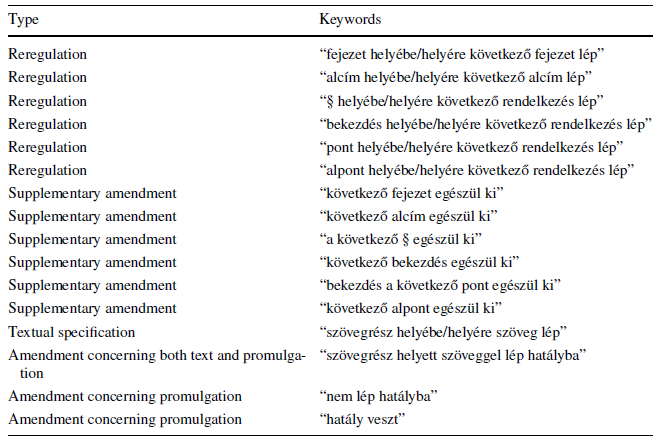
Amendment-type connections refer to provisions that either amend or repeal certain provisions in the given law. It is important to stress that we can define more than one connection for any pairs of laws (since the amendment of any article, section, etc., creates a new connection). We compiled our dictionary based on Decree 61/2009 (XII.14) of the Ministry of Justice and Law Enforcement on the Drafting of Legal Statutes. Table 1 lists the keywords and expressions used by our algorithm to recognise such connections in the texts of the laws.
List of keywords and expressions used to recognise connections between laws
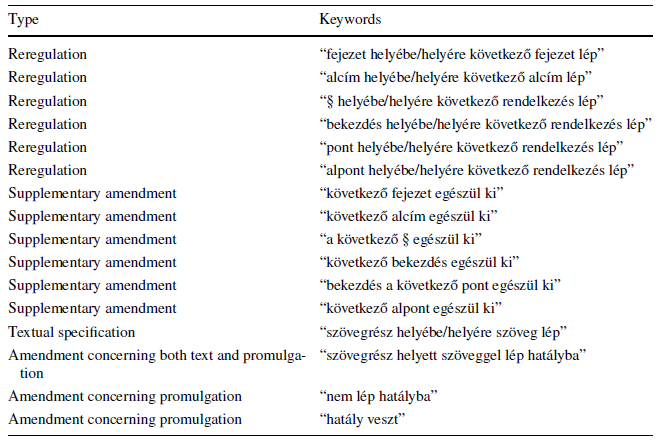
Source Decree 61/2009 (XII.14) of the Ministry of Justice and Law Enforcement on the Drafting of Legal Statutes
In the final step, our text analysis targeting amendment-type connections resulted in the identification of all connections (passages in the texts of the laws) that refer to amendments or repeals among the laws and decrees adopted between 1990 and 2014. This process yielded a dynamic edge-list type network database of legislative and executive texts.Footnote 6
In line with our research plan, what we were interested in were pairs of laws in which a specific law was amended by another within the same legislative term when the original law had been adopted. This required the exclusion of law/decree pairs from the database and the creation of a purely "legislative network". Furthermore, we were only interested in amendment-type connections within the same legislative term as this is a condition of our concept of legislative stability as defined in our theoretical overview. While originally the period spanning from 1990 to 2014 featured 107,407 amendment-type connections on a law/law basis, this latest step narrowed the database down to 18,650 within term law-to-law pairs.
Descriptive statistics
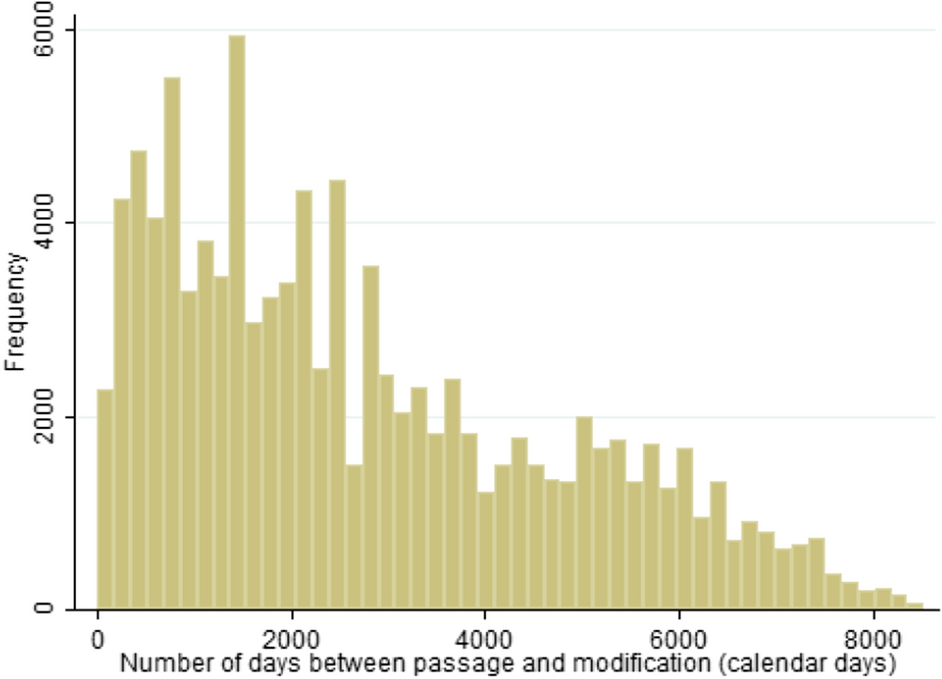
Based on the dataset containing original laws and their amendment(s), we calculated the number of calendar days between the adoption of the original bill and those of its respective amendment(s). For the entire set of observations (including amendments within and beyond the term of adoption) and for the total time period in question, the average value of this difference was 2770 days. The median was 2282 days with a standard deviation of 2022. The minimum number of days passed was 0,Footnote 7 while the maximum was 8537 days. (In other words, there were laws adopted early in the first term which were amended roughly 23 years later.) The distribution of the values for the complete dataset is presented in Fig. 1.
Number of days between passage and modification of laws. Source: cap.tk.hu/en
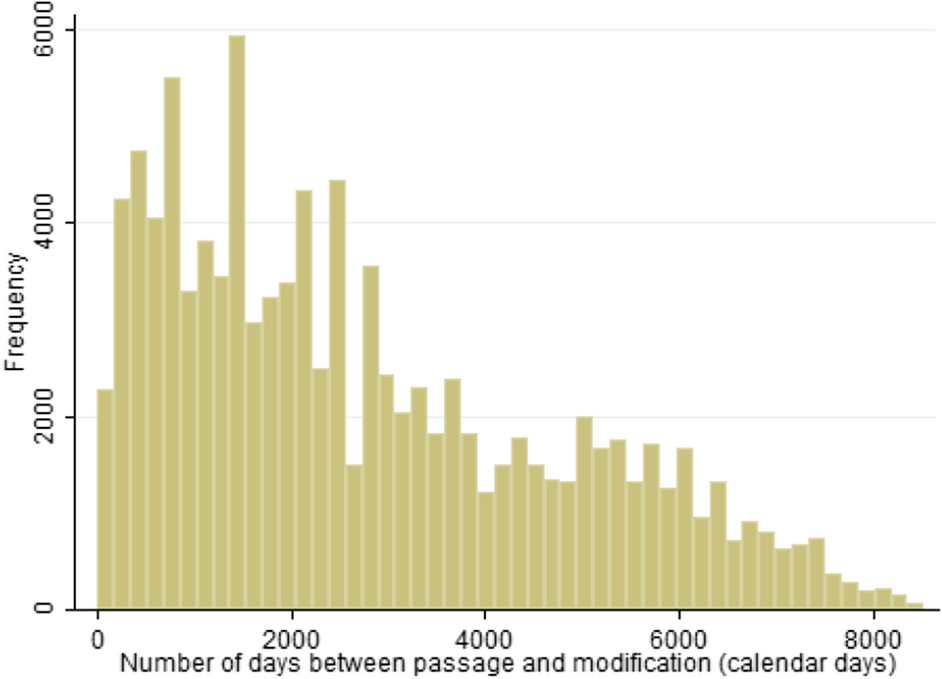
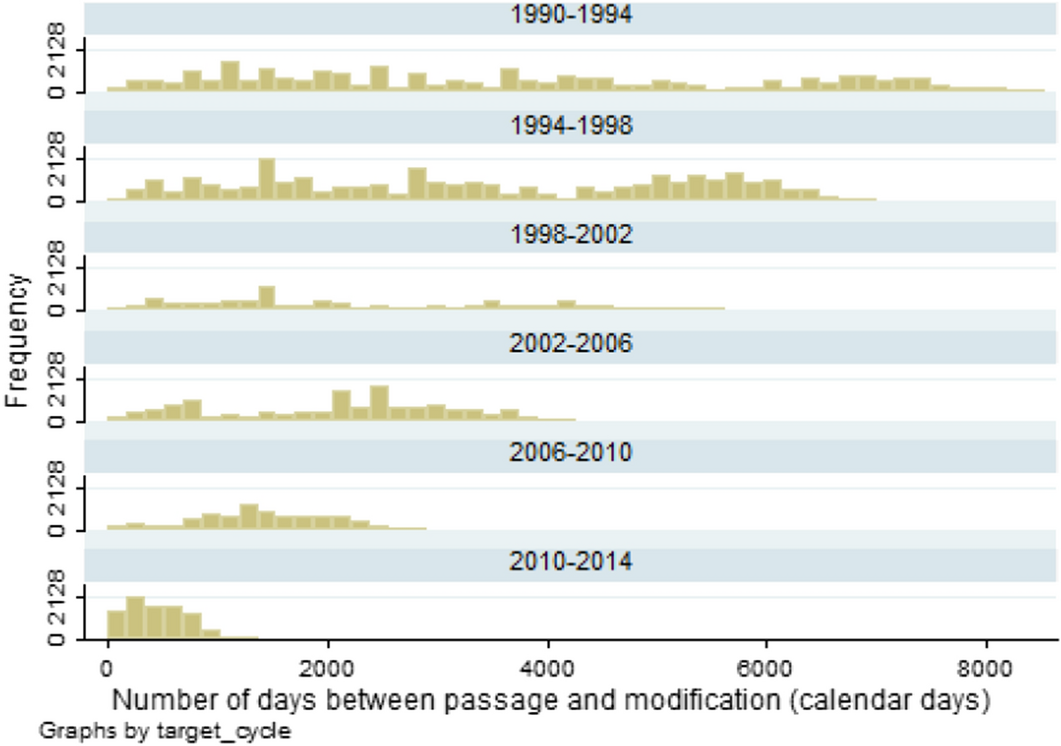
An overview of the data shows that amendments are nose-heavy in the sense that most modifications are enacted during the term when the underlying bill was adopted or during the immediately following term. Having said that, no linear trend is discernible and this may indicate that the day count is influenced by factors other than the trend of decrease. Figure 2 further illustrates this uneven distribution by allowing for the comparison of the legislative life of laws adopted in different terms of government.
Number of days between passage and modification of laws by electoral cycle. Source: cap.tk.hu/en
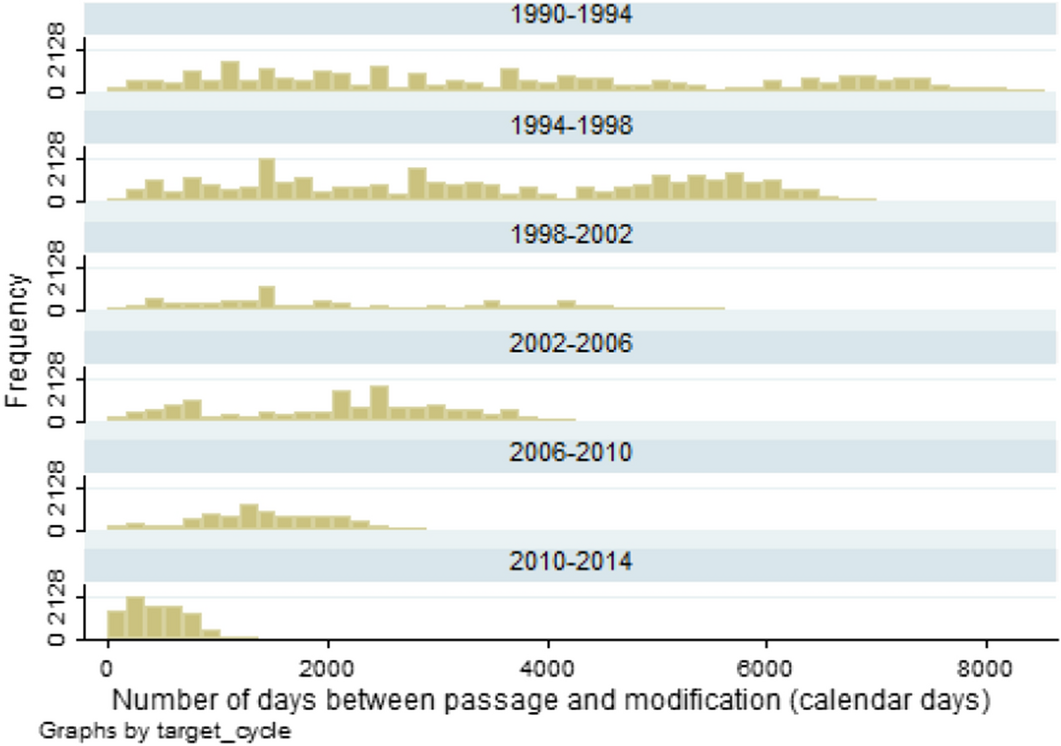
Here, we only single out one interesting feature of the second legislative term. The distribution chart displays a peculiar shape, one that is tilted towards the rear end of the period insofar as the bulk of amendments are concerned. Government ideology may be at play, as the day-count shows that these modifications were enacted by a right-wing government, which changed laws that had been adopted by ideologically left-leaning governments. Having said that, these results may have more to do with the “business as usual” of representative democracies than legislative stability.
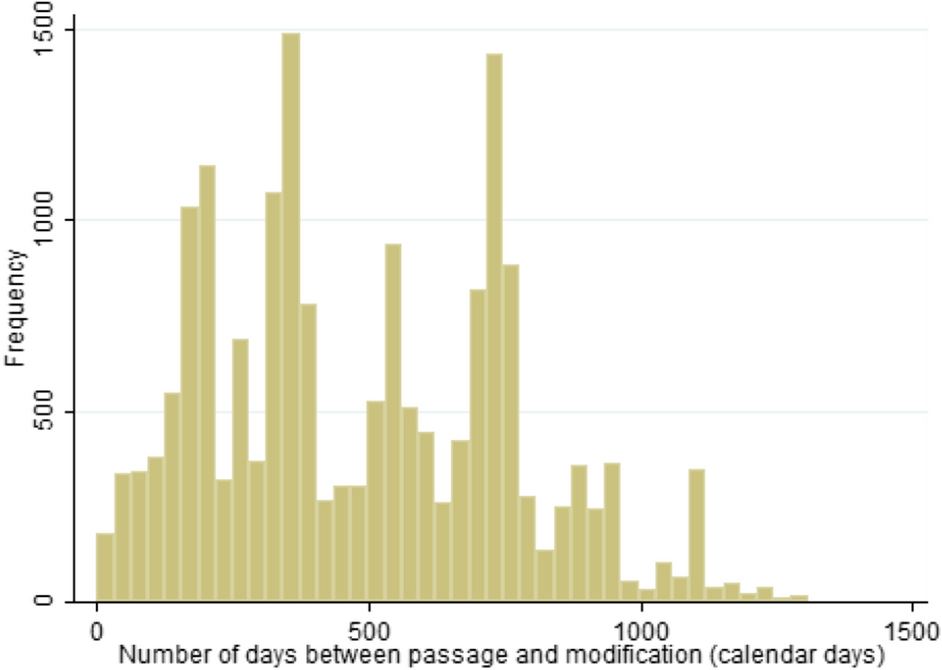
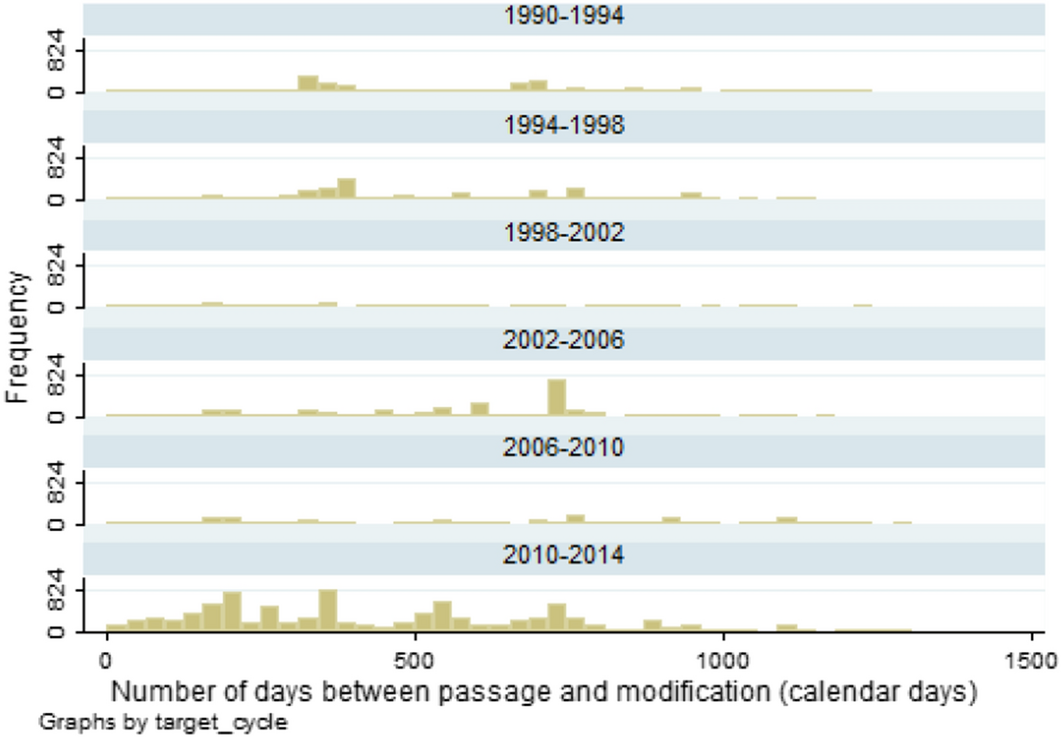
Let us now turn to the data that is more closely connected to our research question! The calculation of intra-term connections shows that the timespan between the adoption of the amended law and of the amending law was 489 days on average, with a standard deviation of 275 days. The median was 448 days, the minimum value was 0 days, and the maximum was 1307 days. Figure 3 shows the distribution over time of amendments within the same term, while Fig. 4 illustrates the distributions that characterise each term.
Number of days between passage and modification of laws within the same electoral cycle. Source: cap.tk.hu/en
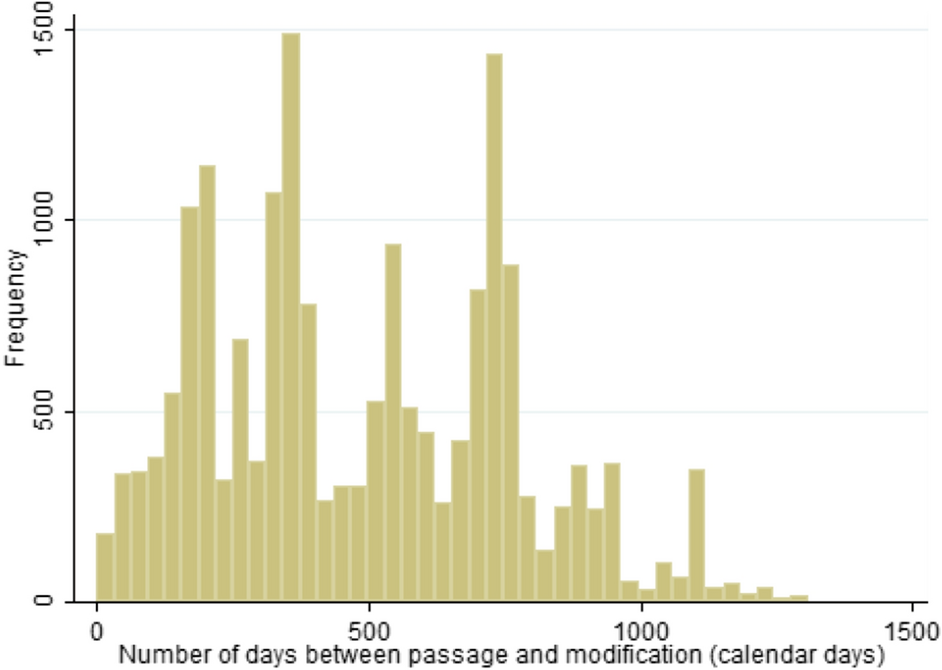
Number of days between passage and modification of laws by electoral cycle within the same electoral cycle. Source: cap.tk.hu/en
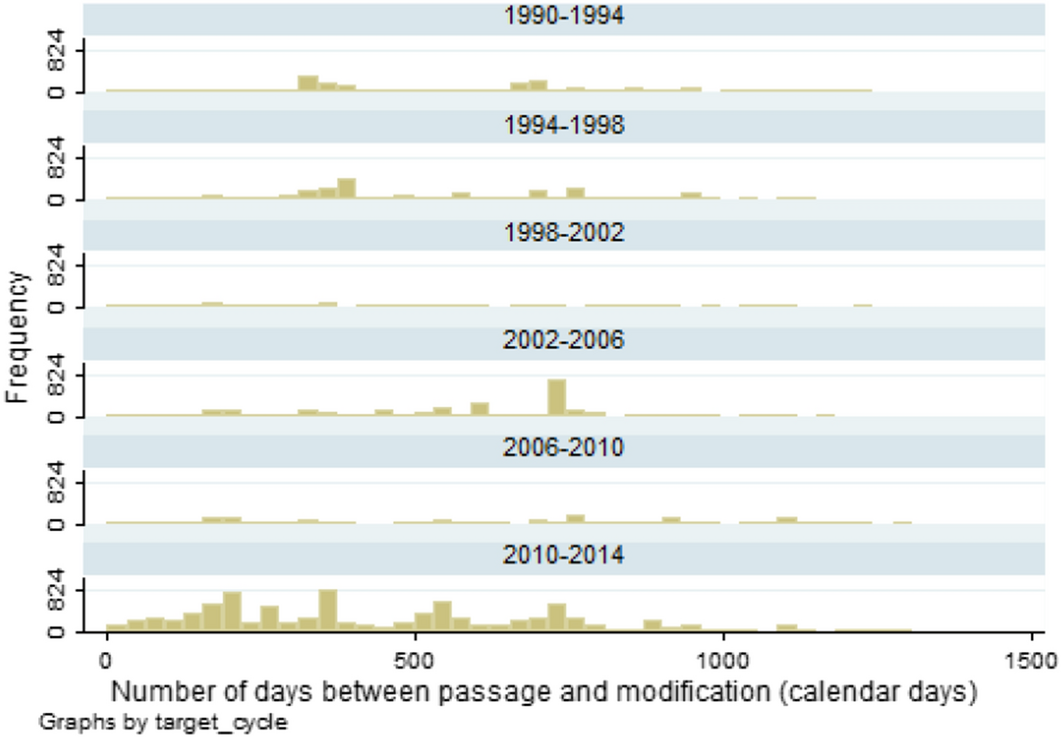
Similarly to the pattern shown for the general database (pictured in Fig. 1), intra-term amendments are nose-heavy with the majority of modifications enacted during the first two years of the legislative term. It is also clear from Figs. 3 and 4 that by the last year of the cycle a period of stability sets in. Furthermore, based on Fig. 4 it is also readily apparent that the government majorities were more actively involved in the constant revision of the legislative corpus adopted by them within the term of adoption. (See the 2010–2014 cycle.) It also emerges clearly from the data that in some periods amendments were enacted in fits and starts. (See the end of the first year in the first and second term, and especially the “half-time” of the fourth term.) We further discuss these preliminary ideas in a formal manner in “Results” section.
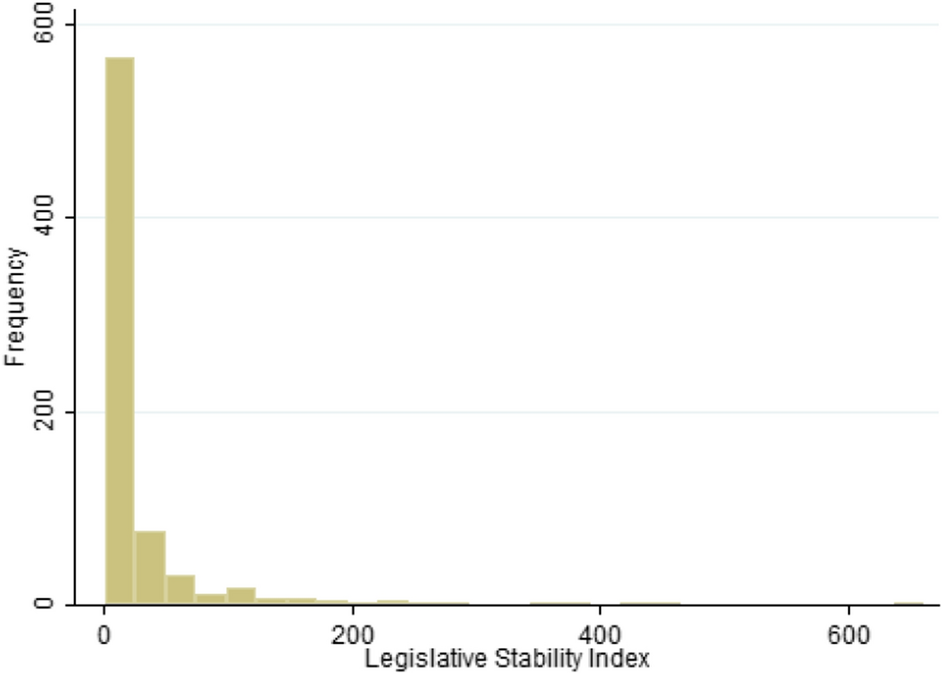
With calendar day data at hand, we were also able to calculate the LSI of each law. For this, we used the number of amendments and the date of the bills amending pre-existing laws as input data. In line with our research question, we were interested in pairs of laws where a given law was amended by another law already during the same legislative term when it was first adopted. As noted above, we found a total of 18,650 such amendment-type connections covering 738 laws with a nonzero LSI score. We filtered the amended laws in a way so as to determine the number of times each had been amended. Using the number of amendments, the date when the law that had been amended was first adopted and the date of the amendment, we were able to calculate the LSI values. The distribution of LSI values is presented in Fig. 5.
Distribution of LSI values. Source: cap.tk.hu/en
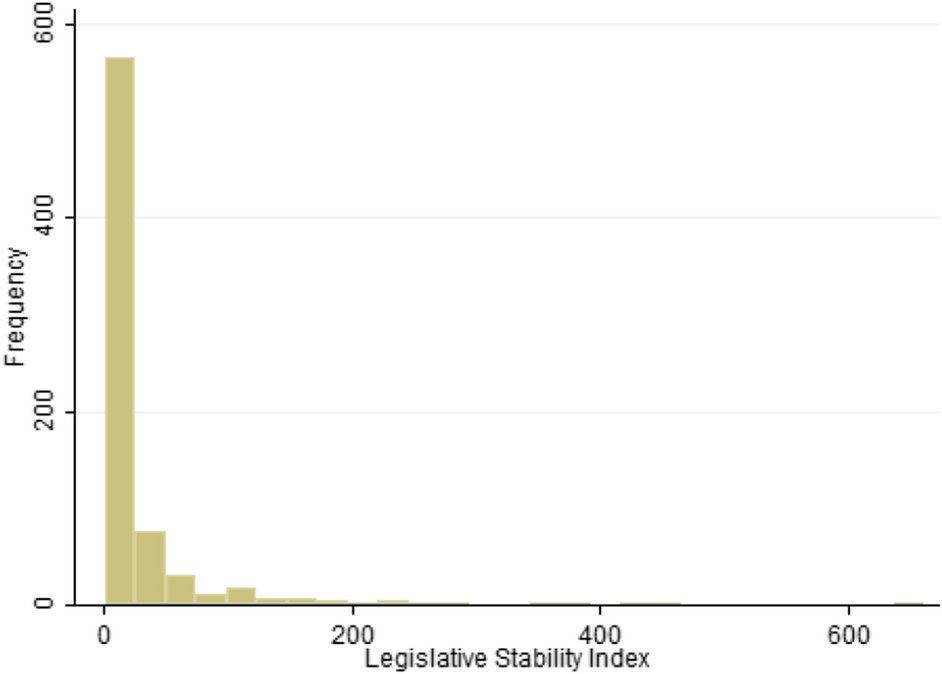
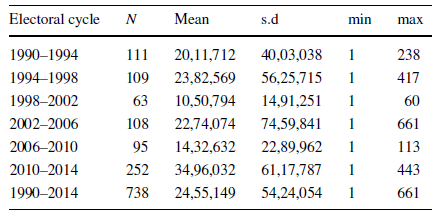
As Fig. 5 presents the distribution of the LSI values, the dependent variables of our models are heavily skewed towards the left, where the predominant majority of our observations cluster around lower values. The average value of the LSI is 24.55, while the standard deviation is 54.24. (See Table 4.)
Results
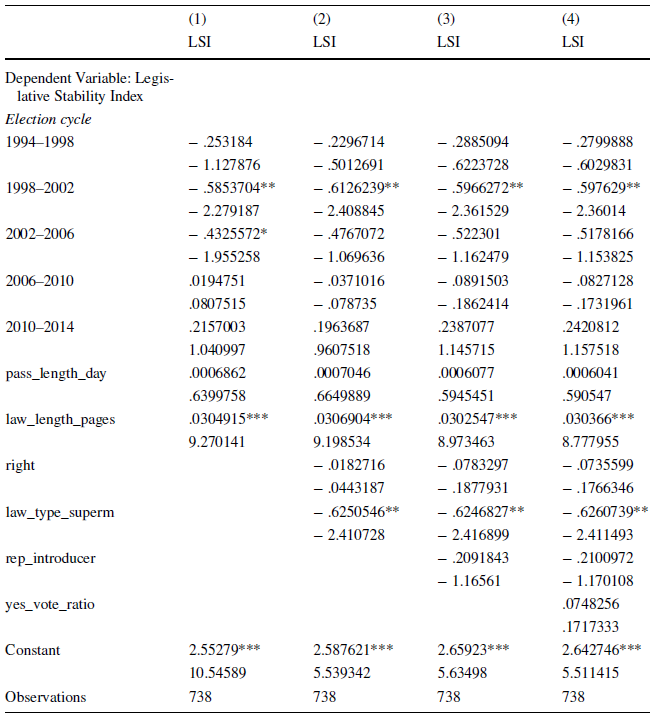
In the following, we present the empirical results concerning the 738 laws between 1990 and 2014 that were enacted within the same term as their amendments. We assumed in our models that the dependent variable exhibits the features of a gamma distribution and we ran generalised linear regressions. Table 2 presents the results of the parameter estimation for the LSI.Footnote 8, Footnote 9
Results of our regression models
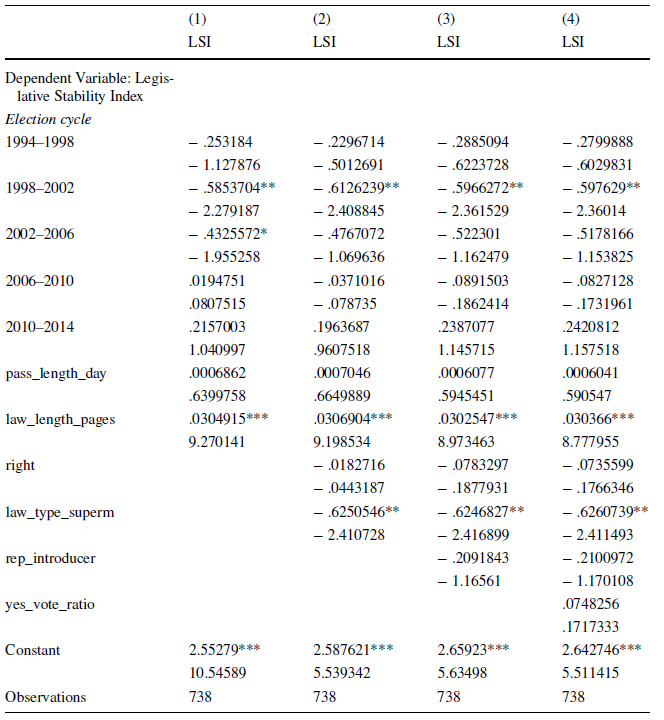
We estimated the regression coefficients for laws with an LSI value higher than zero. As control variables, we also included the public policy area and the potential international dimension of the law for all models investigated to control for the impact of these factors in assessing the effect of our explanatory variables.
First, we discuss the results of the models. Model 1 investigated how legal stability is influenced by the core set of explanatory variables: the legislative term, the length of time it takes to adopt a bill and the length of the law. Results for this basic model show that two out of six terms had a statistically significant impact on LSI values. The third (1998–2002) and fourth (2002–2006) terms correlated with stability in legislation (as witnessed by the negative coefficient). Thus, we can only partly confirm the H6 hypothesis since not all terms of parliament have exhibited significant differences in terms of legislative stability. The length of the law was significantly and somewhat positively correlated with the legal stability index (that is it resulted in lower stability), which confirms our fifth hypothesis (H5). There was no significant relationship between the time it took to adopt a law and its LSI, which falsified our third hypothesis (H3).
Model 2 augmented the basic model with two explanatory variables, the ideological orientation of the government and the method of adoption. The effect of terms only persists in the case of the first Orbán government (1998–2002), which confirms H6 hypothesis, but only partly. The duration of adoption and the length of the law variables continued to behave as we previously observed (falsifying H3 hypothesis and once again confirming H5 hypothesis). Of the new variables introduced, the ideological orientation of the government did not prove significant, thus falsifying H7 hypothesis. When adoption was contingent on a qualified majority, the LSI indicated higher-than-usual legal stability confirming H1 hypothesis. Models 3 and 4 expanded the analysis by two further politics-related variables. Of these, the sponsor of the bill (individual MP or the government) did not prove significant, falsifying H2 hypothesis. Similarly, the ratio of yes votes as a share of the total votes cast on the bill did not have a statistically significant impact on the LSI, falsifying H4 hypothesis again.
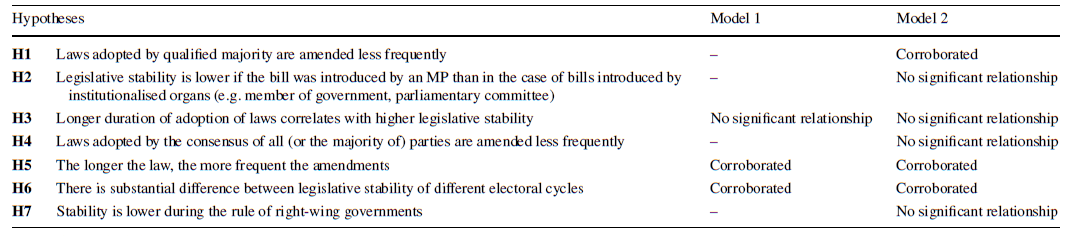
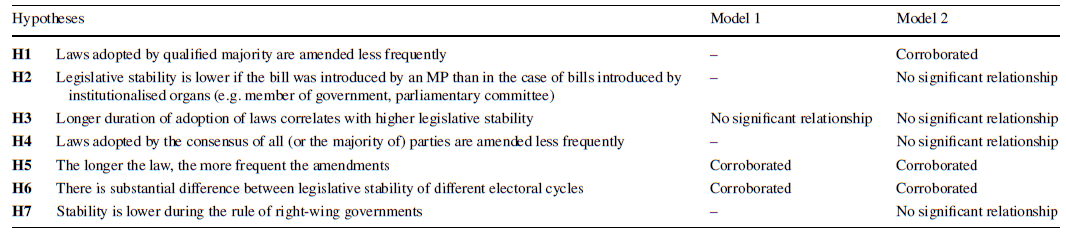
Table 3 summarises the outcomes of our analysis. In our article, we assessed seven hypotheses out of which three provided a decisive result. Our data corroborates the assumptions of H1, H5 and H6. For H2, H3, H4 and H7, we did not find such corroboration. In sum, our article not only introduced a novel theoretical concept (legislative stability understood as the sum of modifications of individual laws), a corresponding measurement approach (Legislative Stability Index) and empirical results on a newly compiled dataset which yielded valid results on seven hypotheses—some straightforward, some less so.
Overview of our results by hypotheses
Source Own calculation
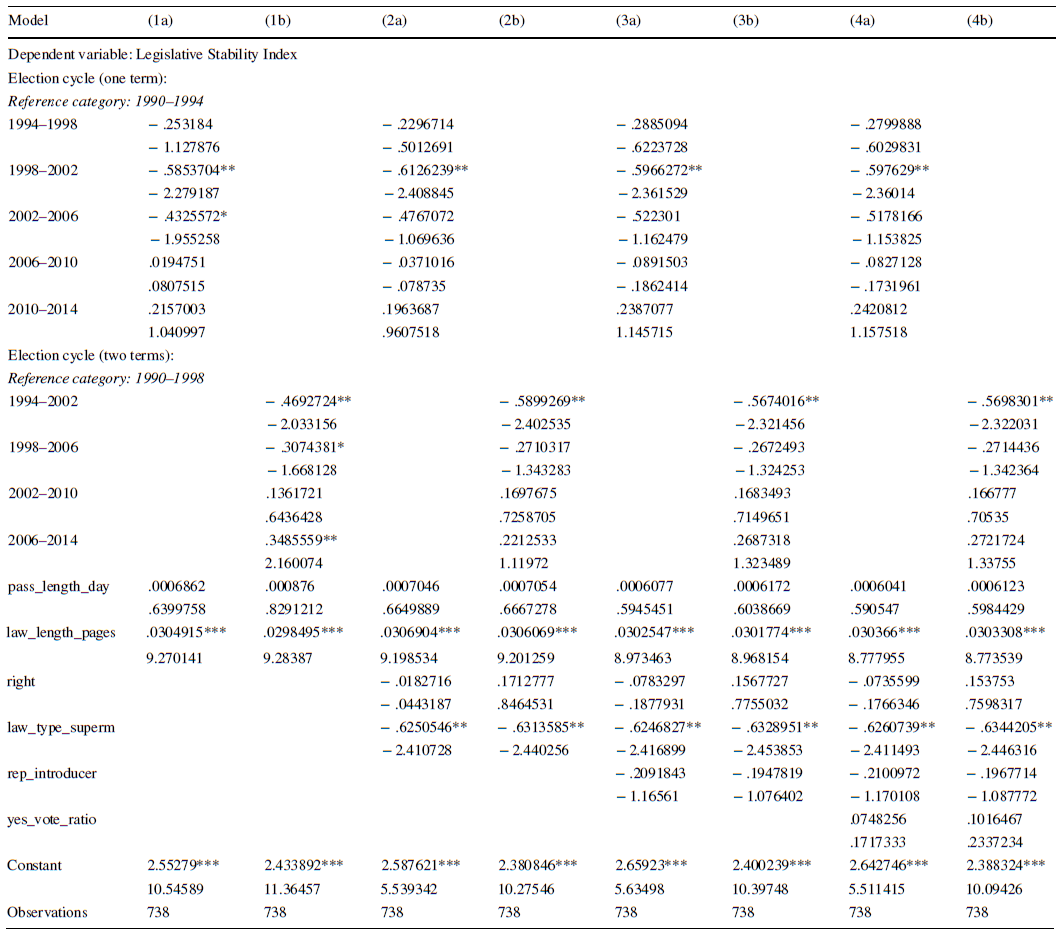
In Appendix 1, we have included a robustness analysis on our regression estimates which show no difference in results whether single-term or double-term categorical time variables were included.
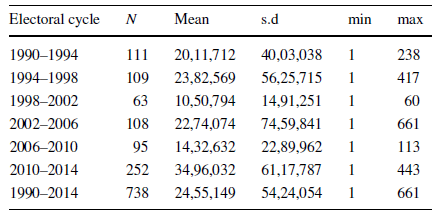
Our regression results were also confirmed by a hand-checked validation of the laws with the highest LSI values. This revealed that the majority of observations in this subsample are laws adopted under the 2nd Orbán government.Footnote 10 Table 4 summarises our results of LSI values broken down by terms.
LSI values by electoral cycle
Source Own calculation
As is apparent from Table 4, there were more laws amended in the same term (N = 252) in the 6th post-transition government cycle than in the aggregated total of the terms with the second and third highest number of such pairs. The second Orbán government's LSI value of almost 35 is also far higher than the index value measured under the Horn government (1994–1998), which represents the second-highest value in the post-transition period. The high standard deviation of values during the second Orbán government indicates that a portion of the laws behaved similarly to laws in the other terms, while the high average value was chiefly attributable to a distinct group of laws that were often and/or extensively amended. This stands in stark contrast to the period of the first Orbán government, which was marked by both the lowest average value and the lowest spread. In light of the above, the vast discrepancy in the LSI values of the two Orbán governments raises an issue to be further investigated in future research.
The remaining explanatory variables produced a mixed bag of results. Regression results for the length of the law (H5) were well behaved in the sense that the longer a law, the more likely it was to be often and/or extensively amended. The variable concerning qualified majority requirements for adoption (H1) also yielded pronounced results; the stricter institutional conditions resulted in fewer and/or less extensive amendments.
Our results show that two of our hypotheses can be clearly confirmed. As H5 states, the longer the law, the more frequently it is amended. Similarly, as H1 shows, stricter institutional requirements concerning the adoption of bills, such as, for example, in the case of laws that can only be amended with a qualified majority, results in higher stability. Interestingly, H6 hypothesis, which posited that there are significant differences between electoral cycles in terms of their legislative stability, can be partly confirmed. We only observed a significant difference in the context of the electoral cycles 1998–2002 (in both Model 1 and Model 2) and in 2002–2006 (only in Model 1).
The lack of significant effect of the second Orbán government (2010–2014)—even though we saw that the first one did have an impact (during the term 1998–2002), contradicts the fact that we can find evidence for a significant learning process between them. If we investigate the first Orbán government, we can see that only 4.98% of government MPs had experience in government. During the second Orbán government, we see an increase in the proportion of MPs with prior government experience: 26.74% of government MPs had previous experience in government.
Among the 29 members of the first Orbán government, no one had previous experience as a minister, and only four had held some office in previous executives (vice prime minister, secretary of state or government commissioner). Only a minority of them, 11 members of government, had served as MPs during previous electoral cycles. Among the 13 members of the second Orbán government, five has served as either a minister or prime minister in the first Orbán government. Two other cabinet members had served as officials in the executive between 1998 and 2002 (a secretary of state and a vice secretary of state). Three other cabinet officials had been members of parliament before, one of them between 1998 and 2002.
This means that the proportion of “greenhorn” ministers without any previous governing experience decreased from 61.54% during the term of the first Orbán government to 24.14% in Orbán’s second term. This confirms the role of the learning process in the context of both members of the legislature and the executive.Footnote 11These results underline and confirm the statement of the previously cited speech by the speaker of the National Assembly during the term of the second Orbán government, László Kövér, who openly acknowledged that the rapid speed with which the government majority passed legislation was based on a strategic choice by the governing Fidesz party.
Discussion
In the sections above, we have presented the concept and measurement of the Legislative Stability Index. In the discussion below, we respond to two potential lines of criticism: (1) the self-imposed limitation related to within-cycle amendments and (2) the possibly disrupting presence of so-called cosmetic amendments.
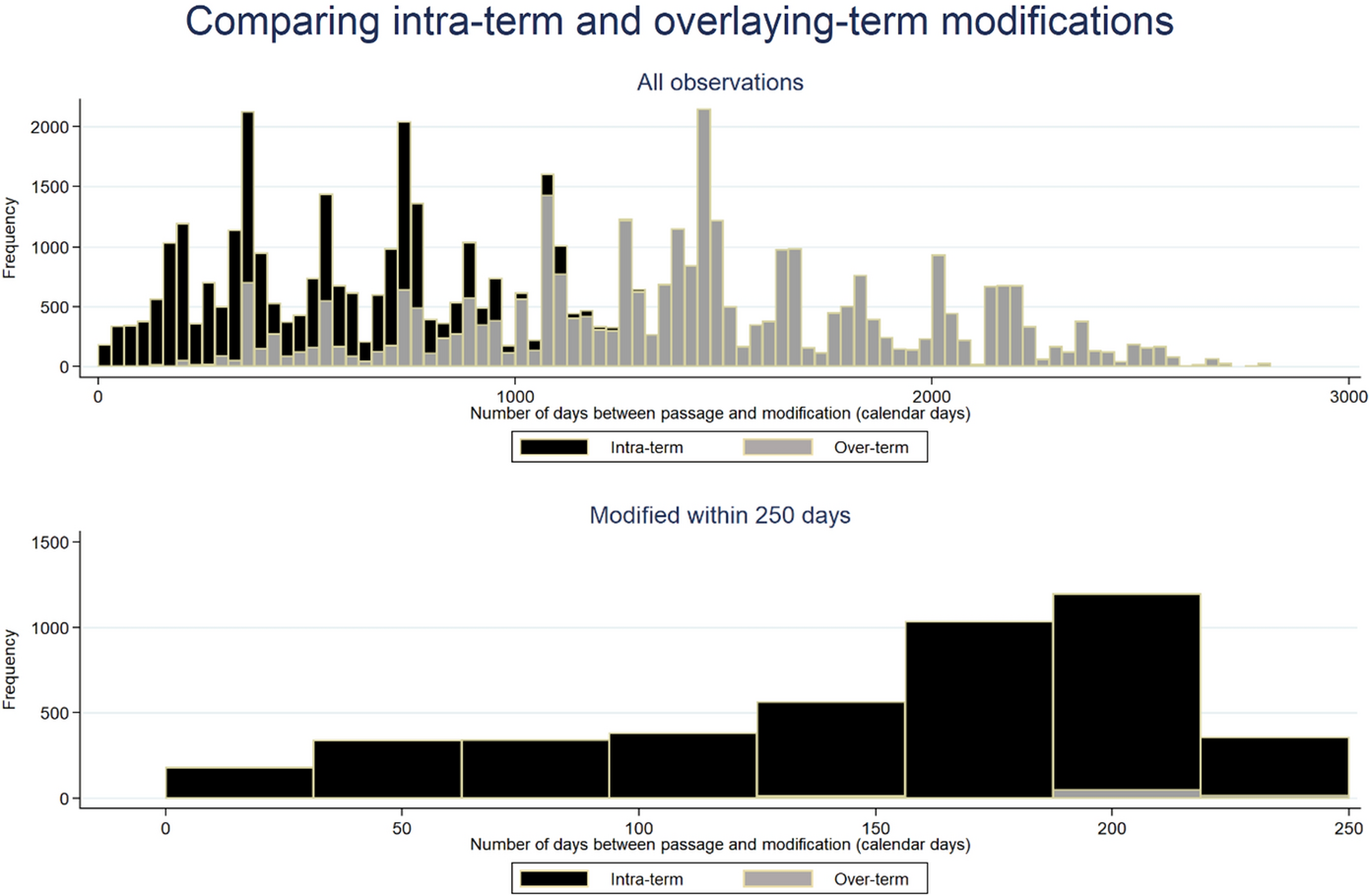
Starting with the first potential criticism, basically our framework of analysis excludes those connections in which the amending laws were adopted during different legislative terms than the laws they amended. Figure 6 presents the cumulative distribution of intra-term and over-term amendments over two consecutive terms. (These are cases in which the amended law was originally adopted during the term directly preceding the adoption of the bill subsequently amending it.) Fig. 6a (on top) presents the data for all observations, while the data in Fig. 6b (on the bottom) are limited to amendments adopted within 250 days of the adoption of the law that was later amended. Based on the distributions, we can conclude that as the time span between the adoption of the amending law and the original adoption of the law being amended shortens, an increasing majority of intra-term amendments are present. In Appendix 1, we have included a robustness analysis on our regression estimates, and these show no difference in the results regardless of whether we include single-term or double-term categorical time variables. The single-term election cycle categorical variables refer to four-year time spans encompassing one full legislative cycle in four-year increments. The double-term election cycle categorical variables are indicating eight-year time spans with four-year increments, encompassing two full legislative cycles.
Comparison of intra-term and over-term amendments. source cap.tk.hu/en
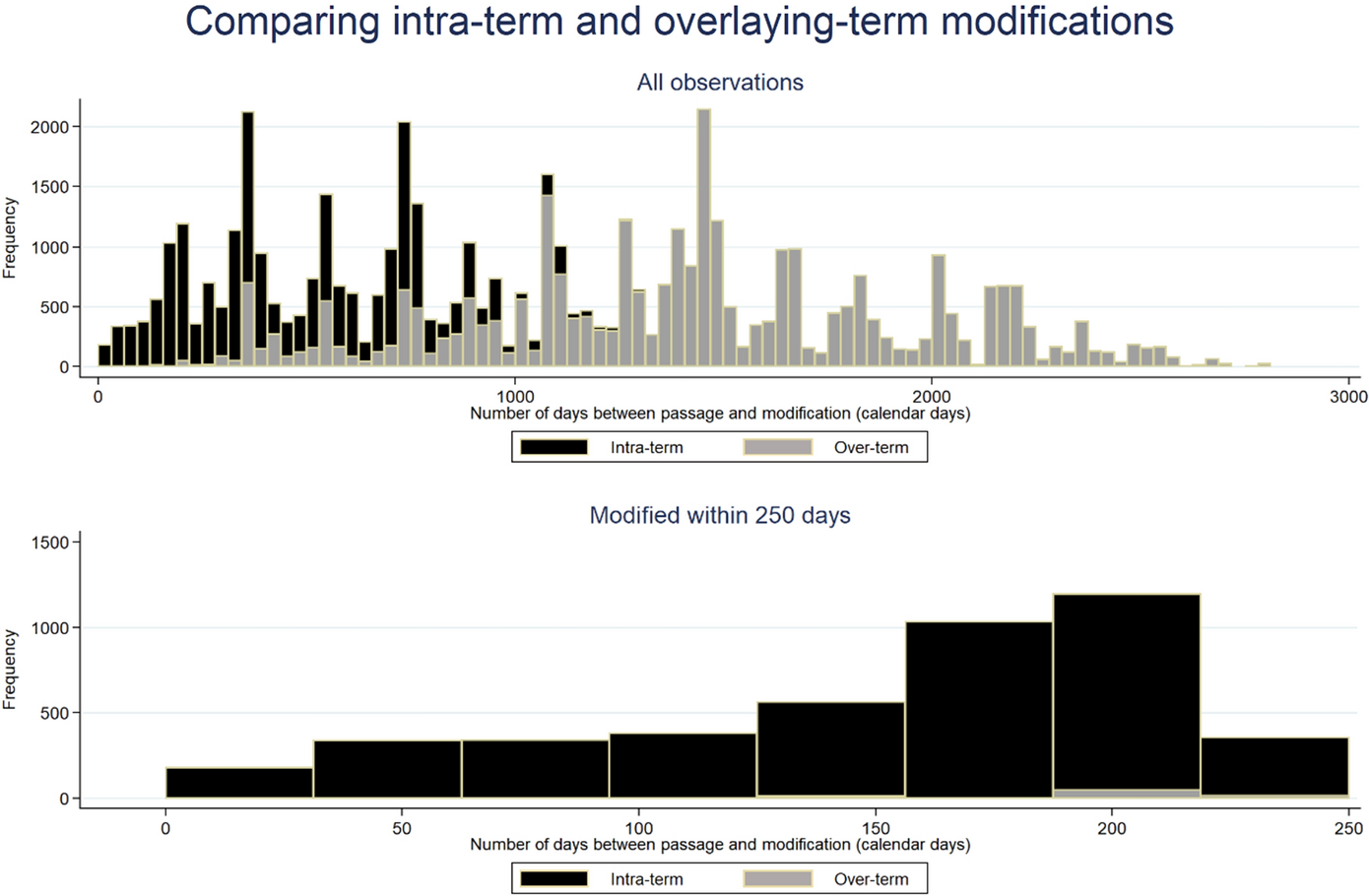
As our manual check confirmed, there was no over-term amendment enacted within 100 days of the adoption of the original bills, which conforms with our prior expectations since there are no plenary sessions in the time between the dissolution of legislature prior to the election and the constituent session of the new parliament after the election. During the term investigated, the average length of the break between the final session of the outgoing parliament and the first session of the newly elected legislature was 81.8 days.
Regarding the second potential criticism on the possibly disrupting presence of so-called cosmetic amendments, we would like to add the following thoughts. Purely cosmetic amendments, such as bills that rename institutions, should be filtered out. Theoretically speaking, a change in the name of an institution should not in and of itself reduce the stability of the underlying law. At first, it seems that the length may be a proxy to find cosmetic (and not substantive) amendments. However, if we analyse the texts in detail, it turns out that this proxy is not accurate. Institutional names in Hungarian are generally composed of more than one word. In addition, substantive amendments may also be the result of just a single word being replaced or changed in the original law. To cite two fairly common examples, think of tax changes (e.g. if a given tax is raised from 17 to 25%, only one word has changed) or changes of controlling authorities (e.g. if a given policy area is no longer controlled by the environmental protection authority—“környezetvédelmi hatóság” in Hungarian—but by the construction authority—“építési hatóság” in Hungarian).
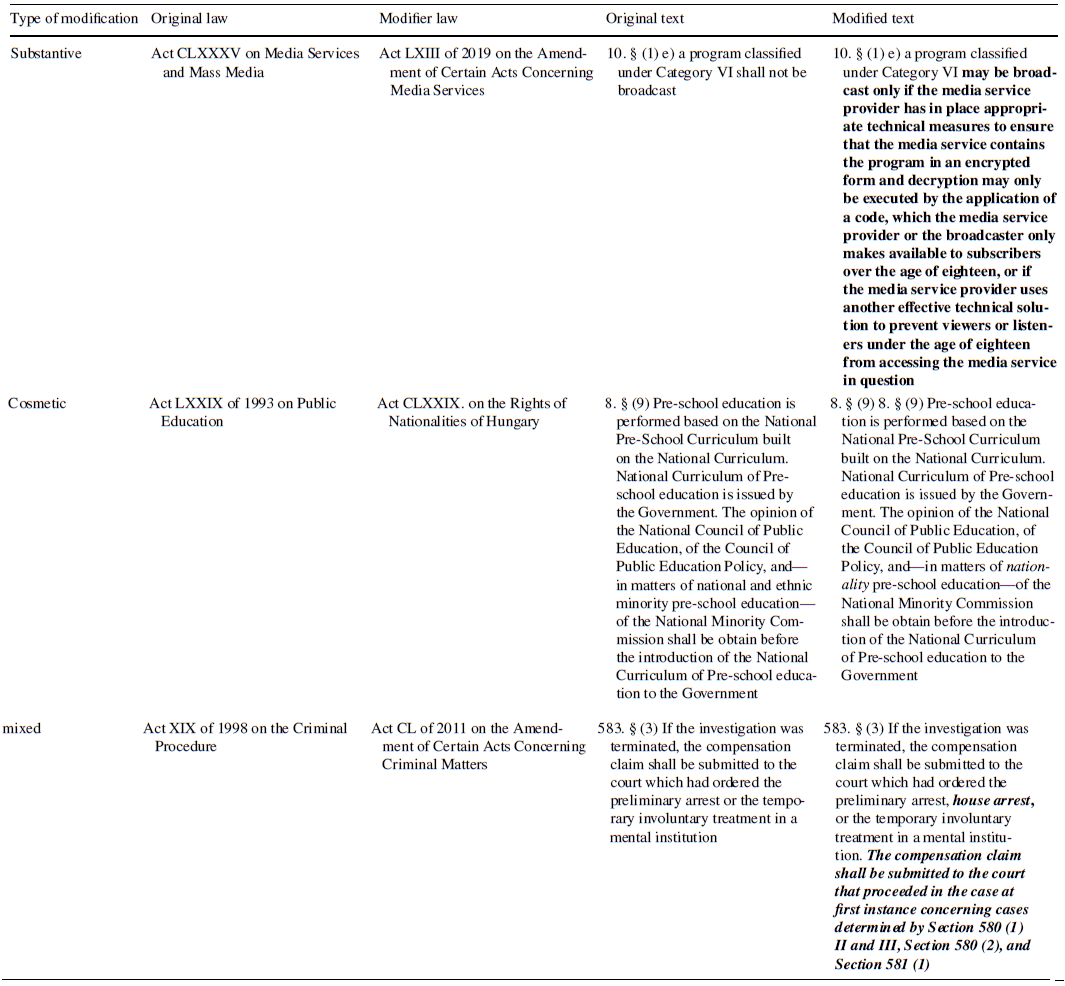
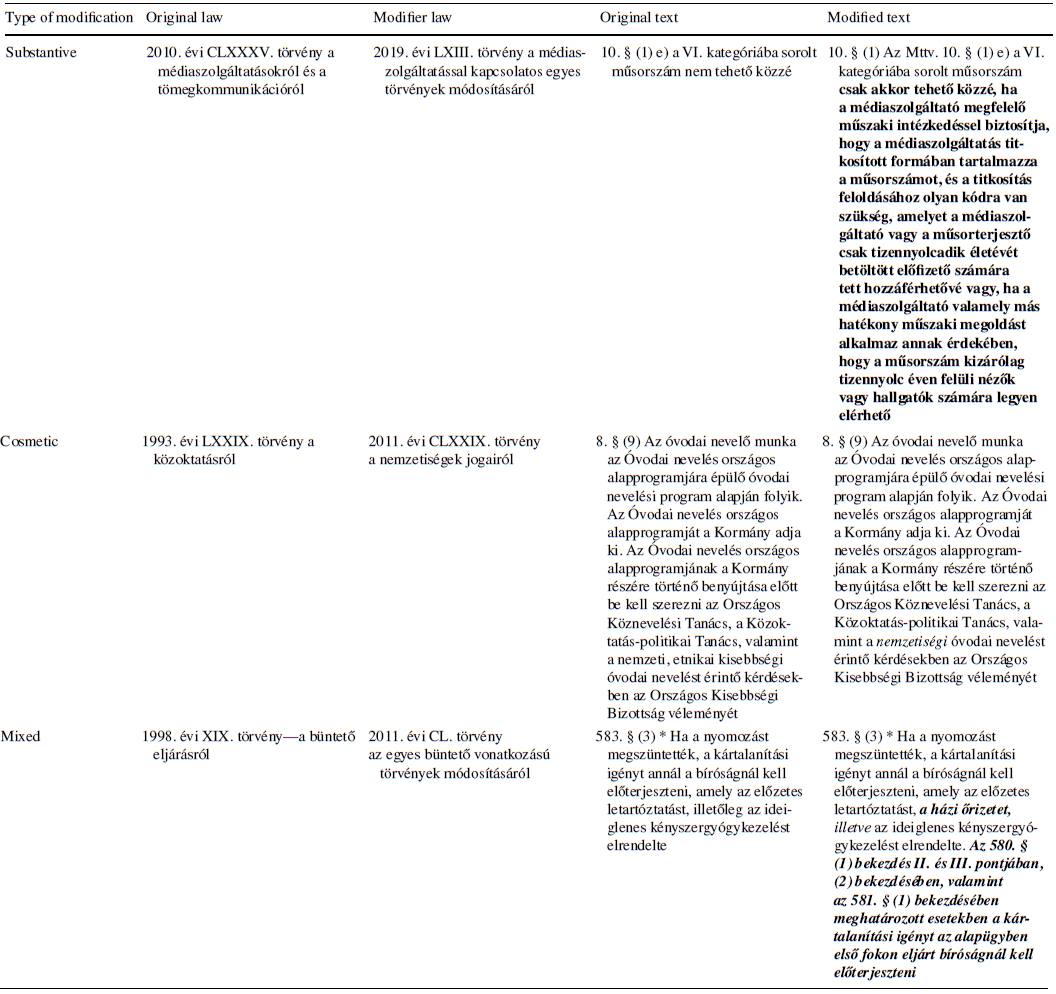
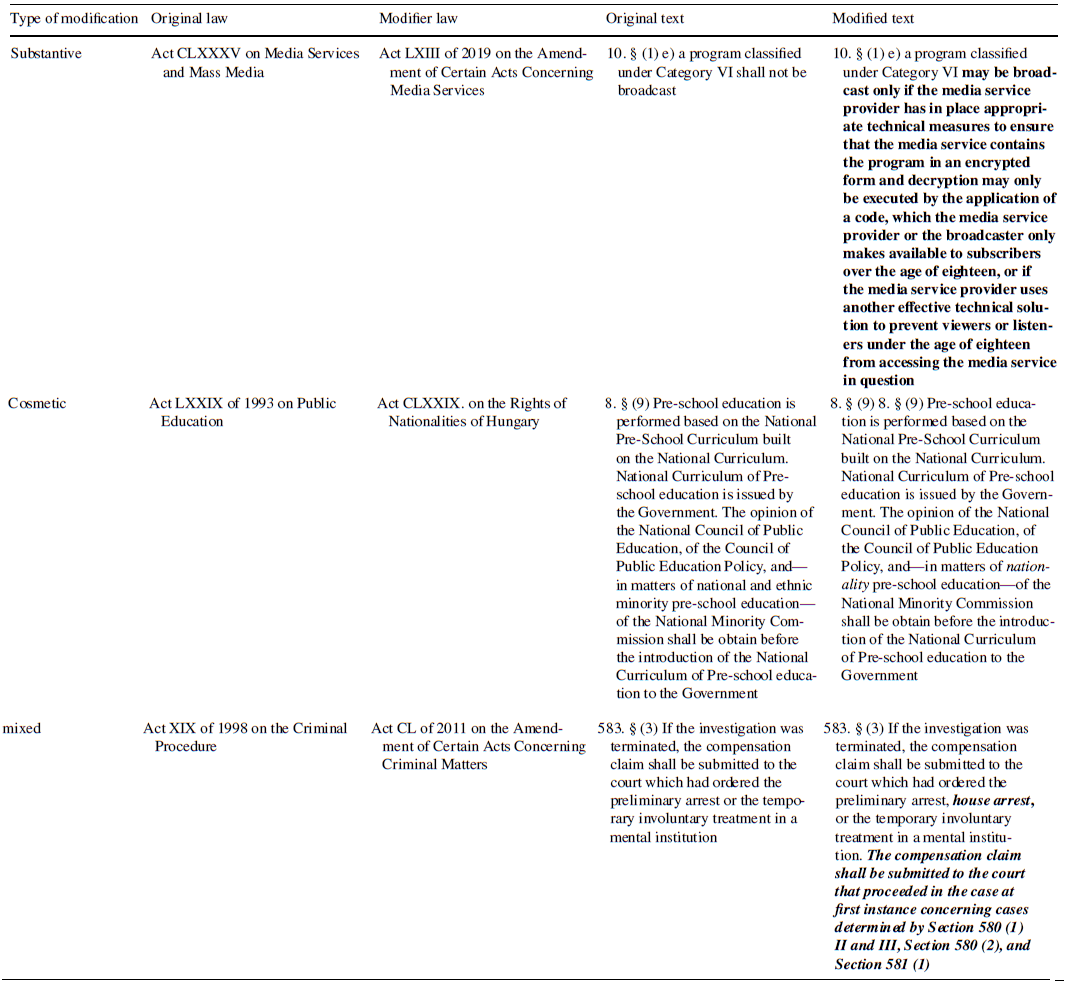
We have chosen to measure the substantive content of amendments based on two criteria. We asked two independent coders to perform so-called blind coding, that is to manually check a random sample of 1000 observations and to code whether the amendment was (1) cosmetic or substantive based on their qualitative assessment and/or (2) involves the renaming of a given institution, process or document. If the coding of these was contradictory, a third coder decided the final code. Our results confirm that although some of the amendments do not change substantive elements of the laws in question, cosmetic amendments only make up an almost irrelevant minority of all legal amendments. (In our randomly chosen sample of 1000 amendments, only 3.2% were merely cosmetic.) Our coders’ inter-coder reliability was as high as 91.7% regarding the first and 90.3% regarding the second criteria, which provides a strong validation of our results. Table 5 features examples of amendments with substantive contents, cosmetic amendments and mixed amendments containing both substantive and cosmetic elements. (The original Hungarian text of these examples can be found in Appendix 2.)
Examples for law amendments (translated to English)
Conclusion
In this article, we formulated a proposal for a measurement scheme to capture legislative stability and we developed a Legislative Stability Index (LSI) to this end. The key to the LSI was a system of categories concerning the frequency with which laws are amended after their adoption. We tested this index by using a newly compiled database based on Hungarian legislative activity. We assessed seven hypotheses out of which three provided a decisive result.
Our data corroborate the following assumptions: there is substantial difference between the legislative stability of different electoral cycles; the longer the law, the more frequent and extended are the amendments; and that laws adopted by qualified majority are amended less frequently and extensively. However, we have not found a significant relationship between legislative stability and the duration of adoption of laws; the ideology of government; the consensual nature of adoption; nor whether the bill was introduced by an MP or institutionalised organs.
In concluding the present study, we will briefly return to the fundamental conceptual problem we raised in our introduction and in the section outlining the theoretical basis of our study: stable legislation is a necessary basis for democratic operation, social well-being and economic prosperity. Nevertheless, one can conceive of a case when changing circumstances necessitate frequent legal amendments, and in such a scenario the public interest is better served by adopting the necessary changes. Stable laws must also be flexible, that is, they must be adaptable to changing political, social and economic circumstances; this notion is also included among the OECD's recommendations, for example.
Nevertheless, we stand by our assumption that neither the general process of politics nor legislative work specifically tends to be typically conducted under extraordinary circumstances. A significant portion of legislative products is the result of discretionary decisions by the governing majority. If that is true, then legal amendments adopted within the same legislative term as the law they amend provide a good way of capturing stability. That is even if we assume that the body of laws changes continuously, the relationship we posited as the basic idea of our study still obtains: more frequent amendments indicate a lack of legislative stability.
Our tool is suitable for measuring a characteristic that both academic literature and general political discourse deem as important: the stability of legislation, which is an important component of legal certainty and due process. Although the long-term aim of our study is to build a metric of legislative stability, the framework we proposed should ideally also be able to provide a quantitative analysis of legislative quality. The current study provides a founding framework for this prospective investigation.
Funding
Open access funding provided by Centre for Social Sciences. The project was supported by Hungarian Scientific Research Fund Grant nr. ÁJP-K-109303 and by the National Research, Development and Innovation Office grant nr. FK-123907, the Artificial Intelligence National Laboratory of Hungary, the OPTED Horizon 2020 project as well as the Bolyai grant of Miklós Sebők.
Appendix 1: Robustness check of inter-term amendments’ effect
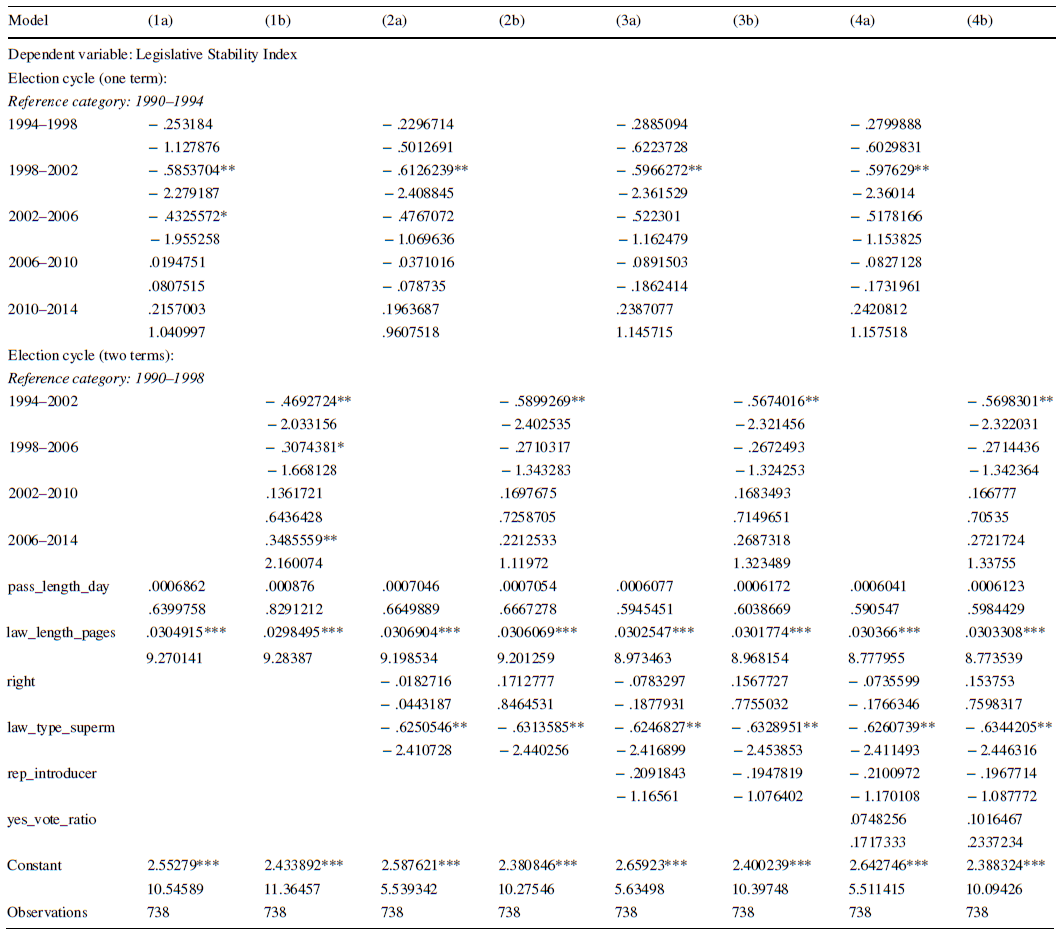
Our regression estimates shown in Table 6 contain term cycle dummies for every election cycle. We call these single-term election cycle categorical variables. As we have discussed, it is also important to consider those cases where the amended law is not intra-term but was enacted in any term preceding the law amended. To validate our analysis on a more robust ground, we included double-term election cycle categorical variables (containing amendments of two continuous electoral terms) in the same regressions as in our primer analysis. Double-term election cycle categorical variables encompass eight-year time spans in four-year increments, containing two full election cycles. In the appended table below, we expanded the original regression estimates table using similar specifications but with double-term election cycle variables replacing the original single-term election cycle variables. A comparison of the results shows that our conclusions still hold. In all four models the list of significant variables stayed exactly the same with the exception of apart the election cycle variables, their coefficients differ only marginally. In the case of the election cycle variables, the double-term variables are significant if and only if there was a significantly influential election cycle within the eight-year time span based on the single-term variables.
Robustness check of inter-term amendment’s effect
Source Own calculation
Appendix 2: Examples of legal amendments
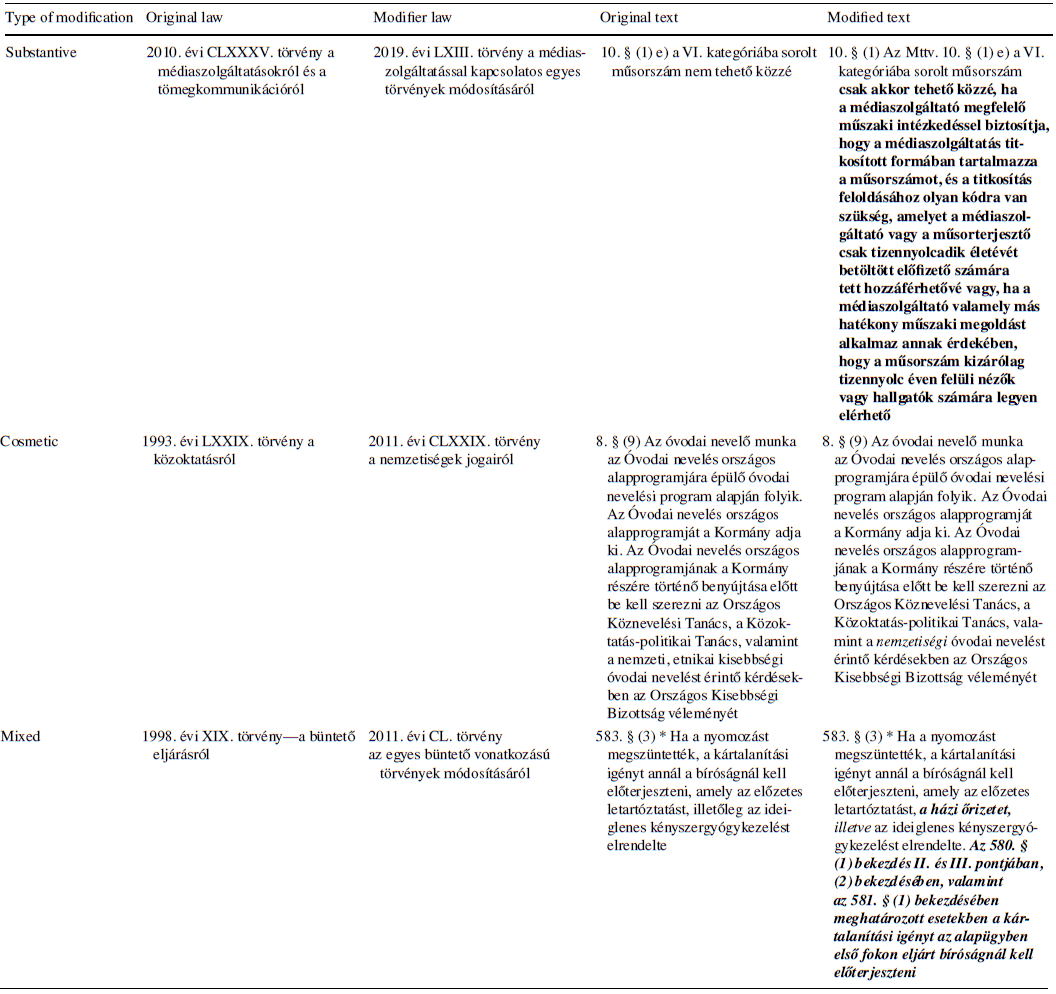
The first column features the type of amendments (substantive, cosmetic, mixed). The original law and the modified law features the name of the law that was amended and the name of the law amending it. The differences between the original and the amended texts are shown in bold when the amendment affects the substance, and they are italicised when the amendment is cosmetic (Table 7).
Examples for law amendments (in Hungarian)

 Open access

