


1 Introducing a Theory of Segmented Polities
Introduction
Contemporary theories of the state seem out of sync with contemporary practices of statehood – in Europe and beyond (Bartolini, Reference Bartolini2007; Schmitter, Reference Schmitter, Marks, Scharpf, Schmitter and Streeck1996; Zielonka, Reference Zielonka2006).Footnote 1 The misalignment stems from inadequate conceptualization of new forms of polity such as supranational authority structures that exert territorial control but are operating within the broader confines of the statist political order.
To respond to this misalignment, this Element proposes the theoretical concept of segmented polity. The Element draws on Max Weber’s concept of Verstehen, that is, to understand and theorize empirical developments of novel forms of political organization beyond the state but within the broader confines of the modern statist political order. The modern segmented polity represents both an attempt at liberating the polity from the distinct presuppositions pertaining to territorial-functional organization that mark the modern state and at the same time exhibits the difficulties and constraints that such efforts encounter in a world made up of states.
Nowhere is the analytical misalignment more evident than in contemporary Europe, even if elements of this development are evident in other parts of the world too. Europe is where the state system has historically been most entrenched, not only because of citizens’ sense of national identity but also because many of Europe’s states are well-developed welfare states with strong senses of social solidarity.
How to fit the European Union (EU) into this picture has long been a puzzle for scholars. The EU is frequently portrayed as a political entity that conceptually fits somewhere between the ideal typical political science categories of a federal state and an international organization (IO). It falls short of the governance authority and capacity of a federal state but features more regulatory and policymaking authority and capacity than any IO – past and present. Such a depiction is obviously correct, but it only tells us what the EU is not; it does not specify what the EU is. While it is risky to put conceptual labels on what may be transitional arrangements restricted in time and space (Trondal, Reference Trondal2010), the resilience and durability of the EU call for renewed theoretical efforts (Trondal, Reference Trondal2023). Moreover, the more general misalignment between theory and empirical evidence in political science also calls for renewed theoretical work. This is all the more pertinent as the EU keeps on showing remarkable governing capabilities through tranquil as well as through rough times across a group of what formally remain sovereign nation-states.Footnote 2
The earlier scholarly puzzle motivates a set of questions that are discussed in this Element. How can we conceptually understand polity formation beyond the sovereign nation-state that at the same time remains subject to the isomorphic pressures embedded in the system of states? Isomorphism entails that organizations strive to match and emulate their institutionalized environments, in effect making organizations adaptive of their wider context (DiMaggio and Powell, Reference Dimaggio and Powell1983). As a consequence, organizations reflect shifting environmental trends and fashionable ideas. Meyer and Rowan (Reference Meyer and Rowan1977: 73) emphasized the importance of taken-for-granted rules that appear in wider institutional environments that take the form of “rationalized myths.” They are myths because they are widely held beliefs whose effects “inhere, not in the fact that individuals believe them, but in the fact that they ‘know’ everyone else does, and thus that for all practical purposes the myths are true” (Meyer and Rowan, Reference Meyer and Rowan1977: 75). Moreover, given that institutions may be loosely coupled, as outlined by Nils Brunsson (Reference Brunsson1989), they may adapt certain elements to their environments while keeping other elements static. Nation-states may, for example, change how they govern (how and what decisions they make) while the language (talk) they use to make sense of this remains fairly constant. This suggests that the isomorphic pressures states face may vary, leading to a divergence between actual state transformation on the one hand and the retention of state-based language on the other. This does not deny that the state system exerts strong isomorphic pressures, but it makes it important to understand why and how the EU is able to govern in ways unavailable to IOs, and why there is need for developing new theoretical categories to capture that. Moreover, is the EU unique in this way or does it share structural features and mechanisms with other contemporary and/or historical political entities? How can we theoretically reconcile the EU’s distinct character with the continued existence of the statist order that continues to mark the European political landscape? Finally, what plausible democratic implications can be derived from this theorizing?
The purpose of this Element is to outline the theoretical concept of segmented polity, assess its applicability by empirically illustrating segmentation in the EU, innovate on the theoretical apparatus available in the political science toolbox, and discuss implications for our thinking on democracy.
We understand a segmented polity as a supranational political system that is equipped with binding authority in a limited policy area and therefore contested, partial and constrained, when compared to the sovereign nation-state. It is contested in normative terms because it is a supranational system of governing with ability to effect authoritative decisions, and in normative terms it represents a deviation from the prevailing understanding of appropriate political organizing anchored in the nation-state and the system of states. IOs are understood as creatures of the states and therefore not considered deviations. The supranational polity’s authority structure rubs against the states’ authority and capacity. The states are effectuating most of the decisions the supranational entity makes; hence states are in a position to constrain the supranational entity. The segmented polity’s realm of authority is partial in functional terms. The partiality of the segmented polity is not only limited in the range of functions over which it can issue authoritative decisions (partial in a horizontal sense), but also with regard to social resonance or the way it is embedded in the societies of the member states (partial in a vertical sense).
Segment and segmentation are familiar terms in political science. Segments are present within contemporary states. Earlier historical epochs have witnessed segmented polities, but contemporary patterns of segmentation are not carbon copies of late medieval instances. The heteronomous genetic soup from which premodern segmented polities originated is long gone, and the modern world is marked by coercive, normative, and mimetic isomorphic pressures from the system of states.
The historical parallel is that segmentation has polity-shaping implications for the EU, but the important difference is that the contemporary European process takes place within an entrenched statist political order in Europe. The rise of segmented polities in Europe and elsewhere takes place within the confines of the broader statist political order rather than replacing it.
By theorizing the EU as a segmented polity, the Element seeks to reconcile two seemingly incompatible forms of resilience of governing systems and political orders. For one is the resilience of the EU as a system of supranational governance, and for two is the resilience of the statist and territorial political order in Europe. By underlining two sets of resilience in contemporary Europe, the Element offers a theory on the formation of political systems beyond the state that is not undoing the statist political order and where supranational polity formation must adapt to the conformity pressures embedded in this order. Segmentation is the process that enables the reconciliation of these seemingly opposite stances because the multilevel EU has not done away with the core tenets of the Westphalian statist European political order. Segmentation helps to understand how polity formation beyond the state can take place within a multilevel configuration with political life retaining a sovereign state imprint, and the state system the dominant form of institutionalized political organization. The sovereign nation-state (and system of states) continues to animate the normative imagination as the mainstay of democracy, the rule of law, efficient public administration, and just welfare society. Given that, the effort to do away with the misalignment between contemporary theories of the state and contemporary state practices must also, as this Element does, pay attention to the democratic implications stemming from such institutional mutations of the modern statist political order.
It follows that to understand segmented polities and processes of (de)segmentation in the modern world, we must distinguish between political order and polity. Both terms refer to a relatively stable collection of norms, rules, structures, resources, and logics of action characterizing relations between actors participating in a mutually recognized sphere of political life. With political order we refer to systemic traits or the basic structuring principles and arrangements for governing political life (March and Olsen, Reference 85March and Olsen1995). Following David Easton’s (Easton, Reference Easton1953) understanding of a political system (what we refer to as a polity) as the total “set of interactions” that affect how laws are made and values are authoritatively allocated for a society, the Element depicts a polity as a political entity consisting of a relatively stable collection of actors and institutions, ways of ruling, senses of belonging, flows of information, and ways of relating to society. A key function is that of a temporal ordering of political life – introducing principles for organizing interactions among sets of actors, setting parameters for appropriate action and setting the very criteria for who are considered legitimate participants in a recognized sphere of political life (Huntington, Reference 84Huntington1968; March and Olsen, Reference March and Olsen1998).
A political order consists of constitutive principles, and the territorial, functional, and hierarchical configurations of the system of political entities that makes up that distinct order. The modern world is structured on the basis of the principles and institutional arrangements we associate with the statist political order. State sovereignty is the constitutive principle, and the statist political order is composed of states that are recognized as and that understand themselves as sovereign entities.
By contrast, a polity refers to the individual governing systems that operate within the broader political order. We thus equate polity with individual political system and conceptually distinguish this from the political order. That is because the political order is more than the sum of its parts. It represents a constant source of isomorphic pressures on the constituted entities.
For the sake of simplicity and to avoid confusion we use polity rather than political system to mark the distinction with political order. Each polity will typically exhibit many of the features of the broader political order, but the degree of convergence will depend on a range of factors not the least the strength of systemic isomorphic pressures. In line with this use of terminology, the classical Westphalian system of states makes up the political order while the individual state represents the polity. Concomitantly, a segmented polity is a nonstate unit within the broader confines of the statist political order.
The Element thus presents segmented polities as consisting of a specific repertoire of actors, institutions, cognitive conceptions, types of knowledge and expertise, ideological and policy pre-dispositions, and recurring patterns of interaction and power relations that uphold the given segment’s closure and boundary vis-à-vis other institutions. A segment is therefore an important source and constellation of institutionalized power. Segmented polities will systematically shift attention and resources available to governing actors to solve public problems toward distinct societal domains and across state borders. Accordingly, fully-fledged segmented polities will disregard, be nonattentive to, and systematically ignore other actors, institutions, expertise, problems and solutions. As such, segmented polities have in-built biases and are established with only partial and constrained governing authority and capacities.
In complex, constrained and unsettled polities such as the EU, several ordering principles may accumulate and coexist so that interactions between actors can be governed by multiple and often competing sets of norms, rules, structures, resource allocations, and logics of action (Olsen, Reference Olsen2007: 14; Curtin and Egeberg, Reference Curtin and Egeberg2008). While at times deeply pathological, such situations of ambiguity of ordering principles also provide an impetus for integration across state borders and policy areas. Segmented orders may thus be conceived of as compound orders that supply overall systemic resilience.
In developing a theoretical framework on segmentation and emergence of segmented polities, we build on three bundles of theories. These are firstly organization theory-oriented new institutionalism in political science and sociology (for a brief selection, see: March, Reference March1994; March and Olsen, Reference March and Olsen1989, Reference 85March and Olsen1995; Olsen, Reference Olsen2010; Orren and Skowronek, Reference Orren and Skowronek2004; DiMaggio and Powell, Reference Dimaggio and Powell1983; Powell and DiMaggio, Reference Powell and DiMaggio1991). The concept of segment is an offspring of this literature since it is an organizational-institutional phenomenon, and we find value in studying it as such. Second, since segmentation focuses on constellations of actors across governments, EU-level institutions, corporations and nongovernmental organizations (NGOs), our approach relies on liberal theories in international relations (IR) literature. Finally, our notion of segmentation entails socialization of actors into sets of norms and cognitive frameworks and, thus, we build on constructivist scholarship in IR. Building on this combination of theories, we develop a concept of segmented polity that allows us to speak to and add value to other conceptualizations of segmented polities in the (macro) historical sociological literature (i.e. Luhmann, Reference Luhmann1982, Reference Luhmann1995; Parsons, Reference Parsons1951; Rokkan, Reference Rokkan and Tilly1975; Tilly, Reference Tilly1975; for applications to the EU see Fossum, Reference Fossum2019; Fossum and Gora, Reference Fossum and Gora2023) and international political sociology literature (i.e. Mann, Reference Mann[1986]2010; Sassen, Reference Sassen2006; Zielonka, Reference Zielonka2006).
As part of this theoretical endeavor, we situate our approach in relation to the literature on state formation, multilevel governance (MLG), and European integration studies. In doing so we identify what is distinctive about this theoretical approach as well as what it has in common with other theories. From these literatures we see three necessary but not sufficient conditions associated with segmented polity formation: First, our review of extant literature underlines the need to understand the isomorphic pressures embedded in the state system. The first condition for segmentation is structural enablers caused by weakened isomorphic pressures from the state system, policy and political problems that require cross-national binding cooperation, and actors willing and able to experiment with new political forms. This implies a weakening, unbundling, and decoupling of state systemic isomorphic pressures. This condition constitutes an opportunity structure for the unbundling of key components of the state system. Secondly, segmented polity formation beyond the state can take place when policy problems systematically undermine state capacity to solve those problems. In such situations, groups of states within the state order can give rise to a segmented polity without the same form of authority and boundary control as a state. Finally, segmented polity formation requires a set of actors (political entrepreneurs) who are willing and able to pursue integration beyond the state.
Before proceeding, one methodological point needs mentioning. In constructing a theory of segmented polity, we draw on the important insight that political systems are often multilevel and operate on multiple levels of aggregation: the macro-level ordering principles of the polity; the meso-level of organizational structures, rules, and norms; and the micro-level of individual practices, identities, roles, and decisions (Hooghe and Marks, Reference Hooghe and Marks2003; Marks et al., Reference Marks, Nielsen and Ray1996; Olsen, Reference Olsen1992). While segmentation has been mostly studied at the meso level of policy formation within states (see Christensen and Egeberg, Reference Christensen and Egeberg1979), this Element outlines a macro-level theory of segmented polities. Without making a claim to the level of empirical rigor, our approach follows similar precepts as Shmuel Eisenstadt (Reference Eisenstadt1963) in attempting to define macroscopic features of polities and political orders.
Why This Element?
The ambition of the Element is fourfold. First is to outline a conceptual theory of a segmented polity that is situated both beyond and embedded in the statist political order. The Element develops a general theoretical model that can be assessed against different empirical types – premodern as well as contemporary. A theory of segmented polities fills a theoretical white spot between theories of the sovereign state and theories of IOs. The theory liberates the notion of polity from conceptual categories associated with the state, especially the Bodinian notion of state sovereignty (Bodin, Reference Bodin1576), but it does so without losing touch with vestiges of state in a world dominated by states. The need for new political categories is evident because the normative hegemony of the state and its totalizing assumptions about sovereign control prevent us from making novel and realistic assumptions of political and institutional resilience of contemporary governing systems. This suggests that the isomorphic pressures in the state system may vary considerably. The notion of sovereign control – normative isomorphism – blinds us to the presence of categories of polity that do not conform to the dominant state-centric model of political organization of which the category IO is a derivative. New categories of polity in a European context must therefore contend with member states exhibiting significant vestiges of political and institutional resilience within the context of the EU. The Element also assesses democratic implications of segmented polities but makes no normative claim to the category of the segmented polity because we see such as a temporary cementation of – or an institutionalized resting-point in – a process rather than an endpoint.
Second, the Element examines the EU as a case of segmented polity. The assessment uncovers segmenting and desegmenting arrangements and dynamics. The EU is a multilevel system where the EU level exhibits a mixture of supranational and intergovernmental traits (Fabbrini, Reference Fabbrini2015, Reference Fabbrini2019, Reference Fabbrini2024; Fossum, Reference Fossum, Bátora and Fossum2020; Hooghe and Marks, Reference Hooghe and Marks2001). The former characteristic enables authoritative decisions that are legally binding on the member states and their firms and citizens; the latter enables coordinated actions among member states and facilitates interstate bargains and soft law. The Element shows how and in what sense the EU qualifies as a segmented polity and explains how this is more conceptually useful than labeling the EU an MLG system or a system of transnational governance. It follows from this that the EU is the only polity that clearly resembles a segmented polity as depicted here. This does not preclude processes and dynamics of transnational and cross-national segmentation elsewhere, but the EU is unique in the nature and scope of supranational governance.
Third, the Element discusses implications of segmented polities in terms of both resilience and democracy. With regard to resilience, a segmented polity can handle considerable internal diversity that helps it survive crises. At the same time, segmentation comes with efficiency and capability costs and shortfalls. With regard to democracy, a segmented polity is democratically deficient (Bátora and Fossum, Reference Bátora and Fossum2020; Eriksen, Reference Eriksen2019). The Element discusses ways of improving resilience and democracy within the context of segmented polity.
Fourth, the Element examines the EU’s resilience in times of global instability and decline of international rule and order, and where the EU’s historical pillar of support – the US – is turning hegemonic and appears to work toward undermining rather than reinforcing the EU. Previous work on EU resilience has generally been conducted in more tranquil international conditions (Ansell et al., Reference Ansell, Trondal and Ogard2016; Ansell and Trondal, Reference Ansell and Trondal2018), in which the concept has taken a conservative and static flavor of “bouncing back” to past conditions. This Element theorizes resilience under less stable and predictable conditions and brings an up-to-date account that takes the effects of the declining international order explicitly into account (see Ansell et al., Reference Ansell, Sørensen, Torfing and Trondal2024).Footnote 3 The final ambition of the Element is thus also to theorize conditions for segmentation and desegmentation of political systems “bouncing forward” under variable international conditions (Ansell et al., Reference Ansell, Sørensen, Torfing and Trondal2024).
The Element builds on previous work (Bátora and Fossum, Reference Bátora and Fossum2020, Reference Bátora and Fossum2024) but extends beyond in several ways. First, it develops a comprehensive understanding of segmented polities by comparing these concepts with the modern state in a Westphalian statist political order. Such a comparison is lacking but useful because it shows that the emergence of a segmented polity need not lead to the undoing of the statist political order. Second, this Element includes a vital dimension that previous work has not addressed, namely how a segmented political system affects and reshapes the member states’ social spheres and civil societies. We use the term social constituency (those efforts that a governing system takes to construct – in ideational and material terms – its social constituency, a faint notion of society, compare Fossum and Trenz, Reference Fossum2006) to understand the social anchorage of segmented polities. This brings the Element in conversation with a range of literatures such as top-down and bottom-up Europeanization, societal corporatism, post-functionalism, and literature on stakeholder groups. Third, the Element extends beyond previous work by discussing segmented polity in relation to prevailing conceptions of the EU in EU studies, in particular the body of literature that designates the EU as an MLG system. By showing points of overlap and divergence between MLG and segmented polity we shed new light on the EU’s distinct features and thus improve conceptual precision. Fourth, the Element expands on previous work by discussing segmentation and segmented polity both in relation to the main theories of EU integration and theories of change in political science literatures. Fifth, with an ambition to ground segmentation in policy dynamics (learning dynamics, interstitial logics, etc.), the Element discusses mechanisms of (de)segmentation. Sixth, previous renditions of the EU as a segmented polity have been written at a time when international conditions were fairly stable with global respect for international law being relatively intact. Today, global political parameters are unstable and unpredictable as illustrated by Russia’s war of aggression against Ukraine, China’s reckless threats to Taiwan and other neighbours in the region and, not least, US hegemonic behaviour not just towards long term foes such as Venezuela and Iran but – as the case of Greenland demonstrates – even towards the most loyal European allies. All this renders key tenets of the post-Cold War liberal international order highly fragile.
The Structure of the Element
The Element contains five sections, structured as follows: Section 1 outlined the main problematic of the Element and justified its theoretical and empirical relevance. Section 2 starts by reviewing the literature on state formation and the English School in IR literature with a view to clarify how our notion of the segmented polity relates to the state and the system of states. The section then proceeds to show how our approach differs from mainstream theories of MLG and European integration, as well as identifying points of overlap and convergence. Section 3 starts by providing a brief overview of the literature on segments and outlines the theory of segmented polity. In so doing, it explains what type of governing system this is, its competencies and constraints, how the segmented polity is embedded in the societies of member and affiliated states,Footnote 4 democratic implications, and how the individual segments that make up the overall system are structured. The section ends with outlining dynamics of segmentation and desegmentation. Section 4 applies this framework to the EU by spelling out how the EU variously corresponds with and diverges from the theory of segmented polity and explains why such regional entities as Association of Southeast Asian Nations (ASEAN) and The Southern Common Market (MERCOSUR for its Spanish initials) do not qualify as segmented polities. Section 5 concludes by summarizing the core argument of the Element. It also provides a brief normative excursus on the pathologies of segmentation and avenues for future research.
2 State Formation, European Integration, and (Re-)segmentation
Introduction
This section provides an overview and assessment of the most relevant sources of literature on state formation and nation-building, systems of MLG, and European integration. This review identifies why there is a need for conceptual innovation by means of the notion of segmented polity. The section has two main aims. The first is to show how our theoretical approach moves beyond the state of the art, and to suggest what it has gained from existing literature and where it diverges from these. The second is to provide insights into why segmented polities emerge and what sets them apart from the political entities that we are most familiar with – nation-states and IOs.
We also argue how segmented polities in the contemporary world are different from how segmented polities looked in premodern times. The main difference is that contemporary segmented polities originate from and are profoundly shaped and constrained by the prevailing organizational form – the modern nation-state, and notably the system of states. That is why the section starts with a brief review of the literature on premodern segmented polities to discern their defining features. Thereafter it reviews the prevailing accounts of state formation and nation-building. The transition from premodern to modern state order in Europe represented a profound systemic change. The literature review needs to include both forms of ordering that were introduced in Section 1 where we distinguished between polity or political system on the one hand and political order on the other. The premodern world consisted of a plethora of variously organized and structured political systems; hence, a heteronomous political order (Ruggie, Reference Ruggie1993). The modern world is marked by the hegemony of the state-system with state sovereignty as the key structuring principle – a homonomous order in John G. Ruggie’s terms. Paying explicit attention to the state system as a political order means taking proper account of the isomorphic pressures fostering structural homonomy in the organizational field of modern states and how these dynamics constrain and condition supranational polity formation.
The review of the literature on states and the state system provides important insights that are fed into the last part of the section, which provides a brief overview of the literature on how the EU was formed and what type of entity it is, with emphasis on neofunctionalism, intergovernmentalism, MLG, and post-functionalism. The relevance of the EU as a core case is readily apparent, given that it is the entity in today’s world that comes closest to a modern-day segmented polity. The review uncovers the main actors and factors that the literature has highlighted and situates our account of segmented polity formation within that.
Medieval and Premodern Complexity of Political Forms
The premodern (Medieval and post-Medieval) political world as noted earlier was marked by heteronomy, composed as it was of governing systems with structurally different principles of political organization. As observed by Charles Tilly (Reference Tilly1990), the various entities in medieval Europe controlled their own armed forcesFootnote 5 and sources of revenue. The European political order of this era was thus corporate and negotiated, that is, built around feudal ties and various types of loyalties and allegiances. Unlike in modern territorially sovereign states, medieval authority was relational and layered. Actors were not bound within territorially defined sovereign jurisdictions of states but could very well owe loyalty and allegiance to multiple principals. Typically, secular authority of feudal lords would overlap and intersect with the ecclesiastical authority of church powerholders, such as bishops (Mattingly, Reference Mattingly1955). Indeed, the fact that ecclesiastical forms of authority were highly efficient was evident in that they later became central as models in the formation of governance administrations in modern territorially sovereign European states (Grzymala-Busse, Reference Grzymala-Busse2024).
The term segmented polity in Tilly’s (Reference Tilly1990) terms refers to a polity with multiple power centers. This is a polity in which there is no institution possessing a monopoly on legitimate violence within a given territory. Instead, coercion was locally organized and often provided by private forces working on contract for various power holders. Political order in such a polity depended not on centralized bureaucratic administrations and standing armies (as they later did in territorially sovereign states), but rather on relatively stable relational structures of multiple actors involved in mutual trade and warfare as well as on religious and secular systems of traditions and customs.
A quintessential example of a segmented polity in Tilly’s view was the Holy Roman Empire. While it was formally united under an emperor (elected from eligible rulers operating within the empire), it consisted of a multitude (in fact hundreds) of de facto autonomous entities including kingdoms, duchies, city-states, and ecclesiastical authority structures – each with their own jurisdiction, extraction of economic resources, and actorness in waging war and conducting diplomacy. Rule in a segmented polity was thus vested in persons and institutions rather than in a territorially bounded centralized structure.Footnote 6 A key enabling factor was Canon law and the ecclesial authority of the Church that hence enabled the fragmented and heteronomous order to operate as a single Res publica Christiana (Mattingly, Reference Mattingly1955, see also Strayer, Reference Strayer1998[1970], Grzymala-Busse, Reference Grzymala-Busse2020, Reference Grzymala-Busse2024). Arguably, religion and ecclesial authority hence operated as powerful segmenting institutional logics in the Holy Roman empire as a segmented polity.
In addition to this internal integrative force of the ecclesial organizing norms, Tilly (Reference Tilly1990) also points out that the Holy Roman empire operated in an environment without a significant military threat from the outside. Hence, the segmented nature of this polity was not the result of delimited or dysfunctional governance (as we would assume if we took the modern territorially sovereign state as a benchmark) but, in fact, the result of gradual evolution in line with existing pressures of the then politico-economic environment in Europe. This has changed fundamentally, once territorially organized states turned out as the form of political organization most capable of organizing for war, and a major restructuring of European political space around territorially organized states followed (Spruyt, Reference Spruyt1994).
Hence, a key difference in comparing the medieval form of segmented polity in Europe with the current form of segmented polity emerging in the EU since the late twentieth century, relates to the current continued dominance of the territorial state as the key form of political organization in Europe and beyond. The current forms of segmentation in Europe emerge in an institutional environment characterized by pervasive isomorphic pressures of the state system.
Post-Sovereign Forms of Segmentation
Before we outline and contrast our notion of segmented polity with the core tenets of the state and the state order, we will briefly revisit three recent theoretical conceptualizations of segmentation as a force of political integration in weakly centralized polities with limited sovereignty. First, in his conceptualization of social transformation as resulting from power dynamics in multiple networks (i.e. ideological, economic, military, and political powers), Michael Mann (Reference Mann[1986]2010) defines segmentation as a key mechanism for how these different sources of social power intersect with social structures and resources, and new forms of solidarity are created (e.g. class solidarity, religious solidarity, minority solidarity). Our concept of segmentation shares Mann’s focus on how ideational structures enable sustained horizontal coordination of actors across social domains and how such coordination leads to strengthened actor capacity and, indeed, empowerment of some actors and disempowerment of others. Yet our concept of segmented polity moves beyond Mann’s focus on network-style coordination as we focus on structural polity-level configurations of segmentation – emergence of segmented polities as imbued with a level of autonomous decision-making.
Second, in her work on denationalization and unbundling of sovereign states through globalization processes, Saskia Sassen (Reference Sassen2006) conceptualizes emergence of functional regimes in fields such as financial markets, digital infrastructures, and migration regimes through processes of segmentation. The result of such segmentation across national boundaries is the emergence of global assemblages of actors across public and private domains sharing authority and carving out spaces of governance beyond national control. Our approach to segmentation and segments shares Sassen’s focus on horizontal coordination of actor constellations and resources. But we differ in two aspects. First, we see segments as broader than specific policy domains (i.e. financial markets, or digital infrastructures) as we conceptualize segments as meso- and macro-level phenomena driven by institutional logics (e.g. the market, security) and with restructuring impacts on multiple policy domains. Second, our concept of segmentation is also connected with its structuring effects on the polity. We seek to identify organizational dynamics of segmentation with impacts on polity formation.
Third, building on Tilly’s and Mann’s conceptual approaches, Jan Zielonka (Reference Zielonka2006) proposed the concept of the EU as an empire. In elaborating on how this ideal-type diverges from the ideal-typical sovereign state, he points to the polycentric nature of EU governance and its shared sovereignty arrangements, legal pluralism, and negotiated decision-making. In Zielonka’s approach such arrangements are conceptually close to Tilly’s. The polity-level focus is also where our concept of segmented polity intersects with Zielonka’s concept of the EU as empire. Yet, Zielonka’s approach overemphasizes the description of structural arrangements, and there is less focus on segmentation as the multiple mechanisms keeping the EU qua polity together. This is where our concept of segmented polity takes a step further and proposes a framework for studying segmentation as a polity-building and polity-sustaining process. Such a claim requires clarifying how and in what sense our concept of segmented polity diverges from state formation, nation-building, and the statist political order.
State Formation, State System, Nation-Building, and the Segmented Polity
Modern territorial state formation represented a significant change from premodern political forms, through political centralization, functional differentiation (as specialization), and the instantiation of the doctrine of state sovereignty. Stein Rokkan (Reference Rokkan1970, Reference Rokkan and Tilly1975; Flora et al., Reference Flora, Kuhnle and Urwin1999) and Stefano Bartolini (Reference Bartolini2007) provide important analytical tools and templates for capturing these developments.
State Formation and Nation-Building Versus the Segmented Polity
A crucial element in Rokkan’s scheme that Bartolini adopts is the relationship between boundary control and internal polity structuring. Bartolini presents this as follows:
A clear-cut separation between the “external relations” of a territorial unit and its internal role differentiation and political dynamics is the contingent historical result of a specific configuration of the unit’s boundaries. It comes into being when an internal hierarchical order manages to control the external territorial and functional boundaries so closely that it insulates domestic structuring processes from external influences. In this case, the internal hierarchy presents itself as the single organizing principle of the internal domestic structuring and, at the same time, as the single autonomous centre for external relations.
State formation and nation-building take place within a two-dimensional – territorial–functional – space, where the territorial dimension unfolds along center-periphery lines and the functional along the dimensions of force, law, culture, and economy. The core idea is that a complete instance of state formation and nation-building would be one where the political center that is formed is capable of controlling the territory (the peripheries) along all four functional dimensions: force, law, culture, and economy. Rokkan’s scheme was devised to show that this was rarely the case; Europe was marked by significant variations in central control.Footnote 7
The key stages in state formation and nation-building are penetration, standardization, participation, and redistribution (Flora et al., Reference Flora, Kuhnle and Urwin1999: 83):
1. Penetration: state formation strictu sensu involves the rise of institutions for the extraction of resources for common defence, for the maintenance of internal order, and the adjudication of disputes; political, economic, and cultural unification at the elite level.
2. Standardization: nation-building involves the rise of conscript armies, compulsory schools, mass media, creating channels for direct contact between the central elite and parochial populations of the peripheries.
3. Equalization of rights of participation and the establishment of political citizenship involves the establishment of privileges of opposition, extension of the electorates for organs of representation, formation of organized parties, bringing subject masses into active participation.
4. Redistribution of resources/benefits and the establishment of social citizenship includes the growth of public welfare services, development of nation-wide policies for the equalization of economic conditions through transfers and progressive taxation.
A modern segmented polity as depicted in this Element differs from a modern type of territorially sovereign state along all four of Rokkan’s stages. That is clearly reflected in Table 1. First, with regard to penetration, it is marked by a weak political center only capable of partial and functionally delimited territorial control. The segmented polity is by its member states structurally barred from the resources that a sovereign state has over its territory. Its involvement in so-called core state powers such as military, police, and taxing power (Genschel and Jachtenfuchs, Reference Genschel and Jachtenfuchs2014) would be confined to coordination, because the segmented polity would not be granted exclusive power to control territory across all functional realms, as is a hallmark of the sovereign state. A segmented polity is de jure and de facto barred from effectively claiming monopoly on the legitimate use of force within a territory.
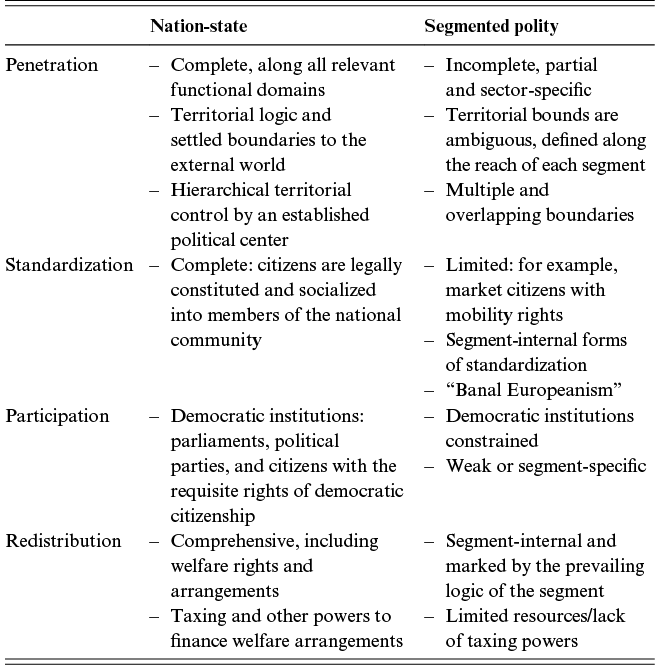
Table 1 Long description
The table has been constructed on the basis of Rokkan’s (1970) different stages of state formation and nation-building, and it compares each with what we expect from a segmented polity.
Second, a segmented polity standardizes a territory less than a fully-fledged state. In the context of nation-building, this refers to the incorporation of citizens and subject regions into the political system and through that process the forging of a unified nation and national identity. In contrast, a segmented polity intervenes in and activates only select portions of the societies of the member states and defines them in terms of the prevailing segmental logic (in a marketized polity as market actors or market citizens). It follows that a segmented polity’s ability to enforce standardization will be patchy and mainly confined to the core sector(s) that constitute the polity.
Third, a segmented polity grants fewer rights than a fully-fledged modern territorial state. In the state formation and nation-building context, equalization of rights of participation and the establishment of political citizenship refer to the development and entrenching of a civil society of rights-holders. The segmented polity also reaches into society and has a social constituency, but this is far looser, less institutionalized and more horizontal (across subunits) than in a state-based civil society. In this Element, we associate civil society with the nation-state and social constituency with a segmented polity. Segmented polities may confer rights on citizens and organizations, but these will be function-specific in contrast to the nation-state that issues rights along all basic realms: civil, political, social, economic, and cultural.
Finally, a segmented polity has far fewer resources and therefore more limited ability to redistribute them than a full-fledged state. Whereas the modern nation-state is based on redistribution, social citizenship and public welfare systems, the segmented polity’s limited autonomous access to resources means that its ability to ensure any form of redistribution is constrained and contained.
The System of States Versus the Segmented Polity
Rokkan’s focus was on the development of the nation-state and patterns and processes of democratization across Europe. His endeavor was aimed at understanding patterns of difference and divergence from Talcott Parsons’ (Reference Parsons1951) theory of differentiation, with Rokkan’s adaptation particularly stressing territorial and functional dimensions. Rokkan’s approach has been labeled as one of encompassing comparison, which “places different instances at various locations within the same system, on the way to explaining their characteristics as a function of their varying relationships to the system as a whole” (Tilly, Reference Tilly1984: 83; see also Fossum, Reference Fossum2006). The large structure is Europe’s political, cultural, and socioeconomic development, with emphasis on the nation-state and its democratization. Rokkan did not study state formation and nation-building as a set of distinct and isolated cases but tried to establish and map these processes within a single interdependent system, which was Europe. State formation and nation-building as seen earlier were disaggregated into territorial and functional dimensions and understood as unfolding along four distinct stages.
In the depiction of Europe, Rokkan mapped structures and conditions on certain key dimensions and variables. Since the mapping covered long periods of time, it was difficult to incorporate how the states as entities interacted at various points in time. How the state system constrained and conditioned states was also affected by the approach to disaggregate states. Since Rokkan was particularly interested in mapping the diversity of Europe (Flora et al., Reference Flora, Kuhnle and Urwin1999), his state-disaggregating approach did not (or perhaps could not) include a reaggregating thrust. The implication was a lack of attention to the isomorphic pressures that are embedded in the system of states.
We approach state systemic isomorphic pressures from blending sociological institutionalism and liberal theories of IR, notably the English School with reference to Hedley Bull’s notion of international society as a society of states. Bull (Reference Bull1977) underlined that modern states regarded themselves as bound by a shared set of rules and norms, including respecting each other’s independence. Robert Jackson (Reference Jackson2000: 6) introduces the notion of the global covenant of states, outlines its core principles centered around the core tenet of state sovereignty and notes that “(w)orld politics is constitutively normative: it incorporates its own distinctive ethics which have been worked out over time by statespeople.” This ethics and the principles of statecraft that are shared among statespeople (those responsible for operating and running states and their staffs) are together with a distinct statist vocabulary and state institutions powerful sources of isomorphic pressures and dynamics – along coercive, mimetic, and normative lines (DiMaggio and Powell, Reference Dimaggio and Powell1983; Powell and DiMaggio, Reference Powell and DiMaggio1991). Isomorphic pressures operate on state-internal, as well as inter-state dynamics.
State sovereignty is the key constitutive principle for the modern society of states (Jackson, Reference Jackson2000). It gives normative bridging-power to the significant variations in stateness (Nettl, Reference Nettl1968) that mark the state system. This implies that the different isomorphic pressures may vary in strength and intensity. Thus, despite significant variations in coercive and mimetic pressures, actors have resort to a coherent conceptual vocabulary associated with the sovereign state to fill in the empirical gaps they observe between formal sovereignty and actual state power and autonomy. Bridging-power emanates from the principle of state sovereignty being encoded in the law of the peoples, which provides criteria for recognizing what constitutes a state and the rights and obligations that accompany this status. The system of states has long exerted a powerful isomorphic pressure on would-be contenders (Spruyt, Reference Spruyt1994), but as current developments show, these pressures are geographically uneven, and alternatives coexist (Osiander, 2001; Fossum, Reference Fossum2006; Olsen, Reference Olsen2010; Bátora and Hynek, Reference Bátora and Hynek2014). The rise of alternatives such as the EU contributes to transform the statist building-blocks. Nevertheless, rather than neat and clear patterns, complex patchworks may emerge.
From these observations we posit that the nature and scope of polity formation above the states depends on at least three sets of factors. The first is a distinct state systemic opening to polity formation beyond the state, which occurs when there is a serious weakening or even suspension of state systemic isomorphic pressures during temporally specific critical junctures. Second, actors that are willing and able to forge a new entity. These are typically supranational entrepreneurs (Haas, Reference 83Haas1958[2004]) but can also include state officials who see the merits in cooperative arrangements above the states (Lindberg, Reference Lindberg1963), or that lack resort to state sovereignty as a viable way forward. Integration includes societal actors as well as external benevolent hegemonic states (the US in the EU case). Third is when pressing policy problems undermine state capacity to address them internally, generating need for binding collaboration. The mix of these helps account for the scope of new polity formation: The greater the systemic opening, the more powerful the entrepreneurs, and the more pressing the policy problems, the more comprehensive supranational polity formation is likely to evolve. This set of factors underline that segmentation is a process, and it is only under certain more specific conditions that segmented polities will emerge.
To sum up thus far, compared to a full-fledged political system such as a sovereign nation-state, a segmented polity is a supranational entity equipped with binding authority in a limited policy area; thus, partial in functional terms, and constrained by the members. As a supranational aberration from the state form, it is normatively and politically contested. Some of this will rhyme with premodern heteronomy. But whereas in the premodern world, segmented polities prevailed, there was no clear distinction between polity and political order since political systems were commingled and overlapping. That is not the case in today’s world because segmented polities are mere partial escapes from the world of states. As an entity, a segmented polity is not only different from a state but also from an IO. The latter derives from and has been entirely adapted to the modern system of states. By contrast, segmented polities deviate from states by unbundling territoriality (Ruggie, Reference Ruggie1993) or unbundling established state-based patterns of authority by “new forms of authority being created beyond the state” (Ansell and Di Palma, Reference Ansell and Di Palma2004: 7). As a process, segmentation differs from state formation seen as a process of (functionally differentiated) integration along all functional domains across a specific territory (territorial closure) run from a political center. Segmented polity formation represents the establishment of a poly-centric system of governing through functionally selective integration under normative and material constraints. Segmentation occurs foremostly as a distinct form of stymied, biased, or partial integration that solidifies within legally binding institutional arrangements in particular policy domains, or sectors.
The development of a segmented polity cannot draw on the same dynamic processes and amassing of power and capabilities that are involved in state formation. Whereas some of the elements – in a partial and incomplete manner – are involved, there is no reason to assume a similar sequence of developments as those four stages depicted by Rokkan or that functional dynamics will reinforce each other over time, as is associated with state formation and nation-building.
Theories of EU Integration
The EU is the most noticeable instance of a segmented polity in the world today. Segmentation processes occur, within states and transnationally, but none of these constitutes polity formation as theorized in this Element. It is therefore necessary to consult the literature on the EU to render clear how a theory of segmented polity resonates with the existing literature on the EU and how it may innovate upon it.Footnote 8
Neofunctionalism
The most prominent theory that has been associated with European integration is neofunctionalism, which is heavily influenced by pluralism and functionalism (Hooghe and Marks, Reference Hooghe and Marks2019: 1114) and is notably associated with the works of Ernst Haas (Reference 83Haas1958[2004], Reference Haas1961), Leon Lindberg and Stuart Scheingold (Reference Lindberg and Scheingold1971), Arne Niemann et al. (Reference Niemann, Lefkofridi, Schmitter, Wiener, Börzel and Risse2019), and Phillippe Schmitter (Reference Schmitter1969, Reference Schmitter1970, Reference Schmitter2002). Integration can be defined as “the process whereby political actors in several distinct national settings are persuaded to shift their loyalties, expectations, and activities toward a new and larger political center, whose institutions demand jurisdiction over the pre-existing national states” (Haas, Reference Haas1961: 366–367). Haas’ notion of integration is focused on polity formation and how such a process fosters unity and reduces subunit distinctness. Neofunctionalism “developed the idea that government could be disaggregated into its component group actors. Instead of making assumptions about the interests of states, as classical realists had done, neofunctionalists conceptualize the state as an arena in which societal actors operate to realize their interests” (Hooghe and Marks, Reference Hooghe and Marks2019: 1114). Neofunctionalism is heavily skewed toward process and posits that the establishment of supranational institutions can develop its own integrationist dynamics, not only in functional but also political and social terms. The process of integration is intended to foster a new political community, which is defined as follows, where: “(p)olitical community … is a condition in which specific groups and individuals show more loyalty to their central political institutions than to any other political authority, in a specific period of time and in a definable geographic space” (Haas, Reference 83Haas1958[2004]: 5, italics in original).
A key dynamic that drives integration in this theory is “spillover,” which is depicted as
an “expansive logic of sector integration” whereby the integration of one sector leads to “technical” pressures that push member states to integrate other sectors. The idea is that functional problems in some sectors (not all; military-security, for example, was transatlantic from the start and strongly encapsulated in functional terms) are so interdependent that they could only be resolved by integrating yet more tasks.
The presumption is that the process starts with functional and moves on to political integration, which constitutes political spillover. This is supported by supranational institution-building, and supranational organizations mobilizing societal actors to challenge and sideline the member states (Haas, Reference 83Haas1958[2004]); thus, including political spillover and eventual regime change. The underlying assumption is that actors are self-interested and (boundedly) rational, albeit capable of learning and changing their preferences, but this takes place in a context akin to integrationist path dependence.
Segmented polity formation benefits from functional dynamics but underlines their limited reach and conditional nature. That is in line with Haas’ later work (Reference Haas1975) and that of his collaborators (Lindberg and Scheingold, Reference Lindberg and Scheingold1971) who came to recognize that functional integration is not automatic, and that various obstacles are preventing a moving to full-scale political integration. A theory of segmented polity formation underlines that political center formation is limited in scope, so that the supranational entity is not only functionally biased and confined but also marked by a distinct sectoral logic (for the EU this has been marketization). The theory of segmented polity formation underlines that supranational polity formation only occurs when state system isomorphic forces are profoundly weakened so that narrow windows of opportunity for supranational polity formation open up. Such windows are typically not wide-open but are likely to occur when systemic forces exert least consistent pressure.
Supranational polity formation is thus lop-sided and biased from the outset. Constraints instituted by member states reinforce built-in biases, especially as the state system is restored as has happened in Europe. Supranational polity formation creates loyalty through socialization dynamics within the governing system albeit with limited social reference. To put it differently, loyalty and socialization patterns are stronger within the governing system than within the subject populations. This relates to how the segmented polity reaches into the societies of the member states: selectively and foremostly within the functional realm(s) that are constitutive for the supranational polity. For the EU that means that European identity has stronger affinities with Laura Cram’s notion of banal Europeanism than with national identity. Banal Europeanism rests on four key tenets:
Identity has more functional or banal aspects than are suggested by many of the traditional measures in terms of sliding scales of stated affiliations and declarations of how European or otherwise an individual feels… The functions performed, or valued goods provided, need not be economic in nature… The functional basis of identification need not be consciously recognized by those identifying with the regime… Identity includes functional elements but this does not imply that sentiment is unimportant.
Cram’s notion underlines the distinct dynamics that occur when functional integration is polity constitutive: It shapes people’s values and affinities not through a clear institutional shift from functional to political integration but more subtly and less auspiciously – through lived practice. Neofunctionalism’s reliance on soft rational choice (Haas, Reference 83Haas1958[2004]) renders it largely inattentive to the subtle identitarian implications of the EU’s lopsided institutional arrangement.
Intergovernmentalism
Intergovernmentalism is steeped in political realism, which understands the state as the core political unit; states are power seekers whose relations are structured by power balancing under conditions of international anarchy (understood not as lawlessness but as absence of organized and binding supranational power) (Morgenthau, Reference Morgenthau1978). Within the EU context, we find several versions of intergovernmentalism, with Stanley Hoffmann’s (Reference Hoffmann and Hoffmann1966) the closest to traditional realism, and Andrew Moravcsik’s (Reference Moravcsik1998) liberal intergovernmentalism as an attempt to blend realism and liberal IR theory. Moravcsik argues that “EU integration can best be understood as a series of rational choices made by national leaders. These choices responded to constraints and opportunities stemming from the issue-specific societal … interests of powerful domestic constituents, the relative power of states stemming from asymmetrical interdependence, and the role of institutions in bolstering the credibility of interstate commitments” (Moravcsik, Reference Moravcsik1998: 18). Institutions emanate as responses to cooperation problems, and “the level of integration that entails will vary with the nature of the cooperation problem” (Hooghe and Marks, Reference Hooghe and Marks2019: 1116).
Classical realist intergovernmentalism associated with Hoffmann (Reference Hoffmann and Hoffmann1966) distinguishes between high and low politics, so that integration proceeds and stabilizes in low politics areas but not in high politics areas. This insight resonates with new intergovernmentalism’s integration paradox: The EU’s realm of action has expanded but this has taken place in the absence of a commensurate transfer of powers and competences to the EU’s supranational institutions (Bickerton et al., Reference Bickerton, Hodson and Puetter2015; Puetter, Reference Puetter2014).
Liberal intergovernmentalism is steeped in rational choice theorizing, seeing actors as cognizant of and pursuing their interests, and institutions reflecting actors’ intentions and/or compromises between contending interests. The theory of segmented polity formation is highly attentive to the constraints on integration that intergovernmentalism points to but understands these differently from how liberal intergovernmentalism presents them because it has a different conception of the EU qua polity. Even if liberal intergovernmentalism acknowledges that EU institutions are not mere creatures of the member states, it does not pay sufficient heed to how the EU institutions are embedded in the member states, which Wolfgang Wessels (Reference Wessels1997) refers to as fusion. Egeberg and Trondal (Reference Egeberg and Trondal2009) point to similar dynamics of interweaving of levels of governing through their notion of two-hatted agencies (catering to the EU and to their respective nation-states), although their argument is based on organization theory. This inter-imbrication of levels is suggestive of how a segmented polity is a form of supranationalism subverted, and the special effects we get from the fact that the internal market is polity constitutive.
That the market is polity constitutive has bearings on the distinction between high and low politics that figures so centrally in intergovernmental thought. Moravcsik (Reference Moravcsik2002) posits that EU internal market integration is a matter of low salience integration, because it takes place foremostly in areas of legislative and regulatory activity that are farthest away from the minds of the voters. But when the internal market is constitutive for the polity then market integrity is not an economic, functional, or low salience issue; it is of vital importance for EU sustenance. We saw that clearly exhibited during Brexit, with the EU insisting that the four freedoms sustaining the internal market were indivisible (Laffan, Reference Laffan2022).Footnote 9 The broader point is that the political salience that the high–low distinction is based on is difficult to pin down, since policy areas wax and wane in salience. An obvious case is energy: In the 1970s, after the initial Organization of Arabic Oil Producing Countries (OAPEC) launched the oil embargo, oil became considered a high politics issue, since states became concerned with security of supply. From the early 1980s and up until recently oil policy has been depoliticized and considered a low salience matter for the market to regulate (Fossum, Reference 82Fossum1997). When Russia invaded Ukraine in 2022, oil again became politicized and considered an issue of high political salience. This suggests that issues or policy areas change salience insofar as they become politically important and linked to core state concerns such as security of supply. In today’s world security is becoming a more overarching concern that works its way across policy sectors, as is reflected in rising concerns with economic security.Footnote 10 There is no doubt that policy areas vary in terms of how central they are to polity sustenance, but this is not static and varies with type of polity and domestic and global contexts.
A further question is whether high vs. low policy salience effectively distinguishes policy domains. Even among those policy domains that (liberal) intergovernmentalists label as having low salience there are different sectoral logics, and their contents may be ideologically driven. Economic or market issues have mostly been considered as having low salience, but socially dis-embedding markets can spur politicization, and the same can a move toward mercantilism. In these two cases, the sociopolitical dynamics are very different, and the same applies to political and polity dynamics and their implications.
Multilevel Governance
This notion was introduced by Gary Marks (Reference Marks and Sbragia1992) and represented a plea to shift attention from neofunctionalism’s and intergovernmentalism’s focus on the conditions for and dynamics of integration to the nature of European governing and those involved in it not only at the EU and national levels, but also at the subnational (regional and local) level (for a brief selection, see Börzel, Reference Börzel, Benz, Broschek and Lederer2021; Hooghe and Marks, Reference Hooghe and Marks2016; Marks et al., Reference Marks, Nielsen and Ray1996; Marks et al., Reference Marks, Hooghe and Schekel2008). This turn to MLG also marks an important disciplinary shift in the analysis of the EU, from a debate mainly conducted within rationalism-inspired IR subdisciplines to comparative and domestic politics perspectives with a stronger institutionalist and constructivist orientation.
Simona Piattoni (Reference Piattoni2010) identifies three core elements of this shift to MLG, which she labels political mobilization by the involvement of regional officials and nongovernmental organizations in EU policy and decision-making, policymaking, or how the EU actually governs, and polity structuring, with emphasis on multilevel and state-society dynamics.
A key point of MLG is to show how polities have transformed from the hierarchical and territorially based nation-state to more complex and less hierarchical systems composed of multiple levels with overlapping competencies and political interaction across levels, across the public–private, and across the national–international divide (Bache and Flinders, Reference Bache and Flinders2004; Enderlein et al., Reference Enderlein, Wälti and Zürn2010; Marks et al., Reference Marks, Nielsen and Ray1996; Piattoni, Reference Piattoni2010). These traits of MLG systems appear to resonate with a theory of segmented polity precisely because both are marked by interactions across levels of governance, including relations among political principals, coordination among public administrators, and public–private interactions.
Our notion of segmented polity, however, places more emphasis on state systemic resilience due to various isomorphic pressures. Having said that, our constructivism makes us acknowledge important differences in the forms of isomorphism at play. We posit that normative isomorphism is likely to exert stronger systemic pressures than for instance mimetic. That helps to account for the magnitude of state transformation that MLG points to and why this is not uniformly recognized. Epistemology and ontology are out of synch, not least due to the continued embrace of state sovereignty and how that in turn influences the debate on democracy. Normative isomorphism also accounts for the way in which a supranational polity such as the EU turns to state-centered language to legitimate itself (parliament, court, European (aka national) anthem, European (aka national) hymn) even if these terms are applied to EU arrangements that in important ways deviate from their namesakes in states.
There are two approaches to MLG in the extant literature. Lisbeth Hooghe and Marks (Reference Hooghe and Marks2003) distinguish between MLG I, which consists in general-purpose jurisdictions, and MLG II, which consists in limited-purpose jurisdictions. The former is generally associated with federal states, whereas the latter is indicative of state transformation dynamics. The distinction also appears to map onto the EU as a composite of two governing modes (supranational and intergovernmental, for more on this, see Section 4). Whereas the supranational component appears similar to a general-purpose jurisdiction, it is significantly constrained in capacity and resource terms and is therefore a supranationalism constrained. In addition, the segmented polity is marked by a distinct logic (in the EU case marketization), and as such is imbued with built-in policy, decision-making, and learning biases. Further, a hallmark of segmented polities is that they are contested. The MLG literature does not theorize polity contestation as a hallmark of multilevel systems of governing. That may also be because this body of literature is focused on policy processes and actor-level dynamics, and is not as attuned to issues of power, political order, and legitimacy (Keating, Reference Keating2017), as are essential elements in a theory of segmented polity. In Section 3, we underline the democratic and legitimacy defects of the segmented polity.
Thus, many features that are highlighted by the MLG literature are also reflected in the segmented polity, but the segmented polity is a more precise and narrowly cut rendition than is MLG. It can serve as both a theory and a research program. A hallmark of the segmented polity is its uneven constitution – only one broadly based policy area is constitutive of the polity at the supranational level.
Post-functionalism
Post-functionalism was initially formulated by Hooghe and Marks (Reference Hooghe and Marks2009) and can be said to have some of its roots in MLG as well as in studies of public opinion, political parties, and elections. Post-functionalism thus has more in common with Rokkan’s and Bartolini’s comparative politics approach and concern with democracy than with neofunctionalism and intergovernmentalism, both of which are steeped in the field of IR. Post-functionalism stresses the important role of identities and ideologies in shaping politics and is particularly concerned with how these issues play out within the EU’s member states. It underlines how a largely functionally driven integration logic challenges the societal cohesion that mark societies with exclusive identities (Hooghe and Marks, Reference Hooghe and Marks2019). The authors importantly observed the transition Europe underwent from permissive consensus to constraining dissensus (Hooghe and Marks, Reference Hooghe and Marks2009). We can detect a certain recursiveness in how post-functionalism underlines how European integration shapes and conditions domestic societies and that the societal reactions in turn profoundly affect the way the EU works. The upshot is that post-functionalism is more of a theory of the constraints on integration than an integration theory as such.
Post-functionalism’s emphasis on domestic constraints on integration sit well with the notion of segmented polity one of whose hallmarks is built-in constraints on integration. Post-functionalism underlines the need to understand how the segmented polity intervenes in and inveigles into the societies of the member states.
One possible difference is the role and status of constraints. Post-functionalism underlines popular consent and cleavage structures, whereas the notion of segmented polity sees built-in constraints as part of the “original sin” or as intrinsic to the genetic soup from which the EU emanated. In that sense, the theory of segmented polity would underline the inherent tension in an essentially political project that is compelled to draw overly heavily on law and functional logics. This tension has taken different manifestations over time, and post-functionalism offers important contributions to Europe’s current malaise.
Post-functionalism is the theory that is most explicit on the social support and legitimacy dimension of the European integration process. Since the financial crisis struck and raised the question of the EU’s continued survival a body of literature on EU disintegration has emerged (see for instance Jones, Reference Jones2018; Vollaard, Reference 89Vollaard2014, Reference Vollaard2018; Webber, Reference Webber2014, Reference Webber2018; Zielonka, Reference Zielonka2014). Douglas Webber, for instance, sides with post-functionalism in that the main IR-based theories do not take sufficient heed of the domestic societies of the member states. Further,
they overlook the extent to which Europe’s uniquely high level of political integration depends on the engagement and support of the region’s economically most powerful “semi-hegemonic” state, Germany. Even though a fundamental reorientation of German European policy at the present time seems unlikely, it is not inconceivable. The European Union has confronted and survived many crises in the past – but has never had to confront a crisis “made in Germany”. The European Union’s current crisis is symptomatic of a broader crisis or malaise of regional and international multilateralism.
German reorientation would seriously weaken or even undermine the EU. We have underlined the role of weakened state systemic isomorphism as a condition for supranational polity formation. Strong states such as Germany are far more important determinants for state systemic isomorphism than small states; hence what Germany does can have systemic implications for Europe.
Conclusion
The purpose of this section has been to provide an overview of extant literature that is of relevance for positioning a theory of segmented polity formation. To that end we started by reviewing the literature on premodern political systems (including segmented polities such as the Holy Roman Empire) and underlined that they were marked by heteronomy of forms and modes of governing. The emergence of the modern nation-state led to uniformity and division, structured around the concept of the sovereign state. This represented a significant transformation of boundary control and internal structuring that Rokkan and Bartolini highlighted – not only within each state but as a systemic feature. The systemic imprint was captured by the English School in IR by the notion of global society of states or what Jackson refers to as the global covenant. Thus, whereas each state exhibits a distinct history and developmental trajectory, the state system nevertheless exerts coercive, mimetic, and normative isomorphic pressures that structurally condition and constrain states as well as efforts at establishing new types of supranational or nonstate-type political entities. The upshot is that segmented polity formation can only take place when such isomorphic pressures are weakened and there are political entrepreneurs who are willing to exploit such openings. Pressing policy problems also matter but do not unto themselves account for supranational polity formation.
We have however also noted that isomorphic pressures do not necessarily exert equal pressure on the states and other governing entities occupying the world. In line with our constructivist approach, we posit that state sovereignty, and the normative language associated with the state and national democracy, weighs in more heavily than mimetic isomorphic pressures, so that more state transformation may be afoot than what conventional descriptions cover. The EU may be considered in such a light and many of these transformations are picked up by the body of literature on MLG.
Since the EU is a prominent example of a poly-centric and supranational entity with features to a large extent matching the model of a segmented polity, we discussed theories of EU integration in the last part of the section. The review shows that both neofunctionalism and intergovernmentalism contain important insights that are compatible with a theory of segmented polity.Footnote 11 However, neither theoretical position captures the basic traits of the normatively and politically contested, institutionally partial, constrained, and functionally biased polity that the segmented polity exhibits. Nor do these theoretical positions shed adequate light on the puzzle that this Element started out with: EU resilience combined with nation-state resilience. A segmented polity is one that allows combining a distinct form of biased and constrained supranational institutionalization, social support, and sustenance that does not undo the member states’ stateness. Post-functionalism provides important insights into the social constraints that a segmented polity faces, of value to the analysis of how and in what sense the segmented polity penetrates into the societies of the member (and affiliated) states.
3 A Theory of Segmented Polities
Introduction
This section develops the theoretical concept of segmented polity. The section starts by reviewing the extant literature on segments and segmentation and develops the theory of segmented polity. This entails moving from theories and theorizing phenomena at micro and meso levels to macro-level theorizing. This step complements organizational–institutional theories with insights from (macro) sociologists and theorists such as Talcott Parsons (Reference Parsons1951), Niklas Luhmann (Reference Luhmann1982, Reference Luhmann1995), Stein Rokkan (Reference Rokkan1970, Reference Rokkan and Tilly1975), Peter Flora et al. (Reference Flora, Kuhnle and Urwin1999), and Michael Walzer (Reference Walzer1983) that modern political systems are functionally differentiated, and where each functional realm exhibits a distinct logic of action and mode of operation. There are no watertight compartments between these functional realms, and some functional logics are more imperialistic or boundary-transcending than others. Segmentation occurs when a select number of functional logics becomes embedded in networks and institutional arrangements, these become closed from the outside world and therefore become self-referential. Segmented polity formation represents a further step in the sense that the logics are embedded in the legal and organizational arrangements that are constitutive for the polity; hence, they are operating at the macro level.
Segmentation Versus Segmented Polity
The premodern period as we have seen was marked by segmented polities, as phenomena at the macroscopic or structural level. Segment was thus a defining feature of the political system as such. The development of the modern state meant that the state system and the principles, procedures, and arrangements associated with that replaced the segmented polity but not segmentation dynamics. Segmentation in the modern world has generally been understood and analyzed as a process at the meso level, as a dynamic that unfolds between actors and institutions within individual states. That does not exclude segmentation dynamics between states, and we provided some examples of that in Section 2.
Segments and Segmentation Dynamics in the Modern World
The concept of segment in the modern world of states is typically understood and analyzed as a meso-level phenomenon. It has been depicted as a durable configuration of linkages among policy participants who share common interpretive frameworks regarding policy problems, solutions, consequences, and decision-making arenas (Christensen and Egeberg, Reference Christensen and Egeberg1979). This conceptualization builds on earlier theoretical models of decision-making under conditions of ambiguity – most notably the “garbage can” model of organized anarchies (Cohen et al., Reference Cohen, March and Olsen1972) – where decisions emerge from loosely coupled streams of problems, solutions, and decision opportunities. Segments do not simply emerge and develop in loosely coupled systems. Segments can become institutionalized and pattern and routinize these streams, producing recurrent and replicable configurations of engagement; hence being part of more tightly coupled systems. They then give rise to relatively coherent actor constellations within specific policy domains, comprised of governmental, private, and civil society actors who mobilize particular, often path-dependent, problem frames and policy instruments. These formations facilitate policy efficiency within the segment by reducing uncertainty and complexity in decision-making and by mobilizing attention and resources toward within-segment problems, solutions, and consequences. However, they also engender epistemic closure and path dependency, narrowing the policy discourse and foreclosing alternative courses of action (Bátora and Fossum, Reference Bátora and Fossum2020; Fossum, Reference Fossum, Bátora and Fossum2020).
Analogous to segments within nation-states are iron triangles, where for instance in the context of defense contracting, defense firms, legislative committees, and executive agencies form stable and mutually reinforcing policy subsystems (Adams, Reference Adams1981). These formations often include mechanisms for interest aggregation and mobilization, such as cultivating supportive constituencies to reinforce specific policy trajectories. But whatever their affinity to segment, they operate at the meso level and are therefore distinct from segmented polities.
Hugh Heclo (Reference Heclo and King1978) identified similar patterns as those observed in iron triangles in his notion of “issue networks” or “intermediary issue-conscious groups” that mediate state–society relations in complex policy environments. While related, the concept of segment emphasizes the cognitive and institutional structuring of the policy process – highlighting how specific configurations of problems, solutions, and decision venues become sedimented and reproduced over time.
From Meso to Macro Level: The Segmented Polity
Within the modern state context, segments, iron triangles, and issue networks are typically phenomena at the meso level. Segmented polity formation – moving from meso level to macro level –implies either moving back in time to premodern times when heteronomy enabled segmented polities to exist or somehow moving beyond the modern state. In today’s world of complex interdependence there is considerable state transformation but there is no indication of wholescale transition away from the system of states. Segmented polity formation therefore takes place within the broader ambit of the state system. Special conditions must exist for such a process to take place. That was the case in Europe in the post-war period, as will be spelled out in Section 4.
The Element underlines that the only real example of segmented polity formation in today’s world is the EU. The EU has sufficient institutional and legal clout to issue authoritative decisions at the supranational level but lacks the coercive capabilities that we associate with the modern sovereign state. Comparing the EU with a state of comparable population size, we see that the EU is on a par in economic terms but not in terms of political or military clout.
A segmented polity emerges when one functional subsystem solidifies and becomes defining for the new polity. This may appear an awkward duality: A segment that we normally associate with a networked policy area becomes a defining feature of the new political system. Such a move from meso to macro is only possible through significant institutionalization. The segmented polity emerges through a process of polity formation, in other words the establishment of a legally based institutional system. Haas defined integration (in Section 2) as “the process whereby political actors in several distinct national settings are persuaded to shift their loyalties, expectations, and activities toward a new and larger political center, whose institutions demand jurisdiction over the pre-existing national states” (Haas, Reference Haas1961: 366–367). Such a process entails center formation and consolidation, with the center developing the requisite capacities to demand jurisdiction over the preexisting national states. The segmented polity develops a political center with a set of institutions capable of effectuating binding decisions on the member states. But the center is weak in the sense that its claim to jurisdiction is limited to one major policy area, which does not unleash the capabilities we associate with the state. Further integration across other policy areas carries with it the logic of the dominant segment. In other words, when the dominant segment or the polity constitutive segment is the market, the market logic is imprinted on attempts to integrate in health, education, culture, and so on. Integration is in this context amplification of bias, not development of competence to control and govern policymaking in other policy areas that is sufficiently tailored to the prevailing logic within each other policy area.
Necessary Features of a Segmented Polity
A necessary condition for segmented polity formation is a serious weakening of state systemic isomorphic pressures. When there is also a set of influential actors – societal and/or state – willing and able to embark on supranational polity formation, a segmented polity emerges. The nature of the polity hinges on how large the window of opportunity is and the balance of contending forces. Segmented polity formation is a political process, not the result of institutional design.
The weakening of state systemic pressures must be sufficient to constitute a critical juncture for segmented polity formation to take place. Once in place the supranational system seeks to exploit those functional dynamics that will enable it to expand its reach, along the lines the neofunctionalists depict. Integration can therefore give rise to more segments.
Segmented polity formation means that a sector or policy area becomes institutionalized to such a degree as to be constitutive for the polity. This is a necessary and defining feature of a segmented polity. It is both a matter of empowerment and constraint: Even if a segmented polity is equipped to effectuate authoritative decisions, that only applies to a limited policy area. The policy range is narrower, the supranational institutions are instrumentalized to pursue certain segment-specific tasks, and the segmented polity’s direct access to capability and resources is heavily constrained, all to a much higher degree than what we see in federal states. Thus, whereas supranational institutions may dress up to look like general-purpose jurisdictions, the decisions are imbued with a clear policy bias. The segmented polity is thus a partial and functionally speaking biased polity since the member states can bar the segmented polity’s political center from expanding its reach into other sectors at the same level and intensity of supranational institutionalization and without the resources and repertoire of policy instruments that are suitable for those other sectors. It follows that a segmented polity has a weak political center. It can give rise to additional segments, but these are as noted less firmly institutionalized precisely because of the constraints operating on the segmented polity.
A further necessary condition for a segmented polity – in contrast to an IO – is that it reaches into the societies of the member states through a distinct pattern of intervention, activation, and exclusion. Typically, the segmented policy’s social resonance is biased because it follows the polity’s core areas of involvement.
Figure 1 offers an abstract illustration of a segmented polity. There is one supranational segment that is constitutive for the polity and therefore able to issue authoritative commands. But, as the figure shows, even the supranational segment is embedded in the member states more than independent of them. This reflects the notion of the segmented polity as constrained. The figure also depicts a second segment that is subject to much stricter member state controls and operates at a lower level of institutionalization (loosely structured). Such a segment is in the figure situated at the intergovernmental level to underline its weak ability to bind the states. Moreover, a segmented polity can have multiple segments, but the defining feature is that only one of them is polity constitutive. The segmented polity can typically coordinate the activities of the member states in the loosely structured intergovernmental segment(s), but it cannot issue authoritative decisions there. Thus, the segment at the supranational level (segment 1) of Figure 1 issues authoritative decisions, whereas the segment at the intergovernmental level (segment 2) is where member states’ activities are merely coordinated by the center.
Visualizing a Segmented Polity
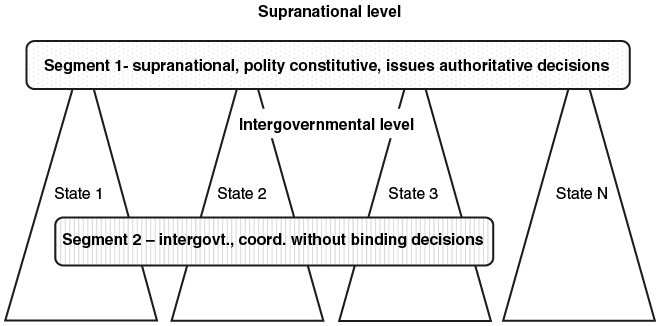
Thus, Figure 1 shows that a segmented polity that remains embedded in a statist context is composed of functionally defined and delimited segments anchored at different levels of governing and cutting across all or most of the states. Each segment does not need to include the same number of states as members, as we see with “State N,” which is included in the supranational segment but not in the intergovernmental one.
In a world dominated by states, a segmented polity will typically consist of several levels, with the upper supranational level (polity-constitutive and issues authoritative decisions) serving as the main site of segmentation. How far into the constituent states the segmented polity extends is an important empirical question. If the process of segmentation permeates the states through and through – for example, by transforming how each state is fundamentally organized and governed – the statist political system will cease to exist and will be replaced by a segmented political order. Such a form of political order represents a categorical break with the statist political order.
A segmented polity is more loosely territorially anchored than a nation-state because segments may vary in their territorial reach across time and space. The more the institutions are aligned along one set of functions and organized in line with a specific repertoire of actors and institutions (component parts of ministries, agencies, international bureaucracies, stakeholder groups, firms, etc.), the more these actors will share common cognitive conceptions, types of expertise, ideological and policy predispositions, and recurring patterns of interaction and power relations – all of which serves to uphold the given segment’s closure and boundary. Actors within segments will thus mutually allocate and share attention and information, share similar perceptions of problems, solutions, and their consequences; develop common identities and loyalties, common professional (or even vernacular) languages, and common practices. One implication is that lines of conflict or cleavage are more likely to emerge between segments than within them. Another implication, as already theorized by earlier literature on segmentation (Christensen and Egeberg, Reference Christensen and Egeberg1979), is that patterns of cooperation is prioritized among the institutions that are embedded in a segment, whereas conflicts more often occur between different segments.
In the literature on segments within states, segments are situated within policy-specific sectors and contribute to the contraction of those sectors, by actors sharing common values and worldviews, and conceptions of what counts as relevant actors, problems and solutions. Such cognitive and perception biases persist through the segment’s exclusion of those actors, worldviews and problem and solution conceptions that diverge from the segment’s prevailing (world)view.
As noted earlier, a given segmental logic can permeate across policy areas and sectors. For instance, in a polity where marketization is the dominant segment, and the system has built-in constraints against the integration of other sectors, a process of further integration only or mainly entails that the marketization logic permeates those other sectors. In that sense marketization spillover to other sectors or policy fields brings with it the marketization logic so that the overall system retains its segmental character.
In the following, we elaborate on the defining features of the segmented polity through specifying competencies and constraints, the social dimension, the democratic dimension, what concrete features mark each segment within the segmented polity, and what constitutes desegmentation.
Competencies and Constraints
A segmented polity is imbued with a set of distinct competencies normally conferred on it by its constituent member states and their citizens. This enables policy coordination and public problem-solving that the constituent entities (the member states) have accepted as binding within a limited number of functional realms. In comparison to a state, a segmented polity is normatively, structurally, and materially constrained. A further systemic constraint in comparison to a nation-state is that a segmented polity does not contain all functional areas that does a nation-state. A segmented polity is functionally speaking uneven and biased, and the policy areas are accordingly unevenly distributed and institutionalized.
A segmented polity consists of institutions that have the capacity and competence to reach authoritative decisions that are binding on the member states, their civil society organizations, and their citizens. How independent these institutions are from the member states depends on how well entrenched the segmented polity is in terms of competence, capacity, and social support. A segmented polity – in contrast to an IO – can make authoritative decisions and allocations independently of the member states (and thus fulfills a key parameter characterizing a political system in Easton’s sense). Nevertheless, when compared to a state, a segmented polity is constrained in several ways.
First, as depicted in Figure 1, a segmented polity is functionally delimited but not territorially delimited in the same way as we would expect from a sovereign state. A segmented polity is not equipped with a monopoly on the legitimate means of violence and therefore does not possess the means of coercion and exclusive territorial control that the modern territorial state possesses. Further, whereas the segmented polity can make authoritative decisions, it is also constrained by relying on subunits for policy implementation, which often is the national public administrations. That implies that a segmented polity, especially in so-called core state powers realms (Genschel and Jachtenfuchs, Reference Genschel and Jachtenfuchs2014), relies on, repurposes, and coordinates existing subunit capacities rather than develops its own.
Second, a segmented polity’s policy thrust is partial and selective by existing and operating in a pronounced manner in some issue areas only. Segmented polities will therefore exhibit significant variations in governing ability across issue areas and governing arrangements. This built-in bias has systemic implications. It means that the segmented polity’s policy thrust is particularly salient in a limited range of policy fields. Insofar as the segment extends into other realms of action these forays will bear the mark of the logic that prevails in the dominant segment. For the EU, this means a strong marketization thrust penetrating into such policy areas as for instance education, health, climate, and social welfare (Bartl, Reference Bartl2015).
Third, since a segmented polity is partial and selective this will also be reflected in its policy style (for this term, see Richardson, Reference 87Richardson1982). The fact that the system is partial and selective in functional terms and that it faces capability constraints, has bearings on the nature and range of policy instruments. We can expect policy instruments to be designed to serve the needs of specific segments rather than be multipurpose and readily adaptive across all policy fields. This does not mean that segmented polities develop distinct policy instruments but rather that they shape and condition those policy instruments that are acceptable, how policy instruments are used, and whether policy instruments are bundled together. We can expect that the type and range of policy instruments are tailored to the resources and constraints that a segmented polity faces. Given the segmented polity’s built-in resource constraints, policy instruments tailored to regulation are far more likely than policy instruments tailored to (re)distribution because the latter require far more direct access to resources embedded in states. Further, since policy instruments are devised according to segment-specific needs, there may be challenges associated with applying policy instruments designed for one segment in other segments.
The segmented polity is contested because it is a product of contending visions and worldviews that have not been reconciled. A further reason for its contested nature stems from the continued strength of normative isomorphic pressures from the state system that the segmented polity coexists with. To obtain legitimacy, it both seeks to emulate statist terminology and organizational forms and at the same time must contrast and distance itself from the nation-state so as not to appear as a competitor to it.
The Societal Dimension
A segmented polity – in contrast to an IO – reaches into the societies of the member states, and in so doing, redefines societal actors’ relations to their respective states. The basic mechanisms can be grouped under the headings of intervention, activation, and exclusion. The segmented polity intervenes in the societies of the member states and regulates their affairs. This is done in a selective fashion because it takes place within the issue area that the segment spans across and is thus particularly inclusive vis-à-vis those parts of society and those societal groups that the segment targets. If the segmented polity is foremostly embedded in the domain of marketization – for example, the EU’s single market system – then the marketization segment reaches into those portions of society that are particularly market relevant: firms, businesses and business associations, and service companies, as well as those aspects of the states directly involved in market matters (notably, designated ministries and agencies). It also addresses persons mainly in their capacity as market actors (workers, employers, consumers, and so on). It follows that a segmented polity based on marketization systematically selects some specific groups or categories of societal actors as much more relevant and to be activated than other ones. Activation can take place through incentives or through legal empowerment as market participants through rights, through fostering networks and organizations for workers’ and employers’ participation and representation directed at the segmented polity.
Those civil society actors that are not deemed to be relevant for the segment are systematically excluded, considered irrelevant and/or organized out. Thus, whereas rights are powerful tools for activation, a marketization polity offers a limited range of rights – confined to market participation. Further, a marketization polity has weak means for attaching citizens to the polity in realms other than the market. It lacks socialization mechanisms to foster a national or other strong group identity. It follows that when we observe complaints from those excluded from a segment, it may serve as a proxy for the existence of a segment. Also, excluded actors’ pleas for inclusion in a segment will likely be heeded only if formulated and framed in line with the prevalent logic and discourse in a segment (e.g. marketization logic and discourse). Another way of putting this is that patterns of conflict are likely to emerge between segment insiders and segment outsiders.
Thus far we have argued that a segmented polity reaches into society and has instruments for connecting with and mobilizing the civil societies of the member states, but in a functionally speaking partial and segment-specific manner. The state penetrates civil society across multiple functional realms. The fact that a segmented polity reaches into society and should be associated with distinct terms of sociality is a further indicator that the segmented polity is a type of political configuration that neither fits with the state nor with the IO. A hallmark of a segmented polity is that it has developed explicit measures to define and delimit its own distinct social constituency. One way of doing so is by establishing boundary closure and control vis-à-vis actors not being conceived as members. Membership by societal actors in a segmented polity is limited by both closure and control of the boundaries of the segmented polity.
A segmented polity deviates from the category of IO because it has societal roots. An IO is a functionally delimited organization with no claim to autonomy from the states that formed it and that responds, sometimes incompletely, to their wishes and demands, and that also lacks any anchorage in the societies of the states that make up the IO. The category IO is therefore no challenger to nation-states and is compatible with a state-centric notion of territorial sovereignty, and thus a statist political order. The IO enables each member state to exert influence beyond its bounds without abrogating national sovereignty and control, including over their civil societies.
A segmented polity, by contrast, intervenes in, and variously activates and excludes portions of society along both vertical and horizontal lines. Vertically by denoting ties and arrangements for fostering inclusion and incorporation of the civil societies of the member states, and horizontally through interactions that the segmented polity forges across the civil societies of the member states. A segmented polity’s weak ability to penetrate the civil societies means that vertical ties and interaction between the supranational political system and the societies of the member states are systematically weaker than the horizontal dynamics it unleashes across the different societies of the member states. That is precisely the obverse of the classical nation-state that fostered strong vertical links and excluded as outsiders those from other states’ societies.
Vertically, a segmented polity imbued with rights-granting ability will have tools to define its social constituency in terms of persons and/or organizations as members or rights holders, with distinct rights and duties that they can hold against the system. Note that a hallmark of a segmented polity is that the nature and composition of rights is limited and as such diverges from Marshallian citizenship. Marshall (Reference Marshall1950) showed how citizenship over time became tied to the state so that the state became the authorized provider of rights (and obligations) and further that the development of rights over time expanded along functional lines to include civil, political, economic, and cultural rights. As we show in Section 4, the development of European citizenship reflected the early narrow definition of persons as market actors (Olsen, Reference Olsen2014). Over time this has expanded through the introduction of the Charter of Fundamental Rights of the European Union. Nevertheless, there is still a built-in bias in that EU citizenship is transnational and tailored to mobility. In addition, member states determine who is a European citizen.
The composition of rights is intrinsic to a powerful horizontal logic where the segmented polity unleashes distinct transnational dynamics between and among its member states. A case in point is the EU’s four freedoms, which confer internal market rights and participation on the member states’ corporations and citizens (and to some extent third country nationals, TNCs). The four freedoms unleash horizontal transnational dynamics because they compel the member states to open themselves to each other, especially within the realm of the EU’s internal market. Within this dominant EU segment, there is a strong onus on a level playing field and the removal of national barriers. This transnational opening-up is therefore selective and particularly pronounced in the internal market segment.
The Democratic Dimension
With democracy we refer to citizens understanding themselves as the authors of the laws they are subject to (Habermas, Reference Habermas1996). Institutionally speaking this entails that citizens authorize and control the system of governing and are equipped with legal and institutional means for participating in the law-making process. Segmented political systems are democratically deficient because of the normative and material constraints that the segmented polity faces. As noted, a hallmark of a segmented polity is that the constituent units confer independent decision-making power but deny the segmented polity Kompetenz-Kompetenz, or the power to define its own competence. The democratic legitimacy and moral authority of a segmented political system are therefore ultimately dependent on the constituent units; hence the normative constraints built into the segmented polity.
A further source of the democratic deficiency stems from the institutional composition of the segmented polity. A fully-fledged segmented polity will either lack democratic bodies for authorization and accountability, or individual segments may contain representative bodies that are clearly democratically deficient. As a rule of thumb, we can say that the salience and strength of a representative-democratic body is inversely related to the polity’s degree of segmentation.
A third source of democratic deficiency pertains to the relationship to society that will not as the marketization example shows contain the nature, reach, and role of basic rights that we associate with democratic citizenship. Rights to ensure market participation are mainly economic (and civil), not political. The notion of market citizens – and market citizenship – is therefore qualitatively different from political citizenship that is required for citizens to understand themselves as the authors of the laws they are subject to.
There are thus features of segments that render them quite inimical to democracy. The segment’s functional closure and in-built exclusive propensity are democratically deleterious. Segments reduce and bias democratic participation and transparency. Segments can shut out representative democratic bodies. Segments can sustain autocracies or support democratic backsliding. But segments can also serve as buffers against democratic backsliding when the autocratic leadership is unable to intervene in or reprogram segments – that is particularly relevant under conditions of segments in systems composed of many states, especially when the dominant states in the segment are not autocratic.
Democratization means intervening in and reprogramming segments to serve democracy when there are limited-purpose democratic bodies in place. Democratization serving desegmentation means establishing representative-democratic bodies when such are not in place. Democratization is also closely related to transparency, so any measure that increases overall system transparency will most likely have desegmenting effects.
How, Then, Do We Identify Segments?
This section operationalizes segments within segmented polities. A segment as defined in Section 1 constitutes a specific and stable repertoire of actors, institutions, cognitive conceptions, types of knowledge and expertise, ideological and policy pre-dispositions, and recurring patterns of interaction and power relations that uphold the given segment’s closure and boundary vis-à-vis other institutions.
Operationalizing segments within segmented polities is a matter of moving from macro to meso and micro levels of analysis. However, since segments within nation-states are meso- and micro-level phenomena and do not play a polity-defining role, we cannot simply depict segments in the same manner as they are depicted within nation-states. In operationalizing segments within segmented polities, we therefore face an important methodological question: How and to what extent are individual segments within a segmented polity different from how we observe segments within nation-states?
The answer is that one segment becomes constitutive of the polity through legal and political institutionalization. A segmented polity is therefore a far more pronounced instrument of institutionalized power than are segments within nation-states. As a case in point, consider the EU. Anu Bradford in her book the Brussels Effect (Reference Bradford2020) underlines the EU’s power to regulate global markets (an important reason for the Trump administration’s attacks on the EU). This EU’s institutionalized power is heavily lopsided, which is also why actors have referred to the EU as civilian power Europe (Duchêne, Reference Duchêne and Mayne1972) and the EU’s much greater repository of soft than hard power.
At the macro level, the institutional setup of a segmented polity is such configured that the polity is partial in a functional sense and constrained in terms of the social support and legitimacy it can amass from the societies of the member states. It is equally constrained in terms of the material resources it can amass. A segmented polity is functionally uneven: One or several segments may be supranationally organized, but this does not apply across all functional realms. This feature of uneven supranational anchorage of functional realms and degrees of organized segmentation affects how we operationalize and unpack individual segments.
In short, we need to identify the polity’s key macro-level characteristics in order to analyze the individual segments of a segmented polity. The following list summarizes necessary dimensions for unpacking segments within a segmented polity. Only some of these are necessary for constituting a segmented polity. These are highlighted in bold and are necessary for a supranational segmented polity to arise: Formal competences, segment-constituting institutions, built-in constraints, and policy instruments and policy style. Since the EU contains several segments, these nine dimensions will inform the empirical discussion of the EU’s segments in Section 4:
Formal competences and their sources (law versus politics)
Segment-constituting institutions
Built-in constraints: nature and definition of policy area
Policy instruments and policy style
Participant traits: expertise
Patterns and processes of (stymied) learning
Segment-specific discourses
Segment-specific forms and sources of power
Segment structuring events
With regard to formal competencies, the polity-defining segment is anchored in law. This – coupled with executive, administrative, and legal institutions – ensures independent decision-making power in a segmented polity. These institutions are organized around a policy area or functional realm (e.g. the earlier marketization example), and the constraints on the polity’s interventions into other functional realms are embedded in the treaties, in the functions the institutions perform, in the qualifications and competences of the personnel, and in the interinstitutional networks and bonds that are formed. A fully-fledged segmented polity will moreover lock-in the participants’ cognitive biases, including the partial inclusion and exclusion of expertise, discourses, and patterns of (stymied) learning. There is therefore in functional terms a direct line from the macro-political constitution of the polity to the micro-political cognitive and mental dispositions of the segment’s participants.
Segmentation can occur through the development of a partial supranational entity that falls short of full-fledged modern Westphalian statehood; or segmentation can occur within an already existing political system and thrive on preexisting institutions, as a sector-specific reconfiguration. Segmentation can therefore unfold in both an integrationist direction and a dis-integrationist direction, which is particularly relevant in the discussion of the EU in the next section. Therefore, segmentation can take place through the development of a supranational and intergovernmental political system on top of an existing system of states, as in the case of the EU. Or an existing state may experience internal segmentation within certain functional domains. The weight of the EU on top of member states can also contribute to internal national segmentation, but that is beyond the scope of this Element.
The Rise-and-Decline of Segmented Polities
When thinking about the rise-and-decline of segmented polities, we may separate different temporal horizons – the long term vs. the short term. Moreover, different time horizons may lead to different ideas about the possibility for willful design of segmented polities. This is important since segmentation may lead to paradoxes. One is that since segmentation is centered on a limited repertoire of institutions and policy domains, segmentation may increase the potential for reform, at least in the short run. Over time, however, since segmentation operates under constraints, it may in the longer run limit actors’ attention to certain ways of framing problems and certain repertoires of solutions that are locked into institutionalized arrangements. Thus, as time passes, reforms bent on addressing pressing problems may become less rather than more suitable for solving the problems (getting stuck in competency traps, for this term see March and Olsen Reference 85March and Olsen1995).
In the long run, segmentation may be hard to govern. Many factors may constrain willful design, such as ambiguities, the stickiness of existing organizational arrangements; institutional fads and fashions, shifting and competing goals, short attention-spans, limited capacity to monitor processes, and a history of previous conflict that could reemerge at any time (e.g. March, Reference March, Sverdrup and Trondal2008; Pierson, Reference Pierson2004). The long-term development of segmented polities fits well into this scenario and is compatible with ideas of static resilience (Ansell et al., Reference Ansell, Trondal and Ogard2016). If anything, segmentation tends to reinforce path-dependent patterns over time and hence the need for cross-sectoral bridging devices to remedy coordination shortfalls. This does not mean that segmented polities lack ability to change, but rather that segmented polities are likely to experience performance shortfalls.
In the short run, however, smaller reforms of segments may be conceivable. The short-term timescale of reforms is relevant and perhaps distinct to segmented polities. To capture distinct features of reform within segmented polities, we may depart from a reform-optimistic approach that focuses on deliberate organizational intervention and reform by redesigning organizational structures, and which builds on the idea of “dynamic resilience” (Ansell and Trondal, Reference Ansell and Trondal2018; Ansell et al., Reference Ansell, Sørensen, Torfing and Trondal2024). Segmentation may in the short run increase action capability within given policy areas by organizational restructuring; the segment as a selection mechanism can increase short-term action capability precisely because actors share similar conceptions of problems and solutions.
Desegmentation
Before concluding the section, we need to clarify what we mean by desegmentation. A segmented polity is a polity that is contested, partial, and profoundly constrained. Desegmentation can accordingly occur along any single one, or all, of these three traits and will be detectable along all the nine dimensions listed in the previous paragraph. Desegmentation may occur through a change in formal competencies either through equipping the polity with Kompetenz-Kompetenz or through stripping it of power and competence (dismantling or down-sizing to IO). The former transforms the polity from a partial to a full-fledged or complete polity in functional-territorial terms and takes place through institution-building and integration that encompasses all relevant sectors or policy fields within a given territory. Such a process entails removing built-in constraints, reconfigures policy instruments and policy style, undoes institutional, policy and cognitive biases, and opens up segment-specific discourses and forms and sources of power. Desegmentation in capacity terms means equipping the polity with own resources and ability to sustain itself as a stand-alone level or system of governing. Desegmentation in democratic legitimacy terms entails equipping citizens with the requisite rights and democratic institutions to permit citizens to understand themselves as self-legislating persons. Desegmentation thus entails transition from normatively contested to normatively and socially supported polity. That does not rule out contestation but shifts it from polity to policy contestation.
Conclusion
The purpose of this section was to provide the bare bones of a theory of segmented polity. We started by providing a brief overview of the literature on segments. Our cursory review was confined to the political science accounts of segments within established states. Those accounts concentrated on the meso and micro features of segments, which were embedded in states. In order to understand segmented polity formation, it was necessary to shift to the macro level because this is a distinct form of polity. We established a set of necessary conditions for what constitutes a segmented polity. A segmented polity is able to make authoritative decisions and reaches into the societies of the member states, both of which distinguish it from an IO. At the same time, and as underlined in Section 2, a segmented polity is supranationally speaking partial in a functional sense and far more constrained in capability and resource terms than a state. The section outlined how segmented polities are embedded in society, their weak or lacking democratic credentials, what is meant by desegmentation, and core conditions for identifying segments within a segmented polity. This required spelling out those conditions that are necessary for segmented polity formation, since one segment will always be polity constitutive in the segmented polity.
4 The EU as a Segmented Polity
Introduction
This section discusses the EU as a segmented polity. In Section 2, we discussed segmented polity not only up against state formation but also with reference to the prevailing theories of European integration: neofunctionalism, (liberal) intergovernmentalism, MLG and post-functionalism and showed points of divergence and overlap.
In assessing the EU, the section focuses on the EU level, since the modern segmented polity is embedded in a system of states. That means as underlined in Section 2 that the segmented polity reaches into and affects the states but does not deprive them of their stateness (Nettl, Reference Nettl1968). The section moreover shows that the EU is lopsided and biased: It has its core in a distinct functional domain (the internal market), which is polity constitutive for the EU and its social constituency. Even if the integration process now extends into virtually all functional realms, the EU’s ability to wield control of member states is still constrained. This raises the question of how many segments the EU may have and whether all segments need similar institutional arrangements, policy instruments and social anchorages to form. The section argues that there are two important EU segments, one with roots in the EU’s internal market and the other in the realm of security. This echoes the EU’s institutional structure: a combination of supranational and intergovernmental arrangements (Fabbrini Reference Fabbrini2015, Reference Fabbrini2019, Reference Fabbrini2024; Fossum Reference Fossum, Bátora and Fossum2020).
Before discussing the EU, we will briefly explain why the two other main regional organizations ASEAN and MERCOSUR are not segmented polities but rather to be understood as IOs.
Why Are ASEAN and MERCOSUR Not Segmented Polities?
How to establish the most relevant EU analogies? The EU is not a state, it is not an IO, but it is a regional union of states. In that sense the two most relevant analogies that are not states but regional unions are ASEAN and MERCOSUR. Both of these regional groupings remain highly state-centric and intergovernmental without any supranational institutions and without high degrees of legally binding integration (Bátora and Hardacre Reference Bátora, Hardacre, Kerr and Wiseman2017).
ASEAN – the regional integration initiative established in 1967 to coordinate policies of Indonesia, Malaysia, the Philippines, Singapore, and Thailand – was established with the aim of promoting regional peace and, more recently, more competitive economic performance across the region. The key integration doctrine – the “ASEAN way” – is a diplomatic code of conduct focused on informal networking between heads of state/heads of governments and aimed at consensual decision-making, coordination and mutual noninterference in domestic affairs. This approach to integration has thus fostered intergovernmental coordination without development of any significant degree of vertical integration and exhibits reluctance toward developing legally binding instruments of cooperation. Hence, although the ASEAN Secretariat (headquarters) in Jakarta does feature organizational elements resembling those of the EU (e.g. rotating presidency; Committee of Permanent Representatives), their mandates are mostly focused on supporting coordination on the level of the heads of governments. ASEAN also has a degree of coordination in its external diplomatic presence and initiatives in key diplomatic hubs such as New York, Washington, DC, Brussels, Paris, Beijing, and Geneva. This is done via local ASEAN committees serving as coordination platforms for ambassadors of ASEAN member states. Yet, ASEAN has not legally achieved the status of a diplomatic actor (e.g. in the legal provisions in the Vienna Convention on Diplomatic Relations). Thus, compared to the EU, it also does not meet the criteria of operating as a polity in external relations but merely as a regional IO.
MERCOSUR, set up in 1991 by Argentina, Brazil, Paraguay, and Uruguay and explicitly referring to the EU model of regional integration, did not develop any form of supranational integration. Focusing primarily on coordination of intergovernmental relations, its institutional structures include a Secretariat in Montevideo as well as a Common Market Council, the Joint Parliamentary Committee, the Economic and Social Consultative Forum, and the Committee of Permanent Representatives. While MERCOSUR has actively been developing its regional diplomatic role in international diplomatic forums, this role has focused mostly on “presidential initiatives” led by member states’ presidents and, thus, remains, an intergovernmental affair. MERCOSUR has not developed any significant instruments of legal integration across the member states leaving it a steadfastly intergovernmental initiative and a regional intergovernmental organization. Thus, MERCOSUR – while one of the most advanced regional integration initiatives world-wide (besides the EU) – remains embedded in a state-centric intergovernmental approach to integration.
In sum, as also underlined by Pelaudeix (Reference Pelaudeix2023), both ASEAN and MERCOSUR operate according to intergovernmental decision-making methods, and they lack any significant legal- and supranational integration elements. They are therefore not comparable with the EU as supranational systems of governing and do not match the features of segmented polities outlined in the current analysis.
The EU’s Polity Constitutive Internal Market
The EU emerged within a context marked by seriously weakened state isomorphic pressures in Europe. That was due to the devastation wrought by the war, the defeat and division of Germany and the devastated economies even of most of the victorious powers. There was a serious need for rebuilding states and societies as well as for taking measures to prevent future wars. As the Schumann Declaration made clear (European Economic and Social Committee, 1950), and the EU’s forerunner the European Coal and Steel Community (ECSC) institutionally entrenched, the development of structured economic cooperation between France and Germany served as a vital mechanism for political reconciliation and entrenching peace in Europe. This political justification therefore served as an important impetus for further market integration. The effect of the devastation wrought by the war was not simply to weaken coercive and mimetic isomorphism, equally important was the discrediting of nationalism, especially in the Axis powers. For Germany that has meant that European integration has played an important legitimating role (Fossum Reference Fossum2001).
This structural opening was as the neofunctionalists have documented complemented by important political entrepreneurs willing and able to get supranational integration off the ground. European integration and the development of the EU’s main institutions historically speaking concentrated around the development of the EU’s Internal Market, because the EU was from its inception effectively barred from engaging directly with security and defense and has been particularly curtailed in the realms of core state powers (Genschel and Jachtenfuchs, Reference Genschel and Jachtenfuchs2014). Nevertheless, the EU being initially confined to market integration does not mean that there was no explicit political purpose behind this.
The brief historical retrospective underlines that there was never an explicit political intention to make the EU into a segmented polity. It is more apt to consider European integration a struggle between intergovernmentalists bent on constraining the EU, and federalists seeking to empower the EU. The apparent compromise has taken the shape of a somewhat organically developed segmented polity void of any institutional super-design, where the federalists have been able to equip the EU with an own decision-making capability, and the intergovernmentalists have ensured that this decision-making power is curtailed in terms of administrative and material resources and normatively through denying the EU the instruments to claim democratic legitimacy on a par with the member states. This Element underlines that we can only come to understand and conceptualize this compromise and its institutional implications for the Union insofar as we add the conceptual toolbox of segmentation theory to the prevailing integration accounts.
a) Formal Competences and Their Sources
The EU is formally speaking an IO embedded in a set of treaties, the EU acquis, composed as it is with several distinct and seemingly contradictory traits. The EU’s powers and competencies are anchored in the treaties, and these are conferred on the EU by the so-called masters of the treaties, the member states. This means that the EU lacks Kompetenz-Kompetenz or the ability to decide its own competence, which is a hallmark of state and constitutional sovereignty. At the same time, EU law has supremacy and direct effect in those areas where the EU has competence, and the EU treaties function as a material constitution (but not a formal or democratic one, cf. Fossum and Menéndez, Reference Fossum and Menéndez2011). This legal system is institutionally embedded and consolidates the EU as a supranational political system embedded in law.
A cursory glance at the EU treaties does not seem to correspond with the notion of the EU as a segmented polity because the current treaties cover such a wide range of policy areas. But breadth of scope does not imply equal depth across the various policy areas. The core of the EU’s competencies as reflected in the treaties is the internal market and monetary union. The EU has long and especially after the UK left insisted that the four freedoms are indivisible (Barnier, Reference Barnier2017). That has prompted analysts to argue that the EU has developed a unique functional constitution, which emphasizes “economic prosperity and technocratic competence over the democratic will of citizens” (Isiksel, Reference Isiksel2016). The notion of functional constitution sits well with our notion of the EU as a segmented polity because it highlights the manner in which the EU treaties are designed to create and consolidate an EU internal market and economic union.
The system of comprehensive and detailed regulation especially in the EU’s internal market realm has made some analysts claim that the EU might suffer from over-constitutionalization (Grimm, Reference Grimm2017). It is then also noteworthy that the EU’s system of market regulations is in many ways more comprehensive than that of a fully-fledged federation such as the United States (Matthijs and Parsons, Reference Matthijs and Parsons2022). It is easy to think of this as an overzealous approach to market integration but that would ignore the important political objective underpinning European integration from its inception: to use economic integration embedded in legal regulations to foster political integration. Over time this generates an overreliance on economic and legal means of integration.
The political objective has throughout the EU’s history run up against initial and ongoing constraints. The member states are in charge of treaty changes, and each member state has the right to veto treaty changes. This serves as a straightjacket and an important mechanism for maintaining member state constraints on the nature and direction of EU integration and institutional development.
If we look at the text of the treaties, then, those factors that speak in favor of segmentation are not the general principles, which are wide and encompassing.Footnote 12 One aspect that reveals a marketization bias (Bátora and Fossum, Reference Bátora and Fossum2020, Reference Bátora and Fossum2024; Bartl, Reference Bartl2015) is that the EU’s core competencies are in the realm of market integration and economic union, and the provisions guiding these are detailed and linked to specific institutional arrangements and obligations. Simply put, market integration is embedded in treaty-based hard law and EU supranational institutions; broadly speaking social welfare, tax, fiscal, and security and defense coordination are matters of soft law and political bargaining with a stronger anchoring in the EU’s intergovernmental institutions. The other more telling aspect relates to the constraints on the EU, not foremost in ability to intervene, but in terms of the means (policy instruments and resources) available for intervention. It is not simply the EU’s realm of competence or ability to intervene in a policy area that determines whether it is segmented or not; it is whether there is a distinct and dominant logic permeating the various policy areas that the EU intervenes in. In other words, the issue is whether the marketization logic is extended across policy fields, and through that, programs how the EU addresses the other policy fields.
Here the introduction of mutual recognition through the Court of Justice of the European Union’s (CJEU) Cassis de Dijon ruling is instructive:
Cassis de Dijon emancipates the review of European constitutionality from the substantive content of national constitutional law. As long as free movement of goods was understood as a concretization of the principle of non-discrimination, what community law required from national legislation was to merely extend the same treatment to European economic actors as that enjoyed by national economic actors. Free movement of goods as an embedded economic freedom was a formal constitutional yardstick, not a substantive one. The moment in which the breadth and scope of what constitutes a breach is shifted from a discriminatory norm to an obstacle, economic freedoms become autonomous substantive standards of constitutional review. This points to the progressive emancipation of Union law from the deep constitution of the EU, the constitutional law common to the Member States.
On the one hand, this example shows that the more clearly economic integration is dis-embedded from its social moorings the more pronounced the segmentation. On the other hand, as the example also shows, the social dis-embedding is one where the free movement market logic trumps the concerns of other sectors, such as labor market and social regulations. The asymmetry of monetary and economic union in the EU’s legal-institutional construct has a similar socially dis-embedding effect.
The gist of the analysis thus far is that there is a gap between the EU’s stated aims, which are general and encompassing, on the one hand, and on the other its core capabilities as reflected in the institutional setup, the nature and repertoire of policy instruments, the nature and depth of capabilities (fiscal, military, and administrative), and the instruments for socialization and inculcation of allegiance. The EU system has long fought a struggle to obtain resources that it can autonomously determine the allocation of (foster desegmentation) but has run up against constraints.
b) Segment-Constituting Institutions
The EU’s distinct institutional configuration is conducive to segmentation in a rather insidious manner. Institutionally speaking, the EU combines a horizontal separation of functional spheres with a vertical integration of levels of governance more akin to the German federation than classical bipolar federations such as Canada and the United States (Scharpf, Reference Scharpf1988; Fossum, Reference Fossum, Bátora and Fossum2020). This structure helps to entrench two segments, each of which is based in and operated by a distinct institutional arrangement: one with the center of gravity in supranational arrangements (the internal market), the other with the center of gravity in intergovernmental arrangements in foreign and security and fiscal and tax policy (Fabbrini, Reference Fabbrini2019).Footnote 13 More concretely this means that the EU’s institutional system can be considered bifurcated with a Community System governing one set of functions, the internal market and flanking policies, and the Union System coordinating security and defense and other core state functions. The former is structured with the European Commission (EC), the CJEU, the European Parliament (EP), and the Council as the core institutions. The latter is structured with the Council and European Council (EUCO) the leading institutions (for the distinction between these two systems, see Fabbrini, Reference Fabbrini2015, Reference Fabbrini2019; Fossum, Reference Fossum, Bátora and Fossum2020). The EC plays a supporting role but neither the EP nor the CJEU play important roles within the Union System.
This structure reflects that the EU is institutionally speaking based on a distinct form of functional division, since policy areas are not only organized in separate sectors, but sectors are differently organized at the EU level. Federations normally introduce a divide between levels of governing, the EU additionally has such an institutional divide at the EU level. This distinct structure facilitates the close incorporation of member state officials and representatives in the EU system of governing. The institutional structure also places limits on the reach of the directly elected EP, whose role in the Union system is very limited. As noted in Section 3, segmented polities are marked by constraints on democracy.
The functional division between internal market (and flanking areas) on the one hand and core state powers on the other represents a built-in constraint on EU supranational integration. That has not prevented the EU from increasingly coordinating fiscal, foreign, security, and defense policy, but as the new intergovernmentalists (Bickerton et al., Reference Bickerton, Hodson and Puetter2015; Puetter, Reference Puetter2014) rightly note, this functional-institutional separation means that it does not take place through the same treaty-based legal provisions or institutional arrangements as the development and consolidation of the EU’s internal market. Since this division subverts supranationalism and transforms intergovernmentalism, with negative democratic effects, the upshot is to give credence to the notion of segmented polity. The democratization of the Community System reflects a long string of efforts to desegment the EU through for instance bolstering the power and decisional range across functional realms of the EP, developing European citizenship (from market citizens to political citizens, cf. Olsen, Reference Olsen2014) and other forms of increasing transparency and accountability. Nevertheless, the coexistence of the Community System with the executive-led and less legally entrenched and accountable Union system means that such desegmenting efforts have all fallen short.
If we look more closely at this structure, we see that the EU’s horizontal functional separation is combined with a vertical integration of levels, in the sense that the EU institutions are embedded in and interwoven with member-states’ governing institutions (Fossum, Reference Fossum, Bátora and Fossum2020). What is important to underline is that this integration underscores that a segmented polity cuts across levels of governing in “vertical segmental pillars,” neither of which complies wholly with supranational or intergovernmental principles, respectively. The EU’s institutional architecture contributes to the segmental lock-in through socially dis-embedding the market. That, as depicted above, takes place through on the one hand, inserting institutional constraints on horizontal coordination, market correction and fiscal stabilization at EU level, and, on the other, by national government officials’ direct involvement in EU-level decision-making, thus becoming co-responsible for joint decisions (Egeberg and Trondal, Reference Egeberg and Trondal2016). This is amplified by an encompassing structural imbalance. Fully functioning democracies typically have comprehensive executive, judicial, administrative, and legislative institutions capable of prying open or preventing segmentation and ensuring an open contestation of different world views, forms of expertise, and values and ideologies.
c) Built-in Constraints: Nature and Definition of Policy Area
The EU is facing constraints in a wide range of areas. Constitutionally speaking the member states still determine the EU’s nature and range of competencies, and that connects directly to the notion of EU’s constitutionalism having taken on distinct traits of functional constitutionalism. Institutionally speaking, the distinct combination of supranational and intergovernmental arrangements in the EU contributes to dis-embedding the market, and the asymmetry between monetary and economic policy. Monetary policy is an exclusive EU competence, whereas fiscal policy is still a member state competence (but coordinated by the EU).
The underlying idea is to locate de-politicised monetary policy in the supranational component, and politicised fiscal policy in the hands of the Member States. Conflicts and contentious issues are, so to speak, organized out of the supranational organizational realm and instead dealt with in the intergovernmental realm, where governments hammer out bargains on thorny and controversial issues… The fact of increasing fusion of levels reduces the scope for decisional exit and limits the possibilities for governments to come up with alternatives to the prevailing view on monetary policy and the prevailing ordo-cum-neo-liberal socio-economic model from which this emanates. In a context of fusion, all governments are co-responsible for decisions. This serves to reinforce the lock-ins.
This institutional configuration with fiscal policy in the hands of the member states represents a major constraint on the EU’s fiscal capacity, because the EU depends on the member states for its economic resources and the EU’s share of own resources is very small. The EU’s own resources in the new multiannual financial framework are supposed to increase from 1.2 to 1.4% of GNI (EUR-Lex, n.d.–a). The US federal government in 2022 in comparison disposed of 19.6% of GDP,Footnote 14 which is fourteen times that of the EU share. A political system with low levels of “slack” and limited access to own resources is not only externally dependent, but also highly vulnerable to external contingencies (Cyert and March, Reference Cyert and March1963).
The EU also has limited administrative resources and largely depends on the member states for effectuating its decisions. This dependence can generate significant implementation deficits, as states often contain compliance through nonimplementation rather than opposing EU provisions outright.
Compared to all its member-states, the EU’s normative and material constraints foreclose options that are available to the member-states in dealing with crises and contingencies (Riddervold et al., Reference Riddervold, Trondal and Newsome2021).
The EU is also constrained in how it intervenes in and activates the societies of the member states. The EU has very limited mechanisms for socialization and inculcation of citizens as Europeans, since it lacks many of the core institutions designed to undertake such tasks such as an army. It has no real ability to socialize persons through control of the school system or through the host of cultural institutions that nation-states make use of (national museums, national art galleries, etc.).
There is also a distinct shape to how the EU intervenes in the affairs of the member states. In Section 3, we distinguished between vertical and horizontal mechanisms. As noted in Section 3, Marshallian citizenship equips citizens with rights and obligations along civil, political, economic, cultural and social lines. This has direct democratic and identitarian implications: citizens understand themselves as co-legislators and as intrinsic to the social, cultural and economic fabric of society. The EU’s four freedoms do not have a similar attachment function. They are instead geared to ensuring that member (and affiliated) states are opening themselves up to each other so that capital, goods, services and persons can travel as freely as possible. That implies that the EU’s four freedoms are more directed toward unleashing horizontal dynamics across member states than toward fostering vertical dynamics along state – citizen lines (how classical Marshallian citizenship rights were designed). This aspect of states opening themselves up to each other represents a significant reneging of the classical state form of boundary control, as we saw in Section 2. This has profound bearings on the role and status of workers. “In both theory and practice, the border for the movement of services within the EU is no longer consistent with the edges of the physical territory of the member states. Yet borders still exist. They just exist elsewhere: in unequal pay, in lack of access to collective channels of representation, or in inability to claim rights” (Wagner, Reference Wagner2018: 2). This is part of what analysts refer to as the “commodification” of the EU’s labor market (Erne et al., Reference Erne, Stan, Golden, Szabó and Maccarrone2024) The development of European citizenship was then also initially anchored in the development of the EU’s internal market, and therefore transnational (Olsen, Reference Olsen2014).
Significant constraints on the nature and realm of EU action are also increasingly emerging from the rise of Eurosceptic and Europhobe political parties and social movements (Hooghe and Marks, Reference Hooghe and Marks2019). They demand clear constraints on the EU’s access to own resources (including taxing ability). In addition, their confrontational style and dismissal of experts gives impetus to experts and professionals to hide from the public limelight and seek out ways of working out problems with as little publicity as possible, thus indirectly helping to foster forms of segmental closure.
d) Policy Instruments and Policy Style
With policy style is meant “standard operating procedures” for how states make and implement policy (Richardson, Reference 87Richardson1982). The EU’s distinct policy style has, historically speaking, been centered on politics by regulation, especially in the realm of internal market. This relates back to the need for common rules to establish and entrench a common or internal EU market, and to prevent this from being undermined or subverted by nation-specific or subregion-specific rules and regulations bent on reducing external competition. The EU’s regulatory onus is also directly linked to the EU’s weak fiscal basis.
That is not to say that the EU solely relies on regulation; it entails that regulation makes up an exceptionally large proportion of the EU’s repertoire of policy instruments. This includes regulatory instruments such as EU Single Market Acts,Footnote 15 including in flanking areas such as emission standardsFootnote 16 and market-based instruments such as environmental taxesFootnote 17 and trade defense instruments.Footnote 18 The use of these instruments in turn helps solidify a segmentation bias.
e) Participant Traits: Expertise
In Section 3, we also associated a segmented polity with a set of actors with a distinct type of expertise. EU integration has historically been driven by executives and experts. In that sense the harnessing of expertise is a central aspect of EU policymaking, and the EU’s strong role in market-making necessarily means that the accumulation of experts in all aspects of market making is an intrinsic aspect of the EU’s political-administrative make-up. Nevertheless, and in line with the EU’s expanded policy portfolio, the EU’s realm of expertise has also widened. But the EU’s institutional make-up, capability profile and distinct policy style entail that the market relevant forms of expertise are particularly privileged. This includes expertise in developing and implementing the Single Market as well as expertise supporting development of entrepreneurship in various industries.Footnote 19
f) Patterns and Processes of (Stymied) Learning
The EU’s marketization bias has cemented over long time and can be said to form an underlying structural bias. That can also be considered a form of learner lock-in and an over propensity to foster market-making as the density of market regulating rules testifies to. Such a learner lock-in occurs at the behest of market correcting or how market-making can be harmonized with market-correcting devices. Over time such a lock-in reinforces this constellation over time so that the organization or system falls out of step with a changing environment. The Euro crisis has exposed how the EU process of integration pre-crisis had become increasingly stuck in what March and Olsen (Reference 85March and Olsen1995) refer to as a “competency trap” or learner lock-in, which:
is the consequence of mutual local positive feedback between experience and competence. Having competence with an activity leads to success, which leads to more experience with the activity, which leads to greater competence. A learner becomes better and better at one technology while doing it more and more and being continually successful. This positive local feedback quickly pushes the learner into a competency lock-in, where efficiency in using one alternative … makes trying other alternatives unlikely. This in turn makes it unlikely that the learner will accumulate the experience necessary with other alternatives to realize their potential.
In the case of the EU, the main issue was stymied learning due to resource and capability constraints. The effect was similar to a learner lock-in, but the process was more one of material rather than cognitive constraints. A clear manifestation of this was the great gap between monetary and fiscal union. The upshot for the EU as a polity meant that it achieved significant progress and competence in market-making, whilst, at the same time, there was limited scope for allocating resources and capacities to deal with the negative effects of market-making (Scharpf, Reference Scharpf2010).
g) Segment-Specific Discourses
The EU with its broad remit of tasks suggests that it would be difficult to identify anything resembling any single one market-segment-specific discourse. Still, as Morin and Carta (Reference 86Morin and Carta2014) observe, a discourse characterizing the EU as a “competitive social market economy” has been taking hold. This is legally formalized as a formulation in the Lisbon Treaty (Art. 3(3)). With its focus on social aspects this term discursively sets the EU’s market liberalism apart from unregulated forms of market liberalism in the US or Asia (Morin and Carta, Reference 86Morin and Carta2014: 126), but this discourse is social-liberal not social democratic, since it focuses much more on market-making than on market-correcting mechanisms. The EU’s market segment thus arguably does feature a specific type of segment-wide discourse. In addition to that there are also discourses in various subfields of the market segment. EU competition policy is a key example. It is intrinsic to the EU’s marketization thrust. The most salient segment-specific discourse relates to the central role of competition law and the significant onus EU institutions place on preventing national barriers to the four freedoms, in the effort to sustain the internal market. The EU’s response to the COVID-19 pandemic and the Next Generation EU program represented significant modifications to the strong onus on a level playing field logic that permeated the competition discourse. Nevertheless, as long as the EU must contend with the current level of resource and other constraints there are limits to how much this discourse will open.
h) Segment-Specific Forms and Sources of Power
Segments can be accumulations of networked and organizational power. In the EU’s market segment, power is wielded through a constellation of actors, institutions and regulatory-, ideational-, and financial resources. This was demonstrated, for instance, in the specific policies implemented in the context of the Greek financial crisis after 2010. In this period, Greece was, in effect, made to choose austerity measures very much inspired by neoliberal and/or ordo-liberal approaches. This dominance effect was achieved through a combination of EU institutions put in place to deal with the crisis (e.g. Troika) and taken-for-granted ordo-liberal assumptions about efficient economic reforms (Chatzistavrou, Reference Chatzistavrou, Bátora and Fossum2024; Hjertaker and Tranøy, Reference Hjertaker, Tranøy, Bátora and Fossum2024).
In the global context the EU – as the sum total of the EU institutions and its member states – makes up a significant accumulation of economic power and clout, as is reflected in Bradford’s The Brussels Effect (Reference Bradford2020). The EU in line with its center of gravity being located in the internal market can be labeled an economic giant and a fiscal and military midget. That suggests that the EU’s ability to wield global power is better under fair than under foul weather conditions. This may also make the EU more vulnerable to external and internal threats and challenges than an ordinary state of comparable size.
i) Segment Structuring Events
The EU’s formation with the built-in bar against integration in security and defense can be considered a vital segment structuring event. This founding moment provided much of the genetic soup (see Section 1) that was later drawn upon in the EU’s development, which exhibits a lopsided development of the EU’s economic versus political and cultural persona. A further segment structuring event was the financial crisis from 2009 onward. It originated in the US but developed into an existential crisis for the EU due to the flaws built into the EU’s monetary union. The EU’s reactions to the financial crisis represented a case of segmental closure after a long period of desegmentation (Bátora and Fossum, Reference Bátora and Fossum2020). Also, the COVID-19 crisis and the post-COVID-19 recovery measures – including the setting up of the NextGen EU fund and the national recovery and resilience plans in all member states represents a new phase in the development of the EU’s economic governance – a phase some over-optimistically referred to as the Hamiltonian moment but also a phase introducing new forms of intra-EU reform conditionality (Bátora, Reference Bátora, Bátora and Fossum2024). This has structuring effects on the EU’s market segment in that new types of regulatory mechanisms are set up and new procedures for redistribution of resources are adopted. In fiscal terms, the EU’s COVID-19 response is the clearest example thus far of a desegmenting thrust because the measures were directed toward the green transition. For the EU a move toward a circular economy would represent a major desegmenting development, since other than narrow market-oriented criteria would determine the EU’s policy stances.
To sum up, the assessment of the EU thus far has shown that the EU’s internal market is both polity constitutive for the EU and at the same time an important source of the EU’s segmentation thrust. The segmentation thrust within the internal market realm stems largely from the constitutional, institutional and resource-based constraints on the EU’s supranational arrangement, which effectively preclude it from functioning as a fully-fledged and self-standing system of governing.
The analysis has traced elements of segmentation; less emphasis has been placed on desegmenting elements and dynamics. There are however powerful actors and factors pointing in a desegmenting direction, notably the European Parliament, national parliaments, political parties and civil society actors. The assessment has pointed to the system’s built-in constraints, factors themselves shaping and conditioning the scope for desegmentation.
The Security Segment
Segmentation in the EU is also clearly evident in the realm of security, which encompasses a complex web of interactions among EU-level and member states’ governance institutions, private sector actors, and civil society organizations operating in a far less institutionalized context than the EU’s market segment. Earlier analyses have mapped out the social-networking-dimensions in the EU’s security policy including a focus on defense- and security networks in the EU (Mérand et al., Reference Mérand, Hofmann and Irondelle2011), diplomatic epistemic communities (Cross, Reference Cross2011) and defense industrial networks (Blockmans and Crosson, Reference Blockmans and Crosson2021). Such networking is a key precondition for stabilization of recurrent interactions over time and emergence of the EU’s security segment. Yet, networking is only one aspect in the process of structuration of the EU’s security segment. To study the EU’s security segment, we focus on the same set of factors as the above discussion of the EU’s internal market segment.
a) Formal Competences and Their Sources (Law versus Politics)
Traditionally, formal competences for the coordination of the EU’s security and defense policy have been anchored, primarily, in the Council of the EU. Here, intergovernmental coordination of CSDP and CSFP have been performed. A number of EU-level agencies have been supporting the Council’s role in coordinating security and defense in the EU – most notably the European Defence Agency (EDA),Footnote 20 the EU Satellite Centre (SatCen),Footnote 21 and the EU Institute for Security Studies (EU ISSS).Footnote 22 The European Commission has traditionally been taking a limited role in defense and security due to legal constraints in the Treaties (see c) below) and much of its coordination role has been focusing on “dual-use technologies” (Schilde, Reference Schilde2023). But, following Russia’s full-scale invasion of Ukraine in 2022, the need to coordinate defense industries as well as security aspects in the EU’s economy has become increasingly pressing. Since 2024, the European Commission thus includes the post of the Commissioner for Defence and Space.Footnote 23 The Commission has been instrumental in coordinating a number of new defense initiatives such as ReArm Europe (White Paper 2030).Footnote 24
b) Security Segment Constituting Institutions
The EU’s security segment involves, first, public governance institutions at the EU level and in the member states: the European Commission and the Council of the EU (and various agencies working under their authority) as well as bodies such as the European External Action Service and FRONTEX/EBCG; member state governments providing capabilities and resources to the EU’s crisis management operations and enforcement of security related legislation and other rules; and coordinating bodies such as OCCAR regulating defense industrial production in the EU (but not formally part of the EU’s treaty framework).Footnote 25 Second, the security segment includes private enterprises involved in providing various aspects of security: private defense industries (Schilde, Reference Schilde2023; Hoeffler Reference Hoeffler2023) as well as the growing industry composed of private military- and security companies linked with the EU on various levels (Bátora and Koníková, Reference Bátora and Koníková2025). Third, the EU’s security segment features civil society organizations – think-tanks (CEPS, Bruegel, Globsec), advocacy groups, NGOs promoting various types of security agenda in the EU. The security segment thus spans the public-, the private- and the civil society dimensions.
c) Built-in Constraints: Nature and Definition of Policy Area
Since the 1950s, the domains of defense and security have been formally and legally excluded from the integration of the EU’s single market. Défense and security have been among the key markers of national sovereignty. Hence, defense industries in the EU have been developing in the respective national silos within member states – each with its own specific legal frameworks and regulations. The Treaties stipulate that defense production is to remain within the domain of the member states (article 296 TEU). This constitutes a set of serious built-in constraints – both of legal and political nature – on the development of the industrial basis and standardization of equipment in the EU’s armed forces. Indeed, two decades after the launch of the European Defence Agency in 2004 – aimed at breaking down national barriers to joint defense production and acquisitions in the EU (Bátora, Reference Bátora2009) – the member states continue to systematically use exemptions under Article 346 TFEU (Helwig and Iso-Markku, Reference Helwig and Iso-Markku2024: 16). Those exemptions allow for nonapplication of standard procurement rules in defense production if national security interests are at stake.
In parallel, there are serious constraints on the EU’s actorness as a security and defense actor – all that in a time of major external and internal security challenges to the EU requiring a well-working defense coordination on the EU level. At the time of writing, EU member states were producing at least 16 different types of tanks and armored vehicles – each based on somewhat different technological standards. The legal constraints also led to serious impediments in army logistics (e.g. moving troops across borders of member states requires lengthy administrative procedures and troops often lose days when waiting for approvals by member state authorities) and even in cases of deliveries of spare parts for defense equipment to the member states’ military forces.Footnote 26
As security threats in the current global environment expand and encompass a broad spectrum of instruments in various social domains (e.g. economy, culture, mediascape, cyberspace, AI, drones), economic and other types of interconnectedness represent a growing security challenge. In this dimension of societal security and resilience, fragmentation of national regulatory capacities represents yet another serious constraint on the EU’s ability to develop an effective security policy. China’s, and other authoritarian powers’, uses of gray-zone warfare strategies (i.e. using economic- and other societal instruments for military purposes) have thus been undermining security in the EU. Here, economic security-related regulatory initiatives of the European Commission (2023,Footnote 27 2024Footnote 28) have sought to bridge the gaps existing due to legal constraints in organizing industrial and other economic policies in the EU member states. This includes investment screening, import- and export control mechanisms, protection of critical communications infrastructures, and, not least, protection of access to key technologies and critical raw materials (Sverdrup, Reference Sverdrup, Fossum and Trondal2025).
The salience of constraints is very visible in terms of the lack of societal depth: the segment reaches companies or businesses much more explicitly than it reaches citizens. That can be illustrated with reference to two forms of reaching out to society that are familiar from the state context. The first relates to how persons are recruited to serve the country as soldiers and other related tasks (see Section 2 and Rokkan’s Reference Rokkan and Tilly1975 scheme). The EU’s lack of a standing army, lack of conscription and lack of an EU police force mean that the EU is barred from reaching into this important portion of society. The second is much more indirect and pertains to schooling and socialization and the various instruments states have to inculcate a national identity and sense of belonging. The EU has no such comparable instruments.
d) Policy Instruments and Policy Style
In 2025, there are several policy instruments supporting the EU’s security segment. First, the European Defence Fund (EDF)Footnote 29 provides financial support for research and development in defense technologies and for joint projects in this area (Andersson and Britz, Reference Andersson and Britz2025).
Second, the European Peace Facility (EPF)Footnote 30 – originally set up to support peace-building processes in Africa – has been repurposed and is used to support Ukraine with military aid, including the delivery of weapons and other lethal military aid.
Third, as a way of expanding financial investments into defense projects in light of Russia’s ongoing war on Ukraine and its potential further threats against the multilevel EU political system, the EU has also set up Security Action for Europe (SAFE). Providing up to 150 billion euro in loans for defense investments to member states, this new instrument backed by the EU budget will allow for enhancing spending on: (1) air and missile defense; (2) artillery systems; (3) missiles and ammunition; (4) drones and anti-drone systems; (5) strategic enablers and critical infrastructure protection, including space-related aspects; (6) military mobility; (7) cybersecurity, artificial intelligence, and electronic warfare (De Lemos Peixoto et al., 2025). Projects hence funded are supposed to involve at least two states – and whenever reasonable and possible involve Ukraine and/or have a focus on supporting Ukraine’s defense.
Fourth, SAFE is part of the broader initiative called ReArm Europe Plan/Readiness 2030 (European Commission, n.d.–e). This plan focuses on closing capability gaps in defense and security; developing the single defense market in the EU; and boosting European defense readiness for war scenarios including stockpiling of ammunitions and coordinating military mobility and logistics schemes across borders. To achieve these goals, ReArm Europe uses various measures including activating national escape clauses, launching initiatives such as the above mentioned SAFE, and expanding the European Investment Bank’s scope to include defense and security investment projects.
Fifth, the European Defence Industry Reinforcement through common Procurement Act (EDIRPA): This act aims to facilitate joint procurement of defense equipment (Helwig and Iso-Markku, Reference Helwig and Iso-Markku2024). This legislative and regulatory initiative is motivated by the fact that there has been little progress in integrating EU member states’ defense industries despite the seriousness of the geopolitical situation – in particular since the start of Russia’s full-scale war on Ukraine. Key defensive powers in Europe – including France, Germany, Italy and the UK – continue to develop their defense industrial complexes with national priorities and separate regulatory frameworks (Schnitzler, Reference 88Schnitzler2024).
e) Participant Traits: Expertise, Knowledge, Interaction
The development of the EU’s security segment is supported by specific types of expertise, knowledge and interaction patterns. Expertise could be defined as skills in areas like military procurement, cybersecurity, weapons systems, protection of critical infrastructure, intelligence and policing. Knowledge includes understanding of defense and security laws, relevant technologies, the political and regulatory landscape. Interaction involves stable patterns of cooperation between member states, EU institutions, defense industries, and civil society actors.
In the field of expertise, governmental participants in the EU’s security segment possess “key skills.” As an EDA-contracted study by a team at RAND Europe points out, “these include national and EU defence procurement management and legal expertise, as well as a number of technical skills areas such as military aviation and air worthiness, cybersecurity, military weapons systems, and chemical and biological warfare” (Silfversten et al., Reference Silfversten, Hall, Kepe and Flint2017: vii). Similarly, skills in investment screening, export and import control, and protection of critical infrastructures belong to the skill set (see Sverdrup, Reference Sverdrup, Fossum and Trondal2025).
When it comes to knowledge, specific knowledge on the advancements in defense technology and dual use technologies is included (European Commission, n.d.–e). Also, strategic knowledge of the political landscape and the political decision-making processes as well as legislative processes in the development of regulatory frameworks in the field of security and defense (EEAS, 2023). Finally, it also includes knowledge of the defense industries in Europe including resources, personnel, supply chains and logistics networks. In 2020, the EU’s defense industries had a turnover of 119 billion euros, about 463.000 employees and featured around 2500 small- and medium-sized enterprises (Giacomello and Preka, Reference Giacomello and Preka2023). The most significant defense industrial sectors (in terms of number of companies) were based in the UK, France, Germany, the Netherlands, the Czech Republic, Italy, closely followed by the Nordic countries and Poland (Giacomello and Preka, Reference Giacomello and Preka2023). The order is somewhat reversed when it comes to the size of the defense industries in terms of turnover and number of employees with France, the UK, Italy and Germany in the leading positions (Bátora, Reference Bátora2021). Following Russia’s full-scale invasion of Ukraine in 2022, this is likely to have grown substantially along both dimensions. Either way, there is a significant Western European clustering of defense industry in Europe (Giacomello and Preka, Reference Giacomello and Preka2023).
As for interaction patterns, those include established coordination mechanisms between various actors including EU institutions, member state governments, private security and defense enterprises as well as civil society actors. That includes formalized procedures in defense standardization, procurement and implementation of defense and security projects via organizations such as EDA and OCCAR (Bátora, Reference Bátora2021). It also includes more organic patterns of sharing information, expertise and knowledge across more or less stable networks in EU security and defense.
f) Patterns and Processes of (Stymied) Learning
The EU’s security segment is supported and continuously enhanced by a training and learning ecosystem consisting of a combination of formal training programs; informal knowledge sharing in epistemic communities and expert groups; and advocacy for specific forms of knowledge and expertise in the public domain.
Formal training is provided by EU agencies such as EU-LISA (focusing on IT systems in border protection and law enforcement), CEPOL (focusing on law enforcement, policing and other security and defense functions), and ENISA (focusing on cybersecurity and digital aspects in critical infrastructure security). Advanced types of cybersecurity and digital security training is also provided by NIS-2 (EU cybersecurity framework).
In addition to formal types of training, there are also various ways of knowledge sharing based on field-level experiences in the conduct of EU security and defense policy. This includes various types of workshops, debriefings and training sessions based on experiences collected during CSDP crisis management missions establishing what Bremberg and Hedling (Reference Bremberg, Hedling and Bremberg2022:146) refer to as “learning communities.” As these findings indicate, the security segment is not well established yet and it would be useful to explore the “learning communities” in more detail, as such structures may be the carriers of segmentation and specific – biased or stymied – forms of learning.
g) Segment-Specific Discourses
The emerging security segment in the EU is also characterized by specific types of security discourse. This encompasses a broad range of topics including military and defense capabilities, border security, counter-terrorism, cyber security, and economic resilience. Also, it includes the transposition of security terminology in various functional domains of governance – diplomacy, finance, economy, humanitarian aid, that is, a form of securitization.
The security segment discourse is characterized by segment-specific terminology. This includes terms such as “security sector reform” and “crisis management operations” that have come to signify entire clusters of doctrines, tactical guidelines, operational practices, and rule sets. Also, terms such as “strategic autonomy” and “proactive threat mitigation” have come to take on specific meanings in the practical conduct of EU’s security and defense policy.
Also, language (specific types of vocabulary and terminology) is used as a vehicle for securitizing various domains in society and economy. The domain of digital economy regulation is but one example where language is actively used for securitization purposes (Mügge, Reference Mügge2023). As Juncos and Vanhoonacker (Reference Juncos and Vanhoonacker2024) show, however, discursive securitization does not automatically succeed in every policy domain and discourses of, in this case “strategic autonomy,” need to be actively promoted. The broader point is, though, that security segmentation is carried by new types of discursive practices.
h) Segment-Specific Forms and Sources of Power
Power in the security segment is wielded though a combination of formal institutions, roles, resources, networks of participants, practices (e.g. agenda setting) and discursively constructed inter-subjectively shared meanings (or ideational power).
Formal institutions have mandates, but their power is determined also by the ability of incumbents of formal institutional positions to activate networks of influence cutting across formal institutional boundaries. As Mérand (Reference Mérand2021) has shown in his analysis of what he calls “political work” by the cabinet of one of the European Commissioners, these players overcome formal constraints on their position by activating resources, alliances and messages across a spectrum of institutions, agencies, governments, enterprises and media actors. Power wielded in this way operates often beyond formally established channels and procedures. In a similar fashion, power is wielded in the security segment by the activation of resources, alliances and messages across a constellation of actors involved in security and defense of the EU.
When it comes to ideational power, as Carstensen and Schmidt (Reference Carstensen and Schmidt2016: 327) point out, it is based on “the ability of actors – normally quite powerful also in terms of institutional position and authority – not to listen, i.e., a capacity to resist alternative ideas.” This constitutes “power over ideas” (see also Juncos and Vanhoonacker, Reference Juncos and Vanhoonacker2024). In the EU’s security segment, ideas such as “strategic autonomy” or “security sector reform” have powerful mobilizing effects in shaping perceptions and setting standards of expected actions.
i) Segment Structuring Events
Given the legal constraints in coordinating defense and security in the EU, a number of initiatives had to be introduced to coordinate member states’ policies under these constraints. Three types of segment structuring events can be recorded: first, legal events: these are key events when new legislation or new institutional structures are introduced with direct impacts on interactions in the security segment: founding of EDA in 2004; launching of PESCO and the European Defence Fund in 2017Footnote 31; founding of the European Peace Facility in 2020 (repurposing in 2022–2023)Footnote 32; adoption of new guidelines for involvement of private military and security companies in EU crisis management operations in 2014; adoption of the Directive on security of network and information systems (NIS Directive) in 2020 (European Parliament Think Tank, 2020).
Second, there are segment-generating reforms. For instance, in France, in light of the ongoing invasion of Ukraine by Russia and the need to rebuild French defense capacities and stockpiles, the French defense ministry has opened up for more regulatory flexibility in exchange for the defense industry carrying out much of the building of the stockpiles and diversification, as well as carry most of the risks related to these processes (Schnitzler, Reference 88Schnitzler2024: 6). Similar processes where the state is teaming up with industries in developing its defense and security capacities are recoded in Germany, Italy and the UK (with some differences in the dynamics) (ibid.). The point in the context of the current analysis is that such geopolitical crisis-driven sharing of defense responsibilities between the State and the private defense sector is a key driver of security segmentation.
Third, there are segment supporting deliberative events: these are stakeholder forums and public consultations where key actors from the segment participate and contribute to shaping and reshaping of rules pertaining to the segment. As the White Paper for European Defence Readiness 2030 (White Paper 2025) points out, there is a need for the Commission (DG DEFIS), to organize a stakeholder forum motivated by an attempt to simplify and harmonize rules:
Regulatory simplification and harmonisation must focus both on rules and procedures that are specific to the defence sector, and on the impact on the defence industry of EU policies and regulations that are not defence-specific, but which impede the European defence technological and industrial base (EDTIB) from responding with maximum agility to the current heightened needs.
With this goal in mind, the Commission (DG DEFIS) organized a stakeholder consultation on the Defence Omnibus Simplification Proposal – and collected data from member states, defense industry and other actors in the first half of 2025 with the aim of simplifying procedures in defense production, joint acquisitions, and so on. This could be classified as a segment structuring event – adopting new sets of rules and principles that will then determine future defense industrial cooperation in the EU.
Security Segment Processes: Interactions and Tensions
The segmentation of the EU’s security policy illustrates processes that may occur within segments, such as complex interactions and tensions among governmental institutions, the private sector, and civil society organizations. While these actors may share common goals, such as ensuring the safety and security of EU citizens, their approaches and priorities often diverge. Hence, decision-making in this segment which is far less tightly structured than the EU’s supranationally organized and legally entrenched market segment may share traits with the garbage can model (Cohen et al., Reference Cohen, March and Olsen1972). Governmental institutions may prioritize state-centric security concerns, focusing on national interests and intergovernmental cooperation. The private sector, driven by market forces, may emphasize efficiency and innovation, sometimes at the expense of broader societal considerations. Civil society organizations advocate for human rights and democratic values, seeking to ensure that security measures do not infringe upon fundamental freedoms. The latter aspect can be seen in human rights related problems due to the EU’s increasing use of private contractors in the management of migration (Pacciardi and Berndtsson, Reference Pacciardi and Berndsson2022).
These differing perspectives can lead to conflicts and challenges in policy formulation and implementation. For instance, the EU’s emphasis on counterterrorism measures may conflict with civil society’s concerns about surveillance and data privacy. Similarly, the reliance on private companies for critical security functions can raise questions about accountability and transparency. Segmentation – bringing about stabilized interaction patterns among participating actors in the security segment and thereby efficiency in the adoption and implementation of security policy measures – is thus faced with almost constant attempts at desegmentation. The latter process is promoted primarily by parliamentary committees in EU member states and other organizations fostering democratic scrutiny (e.g. civil society organizations promoting transparency – for instance in weapons acquisitions; and human rights – for instance those of migrants).
Efforts to bridge these divides have been made through initiatives like the European Agenda on Security (European Commission, 2025), which aims to foster predictability and cooperation among various stakeholders. The point is to involve stakeholders prior to formation of stable segmented patterns in order to set up legitimate solutions and avoid tensions and conflicts later. At the same time, though, these kinds of initiatives may redefine interaction patterns and lead, over time, to cognitive closure and stable ways of organizing in particular participants, problems and solutions and organizing out others. Segmentation thus constitutes an almost inevitable inherent challenge to the quality of democratic policymaking in the EU, notably due to the EP’s lack of bite.
This also raises the issue of efficient organizational capacities to back-up segmented interaction patterns and actor constellations with stable organizational platforms. While the involvement of multiple actors can enhance expertise and responsiveness, it also introduces complexities and challenges in coordination and accountability. To address these challenges, the EU may need to adopt more integrated and inclusive governance models that facilitate collaboration among governmental institutions, the private sector, and civil society organizations. Such models would require reforms to existing institutional structures, decision-making processes, and regulatory frameworks to promote coherence and alignment across sectors.
Table 2 summarizes the two cases of EU segmentation as discussed above.
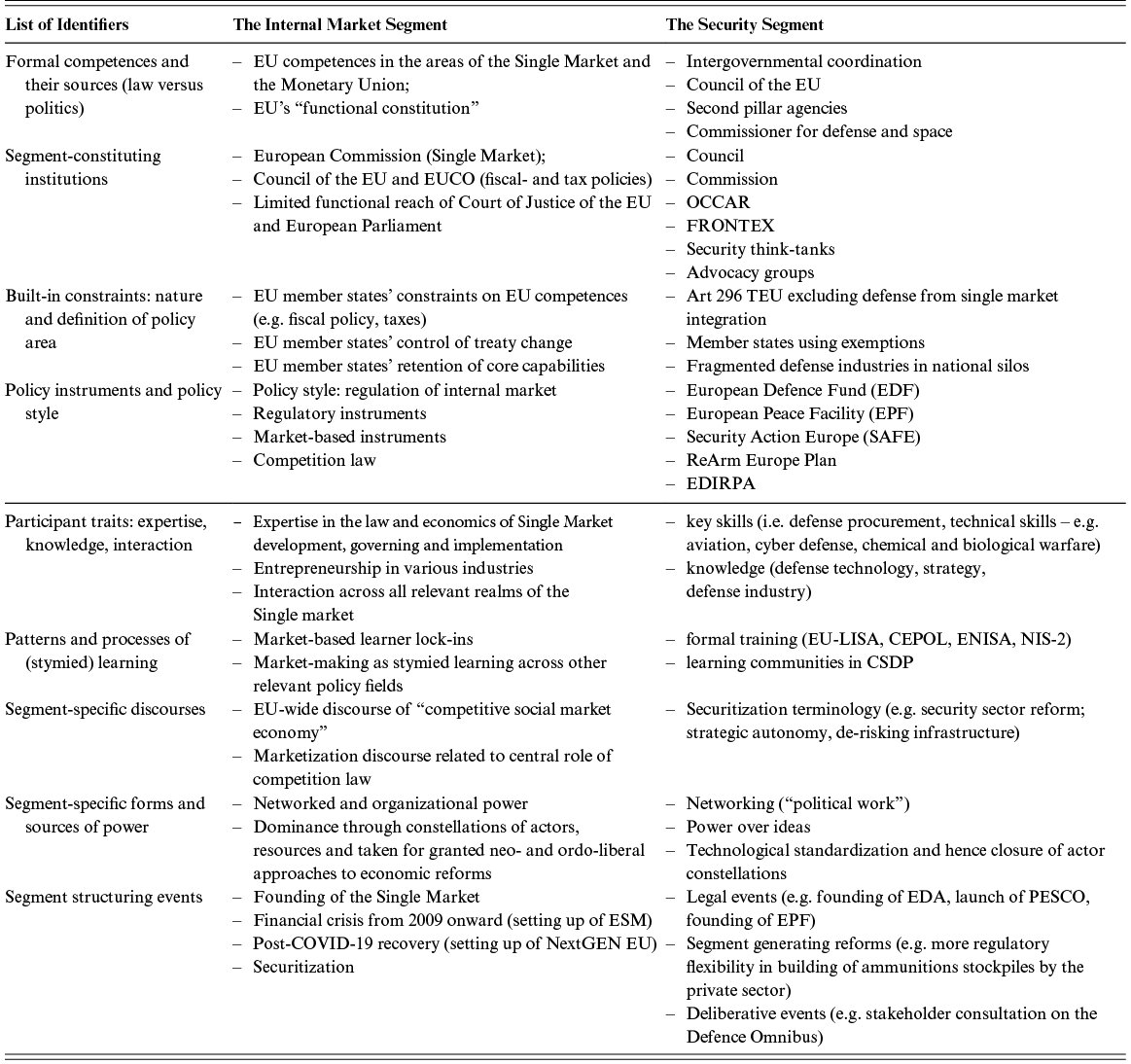
Table 2 Long description
These are outlined by means of a list of identifiers located at the left-hand side of the table and are: (a) formal competences and their sources (law versus politics); (b) segment-constituting institutions; (c) built-in constraints: nature and definition of policy area; (d) policy instruments and policy style; (e) participant traits: expertise; (f) patterns and processes of (stymied) learning; (g) segment-specific discourses; (h) segment-specific forms and sources of power; and (i) segment structuring events. Points (a) to (e) are segment constitutive.
Conclusion
A key thesis in this Element is that to understand the EU as a polity, we need to understand how segments are constituted, how they set parameters for action and governance, and how they interact, and may mutually reinforce and modify one another. This section has presented the EU as a composite polity with supranational and intergovernmental governing arrangements each of which due to the overall constitution of the EU as a polity yields two essential segments in the EU – the internal market segment and the security segment. In this context the internal market may appear the least obvious segment and EU integration has from the onset consisted in numerous efforts to escape constraints and straitjackets so that the supranational institutions could have the means for their own sustenance, but vital constraints remain.
5 Conclusion and Outlooks
Introduction
This section summarizes the core argument of the Element and discusses implications for theory and avenues for future research.
The Element has introduced the theoretical concept of segmented polity as a response to a fundamental misalignment between contemporary political science theories – rooted in the concept of the sovereign nation-state – and the evolving empirical realities of governance, particularly in Europe. Traditional theories, which rely on state-centric models, fail to account for new forms of authority structures that do not fully align with either modern nation-states or IOs, but which nevertheless are formed within and conditioned and constrained by the statist political order. The statist order exerts a powerful set of isomorphic pressures on every attempt to forge a political system that deviates from the basic tenets of the statist order. Having said that we posit that there are important differences between the types of isomorphic pressure in play: normative isomorphic pressure is stronger than mimetic and coercive. Thus, there appears to be a discrepancy between the nature and magnitude of state transformation afoot and the language (state-centered) that is used to depict that. This tension also enables the coexistence of two forms of resilience: the resilience of the EU as a supranational organization on the one hand and the resilience of the statist political order wherein the EU is embedded on the other. The combination of these forms of resilience has prompted us to discuss the EU as a segmented polity, embedded in the statist political order. There is no doubt that the weight of the EU has impact on the states, but the member states constrain, bias and encode the EU, ensuring that it remain a partial and biased entity, an authority structure that falls well short of statehood.
With its combination of supranational and intergovernmental traits, the EU is a prime example of the institutional reconfiguration that permits the coexistence of two forms of resilience. The concept of a segmented polity is proposed as a novel theory to understand this hybrid form of polity.
We have defined a segmented polity as a political system that is contested in normative and political terms; partial (capable of issuing authoritative decisions selectively and across a limited policy field) and constrained (in terms of resources and in terms of falling well short of the comprehensive territorial and functional sovereignty we associate with the modern Westphalian state). Despite these limitations, segmented polities develop autonomous policymaking capacities. They issue binding rules and decisions across selected domains and form unique societal linkages, here discussed under the notion of social constituency to underline that the polity’s social resonance is significantly narrower and thinner than the societies we find in traditional nation-states.
The idea and practice of segmented polities is not new. Various types of segmented polities are found in the medieval period prior to the formation of modern Westphalian states. But today’s form of segmented polity in Europe is distinct because it is embedded in the Westphalian statist political order, rather than replacing it. Thus, segmented polities operate within and not outside (or against) the state system. Segmented polities are neither states nor simple IOs, but reconfigured hybrids that blur traditional political categories. The purpose of the endeavor in this Element – Weberian in its overall aims – is to get a conceptual grip on such novel types of polity, and with a particular focus on theorizing the EU as a segmented polity.
A segmented polity may moreover be composed of multiple segments – constellations of institutions, actors, norms, resources, discourses and problem-solving approaches – that may operate at and across different territorial or functional levels (see Figure 1), but where a hallmark is that one of these is polity constitutive. Segments are (1) functionally delimited – each segment governs a sectoral policy area and potentially spreads into other policy sectors (e.g., the EU’s internal market; the EU’s security domain); (2) institutionally closed – they maintain interactional boundaries that enable inclusion of participating actors and exclusion of other actors not sharing in the segment-specific normative and procedural approaches and ideas; and (3) cognitively unified – participants share similar problem definitions, worldviews, and policy preferences while organizing out alternative ones. Because of their boundedness, segments can foster epistemic closure, stymieing alternative viewpoints and leading to path- dependent policymaking.
Segmented polities enable efficient policy implementation amid institutional and political constraints, but they are democratically deficient for several reasons. First, they are authority structures but lack Kompetenz-Kompetenz – they do not possess the authority to define the nature and extent of their own powers. Second, they have weak representational mechanisms – their institutions may lack direct electoral legitimacy or when that is in place the representative bodies are facing important constraints on their powers and reach. The EP is in many ways a full-fledged parliament but is barred from controlling the whole range of activities that are going on at the EU level (especially within the Union system) and suffers from the EU’s limited access to own resources. Third, they only feature limited rights – for instance, citizenship rights systems in segmented polities are tailored to the system’s core functional realms rather than encompassing the full range and bite of civil, political, economic, and social rights that mark Marshallian citizenship.
Segmented polities are structurally and institutionally constrained. Given these constraints, segmented polities can give rise to various hybrid governance forms as well as various interstitial organizations supporting governance. Given these recombined arrangements, segmented polities are platforms for innovation of institutions of political and economic governance.
Segmented polities are also embedded in the civil societies of the member states. They interpenetrate the civil societies of member states but do so selectively, and far more horizontally (across societies) than vertically (through socialization and inculcation of citizens and NGOs). They activate some societal actors (e.g., firms, market participants in the case of the market segment or defense and security organizations in case of the security segment) while excluding others. This creates biased constituencies and structures conflicts between segment insiders and outsiders. In this way, each segment nurtures a specific social constituency of segment-insiders that is different from what we associate with civil society proper.
To analyze segments within segmented polities, the Element has operationalized them along nine analytical dimensions: (a) legal basis and sources of competence; (b) segment-constituting institutions; (c) built-in constraints: nature and definition of policy area; (d) policy instruments and policy style; (e) participant traits: expertise, knowledge, interaction; (f) patterns and processes of (stymied) learning; (g) segment-specific discourses; (h) segment-specific forms and sources of power; (i) segment structuring events.
Using these dimensions, the Element has provided cursory empirical illustrations of how the EU as a combination of supranational and intergovernmental governing structures has given rise to two segments: the internal market segment – centered on the Single market – and the security segment – focused on defense and strategic coordination. The internal market segment is deeply institutionalized, anchored in EU treaties and equipped with supranational decision-making powers. Its institutional base includes the EC, the ECJ, and the EP, with a legal and regulatory thrust aimed at economic integration (and in flanking areas). This segment exhibits characteristics of “functional constitutionalism” and is marked by regulatory prominence, reliance on expertise, and policy learning patterns that privilege market-making logics over market correcting ones. Its sociopolitical reach is quite extensive into various domains of European societies, but formal and resource constraints ensure that it ends up privileging economic actors and economic logics. Since the EU faces constraints on its capabilities and resources, this intervention into other policy areas covers a marketization imprint that is democratically problematic, as we see from the many attempts by the European Parliament to undo this marketization bias.
The security segment, by contrast, is loosely structured and predominantly intergovernmental. It involves a mix of EU institutions and agencies (e.g., Council, EEAS, EDA), member states, private defense industries, and civil society organizations. Legal constraints, especially on defense integration, limit supranational coordination. Recent geopolitical pressures, notably Russia’s full-scale war against Ukraine and growing ambiguity of the U.S. Administration’s position toward the EU, have spurred new initiatives like the European Commissioner for Defense and Space allowing for supranational coordination of defense industrial initiatives. Also, the security segment is supported by new structures such as the European Peace Facility and new armaments initiatives like ReArm Europe. The security segment also extends into various sectors of the economy (e.g. critical raw materials; telecommunications) and civil society carried by specific regulations and discourses.
These illustrations demonstrate that each segment is shaped by distinct governing logics, institutional resources, discourses, and learning processes. Moreover, segments may potentially also reinforce, modify, and constrain one another. Overall, theorizing the EU as a segmented polity helps to understand its resilience and its limitations. We have suggested that understanding these segments is key to grasping the EU’s partial and constrained character. The next section discusses implications for theory development and outlines avenues for future research.
Implications for Theory Development and Future Research Avenues
We suggest four avenues for future studies of segmented polities and segmentation dynamics: a new theoretical research agenda in social science, an invitation to establish longitudinal research designs, studies of actor-level applications, and comparative analyses beyond the EU. First, the theoretical concept of segmented polity has implications for at least three areas of social science theorizing. In political science, the concept introduces a new category of political system that transcends the dichotomy of state and IO, by highlighting hybridity rather than clear break as reflected in the two forms of resilience: supranational and statist political order. While the state remains an important benchmark in a theory of segmented polity, it allows for escaping the conceptual straitjacket of state sovereignty. This combination of statist and “stateless” thinking-style about policymaking in the EU is what marks citizens’ thinking about the EU (Bátora and Baboš, Reference Bátora and Koníková2025). That shows that citizens are divided across the gap we identified in Section 1 between the magnitude of state transformation and the retention of state-based language for depicting reality. Political science needs to provide guidance by developing conceptual tools that connect theorizing of political governance better to the reality of political governance in the multilevel EU.
This in turn links to an area of theorizing where the currently proposed concept has implications – theories of European integration/European studies. The concept of segmented polity provides a refined conceptual tool to understand the EU’s structure. It also allows for understanding polity formation beyond the traditional supranational and intergovernmental dichotomy. In this sense, we join the effort of Schmitter (Reference Schmitter, Marks, Scharpf, Schmitter and Streeck1996) and propose a novel theoretical concept allowing us to explain polity development in the EU and beyond.
Moreover, a theory of segmented political order contributes to theory development in studies of democracy. The proposed concept of segmented polity highlights novel challenges of democratic legitimacy in hybrid governance settings. Segmented polities may contain well-developed democratic institutions, but these must be able to control resource allocation and distribution, if not they cannot counteract segmentation dynamics.
As alluded to in Section 3, segmented polities are hardly end-states, but temporary configurations within potentially longer-term institutional evolution (Trondal, Reference Trondal2010). Presence of hybrid and interstitial organizational forms as carriers of policy coordination in segmented polities underline their evolutionary nature. More broadly, the existence of segmented polities signals shifts in political authority and organization under conditions of global geopolitical uncertainty and post-sovereign experimentation with new governance forms (Sabel and Zeitlin, Reference Sabel and Zeitlin2012). In that sense, the Element opens new avenues for theorizing democratic governance beyond the state.
Secondly, future research should outline a research agenda that embraces longitudinal research designs that enables both causal identifications of (de)segmentation and empirically maps the ups-and-downs of segmentation across time. There is indeed a void of long-term datasets in political science that enables studies of political life over time. This also hinders causal inferences over time. One consequence has been that contemporary survey research in political science is over-optimistic on the use of survey experiments. Even more ambitious would be for future research to establish collaborative data infrastructures that allow large-scale studies of how segmented systems emerge, evolve, consolidate and decay. This would require the development of joint research infrastructures for the collection of large-scale comparative data (see Schuster et al., Reference Schuster, Mikkelsen, Rogger, Fukuyama, Hasnain, Mistree, Meyer-Sahling, Bersch and Kay2023). This would also enable theorizing causal mechanisms of (de)segmentation.
A third avenue of research would follow from the first one, establishing research on actors who are parts of segments, as well as those who are outside them, or who have left. This would offer actor-level studies of segmented polities – e.g. comparing the role of citizens, public officials, and elected representatives.
Finally, future research should go beyond the EU as a research laboratory by studying (de)segmentation at a world-wide scale. Assuming that future global policy challenges are increasingly hybrid in nature, such as hybrid security threats, it is plausible that segmented polities – and their interstitial and hybrid organizational arrangements – may be geared to deal with them. We therefore need future studies of their role in handling hybrid policy problems.
Acknowledgements
This Element was motivated by an ambition to rethink extant literature on the EU. This was initiated by an identified limit in state-centric modes of thinking about political organization, which in turn impede political science’s ability to conceptually capture elements of the EU. As part of this rethinking the Element revisits older conceptualizations of pre-Westphalian forms of political organization in Europe and readapts them to the present world. Central to that endeavor is to theoretically reconcile the EU’s distinct character with the continued existence of the statist order that continues to mark the European political landscape. The Element accordingly seeks to reconcile two seemingly incompatible forms of resilience of governing systems and political orders. For one is the resilience of the EU as a system of supranational governance, and for two is the resilience of the statist and territorial political order in Europe. The Element shows that it is precisely through theorizing the EU as a segmented polity that we are able to reconcile these seeming incompatibles.
The Element is the result of numerous debates and exchanges among the authors over several years. In writing the Element, we have had useful discussions in Oslo, San Francisco and Vienna and – perhaps the most fruitful ones – during our early morning coffee sessions in Central passage downtown Bratislava in April 2025. The segmented polity concept developed in the Element was presented at conferences and research seminars at ARENA, University of Oslo, EUI Florence, Department of Political Science at Comenius University in Bratislava, IR Department at Webster Vienna Private University in Vienna, and Hertie School of Governance in Berlin. We are grateful to Franco Algieri, Pavol Baboš, Caroline Batka, Mark Dawson, Branislav Dolný, Morten Egeberg, Magdalena Gora, Sergio Fabbrini, Zsolt Gál, Adrienne Héritier, Markus Jachtenfuchs, Markus Kornprobst, Erik Láštic, Darina Malová, Martin Moland, Iver B. Neumann, Johan P. Olsen, Viliam Ostatník, Johannes Pollak, Waltraud Schelkle, Phillippe Schmitter, Samuel R. Schubert, Samuel Spáč, Max Steuer, and Aneta Világi for comments and inspiring exchanges. Two of the authors have also been associated with the SINGLEMARKETS project led by Craig Parsons and have benefitted from the many inspiring exchanges in that project. We are also very grateful to the editors of the series – Gary Marks and Catherine de Vries – for their support as well as for the very useful comments from the anonymous reviewers. Ani Zirakashvili deserves great thanks for excellent technical assistance. We would also like to thank our institutions for great support.
Research for the book was funded by NextGenerationEU through the Recovery and Resilience Plan for Slovakia under the project No. 09I03-03-V04-00043
Special thanks to Zuzana, Ewelyn, and Nadja for making us remember that the good life is not always being tied to the computer.
Catherine De Vries
Bocconi University
Catherine De Vries is a Dean of International Affairs and Professor of Political Science at Bocconi University. Her research revolves around some of the key challenges facing the European continent today, such as Euroscepticism, political fragmentation, migration and corruption. She has published widely in leading political science journals, including the American Political Science Review and the Annual Review of Political Science. She has published several books, including Euroscepticism and the Future of European integration (Oxford University Press), received the European Union Studies Association Best Book in EU Studies Award, and was listed in the Financial Times top-5 books to read about Europe’s future.
Gary Marks
University of North Carolina at Chapel Hill and European University Institute
Gary Marks is Burton Craige Professor at the University of North Carolina Chapel Hill, and Professor at the European University Institute, Florence. He has received the Humboldt Forschungspreis and the Daniel Elazar Distinguished Federalism Scholar Award. Marks has been awarded an Advanced European Research Council grant (2010–2015) and is currently senior researcher on a second Advanced European Research Council grant. He has published widely in leading political science journals, including the American Political Science Review and the American Journal of Political Science. Marks has published a dozen books, including A Theory of International Organization and Community, Scale and Regional Governance.
Advisory Board
Sara Hobolt, London School of Economics
Sven-Oliver Proksch, University of Cologne
Jan Rovny, Sciences Po, Paris
Stefanie Walter, University of Zurich
Rahsaan Maxwell, University of North Carolina, Chapel Hill
Kathleen R. McNamara, Georgetown University
R. Daniel Kelemen, Rutgers University
Carlo Altomonte, Bocconi University
About the Series
The Cambridge Elements Series in European Politics will provide a platform for cutting-edge comparative research on Europe at a time of rapid change for the disciplines of political science and international relations. The series is broadly defined, both in terms of subject and academic discipline. The thrust of the series will be thematic rather than ideographic. It will focus on studies that engage key elements of politics — e.g. how institutions work, how parties compete, how citizens participate in politics, how laws get made.
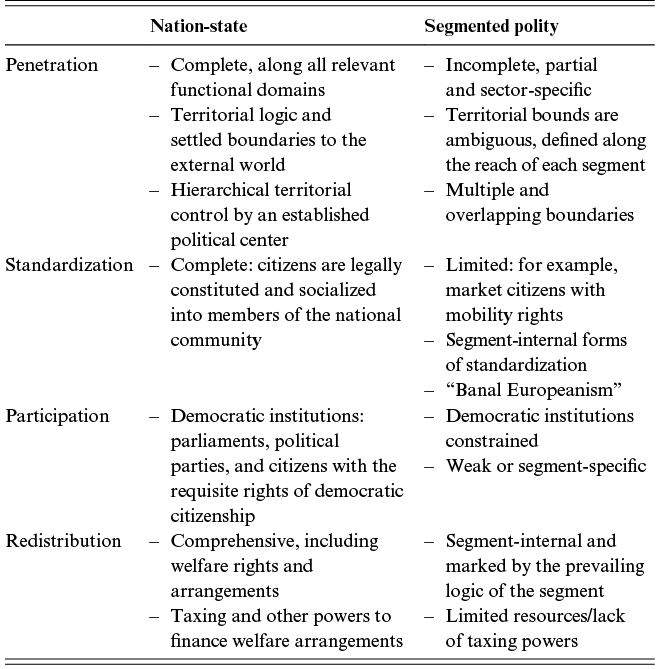
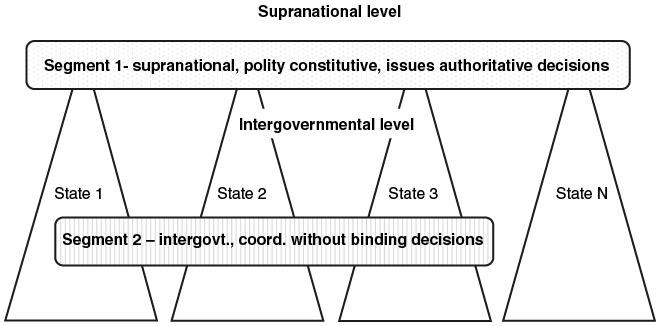
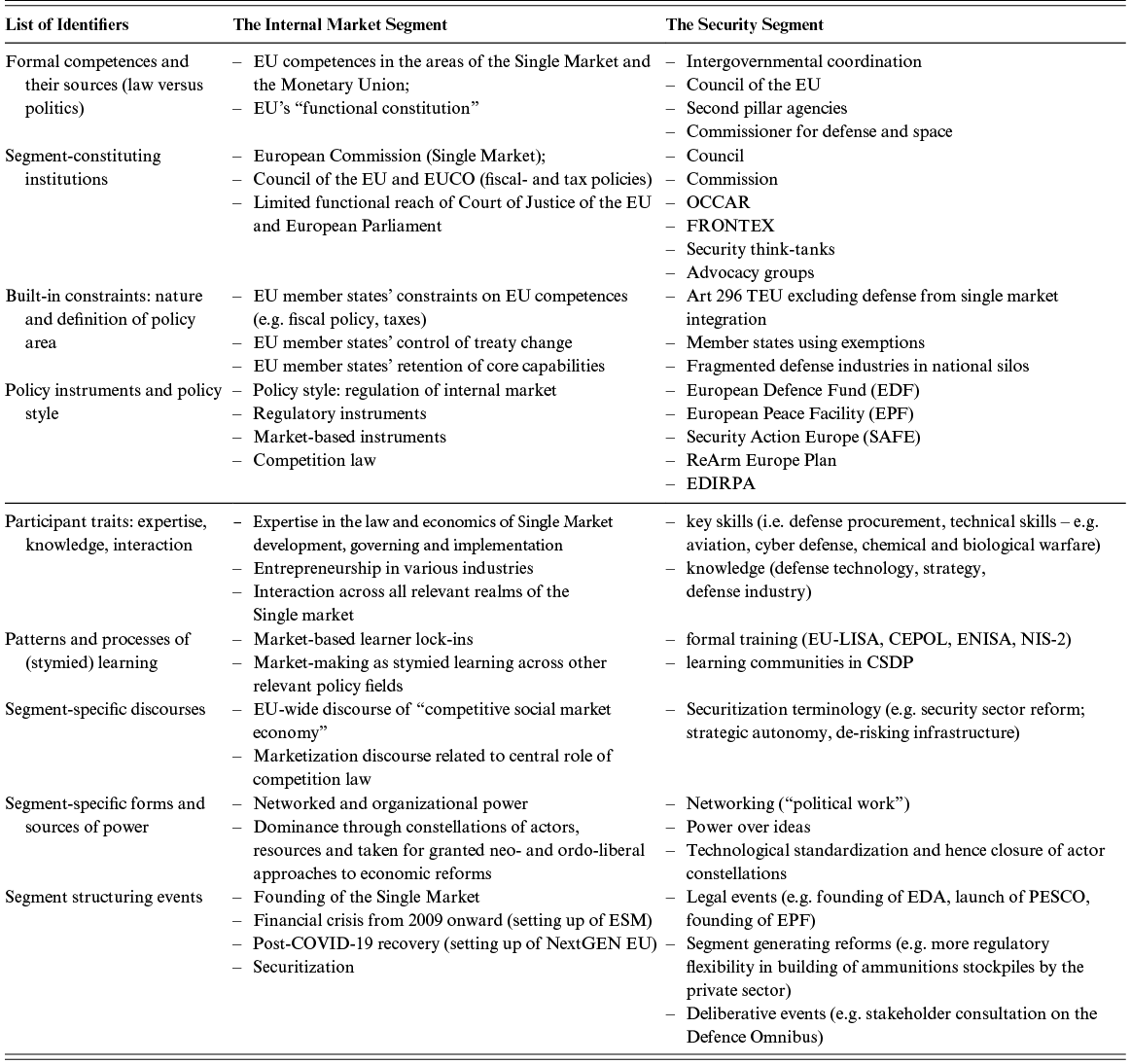

 Open access