


Understanding how words are created is potentially a key component to being able to learn and understand new vocabulary words. Moreover, with increased vocabulary, children should be able to gain insights into the morphological structures and processes prevalent in the language(s) that they speak. The focus of this paper was on the relationship between morphological awareness and vocabulary knowledge in preschool-aged children who speak one of three languages with a rich compounding system and relatively transparent semantic structure: Cantonese, Mandarin, and Korean.
Although children's knowledge of morphology and morphemes have been studied extensively in the child language literature (Berko-Gleason, Reference Berko-Gleason1958; Chomsky, Reference Chomsky1976; Clark, Reference Clark and Deutsch1981; Clark & Berman, Reference Clark and Berman1987; Clark & Hecht, Reference Clark and Hecht1982; Gottfried, Reference Gottfried1997a, Reference Gottfried1997b; Nicoladis, Reference Nicoladis2002, Reference Nicoladis2003; Pounder, Reference Pounder2000), and a mastery of morphological structure has long been assumed to be important to vocabulary learning both for children and adults (Anglin, Reference Anglin1993; Nagy & Anderson, Reference Nagy and Anderson1984), there has been relatively little research on whether children's ability to manipulate the morphological components of words is related to their current or subsequent vocabulary development (but see Lyytinen & Lyytinen, Reference Lyytinen and Lyytinen2004). Rather, most studies attempting to explain vocabulary acquisition focus on the importance of phonological processing (e.g., Avons, Wragg, Cupples, & Lovegrove, Reference Avons, Wragg, Cupples and Lovegrove1998; Bowey, Reference Bowey2001; Gathercole, Service, Hitch, Adams, & Martin, Reference Gathercole, Service, Hitch, Adams and Martin1999; Gathercole, Willis, Emslie, & Baddeley, Reference Gathercole, Willis, Emslie and Baddeley1992; Metsala, Reference Metsala1999) and general cognitive abilities (Henry & MacLean, Reference Henry and MacLean2003). Our purpose was to explore the relations between children's abilities to manipulate morphemes and their vocabulary understanding in the preschool years for three languages that differ from English and other IndoEuropean languages in the relative importance of compounding versus inflectional and derivational processes in word formation. Cantonese and Mandarin are both Chinese languages that differ from one another in phonological structure and grammar (e.g., Cheung & Ng, Reference Cheung, Ng, McBride-Chang and Chen2003) such that an explicit comparison of them might be useful in examining how phonological processing and morphological awareness explain variance in vocabulary growth in each. Korean, Cantonese, and Mandarin all differ across some linguistic features, notably phonological contrasts and type or presence of lexical tones in relation to phonology, but they share an underlying reliance on lexical compounding for vocabulary productivity to a certain extent such that we expected that morphological awareness should be important for vocabulary growth across all three, as elaborated below. This issue of morphological awareness in relation to vocabulary knowledge is potentially important both theoretically and clinically, because an explicit focus on morphological awareness apart from phonological processing skills in relation to vocabulary development has not yet been demonstrated longitudinally in previous work.
MORPHOLOGICAL STRUCTURE ACROSS LANGUAGES
A morpheme is the smallest unit of meaning expressed in a language (Bloomfield, Reference Bloomfield1933). It can refer to either a semantic concept, such as “ball” or “hit,” or to a syntactic function (e.g., “-s” added to a noun in English creates a plural such as “cars” and “-ing” added to a verb marks aspect: “hitting”). Languages differ in how many morphemes it typically requires to make up a word (one, a few, or many), and, for those languages that mark multiple morphemes within a word, how the morphemes are combined (i.e., whether multiple meaning/syntactic units are combined into single units such as the German article der [vs. die, das, den, etc.] which marks definiteness, gender, and case in a single unit, or are added onto each other in an “agglutinative” process such as adding da to chi in Korean [ /chita/] for “hit” and nun to chi [
 /chin
/chin  n/] for “hitting”). It is also important to consider how both semantic and syntactic units may be combined to form more complex words: adding “-s” or “-ing” is an inflectional change (i.e., of plurality or tense), whereas adding “-er” to “hit” creates “hitter,” a derivational change (i.e., from a verb to noun), but adding “base” to “ball” creates “baseball” and is a compounding change (i.e., “base” and “ball” are both independent simple words with their own meanings, but when added together they create a more complex compound word with a single referent that means something different from the two words used independently).
Knowledge of how one's language creates words from morphemes is essential, therefore, if speakers are to use even minimally complex words in semantically and syntactically appropriate ways in their native language. Knowing that “-ing” is used on verbs, but not nouns, in English, for instance, is something that even very young English-speaking toddlers use to infer that a novel word refers to an action rather than an object (Echols & Marti, Reference Echols, Marti, Hall and Waxman2004). Thus, given that different languages emphasize different types of morphological combination systems, it is important to examine how knowledge and awareness of each of these morphological systems relates to children's understanding and learning of new vocabulary words.
Compounding morphology has become a highly productive way of creating new words in Chinese, particularly for nouns in Mandarin (Packard, Reference Packard2000; Ramsey, Reference Ramsey1987). An example of this in Mandarin is to create “baseball” (bang4qiu2) from bang4(zi) (stick) and qiu2 (ball). As in English, the compound refers to either the game or the ball that is used to play the game rather than a stick and a ball in simple combination and, as in English, one can tell which of these is meant from the syntactic structure of the sentence in which the word is used. Chinese languages also display a fairly limited system of inflectional morphemes (primarily marking aspect on verbs and numeral classifier marking on nouns) as well as an even more limited system of derivational processes (e.g., use of the nominalizing “de” particle to change a verb or verb–object compound into a Mandarin noun phrase as in da3 qiu2 de to change the words “hit” and “ball” into a “ball hitter” [i.e., baseball player]). All three of these processes, however, occur by simply adding the relevant morphemes onto the original morpheme in Chinese through an agglutinative process rather than by fusing the markings into a single lexical unit as in German or English irregular verb forms (e.g., running vs. ran) and pronouns (e.g., I vs. me vs. my).
Korean has had a long history of language contact with Chinese and other languages, resulting in a large proportion of “borrowed words” both historically and in contemporary spoken and written Korean (Baik, Reference Baik1992; Shim, Reference Shim1994). By one count, the Korean lexicon consists of up to 69% of its words borrowed from Chinese (Kim, Reference Kim1983). Compounding in Korean, as in Chinese, is common and productive. Thus, despite some differences across linguistic features of Korean and Chinese, Korean, Mandarin, and Cantonese all share a focus on productive lexical compounding that might foster vocabulary acquisition in children.
MORPHOLOGICAL ACQUISITION, MORPHOLOGICAL AWARENESS, AND VOCABULARY DEVELOPMENT
Most studies on the acquisition of children's abilities to correctly use and manipulate the morphological components of words have been conducted in English and have therefore focused on the development of inflectional and derivational morphology. Derwing and Baker (Reference Derwing, Baker, Fletcher and Garman1979, Reference Derwing, Baker, Fletcher and Garman1986), for instance, in a classic developmental study of morphological development from preschool to adulthood using both real and nonsense word stems found the development of inflectional rules to occur earlier than derivational rules, with the derivational rules showing a particularly protracted course of development even into adulthood (Casalis & Louis-Alexandre, Reference Casalis and Louis-Alexandre2000; Tyler & Nagy, Reference Tyler and Nagy1989). Some of these studies also found that compounding, at least for English speakers, showed an even slower pattern of development (Derwing, Reference Derwing1976a) with adults showing great difficulty interpreting novel three-morpheme compounds even when simple principles for combining familiar words were followed (Gleitman & Gleitman, Reference Gleitman and Gleitman1970). However, other studies conducted with English-, Hebrew-, French-, Italian-, and Swedish-speaking children have shown that children's understanding of lexical compounding as a productive morphological process occurs early and that 3-year-olds comprehend and produce appropriate lexical compounds in a number of testing contexts (Alegre & Gordon, Reference Alegre and Gordon1996; Clark, Reference Clark, Fletcher and MacWhinney1995, Reference Clark and Berman2003; Clark & Berman, Reference Clark and Berman1987; Clark, Gelman, & Lane, Reference Clark1985; Clark & Hecht, Reference Clark and Hecht1982; Gordon, Reference Gordon1985; Gottfried, Reference Gottfried1997a, Reference Gottfried1997b; Nicoladis, Reference Nicoladis2002, Reference Nicoladis2003). Indeed, even many 2-year-olds can spontaneously build words from morphemes using lexical compounding (e.g., inventing plantman for gardener; Clark, Reference Clark, Fletcher and MacWhinney1995).
In English, strong associations have also been found between morphological awareness, or the ability to manipulate inflectional and derivational morphemes, and both vocabulary and reading development (Champion, Reference Champion1997; Fowler, Liberman, & Feldman, Reference Fowler, Liberman and Feldman1995; Kuo & Anderson, Reference Kuo and Anderson2006; Leong, Reference Leong1989; Shankweiler, Crain, Katz, & Fowler, Reference Shankweiler, Crain, Katz and Fowler1995). In addition, studies in a wide range of languages show that children with specific language impairments (SLI) or a family history of dyslexia have difficulties with morphological rules, particularly for inflectional morphology (De Jong, Reference De Jong, Verhoeven and Balkom2004, for Dutch; Hansson & Leonard, Reference Hansson and Leonard2003, for Swedish). Despite its relatively minimal use of inflectional morphology, difficulties in the appropriate use of inflections have also been found for Cantonese children diagnosed with SLI (Stokes & Fletcher, Reference Stokes and Fletcher2003). This appears to be the case for Korean as well, as an adult study of two Korean aphasics (Halliwell, Reference Halliwell2000) showed that language impairments in Korean could specifically target inflectional morphology, with both patients showing enormous difficulties with verb tense and case markings on nominals.
However, our interest in the present study was on compounding morphology and the role that children's abilities to manipulate the fully lexical morphemes (e.g., “base” and “ball”) present in compounds (“baseball”) may have on children's vocabulary development. Investigating the role of morphological awareness for compounding morphology is particularly important for languages in which compounding is prevalent, such as Mandarin, Cantonese, and Korean, as well as in considering the role of different aspects of morphological awareness more generally for vocabulary development.
A small number of studies focused on reading abilities in older children have indeed found a strong link between morphological awareness for compounding morphology and vocabulary acquisition across languages. For example, one study of second graders demonstrated that morphological awareness for compounds (indigenously derived in four languages/cultures) was equally and significantly associated with vocabulary knowledge across four different languages (McBride-Chang et al., Reference McBride-Chang, Cho, Liu, Wagner, Shu and Zhou2005), even with phonological awareness statistically controlled. In another study of English-speaking children in kindergarten and second grade, morphological awareness explained 8% unique variance in vocabulary knowledge, after a variety of phonological and articulation skills, along with word recognition ability, were statistically controlled (McBride-Chang, Wagner, Muse, Chow, & Shu, Reference McBride-Chang, Wagner, Muse, Chow and Shu2005). A third correlational study (McBride-Chang, Cheung, Chow, Chow, & Choi, Reference McBride-Chang, Cheung, Chow, Chow and Choi2006) similarly demonstrated that tasks of morphological awareness uniquely accounted for variability in Cantonese (native) receptive vocabulary knowledge but not in English (second) language vocabulary knowledge, with phonological awareness, reading skill, and general reasoning abilities statistically controlled. Thus, there is relatively strong, although preliminary, evidence that morphological awareness for compounds might be useful in accounting for variance in vocabulary knowledge in several samples of children. It is important, however, that none of these studies was longitudinal. Thus, any developmental associations between morphological awareness for compounding and vocabulary knowledge have yet to be demonstrated.
In spoken Cantonese, Mandarin, and Korean, as in German and other languages with highly productive lexical compounding processes, the transparency of complex and new vocabulary terms is surprisingly high. For instance, in Cantonese (although the example also applies to Mandarin), when new terms for television and computer were added to the Chinese language, they were created by using the morpheme for electric ( /din6/) and adding the terms vision (
 /si6/) to create electric-vision (
 /din6si6/) and brain (
 /nou5/) to create electric-brain (
 /din6nou5/), respectively. This process has been repeated throughout the centuries such that most complex terms in Chinese are made up of multisyllabic/multimorphemic lexical compounds (Ramsey, Reference Ramsey1987), as are a large proportion of Korean words.
The salience of lexical compounding in Chinese and Korean likely sensitizes children to morphemes that can be generalized in learning new vocabulary items early in development. Most words in both Korean and Chinese are composed of two or more morphemes, and often these morphemes are directly relevant to the meanings of the words. Thus, for example, the word girl in English is literally female child ( /neoi5zi2/ in Cantonese,
  /nü2hai2/ in Mandarin) in Chinese; it is a two-morpheme word. In addition, zebra is literally striped horse (
 /baan1maa5/), and the various terms for rooster, hen, and chick are all two-character “words” with a stem that means chicken (
 /gai1/), and prefixes for male (
 /gung1/), mother (
 /mou5/), and little (
 /siu2/), respectively, in Cantonese. Importantly, these prefixes can also be used on other animals for terms that, in English, are morphologically opaque, such as bull, cow, steer, heifer, and calf for different types of cattle, or stallion, mare, colt, filly, and foal for different types of horses, and so on. In Chinese, these terms are morphologically transparent (see Tardif, Reference Tardif, Hirsh-Pasek and Golinkoff2006, for further discussion of this issue). In Korean, compounding is also fundamental to the morphological structure of the language, both for Chinese loan words as well as native Korean words (Taylor & Taylor, Reference Taylor and Taylor1995). For example, the words woman, adult, and child in English are literally female person (
 /yəin/), big person (
 /t
/t  in/), and small person (
 /soin/) in Korean Chinese-loan words. Similarly, the terms for rooster (
 /suthak/) and hen (
 /amthak/) are native Korean words that follow the same compounding process with a stem that means chicken (
 /tak/) and prefixes for male (
 /su/), and female (
 /am/), respectively.
Thus, it is reasonable to expect that young Chinese and Korean children develop a sense of compounding fairly early in their linguistic development. Moreover, greater facility or awareness of this type of compounding might be particularly useful for bootstrapping vocabulary knowledge, particularly once children have already acquired a core set of stem words and compounds. A child first exposed to  /gung1ngau4/ (bull), for instance, would be able to infer from previous knowledge of
  /ngau4/ (cattle) and
  /gung1/ (male) in
  /gung1gai1/ (rooster) or other animals that
  /gung1ngau4/ might mean male cattle (bull), in Cantonese. With increasing vocabulary knowledge, more morphemes can be identified, learned, and generalized to newly encountered words.
With this hypothesis as a starting point, we designed a morphological awareness task to tap children's compounding awareness at the word level. In the present study, morphological awareness is defined as awareness of and ability to manipulate the morphemes in words consisting of two or more morphemes. To tap this awareness, we presented short scenarios to stimulate children to create novel words from familiar morphemes. This is similar to the task used by Berko-Gleason (Reference Berko-Gleason1958) to test children's awareness of inflectional morphology in her famous wug/wugs experiment testing children's understanding of inflectional morphology and in later research that specifically contrasted children's mastery of compounding versus derivational and inflectional morphology (e.g., Clark et al., Reference Clark, Gelman and Lane1985; Clark & Hecht, Reference Clark and Hecht1982; Gottfried, Reference Gottfried1997a, Reference Gottfried1997b). However, because of the importance of compounding morphology in Chinese and Korean languages, our task was focused exclusively on lexical compounding and thus used combinations of familiar, semantically laden morphemes to create new words that combined these familiar morphemes in novel ways. As with previous studies examining young children's abilities to use morphological rules to coin new words in English and other languages (Clark et al., Reference Clark, Gelman and Lane1985; Gottfried, Reference Gottfried1997a, Reference Gottfried1997b; Nicoladis, Reference Nicoladis2003), our task required children to construct novel words based on the presented logic of compounding. For example, the novel word  /goek3coeng1/ (footgun) used in our task was based on the real word
  /sau2coeng1/ (handgun), but involves combining “foot” and “gun,” both familiar words in themselves but not a lexical compound in Cantonese.
Given the relatively transparent structure of many Korean and Chinese words, we hypothesized that, among preschool-aged children (4- and 5-year-olds) speaking these languages with sufficient vocabulary knowledge and morphological awareness, both skills might influence one another in a bootstrapping fashion and facilitate further learning of both morphological compounding processes and of individual vocabulary items in the language. Although one could presume that at the very earliest stages of vocabulary development, children with larger vocabularies might first be able to abstract out the morphological components of their language (see, e.g., Marchman & Bates, Reference Marchman and Bates1994, who suggested that vocabulary knowledge, and specifically verb knowledge, predicts verb inflections in 1- and 2-year-olds), the children in the present study were somewhat older (preschoolers), and were asked to demonstrate morphological compounding as a metalinguistic skill. Thus, we predicted that the ability to explicitly manipulate familiar morphemes to create novel words would also be predictive of vocabulary size and the depth of vocabulary knowledge. Indeed, a study to examine relations between morphological awareness (albeit of inflectional morphology) and vocabulary in preschoolers, found that inflectional morphological skills at 2 and 3.5 years of age predicted vocabulary knowledge at 5 years of age (Lyytinen & Lyytinen, Reference Lyytinen and Lyytinen2004). It was also of interest to examine the extent to which vocabulary knowledge would explain subsequent morphological awareness in the present study.
Moreover, because past research has demonstrated both vocabulary knowledge and metalinguistic awareness tasks to be related to a variety of measures, we included multiple other cognitive abilities in our study to determine if we could find any unique effects of morphological awareness on vocabulary or vice versa. Perhaps the most important of these were measures of phonological sensitivity (Bowey, Reference Bowey2001), because these measures have been clearly linked to vocabulary acquisition in previous studies of English vocabulary growth (Avons et al., Reference Avons, Wragg, Cupples and Lovegrove1998; Bowey, Reference Bowey2001; Gathercole et al., Reference Gathercole, Willis, Emslie and Baddeley1992, Reference Gleitman1999; Metsala, Reference Metsala1999). Other skills, including general reasoning measures, were also included, not just because they have been found to be related to general vocabulary measures, but also because we wanted to ensure that success on our morphological awareness task was not merely a function of general reasoning or metalinguistic abilities. Thus, we sought to demonstrate effects of morphological awareness that might go beyond other general cognitive and linguistic abilities. Finding an effect of morphological awareness, while controlling for these other factors, would speak strongly for its importance and unique role in the vocabulary development of individual children.
To summarize, we hypothesized that morphological awareness would be concurrently and longitudinally uniquely associated with vocabulary knowledge in all three languages tested, Cantonese, Mandarin, and Korean, with a variety of other phonological processing and general reasoning abilities controlled. In addition, we hypothesized that vocabulary knowledge would predict unique variance in morphological awareness over time, in this case over the course of a single year, underscoring the bidirectional “bootstrapping” relationship between an awareness of how words are formed in a language and the acquisition and understanding of individual vocabulary words.
METHOD
Participants
Three separate groups of participants of approximately the same age were included in the present study. The first consisted of 211 kindergartners from Hong Kong. The second group was 288 Beijing kindergartners. The third group was composed of 164 Korean kindergartners. All were tested twice over a 1-year period. More details on each sample are given below.
The participants in Hong Kong were children selected from a group of 1,625 infants and toddlers who participated in the norming study of the Cantonese Communicative Development Inventory (CCDI; Fletcher et al., Reference Fletcher, Chan, Wong, Stokes, Tardif and Leung2004; Tardif et al., Reference Tardif, Fletcher, Zhang, Liang, Zuo and Chen2008) in the summer of 2001. Children were selected to represent the top, middle, and bottom range of scores on the CCDI infant and toddler forms and were originally recruited from five Maternal and Child Health Centers located in four regions (Hong Kong, Kowloon, New Territories East, and New Territories West) across Hong Kong. The Hong Kong sample included in the present study included 211 (94 boys, 117 girls) native Cantonese-speaking children who were tested in 2004 and 2005. At Time 1 in September–December 2004, the children's mean age was 53.16 months (SD = 3.49).Footnote 1 At Time 2 in June–September 2005, the children's mean age was 61.24 months (SD = 3.59).
The Beijing sample was selected on the same basis as the Hong Kong sample (CDI scores that were in the top, middle, or bottom ranges of the full CDI) from a total of 1,638 infants and toddlers who participated in the Putonghua version of the CDI norming study in Beijing in the summer of 2000. All children lived in the city of Beijing and were originally recruited from Maternal Child Health Centers located in two districts (Western District and Xuanwu District) of Beijing (see Hao et al., Reference Hao, Liang, Wang, Ji, Zhang and Zuo2004; Liang et al., Reference Liang, Hao, Tardif, Fletcher, Wang and Jiang2002; Tardif et al., Reference Tardif, Fletcher, Zhang, Liang, Zuo and Chen2008, for further details regarding sampling for the norming study). The Beijing sample included in the present study involved 288 children (164 boys, 124 girls) of native Putonghua-speaking parents in Beijing, China. Testing at Time 1 was conducted from June to July, 2003, when the children were a mean of 52.97 months (SD = 3.70). Time 2 testing was conducted from July to December of 2004, when the children were a mean of 64.31 months (SD = 3.63).
The Korean sample included 164 children (90 boys, 74 girls) who were native Korean speakers and recruited from three local kindergartens in the city of Masan, Korea. These children were initially tested in June–July of 2004 and tested again in June–July of 2005. The mean age of children was 66.29 months (SD = 7.26) at testing Time 1. Thus, these children were approximately 1 year older than the Chinese children for the present study. Because these children were spread across two grades in the kindergarten, “grade” (Year 1 or Year 2) was also used as a control variable for all of the regression analyses with the Korean sample reported below.
Procedure
Data collection procedures and sampling protocols in all three sites received institutional review board approval from the researchers' respective sites and consent forms were obtained from the parents of all participants.
Hong Kong parents received an invitation letter for their children's participation. A convenient testing time with the child and a caregiver was arranged. All interviews took place individually in the children's own homes. Each test session lasted for 1–1.5 hr (including several other tasks that go beyond the scope of this study but were part of the longitudinal study in which these children participated) and was carried out by trained psychology majors.
Beijing parents were contacted and scheduled following procedures that were almost identical to the Hong Kong sample. Testing lasted approximately 1–1.5 hr (including several other tasks that go beyond the scope of this study but were part of the longitudinal study in which these children participated) and was also carried out individually by pairs of trained psychology majors in the children's homes.
Korean children were tested individually at their kindergartens by psychology majors attending a local university. Each child participated in two separate testing sessions that took place on separate days. Each session lasted approximately 30 min.
Measures
The present study reports data from a subset of the tests used. Tasks were administered to children in their native language: Cantonese in Hong Kong, Mandarin in Beijing, and Korean in Korea. Measures administered at each time are described below: all Cantonese examples of test items given in this section are represented using the Cantonese Romanization system developed and recognized by the Linguistic Society of Hong Kong (The Linguistic Society of Hong Kong, 1997). Given that it is extremely difficult to estimate total vocabulary size for preschool-aged children (Anglin, Reference Anglin1993), particularly when different languages are involved, we chose to use a definitions task for all three locations. Although word definitions, like any other single measure of vocabulary, are not a perfect measure of vocabulary knowledge, we chose to use word definitions because standardized measures either already existed in each of the languages or could easily be created by using materials generated from existing databases of vocabulary common to preschool or elementary school-aged children. It is important to note that we were not directly comparing means, but rather examining associations among variables across languages, thus avoiding potential problems involved in establishing precise task equivalence across languages.
Vocabulary. We used a metalinguistic task to measure vocabulary knowledge. This task required that children produce explanations for vocabulary items and was similar to those used in previous studies (e.g., Anglin, Reference Anglin1993; Gathercole et al., Reference Gathercole, Service, Hitch, Adams and Martin1999) of young children's vocabulary development. In Hong Kong, a vocabulary definition test was developed and used to measure vocabulary knowledge in children at both testing times. The test comprised 46 and 53 Chinese words, respectively, at Time 1 and Time 2; items were selected from a book listing Chinese words that appeared frequently in Hong Kong primary school textbooks (Zhuang, Reference Zhuang2000). The testing procedures and scoring scheme of the Hong Kong Wechsler Intelligence Scale for Children (Hong Kong Education Department & The Hong Kong Psychological Society, 1981) was used for scoring the children's definitions. A detailed scoring key for each item was created based on the descriptions given by a Chinese dictionary (Lau, Reference Lau1999). Sample answers for zero to two points per question were also included in the scoring key. Children's answers were scored as 0, 1, or 2 according to the key, and examples given for each item. Children were asked to explain objects and concepts of increasing conceptual difficulty. The test was initially piloted with children of the same age ranges as those in the current sample in a kindergarten. After the pilot testing, the answers given by each child were discussed by two well-trained research assistants in order to compile a more complete scoring key. The maximum scores were 92 and 106, respectively, for the first and second testing times. Experimenters were trained to follow the scoring key in rating children's answers, and testing stopped when the child obtained a score of 0 across five consecutive items.
The vocabulary test in Beijing was based on the Hong Kong version of the vocabulary subtest of the Stanford Binet Intelligence Scale (Thorndike, Hagen, & Sattler, Reference Thorndike, Hagen and Sattler1986), adapted for Putonghua speakers. This task consisted of 32 items, and testing stopped when children scored 0 on five consecutive items. The total possible score for this task was 64.
To measure general vocabulary skills in Korea, we used the Korean–Wechsler Preschool and Primary Scale of the Intelligence vocabulary subtest (Park, Kwak, & Park, Reference Park, Kwak and Park1995) across both testing times. In the test, children were asked to define or explain pictures of objects and, at a more difficult level in the test, concepts. Testing stopped when five consecutive items were failed. The test consisted of 25 items, and the maximum possible score on this measure was 47.
Morphological awareness. A morphological awareness test, based on children's ability to manipulate compounding morphology, was administered at both testing times in all three locations. This task consisted of 20 items across locations. For each item, a scenario was first orally presented in a three-sentence story. To make the initial items understandable to children, illustrations were given in the first nine scenarios; the remaining items were not accompanied by pictures. For all items, children were asked to actively construct words for newly presented objects or concepts according to the scenarios. One example of an item of this task from Korean is the following: When a refrigerator keeps Kimchi ( ) in it, then we call it Kimchi refrigerator (
 ). If a refrigerator keeps a flower (
 ) in it, what would we call it? The correct answer should be flower refrigerator (
 ). Although this may seem to be a strange and perhaps overly straightforward task in English, it is important to keep in mind that compound words make up a large part of Cantonese, Mandarin, and Korean vocabularies, and that these compounds are fully lexical in their combinations, with random combinations of words not sharing the same lexical status. Thus, to the children (and the native Cantonese-, Mandarin-, or Korean-speaking research assistants), the new compounds are truly “novel words” in the same way that “plantman” (gardener) is a novel word in English (Clark, Reference Clark and Deutsch1981; Clark et al., Reference Clark, Gelman and Lane1985). The maximum score on this test was 20 for each of the languages.
Nonverbal reasoning. Several measures were combined in various ways to create a proxy nonverbal reasoning measure in different cultures at Time 1 only. First, the book form of Raven's Progressive Matrices (Raven, Court, & Raven, Reference Raven, Court and Raven1995) was administered in both Hong Kong and Beijing during the first testing time as an estimate of nonverbal IQ. Twenty-four colored patterns in order of increasing difficulty were presented in two sets (A and B) with 12 items per set. Each item consisted of one large figure with a portion of the pattern removed. Children were asked to find the portion that would correctly complete the pattern from among six choices. The maximum score on this abbreviated version of the Raven's Matrices was 24.
As an additional proxy for nonverbal reasoning skills, the visual discrimination and visual spatial relationships tasks, which are subtests from Gardner's Test of Visual–Perceptual Skills (Non-motor) Revised (Gardner, Reference Gardner1996), were administered in Korea. In Beijing and Hong Kong, only the latter subtest was used. The visual discrimination subtest required children to look at a target two-dimensional line-drawn figure and locate the identical figure (target) on the same page. There were five alternatives, including the target and four visually confusable distracters. It consisted of 1 practice item and 16 test items.
The Visual Spatial Relationships task required the child to discriminate one single form or part of a single form that was different from the other four forms of identical configuration. It consisted of 1 practice item and 16 test items. Each item was presented with five black-and-white line drawings. The child had to pick the one that was oriented differently from the others. The maximum score was 16. The test stopped when the child failed four out of five items.
Phonological processing measures. Across our three samples, we measured a variety of phonological processing tasks, each found to be associated with vocabulary acquisition in some previous studies of English. These included measures of phonological awareness, nonword repetition, and speeded naming. However, the tasks administered in each culture differed somewhat in part because of constraints imposed by language and in part because of practical time considerations. Phonological processing measures were gathered across both testing times. Measures were as follows:
Phonological awareness was measured using a syllable deletion task in Hong Kong and Beijing at Times 1 and 2. It required children to take away one syllable from three-syllable phrases. For example, the phrase  /daai6 mun4 hau2/ (big door mouth) without
  /mun4/ (door) would be
  /daai6 hau2/ (big mouth; in Cantonese). The task consisted of three practice trials and 15 test items of real words and phrases. Of these, five items each required taking away the first, the middle and the last syllable, respectively. The maximum score was 15. The task stopped when children answered five consecutive items incorrectly. A similar task has been used successfully in past research to demonstrate syllable awareness among Hong Kong Chinese kindergartners (McBride-Chang & Ho, Reference McBride-Chang and Ho2000; McBride-Chang & Kail, Reference McBride-Chang and Kail2002). Phoneme onset deletion was also tested in Beijing only at Time 2, in a task similar to the one described below for Korean.
In Korea, phonological awareness was measured using syllable deletion, phoneme onset, and phoneme coda deletion tasks at both Times 1 and 2. In the syllable deletion task, children were asked to listen to orally presented three-syllable words and nonwords. Eight items were real words and eight were nonwords, for a total of 16 items on this task. Of these, eight items required taking away the middle syllable; and four items each involved deletion of the first and the last syllable, respectively. For Korean phoneme onset deletion task, children were asked to delete the first phoneme from a one-syllable real word that was orally presented to them by the experimenter. For example, saying mal ( ) without the initial sound would be al (
 ). Eight items were consonant–verb (CV) words, and eight were consonant–verb–consonant (CVC) words, for a total of 16 items on this task. For the phoneme coda deletion measure, children were orally presented with one-syllable CVC real words from which they were asked to delete the final phoneme. For example, saying mul (
 ) without the final sound would be mu (
 ). Sixteen items were included in this measure, and all of them were CVC words.
The nonword repetition task, a test of phonological memory skills that has been found to be associated with vocabulary acquisition in English in previous studies (e.g., Gathercole et al., Reference Gathercole, Service, Hitch, Adams and Martin1999) was also created for this study and administered to Hong Kong and Beijing children in both testing times. The task consisted of four practice trials for which feedback was provided and 24 test items consisting of increasingly complex nonwords. The test items start with a group of six one-syllable items, followed by two-, three-, and four-syllable item groups. The test items were made up of nonsense syllables that were combined with initials and rimes that made use of Cantonese/Mandarin phonology. Children were asked to repeat each made up word spoken by a trained experimenter. Each attempt by each child was scored as correct or incorrect. The maximum score was 24. The test stopped when the child failed to repeat four items or more in a given group of a particular syllable length. However, all children were required to finish the one-syllable group. All responses were recorded on a minidisc player. Examples of Cantonese items include kip3, nu6 pim2, lui5 beoi6 jot3, and keot6 wau1 hui2 feng6. Mandarin items included lia1, na1ku2, bian2he3shuang4, and mou4gen2tai3ce1.
In Korea and Hong Kong at both testing times and in Beijing at testing Time 2 only, speeded number naming, a form of rapid automatized naming (Denckla & Rudel, Reference Denckla and Rudel1976) was measured as a proxy of phonological processing as well. On this task, five rows of five digits, arranged in different orders, were presented. Children were asked to name all digits as quickly as possible. Across both tasks, children were given two naming trials each.
RESULTS
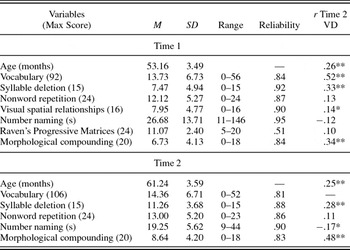
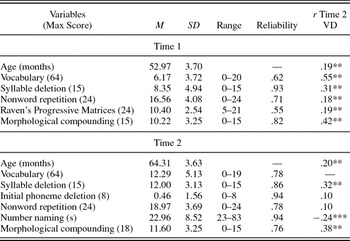
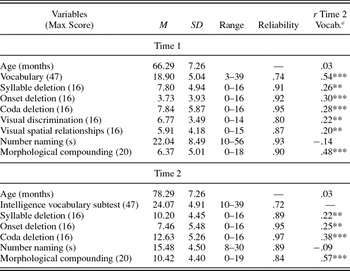
Table 1 shows means, standard deviations, and internal consistency reliabilities of all measures administered at Times 1 and Time 2, as well as their ranges and correlations with the vocabulary definition task at Time 2 for the Hong Kong sample. Table 2 shows the same results for Beijing, and Table 3 displays the same data for tasks administered in Korea.
Means, standard deviations, reliabilities of Time 1 and Time 2 measures in Hong Kong sample, and correlations with Time 2 vocabulary definition (VD) task
Note: Reliabilities represent Cronbach alphas for internal consistencies.
*p < .05. **p < .01.
Means, standard deviations, reliabilities of Time 1 and Time 2 measures in Beijing sample, and correlations with Time 2 vocabulary definition (VD) task
Note: Reliabilities represent Cronbach alphas for internal consistencies.
**p < .01. ***p < .001.
Means, standard deviations, reliabilities of Time 1 and Time 2 measures in Korean sample, and correlations with Time 2 vocabulary task
Note: Reliabilities represent Cronbach alphas for internal consistencies.
aControlling for grade.
**p < .01. ***p < .001.
As indicated across the three tables, vocabulary knowledge was significantly correlated with the morphological awareness measure at both testing times across all three sites. Of importance, when comparing across measures in all three samples, the morphological awareness task showed correlations with Time 2 vocabulary that were as strong or stronger than any of the other measures except Time 1 vocabulary. Some of the phonological processing tasks were also correlated with vocabulary knowledge across time periods and cultures, replicating findings from previous studies in English and other languages. In addition, in Hong Kong, the Raven's task was correlated with the visual spatial relationships task .48, and in Korea, the two visual skills tests were intercorrelated .49. Thus, these were combined, respectively, to create a nonverbal reasoning component by converting each task to a z score and adding the z scores together for this total score. Similarly, after factor analyzing all phonological processing skills, we found that they formed a single factor across cultures. In Beijing, all factor loadings from this factor were .62 or higher, in Hong Kong, the factor loadings were .61 and above, and in Korea, these factor loadings were .67 and above across testing times. Therefore, across cultures, we formed a phonological processing factor by adding z scores across tasks separately for each testing time. In the subsequent regression tables, therefore, nonverbal reasoning and phonological processing measures are shown as composite scores.
In these analyses, we sought to control for the effects of nonverbal reasoning and phonological measures to be sure that the correlation between the morphological awareness task and vocabulary knowledge was not a result of a more general facility with metalinguistic tasks. To do this, we conducted a hierarchical regression analysis explaining vocabulary knowledge at Time 2 in seven steps. First, we entered age at Step 1, followed by nonverbal reasoning at Step 2. We then entered vocabulary knowledge at Time 1 in Step 3. In Step 4, phonological skill at Time 1 was entered. Morphological awareness at Time 1 was then entered at Step 5, followed by phonological skill at Time 2 in Step 6. Finally, morphological awareness at Time 2 was included in the final step of the equation. As shown in Table 4 for all three cultures, across languages, the morphological awareness task at Time 1 predicted unique variance in subsequent vocabulary knowledge, from 2% in Hong Kong to 5% in Korea. Moreover, in the final step, this morphological awareness measure explained a unique 4% unique variance in vocabulary at Time 2 in Korea and 9% in Hong Kong; it explained 1% variance in Beijing at this time, but this change was not statistically significant. Final beta weights for all tasks included are also shown in Table 4. Even after controlling for the autoregressive effects of vocabulary knowledge, phonological skill, and nonverbal reasoning, at least one of the two morphological awareness measures was uniquely associated with vocabulary knowledge in the final equation, underscoring the uniqueness of the morphological awareness measure.
Standardized betas for regression equations predicting Time 2 (T2) vocabulary from Time 1 (T1) measures in Hong Kong, Beijing, and Korea
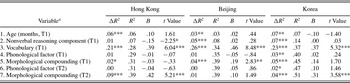
Note: The amount of variance explained in each step in each of the three places was significant (p < .001), such that in the first model in Hong Kong, Beijing, and Korea they were F (6, 204) = 14.15, F (5, 282) = 25.75, and F (10, 153) = 10.36, respectively. In the second model they were F (7, 203) = 12.91, F (6, 281) = 24.86, and F (11, 152) = 11.58, respectively.
aTime administered.
*p < .05. **p < .01. ***p < .001.
Finally, to examine the directionality of effects and begin to explore our hypothesis that morphological awareness both predicts future vocabulary knowledge and is predicted by vocabulary knowledge, we conducted two additional analyses. First, we tested whether Time 1 vocabulary could predict Time 2 morphological awareness above and beyond the autoregressive effects of Time 1 morphological awareness, and these results are shown in Table 5. As shown in the table, indeed, Time 1 vocabulary knowledge did predict Time 2 morphological awareness even after Time 1 morphological awareness and age were controlled. Second, we tested the effects in the opposite direction to see if Time 1 morphological awareness could also predict Time 2 vocabulary above and beyond the autoregressive effects of Time 1 vocabulary. As seen in Table 6, the answer here is positive as well. The final standardized beta weights of predictors in both equations suggested that morphological awareness and vocabulary knowledge were bidirectionally associated with one another across time. In other words, there does appear to be a bootstrapping relationship between children's knowledge of and ability to manipulate the morphological structure of words in their native language and their vocabulary knowledge, at least in the ways we were able to measure them.
Standardized betas for regression equations predicting Time 2 (T2) morphological awareness from Time 1 (T1) vocabulary in Hong Kong, Beijing, and Korea

Note: The amount of variance explained in each step in each of the three places was significant (p < .001). For the first model in Hong Kong, Beijing, and Korea they were F (2, 208) = 83.84, F (2, 285) = 108.28, and F (3, 160) = 47.08, respectively. In the second model they were F (3, 207) = 58.31, F (3, 284) = 75.06, and F (4, 159) = 39.56, respectively.
aTime administered.
*p < .05. **p < .01. ***p < .001.
Standardized betas for regression equations predicting Time 2 (T2) Vocabulary from Time 1 (T1) Morphological awareness in Hong Kong, Beijing, and Korea

Note: The models in all three places were significant (p < .001) such that the first models in Hong Kong, Beijing, and Korea were F (2, 208) = 40.93, F (2, 285) = 63.23, and F (3,160) = 29.08, respectively. In the second model they were F (3, 207) = 29.89, F (3, 284) = 49.58, and F (4, 159) = 30.26, respectively.
aTime administered.
*p < .05. ***p < .001.
DISCUSSION
The present study demonstrated the utility of morphological awareness for facilitating vocabulary knowledge acquisition, both concurrently and longitudinally, across three languages. Across all three languages studied, with other cognitive abilities and age, as well as the autoregressive effects of vocabulary knowledge at Time 1 statistically controlled, morphological awareness predicted unique variance and appeared to show stronger relationships with children's vocabulary knowledge than other measures (e.g., phonological awareness, nonverbal IQ) traditionally associated with children's vocabulary knowledge. We also demonstrated that vocabulary knowledge explains unique variance in subsequent morphological awareness across all three languages, thus speaking to the bidirectional influences of vocabulary development and morphological awareness.
Theoretically, our results highlight the fact that morphological awareness is both a separable component from phonological processing skills and that it is related to vocabulary knowledge, independent of these skills. Moreover, the morphological awareness task emerged as a stronger predictor of subsequent vocabulary knowledge compared to phonological processing skills over time across all three of the languages we tested. This is particularly important given that previous researchers have typically not tested these abilities in the same study and thus have not been able to tease apart the role of more general metalinguistic skills from phonological or morphological awareness per se (see Kuo & Anderson, Reference Kuo and Anderson2006, for discussion of this issue). The two studies (Fowler et al., Reference Fowler, Liberman and Feldman1995; Nagy, Berninger, & Abbott, Reference Nagy, Berninger and Abbott2006) to date that have examined these components together in the context of vocabulary knowledge were conducted with English-speaking children in elementary school who were already reading. Thus, the previous findings could have been accounted for by the possibility that, for those children, the relative role of phonological awareness may have diminished because they were past the initial word-decoding stages of reading, and the importance of morphological awareness in learning and comprehending new vocabulary items from written texts might have been a much more important task at this later phase of reading (Anglin, Reference Anglin1993; Kuo & Anderson, Reference Kuo and Anderson2006; Sternberg, McKeown, & Curtis, Reference Sternberg, McKeown, Curtis, McKeown and Curtis1987). Our data are different in that they show clear effects of morphological awareness above and beyond phonological awareness during the preschool years (when phonological awareness has been demonstrated to be of great importance for both vocabulary and predicting early word-decoding skills) and, when put together in the same regression equations, show consistently stronger beta weights across all three of the languages we tested: Cantonese, Mandarin, and Korean.
In addition, although our task focused on compounding morphology, because this is the primary method of word formation in Chinese languages and Korean (Packard, Reference Packard2000), it is important to put these results in the context of other results finding similar effects of morphological awareness of vocabulary and reading abilities for children learning English and other languages (Carlisle, Reference Carlisle and Feldman1995; Fowler et al., Reference Fowler, Liberman and Feldman1995; Ku & Anderson, Reference Ku and Anderson2003; White, Power, & White, Reference White, Power and White1989). These studies focused primarily on school-aged children's knowledge of and ability to manipulate inflectional and derivational morphology (but see Ku & Anderson, Reference Ku and Anderson2003, who also included compounds) and found that these types of morphological awareness were significantly related to both reading and vocabulary knowledge throughout the school-aged years and even into college (Kaye, Sternberg, & Fonseca, Reference Kaye, Sternberg and Fonseca1987; Mahony, Reference Mahony1994).
Whether, in the end, morphological awareness focused on compounding morphology is as important a predictor as that focused on inflectional or derivational morphology across languages is a fascinating topic for future research. For example, inflectional morphology may be more predictive in languages that require greater use of it, including most Indo-European languages, whereas compounding morphology may be more predictive for languages that have relatively greater reliance on compounding processes for adding new words to the lexicon, such as Cantonese, Mandarin, and Korean. Thus, future research should strive to distinguish various types of morphological awareness and vocabulary knowledge across languages. We expect that results will echo those of Ku and Anderson (Reference Ku and Anderson2003), who investigated these relationships with older children, and showed different types of morphological awareness to be more or less predictive of vocabulary and reading differences across different languages. Nonetheless, carrying this research forward to examine the role of morphological awareness during the preschool years, in addition to the elementary school years, will provide a unique opportunity to more fully understand the multitude of processes and their interactions that predict and are predicted by children's growth in language and reading skills both before and during schooling.
Our results also highlight the bidirectional association, or “bootstrapping,” of morphological awareness and vocabulary knowledge in development. Contrary to previous studies examining effects in only a single direction (e.g., Lyytinen & Lyytinen, Reference Lyytinen and Lyytinen2004; Marchman & Bates, Reference Marchman and Bates1994), our study found that across all three languages studied, vocabulary knowledge was also a unique predictor of subsequent morphological awareness. Such findings add weight to arguments that language development occurs through a continual series of bootstrapping processes (Bloom, Reference Bloom, MacLaughlin and McEwan1995; Gleitman, Reference Gleitman1990; Jusczyk & Kemler Nelson, Reference Jusczyk, Kemler Nelson, Morgan and Demuth1996; Kelly, Morgan, & Demuth, Reference Kelly, Morgan, Demuth, Morgan and Demuth1996; Naigles, Reference Naigles1990). In our study, children's powers of morphological analysis and vocabulary knowledge appear to build on one another. Future research might examine the extent to which this bootstrapping occurs in children who are even younger than those included in the present study and to examine how particular types of morphological awareness might be related to vocabulary development across this preschooling period.
Finally, these results could also have practical applications. In particular, early screening of children using tasks that focus not just on the correct use of inflectional morphology (see Leonard, Miller, & Gerber, Reference Leonard, Miller and Gerber1999; Rice, Wexler, & Redmond, Reference Rice, Wexler and Redmond1999) but on young children's awareness of and ability to manipulate the morphological structures present in their language may be helpful in predicting difficulties with both vocabulary growth (see, e.g., Gray, Reference Gray2003) and reading skills. Our results suggest that we can explain substantial variance in vocabulary knowledge based on tasks of morphological awareness, apart from phonological skills. Given that previous research on cognitive predictors of vocabulary knowledge has focused primarily on measures of phonological sensitivity (e.g., Avons et al., Reference Avons, Wragg, Cupples and Lovegrove1998; Bowey, Reference Bowey2001; Gathercole et al., Reference Gathercole, Willis, Emslie and Baddeley1992, Reference Gleitman1999; Metsala, Reference Metsala1999), our findings, together with recent examinations of the importance of inflectional morphology (Leonard et al., Reference Leonard, Miller and Gerber1999; Lyytinen & Lyytinen, Reference Lyytinen and Lyytinen2004), suggest a different approach to understanding vocabulary development. These findings may be particularly important for those interested in identifying children who are potentially at risk for language and early literacy impairments. In addition, we might expand our focus on morphological awareness to include different facets of morphology, such as derivational skills as well as lexical compounding, to the study of both SLI and dyslexic children in future work.
One practical limitation of both the present study as well as other studies (e.g., Carlisle & Nomanbhoy, Reference Carlisle and Nomanbhoy1993) that have used real words to examine relations between children's morphological awareness and their vocabulary knowledge is a methodological one. For very young children, receptive language tasks may be used to measure both vocabulary knowledge and lexical compounding. However, when both vocabulary and morphological compounding are measured in this way in Chinese and Korean using tasks similar to the Peabody Picture Vocabulary Task—Third Edition (PPVT-III; Dunn & Dunn, Reference Dunn and Dunn1997), such tasks may be indistinguishable. For example, many of the items on the PPVT—Chinese version are items such as “vacuum cleaner” (xi1chen2qi4), which is a somewhat transparent compound noun in English but completely transparent in Chinese (“suck dust machine”). Whereas word identification in English requires independent knowledge of relatively opaque vocabulary words (e.g., woman, car, telephone), in Chinese, these same words may be more easily recognizable based on the makeup of their morphemes. In our study, we tried to avoid choosing words that were morphologically transparent for our vocabulary task, and asked children to provide definitions for these words that clearly indicated they understood the meaning of the word out of context. In addition, although it is possible to use nonsense words to study inflectional morphology and, to a lesser extent, derivational morphology (e.g., zib vs. zibber; Berko-Gleason, Reference Berko-Gleason1958), it is extremely difficult to come up with a task that involves nonsense words for studying children's understanding of compounding morphology. The very essence of lexical compounds requires that the elements that make up the compound are meaningful in themselves, and that they are combined in a way that is consistent with the compounding conventions of the language (e.g., plantman vs. manplant for someone who takes care of plants). Although these compounds may seem perfectly transparent to adults, it is also important to keep in mind that young children often do not analyze familiar compound words until they are well into elementary school, and researchers have found difficulties with English speakers' abilities to analyze compounding morphology even into adulthood (Derwing, Reference Derwing, Raffler-Engel and Lebrun1976b; Derwing & Baker, Reference Derwing, Baker and Macnamara1977; Gleitman & Gleitman, Reference Gleitman and Gleitman1970; Silvestri & Silvestri, Reference Silvestri and Silvestri1977). Thus, although the task we constructed to examine Chinese and Korean-speaking children's morphological awareness is clearly not the only way that compounding awareness could be examined (see, e.g., Ku & Anderson, Reference Ku and Anderson2003, for several tasks that require an understanding of more advanced vocabulary terms and written language), it is a straightforward task that preschoolers could easily comprehend, and one in which they would have to demonstrate an ability to analyze the constituent morphemes to substitute a different morpheme and construct the novel compound. In addition, the fact that the children in the present study were required to give open-ended responses, rather than forced choice responses, in both the morphological construction and vocabulary definitions tasks, allowed children to vary from the expected structure in maximal ways. Nonetheless, future studies on morphological awareness and vocabulary knowledge among young children may face difficulties in distinguishing these constructs, particularly in languages such as Chinese or Korean (or German) for which morphological compounding is highly productive and, often, highly transparent.
To summarize, we demonstrated that a measure of morphological awareness predicted unique variance in vocabulary knowledge in three languages for which compounding morphology is a highly productive and highly transparent process: Cantonese, Mandarin, and Korean. The morphological awareness measure was a stronger predictor of vocabulary knowledge than were various phonological processing measures across three of these languages. Across analyses, our measure of morphological awareness explained between 2 and 9% of unique variance in vocabulary knowledge, a substantial increase in variance explained considering the fact that this was on top of the autoregressive effects of previous vocabulary knowledge itself. Such results have important practical implications for testing, and may suggest avenues for future training of vocabulary knowledge as well. For example, it is possible that teachers who highlight the presence of morphemes across vocabulary words may foster their students' expanding vocabulary knowledge. In addition, we have demonstrated that vocabulary knowledge is also an important predictor of morphological awareness. Finally, we believe our results and our task lay open a number of future avenues for research. Because our morphological awareness task is easily understood by preschoolers, it can now be used together with other morphological awareness tasks exploring inflectional and derivational morphology to go beyond measures of phonological awareness and more general cognitive abilities to further our understanding of children's growing language abilities in the preschool and early school years.
ACKNOWLEDGMENTS
Thanks to the children and caregivers who facilitated this research. This study was supported by a grant from the Research Grants Council of the Hong Kong Special Administrative Region (Project 4257/03H). This research was also partially supported by US National Science Foundation Grant BCS-0350272 to Twila Tardif, Chinese National Science Foundation Grant 30470574 to Hua Shu, and Korea Research Foundation Grant R05-2004-000-11520-0 to J.-R. Cho.



