

Introduction
Time is a topic of longstanding interest to Precolumbian Maya scholars. Much scholarship (e.g. León-Portillo Reference León-Portillo1990; Rice Reference Rice2004; Reference Rice2007; Reference Rice2008; Tedlock Reference Tedlock1982; Vail & Hernández Reference Vail and Hernández2013) has been primarily concerned with the way in which indigenous inhabitants of the region conceptualized and reckoned with time, particularly to the extent that this is seen to differ from scholars or European colonizers and their settler descendants. This has often been approached in the interests of better appreciating other aspects of Maya worldview, cosmology, religion, ritual practice and, indeed, elements of urban planning, monumental construction and other quotidian practices. Conversely, critical reflection on our own use of time as a conceptual tool for narrating the past has been comparatively scant. It is this theme on which I intend to focus; specifically, the chronological periodization of Precolumbian Maya history used by scholars.
The tripartite chronology of Preclassic (c. 2000 bc–ad 250), Classic (c. ad 250–900/1000) and Postclassic (c. ad 900/1000–1519/1697) phases in Precolumbian Maya history has been in use for over a century—albeit previously denoted as periods of ‘Old’ and ‘New’ Empires (Morley Reference Morley1911, 208; Spinden Reference Spinden1913, 155, 198–9), conforming to the Classic and Postclassic—and for at least the last four decades (e.g. Estrada-Belli Reference Estrada-Belli2011, 1; Hammond Reference Hammond1982, 110) scholars have conceded issues with this schema while maintaining it is too engrained in the literature to modify. Objections have focused on accuracy, whether temporal or in terms of material-cultural hallmarks of periods, with debate generally revolving around when precisely transitions occurred and disagreements concerning their significance (Ek Reference Ek2022). Here, I will instead approach the implications of the chronology's continued use from a reflexive perspective. As such, while the focus is on the Precolumbian Maya, this perspective on archaeological chronologies is of widespread relevance beyond geographic/cultural specifics.
Modern scholars (e.g. Estrada-Belli Reference Estrada-Belli2011, 1) have argued that the tripartite chronology has been systematically shorn of its original meaning (that of phases of cultural evolution and, in the case of the Postclassic, devolution) and now remains as, essentially, arbitrary periodizations. This is true to the extent that few scholars still consider the Postclassic a time of decline, decadence or, indeed, the ‘death of a civilization’ (Proskouriakoff Reference Proskouriakoff1955). However, in this paper I am interested in exploring the extent to which a terminology as loaded as ‘Classic’ and ‘Postclassic’ can ever truly be expunged of original meanings and implications. How does the notion of a ‘Classic’ period at the heart of Precolumbian Maya ‘civilization’ shape historiography and what precisely is so ‘classic’ about the ‘Classic’ period anyway?
Addressing these questions requires considerations not just of the tripartite chronology itself but, more generally, the role and significance of periodizations in archaeology. Thereafter, the specifics of the origins and development of the tripartite chronology can be surveyed through a consideration of the tendencies in intellectual history from which it arose. One of the main assertions in this paper is that the tripartite chronology is no more a product of the material culture evidence which is the stuff of archaeological research than it is exclusively that of the historical and genealogical texts which comprise the epigraphic corpus. Rather, it is equally a product of the disciplinary past and the perspectives and biases of scholars. The tripartite chronology, as with all periodizations, is a product of multiple pasts, and it is the forgotten—or perhaps ignored—pasts, and their implications, on which I will focus. A case study considering some similarities which exist between the transition between the ‘Classic’ and ‘Postclassic’ periods in Precolumbian Maya history and the period of ‘Western’ history within which the origins of the tripartite chronology can be located is presented. This exploration of a Maya ‘Enlightenment’ illustrates the impact our (largely arbitrary) decisions regarding periodization have in enforcing a kind of path dependency in historical interpretations. The role of ‘sublimation’ in the evolution of archaeological thought—the lingering impact, generally unappreciated by contemporary scholars, of the mentalities and subtexts which underpin methods and conceptual frameworks—will also be discussed.
Background
History of tripartite chronology
The origins of the tripartite chronology and, particularly, why its focal point is a so-called ‘Classic’ period, are intriguing questions. Semantically, the term ‘Classic’ appears to have two potential roots: as an allusion to either the Mediterranean ‘Classical world’, or to this period being archetypical of Precolumbian Maya culture writ large. Either possibility is predicated on subjective value judgements which merit exploration. As the philosopher of history and archaeologist R.G. Collingwood (Reference Collingwood1939, 132) remarked, ‘no historical problem should be studied without studying … its second-order history; that is, the history of historical thought about it’. Surveying this ‘second-order history’—the origins and development of the idea of a Maya ‘Classic’—will provide a basis for the reflexive critiques which follow.
Conventional wisdom asserts that the origins of the tripartite chronology lie in parallels nineteenth-century ‘explorers’ drew between the ruins they encountered in the jungles of the Yucatán peninsula and the monumental architecture with which they were familiar in the ‘Classical world’ of Rome and Athens. These parallels then appear to have gained further credence through improved understandings of ‘Classic’ Maya geopolitics and their resemblance to Classical Greece and Renaissance Italy (Martin & Grube Reference Martin and Grube2008, 21). The reality, however, seems more complex. Although architectural parallels were drawn, for example by John Lloyd Stephens (Reference Stephens[1843] 2008, 246–7), Desiré Charnay (Reference Charnay, Gonino and Conant1887, 504) and Alfred Maudslay (Maudslay & Maudslay Reference Maudslay and Maudslay1899, 208–9), this appears not to be the root of the notion of a ‘Classic’ period, directly at least, in Precolumbian Maya historiography. In the early twentieth century, a distinction between an ‘Old’ and ‘New’ Empire (Morley Reference Morley1911, 208; Spinden Reference Spinden1913, 155, 198–9) predominated. At this time, mentions of ‘classic’ and ‘classical’ are presented in lower-case and tend to refer to ‘classic Maya culture’ (Ricketson Reference Ricketson1928, 508; Ricketson & Kidder Reference Ricketson and Kidder1930), ‘classical culture’ (Lothrup Reference Lothrup1939, 43), ‘classical lowland Maya or “Old Empire” area’ (Satterthwaite Reference Satterthwaite1945, 15) or ‘classic Maya sources’ (Roys Reference Roys1933, 407) in the linguistic sense. This should be distinguished from a capitalized ‘Classic’, with the former more adjectival than a ‘Classic’ period per se. Even in the 1940s, books such as Thompson's (Reference Thompson1943a) The Civilization of the Mayas or the first edition of Morley's (Reference Morley1946) The Ancient Maya still referenced ‘Old and New Empires’. Interestingly, in two contemporary publications, Thompson (Reference Thompson1943b, 106; Reference Thompson1945, 2) uses the term ‘classical age’; however, in both contexts, he primarily refers to an ‘Initial Series period’, with ‘classical age’ used more as descriptor. This suggests that, while there may have been a sense of ‘classical’ Maya culture—whether understood in the archetypical or comparative with Greco-Roman sense—the notion of a ‘Classic’ period was not yet fixed, undermining the putative time-depth of the tripartite chronology.
By the 1950s, consensus had shifted from ‘Old and New Empire’ to ‘Classic’ and ‘Postclassic’. In 1955, Tatiana Proskouriakoff published a piece entitled ‘The death of a civilization’, discussing the site of Mayapan having been built ‘[t]owards the end of their [Maya] history’ (Proskouriakoff Reference Proskouriakoff1955, 82). Here, Proskouriakoff (Reference Proskouriakoff1955, 86) references ‘the “classic” period (about A.D. 300–900)’ and discusses how its end ‘parallel[s] in a small way the decline and fall of Rome’ (Proskouriakoff Reference Proskouriakoff1955, 84). The following year, the third edition, posthumously revised by George Brainerd, of Morley's The Ancient Maya (Reference Morley and Brainerd1956) presents a modified chronology including chapters on ‘The Classic Stage’ and ‘The Postclassic Stage’. Willey and Phillips’ seminal Method and Theory in American Archaeology defined ‘the American Classic Stage [as] characterized by urbanism and by superlative performance in many lines of cultural endeavor’ including ‘mastery of technology and arts’ (Willey & Phillips Reference Willey and Phillips1958, 183) and, specific to the Maya, ‘the occurrence of the Maya corbeled vault, the initial series dates and stelae, and the ornate and unique Maya art style as this is expressed both in sculpture and in painted pottery’ (Willey & Phillips Reference Willey and Phillips1958, 186). It is at this time that we can really speak of the notion of a ‘Classic Period’ having emerged.
As such, demarcations of a Preclassic, Classic and Postclassic are more recent than may be assumed. While the acknowledgement of a disjuncture in Precolumbian Maya history in the ninth and tenth centuries ad is long-lived, the settled nomenclature of the periods straddling this break-point is relatively novel. In spite of suggestions concerning the ingrained nature of the tripartite chronology in its current form, there is clear precedent for terminological alteration. Moreover, this survey points to a potential ambivalence in what precisely is meant by a Maya ‘Classic’. Willey and Phillips’ (Reference Willey and Phillips1958, 183) definition is clearly a subjective one predicated on a particular (developmental) perspective on the archaeological record. More contemporary definitions tend to focus on features such as the predominance of the k'uhul ajawob [divine lords], a profusion of monumental architectural construction, use of the Long Count calendar, epigraphic inscriptions and polychrome ceramics (Houston & Inomata Reference Houston and Inomata2009). Such definitions of a ‘Classic’ period do not point to great affinities with the Mediterranean ‘Classical world’, at least in terms of material culture. However, neither can they be said to fulfil the criteria of ‘classical’ in the archetypical sense, given the ‘Classic’ period can more accurately be viewed as an aberration in the longue durée of Precolumbian Maya history when considered in relation to the ‘Postclassic’, which was similar in duration, or the far longer ‘Preclassic’. Instead, what this suggests is that—subtextually, at least—what is meant by a Maya ‘Classic’ relates more to how we (‘Western’ scholars) have historically viewed the ‘Classical world’: as representative of a civilizational high point and cultural aspiration. Why then is it that this anomalous period in Precolumbian Maya history has come to be viewed thus, and what does this say about us as scholars and our own values?
Chronologies in archaeology
Ambiguities surrounding the tripartite chronology are in many ways reflective of broader themes in the archaeological use of chronologies. The way we temporally frame the past has a significant impact on the thematic organization of events and, by extension, the ways in which we narrate them. It is for this reason that chronologies matter. Specific to archaeology, as is etymologically clear (arche, ἀρχή—‘origin’ in ancient Greek), the discipline has always, in a sense, been preoccupied with origins. It is through our chronologies that we chart these origins (Lucas Reference Lucas2005, 54–5). However, we tend to devote comparatively less attention to the origins of these origin myths we construct than to the details upon which they are constructed. It is important to recognize that chronologies in archaeology and other past-oriented disciplines are fundamentally grand narratives. This is a topic which is uncomfortable to archaeologists in recent decades (Trigger Reference Trigger2008, 470–72); however, it remains a construct which the discipline cannot fundamentally do without (or, perhaps, cannot fully escape). Intrinsic to our chronologies are grand narratives around which more specific narratives are constructed. As Lucas (Reference Lucas2005, 10) notes, chronologies are generally understood as unilinear sequences, resulting in a tendency for models of historical explanation to be similarly uniform and linear. This has, in extreme manifestations, seen history reduced to merely deterministic in a variety of manners which will be discussed below. However, even in less dogmatic understandings, as scholars of the past we are inclined towards finding causative explanations for events. The way in which we periodize time has a huge bearing on our search for such causal factors.
A clear example of the impact of periodization can be seen by comparing two seminal works of twentieth-century revisionist history. On the one hand, Eric Hobsbawm's (Reference Hobsbawm1994) ‘short’ twentieth century, The Age of Extremes, takes the outbreak of the First World War as its starting point, concluding with the fall of the Soviet Union. Based on this periodization, Hobsbawm characterizes the twentieth century as defined by the competing extremes of communism and fascism and, post-war, communism and neoliberalism (the endpoint of which Francis Fukuyama in Reference Fukuyama1992 notoriously characterized as ‘the end of history’). On the other hand, Moshe Lewin's (Reference Lewin2005) The Soviet Century maintains Hobsbawm's conceptual endpoint but shifts its starting date forward three years to the October Revolution. This shift—a fraction of the margin of error in most radiocarbon dates—entirely alters the narrative of global history in the twentieth century from one of competing ideological extremes to one centred on the appearance and collapse of a single ideology. Given the profusion of data historians of the twentieth century have at their disposal compared to archaeologists, the impact of such a minute temporal shift on the construction of narrative is striking.
Moreover, periodization is inherently political. While this can be seen in the comparison above, an even clearer example is provided by Jennifer Morgan (Reference Morgan2016), who discusses the issues with periodization in the context of the early American republic, noting that this framing necessarily focuses on economic and political dimensions of nation-state formation at the expense of the social. However, as the history of enslaved peoples (particularly women) tends to be considered social, it is marginalized in narratives of the formation of the United States through this particular framing. As archaeologists, too, make use of periodization, it is crucial that we approach these (necessarily arbitrary) demarcations in a reflexive manner to ensure that we are both aware of and comfortable with the political subtexts which we inevitably perpetuate through their use.
Morgan's work illustrates that even when temporal limits of periodizations are maintained, they retain an inherently political dimension. It is in revisionism that this is most clear. For example, few scholars still refer to the late fifth to early tenth centuries ad in Europe as the ‘Dark Ages’, preferring the Early Medieval period or Early Middle Ages. The reasons behind this terminological shift are partly a response to increased scholarship; however, they are as much responsive to the implications inherent in characterizing a multi-century period as one of ‘darkness’ (Blair et al. Reference Blair, Rippon and Smart2020, 3; Collins & Gerrard Reference Collins and Gerrard2004). This belies a crucial point about the past not being closed and hermetically sealed from the present (Squair Reference Squair and Mackenzie1994), rendering narratives around the past open to consistent renegotiation. It is through such renegotiations that we can reckon reflexively with embedded subtexts and consider the narratives which we perpetuate in our use of chronologies. A clear example is provided by Lucas (Reference Lucas2005, 50–51) in reference to the Three Age System of prehistory, which he notes contains an implicitly evolutionary view of time that ‘fitted quite well into contemporary nineteenth-century narratives of industrial progress’ (Lucas Reference Lucas2005, 50).
Historical context and implications of the tripartite chronology
While the current formulation of the tripartite chronology is relatively recent, its intellectual origins are deep-rooted. All scholarship necessarily builds upon that which came before it; however, given the inherent political dimension in chronologizing the past (Shanks & Tilley Reference Shanks and Tilley1987), it is imperative to examine the multiple pasts which contribute to the construction of archaeological knowledge. Here, I shall examine some of the broader earliest intellectual milieux which contributed to the formulation of the tripartite chronology to disentangle and assess these under-appreciated epistemic inputs. This will be handled through a critical biographic approach to a seminal early figure in Precolumbian Maya research: the American ‘explorer’ and diplomat John Lloyd Stephens. Thereafter, the implications of these intellectual movements will be discussed utilizing ‘sublimation’ as an explanatory mechanism for the enduring legacies of these schools of thought.
The origin of origin myths
Despite ambiguity surrounding the origins of the term ‘Classic’, the timing of the first modern ‘Western’ interest in the mundo maya provides a clear hint to its ideological origins. As outlined above, archaeological chronologies should be understood as products of multiple pasts beyond those which they ostensibly categorise. In the case of the tripartite chronology, some of the first allusions to a link between Precolumbian Maya history and ‘the classical’ can be seen in Stephens’ work. Stephens operated in a post-Enlightenment world, the intellectual contours of which are revealing, making him an instructive exemplar of the multiple pasts which contribute to archaeological chronology construction. Herein, there are three intellectual movements to consider in particular: the Enlightenment, Romanticism, and early Modernism.
John Lloyd Stephens: a man of his time(s)
The impact of the Enlightenment looms large over the tripartite chronology. Even reference to a ‘Classic’ period can itself be seen as a function of Enlightenment and post-Enlightenment thought through the neoclassical fetishization of Classical Greece and Rome wherein scholars came to think of a ‘Classic’ as synonymous with civilizational high points (Jackson Reference Jackson, Fitzpatrick, Jones, Knellwolf and McCalman2004; Philp Reference Philp, Fitzpatrick, Jones, Knellwolf and McCalman2004; Wright Reference Wright, Fitzpatrick, Jones, Knellwolf and McCalman2004). Indeed, even the imperative to typologize and order rationally arguably owes much to Enlightenment projects such as those of Linnaeus (in the natural sciences) or encyclopédistes like Diderot, d'Alembert, Montesquieu and Rousseau (Henry Reference Henry, Fitzpatrick, Jones, Knellwolf and McCalman2004; Sweetman Reference Sweetman, Fitzpatrick, Jones, Knellwolf and McCalman2004; Yeo Reference Yeo, Fitzpatrick, Jones, Knellwolf and McCalman2004).
One seminal historical event in this context is Napoleon's Egypt ‘Expedition’. Specifically, the scientific element of the campaign must be considered the archetype of an Enlightenment project and, in many ways, acted as a blueprint for future similar colonial endeavours which cloaked themselves in an Enlightenment pursuit of knowledge and ‘civilizing mission’ (Conklin Reference Conklin1997, 17–19; Shortland Reference Shortland, Clack and Dunkley2022). Moreover, the impact which the Description de l’Égypte had on contemporary popular culture cannot be overstated. Its publication—alongside other influential outputs of the campaign, such as Champollion's decipherment—is directly responsible for the wave of ‘Egyptomania’ seen in the early nineteenth century and arguably the birth of Egyptology as a discipline (Brier Reference Brier2013; Reid Reference Reid2002; Shortland Reference Shortland, Clack and Dunkley2022). More generally, it could be said to have played a significant role in opening the European mind to the reality of ‘early civilizations’, just as impressive as those of the Classical World, outside Europe. Stephens (Reference Stephens1837) was certainly among those influenced by the ‘Expedition’, both in visiting (and publishing on) Egypt, and in his own expedition to Central America being conducted within a colonial, imperialist and nation-building framework (Cabañas Reference Cabañas2006) for which Napoleon's ‘Expedition’ provided the blueprint.
The Lewis and Clark expedition to the northwest coast of North America can also be considered both as an equivalent project undertaken by the nascent United States and an important link between Napoleon's ‘Expedition’ and Stephens's travels. Although the emphasis was more declaring US sovereignty over land acquired through the Louisiana Purchase (Cross Reference Cross, Fresonke and Spence2004, 120; Miller Reference Miller2006), alongside the economically oriented project of mapping these lands and inventorying the resources now under US control, there was also a decidedly scientific aspect to the project, as illustrated by Jefferson's request that Lewis and Clark survey the flora, fauna and peoples of these new lands (Appel Reference Appel, Fresonke and Spence2004, 98–9). Given the Lewis and Clark expedition was under way at the time of his birth, and the role the expedition played in ‘revitaliz[ing] the narrative of exploration in America’ (Cabañas Reference Cabañas2006, 14), it seems likely that this too was influential on Stephens.
While Stephens's work is best remembered for the lithographs produced by his travelling companion Frederick Catherwood, less appreciated is the plainly nationalistic, colonial and imperialistic element to the project. As Cabañas (Reference Cabañas2006) notes, Stephens's primary aim was in the interests of the fledgling United States: exploring the possibilities of constructing a canal across Central America to support westward expansion back home and the broader project of constructing a national culture in contradistinction to that of European nation-states, while asserting US hegemony over Central America in accord with the recently articulated Monroe Doctrine (although see also various chapters in Armstrong-Fumero & Fallaw Reference Armstrong-Fumero and Fallaw2023). In this sense, Stephens's work can be seen as equally, if not more so, a project of Romantic nationalism than an Enlightenment-inspired quest for knowledge.
Within Romanticism, the ‘Classical world’ was central. Aside from an aesthetic and cultural appreciation, republicanism, and later democracy, came into vogue, upon which an imagined genealogical link to ‘Western’ modernity was constructed (Graeber Reference Graeber and Fletcher2007). In the light of counter-revolutionary repression across Europe in the decades following the French Revolution (Zamoyski Reference Zamoyski2014), it was Classical Greece in particular which captured the imagination of elite and bourgeois liberals. Among these, every youngster with sufficient means would have striven to undertake ‘grand tours’ of Europe and the Mediterranean, which came to be considered a crucial component of civilized education (Brodsky-Porges Reference Brodsky-Porges1981; Buzard Reference Buzard, Hulme and Youngs2006). In this regard, Stephens was no different, having previously travelled to, and published on, not just Egypt but also Italy and Greece (Cabañas Reference Cabañas2006, 16; Stephens Reference Stephens1838).
Within Romanticism, philhellenism is an intriguing theme to trace in the development of Precolumbian Maya chronological narratives. A key trope in early twentieth-century historiography is of the Maya as ‘Greeks of the New World’ in juxtaposition to the more militaristic Aztecs, cast in the role of Romans (e.g. Spinden Reference Spinden1917, 177–9). As discussed above, Stephens's work—and that of his contemporaries—contained frequent allusions to Classical Greece. In Stephens's case, this seems to have been in the interests of providing a reference point familiar to his educated, middle-class readership. However, this appears to have evolved in subsequent decades into more tangible comparisons (see Schele & Miller Reference Schele and Miller1986 for discussion). It is perhaps here, in the confluence of Classical Greece as both progenitor of and emulatory example for ‘Western’ civilization and cultural referent for the place of the Precolumbian Maya in the prehistory of the New World, that we can most clearly see precisely what was considered so ‘classic’ about the ‘Classic’ period.
However, beyond a Romantic figure of the early nineteenth century, Stephens was also a man of the emerging times, with his work exhibiting elements of Modernist thought. This tendency is clearest in Stephens's role as United States government agent. As outlined above, Stephens's primary task on his travels was to further US interests in the region. These interests, often couched in terms of commerce and ‘enterprise’, are baldly imperial, albeit framed as ensuring against European colonialism, with his observations on Precolumbian history secondary. Cabañas (Reference Cabañas2006, 19) posits that ‘[t]he concept of antiquity, Stephens believed, was essential for the understanding of modernity’, in that the cultural heritage of indigenous Americans provided a useful raw material for the manufacture of a distinctly ‘American’ culture, over which the United States held dominion.Footnote 1 As such, ‘[w]hat [Stephens] and Catherwood collect are “strategic and selective” elements of Mayan [sic] culture that justify the interpretative and appropriative role of Anglo-American culture in relation to its “Others” in America’ (Cabañas Reference Cabañas2006, 31).
As part of this ‘collection’, it is an often overlooked aspect of his time in Central America that Stephens acquired human remains which he dutifully sent back to the United States to Samuel Morton, the author of the notorious Crania Americana (Reference Morton1839), a foundational text of the ‘scientific’ racism of the mid nineteenth century. Indeed, in one particularly ignominious incident, Stephens (Reference Stephens[1841] 2008, 175) recounts considering stealing the skull of a recently deceased local woman from a cemetery just after her funeral. It is in this support for Morton's work that we most clearly see the third thread in the intellectual origins of the tripartite chronology. Specifically, within the early Modernist project, ideas of evolutionism (underpinning ‘scientific’ racism in its biological manifestation) and, more precisely, the notion of unilinear cultural evolution can first be detected.
Sublimation, path dependency and the development of the tripartite chronology
To be clear, Stephens was not unique; there were many similar individuals who in different ways can be considered representative of these different intellectual strands which built the framework upon which the tripartite chronology rests. However, Stephens is particularly instructive, given his role as one of the first modern ‘explorers’ of the region and the details of his life and work which intersect all three paradigms. By considering these multiple pasts, it is possible to explore some of their consequences through two prisms: ‘sublimation’ and path dependency.
Here, sublimation refers to the process by which the original rationale underpinning certain concepts can become obscured in contemporary usage. To sublimate is to shift in form, but not essence. In the physical sciences, an example is the transformation of H2O molecules from a solid state (ice) to a gaseous one (steam) without transitioning through a liquid stage (water). The essence (H2O molecules) remains unchanged, while the form (ice to steam) is radically altered. Crucially, in this process of transformation, the change in form is so drastic that the essential continuity may be rendered imperceptible unless the act of transformation is witnessed. I argue that a similar phenomenon can be applied to the transmutation ideas and concepts undergo through their life histories. Through the transformation process of revision and refinement of ideas, methods and concepts, we are left using these in their post-transformation form, blissfully unaware of the continuity in essence which remains (lending the term a dual implication of subliminality). Only through observing the transformation—that is, reflexively approaching the history of constructs—are we able to appreciate them holistically, for better or worse.
Linked to this concept is that of path dependency. Path dependency is well-established in archaeology (Fuller et al. Reference Fuller, Stevens, Lucas, Murphy, Qin, Der and Fernandini2016; Hodder Reference Hodder2012; Reference Hodder2014; Hodder & Lucas Reference Hodder and Lucas2017), including in Precolumbian Maya research (Chase & Chase Reference Chase and Chase2014; Iannone et al. Reference Iannone, Prufer and Chase2014; Isendahl et al. Reference Isendahl, Dunning and Sabloff2014; Lucero & Gonzalez Cruz Reference Lucero and Gonzalez Cruz2020; Lucero & Larmon Reference Lucero, Larmon and Chiotis2018). However, it is generally applied to interpret past actions and to understand the motivations behind them. Here, I apply the concept reflexively to consider how archaeological interpretations themselves may become restricted owing to past mentalities and research directions. Specific to the tripartite chronology, initial underlying motifs can still be detected in contemporary usage; in particular, historical determinism and evolutionism, nationalism, colonialism and imperialism.
L'Enfant Sauvage: historical determinism, evolutionism and teleology
As discussed above, all archaeological chronologies have at their core a unilinear sequence. This unilinear conception of time can impact the narratives we construct around past events. As seen through Stephens, one central element in the origins of the tripartite chronology is early Modernist notions of evolutionism, a key theme in contemporary archaeology and anthropology. Beyond Stephens's links to a foundational figure in the application of biological evolutionist principles to human beings, Samuel Morton, of equal importance is the application of these principles to human societies. Indeed, it is in notions of cultural evolution that we can clearly see the principles and implications which have become sublimated in the tripartite chronology.
At their most extreme, unilinear models of cultural evolution have at their core a sense of historical determinism. This is seen most starkly in earlier models such as those of Hegel and Marx. Hegel Reference Hegel([1837] 1995), operating in a peri-French Revolutionary context, argued that all societies inevitably passed through three stages of historical development: oriental despotism, Greek social democracy and, finally, Christian constitutional monarchy. Although influenced by Hegel, in the more secular and Modernist works of Marx (and Engels Reference Engels and Untermann[1884] 1908), we see a concession that human social evolution may not be a fait accompli, with six stages demarcated, including two yet to come to pass: primitive communism, slave societies, feudalism, capitalism, lower-stage communism and higher-stage communism. The commonality between these two models is of social evolution being deterministic, lending these sequences an air of inevitability. In Hegel's case, this determinism led him to the conclusion that, as the scope of historical possibility was constrained, it was determined by reason—an Enlightenment mentality par excellence. Conversely, Marx's formulation gave rise to more Modernist concepts of the dialectic method and historical materialism. Both, however, depend on a certain teleological justification.
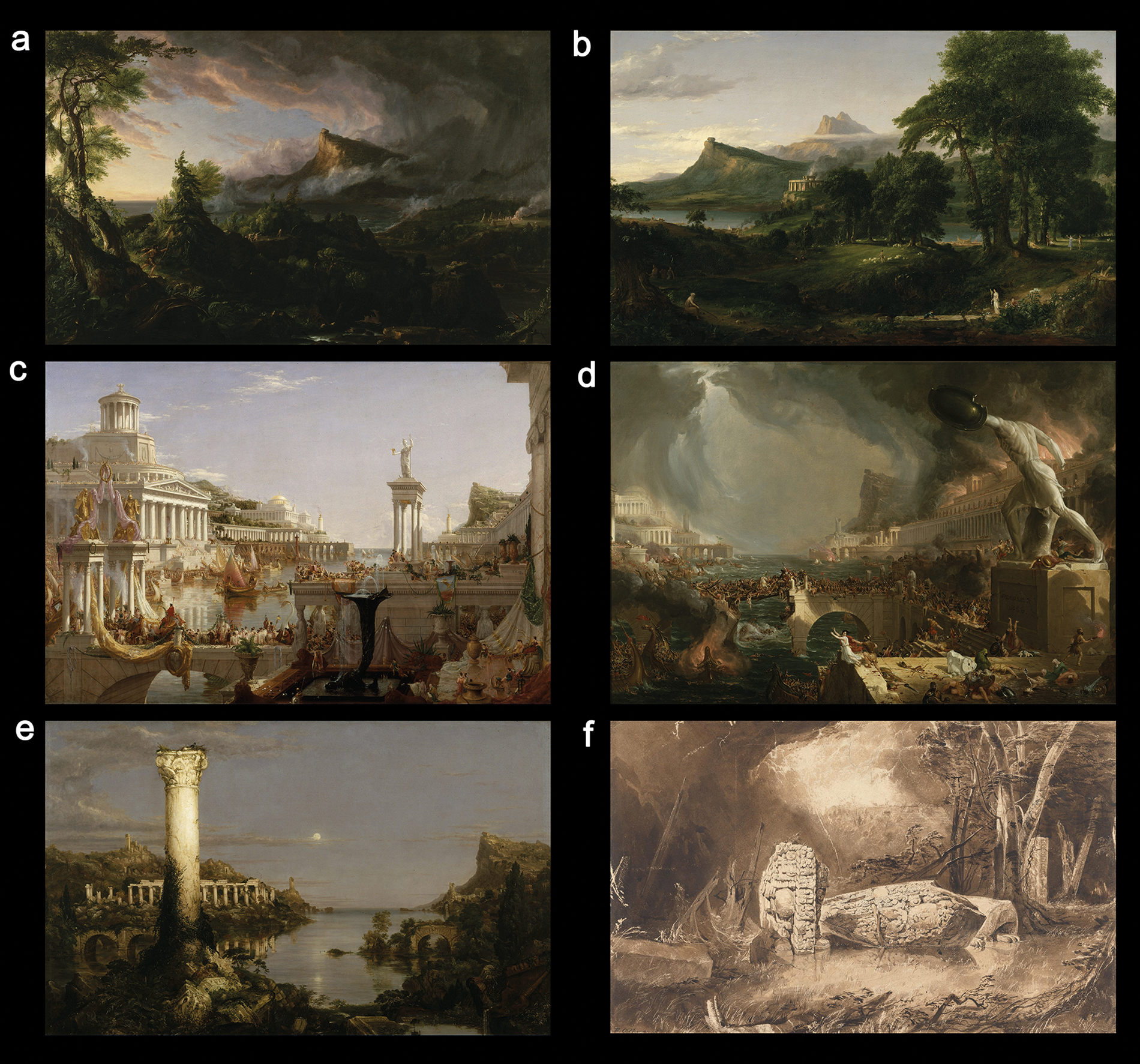
This teleology is also present in other unilinear cultural evolutionary models such as that of Lewis Henry Morgan (Reference Morgan1877), whose work influenced Marx (Shaw Reference Shaw1984) and whose own tripartite chronology of social evolution comprised stages of savagery, barbarism and civilization. Indeed, it could be argued that even more recent (neo-)evolutionary models such Sahlins and Service's (Reference Sahlins and Service1960) schema of bands, tribes, chiefdoms and states have an inbuilt determinism, with the crucial distinction of conceiving of change as multidirectional. That is to say, societies could devolve as well as evolve. Even if not characterized in such terms, this argument that societies may regress as well as progress was advanced by some nineteenth-century scholars (Lucas Reference Lucas2005, 11–12). It is this notion of multidirectionality in the specific while maintaining a unidirectional view of the course of history which is crucial to historiography surrounding the Precolumbian Maya ‘Classic’–‘Postclassic’ transition. Cabañas (Reference Cabañas2006) notes this leitmotif in nineteenth-century archaeology and links it to themes in Romantic art of the rise and fall of civilizations, of which he takes Thomas Cole's The Course of Empires to be emblematic. This series (Fig. 1) is instructive in illustrating the narrative inbuilt within the tripartite chronology. The first painting, The Savage State, can be taken as a Rousseauian state of noble savagery, in the Precolumbian Maya context representing pre-Preclassic phases such as the Lithic or Archaic. The second, The Arcadian or Pastoral State, can be taken to represent the Preclassic, with the emergence of agriculture and an increased ‘civilizational’ sophistication: a period of ascent. The third painting, The Consummation of Empire, represents the Classic in all its ‘glory’. The fourth, Destruction, represents the ‘Collapse’, with the implication of the political order of the k'uhul ajawob as societal lynchpin. Finally, Desolation can be seen to represent the Postclassic but also the mundo maya which Stephens and others pulled from obscurity into (middle-class) public consciousness. Indeed, Desolation is highly comparable with Catherwood's lithographic representation of crumbling ruins overgrown by encroaching nature.
Thomas Cole's historical series, The Course of Empire, compared to the work of Frederick Catherwood. a) The Savage State; b) The Arcadian or Pastoral State; c) The Consummation of Empire; d) Destruction; e) Desolation; f) Catherwood's Maya Stela at Copan, Honduras. (All figures are in the public domain and are used under Creative Commons licenses via WikiCommons.)
Herein lies the sublimation intrinsic in this facet of the tripartite chronology. In a demarcation between a ‘Classic’ and ‘Postclassic’, separated by a putative ‘Collapse’, evolutionist tropes of a stepwise, deterministic course of history are maintained. While the terms ‘Classic’ and ‘Postclassic’ may now be devoid of their original meaning in the eyes of contemporary scholars, and in spite of definitions of these periods having been renegotiated over time, there remains sublimated in the tripartite model an implication that human societies evolve (or devolve) in a manner characterized by civilizational stages. Crucially, the maintained use of the term ‘Classic’ still conjures an impression of a civilizational zenith, rendering the ‘Postclassic’, if not a period of decline and decadence, at least ‘something other than Classic’ which necessarily implies ‘something less than Classic’. Within this, we also see a kind of conceptual path dependency. The constraints imposed by sublimated ideas such as ‘classical’ as a synonym for civilizational zenith, deterministic evolutionary stages, and tropes of ‘collapses’ within meta-narratives of the rise and fall of empires have all acted to keep the tripartite chronology essentially on track: maintaining the essence of the narrative underwriting this periodization, in spite of unrecognizable changes in form.
Moreover, intrinsic within nineteenth-century evolutionist models of cultural evolution was a subtext of Anglo-European superiority. Specifically, it went without saying to scholars at this time that the ‘Western’ world represented a civilizational ‘consummation’. It was by virtue of this lofty perch that the ‘Western’ scholar was able to see the world dispassionately and objectively for what it was and thus formulate such models. Conversely, while this evolutionary model afforded ‘Western’ civilization mastery of nature, technology and science, this perspective deprived that same agency to those perceived not to have attained the same developmental level. How could the ‘savage’ or the ‘barbarian’ (even if they are only thus as a consequence of a quasi-biblical ‘fall’ from civilization into a state of Colean ‘desolation’) be considered equivalent to the ‘civilized’? It is the consequences of this implication on which attention will now be focused.
Nationalism, colonialism and imperialism
The symbiotic relationship between archaeology and the state is well documented (e.g. Fowler Reference Fowler1987; Kohl & Fawcett Reference Kohl and Fawcett1995; Trigger Reference Trigger2008), with the link between archaeology/ists and a range of nationalist, colonial and imperialist projects afforded particular attention (Díaz-Andreu Reference Díaz-Andreu2007; Díaz-Andreu & Champion Reference Díaz-Andreu and Champion1996; Kohl & Fawcett Reference Kohl and Fawcett1995; Trigger Reference Trigger1984). Such research has also stimulated scholarship on decolonization and fostering a more equitable relationship with historically marginalized indigenous communities (Atalay Reference Atalay2006; Reference Atalay2012; Colwell Reference Colwell2016; Smith Reference Smith2012), a theme with which Precolumbian Maya scholars are familiar (e.g. McAnany Reference McAnany2016; Reference McAnany2020). Given recent progress, it is surprising that the chronological framework within which we operate is, in essence, little changed from a century ago. In light of the realization that time is, essentially, a social construct (Bender & Wellbery Reference Bender and Wellbery1991; Gosden Reference Gosden1994; Lucas Reference Lucas2005) and thus our chronologies and periodizations are both arbitrary and subjective, it seems prudent to evaluate those subjectivities critically in the interests of reflexivity.
Again, here, Stephens is instructive. As outlined, a crucial aspect of Romanticism was the creation of nation-states out of the ashes of absolute monarchies (Zamoyski Reference Zamoyski1999), with Anderson (Reference Anderson1991) arguing for the importance of creating new ‘imagined’ communities to forge bonds between the ‘citizens’ of these novel nation-states. In the case of ‘Western’ nations, this nationalism was often suffused with colonialism and imperialism; indeed, Castro-Gómez (Reference Castro-Gómez, Dube and Banerjee-Dube2019, 217) has noted that ‘the rise of nation-states in Europe and the Americas from the seventeenth to the nineteenth centuries was not an autonomous process, but rather one with a structural counterpart: the consolidation of European colonialism abroad’. This tendency can be seen in Stephens's work in the conviction that the peoples and nascent nation-states of Central America existed within US hegemony. It is in this context that Stephens's remarks on both contemporary indigenous peoples of Yucatan and the region's history should be understood. As Cabañas (Reference Cabañas2006, 22–3) has noted, there is an element within Stephens's writing wherein the glorification of regional past societies has the tacit implication of the cultural and civilizational degradation of contemporary inhabitants.
In attempting to justifying colonialism there are, it seems, two approaches which can be taken. The first is to consider the land which you seek to control terra nullius; uninhabited land can be claimed unproblematically. However, the presence of the ruins which Stephens and others ‘discovered’ rendered this implausible. Thus, a more viable approach was to attempt to undermine the claims of contemporary indigenous peoples to this past. The attempted cleavage of peoples from their cultural heritage in the interests of realpolitik is, of course, far from unique to the mundo maya, with prominent examples including Fallmerayer's contention of discontinuity between contemporary Greeks and the ‘Classical’ past (Gourgouris Reference Gourgouris1996) from which western Europe claimed (intellectual, if not genealogical) descent, or myths of the ‘white’ origins of Great Zimbabwe (Garlake Reference Garlake1982). This tendency is seen in Stephens unambiguously stating that ‘a people possessing the power, art, and skill to erect such cities, never could have fallen so low as the miserable Indians who now linger about the ruins’ (Stephens Reference Stephens[1841] 2008, 309). In denying the contiguity of indigenous culture in the region, Stephens attempts to undermine indigenous land claims, a ‘telling colonialist move… [rendering] them foreigners in their own country’ (Cabañas Reference Cabañas2006, 23). However, while important, given the genealogical and cultural continuity of indigenous Maya culture is beyond doubt, it is not this justificatory mechanism which has been particularly sublimated within the tripartite chronology.
The second viable approach, which has proven more enduring through its historiographic sublimation, essentially involves a variation on Kipling's ‘white man's burden’: the ‘civilizing’ mission of the West. It is this strand which appears most implicit in the notion of a Maya ‘Postclassic’. If the indigenous inhabitants of a region were living in a state of Colean ‘desolation’ and in a process of terminal decline, then the land which they occupy can be considered a kind of terra nullius. This line of thinking was expressed most clearly by William Blackstone (Reference Blackstone1765, 104) in his formulation that it was the extent to which land was cultivated, and nature mastered, by which ownership could be assessed. Moreover, as part of this ‘civilizing’ mission, the inhabitants of a region themselves can be considered subject to patriarchal control by the ‘civilizers’. Thus, a narrative wherein indigenous inhabitants are cast in the role of regression—as having once held dominion over the lands which are subject to the colonial desire during a ‘civilized’ stage (the ‘Classic’) but having ceded that authority through a civilizational fall (the ‘Postclassic’)—becomes an invaluable colonial weapon. Such a narrative of ‘civilizational’ decline makes it possible to dispossess indigenous peoples of their lands while, simultaneously, serving as an explanatory mechanism for the really existing colonialism which appears always to require justification in terms of natural laws: the inevitable rise and fall of empires. It is this motif which has also permeated popular conceptions of the Precolumbian Maya, whether through the simplistic reduction of the ‘collapse’ to an issue of environmental mismanagement (e.g. Jared Diamond's Reference Diamond2005 Collapse) or more salacious tellings such as Mel Gibson's Christian propagandistic pseudo-snuff film, Apocalypto (Reference Gibson2006).
It is this narrative sublimated within the tripartite chronology which is particularly pernicious. The possible meanings of a ‘Classic’ period have been discussed above; however, the notion of a ‘Postclassic’ as necessarily ‘less than Classic’ is inescapable. As such, we can again observe the sublimation of problematic tropes within current reconstituted archaeological conceptual frameworks. Few (if any) scholars today would dream of justifying the colonial or imperial oppression and marginalization of indigenous communities. However, implicitly, there remains the echo of precisely these projects in the chronological frameworks within which we narrate the Precolumbian past. Preservation of a meta-narrative of the Precolumbian Maya as essentially doomed to extinction, whether indirectly or allegedly shorn of foundational problematics (which is highly debatable in itself), represents a form of epistemological colonialism (Schneider & Hayes Reference Schneider and Hayes2020)—if not epistemological violence (Kearney Reference Kearney2021; Rizvi Reference Rizvi2019; Spivak Reference Spivak, Nelson and Grossberg1988a,Reference Spivak, Guha and Spivakb; Teo Reference Teo2010)—perpetuated in the continued use of such frameworks. Moreover, it also speaks to a certain path dependency in interpretations, where novel data—such as phenomena typically associated with the ‘Classic period’ appearing in either the ‘Preclassic’ or ‘Postclassic’—are considered exceptional or anomalous in the interests of maintaining the broader meta-narrative implicit within the tripartite chronology.
The Maya ‘Enlightenment’?
Returning to the theme of the tripartite chronology representing a form of epistemological violence, Teo (Reference Teo2010, 296) has suggested that ‘interpretations … are a form of action, and if concrete interpretations have negative consequences for groups—even though alternative, equally plausible interpretations of the data are available—then a form of violence is committed’. Building on Politopoulos and colleagues’ (Reference Politopoulos, Mol and Lammes2023) proposal of the benefits of a more ‘playful’ archaeology, Rizvi's (Reference Rizvi2019) exploration of the role of the speculative in archaeology, and recent discussion of the role of ‘counternarratives’ in archaeological interpretation (Black Trowel Collective et al. Reference Collective, Berihuete-Azorín and Blackmore2023), in the following section I will explore an alternative historiographic framing of the transition between the ‘Classic’ and ‘Postclassic’ periods in the tripartite chronology. As has been discussed elsewhere (e.g. Aimers Reference Aimers2007), the Maya ‘Collapse’ was primarily a political phenomenon characterized by the downfall of the k'uhul ajawob. However, owing to the sublimation of meta-narratives concerning the rise and fall of empires within the tripartite chronology, interpretations—particularly popular but also scholarly—of this period frequently take on an apocalyptic hue. It is intriguing to compare these events with those which Europe and North America underwent in the eighteenth to nineteenth centuries, given the vastly divergent historiography of the two: while the Maya ‘Collapse’ has traditionally been considered a time of decline, descent or civilizational ‘death’, comparable phenomena in Europe and North America are cast as the ‘birth of the modern world’. To be clear, this comparison is not intended to show that the two historical phenomena are identical; rather, through comparison of certain commonalities between the two, the untenability of diametrically opposing historiographical narratives is illuminated.
The political sphere
If there is one fundamental change emblematic of the broader transformations across Precolumbian Maya society between the ‘Classic’ and ‘Postclassic’, it would surely be the dissolution of the institution of divine kingship and the toppling of the k'uhul ajawob across the Maya lowlands (Sharer & Traxler Reference Sharer and Traxler2006. 499–500). The implication in orthodox historiography of this ‘Collapse’ is fundamentally that this dissolution was the proximate cause of the civilizational ‘decline’ which followed. Such an interpretation is to some extent understandable considering, for obvious reasons, this has tended to be measured in terms of surviving material culture: a reduction in monumental construction, particularly of elite monuments such as inscribed stelae; the cessation of the Long Count calendar; a massive decrease in hieroglyphic inscriptions; depopulation of certain previously eminent sites; and the disappearance of other aspects of elite material culture, notably polychrome ceramics.
The toppling of k'uhul ajawob across the Maya region at the end of the ‘Classic’ is—in implication, at least—thus intimately associated with the end of the halcyon days of Precolumbian Maya ‘civilization’. However, this reveals a fundamental historiographical incongruity in retellings of comparable phenomena between the ‘Classic’ to ‘Postclassic’ transition and mid eighteenth- to nineteenth-century Europe and North America. In both instances, political power was held by individuals and their attendant courts—the k'uhul ajawob in the Maya region and absolute monarchs in Europe and their colonies. Both sets of rulers fundamentally legitimized themselves through claims of privileged communicative links with the supernatural—in the case of the k'uhul ajawob, an ability to curry supernatural favour through ritual offerings such as auto-sacrifice (Houston & Inomata Reference Houston and Inomata2009), while European monarchs’ claims to legitimacy was through their rule being ordained by the Christian god (Weber Reference Weber1995). The demise of both of these institutions involved, to put it in terms of European political philosophy, a breach of the social contract: the inability of the k'uhul ajawob to respond adequately to periods of drought, soil erosion and environmental degradation (Houston & Inomata Reference Houston and Inomata2009, 292–5), with a similar proximate cause seen in the lead-up to the French Revolution (Tilly Reference Tilly1983) albeit among other factors. Thereafter, the period which followed in both cases can be characterized by a decentralization of political authority: republicanism in Europe and North America; ruling councils in the mundo maya.
Beyond these parallels, I would argue that orthodox characterizations of the Precolumbian Maya ‘Postclassic’ can also be applied to peri-revolutionary Europe and North America. The ‘Postclassic’ is often considered a time of increased mercantilism and militarism (Sabloff Reference Sabloff2007), which seems a perfect characterization of institutions such as the British East India Company (Robins Reference Robins2012) in the European context. Moreover, viewed through Hobsbawm's (Reference Hobsbawm1962; Reference Hobsbawm1975; Reference Hobsbawm1987) ‘long nineteenth century’, the post-revolutionary ages of ‘capital’ (increased mercantilism) and ‘empire’ (increased militarism) equally fit this description. Indeed, both the Precolumbian Maya ‘Classic’–‘Postclassic’ transition and the post-Enlightenment ‘Western’ trajectory can be summarized singularly.
Rulers whose legitimacy was derived from their privileged communicative abilities with the supernatural were deposed as a consequence of breaching the social contract upon which their legitimacy depended. Their toppling led to political decentralization with a social/class-based renegotiation of power leading to the marginalization, if not disappearance, of traditional elites and the rise of new elites whose power was largely derived from the economic, and perhaps military, sphere(s). In Precolumbian Maya historiography, these new elites are often characterized as the ‘Putun’ (Sharer & Traxler Reference Sharer and Traxler2006, 528), whereas in Europe the toppling of absolute monarchs and their replacement with republican systems of government are considered a bourgeois revolution (Bell Reference Bell2008). In both cases, new elites acquired status in new—arguably more dynamic—ways than those they replaced; essentially, through the acquisition of wealth. Their rise to power also heralded wholescale shifts across society which, alongside surely profound ideological changes (whether religious, political, or otherwise), were characterized by more (archaeologically) tangible changes, particularly with respect to time-reckoning systems and material cultural trends.
Time-reckoning systems
Alongside the demise of the k'uhul ajawob, another hallmark of the ‘Collapse’ in traditional historiography is the disappearance of the Long Count calendrical system. The most voluminous dataset of Long Count use is monumental stelae and other stone-inscribed media (Sharer & Traxler Reference Sharer and Traxler2006, 500). As such, a large part of the evidential basis for use and disuse can be explained politically: given stelae can be considered a form of public propaganda, an inevitable correlate of the downfall of this political model would be the cessation of such reinforcements of legitimacy. This political dimension to calendrical changes has been framed as one of shifting priorities in the use of time, from ‘register[ing] dynastic accomplishments by specific days in linear time’ among ‘Classic’ period k'uhul ajawob to ‘general cycles’ in the form of the ‘Postclassic’ preference for Short Count recording (Rice Reference Rice2008, 288). Here, again, parallels with eighteenth-century Europe and North America can be seen, particularly in the shifts in time-reckoning practices seen with the installation of the First Republic after the French Revolution (Perovic Reference Perovic2012; Shaw Reference Shaw2011)—or, later, the Soviet calendar in use between 1918 and 1940 (Parise Reference Parise and Parise2002, 377; Schwarz Reference Schwarz1931)—evidencing a link between modifications in time-reckoning systems and radical political upheavals.
During the ‘Classic’ period, full knowledge of calendrics may have been restricted by rulers and their specialist priest-astronomers as a manifestation of rulers’ privileged communicative abilities with the supernatural (Sharer & Traxler Reference Sharer and Traxler2006, 102–20). Post-French Revolutionary modifications to time-reckoning systems, aside from representing attempts at rationalization, were also geared towards dechristianisation and a disempowerment of equivalent ritual specialists (the Catholic clergy) with a view to sweeping away the ‘superstition’ which characterised the ancien régime to be replaced with an enhanced focus on nature. As such, the French republican calendar may be viewed as an extension of the political decentralization seen in other spheres of society. When placed on an equal historiographic footing, modification of calendric recording in the ‘Postclassic’ from Long Count to Short Count could conceivably be viewed through the same lens: combining a political disempowerment of previous elites with greater decentralization through rationalization in more arcane linear recordings which existed to legitimize dynastic rule (superstition) being replaced with the more cyclical Short Count of k'atuns more closely linked to natural phenomena (the solar year, with implications for agriculture).
Time is an inherently revolutionary concept (Horvat Reference Horvat2019; Marcos Reference Marcos2001; Zerubavel Reference Zerubavel1977) and, as such, that the decentralization of political authority should see a coeval reform of time-reckoning system makes sense. Instead of viewing the ‘Postclassic’ as characterized (at least in part) by the absence of Long Count recordings, it may instead be perceived as representing a similar trajectory to that embedded within the historiography of post-revolutionary Europe.
Material culture shifts
One key shift in material culture taken as a marker of the ‘Classic’–‘Postclassic’ transition in orthodox Precolumbian Maya chronology relates to polychrome ceramics. Manufacture and elite trade and exchange of such vessels is seen as a hallmark of the ‘Classic’ (Houston & Inomata Reference Houston and Inomata2009), while, as with the Long Count, the ‘Postclassic’ has generally been characterized by their absence and replacement with more utilitarian and functional wares (Sharer & Traxler Reference Sharer and Traxler2006, 590). This owes much to an implicit perception that complexity of manufacture represents a direct proxy for civilizational sophistication. As such, an exquisite polychrome, decorated with mythological scenes and glyphic inscriptions, represents a civilizational high point compared to the monochromatic gouged and incised vessels, devoid of text, which replaced them. To be clear, exceptions—such as ‘Postclassic’ Plumbate or Thin Orange wares—do exist; however, on the whole, polychrome ceramics have often historically been regarded as a consummation of artistic achievement in Precolumbian times.
This, however, represents an entirely subjective value judgement more reflective of scholarly perceptions than necessarily of the people who made, possessed and used these vessels. Crucially, this narrative also stands in contrast to those concerning material cultural shifts in Europe and North America (Lucas Reference Lucas2005). Eighteenth-century Europe also saw a stark shift in material culture in a manner described as ‘the birth of a consumer society’ (McKendrick et al. Reference McKendrick, Brewer and Plumb1982). Whereas, in previous centuries, the ‘family silver’ was seen as a pinnacle of individual or familial status, the late eighteenth century saw a shift from silver—and pewter (Martin Reference Martin1989)—to ceramics as the most prestigious material from which tablewares could be constructed, in spite of ceramics being cheaper both to produce and acquire. However, this lesser financial value (and, debatably, sophistication of manufacture) was not considered reflective of other kinds of (social) value. This shift in perceptions of value has been linked to the coeval rise of a middle class. Or, in other terms, a coeval shift in the locus of political authority from traditional elites to new elites whose power was more associated with the economic realm. However, in the European/North American context, our narrative of this change is entirely different. Rather than being framed as representing an ‘absence’ of certain classes of material culture compared to earlier periods, the shifting fashion from silver tablewares to ceramics is viewed as a facet of modernity; of progress rather than loss.
Discussion
Chronology construction is a necessarily arbitrary process involving subjective value judgements. However, with the passage of time, these chronologies can become naturalized in the minds of scholars. To avoid naively assuming that these arbitrary demarcations are natural and thereby constricting archaeological interpretations by constraining scholars to narrow interpretive frameworks rather than appreciating their socially constructed nature, an awareness of Collingwood's ‘second order histories’ is imperative. Instead, chronologies and periodizations must be understood as products of multiple pasts beyond that which they purport to categorise. Of arguably equal importance is an appreciation of the intellectual milieux from which these frameworks arose to grasp the subtextual assumptions and value judgements implicit within them. As has been demonstrated, this is certainly the case for the Precolumbian Maya tripartite chronology. However, in spite of the profusion of scholarship on conceptions of time in archaeology in recent decades, there has been comparatively less critical reflection on the ways in which we construct chronologies and the impact this has on interpretations. By approaching the Precolumbian Maya tripartite chronology critically, the fundamental issue of what precisely is so ‘classic’ about the Classic Period has been addressed, with the ‘classicism’ of Precolumbian Maya historiography appearing as primarily one of subjective, aesthetic value judgements with origins in the mid eighteenth to nineteenth centuries that are in many ways incongruent with contemporary thought. This is most starkly illustrated in narratives of a ‘Classic’ period separated from a ‘Postclassic’ by a ‘Collapse’, with such a teleological understanding of history rooted firmly in Enlightenment, Romantic and early Modernist thought. Within this meta-narrative lies a deterministic story about the rise and fall of empires which, while en vogue two centuries ago, is off-kilter with contemporary perspectives. This is a point conceded in suggestions that the terms (if not the periods themselves) ‘Classic’ and ‘Postclassic’ remain more according to tradition and habit than explanatory potential. However, it is unclear whether terms as loaded as ‘Classic’ and, in particular, ‘Postclassic’ can ever truly be expunged of their problematic implications.
To be clear, there is a qualitative semantic difference in the continued use of a Preclassic–Classic–Postclassic chronology versus, for example, the Three Age System. Granted, such a periodization is imbued with a sense of unilinearity in technological progress. However, the Three Age System can at least claim to be based on clear material cultural correlates related to technological innovation, rendering it somewhat more neutral than predication on aesthetic value judgements. As has been discussed, the tropes which scholars perpetuate in the continued use of the tripartite chronology are ones which few today would extol: anti-democratic rule as synonymous with ‘civilizational’ zenith, unilinear cultural evolution and historical determinism, and implicit attempted justifications of nationalism, colonialism and imperialism.
The antiquated and deterministic perspective of the Maya as a ‘fallen civilization’—the implicit meta-narrative which remains sublimated within the tripartite chronology—is one which has impacted, and continues to impact, relations between indigenous inhabitants of the region and settler colonial compatriots. To those who suffered it, colonialism ‘did not primarily represent destruction and plunder but, above all, the start of the tortuous, inevitable road to development and modernization’ (Castro-Gómez Reference Castro-Gómez, Dube and Banerjee-Dube2019, 218). Within the process of modernization, the invention of citizens within post-colonial nations formed atop the mundo maya also required the invention of an ‘other’ in juxtaposition. Although colonial (e.g. Spanish) powers formed part of this contradistinction, so too did ‘uncivilized’ indigenous peoples (Castro-Gómez Reference Castro-Gómez, Dube and Banerjee-Dube2019). While various processes such as indigenismo and mestizaje policies (e.g. in Mexico) attempted to incorporate, via assimilation or cultural appropriation, indigenous culture if not peoples into national mythoses, the fundamental ‘othering’ of Maya peoples persisted, supported, in no small part, by a historiographical perspective on Precolumbian culture as, if not essentially incompatible with modernity, then, at least, less than or at odds with modernity (Saldaña-Portillo Reference Saldaña-Portillo, Dube and Banerjee-Dube2019). More recently, Wainwright (Reference Wainwright2008) has argued that contemporary ‘capitalism qua development’ policies owe much to a process of ‘Mayanism’ (see also ‘Mayanness’, sensu Armstrong-Fumero & Fallaw Reference Armstrong-Fumero and Fallaw2023) supported by this kind of meta-narrative. It is precisely these real-world consequences which render the subtexts sublimated within the tripartite chronology a form of ‘epistemological violence’.
While the transition away from k'uhul ajawob rule in the mundo maya undeniably represents a significant historiographic rupture, the narrative decision to categorise this as a ‘Collapse’ is troubling. This is illustrated most clearly through the playful comparison between this period and the very period in ‘Western’ history which lies at the root of such discourse. In one case, the disintegration of k'uhul ajaw regimes is considered a ‘Collapse’, while in the other the comparable move away from absolute monarchies is regarded as the ‘birth of the modern world’. More generally, while the transition from ‘Classic’ to ‘Postclassic’ is broadly characterized by what the latter lacked or had lost compared to the former, the former has been framed as more progressive. Such an incongruity in ‘civilizational’ narratives lays bare their Eurocentricity (or Occident-centrism). Moreover, the origins of this perspective are firmly rooted in nationalistic, colonial and imperialistic projects of ‘Western’ nation-states. While discussion has focused on the United States through John Lloyd Stevens, similar perspectives could surely be derived from early scholars elsewhere.
The argument that the tripartite chronology has been stripped of meaning and now exists simply as epistemically neutral nomenclature too firmly engrained in the literature to change does not hold. In terms of longevity, while recognition of the eighth to tenth centuries ad representing a period of radical change in the mundo maya is long-lived, the specific terminology of a ‘Preclassic’, ‘Classic’ and ‘Postclassic’ is comparatively novel. Crucial to appreciating the socially constructed nature of time is accepting the inherent negotiability of periodizations. This has been seen in changing discourse surrounding what was once known as the European ‘Dark Ages’; however, an equally valid comparator can be seen in the historiographic shift to the present tripartite chronology from ‘Old’ and ‘New’ ‘Empires’. The claim that current terminology is epistemically neutral and devoid of meaning is tenuous. At best, it may be argued that scholars appreciate the ‘Postclassic’ on its own terms and not simply as an impoverished version of the ‘Classic’. However, it cannot be expected of non-experts to appreciate the nuances and histories of such terms. Rather, most will reasonably interpret them precisely in their more pejorative sense. If particularly important objectives of contemporary archaeology should be active, outward-looking engagement, increased decolonization and disentanglement from problematic origins (as I would argue they should), then this kind of nomenclature, rooted in colonialism, imperialism and outdated deterministic and unilinear perspectives on cultural change, must be reconsidered, particularly as, even if the specific nomenclature of periodizations may not fully permeate collective non-specialist consciousness, the sublimated meta-narratives within these certainly do, as evidenced by ongoing popular conceptions of the Maya as a ‘fallen civilization’.
However, problematic elements of the tripartite chronology are not simply semantics. While nomenclature is certainly an aspect which should be debated, what is at stake is more an issue of the reflexive attitudes scholars take to their own work and that of their predecessors. All scholarship builds upon that which came before; however, that is not to say that the past is in any way settled. This is generally accepted in terms of the past as studied; however, it is equally important to appreciate the multiple pasts which contribute to understandings, interpretations, theories and other frameworks upon which we construct historical narratives. This is less an issue of presentism (Lucas & Olivier Reference Lucas and Olivier2022; Tamm & Olivier Reference Tamm and Olivier2019) than of appreciating the open, negotiable and contestable nature of past research and perspectives as much as the ‘subject past’ which is generally the focus of revisionism. Sublimation provides a useful tool with which to approach the intersection of multiple pasts in interpretive frameworks. Through an appreciation of the way in which problematic or disproven mentalities which may underpin established frameworks can become sublimated as attempts are undertaken to revise, refine, reconfigure and redeem them across generations of scholarship, the necessity of consistently reassessing such perspectives forms a cornerstone of reflexivity. Sublimation can be pernicious, as evidenced through the example of the tripartite chronology which may superficially appear to be a semantic issue but, with critical reflection, is revealed to be more epistemic in nature: something which surely also applies to many other aspects of archaeological theory, method and interpretation.
While this paper has focused on the Precolumbian Maya tripartite chronology, the themes discussed are more general. Critical reflections on the way archaeologists utilize chronologies have great potential for both stimulating new and innovative perspectives and providing an opportunity to consider reflexively the longue durée trajectory of the discipline with a view to identifying problematic tropes which have become sublimated in contemporary discourse. One particularly relevant element here is that of tripartite chronologies in general. Lucas (Reference Lucas2005, 52) notes that ‘three seems to be the golden number in narrative time’, drawing upon an observation by Collingwood (Reference Collingwood1927, 324) that ‘a “period” of history is an arbitrary fabrication, a mere part torn from its context, given a fictitious unity, and set in fictitious isolation, yet by being so treated, it acquires a beginning, and a middle and an end’. This notion of every good story requiring a beginning, middle and end begs reflection on what precisely the overarching stories we are telling actually say. As seen above, the initial implication in the Three Age narrative was one of progress befitting the contemporary nineteenth-century European perspectives within which it was constructed. However, the same cannot be said for the tripartite chronology, where instead we see a narrative which closer resembles a bell curve: a ‘Preclassic’ period of ‘becoming’, a ‘Classic’ as civilizational zenith, and, finally, a ‘Postclassic’ fall. This is a very different kind of grand narrative and, indeed, one diametrically opposed to contemporary ‘well’ curve narratives concerning the European trajectory: Classical Antiquity–Dark Ages–Renaissance/Enlightenment/Modernism.
Towards better appreciating the value of narrative in research, recent scholarship has addressed the role of ‘story-telling’ in archaeology (Flexner Reference Flexner2020; Moshenska Reference Moshenska2021; Zorzin Reference Zorzin2021; see also White Reference White1980). Equally, archaeologists have utilized historiographical theory, with the Annales school proving particularly influential since the 1990s in promoting an appreciation of the utility of different timescales in understanding the past (e.g. Bintliff Reference Bintliff1991; Reference Bintliff and Bintliff2006; Gosden & Malafouris Reference Gosden and Malafouris2015; Knapp Reference Knapp1992; Lucas Reference Lucas2005). However, comparatively less space has been devoted to the intersection of these themes and the ways in which our periodizations are not epistemically neutral but a crucial underpinning of narrative construction. Here, the potential for conceptual path dependency to arise from the constraints placed on interpretation by chronologies understood to be static and unchangeable is crucial. If the shape of the past, in terms of its chronological structure, is immutable, then the scope of possibility in narrating and understanding that past is inevitably limited. Conversely, approaching the history of chronological frameworks reflexively, aware of the potential for sublimation to occur as ideas, concepts and methods evolve, this shape becomes inherently negotiable and malleable, broadening the scope of interpretive possibilities.
In accepting the inherent negotiability of narratives of the past, concepts such as ‘counternarratives’ (Black Trowel Collective et al. Reference Collective, Berihuete-Azorín and Blackmore2023) and ‘prefiguration’ (Borck Reference Borck2018; Morgan Reference Morgan2021) may prove helpful guiding principles and offer scholars an avenue for increased agency in the kind of narratives we are putting into the world through our work. The playful historiographic experimentation presented here of a Maya ‘Enlightenment’ attempts to do precisely these things: present a viable counternarrative which accords to the available data aimed at decentring (Atalay Reference Atalay2006, 295) this problematic dominant historiographic perspective sublimated within the tripartite chronology, with an eye towards the ‘future histories’ these generate.
Conclusion
Reflexive perspectives on periodizations remain an under-appreciated aspect of archaeological theorizing. Here, I have drawn attention to the inherent subjectivity and political nature of chronology construction through the Precolumbian Maya tripartite chronology by surveying its origins and contextualizing it within the prevailing intellectual milieux from which it arose, revealing a series of assumptions incongruent with contemporary interpretations. This was highlighted with a comparison between historiographic approaches to the ‘Classic’–‘Postclassic’ transition and the period in ‘Western’ history (the century surrounding the French Revolution) to which the tripartite chronology owes an intellectual debt. In exploring these parallel historiographies, it became apparent that interpreting this period of Precolumbian Maya history as an ‘Enlightenment’ similar to that in ‘Western’ history is a viable counternarrative to traditional perspectives. This is not necessarily to say that such a narrative is required in Maya historiography—nor that such a comparison is 100 per cent accurate—so much as to demonstrate the narrative element embedded within archaeological chronologies: comparable periods are variously considered ‘the death of a civilization’ and ‘the birth of the modern world’, depending on periodizational framing, with little to substantiate such diametric opposition.
Others have noted that periodizations, including the tripartite chronology (Estrada-Belli Reference Estrada-Belli2011, 1), are arbitrary. However, that does not mean such periodizations are either meaningless or irrelevant. Instead, the intrinsic arbitrariness of our chronologies requires close critical reflection on the rationales which underpin their construction to ensure these are in accord with contemporary thought. To this end, I introduced the notion of ‘sublimation’ as an explanatory mechanism for the way in which original bases for concepts can become obscured as they are transformed over their histories. In this context, considering the sublimation inherent in the tripartite chronology revealed implicit assumptions of unilinear evolution, historical determinism and aspects of nationalist, colonial and imperialist ideologies which lie at the roots of terminology such as ‘Classic’, ‘Collapse’ and ‘Postclassic’; however, the concept has broader potential in assessing the multiple pasts which contribute to theoretical precepts and methods.
Specific to the case study of the Precolumbian Maya tripartite chronology, this investigation raises questions about its continued use given the problematic underpinnings revealed, alongside existing debates concerning accuracy. Whether efforts should be directed towards reperiodizing Precolumbian Maya history de novo, doing away with an overarching chronology of Precolumbian Maya history entirely, constructing more thematic chronologies depending on research questions or simply relabelling existing periodizations, are open to debate. More generally, however, the inherent political dimension in archaeological chronology construction suggests that this is an area which would benefit from more thorough critical reflection to ensure that the periodizations we use are fit for purpose in a modern, reflexive archaeological practice.
Acknowledgements
Many thanks to Elizabeth Graham, Chloë Ward and Eponine Wong for their helpful comments in discussions relating to this article, as well as the editors of CAJ and two anonymous reviewers for their constructive feedback. Any errors or omissions are my own.


 Open access

