


1. Introduction
Multi-material structures offer significant potential in multifunctional engineering applications. By combining materials with distinct physical properties, such as the mechanical strength of stainless steel and the thermal conductivity of copper alloy, a trade-off could be realised for competing objectives in heat exchanger design (Reference Xiaoshuang and SeibelXiaoshuang Li & Arthur Seibel, 2023). Recent advancement in multi-material additive manufacturing (MMAM) (Reference Nazir, Gokcekaya, Md Masum Billah, Ertugrul, Jiang, Sun and HussainNazir et al., 2023) enables the fabrication of such components, leveraging both geometric complexity and multi-material capability afforded by MMAM.
The design optimisation of multi-material structures necessitates advanced computational methods to achieve high-performance solutions, with the key challenge being the increased computational burden from the extensive design space (Reference Yu, Griffis, Manogharan and PanesarYu et al., 2025). In contrast to mono-scale designs, lattice structures offer additional design flexibility through control over unit cell topology, size, or shape. While extensive research has explored the effect of unit cell types (Reference Pan, Han and LuPan et al., 2020) (e.g. strut-based, surface-based, plate-based) and applied volume fraction (VF) grading (Reference Panesar, Abdi, Hickman and AshcroftPanesar et al., 2018), comparatively less attention has been given to shape and material modulation within a unit cell.
The inverse problem (i.e. property-to-design mapping) is particularly challenging because multiple designs can yield the same property (Reference Khatib, Ren, Malof and PadillaKhatib et al., 2021; Reference Lee, Chen, Wang, Chan and ChenLee et al., 2023), a phenomenon that becomes more pronounced as design freedom increases. Despite recent advancements in direct inverse design using neural networks that minimise design reconstruction loss (Reference Kollmann, Abueidda, Koric, Guleryuz and SobhKollmann et al., 2020), as well as tandem neural network architectures that additionally incorporate property loss (Reference Kumar, Tan, Zheng and KochmannKumar et al., 2020), these approaches remain largely deterministic, producing only a single design per target and overlooking the diversity of other valid inverse solutions. The promising generative models typically rely on high-dimensional design representation (e.g. pixel/voxel), suffer from potential model collapse, and offer limited insight regarding the diversity and feasibility of viable inverse solutions.
Mixture density networks (MDNs) (Reference BishopBishop, 1994), with their multi-modal nature and probabilistic output, have emerged as a promising alternative to tackle the one-to-many mapping challenge. In essence, an MDN combines a NN with a Gaussian mixture model, learning to predict the parameters of multiple probability distributions instead of a single deterministic output. MDNs were first attempted in the field of photonics to inverse design metasurface with desired optical transmission/reflection (Reference Luo, Li, Li, Peng, Geng, Xie, Li, Alù, Zhu and ZhuLuo et al., 2020; Reference Unni, Yao and ZhengUnni et al., 2020, Reference Unni, Yao, Han, Zhou and Zheng2021; Reference You, Du, Xu and ZhaoYou et al., 2024) or diffraction patterns (Reference Torfeh and HsuTorfeh & Hsu, 2025).
In this work, we propose a novel design parameterisation for strut-based unit cells, enabling simultaneous optimisation of strut curvature, relative density and material. A data-driven framework is then developed to efficiently explore the relationship between effective properties and design features. We propose an ML-based workflow that integrates a material classifier (MC), MDN-based inverse generators (IGs), and a property predictor (PP). Consequently, multiple valid design candidates can be produced for a given target properties with high accuracy, enabling further sampling based on performance or manufacturability criteria. To further bridge the gap in existing data-driven methods, probability measures derived from MDNs offer insights into solution reliability and diversity, as well as the feasibility of the target properties.
2. Methodology
2.1. Unit cell design
The workflow of unit cell design parameterisation and obtaining ground truth properties via homogenisation is illustrated in Figure 1. In this study, a curved body-centred cubic (BCC) unit cell is adopted as the base topology, where the curvature is defined by a cubic spline. Its geometry is determined by the spatial coordinates and tangents at two endpoints. To voxelise the unit cell given a VF target, the 3D design domain is discretised at a resolution of 100 voxels per side, with ‘0’ representing void and ‘1’ representing solid. Two materials, with properties representative of stainless steel (Stainless Steel 316L 1.4404, n.d.) and copper alloy (Datasheet CuCr1Zr, n.d.), are assigned to the unit cell as outlined in Table 1.
Steps in the dataset preparation: unit cells with curved struts defined by cubic splines are mirrored across orthogonal planes, voxelised, and assigned material properties; asymptotic homogenisation is then performed to compute the effective mechanical stiffness and thermal conductivity tensors, from which the independent entries are extracted as the property features

Figure 1 Long description
A diagram illustrating the process of preparing a dataset for multi-material structures, focusing on unit cell design and ground truth property computation. Panel A: The unit cell design parameterisation involves defining cubic splines with two curvature control parameters. The splines are then mirrored across orthogonal planes and voxelised at a resolution of 100, resulting in a structure with one voxel field and one material index. Panel B: Asymptotic homogenisation is performed to compute the effective mechanical stiffness tensor and thermal conductivity tensor. The mechanical stiffness tensor is a 6x6 matrix with eight independent entries, while the thermal conductivity tensor is a 3x3 matrix with three independent entries.
Constituent material properties used in the homogenisation simulations

The asymptotic homogenisation method (Reference Dong, Tang and ZhaoDong et al., 2019) is employed to evaluate the effective mechanical and thermal properties. The voxel design is converted into an Abaqus input file via Python scripting, mapping each solid voxel to a C3D8 element. Periodic boundary conditions are applied to opposite faces of the unit cell. Unit mechanical loads are applied in three axial and three shear directions to construct the homogenised stiffness tensor, which is orthotropic. A similar procedure is followed for thermal homogenisation. Independent entries were extracted from the tensors to construct the ground truth property feature.
To generate the dataset, the two curvature parameters are uniformly sampled in the range [0, 5] with a step size of 0.2. The VF is uniformly sampled in the range [0.1, 0.3] with a step size of 0.05. Combined with the two material indices, this yields 6760 unique unit cell designs. Before training ML models, normalisation is applied to continuous features (i.e. all except material index) to mitigate the effect of differing numerical scales.
2.2. ML-based inverse design workflow
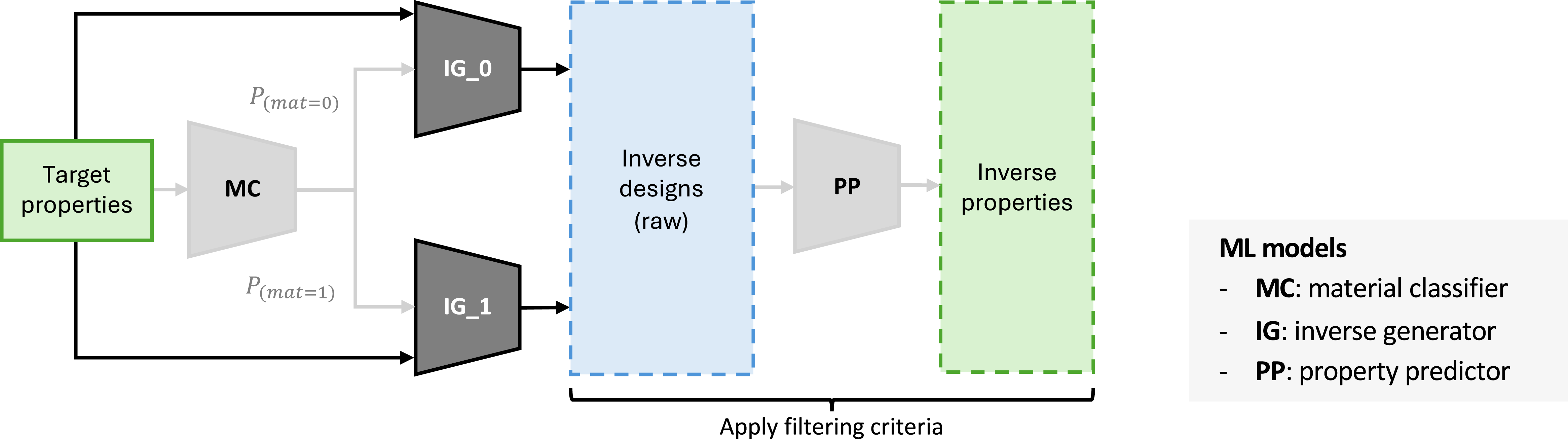
The overview of the ML-based inverse design workflow is presented in Figure 2, enabling one-to-many mapping from effective properties to unit cell designs. It consists of four major stages:
-
• Given target properties, use the material classifier (MC) to predict material probabilities
-
• Apply the corresponding inverse generator (IG) to output continuous design features
-
• Evaluate the raw inverse designs using the property predictor (PP)
Conduct positive definiteness check and apply filtering criteria – based on probability, property satisfaction, geometric reconstruction, or printability – to sample final designs
Overview of the ML-based inverse design workflow

2.2.1. Material classifier (MC)
An MC was trained to predict material from effective properties, namely the six and two independent entries of the
 and
and
 tensor, respectively. The model is a multilayer perceptron (MLP) consisting of three hidden layers, each with 128 neurons. Rectified Linear Unit (ReLU) activation was applied after the fully connected layers. The model was trained using the Adam optimiser to minimise the cross-entropy (CE) loss of material index prediction
2.2.2. Inverse generator (IG)
The IG employs a multi-modal MDNs architecture to realise one-to-many mapping from property to design. Instead of regressing the design features directly as in an MLP, the model outputs a mixture of Gaussian distributions, consisting of the mixture weights (
 ), means (
 ) and standard deviations (
 ). The mixture weights are normalised to sum to unity, ensuring a valid probability distribution. Due to MDN’s inability to handle discrete data, only continuous design features are modelled (i.e.
 ). Individual IGs are trained for each material to be run in parallel. The training objective is to minimise the negative log-likelihood (NLL) loss, effectively maximising the probability of the observed design under the predicted distribution.
2.2.3. Property predictor (PP)
The PP adopts a similar MLP architecture to the MC but performs the regression task instead. The model minimises the mean square error (MSE) between predicted and ground truth properties, shown in Eqn (1).

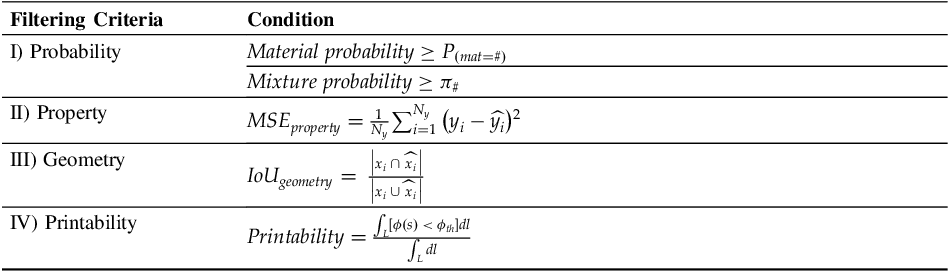
2.2.4. Filtering criteria
These criteria can be used individually or in combination for more stringent filtering.
Inverse design filtering criteria

3. Results & discussion
3.1. Property predictor (PP)
For the PP, both the training and validation MSE losses reach convergence after 100 epochs. Model performance was evaluated on the unseen testing set, with results shown in Figure 3, where the predicted properties are plotted against the ground truth values. Predictions closely follow the
 line, implying high prediction accuracy across both mechanical and thermal features. The average
 score is 0.9994, confirming that the model effectively captures the mapping from mixed-type design parameters to effective properties at different numeric scales. Moreover, the model demonstrates significant computational efficiency during inference, reducing the evaluation time from 5-10 minutes per design using numerical homogenisation (
 ) to less than one second.
Parity plot of the property predictor on the test set (average R2=0.9994)

3.2. Inverse generators (IGs)
3.2.1. Filtering from raw inverse designs
The performance of the IGs is first examined through a random example from the test set (Figure 4). The number of Gaussian mixtures is chosen as three (
 ) to capture multiple possible inverse designs for each material. All raw inverse candidates are visualised and evaluated, followed by the application of filtering criteria to sample final solutions. To start with, the MC accurately predicts copper as the constitutive material. Among the three Gaussian mixtures, the first two exhibit comparable mixture weights around 50%, indicating two likely design candidates. None of them exactly replicate the ground truth design, but both yield low property MSE loss when evaluated by the PP, confirming the reliability of the IGs. For the candidate with the best geometric reconstruction, the discrepancy arises because inverse generation is performed rather than direct dataset retrieval, so the numerical values of the design feature vector inevitably deviate. For the other candidate, the difference is a result of the unit cell parameterisation, where distinct geometrical configurations can lead to the same effective properties (to be elaborated in Section 3.2.2). It is also observed that the design with the best property match does not necessarily coincide with the best geometric reconstruction, highlighting the influence of filtering criteria in sampling final inverse solutions. In contrast, all steel-based outputs failed the positive definiteness check and deviated significantly from the target properties, reinforcing the accuracy of the material classification.
Applying filtering criteria to sample from raw inverse designs; (a) a representative example from the test set is listed with ground truth design and property features; (b) all the raw inverse designs generated, their probability statistics and performance evaluation

3.2.2. Probability-based filtering (one-to-many mapping)
To demonstrate the one-to-many inverse design capability of the proposed workflow, probability-based filtering is applied using thresholds of
 and
and
 , resulting in 1928 inverse designs across 1014 test samples. Note that the total number of inverse designs will vary depending on the threshold settings. Figure 5 illustrates examples where multiple or only one inverse design remains after filtering. In the former, one reconstructs the original geometry while the other flips the strut direction by swapping the curvature parameters – both satisfying the target properties. For cases with only one filtered design, a common observation is that the two tangents have similar magnitudes, making the flipped version geometrically similar and resulting in one dominant Gaussian mixture.
Inverse design results with probability-based filtering (
 and
and
 ); examples with (a) one-to-many mapping and (b) one-to-one mapping; it is observed that the number of dominant Gaussian mixture is influenced by the magnitude difference between two curvature parameters

Following the same probability-based filtering criteria, the inverse designs are now evaluated across the entire test set. Figure 6 compares the predicted design and property features with their ground truth values. Excellent property agreement is observed by the average
 score (
 ). In contrast, no clear trend is observed for the curvature control parameters, reaffirming that the inverse designs consistently satisfy the target properties but do not necessarily reconstruct the ground truth geometry. Please refer to (Reference Yu and PanesarYu & Panesar, 2025) for benchmark comparison against other ML-based inverse design methods in the same problem context, which do not have such one-to-many mapping capability.
Inverse design evaluation on the test set, by setting the probability-based filtering criteria (
 ); (a) reconstruction of continuous design features; (b) property of inverse designs compared to the target, evaluated by the PP

3.2.3. Best property/geometry reconstruction (one-to-one mapping)
Applying the filtering criteria based on the best property satisfaction (i.e.,
 ) yields a similar observation to the probability-based filtering. As shown in Figure 7, the design achieving the closest match to the target properties is not necessarily the original geometry, further highlighting the one-to-many nature of the inverse design problem.
Inverse design evaluation on the test set, by setting the filtering criteria as best property satisfaction (
 ); (a) reconstruction of continuous design features; (b) property of inverse designs compared to the target, evaluated by the PP

Figure 7 Long description
Panel A: Three scatter plots depict the relationship between ground truth and prediction values for different properties. The first scatter plot shows data for tz0 with an R-squared value of -0.0471. The second scatter plot shows data for tz1 with an R-squared value of -0.0387. The third scatter plot shows data for VF with an R-squared value of 0.9999. Each plot has ground truth on the x-axis and prediction on the y-axis. Panel B: Two scatter plots depict the relationship between ground truth and prediction values for mechanical properties (D) and thermal properties (κ). The scatter plot for mechanical properties has an R-squared value of 0.9995, with ground truth on the x-axis and prediction on the y-axis. The scatter plot for thermal properties has an R-squared value of 0.9999, with ground truth on the x-axis and prediction on the y-axis.
Adopting the best geometry criteria (i.e.,
 ) significantly improves the geometric reconstruction of the unit cell. The average
 score for the continuous design features increases to 0.9977, indicating that the ground truth geometry is successfully recovered and is indeed included among the raw inverse candidates.
4. Concluding remarks
This work introduces an ML-based inverse design framework for multi-material lattices with curved struts, targeting mechanical and thermal performance. Using cubic-spline parameterization and discrete material assignment, the design space is expanded beyond conventional straight-strut lattices. The workflow integrates a material classifier, inverse generators, and a property predictor, with post-hoc filtering for candidate refinement. Mixture Density Networks (MDNs) address the one-to-many mapping challenge, enabling probabilistic sampling and diverse solutions based on property, geometry, or manufacturability criteria. Unlike deterministic methods, the probabilistic formulation enhances reliability, diversity, and feasibility, while supporting multi-objective trade-offs and alternative material scenarios. This framework lays the foundation for multi-scale optimization of functionally graded metamaterials, with future work focusing on anisotropic unit cells, multi-material integration, and manufacturability under uncertainty.




 Open access

