


In England, assertive outreach teams have been widely established to reach patients who, in mainstream services, are ‘difficult to engage’ (Department of Health, 2000). Research has so far focused on how service configuration, for example a low staff–patient ratio, influences outcomes (Reference Burns, Creed and FahyBurns et al, 1999; Reference Priebe, Fakhoury and WhitePriebe et al, 2004); yet little is known about what staff should actually do to engage patients and what psychological processes might cause previously disengaged patients to engage with assertive outreach teams (Reference Lang, Davidson and BaileyLang et al, 1999). This study therefore explored with qualitative methods the reasons why patients first disengaged with mainstream services and later engaged with assertive outreach. Particular emphasis was put on the experience of patients from an African–Caribbean background, as this group has been shown to be most dissatisfied with services (Reference Parkman, Davies and LeeseParkman et al, 1997) and overrepresented in the case-loads of outreach teams (Sainsbury Centre for Mental Health, 1998; Reference Priebe, Fakhoury and WattsPriebe et al, 2003).
METHOD
Sampling
Patients were recruited from nine specialised assertive outreach teams across London (Reference Wright, Burns and JamesWright et al, 2003). Teams were selected to cover inner-city and suburban areas, and both statutory and voluntary services. Inclusion criteria for patients were:
-
(a) previous disengagement with secondary mental health services;
-
(b) later engagement with an assertive outreach team;
-
(c) a diagnosis of functional psychosis according to ICD–10 (World Health Organization, 1992);
-
(d) the ability to give informed consent;
-
(e) absence of a significant organic mental disorder;
-
(f) absence of a primary diagnosis of substance misuse and dependence;
-
(g) not requiring an interpreter.
Assertive outreach team workers provided patients who fulfilled these selection criteria with verbal and written information about the study and asked them to take part. Seventy-three participants who volunteered for the study formed the strategic sampling pool. From this sample pool, 44 participants were contacted and interviewed through liaison with their assertive outreach workers. Four patients were later excluded because it became clear in the interview that they did not fulfil the inclusion criteria. Purposive sampling was used to select patients for interviews. Emerging themes were tested by interviewing counterparts, e.g. patients of different gender, age and ethnic background. Once the type of patient for the next interview was identified, the interviewee was randomly chosen from the sub-sample of patients with the desired characteristics, and the keyworker was approached to initiate contact with the patient. Patients were recruited until saturation was reached.
Of the 40 patients whose interviews were analysed, 11 were women and 29 men. The mean age was 40 years. Thirty-two patients were single and 36 unemployed. The ethnic background was African–Caribbean for 18 patients (7 first-generation and 11 second-generation), White UK for 16 patients, African for 4 patients and ‘other’ for 3 patients. Thirty-three patients had been diagnosed as having schizophrenia or psychosis-related disorder and 7 as having psychotic symptoms as part of a mood disorder. Only 2 participants had no experience of hospital, and 24 reported experiences of sectioning.
Material
Patients were interviewed by a trained researcher who was not involved in treatment. The researcher explained the nature and purpose of the study and obtained informed consent. Twenty-five participants were interviewed in their own home and 15 in the base of their assertive outreach team. Participants were asked to recount their experiences of using mental health services from the time of their first contact. Special attention was paid to episodes of disengagement and engagement with services, the circumstances surrounding them, and patients’ explanations as to why and how they disengaged and engaged. Emerging themes were explored throughout the data gathering process. These themes were specifically addressed in further interviews, and re-analysed and further developed in an iterative process. The length of interviews ranged between 25 min and 75 min. All interviews were audiotaped and fully transcribed for analysis.
Analysis
We analysed the material using a method comprising components of both thematic analysis (Reference BoyatzisBoyatzis, 1998; Reference FlickFlick, 2002) and grounded theory (Reference Glaser and StraussGlaser & Strauss, 1967). The QSR*Nudist, 4 database software was used for managing and analysing data. Themes, categories and memos were coded into a database, which was used for continuous comparisons and referencing across interviews. The first 25% of interviews were coded line by line. Once assumptions about themes to be further explored were reached, longer passages were coded, unless there were statements of particular interest, when coding reverted to line by line. One important aspect of the analysis was to identify which themes out of the range reported by patients were actually linked to processes of disengagement and engagement. For example, a negative experience in a hospital might have been significant, but not necessarily have influenced the patient's decision to disengage or engage with services.
The interviewer carried out analyses of all interviews. Two researchers of second-generation African–Caribbean ethnic origin helped to analyse interviews with African–Caribbean patients. Two other researchers separately analysed the interviews to check the validity of the analysis – one of them re-analysed the first 20% of interviews in the initial phase of the study, and the second researcher reviewed all interviews at the end of the analysis. Findings and emerging themes were discussed – in both one-to-one and group meetings – by an interdisciplinary team comprising researchers with psychiatric, psychological and nursing backgrounds and both with and without clinical experience.
RESULTS
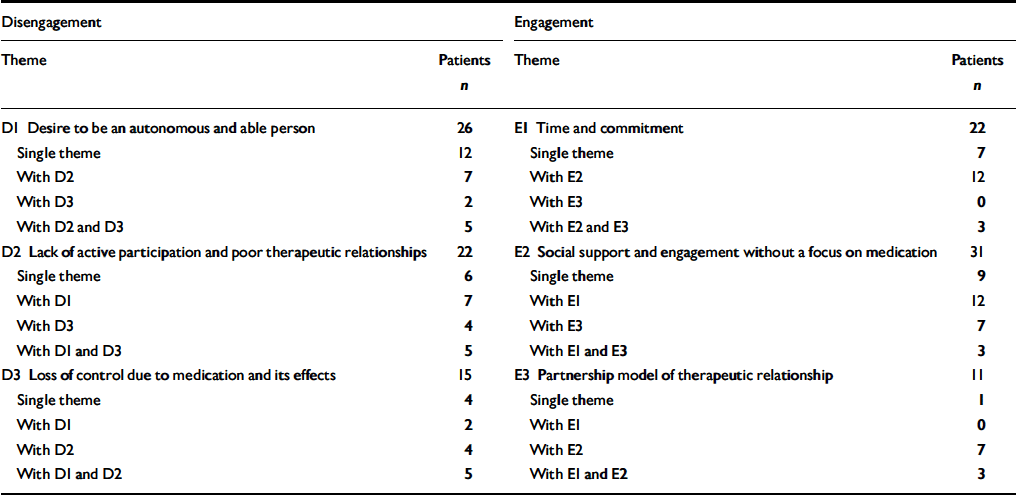
Three main themes emerged from the analysis of patients’ accounts of disengagement and engagement (Table 1).
Table 1 Frequencies of themes (including combinations) reported by participants as reasons for disengagement with mainstream services and engagement with assertive outreach teams (n=40)
| Disengagement | Engagement | ||
|---|---|---|---|
| Theme | Patients n | Theme | Patients n |
| D1 Desire to be an autonomous and able person | 26 | E1 Time and commitment | 22 |
| Single theme | 12 | Single theme | 7 |
| With D2 | 7 | With E2 | 12 |
| With D3 | 2 | With E3 | 0 |
| With D2 and D3 | 5 | With E2 and E3 | 3 |
| D2 Lack of active participation and poor therapeutic relationships | 22 | E2 Social support and engagement without a focus on medication | 31 |
| Single theme | 6 | Single theme | 9 |
| With D1 | 7 | With E1 | 12 |
| With D3 | 4 | With E3 | 7 |
| With D1 and D3 | 5 | With E1 and E3 | 3 |
| D3 Loss of control due to medication and its effects | 15 | E3 Partnership model of therapeutic relationship | 11 |
| Single theme | 4 | Single theme | 1 |
| With D1 | 2 | With E1 | 0 |
| With D2 | 4 | With E2 | 7 |
| With D1 and D2 | 5 | With E1 and E2 | 3 |
Processes of disengagement
Desire to be an independent and able person
Twenty-six patients identified a difficulty in accepting mental illness and the role of the patient as main themes in the break-down of their relationship with mental health services. The patient role required a shift in their perception of themselves as independent individuals:
‘It was a kind of state where you think you are aware of things but you don't know what you are doing’ (Interview 6, man aged 51).
Often, this led to a period of adjustment during which the patient tended to avoid mental health services and tried to carry on with life as before in order to ‘prove them wrong’. A patient who described himself as ‘having a good head on his shoulders’ prior to illness said:
‘I think that a major problem mentally ill people face is their having to accept their diagnosis…. If they tell you you have cancer and you have about 6 months to live, you feel much better than if they tell you you have a… mental illness’ (Int.9, man aged 32).
A psychotic mental disorder can affect all aspects of a patient's life:
‘the kind of identity of like who you are, like your job and other things that define, kind of disappear [because] you are just trying to get better… you become your sickness’ (Int.34, man aged 33).
However, even when patients accept that they are ill, the desire to be ‘as normal as possible’ may persist and is often the reason why some people disengaged after several years of regular use of medication in a bid to regain their old identity:
‘probably that 6 months where I stopped the injection is more likely me trying to get out of the system and getting my life back to normal… it's been 8 years on the injection, seeing doctors’ (Int.20, man aged 28).
This sometimes happens after a switch of medication, which may increase a sense of well-being and a belief in one's ability to cope without medication. Patients also have to deal with a changed perception by other people. Relationships with partners, family and friends are altered or break down. The stigma attached to mental illness and the complexity of changes patients face can lead to a disengagement from services:
‘Sometimes you are scared that they will find out you have a mental health problem and they won't want to know you anymore. I mean schizophrenia is quite a frightening world, because the media made it that way’ (Int.4, woman aged 48).
However, relatives can sometimes facilitate acceptance of illness and treatment:
‘They saw that I was becoming ill and… it happened two or three times, my mum and dad could see it coming on but I couldn't [because] I was ill. I thought that I weren't ill but I was’ (Int.10, man aged 47).
Lack of active participation and poor therapeutic relationships
Twenty-two patients specifically mentioned not being listened to by clinicians and a lack of active participation in treatment decisions as a reason for disengagement. Patients felt alienated when clinicians failed to acknowledge their experience and their view of illness:
‘I felt like they never listened to me and they were just making choices for me and if they listened to me a bit more then I might have felt a bit more like I was. I just felt that my life was out of control and I didn't have a say in what I was doing’ (Int.20, man aged 28).
Communication with psychiatrists was seen as especially difficult and marred by power issues. Eleven patients mentioned not being listened to by their psychiatrist as an important reason for disengagement:
‘I just felt I was fobbed off… it was definitely a case with some psychiatrists of “Them and Us”. And you couldn't talk on the level at all, so in the end you just didn't say very much … I used to think who it benefits, and thought, not me’ (Int.23, woman aged 48).
It is also the manner in which mental health staff behave towards patients:
‘It's like just general gestures they give out with their body language and their posture, itjust suggested that they didn't want to hear what you had to say… start answering the question and you'd be in the middle of what you were saying and they'd catch on to one particular word out of what you were saying and start talking about something they want to talk about, which was very insulting’ (Int.36, man aged 22).
Nine patients mentioned patronising by mental health workers:
‘In other words they are trying to take over your life, treating you like a kid and some of them are younger than you’ (Int.16, man aged 35).
The issues of poor relationships and the passive role of patients were amplified further when it came to the experience of hospitalisation, which 11 patients reported as a reason for disengagement. Fourteen patients described the first admission as a negative experience which affected their view of mental health services for a long time:
‘So our relationship started out really badly, just me and psychiatric services, it was just so violent so… it's taken me a long time to develop any sort of trust between me and psychiatric services’ (Int.28, man aged 45).
It also can be an isolating experience:
‘By not being in an environment I knew, understood, I had never been in hospital before, I felt completely alienated from everyone, from society’ (Int.8, woman aged 23).
Thirty patients reported their dislike of the rigid rules, regulations and restrictions on freedom they face in hospital, with 14 of them using the word ‘prison’. Ten patients reported incidences of perceived injustice and even abuse, including rape and beatings, and 25 reported they were subjected to enforced medication:
‘I did not like it one bit, they treat you bad and they hold you down on the floor and they inject you… they lock you in your room, you can't go outside, it was horrible’ (Int.33, woman aged 27).
However, bad hospital experiences on their own did not necessarily lead to disengagement. Fear of hospitals motivated some patients to cooperate with services and comply with medication to avoid further admissions.
Loss of control due to medication and its effects
The side-effects of medication and associated loss of control were discussed by 28 patients, and 15 said or inferred that this was a main reason for them to disengage. Sometimes, unpleasant effects were so overwhelming that they defeated the intended therapeutic purpose:
‘I stopped hearing voices but the side-effects were so bad I'd prefer to hear voices’ (Int.39, man aged 43).
Patients found that their experience of adverse effects was not acknowledged enough by clinicians. Losing control over some important area of life owing to this neglect led to disengagement:
‘I can't do things that I want to do. I want to come off this depot… it makes me put on weight, it stiffens the joints, it's affecting my fertility, my ejaculation system. I want to have children but I can't have children if I am on depot. So I think it has taken over my life sort of thing’ (Int.29, man aged 31).
Patients in education reported a wish to discontinue medication because of adverse effects on concentration:
‘When the exams were fast approaching, when I have to study… you feel drowsy and everything like that’ (Int.26, man aged 37).
Although interrelated with the themes of poor therapeutic relationships and the desire to be an independent person, complaints about the effects of medication and resulting loss of control were often focused on a single and potentially negotiable issue. When these problems were left unattended, patients felt alienated when they were otherwise willing to engage.
Processes of engagement
Time and commitment
Twenty-two patients reported that assertive outreach workers invest more time and show more commitment to the care of patients. They were described as easy to contact and able to visit patients at home:
‘Well, the outreachteam are better because they have more people around. I mean if I need something, I just pick up the phone and they come down. I don't have to make an appointment or anything which is good’ (Int.1, man aged 46).
Staff's willingness to listen to problems and help was appreciated:
‘Well, the main thing is they listen and you can talk to them when you need someone to talk to’ (Int.30, woman aged 46).
Time and commitment invested in care gave assertive outreach team staff the potential to build mutually trusting relationships, and the consistency over long periods of time appeared particularly important:
‘I think, because what the team and I have been through, they have seen me in a good position and the team have seen me in bad conditions, so they have an idea, a much better idea and understanding of my moods and how to reacttothings, so we have a good working relationship’ (Int.9, man aged 32).
The time and commitment of team staff are particularly valued in comparison with previous experiences:
‘I've done a lot of intense work with one of my social workers before I was in the assertive outreach team, but since I have been in the team there is always someone to talk to, if you want to talk to someone. Even if one of the people is off, there is always someone else there to talk to’ (Int.2, man aged 28).
Social support and engagement without a focus on medication
The social and practical nature of the assertive outreach service was perceived as a positive distinguishing feature by 31 patients, and 11 reported receiving social support in a form of companionship, joined outings and activities. Team workers were frequently described as being interested and friendly:
‘They talk about day-to-day stuff with me you know. It's interesting really, they take an interest in my life’ (Int.1, man aged 46).
They were willing to see patients as persons not just as ‘illness on legs’:
‘I talk to him about films and theatre and books and arts, and which balances it out because I don't really want someone coming to my flat making me feel mad’ (Int.19, woman aged 39).
Patients saw an option to engage with services in a way that was not entirely focused on medication:
‘You don't talk to them purely about how I have taken my tablets and this. I mean it is broader than that’ (Int.23, woman aged 48).
Patients stressed that mental illness often led to a breakdown of close relationships and was a very isolating experience. The attempts of the assertive outreach team to increase their social activities by taking them to restaurants and organising leisure activities and outings was frequently discussed:
‘Sometimes we might just go out and have a cup of tea or coffee at the café, we might go swimming, we might go on an outing or whatever, that's what I like, that's what's good about them they they are quite, like sociable’ (Int. 7, man aged 18).
Help with practical day-to-day issues was also appreciated and mentioned by 20 patients. Help with financial matters such as dealing with the social services, housing department and banks was most popular. Assertive outreach teams were also credited with bringing more structure to the lives of participants by organising educational opportunities and paid or voluntary employment, and by helping with organising housing and necessary repairs, shopping and escorting participants to appointments:
‘You've got to realise that apart from being sick, you've got your financial life as well which is different from your medication, you know, because social security tend to mess you around. You need someone to stand up for you, give you your giro’ (Int.39, man aged 43).
Two patients complained about assertive outreach teams encouraging dependency by offering this type of support, but acknowledged the willingness of the team workers to negotiate reducing the contact if requested.
The partnership model for therapeutic relationships
A need to be treated seriously and afforded an active role in making decisions about their treatment was emphasised by many participants and explicitly outlined as the reason for engagement by 11 patients. However, examples of positive experiences as reasons for engagement were harder to come by. Nine patients acknowledged their relationship with their psychiatrist as a facilitating factor in their engagement with services. They reported that assertive outreach team psychiatrists, like other members of the team, listened to them and saw them as people, not just sets of case notes:
‘He wants to know about everyday things, not just how are your pills… It is broader. That makes up you know, it's a better relationship and you feel oh, you know I wouldn't mind sharing what I do…. But when it was very patronising I just put shutters up’ (Int.4, woman aged 48).
Patients felt that their experience of illness was taken on board and that they were acknowledged as active participants in therapeutic decision-making:
‘When I suggested that I wanted to stop medication for a while, he actually let me and he did actually come across as if he were concerned about me hallucinating again and he wasn't too pushy about things… he warned me I may become delusional again, but he did not come across as though he was trying to prevent me from doing it… he wanted me to be more involved in my own health’ (Int.8, woman aged 23).
The gradual building of relationships enables assertive outreach staff to win the trust of people and communicate effectively about treatment:
‘I trust him to do what's best for me even when I don't know what's best for me…. It took time, initially I was very suspicious of him when I first got put in contact with him. I was mostly in crises…. I did think initially he waslike another CPN [community psychiatric nurse] that I had, that he'd bin me for the smallest reason, but that's not been the case actually’ (Int.19, woman aged 39).
This sort of trust enabled some patients to stop hiding symptoms for fear of being sent to hospital and to assume a more active role in managing their health:
‘I always tell them, when I have a difficulty in sleeping now I talk to them, I tell them my problems. Before I used to deny that, … I'm not ill, I don't want to go to hospital, I don't want to know you, I didn't want to open my door, you'll have to break in with police and they arrest me and take me in. But now I openly talk to them’ (Int.25, man aged 31).
Findings in African–Caribbean patients
African–Caribbean patients did not mention qualitatively different views to other patients. If differences appeared, it was rather the degree and frequency of some experiences that varied between ethnic groups. Some African–Caribbean patients (4 out of 18) particularly emphasised the effects of stigma and peer-group pressure for disengagement. Twelve patients of this group expressed views suggesting they had a compliant rather than an engaged relationship with the psychiatrist (compared with 6 out of 15 White UK patients):
‘I've been taking my medication just for the fact that I don't want to go back to hospital… but, if I had a choice of taking the depot or not taking it, I wouldn't take it’ (Int.29, man aged 31).
Contradictory evidence
The analysis did not reveal substantial evidence that contradicted the reported themes. Yet, as already mentioned, negative hospital experience can be a reason for engagement when compliance with treatment is motivated by the desire to avoid further hospitalisation. Also, the experience of consequences of disengagement might have contributed to a willingness to engage:
‘Yeah, I have stopped taking it… and then I become ill so now I know I have got to stay on it completely’ (Int.10, man aged 47).
DISCUSSION
Despite a high individual variability in the circumstances and experiences involved in engagement and disengagement with services, the study identified a small number of fundamental processes. The identified themes appear plausible, clear and partly linked.
Methodological issues
The study had some methodological limitations. Most importantly, it focused on patients who had originally disengaged from services and later engaged with assertive outreach teams. Thus, patients who even the assertive outreach teams failed to engage were not included. Such patients might have different reasons for disengaging from services, and obviously were not motivated by the processes described here leading to engagement. However, even for patients who do accept assertive outreach team care, the sample was probably not representative. Only patients who were prepared to participate in research and conduct an interview with a researcher were included. Moreover, the study was conducted in London, and assertive outreach team patients in other areas and other services may have had different experiences. The study placed users’ views and testimonies at the centre of the methodological approach. In the vast majority of cases, the researchers believed the participants’ accounts to be accurate and pertinent. Clinicians may have expressed different views and stated good reasons for their behaviour that was criticised by the patients, but their views were not assessed in this study.
Disengagement
The key themes that emerged in our study are often interrelated and coexistent in the experiences of individual participants and, to some extent, reasons for disengagement and engagement are two sides of the same coin. Disengagement was often a result of the struggle against loss of autonomy and identity as a part of the experience of mental illness. Not all clients with a history of disengagement were people who resented mental health services. In fact, when asked to describe the characteristics that made a bad keyworker, 9 out of 20 participants answered that they had never had a bad keyworker. In line with research related to chronic physical illness (Reference Charmaz, Strauss and CorbinCharmaz, 1997), this finding would indicate that identity issues are vital for coming to terms with the impact of mental illness (Reference Watts and PriebeWatts & Priebe, 2002; Reference Tait, Birchwood and TrowerTait et al, 2003). Moreover, issues around psychological adjustment may still be dormant in some patients with long-established illness and not just occur in the newly diagnosed (Reference Spencer, Birchwood and McGovernSpencer et al, 2001). Some participants had been in a compliant relationship with services for many years before they made their ‘bolt for freedom’.
Autonomy was also compromised by the powerlessness patients felt in their relationship with services in general and psychiatrists in particular. The study demonstrated that feelings of not being listened to can often lead to a fundamental breakdown in the therapeutic relationship and consequently to disengagement. This is especially true when a patient's complaints about undesirable side-effects associated with medication are disregarded despite profound effects on important areas of a patient's life (Sainsbury Centre for Mental Health, 1998; Reference Gerber and PrinceGerber & Prince, 1999).
Engagement
The results indicate that patients whose relationship with mental health services has broken down can become more engaged if they feel listened to and have a genuine say in decisions about their care. The current approach of assertive outreach with small case-loads seems useful as it enables keyworkers to put in time and commitment, which is appreciated by patients (Sainsbury Centre for Mental Health, 1998). It enables staff to form trusting relationships with patients and familiarise themselves with the particular circumstances of their lives. This facilitates the making of informed decisions about treatment options. For many participants, moving away from an exclusive focus on medication was a crucial element in improving their therapeutic relationship. The interest of team staff in the patients’ lives was regarded as a welcome antidote against patients being reduced to their symptoms, and efforts to increase social activities and organise educational and work opportunities were important. Practical help with housing and welfare was also seen as an aspect of recognition of the reality of participants’ lives (Reference Hannigan, Bartlett and ClilverdHannigan et al, 1997; Reference Billings, Johnson and BebbingtonBillings et al, 2003). The comprehensive care approach of assertive outreach should help to avoid a sense of being confined to the role of mental patient. The practical support enabled patients to regain control over their lives. The sense of autonomy, the loss of which has proved so important in disengagement, is further strengthened if people are given the chance to be actively involved in making decisions about their treatment and the best ‘anticipatory action’ to avoid relapse (Reference Weaver, Tyrer and RitchieWeaver et al, 2003). Building the necessary relationship often requires time and reliable commitment.
Potential clinical dilemma
To feel supported by staff through ‘ups and downs’ helps to establish a ‘working relationship’, and the psychiatrist who was prepared to stop medication in line with the wishes of the patient was perceived as genuinely concerned and caring – but might have agreed to a treatment that was incompatible with evidence-based medicine. This example highlights a potential dilemma around current policies on ‘difficult to engage’ patients who might pose a risk to themselves or others (Reference Watts and PriebeWatts & Priebe, 2002). A strong focus on risk containment and an insistence on interventions following evidence-based guidelines may interfere with promoting a partnership model of care that – over time – helps those patients to engage. A move away from controlling the patient towards exploring and accepting decisions made by the patient appears essential in facilitating greater engagement. One might conclude that clinicians and services who are able and willing to engage genuinely with patients on a partnership level are, in turn, easier for the patients to engage with.
Implications of the study
The findings suggest that in order to treat ‘difficult to engage’ patients in practice it is important to have, first, a comprehensive care model with social and practical support and no exclusive focus on medication; second, committed staff with sufficient time; and third, a stronger emphasis on relationship issues with patients as partners. Further research might investigate whether, and if so, to what extent, the processes identified in this study apply to other patient groups and other settings in community mental health care, and explore the views of the clinicians involved and relate them to those of the patients.
Clinical Implications and Limitations
CLINICAL IMPLICATIONS
-
• A comprehensive care model with social and practical support, an avoidance of an exclusive focus on medication, and committed staff with sufficient time, help to engage ‘difficult to engage’ patients.
-
• Relationship issues are central to disengagement and engagement, with patients preferring a partnership model and an involvement in clinical decision-making.
-
• African–Caribbean patients do not have qualitatively distinct processes of disengagement and engagement.
LIMITATIONS
-
• Patients who engaged with neither mainstream services nor assertive outreach teams were not studied.
-
• Only patients who were able and willing to participate in research were interviewed, so that the sample was not representative of all assertive outreach team patients.
-
• The study was conducted in assertive outreach teams in London and results cannot necessarily be generalised to other areas and services.
Acknowledgements
The authors thank Rose McCabe, PhD, Gemma Jones, BSc, Cecilia Faduola, BSc, and Louise-Marie Harding, BSc, for their help with data analysis. Most of all we thank all the patients who assisted with the study.




eLetters
No eLetters have been published for this article.