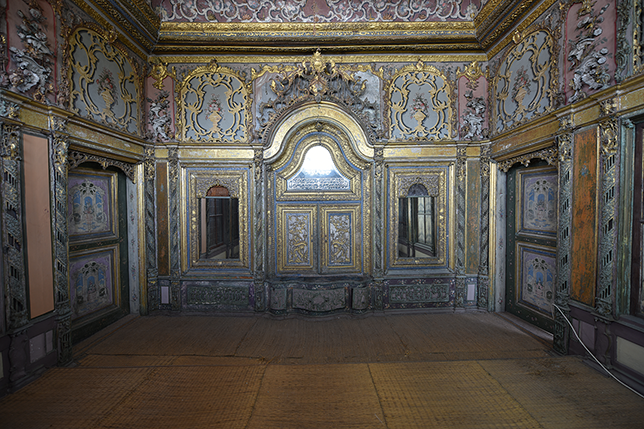
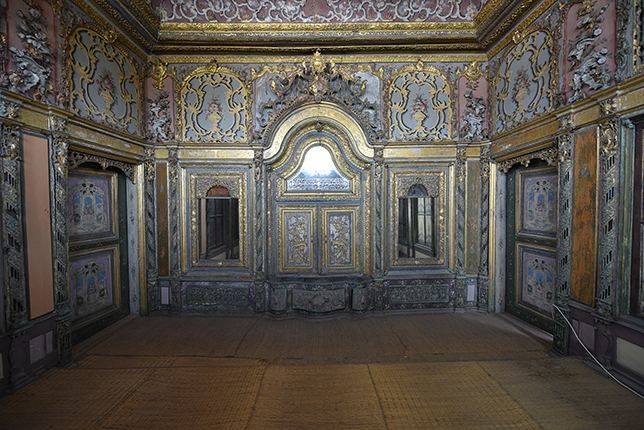
Introduction
We started Letters and Gifts, this volume’s prequel, by identifying a small but regal portrait as Sultan Selim III’s mother, Mihrişah Valide Sultan (d. 1805).Footnote 1 We argued that this painting commission was an instance of dual portraiture and that when Selim sat for a self-portrait, his mother did so as well – a practice unheard of among Ottoman dynastic women that preceded her. In the immediate aftermath of Selim’s accession to the Ottoman throne in 1789, many other analogous moments of tandem patronage of mother and son followed suit. This volume begins with the quick, post-accession building process of their own quarters inside the imperial palace’s extant and quite clustered harem section in Istanbul.Footnote 2 They constructed two rooms each, around and especially above an extant courtyard that would afford them multiple views of their capital, the heart of their empire. Building atop existing structures was a practical choice in this hermetic space situated on a fifteenth-century blueprint but it also foregrounded their panoptic gaze upon Istanbul, on which the duo had already devised an infrastructural overhaul during Selim’s princely seclusion. Jointly, they would populate the suburbs by expanding the water network, construct military barracks, mosques, manufacturing facilities, and renovate royal retreats across the city to affirm their presence for their subjects.
Architecture and Interiors commences with a detailed description of Selim’s and Mihrişah’s little studied additions to the imperial palace’s harem. When they were constructed in the span of a year, the four rooms were collectively conceived and visually interlinked, manifesting the most striking examples of the Ottoman baroque and rococo domestic interiors. Each room followed a template (structured around a prominent, centralized alcove) and each contained an inscription band carefully composed to promote both the individual and joint virtues of the sultan and his mother. These poetic inscriptions also spoke directly about the decorative program, describing the intention behind the murals of landscapes and architecture, myriad colors and materials used, as well as the extravagant stucco projections of floral reliefs. The inscriptions were also portentous (written in the first two years of Selim’s accession), foretelling the many philanthropic initiatives that their owners would soon undertake. One of the couplets in the new valide quarters, conjoins the patronage of Selim and Mihrişah, and sees them build “many mosques and sanctuaries for the needy and the destitute” and “inspire courtiers around them to do the same.”Footnote 3 The windows of these new chambers, especially those belonging to Mihrişah, looked out toward the two coasts of the Golden Horn estuary: Eyüp and Hasköy. She would soon commission the building of her own soup kitchen (imaret) and tomb on the northwestern side of the waterway, adjacent to the extant tomb and mosque of Abu Ayyub al-Ansari (one of Prophet Muhammed’s early supporters, who died in the first Arab siege of Constantinople, and lent his name to the neighborhood). It was and continues to be one of the most important Muslim pilgrimage destinations, but it was also a site that stood to legitimize Ottoman dynastic rule by hosting the sword-girding ceremony of the new sultans.Footnote 4 Situated on the northeastern side of the estuary, directly across from the holy site of Eyüp, she commissioned a mosque, which is recorded in her foundation register as part of her charitable complex in Eyüp. In the valide’s mind, the waterway in between the two sites did not bisect but bound them. This mosque stood within the courtyard of the expansive military barracks her son was constructing for his reformed corps of miners and bombardiers. In addition to the mosque, Mihrişah financed the water infrastructure for the barracks complex and built several fountains. These contributions prominently showcased her authority as the valide and her close collaboration with her son in his efforts to reform and modernize the state.
“Ocular politics,” central to Gülru Necipoğlu’s analysis of the Ottoman imperial palace’s earliest, fifteenth-century incarnation, continues to drive the architectural orientation of its eighteenth-century patrons.Footnote 5 Like their ancestors, these modern rulers were deliberate in setting the locations from which they projected their gaze. They knew that their residences were their embodiments. This volume elaborates on royal paintings from Selim’s reign that speak to this very association of the built environment with the ruler’s presence, not only his but also those of his male and female dynastic agents. Günsel Renda’s foundational scholarship on the Ottoman Greek court painter Konstantin Kapıdağlı and on eighteenth-century murals on the walls of Topkapı’s harem constituted staple references.Footnote 6
A poignant letter that Mihrişah asks her son to address to her own steward (kethüda), the illustrious and feared Yusuf Ağa, exemplifies both the value that dynastic rulers attributed to imperial sightlines, the very act of prolonged looking and seeing without being seen, as well as the embodied significance of royal monuments. It appears that while sitting inside one of the shoreline pavilions of the imperial palace (likely Yeni Kiosk discussed in this volume) with her son and contemplating Selim’s new mosque in Üsküdar situated across the sea from them, Mihrişah voiced her desire for a second minaret to be placed on her Hasköy mosque, the structure that she saw from the windows of her harem chambers.Footnote 7 In her request, she referenced other valide mosques that in previous centuries broke the rule which reserved multiple minarets for sultanic commissions alone. She was likely thinking of the Atik Valide Mosque, built by the sixteenth-century valide Nurbanu Sultan (d. 1583). Located in Üsküdar, near Selim’s new mosque, the structure had been enhanced with a second minaret when Nurbanu’s son, Murad III (r. 1574–1583), ascended the throne in 1574.Footnote 8 Selim granted his mother’s wish without objection.
In this volume, we foreground the domestic environments that Selim, his mother, sisters, and female cousins devised for themselves at the end of the eighteenth century. These lavishly intimate royal sites, designed with clearly defined private and public functions, are now largely lost or inaccessible, making their study all the more significant. The first half of the narrative is a close architectural study of the changes that the new sultan, Selim and his mother, Mihrişah undertook in the imperial palace, first in the extant harem and next on the fourth courtyard (along the sea walls) at a section of the palace that was known as the shoreline palace of the Cannon Gate (Topkapısı Sahilsarayı). Although the eighteenth-century proliferation of waterfront palaces in Istanbul may suggest to some a decline in Topkapı palace’s prominence, they never sought to leave the palace which had long served as the sultans’ principal residence and was a defining architectural emblem of Mehmed II’s post-conquest capital.Footnote 9 The mother and son amended the palace and initiated a completely new segment, which would enhance their visibility from the capital’s heavily crisscrossed waterways. The second half of the narrative focuses on the now lost imperial retreats and women’s mansions, first along the shores of the Golden Horn and later the Bosphorus. It aims not only to pinpoint their exact locations and establish their connections to other significant imperial sites but also to explore alternative sources – such as the kethüda letters, sketches, and memoirs of Grand Tourers – to gain deeper insights into their interior layouts and exterior designs. The waterfront mansion of Selim III’s cousin Esma (the Younger) in Eyüp occupies most of our discussion in Section 3 than the residences of other dynastic women because of the inordinate number of extant letters from Esma and her mother, Sineperver, to her designated steward, Ömer Ağa, which detail the prolonged process of its construction. These letters reveal the involvement of Ottoman Greek builders (kalfas), cost of construction, use of salvaged material, and the engagement of women as patrons at every stage of the building process. The letters are also eye-opening in exposing the competitive spirit with which these women commissioned their homes: They desired that they outmatch the style of structures and objects, which they observed in the mansions of their female peers with whom they shared considerable social hours.
Following in the footsteps of his grandfather Sultan Ahmed III (r. 1703–1730), Selim also appears to have mandated married women of the dynasty (mainly his sisters and female cousins) to energize the capital through their patronage circles and associated object commissions and building projects.Footnote 10 Selim’s historical modeling of his rule on those of his predecessors, especially with regards to the increased public presence of dynastic women, has been skillfully rendered by Tülay Artan in her magisterial doctoral work, “Architecture as Theater for Life,” alongside her more targeted, in-depth studies on the wealth and material life of women like Esma the Younger, Hatice Sultan, and others.Footnote 11 It is in this period that the suburban shorelines of Eyüp became a venue for architectural competition between these women.
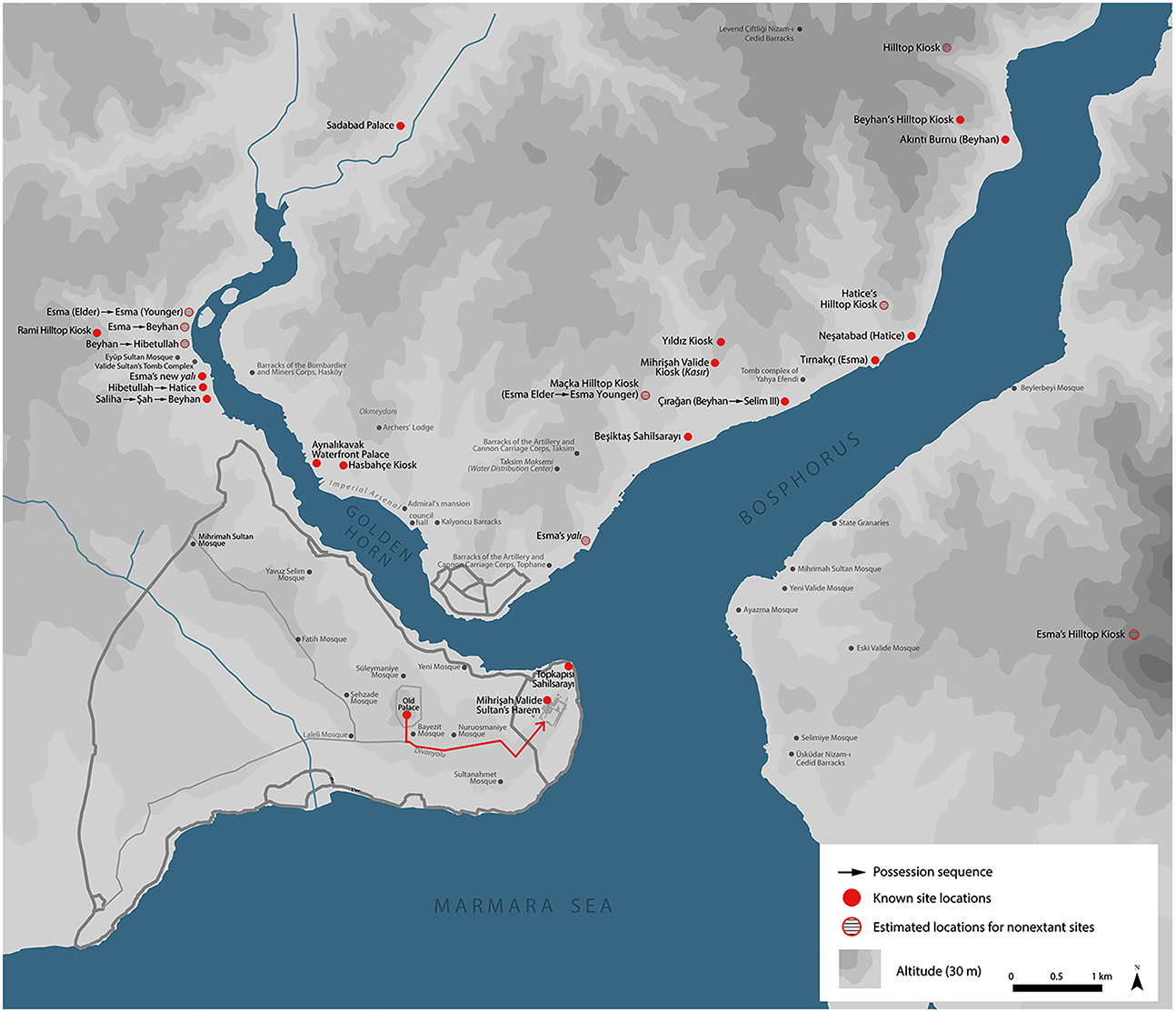
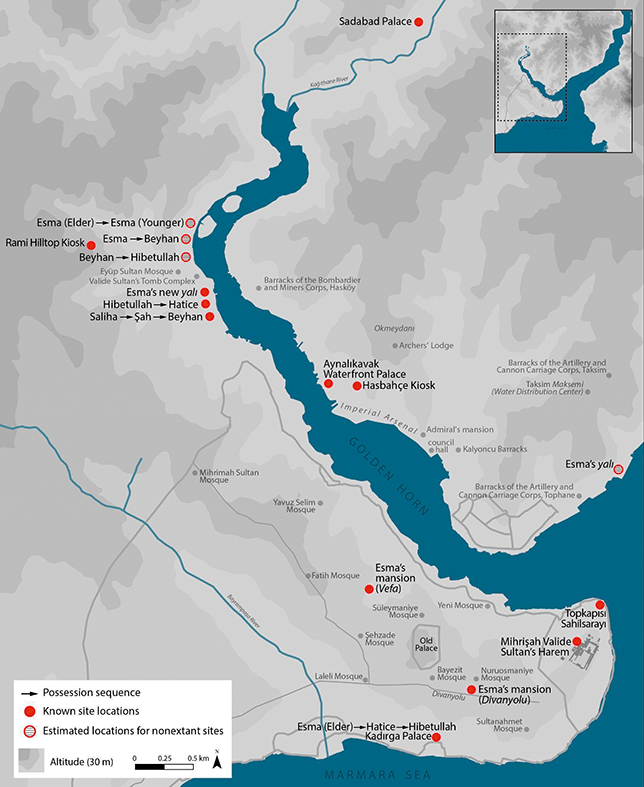
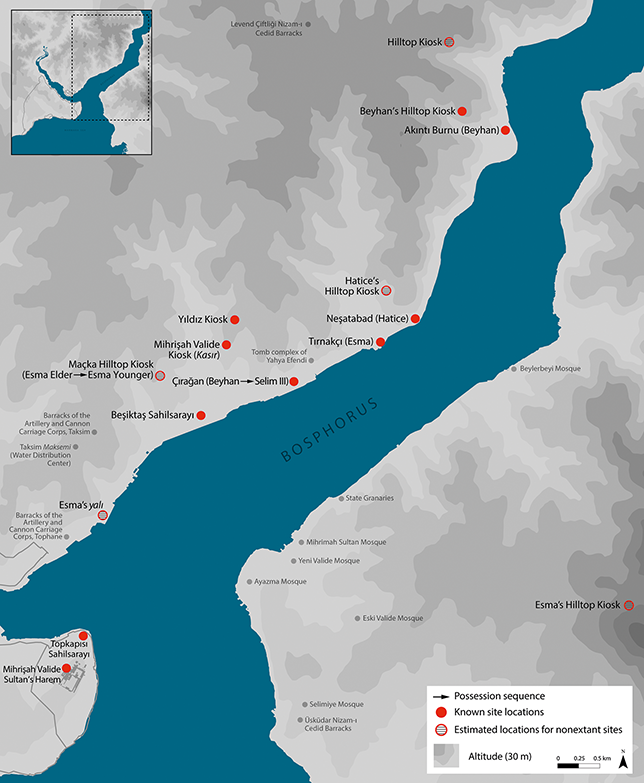
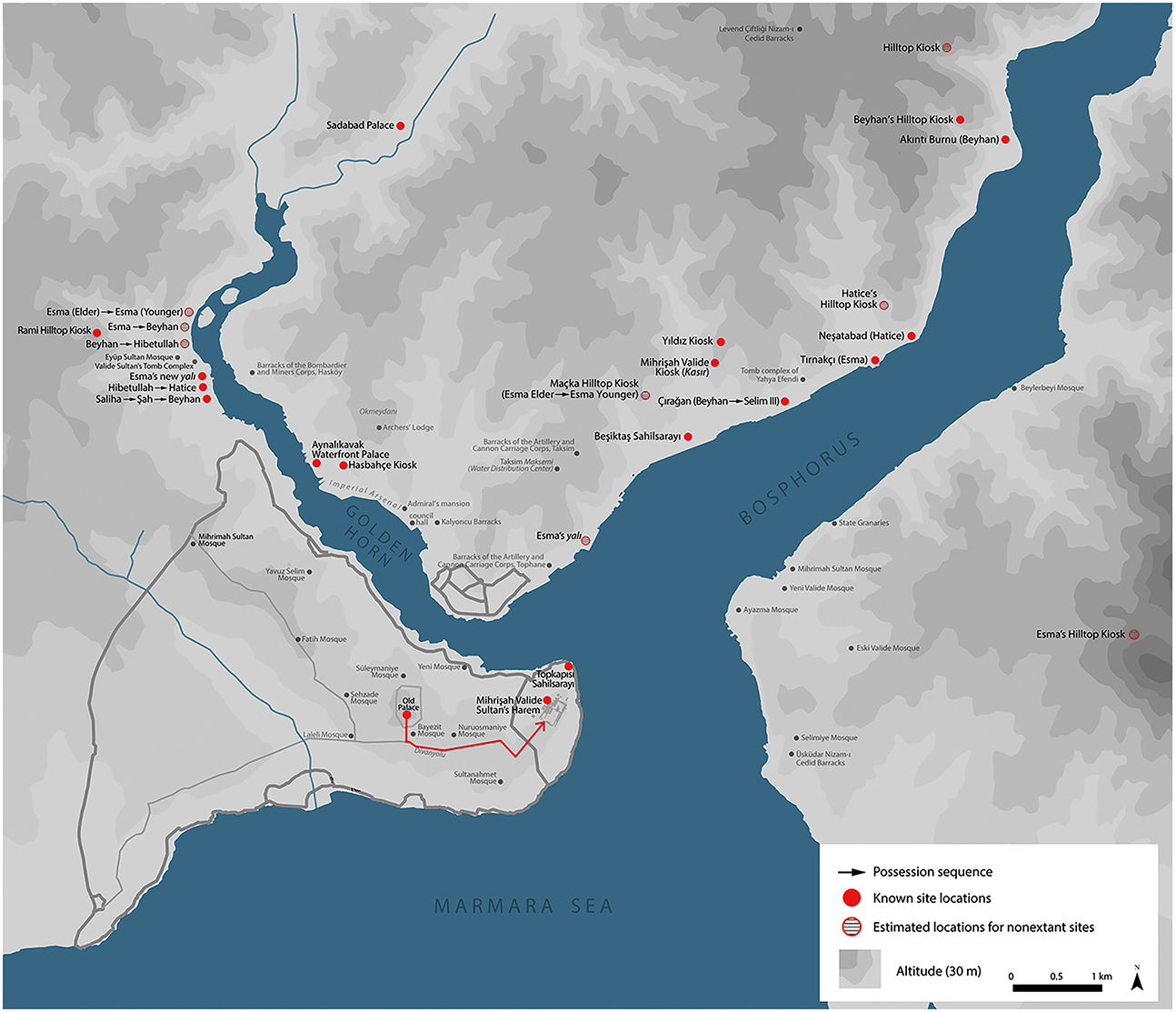
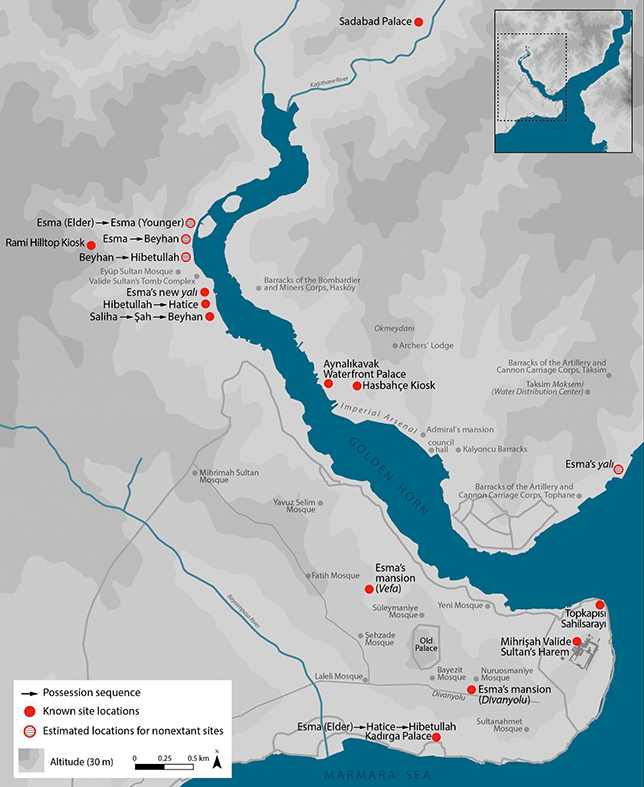
An analysis of the spatial distribution of the existing and newly built imperial palaces, mansions and kiosks at the end of the eighteenth century reveals a clustering in specific urban locales, particularly within Istanbul’s city walls near the Golden Horn in the vicinity of Eyüp, along the Bosphorus coast between Beşiktaş and Bebek, and on the hilltops overlooking their own waterfront palaces (Figure 1). In this Element, while we acknowledge the significance of their palaces in Istanbul intra muros, where the married women of the dynasty spent their winters, we have deliberately chosen not to address them due to lack of detailed information; numerous cost estimate registers in the Ottoman archives provide no insight into either the architectural organization or the use of these palaces. Furthermore, foreign travelers’ accounts are largely absent, as such visitors were typically hosted in the newly fashioned waterfront mansions of these women, rather than their intramural palaces.
Map of Istanbul showing the eighteenth-century imperial palaces and waterfront mansions appointed to or built by the members of the Ottoman dynasty.
These intramural sites given to the dynasty’s women are particularly significant due to their proximity not only to the old palace (eski saray), the first palace built by Sultan Mehmed II in 1454 soon after the conquest of Istanbul, where the mothers of these women, if still alive, typically resided, but also – perhaps even more importantly – to Topkapı Palace, where Selim and Mihrişah spent their winters. Being close to Topkapı, the epicenter of political power, ensured that these women maintained access to the central authority and influence of the Ottoman court, further solidifying their position within the imperial hierarchy. Although the exact locations of these are unclear, historical evidence nevertheless allows us to approximate their siting. For example, the choice location of the urban mansion belonging to Esma the Younger, situated along the imperial avenue called Divanyolu (or Mese, the main artery of the Byzantine Constantinople), would later house the tomb complex of Sultan Mahmud II (r. 1808–1839), Esma’s brother.
To a certain extent, we conceive of Architecture and Interiors as a cartographic reference that lays out the complicated ownership of waterfront mansions by the dynasty’s women, especially in Eyüp, but also along the Kuruçeşme-Beşiktaş segment of the Bosphorus coast (Figure 1). We roughly follow the traditional path taken by many Ottoman İstanbulite authors, such as Eremya Çelebi Kömürciyan (d. 1695) and Ghukas İncicyan (d. 1833), as well as European figures like the French diplomat and scholar Marie-Gabriel-Florent-Auguste de Choiseul-Gouffier (d. 1817) and the French artist and imperial architect Antoine Ignace Melling (d. 1831), in their textual and visual narratives of the city. This journey begins at Sarayburnu, the tip of the historic peninsula where the Ottoman Palace is located, continues toward the Golden Horn, and then moves to the northern shore of the Bosphorus.
The extensive restoration notes of Selma Emler (d. 2001), a consummate architect and under-recognized restorer of the imperial palace, with her collaborator Mualla Eyüboğlu (d. 2009), meaningfully rendered for us segments of the Topkapı Palace that are inaccessible today.Footnote 12 Architecture and Interiors is dedicated to Emler’s memory. Moreover, we were able to layer our findings on the architectural changes in Eyüp and the Bosphorus shores thanks to the urban histories written by Artan and Shirine Hamadeh.Footnote 13 Their dedicated work on the capital’s physical growth in part due to the expansion of its architectural patrons and their network allowed us to build our findings on the relationships between dynastic homemakers and the interconnected community of non-Muslim builders. Artan and Hamadeh’s expansive understanding of the eighteenth-century Ottoman capital also enabled us to argue that dynastic patrons strategically crisscrossed between the sites designated for them, in order to regulate their public visibility. The online project entitled “Map of Women Patrons’ Structures in Ottoman Istanbul” has served as an important visual resource for our research.Footnote 14
A majority of Architecture and Interiors is also an analysis of the Ottomanization of baroque and rococo forms in global circulation during the reigns of Selim and Mihrişah. We focus our analyses on their particularly ebullient uptake inside imperial residences, especially intimate spaces within the harem that both physically (through inscriptions) and metaphorically (through visual representations) spoke of the taste and symbols of their patrons. Baha Tanman’s extensive knowledge of eighteenth-century waterfront mansions and palaces has deepened our understanding of the era’s aesthetics of the interior. Ünver Rüstem’s volume on the more visible, public-facing Ottoman baroque monuments of the period has been supplemental for our approach.Footnote 15
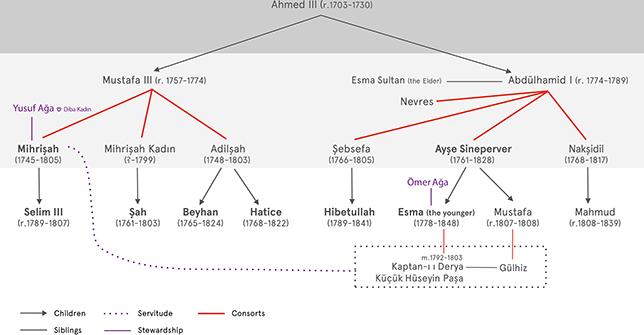
This volume, like its prequel, re-energizes extant eyewitness accounts alongside underused archival records to illuminate the role of Ottoman imperial women in the empire’s capital, specifically during Sultan Selim III’s rule (1789–1807). His mother Mihrişah, as the female head of the dynasty, presided over the lives of a group that included his half-sisters, Şah, Beyhan, and Hatice, and their mothers, who were the consorts of Mustafa III (Selim’s father, r. 1757–74) just like Mihrişah. The valide’s oversight extended over Selim’s female cousins, Esma, the Younger, and Hibetullah, alongside their mothers, who were the consorts of Abdülhamid I (Selim’s uncle, r. 1774–89) (Figure 2).
Family tree illustrating the imperial women connected to Sultan Selim III’s reign.
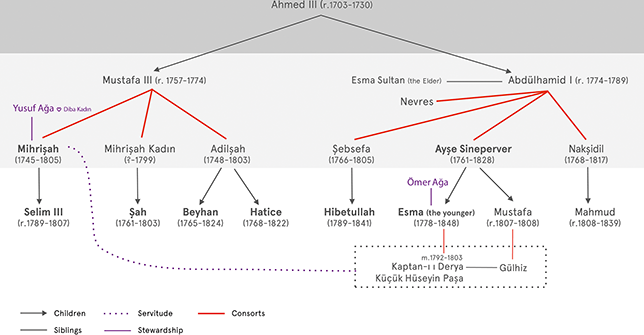
The power dynamics varied for Ottoman imperial women depending on their origins and the stages of their lives. Women born into the dynasty – such as Şah, Beyhan, Hatice, Esma, and Hibetullah – held secure and relatively untouchable positions, especially when supported by strong connections and networks. In contrast, women of slave origin, who were given to or purchased by senior harem members, aligned their loyalties with specific cliques from the outset, gradually amassing power until, one day, they rose to the position of valide. This role represented the pinnacle of authority and influence for a woman – and indeed any man other than the sultan – to attain in the empire. The duration of this topmost status varied dramatically, lasting anywhere from a few days to several decades. For example, Mihrişah enjoyed this position for sixteen years (1789–1805), but Sineperver held it for only fourteen months (1807–1808).
Whether mother or daughter of a sultan, each woman was keenly aware of her social standing and recognized the stages of her life when her power was at its zenith. Consequently, she shaped her material investments and structured her sociopolitical relationships with this awareness in mind. We examine a section of this continuous history of imperial women and intentionally adopt a microhistorical approach, seeking to reevaluate the presumed anonymity and invisibility of Ottoman dynastic women of this period. While Letters and Gifts closely examine the many facets of their power and the networks they actively cultivated, this volume focuses on the material worlds they constructed around themselves. Far from being hidden in their harem quarters (a regrettably long-sustained Orientalist trope), these women interacted frequently with individuals of similar imperial stature. Their letters and expense accounts – consistently analyzed throughout these volumes – document their dynamic intra-court mobility, which allows us to map their diverse networks and identify the familial practices (intermarriages, the exchange of cultivated female servants, and constant gifting) that supported their political ambitions.
1 A New Sultan and a New Valide in the Imperial Palace’s Harem
On April 11, 1789, four days after her son Selim ascended the imperial throne, Mihrişah moved from the old palace (eski saray), where she had resided for the last four years, processing to the empire’s official palace (today known as Topkapı) as was customary for the sultan’s mother (valide alayı).Footnote 16 As more than three decades had passed since the last valide procession had occurred and a valide had last presided over the imperial harem, a slight alteration was made in the order of ceremonial protocol to speed up Mihrişah’s relocation to the palace before her son’s sword-girding ceremony in Eyüp. Her expenses in her first week as the valide indicate that she paid individual visits, bearing gifts, to each of Selim’s three adult sisters, Şah, Beyhan, and Hatice – who were born to two other consorts of Mustafa III – in their respective intramural palaces.Footnote 17 These visits not only affirmed the new valide’s intent to establish Selim’s sisters as stable political allies and guardians of dynastic protocol but also symbolized her immediate effort to integrate them into her newly expanded sphere of influence. Having shared the same harem during Mustafa III’s reign, Mihrişah had already established relations with these women, which continued but with an expected increase in their acquiescence to the new valide as head of the harem. As exemplary of the political allegiances between dynastic women, in the previous volume, we highlighted the collaboration between Mihrișah and Selim’s eldest sister Şah in arranging the marriage between Selim’s wealthy cousin Esma, the Younger, and his confidant and footman, Küçük Hüseyin.Footnote 18
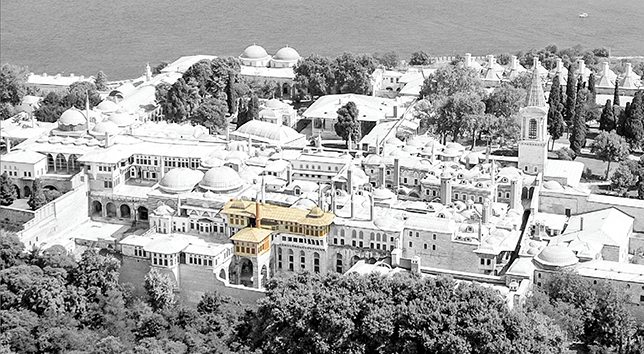
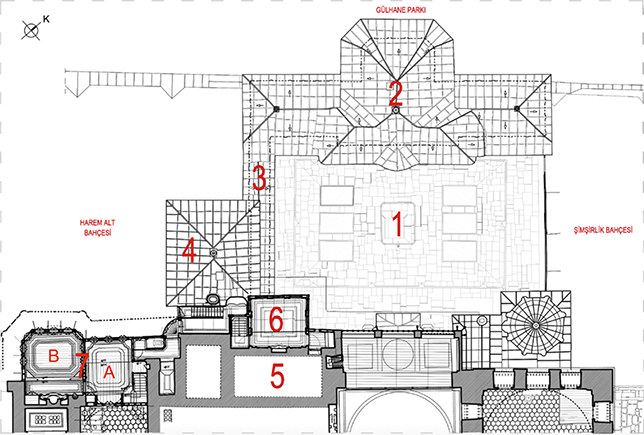
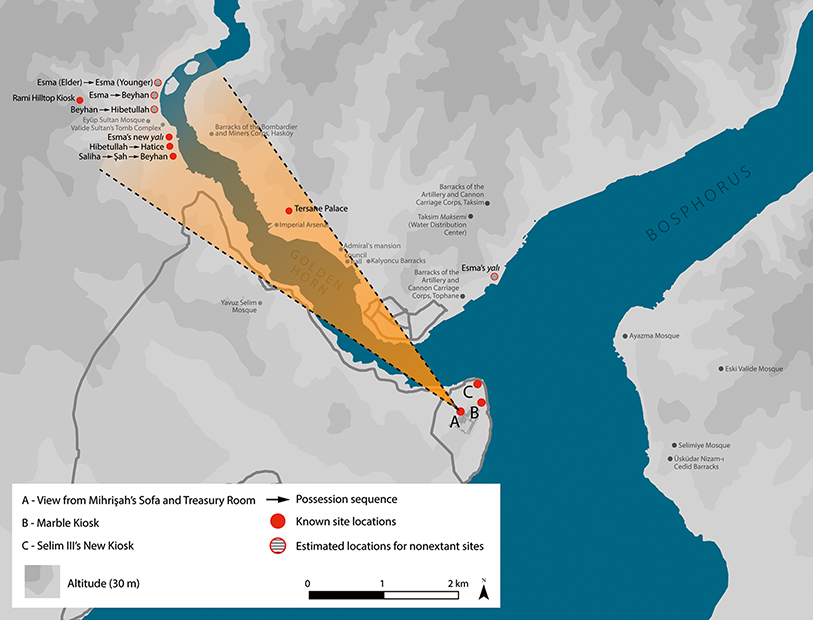
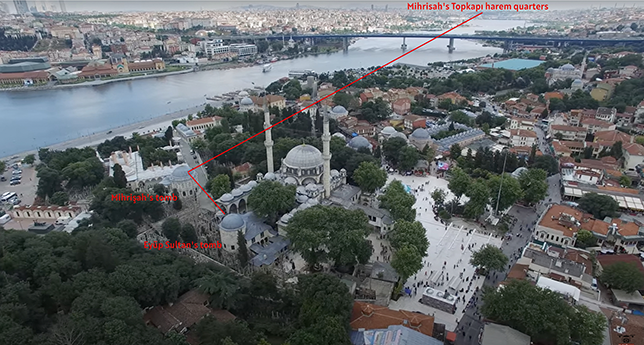
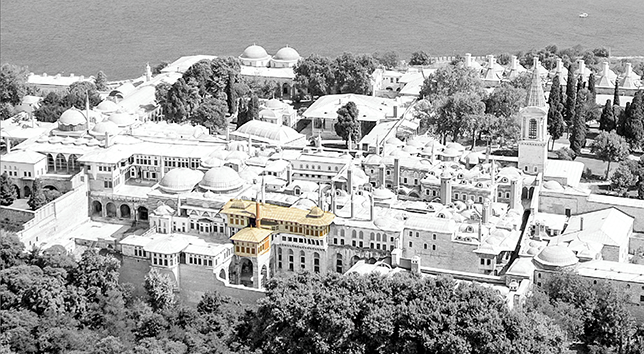
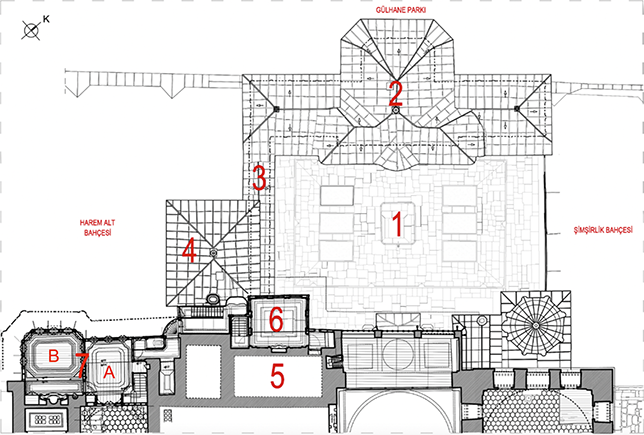
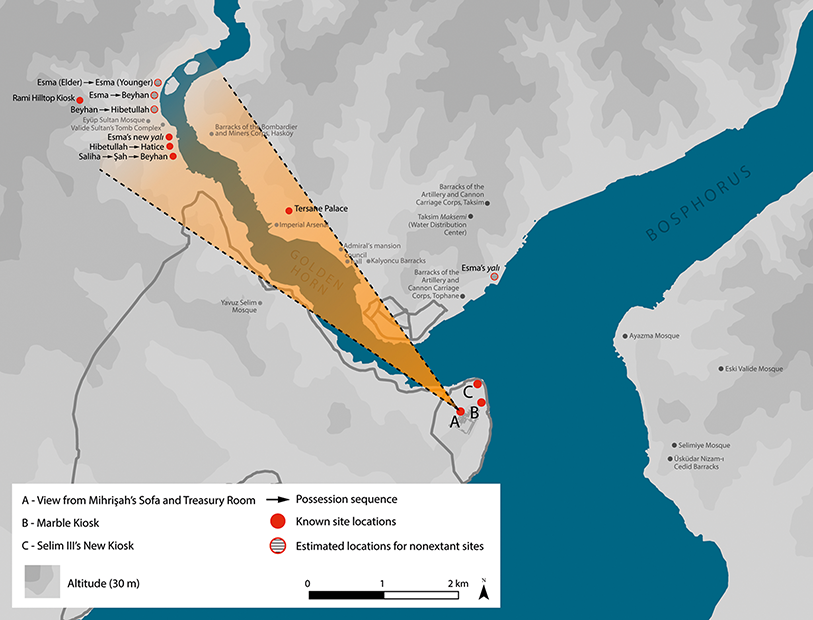
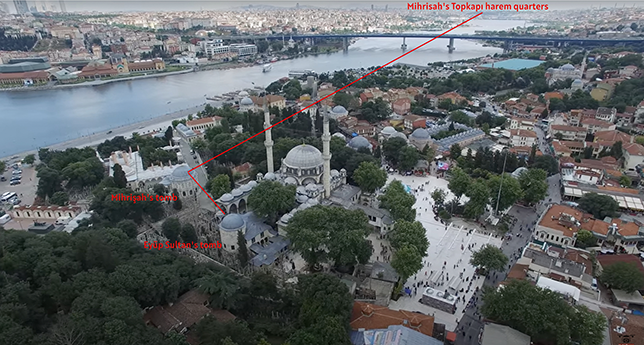
The speed with which Mihrişah assumed her new role as valide was also reflected in the architectural projects she undertook in her new residence inside Topkapı’s harem. Soon after she moved in, the harem quarters underwent extensive restorations, including the construction of new rooms for herself and her sonFootnote 19 (Figure 3). One of Selim’s two new rooms was constructed at the western corner of the courtyard of Osman III (Figure 4). His second, smaller room was situated upstairs, directly connected to his mother’s newly built quarters, which consisted of two additional interconnected rooms. All of these spaces boasted commanding views of the Golden Horn, but most deliberately a distinct vista of Eyüp highlighted by the tomb complex of Eyüp Sultan (Figure 5). Since the sixteenth century, this district, which had developed around the sacred body of Abu Ayyub al-Ansari, the Medinan companion and standard-bearer of the Prophet Muhammed, had been a favored suburban spiritual retreat for dynastic women, who were given waterfront properties on either side of the complex.Footnote 20 At the end of the eighteenth century, Selim first initiated an extensive renovation of the shrine in 1792 and six years later, demolished and rebuilt the mosque that Mehmed II, Istanbul’s fifteenth-century conqueror and one of Selim’s ancestral role-models, had originally built on the site in the fifteenth century.Footnote 21 During her lifetime, Mihrişah commissioned a charitable complex that included her own tomb, which we will further expand in Section 3. Selim’s sisters and cousins had waterfront mansions (yalıs) clustered around the holy site, not only having the dynastic privilege of frequent pilgrimage, but also further embodying their alliance with the new valide, who emerged as the neighborhood’s patron.
The official palace of the Ottoman Sultan (known today as the Topkapı Palace). Highlighted spaces indicate the new rooms of Selim III and Mihrişah Valide Sultan
Plan of the Courtyard of Osman III and the surrounding buildings: (1) Courtyard of Osman III (2) Osman III’s quarter (3) corridor (4) Selim III’s quarters (5) Abdülhamid I’s quarters (6) lihye room of Selim III (7) of Mihrişah Valide Sultan’s sofa (A) and the treasury room (B).
Map of the viewshed toward Eyüp from Mihrişah Valide Sultan’s treasury room.
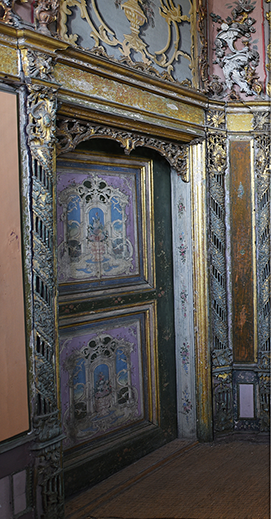
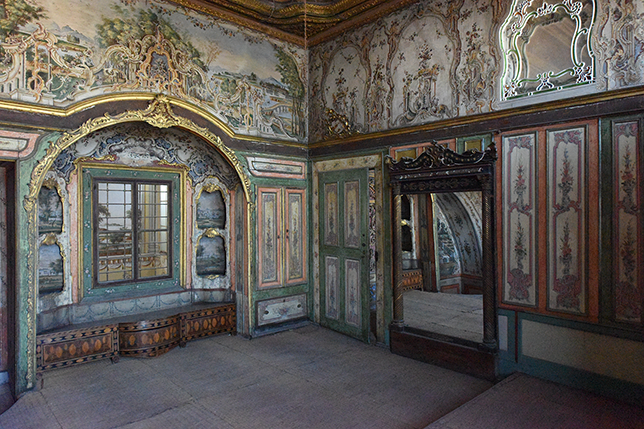
While it is currently hard to place the construction processes for Selim’s and his mother’s harem rooms on a clear timeline, they seem at least to have been conceptualized together, based on an interior design template in which they almost form a t-shape with Selim’s room extending out from Osman III’s court and the three conjoined rooms above it. They were all refurbished with extravagant rococo designs, augmented by intricate wood, metal, and stucco reliefs that frame copious murals depicting figureless kiosks in natural landscapes, and enhanced by individual or grouped columns, either painted or sculptural.Footnote 22 In all of the rooms, continuous bands of poetic inscription with chronograms eulogize the two patrons but also speak very directly about the lavish materials used in and the intended visual effects of each space. Each of the four rooms is arranged around a large arched alcove spanning an entire wall; Mihrişah’s central room upstairs has a window with a low rounded seat right below it at the center of its alcove, while one of the side rooms has a marble pietra dura fireplace with a rococo hood, and the other a cupboard topped with a mirror lunette. Selim’s room below, perched on high stone piers, was also designed around an alcove featuring an exuberant marble fireplace. While providing the undulation requisite of a rococo interior, the tripartite arched alcove that dominates all of these rooms also appears to be an adaptation and enlargement of the flower (or sherbet) niches in earlier domestic interiors.Footnote 23 Indeed, the alcove retains these smaller niches, which either bear smaller landscape scenes (in the valide’s rooms) or trompe l’oeil architectural features (in Selim’s room as well as the rooms of Osman III and Abdülhamid I).
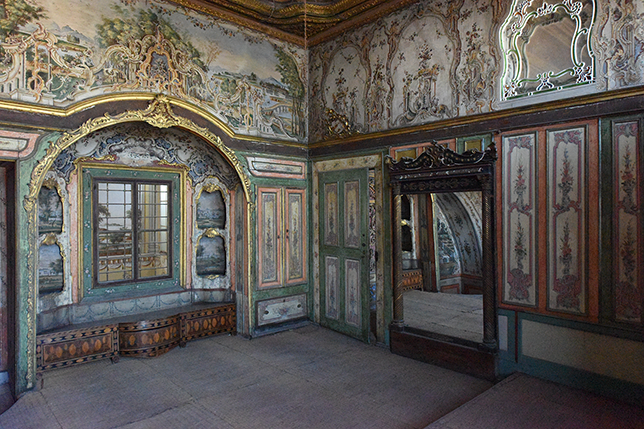
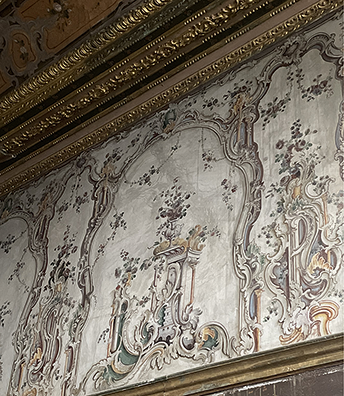
The first of the two connected rooms upstairs built for the valide (7A in Figure 4) was called the sofa, most likely because of its position at the center of the two wings, Mihrişah’s private room on one side (7B in Figure 4), and her son’s on the other (6 in Figure 4). The sofa features a window that looks down onto her domed reception hall much in the way of the sultan’s second-story room inside the Tower of Justice and above the divan hall in the palace’s second courtyard; the valide could view events below without being seen. The view from this window is of a longitudinal mural of a landscape on the high wall of the reception hall. Therefore, the overall effect of the alcove inside Mihrişah’s sofa is of an unbroken sequence of landscapes with architectural features, which, in fact, begins with the landing of the small staircase that leads up from the ground level of the reception hall into this space (Figure 6). The painted panels surrounding the alcove were collectively conceived. Each side of the window bears Cartesian flower parterres and pools fronting Ottoman kiosks with the sea beyond, while its top features an elongated and dynamic mural of a windswept landscape with bodies of water, airy Ottoman kiosks, undulating bridges, and distant mountains. White rocaille garden architecture made up of colonnades, columns, and towers with a gilded shell centerpiece framing a cascade of flowers compartmentalizes the scene. Once again, a continuous inscription, composed and written by Selim’s preferred calligrapher and one-time writing instructor Yesari Mehmed Esad (d. 1798), gives voice to the room’s visual program.Footnote 24 Echoing the landscape imagery, the poem reads this room as “paradise” (Firdevs). Moreover, the poet likens the central sofa to the “mirror of Alexander,” a technological wonder invented by Alexander the Great that according to the writers of the Arabo-Islamic and Perso-Islamic traditions allowed him to see enemies at a great distance and on occasion transformed into a weapon of war, setting a city on fire by reflecting the sun’s rays.Footnote 25 The aspects of the sofa that seem to have been devised to amplify the valide’s gaze – the elevated window that looks at the hall below, the windows that look out toward Eyüb, as well as the two apertures that lead to her more private space on one side and her son’s on the other – make a compelling case for such a powerful panoptic analogy. Alexander’s presumed tomb, the gift which the Grand Admiral Küçük Hüseyin Paşa hoped to make to Selim as discussed in Letters and Gifts, and the frequent appearance of Alexander’s name in Selim III’s honorifics (iskender-tuvan),Footnote 26 form a thread that connects these quarters, most emphatically in Selim’s room to which we return below, to the larger Alexander mythos.
View from the alcove of the valide’s central sofa into her treasury room.
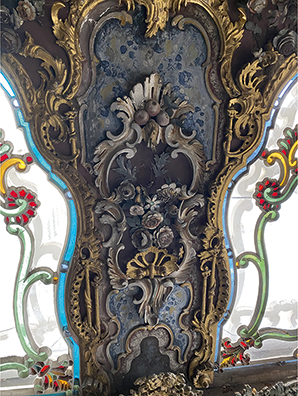
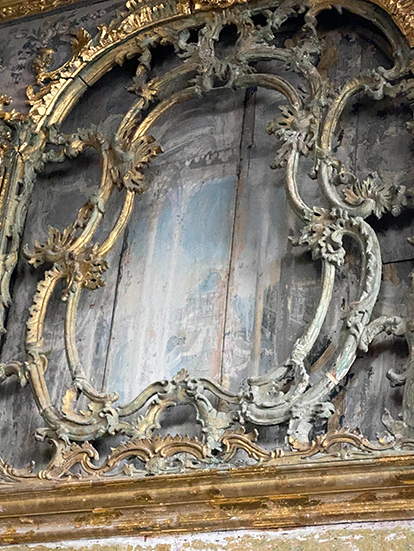
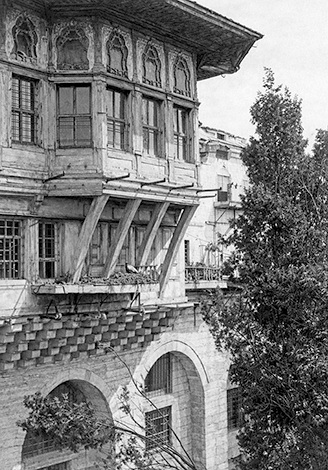
Mihrişah’s “treasury room” (often but not consistently hazine odası in archival records) exhibits the most sculptural decorative effects (7B in Figure 4).Footnote 27 The garden of paradise depicted in the murals on the walls of the room next door here seems to have been executed in three dimensions: The blossoming vegetation is made to grow out of the walls and the gilt rocaille frames resemble branches of a tree (Figure 7). It is no wonder that the first line of the poetic inscription adorning the space, composed by Seyyid Mehmed Münib Efendi (Ayıntâbî) (d. 1823), an important ulema proponent of Selim’s reform initiatives, poet, and composer of Mihrişah’s endowment deeds, likens the room to “a delicate tree abode” (cay-ı letâfet-mesken). Indeed, this architectural unit, constructed almost entirely of wood, is perched over the extant ground level structures like a treehouse. Münib articulates the intended amplification of visual effects from one room to the next by suggesting that the Garden of Paradise (Bâğ-ı Firdevs), represented on the walls in the previous room, was going to “burn with envy” because of the way that the gardens, water, and light were depicted in this adjacent space. In other archival records, this room is mentioned as the valide’s room with a navy-blue ceiling, which was meant to resemble the night sky, reinforced by the poem’s allusion in which the room (domed on the outside) is likened to a tree reaching up to touch the azure firmament (İrtifâ-ı kaddi tâ çerh-i kebûd ile mümâs).Footnote 28 This allegory continues throughout the poem, relating the shiny color of the room’s ceilings to “the soul of the night-illuminating stone used in its oil,” and claiming that the new-style illuminations on its gold-pasted ceilings are comparable only to the stars in the sky.Footnote 29 In fact, judging from extant expense accounts, an inordinate number of different tones of blue were used to paint this room to make it look like a forested landscape at night: navy blue (lacivert), Viennese/Austrian indigo (çivid-i Beç), and Lahori indigo (çivid-i Lahori).Footnote 30
Two-dimensional painted mural with blossoming vegetation and columns in Mihrişah Valide Sultan’s sofa;
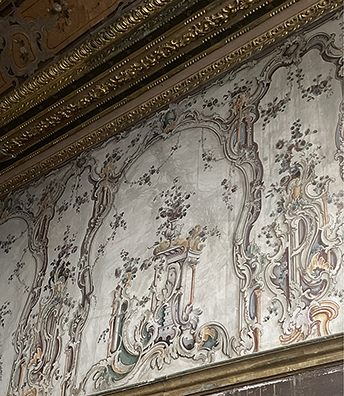
Three-dimensional, stucco version of a similar mural with a gilt rocaille frame from Mihrişah’s treasury room.
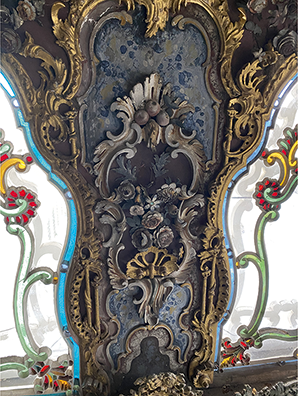
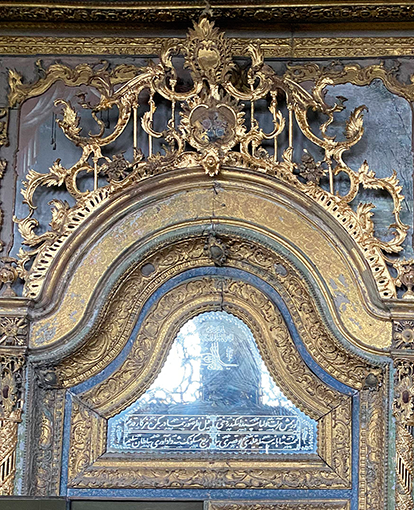
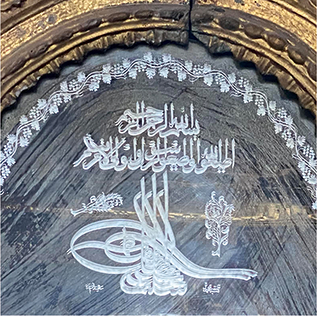
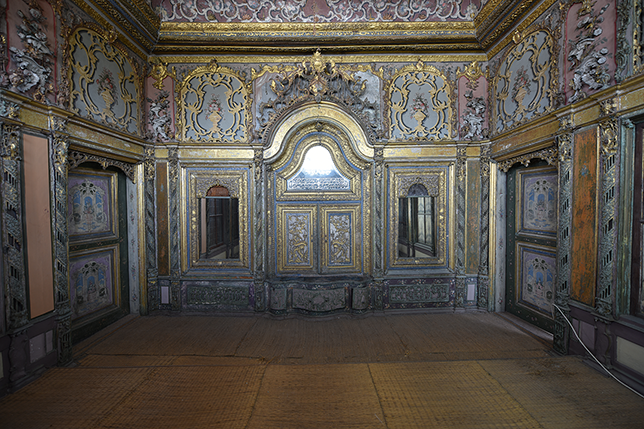
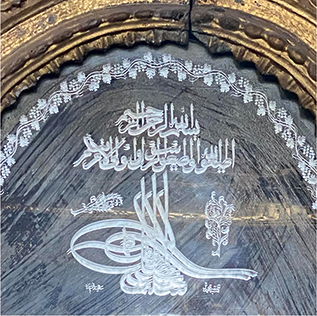
Although designed symmetrically with his mother’s quarters, Selim’s heavily gilded private room is located on a slightly higher level, befitting Ottoman architectural decorum that reserved the highest stature for structures for the sultan (6 in Figure 4). Atop a narrow wooden staircase, a two-paneled wooden door opens into this rectangular room, which once also hosted a holy relic of the Prophet, strands of his hair and beard (lihye-i şerif).Footnote 31 The entrance door and the door of the small storage area directly opposite it are adorned with identical paintings (Room 6, doors C & D in Figure 4). These paintings depict a sizable imaginary terrace, which supports slender columns with Corinthian capitals connected by rocaille-topped arches that open toward a green landscape. The only wall without windows is the one with the tripartite alcove, like those in Mihrişah’s sofa and treasury room (Figure 8). The alcove’s three sections and the decorative panels on the room’s other walls are separated from each other by gilded wooden engaged columns stacked with slender columns and bands of foliage and flanked with gilded small spheres that resemble pearls. Placed at the center of the alcove is a mirror engraved with the besmele, a section of the fifty-ninth verse of the Qur’anic surah al-Nisa, Selim’s tughra, and the name of the calligrapher, Mehmed Sa’id, with the hijri date 1205 (1790–91) on the top and a chronogram on the bottom (Figure 9).Footnote 32 Just like the chronogram in Mihrişah’s sofa, this, too, references Alexander’s mirror, stating that the beauty of this room, commissioned by Selim for his personal use, was unparalleled, not reflected even by the mirror of Alexander.Footnote 33 The outer borders of this mirror are framed by engraved grape vines, closely resembling the painted decoration on the dome of the valide’s reception hall.
A view of the alcove-like tripartite mirrored wall in the lihye room of Selim III.
The three-dimensional crest of the mirrored cabinet in Selim’s lihye room.
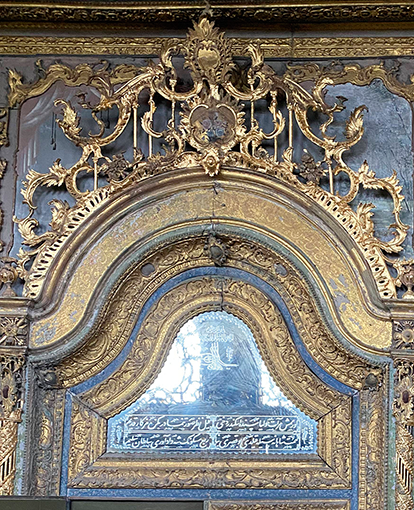
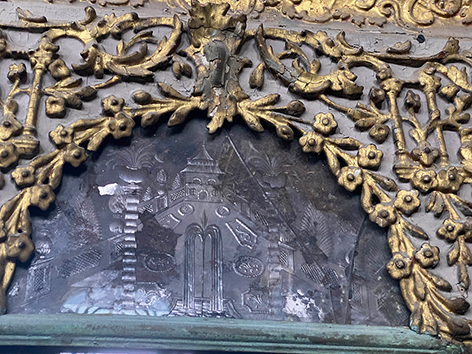
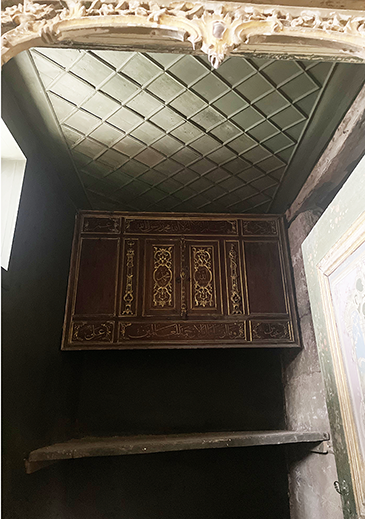
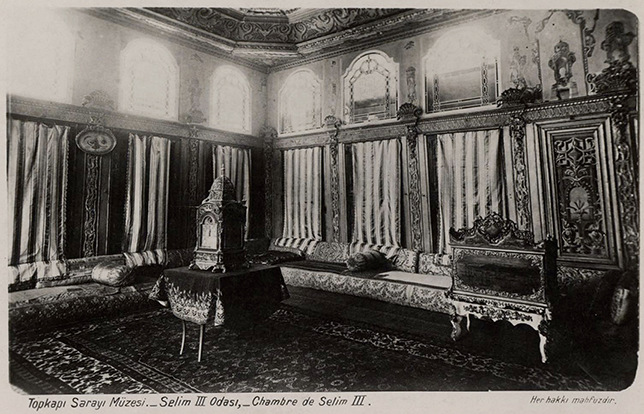
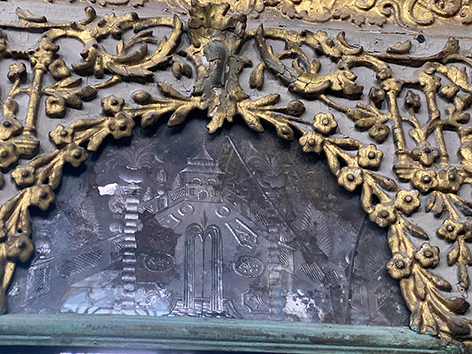
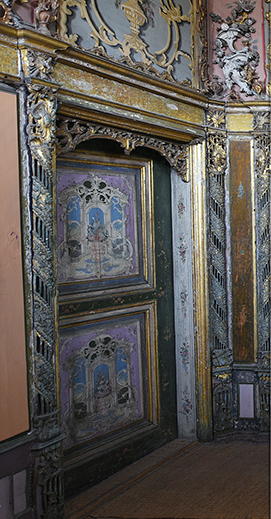
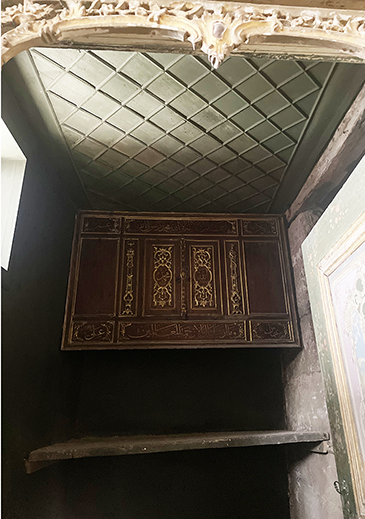
The alcove’s midsection was designed more spectacularly than its mirrored sides, featuring a cabinet beneath a large, lunette-shaped central mirror. This cabinet, along with its projecting convex drawers, features columns linked by foliage, flowers, and cypresses, all rendered in gilded relief. The alcove’s mirrored sides not only amplify the perceived size of the room by reflecting the view of the Golden Horn from the windows opposite, but they are topped with smaller lunettes covered with glass panels displaying perspectival views of pagoda-like kiosks, set at the center of a garden featuring flower beds, vases, and reflective pools stretching toward the viewer, all in repoussé (Figure 10).Footnote 34 Specifically in the case of this room, the alcove bearing a relic could perhaps be likened to an iconostasis – an especially poignant adaptation if these rooms were in fact constructed by Greek Orthodox artisanal communities, as several archival documents concerning the Ottoman palace suggest, who also worked on their own ecclesiastical buildings.Footnote 35 Another indication of the employment of these Greek artisans in imperial commissions might be the resemblance of the Solomonic oymakari wooden columns found in the rooms of Selim and Mihrişah in the upper harem to those within the Phanar Greek Orthodox College or the Patriarchal Church of Saint George.Footnote 36 Old photographs reveal roundels containing the names of the Rashidun caliphs, along with Hasan and Hüseyin (the sons of Prophet Muhammed’s daughter Fatima from ‘Ali, the last of the caliphs), placed above the gilded corniche and at the center of the painted rocaille cartouches, further emphasizing the room’s chapel-like function for the sultan. On the alcove’s left, nested behind a door with double imagery of a rose garden, there is a small room with a cabinet, whose burgundy doors replicate the hilye format often found on paper: Four small roundels on four corners reserved for the Rashidun Caliphs surround the pendentives reserved for Muhammed and Allah, the besmele at the top and the verse “We have sent you [O Prophet] only as a mercy for the whole world” in the bottomFootnote 37 (Figures 11 and 12). The lihye might have been stored here, the bodily relic itself substantiating the physical characteristics of the Prophet.
One of the glass panels depicting an architectural landscape from the lihye room.
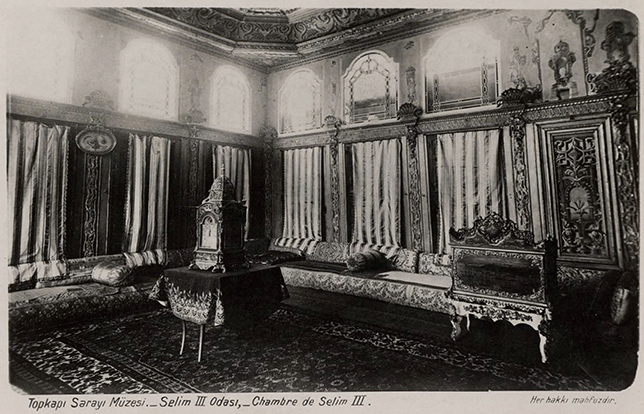
A photograph from the 1960s showing the interior of the lihye room. From Emler, Topkapı Sarayı Restorasyon Çalışmaları, 71.
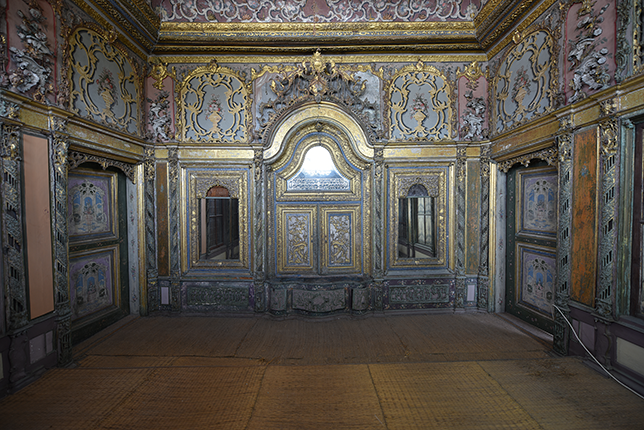
A photograph from the 1960s showing the door (with a calligraphic pendentive bearing the name of Prophet Muhammed) leading to the small nook containing the lihye’s cabinet;
The hidden cabinet where the lihye-i şerif was preserved.
A poem by Münib Efendi, the ulema-poet who composed the chronographic poem in Mihrişah’s treasury room, is here inscribed over the solid gold corniche, which encircles the room, and lauds Selim’s sovereignty. Curiously, the inscription does not mention the presence of the lihye. The poem’s last line dates the completion of the building to a year after Selim’s accession and calls this building the Selimabad pavilion (kasır). In the way that the poet animated this room’s mirror-image, Mihrişah’s treasury room, here, too, he draws allusions to the interior being Edenic, designed to evoke an ever-blossoming field with its domed ceiling reaching to the heavens. This imperial interior of the palace is also meant to represent an outdoor chamber of repose (ârâmgâh). While Alexander the Great is once again central to the kingly metaphors, the poet also links Selim’s reign to that of Solomon, the wisest of all biblical rulers. Therefore, while the mirror on the alcove is the material manifestation of Alexander’s mythical, all-seeing mirror and weapon of war, the rounded pilasters with miniature columns encircled by heavy garlands might be an interpretation of the helical Solomonic columns with twisted vine leaves.Footnote 38
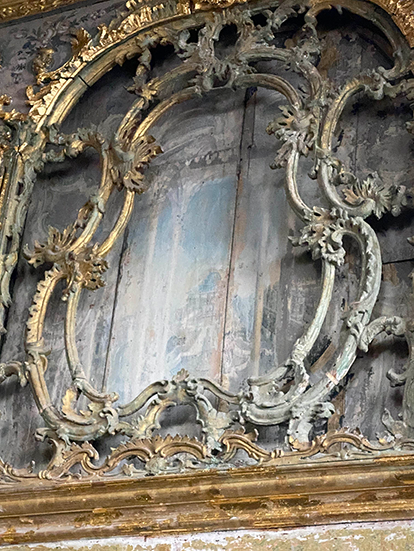
The flat designs above the inscription band on the solid wall transition into sculpted, three-dimensional forms as they approach the windows on the other three walls, adding a dynamic and tactile quality to the space. While above the windows this foliage transforms into frames that enclose the Golden Horn, in one instance where there is a blind window across from an actual window, in order to continue the symmetry, the foliage frames another figureless architectural landscape painting, almost identical to the engraving on the central mirror and mimicking the real windows (Figure 13). This mock window, just like other examples, embodies a desire to look upon landscapes with a clear horizon, featuring as it does airy kiosks and symmetrically designed gardens and pools. These architectural landscapes are ambiguous in their representation; however, it is not unreasonable to suggest that they portray an abstract interpretation of the Garden of Paradise. The theme of gardens and rivers is a recurring motif in the Qur’an, associated with both paradise and the dwelling place of the righteous. Coupled with the epigraphic program and the gilded reliefs depicting foliage, flowers, and trees, these paintings likely contributed to the creation of a sublime atmosphere, aligning the users with the image of “righteous” Muslims.Footnote 39 The example in the lihye room is particularly meaningful, as the paradise garden imagery is most fitting in the presence of the Prophet (Appendix 3). Nevertheless, these architectural landscapes may also be blueprints of the real coastal palaces that Selim and Mihrişah were planning to build well before Selim ascended the throne. The poetic inscriptions on their new chambers writing about completed monuments before they were built is indication of an active political agenda relying on a healthy dose of foretelling.
A three-dimensional foliage framing the painting of an architectural landscape in the lihye room.
Selim III’s main room, on the same level as Osman III’s forecourt, is a light wooden structure raised over four stone piers (4 in Figure 4). It also retains the identical model of an alcove-centered room, in which the alcove’s arch (like in Mihrişah’s treasury room) houses a baroque marble fireplace. The arch is topped by a gilded garland, and a shell cartouche (once inscribed with Selim III’s tughra) is set as its keystone. Like the lihye room upstairs, this room also displays architectural landscapes, but in much more modest quantities than those in his mother’s rooms. Selections from the sixteenth-century Ottoman poet Mehmed Bey’s hilye-i hakani are written by Yesari Mehmed Esad in gold on a blue inscription band surrounding the room (Appendix 4).Footnote 40 The marble fireplace composed of fluted plaster and baroque curves is visually augmented on either side by trompe l’oeil columns and marches, as well as gilded three-eyed niches also painted with perspectival illusions (Figure 14).
Sultan Selim III’s room, facing Osman III’s courtyard. Salt Research, Saim Ülgen Archive, TASUH3509.
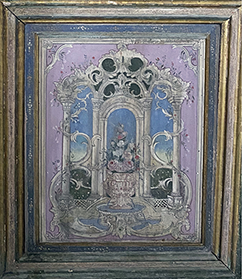
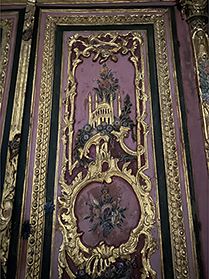
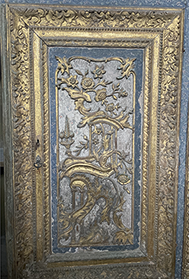
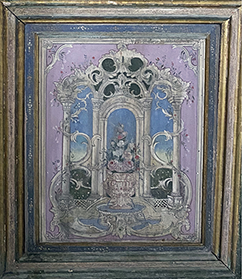
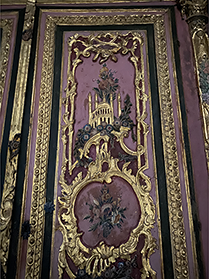
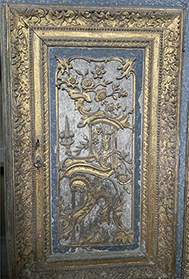
Many groups of artisans, such as carpenters (neccaran), plasterers (sıvacıyan), stonemasons (taşçıyan), engravers/carvers (oymacıyan), illuminators (nakkaşan), and tinsmiths (tenekeciyan), appear on the expense registers related to the decoration of these rooms.Footnote 41 These individuals seem to have used ample creative license to localize rococo forms, whether it was by inserting murals that are distinctly Ottoman in form with kiosks and landscapes (Figure 15a), or by depicting a baroque mosque in relief inside a gilt cartouche on a door panel (in the sultan’s principal sofa inside the harem) (Figure 15b), or by inserting a somber cypress tree into rococo foliage (on the cabinet in Selim’s room that housed the lihye) (Figure 15c). Their final decorative program might have involved selecting forms and motifs from pattern books in circulation, which would have then been improvised on by makers in alignment with the patrons’ desires.Footnote 42
Door panel depicting a rococo fountain in Selim’s lihye room;
Door panel with gilt rococo mosque in the harem’s principal audience hall (hünkar sofası);
Rococo foliage with a cypress tree on the cabinet in the lihye room.
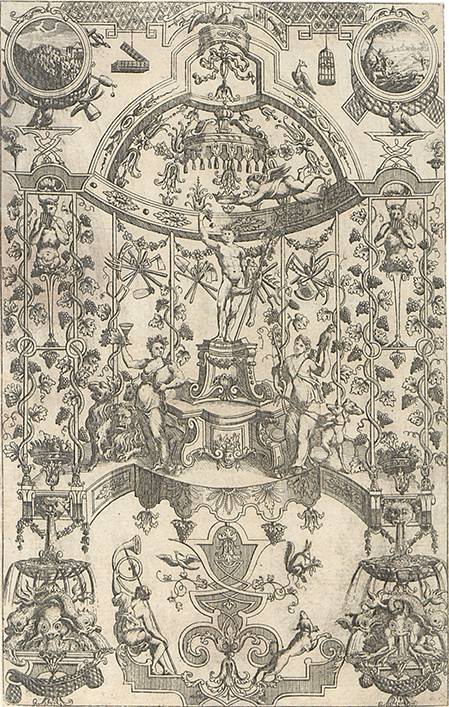
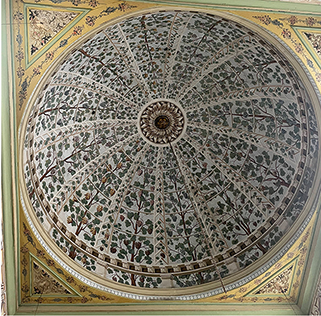
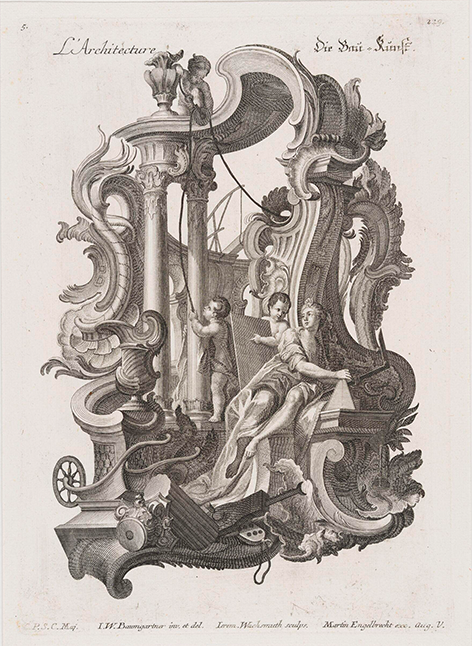
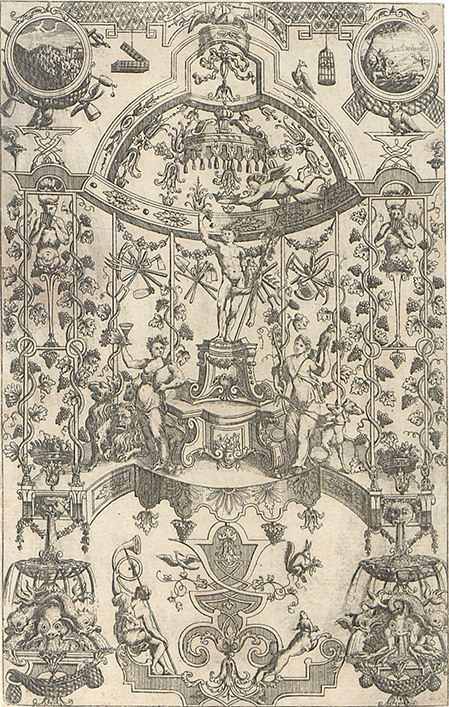
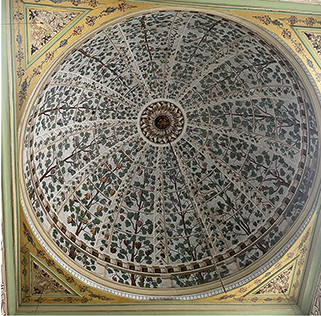
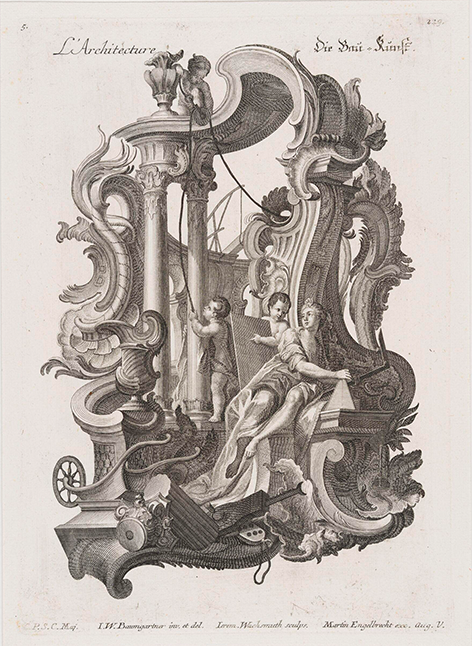
One of these pattern books, later rebound during the reign of Sultan Abdülhamid II (1876–1909) contains copious engravings from celebrated rococo designers from France and Augsburg such as Jeremias Wolff (d. 1724), Jeremias Wachsmuth (d. 1774), François de Cuvilliés (d. 1768), and Jean-Antoine Watteau (d. 1721).Footnote 43 The cascading vine decorations painted on the inside of the dome in the valide’s reception hall as well as the elegant vine motif on the mirror in Selim’s room bearing the lihye are found in a grotesque assemblage, designated precisely for a domed architectural space, inside the pages of this album (Figures 16 and 17). Cuvilliés’ rocaille-framed, figureless landscapes with temples, ruins, and bridges seen from across seascapes must have been understood as kindred practice, close in sensibility to the Ottoman landscape vignettes and therefore preferred as models. One of the predominant rococo motifs favored for the harem walls is the painted or stucco columns holding up the rocaille frame. This is an especially dominant feature in Selim’s lihye room, where the alcove hosting the mirrored cabinet is adorned with a three-dimensional gilt crest projecting out of the wall. This crest, composed of Ionic columns supporting a tripartite rocaille frame, serves as a vivid example of the intricate ornamentation typical of the era (Figure 9). An engraving by Wachsmuth, which although not found in the palace library might have been part of the Ottoman artisans’ own collections and likely inspired the persistence of rocaille-based frames with columns in these imperial rooms. The engraving pivots the rocaille frame to enhance its dimensionality and adds columns to support the organic frame, which hosts within it the personification of Architecture and her cherubic helpers (Figure 18). In the Ottoman context, the human figures are replaced with architectural features and landscapes alone.
A grotesquerie after Jean-Antoine Watteau from a collated group of engravings in the Topkapı Palace Archives, TSMA H.2590–036.
Vine motifs encircling the mirror in the lihye room.
Cascading vine decorations painted inside the dome of the valide’s reception hall.
L’Architecture/Die Baukunst. By Jeremias Wachsmuth after Johann Wolfgang Baumgartner.
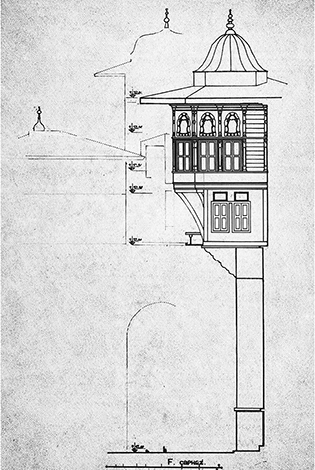
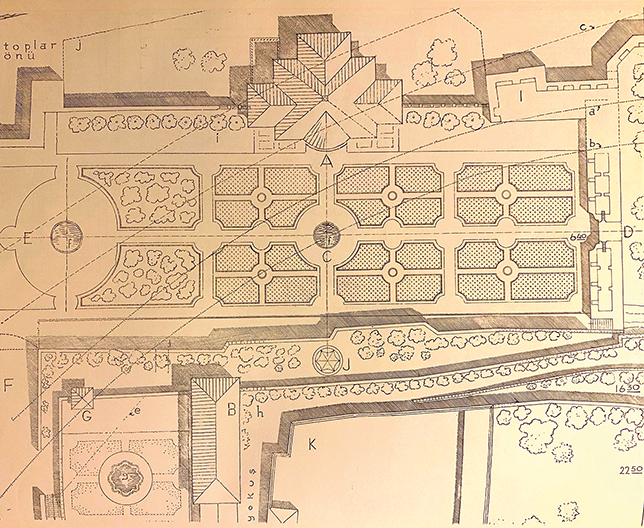
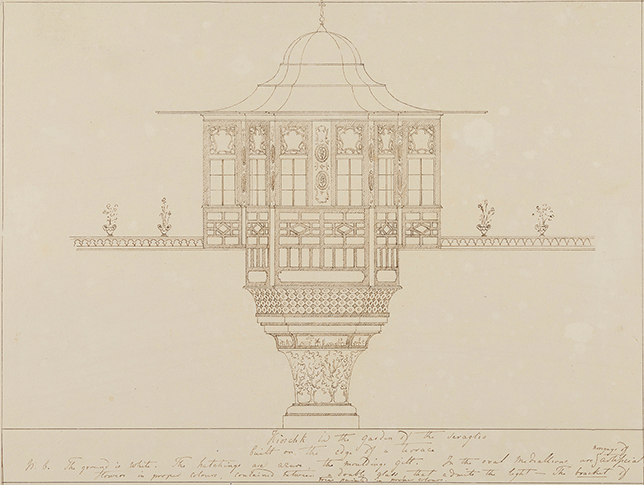
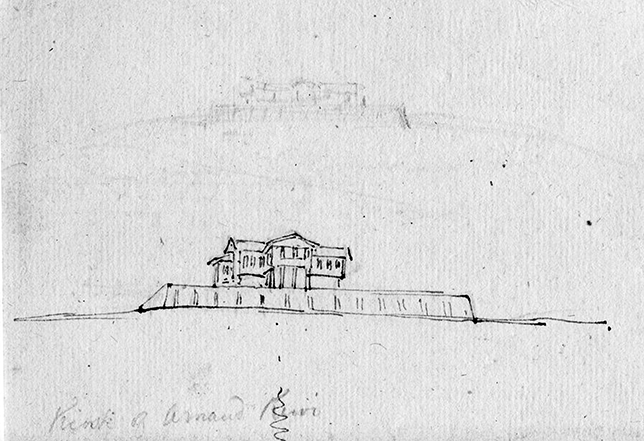
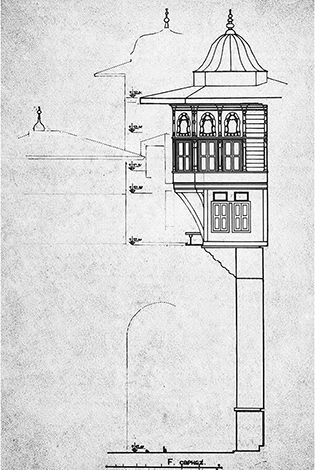
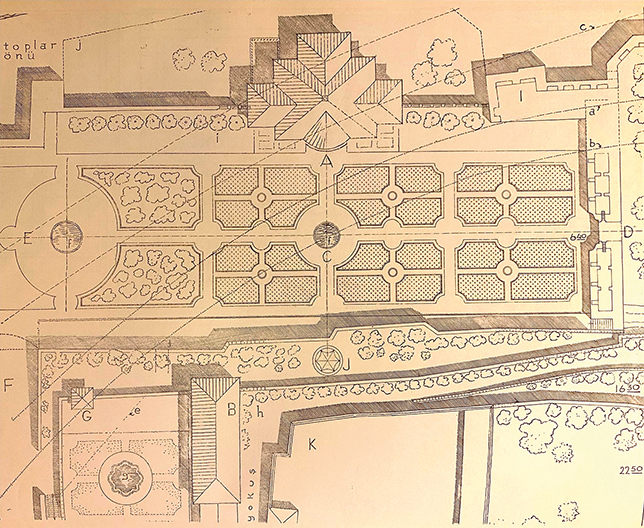
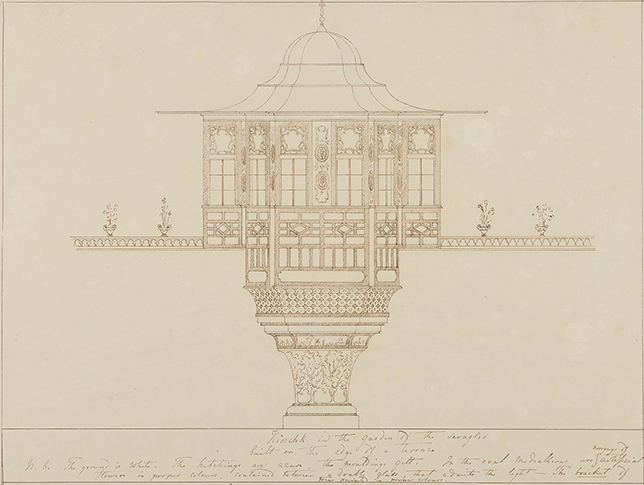
Architectural forms bearing allusions to nature and specifically associated with Mihrişah were also present within the imperial palace. Her treasury room, built in timber and placed high above the winter harem’s extant masonry walls like a tree-or birdhouse (clearly illustrated in Emler’s section, Figure 19), found its miniature expression as a kiosk in the gardens of the summer harem. (G in Figure 20) Thomas Hope (d. 1831), the Dutch-British designer, tastemaker, author and one of the most detail-oriented of the period’s Grand Tour draughtsman provides an elevation of this elegant, polygonal folly, which straddles a garden wall separating the new gardens of Selim’s Yeni Kiosk and the higher terraced spaces of the sloping site. Hope’s detailed description speaks of the small garden kiosk’s moldings as containing bouquets of artificial nosegays. These projecting floral reliefs, the baroque windows beneath the roofline, the form of the dome, the bracket on which the structure rests, all replicate the valide’s treasury room (Figure 21). In the case of the ornate facade of the garden kiosk, it is as if the treasury room was turned inside out for the representation of the summer harem’s outdoor folly. The moldings of this garden structure, Hope carefully labeled on his sketch, were of gilt and the hatched frames were azure blue (extending the obsession of blue in the treasury room). The bracket is covered in lofty trees and architectural landscapes, not unlike the murals in frames inside the winter rooms of Mihrişah and Selim.
Mihrişah Valide Sultan’s Treasury Room.
A Section of the treasury room droughted by Selma Emler in her Topkapı Sarayı Restorasyon Çalışmaları, 33.
Site plan of Selim’s Yeni Kiosk and its parterre garden in Sedad Hakkı Eldem, Türk Bahçeleri, 98.
Kiosk in the garden of the Imperial Seraglio. By Thomas Hope, Benaki Museum, 27093.
2 The Summer Section of the Imperial Palace, Topkapısı Sahilsarayı
During Selim’s reign, the destinations and periods of the court’s seasonal migration were well regulated. In winter, the harem stayed put in the third courtyard; during the summer’s hottest days, the court resided in the Beşiktaş Palace. But the harem inhabitants spent perhaps the longest periods (early fall; spring and early summer) in Topkapı’s coastal tip, which Melling’s map called the summer harem (harem d’été).Footnote 44 Though none of the structures that constituted this area have survived, a cluster of maps, walkthroughs, and sketches from the period allow us to reimagine the spaces, and in fact rethink some of Selim’s best-known portraits as representations that also aimed to exhibit the segments of this site that were relevant to his imperial persona.
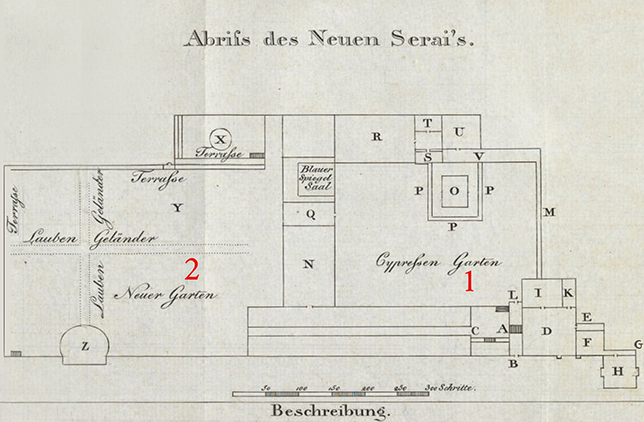
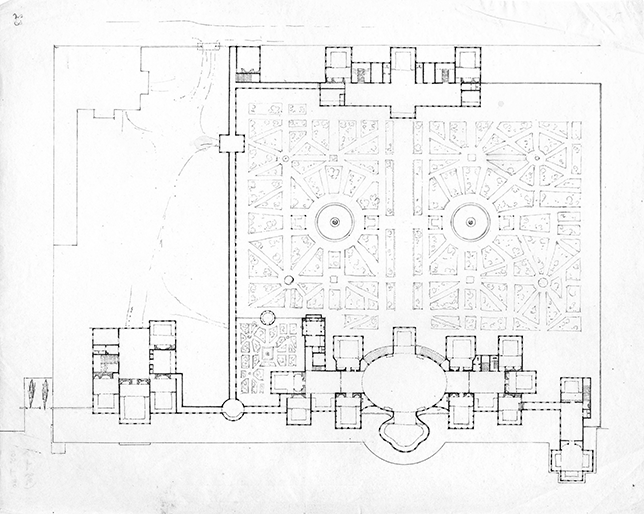
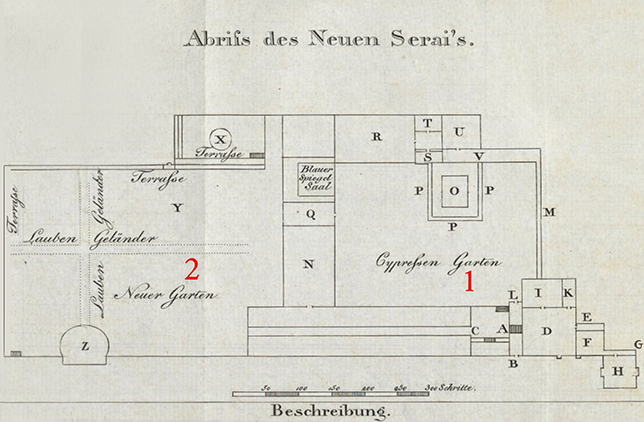
The summer harem was broadly composed of two courtyards, each with quadripartite gardens (Figure 22). These gardens were a terraced version of the chaharbagh, the parterres quartered by water channels or walkways, landscape design ubiquitous in the Islamicate domains. The courtyard closest to the Cannon Gate (Topkapısı) was considered the inner courtyard (1 in Figure 22), reserved for the harem inhabitants alone, while the adjacent courtyard (2 in Figure 22), which housed Selim’s Yeni Kiosk and its oval central hall (otherwise known as Şevkiye Kasrı), was an interstitial space that combined private and semi-private functions of the court. Selim’s court used the many extant structures commissioned by preceding sultans; especially during the reigns of Ahmed III and Mahmud I, this area became known as the waterfront palace of Topkapı.Footnote 45 However, the outer courtyard and its structures were all built under Selim with the guidance of Danish ambassador Baron Hübsch and a new German gardener, Jacob Ensle.Footnote 46 Many European travelers who made connections with Ensle were able to see parts of the summer palace – among them, Austrian Orientalist Joseph von Hammer-Purgstall (d. 1856), who refers to the two-courtyarded site in the peninsular tip as the “river palace” (Uferpallast).Footnote 47 In rapid succession, the French diplomat François Charles Hugues Laurent Pouqueville (d. 1838); English clergyman Edward Daniel Clarke (d. 1822), who would secure the Rosetta Stone and tomb presumed to be Alexander’s for the British (discussed in Letters and Gifts); Thomas Hope; and Hammer would visit and document their Ensle-led tours of the segments developed further by Selim III.Footnote 48
The schematic plan of the Topkapı Waterfront Palace topkapısı sahilsarayı. Hammer, Constantinopolis und der Bosporos (1821), 308.
The murals covering the walls of the winter harem depicting kiosks fronted with pools, fountains, and flowerbeds, while undoubtedly alluding to the Garden of Paradise, should perhaps also be considered as representations of real ones conceived in the sections of the summer harem as well as of the imperial kiosks and gardens along Istanbul’s shores. The winter harem’s decorative program acted as a reminder of warmer days, and of the real nature that awaited the inhabitants. From Melling’s recollections, we understand that Selim devised plans – not fulfilled due to Napoleon’s entry into Egypt – to completely overhaul the inner courtyard adjacent to the Cannon Gate in the likeness of his Yeni Kiosk-fronted outer courtyard with the help of Melling, Ensle, and the French engineer François Kauffer.Footnote 49
Ensle would bring Hammer and his European retinue up from the sea through the Cannon Gate. The first structures they encountered were those designated for Mihrişah and the sultan’s seven consorts, “chambers and a bath” that were small but appealed to the senses because they housed fragrant cabinets made of cypress wood and inlaid with mother-of-pearl inscriptions.Footnote 50 An avid compiler of Ottoman, Arabic, and Persian inscriptions during his travels, Hammer was struck by the frequency of the use of the hilye on the surfaces of spaces designated for women. Those who wanted to bear children would wear this inscription, one describing the image of “the highest radiance of beauty and perfection,” around their waists as apotropaic belts.Footnote 51 He also formulated a connection between the valide’s honorific, mehd-i ulya-i saltanat, the mother-of-pearl of the sultanate, and the precious material that covered the spaces in which she presided. He likened this powerful visual icon to the images in European bedrooms of Apollo Belvedere (otherwise known as Apollino) and the Medici Venus, both Hellenistic copies at the Uffizi of Greek originals that shared the same talismanic function of fertility.Footnote 52 The deliberate avoidance of figural imagery by Ottoman patrons in their domestic settings invites a reconsideration of the purpose of the numerous architectural and landscape vignettes enclosed within exuberant rococo shells, as well as those entirely devoid of human figures. Rococo’s emphasis on arboric motifs and its preference for shell and rockery forms made it particularly compatible with a Muslim audience and its visual traditions.Footnote 53 As noted earlier in this section, the inscriptions that traverse the murals on the walls of Mihrişah Sultan’s upper-story chambers in the winter harem at Topkapı Palace further shape their meaning, allowing these compositions to be understood as carefully regulated variations on the theme of the Garden of Paradise.
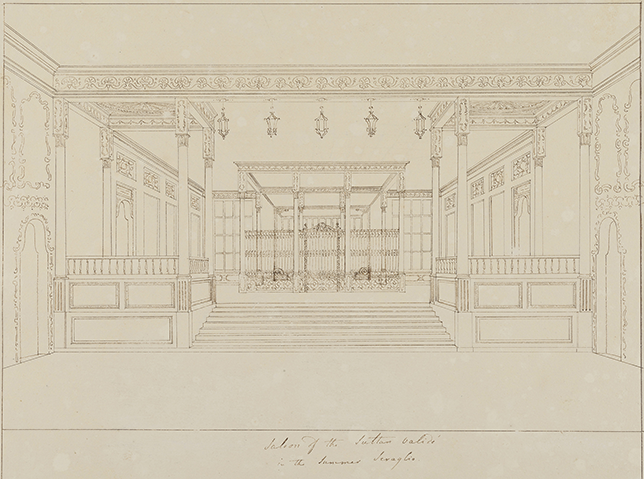
After providing a brief description of the imperial spaces around the Cannon Gate, from where he enters the summer harem, Hammer elaborately describes a “dance or festival hall” (Tanz- und Festsaal) (A in Figure 22), which was divided into an upper and a lower section. The upper part, which he interprets as a classic Eastern inversion, was “surrounded by golden railings,” where the enthroned sultan – in “a sort of cage” according to Clarke – watched the dances and games in the lower part. From behind the sultan’s grilled space the view was of the sea, “bright and clear,” while the back of the performance hall presented views of the cypress garden, “dark and magically beautiful,” forming a perfect zülvecheyn, a structure enabling two distinct vistas on either side.Footnote 54 Clarke observes that the broad steps separating the two zones were covered in crimson cloth with furnishings of crimson velvet and gold. Both Clarke and Hammer are struck by the profusion of mirrors and by two large pieces of agate stone, cut like mirrors, surrounding the performance space.Footnote 55
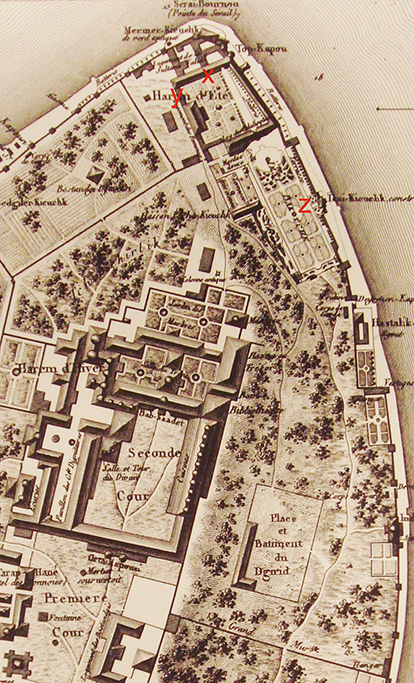
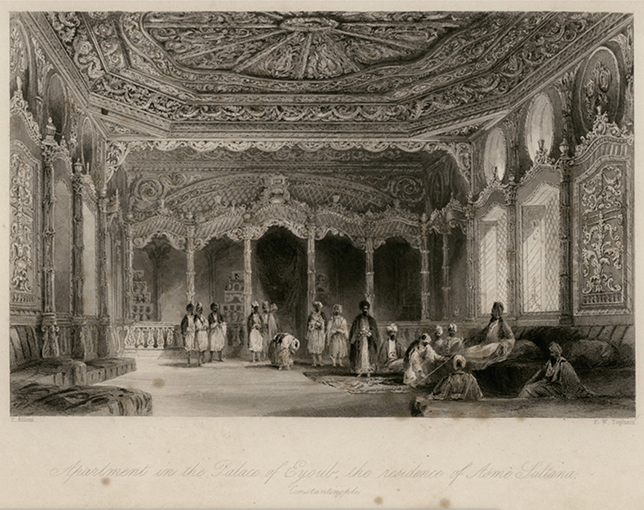
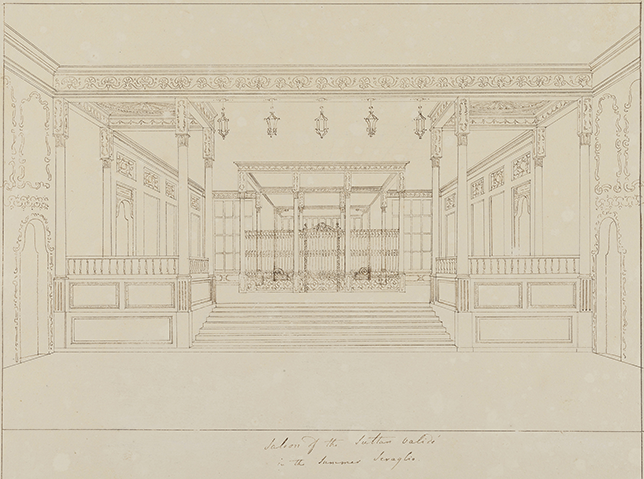
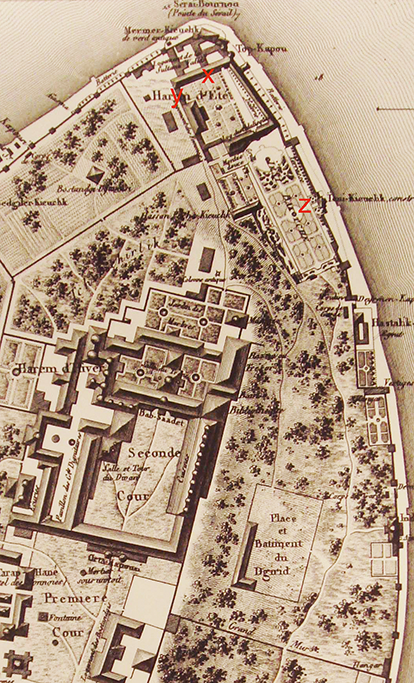
Thomas Hope provides a line drawing of an interior from inside the palace, with precisely the same columned and grilled maqsura-like space designated for the sultan, which he identifies as a “room of the Sultan Validé in the Summer Seraglio.” (Figure 23). Hope likely refers to this entertainment space as belonging to the sultan’s mother because it was situated between a specific room with an oeil-de-boeuf window (D in Figure 22), which was built during the reign of Ahmed III and later assigned to Mihrişah Sultan (as shown in Hope’s sketch), and the adjoining harem building. Hammer’s detailed description of the palace’s new sections on the peninsular tip sheds light on the location of the harem drawing in Melling’s VoyageFootnote 56 (Figure 24). The artist’s cross-section of an elongated, gallery-like space divided into three floors on either side raised over wooden scaffolds – peopled by the flurry of harem inhabitants attending to different tasks – presents the designated space for the sultanas, perhaps Selim’s unmarried sisters, as he had no daughters, as well as his married sisters and cousins who paid him regular visits. This gallery spanned the entire length – about 300 paces long and forty five paces wide – of the shoreline segment of the summer harem’s first (inner) courtyard (V and M in Figure 22 and X and Y in Figure 24). and connected perpendicularly to an extension of the dormitories for the cariyes (N in Figure 22).Footnote 57 Just like the theater, one side of the gallery had privileged sea views while the other looked out over the inner courtyard’s cypress garden.
Saloon of the Sultan Validé in the Imperial Seraglio [the nonextant palace theater]. By Thomas Hope. Benaki Museum, 27101 v. I.
The map of the imperial palace and the layout of the peninsular tip by the Cannon Gate in Melling, Voyage pittoresque (1819).
It appears that two of the most famous portraits of Selim III, both still attributed to Konstantin Kapıdağlı though with considerable differences in the hands of the maker, were also made to render visible the newly developed sections of Topkapı’s summer harem.Footnote 58 In the same vein, the court desired that their new space be seen by privileged foreigners, especially at times when courtiers were in their summer palaces along the shoreline. For example, upon the request of Pierre Ruffin, France’s diplomatic representative, sometime before 1798 Selim permitted a delegation to visit the palaces of Beşiktaş and Çırağan, alongside imperial mosques, headquarters of the Janissaries (Ağa Kapısı), the Seven Towers, and the slave market. The Sultan even remarked, “If there are no hindrances, let them also visit the garden of Topkapı” (Bir mahsur yok ise Topkapı‘nın bahçesine de gelsinler).Footnote 59 Their European builders and gardeners such as Ensle, Melling, and Baron Hübsch were given permission, perhaps even encouraged by the court, to provide tours of these zones.Footnote 60 Selim and his image-makers, foremost among them Küçük Hüseyin Paşa, modeled for the sultanic portrait several times across the site’s most important buildings.
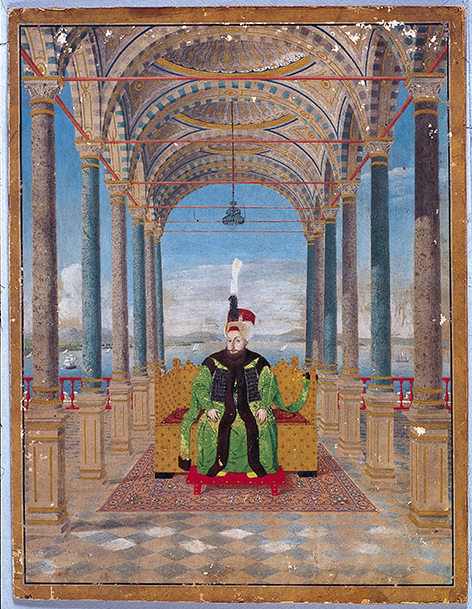
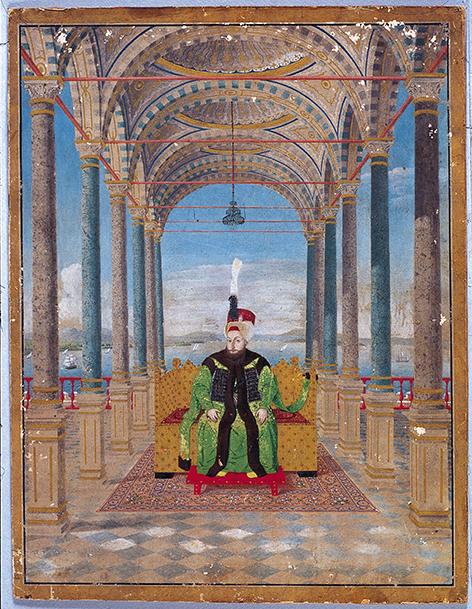
The first of these paintings, a small, illuminated folio (47 × 35 cm), spotlights Selim seated on the golden “bayram” throne encrusted with precious stones under the canopied arches of the Marble Kiosk (Figure 25). He is situated at the center of the columnar space slightly above sea-level and below the kiosk’s enclosed upper story. In his detailed description of the palace’s new zone, Hammer focuses on this very level of the kiosk only precisely because of its views that “dominate the entire Propontis and the Bosphorus up to its first bend.”Footnote 61 The painting gives us precisely that view, with the Sea of Marmara opening toward the Prince’s Islands. He also describes the beauty of the very columns that aid in the perspectival illusion of the painting; he counts twelve of Breccia green marble; the exactness of the stones’ crystallized formation is detailed by the artist. The sultan’s gaze lines up with the horizon line and the painting’s one-point perspective.Footnote 62 The visibility of this kiosk more than all the other structures in these new harem grounds was also not lost on Clarke, who made a similar but relatively more rushed visit to the site than Hammer; he names the kiosk the “Chamber of Repose,” and writes:
Portrait of Selim III seated under the canopied arches of the Marble Kiosk. Presumed to be the hand of Konstantin Kapıdağlı. Oil on paper, TSM, A. 121–31.
Nothing need be said of it, except that it commands the finest view anywhere afforded from this point of the Seraglio. It forms a part of the building well known to strangers, from the circumstance of its being supported, towards the sea [italics ours], by twelve column[s] of that beautiful and rare breccia, the viride Lacedaemonium of Pliny, called by Italians Il verde antico. These columns are of the finest quality ever seen; and each of them consists of one entire stone. The two interior pillars [are] of green Egyptian breccia, more beautiful than any specimen of the kind existing.Footnote 63
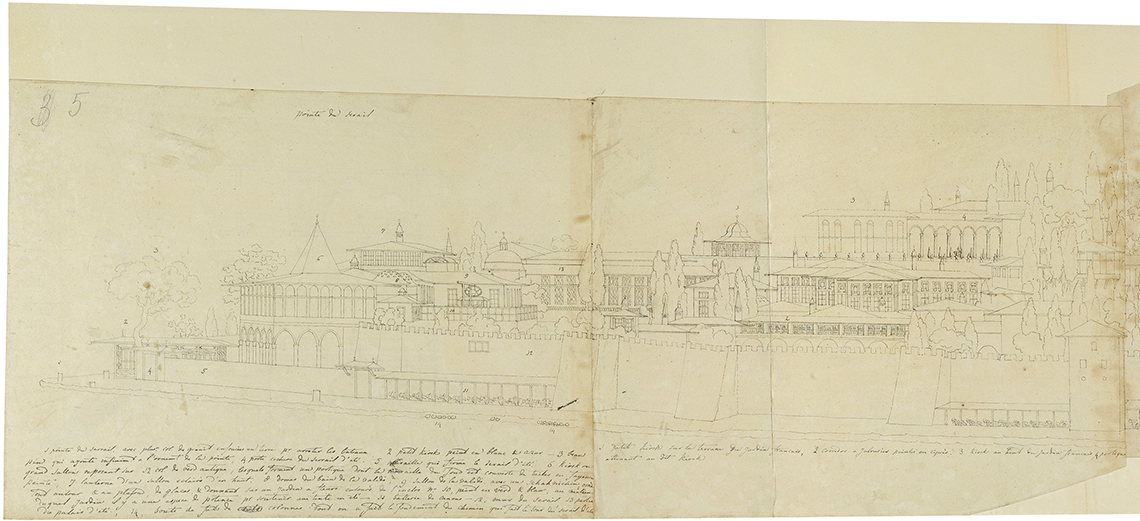
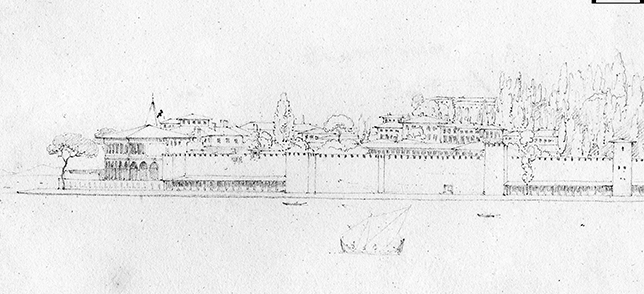
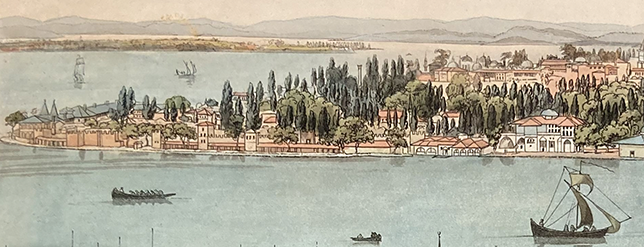
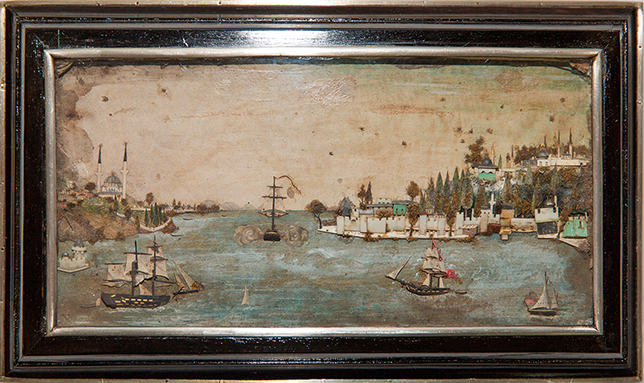
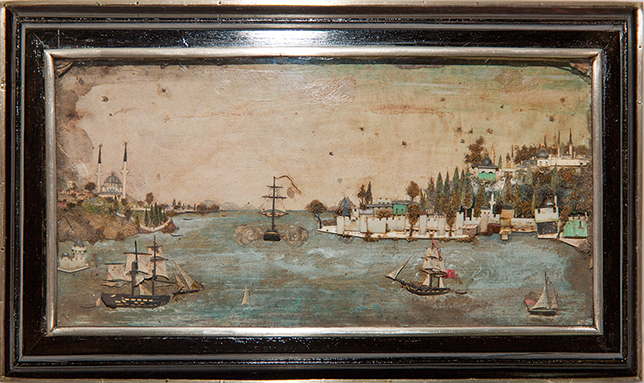
Hope provides us with a wonderful sketch of the new harem’s elevation from the peninsular tip toward the Eminönü quay, most likely drawn while he was seated in a Tophane coffeehouse (Figure 26). Most Grand Tourers of this period focus on this portion of the palace, most likely because they were made aware of its architectural revitalization and increased use by the court; the British architect Robert Cockerell provides a near-identical elevation of this portion of the palace among his sketches (Figure 27). The summer palace also appears in Barker’s panorama, where the green of the inner courtyard with its cypresses is visible (Figure 28). In Pope’s version, the kiosk appears in front of one of the towers of the Topkapı gate, its celebrated columns visible from behind a low seawall. Hope, likewise, jots down its description as “kiosk or grand room supported on 12 columns of antique green that form a portico where the back wall is covered by painted ceramic.”Footnote 64 The pen box, first introduced in Letters and Gifts, provides a similar view to Pope’s and constructs the entirety of the kiosk from a bluish-green material, perhaps to emphasize the color of its famous marble columns (Figure 28). The double portrait of Selim and his vizier Koca Yusuf also mentioned in Letters and Gifts, which Küçük Hüseyin Paşa commissioned as a seemingly sardonic gift to the vizier, represents the interior of this kiosk’s upper story. It appears that the builders carried the illusion of marble that was made up with the kiosk’s base to the structure’s interior surfaces: The walls depicted in the double portrait are painted to look like bookmatched marble.
Panoramic view of the seraglio.
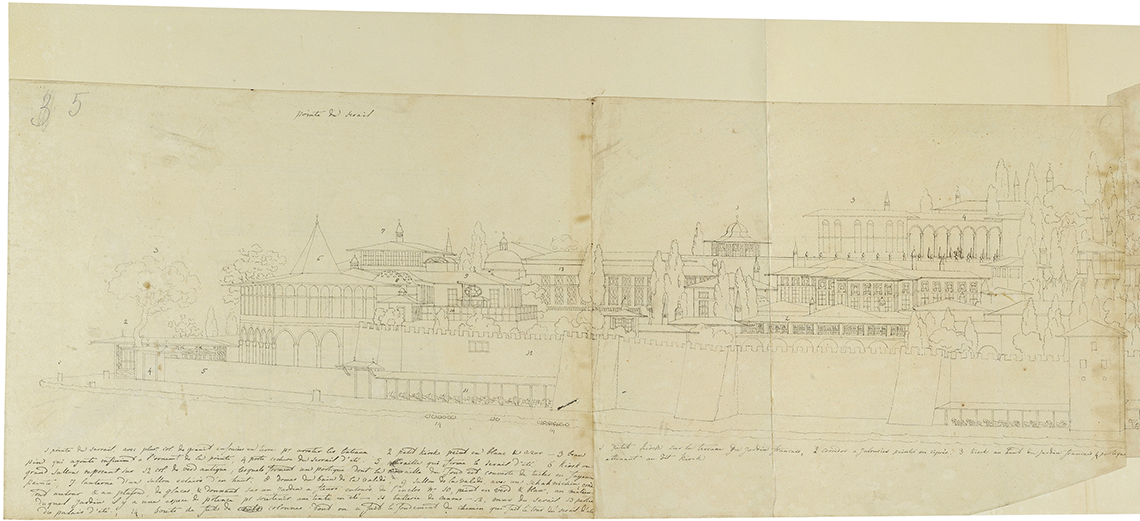
Panoramic view of the palace’s peninsular tip.
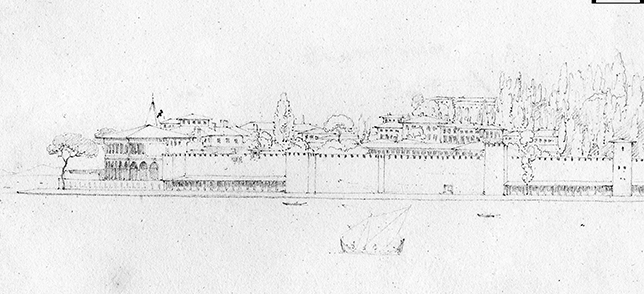
Detail from the panorama of Constantinople.
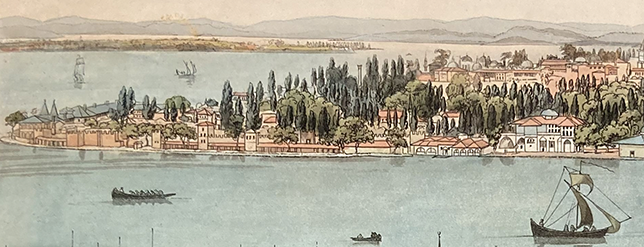
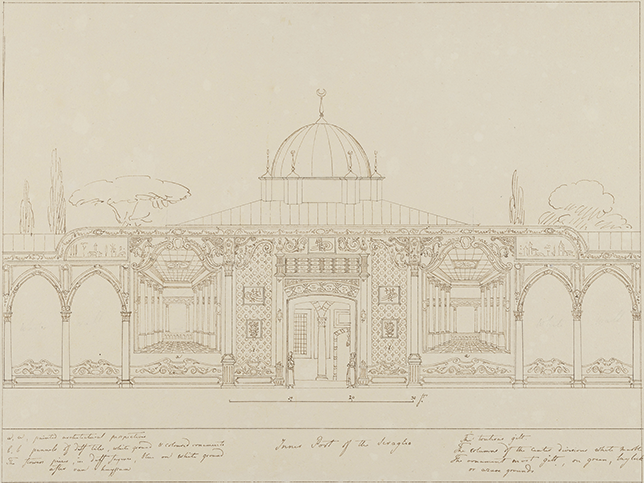
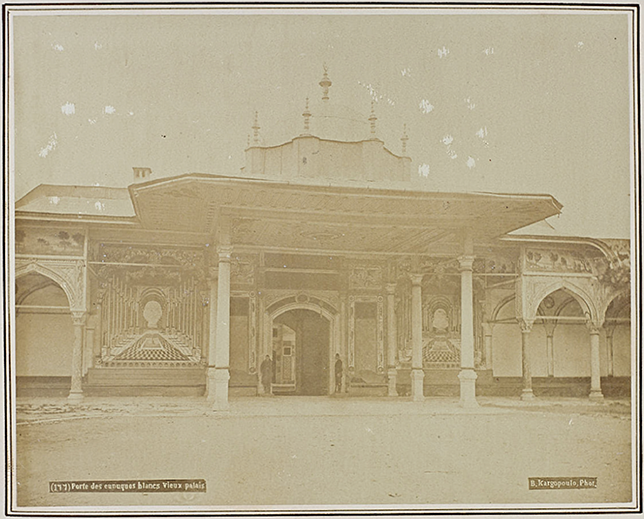
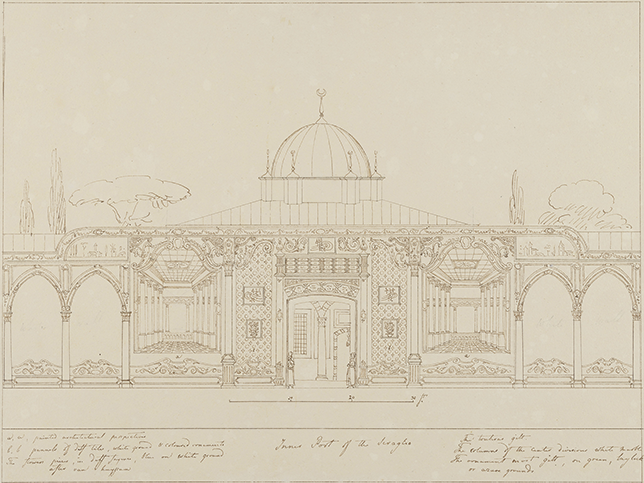
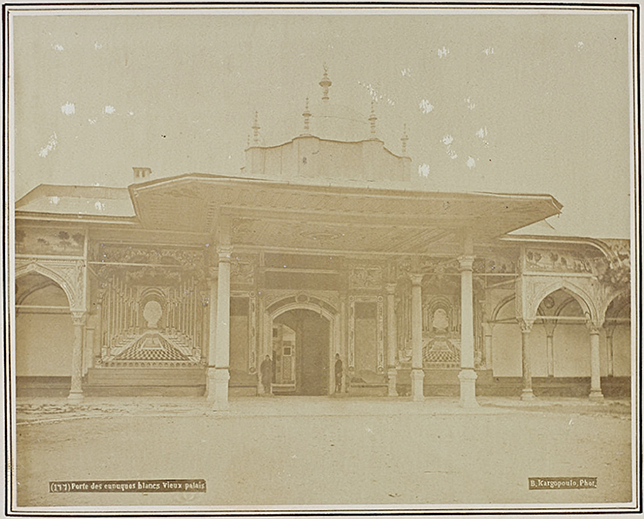
The precious marble columns, a hallmark of the Marble Kiosk, were also utilized in various mediums, such as the painted and relief decorative elements found in the rooms of Selim and Mihrişah, as we discussed earlier in this section (Figure 29). Here, we would like to open a parenthetical on the nature and representation of columns to define spaces in Selim’s Topkapı. Hope draws a detailed elevation of the Gate of Felicity (Babü’s-Saade), which led from the second, more public courtyard to the third and into the sultan’s privy chamber. While the famous Kapıdağlı bayram painting emphasizes the importance of this site as an imperial threshold by placing the enthroned Selim right in front of the gate, Hope shows that soon after this celebration two large murals of a columned perspectival view, much like the lower section of the Marble Kiosk, were painted on either side of the gate, and immediately next two narrower the Delft ceramic panels (Figure 30). These murals survived well into the reign of Abdülhamid II (r. 1876–1909), documented in photographs by the Ottoman Greek photographer Vasilaki Kargopoulo (Figure 31). What is remarkable is less the perspectival illusionism that entered the painterly domain of the Ottoman eighteenth century than the consistent and continuous employment of these columns, without the human figure, on the palace’s surfaces. Much in the way that figures were removed from the rococo frames, to be replaced by hilyes and poems lauding the Prophet and the imperial patrons on the walls of the winter harem, these emptied columnar spaces evoked the absent presence of the sultan, especially poignant when placed on charged thresholds like the Gate of Felicity. Retaining the same aesthetic, the oval portraits of sultans in the Young Album, too, are framed by fluted pillars.
Detail from a pen box depicting the palace’s peninsular tip and the Selimiye Mosque in Üsküdar. TSM, A. 447.
The Inner Port of the Seraglio at Constantinople [Babü’s-Saade].
Photograph of the Gate of Felicity (Babü’s-Saade).
The sequence of rooms in which Selim spent the most time was located in the same quadrangle as the Marble Kiosk. While Clarke was only able to see the spaces from the outside looking in, he still comments on the fact that this section of the harem operated as a working space of a less-than-idle ruler, calling it “divested of the outward parade of [the] Sultan.”Footnote 65 Hammer identifies the first of these interlinked spaces as Selim’s reference library (Handbibliothek), containing “books by historians and poets.”Footnote 66 While the room appears to be small in Hammer’s outline, it was certainly lavishly upholstered, with three bird cages of pure gold hanging from its ceiling containing mechanical birds that sang, a bronze brazier, and the sultan’s embroidered purse to collect petitions; groups of rare daggers, pistols, bows, and quivers with diamonds and other previous items encrusted with stones like “terrible constellations” hung on the walls.Footnote 67 If the sultan used the Marble Kiosk as a backdrop for his public visibility, this studiolo filled with books, automata, and precious weapons was a site of active state-building. Clarke mentions the glass case containing the very same sultanic reference books of which Hammer observes that “every volume [was] in manuscript, and upon shelves, one above the other, and the title of each book written on the edges of its leaves.”Footnote 68
According to Hammer’s meticulous walkthrough, this study was connected to an L-shaped corridor of two galleries, the first gallery containing English copperplate engravings of animals and landscapes alongside prints of recent Ottoman victories in Rhodes and, with British support, against the French in Aboukir, which latter were gifts from Küçük Hüseyin Paşa. This print gallery led to another at a ninety-degree angle. At about 150 steps long, it was lit from above by small round glass windows like baths and housed plans and construction drawings (Gallerie der Plane und Baursisse). All of Selim’s ongoing projects associated with nizam-ı cedid were on display: The training grounds of Levend Çiftliği for his new army, the School of Engineering, the powder mill (baruthane), the barracks, the printing press, the Selimiye Mosque in Üsküdar, the bends, and the Bahçeköy dam.Footnote 69 Selim’s studiolo and its gallery extensions (perhaps partly converted from an earlier bath) operated as a control center, where active planning of reforms and management of wars took place.
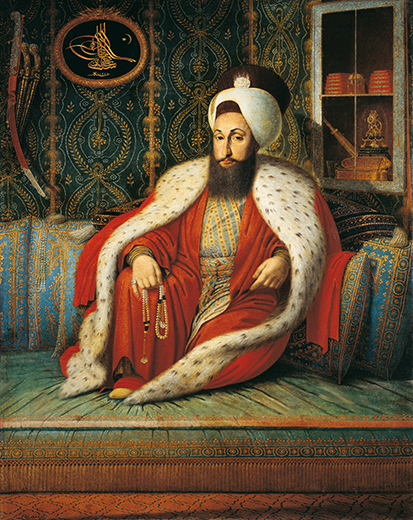
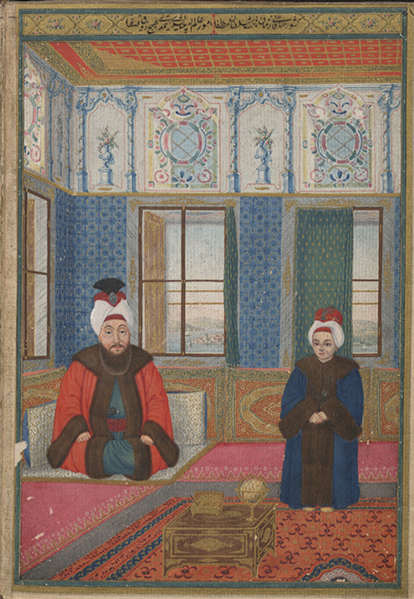
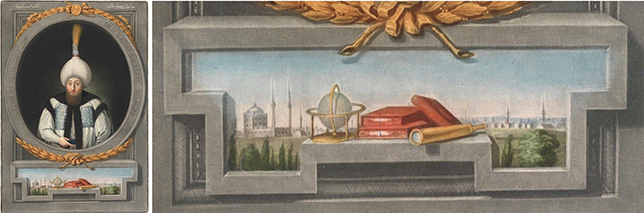
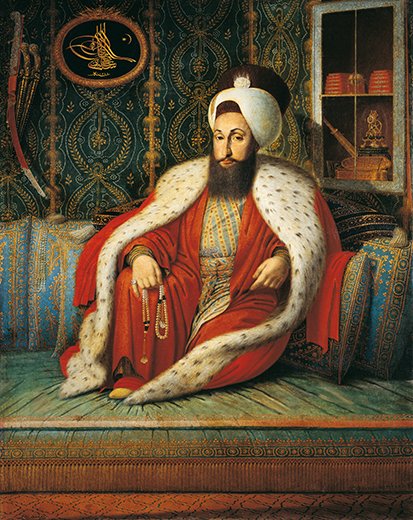
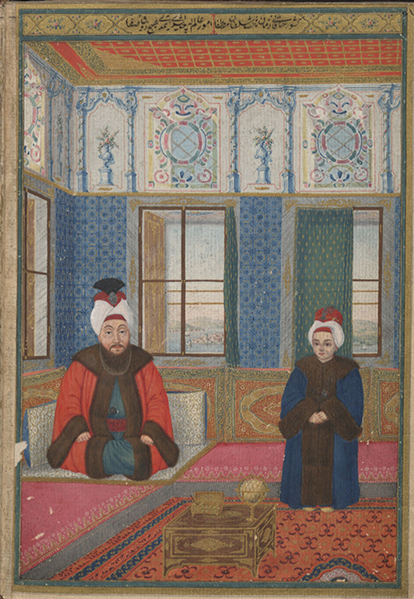
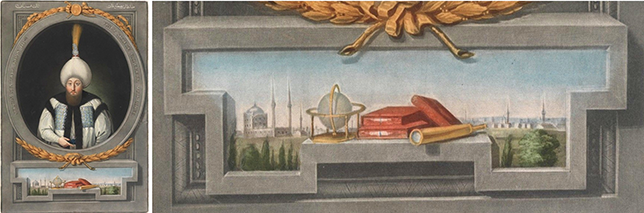
We might reconsider Kapıdağlı’s best-known portrait of Selim as the one situating the sultan in this reference library (Figure 32). Though the gilt bird automata are not present in the portrait, Selim’s glass library case stacked with manuscripts is, as well as the assemblage of precious weapons on the wall.Footnote 70 The golden foliage painted on the walls surely complemented the “burnished gold ceiling,”Footnote 71 and the gilt cages that hung from it. Selim’s back is supported by the very “black embroidered cushions” that Clarke observed. The artist added a few additional items that were indexical for his royal patron, such as the bejeweled pocket watch, which rests upon a cushion, his rosary beads, dagger that rests on his waist, a table clock revealing its mechanics, and a small globe and writing box that were most likely signifiers of his father, Sultan Mustafa III. These last two objects are foregrounded in an earlier double portrait of Selim as a young prince alongside his father in another Topkapı room with a view (Figure 33). Selim would later also include the globe, a stack of manuscripts, and binoculars in the panoramic vignette below his father’s portrait in the Young Album for a European audience (Figure 34).Footnote 72
Portrait of Sultan Selim III.
A double portrait depicting Prince Selim (later Sultan Selim III) standing beside his father, Sultan Mustafa III. From the Silsilename-i Al-i Osman.
Detail from the vignette below Sultan Mustafa III’s portrait.
Not only the sultan’s private chambers, but walls of larger rooms inside the harem were used as sites for displaying gifted weaponry. The sultan’s sword-bearer (silahdar ağa), who was also the overseer of the palace’s armory, regulated the arms that were gifted, and which would be displayed, regifted, or repurposed, much in the way that dynastic women did with the textile gifts they received, stocked, handed over or altered. A single document dated to the immediate aftermath of Ramadan celebrations of 1795 exemplify all of these instances: English pistols (piştov) and carabines (filinta), various kinds of swords with braided straps or those worn around the waist (gaddare, kılıç), and knives (yatağan) were hung on the tiled walls of the chamber with a tall central fireplace (ocaklı oda) adjacent to the chambers of the valide inside the harem. It appears that there were too many to display so side rooms were also used to exhibit the luxurious weapons. Some of the stately gifters are noted on the document; from the Bey of Tunis, a Tunisian (Tunuskârî), enameled sword encrusted with numerous precious stones; from the grand vizier Yusuf Ziya Paşa, a sword with a jewel-encrusted hilt and guard; and from the valide’s trusted, late-head eunuch Halil Ağa, a ruby-hilted, enameled sword. The weapons on the walls of Selim’s portraits were likely an acknowledgement of the person who gifted them. A pistol and sword, selected by the silahdar, were gifted to Cezzar Ahmed Pașa, the then-governor of Syria. With the order of the sultan, a gold-plated knife whose hilt, bolster and pommel were covered in rubies and diamonds, was converted into a set of blades.
If Selim’s study and the Marble Kiosk were the central structures within the first segment of the summer harem, the Yeni Kiosk was the principal structure of the second garden courtyard (see Figure 19). Selim commissioned this kiosk at the beginning of his reign, concurrently with the building activities in the upper harem, and it served as the backdrop for the wedding of Esma Sultan and newly minted Grand Admiral Küçük Hüseyin Paşa.Footnote 73 Situated on the palace’s shoreline, the structure commanded direct views of Üsküdar – where Selim later built Üsküdar Barracks, the largest and most elaborate Nizam-ı Cedid Barracks, and the mosque bearing his own name, the Selimiye – as well as into the palace’s terraced quadripartite garden, featuring a jasmine-covered wooden arbor. Poqueville writes of it: “The view from this kiosk is delightful, and the Sultan loves to repair hither, to enjoy the charming spectacle of a sea covered in ships and golden barges, moving in a thousand different directions.”Footnote 74 Outlines of the Yeni Kiosk’s placement along the shore are visible in Melling’s site plan of the palace’s peninsular tip (z in Figure 24). What is not visible in Melling’s drawing, however, is the fact that the kiosk had an elliptical central domed room (sofa) – the first of its kind in the Ottoman capital and a template for subsequent versions – that led to a room reserved for Selim on one side and one for his mother on the other. Clarke observed that the upholstery in the valide’s section was more “magnificently embroidered.”Footnote 75 Especially the view from a high vantage point in the palace looking toward this kiosk would have appeared like a version of the figureless gardens with kiosks displayed on the walls in different iterations of Mihrişah’s and Selim’s conjoined quarters inside the winter harem. Further representational connections with other harem structures seem to have been carried into this kiosk, such as the crysographic hilye inscribed on the interior walls; murals of uninhabited colonnades on either side of the kiosk’s garden entrance were prominent iconographies in the Selimian harem. Melling would inform Poqueville that the colonnades had been painted by European painters.Footnote 76 Hammer alerts us to two more event-specific reasons for the kiosk’s importance: one that it housed a majestic crystal chandelier, which had been gifted by Lord Elgin, and second that it contained chronograms that celebrated the Ottoman victory in Egypt.Footnote 77 By renovating the kiosk he had previously erected to commemorate a military victory, Selim not only revived the tradition of such architectural practices within the palace grounds but also sought to solidify the military achievements he aimed to present as a result of his reforms through enduring architectural symbols.Footnote 78
3 Eyüp and the Golden Horn
We already pointed to the fact that the windows of Mihrişah’s winter harem look out upon the neighborhood of Eyüp, sanctified by the presence Abu Ayyub al-Ansari, a member of the Prophet’s circle, whose participation in an earlier Muslim conquest of the city had made him a patron-saint of Ottoman Istanbul. The poems inscribed on the walls of her harem rooms in 1791 anticipated her plans to build her own charitable complex, which would also include her tomb, adjacent to the tomb and mosque of Eyüp Sultan. This holy neighborhood presented the best site for a valide to make a public statement about her religiosity and devotion in life and in the afterlife. She would also be buried close to her one-time master and protector, Sultan Ahmed III’s daughter Saliha Sultan (d. 1778), who had resided in a waterfront palace in Eyüp, which Selim III handed over to his sister Beyhan. Saliha’s grave is in Eyüp Sultan’s forecourt, where Mihrişah commissioned four small fountains (hacet çeşmeleri) surrounding the courtyard’s monumental plane tree. These water structures, as distinctive and self-referential architectural markers, brought Mihrişah’s commemorative presence even closer than her tomb to Eyüp Sultan and Saliha.Footnote 79
Mihrişah chose the location of her charitable complex for its proximity to the tomb of Eyüp Sultan, which Selim’s court had also begun to restore. As part of this restoration, the brass window covers, fabrics, and chandeliers of the tomb were refurbished, and the lattice, originally made of silver wires, was replaced with a newly crafted version of cast silver.Footnote 80 Moreover, Selim’s tughra and an inscription, both highlighting the patron of this restoration, were affixed to the lattice.Footnote 81 The poet who composed the four-couplet chronogram was none other than Münib Efendi, who had written the inscription poems for Mihrişah’s rooms inside the harem just a year earlier, which forecasted the project of this philanthropic act.
Mihrişah’s elegant tomb, located at the southwest corner of her complex, was deliberately positioned in relation to Eyüp Sultan’s tomb, which shared a forecourt with its associated mosque. The gate of this forecourt that is oriented toward the Golden Horn also opened onto the street lined by Mihrişah’s complex. This alignment enabled an unbroken sightline, which gave the impression that two tombs were in a continuous visual dialogue, further emphasizing their connection (Figure 35). Moreover, this particular street was the route used by sultans during their visits to Eyüp Sultan’s tomb, especially for their post-accession sword-girding ceremonies, with Mihrişah’s building now providing a new and modern architectural backdrop.Footnote 82
Visual alignment of Mihrişah Valide Sultan’s tomb to Eyüp Sultan’s tomb with view toward the Topkapı Palace.
The circular tomb structure of the valide, segmented, enigmatically, into twelve convex sections, offers not only intriguing clues about her religious sensibilities but also her intricate socio-political networks. The inscriptions on the twelve roundels, made possible by the building’s baroque design, bear the customary names of Allah and Muhammed, the four caliphs – Abu Bakr, Umar, Uthman, and Ali – the Prophet’s grandsons, Hasan and Husayn, as well as four additional names among the ten promised paradise: Talha, Zubair, Sa’id, and Sa’d. This deliberate selection reflects an intentional effort to evoke an Edenic atmosphere, blessed and protected by members of the Prophet’s circle. Notably, the same twelve names also appear in the tomb constructed by Şah Sultan, the sister of Selim, for her mother also in Eyüp – a tomb where Şah Sultan was later interred. Surrounding Mihrişah’s tomb are the graves of individuals closely tied to her life, revealing layers of political alliances, familial ties, and patronage.Footnote 83 Two of Selim’s favorite sisters, Hatice and Beyhan, as well as two of his consorts, Refet and Rahime Piristû, were buried next to Mihrişah. Moreover, members of Mihrişah’s household including Pembe Kalfa, her head of servants; Bilal Ağa, her second eunuch; Küçük Mercan Ağa, her tutor and the chief harem eunuch; Küçük Hüseyin Paşa, her one-time slave and later grand admiral of the empire, and Hüseyin’s kethüda, Mehmed Paşa, along with many others, were buried in the small cemetery (hazire) within the complex.Footnote 84 By choosing her tomb (alongside the graves of her entire retinue) close to the one housing her own one-time master Saliha, Mihrişah was able to architecturally bind and record the genealogy of dynastic women as masters of female servants, heads of imperial household.
There was no imperial palace belonging to Mihrişah or Selim in Eyüp, near the newly built complex. While it is known that a Valide Sultan Yalısı – a waterfront palace built in 1682 for the mother of Mehmed IV and later used by other valides in the eighteenth century – once stood on the shores of Eyüp, this building no longer existed during the reign of Selim, according to the registers of the chief gardener (bostancıbaşı defterleri).Footnote 85 When Mihrişah decided to build her charitable complex in Eyüp, there was likely no more fitting site than this one, already imbued with the memory and prestige of earlier valides. The court chronicles frequently mention visits by both the sultan and his mother to Eyüp. They stayed in imperial kiosks, which were specifically designed and built for them as part of the waterfront mansions appointed to the Selim’s sisters and female cousins.
Before their marriages to high officials, as arranged by the members of the court, women of the dynasty lived either in Topkapı or the old palace, under the watchful guidance of their mothers. After their nuptials, Selim’s sisters and cousins were tasked with creating their own households. Just like the sultan, these women also had multiple palaces in which they resided at different times of the year. As we have exemplified in the first volume (Letters and Gifts), through their frequent moves between their various palaces and kiosks situated in different parts of the city, these women became visible and active political agents of the sultan and his mother, thereby exerting an extended dynastic dominion over the capital. They mostly resided in their intramural palaces during the winter, moved to their palaces in Eyüp during the warmer days of spring and fall, and spent their summers in their waterfront palaces along the shores of the Bosphorus. All of these palaces changed hands among the sultanas and were occasionally renovated or rebuilt according to their current owners’ preferences, creating a palimpsest of architectural tastes, but at least across the eighteenth century there was a consistency of ownership and urban understanding of particular neighborhoods as hubs for these women and their sub-courts.
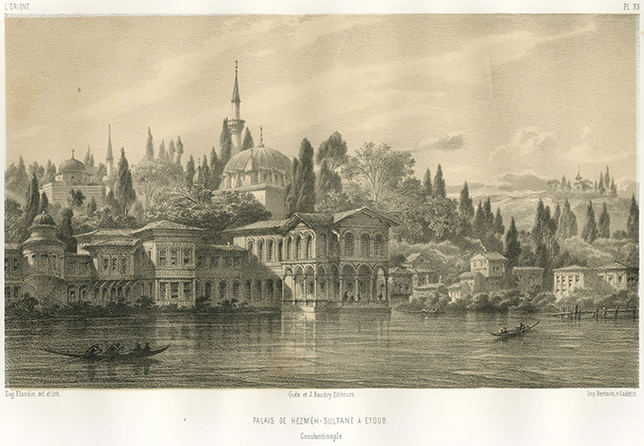
After the dynastic court returned to Istanbul from Edirne at the beginning of the eighteenth century, the sixteenth-century waterfront palaces of Eyüp regained their popularity.Footnote 86 Palaces located around Eyüp changed hands between various royal women throughout the eighteenth century. During Selim III’s reign, the yalı in Eyüp located right after the Bostan landing place as one moved toward Bahariye, known as the waterfront palace of the sultan’s mother (the above-mentioned valide sultan yalısı), was bequeathed to Beyhan. The palaces next to it that had once belonged to Ahmed III’s two daughters, Zeynep (d. 1774) and Esma the Elder (d. 1788), were given respectively to Hibetullah and Esma the Younger.Footnote 87 Another yalı, located right after the landing place called Defterdar – itself upstream from Eyüp along the Golden Horn – was given to Şah, and upon her death in 1803 was transferred to Selim’s waqf and then rented to Beyhan.Footnote 88 In 1795, Esma, who already had a mansion in the vicinity, started to build a new waterfront palace near Şah’s palace (which would later also become Beyhan’s), and when it was (almost) completed in 1800, she relocated to this site (Figure 36).
Map of the Golden Horn showing the waterfront palaces of the royal women.
Although these relocations can be partially traced through the use of primary sources such as the registers of the bostancıbaşı (head of the gardeners’ corps), expense accounts, maps, and chronicles, it is almost impossible to track these changes with certainty.Footnote 89 This difficulty arises from the recurrence of female names within the dynasty (e.g., Esma the Elder and Younger); the enduring association of the palaces with their earlier owners’ names, despite changes in residents; and the continual repairs or overhauls of the structures. Fortunately, the abundant documentation of the construction process of Esma the Younger’s new yalı from the start of 1798 not only highlights the importance of Eyüp as a principal site of habitation for royal women but also reveals the entire process from their perspective as patrons.Footnote 90
When Esma was betrothed to Küçük Hüseyin Paşa in 1792 (which allowed Hüseyin to be appointed the empire’s grand admiral), she had already been given her palaces in Ortaköy (Tırnakçı), Maçka, and Divanyolu.Footnote 91 The last, her intramural palace, underwent an extensive renovation before their marriage.Footnote 92 Her mother Sineperver oversaw this renovation as well as the renovations, restorations, and reconstructions of all her daughter’s palaces. For example, when Esma’s palace in Ortaköy needed an upgrade in 1794, it was Sineperver who controlled the cost estimate registers and supervised the work to ensure building efficiency and budget compliance.Footnote 93 However, the most extensive, time-consuming, and probably nerve-wracking project that she had to oversee for her daughter was Esma’s new yalı near the Defterdar landing place in Eyüp, for which construction began in early 1798.
One of the most significant motives behind the initiation of this project seems to have been Esma’s desire to keep up with the other princesses, especially with Şah, Beyhan, and Hatice.Footnote 94 All of these women, much older than Esma and all sisters of the sultan, were trendsetters in terms of lifestyle choices, fashion, and social etiquette. According to correspondence between Sineperver and her daughter’s steward Ömer Ağa, Esma was miserable due to the dilapidated condition of her Eyüp palace. She complained to her mother that other sultanas could come and live comfortably in their palaces in Eyüp, but her mansion lacked adequate living space (öbür sultanlar kahca gelip iyi yalılarında oturuyorlar, benim yalımın oturacak yeri yokdur). Sineperver acknowledged Esma’s point by saying “of course, when her peers go, she wants to go too” (elbette … akranları gittikçe o da gitmek ister).Footnote 95 In another letter, Sineperver touches upon her daughter’s despair over not having an adequate yalı in Eyüp to entertain the sultan when, upon hearing that he would be there, all of Selim’s sisters departed their yalıs along the Bosphorus shores, leaving Esma behind.Footnote 96 One other reason why Esma was desperate to have a better-equipped yalı in Eyüp had to do with the site’s presumed salubriousness (hava tebeddül edecek yer).Footnote 97 The importance in strict dynastic decorum of maintaining the same if not better living standards across a group seen as peers (akran) is evident. Moreover, proximity to the sultan and being able to spend time with him and the valide in one’s private and lavish surroundings certainly had a competitive aspect. Thus, all these women commissioned extravagant quarters designated for the personal use of the sultan and the valide sultan in their yalıs. From yet another letter from Sineperver to Ömer Ağa we find out that Esma wanted the sultan’s kiosk in her Eyüp residence to have a band of inscriptions eulogizing Selim and Mihrişah, but because this was the costliest of decorative option Sineperver was planning to convince her that heavy carvings (oyma) were in fact more popular.Footnote 98 In the same letter, to make a case for the high cost, Sineperver also alluded to the ostentatious ceiling covered in jewels which Hatice, Esma’s peer created for the imperial kiosk she built for Selim in her Eyüp home (Hatice Sultan hünkar odasında tavanı bütün cevahirden yaptırdı böyle olması bütün akranlarındandır). She argued that the imperial court would naturally expect from Esma to embellish the sultan’s lodgings with comparable lavish ingenuity. Later descriptions of Esma’s residence, discussed below in this chapter, would confirm that the ceilings of the main halls were the centerpieces of the site’s interiors.
When the necessity of renovation or even reconstruction of Esma’s new yalı in Eyüp became evident, Sineperver took matters into her own hands and asked Ömer Ağa to go in secret and check if the existing structure was in an irreparable condition. Although Sineperver likely hoped for a comprehensive renovation that would preserve the existing structure, thereby incurring significantly lower costs, she also acknowledged the potential need for reconstruction. Her comments suggest that if the building were to be demolished, the materials, especially the load-bearing wooden pieces called “ağa tahta” from its council hall (divanhane), might be reused and would be sufficient for the new construction, revealing her unexpectedly deep knowledge of the use of spoliated building materials.Footnote 99 As the person upon whom Sineperver relied to execute all tasks, Ömer likely inspected the existing building and reported its uninhabitable condition. Four months later, in June 1798, Sineperver instructed Ömer to commission the design of an entirely new building and the renovation of the extant sections, which included the quarters for Hüseyin (paşa dairesi), the quarters for the eunuchs (ağalar dairesi), the office of the steward (kethüdâ yeri), places for the cooks (aşçılar yerleri), and the necessary infilling of the sea from both kalfas, Komyanoz (قومیانوز / Κομηνὸς) and Kurdoğlu Küçük Yorgi (قورداوغلی کوچک یورکی / Γιοργι).Footnote 100 She asked Ömer to share the projects of these two architects with Usta (master) Yani, who was esteemed for having an undisclosed imperial mosque, and with Yani’s expert and trusted knowledge to set a fair price for each part and to allocate these tasks between the two kalfas.Footnote 101
Sineperver understood the importance of working with a skilled kalfa; in another letter to Ömer, she expresses her concern over the process of construction without a proper kalfa at its helm: “If this yalı is built poorly without [the supervision of] a kalfa, the kalfa will be punished later, and I will therefore be embarrassed” (Bu yalı kalfasız çirkin yapılır ise sonram kalfanın da cezasın görürüm ben de rencide olurum).Footnote 102 Later correspondence between Sineperver and Ömer demonstrates the numerous disputes, contentions, and tensions that arose between Komyanoz – who seems to have gained total control of the project over his associates, Yani (یانی / Γιάννης) and Yorgi – and his patrons. One notable dispute occurred when the second cost estimate exceeded the first, prompting Komyanoz to attempt modifications to the initial project in order to stay within budget. This attempt was strongly opposed by Sineperver, as she wanted the project to be executed exactly as her daughter had originally envisioned. At times, as a result of established structures of power determined by religious difference, Sineperver would attribute cost contentions to the builders being non-Muslim: “this kalfa seems like a clownish infidel, and one can never trust an infidel” (kalfa bir şaklaban kefereye benziyor mucebince ağnadım kefereye inan olmaz).Footnote 103 Though we only know the royal side of the story, it is not hard to imagine how precarious working for the Ottoman court must have been for the kalfas, craftsmen, and even for vendors of goods. Aside from usually not being able to receive their payment on time, Esma’s wishes during the construction process were often inconsistent and prone to increasing costs, which, over time, exhausted even her own mother. Price negotiations were another issue that might become bothersome for both sides. These were not only done on paper and mediated through the steward. There is also indication that at moments of crisis, Sineperver would meet the architect, who would bring along the drawings and price lists, in person.Footnote 104
In the early 1800s, although the construction was not yet fully completed, the main parts of the yalı had already been built. These included the imperial kiosk situated over the sea and the building located on the land side; Hüseyin’s two-story quarters (paşa dairesi); a long, elevated passageway connecting the harem buildings on the sea to the inland segments; and spaces for service functions such as the baths (hamam), rooms for various staff and officials, and a boat house (kayıkhane).Footnote 105 A cost estimate register dated to 1800 details a two-tiered garden, just like the one behind Selim’s Yeni Kiosk in the imperial palace (see Figure 19). The document describes a small circular (or elliptical) kiosk (mehtabiye) with a ceiling covered in green textiles, a marble jet fountain (selsebil) situated on the upper level, and a smaller mehtabiye along with two large pools on the lower level.Footnote 106
This description corresponds to Robert Cockerell’s detailed but unidentified sketch of a waterfront palace that he attributes in his memoirs to “the sultan’s sister”Footnote 107 (Figure 37). This sister must have been Esma, as her brother, Mahmud II, was the ruling sultan during Cockerell’s stay in Istanbul in 1810. The sketch depicts the spaces itemized within the above-mentioned cost estimate register: The cruciform imperial pavilion on the far right, Esma’s main building with its ovoid reception room and an undulating smaller elliptical seating area projecting out toward the sea as well as the building on the landside boasting a terraced garden. The elevated passageway and the wall beneath it separate the harem grounds from the pasha’s quarters on the left. In his memoirs, after mentioning bribing a gardener in order to visit this palace and make a “running sketch,” Cockerell describes the “splendidly embroidered” textiles on the sofas, brilliant “colours and the gilding on the ceilings and walls,” and richly ornate window frames and ceilings. He also mentions the elegant baths and the use of carved, gilded or painted marble both in these spaces and on the pavements, the fountains, and the pillars.Footnote 108 Of all the impressive parts of the palace, Cockerell found the reception hall, with its oval central space, to be the most ingenious.Footnote 109 This main reception hall was where Esma entertained Selim and Mihrişah after the near-completion of her palace, on October 11, 1800. While Selim returned to his palace at Beşiktaş, Mihrişah stayed overnight in the imperial kiosk built and decorated specifically for her and her son.Footnote 110 Esma and her mother attached considerable importance to this building. When Komyanoz drafted the project (resim) of the imperial kiosk in 1798, it was Sineperver who suggested the addition of marble columns supporting the overhanging upper floor (Komyanoz kalfaya söyleyesiniz dışarıdan taş direkler konsa olmaz mı).Footnote 111 Sineperver, as consort to Abdülhamid I, had formerly inhabited the summer harem in Topkapı and thus knew the architectural layout of the Marble Kiosk. She was probably also aware of Selim’s fondness for and frequent use of such porticoed neoclassical spaces (also in architectural murals inside Topkapı), and of the other imperial kiosks in the newly built waterfront palaces of royal women, such as Hatice’s Neşatabad or Beyhan’s new palace at Akıntıburnu. The imperial kiosk, partially seen in an engraving by the French artist Jean-Baptiste Eugène Napoléon Flandin (d. 1889), with its arched windows, pediments, and marble columns, followed a typology reminiscent of the Marble Kiosk (Figure 38).
Plan of a waterfront palace.
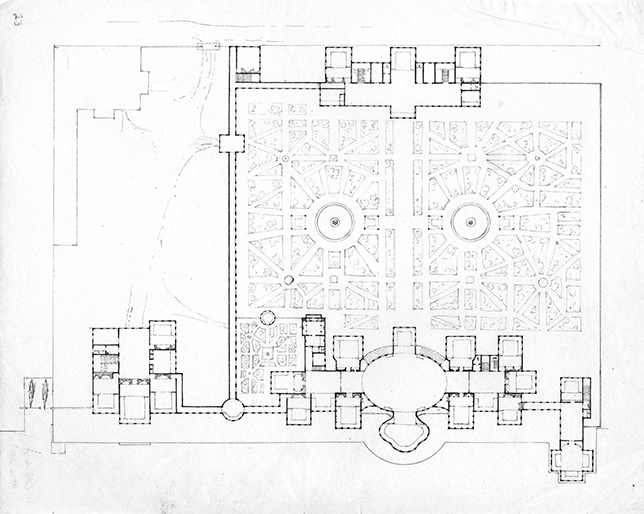
Palace of Esma Sultan in Eyüp.
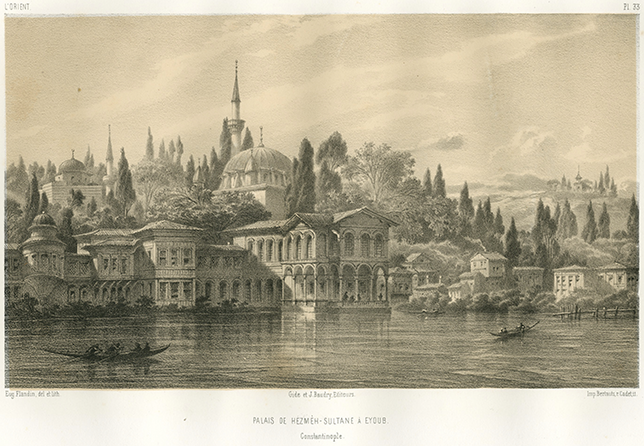
Before the royal visit in May 1800, Sineperver expressed her concern over the inadequate size of Esma’s reception hall and the imperial kiosk, both of which were later likely enlarged. Two months before this visit, she ordered the swift completion of the imperial kiosk and the gardens, as these places were to be the most significant venues for this occasion.Footnote 112 By August, although the construction elsewhere was still ongoing, the decoration of the imperial kiosk had been completed.Footnote 113 Travelers such as Julia Pardoe and Robert Cockerell, who visited this site later during the reign of Mahmud II, noted the magnificence of Esma’s reception hall, wrongfully attributing this place to the “unfortunate Sovereign” (Selim III) most probably due to its vast size and excessively ornate decoration (Figure 39). Pardoe’s description of its ceiling as “faint blue, sprinkled with silver stars” draws parallels to the ceiling of Mihrişah’s treasury room in the upper harem of Topkapı, which similarly imitated the night sky, or perhaps Hatice’s choice of a bejeweled ceiling for her brother’s kiosk.Footnote 114
Apartment in the Palace of Eyüp, the residence of Asmé Sultana. By Thomas Allom.
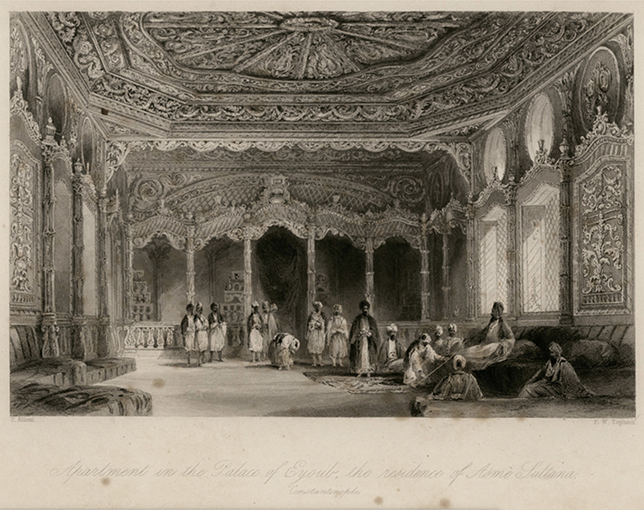
Correspondence between Esma, Sineperver, Ömer, and Komyanoz reveals that the construction project lasted for at least eight more years. The prolonged process of this building caused Sineperver great distress, as she was responsible for making architectural revisions according to her daughter’s wishes and managing the finances. She would occasionally complain about the negligent work of the craftsmen and Komyanoz’s lack of oversight, comparing this yalı’s building process to those of other royal women’s palaces in terms of construction time, expenditure, and beauty. Conveying a clear sense of competition, she asks: “Now that so much money and time have gone into this palace, is it magnificent? Does it surpass the palaces of Hatice and Beyhan Sultan?” (bu yalıya bu kadar akçe gittiğine göre ve geç bittiğine göre pek aʽlâ mı oluyor? Beyhan Sultanın yalısından Hatice Sultan yalısından mı iyi oluyor?)Footnote 115 Neither of these two competing palaces in Eyüp, nor their representations, have survived.
Throughout the process of building her daughter’s palace in Eyüp, Sineperver also sought ways to secure funds to finalize the construction. She turned to borrowing money from affluent individuals like the stewards Ömer and Yusuf Ağa, and even the valide.Footnote 116 In one of her exchanges with Ömer, responding to the suggestion that she keep a separate register for the expenditures of Esma’s Eyüp yalı in order to prevent “others” from finding out about their debts, Sine replies, “There is no one in the world without debts. As if other sultanas complete their commissions without any. I know all about how much they owe.”Footnote 117 Expenses were more often than not covered with borrowed money; thus, it was natural that each court was aware of others’ financial situations. Additionally, Sineperver resorted to selling her own valuable belongings as well as her daughter’s; a task she often lamented as the items were sold for far less than their actual worth.Footnote 118 Alongside these financial challenges, Sineperver also had to navigate the expectations of royal protocol in giving gifts during the process of construction. For example, Esma felt obligated by court decorum to present two female servants (cariyes) to Selim and Mihrişah during their first visit to the yalı, at a time of particular financial hardship for mother and daughter. Though she advised her daughter not to buy new female servants and instead give two of her own, Sineperver still acknowledged the requirement for this gift by saying “she commissioned a new palace, it wouldn’t be appropriate if she doesn’t give presents” (yeni yalı yaptırdı hediye verilmeyince olmaz).Footnote 119 Another instance where gift-giving was seen as an absolute necessity was after the completion of various construction works.Footnote 120 While the kalfa(s) and the construction administrator(s) (bina emini) would receive pelisses, craftsmen received monetary compensation. After certain sections of Esma’s palace in Eyüp were completed in 1800, Sineperver tasked Ömer with a detailed note outlining the recipients of gifts and specifying the amount of money that would be given to each.Footnote 121 Similarly, Mihrişah took great care to enumerate the officials serving in the construction of the mosque she commissioned within the Barracks of the Bombardiers and Miners (Humbaracılar Kışlası) and the gifts suitable to their ranks.Footnote 122 She compared her recorded gifts with the presents Beyhan Sultan had distributed, using these insights to judiciously assess the propriety of her own allocations.Footnote 123
Among the yalıs and kiosks situated along the shores of the Golden Horn, Eyüp was where the royal women spent the longest time. However, they occasionally visited the crown’s retreats across Eyüp, such as the kiosks of Aynalıkavak (adjacent to the imperial arsenal) or the suburban Sadabad set in a flat green meadow along a cascading stream, for shorter stays. These additional imperial sites, though used ostensibly for courtly leisure and entertainment, also operated as strategic waystations from which the sultan as well as his mother would be able to keep an eye on the reforming military apparatus.
The imperial complex of Aynalıkavak, also referred to in Ottoman archives and chronicles as the Arsenal Palace (tersane sarayı), was originally a seventeenth-century royal lodging located near the imperial arsenal. In 1792, only a year after completing his and his mother’s quarters within Topkapı Palace, Sultan Selim III initiated an ambitious restoration and expansion of the Aynalıkavak waterfront palace. This renovation project involved the addition of new structures to the existing harem building, including a splendid kiosk (kasr-ı ferruh) built for Selim himself, along with quarters for his mother and for princes Mustafa and Mahmud. Several existing buildings were also carefully restored, among them a bath, accommodations for the guards tasked with the Sultan’s protection, and a small mosque.Footnote 124 These structures were built under the architectural direction of Komyanoz Kalfa, with superintendent of the Imperial Arsenal (tersane emini) Mehmed Nazif Efendi serving as the construction superintendent (bina emini).Footnote 125 One of the most prominent of these restored buildings was the cruciform Hasbahçe Kiosk (today known as the Aynalıkavak Kiosk), which stood on a hill overlooking the Golden Horn. The new decorative program of the Hasbahçe Kiosk’s interior bore striking parallels to the design of Selim’s and Mihrişah Sultan’s quarters in Topkapı Palace. Notable examples include the intricate patterns on the concave cornices of the council hall, murals of double columns connected by garlands, and the tripartite arrangement on the entrance wall of the audience hall, which recalled the alcove in Selim’s lihye room.
These similarities suggest that the same group of artists and artisans may have worked on both projects. Indeed, after Yesari Mehmed Esad completed his work in Topkapı’s harem quarters, Selim personally urged the aging calligrapher to inscribe an ode by the Mevlevi poet Mehmed Esad, known as Şeyh Galib (d. 1799) onto the band of the Hasbahçe Kiosk.Footnote 126 Selim expressed that he would not entrust the task to any other calligrapher if Yesari refused.Footnote 127 Yesari obliged, contributing not only this inscription but also a fifty-four-verse poem by Enderunlu Fazıl (d. 1810) on the audience hall walls, which extolled the virtues of the kiosk.
Despite these architectural activities, the court chronicles reveal that Selim and his mother used Aynalıkavak a few times between 1792 and 1794. By 1795, only three years after these significant renovations, Selim allocated the site of the council hall to the imperial arsenal.Footnote 128 The particular typology of Aynalıkavak council hall, subsequently demolished with its materials repurposed for other imperial palaces, exemplified those of its kind from earlier eras.Footnote 129 Its architectural design, reminiscent of the Çinili Köşk (Tiled Pavilion) and the Beşiktaş waterfront palace, reflected the aesthetic preferences of its time, featuring tiled exteriors and central domed spaces with exaggerated eaves.Footnote 130 However, these earlier styles seemingly did not resonate with Selim’s late eighteenth-century tastes. Rather than preserving or restoring such structures, he opted to construct new buildings or renovate existing ones in a more contemporary style.
Following the above-mentioned alteration of the site in 1795, this imperial complex served more ad hoc needs for the dynastic members. It was occasionally used by Selim for short stays during visits to the imperial arsenal or Okmeydanı (an important site of archery and Mehmed II’s conquest of the city) and at times as temporary residences for his sisters. For instance, Hatice Sultan stayed there from at least December 1795 to February 1796 to escape the plague.Footnote 131 Similarly, Beyhan Sultan resided at the site between July and October of 1800 and 1801 while her waterfront mansion in Arnavutköy was under construction.Footnote 132
Sultan Ahmed III’s Sadabad Palace complex in the Kağıthane meadow was another destination, farthest from intramural Istanbul, which Selim and Mihrişah occasionally visited after comprehensive renovations in 1793. During this period, the construction of the barracks for the bombardiers and miners (Humbaracı ve Lağımcı Kışlası) in Hasköy was also ongoing.Footnote 133 Selim appears to have intended for these two construction projects to be completed simultaneously, as he planned to use the Sadabad Palace to inspect his new troops during their drills, much like his predecessors did – a practice Selim undertook multiple times throughout his reign.Footnote 134 A now lost mural on the wall of an eighteenth-century Istanbul mansion displays fired cannons (predictably unmanned) immediately adjacent to Mihrişah’s quarters at this imperial site.Footnote 135 In most of Selim’s military inspections, Mihrişah played a highly visible role, distributing presents and clothes to soldiers and their commanders after drills.Footnote 136
Apart from its significance as an imperial viewing station for military drills, Sadabad served as a favorite location for royal retreats (halvet-i hümayun). Selim, Mihrişah, and occasionally one or more of Selim’s sisters would gather here with their retinues, watching dance, musical, circus, and athletic performances and having time to discuss state matters in private.Footnote 137 Both Melling and Hope ensured to represent the spacious green field used for jerid (the game of javelin), which was across from the ubiquitously elongated imperial structure with multiple projections on columns, and separated by the stream (Figure 40). Traditionally, these royal retreats had been held within the Topkapı Palace or in one of suburban imperial gardens. However, during Selim’s reign, locations with a military character, such as Sadabad or Levend Çiftliği, became increasingly prominent choices. This shift aligns with the argument that these women were, in fact, meant to be seen as supporters of Selim’s reform program and were directly connected to the nizam-ı cedid elite.
Kiahd Hane, Lieu De Plaisance Du Grand Seigneur, [Game of Javelin played in Sadabad]. In Melling, Voyage pittoresque, 1819.
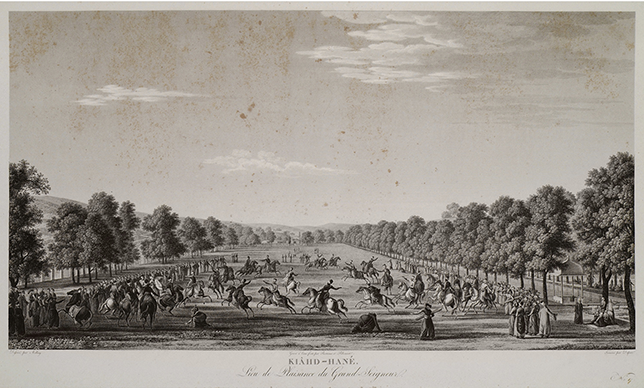
4 The Bosphorus and Its Hilltops
Members of the court retained their peripatetic lifestyle throughout the eighteenth century, which not only increased their visibility across the expanding capital, thus maintaining their dynastic legitimacy, but also provided them with alternative ways and venues for networking, as was highlighted in the third chapter of our previous volume, Letters and Gifts. Although Selim, Mihrişah, and their retinues – including their female servants, Selim’s consorts, and the two princes (Mustafa and Mahmud) – split most of their time between Topkapı’s winter and summer segments, they also spent the hottest summer days in Beşiktaş. This area had been a popular summer destination along the Bosphorus for Ottoman sultans since the late fifteenth century.Footnote 138 Although scattered palatial edifices existed within the Beşiktaş imperial garden, the establishment of a well-equipped palace complex did not occur until the late seventeenth century. The domed, cruciform Tiled Pavilion, mentioned earlier, which appears in the right foreground of Melling’s drawing of the Beşiktaş Palace, was inherited from this earlier complex. Throughout the eighteenth century, the palatial buildings in the Beşiktaş garden were continually restored and reconstructed. Selim, however, undertook significant changes to the main structure facing the Bosphorus, likely reflecting his intention to spend longer periods here during the summer compared to his predecessors.
As part of these changes, Selim tasked Melling with restoring the existing Beşiktaş waterfront palace and constructing more expansive harem quarters for himself and his mother (Figure 41). In accordance with courtly decorum, the sultan’s quarters were slightly larger and higher than the valide’s new apartment and projected further toward the sea. A gallery connected Selim’s quarters to his mother’s apartment, echoing the proximity of their rooms within Topkapı Palace. Mihrişah’s apartment was positioned at the center of the 91.5-meter-long quay, bordered by a low balustrade. This central position likely reflected the valide’s central role and direct control over the sultan’s harem. Another carry-over from imperial building practices in the Topkapı is the modeling of all sultanic domestic units on the columnar, two-story structure of the Marble Kiosk, which Selim frequently used and illustrated in portrait commissions. When dynastic women built accommodations for their royal relative and his mother, they used exactly this typology.
Palais de Beschik-tasch, [Beşiktaş Waterfront Palace]. In Melling, Voyage pittoresque 1819.
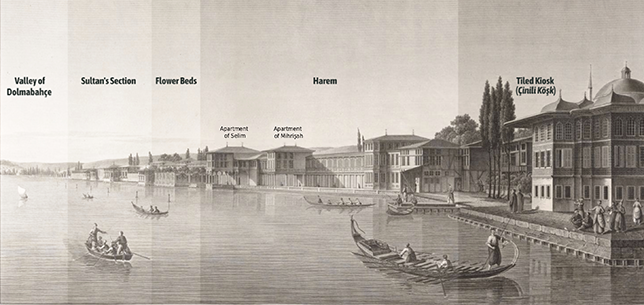
The expanded Beşiktaş waterfront complex seems to have determined the court’s allotment of nearby summer residences for the dynasty’s sultanas along the Bosphorus shore. Beyhan received Çırağan nearby, which she would inhabit for approximately five years before handing it over to her brother to build herself a new one in Akıntıburnu near Bebek. Hatice Sultan would receive a palace known as Neşatabad, between Ortaköy and Kuruçeşme, and Esma the Younger resided in Ortaköy, in the yalı called Tırnakçı (Figure 42). Though these summer residences all reflected the individual tastes of their owners, these sites shared common features: a primary structure with a central sofa reserved for the sultana; an elaborate unit, an attached imperial kiosk like in Eyüp, built specifically to host the sultan and his mother (hünkar dairesi); a modest structure separated by a high wall for the owner’s husband; a terraced garden with marble fountains, greenhouses, and wooden kiosks; and a third building set in the back of the garden for ancillary functions, such as an office for the sultana’s kethüda. While the Greek kalfas continued to organize and control the construction networks for their royal patrons, Melling is known to have added the classical touches to Hatice’s waterfront mansion, as well as garden and the structure resting on eight marble Ionic columns at the Beşiktaş Palace for Mihrişah and the gallery on the quay.Footnote 139
Map of the southern end of the Bosphorus illustrating the alignment of imperial palaces and mansions (yalı) along the coast as well as the relationship between the waterfront palaces and the hilltop kiosks.
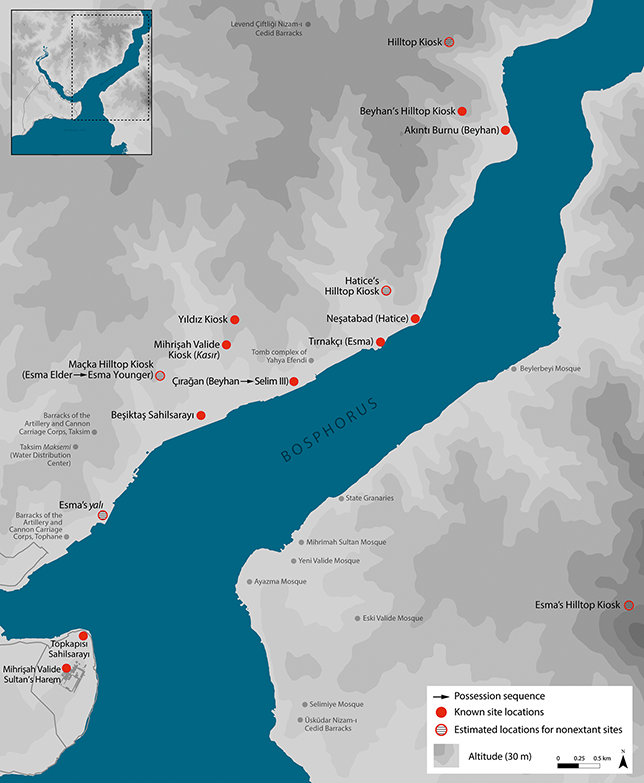
The sultan and his valide visited their neighboring female relatives for musical and dance performances, but Sufi gatherings at the Mevlevi lodge adjacent to Beyhan’s mansion also determined the social structure of visitations. These women visited each other and received privileged guests, both types of events orchestrated according to the courtly etiquette witnessed by Mary Nisbet during her audience with the valide, highlighted in Letters and Gifts. Often the female host’s favorite cariye would act as the intermediary (in Nisbet’s case, it was the Grand Admiral Küçük Hüseyin’s sister Gülhiz who facilitated the audience with Mihrişah) while Ottoman Greek women who were related to the capital’s dragomans acted as able translators. While the decadent centralized sofa with an elaborate gilt ceiling and views of both sea and land was the stage for these visitations, objects such as chandeliers, bejeweled coffee sets, oil and incense burners, writing boxes, mirrors, clocks, watches, bird cages, and binoculars, as well as richly embroidered furnishings designed for these spaces, were purchased to be used as set pieces in such encounters (Figure 43).
Illustration of Ottoman domestic metalwork and a wooden inlaid box.
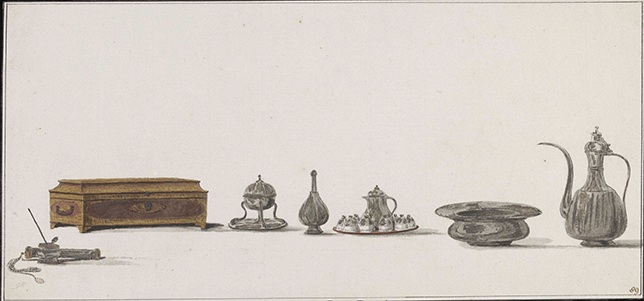
Melling promotes the interiors that he designed for Hatice Sultan’s yalı, the temple-fronted Neşatabad in Ortaköy, by dramatizing a moment when the sultana is visited by a sister and retinue in the elevated dais of her sofa (Figure 44). The oblique procession over to her sister’s divan is preceded by women sprinkling rose water from small flasks (gülabdan) and burning scented oils (buhurdan). Once the visiting sister sits down, a rich and brilliant textile is placed over her legs, similar to the embroidered landscapes that Selim bears on his lap in Küçük Hüseyin Paşa’s commissioned portrait discussed at length in Letters and Gifts. It is tempting to think that the represented visitor was Beyhan, who seems to have been inspired by Melling’s work to commission him to decorate the interiors of her Çırağan, but she did not patronize him exclusively and would also use the carvers from Chios, who had been employed in decorating Mihrişah’s private room at Topkapı.Footnote 140 Like Ensle at Topkapı, Melling would grant members of foreign ministries access to Hatice’s palace and gardens; the Neapolitan ambassador Count Ludoff, his daughter, and a Mademoiselle Amoreux, the daughter of the former French ambassador to Izmir, were privy to the site and received gifts of shawls, embroideries, and scents “commensurate with their rank.”Footnote 141 Hatice’s gifts were coordinated not only by Melling but Melling’s Levantine wife, Francesca Luisa Colombo.Footnote 142
Intérieur d’un salon du palais de la Sultane Hadidgé, Soeur de Sélim III [Interior of a sofa in the Neşatabad waterfront mansion: Hatice sits in the left corner, awaiting her sister Beyhan (right corner)]. In Melling, Voyage pittoresque, 1819.
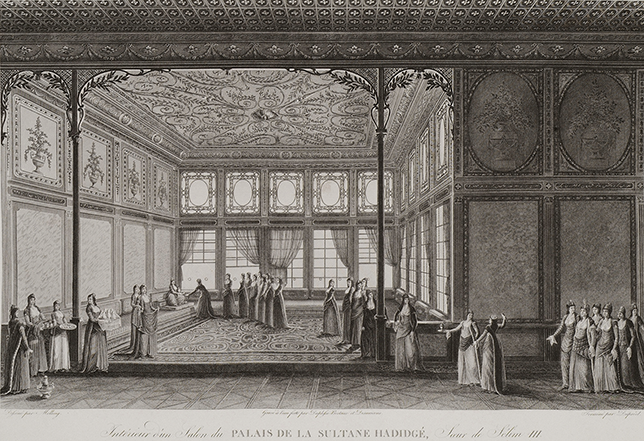
Though there is no visual record of Esma’s Tırnakçı waterfront mansion (otherwise known to be almost adjacent to Hatice’s palace), Pardoe’s detailed walkthrough of the site is reminiscent of Cockerell’s sketch of the sultana’s palace in Eyüp. Like its Eyüp counterpart, Esma’s main hall here was also ovoid in shape with an internal dome that rested on “forty porphyry columns with gilt capitals.”Footnote 143 The harem’s central hall opened into a marble terrace with a fountain that filled eleven basins of water right below it. Terraced gardens with “stately trees, a gaily gilded kiosk, superbly painted in fresco, throughout the whole of its interior, occupied the highest point of the grounds.”Footnote 144 Royal visitations were not just structured on religious observances or festive celebrations; a court chronicle only briefly mentions that Selim came to Esma’s Tırnakçı residence to observe anatomical wax figures from Italy, an unusual event coordinated for the royal viewers by the court’s long-serving and sought-after Florentine physician Lorenzo Noccrola.Footnote 145
When summering in the Beşiktaş Palace, Mihrişah found regular spiritual solace in the nearby verdant hilltop hamlet of the sixteenth-century tomb and dervish lodge of Yahya Efendi (d. 1570). Her relationship to this site and the guidance and protection of this revered Sufi sheikh, who once shared a close friendship with Sultan Süleyman I (r. 1520–1566) from the latter’s princely years, paralleled her devotion to Eyüp. In every imperial site, she sought a devotional refuge. Like Eyüp Sultan, local lore assigned Yahya Efendi the role of patron saint, especially of Beşiktaş, where he was bequeathed a plot of land by the sultan which he cultivated.Footnote 146 His hagiography also relayed a story about Yahya’s audience with Hızır, a prophetic figure in Islam, who is associated with fecundity.Footnote 147
The eighteenth-century court used the unbuilt area around this sacred convent for entertainment; Selim frequented it for archery, rifle-shooting, and wrestling, for which Mihrişah was often present. By 1800, Selim and Mihrişah increasingly reserved the Beşiktaş Palace for diplomatic encounters and spent their more private hours in an extant waterfront yalı called Çırağan, right in front of Yahya Efendi’s lodge. This light timber residence, better equipped for daytime use for courtly pastimes (and not longer stays), was assigned to the court’s married sisters and daughters in the seventeenth century and was therefore, following precedence, appointed under Selim’s tenure to his sister Beyhan. Beyhan undertook lengthy renovations in her residence in Beşiktaş from 1796 onwards, employing Yorgi, the Greek kalfa, who would also build her future residences. Yorgi’s crew contained the same wood and stucco carvers from Chios, who were employed in the harem rooms of Selim and Mihrişah.Footnote 148 We should imagine similarly exuberant, pastel and gilt rococo interiors in Beyhan’s now nonextant spaces. Following the trends of the period, Beyhan also built an imperial kiosk for her brother, which (like in Hatice’s and Esma’s version of the imperial kiosks) had sequined ceilings and bejeweled apertures.Footnote 149 An anonymous “Frenk” (European), who might easily be Melling, supplied Beyhan’s space with embroidered pillows and upholstered furniture of his designs, corresponding to his ceaseless services to Hatice’s Neșatabad residence nearby.Footnote 150
Perhaps due to his mother’s attachment to the convent and its quiet green surroundings, Selim bought Çırağan from Beyhan in 1800, and the site acquired the name saray (palace) instead of yalı.Footnote 151 Occasionally, archives and chronicles refer to the site after the change of ownership as the palace of the valide.Footnote 152 Beyhan promptly began the construction of her new Bosphorus mansion further north, in Akıntıburnu.Footnote 153 Her new yalı was close to Selim’s waterfront palace in Bebek with its expansive gardens, which operated as another diplomatic hub in addition to the palaces of Topkapı and Beşiktaş. Moreover, it was used as an imperial stopping point on the way to the former Nizam-ı Cedid Barracks at Levend Çiftliği, which Selim frequently visited and inspected. The water supply for Beyhan’s new palace was also sourced from this military complex. (While she built her new home, Beyhan divided her time between Eyüp and the palace grounds of Aynalıkavak within the expanding complex of the Arsenal, indicating that the dynastic women, when in need, had equal access to sultanic residences.)
According to the German physician and naturalist Ulrich Jasper Seetzen (d. 1811), the main building of Beyhan’s Akıntıburnu waterfront mansion was composed of multiple bay windows that helped with air circulation and it boasted a vast terraced garden (Figure 45).Footnote 154 The cost-estimate registers paint a more detailed picture of the site, which consisted of a principal harem building with a large reception hall (divanhane) and numerous other projecting halls (sofa), an imperial kiosk (kasr-ı hümayun), and an “ornate garden” (musanna bahçe).Footnote 155 The site seems to have shared similar spatial arrangements with other yalıs of royal women, especially Hatice’s Neşatabad. The tiered garden, which Seetzen criticized for not adhering to “perfect” English garden designs, featured various vernacular elements such as kiosks (kameriye), an orangery (limonluk), large but shallow pools, cascading fountains (selsebil) with elliptical basins, and artificial waterfalls (çağlayan). The main body of the harem building was painted pink (penbe), with the windows and doors framed in marble-like colors (somaki taklidi elvan boya).Footnote 156
The Palace of Said Pasha on one of the Rapids of the Bosphorus [formerly Beyhan Sultan’s Akıntıburnu yalı] By Thomas Allom in Robert Walsh, Constantinople and the Scenery of the Churches of Asia Minor (1839).
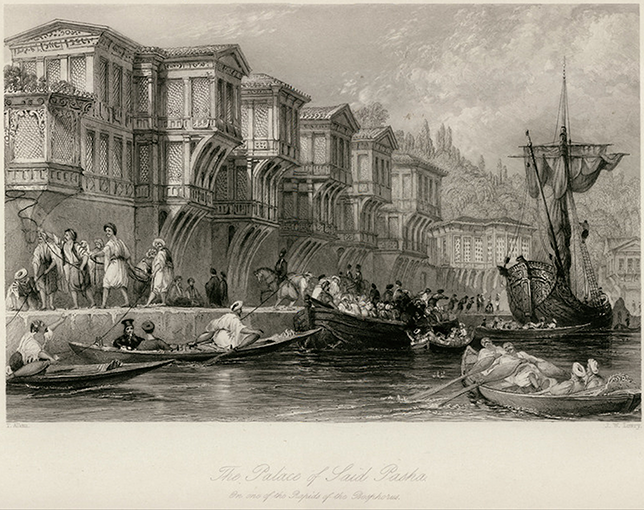
On July 12, 1801, Esma and her mother, Sineperver, visited Beyhan Sultan’s new yalı. In her correspondence with her daughter’s steward, Ömer, Sineperver stated that they had dropped by hastily (bir acele uğradık) and requested that three purses of coins be sent, not in a woven basket (zenbil), but wrapped in a bundle (bohça). In another letter penned eight days later, Sineperver wrote that she and her daughter were visiting Çırağan to spend time (eğlenmek) with the Sultan and his mother, Mihrişah. She instructed Ömer to send an ermine fur cloak of the purest white along with enough money for a twenty- to thirty-day stay. From her letter, it is apparent that Sineperver herself was uncertain about the duration of the visit. She mentioned that she would write to Ömer again and inform him once the details were finalized.
In many travelers’ accounts, the descriptions of palaces like Beyhan’s commonly begin with the ceilings and then proceed to detail the niches and gilded ornaments on the walls, followed by exquisitely embroidered cushions, carpets, and curtains. To some uninvited visitors, who secured precarious access, the sites seemed deserted and empty, because their owners moved between their multiple residences both seasonally and according to events nearby and brought along their most precious belongings, featured across the previous three sections, which only the invited guests had the privilege of using.
On March 21, 1802, Selim spent the day as his sister Beyhan’s guest in Akıntıburnu, when the site was not entirely completed.Footnote 157 Seetzen noted in 1803 that the yalı was still under construction.Footnote 158 While terms used in archival documents and primary sources such as “newly built” (müceddeden inşa) imply a complete renewal of these palaces, they were never entirely demolished and reconstructed from scratch. Instead, existing structures were renovated and spoliated materials were repurposed alongside new ones to fit the needs and desires of new tenants. The yalı was later renovated again when it was handed over to Hoşyar, Beyhan’s beloved cariye and a consort of Mahmud II, and subsequently to Mihrimah, the daughter of Hoşyar and Mahmud. This sequence of tenants in Beyhan’s yalı is just one example of the enduring female networks that spanned the reigns of different rulers. It highlights the significance of social network structures that enabled a cariye to rise within the imperial family – though not in this case – sometimes even reaching the position of valide.
Perched atop the hill in Akıntıburnu, where Beyhan’s lavish new waterfront palace stood, was a small kiosk she commissioned in late 1804. It replaced another kiosk that had originally been presented to Selim III in 1797 by the then-grand vizier İzzet Mehmed Paşa (d. 1812), but was later (sometime before 1804) destroyed in a fire that swept the hill behind Akıntıburnu.Footnote 159 The kiosk with the elliptical central space – like Selim’s Yeni Kiosk in Topkapı – in Cockerell’s drawing of two kiosk plans belongs to this building (Figure 46). Near Beyhan’s new kiosk, her sister Hatice also built another of the same kind.Footnote 160 Câbî recounts that there was a third kiosk nearby, which belonged to Esma.Footnote 161 The construction of these kiosks coincided with the relatively successful end of the campaign in Egypt, which had bolstered support for Selim’s efforts to strengthen his Nizam-ı Cedid army. Akıntıburnu likely became popular among the dynastic women closest to Selim because it served well as a rest stop for the Sultan en route to the barracks in Levend. If, indeed, the women’s courts were meant to be scaled-down versions of the sultan’s, these novel hilltop kiosks were erected as structures celebrating Selim’s reform initiatives much in the same way that Selim re-dressed his Yeni Kiosk as a commemorative edifice inside the Topkapı. These small and well-ventilated structures also reflected quotidian practicalities such as escaping the summer heat by going upland as well as quarantining in smaller numbers from various infectious diseases.
Plans of two imperial hilltop kiosks.
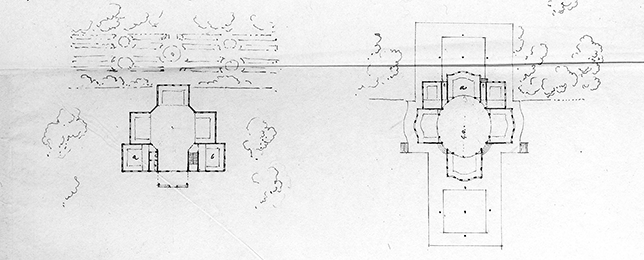
Cockerell describes and depicts these hilltop kiosks, emphasizing their structural lightness and stylistic variation.Footnote 162 Proliferating on the hills behind waterfront palaces in this period – and often within the estates of these yalıs – they commonly had a cruciform plan of four arms, each with a central sofa, and ample windows that offered panoramic views of the surrounding landscape. For example, the kiosk built in 1803 by Mihrişah Sultan, later a precursor to Yıldız Palace, stood on the hill behind the Çırağan waterfront palace.Footnote 163 Maçka Kiosk, behind Beşiktaş Palace, was bequeathed to Esma Sultan by her aunt of the same name in 1788. This hilltop–waterfront pairing was not confined to the Bosphorus: The linkage between Aynalıkavak Kiosk and Tersane Palace, between Rami Kiosk and the palaces in Eyüp on the shores of the Golden Horn, and even the kiosks in Çamlıca overlooking the Selimiye Barracks, all formed part of the same patternFootnote 164 (Figure 42).
These structures served not only as royal waystations en route to outlying areas of the city like Levend Çiftliği, Rami Çiftliği, or the Büyükdere dams but also as refuges during epidemics like the plague or tuberculosis. Most of them boasted their own orchard estatesFootnote 165 and were used for animal husbandry; Sineperver’s letters contain minute information on her desire to increase poultry-raising in her daughter Esma’s hilltop kiosk in Maçka.Footnote 166 On the one hand, with their many windowed seating areas projecting from a central space, and the geometric flower beds, pools, and fountains integrated into their design, these hilltop kiosks resembled the Edenic architectural landscapes that adorned the interior walls of the rooms in which these women wintered. These kiosks, secluded in nature but all-seeing, perhaps best embodied the position of their dynastic patrons in the capital. Spacious and distant from the prying eyes of the capital’s denizens, these kiosks best satisfied their need for the change of scenery (tebeddül), a frequent plea in their letters to the stewards (Figure 47). No matter how scenic though these sites were, however, the chronic need for ready cash, the preeminent concern in these same letters, saw the dynastic women seeking ways to convert segments of their hilltop retreats into income-generating lands.Footnote 167 Like most taste-related decisions, these land conversions were also propelled by observing what their peers were doing, and guided by the counsel of their stewards.
Kiosk a Arnaud Koi (Arnavutköy).
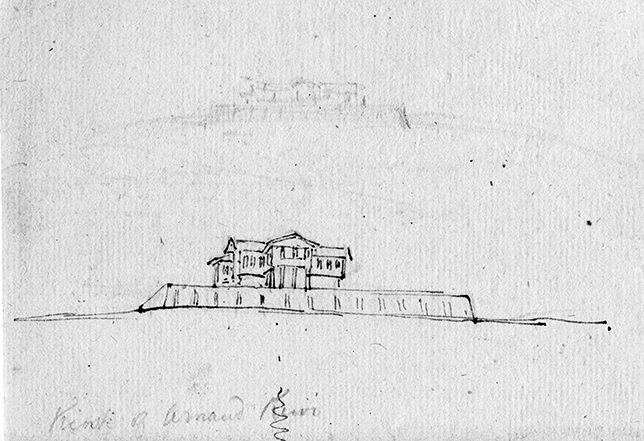
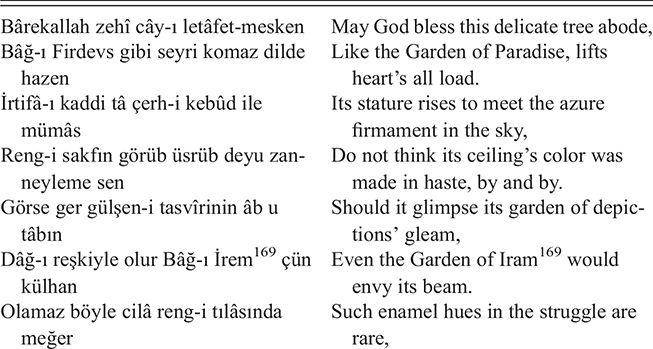
Table A1a Long description
Transcription: Bârekallah zehî cây-ı letâfet-mesken Bâğ-ı Firdevs gibi seyri komaz dilde hazen İrtifâ-ı kaddi tâ çerh-i kebûd ile mümâs Reng-i sakfın görüb üsrüb deyu zan-neyleme sen Görse ger gülşen-i tasvîrinin âb u tâbın Dâğ-ı reşkiyle olur Bâğ-ı İrem (169) çün külhan Olamaz böyle cilâ reng-i tılâsında meğer. Translation: May God bless this delicate tree abode, Like the Garden of Paradise, lifts heart’s all load. Its stature rises to meet the azure firmament in the sky. Do not think its ceiling’s color was made in haste, by and by. Should it glimpse its garden of depictions’ gleam, Even the Garden of Iram (169) would envy its beam. Such enamel hues in the struggle are rare.
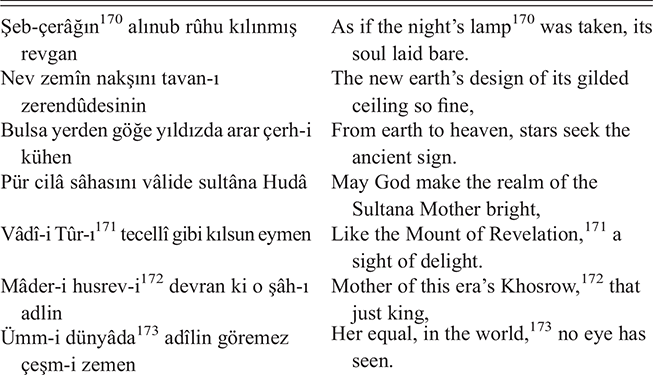
Table A1b Long description
Transcription: Şeb-çerâğın (170) alınub rûhu kılınmış revgan Nev zemîn nakşını tavan-ı zerendûdesinin Bulsa yerden göğeyıldızda arar çerh-i kühen Pür cilâ sâhasını vâlide sultâna Hudâ Vâdî-i Tûr-I (171) tecellî gibi kılsun eymen Mâder-i husrev-I (172) devran ki o şâh-ı adlin Ümm-i dünyâda (173) adîlin göremez çeşm-i zemen. Translation: As if the night’s lamp (170) was taken, its soul laid bare. The new earth’s design of its gilded ceiling so fine, From earth to heaven, stars seek the ancient sign. May God make the realm of the Sultana Mother bright, Like the Mount of Revelation, (171) a sight of delight. Mother of this era’s Khosrow, (172) that just king, Her equal, in the world, (173) no eye has seen.
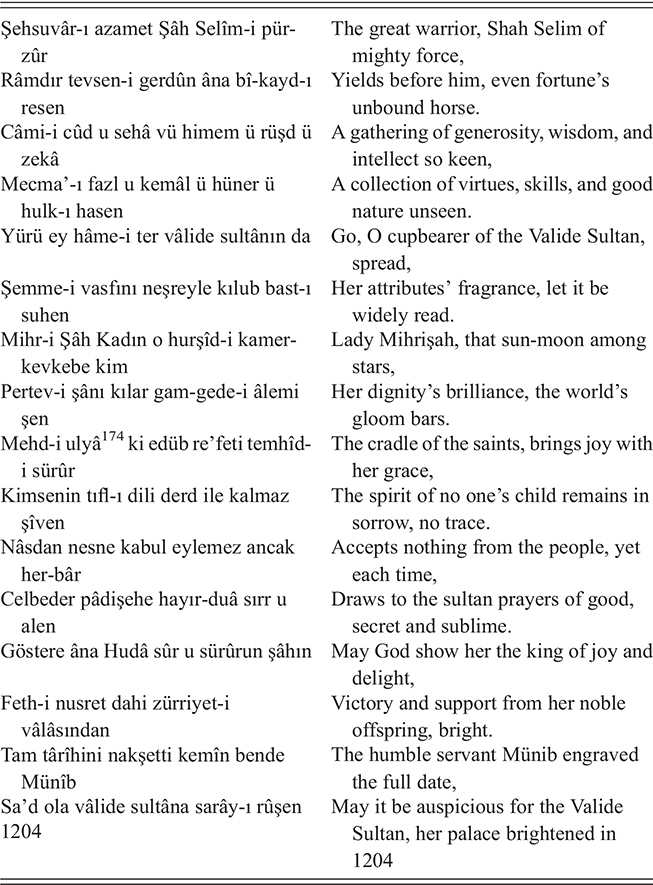
Table A1c Long description
Transcription: Şehsuvâr-ı azamet Şâh Selîm-i pürzûr Râmdır tevsen-i gerdûn âna bî-kayd-ı resen Câmi-i cûd u sehâ vü himem ü rüşdü zekâ Mecma’-ı fazl u kemâl ü hüner ü hulk-ı hasen Yürü ey hâme-i ter vâlide sultânında Şemme-i vasfını neşreyle kılub bast-ı suhen Mihr-i Şâh Kadın o hurşîd-i kamer-kevkebe kim Pertev-i şânı kılar gam-gede-i âlemi şen Mehd-i ulyâ (174) ki edüb re’feti temhîdi sürûr Kimsenin tıfl-ı dili derd ile kalmaz şîven Nâsdan nesne kabul eylemez ancak her-bâr Celbeder pâdişehe hayır-duâ sırr u alen Göstere âna Hudâ sûr u sürûrun şâhın Feth-i nusret dahi zürriyet-i vâlâsından Tam târîhini nakşetti kemîn bende Münîb Sa’d ola vâlide sultâna sarây-ı rûşen 1204. Translation: The great warrior, Shah Selim of mighty force, Yields before him, even fortune’s unbound horse. A gathering of generosity, wisdom, and intellect so keen, a collection of virtues, skills, and good nature unseen. Go, O cupbearer of the Valide Sultan, spread, Her attributes’ fragrance, let it be widely read. Lady Mihrişah, that sun-moon among stars, Her dignity’s brilliance, the world’s gloom bars. The cradle of the saints, brings joy with her grace, The spirit of no one’s child remains in sorrow, no trace. Accepts nothing from the people, yet each time, Draws to the sultan prayers of good, secret and sublime. (174) May God show her the king of joy and delight, Victory and support from her noble offspring, bright. The humble servant Münib engraved the full date, May it be auspicious for the Valide Sultan, her palace brightened in 1204.
The original eighteenth-century molds of the inscription band in Mihrişah Valide Sultan’s treasury room in the upper harem of the Topkapı Palace.
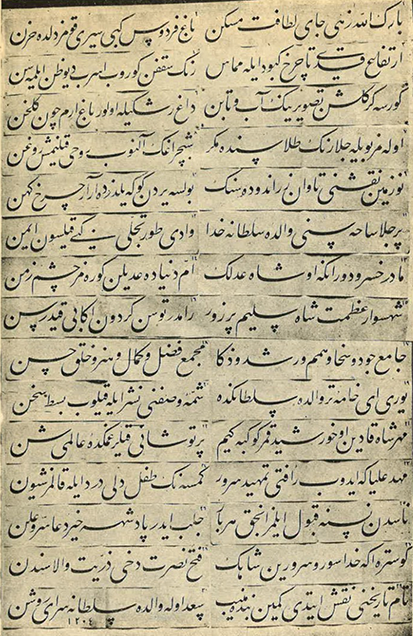
Figure A1 Long description
The poem adorns the inscription band of Mihrişah Valide Sultan’s treasury room in Topkapı Palace’s upper harem, celebrating her piety and royal virtues.
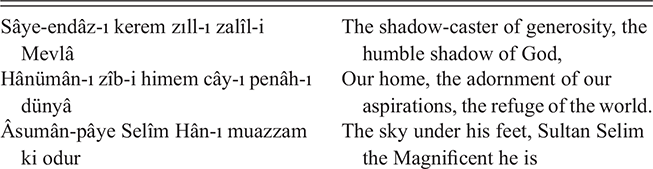
Table A2a Long description
Transcription: Sâye-endâz-ı kerem zıll-ı zalîl-i Mevlâ Hânümân-ı zîb-i himem cây-ı penâh-ı dünyâ Âsumân-pâye Selîm Hân-ı muazzam ki odur. Translation: The shadow-caster of generosity, the humble shadow of God, Our home, the adornment of our aspirations, the refuge of the world. The sky under his feet, Sultan Selim the Magnificent, he is.
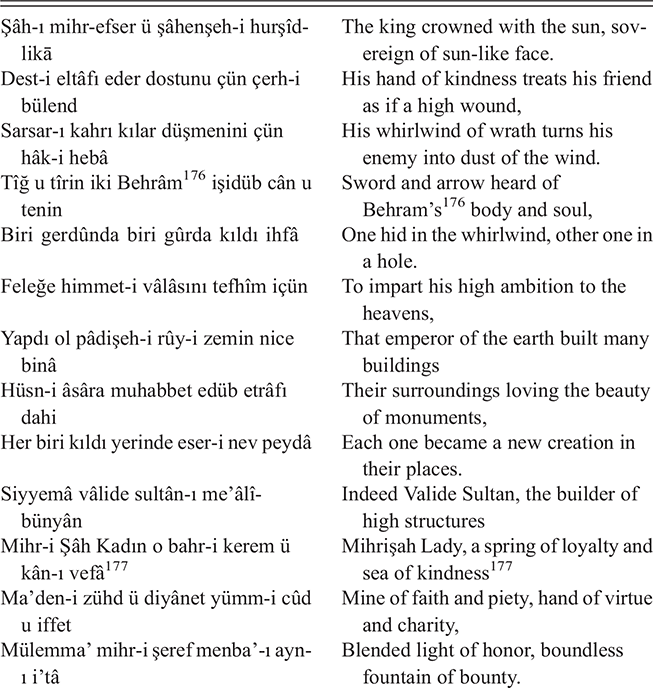
Table A2b Long description
Transcription: Şâh-ı mihr-efser ü şâhenşeh-i hurşîdlikā Dest-i eltâfı eder dostunu çün çerh-i bülend Sarsar-ı kahrı kılar düşmenini çün hâk-i hebâ Tîğ u tîrin iki Behrâm (176) işidüb cân u tenin Biri gerdûnda biri gûrda kıldı ihfâ Feleğe himmet-i vâlâsını tefhîm içün Yapdı ol pâdişeh-i rûy-i zemin nice binâ Hüsn-i âsâra muhabbet edüb etrâfı dahi Her biri kıldı yerinde eser-i nev peydâ Siyyemâ vâlide sultân-ı me’âlî-bünyân Mihr-i Şâh Kadın o bahr-i kerem ü kân-ı vefâ (177) Ma’den-i zühd ü diyânet yümm-i cûd u iffet Mülemma’mihr-işerefmenba’-ıayn ı i’tâ. Translation: The king crowned with the sun, sovereign of sun-like face. His hand of kindness treats his friend as if a high wound, His whirlwind of wrath turns his enemy into dust of the wind. Sword and arrow heard of Behram’s (176) body and soul, Onehidinthe whirlwind, other one in a hole. To impart his high ambition to the heavens, That emperor of the earth built many buildings. Their surroundings loving the beauty of monuments, Each one became a new creation in their places. Indeed Valide Sultan, the builder of high structures Mihrişah Lady, a spring of loyalty and sea of kindness (177) Mine of faith and piety, hand of virtue and charity, Blended light of honor, boundless fountain of bounty.
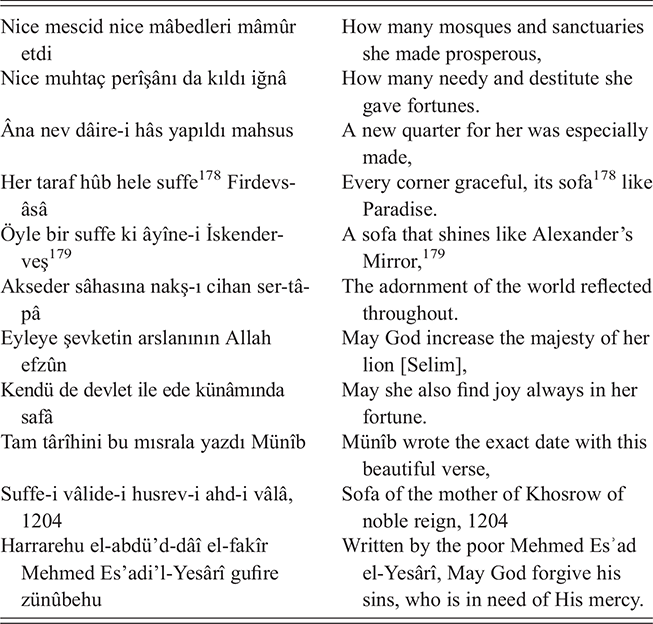
Table A2c Long description
Transcription: Nice mescid nice mâbedleri mâmûr etdi Nice muhtaç perîşânı da kıldı iğnâ Âna nev dâire-i hâs yapıldı mahsus Her taraf hûb hele suffe (178) Firdevs-âsâ Öyle bir suffe ki âyîne-i İskender-veş (179) Akseder sâhasına nakş-ı cihan ser-tâ-pâ Eyleye şevketin arslanının Allah efzûn Kendü de devlet ile ede künâmında safâ Tam târîhini bu mısrala yazdı Münîb Suffe-i vâlide-i husrev-i ahd-i vâlâ, 1204 Harrarehu el-abdü’d-dâî el-fakîr Mehmed Es’adi’l-Yesârî gufire zünûbehu. Translation: How many mosques and sanctuaries she made prosperous, How many needy and destitute she gave fortunes. A new quarter for her was especially made, Every corner graceful, its sofa (178) like Paradise. Asofa that shines like Alexander’s Mirror, (179) The adornment of the world reflected throughout. May God increase the majesty of her lion [Selim], May she also find joy always in her fortune. Münîb wrote the exact date with this beautiful verse, Sofa of the mother of Khosrow of noble reign, 1204. Written by the poor Mehmed Esʾad el-Yesârî, May God forgive his sins, who is in need of His mercy.
The original eighteenth-century molds of the inscription band in Mihrişah Valide Sultan’s sofa in the upper harem of the Topkapı Palace.
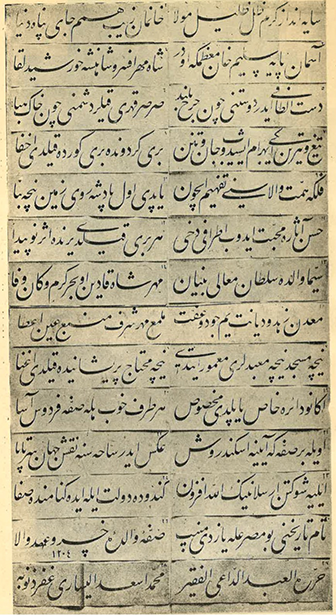
Figure A2 Long description
The page features the transcription and English translation of the eulogistic poem from the inscription band in Mihrişah Valide Sultan’s sofa in the upper harem of Topkapı Palace. The text honors Mihrişah’s generosity and devotion through refined nasta‘liq script.
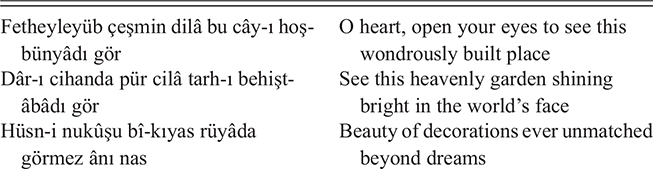
Table A3a Long description
Transcription: Fetheyleyüb çeşmin dilâ bu cây-ı hoş-bünyâdı gör Dâr-ı cihanda pür cilâ tarh-ı behişt-âbâdı gör Hüsn-i nukûşu bî-kıyas rüyâda görmez ânı nas. Translation: O heart, open your eyes to see this wondrously built place. See this heavenly garden shining bright in the world’s face. Beauty of decorations ever unmatched beyond dreams.
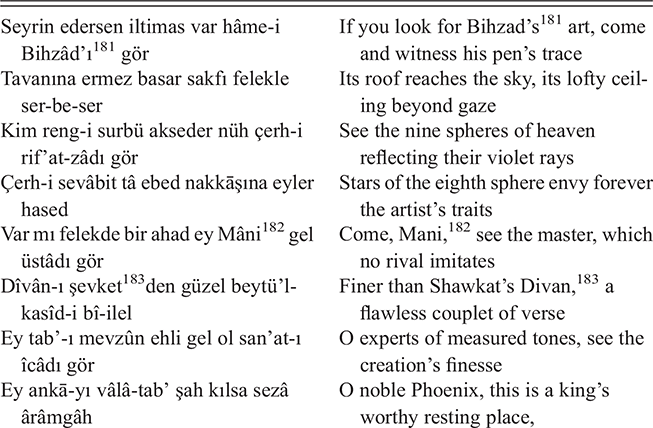
Table A3b Long description
Transcription: Seyrin edersen iltimas var hâme-i Bihzâd’I (181) gör Tavanına ermez basar sakfı felekle ser-be-ser Kim reng-i surbü akseder nüh çerh-i rif’at-zâdı gör Çerh-i sevâbit tâ ebed nakkāşına eyler hased Var mı felekde bir ahad ey Mâni (182) gel üstâdı gör Dîvân-ışevket (183) den güzel beytü’l-kasîd-i bî-ilel Ey tab’-ı mevzûn ehli gel ol san’at-ı îcâdı gör Ey ankā-yı vâlâ-tab’ şah kılsa sezâ ârâmgâh. Translation: If you look for Bihzad’s (181) art, come and witness his pen’s trace Its roof reaches the sky, its lofty ceiling beyond gaze See the nine spheres of heaven reflecting their violet rays Stars of the eighth sphere envy forever the artist’s traits Come, Mani, (182) see the master, which no rival imitates Finer than Shawkat’s Divan, (183) a flawless couplet of verse O experts of measured tones, see the creation’s finesse O noble Phoenix, this is a king’s worthy resting place.
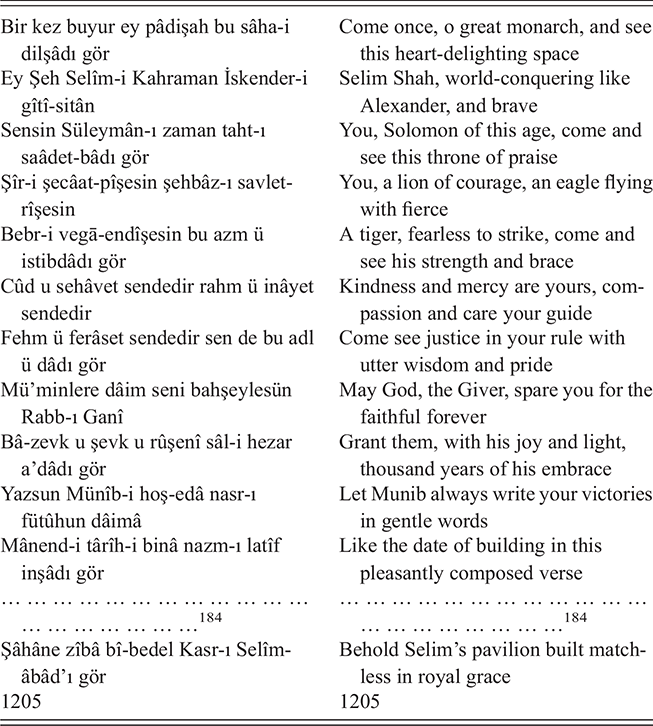
Table A3c Long description
Transcription: Bir kez buyur ey pâdişah bu sâha-i dilşâdı gör Ey Şeh Selîm-i Kahraman İskender-i gîtî-sitân Sensin Süleymân-ı zaman taht-ı saâdet-bâdı gör Şîr-i şecâat-pîşesin şehbâz-ı savlet-rîşesin Bebr-i vegā-endîşesin bu azm ü istibdâdı gör Cûd u sehâvet sendedir rahm ü inâyet sendedir Fehm ü ferâset sendedir sen de bu adl ü dâdı gör Mü’minlere dâim seni bahşeylesün Rabb-ı Ganî Bâ-zevk u şevk u rûşenî sâl-i hezar a’dâdı gör Yazsun Münîb-i hoş-edâ nasr-ı fütûhun dâimâ Mânend-i târîh-i binâ nazm-ı latîf inşâdı gör, (blank; 184), Şâhâne zîbâ bî-bedel Kasr-ı Selîm âbâd’ı gör 1205. Translation: Come once, o great monarch, and see this heart-delighting space Selim Shah, world-conquering like Alexander, and brave You, Solomon of this age, come and see this throne of praise You, a lion of courage, an eagle flying with fierce A tiger, fearless to strike, come and see his strength and brace Kindness and mercy are yours, compassion and care your guide Come see justice in your rule with utter wisdom and pride May God, the Giver, spare you for the faithful forever Grant them, with his joy and light, thousand years of his embrace Let Munib always write your victories in gentle words Like the date of building in this pleasantly composed verse, (blank; 184), Behold Selim’s pavilion built match less in royal grace 1205.
The original eighteenth-century molds of the inscription band in Selim III’s lihye room in the upper harem of the Topkapı Palace.
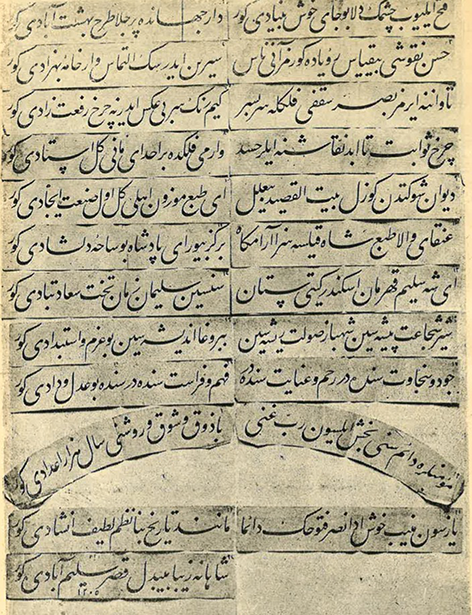
Figure A3 Long description
The Ottoman Turkish manuscript page contains the transcription and English translation of the poetic inscription from Sultan Selim III’s lihye (beard relic) room in the upper harem of Topkapı Palace. The nasta‘liq calligraphy praises divine wisdom, justice, and royal devotion.
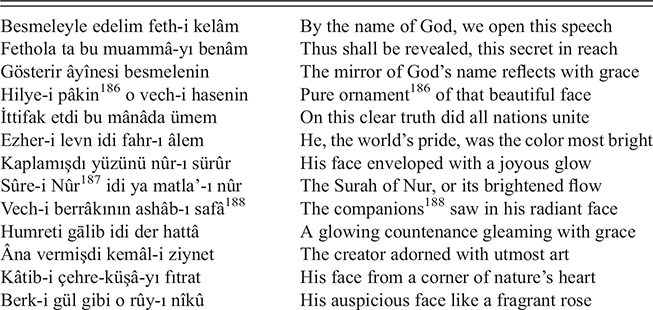
Table A4a Long description
Transcription: Besmeleyle edelim feth-i kelâm Fethola ta bu muammâ-yı benâm Gösterir âyînesi besmelenin Hilye-i pâkin (186) o vech-i hasenin İttifak etdi bu mânâda ümem Ezher-i levn idi fahr-ı âlem Kaplamışdı yüzünü nûr-ı sürûr Sûre-i Nûr (187) idi ya matla’-ı nûr Vech-i berrâkının ashâb-ı safâ (188) Humreti gālib idi der hattâ Âna vermişdi kemâl-i ziynet Kâtib-i çehre-küşâ-yı fıtrat Berk-i gül gibi o rûy-ı nîkû. Translation: By the name of God, we open this speech Thus shall be revealed, this secret in reach The mirror of God’s name reflects with grace Pure ornament (186) of that beautiful face On this clear truth did all nations unite He, the world’s pride, was the color most bright His face enveloped with a joyous glow The Surah of Nur, or its brightened flow The companions (188) saw in his radiant face A glowing countenance gleaming with grace The creator adorned with utmost art His face from a corner of nature’s heart His auspicious face like a fragrant rose.
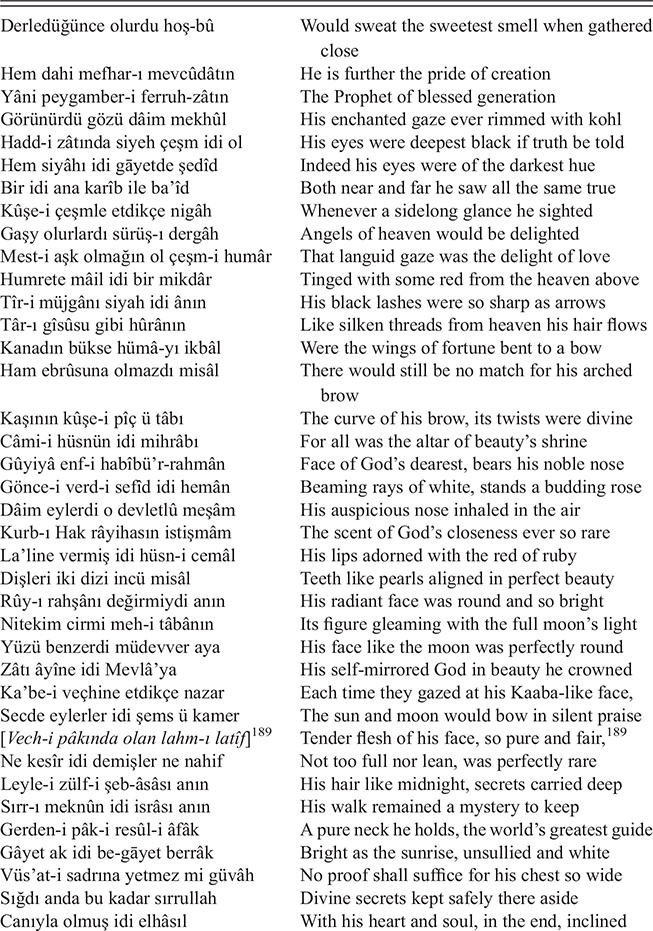
Table A4b Long description
Transcription: Derledüğünce olurdu hoş-bû Hem dahi mefhar-ı mevcûdâtın Yâni peygamber-i ferruh-zâtın Görünürdü gözü dâim mekhûl Hadd-i zâtında siyeh çeşm idi ol Hem siyâhı idi gāyetde şedîd Bir idi ana karîb ile ba’îd Kûşe-i çeşmle etdikçe nigâh Gaşy olurlardı sürüş-ı dergâh Mest-i aşk olmağın ol çeşm-i humâr Humrete mâil idi bir mikdâr Tîr-i müjgânı siyah idi ânın Târ-ı gîsûsu gibi hûrânın Kanadın bükse hümâ-yı ikbâl Ham ebrûsuna olmazdı misâl Kaşınınkûşe-i pîç ü tâbı Câmi-i hüsnün idi mihrâbı Gûyiyâ enf-i habîbü’r-rahmân Gönce-i verd-i sefîd idi hemân Dâim eylerdi o devletlû meşâm Kurb-ı Hak râyihasın istişmâm La’line vermiş idi hüsn-i cemâl Dişleri iki dizi incü misâl Rûy-ı rahşânı değirmiydi anın Nitekim cirmi meh-i tâbânın Yüzü benzerdi müdevver aya Zâtı âyîne idi Mevlâ’ya Ka’be-i veçhine etdikçe nazar Secde eylerler idi şems ü kamer [Vech-i pâkında olan lahm-ı latîf] (189) Ne kesîr idi demişler ne nahif Leyle-i zülf-i şeb-âsâsı anın Sırr-ı meknûn idi isrâsı anın Gerden-i pâk-i resûl-i âfâk Gâyet ak idi be-gāyet berrâk Vüs’at-i sadrına yetmez mi güvâh Sığdı anda bu kadar sırrullah Canıyla olmuş idi elhâsıl. Translation: Would sweat the sweetest smell when gathered close He is further the pride of creation The Prophet of blessed generation His enchanted gaze ever rimmed with kohl His eyes were deepest black if truth be told Indeed his eyes were of the darkest hue Both near and far he saw all the same true Whenever a sidelong glance he sighted Angels of heaven would be delighted That languid gaze was the delight of love Tinged with some red from the heaven above His black lashes were so sharp as arrows Like silken threads from heaven his hair flows Were the wings of fortune bent to a bow There would still be no match for his arched brow The curve of his brow, its twists were divine For all was the altar of beauty’s shrine Face of God’s dearest, bears his noble nose Beaming rays of white, stands a budding rose His auspicious nose inhaled in the air The scent of God’s closeness ever so rare His lips adorned with the red of ruby Teeth like pearls aligned in perfect beauty His radiant face was round and so bright Its figure gleaming with the full moon’s light His face like the moon was perfectly round His self-mirrored God in beauty he crowned Each time they gazed at his Kaaba-like face, The sun and moon would bow in silent praise Tender flesh of his face, so pure and fair, (189) Not too full nor lean, was perfectly rare His hair like midnight, secrets carried deep His walk remained a mystery to keep A pure neck he holds, the world’s greatest guide Bright as the sunrise, unsullied and white No proof shall suffice for his chest so wide Divine secrets kept safely there aside With his heart and soul, in the end, inclined.
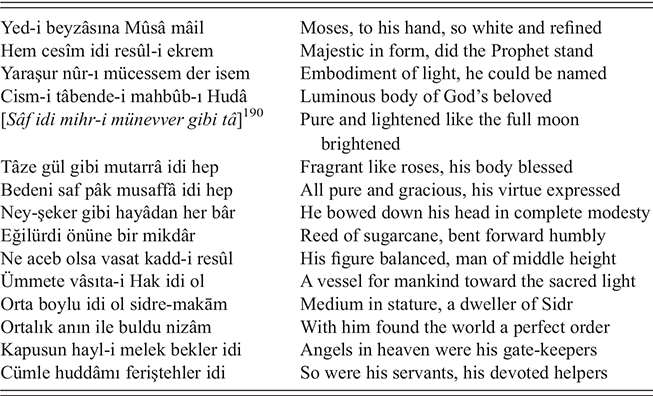
Table A4c Long description
Transcription: Yed-i beyzâsına Mûsâ mâil Hem cesîm idi resûl-i ekrem Yaraşur nûr-ı mücessem der isem Cism-i tâbende-i mahbûb-ı Hudâ [Sâf idi mihr-i münevver gibi tâ] (190) Tâze gül gibi mutarrâ idi hep Bedeni saf pâk musaffâ idi hep Ney-şeker gibi hayâdan her bâr Eğilürdi önüne bir mikdâr Ne aceb olsa vasat kadd-i resûl Ümmete vâsıta-i Hak idi ol Orta boylu idi ol sidre-makām Ortalıkanın ile buldu nizâm Kapusun hayl-i melek bekler idi Cümle huddâmı feriştehler idi. Translation: Moses, to his hand, so white and refined Majestic in form, did the Prophet stand Embodiment of light, he could be named Luminous body of God’s beloved Pure and lightened like the full moon brightened (190) Fragrant like roses, his body blessed All pure and gracious, his virtue expressed He bowed down his head in complete modesty Reed of sugarcane, bent forward humbly His figure balanced, man of middle height A vessel for mankind toward the sacred light Medium in stature, a dweller of Sidr With him found the world a perfect order Angels in heaven were his gate-keepers So were his servants, his devoted helpers.
Selma Emler’s print publication of the legible segments of Hakanî’s hilye on the inscription band in Selim III’s room in the courtyard of Osman III.
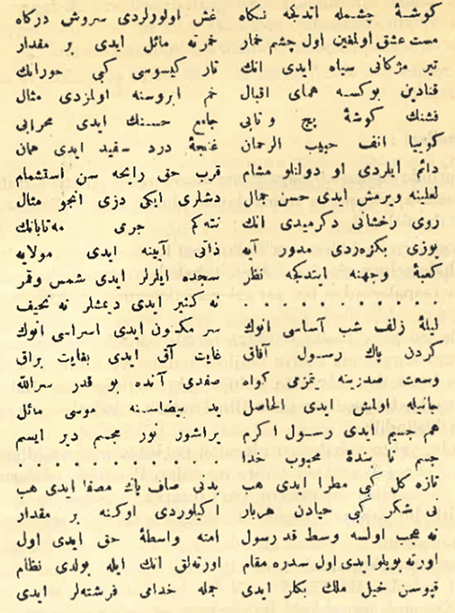
Acknowledgements
These two interconnected volumes, dedicated to the material worlds of eighteenth-century Istanbul’s royal women, were made possible through the generous support of our families, friends, and colleagues.
Our first thanks go to Peter Frankopan, who invited us to contribute to the Cambridge Elements’ History of Constantinople, gave us the freedom to choose our time period and protagonists, and provided the space to write about them across two volumes.
We first workshopped the project at ANAMED (Istanbul) in March 2024 under the title Unveiling the Hidden Power of Ottoman Women: Exploring their Relations, Networks, and Material Culture. Our generous participants – Aysel Yıldız, F. Betül İpşirli Argıt, Sabiha Göloğlu, Muzaffer Özgüleş, Merve Çakır, Akın Sefer, and Bahar Yolaç-Pollock – greatly expanded our knowledge and enriched our ideas for these volumes. We are also grateful to the ANAMED team – especially Buket Coşkuner – for providing a venue for the event and offering warm support throughout the process.
Aysel Yıldız was among the first to read our drafts. She also introduced us to her student-turned-colleague, Merve Çakır, who opened the doors to the chambers of Selim III and Mihrişah Valide Sultan inside the Topkapı Palace Museum – exquisite and intimate spaces that form the heart of the second volume. Rıza Bey, the museum’s guard, understood the urgency of our desire to see these closed-off rooms and spared us more time than allowed.
Selim Kuru was always eager to discuss our findings, read various versions, and help decipher the idiosyncratic Ottoman phrasing found in chronicles and letters. His insight – and laughter – resonates throughout many of our primary sources.
Eda Özel provided elegant English translations of the inscription bands found in the harem rooms, which are still under renovation. Üzeyir Karataş came to our rescue with the missing lines of the hilye inscription.
Edhem Eldem directed us to a treasure trove of letters between lesser-known women of the harem and the wives of English diplomats, which Günseli Gürel kindly photographed at the British Museum.
Murat Tülek conceptualized and designed maps of now-lost sites once inhabited by these women, helping us visualize spaces that no longer exist.
Lale Görünür not only provided textile examples from the exceptional collections of the Sadberk Hanım Museum but also shared her deep knowledge of the material language of these
objects. She too read our drafts with care and attention.
Elizabeth Key Fowden shared in our joy of discovery with profound interest and her ever-present wisdom.
Enormous thanks to Namık Erkal for emphasizing the importance of Thomas Hope’s sketches of Istanbul; F. Melike Sümertaş and Haris Rigas for their support with Greek-language materials; Mehmet Kentel for sharing digital copies of Henry Aston Barker’s diary and sketchbook; Mara Verykokou and Vassiliki Daniil for their generous assistance with the Benaki Museum’s collections; Fuat Recep, for his constant help in expediting our Ottoman transcriptions of archival sources; and Akif E. Yerlioğlu for providing scans of books available only at the Boğaziçi University Library.
An Aga Khan Fellowship at Harvard expedited the writing, for that we are hugely grateful to Gülru Necipoğlu and David J. Roxburgh. A generous publication grant from The Barakat Trust made it possible to produce these volumes with the visual sources we needed.
We are thankful to Jessica Stilwell for copyediting our volumes with great care and interest.
Our brilliant student assistant, Öznil Çelebi, deserves special recognition for her tireless energy, positivity, and steadfast support.
We extend our deepest gratitude to our families. To our beloved babaanne (Pınar), and to Tevfik Türker, Gülşah, and Tarık Akçal, whose unconditional love and support have always been a source of strength and joy.
To our spouses, Rodrigo Cerdá and Kutay Uğurlu, who not only stood by us but also welcomed each other into our shared daily lives as family. Their boundless patience with our hours-long conversations, and their willingness to live through this long journey with us, made these volumes possible. And to our children – Rui (10) and Siro (4) Cerdá, and Neslihan (18), Ali (14), and Selim (14) Uğurlu – who embraced our sisterhood as their own and filled it with laughter and love, we offer our deepest thanks and all our affection.
This project spanned over five years, during which we found ourselves on Zoom together almost every single day. The seven-to-eight-hour time difference was not always easy, but we will always remember the process as exhilarating and deeply bonding. We look forward to many more projects together – some of which are already in the making.
Finally, we note that although the Virgin Mary mosaic on the wall of Hagia Sophia is a meaningful cover image for a study of Ottoman female patronage, an alternative we would have preferred is the eighteenth-century aerial view of Constantinople from a Dutch diplomat’s travelogue, framed by portraits of imperial women rendered in all of their imagined splendor (Figure 48).
Ladies of Constantinople from J. Aegidius van Egmont, Travels Through Part of Europe, Asia Minor, the Islands of the Archipelago, 2 Vols. (L. Davis and C. Reymers, 1759), vol .1, 293.
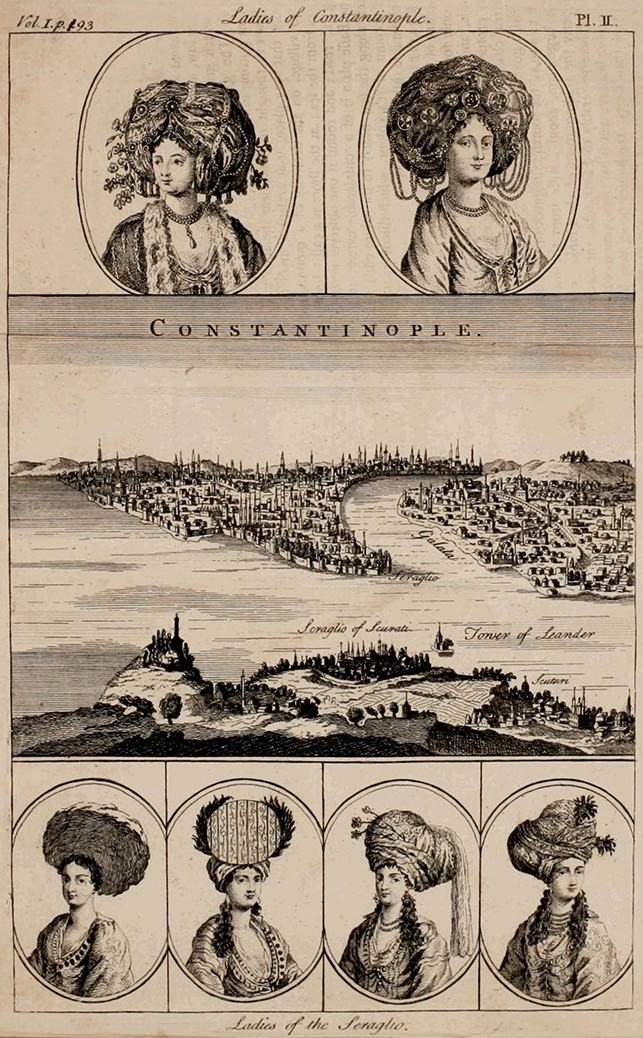
Peter Frankopan
University of Oxford
Peter Frankopan is Professor of Global History at Oxford University, where he is also Director of the Centre for Byzantine Research and Senior Research Fellow at Worcester College. He specialises in the history of the Eastern Mediterranean from antiquity to the modern day, and is the author of the best-sellers The Silk Roads: A New History of the World (2015) and The New Silk Roads: The Future and Present of the World (2018).
About the Series
Telling the history of Constantinople through its monuments and people, leading scholars present a rich and unbiased account of this ever-evolving metropolis. From its foundation to the domination of the Ottoman Empire to contemporary Istanbul, numerous aspects of Constantinople’s narrative are explored in this unrivalled series.