




Introduction
The first two years of life are characterized by profound advances in language acquisition, laying the foundations for later oral language skills. The quality and quantity of speech input provided to infants during this time shapes their language development (Rowe, Reference Rowe2012; Weisleder & Fernald, Reference Weisleder and Fernald2013), and might vary as a function of socio-economic status (SES), creating a ‘language gap’ between high and low-SES peers that does not necessarily close over time (Fernald et al., Reference Fernald, Marchman and Weisleder2013; Golinkoff et al., Reference Golinkoff, Hoff, Rowe, Tamis-LeMonda and Hirsh-Pasek2019; Hoff, Reference Hoff2013). As such, it is important to address specific activities parents can engage in to best support early language acquisition across varying SES. In the current study, we examine the association between 12- and 24-month-old infants’ vocabulary size and two activities that have gained significant attention in the literature: shared book reading and exposure to screens.
Evidence to date suggest that shared book reading might be a particular effective activity parents can engage in to support their infants’ vocabulary growth (Dowdall et al., Reference Dowdall, Melendez-Torres, Murray, Gardner, Hartford and Cooper2020; Kartushina et al., Reference Kartushina, Mani, Aktan-Erciyes, Alaslani, Aldrich, Almohammadi, Alroqi, Anderson, Andonova, Aussems, Babineau, Barokova, Bergmann, Cashon, Custode, de Carvalho, Dimitrova, Dynak, Farah and Mayor2022; Muhinyi & Rowe, Reference Muhinyi and Rowe2019; O’Farrelly et al., Reference O’Farrelly, Doyle, Victory and Palamaro-Munsell2018). The facilitating role of shared book reading has been proposed to arise from the features of the books themselves (Bruner, Reference Bruner2021; Dawson et al., Reference Dawson, Hsiao, Tan, Banerji and Nation2021; Montag et al., Reference Montag, Jones and Smith2015), and the features of the learning situation that shared reading brings to the infant (Hoff, Reference Hoff2010; Tamis-LeMonda et al., Reference Tamis-LeMonda, Custode, Kuchirko, Escobar and Lo2019). Corpus analyses of the linguistic content of children’s picture books suggest that, compared to child-directed speech, picture books contain richer and more varied vocabulary, a higher frequency of rare words, and words with greater phonological and morphological complexity (Dawson et al., Reference Dawson, Hsiao, Tan, Banerji and Nation2021; Montag et al., Reference Montag, Jones and Smith2015). In comparison to other routine activities, during shared reading parents use more sophisticated, less regulatory, and more referential language, asking more questions (Ece Demir-Lira et al., Reference Ece Demir-Lira, Applebaum, Goldin-Meadow and Levine2019; Snow et al., Reference Snow, Arlman-Rupp, Hassing, Jobse, Joosten and Vorster1976; Tamis-LeMonda et al., Reference Tamis-LeMonda, Custode, Kuchirko, Escobar and Lo2019). Infants themselves are, in turn, eliciting more contingent and complex vocal and verbal responses during shared book reading (Gros-Louis et al., Reference Gros-Louis, West and King2016; Hoff, Reference Hoff2010); in sum creating a reciprocal learning situation, which, in combination with the rich linguistic content in books, might be ideal for vocabulary growth.
While benefits of shared book reading are rarely disputed, the impact and direction of effects of screen time on early language development are less clear (e.g., Dynia et al., Reference Dynia, Dore, Bates and Justice2021; van den Heuvel et al., Reference van den Heuvel, Ma, Borkhoff, Koroshegyi, Dai, Parkin, Maguire and Birken2019). While on one hand, the time infants spend with screens might present an opportunity cost in reducing activities that are more conducive to language learning (Brushe et al., Reference Brushe, Haag, Melhuish, Reilly and Gregory2024; Christakis, Reference Christakis2008; Kartushina et al., Reference Kartushina, Mani, Aktan-Erciyes, Alaslani, Aldrich, Almohammadi, Alroqi, Anderson, Andonova, Aussems, Babineau, Barokova, Bergmann, Cashon, Custode, de Carvalho, Dimitrova, Dynak, Farah and Mayor2022), on the other hand, exposure to screen content that is educational and well-designed might be positive for language growth and provide an opportunity benefit. Analogously, recent meta-analytic evidence is conflicting; one study reported a negative effect of quantity of screen use – and a positive effect of a delayed screen use onset age – on a composite score of language skills (Madigan et al., Reference Madigan, McArthur, Anhorn, Eirich and Christakis2020), whereas another meta-analysis reported a non-significant (but positive) effect of screen time on vocabulary size in correlational studies, and a significant and positive effect of screen time on vocabulary learning in experimental studies (Jing et al., Reference Jing, Ye, Kirkorian and Mares2023). It is noteworthy that in both meta-analyses older children are overrepresented as compared to participants in the current study (M age 39.9 months in Jing et al., Reference Jing, Ye, Kirkorian and Mares2023; 44.4 months in Madigan et al., Reference Madigan, McArthur, Anhorn, Eirich and Christakis2020 vs. 19.4 months in the current study).
To further investigate associations between shared book reading, screen time exposure and vocabulary learning, in this pre-registered study we tested, with a large sample of 12- and 24-month-old infants, the following predictions:
-
1. The frequency of shared book reading will be positively related to 24-month-olds’ expressive vocabulary, and 12-month-olds’ expressive and receptive vocabulary, with more frequent book reading associated with larger vocabulary sizes (Dowdall et al., Reference Dowdall, Melendez-Torres, Murray, Gardner, Hartford and Cooper2020; Kartushina et al., Reference Kartushina, Mani, Aktan-Erciyes, Alaslani, Aldrich, Almohammadi, Alroqi, Anderson, Andonova, Aussems, Babineau, Barokova, Bergmann, Cashon, Custode, de Carvalho, Dimitrova, Dynak, Farah and Mayor2022; O’Farrelly et al., Reference O’Farrelly, Doyle, Victory and Palamaro-Munsell2018).
-
2. Daily duration of screen time will be negatively related to 24- and 12-month-olds’ expressive vocabulary, with more screen time being associated with smaller vocabulary sizes (see Dynia et al., Reference Dynia, Dore, Bates and Justice2021; Madigan et al., Reference Madigan, McArthur, Anhorn, Eirich and Christakis2020; Kartushina et al., Reference Kartushina, Mani, Aktan-Erciyes, Alaslani, Aldrich, Almohammadi, Alroqi, Anderson, Andonova, Aussems, Babineau, Barokova, Bergmann, Cashon, Custode, de Carvalho, Dimitrova, Dynak, Farah and Mayor2022 – the latter study included a sample of n=231 Norwegian 6–36-month-old infants).
-
3. With respect to screen time and 12-month-olds’ receptive vocabulary, we have less evidence to form a unidirectional prediction. If time spent with screens exposes the infant to language input, despite not being from a contingent learning situation, that still can help build their receptive vocabulary (Jing et al., Reference Jing, Ye, Kirkorian and Mares2023), then we expect a positive association between screen time and receptive vocabulary. Contrarily, if screen time reduces opportunities for interactive, contingent language input, we expect a negative association between the two (Madigan et al., Reference Madigan, McArthur, Anhorn, Eirich and Christakis2020; Masek et al., Reference Masek, McMillan, Paterson, Tamis-LeMonda, Golinkoff and Hirsh-Pasek2021).
Method
Parents of 12- and 24-month-old infants residing in Oslo, Norway were recruited via postal invitations (with addresses acquired from birth registries) to participate in the current study. Approximately 10,000 families were contacted, comprising the entire relevant population in the greater Oslo area. Eligible participants (see inclusion criteria below) were screened through an online questionnaire. The sample comprised n=1442 infants; n=556 (276 girls; 280 boys) 12-month-olds (M age = 367 days, SD = 5.05, range = 352–378) and n=886 (465 girls; 421 boys) 24-month-olds (M age = 886 days, SD = 5.54, range = 717–743). Infants were monolingual, with no less than 90% reported exposure to Norwegian, born full term (after gestational week 37), and had no reported visual, auditory, or cognitive impairments. Infants had on average 0.51 siblings (SD = 0.71, range = 0–5). Mothers’ highest level of education, used as an index of SES, ranged from 1 (primary school) to 6 (doctoral degree), with the median being 5 (master’s degree). Note that census data indicates that 23.5% of the adult population in Oslo has education beyond bachelor level (Statistisk Sentralbyrå, Reference Sentralbyrå2023), suggesting a skew towards high SES in our sample. See Appendix 1 for a description of participants’ age, gender and number of siblings for each SES group.
Through an online questionnaire, parents reported how often they engaged in shared book reading with their infant (ranging from 0–‘never’ to 5–‘several times a day’, cf. Table 1) and their infants’ daily screen time on smartphones and/or tablet devices (ranging from 0–‘none’ to 7–‘6 hours’, cf. Table 1), in the past four months.Footnote 1 Note that our measure of screen time did not include TV exposure per se, and potentially underestimate the total time spent on screens for some infants. Yet, a recent report suggests that 89% of Norwegian 1–5-year-olds use smartphones and/or tablets to watch TV-shows, movies and cartoons (Medietilsynet, 2023), suggesting that our screen measure captures a significant fraction of total screen time. In addition, parents reported their infants’ vocabulary size using the Norwegian adaptation of MacArthur-Bates Communicative Developmental Inventories (Fenson et al., Reference Fenson, Bates, Dale, Marchman, Reznick and Thal2007; Simonsen et al., Reference Simonsen, Kristoffersen, Bleses, Wehberg and Jørgensen2014). Parents of 24-month-olds reported infants’ expressive vocabulary – that is, the number of words their infant produced; while parents of 12-month-olds reported both infants’ expressive and receptive vocabulary – that is, the number of words their infant understood. Individual raw vocabulary scores were transformed into age- and gender-adjusted percentiles using Norwegian norms (Simonsen et al., Reference Simonsen, Kristoffersen, Bleses, Wehberg and Jørgensen2014), following the procedure described in Kartushina et al. (Reference Kartushina, Mani, Aktan-Erciyes, Alaslani, Aldrich, Almohammadi, Alroqi, Anderson, Andonova, Aussems, Babineau, Barokova, Bergmann, Cashon, Custode, de Carvalho, Dimitrova, Dynak, Farah and Mayor2022).
Distribution of shared book reading frequency and daily screen time by age group
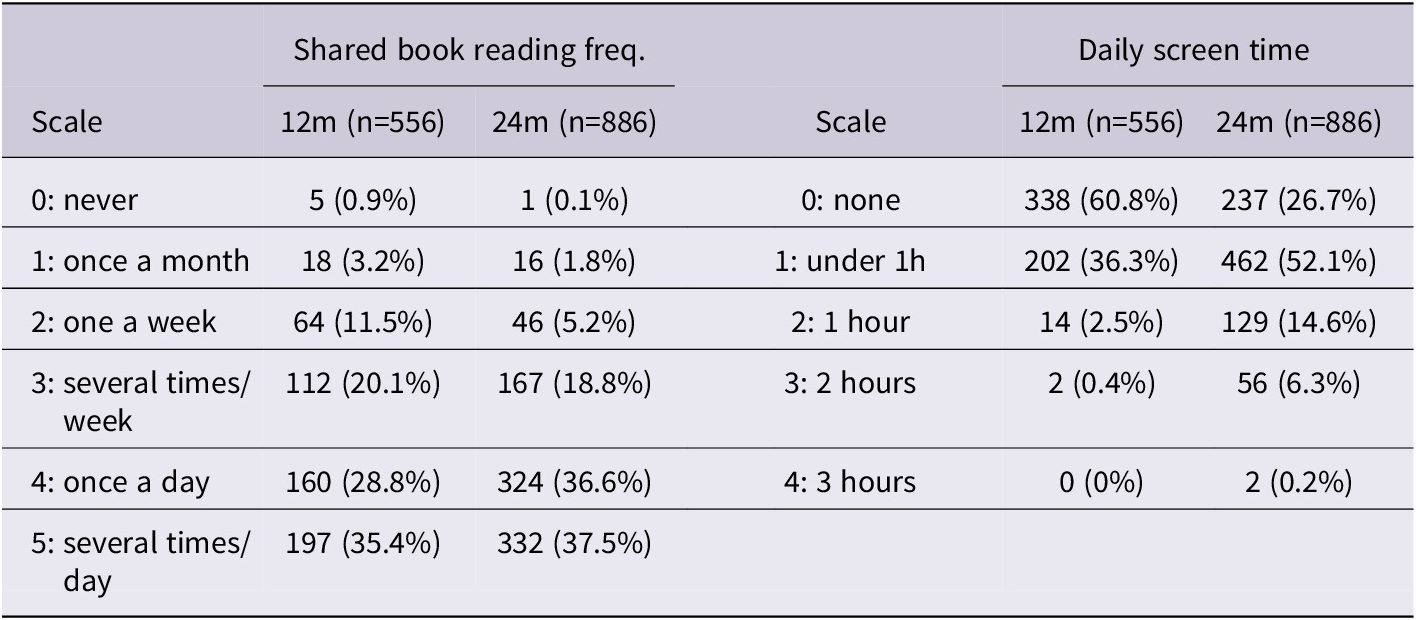
Note. Parents had the opportunity to report up to 6 hours of daily screen time, but the highest reported value was 3 hours.
The present study was conducted according to the guidelines laid down in the Declaration of Helsinki, with written informed consent obtained from a parent or a guardian for each child before any assessment or data collection. The study was approved by the ethics committee at the Department of Psychology, University of Oslo and by the Norwegian Centre for Research Data (no. 5600837).
All statistical analyses were conducted using R Studio (version 2022.12.0+353). Pre-registration, materials, data and code are openly available at the Open Science Framework (OSF) project’s page (https://osf.io/fb5kx/).
Results
The distribution of responses for each level of shared book reading and daily screen time are reported in Table 1. The mean score of shared book reading was 4.02 (SD = 0.98) for 24-month-olds; and 3.79 (SD = 1.19) for 12-month-olds, and the mean score of daily screen time was 1.01 (SD = 0.83) for 24-month-olds; and 0.42 (SD = 0.56) for 12-month-olds (cf. Table 1 for scale correspondence). The mean percentile for expressive vocabulary was 57.2 (SD = 32.0, range = 10–99) in 24-month-olds’ and 57.6 (SD = 23.8, range = 9–99) in 12-month-olds’; the mean receptive vocabulary in 12-month-olds’ was 54.3 (SD = 29.4, range = 10–99).
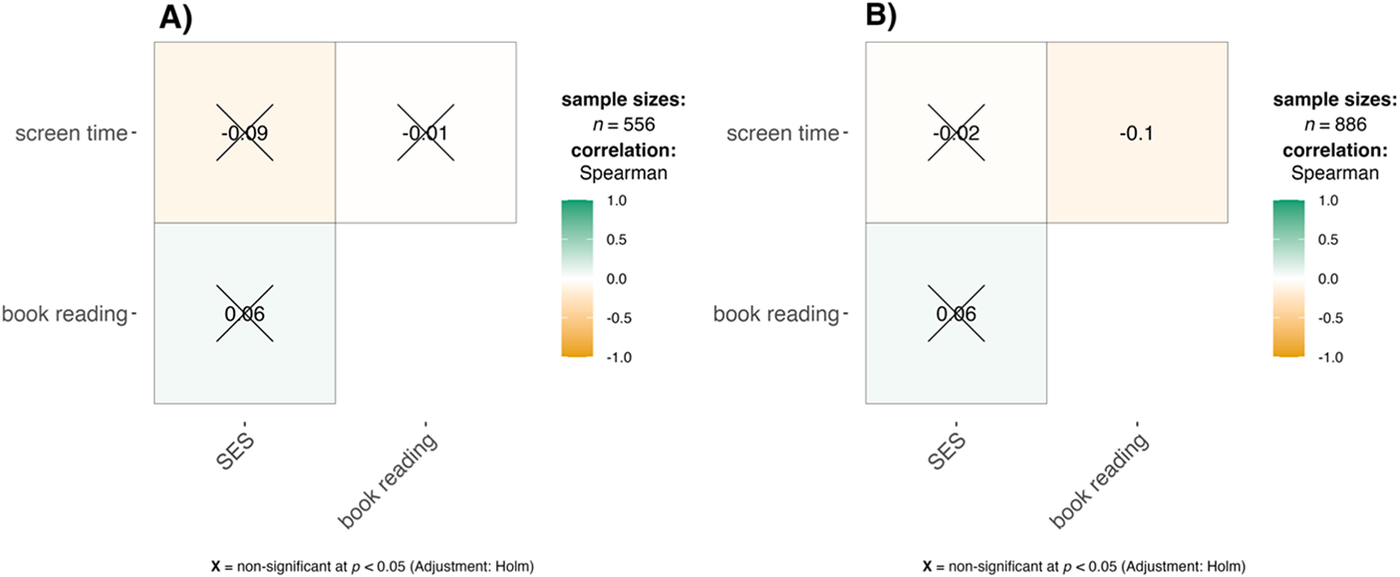
To test our hypotheses regarding the impact of book reading and screen time on vocabulary, we fitted three beta-regression models using the betareg package (Cribari-Neto & Zeileis, Reference Cribari-Neto and Zeileis2010), with a two-sided significance test, applying a significance threshold of ≤ .05. The primary outcome for all models derived from infants’ vocabulary size in percentiles (24-month-olds’ expressive vocabulary, 12-month-olds’ expressive vocabulary, and 12-month-olds’ receptive vocabulary), with shared book reading and daily screen time as predictor variables, and SES as a covariate (all z-transformed). A correlation matrix depicting the relationship between these predictors is provided in Appendix 2. Model assumptions, including normality and homogeneity of residuals, overdispersion, collinearity among predictors, and model stability were evaluated and deemed appropriate (see OSF for diagnostic plots). Before assessing the significance of the predictors, we performed full-null model comparisons, where the null models included only the SES, to safeguard against type-I errors that may arise from multiple testing (Forstmeier & Schielzeth, Reference Forstmeier and Schielzeth2011). All full-null comparisons were significant (p’s <.001) – hence, we interpreted model estimates and p-values using the summary() function on the models.
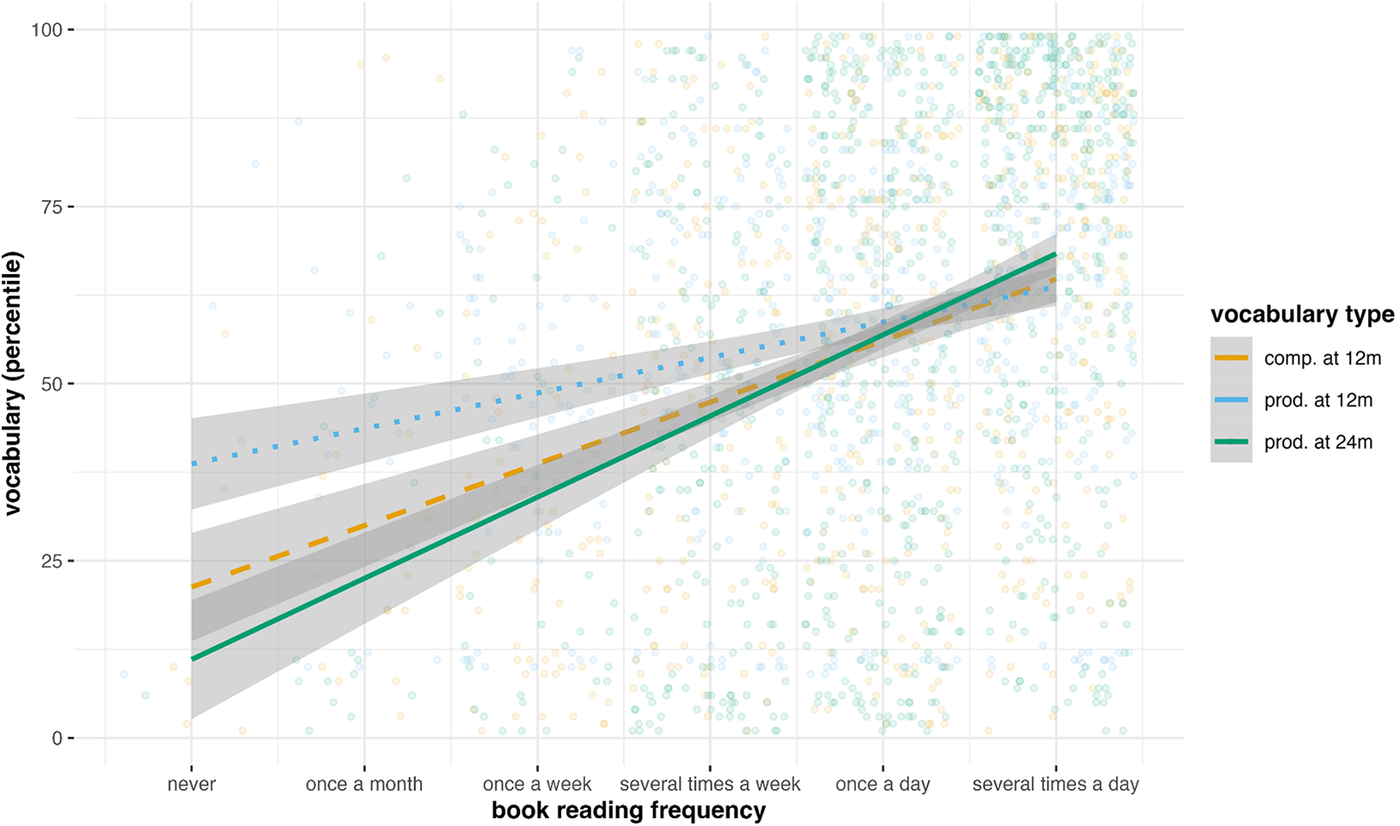
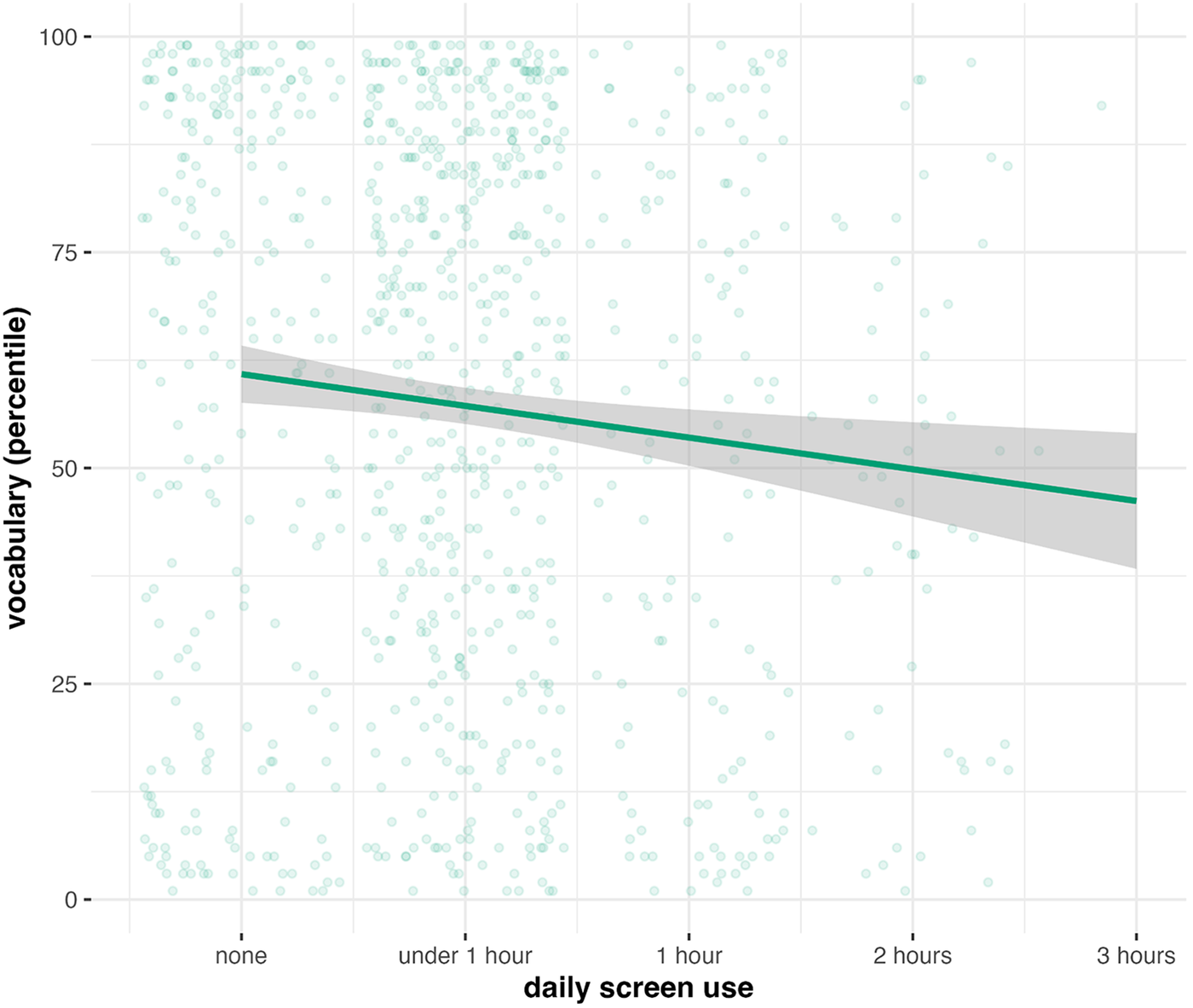
Model estimates are reproduced in Table 2. As predicted, shared book reading was positively associated with vocabulary size, both for 24-month-olds’ expressive vocabulary, and 12-month-olds’ expressive and receptive vocabularies (Figure 1). In other words, parents who engaged more frequently in shared book reading with their infants, had infants with larger vocabulary sizes across age groups and vocabulary types. Daily screen time was, as predicted, negatively associated with 24-month-olds’ expressive vocabulary (Figure 2), that is, 24-month-olds who spent more time with screens each day had smaller vocabulary sizes. Contrary to our prediction, daily screen time was not significantly associated with 12-month-olds’ expressive vocabulary. Finally, daily screen time was not significantly associated with 12-month-olds’ receptive vocabulary. As can be seen in Table 2, our covariate, SES, exhibited a significant negative correlation with 12-month-olds’ receptive vocabulary. Although this finding might seem counterintuitive, it could be attributed to potential overestimations of comprehension by parents from low-SES backgrounds, as suggested by previous studies (e.g., Feldman et al., Reference Feldman, Dollaghan, Campbell, Kurs-Lasky, Janosky and Paradise2000; Frank et al., Reference Frank, Braginsky, Marchman and Yurovsky2021).
Model estimates for vocabulary size by shared book reading and daily screen time
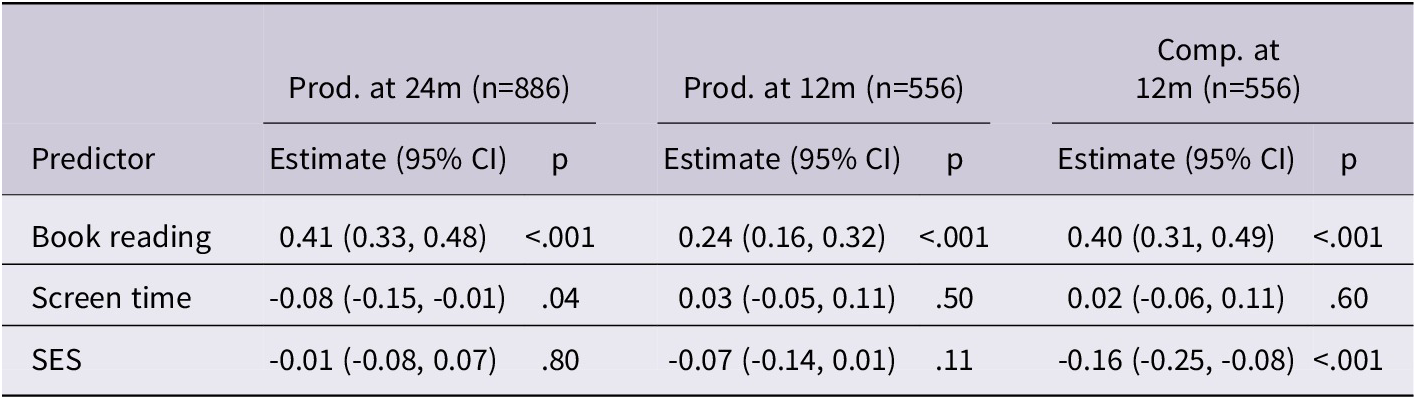
Note. Prod. = production (expressive vocabulary), Comp. = comprehension (receptive vocabulary), SES = socio-economic status. Predictors were z-transformed to a mean of 0 and a standard deviation of 1, mean (SD) of the original variables were, for 24-month-olds: 4.02 (0.98); 1.01 (0.83); 4.59 (0.76), and, for 12-month-olds: 3.79 (1.19); 0.42 (0.56); 3.58 (0.71), for book reading, screen time and SES, respectively.
24-month-olds’ expressive vocabulary in percentiles and 12-month-olds’ expressive and receptive vocabulary in percentiles by shared book reading frequency (dotted blue line = prod. at 12m; dashed orange line = comp. at 12m, solid green line = prod. at 24m)
Note. Datapoints are jittered. Comp. = comprehension (receptive vocabulary), Prod. = production (expressive vocabulary).
24-month-olds’ expressive vocabulary in percentiles by daily screen time
Note. Datapoints are jittered.
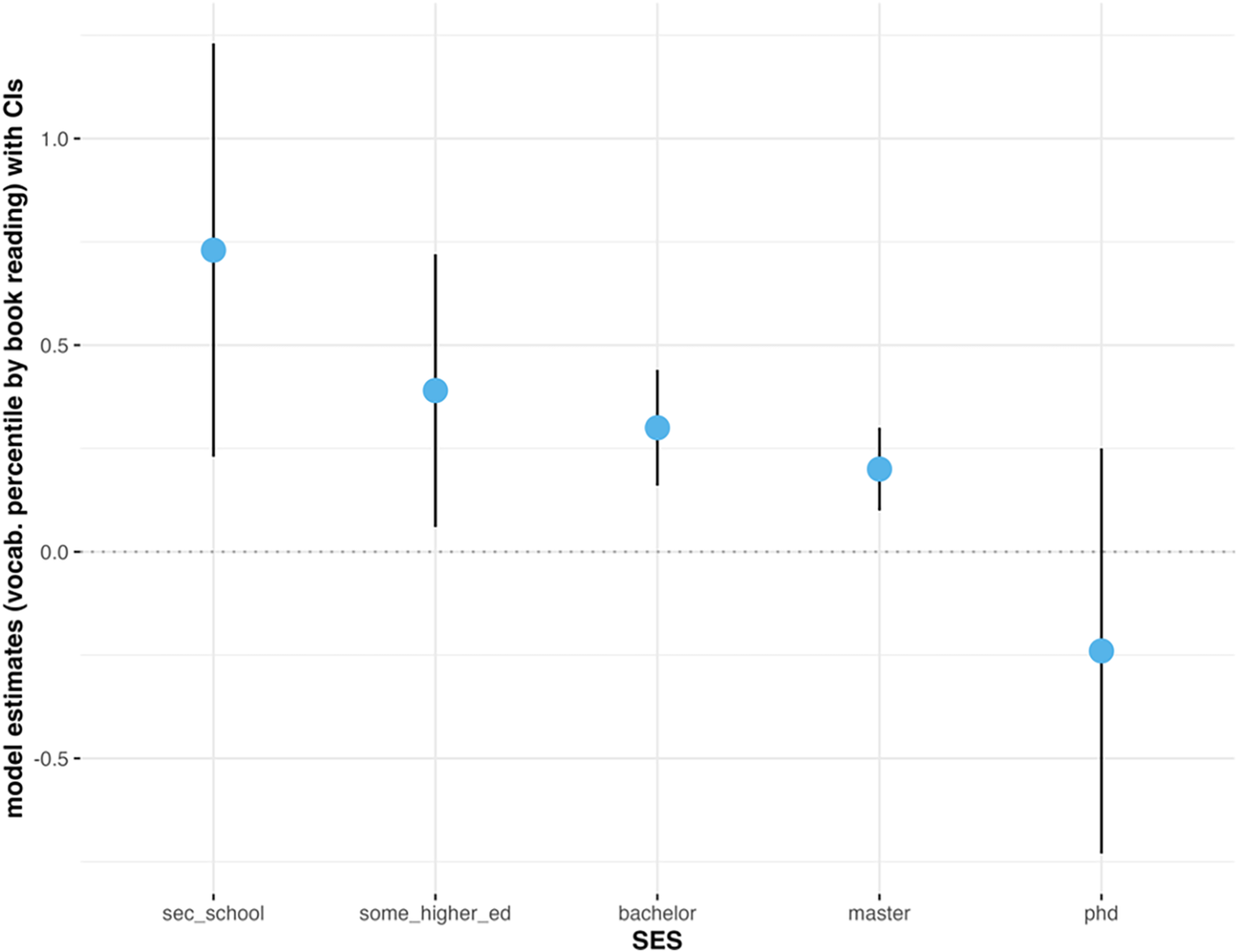
To explore the data and further examine the potential role of SES, we fitted a new set of full-null models to predict infants’ vocabulary size where SES was included as an interaction term with shared book reading and daily screen time. The full-null comparisons were significant (p’s <.001), and the full models revealed that SES interacted with shared book reading for 12-month-olds’ expressive vocabulary [β = −0.078, 95% CI (−0.154, −0.002), p = .05]. To untangle what drove this interaction, we ran post-hoc models separately for each SES group. These models indicated that the strength of the association between shared book reading and 12-month-olds’ expressive vocabulary size declined from low to high SES groups (Table 3; Figure 3).Footnote 2
Model estimates for 12-month-olds’ expressive vocabulary size by shared book reading for each socio-economic status (SES) group

Note. SES = socio-economic status.
Model estimates with 95% confidence intervals of 12-month-olds’ expressive vocabulary size by book reading as a function of socio-economic status (SES). Higher estimates correspond to larger effects of shared book reading on vocabulary.
Discussion
This study investigated the relationship between the frequency of shared book reading, daily screen time, and vocabulary size in Norwegian infants from varied SES backgrounds. It revealed a positive association between shared book reading and expressive and receptive vocabulary size in both 12- and 24-month-olds, and a negative association between increased daily screen time and expressive vocabulary in 24-month-olds. We also report exploratory evidence that the association between shared book reading and expressive vocabulary in 12-month-olds is modulated by SES, with stronger associations in lower SES groups.
Our results align with previous studies that demonstrated positive associations between shared book reading and language outcomes in infants (Dowdall et al., Reference Dowdall, Melendez-Torres, Murray, Gardner, Hartford and Cooper2020; Kartushina et al., Reference Kartushina, Mani, Aktan-Erciyes, Alaslani, Aldrich, Almohammadi, Alroqi, Anderson, Andonova, Aussems, Babineau, Barokova, Bergmann, Cashon, Custode, de Carvalho, Dimitrova, Dynak, Farah and Mayor2022; O’Farrelly et al., Reference O’Farrelly, Doyle, Victory and Palamaro-Munsell2018), and support our pre-registered hypothesis. The potential benefits of shared book reading on early vocabulary acquisition may arise from the opportunities shared reading provides for rich linguistic input (Dawson et al., Reference Dawson, Hsiao, Tan, Banerji and Nation2021; Montag et al., Reference Montag, Jones and Smith2015), in a contingent learning context (Ece Demir-Lira et al., Reference Ece Demir-Lira, Applebaum, Goldin-Meadow and Levine2019; Hoff, Reference Hoff2010; Masek et al., Reference Masek, McMillan, Paterson, Tamis-LeMonda, Golinkoff and Hirsh-Pasek2021; Tamis-LeMonda et al., Reference Tamis-LeMonda, Custode, Kuchirko, Escobar and Lo2019), consequently promoting word learning and vocabulary acquisition. Engaging more frequently in shared reading has been shown to improve parents’ reading competence (Dowdall et al., Reference Dowdall, Melendez-Torres, Murray, Gardner, Hartford and Cooper2020), and could thus further facilitate parents’ attunement towards their infants during reading.
With respect to screen time, our hypothesis on an association with expressive vocabulary was supported for 24-month-olds only, as we report a negative relationship between screen time (ranging from 0 to 3 hours daily) and expressive vocabulary size. This is in line with previous studies with this age group (Dynia et al., Reference Dynia, Dore, Bates and Justice2021; Kartushina et al., Reference Kartushina, Mani, Aktan-Erciyes, Alaslani, Aldrich, Almohammadi, Alroqi, Anderson, Andonova, Aussems, Babineau, Barokova, Bergmann, Cashon, Custode, de Carvalho, Dimitrova, Dynak, Farah and Mayor2022), and may be taken to support the opportunity cost hypothesis, i.e., that extensive screen consumption (potentially accumulated over the child’s lifespan), which is not contingent on verbal responses from the child, might take time from other activities that may be more beneficial for language learning (e.g., Brushe et al., Reference Brushe, Haag, Melhuish, Reilly and Gregory2024). However, we did not find any relationship between screen time and expressive or receptive vocabulary among the 12-month-olds’, thus supporting neither an opportunity cost nor benefit at this age. At 12 months, expressive vocabulary is only emerging, and most of our sample reported to not have any screen time at all, or less than 1 hour per day, an exposure brief enough to have a limited impact, if any. Finally, it must be highlighted that our global measure of infants’ daily exposure to screens did not include TV exposure per se, and did not assess potential varying effects of the content and context of screen time consumption on language learning (Gago-Galvagno et al., Reference Gago-Galvagno, Perez, Justo, Miller, Simaes, Elgier and Azzollini2023; Jing et al., Reference Jing, Ye, Kirkorian and Mares2023; Madigan et al., Reference Madigan, McArthur, Anhorn, Eirich and Christakis2020). Future research is needed to address these questions and potential dissociations between passive vs active screen exposure, and the role of parent support and engagement during periods of screen use (see also Bergmann et al., Reference Bergmann, Dimitrova, Alaslani, Almohammadi, Alroqi, Aussems, Barokova, Davies, Gonzalez-Gomez, Gibson, Havron, Horowitz-Kraus, Kanero, Kartushina, Keller, Mayor, Mundry, Shinskey and Mani2022), on infants’ language development.
Our exploratory analyses indicate that shared reading appears to be more strongly associated with 12-month-olds’ expressive vocabulary in lower SES compared to higher SES families. As low SES has been associated with poorer language trajectories (e.g., Fernald et al., Reference Fernald, Marchman and Weisleder2013), also in Norwegian samples (Ribeiro et al., Reference Ribeiro, Zachrisson, Nærde, Wang, Brandlistuen and Passaretta2022), these are notable results. Shared book reading may function as a compensatory mechanism, attenuating potentially impoverished learning environments and reduced parent interaction in low-SES families (Golinkoff et al., Reference Golinkoff, Hoff, Rowe, Tamis-LeMonda and Hirsh-Pasek2019). While previous meta-analytic evidence indicates no moderating effect of SES on the link between shared reading and language outcomes (Dowdall et al., Reference Dowdall, Melendez-Torres, Murray, Gardner, Hartford and Cooper2020), this comprised only one sample with infants below 12 months of age. Given that our results indicate a differentiating ‘SES-effect’ specifically among 12-month-olds, and not in the older age group, it might be during the first year of life that the diverse linguistic input and contingent interaction from shared reading has its compensatory impact. It is also notable that this effect was present for expressive, but not receptive vocabulary. Perhaps it is the opportunities that shared reading provide for parents to elicit vocal participation from infants, in turn promoting expressive vocabulary, that might be less frequent in low-SES families, thus having a stronger impact for infants who are read to more frequently. However, the singular effect for expressive vocabulary could also be attributed to differences in reliability between the vocabulary types, as receptive vocabulary might be more challenging to report (see e.g., Tomasello & Mervis, Reference Tomasello and Mervis1994).
The current study had several limitations that should be addressed in future research. First, our design is correlational, and thus, results should not be interpreted as evidence for causal relationships – other factors might be moderating the associations between activities and infants’ language, such as genetic confounds (although see Coffey et al., Reference Coffey, Shafto, Geren and Snedeker2021). Further, we rely on parent-reported data for all our measures, which, while proven reliable (Borovsky et al., Reference Borovsky, Thal and Leonard2021), might be subject to bias, and contribute to shared method variance of results. Moreover, we have fewer participants from lower SES backgrounds, and our sample had higher education than the overall population in Oslo (cf. Methods). Finally, we might have underestimated infants’ screen time, given that our measure concerned smartphones and tablet devices only, and, crucially, we have no details on the specific content and context of infants’ screen time activities.
In sum, these findings emphasize the importance of promoting shared book reading and potentially limiting screen time in early childhood for optimal language development, and are generally in line with current recommendations from the World Health Organization and the American Academy of Pediatrics that advocate for shared book reading (Council on Early Childhood et al., Reference High and Klass2014), while discouraging screen time (Council on Communcation and Media et al., Reference Media, Ameenuddin, Reid Chassiakos, Linda), Cross, Hutchinson, Levine, Boyd, Mendelson, Moreno and Swanson2016; World Health Organization, 2019) for infants below two years of age. Crucially, if our exploratory analyses on the role of SES are to be confirmed in future work, it would indicate that shared book reading may be particularly effective for young infants from lower SES backgrounds, holding promise for shared reading-based interventions as a means to reduce the SES-gap in early language development.
Acknowledgments
The authors thank Ada Koleini for her help with participant recruitment and all families for their participation. AR and NK were supported by funding from the Research Council of Norway (project numbers 223265 and 301625).
Competing interest
The author(s) declare none.
Appendices
Overview of participant demographics for each SES and age group
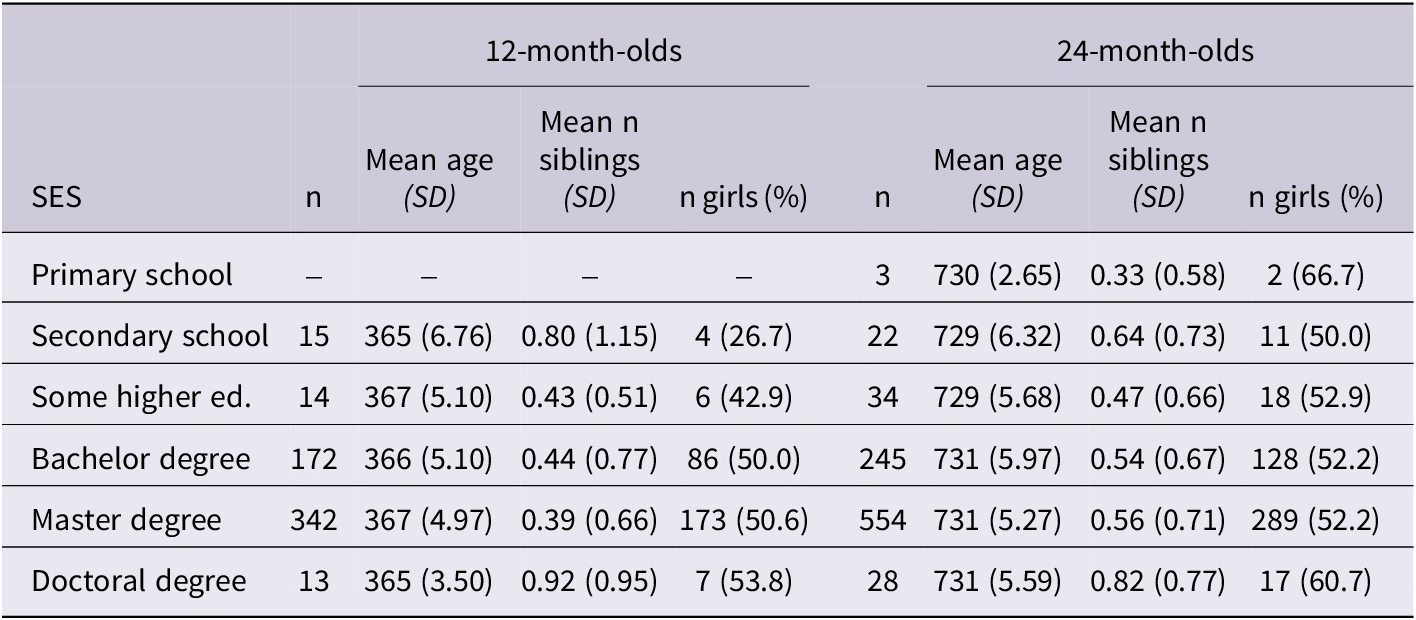
Note. SES = socio-economic status.
Spearman correlation matrix depicting the relationship between the predictors for 12-month-olds (A) and 24-month-olds (B).
Model estimates for vocabulary size by shared book reading and daily screen time, including SES and number of siblings as control variables
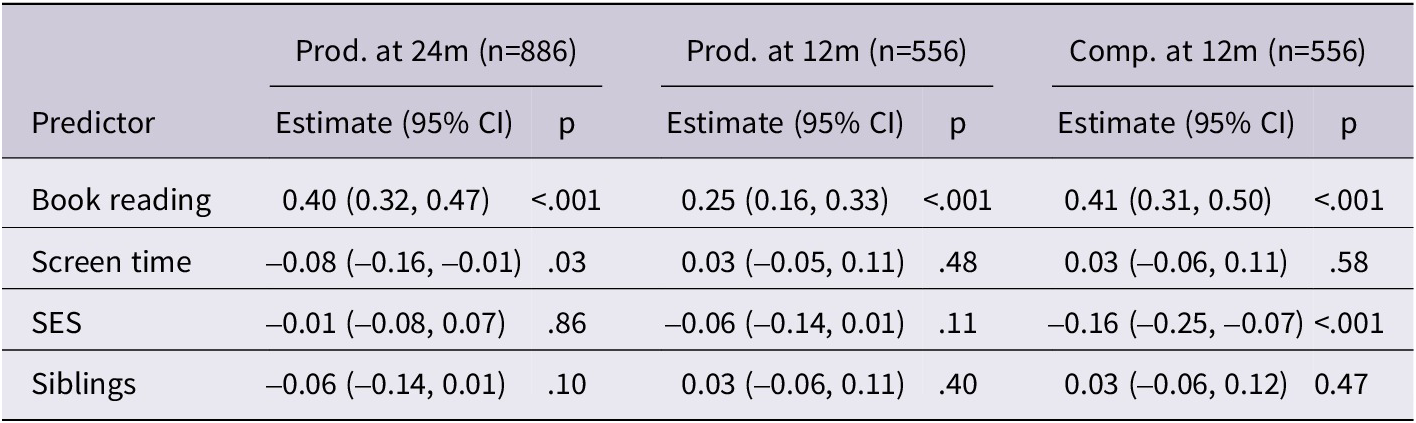
Note. Prod. = production (expressive vocabulary), Comp. = comprehension (receptive vocabulary), SES = socio-economic status. Predictors were z-transformed.
Model estimates for vocabulary size by shared book reading and daily screen time in interaction with SES and number of siblings as a control variable
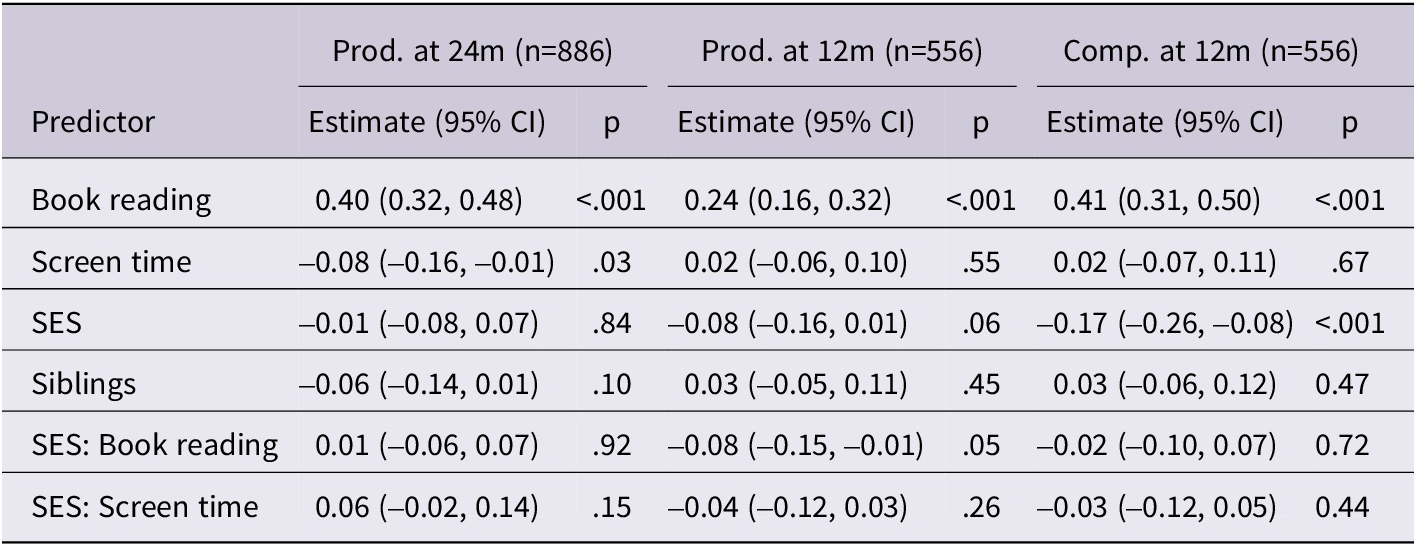
Note. Prod. = production (expressive vocabulary), Comp. = comprehension (receptive vocabulary), SES = socio-economic status. Predictors were z-transformed.


 Open access

