





Impact statements
This study advances understanding of how political violence affects Palestinians’ mental health by identifying dehumanization and humiliation as key mechanisms linking exposure to violence with depression, anxiety and stress. By showing that these experiences significantly mediate the impact of political violence, the findings highlight how harm extends beyond exposure to direct and physical traumatic events to include threats to dignity, identity and social value. The results have important implications for mental health practice and policy in Palestine. Interventions should focus on enhancing psychological resilience, sumud as a resilient resistance and promoting positive coping strategies for managing stress related to political violence. Moreover, there is a necessity to develop comprehensive community-level therapeutic interventions. For researchers, the study underscores the need to further examine the association between the study variables in areas affected by war.
Theoretical background
The ongoing Israeli-Palestinian conflict has lasted for 74 years since Al-Nakbah, “the catastrophe,” happened in 1948. Since then, Palestinians were exposed to the denial of their culture, as over 700,000 Palestinian Arabs – nearly half of prewar Palestine’s Arab population – were forced to flee or were expelled from their homes and became refugees living in camps in neighboring countries such as Lebanon, Jordan and Syria, as well as in the West Bank and Gaza Strip (Manna’, Reference Manna’2013; Caplan, Reference Caplan2019; Mahamid, Reference Mahamid2020).
Palestinians have been exposed to different traumatic circumstances as a result of the long-standing Israeli military occupation, such as witnessing mutilated bodies on TV, hearing shelling of the area by artillery, seeing evidence of shelling and hearing sonic bombs from jetfighters or drones flying over the area (Thabet et al., Reference Thabet, El-Buhaisi and Vostanis2014).
Political violence has devastating effects on mental health, particularly in regions like Palestine (Saeedi et al., Reference Saeedi, Jabali and Khalili2025), where the population is subjected to chronic conflict, military occupation and systemic oppression. The psychological toll of political violence is far-reaching, impacting both individual and collective mental health. Shukri et al. (Reference Shukri, Holmes, Shukri, Shukri and Saada2022) found that Palestinians are much more likely to suffer from post-traumatic stress disorder (PTSD) and depression than the global average and their neighboring countries. The global prevalence of depression and PTSD are 5% and 3.6%, respectively. The prevalence of severe PTSD in children living in the Gaza Strip is 32.7%. Furthermore, depression in Palestine is among the highest rates in the world, affecting 40% of Palestinians. Moreover, Mahamid et al. (Reference Mahamid, Bdier and Chou2021) found that traumatic life events were negatively associated with psychological well-being among Palestinians living in the West Bank. Furthermore, a study reviewed 37 studies examining the well-being of Palestinian individuals, focusing on the effects of conflict and war on their physical, mental and social health. PTSD, depression and anxiety were found to be among the most common mental health outcomes as a result of being exposed to political violence (Topuzb and Aslan, Reference Topuz and Aslan2025). In addition, economic pressure related to the political instability was found to be associated with self-harm among Palestinian adults (Hamamra et al., Reference Hamamra, Jabali, Mahamid and Abuarrah2025).
Central to understanding these outcomes are the mediating roles of dignity and humiliation, which play a critical part in how violence is experienced and how it shapes long-term mental health outcomes (Elbedour et al., Reference Elbedour, Onwuegbuzie, Ghannam, Whitcome and Hein2007; Giacaman et al., Reference Giacaman, Rabaia, Nguyen-Gillham, Batniji, Punamaki and Summerfield2011; Hobfoll et al., Reference Hobfoll, Mancini, Hall, Canetti and Bonanno2011; Barber et al., Reference Barber, McNeely, Olsen, Belli and Doty2016). Political violence in Gaza is not confined to physical acts of aggression but involves a continuous effort to dehumanize Palestinians, stripping them of their dignity and inflicting profound psychological harm (Giacaman et al., Reference Giacaman, Abu-Rmeileh, Husseini, Saab and Boyce2007; Khamis, Reference Khamis2012).
Dehumanization and the erosion of dignity
Dehumanization is a central feature of political violence, where individuals are systematically reduced to sub-human status to justify acts of violence against them (Hicks, Reference Hicks2011; Hartling and Lindner, Reference Hartling, Lindner and Rothbart2018). In Palestine, this process is evident both in rhetoric and action. Israeli officials have frequently used dehumanizing language to frame Palestinians as dangerous, violent and undeserving of compassion or protection (Jabareen, Reference Jabareen and Carmon2010). Israeli Defense Minister Yoav Gallant’s statement referring to Palestinians as “human animals” (Gallant, Reference Gallant2023) exemplifies this dehumanizing rhetoric. Such language not only legitimizes violence but also inflicts psychological harm (Bar-Tal, Reference Bar-Tal2007; Elbedour et al., Reference Elbedour, Onwuegbuzie, Ghannam, Whitcome and Hein2007).
This aligns with Giorgio Agamben’s (Reference Agamben1998) concept of Homo Sacer, in which certain groups are excluded from legal and moral protections, rendering their lives expendable (Cohen, Reference Cohen2016). Palestinians, like Agamben’s Homo Sacer (Reference Agamben1998), are placed in a state of exception, where violence against them is normalized, and their lives are treated as disposable (Hajjar, Reference Hajjar2005). This systematic dehumanization reinforces feelings of powerlessness and insecurity among Palestinians living under prolonged occupation (Hammami, Reference Hammami2004; Giacaman et al., Reference Giacaman, Rabaia, Nguyen-Gillham, Batniji, Punamaki and Summerfield2011).
Dehumanization also has profound effects on the collective consciousness of Palestinians. When an entire community is treated less than humans, individuals feel internally that they are less than others and worthless (Rouhana and Bar-Tal, Reference Rouhana and Bar-Tal1998). This collective experience of dehumanization creates a sense of shared trauma, reinforcing feelings of worthlessness and helplessness (Hammami, Reference Hammami2004). Examples of such practices against Palestinians in the West Bank are the demolition of houses; the acquisition of Palestinian land by force; separating neighborhoods and villages by checkpoints, and the establishment of the Separation Wall; collective punishment such as detention and torture; and forcible transfer of Palestinians (Ladadwa and Nasr, Reference Ladadwa and Nasr2022).
Humiliation as a tool of political violence
Humiliation is a critical psychological weapon in political violence, particularly in conflict zones like Gaza. The experience of humiliation undermines an individual’s sense of dignity, leading to long-term psychological damage (Lindner, Reference Lindner2006). Palestinians are subjected to humiliation not only through direct violence but also through the daily degradation imposed by the occupation (Giacaman et al., Reference Giacaman, Abu-Rmeileh, Husseini, Saab and Boyce2007). Acts of humiliation include the destruction of homes, the denial of medical care and the restriction of movement, all of which are designed to diminish the dignity of the population (Barber, Reference Barber2000; McNeely et al., Reference McNeely, Barber, Giacaman, Arafat, Daher, El Sarraj and Abu-Mallouh2015).
Humiliation is not only experienced individually but collectively, as entire communities face systemic degradation (B’Tselem, 2021). This collective humiliation is strongly linked to the development of mental health disorders, including PTSD, depression and anxiety (Giacaman et al., Reference Giacaman, Rabaia, Nguyen-Gillham, Batniji, Punamaki and Summerfield2011; Khamis, Reference Khamis2012). Humiliation weakens the protective factors, reinforces psychological resilience and leaves them more vulnerable to trauma (Hartling and Lindner, Reference Hartling, Lindner and Rothbart2018).
Exposure to humiliation during childhood has been found to have long-term psychological effects on Palestinians, contributing to the development of behavioral problems, anxiety and trauma-related disorders (Punamaki et al., Reference Punamaki, Qouta and El-Sarraj2005; Qouta et al., Reference Qouta, Punamaki and El Sarraj2008). The experience of watching one’s family members be humiliated or degraded by occupying forces creates a deep psychological scar that can persist into adulthood (Elbedour et al., Reference Elbedour, Onwuegbuzie, Ghannam, Whitcome and Hein2007).
Restoring dignity and the role of collective trauma
Dignity is essential for psychological well-being, and its violation has significant mental health consequences (Hicks, Reference Hicks and Levine2015; Kteily et al., Reference Kteily, Bruneau, Waytz and Cotterill2015). In Palestine, the continuous violation of dignity through dehumanization and humiliation plays a central role in shaping mental health outcomes. The destruction of homes, restrictions on movement and the denial of basic human rights erode the dignity of the population, contributing to feelings of helplessness, worthlessness and powerlessness (Giacaman et al., Reference Giacaman, Rabaia, Nguyen-Gillham, Batniji, Punamaki and Summerfield2011; Hobfoll et al., Reference Hobfoll, Mancini, Hall, Canetti and Bonanno2011).
Research has shown that the restoration of dignity is critical for psychological recovery (Hicks, Reference Hicks and Levine2015; Hartling and Lindner, Reference Hartling, Lindner and Rothbart2018). Social support, personal resistance and community solidarity can help in fostering agency (Hobfoll et al., Reference Hobfoll, Palmieri, Johnson, Canetti-Nisim, Hall and Galea2012).
The collective loss of dignity also plays a significant role in shaping the mental health outcomes of the Palestinians through generations. The shared experience of humiliation and degradation creates a communal sense of worthlessness and despair, which contributes to the development of mental health disorders on a larger scale (Giacaman et al., Reference Giacaman, Abu-Rmeileh, Husseini, Saab and Boyce2007; Barber et al., Reference Barber, McNeely, Olsen, Belli and Doty2016). This collective trauma is particularly damaging in a cultural context where respect, honor and social standing are central to identity and psychological well-being (Barber, 2000; Hajjar, Reference Hajjar2005).
Global indifference and perpetuation of trauma
The international community’s relative inaction regarding the violence in Palestine exacerbates the psychological damage caused by political violence. The global failure to hold Israel accountable for its actions sends a message to Palestinians that their lives and rights are of lesser value, further reinforcing the dehumanization they experience (Aswadi, Reference Aswadi2023). This global indifference not only allows the violence to continue but also deepens the feelings of humiliation and abandonment, compounding the psychological harm caused by the conflict (Giacaman et al., Reference Giacaman, Rabaia, Nguyen-Gillham, Batniji, Punamaki and Summerfield2011; Hobfoll et al., Reference Hobfoll, Mancini, Hall, Canetti and Bonanno2011).
Media coverage also plays a role in reinforcing global indifference. Western media often frames the Israeli-Palestinian conflict in ways that dehumanize Palestinians, portraying Israeli military actions as self-defense while downplaying the humanitarian crisis in Palestine (Fabian, Reference Fabian2023). This biased portrayal further marginalizes Palestinian suffering and reinforces the perception that their lives are less valuable (Shalal and Singh, Reference Shalal and Singh2023).
Addressing the psychological effects of global indifference requires a shift in how the international community engages with the conflict in Palestine. Greater recognition of Palestinian suffering, coupled with a commitment to upholding international law, is essential for restoring dignity to those affected by the violence (Hobfoll et al., Reference Hobfoll, Palmieri, Johnson, Canetti-Nisim, Hall and Galea2012). Without meaningful global intervention, the cycle of humiliation and psychological trauma will continue, deepening the mental health crisis in Palestine (Hajjar, Reference Hajjar2005).
Current study
This study investigates whether political violence predicts stress, depression and anxiety among Palestinians, with a focused analysis on the mediating roles of humiliation and dehumanization between these variables. This research is groundbreaking, as to our knowledge, it is the first to explore the relationship between these variables within the Palestinian context. Based on prior studies (Hammami, Reference Hammami2004; Punamaki et al., Reference Punamaki, Qouta and El-Sarraj2005; Qouta et al., Reference Qouta, Punamaki and El Sarraj2008; Giacaman et al., Reference Giacaman, Rabaia, Nguyen-Gillham, Batniji, Punamaki and Summerfield2011; Hobfoll et al., Reference Hobfoll, Mancini, Hall, Canetti and Bonanno2011; Barber et al., Reference Barber, McNeely, Olsen, Belli and Doty2016; Hartling and Lindner, Reference Hartling, Lindner and Rothbart2018), the study hypotheses were defined as follows: First (H1), political violence would be positively associated with depression, anxiety and stress; and second (H2), humiliation and dehumanization would mediate the associations between political violence and these mental health outcomes.
Methods
Participants and procedures
The research was conducted in October 2024 and targeted Palestinians living in the West Bank of Palestine. Participants were recruited using online methods, including emails, social media and advertisements. The aims of the study were presented online, and participants interested in participating were asked to send an email indicating their willingness to join the study. All participants received a letter clarifying the objectives and ethical issues of the study. They provided written informed consent upon accepting the conditions of participation. A total of 633 adults participated in the study, comprising 310 males and 323 females. Of the participants, 58.8% were from urban regions, 36.7% were from rural regions and the remaining 4.5% were from internally displaced camps. Regarding educational attainment, 26.4% held a graduate degree, 65.9% held a bachelor’s degree and 7.7% held a high school degree. To be included in the study, participants were required to be (1) native Arabic speakers, (2) Palestinian and (3) residents in the occupied Palestinian territories (oPt). Approval for the study was obtained from An-Najah National University Institutional Review Board before data collection began.
Measures
Following standard methodological recommendations for questionnaire development (Hambleton et al., Reference Hambleton, Merenda and Spielberger2005), all measures not already validated in Arabic were translated and back-translated from the original English version into Arabic. This process involved a panel of 10 Arab professionals in psychology, counseling and social work, who evaluated the clarity and relevance of the questions and translations. After completing the initial draft of translated items, the questionnaires were back-translated into English by an independent expert English editor. Based on their feedback, the translated version was pilot-tested among 80 participants and further refined for clarity.
The experience of dehumanization scale
This scale aims to assess how individuals perceive their own dehumanization in various contexts. It includes items that capture different dimensions of dehumanization, such as feelings of being treated as less than human, experiencing a lack of empathy from others and the impact of these experiences on one’s self-identity and well-being. Participants rated how often they experienced dehumanization, as represented by each of the 10 items in the past 6 months, on a 5-point Likert-type scale ranging from 1 (never) to 5 (all the time).
Exposure to Political Violence Scale (EPVS)
The EPVS (Haj-Yahia, Reference Haj-Yahia2005) examines 49 acts of political violence, which reflect experience with psychological abuse, physical violence, sexual abuse (as a direct victim) and witnessing of such violence (as an indirect victim) committed by the Israeli army and police, as well as by Israeli settlers against family members and relatives. Participants were requested to answer the question about each act using a dichotomous measure: no = 0 or yes = 1. Cronbach’s alpha value of the EPVS, as used in the females’ study, was 0.90, while in the males’ study it was 0.91.
Depression, Anxiety and Stress Scale (DASS-21)
The DASS-21 is a 21-item self-report questionnaire designed to measure the severity of a range of symptoms common to both depression and anxiety. In completing the DASS, the individual is required to indicate the presence of a symptom over the previous week. Each item is scored from 0 (did not apply to me at all over the last week) to 3 (applied to me very much or most of the time over the past week). The essential function of the DASS is to assess the severity of the core symptoms of depression, anxiety and stress. Accordingly, the DASS allows not only a way to measure the severity of a patient’s symptoms but also a means by which a patient’s response to treatment can be measured. The scale to which each item belongs is indicated by the letters D (depression), A (anxiety) and S (stress). For each scale (D, A and S), sum the scores for identified items. Because the DASS 21 is a short form version of the DASS (the long form has 42 items), the final score of each item group (depression, anxiety and stress) needs to be multiplied by 2 (×2) (Gomez, Reference Gomez2016).
Humiliation inventory (HI)
The HI measures humiliation along two subscales: fear of humiliation and cumulative (Hartling and Luchetta, Reference Hartling and Luchetta1999). This 32-item scale is divided into four sections, the first of which assesses how much participants believe themselves to have been affected by particular experiences (“Throughout your life, how seriously have you felt harmed by being ridiculed?”). The second section measures how fearful participants are of being humiliated (“At this point in your life, how much do you fear being harassed?”). The next section attempts to measure participants’ concerns over experiencing humiliation (“At this point in life, how concerned are you about being discounted as a person?”). The last section consists of only two items, which assess participants’ worries (“How worried are you about being viewed by others as incompetent?”). All 32 items are measured on a 5-point Likert scale, ranging from 1 (“Not at all”) to 5 (“Extremely”) (Asmari et al., Reference Asmari, Dolatshahi, Poursharifi and Barahmand2022).
Data analysis
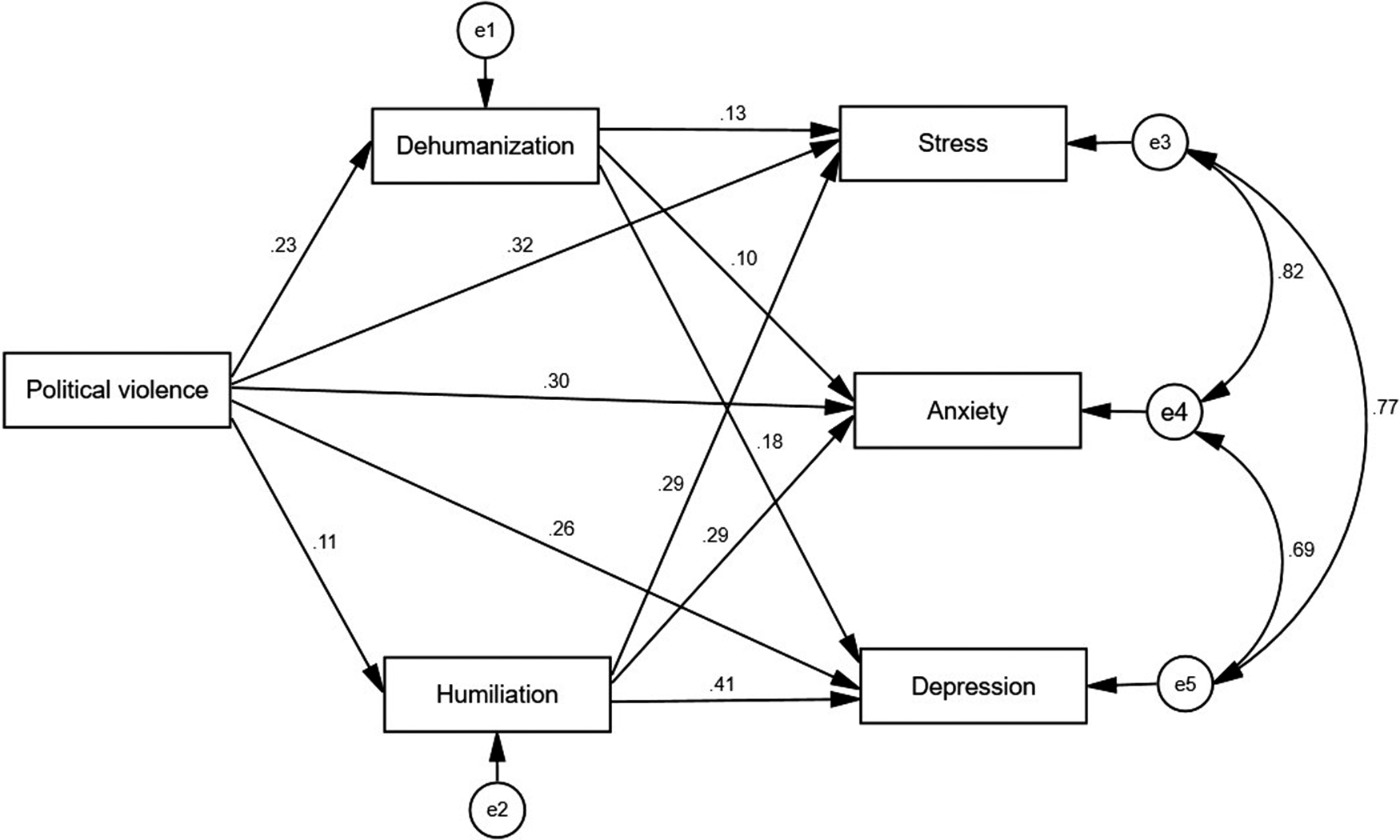
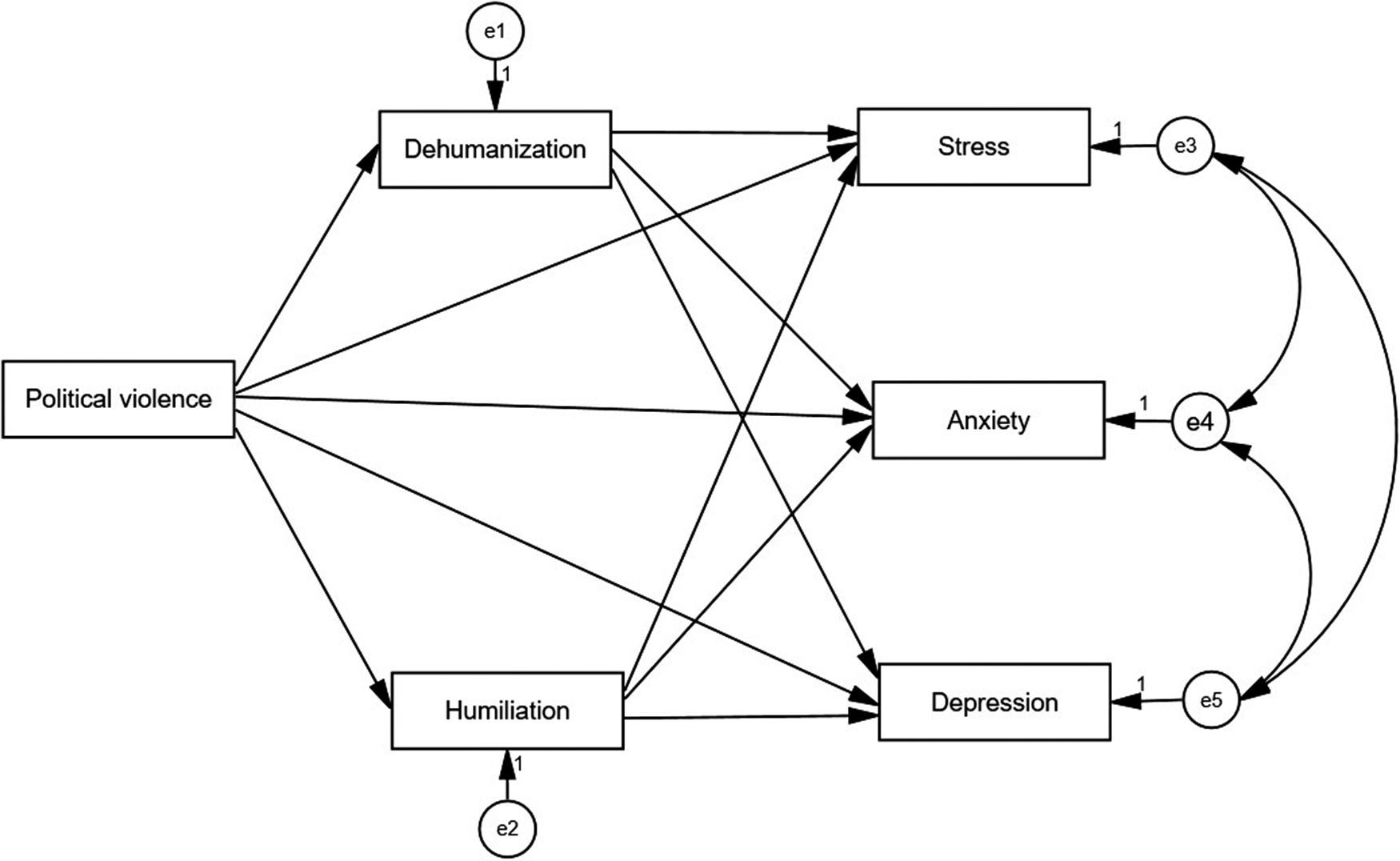
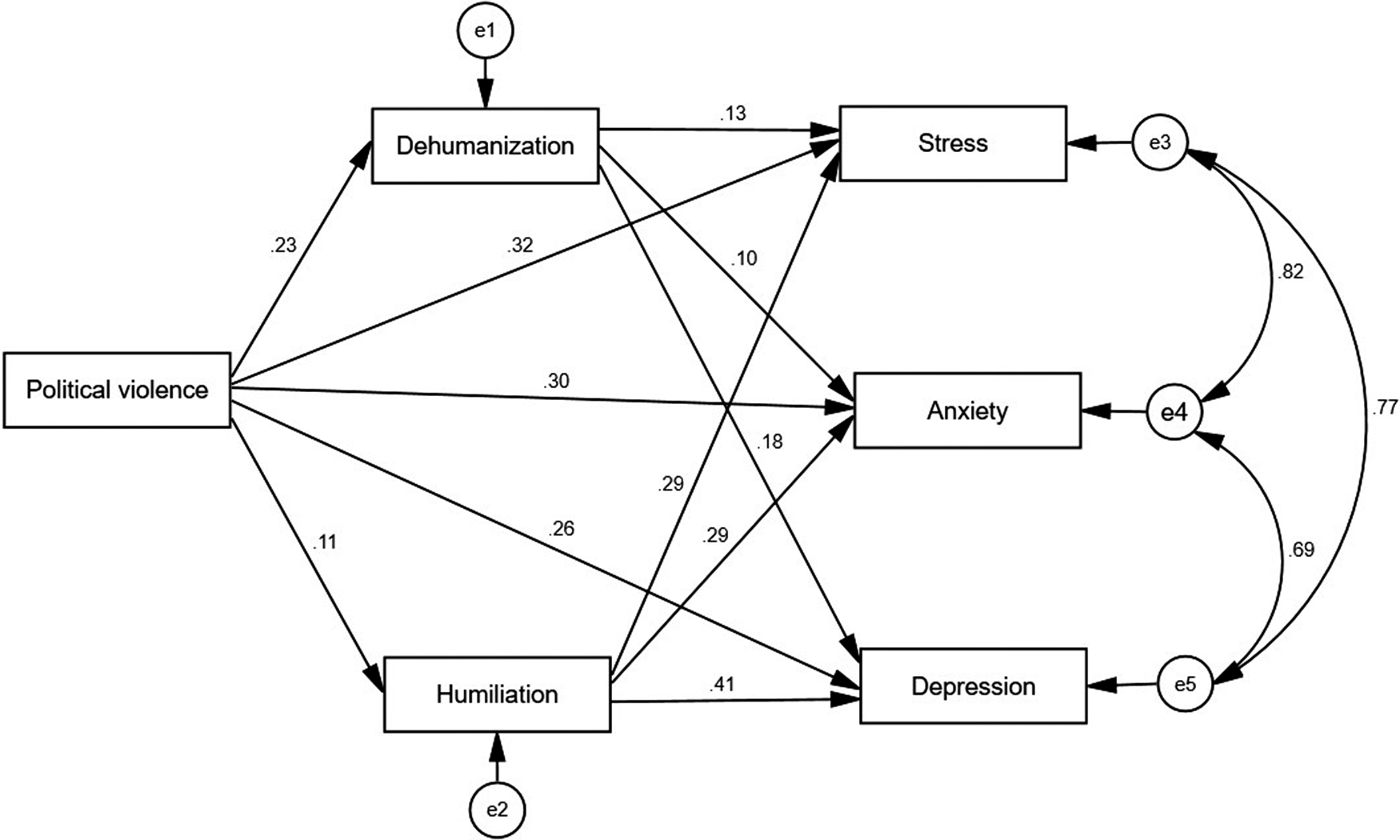
We used descriptive statistics to examine the main characteristics of the study variables and tested the correlations between these variables: political violence, humiliation, dehumanization, stress, anxiety and depression. Structural equation modeling (SEM) was employed to assess the conceptual model (see Figure 1) of our study, where political violence operated as the predictive variable. Humiliation and dehumanization served as mediating variables, while mental health outcomes (stress, depression and anxiety) were the outcome variables. The model demonstrated good fit indices: Comparative Fit Index (CFI) = 0.99, Normed Fit Index (NFI) = 0.98, Incremental Fit Index (IFI) = 0.98, Standardized Root Mean Square Residual (SRMR) = 0.03 and Root Mean Square Error of Approximation (RMSEA) = 0.04. The SEM model (see Figure 2) was tested using AMOS 29 statistical analysis software.
The conceptual effect of political violence on mental health outcomes, and the mediating roles of humiliation and dehumanization.

Structural equation modeling of political violence on mental health outcomes, and the mediating roles of humiliation and dehumanization.
Findings
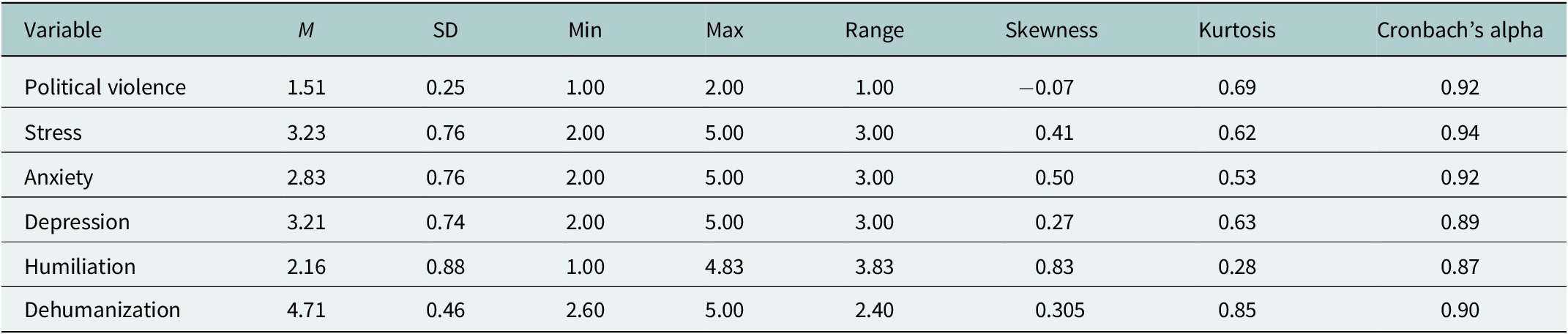
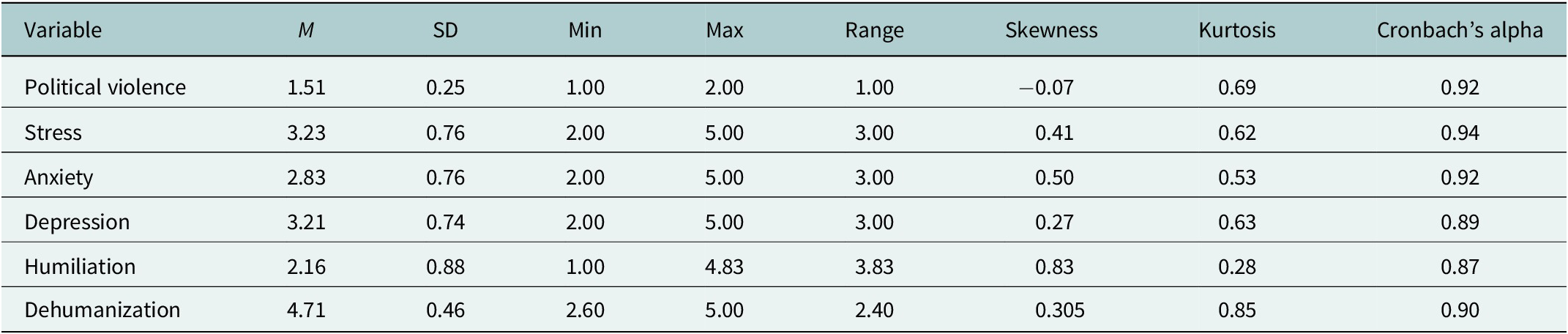
Descriptive statistics for political violence, stress, anxiety, depression, humiliation and dehumanization are presented in Table 1. Mean scores and standard deviations (SDs) were as follows: political violence (M = 1.51, SD = 0.25), stress (M = 3.23, SD = 0.76), anxiety (M = 2.83, SD = 0.76), depression (M = 3.21, SD = 0.74), humiliation (M = 2.16, SD = 0.88) and dehumanization (M = 4.71, SD = 0.46). All measures demonstrated a high degree of reliability, with coefficients ranging from 0.87 for humiliation to 0.94 for stress. To better interpret the findings of our study, we adopted a scoring key based on the 1–5 Likert scale: 1.00–2.00 = low, 2.01–3.00 = moderate, 3.01–4.00 = high and 4.01–5.00 = very high (see Table 1). According to this key, political violence was low, stress and depression were high, anxiety and humiliation were moderate and dehumanization was very high. In addition, all measures used in this study demonstrated a high degree of reliability, with coefficients ranging from 0.87 for Humiliation to 0.94 for stress.
Descriptive statistics for research variables (N = 633)
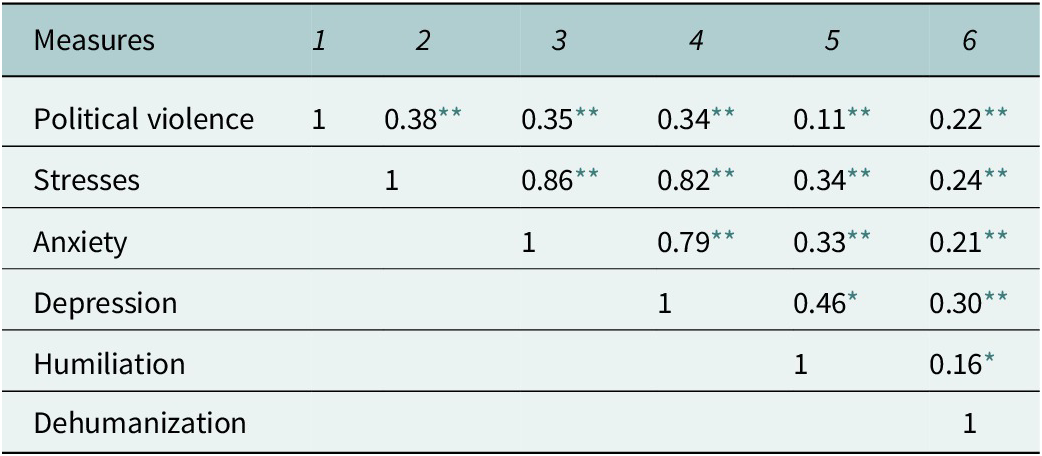
Results of the correlational analysis, presented in Table 2, revealed several significant relationships. Political violence was positively correlated with stress (r = 0.38, p < 0.01), anxiety (r = 0.35, p < 0.01), depression (r = 0.34, p < 0.01), humiliation (r = 0.11, p < 0.05) and dehumanization (r = 0.22, p < 0.01). Stress showed positive correlations with anxiety (r = 0.86, p < 0.01), depression (r = 0.82, p < 0.01), humiliation (r = 0.34, p < 0.01) and dehumanization (r = 0.24, p < 0.01). In addition, anxiety was positively correlated with depression (r = 0.76, p < 0.01), humiliation (r = 0.31, p < 0.01) and dehumanization (r = 0.21, p < 0.01). Moreover, depression was positively correlated with humiliation (r = 0.46, p < 0.01) and dehumanization (r = 0.30, p < 0.01). Finally, humiliation was positively correlated with dehumanization (r = 0.16, p < 0.05).
Correlations among study variables (N = 633)
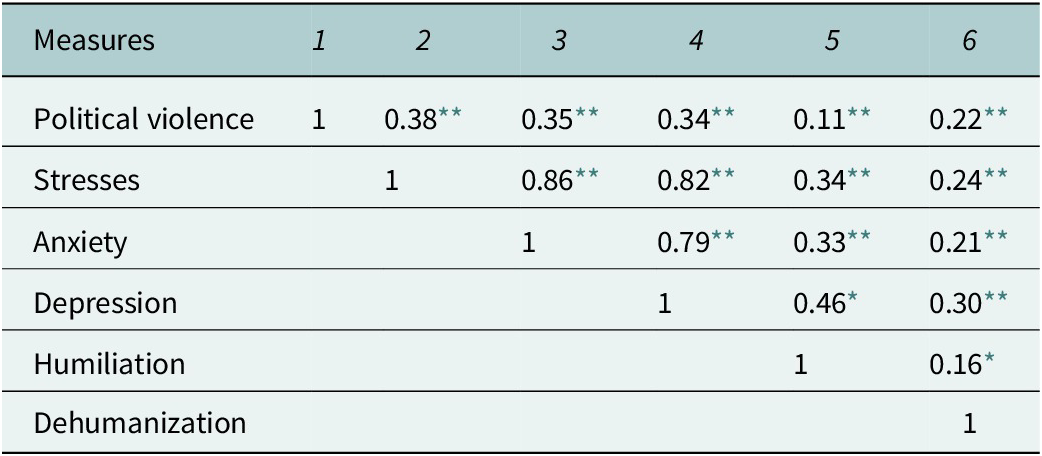
** α is significant at ≤ 0.01.
* α is significant at ≤ 0.05.
Structural equation modeling
The results of the SEM analysis are illustrated in Figure 2. The hypothesized model, depicted in Figure 1, includes political violence as a predictor, with humiliation and dehumanization as mediating variables. The outcomes assessed in this model are mental health outcomes (stress, depression and anxiety).
Analysis of the paths showed positive effects between political violence and humiliation (β M, Y = 0.39; p < 0.01), dehumanization (β M, Y = 0.41; p < 0.01), stress (β M, Y = 0.66; p < 0.01), depression (β M, Y = 0.77; p < 0.01) and anxiety (β M, Y = 0.83; p < 0.01). In addition, results of path analysis showed positive effects between humiliation and stress (β M, Y = 0.25; p < 0.01), anxiety (β M, Y = 0.26; p < 0.01) and depression (β M, Y = 0.34; p < 0.01). Moreover, results of path analysis showed positive effects between dehumanization and stress (β M, Y = 0.21; p < 0.01), anxiety (β M, Y = 0.15; p < 0.05) and depression (β M, Y = 0.28; p < 0.01).
Concerning the mediating hypothesis, our model revealed a standardized total effect of political violence on depression (β X, M = 0.77; p < 0.001), with significant indirect effect via humiliation (β X, M, Y = 0.26; p < 0.01) and dehumanization (β X, M, Y = 0.27; p < 0.01). The model also revealed a standardized total effect of political violence on anxiety (β X, M = 0.83; p < 0.001), with significant indirect effect via humiliation (β X, M, Y = 0.28; p < 0.01) and dehumanization (β X, M, Y = 0.22; p < 0.01). Finally, the model revealed a standardized total effect of political violence on stress (β X, M = 0.66; p < 0.001), with significant indirect effect via humiliation (β X, M, Y = 0.21; p < 0.01) and dehumanization (β X, M, Y = 0.24; p < 0.01).
Discussion
This study investigates the relationship between political violence and mental health outcomes – namely stress, anxiety and depression – among Palestinians, with a focus on how humiliation and dehumanization mediate these effects. The results revealed a significant association between exposure to political violence and increased psychological distress, where humiliation and dehumanization acted as crucial mediators. The findings highlight the complex mental health impact of sustained political violence, intensified by the systematic dehumanization and humiliation Palestinians endure under the Israeli occupation.
The association between political violence and poor mental health is well-documented in conflict studies. Research by Johnson and Thompson (Reference Johnson and Thompson2008) found that ongoing violence and instability strongly predict trauma-related symptoms, a trend similarly observed by Hall et al. (Reference Hall, Murray, Galea, Canetti and Hobfoll2015) and Steel et al. (Reference Steel, Chey, Silove, Marnane, Bryant and Van Ommeren2009), who identified exposure to violence as a major contributor to mental health disorders. For Palestinians, these findings resonate with their daily reality: constant threats to life and well-being, limitations on movement and recurrent confrontations with the Israeli military forces. These conditions create a sustained sense of insecurity, contributing to elevated levels of stress, depression and anxiety (Giacaman et al., Reference Giacaman, Rabaia, Nguyen-Gillham, Batniji, Punamaki and Summerfield2011; Hobfoll et al., Reference Hobfoll, Mancini, Hall, Canetti and Bonanno2011; Barber et al., Reference Barber, McNeely, Olsen, Belli and Doty2016).
The mediating roles of humiliation and dehumanization in this study provide insight into how political violence under Israeli military occupation impacts Palestinians’ mental health. Dehumanization, for instance, is not only a consequence of political violence but also a calculated mechanism within it. Palestinians are frequently subjected to language and treatment that reduce their status to less than human, which erodes their inherent worth (Hicks, Reference Hicks2011; Hartling and Lindner, Reference Hartling, Lindner and Rothbart2018). This dehumanizing rhetoric has been widely observed in official statements and media, with some figures labeling Palestinians as “human animals” or “threats,” a characterization that legitimizes and even normalizes violence against them. This type of rhetoric not only serves to justify political violence but also reinforces a profound sense of worthlessness and disposability among those affected (Bar-Tal, Reference Bar-Tal2007; Elbedour et al., Reference Elbedour, Onwuegbuzie, Ghannam, Whitcome and Hein2007).
The theoretical framework of Homo Sacer, proposed by Agamben (Reference Agamben1998), helps contextualize these experiences, where Palestinians are placed in a “state of exception,” essentially stripped of protections that are afforded to others (Mayaleh et al., Reference Mayaleh, Hamamra and Gould2024). This status, legally and socially, treats Palestinians as expendable and deprives them of the security that is fundamental to psychological well-being (Hajjar, Reference Hajjar2005; Cohen, Reference Cohen2016). Without legal recognition of their suffering, Palestinians face unique challenges in coping with the psychological toll of such violence. The constant reinforcement of their status as “other” impacts their self-perception, increasing levels of depression, anxiety and hopelessness (Hammami, Reference Hammami2004; Giacaman et al., Reference Giacaman, Abu-Rmeileh, Husseini, Saab and Boyce2007).
Humiliation, similarly, aggravates the mental health impacts of political violence. Lindner (Reference Lindner2006) and McNeely et al. (Reference McNeely, Barber, Giacaman, Arafat, Daher, El Sarraj and Abu-Mallouh2015) demonstrate that prolonged exposure to humiliation in everyday life can undermine resilience, leading to long-lasting psychological damage. In Gaza and the West Bank, humiliation is often deliberately inflicted through Israeli actions like home demolitions, invasive checkpoints and the denial of medical resources. The psychological harm of these experiences shapes a collective identity that internalizes shared suffering, leading to what Rouhana and Bar-Tal (Reference Rouhana and Bar-Tal1998) described as “collective trauma.” This collective trauma is especially harmful to future generations, as evidenced by studies of Palestinian children exposed to political violence, who often display signs of anxiety, depression and emotional distress (Punamaki et al., Reference Punamaki, Qouta and El-Sarraj2005; Qouta et al., Reference Qouta, Punamaki and El Sarraj2008). By compounding each individual’s sense of helplessness, these experiences contribute to a wider atmosphere of community despair and helplessness.
Beyond the immediate psychological consequences, the study’s findings also suggest that humiliation and dehumanization limit recovery options. In the Palestinian territories, the blockade, lack of mental health services and restrictive movement policies hinder these processes. Without access to therapeutic resources and protective measures, individuals and communities face cycles of trauma, which reinforce anxiety, stress and depressive symptoms. Keys et al. (Reference Keys, Kaiser, Foster, Burgos Minaya and Kohrt2014) further point out that the compounded effects of perceived dehumanization and humiliation exacerbate barriers to healthcare access, perpetuating trauma and distress.
These findings highlight the urgent need for international advocacy and mental health interventions that focus on cultural resilience and community support within the Palestinian context. This may include community-led psychosocial support, training local community health providers and integrating positive religious coping within existing social networks to enhance individuals’ and communities’ capacity to deal with ongoing political conflicts.
This recommendation is supported by Punamaki et al. (Reference Punamaki, Qouta and El-Sarraj2005) study, which highlights the importance of culturally sensitive mental health services and community solidarity in regions experiencing prolonged conflict. Without such initiatives, Palestinians will likely continue to experience high levels of psychological distress, exacerbated by structural violence and dehumanizing rhetoric that strips them of both individual and collective dignity.
Limitations
Our study has several limitations that could inform future research. First, it focused primarily on Palestinians residing in the West Bank. Future studies should investigate the effects of political violence on mental health in other areas of Palestine, such as East Jerusalem and the Gaza Strip, to gain a broader understanding of how political violence impacts mental health across different Palestinian contexts. Second, our research employed a cross-sectional quantitative design to examine the relationships between political violence, stress, depression and anxiety, as well as the mediating effects of humiliation and dehumanization. Future research should consider adopting mixed methods to explore these variables and additional relevant factors in greater depth, providing a more comprehensive understanding of the findings. Finally, it would be beneficial to test the psychometric properties of humiliation and dehumanization scales, as these tools have not yet been validated within the Palestinian context.
Conclusion
The current study aimed to examine the relationship between exposure to political violence and mental health outcomes, specifically depression, anxiety and stress. Our results showed a positive correlation between exposure to political violence and increased levels of stress, depression and anxiety. The findings further indicated that humiliation and dehumanization served as mediators in the relationship between exposure to political violence and these mental health outcomes. The novelty of the study lies in testing the role of humiliation and dehumanization as mediating variables in the relationship between political violence and mental health outcomes, as these variables have not previously been tested within the Palestinian context. These results draw attention to the continuous violence experienced by the Palestinian people, which correlates with rising levels of psychological stress, anxiety and depression within the community. Palestinians face significant political violence, marked by frequent incursions into cities, villages and refugee camps, resulting in ongoing collective trauma. The study also highlights the inhumane treatment and humiliation endured by Palestinians, which contributes to heightened anxiety and psychological distress.
The high rates of psychological stress, anxiety and depression among Palestinians necessitate the development of comprehensive community-level therapeutic interventions. These interventions should focus on enhancing psychological resilience, sumud as a resilient resistance, which means sticking to the land, as found to be a crucial protective factor among Palestinians against exposure to political violence (Ryan, Reference Ryan2015), and promoting positive coping strategies for managing stress related to political violence. It is also crucial to target specific community groups within Palestinian society that may be especially vulnerable to political violence, such as residents of refugee camps and those living in areas frequently affected by Israeli military incursions. There is an urgent need for international mental health organizations operating in the Palestinian territories to strengthen the skills of Palestinian mental health professionals, enhancing their capacity to design and implement various mental health interventions. Moreover, and most importantly, than trying to support Palestinians and to boost their resilience by focusing on their individual and communal resources, it is crucial to recognize the structural injustice that Palestinians are going through, and to try to stop and remove it, as it is considered essential in boosting their resilience.
Open peer review
To view the open peer review materials for this article, please visit http://doi.org/10.1017/gmh.2026.10162.
Data availability statement
The datasets generated during and/or analyzed during the current study are available from the corresponding author on reasonable request.
Author contribution
All authors contributed equally to this work. All authors read and approved the final manuscript.
Financial support
No funding was received for this study.
Competing interests
The authors declare none.
Ethics approval and consent to participate
All procedures performed in this study involving human participants were in accordance with the ethical standards of An-Najah National University Institutional Review Board, the American Psychological Association (APA, 2010) and with the 2013 Helsinki Declaration. Informed consent was obtained from all participants.
Informed consent
Written informed consent was taken from all participants.

 Open access


Comments
Dear Editors,
We are glad to submit our paper entitled “Political violence and mental health outcomes among Palestinians: The mediating roles of dehumanization and humiliation”. This is an important study testing the correlation between political violence and mental health outcomes, specifically, depression, anxiety and stress, and whether humiliation and dehumanization mediate the correlation between these variables among Palestinians living in a context characterized by a high level of political conflict and ongoing trauma. Hoping the manuscript can be interesting for the readers of Cambridge Prisms: Global Mental Health Journal. All authors declare no conflicts of interest and agree for submitting to the journal.
Thank you for your gentle support,
Yours Sincerely,
Dana Bdier (on behalf of the co-authors).