

Introduction
Museum collections in Sweden hold thousands of gaming pieces, primarily from graves and urban deposits dating to between around ad 200 and 1200. Some are made from a wide variety of exclusive or eye-catching materials such as glass, amber, ivory, or horse teeth. However, the most common materials are bone or antler, mostly not clearly identified as to species.
A pilot study was recently conducted to identify the raw materials within the group of unspecified bone/antler gaming pieces in Sweden and Åland, found in Late Iron Age graves, divided into the Vendel period (c. ad 550–750) and the Viking period (c. ad 750–1050). A large proportion of these were identified as being made of whalebone (Gustavsson et al., Reference Gustavsson, Hennius and Ljungkvist2015). The need for a stable and reliable source of raw material makes it reasonable to postulate an origin outside the Baltic Sea, in the Atlantic or North Sea region. Whales occasionally appear in the Baltic Sea today. The presence of whalebones in churches and castles around the Baltic may suggest that their presence was more common before the nineteenth century (Svanberg, Reference Svanberg2008: 70); but, even if marine life in the Iron Age Baltic was richer, it could hardly support a significant and standardized whalebone industry. Stranded whales should be seen as an irregular occurrence in this region. Taken together, these aspects show that the whalebone gaming pieces had the potential of studying a major trade-related material (Gustavsson et al., Reference Gustavsson, Hennius and Ljungkvist2015).
The primary aim of this article is to investigate whether the whalebone gaming pieces could be interpreted as the by-products of active whale hunting. Here, we present a more substantial body of evidence than that undertaken in the pilot study. Beyond determining the scale of whalebone products in the relevant periods, we present insights into a more intensified exploitation of coastal resources as a result of socio-economic processes in the sixth century ad.
Whaling in Archaeological and Historical Sources
Whalebone bearing more or less distinct traces of processing is found in excavations from almost every prehistoric period in the North Sea and North Atlantic sphere (e.g. Clark, Reference Clark1947; Sjøvold, Reference Sjøvold and Filip1971; Hallén, Reference Hallén1994; McGregor et al., Reference McGregor, Mainman and Rogers1999). It has been a matter of debate whether these derive from whales that were actively hunted or occasionally stranded. Vicky Szabo stresses the dangers related to whaling, as well as the small differences between whale hunting and scavenging, and also that every hunted whale must be landed regardless of whether it is killed and towed to shore or washed there after being wounded offshore (Szabo, Reference Szabo2008: 257, 262, 279).
Whaling is known from early medieval written sources, both in continental Europe and Scandinavia. The interpretation and use of the historical accounts needs significant reflection. The argument in this article is based on archaeological material, but some historical statements may be used to illustrate the discussion.
The Basques are famous for extensive medieval whaling along the coast of the Bay of Biscay and northwards (Aguilar, Reference Aguilar1986: 191–92). The earliest written source dates to ad 670 and records a delivery of forty casks (each containing 250 litres) of whale oil or whale blubber to the abbey of Jumièges (Laist, Reference Laist2017: 103). The earliest English historical reference to whale hunting comes from Bede in ad 731: ‘… seals as well as dolphins are frequently captured and even whales’ (Mulville, Reference Mulville2002: 36 with references). Another early source with comments on whaling is Ælfric's Colloquy (c. 955–1010), remarking ‘I prefer to catch a fish that I can kill, rather than a fish that can sink or kill not only me but also my companions with a single blow’ implying that, even if the author of these lines did not hunt for whales, others did (Szabo, Reference Szabo2008: 2 with references).
The earliest written account of Scandinavian whaling is from Óttarr/Ohthere, a ninth-century traveller and tradesman at King Ælfred's court in England. Ohthere came from Hålogaland in northern Norway. He gained a large proportion of his wealth from the sea, including from hunting whales and walruses. The account relates how he tells the king about killing more than sixty whales measuring 50 ells (about 20–30 m) with his friends in just two days. This account has been highly debated by scholars (Bately, Reference Bately, Bately and Englert2007: 44–46; Bill & Damgård-Sørensen, Reference Bill, Damgård-Sørensen, Bately and Englert2007: 7; Storli, Reference Storli, Bately and Englert2007: 90–99, for discussion and interpretations). The simple question is whether it was possible and relevant for pre-medieval Scandinavians to hunt large amounts of big whales.
Direct archaeological evidence of pre-medieval whaling is hard to find. Most historical whale hunting in northern Europe seems to have been carried out from the shore or nearby coasts. The whales were scared by noises made on the boats into coming closer to land, where they were trapped, speared, or simply stranded (Szabo, Reference Szabo2008: 102). The technology for coastal hunting did exist, and documented historical evidence of Norwegian whale hunting by spearing shows that it required neither harpoons nor large vessels. Historical and ethnographic accounts also tell us that it is possible to hunt whales with harpoons or spears from small boats and canoes in open waters (Nelson, Reference Nelson1969: 217–18; Lowenstein, Reference Lowenstein1993: xxi–xxv). Iron spear points and arrowheads become common grave goods in Norwegian weapon graves between ad 650 and 950. Szabo (Reference Szabo2008: 108) suggests that these could have been used for whaling with spears.
An extensive use of whales is documented in the material culture. Baleen was used to fasten the planking of the Oseberg ship (Shetelig, Reference Shetelig, Brøgger, Falk and Shetelig1917: 294); and North Scandinavian crafts using whalebone are well-known during the Viking period, including weaving swords, plaques, and cleavers. Based on a study of these artefacts, Thorleif Sjøvold suggests that active hunting for whales could have started as early as the sixth century ad (Sjøvold, Reference Sjøvold and Filip1971: 1204). In Anglo-Saxon England, fragments of worked whalebone have been found, for example at Hamwic, a seventh- to ninth-century trading and production site near Southampton in southern England, as well as at Flixborough in Lincolnshire (Riddler, Reference Riddler, Klein, Shipper and Lewis-Simpson2014: 338). However, Gardiner suggests that Anglo-Saxon whaling was rare and that the whalebone primarily came from stranded individuals (Gardiner, Reference Gardiner1997: 174).
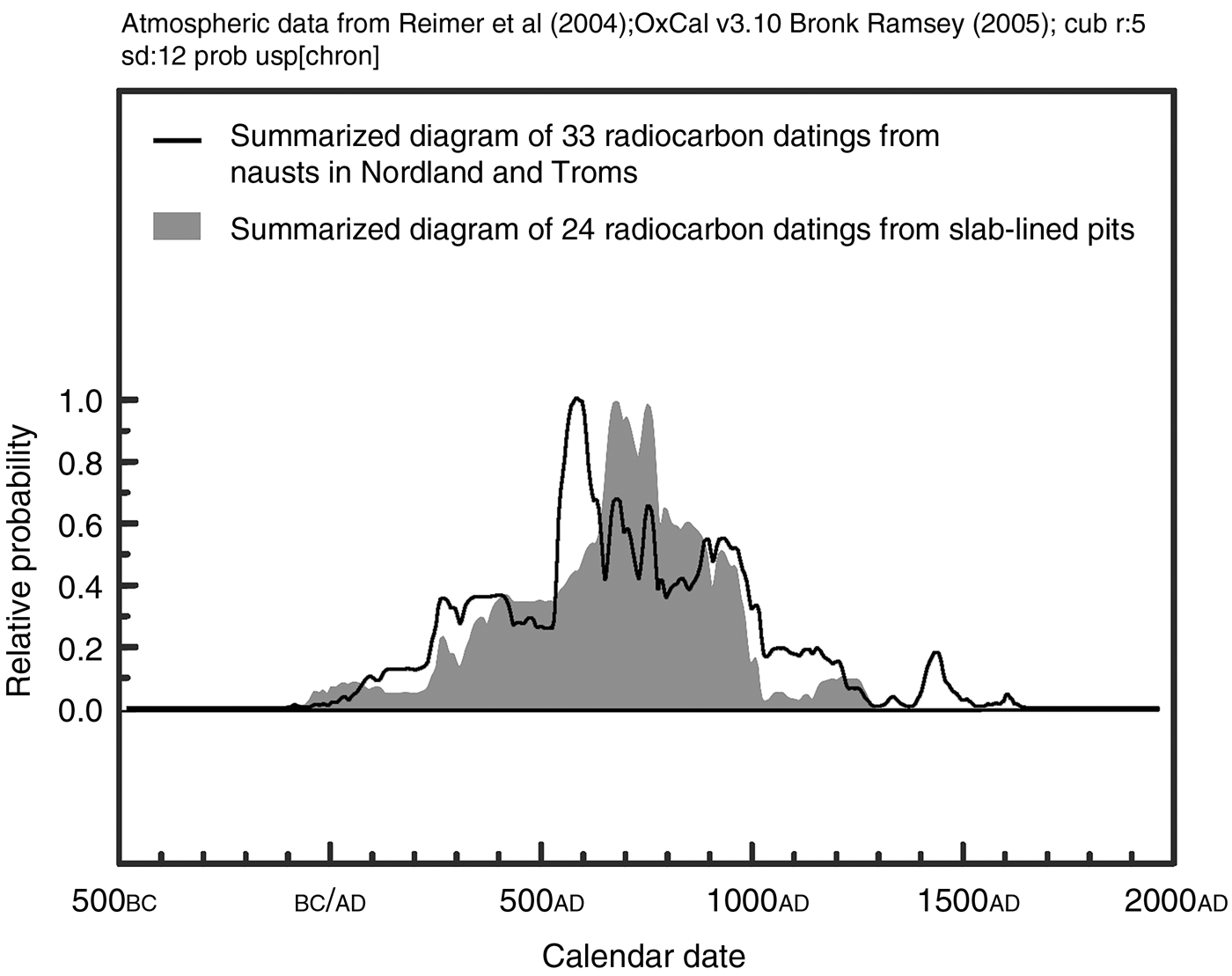
Several factors indicate an increased focus on maritime resources by the Vendel period. New building techniques made it possible to have bigger boats with sails that could reach further out into the sea (Larsson, Reference Larsson2007: 85). In northern Norway, corresponding to Ohthere's Hålogaland, boathouses or nausts have a primary construction phase around ad 600–900. In Finnmark, maritime exploitation is also indicated through more than 700 recorded slab-lined pits or hellegroper used for processing blubber from marine mammals (Nilsen, Reference Nilsen2017: 4). Radiocarbon dating indicates an increase in these features around ad 600–900, therefore revealing a chronological, and sometimes also geographical, correlation with the boat houses (Figure 1; see Henriksen, Reference Henriksen1995: 57; Stylegar & Grimm, Reference Stylegar and Grimm2005: 256, 258; Wickler & Nilsen, Reference Wickler and Nilsen2012: 106–07; Nilsen, Reference Nilsen2014: 95; Reference Nilsen2017: 10, 16). The slab-lined pits are, in some cases, connected with the presence of whalebone, suggesting whale blubber processing, and could be another indication of whaling. At an excavation in Skjærvika, Finnmark fylke in Norway (Figure 10), such bones were identified as belonging to large species of the Eubalaena or Balaenidae families (Henriksen & Roll Valen, Reference Henriksen and Roll Valen2013: 384). These whales could weigh up to 50–100 tonnes, and the blubber constitutes forty per cent of the bodyweight. It was necessary to kill several hundred seals to get an equal amount of blubber from a single whale.
Comparison of summarized radiocarbon dates from boathouses (black line) and slab-lined pits (grey) from northern Norway. A concurrent increase in the sixth century can be identified (thirty-three radiocarbon dates from boathouses in Nordland and Troms, compilation from Wickler & Nilsen, Reference Wickler and Nilsen2012:11, and twenty-four radiocarbon dates from slab-lined pits north of Tromsø, compilation from Henriksen, Reference Henriksen1995: 58).
To summarize, compared with the well-attested history of Basque whaling, the introduction of active whale procurement in northern Europe is still obscure. Already in the Vendel period there is an increased maritime focus in society, including the exploitation of marine resources. Viking-period weaving swords and plaques made of whalebone have long been recognized, but many other products gained from whales, like rope, blubber, or meat, have not survived in the archaeological record.
The discovery of an extensive production of whalebone gaming pieces in the Vendel period adds another crucial piece of evidence to the question of early whaling in the North Atlantic and also sheds new light on the exploitation of this resource as well as the emergence of long-distance trade networks in Late Iron Age Scandinavia.
An Overview of Previous Studies and the Prerequisites of this Study
Few publications and articles are concerned with northern European, early medieval gaming pieces, particularly the Swedish items. These objects are regularly found on excavations and described in reports, but in-depth analyses are few and questions about the raw material for the large group made of unspecified bone and antler have always been secondary to chronology, typology, and social contexts (e.g. Selling, Reference Selling1940; Lindquist, Reference Lindquist1978; Mclees, Reference McLees1990; Kjer Michaelsen, Reference Kjer Michaelsen1992; Sandberg, Reference Sandberg1994; Stauch, Reference Stauch1994; Duczko, Reference Duczko and Duczko1996; Haahr Kristiansen, Reference Haahr Kristiansen1997; Dahl, Reference Dahl2003; Whittaker, Reference Whittaker2006; Kristensen, Reference Kristensen2007; Solberg, Reference Solberg, Hårdh, Jennbert and Olausson2007; Rundkvist & Williams, Reference Rundkvist and Williams2008; Ljungkvist, Reference Ljungkvist2008a; Lund Koksvik, Reference Lund Koksvik2010, Reference Lund Koksvik and Øye2013; Skomsvoll, Reference Skomsvoll2012; Caldwell & Hall, Reference Caldwell and Hall2014; Hall, Reference Hall2016).
The present study is based on a database containing more than 200 entries, of which the largest part (about 150 entries) originates from burials. It represents a broad spectrum of graves from a wide area of present-day Sweden and Åland and shows the considerable potential of the data outside internationally well-known sites.
Due to changes in funerary practices, only a small number of gaming pieces come from burial contexts after c. ad 1000. In order to gain information from contexts up to about ad 1200, fifty finds from the medieval town of Sigtuna have been added. The finds’ contexts have been dated by 14C analysis and/or find association, and span from c. ad 300 to 1210. The degree of fragmentation within cremation burials made it impossible to determine the exact number of gaming pieces. A complete set of the game Hnefatafl consisted of some twenty to thirty-five pieces (Skomsvoll, Reference Skomsvoll2012: 52–53); and, even if it is highly unlikely that each burial contained a complete set, the numbers of gaming pieces originally deposited in these Swedish Late Iron Age burials would have been in their thousands.
Whalebone is unusual in Scandinavian archaeological contexts, and few professionals are trained to identify the material. Osteological analysis is not always conducted on artefacts (Karlsson, Reference Karlsson2016: 9) and archaeologists with insufficient knowledge are likely to conduct the osteological identification, leading to inaccuracies. There are a few previously identified Late Iron Age whalebone gaming pieces from Sweden and northern Europe, but these occasional observations have not been interpreted in a wider context (e.g. Sjøvold, Reference Sjøvold and Filip1971; Lundqvist, Reference Lundqvist1988; Seiler, Reference Seiler2001; Artelius & Kristensson, Reference Artelius and Kristensson2005; Kristensen, Reference Kristensen2007; Skomsvoll, Reference Skomsvoll2012; Christensen, pers. comm. 7 November 2017).
The identification of the raw material in this study was predominantly carried out by visual examination, supplemented by microscope analysis, and compared with samples from known species. The basic characteristics of antler, terrestrial bone, whalebone, and walrus tusk that have been considered in the examination are as follows:
• In antler, the structure of the spongy bone can vary considerably between different deer species, and within a single antler. The spongious part has a very low bone density and the orientations of the cavities are heterogeneous. Gaming pieces made from these materials are generally small and flat, utilizing the harder outer surface, or tall and narrow, using a sawn-off tip of the antler. There are also larger pieces that use the palmate part of moose antlers (Figure 2a and b).
• Bone from terrestrial mammals has a spongy core, with unaligned cavities, quite similar to antler. Gaming pieces from terrestrial animals are mostly made by using the compact outer part of a large long bone, or, more rarely, the head of the femur from large animals (Figure 2c and d).
• Whalebone has a relatively thin layer of outer compact tissue. The spongy tissue is homogenous, coarse, with elongated, thread-like cavities. The homogeneous workable volume of spongy bone tissue is much larger compared to that of antler. This is particularly true for certain parts of the whale skeleton, such as the jaw (Figure 2e and f).
• Walrus tusk is a dentine material, comparable to ivory from elephant, mammoth, or several other animal species with elongated teeth, hence its occasional designation as ‘walrus ivory’. Specific to walrus tusk is that it consists of two different kinds of dentine: the outer homogenous primary dentine, and an inner core of secondary dentine (osteodentine) that has a marbled structure. The tip of the walrus tusk has an enamel coating, which is worn away during the animal's youth (Figure 2g and h; Espinoza & Mann, Reference Espinoza and Mann1992).
Raw materials within the group of unspecified bone/antler identified in the study: (a, b) antler; (c, d) bone from terrestrial animals; (e, f) whalebone (reference sample of Balaenoptera acutorostrata); (g, h) walrus. Photographs by Rudolf Gustavsson, Societas Archaeologica Upsaliensis, Andreas Hennius, Uppsala University, and Bengt Backlund, Upplandsmuseet; drawing from Espinoza & Mann, Reference Espinoza and Mann1992: fig. 13, with permission from National Fish and Wildlife Forensic Laboratory.

As part of a preliminary project aiming to research marine exploitation and the possibilities of species determination of whalebone, a small number of samples from cremations and inhumations has been analysed by the ZooMS method (Zooarchaeology by Mass Spectrometry). This is a type of peptide mass fingerprinting, where bone collagen is digested into fragments with an enzyme, then analysed using MALDI-TOF-MS (Matrix-Assisted Laser Desorption/Ionization Time-of-Flight Mass Spectrometry) to identify species (Buckley et al., Reference Buckley, Collins, Thomas-Oates and Wilson2009).
The database used in this study provides valuable information concerning chronology, mode of production, geographical distribution, and raw materials, but it also has some limitations:
• It is rarely possible to determine the actual numbers of gaming pieces from the graves due to factors such as preservation conditions, funeral practice, excavation methods, etc. A burial context can contain between one and forty-five gaming pieces. The numbers presented here thus represent the number of contexts containing a certain type of find or raw material.
• Even if this is an extensive study, it is not comprehensive, and it makes no claim to include every Iron Age gaming piece found in Sweden.
• Early medieval gaming pieces from the town of Sigtuna show a different and mixed deposition pattern in contrast to the earlier burial contexts. Grave goods are reflections of conscious acts included in the funerary rituals, while finds from urban layers may represent accidental losses, symbolic depositions, production debris, or various other processes.
Gaming Pieces: Types, Dating and Material
Gaming pieces made from bone or antler vary considerably in appearance. Their shapes range from flat/convex to dome-shaped, and there are examples of anthropomorphic pieces and flat cylindrical types. There is also a group of uncertain identification, primarily from urban contexts, such as sawn-off tips of antlers, sometimes interpreted as simple gaming pieces, sometimes as craft waste.
The items in this study come from southern to central-northern Sweden (Frösön, Jämtland). There is an over-representation of finds from central-eastern Sweden around Lake Mälaren, partly due to the large number of excavated graves in this region and because we have included the finds from Sigtuna (Figure 3), but perhaps also owing to differing funerary practices and preservation conditions in burials in southern and western Sweden.
Geographical distribution of the gaming pieces included in the study, divided by province. The large proportion of gaming pieces made from materials other than whalebone in Uppland is due to the many entries from Sigtuna.

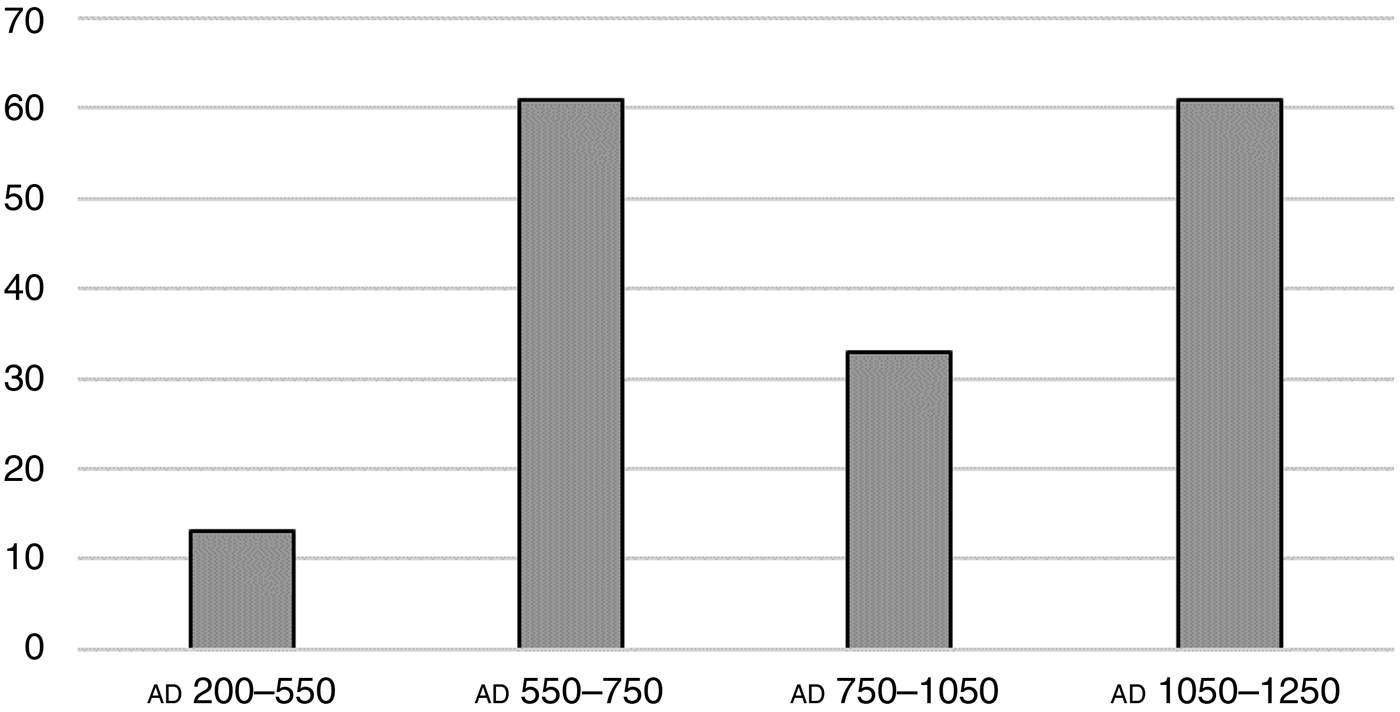
There are few gaming pieces from the Roman Iron Age or Migration period (ad 200–550), with those that have been found primarily coming from rich burials. Many more examples datable to the following centuries have been found (Figure 4), and they soon become more frequent in non-elite burials (see Sandberg, Reference Sandberg1994: 61–62).
Chronological distribution of gaming pieces in the database. Only well-dated contexts are included, excluding around forty objects mainly from the period ad 650–850. The large majority of the items in the far-right column (ad 1050–1250) are gaming pieces from urban layers in Sigtuna.
In 1914, Jan Petersen published a study of Norwegian bone and antler gaming pieces with a typology that is applicable in this study (Figures 5 and 6; Petersen, Reference Petersen1914). In the Roman Iron Age and Migration period, the gaming pieces are flat or convex and cut parallel to an antler tip, or from the hard, outer surface of the antler, or are made from the long bones of terrestrial mammals. Petersen divided these into two groups (Sætrangtypen and Avaldsnestypen), but our study merged this group into one (Type I). These flat or convex Type I gaming pieces predate the larger and taller types, but both are in use in the early Vendel period, especially on the island of Gotland.
Typological classification used in the article, partly based on Petersen's typology, but with Sætrangtypen and Avaldsnestypen merged into Type I. The cut-off tip of an antler to the right is hard to interpret, but it is worth noting that the use of the raw material differs between this and the Type 1 gaming pieces.

Chronological development of different types of gaming piece.
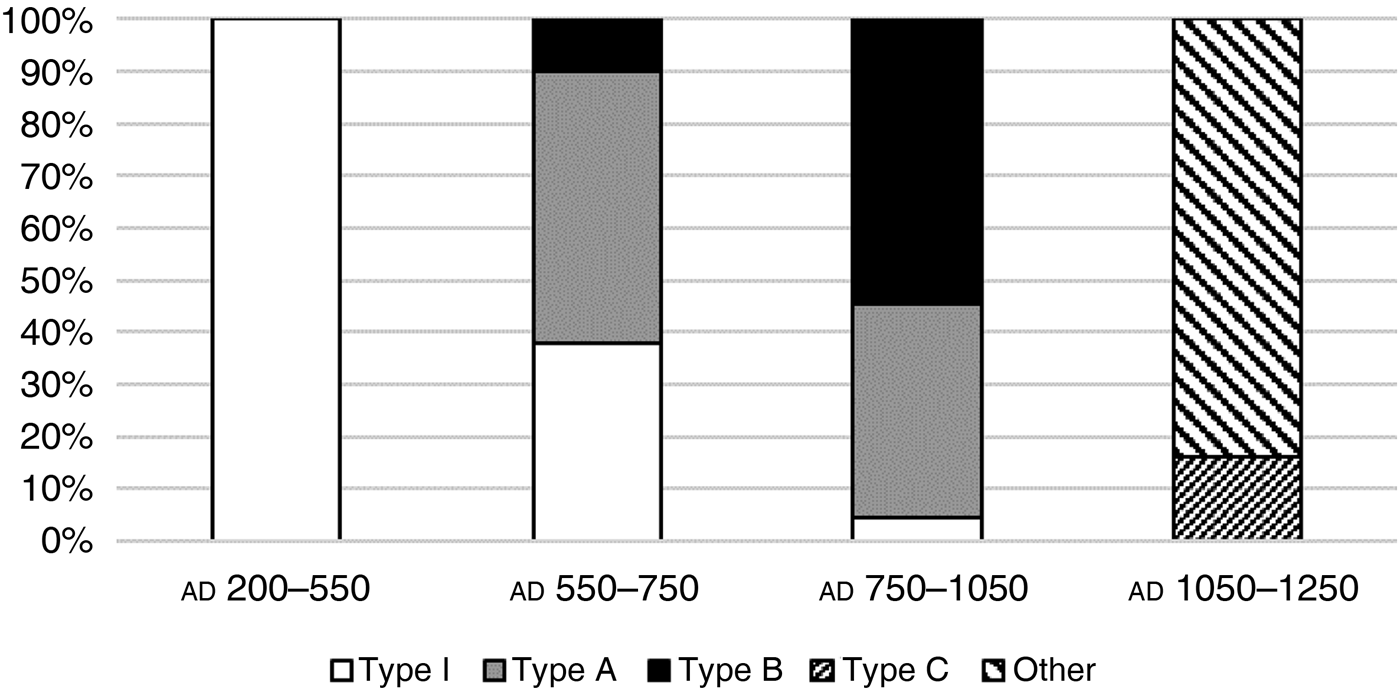
Petersen Type A gaming pieces are large, hemispherical, and their greatest width is at their base. In contrast to the situation in Sweden, Norwegian gaming pieces from the Merovingian period (Swedish Vendel period) were (and still are) rare (Petersen, Reference Petersen1914; Kristensen, Reference Kristensen2007: 21; Skomsvoll, Reference Skomsvoll2012: 23–24). Petersen dated these items to the Viking period; but, in Sweden, the hemispherical Type A gaming pieces are most common in the Vendel period.
Petersen Type B are approaching three quarters of a sphere with the greatest width towards the middle, making the base diameter smaller in comparison. Type A and B gaming pieces are used in parallel, but Type B becomes more common in the Viking period.
Petersen Type C, gaming pieces with a narrowing tip, are often elaborate and have an onion-shaped profile. They are introduced at the end of the Viking period, but are also found in later periods.
In early medieval urban contexts, there are also simple items cut at right angles to the antler tips. These are manufactured in a that differs from the Type 1 bone or antler gaming pieces. Proper interpretation of these objects is in many cases uncertain and many potentially represent craft waste.
Large gaming pieces of Type A and B have one or two holes in the base. Items with two holes are much more frequent in the Vendel period, while in later periods gaming pieces with two holes are only found together with gaming pieces with one hole (Figure 7), indicating a reuse of older gaming pieces.
Chronology of the number of holes in the base of the gaming pieces.
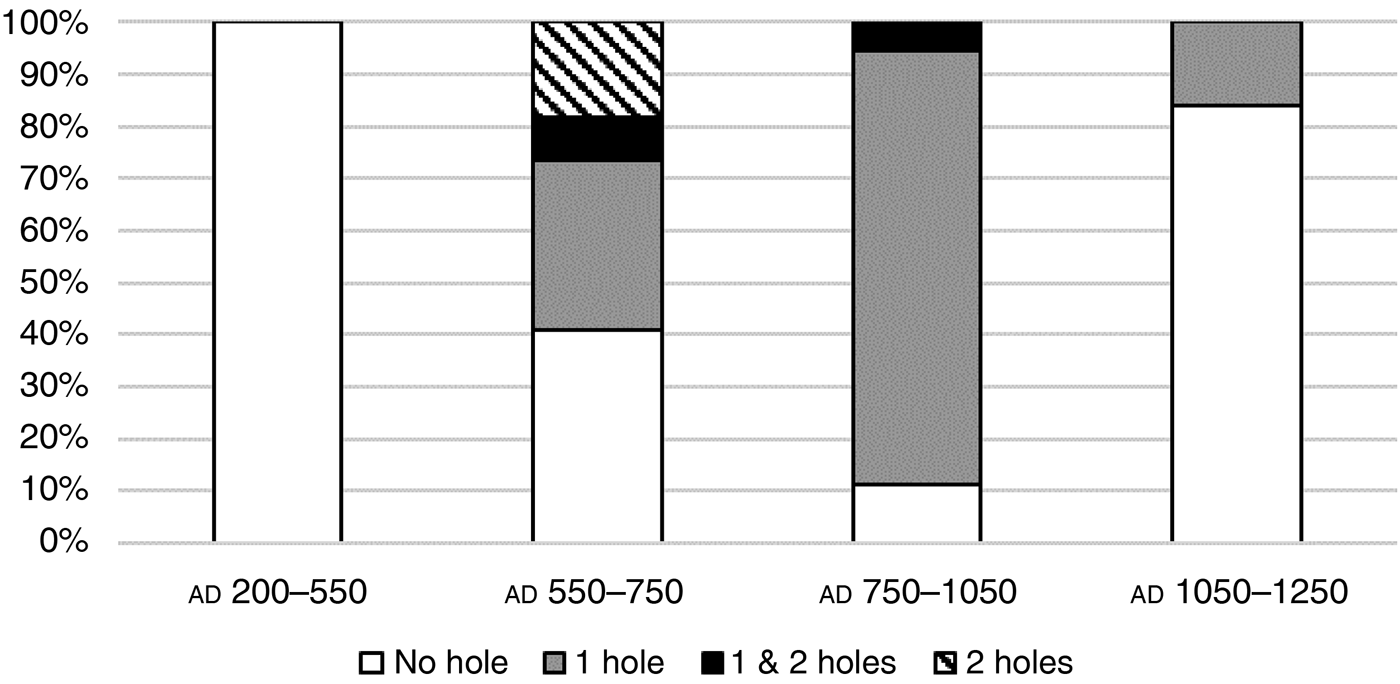
These holes are thought to be markings from the spur drive used by a turning lathe. Traces of circular grinding are common, suggesting that this mode of production was indeed employed. Grinding marks are also present on the lower flat or convex Type I gaming pieces, even if they lack the hole on the flat side. The production process could be important when trying to find the provenance of the items.
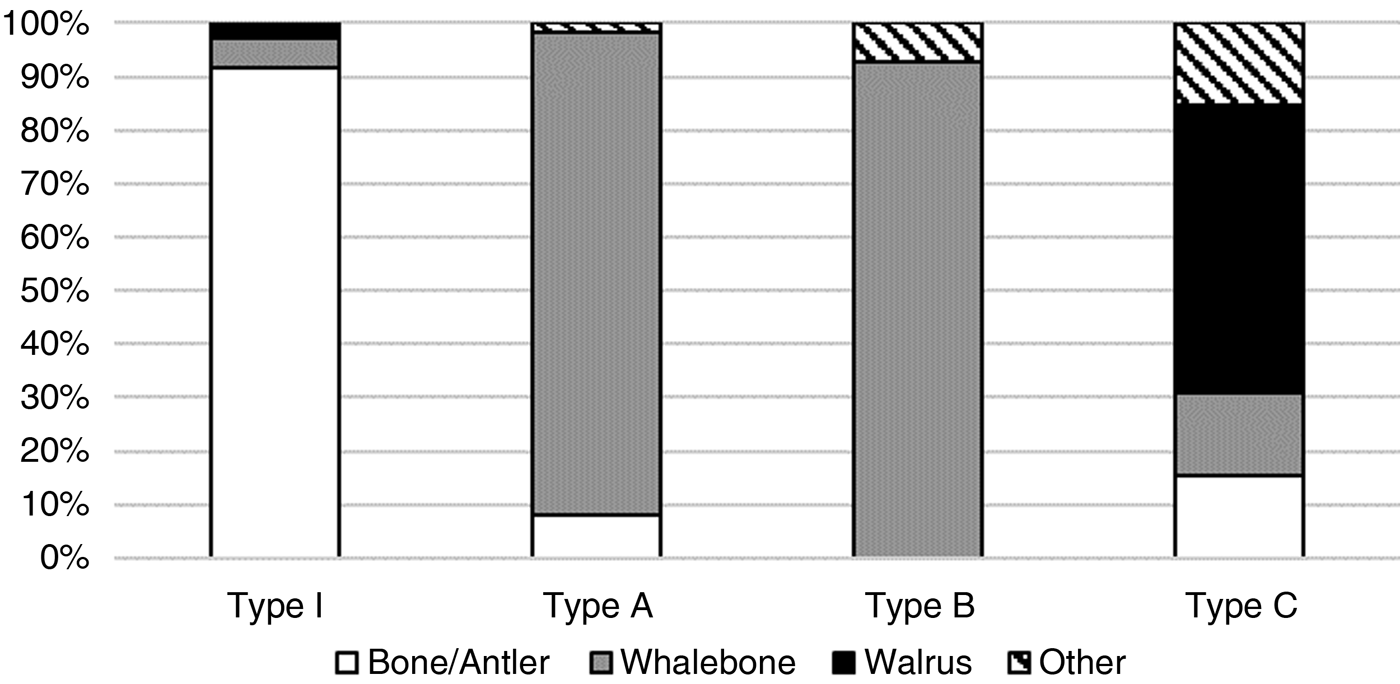
The study clearly identifies a correlation between shape and raw material. Type I gaming pieces are usually made from antler. In contrast, the majority of Types A and B are made from whalebone. Type C items are mostly made of walrus tusk. These all have the secondary dentine exposed, and would therefore not be misidentified as whale tooth, a separation that otherwise is very hard to make based on morphology or microscopic structure. It should also be emphasized that the characteristics of the raw material seem to be a prerequisite of the design. The heterogeneity of bone or antler implies that the material has its limitations, as it is difficult to make larger items from it. Bone and antler gaming pieces typically have a diameter of around 20 mm and a height that rarely exceeds 10 mm. Whalebone gaming pieces, on the other hand, often have a height approaching 30 mm. However, the porosity of whalebone restricts the possibility of creating items with more elaborate designs. Compact homogenous walrus tusk is well suited for manufacturing intricate onion-shaped Type C gaming pieces, but there are some examples of roughly-carved bone in this style (Figure 8). As each design is generally manufactured from a particular raw material, it can be concluded that materials dictate design.
Relationship between raw material and design among the gaming pieces studied.
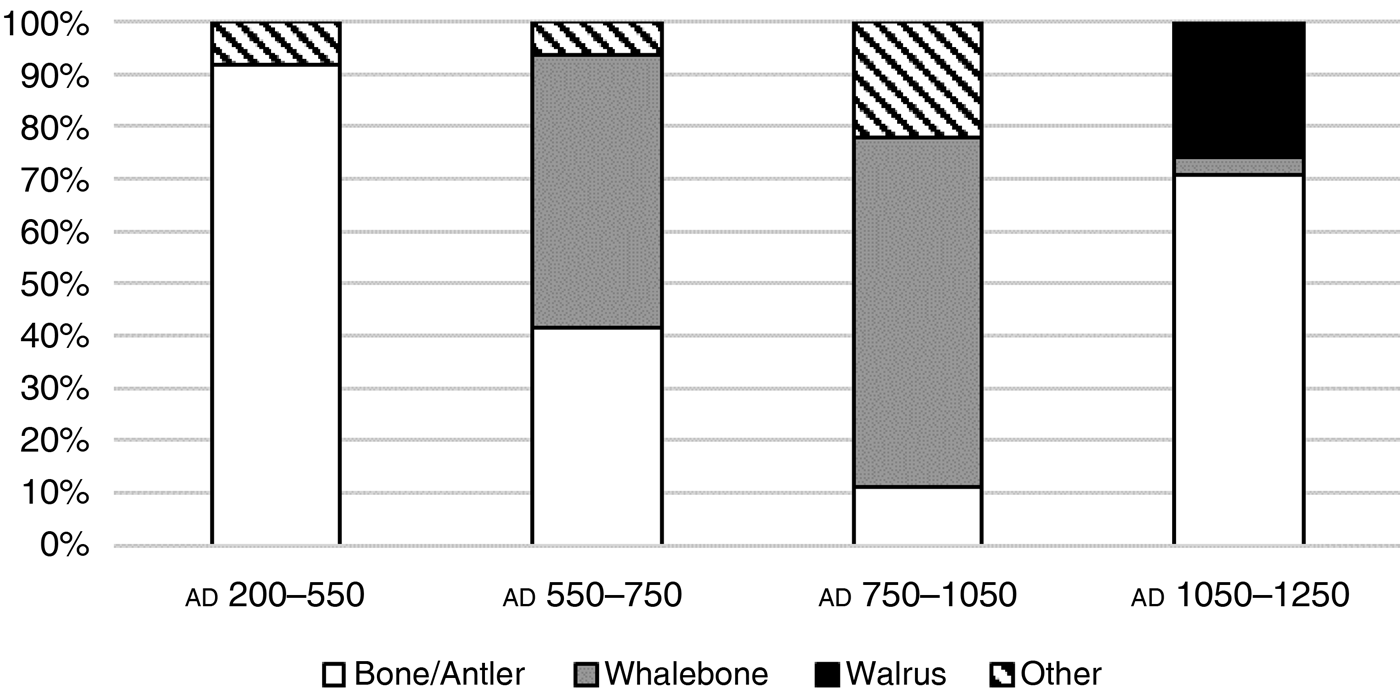
As suggested above, the choice of raw material has a chronological dimension, which sheds light on processes of availability and demand in faunal exploitation in the first millennium ad. Gaming pieces from the Roman and Migration periods are few by comparison, but it is possible to note a clear change in raw material use from around ad 550, when Type A gaming pieces in whalebone appear more frequently, while the use of antler and bone from terrestrial mammals decreases in parallel with fewer finds of Type I. From this point, whalebone dominates until the beginning of the eleventh century, when walrus tusk becomes more frequent, corresponding to the appearance of Type C gaming pieces. At the same time, hemispherical items of Type A and B decrease. The increase in bone and antler seen in ad 1050–1250 is due to the presence of cut-off tips of antlers (Figure 9).
Chronology of the raw material used for the gaming pieces studied.
Whalebone has been identified in ninety-nine of the 166 assemblages from burial contexts in the study. Nine fragments were analysed using ZooMS. Five of the samples yielded results and the identified species was, in all cases, the North Atlantic right whale (Eubalaena glacialis). This species identification is based on the presence of peptides markers at m/z 1079 (common to all cetaceans) and 1682, which is specific to E. glacialis (Buckley et al., Reference Buckley, Fraser, Herman, Melton, Mulville and Pálsdóttir2014). The samples that produced results were collected from inhumations in boat graves from Valsgärde 6 and 7 and Gamla Uppsala boat grave 1, dated to ad 620/30–750 and ad 875–950 respectively (Nordahl, Reference Nordahl2001: 27; Ljungkvist, Reference Ljungkvist and Norr2008b: 18, 30). Even though the sample size was small, the fact that the results showed a coherent composition of only one species suggests to us a conscious selection of specific raw materials. A larger variety of species could be expected in planned analyses of more samples.
Discussion
This study has tested and consolidated the proposition that whalebone gaming pieces were introduced on a large scale immediately after ad 550 in Sweden and Åland. Thereafter, they were popular items until c. ad 1000, when they were replaced by walrus pieces in new shapes.
Below, we will argue that whalebone items were a by-product of active whale procurement, beginning in the Vendel period. We will also argue for a plausible production or catchment area in northern Norway. The gaming pieces may, thus, reveal strong trade connections between the Norwegian Sea and central-eastern Sweden, and beyond.
There is, as stated earlier, no reliable way of distinguishing hunted whales from stranded individuals on the basis of the artefacts, whether these are gaming pieces, weaving swords, or plaques. An impressive number of objects can easily be produced from one single whale carcass. The question is whether people in northern Norway (or other areas along the North Sea) were satisfied with irregular strandings or whether the demand for whale oil and other whale products made active procurement worth the hazardous venture. A development of the technology for standardized manufacture, creating demand and distribution of refined products over vast areas for a long but defined period, could be interpreted as indicating the reliance of producers on stable resources (e.g. Sjøvold, Reference Sjøvold and Filip1971; MacGregor, Reference MacGregor1985; Mulville, Reference Mulville2002).
There are several striking facts indicating active whale procurement:
• The shift in raw material and design of gaming pieces in the sixth century is coherent and, from an archaeological perspective, fast. This suggests that it was based on rational decisions and choices.
• The whalebone gaming pieces found in Swedish Late Iron Age burials are numerous. There seems to have been large-scale and regular imports of gaming pieces over the centuries. These are initially high-status grave markers, but are soon found in a significantly broader range of burials.
• Whalebone gaming pieces coincide with an increase in slab-lined pits used for blubber processing. In some cases, these relate to the presence of whalebone, suggesting whale blubber exploitation.
• There is a correlation between the use of whalebone for gaming pieces and the use of whalebone for other types of artefact.
• The initial few results from ZooMS analysis suggest a preference for certain species.
• The use of refined whale products resulting from whaling in the Late Iron Age is portrayed in the historical account of Óttarr/Ohthere.
Whale hunting and an intensified use of coastal resources starting in the sixth century ad corresponds with numerous other indications of increased exploitation of non-agrarian products in the outlands, for example the hunting of terrestrial animals, fishing, or tar production (Hennius, Reference Hennius, Hjärthner-Holdar, Ranheden and Seiler2007; Lindholm & Ljungkvist, Reference Lindholm and Ljungkvist2016; Star et al., Reference Star, Boessenkool, Gondek, Nikulina, Hufthammer and Pampoulie2017).
Source of production
Historical sources suggest that whale hunting took place along the Norwegian and western European coasts during the Viking period. The sixth-century whalebone gaming pieces are a strong reason to argue for whaling even earlier. The main materials of interest were probably meat and blubber, but whaling also resulted in access to good raw materials for various crafts or boat building, among other things.
It is hard to pinpoint an area of production for the large, hemispherical whalebone gaming pieces, but the whalebone plaques and weaving swords can be strongly related to a northern Norwegian context (Isaksen, Reference Isaksen2012: 1). The holes in the base and the circular grinding marks on the convex side support an interpretation that the Iron Age gaming pieces were turned on a lathe. This technique does not need any large equipment and, except for simple edged tools, hardly leaves any archaeological remains. Additionally, the waste from the manufacture of gaming pieces (i.e. small fragments of whalebone) is not easily recognized. To our knowledge, the only potential semi-processed pieces of whalebone found in Sweden come from Birka, but there are also finds from the British Isles (Mulville, Reference Mulville2002: 43; Riddler, Reference Riddler, Klein, Shipper and Lewis-Simpson2014: 338; Karlsson, Reference Karlsson2016: 129).
Pre-Viking hemispherical gaming pieces have been found in England in both Hamwic and York, although they were not made of whalebone (Riddler, Reference Riddler, Klein, Shipper and Lewis-Simpson2014: 348). The choice of whalebone as a raw material seems to be a phenomenon connected to the Scandinavians, and such gaming pieces are found in Viking burial contexts and occasionally on settlements with large bone assemblages such as Birka or Lejre (Christensen, pers. comm. 7 November 2017).
The reference to whaling and the handling of whalebones in Ohthere, the presence of finely refined whalebone products like plaques and weaving swords, and the large-scale processing of blubber, are all strong arguments that the origin of the whalebone is northern Norway.
Raw material
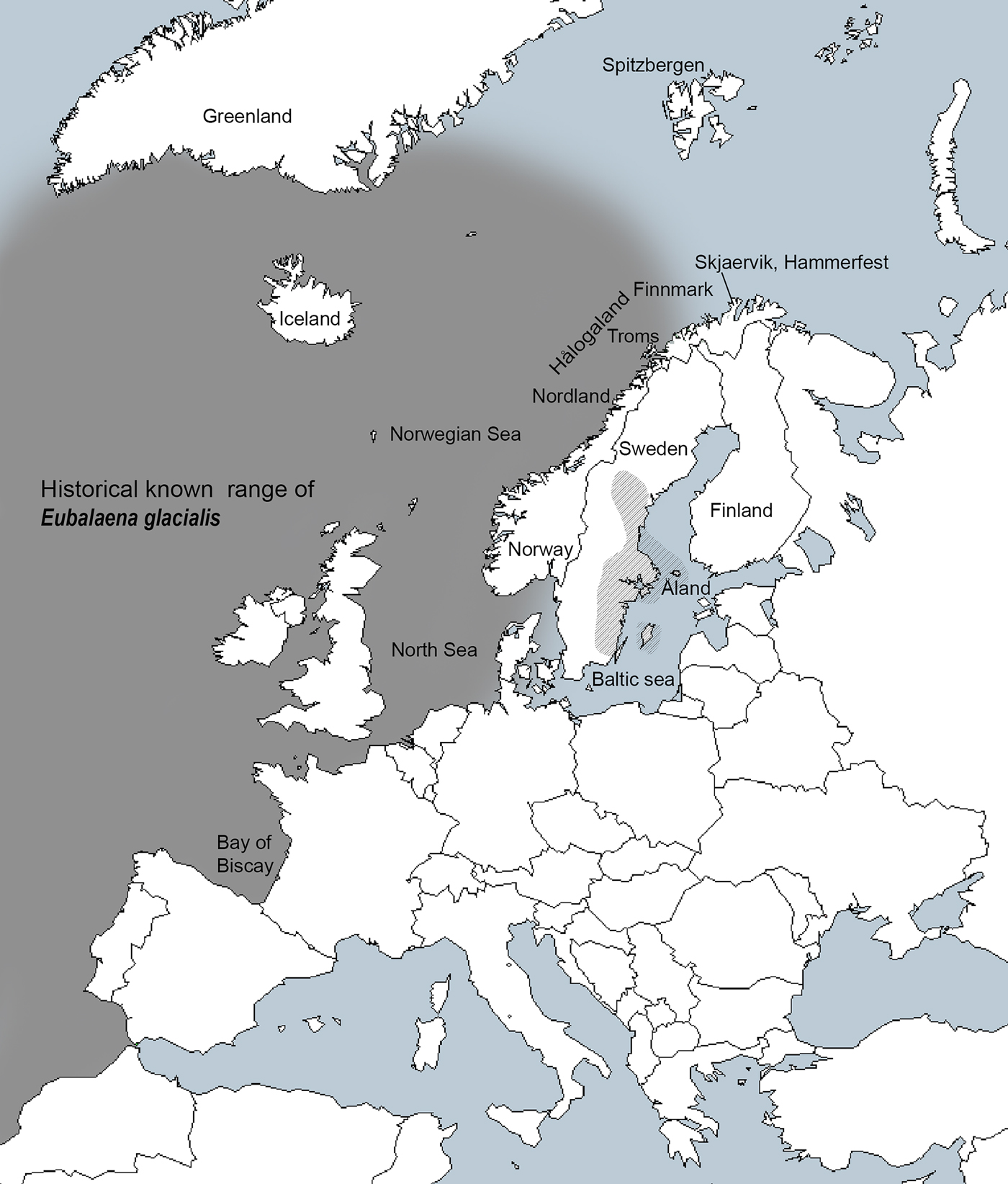
Several species could have been hunted in the early medieval period and Szabo (Reference Szabo2008: 78) lists twenty-eight cetacean species that are thought to have inhabited the North Atlantic region at this time. The single identified species in the ZooMS samples that were analysed was the North Atlantic right whale (Eubalaena glacialis). Today, this is one of the most endangered large whale species. Despite weighing 30–80 tonnes and measuring 10–18 metres in length, it was considered the ‘right’ whale to hunt, due to its tendency to stay close to the coast. It could easily be sighted from land, was a slow swimmer, and could be approached within spearing distance by small boats. Finally, it had a high proportion of low-density blubber, which made it a valuable catch that floated after being killed (Carwardine, Reference Carwardine1995: 44–47; Teixeira et al., Reference Teixeira, Venancio and Brito2014: 1). E. glacialis migrated on a yearly basis from North Africa along the European coast with documented sightings as far north as Spitzbergen (Figure 10) (Aguilar, Reference Aguilar1986: 192). So far only five ZooMS analyses have been undertaken, and this picture may change with further sampling.
Historically, Eubalaena glacialis migrated from the Azores to Arctic Norway on a yearly basis. The northern part of Norway with the provinces of Nordland, Troms, and Finnmark shows the presence of Late Iron Age boathouses and areas with slab-lined pits. Hålogaland (the place of origin of Ohthere) included large parts of northern Norway. Hatched areas in Sweden are where the whalebone gaming pieces have been found.
Whalebones and trade
The processing of blubber in heated slab-lined pits has often been ascribed to the north Scandinavian Sámi (Henriksen, Reference Henriksen1995: 41, 75). The connection between the Sámi and whales is also indicated in Ohthere, who collected taxes from them consisting of ‘… animals’ skins and of birds’ feathers and whale's bone and of those ship's ropes that are made from whale's [or walrus?] hide’ (Bately, Reference Bately, Bately and Englert2007: 46). The reference to whalebone as part of the collected taxes shows that there was value in the material. The tax considers whalebone, rather than refined products, which may indicate there were several actors in the handling of whale-related products in northern Norway: those producing whale oil and those who received bone as raw material, perhaps for further refining.
Despite difficulties in identifying the production sites, we suggest that the whalebone gaming pieces were traded as finished items. If there was a Late Iron Age transport and trade in whalebone, the leftover debris should have been noticed at more sites in Scandinavia. We suggest northern Norway as the area of origin for the whalebone gaming pieces and that trade networks connected the Norwegian coast to widespread parts of Sweden as early as the Vendel period. Looking at the geographical distribution of gaming pieces, this network was probably based on the land route through Jämtland and Frösön in the Great Lake area—a trading route well-known from later periods (Holm, Reference Holm2012: 50–51).
The traditional way of describing Iron Age trade in Scandinavia is that it transforms from a system of exchanging luxury gifts in the Early Iron Age towards a trade of bulk goods and everyday products in emporia like Birka, Hedeby, Ribe, and Kaupang founded by political elites in the Viking period (Näsman, Reference Näsman1990). Current research points to a more complicated picture. Instead of the political elite, the agency of the traders and craftsmen is emphasized (Callmer, Reference Callmer and Henning2007: 240–41). Smaller trading sites complemented the nodal point listed above, creating complex networks (Loveluck & Tys, Reference Loveluck and Tys2006: 141, 146–48; Sindbæk, Reference Sindbæk2007: 65–66; Hennius, Reference Henniusforthcoming). Recent studies indicate that there were extensive trade networks in the centuries before the Viking period, connecting northern Scandinavia with continental Europe, as well as the rural outlands to the urban centres, which included large quantities of furs, antler, iron, and tar (Hennius, Reference Hennius, Hjärthner-Holdar, Ranheden and Seiler2007; Ashby et al., Reference Ashby, Coutu and Sindbæk2015; Lindholm & Ljungkvist, Reference Lindholm and Ljungkvist2016: 19; Berglund, Reference Berglund and Berglund2017: 94–95; Hennius, Reference Henniusforthcoming). There was a dynamic and large-scale flow of products which pre-dates the emergence of the eighth-century emporia.
Conclusions
This study demonstrates that large quantities of gaming pieces made of whalebone were deposited in graves in widespread parts of Sweden from the middle of the sixth century ad onwards. These gaming pieces are larger than earlier examples, they are hemispherical, and, when found outside Scandinavia, they are connected to Viking contexts.
In the initial phase, the objects are found in elite burials in eastern-central Sweden, but soon also become common in non-elite burials and over wide areas in a pattern comparable, for example, to that of combs or glass beads. We argue that the gaming pieces were produced in Norway and were the by-products of the active hunting of whales initiated at the beginning of the Vendel period, an argument supported by the presence of pits for blubber processing and, later on, by other whalebone artefacts, as well as by written sources. The suggested whaling is consistent with a more intensified marine focus, indicated in advances in boat-building technology and in the building of boat houses. The single species determined by the ZooMS analysis is the now-endangered North Atlantic right whale (Eubalaena glacialis), which speaks for the deliberate selection of a preferred and relatively easy catch, as opposed to a reliance on occasional stranded whales.
From a long-term perspective, the Vendel-period exploitation of coastal and maritime resources can be seen as a starting point for further expeditions across the sea, and this had an influence on the raw materials available, trade and crafts, as well as material culture. The hunting of marine mammals should be compared to the intensified hunting of terrestrial animals in the same period. This includes an increased focus on the exploitation of non-agrarian products from the outlands beyond the settlements, regardless of whether these were extracted on land or at sea. Whalebone is an additional indication of a large-scale flow of products and trade well before the Viking period and the foundation of the Scandinavian emporia.
Acknowledgements
This work was supported by the Berit Wallenberg Foundation under grant no. BWS 2014.0117, SAU's forskningsfond, and the Viking Phenomenon project from the Swedish Research Council (grant no. 2015-00466). We would like to thank Bengt Backlund of Upplandsmuseet in Uppsala for photographic processing and Calum McDonald for language revision.


 Open access

