

1. Introduction
Statements by pundits, politicians, and citizens alike lament the rise of political polarization and the role that partisan news media may have played in this process. In particular, this argument articulates a worry that silos of repeated exposure to one-sided media may cause political attitude extremism via accumulated and persistent persuasion (Sunstein, Reference Sunstein2001; Pariser, Reference Pariser2012; Tufekci, Reference Tufekci2018). Although such echo chambers might only affect a small portion of the population (Prior, Reference Prior2013; Allen et al., Reference Allen, Howland, Mobius, Rothschild and Watts2020; Guess, Reference Guess2021; Wojcieszak et al., Reference Wojcieszak, Menchen-Trevino, Goncalves and Weeks2022; Wittenberg et al., Reference Wittenberg, Baum, Berinsky, de Benedictis-Kessner and Yamamoto2023, cf. Broockman and Kalla, Reference Broockman and Kalla2024), if the minority that repeatedly consumes partisan media disproportionately engages in the political system, they might have an outsized effect on policy—especially if these effects accumulate and persist over time. However, observational data rarely allow researchers to examine either the accumulation or persistence of partisan media’s effects over time.
In the face of this challenge, political scientists have turned to experimental methods. These studies (e.g. Arceneaux et al., Reference Arceneaux, Johnson and Murphy2012; Leeper and Slothuus, Reference Leeper and Slothuus2014; de Benedictis-Kessner et al., Reference de Benedictis-Kessner, Justin, Berinsky and Yamamoto2019) have generally yielded more modest effects than observational research designs, leading to ambiguity about the cause of this discrepancy. Indeed, such differences could emerge from a number of limitations such experimental designs face, such as their time-limited nature or artificiality of the stimuli. While some studies have avoided the artificiality of media stimuli and the artificiality of the news consumption environment by incorporating more realistic choice settings (e.g. Guess et al., Reference Guess, Barberá, Munzert and Yang2021; Levy, Reference Levy2021; Broockman and Kalla, Reference Broockman and Kalla2025), these studies often have had to sacrifice some degree of experimental control.
In this paper, we present the results of three experiments that explore the accumulation and persistence of the persuasive effects of partisan media. These multiwave experiments allow us to examine the way these persuasive effects can dynamically change over time in ways that traditional single-wave experiments must ignore. In particular, we focus on two ways in which temporally limited experiments deviate from real-world behavior. First, such experiments focus on the instantaneous change in respondents’ attitudes. However, the persuasive effect of partisan media may quickly decay, limiting its ultimate effect on public opinion and political behavior, or they may persist, leading to longer-term impacts on politics. Second, these experiments typically focus on the consumption of just a single story at a single moment in time. Yet in reality, readers or viewers will repeatedly consume their favorite publications and broadcasts, potentially amplifying their persuasive effects through accumulation. Single-exposure studies with immediate measurement of attitudinal change have little ability to mirror these real-world processes of persistence and accumulation and therefore assess their effects (Slater, Reference Slater2004).
We address these shortcomings by conducting a series of large-scale multiwave experiments that test for both the accumulation and subsequent decay of media persuasion. Specifically, we report the results of three survey experiments. Experiment 1 focused on policy attitudes about the legalization of marijuana and consisted of three waves. In this experiment, we exposed respondents to a short news article in one or both of the first two waves and measured their policy attitudes in all three waves, allowing us to study the longevity of the effects of news media as well as the cumulative effects of receiving multiple treatments. Based on the results of Experiment 1, we discovered evidence suggesting the persistence of persuasive effects across waves of our survey, but determined that an adequately powered experiment isolating cumulative effects would be virtually infeasible. We then conducted two preregistered experiments (Experiment 2 and Experiment 3) to replicate our tests of the persistence of persuasive effects.Footnote 1 Both of these follow-up studies consisted of two waves and focused on the policy issue of the break-up of large technology companies. In both experiments, we only treated respondents once in the first wave but measured their policy attitudes in both waves, allowing us to assess the persistence of the persuasive effects of the initial treatment over the two waves.
The results of these three studies lead to two salient conclusions. First, we demonstrate that—in contrast to both longstanding theory and recent work showing “minimal effects”—partisan media can have persistent persuasive effects. Our studies provide evidence that the effects of treatment can persist for over a week, with some effects showing significant persistence and others showing suggestive evidence of durability. That even brief exposure to a short news clip or article can lead to lasting changes in attitudes suggests we should broaden our focus beyond partisan media’s polarizing effects near elections to consider its substantial influence on political discourse at any point in time.
Second, based on the results of Experiment 1, as well as the magnitude of immediate persuasive effects revealed in Experiments 2 and 3, we show that it would be very difficult to conduct an adequately powered experiment to examine how persuasive effects vary with the treatment received in the previous wave—that is, whether the effects of treatments accumulate over time. Consequently, we believe that our results approach the limit of what can be learned about the cumulative effects of partisan media from design-based analyses such as multiwave experiments. In sum, while exposure to partisan media can lead to persistent persuasive effects, studying how these effects might accumulate is unlikely to be achievable with realistic sample sizes without the aid of strong modeling assumptions.
2. Experimental designs to assess dynamic persuasion
Research has documented that even short exposure to partisan media can change the opinions of its viewers and readers. These studies are typically single-shot experiments, in which respondents read a short article or watch a short video and then complete a survey (e.g. Arceneaux et al., Reference Arceneaux, Johnson and Murphy2012; Leeper and Slothuus, Reference Leeper and Slothuus2014; de Benedictis-Kessner et al., Reference de Benedictis-Kessner, Justin, Berinsky and Yamamoto2019). A few studies have added a second survey wave to measure persistence of the persuasive effects, albeit typically with only a brief period between waves (e.g. 48 hours for Levendusky (Reference Levendusky2013b)). The longer-term durability of any persuasive effects thus remains unknown. Guess et al. (Reference Guess, Barberá, Munzert and Yang2021), in turn, find little evidence of durable attitudinal polarization from exposure to MSNBC or Fox, but their reliance on real-world media viewing limits their ability to detect longer-term impacts.
Single-shot experiments are unrealistic in two principal ways. First, the political outcomes we typically care about—such as participation in elections—may occur long after any media exposure. Hence, estimating the influence of partisan media on real-world outcomes requires that we consider whether and to what extent these effects persist over time. Second, typical experiments present participants with a single news story to watch or read. However, consumers of partisan media tend to repeatedly watch or read their favorite shows and publications, resulting in a much larger volume of exposure than typical experiments can reflect. Real-world effects of repeated exposure may thus far exceed those measured in single-shot experiments. We refer to these questions about the durability of effects and repeated exposure as persistence and accumulation effects, respectively, which we discuss in the remainder of this section.
2.1. Persistence and decay
If the persuasive effects of partisan media are short-lived, they may not be as critical a concern as if they are persistent (Gaines et al., Reference Gaines, Kuklinski and Quirk2007). Identifying the long-term persistence of persuasive effects is thus crucial for understanding the real-world role of the media in politics.
Previous work on informational framing in news articles indicates that experimental estimates of persuasion may be quite persistent.Footnote 2 For instance, some research suggests that the polarization effects of partisan media may persist for at least two days (Levendusky, Reference Levendusky2013a, pp. 85–86), while decaying by approximately half over ten days and remaining at that level for up to a month (Coppock et al., Reference Coppock, Ekins and Kirby2018). Additional research suggests that persuasive effects may decay, but only in certain segments of the population—such as those who are high in “need for cognition” (Chong and Druckman, Reference Chong and Druckman2010), or moderately politically knowledgeable (Baden and Lecheler, Reference Baden and Lecheler2012).
It remains possible that persistence of persuasive effects might vary depending on the type of treatment (e.g. text vs. video). For instance, while there is little evidence to date on the question of whether text or video treatments produce more persistent persuasive effects, some media effects research suggests a mechanism by which persuasive effects of video might be more persistent because, more than text, video can “attract and hold attention and ... excite the imagination” (Nisbett and Ross, Reference Nisbett and Ross1980, 45). Yet recent research (Wittenberg et al., Reference Wittenberg, Tappin, Berinsky and Rand2021) finds little evidence of a difference in persuasiveness between text and video, calling this argument into some question. In sum, previous research on partisan media and informational treatments more generally suggest that persuasion effects are likely to be persistent to at least some extent and that there is no clear ex ante reason to anticipate that such persistence will vary substantially depending on the type of treatment. We summarize these previous studies on persistence in Table A1 in Section A of the supplementary information (SI).
On the other hand, research in other domains—e.g. campaign advertising and highly polarizing political issues (Hill et al., Reference Hill, James, Vavreck and Zaller2013), policy preferences (Dowling et al., Reference Dowling, Henderson and Miller2020), information about climate change (Nyhan et al., Reference Nyhan, Porter and Wood2022), crime (Larsen and Olsen, Reference Larsen and Olsen2020; Carey et al., Reference Carey, Guess, Loewen, Merkley, Nyhan, Phillips and Reifler2022), and evaluations of government (Kalmoe et al., Reference Kalmoe, Pingree, Watson, Sui, Darr and Searles2019)—finds evidence of fairly rapid decay in persuasive effects and only residual persistence.
Thus for some policy attitudes, attitudinal persuasion may be short-lived, especially when people are likely to confront additional relevant information in their everyday lives that can potentially conflict with the initially persuasive information.
2.2. Accumulation of partisan media’s effects
Most people who watch or read partisan media do so repeatedly. Over time, this can lead to both attitudinal change and shifts in electoral choices, as shown in aggregate observational data (Hopkins and Ladd, Reference Hopkins and Ladd2014; Martin and Yurukoglu, Reference Martin and Yurukoglu2017; Ash et al., Reference Ash, Galletta, Pinna and Warshaw2024). These patterns are difficult to square with the findings of typical single-exposure experimental studies that tend to find minimal effects. Yet observational studies are often unable to distinguish between cumulative attitudinal changes resulting from repeated, over-time self-selection into consumption of these media outlets because observed attitudes result from both processes.
A few studies, however, have used experimental designs incorporating multiple exposures to partisan news and assessed whether repetition of arguments produces a cumulative effect. This research has found limited evidence that persuasive effects accumulate after repeated exposure to media, depending on the content, circumstances, and individuals receiving information.
Levendusky (Reference Levendusky2013a), for instance, shows survey respondents either like-minded partisan news editorials or apolitical articles in a two-wave experiment. He finds that multiple exposures to like-minded partisan media polarize attitudes more than a single exposure, though the additional effect of the second exposure is smaller than the effect of initial exposure. Thus, we might expect that persuasive effects compound, to some extent, after multiple exposures. That said, additional research finds limits to this accumulation and suggests that repeated exposure may have no effect beyond that of a single exposure (Lecheler and de Vreese, Reference Lecheler and de Vreese2013). This latter finding is consistent with communication theory predicting that repeated framing of information may be redundant (Baden and Lecheler, Reference Baden and Lecheler2012; Guess et al., Reference Guess, Barberá, Munzert and Yang2021).
Characteristics of both individuals and the information they consume may contribute to the observed limitations in the accumulation of persuasive effects. For instance, “pretreatment” effects from the initial exposure to partisan media may limit the degree of attitude change resulting from subsequent exposure (Druckman and Leeper, Reference Druckman and Leeper2012). Similarly, repeated exposure to contradictory or offsetting arguments may undermine any impact on attitudes or beliefs (Chong and Druckman, Reference Chong and Druckman2010). Thus, prior exposure may moderate any accumulation of persuasive effects (Zaller, Reference Zaller1992; Huber and Arceneaux, Reference Huber and Arceneaux2007; de Benedictis-Kessner et al., Reference de Benedictis-Kessner, Justin, Berinsky and Yamamoto2019). This would lead us to anticipate relatively large initial effects and relatively large effects among those with limited previous exposure to partisan media, but little additional impact from repeated exposure.
Identifying the conditions under which the persuasive effects of partisan media decay or accumulate is essential for understanding the real-world effects of partisan media on policy and public opinion. To address these questions, we constructed several experiments to test whether the persuasive effects of short exposure to a short partisan media article or video clip can persist over days and weeks, and whether their effects accumulate.
3. Experimental design
Our three experiments employ multiple media formats (text and video) to examine the temporal dynamics of partisan media exposure’s effects on public opinion on two distinct policy issues. The first study (Experiment 1) used a three-wave design involving text treatments to assess both persistence and accumulation.Footnote 3 The second and third experiments focused on the persistence of persuasive effects in two-wave experiments with both text (Experiment 2) and video (Experiment 3) treatments.Footnote 4 For all three experiments, we exposed respondents to media about (and asked respondents for their attitudes about) policy issues that have support (and opposition) on both sides of the partisan aisle among elites. This means that these issues are ones on which we might reasonably expect there to be persuasion rather than issues about which people might have calcified opinions immune to opinion change.
3.1. Experiment 1
We embedded Experiment 1 within a three-wave panel survey, which we depict visually in Figure 1. In the first two waves, respondents provided their stated media preference before reading an article supportive of marijuana legalization (MSNBC), opposed to marijuana legalization (Fox News), or about grocery shopping (the entertainment, or placebo condition). In both waves, we randomly assigned half the respondents to a “free choice” condition, which tasked respondents with reading an article of their choice—again, either a pro- or anti-legalization story on MSNBC or Fox News, respectively, or an entertainment story—and half to a “forced exposure” condition, which randomly assigned respondents to read one of the three articles.Footnote 5 We focus on the respondents who were in the forced-choice arm of the first wave of the experiment and in the free-choice arm of the second wave in order to assess the persistence of the effects of randomly-assigned treatments on their opinions while incorporating realistic post-treatment interference from respondents consuming other (non-random) media in realistic media environments.
Experimental design, Experiment 1.

We measured our outcomes at the end of the first wave, the end of the second wave, and in the third wave survey. Since we were interested in opinion change on underlying latent attitudes about marijuana policy, we focused on one summary measure of opinions rather than focusing on individual policy opinions in the domain of marijuana policy that would be subject to measurement error (e.g. Ansolabehere et al., Reference Ansolabehere, Rodden and Snyder2008). Our outcome measure for this experiment was the standardized first principal component of a wide-ranging series of questions on marijuana policy, which we asked following treatment in the first and second waves of the experiment. We provide additional details on the experimental design and the full text of these questions in Section G of the SI. The third wave included the same outcome battery, but did not include a treatment.
We administered this experiment via an online survey to a national sample of respondents recruited through Dynata in November 2017.Footnote 6 Our sample consisted of 7,385 survey respondents in the first wave, 4,886 in the second wave, and 4,501 in the third wave. We invited respondents to the first two waves to participate in the next wave one week after they had completed the previous survey wave. This yielded a final retention rate in the third wave of 60.9%. Section E of the SI provides a detailed discussion of survey attrition patterns, and Section D of the SI presents balance tables summarizing the demographic composition of our panel across treatment groups.
3.2. Experiments 2 and 3
We designed Experiments 2 and 3 to replicate the findings of persistent persuasive effects found in Experiment 1, using a second policy issue: the breakup of big technology companies. Specifically, we preregistered both experiments to focus on the persistence of persuasive effects between survey waves. Both experiments included two waves, which we depict visually in Figure 2. In Experiment 2, we randomly assigned respondents into one of three treatment conditions: a pro-breakup condition where respondents read two articles with MSNBC formatting supporting the breakup of tech companies, an anti-breakup condition where respondents read two articles with Fox News formatting opposing the breakup of tech companies, or an entertainment condition where respondents read two articles about grocery shopping, presented with the Food Network logo. In both the MSNBC and Fox conditions, one article always focused on monopolization and market power, while the other focused on the spread of misinformation online. Experiment 3 employed a video treatment and randomly assigned respondents to watch either a pro-breakup video clip from MSNBC, an anti-breakup clip from Fox News, or a non-political clip from the Food Network about how to make a fried chicken sandwich.
Experimental design, Experiments 2 and 3.

Both experiments employed two primary outcome measures, which we measured both at the end of the first wave and in the second-wave survey. The first, the “number of companies broken up,” is a count variable based on respondents’ selections from a list of nine companies they believe should be broken up by federal regulators. The second measure is the standardized first principal component extracted from a battery of survey questions that capture respondents’ underlying attitudes toward large tech companies and related policies. This component serves as a summary indicator similar to the measure used in Experiment 1.Footnote 7 In both Experiments 2 and 3, Wave 2 included no treatment and instead just repeated the outcome measures, allowing us to assess the persistence of the treatment effects between waves.
We administered these experiments via an online survey to a national sample of respondents recruited through Dynata in July 2021. Experiment 2 included 3,816 respondents in its first wave, all of whom were invited to participate in the second wave a week later, of which 1,487 (38%) completed Wave 2. Experiment 3 included 3,367 in the first wave, and retained 1,830 (54%) in the second wave. Section E of the SI examines the attrition patterns in all experiments, showing that dropout was not systematically related to treatment assignment and did not substantially alter the demographics of the sample.
4. Results
4.1. Persistence
4.1.1. Experiment 1
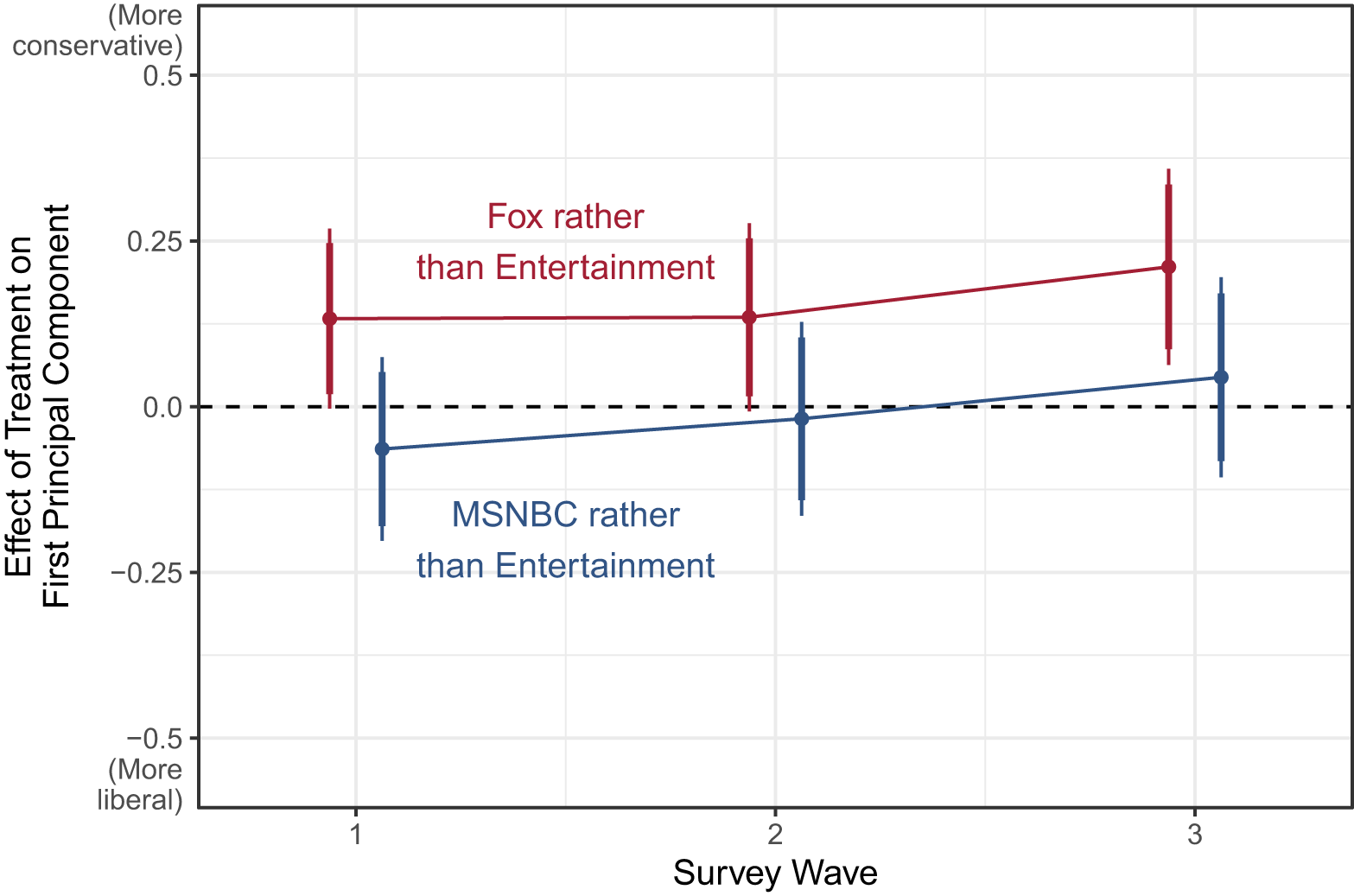
Figure 3 presents results regarding the magnitude and persistence of the persuasive effects of partisan media over the course of the three survey waves in Experiment 1, using the first principal component as the outcome measure.Footnote 8 The vertical axis plots the difference in the outcome between those respondents receiving a partisan news treatment and those respondents receiving the entertainment media treatment. Positive effects indicate that the treatment resulted in more conservative attitudes, while negative effects suggest that treatment led to more liberal ones. The estimates presented here use respondents that were randomly assigned a treatment in Wave 1, but were in the free-choice group in the second wave.
Effect of treatment on first principal component (PC1) in Experiment 1. Points represent the effect of being treated with partisan media instead of entertainment on the outcome measured in the wave identified on the  $x$-axis, with 95% (thin lines) and 90% (thick lines) confidence intervals. Red shading identifies the effect of being treated with Fox News, while blue shading identifies the effect of being treated with MSNBC. PC1 is computed and standardized within a wave. Entertainment group means (standard deviations) are, in Wave 1: $-$0.01 (0.95); Wave 2: $-$0.07 (0.97); Wave 3: $-$0.11 (0.95).

In the first wave, the estimated average treatment effect for the Fox News treatment relative to entertainment (red points and line) is 0.133 [ $-$0.003, 0.269],Footnote 9 indicating that respondents who consumed conservative media rather than entertainment media reported more conservative opinions. This effect is marginally significant ( $p \lt 0.1$), with the 95% confidence interval just crossing zero. In contrast, the estimated effect of the MSNBC treatment (blue points and line) is $-$0.064 [ $-$0.202, 0.075]. Although in the expected direction, the effect for MSNBC is smaller than that observed for Fox News and is statistically insignificant.Footnote 10
In the second wave, the point estimate for the persuasive effect of Fox News remains essentially unchanged, while the effect of MSNBC is near zero and statistically insignificant. The persuasive effect of treatment with Fox News rather than entertainment is even stronger in Wave 3 and is again statistically significant (0.211 [0.063, 0.359]). Conversely, the effect of treatment with MSNBC rather than entertainment remains null. Overall, these results suggest that partisan news can have a persistent persuasive effect, even when treatment involves reading just a short news article.
One complicating factor in interpreting the results of Experiment 1 is the role of the free-choice condition in Wave 2. Specifically, our design allows respondents to consume a follow-up dose of partisan media of their choice, to some extent simulating the real-world process by which respondents will self-select into additional doses of partisan media. Although more realistic, because this design allows for the possibility that respondents might consume reinforcing, offsetting, or unrelated stories across the two exposures—that is pro- vs. anti-marijuana legalization, and/or a story about groceries—it might lead us to over- or under-state the persistence of the effects of partisan media relative to a design with no treatment in the second wave. That said, our analysis in Section F of the SI reveals that Wave 1 treatment assignment did not significantly influence Wave 2 media choices, with only about one-third of respondents choosing the same media outlet in both waves. Unlike Experiment 1, Experiments 2 and 3 did not include a second treatment in Wave 2, and so allowed us to more directly identify the persistence of the persuasive effect of a single dose of partisan media.
4.1.2. Experiments 2 and 3
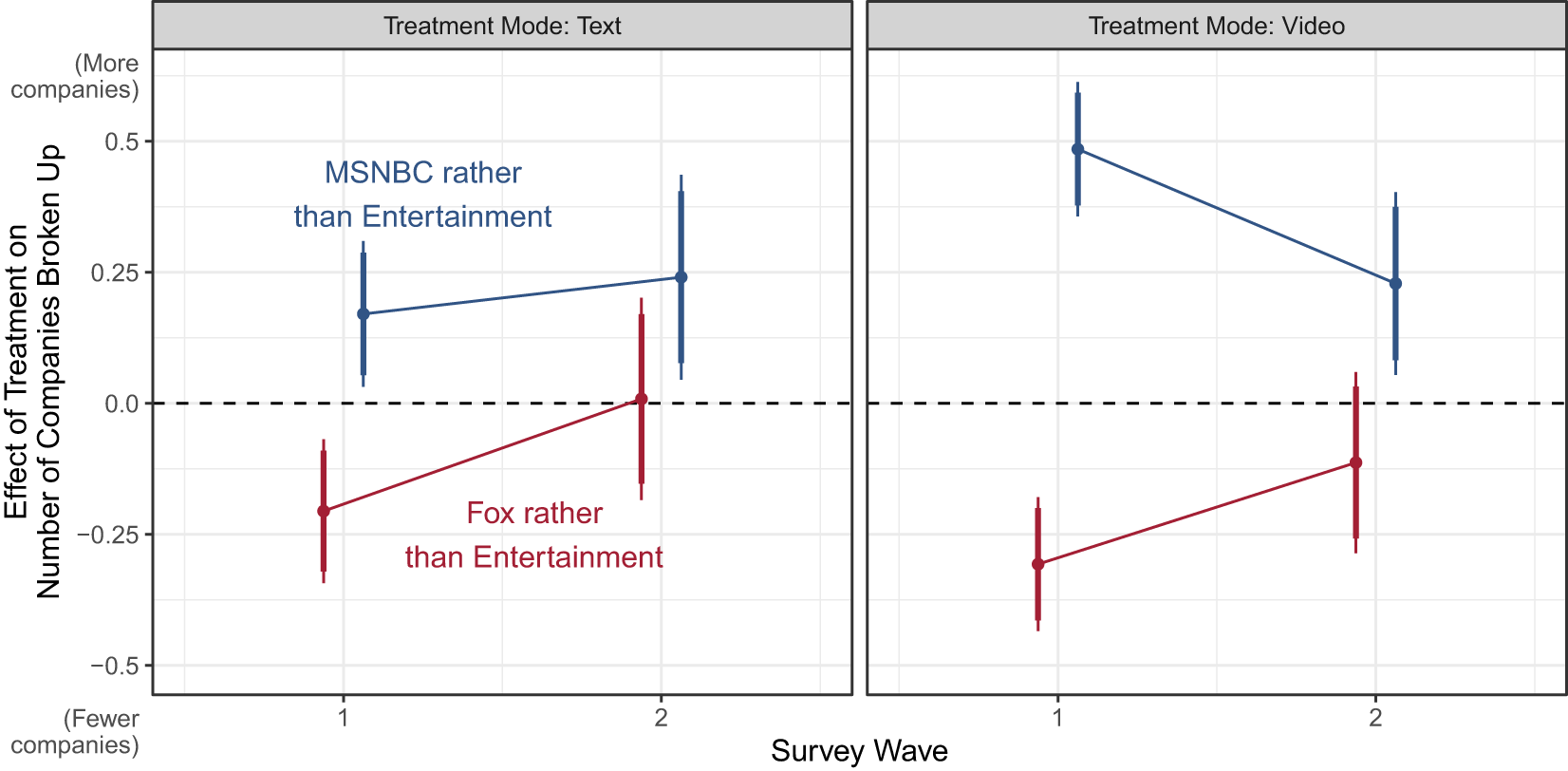
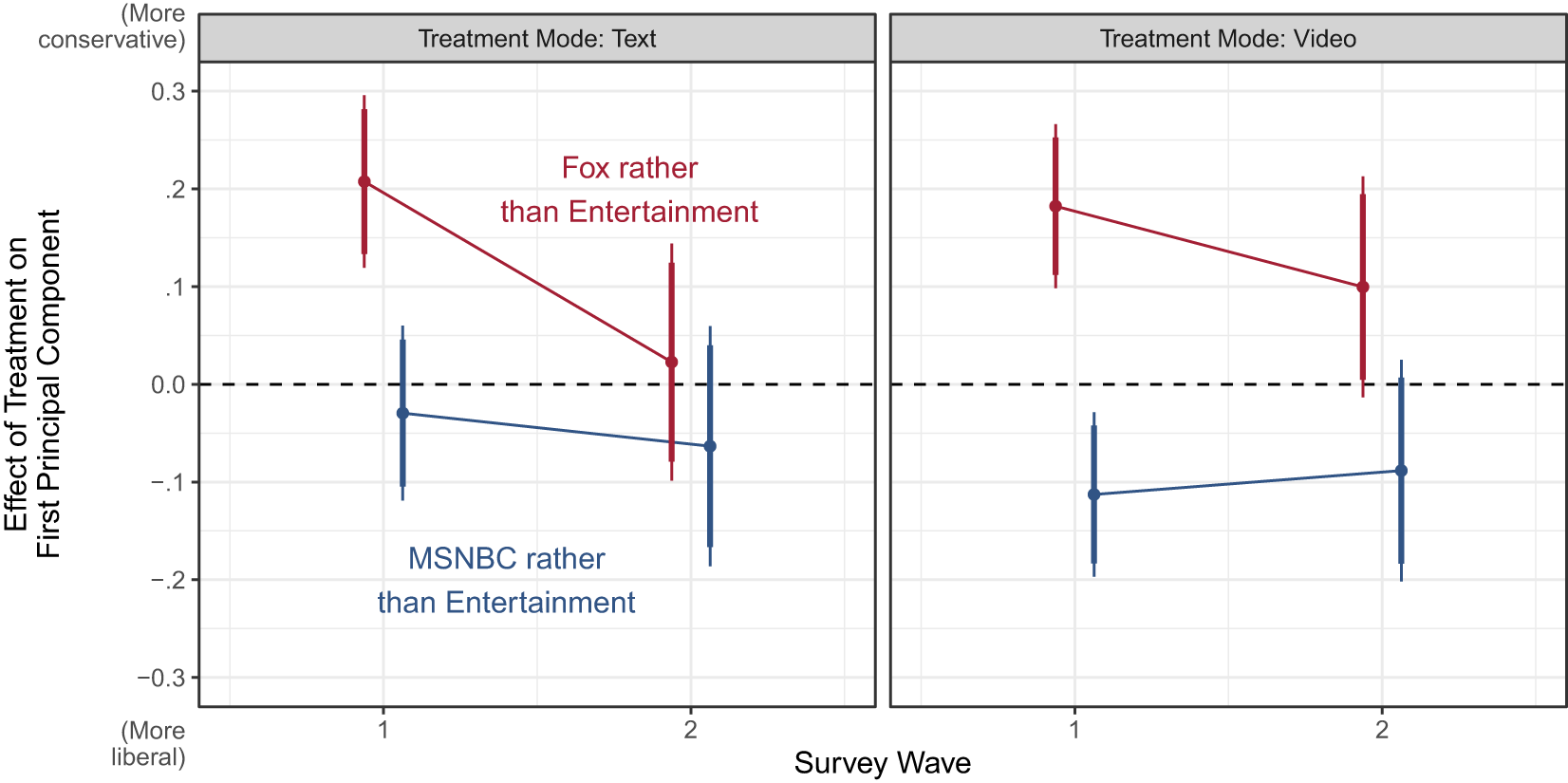
We next present the estimates for the persuasive effect of partisan media in the full sample for both our “number of companies broken up” outcome (Figure 4) and first principal component outcome (Figure 5) in Experiments 2 and 3.Footnote 11 The “number of companies broken up” measure directly captures respondents’ support for regulatory intervention by counting the companies they favor breaking up, while the first principal component aggregates responses from several related questions to provide a broader summary of their underlying tech policy attitudes. Note that a positive effect for the “number of companies broken up” measure indicates a shift toward increased support for regulation (i.e. a more liberal stance), whereas a positive effect for the principal component indicates a shift toward more conservative attitudes.
Effect of treatment on the number of companies broken up in Experiments 2 and 3. Points represent the effect of being treated with partisan media instead of entertainment on the outcome measured in the wave identified on the  $x$-axis, with 95% (thin lines) and 90% (thick lines) confidence intervals. Red shading identifies the effect of being treated with Fox News, while blue shading identifies the effect of being treated with MSNBC. The left panel shows effects in Experiment 2 (text stimuli) and the right panel shows effects in Experiment 3 (video stimuli).

Effect of treatment on first principal component (PC1) in Experiments 2 and 3. Points represent the effect of being treated with partisan media instead of entertainment on the outcome measured in the wave identified on the  $x$-axis, with 95% (thin lines) and 90% (thick lines) confidence intervals. Red shading identifies the effect of being treated with Fox News, while blue shading identifies the effect of being treated with MSNBC. The left panel shows effects in Experiment 2 (text stimuli) and the right panel shows effects in Experiment 3 (video stimuli). PC1 is computed and standardized within a wave. Entertainment group means (standard deviations) are, for text in Wave 1: $-0.06$ $(0.96)$; Wave 2 $0.00$ $(0.98)$ and for video in Wave 1 $-0.02$ $(0.95)$; Wave 2 $0.01$ $(0.95)$.

Both Experiment 2 (the text treatment, presented on the left side of both figures) and Experiment 3 (the video treatment, on the right side of both figures) show significant first-wave effects of partisan media. The effect of being treated with Fox rather than entertainment is statistically significant in both experiments for both outcomes in the first wave, while the effect of treatment with MSNBC rather than entertainment is significant for both outcomes in Experiment 3, as is the “number of companies broken up” outcome in Experiment 2.
Specifically, we see that respondents who received the Fox treatment wanted to break up 0.206 [0.068, 0.343] fewer companies than respondents who received the entertainment treatment. This effect is reflected in the raw percentages: while 59% of respondents indicated they would break up at least one big tech company after receiving the entertainment treatment, only 53% did after reading the Fox article. For the first principal component outcome, we observe a similar effect of 0.208 [0.119, 0.296] for the Fox treatment in Experiment 2. We also observe an effect of 0.171 [0.031, 0.310] for the number of companies broken up outcome and  $-$0.030 [ $-$0.119, 0.060] for the first principal component outcome for the MSNBC treatment in Experiment 2.
Most important for our purposes, we also observed some evidence of persistence into the second wave, which we administered roughly one week after the first wave in both experiments. In Experiment 2, we find a significant persistent effect from treatment with MSNBC on the “number of companies broken up” outcome of 0.241 [0.045, 0.436] and a suggestive effect on the first principal component outcome of  $-$0.063 [ $-$0.186, 0.060]. The effect of treatment with Fox seems to attenuate more strongly in Experiment 2, with the effect being near zero in the second wave.
The video treatment used in Experiment 3 also shows evidence of persistence for certain outcomes. Specifically, we saw respondents treated with Fox support breaking up 0.307 [0.179, 0.435] fewer companies than after receiving entertainment, while respondents treated with MSNBC favored breaking up 0.485 [0.357, 0.613] more companies than after receiving entertainment. Similarly, 64%, 77%, and 76% of respondents favored breaking up at least one big tech company after receiving the Fox, entertainment, and MSNBC treatments, respectively. In the second wave, we found a persistent effect for the MSNBC treatment on the number of companies outcome, with respondents treated with MSNBC in Wave 1 favoring breaking up 0.229 [0.054, 0.403] more big tech companies in Wave 2 than respondents treated with entertainment in Wave 1. We also found suggestive evidence of persistence for other outcomes: respondents who received the Fox treatment in Wave 1 favored breaking up 0.113 [ $-$0.06, 0.286] fewer companies in Wave 2 than after receiving entertainment. Overall, 75%, 77%, and 78% of respondents supported breaking up at least one tech company in Wave 2 after having been treated with the Fox, entertainment, and MSNBC treatments in Wave 1, respectively. This compares with 77% of respondents wanting to break up at least one big tech company in the full sample, suggesting that treatment effects diminished in the second wave, but did not vanish completely.
For the first principal component outcome, we observed significant initial effects of  $-$0.113 [ $-$0.197, $-$0.029] for the MSNBC treatment and 0.182 [0.098, 0.266] for the Fox treatment in Wave 1. These effects showed suggestive evidence of persistence, attenuating to $-$0.088 [ $-$0.202, 0.025] for the MSNBC treatment and 0.100 [ $-$0.013, 0.213] for the Fox treatment in Wave 2. Taken together, the results from these experiments suggest that both text and video treatments by partisan media can be persuasive, with different patterns of persistence across experiments: significant persistence of Fox News effects in Experiment 1, significant persistence of MSNBC’s effect on the number of companies broken up in Experiments 2 and 3, and suggestive evidence of persistence for other outcomes.
4.1.3. Comparing persistence patterns across studies
The persistence patterns varied across our three experiments, reflecting differences in design, policy domain, and outcome measures. Specifically, Experiment 1 showed persistent effects of Fox News treatment on the principal component measure through Wave 3, while Experiments 2-3 showed significant persistence of MSNBC treatment on the “number of companies broken up” outcome but only suggestive for the principal component measures.
These differences likely stem from several factors. First, the experimental designs created different contexts: Experiment 1 allowed participants to self-select media in Wave 2, potentially reinforcing initial treatment effects, while Experiments 2–3 measured pure decay with no intervening treatment in Wave 2. Second, the policy domains—marijuana legalization versus tech company regulation—may engage different types of attitudes and considerations. Third, the concrete “number of companies broken up” measure demonstrated clearer persistence than the principal component measures. This pattern suggests that when people express specific policy preferences (breaking up particular companies), these choices persist better than shifts in general attitudes.
Despite these differences, all three experiments converge on a key finding: partisan media effects can persist for at least one week. These complementary designs—varying in reinforcement opportunities, policy domains, and measurement approaches—together provide robust evidence for the durability of media persuasion effects.Footnote 12 Our results also suggest more persistent effects among respondents who indicated that they prefer partisan media over entertainment across experiments (see SI Section C), highlighting how individual media preferences may moderate persistence patterns, though the precision of these subgroup estimates is limited by sample sizes within each media preference group.
4.2. Accumulation
4.2.1. Experiment 1
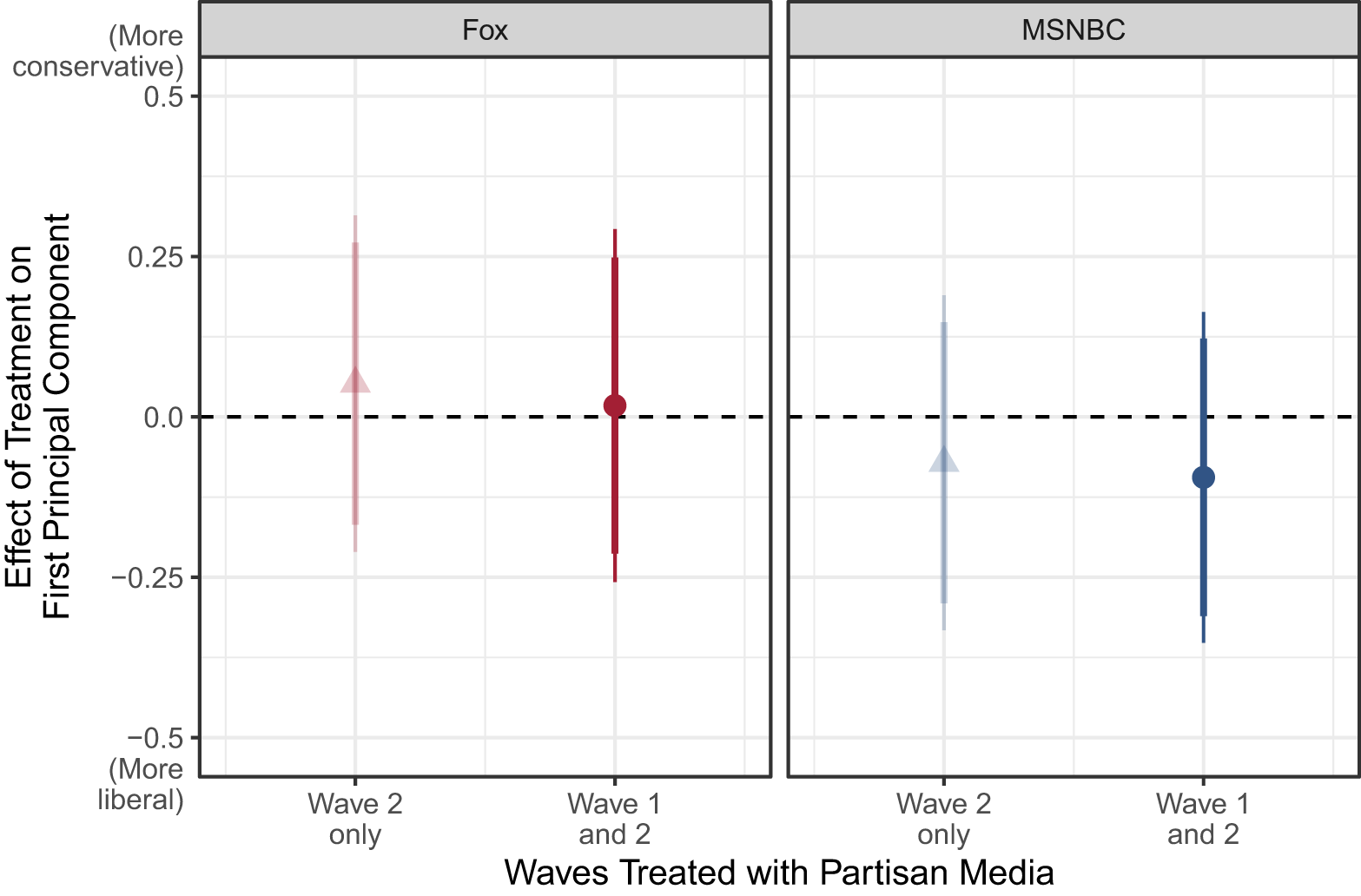
Beyond identifying a persistent persuasive effect of partisan media, we also designed Experiment 1 to allow us to test for the accumulation of partisan media’s persuasive effects after multiple exposures. Such cumulative effects require us to examine how persuasive effects vary with repeated exposures to partisan media. Specifically, we focus on whether the effect of receiving two doses of partisan media treatment (once each in Waves 1 and 2) is larger or smaller than the effect of being exposed to partisan media only in the second wave. A larger effect from repeated doses would suggest that the real-world effects of partisan media on the beliefs of its regular viewers are larger than a single-shot experiment could reveal.
Figure 6 visualizes the evidence for accumulation in Experiment 1. Specifically, the vertical axis represents the estimated effect of treatment with different doses of partisan media (rather than exposure to entertainment in both waves) on respondents’ attitudes as reported in the second wave. The horizontal axis breaks down the results based on the dosage of partisan media treatment—either once (in Wave 2, after being exposed to the entertainment treatment in Wave 1) or twice (in Wave 1 as well as Wave 2)—with a panel for each partisan media outlet. While the results are noisy, they offer little evidence of the cumulative effects of partisan media. For the subgroup of respondents who received entertainment in the first wave, the treatment effects of consuming Fox or MSNBC in the second wave (relative to entertainment in the second wave) are in the expected direction. Yet neither effect is statistically significant—and neither effect is statistically significantly larger for those people who received that same partisan media treatment in Wave 1 as well. In other words, we see no reliable evidence that two doses of partisan media treatment are more powerful than one. However, these estimates are too noisy to allow us to conclusively say that the treatment effect is small. This imprecision results from the large number of treatment combinations we needed to assess the cumulative effects of partisan media. Consequently, we present the results of power analysis aimed at estimating the number of respondents needed for an adequately powered experiment in the next section.
Accumulation effects in Experiment 1. Points represent the effect on respondents’ attitudes from one exposure to partisan media in Wave 2 after exposure to entertainment in Wave 1 (partially transparent triangles) or two exposures to partisan media in both Wave 1 and 2 (non-transparent circles), both relative to exposure to entertainment twice, with 95% (thin lines) and 90% (thick lines) confidence intervals.

4.2.2. The infeasibility of an adequately powered experiment on cumulative effects
Our estimates regarding the presence of accumulation effects were very imprecise, leading us to consider the feasibility of conducting an adequately powered follow-up experiment on this topic. In this section, we present results from power analyses of a potential follow-up experiment to assess these effects. We assumed an experimental design in which we randomly assign respondents to one of three treatment groups in each of two waves: MSNBC, Fox, or Entertainment. We focused on identifying the difference in treatment effects between respondents who were exposed to partisan media in both the first and second waves versus those who were exposed in only the second wave.
Although Experiment 1 provides some evidence for the magnitude of this difference, the estimates from this experiment were extremely imprecise. Indeed, the 95% confidence interval for the effect of two doses of the Fox treatment on the second wave outcome ranged from  $-$4.97 to 5.65 times the effect of a single dose of the Fox treatment on the first wave outcome. Similarly, the 95% confidence interval for the effect of two doses of the MSNBC treatment on the second wave outcome ranged from $-$2.29 to 4.92 times the effect of a single dose of the MSNBC treatment on the first wave outcome.
This imprecision is fundamentally driven by the number of different treatment combinations included in our experiment. Although the forced exposure arm in Experiment 1 included 1,192 respondents in total, there were 9 distinct treatment combinations that respondents could have received across the 2 waves. Consequently, no pair of Wave 1 and Wave 2 treatments received more than 148 respondents. This rendered any attempt to estimate the difference in outcomes between respondents in any two pairs of treatment combinations under-powered.
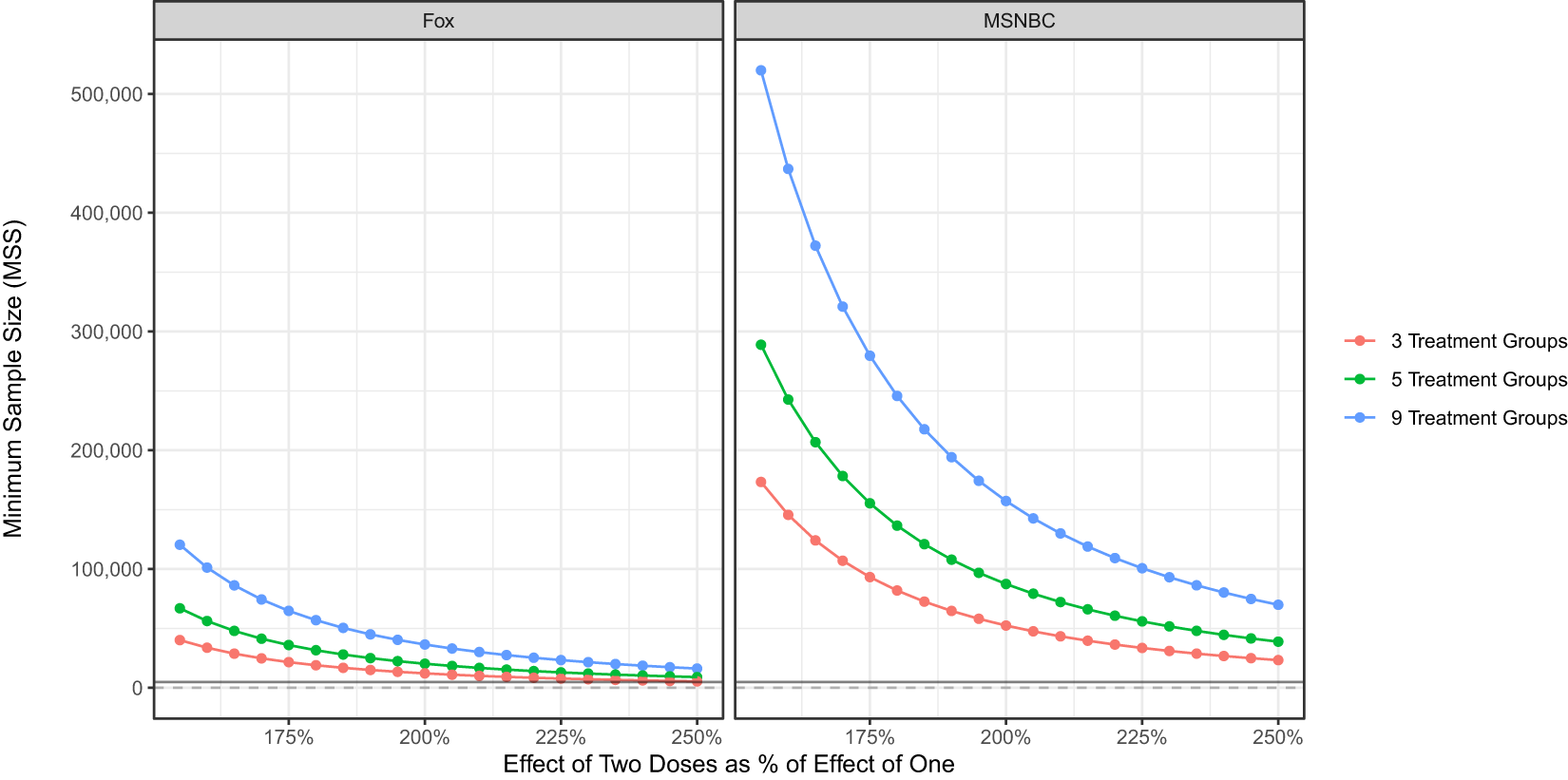
Here, we instead focus on what we consider the plausible range of effects of two doses relative to one. Specifically, we calculated the Minimum Sample Size (MSS) required for us to conduct an experiment with a power level of 0.8 aimed at distinguishing the effect of two doses of the same partisan media from the effect of just a single dose. We do so under different assumptions about the effect of two doses as a percent of the effect of one dose. Our estimates assume that the effect of a single dose of partisan media (as well as the variance of the outcome measure) are fixed at the levels we observed in the first wave of our first experiment.Footnote 13 Larger treatment effects would result in more optimistic power calculations.Footnote 14 While it is theoretically possible that a carefully constructed experiment could produce treatment effects that are significantly larger than this, we consider it highly unlikely.Footnote 15
Figure 7 visualizes the results of this power analysis. The  $x$-axis represents the assumed effect of two doses of partisan media as a percent of the effect of a single dose. The $y$-axis visualizes the MSS needed for an adequately powered experiment under the assumed decline in persuasive effects. The left panel highlights the MSS needed to distinguish the effect of a second dose of the Fox treatment from a first dose of the Fox treatment, while the right panel does the same for the MSNBC treatment.
Minimum sample size (MSS) needed for an adequately powered experiment. This figure visualizes the number of observations needed to conduct an adequately powered experiment, distinguishing the effect of a single dose of partisan media from the effect of two doses of partisan media. The  $x$-axis represents the assumed effect of two doses as a percent of the effect of a single dose. The solid gray horizontal line highlights our sample size in Experiment 1 (4,886), and the dotted gray line is at zero. Line colors indicate whether we assumed there were 3, 5, or 9 treatment arms.

Our original experiment randomly assigned respondents to each of the three treatment conditions in both of the first two waves, so that all respondents ultimately received one of 9 different treatment combinations. However, the analysis of accumulation effects really only makes use of five treatment groups (i.e. entertainment-entertainment, entertainment-Fox, Fox-Fox, entertainment-MSNBC, and MSNBC-MSNBC). A more streamlined experiment might improve the power by randomizing respondents only among these combinations. Indeed, if we were willing to focus on the effects of only one type of partisan media (and thereby eliminate either the Fox or MSNBC arm), we could further improve the power of the experiment by using only three treatment groups (e.g. Fox-Fox, entertainment-Fox, and entertainment-entertainment). The color of points and lines in Figure 7 varies based on this assumption about the number of treatment groups used, with the red points and lines indicating the most pared-down version of an experimental design for assessing accumulation.
These power analyses indicate that an adequately powered experiment to test hypotheses about cumulative effects of partisan media, using stimuli comparable to those employed in real-world persuasion campaigns, would require an extremely large sample size. We consider it most plausible that the persuasive effect of a stimulus would be smaller in the second instance of exposure compared to the first exposure—meaning that the effect of two doses would be less than 200% of the size of the effect of a single dose. However, even in the unlikely case that the effect did not decline in size, an adequately powered experiment with all 9 treatment groups would require 36,439 respondents for the Fox News treatment. Indeed, even if we were willing to reduce the experiment to 5 or 3 treatment groups, a choice that would eliminate our ability to estimate many other interesting quantities of interest—for instance, comparing the effects of Fox News vs. MSNBC relative to entertainment—an adequately powered experiment would still require 20,244 or 12,146 respondents, respectively. These calculations are more pessimistic for the MSNBC treatment, but the substantive conclusion is the same—a very large sample would be needed to conduct an adequately powered experiment.Footnote 16 These power analyses suggest that—even under favorable assumptions—examining the cumulative effects of partisan media in an experiment may be out of the range of feasibility for many researchers.
Of course, several other changes to our experimental design might improve our statistical power. We already use an outcome from PCA that is likely to have a higher degree of measurement reliability than, for instance, a single outcome measure. Yet there are other improvements that could gain us additional power. One of those changes would be to use fewer treatment groups and focus on one partisan media source instead. This would, of course, limit the potential conclusions that could be drawn about multiple types of partisan media. Another potential improvement to the design would be to use informative covariates, such as pre-existing media preferences (de Benedictis-Kessner et al., Reference de Benedictis-Kessner, Justin, Berinsky and Yamamoto2019), as controls in our experiments. Covariates such as these would allow us to reduce residual variance in our outcomes.
5. Conclusion
Increasing consumer choice has led to concerns that viewers self-sort into ideologically consonant partisan news programs. If such partisan media is able to exercise a large persuasive effect over its viewers that accumulates over time and is durable, it may play a significant role in exacerbating political polarization. This may be coupled with increasing self-selection into silos of in-party news sources that limit the degree to which partisans trust news from the other side of the partisan aisle due to increasing hostility towards out-party news outlets (e.g. Peterson and Kagalwala, Reference Peterson and Kagalwala2021). However, examination of the temporal dynamics in the persuasive effect of partisan media requires research designs that deviate from the typical single-shot experiments used by political scientists.
In this paper, we presented the results of three experiments focused on exploring the accumulation and persistence of persuasive effects. All three experiments included multiple waves, allowing us to examine the persistence of persuasive effects. Across these experiments, we found evidence of persistent effects that varied by source and outcome: in Experiment 1, our Fox News treatment showed significant persistence across waves, while in Experiments 2 and 3, our MSNBC treatment showed persistent effects for certain outcomes. We also found suggestive evidence of persistence for other outcomes. Together, these results indicate that even a fleeting exposure to partisan media can result in durable opinion changes. It remains unclear, however, exactly which types of media may have effects that are most persistent.
This finding suggests that large effects of partisan media on political attitudes and politics more generally are plausible. For example, chance exposure to a partisan news segment or clip a week before an election could lead to a significant change in policy preferences that extends through the time of the election. Any study of the electoral effects of media exposure should therefore seek to investigate not only the immediate time period before an election, but also a longer time period preceding it. Our findings also suggest that the effect of partisan media on infrequent viewers may also be meaningful. While only hardened partisans are likely to regularly consume partisan media, a much larger, less polarized audience may be briefly exposed to partisan media within a week of voting or answering a survey. Given that effects among this subgroup of people also do not completely decay, such exposure may have persistent effects that could affect an election.
In contrast to our findings about the persistence of the persuasive effects of partisan media, we find that the accumulation of persuasive effects from multiple doses of partisan media is effectively unknowable in an experimental framework. Indeed, we present power calculations suggesting that, based on our results from Experiment 1, an experiment adequately powered to detect this accumulation would need tens of thousands of respondents—outside the realm of the financial feasibility for most social scientists and the logistical possibility of most survey panels (e.g. Stewart et al., Reference Stewart, Ungemach, Harris, Bartels, Newell, Paolacci and Chandler2015). Consequently, we conclude that our design and estimator approach the limit of what can be learned from such multiwave experiments within the resource constraints that most researchers face without introducing strong modeling assumptions about the accumulation of these persuasive effects.
Together, these findings affirm the importance of examining the temporal dynamics of partisan media persuasion to understand its effects on politics more broadly. Time-limited experiments have shed little light on whether partisan media’s effects decay and have only temporary effects on politics. Our results point to an opposite conclusion for politics: the effects of partisan media may have longer-term impacts due to persistent effects from even a single exposure.
Supplementary material
The supplementary material for this article can be found at https://doi.org/10.1017/psrm.2026.10095. To obtain replication material for this article, please visit https://doi.org/10.7910/DVN/WMIIOI.
Acknowledgements
We appreciate the research assistance of Grace Chao, Henry Feinstein, Kaitlin Tucci, and Kai Zhou, and funding from the National Science Foundation (SES-1528487), the Political Experiments Research Lab (PERL) at MIT, and JSPS KAKENHI Grant Number JP25K00604.









 Open access

