


Introduction
In his Lausiac History, Palladius of Helenopolis recalled a time he got into a sulk. At some point in the early 390s, Palladius travelled from Nitria to the Thebaid to visit the celebrated ascetic John of Lycopolis (d. 394).Footnote 1 This pilgrimage is recounted as the thirty-fifth of the serial biographies of holy people that make up the History. After a journey of eighteen days, Palladius was disappointed to discover that he had to wait until the weekend to see the hermit. When he finally got a face-to-face meeting on Saturday morning, the future bishop and biographer was disgruntled to find it cut short by the arrival of a more important visitor.
While we were talking, the governor of the country, Alypius, entered as well. Rushing over to him, John broke off our conversation. So I withdrew a little, gave them space, and stood at a distance. As they talked for a long time, I got impatient, and being impatient I grumbled about the reverend one, because he had honoured Alypius and treated me with contempt.Footnote 2
Palladius presumably felt that John had shown undue deference to the governor of the Thebaid. Once the hermit had finished his audience with this powerful queue-jumper, he chastised Palladius for this misdirected irritation and gave a more pastoral explanation for his prioritisation of Alypius.
‘I can find you when I want, and you me. And if I cannot provide you comfort, other brothers and other fathers can comfort you. But he is given over to the devil through worldly affairs, and, getting a short respite, he comes here to get help, like a slave running away from his master. It would be wrong to abandon him and occupy myself with you, when you have uninterrupted time to devote to your salvation.’Footnote 3
In Palladius’ telling, John let Alypius cut the line because it was more difficult for the governor to attend to his immortal soul while ruling the Thebaid.
Such a statement could be seen to reflect a fundamental premise of late ancient ascetic discourse: that one could not be a good Christian while serving the state. Yet Palladius’ characterisation of this episode suggests otherwise. In John’s terms, the governor and the monk were engaged in the same quest for salvation, which had led both to come to him for spiritual ‘healing’. Palladius’ John portrayed the central challenge to Alypius’ pursuit of Christian piety in the same terms as that of other ascetics in the Lausiac History: a fight with the devil.Footnote 4 Such a message was particularly appropriate in a text written for Lausus, currently in service in the bedchamber of the emperor Theodosius II.Footnote 5 Indeed, the prologue of Palladius’ text finds the bishop of Helenopolis expressing his hope that Lausus would learn from holy men and women – both through face-to-face meetings and through reading the History – and imitate them as far as he could in his own struggles with diabolical temptation.Footnote 6 By adopting an appropriate code of conduct, Lausus, like Alypius, would be able to pursue piety in service to the imperial state.
That one of the most famous chroniclers of desert asceticism portrayed the political service of a provincial governor and an imperial chamberlain in this way might come as a surprise. This chapter reconsiders the relationship between militia saeculi and militia Christi in late antiquity. It explores a series of recurring models of pious Christian behaviour within the state. It is worth stressing that radical political change was not on the agenda. The values and practices that contemporary writers saw as the purview of good Christian officials did not differ drastically from the traditional standards of elite Roman culture. Like the irritated Palladius, we might suspect an underlying desire to flatter the powerful. Certainly, as Chapter 4 demonstrated, the recourse of clerics and ascetics to basic norms of late ancient political culture makes sense in terms of a need to appeal to the views of aristocratic patrons and dedicatees, as well as these authors’ own internalisation of those cultural codes as elite Roman men. And yet, as John’s riposte to his stroppy visitor should already suggest, accommodating approaches to the involvement of Christians in governance could be justified as the result of various basic premises of late ancient Christian thought and practice. They were part of a broader willingness amongst late ancient churchmen to adapt their more stringent norms when addressing the laity.Footnote 7 Recent work has used sermons (in particular) to explore how theorists of ascetic perfection recalibrated their expectations when teaching the varied communities who turned up to their churches. These pastoral strategies allowed for a more situational appreciation of the status, occupation, and character of individual Christians than that implied by blanket demands to give up ‘the world’.Footnote 8 Even those more strident calls to renunciation are not all that they seem. The rhetoric of withdrawal was not about an absolute break with normal life but rather the appropriate calibration of the individual’s social and affective relationship to (for example) family members or economic production.Footnote 9 The potential for such ideas to shape office-holding is evident from the influence of ascetic concepts on episcopal authority. Conrad Leyser, Andrea Sterk, and Claudia Rapp have traced how bishops in East and West sought to fulfil ideals of pious withdrawal while managing a complicated portfolio as a combined pastoral leader, church official, civic notable, and imperial functionary.Footnote 10 Contemporaries could adopt analogous frames of reference to present imperial and royal officials as pious (and even ascetic) Christians while they remained bound up with the ‘cares’ of their own form of earthly office.
Positive accounts of the combination of Christian commitment and governance did not simply stem from fellow feeling for an overworked administrator.Footnote 11 Christian writers in the post-Constantinian empire continued a long tradition of apologetic discourse regarding Roman power that traced its roots back to charged passages and episodes from the New Testament. Exegetes before and after the Constantinian revolution interpreted these biblical injunctions as expressing support for the imperial authorities and acceptance of their legitimate exercise of authority.Footnote 12 The pre-Constantinian writers known as the ‘apologists’ could go further, portraying Christians as loyal subjects and ideal citizens; indeed, their capacity for virtuous behaviour made them superior to their fellow Romans.Footnote 13 Even more overtly oppositional texts like the acts and passions of the martyrs seed claims regarding their legitimacy as authority figures according to the terms of Roman imperial self-justification.Footnote 14 Recourse to these defensive arguments continued once Christians were no longer subject to legal proscription and periodic suppression. James Corke-Webster has shown how they shaped Christian political thinking in the key transitional moment of the Constantinian era.Footnote 15 Fourth- and fifth-century churchmen used these apologetic strategies to legitimate the (comparatively novel) socio-political authority of bishops and ascetics in culturally acceptable terms.Footnote 16 They also deployed them to articulate and justify traditional accounts of how imperial or royal office-holders could engage in virtuous political behaviour: only, now, as Christians.
Section 5.1 considers how clerics and ascetics utilised these pastoral and apologetic approaches to demonstrate that officials could be good Christians while serving the state. In particular, it shows how contemporaries tackled those governmental practices that led contemporary ascetics (and more wary pre-Constantinian authors) to preach renunciation: corruption and violence.Footnote 17 For the former, officials were to avoid avarice and ‘be content with their pay’ (in the words of John the Baptist); for the latter, they were to maintain an appropriate interior disposition and use their capacity for violence for the social good. Scriptural warrants were adduced to justify the exercise of authority on behalf of an (irredeemably worldly) state. Officials, like all laypersons, were to do what they could given their circumstances and capabilities. Indeed, when episcopal and ascetic letter writers encouraged select correspondents to greater forms of Christian commitment, they suggested that being (better) Christians would make them more virtuous as political actors. Late ancient observers could also hope that the employment of Christians would reshape wider institutional norms for the better. In advice letters, saints’ lives, and church histories, bishops and ascetics envisaged pious Christians inspiring higher standards from those around them within the imperial state. Contemporaries proceeded from the assumption that Christians should hold themselves to higher moral standards in government; the relevant standards remained to a significant degree those of a common Roman political culture.
Section 5.2 explores how contemporaries could portray political service itself as a form of service to God. Just as divine providence was understood to determine and structure all aspects of earthly existence, so its exercise could be taken as foundational to the character of administrative office. When Christian authority figures addressed current officials, they praised them for their appointment by God, highlighted the virtues that the creator of the universe had cultivated in them, and celebrated their arrival as a divine gift to the ruler’s subjects. These gifted rhetorical operators could rarely resist the temptation to juxtapose and elide the administrative oversight provided by these officials’ earthly and heavenly rulers. Their bureaucratic accountability to their divine lord could also be invoked with respect to more specific acts that might benefit the church or Christians. Officials could be encouraged to see a particular intervention or judgement as a way of serving God, whether it was by protecting orthodoxy or reducing a tax burden. Even those most apt to make power into a problem were happy to see office-holding as a way to serve God in this more limited sense. For Augustine and his later disciples, it neatly slotted into a conceptual framework whereby worldly things might be ‘used’ for heavenly ends. These more ambivalent portrayals of political institutions as a context for pious Christians serve to emphasise the commonplace nature of this equation of service to ruler and God. Far from being a career that committed Christians had to abandon, office-holding was a field of activity where these men could make themselves ‘pleasing to God’.
A conception of virtuous office-holding as a distinct form of service to God represented one means to reconcile perceived contradictions between Christian commitment and the duties of a late or post-Roman administrator. Section 5.3 explores how more oppositional models of the state and the demands it placed on its agents could also be used to construct ideals of Christian political behaviour. This section takes as its point of departure a remarkable letter in which Severus of Antioch advised a budding ascetic, the cubicularius Misael, to stay in office in the palace of Anastasius because he could do a better job of serving the church while in power. Severus commiserates with Misael by suggesting that remaining in the palace will be, for him, a form of martyrdom. This portrayal of a position of immense power and privilege as a form of persecution may seem rather unlikely (or even crass). Nevertheless, Misael’s attempt to pursue ascetic praxis within the state (and Severus’ rationales for him to continue doing so) map onto wider discourses around Christian imperial service. Political service could be understood and justified in terms that drew from more radical Christian critiques of power (themselves rooted in neo-Platonic and Stoic philosophy).Footnote 18 As for various other categories of contemporary Christians, martyrdom was treated as a model for officials. Fourth-, fifth-, and sixth-century Christian historians portrayed the willingness of official confessors and martyrs to lose their position and even die for their faith as indicators of a nobility of character that made them into valuable agents of the state. Readiness for martyrdom could be presented as part of how a Christian should approach political service even without an immediate threat to their favoured church or orthodoxy. The admonitions of ascetic advisors aligned specific fears of religious persecution with the wider risks of court politics and the sinful worldliness of state. Misael’s pursuit of the ‘philosophical life’ in the palace also fits with wider attempts to combine asceticism and political service (as already suggested by Palladius’ discussions of Alypius and Lausus). These experiments appear most frequently in the context of saints’ lives: as a trial period before the holy men gave up office for a more suitable social and institutional context. In other cases, the pursuit of ascetic virtue while serving the state is presented as more of an ongoing project. These saints’ lives and advice letters also attest attempts to create forms of monastic community within political institutions. The ubiquitous sense of the state as an environment hostile to Christian virtue could be taken as just cause for ambitious Christian ‘philosophers’ to give up the political life. It could also make it all the more necessary that pious Christians served, while presenting opportunities for (supposedly) exceptional individuals to explore the outer reaches of that virtuous self-control.
Late ancient texts written by clerics and ascetics show various means to reconcile Christian piety and service. The deployment of these intellectual frameworks was not simply a matter of exegetical analysis, ecclesiological speculation, or episcopal self-aggrandisement. That clerics and ascetics articulated these ideals when writing to serving officials suggest that they spoke to the manner in which their addressees might understand their authority and wish it to be represented. Texts and objects produced by, or more directly for, these officials confirm the impression that these ideas had entered the mainstream of political thought and could shape the conduct of individual appointees. Section 5.4 explores these glimpses of official self-presentation. Its starting point is a formulary letter for the appointment of a praetorian prefect written for the use of the Ostrogothic regime in Italy in the 530s by Cassiodorus, which identifies Joseph as the first holder of the post. The degree to which this use of biblical typology was simply a question of Cassiodorus’ idiosyncracy or a matter of administrative and ceremonial routine is up for debate. If the former, the Ostrogothic prefect takes his place as one of many late ancient officials who chose to cast their own authority in terms of the Christian cultural resources that had come to shape imperial and royal self-presentation. The likes of the tribunus et notarius Darius and the patricius Secundinus similarly presented their conduct as inspired by biblical and early Christian political actors. Recorded inscriptions, descriptions of mosaics, and surviving lead seals from the sixth-century Eastern Mediterranean capture officials depicting their receipt of power from various divine and holy patrons: most notably, God, Christ, the Virgin Mary, and the archangel Michael. Cassiodorus’ formulary letter for the appointment of the praetorian prefect is thus emblematic of the possibilities for officials to internalise distinctly Christian norms of political conduct and seek to characterise their authority in terms of their relationship to a Christian God. It might also reflect how, by the 530s, regimes had come to encourage these cultural assumptions within their political institutions. The Variae of Cassiodorus and the provincial reform legislation of Justinian demonstrate how notions of divine appointment and oversight could be used both to legitimate and to delimit the appropriate behaviour of a ruler’s subordinates. All in all, this chapter considers how contemporaries presented and perceived the connection between Christian piety and political service in this period. It suggests various models for how late ancient officials could themselves have reconciled their religious affiliations and administrative careers (without discounting more pragmatic or downright cynical combinations of these overlapping identities).Footnote 19 There were numerous ways these men could understand themselves as virtuous political actors, according both to traditional Roman political assumptions and to the more distinctly Christian norms that appropriated, problematised, and reframed them in late antiquity.
5.1 ‘It Is Not a Sin to Be in Service’
At some point in the first decades of the fifth century, Maximus, bishop of Turin, had cause to rebuke certain members of his congregation.Footnote 20 The Gospel reading that Sunday was a pointed choice: the baptism of tax collectors and soldiers by John the Baptist (Luke 3:12–14).Footnote 21 The opening words of this (characteristically punchy) homily got straight to business.Footnote 22
Some brothers who are either held by the belt of service (militiae cingulo detinentur) or assigned to public office (in actu sunt publico constituti), when they sin gravely, they are accustomed peremptorily (prima uoce) to excuse themselves for their sins because they serve (militant), and if they ever do something which is not good, they lament that they are stuck with evil duties, just as if it was the fault of these men’s service and not their will. Thus they ascribe to their offices that which they themselves do.Footnote 23
Maximus went on to elaborate the sins committed by these soldiers and imperial officials. They engaged in murder and various methods of self-enrichment, which the preacher characterised as ‘pillaging’ (praeda): forced requisitioning, excessive tax collection, confiscation of bequests, exploitation of widows, and the sale of justice.Footnote 24 These manifold forms of corruption were all, of course, classic criticisms of the practices of soldiers, tax collectors, and judges.Footnote 25 They were also the types of activities cited by ascetic experts as examples of the sinful behaviour required of those who served the state. The normalisation of such sharp practice led these authors to stress the necessity of quitting that career path and provoked fourth-, fifth- and sixth-century church councils to disqualify former officials from the priesthood.Footnote 26 This basic contrast between Christian morality and sharp official practice has been appealing to modern observers, too. For Ramsey MacMullen, Maximus’ sermon was a key proof text for the assertion that ‘in the eyes of the western church, militia and morality were radically incompatible’.Footnote 27
Certainly, Maximus directs considerable opprobrium at these local ‘shake down’ artists (in MacMullen’s words), of a sort that might make us doubt whether they were present in the basilica or simply conjured by the brilliant rhetoric of the preacher.Footnote 28 Yet the point that Maximus wished to make was diametrically opposed to that which MacMullen intuited. In his sermon, the bishop seeks precisely to defend the possibility that Christians could engage in political service on ethical terms, as against the laissez-faire nihilism of these unnamed congregants. ‘For serving is not a crime, but serving so you can pillage is a sin; nor is governing the commonwealth a criminal offence, but to administer the commonwealth so that you might increase your private property is considered worthy of condemnation.’Footnote 29 If corruption was put aside, agents of empire could be good Christians (and vice versa). Indeed, Maximus explicitly rejects the notion of ‘two ethics’ that MacMullen read into his text, but which is in fact attributed by the preacher to the corrupt officials whom he critiqued.Footnote 30 The bishop of Turin suggested that those accused of such crimes were accustomed to say, ‘what could I have done as a man of the world and a soldier (homo saecularis aut miles)? Did I make a vow as a monk or a cleric?’Footnote 31 This rather devious appropriation of ascetic norms of perfection is given short shrift. ‘A rule of life is prescribed by the Holy Scriptures for all positions, and every sex, age, and dignity is called to do good.’Footnote 32 Any imperial servants listening in the nave were pointed towards key New Testament passages on the ethics of governance. Contemporary Christian tax collectors were given divine sanction so long as they followed John the Baptist’s instruction to their Gospel predecessors: ‘exact no more than has been determined for you’ (Luke 3:13).Footnote 33 The legitimacy of such demands could also be justified through Jesus’s own famous response regarding tax collection (more often taken as a wider statement on the appropriate position of his followers towards Roman rule in general): ‘render unto Caesar those things which are Caesar’s’ (Matt. 22:21; also Mark 12:17; Luke 20:25).Footnote 34 Like the soldiers baptised by John the Baptist, Maximus’ targets were not to seek their own gain, nor employ violence to do so: ‘do not intimidate anyone, or injure anyone, but be content with your pay’ (Luke 3:14).Footnote 35 The bishop of Turin makes the latter a ruling applicable to all who served in the world, including civil officials (and even clerics).Footnote 36 Like many of his contemporaries, Maximus reproached what he saw as a cynical moral compartmentalisation amongst the laity who attended his church.Footnote 37 That laxity compelled him to articulate the capacity – indeed, the necessity – for Christians in political service to conform to traditional norms of virtuous political behaviour.
Maximus was far from alone in seeking to establish the parameters of Christian political service. Numerous late ancient Christian writers pursued similar arguments, often in response to the questions, doubts, and critiques of current, former, and prospective imperial officials. These requests could come from a place of aspiration, as when the generals Boniface and Reginus received advice from Augustine of Hippo and Ferrandus of Carthage on how to be good Christians while occupied by military command.Footnote 38 They could be the product of perplexity, as when the governors Macedonius and Ausonius Dionysius sought clarification on the import of particular moral imperatives and Scriptural passages for their official duties.Footnote 39 They also resulted from less sympathetic inquiries, as when the former proconsul of Africa, Volusianus, posed to Augustine the problem of how the pacific ethical demands made in the New Testament could be squared with ‘the customs of the commonwealth’.Footnote 40 Of course, late ancient clerics and ascetics did not require such invitations to assert and formulate the compatibility of Christianity and political service (and often in direct contact with those in imperial or royal administration). Their justifications deployed the same central strategies as Maximus in his shadow boxing with the bad actors apparently terrorising his community. They rooted their accounts of how good Christians could serve the state in the same accommodationist Scriptural passages used by Maximus (alongside other classic proof-texts).Footnote 41 They deployed a pastoral understanding of the different ‘gifts’ given to the various constituencies within the church. Above all, they tackled those aspects of contemporary governance that were seen as particularly problematic for a committed Christian: most notably, the use of violence and the potential to practise, or be complicit in, corruption. As in Maximus’ sermon, the Christian ethical orientation of the administrator was precisely what should ensure they avoided these excesses, suppressed their self-interest, and picked the most appropriate course of action in whatever situation they were placed.Footnote 42 The continuing pursuit of piety, far from requiring Christians to give up the state, could be seen as what would allow them both to overcome these threats to their self-control and ethical orientation, and to act as good rulers, colleagues, and subordinates.
These problematic practices were deflected in differing ways. Corruption was, at least discursively, the easier problem. Christian officials could simply be told to pass over opportunities for self-enrichment.Footnote 43 A particularly neat example comes in the postscript to Quodvultdeus’ Book on the Promises and Predictions of God (c. 445–52), in which the exiled bishop of Carthage took it upon himself to counsel the elite Christian youth of Italy and North Africa.Footnote 44 Quodvultdeus deprecates various traditional aristocratic pastimes, but the only group whom he does not suggest have to give up their favoured activity for the contemplation of Scripture are those who ‘play at governing the commonwealth in this age’. Instead, they were to ‘conquer the avarice which is the root of all evil (1 Tim 6:10)’, on the model of those proconsuls of Africa whose names were still cheered by the people when their names were read out from the diptychs each year in Carthage.Footnote 45 The list of those reminded to be ‘content with your pay’ (in the words ascribed to John the Baptist) in late antiquity is an impressive one: the tax assessor Julian (by Gregory of Nazianus); the comes Africae Boniface (by Augustine of Hippo); the dux Reginus (by Ferrandus of Carthage); ‘the purse-watching set’ (to meros tōn balantioskopōn) amongst the Christian elite of Constantinople (by John Chrysostom); and the Ravenna congregation of Peter Chrysologus (potentially stacked with visitors from the imperial palace).Footnote 46 These blanket admonitions against corruption and favouritism were likely easier to implement in theory than in practice, given the routine use of cash payments and patronage networks within the late Roman bureaucracy and even by bishops and ascetics seeking to secure favourable treatment.Footnote 47 It is likely that some would have taken the invocation to ‘be content with your pay’ to include such sportulae.Footnote 48 When justifying the capacity of good Christians to serve the state, Christian writers could align with wider societal critiques of these practices by detaching them from what was necessary (as opposed to simply prevalent) in administration.
The necessary role of violence in all aspects of imperial governance made it a trickier proposition.Footnote 49 The commandment ‘thou shalt not kill’ had been taken by Julian as just cause not to appoint Christians to governorships.Footnote 50 Parallel injunctions set out by Paul in his Letter to the Romans and by John the Baptist (before he was approached by the tax collectors) were cited by Volusianus as cause for concern, in an objection passed on to Augustine by their mutual friend, the tribunus et notarius Fl. Marcellinus.
His [God’s] preaching and teaching is in no part appropriate to the customs of the commonwealth, since, just as many say, it is well known that it is his precept that we ought to repay no-one with evil for evil, and offer the other cheek to one striking us, and give our cloak to one trying to take our tunic, and go twice the distance with one who wants to commandeer us, all of which things he asserts are contrary to the customs of the commonwealth. For who should suffer something to be taken from them by an enemy or not want to repay evils to the despoiler of a Roman province by right of war?Footnote 51
Marcellinus interpreted Volusianus’ qualms as part of a wider sense, common in the aftermath of the Sack of Rome of 410, that the abandonment of traditional religion and adoption of Christian observances had fatally weakened the Roman empire.Footnote 52 They could just as equally be taken as an indication that the former proconsul could not pursue Christian commitment (as Augustine wished),Footnote 53 since good Christians could not be good Roman officials. The difficulties that this objection posed are obvious from Augustine’s lengthy and carefully argued rebuttal, which has been read closely and often, not least because it acts as a sneak preview of the City of God.Footnote 54 The bishop of Hippo uses some nifty rhetorical footwork to domesticate Volusianus’ self-denying Christian mercy as a functional equivalent of classical clemency.Footnote 55 In a passage much cited by modern theorists of just war, Augustine justifies a Christian recourse to violence by relating Volusianus’ pacific New Testament citations to an imperial official’s intentions and not his actions.Footnote 56
We must, then, always keep those precepts of patience in the disposition of the heart, and we must always have benevolence in the will so that we do not return evil for evil. But we also have to do many things, even against the will of people who need to be punished with a certain kind harshness, for we have to consider their benefit rather than their will, something which their writings have most richly praised in a leader of a city.Footnote 57
This defence of the congruence of Christian ethics with the necessities of Roman imperialism salvages the possibility of a conscientious Christian acting as an effective administrator. At the same time, it lays bare the basic limitations on how far – at least to Augustine’s mind – virtuous Christians could be good officials (and vice versa).Footnote 58 These limits are set out explicitly in an extended counterfactual in which Augustine imagined the conditions necessary for the empire to run on Scriptural lines.
Thence, those who say that the teaching of Christ is contrary to the commonwealth, let them give such an army as the teaching of Christ ordered soldiers to be; let them give such provincials, such husbands, such wives, such parents, such children, such masters, such slaves, such kings, such judges, and finally, such taxpayers and tax collectors (debitorum ipsius fisci redditores et exactores), as Christian teaching ordered, and let them dare to say that it is contrary to the commonwealth, indeed, let them hesitate to confess that it would be of benefit to the commonwealth if this were complied with.Footnote 59
Augustine could imagine a way to a society in which imperial officials governed in wholly Christian terms. But – like the interlocutor of the old joke about asking directions – he would not have advised starting from here.
In discussions of the Christian ethics of state violence in late antiquity (and modernity), Augustine’s thinking has tended to hold the field. But the rationales that the bishop of Hippo adopted have clear parallels in the texts written to and about imperial officials by other late ancient clerics and ascetics. These justifications have been the subject of numerous close readings as part of an overriding concern amongst scholars of late antiquity to understand a more sharply focused question: how the practitioners of a supposedly ‘tolerant’ religion legitimised religious coercion after the conversion of Constantine.Footnote 60 Violence carried out by agents of the imperial state could be justified as an instrument of the divinely sanctioned ordering of society.Footnote 61 Augustine and Jerome went so far as to state explicitly that the sixth commandment did not apply to the execution of criminals.Footnote 62 Actions that involved inflicting physical harm on others could be couched in social metaphors (already present in Scripture), which transplanted them into safer discursive territory: a father’s discipline of his children, a teacher’s correction of his students, or a doctor healing his patient. As acute studies of Augustine’s writings have demonstrated, such metaphors shifted the moral focus of these scenarios from the violent act to the benefit it provided to society and even, in some cases, to those who received it.Footnote 63 In this context, it was the responsibility of a judge to adopt an appropriate severity to deter criminal behaviour. Basil of Caesarea, Isidore of Pelusium, Shenoute of Atripe, and Dioscorus of Aphrodito each praised civilian and military governors for averting the oppression of the poor by striking fear into the hearts of potential wrongdoers.Footnote 64 These authors could also lean on the same injunctions towards mercy and mildness whose precise application Augustine’s correspondents queried.Footnote 65 But such virtues were not consistently prioritised by clerical and ascetic petitioners, for the simple reason that the path of forgiveness and leniency was not always the course that they wished their correspondents to pursue in a specific case.Footnote 66 Even in generic advice, they were often balanced by reminders of the social utility of (the fear of) punishment.Footnote 67 Recourse to violence could be cast in terms that made it part of an official’s service, not only to the commonwealth but also to God.
Augustine’s pragmatism regarding what could be achieved by Christian administrators operating ‘in this world’ was likewise shared by his contemporaries. Their sense of political service as a potential context for ethical conduct was rooted in a pastoral vision of what God required from Christians.Footnote 68 On various occasions, bishops and monks told political servants seeking advice that they must simply serve God as much as they could while serving an earthly ruler.Footnote 69 A neat example comes in the response that the bishop of Hippo sent in 417 when the comes Africae Boniface requested that he write something which might ‘edify [him] for eternal salvation’. Augustine provided a letter explicitly framed as a ‘mirror’ (speculum), which set out the possibility for one serving in the military to please God.Footnote 70 His central justification was that of the different capacities of individuals to attain a properly Christian lifestyle given their place in a wider economy of divine providence. ‘Those who have abandoned all these worldly activities and also serve God with the perfect continence of chastity certainly have a greater place before God. But each person, as the apostle says, has his own gift from God, one this gift, another that (1 Cor 7:7).’Footnote 71 Shenoute gave a similar reply when the comes Thebaidis Caesarius and his legal advisers visited him at the White Monastery and apparently confessed, ‘“We want the things of God, but are overcome by weakness.”’Footnote 72 The abbot provided a series of parables and admonitions that repeated the same central message: ‘let us act according to our ability’.Footnote 73 Likewise, when writing to the Senate of Constantinople during his stay at the capital prior to his episcopacy (508–11), Severus set out a capacious discussion of the pursuit of philosophy (that is, asceticism).
It is in fact the custom of our fathers to look to the soul’s profit only, and for those who have once taken upon themselves to practise philosophy, whether they be priests or whether they be kings, to lead them on through the performance of humble services, in order that by trampling on pride they may imitate him who humbled himself for our salvation … For the correct definition of philosophy is this, that one imitate God as much as possible.Footnote 74
All these Christian authority figures applied to the imperial and royal officials to whom they wrote strategies familiar from their engagement with the laity in other contexts. As in their preaching, the likes of Augustine and Severus articulated high expectations while accepting greater latitude in practice.Footnote 75 Officials, like any other kind of Christian, were supposed to strive to do what they could according to their individual capacities and their current circumstances.
For the most part, this pastoral latitude was (at least rhetorically) unnecessary. Though couched in terms of Scriptural injunctions, these visions of Christian administrative conduct largely chimed with what these bureaucrats, generals, and governors might read in treatises on good governance and critiques of malpractice formulated by more straightforwardly classically minded authors.Footnote 76 As discussed in Chapter 4, even the most stridently oppositional or harshly ascetic writers did not fundamentally re-imagine how Christian men should conduct themselves in government. Saints’ lives premised on the necessity that holy people abandon the world also praised individuals for their administrative conduct. These high-ranking officials were noted as both pious Christians and virtuous office-holders.Footnote 77 Likewise, ascetic impresarios and episcopal theorists like Basil of Caesarea, Gregory of Nazianzus, John Chrysostom, Isidore of Pelusium, and Theodoret of Cyrrhus tended to adopt a largely or purely classical frame of reference when addressing official correspondents.Footnote 78 Such strategies can partly be explained by the requirements of letters as a genre, where social distance led skilled rhetorical operators to retreat to the safe ground of a common political culture. But epistolographers also adopted this idiom when writing to closer contacts and even to those who otherwise received advice and admonition more explicitly rooted in a Scriptural ethics.Footnote 79 The obvious implication is that these officials could pursue Christian and more traditionally aristocratic (or indeed bureaucratic) forms of virtue at the same time. Even those thinkers who were most keen to problematise these time-honoured notions of political morality tended to retool them to fit with a more distinctly Christian ethical framework, as Augustine did when harmonising Ciceronian clemency and Christian mercy. As Peter Chrysologus put it in his concise exegesis of Luke 3:14: ‘Blessed John taught divine things in a way that did not disturb human ones. He put the commonwealth in order, he did not tear it apart.’Footnote 80 Christians serving the state were to keep doing largely the same things, only now as Christians.
Late ancient observers did not simply suggest that Christians could be virtuous political actors; they claimed that these officials should also be better at it because they were Christians. The moral superiority of Christians was the basic premise of various letters where clerics encouraged officials to greater commitment.Footnote 81 It could frame invitations for praiseworthy individuals to pursue further improvement, as when Theodoret wrote in praise of Sallustius, probably in the spring of 445. The bishop of Cyrrhus informed the recently reappointed governor of Euphratensis that his subjects were delighted at his return to office. Theodoret encouraged him towards an unspecified change in his religious outlook (conversion? baptism?), which would further improve the lot of the provincials. ‘But I pray that they will experience greater goods, and your illustriousness will have a share of greater glory: to add to your other goods also the head of those good things, piety.’Footnote 82 The moral superiority of a good Christian could also be used to challenge those whom more abrasive correspondents found wanting. Such was the case when Augustine wrote to chastise the imperial official and Christian catechumen Caecilian in 414.Footnote 83 The bishop of Hippo for once had good reason to adopt his characteristically passive-aggressive tone: the letter none too subtly implies Caecilian’s complicity in the recent killing of two of Augustine’s imperial allies, the tribunus et notarius Marcellinus and his brother, the proconsul Apringius. The bishop suggested that a firmer Christian commitment might help to remedy his moral failings in government.
But there is one thing, if you wish to hear the truth, which I find most troubling in you, that although you are the age you are now and have this sort of life and probity, still you wish to be a catechumen, as if the faithful cannot administer the commonwealth more faithfully and better, insofar as they are more faithful and better.Footnote 84
For a less critical observer, Caecilian’s delayed baptism may not have been as ‘troubling’ as Augustine presented it;Footnote 85 as Matthieu Pignot’s recent study has stressed, a lengthy spell in the catechumenate was normal for adult Christians in early fifth-century North Africa.Footnote 86 Men in political service – and especially those involved in (extra-)judicial violence – had particular reason to leave it late. Augustine brusquely draws the opposite conclusion: the moral demands placed upon Christians after baptism were all the more reason for an administrator like Caecilian to take up his position amongst ‘the faithful’.
Idealised Christians in political service were not simply good at what they did; their presence was understood to be beneficial for the whole state. In his preface to the Lausiac History, Palladius stressed the potential for the work’s dedicatee, the praepositus sacri cubiculi Lausus, to act as an example for his colleagues, subjects, and superiors. Palladius imagined a chain of imitation running from the ascetic superstars whose lives he recounted, through the conduct of the chamberlain who had (apparently) requested these biographies, to those around him in the Great Palace in Constantinople.Footnote 87
Having in this way a solemn memorandum for the benefit of your soul and a constant cure for forgetfulness, you might rid yourself of worldly distractions, all drowsiness from irrational desire, all indecision and pettiness from your duties, and all hesitation and weakness from your character, along with fits of anger, disorder, grief, and irrational fear, and you might advance with unceasing desire towards your goal of piety, and become a guide to yourself, and those with you, and those beneath you, and the most pious emperors. For through these virtuous actions all lovers of Christ seek to be made one with God.Footnote 88
Reflecting on the trials of these holy men and women would help Lausus – and anyone else who passed through the emperor’s bedchamber – to cultivate the self-control that they needed to uphold appropriate standards at the epicentre of imperial power. Ferrandus of Carthage envisaged a similar impact when he wrote a ‘spiritual rule’ for the East Roman dux Reginus in the mid-530s.Footnote 89 The deacon opened this advice letter by contrasting the stereotypical abuses of state agents with the praiseworthy behaviour of clerics and ascetics (characterised as ‘worldly soldiers’ and ‘soldiers of God’, respectively). Yet Ferrandus also recognised that these were not mutually exclusive categories: those engaged in ‘spiritual service’ might pursue a career within the imperial state. Their involvement in government was part of a divine plan to limit such misconduct.
Whenever the hidden dispensation of the most pious creator has given the power of judging and administering the earthly commonwealth to those hearing and obeying this salubrious admonition [i.e. 1 John 2.15–17: ‘Do not love the world, nor those things which are in the world’ etc], because of them worldly service is not filled with graver sins.Footnote 90
Divine providence brought it about that pious Christians were part of the machinery of government. The guiding principle for those exceptional individuals was to break with the customs of a flawed earthly institution. Like Lausus, Reginus was supposed to make his life ‘a mirror, where your soldiers see what they ought to do’ (rule 2): one that contained a ‘truthful display of faith, justice, mercy, patience, continence, and a prudent estimation of future events’.Footnote 91 For Palladius and Ferrandus, the pious conduct of individual Christian officials was necessary to inculcate higher standards of behaviour within earthly political institutions.
The latent superiority of their pious co-religionists was a recurring premise for late ancient authors when writing to or about Christian imperial officials. The position that Christian piety was a ‘crowning virtue’ (in the words of Theodoret) that made you a better administrator could – for some writers, in some circumstances – simply be taken for granted. Other attempts to read across from political to Christian virtue (and vice versa) show a greater concern to justify the fit between imperial service and Christian morality. There were limitations on the ability of pious Christians to be effective administrators, as too for agents of the state to pursue Christian perfection. Yet when writing to or about current officials, Christian authority figures did not make service to the state sinful; or, at least, no more sinful than they considered the rest of human existence. That is not to say that all would or could live up to those standards: in the terms of the City of God, not all Christian officials would prove to be ‘heavenly citizens’ in the final reckoning. But those defects could be attributed (as they were by Maximus of Turin) to the individual capabilities of officials as moral agents. The overarching impression of much surviving Christian literature from this period is of a profound investment in the possibility of the state as a context for Christian virtue. The basic rationale used to justify that possibility, to praise Christians in service, and to persuade the uncommitted or unconvinced, was the same as that which, in other contexts, led ascetic authors to recommend a career change. The moral probity required of pious Christians, if it did not make them give up political service, could make them better at it.
5.2 Serving Two Masters
Political service could be imagined as a neutral field of activity for Christians. It could also be presented as an occupation that they could and should use to serve God. Such providential rhetoric was a frequent recourse for late fourth-, fifth-, and sixth-century clerics and ascetics when addressing officials whose careers – as they portrayed it – were shaped by a divine line manager. This framework could be used to praise the conduct and legitimate the authority of imperial and royal officials. They had been appointed by God; he had shaped their character; if they performed well, he would reward them. These ‘God-loving’ and ‘Christ-loving’ officials could count on a divine helper in their official duties, whether during judicial deliberations or census calculations. As with the legitimation of emperors as divinely appointed, this providential account of office-holding had a hard edge. Officials were to ‘render an account’ for their actions at the Last Judgement; judges and tax collectors were to carry out their duties in the awareness that they, too, would be judged and assessed. This discursive framework was helpful for clerical and ascetic petitioners, who used it to cast their requests as a means to serve God and earn rewards from him (both now and in the life to come). These rhetorical appeals rested on a shared sense of the significance of church membership for the approach to governance taken by a representative of the state. Their ubiquitous use by clerics and ascetics when addressing current imperial and royal officials suggest that the former expected the latter wished to be seen as devoted servants of their heavenly ruler, as much as their earthly one.
Like emperors and kings, officials were individuals whose authority was seen as part of the Christian God’s ordering of the world. Clerics and ascetics stated straightforwardly that office-holders had received their power from God.Footnote 92 The divine source of an official’s power was a particularly suitable subject for letters of congratulation and introduction after the writer had heard news of a new appointment.Footnote 93 As part of polite political discourse, the workings of divine providence could be portrayed as due recompense for an appointee’s good qualities and recommendations for government. The choice of such an excellent individual could be presented as a part of God’s providential care for those now subject to the appointee’s authority (including the author himself).Footnote 94 These worldly virtues and honours could also themselves be presented as gifts of God: the fruits of his cultivation of their character and determination of their circumstances.Footnote 95 The potential implications for their conduct in government were neatly encapsulated by Isidore in a letter sent to a dux with the apt name of Strategius.
You indeed have a rulerly soul, hating evil from childhood. And you have received from the emperor an office conferring the power which your predisposition demands. Since indeed both these gifts are from God, these things should be used in service of him whose power is so great; that also he might give a greater power, if he knows this one has been administered spotlessly. Know then also that a pastoral greatness of spirit makes rule most powerful.Footnote 96
Again and again, contemporaries asserted that office-holders were (or should be) aware that the power God had given them should be used to serve him. The pursuit of conduct befitting that realisation would secure future rewards, both in this life and in the next; most immediately, as Isidore indicated to Strategius, God might arrange a promotion.Footnote 97 This framework was most famously articulated by Augustine as part of the schema of earthly and heavenly citizenship he deployed in his letters to imperial officials and developed at greater length in the City of God (and especially its programmatic book 19).Footnote 98 The emperor’s subordinates were amongst those who, on the bishop of Hippo’s account, were supposed to value their membership of the church above their worldly position and use earthly goods for heavenly ends. As Augustine put it in a letter sent to Ravenna in 408 to congratulate the new magister officiorum Olympius (and seek tax relief for an episcopal colleague):
We have no doubt that you will wisely use temporal happiness for eternal gains in order that, the more power you have in this earthly state, the more you will use it for that heavenly city, which has brought you to birth in Christ, and you will be more richly repaid in the land of the living and in the true peace of joys that are secure and that last without end.Footnote 99
This doctrine of usus and fruitio was taken up by Ferrandus of Carthage and Gregory the Great when advising and petitioning political agents in sixth-century North Africa and Italy.Footnote 100 As Isidore’s letter to Strategius should already suggest, such an understanding of the providential and eschatological significance of political service was not limited to the bishop of Hippo and his acolytes in the Latin West. That numerous other episcopal and ascetic petitioners from the Greek East made recourse to the same equations of earthly and heavenly service and rewards suggest that these assumptions represented part of the common sense of late ancient political culture. Bureaucratic careers could be portrayed as dependent on an individual’s relationship to the Christian God, to the significant exclusion of more earthly processes of evaluation and appointment. In so doing, Christian authors infused the ideal administrative conduct of their addressees with cultural and institutional expectations tied to their membership of the church.
God was frequently portrayed as Christian officials’ ultimate supervisor. In this role, he could be remarkably hands-on. Divine help for those in government could be framed in generic terms, as when Theodoret of Cyrrhus, in a letter to the magister officiorum and consul Nomus in 445, conveyed his prayer to ‘the Master of the Universe to guide your life and always provide you with favourable winds, that we might all benefit from your providence’.Footnote 101 It could also pertain to more specific aspects of their roles. When writing to Simplicius, the newly appointed corrector of Augustamnica, Isidore foresaw the divine aid he would receive as a judge. ‘We share the joy of the city regarding your office and are delighted to see justice now walking the main street and judging. For which you will have God as helper and ally, both indicating to you the bad ones, and showing to you the good ones.’Footnote 102 When announcing the governor’s appointment to the town council of Pelusium, Isidore similarly stressed that Simplicius was ‘strengthened by God, by whom the capacity to do good is granted to many’.Footnote 103 Such divine collaboration could take remarkably specific forms, as in the sermon that Gregory of Nazianzus gave before the tax assessor Julian (with which this book begins). In working on ‘a benevolent and righteous assessment’ (that is, one that would remit taxes for Gregory’s ascetic friends in Nazianzus), Julian would have constant help from a divine micro-manager. ‘It is with Christ that you compile your accounts, with Christ that you form your appraisals; it is with him as your head that you make your scrutiny, with him as the Logos that you reconcile your logbook.’Footnote 104 Such portrayals of God as a bureaucratic supervisor – judging their cases and double checking their figures – were, of course, a way of recommending particular forms of conduct to these Christian officials. This metaphor made manifest the demands of conscience involved in the pursuit of effective governance as a Christian.
The conduct of Christians in government was overseen, not only by their earthly superiors but also their heavenly emperor. The accountability of officials to God was envisaged ultimately as a feature of the Last Judgement. As Augustine, Shenoute of Atripe, Peter Chrysologus, Agapetus, Gregory the Great, and the emperor Justinian noted, those who served the state would ‘render an account to God’ for their conduct in office.Footnote 105 The bishop of Ravenna set out a particularly detailed reckoning of the responsibilities upon which ‘the general, the soldier, the governors of provinces, and (those) of cities’ would have to report back.Footnote 106 Administrative liability could encompass an official’s subordinates. When Isidore petitioned Rufinus to seek the removal of Cyrenius, a corrupt governor of Augustamnica, he adverted the praetorian prefect of the East to the threat of future punishment for his complicity. ‘Either stop his power or know that you will share his rewards (sunapolausōn autō) before the judgement of God.’Footnote 107 The terrifying prospect of divine judgement was a frequent recourse for those seeking to admonish officials to adopt particular courses of action, as too the possibilities it provided for bureaucratic analogies.Footnote 108 Judges were to judge knowing that they, too, would be judged; they were well advised to show the mercy and clemency they hoped to receive for their own sins.Footnote 109 Officials with fiscal responsibilities were to forgive debts as they hoped their own debts would be forgiven; they too would receive an exacting assessment at the End Times.Footnote 110 An appropriate fear of the Last Judgement was also portrayed as a general characteristic of pious Christians in government.Footnote 111 As Theodoret put it when writing to his ally, the magister militum per Orientem Anatolius, after the Council of Ephesus (431):
You have this faith, best of men, and desire to remain within the definitions and laws of divinely inspired scripture, and you await the great, terrible and longed for presence of our saviour, at which time each will receive recompense according to their own life and behaviour.Footnote 112
The profound vulnerability of Christians at the Last Judgement – and even, perhaps especially, that of the powerful – was to shape the conduct of those in political service. Their heavenly accountability was supposed to make them bring Christian moral demands to bear in earthly administration.
Contemporaries set the conduct of individual officials within a wider economy of divine providence and portrayed political service as a way of serving God. This discursive framework was often used to encourage officials to undertake specific actions that were in the interests of the petitioner and those he claimed to represent. Fulfilling those requests would grant them future rewards (both on earth and in heaven).Footnote 113 Petitioners might even suggest that an official had been appointed by God, at least in part, to accomplish that specific task.Footnote 114 Such claims rested on the capacity of a cleric or ascetic to identify the benefit of his clients, congregants, and fellow citizens and provincials – as, too, his own interests – with the will of God. As might be expected, the possibility of heavenly rewards was often deployed when bishops sought the aid of imperial officials in defence of (what they considered to be) the true faith.Footnote 115 This theme appears with particular frequency in batches of letters sent by Theodoret of Cyrrhus to imperial grandees seeking to overturn first his confinement to his see (in 448) and then his proscription and the downfall of his ecclesiastical faction (at the Second Council of Ephesus in 449).Footnote 116 But the forms of conduct that could be portrayed as an act of service to God (and the petitioner) covered a much broader field of Christian and imperial piety. Theodoret had previously used the same theme to try to prevent an increase in his city’s tax assessment in 445/6. The batch of letters sent to his contacts in Constantinople included groan-worthy punning on the spiritual yield that these imperial grandees would receive. As he put it in a letter to another prime exponent of nominative determinism, the patricius Senator, ‘it is fitting for your magnitude, both to reap the harvest of this just action with the others, and to gather in prayers from the recipients of those good works, and to serve the God of all’.Footnote 117 Theodoret was not the first episcopal petitioner to portray fiscal administration as a field in which Christians could fulfil their commitment to their God. Such generosity in the assessment and remittance of taxes sat alongside the forgiveness of debts, and care for widows, orphans, the poor and the oppressed as areas in which officials might use the power that God had given them to store up heavenly rewards.Footnote 118
When we can see this discourse of providential government and twinned forms of service, it is frequently filtered through the interests of the petitioner who deployed it. Claims regarding an official’s appointment by, service to, and rewards from God were useful ways for Christian authority figures to pursue their goals. Yet these tropes were more than simply rhetorical tools for ascetic and episcopal clients. The ubiquity of such claims across a wide swathe of letter collections suggests that imperial and royal officials might themselves feel this divine accountability in administration, or this would not have been perceived as an effective rhetorical strategy. At the very least, the frequent appearance of appeals to providential rewards and future judgement suggest that Christian piety was amongst the virtues that imperial and royal officials wished their subjects to ascribe to them. When writing about those who had given up ‘the world’ (or to those considering that step), ascetic experts liked to claim that Christians could not serve two masters. When writing to serving officials, those same authors stressed how those who held earthly office could use their power to serve God.
5.3 Fiery Furnaces: Monks and Martyrs in Service
At some point in his episcopate (c. 513–18 CE), Severus of Antioch sent a letter to Misael, a cubicularius in the palace of the emperor Anastasius.Footnote 119 The bishop had heard that his correspondent in the imperial bedchamber was considering giving up his post to pursue philosophia (that is, asceticism). Severus responded to this news, not with the congratulations we might expect but a rebuke.
But this wounds me greatly that, because your soul has been struck with divine love, it should dream of a philosophical and solitary life, though it is living in a philosophical manner and has within that which it seeks as if it were at a distance. For through the grace of God, while you conduct yourself in so chaste and ascetic a fashion, you have this privilege also that has been bestowed from above, I mean not only to believe in Christ, but also to suffer for his sake, and endure distress with Israel when in turmoil; whence also the illustrious crown of martyrdom is being woven for you.Footnote 120
Severus spent the rest of a long advice letter dissuading the cubicularius from his plan to quit imperial service. Part of the reasoning behind this counter-intuitive guidance is distilled by Severus’ later editor, who preserved this letter under the general rule, ‘That a man who can help or assist the right confession while engaged in state affairs must not become a monk.’Footnote 121 During the period of Severus’ episcopate, Anastasius was seeking to shift Eastern imperial orthodoxy from the wide-ranging consensus of the Henotikon towards the more hardline Miaphysite (and anti-Chalcedonian) position that the bishop of Antioch favoured. Yet both emperor and bishop faced large-scale opposition to these doctrinal initiatives on numerous fronts.Footnote 122 At this critical juncture, Severus and his Miaphysite ecclesiastical faction simply could not afford to lose an ally placed at the very centre of imperial power. The central argument that Severus used should be familiar from Section 5.2: Misael could provide valuable aid to the church and true faith and thus serve God through his political agency. The bishop’s justifications for telling a budding monk to give up his dreams of the desert suggest another conception of the pursuit of Christian piety in office. Ideals of martyrdom and ascetic progress could be used to portray the imperial state as a location where exceptionally pious Christians might test themselves. The state could be imagined as a context that Christians could and should use to serve God. For some overachievers, it could even be seen as a place where they could serve God by suffering.
Misael was not alone in experiencing this (peculiarly privileged) form of suffering: there were biblical precedents for his predicament. Severus pointed to Old Testament figures who had managed to serve God while serving earthly kings: Obadiah, Joseph, and, central to his case, an extended parallel with the story in the Book of Daniel regarding the Three Hebrew Boys, Mischach (Misael in Greek), Shadrach, and Abednego, thrown into the fiery furnace by the Babylonian king Nebuchadnezzar.
By desiring retreat or solitariness at a time so unsuited for it you are doing the same as if one of those three boys, of one of whom you are namesake, when the golden image of Nebuchadnezzar the fighter against God was set forth, and he was required to stand up and confute the error, had fled and withdrawn, thinking to win safety for himself.Footnote 123
By doing their pious duty, these three royal servants had gained promotions for themselves and protection for the Jews of Babylon. If those three could suffer in this way for their faith, Severus asked Misael, ‘how then can you, when the king is pious, flee from the contest with the heretics, when you are goaded by a God-loving thought, and will not endure their blasphemies?’Footnote 124 Of course, as the bishop of Antioch himself recognised, there was a problem with these biblical analogies. Obadiah, Joseph, and Mischach, Shadrach, and Abednego served tyrannical rulers who sought to persecute the people of Israel; Misael’s ruler was both a ‘pious king’ (naturally) and a supporter of Severus’ anti-Chalcedonian church faction. The awkward fit of these Old Testament types for martyrdom with contemporary political circumstances makes most sense as a gesture towards the unsuitable nature of imperial service in general. The palace could be a ‘fiery furnace’ even when it was not ruled by a Nebuchadnezzar.
The potential hostility of this institutional context to Christian virtue was, paradoxically, an advantage. Severus did not tell Misael he had to give up his monastic ambitions to stay put. Rather, the bishop of Antioch offered a compelling account of how continued imperial service was the logical conclusion of the chamberlain’s pursuit of a virtuous Christian life. Severus stated that Misael was already ‘living in a philosophical manner’ within the imperial palace and thus did not need to leave it.Footnote 125 The bishop told his correspondent a story of two anonymous solitaries who had been called back from the desert to fight heresy during the Arian controversy.Footnote 126 They did not want to come back ‘because they clung to philosophy, and action seemed to them irksome’. One quickly gave up his solitude to answer the call; the other was more reluctant and ‘remained according to his pleasure in the desert, and the spirits of evil came and assailed him with greater vehemence, and he became possessed of the feeling that he had been stripped of God’s grace and help, and was in danger of being devoured by fiends as it were by lions’.Footnote 127 These demonic trials led him to change his mind and join his colleague. Severus implies that Misael’s withdrawal from the imperial palace would be an act of disobedience to God comparable to the ascetic’s refusal to quit the desert. This inverted comparison nevertheless redounded considerably to the praise of the chamberlain. The story that Severus told resembles many other exemplary tales of desert fathers and other solitaries preserved in saints’ lives and apophthegmata. Through the pursuit of various forms of strict bodily and spiritual regimes in their isolation, exceptional holy people were able to reach such a level of self-control that they could return to the world. Indeed, this re-entry into normal human society was depicted as a necessary consequence of their desire to serve God, whether (as in this case) it involved them defending orthodoxy against heretics, or (in many others) taking on the role of a bishop.Footnote 128 Severus invited Misael to see his continued imperial service in just these terms: as a duty of care that trumped his own individual desires for the solitary life. Unlike the poster children of late ancient asceticism, the chamberlain had not even had to go to the desert first to train himself.
For all its tone of rebuke, Severus’ letter presented Misael as an ideal ascetic: a figure with the exceptional self-control required to explore the outer reaches of his own pious capabilities while in the imperial palace. It seems plausible that the cubicularius did in fact adopt some form of ascetic praxis while serving Anastasius. Such is the implication of the dedication with which Misael and Severus’ mutual friend Zachariah Rhetor addressed Lives of Isaiah, Peter, and Theodore to the imperial chamberlain at around this time. Zachariah called upon these three saints to pray that ‘despite the government of the royal bedchamber, your life might be governed virtuously, and you might flee entirely from the temptation of the furnace which is this place’.Footnote 129 This combination of spiritual government of self and worldly government of others marked the rest of Misael’s known career, which, at least in the long term, seems to have been surprisingly unaffected by his banishment to Serdica in 518 after participating in a coup against Justin I.Footnote 130 What exactly happened next is complicated by divergent evidence.Footnote 131 At some point after 518 – and potentially quite soon after – Misael was ordained as a priest. Severus’ letters from exile to ‘Misael the deacon’ place him back in court circles at some point before 534 and later in service of Theodora (c. 537) with a role looking after the finances of an anti-Chalcedonian community, most likely those under the empress’ protection in the Palace of Hormisdas in Constantinople.Footnote 132 John of Ephesus in his Life of Theodore the Castrensis, by contrast, states that Misael was restored to his former position on his return to Constantinople (some years after 518), before a more permanent retirement.Footnote 133 John nevertheless paints a familiar portrait of Misael’s conduct in the later years of his career in the palace of Justin or Justinian, even claiming that he inspired two other chamberlains (including the subject of the biography) to adopt an ascetic lifestyle. Various combinations of these biographical data are possible.Footnote 134 However these references are reconciled, what is clear from all of them is Misael’s continued pursuit of Christian virtue while bound up in the political networks of the imperial court.
Severus presented Misael’s continued service in the imperial palace as a form of suffering for God. In so doing, he applied a powerful model of good Christian conduct to the context of the state. The figure of the martyr was a ubiquitous recourse for late ancient Christian authority figures when seeking to characterise how Christians should behave. More than that, the portrayal of martyrs as ideal administrators had long formed part of apologetic claims about the appropriate status of Christian communities within the empire. As James Corke-Webster has explored in a series of excellent studies, a powerful strand of early Christian discourse sought to portray Christians in the pre- (and immediately post-)Constantinian empire, not only as good Roman citizens but as superior on these terms to the ‘pagans’ amongst whom they lived.Footnote 135 Amongst the martyrs whose noble suffering was recounted by Eusebius of Caesarea in his Church History, the bishop notably included two of Diocletian’s palace attendants, Dorotheus and Gorgonius. Eusebius described how, prior to the onset of the Great Persecution, these two Christians were not only permitted to serve but were ‘particularly and especially favoured among their fellow servants’.Footnote 136 As previously discussed, late fourth-, fifth-, and sixth-century Christian historians ran even further with stories of confessors and martyrs whose service helped to show that their ecclesiastical factions and doctrinal formulae were wrongfully in political disfavour. Rufinus, Sozomen, Victor of Vita, and John of Ephesus suggested both that the exceptional qualities of confessors and martyrs made them excellent administrators and that these virtues were recognised by emperors and kings (at least until a change of political climate meant they were sacked, executed, or forced to resign).Footnote 137 Rufinus’ expansion of Eusebius’ story of Dorotheus and Gorgonius is a case in point.Footnote 138 Dorotheus ‘was considered to be most faithful in all things on account of his faith in the Lord, whence he deserved to be preferred to all others in honour and love’; his fellow Christians in the palace ‘deserved to be chosen before others to govern provinces on account of their contemplation of the faith’.Footnote 139 The double fides of these office-holders – as pious Christians before God and loyal servants before the ruler – was redeployed by Rufinus and his successors to characterise the service of (orthodox) Christians under various persecuting emperors and kings. As Avitus of Vienne put it when praising the forthright Trinitarian discussions that the uir illustrissimus Heraclius had held with his ruler, the Burgundian king Gundobad: ‘the wisdom of those in power notes that those who put earthly before heavenly things easily change sides in human affairs’. By refusing to bend on what he (and Avitus) saw as the truth, this courtier had shown he could be trusted on other matters.Footnote 140 To this mindset, the extraordinary moral qualities that led these men to stand up for their faith made them into exceptional administrators: or, at least, they did so until it meant they could not be administrators any longer.
It was not merely that the qualities of a martyr coincided with those of a faithful political servant. Readiness for martyrdom was portrayed by various sixth-century authors as a necessary state for pious Christians in administration. In his discussion of his fifth rule of Christian service, ‘place divine things before human ones’, Ferrandus instructs the dux Reginus to envisage just this possibility. ‘And as for those kings, by whose support you were made a commander, if perhaps they think some things contrary to the true faith, you will not concede, but fight back, and you should learn to be prepared for martyrdom.’Footnote 141 Gregory the Great gave a similar reminder to the Constantinopolitan comes Narses in June 597, in response to a letter in which his correspondent had complained about unspecified ‘spiritual afflictions and tribulations, and the opposition of evil men’. For Gregory, such machinations were simply the lot of a religious man (even in political service): ‘In all of this, recall to your mind what I believe also you will never forget, “all who want to live piously in Christ suffer persecution”. In this matter, I say confidently that you are living less religiously, if you suffer less persecution.’Footnote 142 Such strictures were taken to heart by a contemporary of Misael’s in Anastasius’ inner circle. In another letter, Severus reported on the discussions between Macedonius and a group of imperial dignitaries at the height of the crisis in the summer of 511, which resulted in the deposition of the bishop of Constantinople. In the surviving portion of direct speech preserved by Severus, the patrician Secundinus – the emperor’s brother-in-law and the Eastern consul for that year – responded to Macedonius’ accusations against the imperial house by stating that he did not fear the consequences of the course staked out by the emperor.
In any case, if it is necessary that hardship befall me because of Christ, I too shall say the words that those three holy children uttered: Our God, he who is able to save us, is in Heaven. Even if he does not want to save us, let this be clear to you that we shall not serve your gods nor shall we worship the golden image which you have set up
Ideas of martyrdom were sufficiently malleable that even a member of the imperial dynasty preparing the ground for the violent ejection of a bishop could claim readiness to suffer for the true faith.
As with Severus’ depiction of Misael, Secundinus staged his power in the terms of Daniel and the three Hebrew boys in the palace of Nebuchadnezzar. These individuals represented a recurring biblical comparison for service in the palace. Isidore of Pelusium suggested that the eunuch and imperial powerbroker Antiochus should be reading the Book of Daniel as inspiration; Ferrandus cited Daniel’s words to Nebuchadnezzar as a model for Reginus’ treatment of the poor.Footnote 144 The Life of Peter the Iberian similarly uses them as a comparison for the Georgian prince (and Roman comes domesticorum) Bacurius under the Persian king; Peter the Iberian himself is said to have been inspired by their diet during his time in the palace of Constantinople.Footnote 145 Such allusions fitted neatly into a wider sense that the state and especially the imperial palace represented a hostile environment for those who pursued virtue (picking up earlier Stoic and continuing Neo-Platonic discourse about the dangers of the political life).Footnote 146 These arguments could be used to claim that pious Christians had to give up office. Yet service amidst the dangers of the palace and the worldliness of its satellite political institutions could also be part of what forged these individuals as pious Christians. As Palladius put it in his concluding encomium for Lausus: ‘For one whose fear of God has not been lessened by such honour and wealth and such power, that man is devoted to the Christ who was told by the devil, “All these things I will give you if you will fall down and worship me”’ (Matt. 4:9).Footnote 147 Those who sought to be athletes of Christ while serving in the imperial palace tackled the virtuous life on a higher difficulty setting.
The problem of seeking a heavenly life despite the demands of human society was (of course) a basic premise of late ancient ascetic discourse. Recent work has explored how ascetic and monastic lifestyles rarely represented a total break with the ‘world’ but rather an attempt to negotiate an appropriate relationship with the necessities and obstacles thrown up by normal social existence.Footnote 148 Ascetic experts frequently counselled their disciples to pursue what Severus said Misael was doing: to ‘live philosophically’ while bound up by earthly ties. Indeed, saints’ lives, letters, and histories not infrequently recounted the attempts of their elite male protagonists to adopt exceptional Christian piety while serving the state. These narratives normally depicted this pursuit of asceticism in office as a transitional state before the saint decided to quit. Nevertheless, these authors ceded space in their accounts of holiness to the time before they realised they had to give up their belts of office. John Rufus and John of Ephesus portray Peter the Iberian and Misael’s disciple Theodore the castrensis (respectively) pursuing ascetic praxis in the palace in Constantinople. Theodore even stayed on for two more years under Justinian so that he could use the money he made in the palace for (financially unsustainable) levels of almsgiving.Footnote 149 Both eventually gave up their offices when their pious ambitions overtook the scope for such practices within the palace.Footnote 150 Others portray official asceticism as more of a sustainable project, while using ascetic discourse to conceive being Christian in government more generally.Footnote 151 Perhaps the neatest example of ascetic praxis combined with ongoing political service is provided by the early sixth-century Constantinopolitan church historian Theodore Lector. Theodore recounted how the former magister officiorum and consul John Vincomalus (supposedly) attended the palace of Marcian by day (in the guise of a senator) before returning to the monastery of Bassianus (where he changed into the habit of a monk).Footnote 152 Both the dangers and the onerous social expectations of the state suggested greater possibilities for Christian achievement.
Theodore Lector depicted Vincomalus on his return commute to a monastery where he could find an appropriate social and institutional context to perform his humility. Others were portrayed as seeking to establish forms of monastic community within political institutions. The palace was, above all, the site where such monastic experiments were envisaged. Whether it was Rufinus’ description of the pious community of Christians around Dorotheus and Gorgonius in Diocletian’s palace, Peter the Iberian’s followers in Theodosius II’s palace, or Misael’s disciples in Justinian’s bedchamber, church historians and hagiographers were keen to pursue the social implications of the trope of the palace as a monastery.Footnote 153 Advice letters likewise imagined the possibility that exceptional Christian officials could act as models of piety for their superiors, colleagues, subordinates, and subjects, and thus bring something of the monastery into palace or praetorium.Footnote 154 As Augustine put it in his advice to the (unusually receptive) vicar of Africa, Macedonius:
If you know from whom you got the virtues which you have received, and give Him thanks, you would direct them towards the worship of Him even in your worldly honours [i.e. office-holding], and you would encourage the people subject to your power to the worship of Him, both through the example of your religious life, and by your zeal in providing for them, whether by fear or favour.Footnote 155
Part of the task of holy people was to lead others along the same path of (ongoing) conversion to a Christian life. A palace chamberlain, military commander, or provincial governor was, if anything, too well placed to ‘encourage’ such changes of belief, practice, and life course amongst those over whom they wielded authority.
Such stories of saints in government are not unfamiliar. They have been the subject of a recurring fascination amongst historians keen to chart the development of both episcopal and monastic authority. In these accounts, the preceding secular careers of bishops and abbots (amongst other holy men) have been used as part of an explanation for their increasing capacity to undertake roles of communal leadership in the late and post-Roman world.Footnote 156 Yet awareness of the potential significance of secular experience has not been matched by a corresponding exploration of the possibilities of asceticism – or, indeed, a quasi-episcopal ‘ministry’ – in government. The ascetic experiments of Misael and his spiritual colleagues in political service across the late fourth, fifth, and sixth centuries suggest a need to problematise this sense of an imperial or royal career as an inevitably transitional state for a pious Christian. The advice offered by the likes of Severus implies that such individuals were not set on an inevitable trajectory towards the renunciation of office. Indeed, some individuals may even have gone back and forth between these two ‘states’ (as Misael seems to have done).Footnote 157 For some late ancient officials (and the bishops and monks who wrote to and about them), ascetic praxis was not only achievable in government but also a model for virtuous office-holding. The obstacles posed by the practices required of those who served in palace and administration may have incentivised pious retirement. But they could also be presented as an occasion for martyrdom for those who were willing to suffer, like the Three Hebrew Boys, in the fiery furnace of the state.
5.4 New Josephs
Cassiodorus’ Variae is a key text for our understanding of the ideas of office-holding and governance prevalent within late ancient political institutions. This twelve-book compilation of administrative letters, constructed by its author sometime between 538 and 554, includes two books of form letters for Ostrogothic kings’ appointments to specific administrative offices. Cassiodorus’ copy for the announcement of a new praetorian prefect contains a surprising indication of the post’s origins.
If the origin of any honour is praiseworthy, if a good beginning can give renown to subsequent events, the praetorian prefecture may glory in such a founder, who is approved as most prudent according to the world and greatly pleasing to the divinity. For when Pharaoh the Egyptian king was troubled by unthinkable dreams concerning the danger of future famine, and human counsel could not explain such a vision, the blessed man Joseph was found, who could both truthfully predict the future and assist most providentially a people in danger. He first consecrated the insignia of this dignity … from this patriarch, [the praetorian prefect] is called the father of the empire even now.Footnote 158
Most of the rest of this form letter contains a much more straightforwardly classicising account of the prefect’s character and duties, of the sort that the recurring cultural touchstones of the Variae would lead us to expect. Cassiodorus nevertheless comes back to Joseph in the last line of the letter. ‘For if that aforementioned, most holy founder is recalled, to perform the dignity of the praetorian prefecture competently is a sort of priesthood.’Footnote 159 The ideal moral formation of the prefect may have been classical, but, for Cassiodorus, the best model for such excellence in government – the literal archetype of the praetorian prefect – was biblical.
The Variae represent, in the first place, Cassiodorus’ contribution to a sixth-century, pan-Mediterranean – and decidedly classical – discourse about bureaucracy and political service.Footnote 160 Yet this letter hints at the possibilities of a rather different conception of office-holding within earthly regimes. In characterising the ideal prefect, Cassiodorus conjures exactly the sort of Christian exemplary analogy so fundamental to modern accounts of the transformation of political leadership in late antiquity. For many recent commentators, this fusing of classical comparison and biblical typology was integral to how what might be called a Christian imaginary came to reshape political life in the late ancient Mediterranean. Perceptive studies have explored the use of Old Testament patriarchs as models for emperors, bishops, and monks.Footnote 161 In this formulary letter, Cassiodorus does something similar for officials. Moreover, in conceiving of that role as quoddam sacerdotium, Cassiodorus suggested that the job of a bureaucrat was comparable both to that of a bishop and, more subtly, that of an appropriately Christian emperor or king, who were also often praised for their priestly qualities.Footnote 162 Such an allusion was particularly apt in a letter portraying the praetorian prefect as the king’s alter ego.Footnote 163 As Sam Barnish has observed, the precise implications are obscure. A maximal position might take Cassiodorus at his word and suggest the ceremonial of appointment involved acclamation of the appointee as Joseph’s successor.Footnote 164 If so, it would suggest that the Ostrogothic regime cultivated an image of the prefecture that drew on this biblical model.Footnote 165 While this is a tempting proposition, a more minimal interpretation would take this as part of the author’s own idiosyncratic take on an office that he himself held. In a series of letters sent while praetorian prefect from 533–37/8, Cassiodorus staged his own authority – and, in particular, his efforts to alleviate food shortages – as a reflection of the conduct of the Old Testament patriarch under Pharaoh. The same image of Joseph-as-prefect recurs in the Exposition of the Psalms (written at the same time as the Variae were compiled).Footnote 166 Even in this more contained interpretation, Cassiodorus’ letter helps to show that Christian interpretations of office-holding were not simply the preserve of clerical or ascetic advice. This formula for the appointment of the Ostrogothic praetorian prefect in the 530s illustrates how those who held office could understand and present their political service according to the dense complex of biblical and ecclesiastical stories and figures that informed the late ancient Christian imagination.
The claim that Joseph was the first praetorian prefect may simply be Cassiodorus’ distinctive take on the office’s origins and a feature of his own self-presentation. In that case, the Italian senator would be one of many late ancient officials who we can see staging their own authority in Christian terms. For much of this period, recourse to these models and resources is most evident when officials communicated with clerics and ascetics. For the most part, only one half of these exchanges survives. An ecclesiastical authority figure models pious official conduct, and we are left to imagine how the recipient might have responded. But occasionally the letter collections of specific bishops reproduce the copy of the official’s letters preserved in their archives. These letters are sometimes startling for their authors’ willingness to take up distinctly biblical and ecclesiastical frameworks to define their own roles in government. These texts still (of course) situate such models and analogies in an ecclesiastical context. They suggest that self-presentation as a Christian political servant was a pose to adopt when dealing with churches and churchmen, as opposed to an overarching means to legitimate authority in service of the state. Yet various objects and images suggest that, by the middle decades of the sixth century, personal piety had become part of how officials presented and justified their rule more widely. These images, poems, names, and seals imply that Christian notions of political service had entered the mainstream of political discourse by the time Cassiodorus wrote his formula for the praetorian prefecture.
Various letter collections preserve missives sent from officials to clerics. Augustine’s letter collection offers four such exchanges. Two are less straightforwardly indicative of the possibilities of pious self-presentation: Volusianus’ arch scepticism about Christian imperialism (cited above) and the dismissive doctrinal polemic of the Homoian (‘Arian’) comes Pascentius.Footnote 167 The letters that the bishop received from the vicar Macedonius (discussed in Chapter 8) and the tribunus et notarius Darius are more illuminating on the positions that Christian officials might project. Darius offered a particularly expansive conception of his Christian political agency. The tribunus et notarius had probably come to the province of Africa from Ravenna in 428/9 to secure peace after a civil war provoked by the comes Africae Boniface.Footnote 168 As part of his duties, he met with two of Augustine’s episcopal colleagues, who passed on some of the bishop of Hippo’s writings. Augustine also sent a letter asking Darius to write to him and reminding him of the superiority of peace over war: ‘blessed are the peacemakers’ (Matthew 5:9), after all.Footnote 169 In response, the tribunus et notarius went almost overboard in setting his mission in terms amenable to the pastoral authority of his correspondent. ‘May God bring it about that I measure up to your judgment, my father, and that I not be guilty in my conscience, since interiorly I do not see that I am such a man as you have imagined for yourself.’Footnote 170 Darius’ success in securing a ceasefire was a result of the ‘help of God the ruler of all’.Footnote 171 This providential conception of his authority continued as the tribunus et notarius sought Augustine’s intercessory prayers on behalf, not only of himself but the imperial state as a whole – or, at least, those imperial agents of whose conduct the bishop of Hippo approved. ‘Father, continue to take up and express such prayers for Roman rule, for the Roman commonwealth, and also for those people who strike you as worthy.’Footnote 172 This request for Augustine’s aid in securing divine sanction for the empire was matched by an even more impressive claim regarding Darius’ own place within a providential economy. The tribunus et notarius recalled ‘a certain satrap or rather a king who entreated by letter Christ, the Lord God’ and received healing and the protection of his city in exchange. This is, of course, King Abgar V of Edessa.Footnote 173 Invoking this legendary early Christian story allowed Darius to draw a parallel with his own situation. Just as that king had received the personal and political benefits of divine intervention, so ‘I, a humble slave of kings, beg from you my lord, that you do not hesitate to intercede daily for my sins before that Christ, the lord God and ruler of all, and that you pray for me unceasingly, and that you ask for whatever you will.’ Darius was a new Abgar; Augustine, perilously close to being his own, personal Jesus.Footnote 174 Through this letter to the bishop of Hippo, the tribunus et notarius presented himself as a conscientious Christian, cognisant of relevant models for pious government and concerned for continued divine support of his own agency alongside that of the empire as a whole. Other officials were similarly effusive in describing their relationships to specific bishops and seeking prayers for their political success.Footnote 175 It is tempting to see these expansive (and often highly wrought) combinations of personal salvation and political service as an authentic expression of the individual experience of certain Christians in office. All that can be said for sure is that this was one way in which officials could present their authority and a schema particularly well suited to those occasions when they had to address an episcopal audience.
Late fourth-, fifth- and sixth-century imperial and royal officials could adopt Christian concepts and cultural reference points to characterise their authority in relation to the church, churchmen, and questions that touched ‘the religion of our souls’ (in the words of the early fifth-century magister militum Dionysius).Footnote 176 At the time when Cassiodorus wrote the Variae, we can begin to see officials projecting images of pious governance on their own initiative (and not simply in response to the prompting of meddlesome clerics). These sixth-century efforts to cultivate a decisively Christian image of legitimate authority can be most neatly captured in objects and images produced for serving officials often only known from literary descriptions. The Palatine Anthology includes a poem inscribed on the sceptre of office of one Amantius, most likely the praepositus sacri cubiculi later executed for his attempt to usurp the authority of Justin I. ‘Worthy Amantius received this dignity because he was faithful to the emperor and delighted Christ by his fear of God.’Footnote 177 This sceptre worked – like the letters of Augustine, Isidore, and others – to remind the praepositus and those in his presence that his power came, ultimately, from God.Footnote 178 Other intercessors were invoked by officials as the sources of their authority. The Palatine Anthology includes another poem describing an image commissioned by the two-time proconsul of Asia and newly appointed magister officiorum Theodorus, for the narthex of the Basilica of St John at Ephesus in 566.
Forgive us, archangel, for giving you form, for your face is invisible: but this is the gift of mortals. For it is thanks to you that Theodorus has the master’s belt, and twice reached the proconsular throne. This picture testifies to his gratitude, for he faithfully depicted your grace toward him in colors.Footnote 179
Michael was closely associated with imperial power (and particularly favoured by the emperor Justinian).Footnote 180 Since angels were also normally depicted in the garb of a late Roman emperor or official, an image of Michael would have represented a particularly nice referent for a divine bureaucratic appointment (although key studies have downplayed the likelihood of an actual depiction of the archangel giving Theodorus his belt of office).Footnote 181 Moreover, the archangel’s authority was frequently compared in early Christian discourse to that of a provincial governor, which is one of the reasons Michael and Gabriel were called upon as guarantors of the oath that the emperor Justinian assigned to gubernatorial appointees on 15 April 535.Footnote 182 For all these reasons, a two-time proconsul would have been primed to see his own authority as the result of Michael’s intercession with his heavenly emperor. Choricius of Gaza describes a similar image of Stephanus, proconsul of Palestine from 536, in the apse mosaic of a church he dedicated to St Sergius in the provincial capital of Caesarea. In this mosaic, the governor gave a miniaturised version of the church to Sergius, who presented him to the Virgin and Child.Footnote 183 The bespoke objects and monuments commissioned by Amantius, Theodorus, and Stephanus depicted the place of their imperial authority within a wider scheme of providential government mediated by holy and supernatural intercessors. In so doing, they advertised the dependence of their legitimate authority on divine sanction and individual devotion, just as contemporary clerics and ascetics encouraged imperial and royal agents to do.
These juxtapositions of official authority with the approval of heavenly intercessors were not simply a recourse for those with the means and gumption to fund monumental building projects. They can be seen in the naming choices of various sixth-century Eastern officials. As Michael Wuk has recently shown, the epigraphic and papyrological record suggests a particular vogue for administrators to express their pious dedication through the adoption of ‘Marianus’, ‘Michaelius’, and ‘Gabrielius’ as cognomina. Given our ignorance of the full names of most sixth-century East Roman people, Wuk is right to be cautious about assuming that these praetorian prefects and governors adopted such names because of their bureaucratic careers.Footnote 184 At the same time, another set of evidence suggests a similar connection of administrative probity to personal devotion. Perhaps the best indication of the spread of Christian modes of legitimation through the sixth-century Eastern imperial bureaucracy come in the form of the lead seals that officials used to authenticate documents. The dating of early examples of these objects is notoriously fraught.Footnote 185 Nevertheless, a substantial number of potentially sixth-century seals of imperial administrators include invocations of the help of God or that of the Theotokos.Footnote 186 From the late sixth and seventh centuries – the point from which a much larger corpus of these objects survives – catalogues of surviving objects include vast numbers of depictions of the Virgin and saints commissioned by officials at all levels of the state.Footnote 187 Work on these seals across the Byzantine period has repeatedly argued against any sense of standardisation in these design choices; text and image reflected the self-presentation of the owner.Footnote 188 Various sixth-century Eastern officials made the choice to present their authority as defined by their pious dedication to God, the Virgin, and the saints.
These choices were not made in a vacuum. They were shaped by, and helped to encourage, developments in imperial ideology and political culture at Constantinople: not least, the integration of the cult of the Theotokos into the imperial image in the last decades of the sixth century.Footnote 189 In this context, Barnish’s suggestion regarding the actual ceremonial staging of the appointment of an Ostrogothic praetorian prefect fits nicely with wider developments in the culture of office-holding in the middle decades of the sixth century. Late fourth-, fifth-, and early sixth-century texts written by clerics and ascetics suggest the receptivity of individual office-holders to the presentation of their authority in Christian terms. But, as I discussed in Chapter 1, the moment when Cassiodorus wrote this formula is when we can first see ideas of service to God presented as an integral part of how regimes themselves understood what their appointees were doing. Before the 530s, late Roman and post-Roman laws suggest that appointing (orthodox) Christians was seen as necessary for dealings with churches and matters of religion. It is with the legislation of Justinian that a pious Christian mindset and a concern for divine sanction becomes part of what emperors required, not just in this subset of governance but across imperial administration.Footnote 190 It is thus hardly surprising that it is in this period where we can see officials adopt a decisively Christian frame of reference to legitimate their authority, not only to clerics and ascetics but to their subjects in general. Cassiodorus’ use of a potent biblical exemplum fits with these wider changes in the culture of mid-sixth-century political institutions. We cannot know whether the populace of Ravenna chanted in celebration of the new Joseph who had come to help govern them. By the 530s, such a parallel had become enough of a commonplace part of administrative authority across the Mediterranean world for this to be a plausible scenario.
Conclusion
By the middle decades of the sixth century, Christian visions of good governance were part of the fabric of the Roman state. In at least one political environment, this was not simply a metaphor. Late twentieth-century excavators at Caesarea Maritima, the capital of the Roman province of Palestine, found the remains of an intriguing building abutting the governor’s palace, made up of seven rooms around a central courtyard.Footnote 191 A series of helpful surviving mosaic inscriptions spell out its purpose as a tax archive. The surviving fragments of the décor of this skrinion were revealing about the political business conducted in that building in other ways. On the floor as you enter the building, the excavators found the following Greek text: ‘If you would not fear authority, do good and you will receive praise from it (theleis mē phobeisthai tēn exousian; to agathon poiei, kai hexeis epainon ex autēs).’ This is Paul’s Letter to the Romans, chapter 13, verse 3. As they went about their business, tax officials and taxpayers alike would be reminded of Paul’s injunction to avoid corruption, taken from a biblical passage often cited by Christian writers in their advice to pious office-holders. Like countless previous imperial and royal administrators, the tax officials of mid-sixth-century Palestine were confronted with a biblical admonition regarding how they were supposed to do their administrative work. Only now this Christian model of government was not simply a subject of an episcopal petition or a sermon in church; it was on display in their own office (Figures 5.1–3).Footnote 192
Reconstruction of the sixth-century skrinion abutting the governor’s praetorium at Caesarea Maritima.
The mosaic inscription of Romans 13:3 in situ in the skrinion at Caesarea Maritima.
Detailed image of Romans 13:3 inscription.
This extraordinary survival neatly exemplifies what this chapter is and is not trying to argue. It has sought to delineate the ways in which people in late antiquity could conceive of governance as a career for a pious Christian. In the pastoral overviews provided by late ancient bishops, service to the state was one of the ‘gifts’ that God might give to an individual Christian. While late ancient political institutions were not an ideal context for piety, Christian officials (like all those who lived in the world) were to do their best. What that meant in practice rarely diverged from traditional forms of virtuous administrative practice, except in the recasting of ideal political conduct as the particular preserve of Christians. The exceptional moral compass of pious Christians enabled them to act as models for their colleagues and subjects. Virtuous administrative conduct could also be seen, in providential terms, as a way to serve God as well as their emperor or king. Just as in their earthly bureaucratic context, the heavenly emperor had appointed them and would give them their just deserts for their performance (both on earth and at the Last Judgement). This sense of Christian officials doing double duty was equally used for praise, persuasion, and admonition depending on the political thinking of the author, the situation involved, and the moral status of the individual Christian to whom it was applied. Exceptional Christians might wish to flee the state; they also might seek to serve God by subjecting themselves to the necessities of rule. The difficulties posed by political institutions could be recast as the torments and trials of confessors, martyrs, and ascetics. Budding athletes of Christ are portrayed wearing a hairshirt under their chlamys, governing like a bishop, and facing down the wiles of the devil in the palace and praetorium. Such images of pious administrative conduct were not simply projected onto officials by bishops and clerics. Imperial and royal officials can also be seen portraying their own agency in this way. Most often, serving administrators deployed these providential tropes, ethical concepts, and biblical exempla when communicating with the episcopal and ascetic audiences who would most appreciate them. Yet, by the sixth century at the latest, we can also see these frameworks used to legitimate the authority of officials before their wider subjects.
This chapter has thus suggested that Christian ideas of office-holding were part of the mainstream of late ancient political culture. What it has not done (and cannot do) is say that specific officials thought this way about their own political service. For the most part, what we have in surviving evidence is clerics projecting ideal images onto those who served the state. Even where surviving texts preserve officials talking or writing about their own religious identities, these snapshots cannot sustain a holistic reconstruction of their views on governance. Such moments were generally calibrated for specific interactions and audiences and often mediated by the clerics and ascetics who reported them. To be clear: I am not saying that fifth- and sixth-century political institutions were populated by thousands of pious Christians who worried about the morality of governance. (I leave such banally improbable claims to those who take it upon themselves to justify the ‘ethics’ of empires closer to my own time and place in twenty-first century Liverpool.) What all these letters, sermons, church histories, and saints’ lives do tell us is that there were now distinctly Christian expectations of what made for legitimate governance of which those who served the state had to be cognisant. The desk jockeys in the tax office of sixth-century Caesarea might not have worried too much about what their calculation of estate sizes and agricultural yields meant for their salvation. Yet the siting of this passage from Romans on the way into their office encouraged them and, just as importantly, the imperial subjects who wanted to haggle over their liability, to think about their bureaucratic practice in terms of Scriptural demands and Christian ethics. More than that, this choice of décor implies that the governor or someone else on the staff wanted to present the authority of these officials and the work they were doing in those terms to legitimate their governance, or hold them accountable, according to distinctly Christian cultural resources. In that sense, to borrow a phrase from Gregory of Nazianzus, Christ the Logos was there when these officials tallied up their log book – whether they liked it or not.
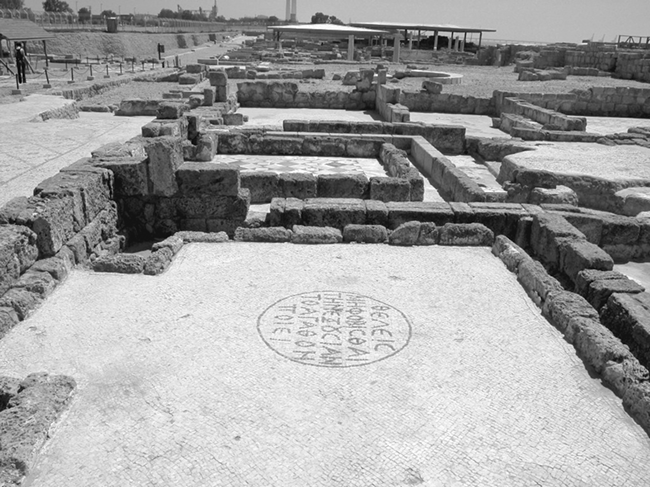
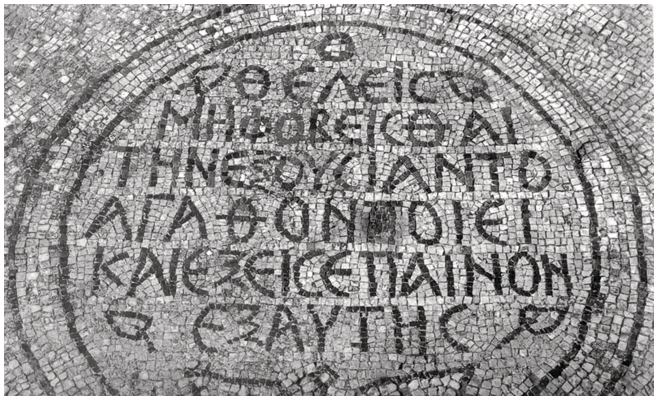

 Open access