


Ontogenesis of Prejudice
Ontogenesis is the process of change of the representations of a single individual through their life course. The main influential figures in shaping our understanding of this process are Jean Piaget, Hans Furth and Gerard Duveen. This process is a process influenced by microgenetic processes but also by the cognitive developmental level of the individual, the influence of norms of the in-group, and the changing role of relations of constraint and relations of co-operation beyond any maturational or biological factors.
Various theories exist that attempt to explain the development of prejudice in childhood (Aboud, Reference Aboud1988, Reference Aboud, Quintana and McKown2008; Nesdale, Reference Nesdale, Augoustinos and Reynolds2001, Reference Nesdale, Bennett and Sani2004; Bar-Tal & Teichman, Reference Bar-Tal and Teichman2005; Nasie et al., Reference Nasie, Reifen Tagar and Bar‐Tal2021), and they have all contributed a lot to our understanding of how prejudice develops from early childhood to adolescence. Nevertheless, the narrow focus of most of the mainstream social cognition models on the single outcome of prejudice with the exception of the rich and multilevel framework proposed by Bar-Tal (Reference Bar-Tal2023) and his colleagues in Israel fails to explore what lies beyond the tip of the iceberg in the representations of an interethnic conflict and its transformation in historical time as mentioned earlier. Additionally, there is an intricate tension between the emerging agency and developing potential of the human mind on the one hand to grasp complexity and avoid stereotypical thinking, and on the other to form a collective identity or follow group norms that puts on the developing child contrasting orientations and creates tensions and conflict between various norms, commitments and values that have not been totally understood until today. The genetic social psychological framework can contribute to capturing some of this complexity in a way that goes beyond just the measurement of prejudice indices.
Developmental Theories of Prejudice
Most prejudice development theory and research has concentrated on the childhood years (4–12 years of age) with a particular focus on the role of social-cognitive developmental (Aboud, Reference Aboud1988, Reference Aboud, Quintana and McKown2008) and motivational processes (Nesdale, Reference Nesdale, Bennett and Sani2004), but a proper synthesis of the empirical basis of these theoretical approaches has not yet taken place.
According to Doyle and Aboud (Reference Doyle and Aboud1995), who have been influenced by Piaget’s work on children’s cognitive development, feelings of prejudice and biased attitudes in children, peak at the age of five to seven years and then decline as they grew up. Aboud and Amato (Reference Aboud, Amato, Brown and Gaertner2003) claim that the emergence of cognitive abilities during the concrete operational stage, such as the cognitive ability of multiple classification skills, relates to the reduction of prejudice. In particular, past the age of seven years, the greater attribution of importance to individual traits and characteristics rather than collective ones when assessing other individuals allows children to start recognising that both in-group and out-group members can have both positive and negative traits. This more flexible way of thinking is less stereotypical, thus leading to a gradual reduction of prejudice in late childhood.
On the contrary the motivational social identity development theory (SIDT) (Nesdale, Reference Nesdale, Bennett and Sani2004, Reference Nesdale, Rutland, Nesdale and Brown2017) predicts that children before six to seven years of age usually exhibit only in-group favouritism without out-group derogation. Prejudice can emerge after this age, but its emergence depends (1) on the extent to which children identify with their social group, (2) on whether prejudice is a norm held by the members of the child’s social group, and/or (3) on whether the in-group members believe that their group is threatened in some way by members of the out-group.
A meta-analysis by Raabe and Beelmann (Reference Raabe and Beelmann2011) shed more light on the issue of the developmental trajectory of prejudice. It included 121 cross-sectional and 7 longitudinal studies from 18 different countries and examined age differences in racial, national and ethnic prejudice from childhood to late adolescence. They found that there was a significant mean-level increase in prejudiced attitudes from early to middle childhood, thus supporting Aboud’s (Reference Aboud, Quintana and McKown2008) proposition. However, this was only true for prejudice towards low-status groups. In the case of prejudice towards national out-groups and high-status groups, this was not the case. This shows that there is indeed a cognitive developmental shift around the age six to eight years that makes possible the reduction of prejudice, as suggested by Aboud, but only if the social context contains in-group norms and social representations about the inappropriateness of the marginalisation of minorities. They also found evidence of more heterogeneity in prejudiced attitudes in adolescence, suggesting that the role of the sociocultural context and environmental factors becomes more central as children grow older. More recent research supports the same conclusion (Barret & Oppenheimer, Reference Barrett and Oppenheimer2011; Miklikowska, Reference Miklikowska2017; Miklikowska, Thijs & Hjerm, Reference Miklikowska, Thijs and Hjerm2019), especially in post-conflict settings where social identity in adolescence gains a prominent role in the context of ethnic antagonisms (Bar-Tal & Teichman, Reference Bar-Tal and Teichman2005; Nasie et al., 2019; Teichman, Reference Teichman, Sharvit and Halperin2016).
Such findings can be explained by the genetic social psychology framework in that the thought of children in early childhood could be characterised as a process of agentic internalisation of social representations of various categories (first gender and then racial, ethnic, national, etc.) and meanings attached to these categories either because children obtain personal experience of coming into contact with members of these categories or because they hear or read stories about these categories. By the age of two years, children start forming representations and symbols that revolve around a figurative core of simple binary oppositions as shown in the work of Duveen for the case of gender. As both Furth and Duveen show, however, behind every binary opposition there is an asymmetry of power. Clearly the social representations of each group (ethnic, national, racial, etc.) would carry their own meanings and norms that would be expected to create varied prejudice developmental paths through social influence in microgenetic processes, and one should not expect a universal process of ontogenetic increase or decrease of prejudice. The specific trajectory of a single group will always depend on the specific socio-historical context. It is clear that militarism and nationalism are one of the ways that children do gender through commemorations and national celebrations in the school context, even starting from the kindergarten (Nasie & Bar-Tal, Reference Nasie and Bar‐Tal2020). Therefore, gender and national identities are intertwined, and patriarchy should be seen as supporting both militarism and nationalism generally and honour culture in traditional and rural societies through religion (Hadjipavlou & Mertan, Reference Hadjipavlou and Mertan2019).
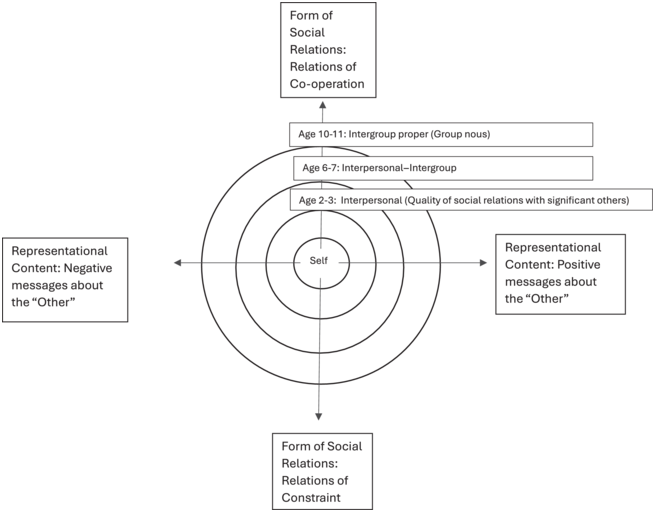
Nevertheless, what all these theoretical frameworks failed to capture is an understanding of the role of the quality of social relations in the development of prejudice as originally proposed by Piaget (Reference Piaget1932) as well as to explore more generally the representations about ‘otherness’ and historical consciousness which of course incorporates a richer set of meanings than the narrow focus on prejudice and adds historical depth to the analysis. The core question then that should be studied is the following: How do children interact with significant in-group others (parents, peers, teachers) about otherness and represent otherness itself, and how do they interact with members of various outgroups? The two axes of this proposal are represented in Figure 2.1.
The what and how axes of family and school socialisation.
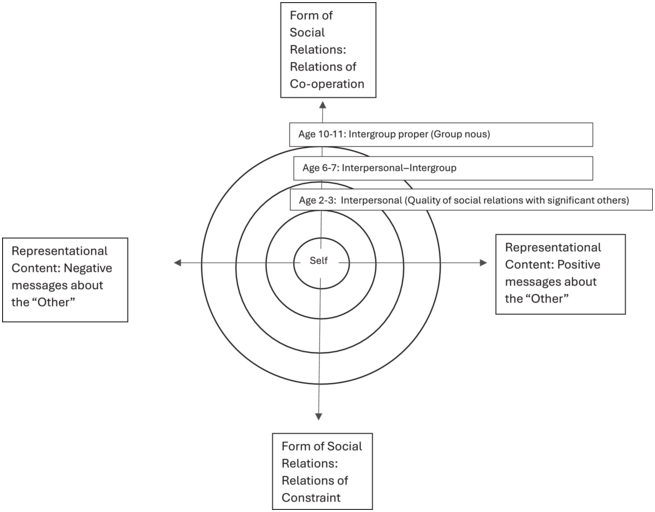
Figure 2.1 Long description
The central focus is Self, surrounded by three concentric layers denoting different developmental stages. Ages 2 to 3 categorised under Interpersonal, highlights the quality of social relations with significant others. Age 6 to 7 under Interpersonal to Intergroup, indicates the transition between personal and group-based interactions. Ages 10 to 11 under Intergroup proper, reflects Group nous. Four directional arrows from the Self point in 4 different directions. An upward arrow points to a box labelled Form of Social Relations, Relations of Cooperation, a downward arrow points to a box labelled Form of Social Relations, Relations of Constraint, a leftward arrow points to a box labelled Representational Content, Negative messages about the Other, and a rightward arrow points to a box labelled Representational Content, Positive messages about the Other.
Both processes could be seen as different facets of the process of social representing the ‘other’. Whether children often find themselves embedded in social relations of constraint or co-operation (Piaget, Reference Piaget1932) with significant others (e.g. parents, teachers) would be expected to make a difference, but changes in prejudice levels would also be expected by the content of what they discuss about otherness, mediated by such cultural artefacts as history texbooks or popular history, commemorations or other various symbolic resources that make reference to the outgroup. Even more impactful could be direct intergroup contact experiences with otherness, especially if what is usually being discussed within group with significant others carries negative overtones or in a context of geographical separation like Cyprus, which offers little opportunities for intergroup contact.
From our perspective, however, the effectiveness of intergroup contact would depend on children’s developmental level. It would be wrong, for example, to expect children in the pre-operational level who have not yet mastered part–whole relations to generalise any positive intergroup encounters from the single case to all members of the out-group. Indeed recent reviews of the role of intergroup contact in prejudice reduction in childhood points towards this limitation for young children under six to seven years of age (Aboud & Spears-Brown, Reference Aboud and Spears-Brown2013). Still, it is possible for otherness related to skin colour, which is visible from early childhood and does not necessitate an understanding of part–whole relations, to still get the beneficial effects of intergroup contact in this younger age group.
In this connection, relevant to our focus on interethnic relations and the development of social representations of the Cyprus issue in Cyprus, is the notion of sociocentrism which Piaget talks about but only once explored in any detail in his work with Weil (Piaget & Weil, Reference Piaget and Weil1951) on the ontogenesis of the idea of homeland in children. Even though Piaget’s work was written 70 years ago, it is more nuanced in capturing links between form and content than recent work and could perfectly explain the findings of a recent meta-analysis (Raabe & Beelmann, Reference Raabe and Beelmann2011), since it offers a more holistic understanding of representations than the narrow focus of prejudice reduction.
First, it helps to understand why one should not expect strong statistical relationships between intelligence and prejudice levels but only small to moderate as we would expect between intelligence and wisdom (only at about r = 0.30), as suggested by Demetriou et al. (Reference Demetriou, Liakos and Kizilyürek2021) when they propose their own historical/developmental framework of raising Mandelas by cultivating wisdom. This is because prejudice can be sustained by various and diverse forms of thinking which depends on not only cognitive ability but also in-group norms. For example, some cognitive developmental skills in older children or adolescents make possible an understanding of part–whole relationships. However, these part–whole relations should not necessarily be inclusive of all out-groups because they might selectively or strategically keep some groups out of the definition of a superordinate in-group category depending on the sociocultural or historical context. Second, Piaget’s work suggests that both cognitive structuring and the content of the representations of the group (positive or negative) can influence prejudice in childhood, and he essentially supports the idea that both prejudiced and non-prejudiced views could be sustained by in-group norms in late childhood and early adolescence. However, with every developing stage, their application would concern a wider group (or one could talk of an expanding ethical or moral horizon) that can be seen in Figure 2.1. First, there is the here and now of the egocentric child in the pre-operational stage, then the possibility of submission to family or decentration from family views and values in the concrete operational stage, and finally comes the submission or emancipation through reciprocity and decentration from wider societal views and values in the formal operational stage. The hallmark of deep and not superficial tolerant views for Piaget would be the development of reciprocity where the process of co-operative interaction and norms of mutual respect align with the positive content of representations about any ‘other’, thus forming a universalising attitude. Of course, given the emerging socialisation of various in-group norms that exclude otherness (religion, ethnic or gender related), this is rarely achieved indeed.
For example, positive norms about collaboration with in-group strangers (co-religionists) can be promoted by a powerful institution like religion, people in authority or the school without this necessitating acceptance of individuals from other religious or ethnic groups. In this sense the moral horizon does exclude specific others. However, in periods of positive political developments in a conflict transformation process the ethical horizon can be expanded by the will of powerful institutions. In our later chapter analysing the Cyprus case in the period from 2015 to 2017 we will see an example of this for bicommunal relations in Cyprus. In the case of conformity pressures towards a positive anti-discriminatory policy, the normative context of the in-group could be leading to lower expression of prejudice. From the perspective of genetic social psychology, this would not necessarily entail the reconstruction of knowledge but a superficial layer of beliefs (‘I should not sound prejudiced’) which might be enough to reduce the expression of prejudice but not the presence of prejudiced feelings (the lower right quadrant in Figure 2.1) in the mind of many individuals unless such policy shifts are accompanied by opportunities for real co-operative contact with out-group members (the upper right quadrant in Figure 2.1). Discussions between equal peers can also entail negative stereotypes about otherness. Given the increasing role of in-group peer norms in adolescence, for example, we might expect to find peer negative norms of the upper left quadrant in Figure 2.1 that might conflict with positive in-group norms at the school level represented in the lower right quadrant and lead to resistance to school positive norms. From the same perspective the lower left quadrant of Figure 2.1 is very problematic, since dominant and hierarchical institutions or authorities promote negative representations of out-groups that is usually the case in hot intergroup conflicts. Here the various forms of threats, prejudice, distrust, intergroup anxiety and lack of contact are expected at high levels, further supporting hierarchical institutions, traditional, security values and conformity largely described in the work of Bar-Tal (Reference Bar-Tal2023) as the “ethos of conflict.”
Thus, processes relating to the quality of social relations directly relate to varieties of social influence as in the genetic model of social influence in Moscovici (Reference Moscovici1976) who discussed both majority and minority influence as two different routes to social influence with distinct qualitative characteristics. Between these two processes there seems to be a third process with somewhat ambivalent characteristics, according to Moscovici (Reference Moscovici1976), which relates to processes of normalisation and norm formation as explored originally by Muzafer Sheriff in the context of small groups. As Moscovici (Reference Moscovici1991) shows in an insightful paper where he discusses the work of Sherif and Asch in the context of Sherif’s experiments, two qualitatively different reactions were observed once participants to the experiments were interviewed. There are those who, when faced with a majority, simply comply publicly, in front of others, without actually changing their internal knowledge, belief or representation of the world or reality. However, there are also those who, when faced with a majority, might actually start doubting their beliefs, knowledge or representation of the world, and in that sense it is possible that a numerical majority can also put in motion a process of deeper, real change depending on the mode of resolution of socio-cognitive conflict that will take place. This is likened by Moscovici to a process of informational influence or cognitive validation whilst the former is likened to a process of normative influence or social comparison which results in public compliance but no real internal change. From our perspective, small group settings can take both forms depending on the conversation types that evolve between subject and other in these settings and specifically whether they take the form of mutual respect (co-operation) or unilateral respect, submission or coercion (relations of constraint). Efforts to coerce can cause resistance and even reaction towards the opposite direction that the source of influence demands as we know from classic social psychological work.
The role of in-group norms in prejudice reduction in childhood has been recently explored in the context of social identity development theory (Nesdale, Reference Nesdale, Rutland, Nesdale and Brown2017), and a series of studies indicate that in-group norms in childhood have a powerful influence on the expression of prejudice by children, but these researchers have not really examined how deep the change is as a result of normative influences. Their findings indeed suggest that the influence of in-group peer norms becomes bigger in late childhood and early adolescence compared to adult in-group norms that influence children more in early childhood (Aboud & Spears-Brown, Reference Aboud and Spears-Brown2013). However, findings about in-group norms also show some interesting competing effects from group norms from smaller and larger groupings (e.g. friend’s group vs school norms) with norms of larger groups being in a better position to influence older compared to younger children. This of course brings to the picture the ‘ethical horizon’ of the group which could expand with age and greater opportunities for intergroup contact (Allport, Reference Allport1954) outside the smaller interpersonal bubble of the student.
Such an interest in the role of interpersonal social relations and part–whole relations in groups was also found in the context of western Marxism in the work of Adorno who was also largely influenced by the affective and emotive component of Freud’s work and is unique in his social developmental theorisation. He suggested that punitive and strict parenting would lead to the formation of the authoritarian personality (Adorno, 1950/Reference Adorno2019). Such parenting in Piagetian terms would be characterised by relations of constraint, as they lack the element of mutual respect and put the psychological subject in a position of passivity in relation to others (interpersonal orientation) or the group (part–whole relations). In the later work of Altemeyer (Reference Altemeyer1988, Reference Altemeyer and Zanna1998) there were indeed significant statistical relations identified between harsh parenting and prejudice levels.
More recently John Duckit (Reference Duckitt2001), following the steps of Altemeyer, made further distinctions within the idea of authoritarianism or within Piaget’s social relations of constraint: an orientation of submission, likening it with social conformity; and an orientation of domination, likening it with Machiavellian ways of thinking about weaker others. He also brings convincing empirical evidence that the first orientation is related to the development of right-wing authoritarianism (RWA) and the second with social dominance orientation (SDO) that both predict prejudice but through different paths. Interestingly, he finds that in younger adolescents the link between RWA and SDO is less strong, but as adolescents become more politically socialised in later adolescence and especially in sociocultural contexts of strong left wing–right wing differentiation, the links become stronger. A crucial distinction between RWA and SDO seems to be the level of agency involved in the two positions. Whilst RWA minimises agency through submission to authority and tradition, SDO takes agency to the opposite end in an orientation of controlling, cold and calculating manipulation and domination of others. Very interesting social developmental research by Guidetti, Carraro and Castelli (Reference Guidetti, Carraro and Castelli2017) explored the links between parental RWA and SDO and their preschoolers epistemic (preference for order in stimuli), relational (conformity to peer pressure in an Asch-like task) and existential (threat sensitivity) orientations. They found that parents’ RWA and SDO scores appeared to have opposite effects on children’s relational needs: children’s conformity increased at increasing levels of mothers’ RWA and decreased at increasing levels of fathers’ SDO. Also, higher mother RWA scores were related to greater sensitivity to threatening stimuli by the preschoolers. An interesting link with traditional or sexist representations of gender was noted by the authors, since the findings point to an influential path from an ‘anxious’ mother and a ‘domineering or calculating, powerful’ father influencing RWA and SDO correspondingly in their sample of preschoolers.
Toward a Triadic Model of Prejudice
From the clinical psychology point of view in terms of well-being, the development of agency away from a position of submission and helplessness is important. Piaget’s relations of co-operation (Piaget, Reference Piaget1932) and his principle of mutual respect are again the third way between the two extremes of submission and domination. The microgenetic processes that strengthen a RWA and SDO view are obviously asymmetrical relations of constraint (unilateral respect). This relates to forms of recognition in microgenetic processes that we have identified in previous work (Psaltis & Duveen, Reference Psaltis and Duveen2006, Reference Psaltis and Duveen2007) as the defining element of the quality of social relations. On the one hand there is instrumental recognition which downgrades the subject to an object that serves the aims of another person or institution and diminishes agency. This was seen in our conversation type of no resistance where the subject passively accepted other’s views or perspectives. On the other end of the spectrum of instrumental recognition was the non-conserving type where original non-conservers (less developmentally advanced children) dogmatically supported their own view without taking into consideration or ignoring the conflicting position of the other. But there was also the middle way of recognition as a thinking subject (Psaltis & Duveen, Reference Psaltis and Duveen2007), which is promoting the agency of the subject who is being recognised whilst at the same time recognising others as thinking subjects. In our previous work we have identified conversation types that facilitated the establishment of a social relation of co-operation as ‘explicit recognition’ which was the type of conversation that entailed mutual respect (Psaltis & Duveen, Reference Psaltis and Duveen2007) and, importantly, an intersubjectivity structure where both partners know that the others know what they know (Psaltis, Reference Psaltis2005; Duveen & Psaltis, Reference Duveen, Psaltis, Mueller, Carpendale, Budwig and Sokol2008).
Agency is also discussed by Gillespie (Reference Gillespie2012) as the development of the ability for distancing oneself from the immediate situation. Gillespie gives the example of the research subject in Milgram’s experiment that resists the directives of an authority to harm another individual as a good example of agency. In this sense resistance to authorities and group norms would be another example of the exercise of agency as also suggested by Piaget (Reference Piaget1932). But how does agency develop? Gillespie (Reference Gillespie2012) shows this process to be dependent on the process of position exchange that allows the integration of first- and third-order perspectives. Agency entails identification with another person’s pain in Milgram’s experiment and taking the perspective of others onto self as someone who is causing pain (thus the self becomes observable from another perspective), and it is this positioning that is resisted by the subject as an expression of resistance and agency. The triad of the subject–object–other depicted in Figure 2.1 is the significant structure to be studied; it is the unit of analysis of genetic social psychology. The triad should be conceptualised as both an activity structure and a configuration of expectations about who (in-group or out-group) should or is controlling the ‘object’ (property, land, power, etc.), which makes triadic expectations asymmetrical and dependent on power structures. Domestic tensions extend to regional and global through geopolitical interests of great powers.
The structure and configuration of the triad (symmetrical or asymmetrical) depend on both cognitive developmental and ideological constraints. From the cognitive developmental perspective, the triad in early childhood should be seen as undifferentiated. Subject–object and subject–other are undifferentiated before symbol formation in the child around the end of the first year of life (Furth, Reference Furth1996) (see Figure 2.1), but after this age we have the emergence of the triad through a differentiation process. The process of human development can be seen as a process of gradual differentiation and coordination of perspectives. The knowledge of the child in his or her early years is constrained by the here and now and is driven by the figurative aspects of knowing. In Piagetian terms, the representations stay at the ‘periphery’ of subject–object interaction. Any ‘prejudice’ in these years of early childhood (before six to seven years old) should be seen as the result of having heard from significant others that other groups or countries ‘are like that (usually negative trait)’ or ‘grabbed something from us’ or from visible cues of difference (gender, colour, etc.). The more hierarchical the relations between subject–other (with parents or friends), the less subject–other differentiation will be observed, which will have epistemological consequences because it will hinder the movement from the periphery to the centre of knowledge and constrain the development of agency. This will facilitate a more holistic (relational) way of thinking and less analytic (abstract/categorical) way of thinking (cf. Henrich, Reference Henrich2020). This has a parallel in the genetic model of social influence of Serge Moscovici, where he described majority influence as setting in motion a social comparison process and conformity, whereas a minority as the source of influence was setting in motion a process of cognitive validation and a conversion process in the mind of the target of influence. Hierarchical relations of constraint supported by higher religiosity in the family will also contribute to a fixation in the periphery of knowledge and less analytical thinking. Traditional and conformity values (Schwartz, Reference Schwartz2021) as well as honour and face values will be expected to form close links with religiosity that supports hierarchical representations of gender (sexist beliefs, machismo, etc.) and a more interdependent self-construal or understanding of self. The role of cultural values is key. For example, honor values (Uskul et al., Reference Uskul, Kirchner-Häusler, Vignoles, Rodriguez-Bailon, Castillo, Cross and Uchida2023) could support both positions of submission (usually women and LGBTQI+ or minorities) and domination (machismo, bravado, retaliation, overconfidence, egocentrism, sociocentrism, assimilation over accommodation). Domination would be a position more often taken by males compared to females. This would explain, for example, why SDO is often higher in males than females.
Children, before six to seven years of age have no understanding of part–whole relations, and this would be expected to have consequences for the role of intergroup contact in the generalisation effects of prejudice reduction from an individual out-grouper to the whole out-group. Even if they have positive intergroup contact from their perspective, generalisation of positive feelings from the individual to the whole group would be difficult. At this age binary distinctions of a figurative nature would work as organising principles (gender, skin colour, etc.) and would make difficult any differentiations within groups. Children in middle and late childhood between ages of 6–7 and 10–11 years (Figure 2.1) develop their cognitive capacity to a great extent, and for them subject–object–other relations become differentiated and the move from ‘periphery to centre’ starts to take place. Children master part–whole relations as well as begin to make internal differentiations between out-group members on the basis of individual or trait characteristics of persons. This stereotypical thinking can be reduced but its actual reduction depends on the prevailing in-group norms and opportunities for intergroup contact whose importance increases in this period for prejudice reduction. In this period from 6–7 to 10–11 years old the role of social relations of constraint and co-operation is also important as the ethical horizon of childhood is largely exhausted in interpersonal relationships with significant others but links between the interpersonal and the intergroup sphere are beginning to emerge with children that often find themselves in positions of submission (with both peers and adults) developing a sense of threatened identity that is also projected to feelings about out-groups. In this sense this is the period that we have the beginnings of the formation of a rudimentary consciousness of RWA and SDO (Cadamuro et al., 2021), which seems to suggest a transition that entails the broadening of horizon from the interpersonal to the intergroup in a more reflective way. In this period we also have the emergence of resistance to unfair treatment as children become reflective of equality and inequality in their interpersonal relationships (Killen, Reference Killen2018). Emerging agency and empathy (both emotional and cognitive) in this age period are key. Even biological or genetic factors known in the literature as primary psychopathy could play a role here. In Figure 2.1, for example, an egocentric, narcissistic or Machiavellian position, high on callous unemotional traits (Fanti & Lordos, Reference Fanti and Lordos2022) that lack empathy, could constrain the individual into the narrower ethical horizon in terms of out-group inclusion. But even if biological factors play no role, in-group norms relating to the attitude towards out-groups will certainly play an important role here. Such a constriction or narrowing of the ethical horizon could have various consequences for not being interested in the social and political life of their community, ending up apolitical being both indifferent and negative towards out-groups by conforming to a thin layer of negative stereotypes.
Table 2.1 thus further separates the ontogenetic outcomes depending on the triadic significant structure (the submerged part of the iceberg in our metaphor) into three enduring patterns of organisation of the thought and behaviour of the social psychological subject. A relation of constraint is further subdivided into the position on either the one or the other pole of a relation of constraint (submission vs domination), although it should be recognised that children and adults depending on the ‘other’ they have to deal with can often take either of the two positions. The structure that makes taking the one or the other end of the relation of constraint less likely is the development of relations of co-operation (mutual respect). It should also be recognised that in the case of members of minority groups, the SDO correlation structure in the middle of Table 2.1 could not actually work in the predicted direction, since legitimating inequality between groups automatically entails legitimising a structure that disfavours their in-group and self-image. An important element of the table below is values and their articulation with sociogenetic changes in historical time is key for genetic social psychology, and the table should be completed with the role of values (last column in Table 2.1), which is the topic of the next chapter.

 Open access