


1. Introduction
Our contemporary societies are deeply dependent on a multitude of infrastructures. These systems themselves tend to interact with each other in increasingly significant ways, driven by digitalization and electrification, creating interconnections and giving rise to complex systems. Thus, failure or disruption in one infrastructure can have uncontrollable cascading effects in several other sectors or systems. The most common example of such a situation is the failure of electrical infrastructure leading to a “blackout.”. Most recently, a blackout occurred in Spain and Portugal in April 2025. This outage, which lasted several hours, caused a multitude of disruptions in connected sectors (Reference MorelMorel, 2025).
In this endeavor of anticipating and protecting such critical infrastructures, a better understanding of interdependences and the mechanisms that could lead to uncontrolled escalation of failures is needed. If models and simulations can address this objective (Reference RinaldiRinaldi, 2004), the design process of these models is informed by knowledge on how to model these interdependencies. In its seminal work, Reference Rinaldi, Peerenboom and KellyRinaldi et al. (2001) introduced a foundational classification that has since been extensively adopted, distinguishing among physical interdependencies, based on the exchange of material resources; cyber interdependencies, grounded in the exchange of digital information (both often grouped under the broader notion of functional interdependencies); and geographical interdependencies, arising from spatial proximity between infrastructures. In addition, the article introduced logical interdependencies, defined as relationships that do not fit within the physical, cyber, or geographical domains. Drawing from the socio-technical nature of infrastructures (Reference Ottens, Franssen, Kroes and PoelOttens et al., 2006), logical interdependencies can be seen as indirect ones that act through human systems. Following this observation, Reference Mohebbi, Zhang, Christian Wells, Zhao, Nguyen, Li, Abdel-Mottaleb, Uddin, Lu, Wakhungu, Wu, Zhang, Tuladhar and OuMohebbi et al. (2020) by reviewing different works on interdependencies, especially social interdependencies, observed that interdependencies emerging from human interactions were still ill-understood.
These issues resonate more deeply as related research domains like community disaster studies more and more try to understand the role of CIs in relation to populations (Reference Koliou, Van De Lindt, McAllister, Ellingwood, Dillard and CutlerKoliou et al., 2020).
More recently, Reference Magoua and LiMagoua et Li (2023) in their systematic literature review on the human factor in CI modelling, distinguishes the different human factors for the different stakeholders and how they can be modelized. The present work draws from the insights provided by this article in order to investigate how previous models and simulations accounted for human related interdependencies in order to extract a comparative framework, new research directions and a set of practices to tackle these common research issues. A cross-area approach was also integrated in our study, by integrating works related to community disaster studies and economic modelling.
1.1. Critical Infrastructure interdependencies
1.1.1. Critical Infrastructure
The term Critical Infrastructure (CI) does not have a fixed, universally shared definition across the literature, resulting in a wide variety of classifications regarding which infrastructures are considered critical — from two infrastructure sectors identified by Portugal (namely, energy and transport) to sixteen defined by the United States (Reference Kumar, Pal, Santoso, Ninsawat and IslamKumar et al., 2025). To take this disparity in definitions into account, the research was examined in order to distinguish the models by exhaustiveness of critical sectors accounted for, from the perspective adopted by each set of researchers. In doing so, the rating is done on a scale from 1 to 3 corresponding to: (1) models focused on a specific interface between 2 sectors; (2) focused on a subset of sectors (between 3 and 5); (3) studies adopting what could be described as a holistic approach, aiming to encompass all CI according to the definition proposed in the respective study.
1.1.2. Interdependencies
As observed in the introduction, the seminal contribution of Reference Rinaldi, Peerenboom and KellyRinaldi et al. (2001) introduced a foundational classification of interdependencies among which logical interdependencies. This latter category has subsequently attracted particular attention in later classification efforts. As illustrated in Figure 1, while the tripartite distinction among physical, cyber, and geographical interdependencies remains largely consistent across proposals, substantial nuances emerge in the interpretation and subdivision of logical interdependencies. Following the socio-technical nature of infrastructure systems (Reference Ottens, Franssen, Kroes and PoelOttens et al., 2006), logical interdependencies can thus be interpreted as indirect relationships, mediated by human factors—social, economic, organizational, or institutional—that link otherwise distinct infrastructures. This perspective underscores the importance of explicitly incorporating the human factor into modeling efforts.
The different type of interdependencies in the literature and our suggestion for this survey (adapted from Reference Rinaldi, Peerenboom and KellyRinaldi et al. (2001), Reference ZimmermanZimmerman (2001), Reference Dudenhoeffer, Permann and ManicDudenhoeffer et al. (2006), Reference Porcellinis, Setola, Panzieri and UliviPorcellinis et al. (2008), Reference Zhang and PeetaZhang et Peeta (2011), Reference Mohebbi, Zhang, Christian Wells, Zhao, Nguyen, Li, Abdel-Mottaleb, Uddin, Lu, Wakhungu, Wu, Zhang, Tuladhar and OuMohebbi et al. (2020))

In the context of this study, a simplified classification framework was adopted to systematically examine how logical interdependencies are represented across different models and to facilitate comparison of the types of interdependencies they incorporate. Thus, closely related type of interdependencies were regrouped — social, cultural, societal norms and policy and procedural interdependencies were grouped under the societal term. It resulted in the following classification: physically ; cyber (they will also be referred as functional when physical and cyber interdependencies are not clearly differentiated); geographic ; societal relates to CI linked by both their use/perception influenced by social, cultural perceptions and societal norms but also by policy and procedural mechanism; economic relates to CI linked through a value (typically monetary) based mechanisms.
2. Method
2.1. Search method
Models and simulations were searched following a systematic approach. Web of Science and SCOPUS databases were searched for English research articles (both conference and journal). The search terms used were:
“infrastructure” AND “model*” AND (“comput*” OR “simulat*” OR “tool”) AND (“critical” OR “economi*” OR “communit*”) AND “interdependen*” AND (“human” OR “social” OR “socio*” OR “demograph*” OR “societal”).
The search resulted in 244 papers, 177 after eliminating duplicates. After reading the articles, only works that followed the following criteria where included (1) the paper must present and discuss a simulation model including the temporal dimension (2) economic and/or societal interdependencies are accounted; and (3) the model isn’t limited to only one CI sector. When multiple papers discussed and presented the same model or an updated version, only the most up to date was retained. The process resulted in a list of 19 analytical computable models.
2.2. Classification and scoring method
The works are classified based on the approach used, following the classification proposed by Reference OuyangOuyang (2014). Supplementary technics were also identified. A rating system was used to semi-quantitatively compare the exhaustiveness and modelling effort of the works with each other.
The exhaustiveness is measured based on the desired scope of sectors (see section 2.1.1); by number of type of interdependences modelized (see section 2.1.2) and by the accounting or not of the human factor.
For the latter, the classification used by Reference Magoua and LiMagoua et Li (2023) was adopted, it differentiates 3 groups of stakeholders relevant to CIs: system operators — include frontline personnel responsible for maintaining infrastructure functionality, such as technicians, medical personnel, and emergency responders —, system users — include the majority of the population as clients —, and decision makers — include system managers, policy-makers, and risk mitigation agencies responsible for strategic planning and resource allocation during disruption and recovery phases. The human factor accounting for each group is evaluated using the following criteria:
-
a) No human factor accounting, the model doesn’t consider the stakeholders;
-
b) Static and undifferentiated human factor accounting, the model considers the stakeholders but their behavior is static over time and undifferentiated between groups;
-
c) Social based human factor accounting, the model considers the behavior of different groups, often based on census data; and
-
d) Dynamic based human factor accounting, the behaviors are dynamically modelized as resulting from experience and can be individualized.
Each model were then ranked on a scale from 0 to 3 the modelling level of the human factor for each group of stakeholders following: (0) no accounting for the human factor of the stakeholder; (1) static accounting; (2) either differentiated or dynamic; (3) both differentiated and dynamic.
The different ratings listed are then averaged into an exhaustiveness score. A qualitative estimate rating from 1 to 3 referring to the quantity of input data used to develop the model was also included (3 being a very important quantity of data processed). The data issue is notably pointed out by Reference OuyangOuyang (2014) as quality data is needed in order “to provide a detailed description and modelling of interdependent CISs”. This indicator serves as a proxy for modelling effort to put into perspective the exhaustiveness score.
3. Results
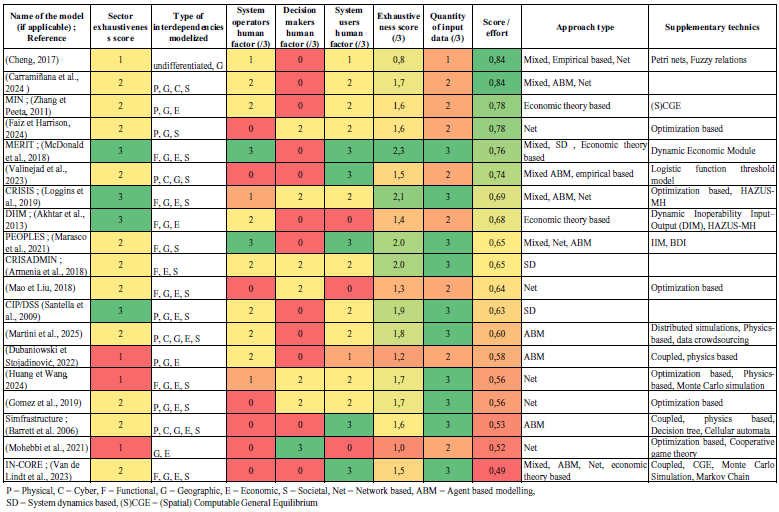
See Table 1 below for the list and description of the models & simulations studied and rating results.
Models classification

Overall, the behavior of decision-makers is the least frequently accounted-for dimension, being explicitly modeled in only 7 out of the 19 reviewed frameworks. The work by Reference Mohebbi, Barnett and AslaniMohebbi et al. (2021) is the only one scoring 3 out of 3 in this category, using a cooperative game theory approach. The behavior of system operators is represented in 11 of the 19 models. The behavior of system users is the most extensively represented dimension, appearing in 15 of the 19 models. Among these, 5 explicitly account for both the dynamic and social nature of user behavior (Reference Barrett, Eubank and MaratheBarrett et al., 2006; Reference Marasco, Cardoni, Zamani Noori, Kammouh, Domaneschi and CimellaroMarasco et al., 2021; Reference McDonald, Smith, Kim, Brown, Buxton and SevilleMcDonald et al., 2018; Reference Valinejad, Guo, Cho and ChenValinejad et al., 2023; Reference van de Lindt, Ellingwood, Kruse, Cox, Lee and McAllistervan de Lindt et al., 2022). MERIT (Reference McDonald, Smith, Kim, Brown, Buxton and SevilleMcDonald et al., 2018) and PEOPLES (Reference Marasco, Cardoni, Zamani Noori, Kammouh, Domaneschi and CimellaroMarasco et al., 2021) are the only models having the maximum score for both system users and operators. Only the model proposed by Reference ChengCheng (2017) did not explicitly account for the behavior of either group. As this work provides an efficient way to qualify interdependencies through an empirical data-based and abstract approach, it highlights the limitations of our rating method.
The average exhaustiveness score is 1.5 out of 3, with the five best-ranking models being MERIT (Reference McDonald, Smith, Kim, Brown, Buxton and SevilleMcDonald et al., 2018) at 2.3, CRISIS (Reference Loggins, Little, Mitchell, Sharkey and WallaceLoggins et al., 2019) at 2.1, PEOPLES (Reference Marasco, Cardoni, Zamani Noori, Kammouh, Domaneschi and CimellaroMarasco et al., 2021) at 2.0, CRISADMIN (Reference Armenia, Tsaples and CarliniArmenia et al., 2018) at 2.0, and CIP/DSS (Reference Santella, Steinberg and ParksSantella et al., 2009) at 1.9. Notably, three of them are SD-based and three use a mixed approach (MERIT being a mixed SD- and economic theory-based model). Notably, only the two models, Simfrastructure (Reference Barrett, Eubank and MaratheBarrett et al., 2006) and the one proposed by Reference Martini, Boigk, Catal, Dietze, Gerold, Lukau, Monteforte, Neuhäuser, Peitzsch, Phung, Pfennigschmidt, Simon, Vetter, Winter, Adams, Finger and RosinMartini et al. (2025) explicitly capture all five types of interdependencies. The models are based on a detailed “virtual city” built from census-based synthetic populations, in which sector-specific infrastructure modules are coupled through a central population mobility component based on cellular automata.
However, because of the large amount of input data used to develop each of these five models, which suggests greater modeling effort (CIP/DSS was developed through a joint effort by three national labs over several years), they do not perform as well when the ratio between the exhaustiveness score and the quantity-of-data-used score is calculated. In this category, the three best-performing models are those proposed by Reference Carramiñana, Bernardos, Besada and CasarCarramiñana et al. (2024), Reference Zhang and PeetaZhang and Peeta (2011), and Reference ChengCheng (2017). However, it should be noted that each of them represents only a limited subset of CI sectors. Again, only the model proposed by Reference ChengCheng (2017) had a quantity-of-data-used score of 1 out of 3, showing that this approach requires less setup effort and is easier for an individual to develop.
4. Discussion
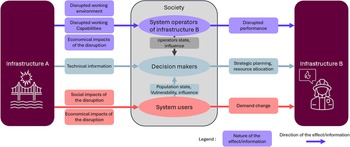
Using the typology of CI stakeholder’s provided by Reference Magoua and LiMagoua et Li (2023), logical interdependencies can be studied through each of these groups and more specifically how an infrastructure affects a particular group and then how this group affects another infrastructure (Figure 2). How the different models tackle each information/effect flow and provide frameworks, methods, knowledge that can be used in or inspire future modeling efforts, but also limitations and potential future research directions is discussed.
Logical interdependence Valinemechanisms through different stakeholders

Figure 2 Long description
A diagram of the interdependence mechanisms through different stakeholders. The diagram represents the process of how disruptions in one infrastructure can affect other infrastructures and society. It includes Infrastructure A, Society, and Infrastructure B. Infrastructure A shows a disrupted environment leading to disrupted working capabilities and economical impacts. These disruptions affect system operators of infrastructure B, decision makers, and system users within society. System operators influence the state and performance of infrastructure B. Decision makers receive technical information and influence strategic planning and resource allocation. System users experience social and economical impacts, leading to demand changes. Arrows indicate the direction of effects and information flow between these components.
4.1. Interdependencies through the decision making process
With the exception of CRISADMIN (Reference Armenia, Tsaples and CarliniArmenia et al., 2018), all seven models that represented the behavior of decision makers rely on optimization-based approaches to reproduce the decision making process (Reference Faiz and HarrisonFaiz & Harrison, 2024; Reference Gomez, González, Baroud and Bedoya-MottaGomez et al., 2019; Reference Huang and WangHuang & Wang, 2024; Reference Loggins, Little, Mitchell, Sharkey and WallaceLoggins et al., 2019; Reference Mao and LiuMao & Liu, 2024; Reference Mohebbi, Barnett and AslaniMohebbi et al., 2021). These approaches are grounded in the hypothesis of rational actors seeking to maximize a predefined objective function—typically minimizing recovery time, economic loss, or service disruption. In these models, resource allocation during the recovery process constitutes a central mechanism through which indirect interdependencies between CIs emerge. Indeed, the prioritization of one infrastructure over another by decision makers can reshape recovery trajectories.
Situational information is needed to inform the decision-making process, thus, the kind of information available can greatly impact the output decision. Decision makers need precise technical information, which can be obtained directly from infrastructures or from crowdsourcing (Reference Martini, Boigk, Catal, Dietze, Gerold, Lukau, Monteforte, Neuhäuser, Peitzsch, Phung, Pfennigschmidt, Simon, Vetter, Winter, Adams, Finger and RosinMartini et al., 2025). The several optimization models based on network theory (Reference Faiz and HarrisonFaiz & Harrison, 2024; Reference Gomez, González, Baroud and Bedoya-MottaGomez et al., 2019; Reference Huang and WangX. Huang & Wang, 2024; Reference Loggins, Little, Mitchell, Sharkey and WallaceLoggins et al., 2019; Reference Mao and LiuMao & Liu, 2024) also account for socioeconomic factors like population state or vulnerability. For example, Reference Faiz and HarrisonFaiz and Harrison (2024) developed a framework to identify optimal mitigation and recovery actions highlighting the number of dislocated households as a key metric and reinforcing the role of residential buildings as a critical interface between people and the built environment.
However, as emphasized by Reference Mohebbi, Barnett and AslaniMohebbi et al. (2021), large-scale optimization problems can be computationally intensive and therefore difficult to manage for a limited number of centralized human decision makers operating under time pressure and incomplete information. To address these limitations, the authors proposed a collaborative game-theoretic framework capable of capturing strategic interactions among heterogeneous actors under imperfect information. By explicitly differentiating categories of decision makers and accounting for information asymmetrical and conflicting objectives, this model is the only one in the sample to achieve the maximum evaluation score (3 out of 3) for decision-maker representation.
From the above observations, 2 limitations can be seen. Firstly, Reference Valinejad, Guo, Cho and ChenValinejad et al. (2023) demonstrate how the diffusion of misinformation can alter public perception, creating discrepancies between objective system states and perceived risk levels. Such discrepancies may generate misaligned and disproportionate influence on decision makers, potentially leading to biased or suboptimal resource allocation. Secondly, most models continue to assume fully rational behavior. Future modeling efforts should more systematically investigate bounded rationality, cognitive biases, political constraints, emotionally driven decisions, especially under crisis conditions where uncertainty and stress significantly affect judgment in order to reproduce real life decision makers behavior.
4.2. Interdependencies through system operators
Reference Loggins, Little, Mitchell, Sharkey and WallaceLoggins et al. (2019) highlight that certain infrastructures—often referred to as social infrastructure—cannot be treated analogously to purely civil or technical infrastructures such as power grids or water systems. Social infrastructures are characterized by a more prominent and active role of human agents, such as doctors in hospitals or firefighters in emergency response systems. Consequently, the functionality of these infrastructures is more directly dependent on human performance and availability. Following the work of Reference Magoua and LiMagoua et Li (2023), influencing factors can be either individual or situational.
4.2.1. Individual factors: disrupted working capabilities
Models, including CIP/DSS (Reference Santella, Steinberg and ParksSantella et al., 2009), CRISADMIN (Reference Armenia, Tsaples and CarliniArmenia et al., 2018), explicitly account for factors affecting operators’ capacity to perform their duties. Health-related impacts are particularly salient during epidemic outbreaks, where healthcare practitioners (e.g., doctors and nurses) may themselves become ill, reducing operational capacity at the very moment when demand peaks. System dynamics methods are well suited to represent this kind of causal mechanism.
4.2.2. Situational factors: disrupted working environment
Several models (Reference Marasco, Cardoni, Zamani Noori, Kammouh, Domaneschi and CimellaroMarasco et al., 2021; Reference Martini, Boigk, Catal, Dietze, Gerold, Lukau, Monteforte, Neuhäuser, Peitzsch, Phung, Pfennigschmidt, Simon, Vetter, Winter, Adams, Finger and RosinMartini et al., 2025) emphasize that operators’ working environments can themselves be disrupted. For example, following a seismic event, ambulance crews may face severe mobility constraints due to debris-blocked roads, directly reducing service effectiveness.
4.2.3. Economical impact on system operators
Not based on behavioral factors but from an economic perspective, the disruption on an infrastructure can have important economic impacts on system operators, it is particularly represented using the DIIM method by Reference Akhtar and SantosAkhtar et Santos (2013). Reference Zhang and PeetaZhang et Peeta (2011) as well as Reference McDonald, Smith, Kim, Brown, Buxton and SevilleMcDonald et al. (2018) investigate substitutability among different forms of capital—physical, human, and social. In particular, the Dynamic Economic Model (DEM) incorporates the concept of social capital, recognizing that informal networks, trust, and cooperation can partially compensate for degraded physical infrastructure. However both works provide little insights in such phenomenon.
4.2.4. Other: dependency links between system operators and decision makers
Similarly to the state of the population affects decision making, a link between system operators and decision makers can also be formulated. This link can represent how system operators provide knowledge and information on their system for example. The quality of this information flow has an important effect on decision making. This phenomenon could be represented using game theory, similarly to the method developed by Reference Mohebbi, Barnett and AslaniMohebbi et al. (2021). The case for a link the other way around as a decision affects system operators can also be made. For example, in crisis situations like natural disasters, the military is put to contribution to support other infrastructure with supplementary workforce. Here, politics choose to use a specific workforce for another purpose as their intended function.
4.3. Interdependencies through system users
From the perspective of CIs, system users influence infrastructure performance primarily through variations in demand. During emergency situations, demand for specific goods or services can fluctuate dramatically due to multiple factors, including:
-
• Health conditions, e.g.: increased medical demand, as in CIP/DSS (Reference Santella, Steinberg and ParksSantella et al., 2009),
-
• Population dislocation following disasters (Reference van de Lindt, Ellingwood, Kruse, Cox, Lee and McAllistervan de Lindt et al., 2022),
-
• Economic disruptions (Reference McDonald, Smith, Kim, Brown, Buxton and SevilleMcDonald et al., 2018; Reference Zhang and PeetaZhang & Peeta, 2011).
These demand surges or contractions can exacerbate stress on already weakened infrastructures, creating feedback loops between societal conditions and technical systems. These phenomena were accounted indirectly by Reference ChengCheng (2017), who proposed a network model that combines empirical evidence from past disasters with expert knowledge to characterize infrastructure interdependencies, abstracting them as weighted, directed links to reduce modeling complexity.
4.3.1. Societal Impacts of infrastructure disruption
From the users’ perspective, disruptions to CIs generate heterogeneous societal impacts depending on the type of service provided and the vulnerability profile of the affected population. Reference Huang and WangHuang and Wang (2024) propose an innovative approach based on the hierarchy of needs formulated by Abraham Maslow to weight the relative importance of infrastructure services according to their role in fulfilling fundamental human needs.
Assessing societal impact also requires a detailed representation of population vulnerability. Census data have been widely employed for this purpose (Reference Barrett, Eubank and MaratheBarrett et al., 2006; Reference Faiz and HarrisonFaiz & Harrison, 2024; Reference Gomez, González, Baroud and Bedoya-MottaGomez et al., 2019; Reference Huang and WangHuang & Wang, 2024; Reference McDonald, Smith, Kim, Brown, Buxton and SevilleMcDonald et al., 2018; Reference van de Lindt, Ellingwood, Kruse, Cox, Lee and McAllistervan de Lindt et al., 2022). Notably, Simfrastructure (Reference Barrett, Eubank and MaratheBarrett et al., 2006) and IN-CORE (Reference van de Lindt, Ellingwood, Kruse, Cox, Lee and McAllistervan de Lindt et al., 2022) introduced methods for generating synthetic populations derived from census data, enabling more granular modeling of demographic heterogeneity and social vulnerability. Both models also use a specific method to account for the dynamic nature of individuals behavior, respectively decision tree to represent the decision process and Markov chains to account for the dislocation process of populations.
4.3.2. Economical impact on system users
On key economical mechanism in economical interdependencies in emergency and shortage situations is product and service substitutability. As noted by Reference McDonald, Smith, Kim, Brown, Buxton and SevilleMcDonald et al. (2018), substitutability is commonly modeled as the capacity to replace a good produced locally with an equivalent good produced abroad, thereby maintaining supply through trade adjustments or as functional equivalence between different goods or even the adaptive transformation of available resources to fulfill the function of a scarce product. In crisis contexts, consumers and organizations may shift demand toward alternative goods that provide similar services or repurpose existing materials to compensate for shortages. A salient example is observed during the COVID-19 pandemic, when the sudden surge in demand for medical-grade masks led to severe supply shortages. In response, populations rapidly adopted substitute solutions, including the production of homemade masks using common fabrics and clothing materials (Reference Deng, Sun, Yao, Subramanian, Ling, Wang, Chopra, Xu, Wang, Chen, Wang, Amancio, Pramana, Ye and WangDeng et al., 2022). This form of adaptive substitutability illustrates the dynamic and decentralized capacity of societies to reorganize consumption patterns under constraints, thereby partially alleviating supply pressures and enhancing short-term resilience. Similarly to substitutability among different forms of capital (as discussed earlier) only the CGE methods proposed by Reference McDonald, Smith, Kim, Brown, Buxton and SevilleMcDonald et al. (2018) and Reference Zhang and PeetaZhang et Peeta (2011) investigate this mechanism but provide insufficient insights.
5. Conclusion and future research directions
Over the past two decades, a wide range of models & simulations has been developed to study CI and especially interdependence in emergency situations. Building upon earlier surveys, this paper contributes to the literature by focusing on what Reference Rinaldi, Peerenboom and KellyRinaldi et al. (2001) introduced as “logical interdependencies”. By seeing them as economic and societal interdependencies that are indissociable to the human factor, this review adopted a cross-disciplinary perspective that reviewed critical infrastructure (CI) models & simulations but also drawn from community disaster research and economic modeling. The reviewed models were semi-quantitatively ranked according to three criteria: their overall exhaustiveness in representing interdependencies, the depth of behavioral modeling for system users, decision makers, and system operators, and their data requirements. Such rankings are inherently imperfect and may introduce partial biases; therefore, the results should be interpreted with caution and complemented by a critical reading of the semi-quantitative analysis. In parallel, a qualitative comparison was conducted to identify prevailing model design practices, recurring challenges, and emerging research directions.
The review highlights the diversity of methodological approaches used to incorporate the human factor. System dynamics–based and economic theory–based models can, by construction, account for aggregate behavioral feedbacks and adaptive mechanisms. In contrast, agent-based and network-based approaches, particularly when combined with techniques such as Belief–Desire–Intention architectures or game-theoretic formulations, enable a more explicit and heterogeneous representation of individual actors and their interactions. The integration of real-world data—derived from census databases, economic statistics, social studies, or crowdsourced information—emerges as a key enabler for calibrating and validating social and behavioral components. Nevertheless, capturing the full complexity of socio-technical systems requires substantial data inputs and modeling effort. While abstraction strategies and the use of open data resources can mitigate this burden, achieving both exhaustiveness and tractability remains a central trade-off.
Several research directions emerge from this synthesis. First, future models should more explicitly represent the interactions among different stakeholder groups, which could make the case for more complex indirect interdependencies, rather than in isolation. Second, further investigation of substitution mechanisms—for capital, products, and services—is needed to better capture adaptive capacities during disruption and recovery. Third, there is a need to experiment with more recent and empirically grounded behavioral theories, as classical frameworks such as BDI were already considered aged decades ago (Reference Georgeff, Pell, Pollack, Tambe, Wooldridge, Müller, Rao and SinghGeorgeff et al., 1999). In addition, greater attention should be paid to irrational decision-making, cognitive biases, and disinformation dynamics, which can create discrepancies between actual and perceived system states, erode trust among actors, and ultimately degrade collective performance. These aspects are closely related to the concept of social capital, which has been shown to play a critical role in post-disaster recovery processes (Reference Aldrich and MeyerAldrich & Meyer, 2015). Incorporating such dimensions into CI modeling frameworks represents a promising avenue for advancing the realism and policy relevance of resilience assessments.
This review contributes to laying the scientific foundations for the author’s future works which will be focused on developing a simulation for studying societal interdependencies based on an empirical approach, to better identify and quantify interdependence mechanism using human behavior modelling methods. A specific subset of CI sectors will be used as a starting point, using real world data in order to assess its relevance and scalability in terms of sectors and type of interdependencies.
Acknowledgement
This research was partially sponsored by AID (Agence de l’Innovation de Défense).


 Open access

