





Impact statement
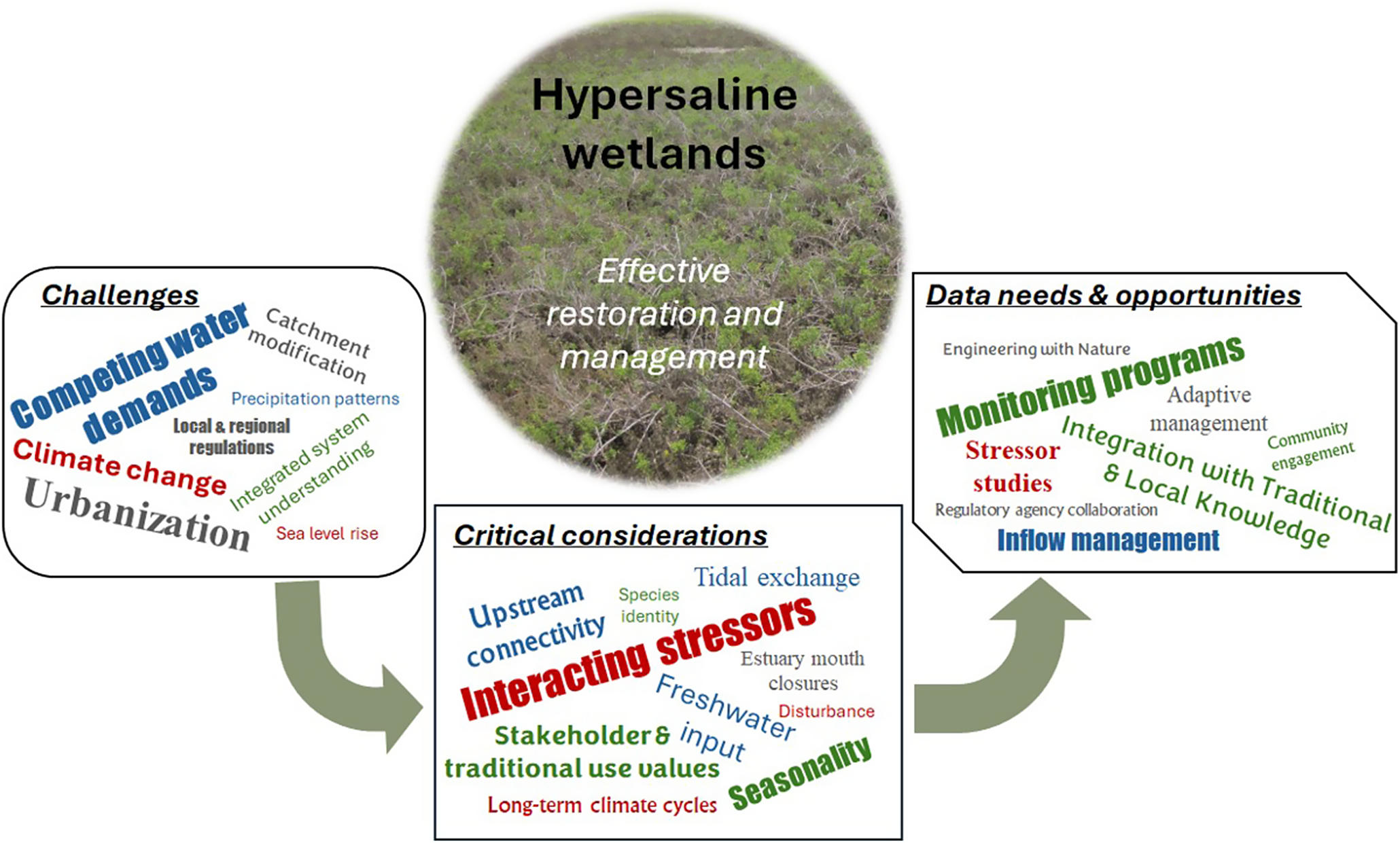
Restoration of coastal wetlands in the Anthropocene must balance considerations of ecology, economy, and Indigenous rights. These complex and interactive needs require adaptive management in the context of a changing climate, as the effects of sea level rise and shifting precipitation patterns compound with the consequences of land use/land cover change and anthropogenic freshwater demands. Globally, many coastal wetlands are experiencing hypersalinity stress linked to freshwater diversion or drought conditions. These hypersaline wetlands, including those in arid and semi-arid regions, are especially vulnerable to loss and degradation, as increasing coastal urbanization and climate change are rapidly exacerbating freshwater supply stressors. These wetlands present unique management challenges, necessitating the development of novel restoration approaches and success metrics. This article describes restoration successes, challenges, and lessons learned in these habitats, and lays a foundation for developing new, forward-looking restoration strategies that connect the values and needs of human and ecological communities.
Introduction
Restoration of coastal wetlands in the Anthropocene must account for climate change, where sea-level rise, shifting precipitation patterns and modification of climatic and weather phenomena (e.g., El Niño-Southern Oscillation, cyclones) compound with the consequences of land use/land cover change and anthropogenic freshwater demands. Globally, many coastal wetlands face limited freshwater supply due to drought, flow impoundments by overgrowth of invasive plant species, low precipitation, freshwater diversion and/or groundwater extraction, leading to hypersaline (exceeding seawater salinity, typically above 40 ppt) conditions (Bornman et al., Reference Bornman, Adams and Bate2002; Le Maitre et al., Reference Le Maitre, Forsyth, Dzikiti and Gush2016; Lovelock et al., Reference Lovelock, Feller, Reef, Hickey and Ball2017; Adame et al., Reference Adame, Reef, Santini, Najera, Turschwell, Hayes, Masque and Lovelock2021; Duke et al., Reference Duke, Mackenzie, Canning, Hutley, Bourke, Kovacs, Cormier, Staben, Lymburner and Ai2022; Tran et al., Reference Tran, Tsujimura, Pham, Nguyen, Ho, Le Vo, Ha, Dang, Van Binh and Doan2022). Contemporary definitions of anthropogenic droughts in human-water systems acknowledge the complex interplay of meteorological, geomorphological, hydrological, and anthropogenic drivers (AghaKouchak et al., Reference AghaKouchak, Mirchi, Madani, Di Baldassarre, Nazemi, Alborzi, Anjileli, Azarderakhsh, Chiang, Hassanzadeh, Huning, Mallakpour, Martinez, Mazdiyasni, Moftakhari, Norouzi, Sadegh, Sadeqi, Van Loon and Wanders2021), where the over-extraction of water can increase the likelihood of drought, irrespective of climatic drivers (Mosley, Reference Mosley2015).
Wetlands in hypersaline settings are typically within coastal estuaries and lagoons that can be intermittently open or closed and may range in vegetation composition and structure from those void of vascular plants (e.g., salt flats or mud flats), to herbaceous or succulent groundcovers, to hypersaline mangrove scrub or short forest. Wetlands in hypersaline environments are especially vulnerable to loss and degradation, as increasing coastal urbanization and climate change rapidly exacerbate freshwater supply stressors (Short et al., Reference Short, Kosten, Morgan, Malone and Moore2016; Geedicke et al., Reference Geedicke, Oldeland and Leishman2018), often with critical consequences for foundation species like mangroves or oysters, for ecosystem engineers such as bioturbating organisms (Miller et al., Reference Miller, La Peyre and La Peyre2017; Lam-Gordillo et al., Reference Lam-Gordillo, Mosley, Simpson, Welsh and Dittmann2022), or for the conservation of estuarine-dependent fauna (Komoroske et al., Reference Komoroske, Jeffries, Connon, Dexter, Hasenbein, Verhille and Fangue2016; Tweedley et al., Reference Tweedley, Dittmann, Whitfield, Withers, Hoeksema and Potter2019; Brookes et al., Reference Brookes, Huang, Zhai, Gibbs, Ye, Aldridge, Busch and Hipsey2022). Wetlands experiencing acute drought, reduced freshwater inputs, or persistent aridity resulting in hypersalinity pose unique management challenges relative to mesohaline or polyhaline wetlands (with salinity at or below 30 ppt). For example, restoration in hypersaline wetlands may require the use of slower growing, salt tolerant species with lower transplant success rates, potentially delaying ecosystem recovery (Zedler et al., Reference Zedler, Morzaria-Luna and Ward2003). Thus, hypersaline wetlands require unique restoration perspectives and potentially complex, multifactorial approaches. Given the substantial economic value of the ecological functions of these systems (Davidson et al., Reference Davidson, Van Dam, Finlayson and McInnes2019), and the cost- and labor-intensive efforts to maintain and restore those functions (Wang et al., Reference Wang, Li, Lin and Ma2022), effective outcomes will require consideration of the complex local and regional dynamics that are unique to hypersaline ecosystems. This article considers the challenges facing the restoration and management of these systems, outlines areas needing additional research and integration into practice, and identifies potential paths forward for the future restoration of coastal wetlands subject to hypersalinity.
Estuarine dynamics
Coastal wetlands occupy a range of geomorphological and climatic settings that influence their form and may periodically create hypersaline conditions. Along high wave energy and/or low precipitation coastlines, intermittent estuaries (also called temporarily closed estuaries) can form in association with sand bars or berms that restrict tidal influence, cutoff low water areas, or perched impoundments (Stein et al., Reference Stein, Gee, Adams, Irving and Van Niekerk2021). In some settings, these systems experience low or zero inflow outside of seasonal rainstorms; these low flow and low volume conditions can hover near salinity tolerance thresholds of resident biota. Restoration of these often small, seasonally variable systems is closely linked to watershed inputs, making them highly sensitive to changes in inflow, sediment, nutrients, and other contaminants. Reestablishing dynamic estuary entrances, such as seasonal mouth openings and closures, can improve salinity regimes, enhance intertidal vegetation recovery, and subsequently improve shoreline stability by mitigating erosion, attenuating waves, and supporting biodiversity (Bilkovic et al., Reference Bilkovic, Mitchell, Mason and Duhring2016).
Robust baseline data obtained from comprehensive monitoring programs is essential for effective management, especially in low flow and low volume systems (Adams and Van Niekerk, Reference Adams and Van Niekerk2020; Stein et al., Reference Stein, Gee, Adams, Irving and Van Niekerk2021). A universal challenge is determining appropriate management targets that inform decisions, including management of mouth openings. As in many types of coastal ecosystems, this challenge is difficult because ecological states often shift seasonally (Stein et al., Reference Stein, Gee, Adams, Irving and Van Niekerk2021), driven by fluctuations in hydrological, climatic, and marine processes. This seasonality affects water flow, sediment deposition, salinity gradients and species distributions, making it difficult to establish clear reference targets for all expected seasonal states (Little et al., Reference Little, Spencer, Schuttelaars, Millward and Elliott2017; Mosley et al., Reference Mosley, Ye, Shepherd, Hemming, Fitzpatrick, Mosley, Ye, Shepherd, Hemming and Fitzpatrick2018).
Freshwater inflow
Freshwater inflow to coastal wetlands and estuaries is key to maintaining system health and productivity, particularly in arid and semi-arid regions. Rising demand in freshwater abstraction to support growing human populations directly contributes to the salinization and desiccation of coastal wetlands. Scarcity of freshwater can lead to hypersalinization (due to high evaporation; Tweedley et al., Reference Tweedley, Dittmann, Whitfield, Withers, Hoeksema and Potter2019) or marinization (extended intrusion of seawater into an estuary; Pasquaud et al., Reference Pasquaud, Béguer, Larsen, Chaalali, Cabral and Lobry2012). Additionally, urbanization can lead to reduced seasonal freshwater input while also generating perennial “urban drool,” where contaminated freshwater runoff trickles into ephemeral streams during the dry season (White and Greer, Reference White and Greer2006; Pilone et al., Reference Pilone, Garcia-Chevesich and McCray2021). Altered freshwater inflow influences estuary mouth states, changes water residence times, and triggers extreme shifts in salinity regimes with consequential biological degradation of mudflats, salt marshes, and mangroves (Zampatti et al., Reference Zampatti, Bice and Jennings2010; Dittmann et al., Reference Dittmann, Baring, Baggalley, Cantin, Earl, Gannon, Keuning, Mayo, Navong, Nelson, Noble and Ramsdale2015).
Anthropogenic freshwater demands often co-occur with climate change-induced increases in drought frequency and intensity, especially in the wet-dry tropics where coastal estuaries may experience low inflow during the dry season, leading to periodic hypersalinity in the upper intertidal zone. When the wet season is reduced or fails, as can occur with oceanic and climatic perturbations (e.g., El Niño-Southern Oscillation events), the impacts on coastal wetland function can be profound and may cause dieback (including plant mortality in severe instances), especially in mangrove-dominated systems (Duke et al., Reference Duke, Kovacs, Griffiths, Preece, Hill, Van Oosterzee, Mackenzie, Morning and Burrows2017; Lucas et al., Reference Lucas, Finlayson, Bartolo, Rogers, Mitchell, Woodroffe, Asbridge and Ens2017; Otero et al., Reference Otero, Mendez, Nobrega, Ferreira, Santiso-Taboada, Melendez and Macias2017). In these circumstances, restoration of wetland condition may only be successful when prevailing salinity conditions have returned to a normal state after the perturbation event subsides (Asbridge et al., Reference Asbridge, Bartolo, Finlayson, Lucas, Rogers and Woodroffe2019).
Wetlands in arid systems are already near their tolerance limits in terms of freshwater inputs (Bertness et al., Reference Bertness, Gough and Shumway1992; Howard and Mendelssohn, Reference Howard and Mendelssohn1999; Watson and Byrne, Reference Watson and Byrne2009; Adame et al., Reference Adame, Reef, Santini, Najera, Turschwell, Hayes, Masque and Lovelock2021). Therefore, restoring connectivity between freshwater sources and downstream estuaries is key for mitigating the potentially antagonistic effects of anthropogenic freshwater demands and climate drivers, thus enhancing ecological and societal benefits (Arthington et al., Reference Arthington, Kennen, Stein and Webb2018b; Adams et al., Reference Adams, Taljaard and Van Niekerk2023). However, effective outcomes will require consideration of local and regional dynamics of changing water, sediment, and nutrient inputs from the watershed (Mosley et al., Reference Mosley, Priestley, Brookes, Dittmann, Farkas, Farrell, Ferguson, Gibbs, Hipsey, Huang, Lam-Gordillo, Simpson, Tyler, Waycott and Welsh2023). Adaptive management of hydrological infrastructure may include removing in-stream barriers (e.g., weirs, flood gates) and flood controls on coastal floodplains (e.g., bund walls, levees) to recreate natural flow and connectivity conditions (Webster, Reference Webster2010; Chilton et al., Reference Chilton, Hamilton, Nagelkerken, Cook, Hipsey, Reid, Sheaves, Waltham and Brookes2021). Future restoration efforts will also need to address past overallocation and illegal catchment and abstraction activities. Such management actions must consider future climate projections to ensure restoration is sustainable in a changing socioecological framework. In some countries, legal mandates require Environmental Flow (E-Flow) allocation to estuaries and associated wetlands. E-flows describe the volume, timing and duration of flows (the hydrological regime) required to sustain the components, processes and services of estuarine and freshwater ecosystems (Arthington et al., Reference Arthington, Kennen, Stein and Webb2018b). These E-Flows safeguard estuarine health and their multiple ecosystem services to society (Arthington et al., Reference Arthington, Bhaduri, Bunn, Jackson, Tharme, Tickner, Young, Acreman, Baker, Capon, Horne, Kendy, McClain, Poff, Richter and Ward2018a; Adams and Van Niekerk, Reference Adams and Van Niekerk2020). Planning and implementation of E-Flow restoration resides with catchment (or watershed) management authorities and should use an adaptive management approach that includes scenario planning, ecological monitoring, and consultation with advisory panels comprised of scientists, stakeholders, and regional Indigenous groups (Rumbelow, Reference Rumbelow, L, Q, S, S and R2018). In hypersaline wetlands, however, monitoring, implementation, and enforcement are often underfunded and salinity-specific management is overlooked, especially for invertebrates and other estuarine fauna (Hemeon et al., Reference Hemeon, Ashton-Alcox, Powell, Pace, Poussard, Solinger and Soniat2020).
Landscape modification
Urbanization worldwide has resulted in substantial structural and physical modifications of shorelines and watersheds in general and for intermittently closed estuaries in particular (Bugnot et al., Reference Bugnot, Mayer-Pinto, Airoldi, Heery, Johnston, Critchley, Strain, Morris, Loke and Bishop2021; Lawrence et al., Reference Lawrence, Evans, Jackson-Bué, Brooks, Crowe, Dozier, Jenkins, Moore, Williams and Davies2021). Resulting changes to erosion, freshwater inputs, and deposition patterns disrupt coastal wetland hydrodynamics (Dugan et al., Reference Dugan, Emery, Alber, Alexander, Byers, Gehman, McLenaghan and Sojka2018), potentially altering salinity regimes in systems near biotic salinity tolerance limits (Whitfield et al., Reference Whitfield, Elliott, Basset, Blaber and West2012). Construction of structures intended to manage erosion (e.g., seawalls, breakwaters), can fragment wetlands and restrict water flow (Bulleri and Chapman, Reference Bulleri and Chapman2010). Further, upland development may lead to the loss of relict coastal wetlands due to coastal squeeze, further compromising ecological functionality (Munsch et al., Reference Munsch, Cordell, Toft and Trenkel2017) and reducing biodiversity (Bulleri and Chapman, Reference Bulleri and Chapman2010; Dugan et al., Reference Dugan, Emery, Alber, Alexander, Byers, Gehman, McLenaghan and Sojka2018). Coastal wetland restoration in heavily regulated, urbanized systems with competing water demands (Verdonschot et al., Reference Verdonschot, Spears, Feld, Brucet, Keizer-Vlek, Borja, Elliott, Kernan and Johnson2013), such as those in arid and semi-arid regions, present unique challenges. While full recovery to ‘pristine’ pre-disturbed states is often unachievable, adaptive eco-engineering approaches (both hydrological and ecological remediation) may help retain the remaining ecosystem values of coastal wetlands (Elliott et al., Reference Elliott, Mander, Mazik, Simenstad, Valesini, Whitfield and Wolanski2016; Zedler, Reference Zedler2017).
Multiple co-occurring stressors
Hypersaline coastal wetlands and estuaries face multiple, cumulative long-term stressors that can complicate restoration and management planning. For example, the impacts of drought and high salinity conditions often coincide with other climate-driven stressors including fire (Taillie et al., Reference Taillie, Moorman, Poulter, Ardón and Emanuel2019) and freeze events (Madrid et al., Reference Madrid, Armitage and López-Portillo2014; Osland et al., Reference Osland, Day, Hall, Brumfield, Dugas and Jones2017). Likewise, erosion or sedimentation following severe storms and floods might be amplified during post-drought periods when vegetation cover is reduced, often slowing ecosystem recovery (Cahoon, Reference Cahoon2006; Alexandra and Finlayson, Reference Alexandra and Finlayson2020). Drought or hypersalinity may intensify the consequences of anthropogenic stressors associated with land-use type and intensity, such as surface or groundwater extraction, nutrient input, and agricultural grazing (e.g., Tran et al., Reference Tran, Campbell, Wynne, Shao and Phan2019). Broadly, interactions between hypersalinity and other stressors often constrain ecosystem productivity and restoration potential (Box 1). In many cases, specific outcomes of interactive stressors are specific to sites, species, and stressor conditions, and predicting these patterns will require ongoing and new research efforts (Morzaria-Luna et al., Reference Morzaria-Luna, Turk-Boyer, Rosemartin and Camacho-Ibar2014).
Case study: Multiple co-occurring stressors in hypersaline mangrove wetlands.

Any restoration activities in these systems will need to consider the complex range of acute and chronic stressors that may be concurrently or sequentially affecting an ecosystem (Turner II et al., Reference Turner, Kasperson, Meyer, Dow, Golding, Kasperson, Mitchell and Ratick1990; Kondolf and Podolak, Reference Kondolf and Podolak2014; Spencer and Lane, Reference Spencer and Lane2016). Furthermore, what works well for a foundational species in one region may not transfer to other portions of its range (Box 1). Managing multiple and compounding stressors is especially challenging given projections of increasing frequency and intensity of multiple co-occurring climatic stressors (He and Silliman, Reference He and Silliman2019), and a lack of understanding and difficulty predicting the synergistic interactions of co-occurring stressors (Stockbridge et al., Reference Stockbridge, Jones, Brown, Doubell and Gillanders2024).
Values of local and Indigenous peoples
The recognition and appreciation of Traditional and Local Knowledges are on the rise, and along with stakeholder values, they are now considered critical for enhancing coastal ecosystem restoration and management success (e.g., Uprety et al., Reference Uprety, Asselin, Bergeron, Doyon and Boucher2015; Hemmerling et al., Reference Hemmerling, Barra, Bienn, Baustian, Jung, Meselhe, Wang and White2019; Loch and Riechers, Reference Loch and Riechers2021), including wetlands (de Oliveira et al., Reference de Oliveira, Morrison, O’Brien and Lovelock2024). Despite the recognized value of Indigenous and Local Knowledges and efforts to rectify skewed western epistemologies (Parsons and Fisher, Reference Parsons and Fisher2020) and inequities through international commitments (e.g., UN Declaration on the Rights of Indigenous People, Kunming-Montreal Global Biodiversity Framework, and others), the active participation of Indigenous communities in wetland ecosystem restoration remains under-utilized (Gaspers et al., Reference Gaspers, Oftebro and Cowan2022; Reed et al., Reference Reed, Brunet, McGregor, Scurr, Sadik, Lavigne and Longboat2022). Real collaborations between wetland custodians and conventional knowledge scientists, policy makers and practitioners (Muller, Reference Muller and Weir2012; Parsons and Fisher, Reference Parsons and Fisher2020) are still limited. Without input from people that reside in and sustainably use the resources within coastal systems, restoration and management actions risk degrading ecosystems and further loss of critical ecosystem services (Peer et al., Reference Peer, Stretch, Ndabeni, Ngcobo and Madikizela2022; Nsikani et al., Reference Nsikani, Anderson, Bouragaoui, Geerts, Gornish, Kairo, Khan, Madikizela, Mganga, Ntshotsho, Okafor-Yarwood, Webster and Peer2023). This threat is particularly potent in arid, hypersaline wetland systems nearing the biotic tolerance limits for salinity, where “standard” restoration approaches, such as managed realignment, re-establishment of water flow, sediment and nutrient control, and revegetation (Almendinger, Reference Almendinger1998; Henry et al., Reference Henry, Robinson, Sinnott, Tarsa, Brunson and Kettenring2024) are less likely to be effective. Thus, emphasizing the integration of Indigenous, traditional, and locally-led community knowledge in wetlands research, management, and governance is crucial in these hypersaline habitats, offering tangible environmental benefits by informing ecologically sustainable (nature-based) approaches (Seddon et al., Reference Seddon, Smith, Smith, Key, Chausson, Girardin, House, Srivastava and Turner2021; Reed et al., Reference Reed, Brunet, McGregor, Scurr, Sadik, Lavigne and Longboat2022) that are collectively relevant (Pyke et al., Reference Pyke, Toussaint, Close, Dobbs, Davey, George, Oades, Sibosado, McCarthy and Tigan2018). For example, Indigenous-led workshops can be part of a decentralized framework that supports community (including youth and elderly) leadership and rights of custodians to promote meaningful review of needs, co-design and co-implementation of restoration/management (Gann et al., Reference Gann, McDonald, Walder, Aronson, Nelson, Jonson, Hallett, Eisenberg, Guariguata and Liu2019; Dickson-Hoyle et al., Reference Dickson-Hoyle, Ignace, Ignace, Hagerman, Daniels and Copes-Gerbitz2021; Robinson et al., Reference Robinson, Gellie, MacCarthy, Mills, O’Donnell and Redvers2021), governance (de Oliveira et al., Reference de Oliveira, Morrison, O’Brien and Lovelock2024) and ecosystem stewardship (Holmes and Jampijinpa, Reference Holmes and Jampijinpa2013) of arid wetlands.
Future restoration in practice
Coastal ecosystem restoration demands an integrated, adaptive, and often long-term approach that recognizes changing climatic conditions and increasing anthropogenic pressures. To develop holistic restoration strategies within the Anthropocene context, the following considerations are suggested as critical for the management of hypersaline wetlands:
Socio-ecological framework
Adopting a socio-ecological systems framework is crucial, incorporating all stakeholders and balancing societal and ecological benefits (Adams et al., Reference Adams, Whitfield and Van Niekerk2020; Nsikani et al., Reference Nsikani, Anderson, Bouragaoui, Geerts, Gornish, Kairo, Khan, Madikizela, Mganga, Ntshotsho, Okafor-Yarwood, Webster and Peer2023). This framework should embrace transdisciplinary approaches that explicitly integrate Indigenous and Local Knowledges, promote Indigenous-led restoration, and engage local communities in restoration practice. Collaborative partnerships among community stakeholders and regulatory agencies are essential for co-producing design and management strategies in hypersaline wetlands. These partnerships will foster sustainable relationships and ensure long-term provision of essential ecosystem functions and the unique suite of biota that are adapted to these hypersaline systems.
Ecological engineering
Opportunities for “Engineering with Nature” designs (Bridges et al., Reference Bridges, Bourne, Suedel, Moynihan and King2018), hold promise for restoring hypersaline wetland systems, especially along heavily modified shorelines (Elliott et al., Reference Elliott, Mander, Mazik, Simenstad, Valesini, Whitfield and Wolanski2016). Diverse approaches (e.g., managing upstream and downstream infrastructure, constructing novel habitat, and reintroducing foundation species such as salt-tolerant mangroves) can lead to some measure of restoration success. Decisions to pursue engineered solutions should be carefully balanced against the benefits and risks of passive approaches that allow for ecosystem restoration to follow an unmanaged trajectory. In some instances, active restoration work can be ecologically successful and a publicity boon (e.g., Banerjee et al., Reference Banerjee, Ladd, Chanda, Shil, Ghosh, Large and Balke2023), but can also sometimes yield incremental ecological outcomes (e.g., Lee et al., Reference Lee, Hamilton, Barbier, Primavera and Lewis2019). Engineered solutions may not be responsive or adaptable to rapidly changing climate conditions, including increased frequency and intensity of extreme events (Ting et al., Reference Ting, Kossin, Camargo and Li2019; Cohen et al., Reference Cohen, Agel, Barlow, Garfinkel and White2021), or to chronic and irreversible stressors such as sea level rise (Saintilan et al., Reference Saintilan, Kovalenko, Guntenspergen, Rogers, Lynch, Cahoon, Lovelock, Friess, Ashe, Krauss, Cormier, Spencer, Adams, Raw, Ibanez, Scarton, Temmerman, Meire, Maris, Thorne, Brazner, Chmura, Bowron, Gamage, Cressman, Endris, Marconi, Marcum, St. Laurent, Reay, Raposa, Garwood and Khan2022). Given the uncertainty and variability facing hypersaline wetland systems, and the lack of baseline data to inform management targets, it may be challenging to develop sustainable, long-lived engineered designs that can adaptively respond to future climatic conditions.
Regulatory framework
In complex hypersaline systems that extend across socio-political borders, policy provisions to guide the prioritization and management of water allocations for environmental purposes (E-flows) are being incorporated into some legal agreements for hypersaline systems such as Australia’s Murray Darling Basin Plan (MDBA, 2012) and the Colorado River Minute 323 (IBWC, 2017). In some cases, legally mandated E-flow requirements have bolstered water security by increasing flows, thus generating drought protection to end-of-catchment coastal wetlands (Brookes et al., Reference Brookes, Busch, Cassey, Chilton, Dittmann, Dornan, Giatas, Gillanders, Hipsey and Huang2023). In many other instances, however, there remains substantial room for cross-agency collaboration and monitoring to improve data-informed guidance for inflow and freshwater allocation decisions at the catchment scale (Davis et al., Reference Davis, O’Grady, Dale, Arthington, Gell, Driver, Bond, Casanova, Finlayson, Watts, Capon, Nagelkerken, Tingley, Fry, Page and Specht2015).
Adaptive management
Future restoration of hypersaline systems must integrate climate change projections and anticipated impacts on wetlands and associated communities. For example, managers should consider the delivery of freshwater flows and restoration efforts in the context of drier futures with expanding human populations and subsequent demands on upstream water resources. Addressing these challenges will involve difficult decisions about human-environmental trade-offs that consider the salinity setting (Largier, Reference Largier2023) and the local socio-ecological framework as described above. In doing so, restoration practitioners may need to prepare people for alternate environmental, social and economic futures while striving to restore to the ‘best possible’ states under a changing climate.
Climate change poses adaptive management implementation challenges in hypersaline systems, as this has shifted climatic and rainfall baselines and increased unpredictability in rainfall and extreme events, impacting freshwater use and delivery to estuaries (Stein et al., Reference Stein, Gee, Adams, Irving and Van Niekerk2021). Such impacts are likely to also affect sediment supply to coastal wetlands, which is already low in most arid/semi-arid areas. Any further reduction in sediment supply due to reduced freshwater/land-based inputs to the coast will subsequently reduce accretion rates in wetlands. This will decrease the ability of these systems to maintain their optimal position in the tidal frame and lead to increased erosion and/or shoreline submergence with sea-level rise. These climate-induced changes may affect the state of estuaries post-restoration, necessitating revised management practices, notably a “learning-by-doing” approach.
Next steps
Restoration is vital to maintain and improve the health of hypersaline wetlands, ensuring the provision of multiple ecosystem services to society. There are unique challenges associated with adaptive restoration of wetlands subject to salinity extremes, and these challenges are compounded by co-occurring stressors and anthropogenic alterations, including estuary mouth closure and freshwater inflow diversions. Restoration in practice should be adaptively informed by locally-led, community-informed best practices at the catchment scale, and future research should seek to fill gaps in this type of knowledge. There is a broad need for actionable research on adaptively managing high-salinity wetlands that will enhance the sustainability and effectiveness of future restoration efforts. Using practices, information, and lessons shared across a diversity of socio-ecological settings will improve the effective management of hypersaline coastal wetlands on a global scale.
Open peer review
To view the open peer review materials for this article, please visit http://doi.org/10.1017/cft.2025.1.
Data availability statement
No new data are reported in this article.
Acknowledgements
This article was inspired by discussions during and after an organized special session titled “Adaptive habitat management in a changing climate: challenges in the ecological and cultural restoration of coastal wetlands in regions vulnerable to drought conditions” at the Society for Ecological Restoration 10th World Conference on Ecological Restoration in Darwin, Australia in September 2023. The meeting was held on country of the Larrakia Nation. We acknowledge the Indigenous custodianship of the Larrakia saltwater people, and the coastal wetland custodianship of Indigenous people globally.
Author contribution
A.R.A., J.B.A., C.W., and K.R. conceived the paper concept and organized a special session at the Society for Ecological Restoration 10th World Conference on Ecological Restoration that was attended by most authors. A.R.A. led the writing and figure design. All authors contributed to writing and editing the text.
Financial support
The National Research Foundation of South Africa through the support of the DSI/NRF Research Chair in Shallow Water Ecosystems supported J.B.A. (UID 84375). Funds were provided to F.P. by the National Research Foundation of South Africa (Grant Number 136486; Reference: MCR210218586984). Travel for K.R. was supported by the Australian Research Council (DP210100739).
Competing interest
The authors declare none.

 Open access


Comments
Hypersaline wetlands are especially vulnerable to loss and degradation, as increasing coastal urbanization and climate change are rapidly exacerbating freshwater supply stressors. These wetlands present unique management challenges, necessitating the development of novel restoration approaches and success metrics. This article describes restoration successes, challenges, and lessons learned in these habitats, and lays a foundation for developing new, forward-looking restoration strategies that connect the values and needs of human and ecological communities. We have been invited to submit this article as a rapid communication. The content is novel and is not under consideration for publication elsewhere. Thank you for your consideration.