

Archaeological background
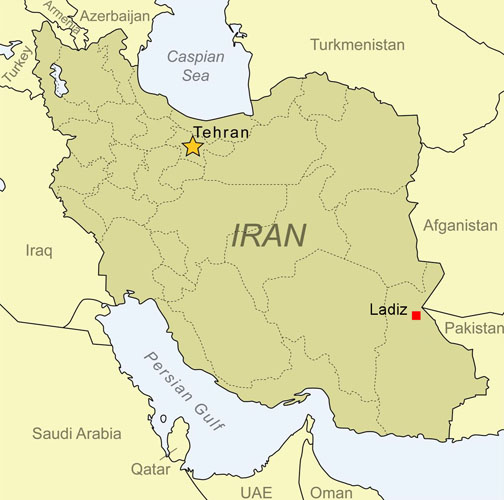
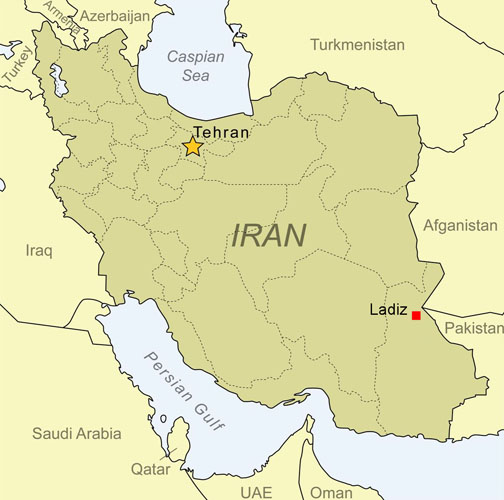
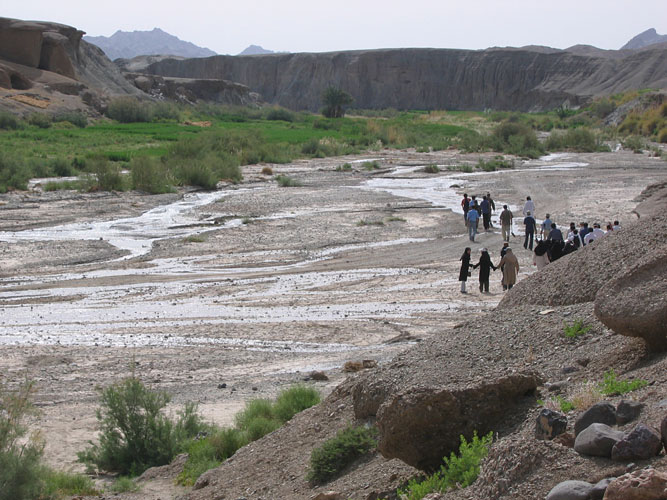
The Ladiz River runs through the central Sarhad Plateau in Baluchestan, south-eastern Iran (Figure 1). Four decades ago its terraces were the subject of research by G. Hume and colleagues from the University of Minnesota (Reference HumeHume 1976). Hume was particularly interested in tracking the possible routes of early hominin migration along the northern shores of the Persian Gulf, and he looked firstly for Lower Palaeolithic industries similar to those of Oldowan, in particular those with no handaxes, and secondly, for evidence of ecological adaptations by the hominins who occupied this region in the middle Pleistocene (Reference HumeHume 1976: 12).
Map showing the location of the Ladiz River in south-eastern Iran.
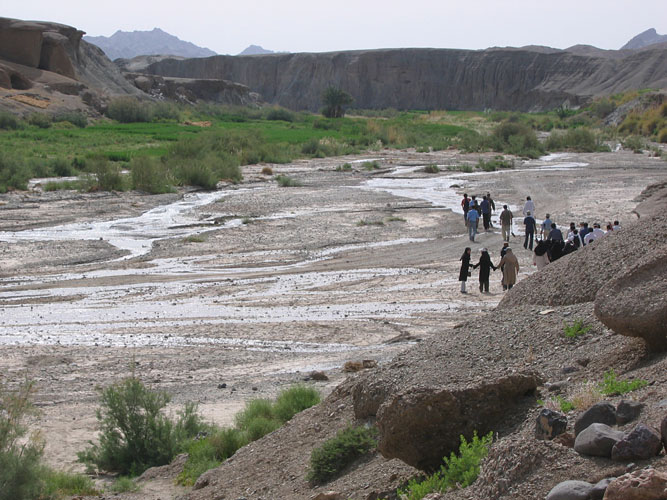
View of the Ladiz River in south-eastern Iran.
During the course of the 1966-67 expeditions, over 1189 lithic pieces were recovered from two sites: LT2 and LT8 (LT = Ladiz Terrace). Hume assigned the term 'Ladizian industry' to these assemblages and characterised them as a type of Lower Palaeolithic industry with no handaxes or cleavers, but with a high occurrence of choppers, scrapers, knives, denticulates, and an abundance of flakes and cores (Reference HumeHume 1976: 94). He compared the Ladizian artefacts with the Soanian assemblages from nearby Pakistan and observed many similarities between them. He later proposed the term 'Asian Chopper-Chopping Tools' for such industries.
The valley of the Ladiz River has five parallel terraces, numbered by Hume as 1 to 5 from top to bottom (Reference HumeHume 1976: 37). Comparing the sediments of the Ladiz River terraces with those of Central Europe, Hume claimed that terraces 1-3 belonged to the end of the Riss glacial period and the remaining two to the early Würm (Reference HumeHume 1976: 58). Accordingly, he assigned the two Palaeolithic sites of LT2 and LT8 to the late Riss and early Würm periods.
Reassessment of the Ladizian industry
Our research was designed to address two main questions: whether the artefacts recovered from the two Palaeolithic sites of LT2 and LT8 could be assigned to Lower Palaeolithic industries; and how reliable was the chronology for the deposition of the terraces.
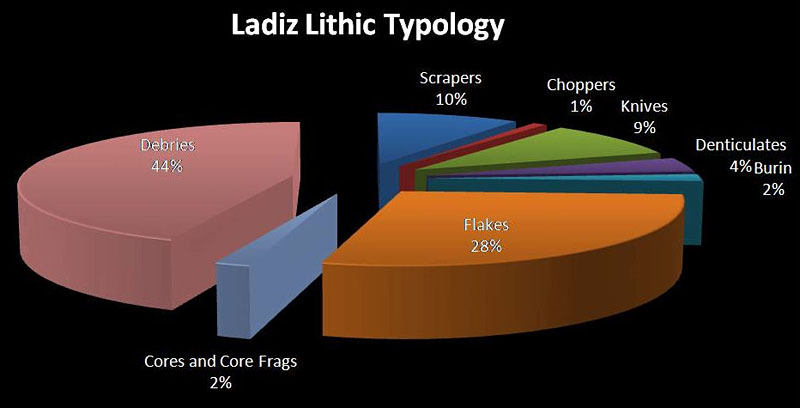
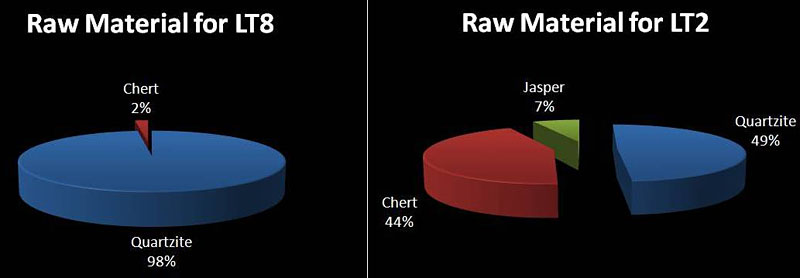
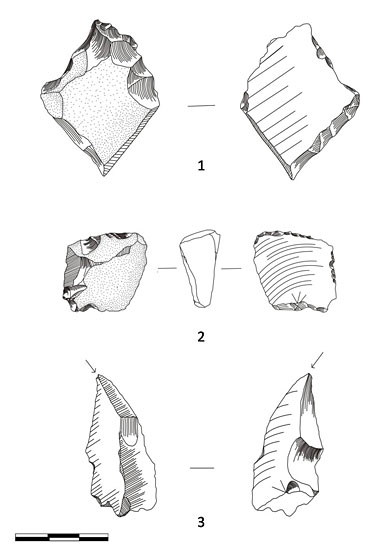
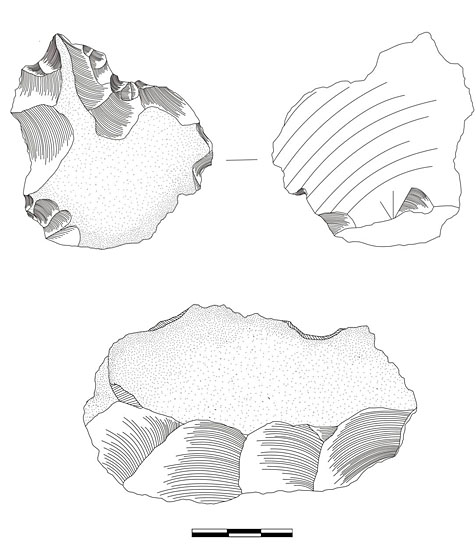
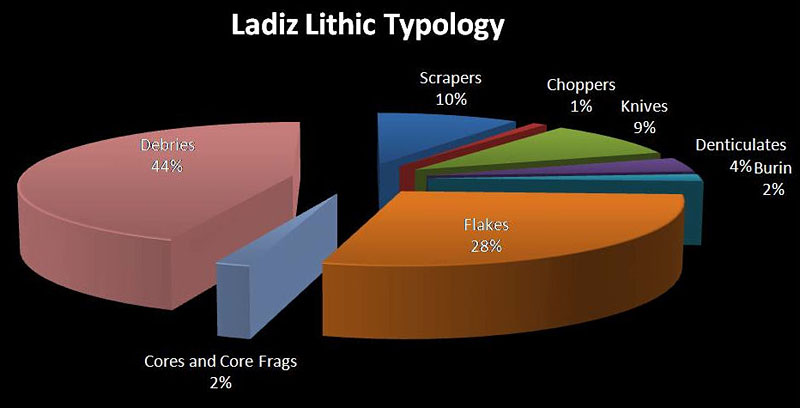
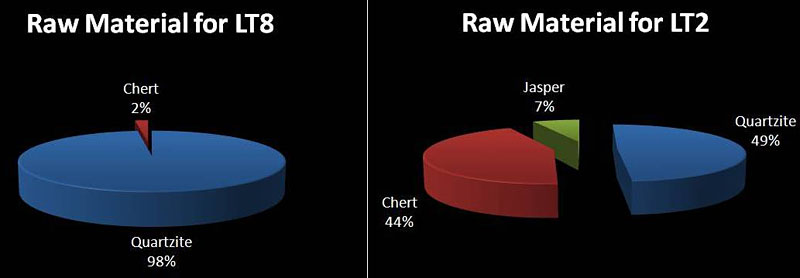
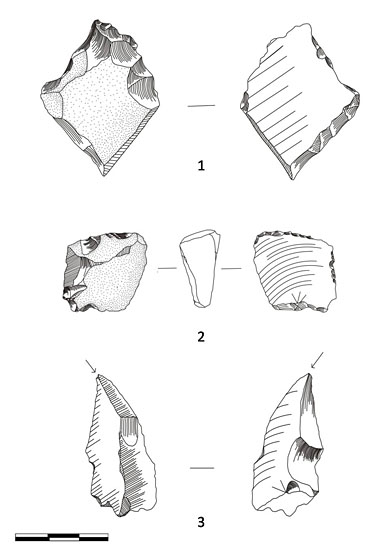
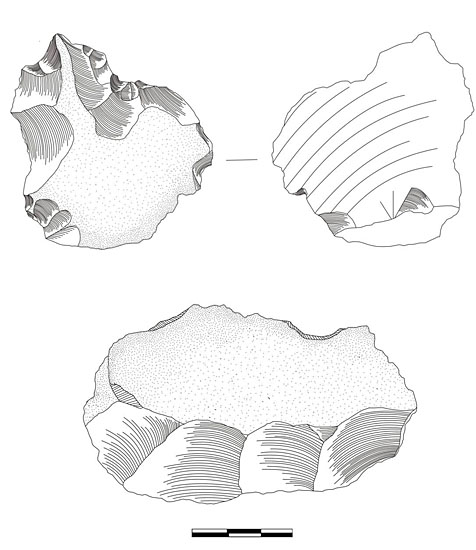
The lithics from sites LT2 and LT8 The lithics from the two sites, currently stored in the Iranian National Museum, were reanalysed. The range of forms are summarised in Figure 2. Data were also recorded on additional lithic attributes, such as the raw materials, platform angles, platform typologies, bulbs of percussion, artefact dimensions, cortex and retouches. The predominant raw materials used at both sites were chert and quartzite but in noticeably different proportions at the two sites (Figure 3). LT2 also included a small amount of jasper. Over 67% of the debitage demonstrated platform angles larger than 90°, which is consistent with that proposed for Lower Paleolithic industries. Results regarding the occurrences of dorsal cortex and cortical platforms indicate that more than 68% of the debitage displays cortex in their dorsal, and 22% show cortex on their platforms. Analysis showed that over 58% of the artefacts display plain and crushed platforms, which are consistent with Lower Palaeolithic flaking techniques, and only 15% demonstrate signs of preparation. Seventy-five per cent of the artefacts show no sign of retouch. Figures 4 and 5 illustrate some of the artefacts from sites LT2 and LT8.
Summary of the range of forms of the Ladizian lithic assemblages.
Raw materials from sites LT2 and LT8.
Ladiz lithics: 1-2) scrapers; 3) burin.
Ladiz lithics: heavy duty scrapers.
Proposed chronology Some scientists have questioned Hume's methodology (e.g. Reference SmithSmith 1986: 16). Moreover, recent geological investigations in this region have indicated that the Iranian Plateau has never witnessed the physical expansion of glacial ice sheets. The sediments of the Ladiz River terraces, therefore, cannot be correlated with any major glaciation events (Reference MotamedMotamed 1998: 205). Close examination of the sediments from the Ladiz River has revealed that they lack major features of glacial deposits, such as frost-shattered rocks, sediment with an enormous range of grain-sizes, and broken, angular and crushed rock debris (Reference Hancock, Skinner, Hancock and SkinnerHancock & Skinner 2000: 264).
Conclusions
The lithic assemblages from sites LT2 and LT8 share a number of features with Lower Palaeolithic industries, such as a high occurrence of low quality raw materials, an abundance of plain and crushed platforms and, within platforms, a high number of wide-angled platforms indicating the use of hard hammers and direct percussion techniques. The assemblages also include the presence of relatively large numbers of choppers, scrapers and knives, again typical of Lower Palaeolithic industries. In contrast, the lithic assemblages from the Ladiz River sites have not revealed artefacts associated with later periods, such as prepared cores, the Levallois technique and blade and bladelet technologies.
As proposed by Hume, the Ladizian artefacts demonstrate close parallels with the Soanian assemblages. Recent analysis performed on Soanian artefacts has allocated the majority of them to Mode III or Middle Palaeolithic industries (Reference LycettLycett 2007). With this in mind, we propose that the Ladizian industries could have belonged to the late Lower Paleolithic, as Hume originally suggested, and into the early Middle Palaeolithic period.
Hume's chronology for the terraces, however, must be abandoned. It is clear that the Ladiz River terraces are located at altitudes that physically could not have been affected by glacial movements, and any possible similarities observed by Hume between the sediments of the Ladiz River terraces and those of Central Europe are likely to have been merely coincidental.
Acknowledgements
We are grateful to F. Biglari at the National Museum of Iran for granting us access to the Ladiz collection.