


INTRODUCTION
In marine ecosystems, large fish play an important trophic role at or near the top of the food chain, but are also of principal economic value to commercial fisheries, which often target the larger species or individuals (Jennings et al. Reference Jennings, Kaiser and Reynolds2001). Populations of large fish species tend to fluctuate less and in a more predictable manner than those of small species, and large species often yield higher prices per weight of catch (Pinnegar et al. Reference Pinnegar, Hutton and Piacenti2006); charismatic large fish have also significant cultural value, for example as they are primarily sought after by recreational fisheries (Jennings et al. Reference Jennings, Kaiser and Reynolds2001). Yet, it is also well known that large species are typically most vulnerable to the impacts of fishing, leading to reduced or truncated size distributions in both populations of species and whole fish communities (Jennings & Kaiser Reference Jennings and Kaiser1998; Blanchard et al. Reference Blanchard, Andersen, Scott, Hintzen, Piet and Jennings2014). This is why the status of large fishes in marine communities is increasingly recognized as an important indicator of ecosystem health.
The Marine Strategy Framework Directive (MSFD) tasks European Union (EU) member states to take the necessary measures to achieve or maintain Good Environmental Status (GES) in European seas by the year 2020 (EC [European Commission] 2008). Good Environmental Status should be determined on the basis of eleven qualitative descriptors, including biodiversity (descriptor 1) and food webs (descriptor 4). The Commission Decision of 1 September 2010 (EC 2010) clearly states that an indicator addressing the proportion of selected species at the top of food webs is required to monitor the structure of food webs for descriptor 4: namely the large fish indicator (LFI; Greenstreet et al. Reference Greenstreet, Rogers, Rice, Piet, Guirey, Fraser and Fryer2011; Shephard et al. Reference Shephard, Reid and Greenstreet2011b ). The Biodiversity Committee for the OSPAR Convention for the Protection of the Marine Environment of the North-East Atlantic has identified the LFI as a core indicator for biodiversity (descriptor 1) and has suggested that, with the inclusion of pelagic species, the indicator can be useful also for food webs (descriptor 4).
The MSFD (EC 2008) also states that adaptive management on the basis of the ecosystem approach with the aim of attaining good environmental status should be employed through a programme of measures, including input controls on human activities (such as fleet capacity measures or fishing effort limitation), output controls on perturbation of ecosystem components (for example change in state), and controls on the spatial and temporal distribution of human activities. An improved knowledge of the spatio-temporal response of the LFI to anthropogenic pressure is required to determine the optimal management of human activities to effect change in the environmental status.
The North Sea has been exploited for centuries by the surrounding countries and the state of its environment has been altered greatly by human activities (Garstang Reference Garstang1900; Jennings & Kaiser Reference Jennings and Kaiser1998). Fisheries developed, expanded, and changed throughout the 20th century, with great increases in international effort from the 1960s through 1990s, coinciding with the introduction of intensive mechanized beam trawling, increasingly powerful vessel engines, fish-finding techniques such as sonar, and a wide range of other improvements in fishing technology (Engelhard Reference Engelhard, Payne, Cotter and Potter2008; Rijnsdorp et al. Reference Rijnsdorp, Poos, Quirijns, HilleRisLambers, de Wilde and Den Heijer2008). In the late 1990s, realizing that the pressure from fisheries had grown to unacceptable levels, the EU began a fleet reduction scheme in which decommissioning of vessels was paramount (Villasante Reference Villasante2010). Although it has been argued that the overall fishing power of the EU fleet did not change greatly as a result, the distribution of fishing activities changed, with larger vessels fishing in deeper waters gaining prominence (Villasante Reference Villasante2010). Since 2000, a reduction in total allowable catches (TACs) for most North Sea stocks and restrictions on days at sea have further contributed to reduced fishing activity levels (Greenstreet et al. Reference Greenstreet, Holland, Fraser and Allen2009).
Greenstreet et al. (Reference Greenstreet, Rogers, Rice, Piet, Guirey, Fraser and Fryer2011) showed that over this historic period, the LFI for the North Sea fish community declined from an average value of 0.3 in the early 1920s to a historic minimum of 0.05 in 2001, later recovering to 0.22 by 2008. They also showed that the decline in the LFI was correlated with the average fishing mortality on a range of commercially exploited demersal stocks in the North Sea in the preceding 12–20 years (cod Gadus morhua, haddock Melanogrammus aeglefinus, saithe Pollachius virens, whiting Merlangius merlangus, plaice Pleuronectes platessa, sole Solea solea, and Norway pout Trisopterus esmarkii). The authors speculated that the lagged relationship was not necessarily linear, but declines in the LFI may have resulted from a prolonged period of fishing above a given management reference point in the 1980s and 1990s (Greenstreet et al. Reference Greenstreet, Rogers, Rice, Piet, Guirey, Fraser and Fryer2011). The study justified a target LFI value of 0.3, in line with the value adopted as indicator of GES (EC 2010). This raises the question: how does society manage human activities effectively in order to achieve this objective?
To help reveal the detail of whether and how the LFI responds to changes in fishing pressure, we investigated the spatial patterns of change across two periods, 1983–1999 and 2000–2012, characterized by contrasting fishing effort regimes, namely, before and after the onset of EU fleet reduction schemes. In both periods, we analyse if changes in the LFI can be related to the spatial distribution of trawling effort, which is known to be unevenly distributed and considerably higher in some than in other parts of the North Sea (Rijnsdorp et al. Reference Rijnsdorp, Buys, Storbeck and Visser1998; Greenstreet et al. Reference Greenstreet, Spence, Shanks and McMillan1999; Jennings et al. Reference Jennings, Alvsvåg, Cotter, Ehrich, Greenstreet, Jarre Teichmann, Mergardt, Rijnsdorp and Smedstad1999). By demonstrating direct linkages between changes in the LFI and human activities in particular locations, we show how targeted adaptive management can be used successfully to manage actively toward GES. Specifically, we test the following hypotheses:
-
(1) Spatial patterns of change in the LFI were very different between 1983–1999 and 2000–2012, respectively, before and after the onset of the EU fleet reduction scheme;
-
(2) Spatial patterns of change in the LFI are associated with the spatial distribution of international trawling effort;
-
(3) Local reductions (or increases) in international trawling effort will be reflected in local improvements (or decreases) in the LFI.
METHODS
Survey data and indicator calculation
This paper uses the revised definition of the LFI (Greenstreet et al. Reference Greenstreet, Rogers, Rice, Piet, Guirey, Fraser and Fryer2011), namely the proportion by weight of fish over 40 cm in length in the North Sea demersal fish community, as sampled by International Bottom Trawl Surveys (IBTS) during quarter 1 (for a full description of the survey methods, see ICES [International Council for the Exploration of the Sea] 2012). IBTS data were downloaded from the ICES Database of Trawl Surveys (DATRAS, http://datras.ices.dk/Home/Default.aspx). Data for the years 1983–2010 were downloaded on 14 October 2011 in the raw ‘exchange data’ format. This dataset was updated with 2011 data on 15 March 2012 and with 2012 data on 13 December 2012. The calculation of LFI values from these data involved numerous processing steps, as detailed by Fung et al. (Reference Fung, Farnsworth, Reid and Rossberg2012). To determine yearly LFI values, the equation is as follows:
 \begin{equation}
LF{I_y} = \ \frac{{\mathop \sum \nolimits_i \mathop \sum \nolimits_{j:{L_j} > 40cm} \mathop \sum \nolimits_k \mathop \sum \nolimits_m {\rho _{ijkmy}}}}{{\mathop \sum \nolimits_i \mathop \sum \nolimits_j \mathop \sum \nolimits_k \mathop \sum \nolimits_m {\rho _{ijkmy}}}},
\end{equation}
\begin{equation}
LF{I_y} = \ \frac{{\mathop \sum \nolimits_i \mathop \sum \nolimits_{j:{L_j} > 40cm} \mathop \sum \nolimits_k \mathop \sum \nolimits_m {\rho _{ijkmy}}}}{{\mathop \sum \nolimits_i \mathop \sum \nolimits_j \mathop \sum \nolimits_k \mathop \sum \nolimits_m {\rho _{ijkmy}}}},
\end{equation}
where the numerator is the sum of biomass densities ρ of all individuals with length L > 40 cm in year y, for each taxonomic group i, and length class j, for all valid hauls k, made by vessels m. The biomass density is equal to the biomass caught divided by the swept area, as in Fung et al. (Reference Fung, Farnsworth, Reid and Rossberg2012). The denominator is simply the sum of the biomass densities of all fish individuals without application of the 40 cm length threshold. Whereas in Fung et al. (Reference Fung, Farnsworth, Reid and Rossberg2012), Equation 1 was computed for the whole North Sea to obtain a single, North Sea-wide LFI value by year, here we determined yearly LFI scores by ICES rectangle, by computing Equation 1 for each rectangle separately.
Length–weight parameters to convert numbers of individuals to biomass estimates were taken from those reported by Fung et al. (Reference Fung, Farnsworth, Reid and Rossberg2012). Following computation of the LFI scores by rectangle, the time-series of the LFI index for the entire North Sea was correlated with the values reported by Fung et al. (Reference Fung, Farnsworth, Reid and Rossberg2012) as a validation of the coding exercise.
For each time-series of LFI by rectangle, a non-parametric rank-based trend analysis was conducted based on a correlation between the LFI values and an index of time corresponding to the temporal period over which observations were made. The statistic calculated in this way, Kendall's tau, has the notable benefit that the relationship between variables (year and LFI) may be any smoothly varying function (such as a curve) as expected for temporal changes in such an indicator. We interpret the estimates of tau for each rectangle in terms of the probability that a monotonic temporal trend exists in the LFI time-series for that rectangle. Tau scores range from –1 to +1, namely a 100% probability of a decreasing or increasing trend, respectively.
All analyses were made in R version 2.15.2 (R Development Core Team 2012).
Compilation of international effort data
Although international landings data for the North Sea have been compiled by ICES since 1903 (for example see Kerby et al. Reference Kerby, Cheung and Engelhard2012), no comparable long-term data on international fishing effort exist, let alone at the spatial detail of ICES rectangles. This is because traditionally countries have been required to provide information on fish landings, but no such legal requirements on effort data existed until the introduction of effort management regulations following the reform of the Common Fisheries Policy in 2002. Here we have compiled data on the spatial distribution of international trawling effort in the North Sea, for two periods: 1990–1995 (from Jennings et al. Reference Jennings, Alvsvåg, Cotter, Ehrich, Greenstreet, Jarre Teichmann, Mergardt, Rijnsdorp and Smedstad1999) and 2003–2012 (from STECF [Scientific, Technical and Economic Committee for Fisheries] 2013). We acknowledge that, unfortunately, these periods could not be matched perfectly with the time-slots over which change in the LFI was calculated (1983–1999 and 2000–2013) but attribute this to the notorious difficulties in compiling international effort data, and note that this is the first time that a picture of the distribution of international trawling effort in the North Sea has been presented for two distinct time-periods preceding and following the onset of the EU fleet reduction scheme.
Trawling effort data for 1990–1995 were kindly provided by Simon Jennings (personal communication 2014). These represented the aggregate number of hours fishing by ICES rectangle for Danish, Dutch, English, German, Norwegian, Scottish and Welsh vessels, separated between beam trawlers (defined as any trawlers which towed nets supported by a rigid beam) and otter trawlers (defined as any vessels which towed bottom-fishing nets held open by trawl doors; Jennings et al. Reference Jennings, Alvsvåg, Cotter, Ehrich, Greenstreet, Jarre Teichmann, Mergardt, Rijnsdorp and Smedstad1999). These data were not available for the countries separately, as originally agreed by the contributors to Jennings et al.’s (Reference Jennings, Alvsvåg, Cotter, Ehrich, Greenstreet, Jarre Teichmann, Mergardt, Rijnsdorp and Smedstad1999) study, as this would have required extensive collaboration with national administrations. The effort data, moreover, did not include Belgium and France, which had comparatively minor fishing interests in the North Sea (combined, these countries caught 6% of the total demersal landings in 1990–1995). For details on the data collection protocols by country, and the minimum sizes of vessels included, see Jennings et al. (Reference Jennings, Alvsvåg, Cotter, Ehrich, Greenstreet, Jarre Teichmann, Mergardt, Rijnsdorp and Smedstad1999).
EU effort data for the period 2003–2012 were sourced from the data appendix to the report by the Expert Working Group on Evaluation of Fishing Effort Regimes in European Waters Part 2, reviewed by the Scientific, Technical and Economic Committee for Fisheries (STECF 2013). The STECF dataset is publicly available at http://stecf.jrc.ec.europa.eu/data-reports, and amalgamated from submissions by EU member states in response to the current Data Collection Framework (DCF, previously the Data Collection Regulation; STECF 2013). The data consist of effort (number of hours fishing) per country, métier, vessel length category, and ICES rectangle. The STECF data were subset geographically to ICES sub-area IV (North Sea) to match spatially with the 1990–1995 effort data (Jennings et al. Reference Jennings, Alvsvåg, Cotter, Ehrich, Greenstreet, Jarre Teichmann, Mergardt, Rijnsdorp and Smedstad1999). Activity is defined by the EU member state the métier relates to (namely gear used and mesh size range), and length category (STECF 2013). These were aggregated to create a beam trawl gear type (subcategories Beam, Bt1, Bt2), and an otter trawl gear type (subcategories Tr1, Tr2, Tr3, Otter). All other gear types were removed for this analysis.
For the purpose of our study, it was important that the effort data (1) provided an appropriate description of the spatial distribution of trawling in the North Sea, and (2) would be comparable between the two time-periods 1990–1995 and 2003–2012. Unfortunately, this was hampered by three points. Firstly, although the STECF data account for a large proportion of the overall fishing activities in the North Sea, they do not include the Norwegian fleets, which are primarily active in the north-eastern and eastern North Sea (Greenstreet et al. Reference Greenstreet, Robinson, Piet, Craeymeersch, Callaway, Reiss, Ehrich, Kröncke, Fraser, Lancaster, Jorgensen and Goffin2007); by contrast the (aggregated) international effort data for 1990–1995 (Jennings et al. Reference Jennings, Alvsvåg, Cotter, Ehrich, Greenstreet, Jarre Teichmann, Mergardt, Rijnsdorp and Smedstad1999) did include Norway, in that period responsible for a moderate (8% in 1990) proportion of the total demersal landings from the North Sea (Kerby et al. Reference Kerby, Cheung and Engelhard2012). Secondly, the way that fishing hours were reported to STECF differed between countries; whereas Denmark, the Netherlands, Germany, Belgium and France provided data on fishing hours, the UK (England and Scotland) provided data on ‘days at sea multiplied by 24’ (STECF 2013). However, fishing vessels only spend a proportion of the days at sea fishing, so that days at sea multiplied by 24 would give an overestimate of English and Scottish fishing hours compared to other European fleets, distorting the spatial distribution map and comparison between the 1990s and 2000s. Thus, English and Scottish trawl fishing hours data for 2003–2012 were estimated from days at sea using correction factors (see Supplementary material for details of estimation method; also see Greenstreet et al. Reference Greenstreet, Robinson, Piet, Craeymeersch, Callaway, Reiss, Ehrich, Kröncke, Fraser, Lancaster, Jorgensen and Goffin2007). Thirdly, for Belgium and France, effort data were available through STECF for 2003–2012 but not for 1990–1995; to facilitate the temporal comparison between the two decades, we excluded these two countries from the analysis, as their combined effort is only responsible for a fairly small fraction of the total demersal landings from the North Sea (c. 6% in 2009; Kerby et al. Reference Kerby, Cheung and Engelhard2012).
RESULTS
The LFI: spatial distribution and patterns of change
The spatial distribution of the LFI within the North Sea has changed considerably over the period 1983–2012 (Fig. 1). Initially in the 1980s, high values of LFI (>0.3) were distributed over many ICES rectangles throughout the entire area (Fig. 1 a). By contrast, LFI values > 0.3 have since then become rather limited to the northern- and easternmost fringes and along the Thames and Humber estuaries of the south-west (Fig. 1 b, c). Around the turn of the millennium, the LFI was particularly low in the western North Sea (Fig. 1 b).
Spatial distribution of the large fish indicator (LFI) for the North Sea fish fauna, shown separately for three-year time-windows at the beginning, middle, and end of the study period 1983–2012. Light to dark shading indicates the value of the LFI by ICES rectangle, averaged over each 3-year period (see legend).

If considered over the entire study period 1983–2012, then LFI has generally decreased, especially in the central North Sea (Fig. 2 a). This was indicated by mostly negative Kendall rank correlations (red symbols) of LFI with time in the majority of rectangles, many of these statistically significant (p < 0.05; marked by crosses), and very few positive correlations (green symbols). However, patterns of change were very different between the periods 1983–1999 and 2000–2012. Most of the decreases in the LFI took place during the first part of the time-series (Fig. 2 b), in the western and north-western parts of the North Sea. By contrast, over the period 2000–2012, the LFI has improved or remained stable over most parts of the North Sea, especially in those central-western and north-western rectangles where LFI had previously declined most (Fig. 2 c, note green symbols marked by crosses, indicating significant positive trends over time).
Patterns of change in the large fish indicator (LFI) for the North Sea fish fauna, (a) over the entire period 1983–2012, (b) for the first part of the time-series (1983–1999), and (c) for the second part of the time-series (2000–2012). The maps show, for each ICES rectangle, whether the LFI has either increased (green) or decreased (red) over the time-span considered (using Kendall's rank correlation); crosses indicate statistically significant correlations (p < 0.05).

International trawling effort: distribution in the 1990s and 2000s
The distribution of international trawling effort in the North Sea was such that some areas were trawled much more intensively than other areas during both periods where we were able to compile a reasonably complete picture of international effort: 1990–1995 (from Jennings et al. Reference Jennings, Alvsvåg, Cotter, Ehrich, Greenstreet, Jarre Teichmann, Mergardt, Rijnsdorp and Smedstad1999) and 2003–2012 (from STECF 2013), and this was the case for both beam and otter trawlers (Fig. 3). It should be noted that our data, unfortunately, do not include Belgian and French effort, and for the 2000s exclude Norwegian effort.
Spatial distribution of international fishing effort in the North Sea by beam trawlers (top) and demersal otter trawlers (bottom), averaged by year over the periods 1990–1995 (left) and 2003–2012 (right). Light to dark shading indicates the number of hours fishing in each rectangle (on a √-scale). Data for the 1990s from Jennings et al. (Reference Jennings, Alvsvåg, Cotter, Ehrich, Greenstreet, Jarre Teichmann, Mergardt, Rijnsdorp and Smedstad1999); 2000s data from STECF (2013). Note some discrepancy in the countries included for each time period: 1990s data include Denmark, England, Germany, Netherlands, Norway, Scotland and Wales; 2000s data include Denmark, England, Germany, Netherlands, Scotland and Wales.

During the 1990s, international beam trawl effort was especially high and widespread in the central and southern North Sea, with moderate beam trawling off eastern Scotland (Fig. 3 a). In the 2000s, beam trawl effort reduced considerably, became increasingly concentrated in the south-east, and is currently very limited near Scotland (Fig. 3 b). International otter trawl effort, in both periods, was widely distributed throughout the entire North Sea. However, while in the 1990s otter trawling was especially concentrated in the central-western and north-western parts (Fig. 3 c), there appears to have been no appreciable change in total effort and a redistribution towards the east (Fig. 3 d). Otter trawling in the 2000s was more concentrated in the deeper north-eastern parts of the North Sea, and has also increased in some shallower parts in the German Bight. We acknowledge that the 2000s data exclude Norwegian effort, but inclusion would have aggravated the signal of an eastward shift in effort, because Norwegian effort is more concentrated in the east.
The redistribution of international trawling effort becomes even clearer when the change in otter or beam trawl effort between the 1990s and 2000s is visualized for each ICES rectangle separately (Fig. 4). Clearly, levels of otter trawling have declined in many western rectangles near the coasts of England and Scotland (Fig. 4 a, blue-shaded cells), but increased in the east (red-shaded cells). Beam trawling has increased moderately in the south but clearly declined in the northern and central North Sea (Fig. 4 b); although 7 rectangles in the north did show high proportional increase (shaded red), the total beam trawl levels in these are still low (as these rectangles were unfished by beam trawlers in the 1990s).
Patterns of change in international trawling effort in the North Sea between the 1990s and 2000s, shown separately for otter trawlers (left) and beam trawlers (right). Blue- and red-shading indicate reduced and more intensified effort, respectively. For each rectangle, change in effort is quantified here as annual mean effort over 1990–1995 (E1990s) subtracted from the mean over 2003–2012 (E2000s), standardized by sum of mean effort in both periods. Data sources as in Figure 3; note that 2000s data exclude Norwegian effort.

International trawling effort: links with change in the LFI
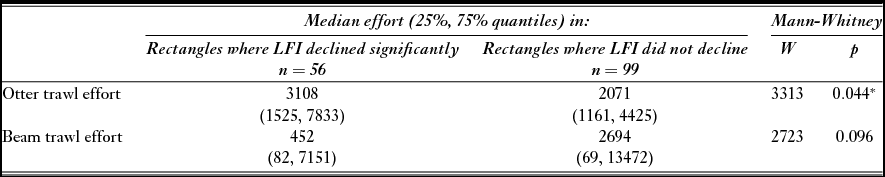
The spatial distribution of otter trawling in the 1990s was significantly negatively associated with patterns of change in the LFI from 1983–1999 (Table 1). In 56 rectangles where the LFI declined, annual otter trawl effort was significantly higher than in 99 rectangles where the LFI did not decline (median 3108 versus 2102 h fishing yr–1 rectangle–1; Mann-Whitney, p = 0.044). Beam trawl effort in the 1990s was not significantly different between rectangles where the LFI declined, or did not decline (Table 1; median 452 versus 2694 h fishing yr–1 rectangle–1; Mann-Whitney, p = 0.096).
Comparison of trawling effort (1990s) between ICES rectangles where the large fish indicator (LFI) declined significantly and ICES rectangles where the LFI did not show a significant decline, over the period 1983–1999. *Significant difference p < 0.05.
During the 2000s, 18 rectangles where the LFI improved significantly were similar in levels of otter trawling to 137 rectangles where the LFI did not show a significant increase (Table 2; median 3722 versus 3647 h fishing yr–1 rectangle–1; Mann-Whitney, p = 0.95). Beam trawl effort, however, was significantly less in the former than in the latter (median 0 versus 96 h fishing yr–1 rectangle–1; Mann-Whitney, p = 0.0003).
Trawling effort (2000s) and reductions in trawling effort (from 1990s to 2000s), compared between ICES rectangles where the large fish indicator (LFI) improved significantly, and ICES rectangles where the LFI did not significantly improve, over the period 2000–2012. *Significant difference p < 0.05.

Moreover, there was significant evidence that reductions in trawling effort between the 1990s and 2000s (see Fig. 4) were significantly associated with improvements in the LFI during 2000–2012 (Table 2). This was the case for both otter trawling (median effort reduced by –23.2% in rectangles where LFI improved, and median effort increased by +18.7% in rectangles where LFI did not increase; Mann-Whitney, p = 0.0047) and beam trawling (median effort reduced by –99.9% and –79.1% in rectangles where LFI improved and did not improve, respectively; Mann-Whitney, p = 0.00011).
This was confirmed when change in LFI during 2000–2012 was compared between rectangles where otter trawling either decreased or increased from the 1990s to 2000s (Table 3): in the former (n = 65), Kendall's tau values (proxy for LFI change) were significantly higher than in the latter (n = 90; t test, p = 0.022). Likewise, in 80 rectangles where beam trawling was reduced by over 75%, Kendall's tau values were significantly higher than in 59 rectangles where beam trawling was reduced by less than 75%, or not reduced (t test, p = 0.010). Thus, rectangles in the western North Sea where otter trawling was reduced most, tended to be those which saw significant improvements in the LFI; and those rectangles (mainly in the south or east) where otter or beam trawling increased, tended to be those that saw a lack of improvement (compare Fig. 2 c with Fig. 4).
Kendall's tau values (proxy for large fish indicator change during 2000–2012) compared between ICES rectangles differing in the extent to which trawling was reduced (or increased) from the 1990s to 2000s. *Significant difference p < 0.05.

DISCUSSION
This study provides strong evidence that the large fish indicator for the North Sea is directly responsive to trawling pressure. Firstly, we have shown that the LFI is unevenly distributed over the North Sea, with greater concentrations of large fish in some areas (the northern, north-eastern, and south-westernmost fringes) than in others, although during the 1980s the LFI was distributed much more evenly than now. Secondly, the spatial distribution of trawling is also very heterogeneous (see also Rijnsdorp et al. Reference Rijnsdorp, Buys, Storbeck and Visser1998; Jennings et al. Reference Jennings, Alvsvåg, Cotter, Ehrich, Greenstreet, Jarre Teichmann, Mergardt, Rijnsdorp and Smedstad1999) and has changed recently, with areas trawled more intensively in the 1990s coinciding with greater reductions in the LFI from 1983–1999; areas where trawling has been reduced since then, have shown better recoveries in the LFI from 2000–2012 than other areas. Thirdly, although the LFI has significantly improved since 2000 in especially the western North Sea, it is not yet at levels comparable to the 1980s (in line with Greenstreet et al. Reference Greenstreet, Rogers, Rice, Piet, Guirey, Fraser and Fryer2011; Fung et al. Reference Fung, Farnsworth, Reid and Rossberg2012, 2013; and see Shephard et al. Reference Shephard, Fung, Rossberg, Reid, Greenstreet and Warnes2013 on lack of recovery in the Celtic Sea LFI).
The uneven distribution of the LFI is unsurprising and partly reflects the distribution patterns of the two predominant species in the ‘large fish component’ of the LFI: cod and saithe (Greenstreet et al. Reference Greenstreet, Rogers, Rice, Piet, Guirey, Fraser and Fryer2011). Saithe have a generally northerly, deeper-water distribution (Homrum et al. Reference Homrum, Hansen, Jónsson, Michalsen, Burgos, Righton, Steingrund, Jakobsen, Mouritsen, Hátún, Armannsson and Joensen2013), and cod have shown major range shifts within the North Sea since the 1970s, to a distribution that is currently further north, east, and deeper than it has been throughout the 20th century (Engelhard et al. Reference Engelhard, Righton and Pinnegar2014; see also Dulvy et al. Reference Dulvy, Rogers, Jennings, Stelzenmüller, Dye and Skjoldal2008). The shift in cod distribution has been attributed to both climate change and fishing pressure (Engelhard et al. Reference Engelhard, Righton and Pinnegar2014), and the latter is in line with the significant relationships between LFI and trawling distribution reported here. A third, important species within the ‘large fish component,’ haddock, has also shown a northward shift, in particular the southern range boundary within the North Sea has moved north (Skinner Reference Skinner2009).
In the south-western North Sea, areas off the Thames Estuary and the Wash stood out by locally high values of the LFI. These areas are not only visited in winter by spawning cod (Righton et al. Reference Righton, Quayle, Hetherington and Burt2007), but are also spawning and nursery grounds for several elasmobranch species, notably thornback ray Raja clavata, spotted ray Raja montagui and tope shark Galeorhinus galeus (Ellis et al. Reference Ellis, Cruz-Martínez, Rackham and Rogers2005; Hunter et al. Reference Hunter, Berry, Buckley, Stewart and Metcalfe2006). These are considered vulnerable to fishing pressure and of conservation concern. The importance of the region for these larger fish species adds additional evidence to the designation of two special areas of conservation (SAC) in the outer Thames Estuary (Margate and Long Sands; Essex Estuaries) and the North Norfolk Coast SACs, and supports the currently proposed designation of the Wash Approach recommended Marine Conservation Zone (rMCZ; www.jncc.defra.gov.uk/page-4549).
Improvement in the LFI since the late 1990s, at the North Sea-average scale, has previously been suggested to relate to reductions in fishing mortality F (Greenstreet et al. Reference Greenstreet, Rogers, Rice, Piet, Guirey, Fraser and Fryer2011). However, the North Sea-averaged LFI was linked to community-averaged F, namely the mean of annual F estimates over a range of demersal fish stocks exploited in the North Sea (cod, haddock, saithe, whiting, plaice, sole, and Norway pout), with a 12–18 year time-lag (Greenstreet et al. Reference Greenstreet, Rogers, Rice, Piet, Guirey, Fraser and Fryer2011; and see Modica et al. Reference Modica, Velasco, Preciado, Soto and Greenstreet2014 for an analogous study on the LFI in the Bay of Biscay). Community-averaged F had previously also been linked to fish size spectra in the North Sea (Daan et al. Reference Daan, Gislason, Pope and Rice2005). This supported the relationship between pressure (community-averaged F) and state (stock biomasses; size spectra; LFI). For the Celtic Sea, fine-scale spatial correlations between fishing effort and the LFI had been reported, but no link with temporal change in the LFI (Shephard et al. Reference Shephard, Gerritsen, Kaiser, Truszkowska and Reid2011a). The present study complements this work by providing direct statistical evidence for the relationship between the activity (trawling effort; which can be managed) that induces the pressure (F), and responsiveness of the LFI (the variable to be monitored), being the full chain:
 \begin{eqnarray*}
{\rm{Activity}}\ ({\rm{effort}}) &\to& {\rm{Pressure}}\ ({\rm{F}}) \to {\rm{State}}\,({\rm{stocks}})\\
&\to& {\rm{Indicator}}\,({\rm{LFI}}).
\end{eqnarray*}
\begin{eqnarray*}
{\rm{Activity}}\ ({\rm{effort}}) &\to& {\rm{Pressure}}\ ({\rm{F}}) \to {\rm{State}}\,({\rm{stocks}})\\
&\to& {\rm{Indicator}}\,({\rm{LFI}}).
\end{eqnarray*}
Areas otter-trawled most intensively during the 1990s (central-western, north-western North Sea) were those that saw the greatest reductions in the LFI over 1983–1999, resulting in an (albeit temporary) ‘depletion’ of the LFI in this region towards the turn of the millennium. Indeed, otter trawlers (with > 100-mm mesh) directly target those roundfish species (cod, saithe, and haddock) that predominate the numerator of the LFI (the large fish component). The area was also intensively fished by Nephrops trawlers (with 80-mm mesh) which, while targeting Nephrops, can have considerable bycatches of cod and whiting Merlangius merlangus (Catchpole et al. Reference Catchpole, Frid and Gray2005; Ungfors et al. Reference Ungfors, Bell, Johnson, Cowing, Dobson, Bublitz and Sandell2013), although only the largest of whiting will contribute to the ‘large fish component’. Hence, the catch and bycatch composition of the otter trawl fleets supports the notion that high otter trawling effort in the west during the 1990s (and probably during the preceding decade too; Houghton & Flatman Reference Houghton and Flatman1981) resulted in a regional depletion of large fish.
Although the LFI in a statistical rectangle was associated with the trend in fishing effort in that rectangle, it will likely also be affected by the development in fishing effort in a larger area. This is because many of the fish species that make up the assemblage at the time of the survey (first quarter), upon which the LFI is based, perform seasonal migrations between spawning and feeding areas (Righton et al. Reference Righton, Quayle, Hetherington and Burt2007; Homrum et al. Reference Homrum, Hansen, Jónsson, Michalsen, Burgos, Righton, Steingrund, Jakobsen, Mouritsen, Hátún, Armannsson and Joensen2013), and will be exposed to fishing pressure in other areas during part of the year (Hunter et al. Reference Hunter, Berry, Buckley, Stewart and Metcalfe2006). This will introduce an element of uncertainty in the correlation between local fishing effort and the LFI. However, in spite of this, significant and meaningful relationships between effort and the LFI at rectangle level were demonstrated.
This is the first study, to our knowledge, where the spatial distribution of international otter and beam trawl effort in the North Sea was described and contrasted between two distinct time periods, the 1990s and 2000s. Although the overall EU fleet size has been reduced (Villasante Reference Villasante2010), the reduction in trawling pressure has not been even throughout the North Sea. While otter trawling was especially reduced in the west off the English and Scottish coasts but increased in the north-east and south-east, beam trawling decreased in northern and western parts but stayed about constant in the south. The redistribution of otter trawling might be a response to the distribution shift and local depletions of large gadoids (including cod: Dulvy et al. Reference Dulvy, Rogers, Jennings, Stelzenmüller, Dye and Skjoldal2008; Engelhard et al. Reference Engelhard, Righton and Pinnegar2014), thus fleets likely redistributed their effort in order to follow their target species. The local increase of otter trawling in the German Bight (south-eastern North Sea) might be explained by a recent shift in plaice fisheries, from (fuel-intensive) beam trawling to (less fuel-demanding) otter trawling (STECF 2013), even though beam trawlers remain the predominant fleet targeting flatfish in the North Sea.
To an extent, the reduction in effective trawling pressure might be less than suggested here based on fishing hours as proxy for effort, owing to ‘technological creep’ (increasing catchability: Engelhard Reference Engelhard, Payne, Cotter and Potter2008; Eigaard et al. Reference Eigaard, Marchal, Gislason and Rijnsdorp2014). For example, twin trawls have been used more widely, which have substantially wider widths than conventional otter trawls (Eigaard et al. Reference Eigaard, Marchal, Gislason and Rijnsdorp2014). Conversely, most beam trawlers have reduced their towing speeds to compensate for rising fuel prices, hence their effective fishing effort would have been reduced even further than reported here based on fishing hours (Abernethy et al. Reference Abernethy, Trebilcock, Kebede, Allison and Dulvy2010). We expect that technological creep, although potentially complicating interpretation of temporal trends in effective effort, would not have appreciably influenced our results, based on analysis of spatial patterns of change in effort (Figs 3 and 4).
In spite of recent improvements in the LFI, it is worth noting that current levels are not yet comparable to those that characterized the 1980s, when high LFI was distributed almost throughout the North Sea. Indeed, community model-based analyses have suggested that recovery rate may decline after an initial bounce owing to trophic interactions, such that full recovery may take many decades (Fung et al. Reference Fung, Farnsworth, Shephard, Reid and Rossberg2013; Shephard et al. Reference Shephard, Fung, Rossberg, Reid, Greenstreet and Warnes2013). Moreover, the 1980s marked the later stage of the ‘gadoid outburst’, two decades from the mid-1960s to mid-1980s when productivity of gadoid stocks in the North Sea was unusually high, and not only cod, but also saithe, haddock and whiting produced some of the largest year-classes on record (Daan Reference Daan1978; Jones & Hislop Reference Jones and Hislop1978). The precise causes behind the gadoid outburst are still not fully understood, but it is believed that the relatively cold environmental conditions of the 1960s to mid-1980s favoured the productivity of gadoids and several other large-bodied, cold-water (boreal) fish species (Daan Reference Daan1978); in addition, overfishing and subsequent collapse of herring Clupea harengus in the 1960s–1970s might have temporarily released large gadoids from predation on eggs and larvae (Daan Reference Daan1978; Cushing Reference Cushing1980). Since the 1980s, the North Sea has warmed significantly (Holt et al. Reference Holt, Hughes, Hopkins, Wakelin, Holliday, Dye, González-Pola, Hjøllo, Mork, Nolan, Proctor, Read, Shammon, Sherwin, Smyth, Tattersall, Ward and Wiltshire2012). This has led to dramatic increases in the stock sizes of many warm-water (Lusitanian) fish species characterized by small body sizes, and unfavourable conditions for a range of boreal species with on average larger body sizes (Beare et al. Reference Beare, Burns, Greig, Jones, Peach, Kienzle, McKenzie and Reid2004; Engelhard et al. Reference Engelhard, Ellis, Payne, ter Hofstede and Pinnegar2011; ter Hofstede & Rijnsdorp Reference ter Hofstede and Rijnsdorp2011). Within stocks, warmer temperatures appear to have led to reductions in growth rates and asymptotic body sizes (Baudron et al. Reference Baudron, Needle, Rijnsdorp and Marshall2014). The North Sea fish community has also shifted from a predominance of demersal species to a greater abundance of (typically smaller-sized) pelagic species (Kenny et al. Reference Kenny, Skjoldal, Engelhard, Kershaw and Reid2009; Engelhard et al. Reference Engelhard, Ellis, Payne, ter Hofstede and Pinnegar2011). Therefore, in spite of reductions in trawling pressure, a return of the LFI to the levels of the 1980s may be compromised by prevailing conditions: the current warmer climatic regime favours Lusitanian above boreal species, and small pelagic above demersal fishes (Kenny et al. Reference Kenny, Skjoldal, Engelhard, Kershaw and Reid2009; Engelhard et al. Reference Engelhard, Ellis, Payne, ter Hofstede and Pinnegar2011; ter Hofstede & Rijnsdorp Reference ter Hofstede and Rijnsdorp2011).
The significant increases in the LFI in those regions where trawling effort was reduced since the turn of the millennium demonstrate the benefits of management action and successful implementation by the fishing industry. This provides strong evidence that reductions in fishing pressure can pay off in terms of improvements in a key indicator of GES, within the reasonably short time-span of c. 10 years. This is a promising signal that EU effort reduction schemes aimed at improving profitability of fisheries and moving towards GES, are beginning to pay off.
ACKNOWLEDGEMENTS
This study would not have been achievable without our international STECF colleagues who compile and quality-assure data on fishing effort for the 2000s during annual meetings, or without Simon Jennings who provided the 1990s effort data. Large Fish Indicator data were included in the European Marine Ecosystem Observatory (EMECO) Datatool (www.emecodata.net) and will become available in future. The study benefited from feedback from John Pinnegar, Axel Rossberg, Tracy Maxwell, Eva Garnacho, and three anonymous referees. This work was supported by the Department for Environment, Food and Rural Affairs of the UK (Defra project MF1228 ‘Physics to Fisheries’), with additional support from the European Union (Framework 7 project 308392 ‘Devotes’) and from Defra project ME5427 ‘Meeting the Assessment Needs of the MSFD’.
Supplementary material
To view supplementary material for this article, please visit http://dx.doi.org/10.1017/S0376892915000077.


 Open access

